




Abstract
Objectives
To assess (1) how victims’ past-year police encounters are related to their reports of police investigatory effort, complaint signing, and case clearance and (2) how police and victim actions act in concert to account for case clearance.
Methods
Processes are explored using the National Crime Victimization Survey and Police Public Contact Survey. Models are estimated using regression and structural equation modeling.
Findings
Past-year police contact is unrelated to perceived investigatory effort. Victims with more encounters and whose most recent encounter was invasive are less likely to sign a complaint, and the number of contacts is negatively associated with clearance. Investigatory effort and complaint signing are related to clearance but do not account for the relationship between police interactions and case outcomes.
Conclusions
There is no indication that victims with past-year police encounters perceive their cases are investigated less vigorously. Frequent and invasive past-year contacts are negatively related to complaint signing, but this action explains little of the relationship between police contact frequency and clearance. While additional work is needed to explore the cumulative and long-term effects of police-related experiences on case processing and outcomes, results point to the importance of enhancing cooperation among those with frequent and invasive police encounters.
Keywords
In recent years, widespread protests and emerging social movements have raised awareness of overpolicing and its adverse consequences for individuals and their communities (Lum 2021). Yet the same people subject to elevated levels of surveillance and enforcement also have high rates of victimization and report being underserved by law enforcement (Brunson and Wade 2019; Rios 2011). Underpolicing can take different forms, but it is often associated with slow or no response to calls made to the police and the failure of police to vigorously investigate and ultimately solve crimes (Clampet-Lundquist, Carr, and Kefalas 2015; Brunson 2020). There is mounting evidence that underpolicing has many of the same negative consequences for police–citizen relationships and safety as overpolicing, including loss of trust in law enforcement (Anderson 1999; Leovy 2015; Natapoff 2006, 2009).
While a great deal of research has examined how individuals’ contacts with law enforcement can lead them to be labeled criminal and contribute to cycles of overpolicing (e.g., Rios 2011), researchers have also begun to consider how prior interactions with the law shape later experiences with underpolicing. A prominent argument in this work is that police “devalue” some victims, putting less effort into investigating their cases and punishing those who have harmed them (e.g., Charman 2023; Hawk and Dabney 2014; Klinger 1997; Vaughn 2020a). One factor used to judge victim “worthiness” is their history with the law, both as a user of police services and as a target of enforcement. An alternate explanation is that prior police-related experiences are associated with case outcomes via their relationship with victims’ future help-seeking behaviors and cooperation with law enforcement. Indeed, studies find that, for myriad reasons, individuals’ prior experiences as both victims and as suspects affect their decisions to cooperate with law enforcement, although much of this work focuses on crime reporting (e.g., Davis and Taylor 1997; Hickman and Simpson 2003; Slocum 2018; Xie et al. 2006).
Although informative, research examining whether and how victims’ prior experiences with law enforcement affect case processing and outcomes is limited in several ways. First, most studies capture a narrow set of police-related experiences, failing to consider the wide range of ways victims interact with the law or the frequency of these interactions. For example, police administrative data have been used to study victim devaluation in the context of case clearance, but because victims’ prior interactions with the police are not readily integrated into these data, most of this work focuses on victim credibility, deviant lifestyle, or blameworthiness for the current crime (e.g., Rydberg and Pizarro 2014; Tasca et al. 2013). This work does not consider how other law enforcement-related experiences, such as prior efforts to obtain assistance from the police or the accumulation of their recent encounters, are associated with case processing and outcomes. Moreover, with a few notable exceptions (e.g., Xie et al. 2006), studies exploring the factors that shape victim and police behavior typically include only measures of a victim's personal police-related experiences or focus on gang membership; however, family members also share important messages about the law (Brunson 2007). These vicarious experiences may be particularly relevant when family members perceive they have been recently mistreated by the police.
Second, researchers typically examine the impact of prior police encounters on victim behavior (usually victimization reporting), police investigatory actions, or case clearance, never exploring how these components operate together or may be influenced differently by victims’ prior experiences with the law. This limits their ability to explore how factors such as investigatory effort and victim cooperation contribute to the resolution of cases, including whether an arrest is made and charges filed.
Finally, by relying on administrative data, most studies of case processing and clearance privilege police reports over victims’ own understandings of how their cases were handled and resolved. But case information is not always transmitted from the criminal justice system to victims, and when it is, victims’ perceptions of what happened may differ from those of the police (Alliance for Safety and Justice 2019). Considering how victims believe their cases were processed and resolved is important: Many of the negative consequences that can ensue from underpolicing—such as reluctance to seek police assistance or cooperate during future investigations, loss of police legitimacy, and diminished perceptions of police effectiveness—operate via victims’ perceptions of how their cases were handled. More fundamentally, when people believe their safety and access to justice are not valued by the police, it sends the message that the government views them as lesser citizens (e.g., Bell 2017; Soss and Weaver 2017).
This study begins to fill these gaps by using self-report data from the National Crime Victimization Survey (NCVS) and the Police–Public Contact Survey (PPCS) to understand how victims’ past-year experiences with law enforcement shape their reports of what happens after the police are notified. We assess the effect of victims’ recent personal police encounters—including the number of past-year interactions and the nature and type of their most recent interaction—as well as those of other household members, because there is some evidence that vicarious experiences impact police and victim behaviors (Lorenz, Dewald, and Venema 2021; Tinney 2023; Wiley, Slocum, and Esbensen 2023). 1 Importantly, other markers of victim devaluation are included, such as race, income, and sex. Our outcomes are victim reports of three interrelated aspects of case processing and resolution: perceptions of police investigatory effort, whether a complaint was filed, and case clearance (i.e., the victim reported the police made an arrest or filed charges). Including victims’ reports of their own actions and their understanding of the steps police took to investigate their case enables us to begin to untangle the contribution of each of these factors to case clearance while centering the views of victims. In this manner, our study brings together research and theory related to devaluation and stigmatization, case processing, and help-seeking, allowing for a more comprehensive examination of how recent police-related experiences shape victims’ behavior and their views of how their case was handled and resolved.
Background
The clearance literature offers complementary perspectives for thinking about the ways that prior police-related experiences may influence case processing and outcomes. Devaluation perspectives are rooted in the idea that victims positioned in “the lower ranks” of a stratified society will rank low on the criminal justice system's “hierarchy of harm,” resulting in fewer legal resources and less police attention directed to their cases (e.g., Anderson 2022; Black 1976; Garland 1996; Litwin and Xu 2007). In contrast, the solvability perspective holds that certain groups of people are more likely to experience victimizations that, for various reasons, are harder to solve (Vaughn 2020a). Chief among these reasons is the victim's decision to not cooperate with the police. While devaluation and solvability may be important on their own, they are often intertwined and difficult to unravel, and studies have been limited in their ability to explain victims’ understandings of these factors (Vaughn 2020a).
Research examining devaluation and clearance has generally focused on victim demographic characteristics, such as race, age, and sex, partly because this information is recorded in police records (Hawk 2015; Litwin and Xu 2007; Prince, Lum, and Koper 2021; Puckett and Lundman 2003). While this work finds that younger victims are more likely to have their homicides solved (e.g., Addington 2006), race and sex have inconsistent relationships with clearance (Riedel 2008). Some studies find that Black and Latino victims are denied the same levels of protection offered to White victims (e.g., Regoeczi, Jarvis, and Riedel 2008; Roberts and Lyons 2009, 2011). Others find lower clearance rates for cases involving White victims (Regoeczi, Kennedy, and Silverman 2000) or suggest that devaluation depends on the racial makeup of the offender–victim dyad (e.g., Vaughn 2020b). These mixed effects may be due in part to demographic characteristics operating indirectly through stigmas, including those associated with criminality (Russell-Brown 2009). They may also arise because most studies focus only on crimes known to the police, and there is evidence that the victimizations of groups of individuals most likely to be “devalued,” such as those with more police stops and recent negative treatment, are less likely to be reported (e.g., Rengifo, Slocum, and Chillar 2019; Slocum 2018; Xie and Baumer 2019a), introducing potential bias. There is a need for research that determines the extent to which prior police experiences and other devaluation features associated with reporting shape clearance.
Devaluation, Investigatory Effort, and Case Clearance
It has long been recognized that public servants, including the police, are not neutral arbiters of assistance. In his 1972 study of emergency personnel, Roth noted that it is more accurate to assume “that those engaged in dispensing professional services will apply the evaluations of social worth common to their culture and will modify their actions with respect to those evaluations” (1972:840). Many factors influence police officers’ evaluations of victim “worthiness,” including their prior personal interactions with them, information shared by other officers via official channels (e.g., roll call and radio transmissions), and informal conversations (Klinger 1997). Thus, officers often know by sight or name people in their district who have recent, repeated, or significant interactions with law enforcement as the focus of enforcement or seekers of assistance, and they may adjust their efforts accordingly. At the same time, studies have found that victims who have been targeted by or repeatedly sought assistance from law enforcement often feel stigmatized and are acutely aware that the police see them as “unworthy” of their assistance (e.g., Anderson 2022; Rios 2011; Russell and Light 2006). This has implications for future decisions on whether to engage and cooperate with law enforcement (Slocum 2018; Xie et al. 2006).
Devaluation of Victims with Prior Invasive Police Contact
For people who have been in recent contact with the police because they were suspected of a crime or were arrested (i.e., invasive contact), the devaluation perspective assumes that law enforcement will expend less effort investigating their victimizations and, ultimately, will be less likely to clear their cases. Regardless of their actual involvement in crime, these individuals have been labeled by the police as “criminals” who are less deserving of their attention because (1) they are engaging in harmful illicit behavior and (2) victimization is a risk one assumes when violating the law (Topalli, Wright, and Fornango 2002). Law enforcement may therefore stigmatize those with prior invasive police contact, making these experiences an “attribute that is deeply discrediting” (Goffman 1963:3). Consistent with a robust body of work on “ideal victims” (e.g., Christie 1986), Charman's (2023) ethnographic study found that during their training, police recruits are conditioned to distinguish between “genuine” and “ingenuine” victims and to provide those deemed “genuine” with more attention and support.
Researchers have documented that individuals with criminal justice system contact, particularly those with frequent encounters and those who have been criminalized, perceive that the police take their victimizations less seriously (Anderson 2022). For example, in his ethnography of young Black and Latino men in Oakland, Rios (2011) found that youth who were labeled by the police as “criminal” are the same ones who need their help as crime victims. Yet the youth perceived officers to be unsympathetic to their harm. Importantly, this “criminal” label was not necessarily based on actual involvement in illegal activity but rather on their residence in areas with elevated levels of crime and police enforcement. Rios concluded, “Policing seemed to be a ubiquitous part of the lives of many of these marginalized young people; however, the law was rarely there to protect them when they encountered victimization” (2011:54). Anderson (1999) similarly observed that in Black communities with high rates of crime, violence, and enforcement, residents feel abandoned by the law and believe that their victimizations will not be thoroughly investigated. Drawing on interview and survey data, research by Lerman and Weaver (2014) found that among Black individuals, perceptions of government and police neglect are especially strong for people with involuntary criminal justice system contact and that carceral contact predicted lower levels of trust in the government even after accounting for illegal behavior, such as drug use.
Work that uses quantitative data to explore how prior police contact shapes clearance relies heavily on police data, uses complex measures of devaluation, and provides a more complicated picture. For example, Rydberg and Pizarro (2014) found that homicide cases involving victims enmeshed in a deviant lifestyle—as indicated by involvement with gangs, drugs, illegal activity, and/or the criminal justice system—were less likely to be cleared. Others have used a victim's gang involvement (Wellford and Cronin 1999) or criminal history (Alderden and Lavery 2007; Litwin and Xu 2007; Xu 2008) to predict clearance, finding mixed results. One of the few studies focusing on prior police contact, police effort, and clearance measured investigatory effort as the collection and use of DNA evidence (Schroeder and White 2009). Utilizing data from the New York Police Department, the researchers found that whether a victim was labeled as a known drug dealer or gang member had no effect on whether the police reported that DNA evidence was collected or used or on case clearance. However, DNA evidence was used less often in cases involving victims with prior records, and these cases were less likely to end in an arrest.
Victims may also be labeled “unworthy” due to the police experiences of those close to them (i.e., vicarious or indirect contact). At the neighborhood level, this can take the form of “territorial stereotyping” or “ecological contamination”—the idea that people living in high-crime areas are viewed by the police as less worthy simply by virtue of where they reside (Klinger 1997; Rios 2011; Werthman and Piliavin 1967). At the individual level, this occurs through “courtesy stigmas,” or stigmas that develop when one associates with stigmatized others (Goffman 1963). Rios’s (2011) policing research documents how parents of young men of color are stigmatized and blamed for their sons’ behaviors. Other work has described how the stigma of incarceration is transferred to children of incarcerated parents (Saunders 2018). Therefore, victims may report that the police devoted less attention to their case when people close to them have repeated experiences with the police.
Devaluation and Victims’ Prior Utilization of Police Services
Many interactions between law enforcement and the public are initiated when someone calls the police to report a crime or seek assistance, and these citizen-initiated contacts can shape perceptions of victim worthiness and, ultimately, case clearance. Although the research is limited regarding policing, in his observations of emergency rooms, Roth (1972) found that staff members perceived that individuals who repeatedly visited the emergency room were abusing and misusing their services, and accordingly, they devoted less time and effort to their cases. Lipsky (2010) offered a different perspective. He posited that when the same people repeatedly seek their assistance, police officers can come to believe the solutions they have to offer are inadequate and perceive a “loss of control over situations they are supposed to control” (Lipsky 2010:78). As a result, they become alienated from their work and dissatisfied with their job, leading to a decline in their concern for serving the public's best interests.
Research also indicates that police departments are strained by repeat callers (Millie and Hirschler 2023), and officers report being frustrated with individuals who repeatedly seek their assistance. In their interviews with domestic violence victims and law enforcement in Canada, Russell and Light (2006) found that the police were more likely to view repeat victims as undeserving, particularly if they perceived the individual did little to change their circumstances or the assault did not result in severe harm. Subsequently, officers provided those who frequently sought out their services with less support and understanding, and they investigated their cases less thoroughly. Importantly, repeat victims reported that they were well aware of how they were viewed by the police and this unequal treatment.
Victim Cooperation as a Key Solvability Factor
While devaluation expects prior experiences with the police to affect case clearance via investigatory effort, the solvability perspective claims that case outcomes are, in part, determined by victim behaviors, most importantly victim cooperation with the investigation of their case (Chaiken, Greenwood, and Petersilia 1977; Cook et al. 2019). Cooperation can take many forms, but perhaps one of the best postreporting indicators of victim cooperation is whether the victim signs a complaint, as this behavior signals willingness to follow through with an investigation and increases the chances of formal case processing (Felson and Ackerman 2001; McLeod 1983). The few studies examining complaint signing have found that domestic and sexual violence victims are more likely to sign complaints when they suffer injuries, they are victimized in a public setting, or the perpetrator is a stranger; and victim refusal to cooperate has been shown to reduce the likelihood of arrest (Felson and Ackerman 2001; Felson and Lantz 2016; Richards, Tillyer, and Wright 2019).
Related scholarship, which focuses on crime reporting, suggests that a range of personal experiences with the police can also shape an individual's decision to cooperate with future investigations (for a review, see Xie and Baumer 2019a). Work on legal cynicism and legitimacy has found that victims subjected to repeated or unjust police contact are less likely to seek help from and cooperate with the police because they do not trust that their victimizations will be taken seriously (e.g., Leiber, Nalla, and Farnworth 1998; Rios 2011; Sunshine and Tyler 2003). These types of experiences need not be personally experienced to have an impact, as people learn about the police from stories shared by friends and family through a process of legal socialization (e.g., Bell 2017; Brunson 2007). Thus, unjust vicarious police encounters may have a similar dampening effect on victim cooperation. In line with these expectations, there is evidence that victims with prior police-initiated contact are less likely to report subsequent victimizations to the police, as are non-White victims with prior police encounters that they perceived as unjust (e.g., Davis and Henderson 2003; Rengifo, Slocum, and Chillar 2019; Slocum 2018). A study also found that domestic violence victims felt less empowered when they perceived the police treated them unfairly, which has implications for their decision to press charges (Russell and Light 2006). In addition, using police data in two U.S. cities, Hipple et al. (2019) found that having an arrest record is inversely related to victim cooperation.
Prior help-seeking experiences also have the potential to shape subsequent victim cooperation, although this may be contingent on victims’ perceptions of how they were treated and the handling of their cases. For example, using NCVS data, Xie et al. (2006) found that victims who reported that the police expended more investigatory effort were more likely to notify law enforcement the next time they were victimized. Moreover, police responses to victims’ own prior victimizations were more influential for future cooperation than those of other household members, underscoring the greater importance of direct experiences. Conversely, research indicates that victims who report that their cases were not taken seriously by criminal justice system actors report less satisfaction with the police and are less apt to seek their help (Anderson 1999; Hotaling et al. 2006). Researchers have also found that repeat victims expect to be treated worse than others, which may “preclude their participation in crime prevention efforts” (Ziegenhagen 1976).
Current Study
In summary, there is some evidence that victim devaluation shapes case processing and outcomes, yet much of this work uses administrative data, leading to several notable gaps. First, this research tends to be local, focusing on one or two agencies. Second, studies rarely include important measures of devaluation, such as the victim's prior police-related experiences or other factors, such as income. Third, and perhaps most importantly, administrative data cannot speak to the victim's perspective of how their case was handled or resolved. A parallel body of literature uses victim self-report data to explore how prior police-related experiences shape victim cooperation, especially crime reporting, but other forms of cooperation are less well studied. In both literatures, studies examine a narrow range of police experiences, and victim cooperation, investigatory effort, and case clearance are studied in isolation. Researchers rarely consider how both police and victim actions operate in concert to ultimately affect whether justice is served.
Using national longitudinal data from the NCVS and PPCS, we explore the factors that shape victims’ reports of how their cases were handled and resolved by the police after law enforcement was notified. Specifically, we examine how victims’ past-year personal and vicarious police-related experiences are related to their self-reports of (1) police investigatory effort; (2) whether a complaint against the offender was signed; and ultimately, (3) whether someone was arrested or charges were filed. The primary independent variables include the number of past-year face-to-face contacts and, for the most recent interaction, the type (invasive, traffic stop, calls for help/assistance) and perceived justness of the encounter, because these are markers of victim devaluation and stigma that have rarely been explored. We also incorporate a range of other measures that have been hypothesized to affect the perceived “worthiness” of victims and case solvability, including race, income, sex, living in public housing, and case characteristics. 2 Importantly, we explore these relationships using victim data. While we recognize that victims’ knowledge of their cases may differ from what is documented by the police, we argue this is a strength of our study and fills an important research gap. Regardless of what actions the police recorded that they did, if a victim believes their case was investigated with less vigor and justice was not served, it can harm their views of the law enforcement, reduce future cooperation, and motivate them to take justice into their own hands, making communities less safe. To this end, we test several hypotheses.
First, drawing on devaluation and stigma, we hypothesize that victims with more frequent past-year personal and vicarious police encounters and those whose most recent contact was invasive will perceive that law enforcement took fewer actions when investigating their cases and will be less likely to report that their cases were cleared. Literature on procedural justice, legitimacy, and legal cynicism leads us to hypothesize that victims with more frequent prior personal and vicarious police encounters, invasive encounters, and unjust personal or vicarious police contacts will be less likely to sign a complaint. The relationship between other types of contacts, including citizen-initiated contact, and victim cooperation is expected to depend on the nature of their most recent contact, with only recent unjust police encounters negatively associated with complaint signing. We also hypothesize that the negative effects of frequent and invasive contact will be amplified when the most recent police encounter was viewed as unjust. Third, we expect that the relationship between the victim's past-year police-related experiences and case clearance will be accounted for by complaint signing and police investigatory effort. Devaluation perspectives suggest that most of the effect of prior police contact on clearance will operate via investigatory effort, while the solvability perspective emphasizes the importance of victim cooperation. Finally, in a series of supplemental models, we examine whether race, income, and sex amplify the negative relationship between prior police contact and our outcomes. This allows us to assess if people with police contact and other markers of devaluation are doubly disadvantaged.
By describing these relationships, the study makes several contributions. We use national longitudinal data with information on multiple forms of police encounters and a diverse range of victimization types to describe factors that affect victims’ reports of case processes and outcomes. In addition, we focus on how prior police-related experiences impact both victims’ reports of what law enforcement did (investigatory effort) and their own actions (complaint signing), as well as the implications of these two factors for victims’ knowledge of whether the police arrested or charged someone. Focusing on the victim's perspective, this two-pronged approach allows us to begin to disentangle how victim and police behaviors may differentially contribute to clearance. We also include a wide range of victim and case characteristics that prior research has linked to devaluation and solvability, describing how these factors are related to case processing and outcomes from the victim, rather than police, perspective. This adds a needed viewpoint to the body of quantitative research on underpolicing.
Data and Methods
We combine two data sources to capture victimization and police-related experiences. Information on victimizations comes from the NCVS, which is a valuable source of information on crimes committed against persons and households in the United States. This nationally representative longitudinal household survey utilizes a rotating panel design. Once a household enters the sample, members are interviewed every 6 months. Households rotate out of the sample after seven interviews and are replaced with new ones. In recent years, NCVS data have included approximately 240,000 interviews with individuals from about 150,000 households across America. The data contain detailed self-reported information on victimizations that have occurred in the prior 6 months, including where and when it occurred, who was present, what transpired, and the police response. The only measures of police contact in the NCVS are related to law enforcement's response to victimizations, so it is limited in its use for understanding how a range of police-related experiences shape case processing and outcomes.
Therefore, respondents’ reports of their past-year police experiences are obtained from the PPCS. This survey is administered to NCVS participants every 3 years as a supplement to their interview, but it is limited to English-speaking household members who are 16 years of age or older. Respondents are asked to report the number of face-to-face encounters they had with the police in the past year and if any of these contacts involved police force or threat of force. For the most recent contact, they are then asked a series of follow-up questions, including the reason for the contact and perceived treatment. While most respondents with past-year police contact reported only one encounter, 42.9% reported two or more, and the data cannot speak to the nature of these earlier interactions.
PPCS records from 2002, 2008, and 2011 were matched manually to their corresponding records in the NCVS because the Census does not provide a crosswalk for linking datasets. We were only able to match these years due to changes in the sampling design and the survey questions. 3 To create the linked files, variables common to both surveys, sampling weights, and person-sequence numbers were first concatenated to create unique identifiers. Next, these identifiers were used to match each person's PPCS responses to their NCVS report from the same interview. Lastly, because NCVS respondents could have been surveyed up to six additional times, their responses from prior and subsequent waves of the NCVS were merged into the file containing the linked NCVS–PPCS cases.
The final sample includes 95,014 people who completed the PPCS concurrently with the NCVS and were surveyed in the subsequent wave. 4 This excludes 17% of the respondents that, per the design of the NCVS, rotated out of the study. It also excludes a small percentage of cases due to household (2%) or person nonresponse (3%) post-PPCS or changes in the personal characteristics of the respondents (e.g., sex and race/ethnicity) across waves (5%), an issue documented in other studies using the NCVS (Xie et al. 2006). Compared to most longitudinal studies, attrition in the NCVS is minimal. More details on the matching process, including comparisons of matched versus unmatched cases and the longitudinal linking of the NCVS data, can be found in online Appendix A.
Of the matched sample, 1,240 persons reported that they had been the victim of at least one personal crime (sexual assault, physical assault, robbery, personal larceny) in the period following their PPCS interview. 5 Police can only process and solve cases they know about, so like all clearance studies, our final sample is limited to the 693 individuals whose victimizations were known to the police. Importantly, exclusion from the sample due to nonreporting is not random (e.g., Baumer and Lauritsen 2010) and may be related to the underlying phenomenon—devaluation (e.g., Rengifo, Slocum, and Chillar 2019; Slocum 2018). As such, findings cannot speak to how police contact would be related to our outcomes among all victims of person crimes. We return to the implications of this in the discussion.
Item-missing data are minimal, with a few exceptions: income, public housing, and education. To minimize missing data on these variables, we used the carryback method in which responses from other waves were substituted for missing values. However, 9.7% of respondents had no income data for any wave, so single imputation was used to estimate income for these individuals. Listwise deletion was used to address missing data on other variables, reducing the final sample size from 693 to 667. 6 While the sample is relatively small, it is based on national data from almost 100,000 individuals. Therefore, findings privilege national representation over additional statistical power, which would likely require purposive sampling of subgroups of the population that have a high likelihood of being victimized.
Variables
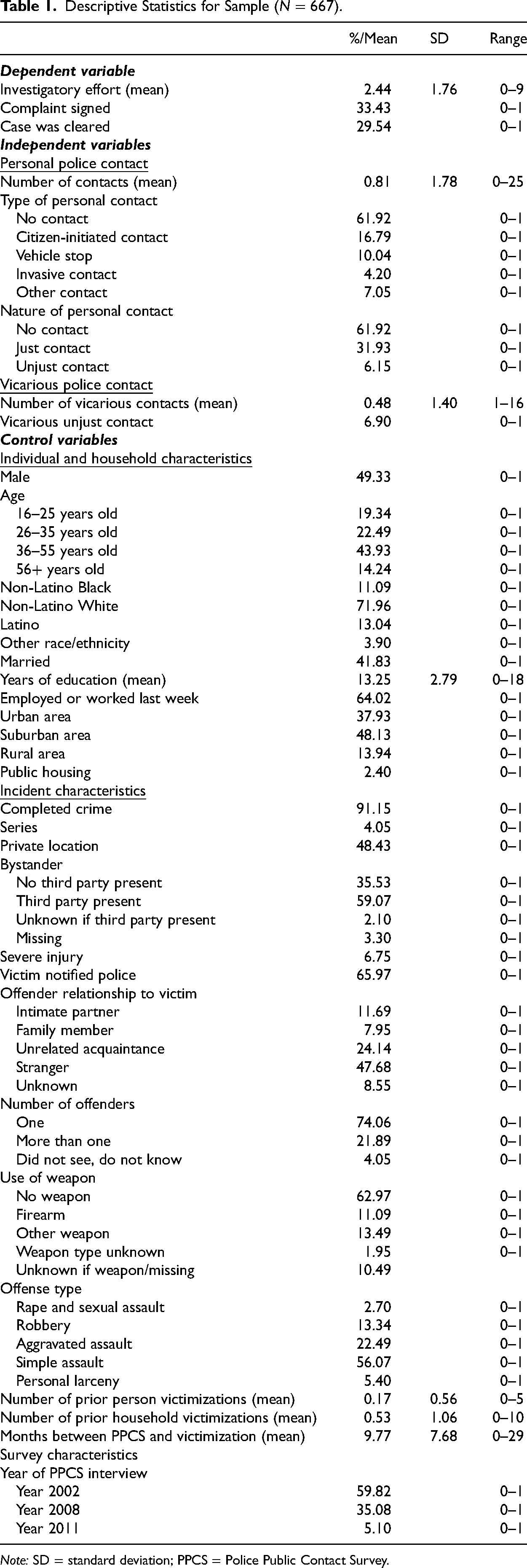
To maintain proper causal ordering, police contact data are from the PPCS, and victimization measures are taken from the subsequent wave of the NCVS. Descriptive statistics are located in Table 1.
Descriptive Statistics for Sample (N = 667).
Note: SD = standard deviation; PPCS = Police Public Contact Survey.
Dependent Variables. Investigatory effort is an index that captures the number of nine different actions the victim reported the police undertook at any point in the investigation, including (1) responded to the scene, (2) took a report during the initial investigation or follow-up, (3) searched the scene, (4) took evidence, (5) questioned a witness or a suspect during the initial investigation or follow-up, (6) promised or did surveillance during the initial investigation or follow-up, (7) promised to investigate further, (8) got in touch with the respondent or household member after the initial investigation, and (9) stayed in touch with the respondent. Of the 667 reported victimizations, 82.9% involved at least one form of investigation, and on average, victims reported that police engaged in 2.44 (standard deviation [SD] = 1.76) different investigatory actions. 7 The most common types of police actions included responding to the scene (72.7%), taking a report (65.2%), questioning a witness or a suspect (32.1%), and getting in touch after the initial investigation (23.1%), followed by searching (15.6%) and promising to investigate (12.1%).
It is important to consider the limitations and strengths of this measure. First, the types of actions the police take during an investigation are affected by the victimization characteristics. While we control for many of these factors (e.g., crime type, location, injury, weapon, bystander), others may be unaccounted for. 8 Second, this measure cannot distinguish what the police actually did from the victim's knowledge of the investigation. Still, we are interested in how the victim believes their case was handled, which is less well studied than what the police recorded they did and has implications for future cooperation and help-seeking (e.g., Russell and Light 2006; Xie et al. 2006).
Signed complaint primarily reflects victims’ actions. A complaint can take the form of any official report by the victim in which the police have identified at least one offender (U.S. Census Bureau 2003). This variable is scored 1 if the victim or someone in their household signed a complaint against the offender(s) with their local police department or some other legal authority (e.g., FBI) and 0 otherwise. A complaint was signed in approximately one-third (33.4%) of cases.
Case clearance can be conceptualized as an outcome of both police investigatory effort and victim behavior (e.g., complaint signing). A crime was considered cleared if the respondent indicated that an arrest had been made during the investigation or if they knew that someone had been arrested or charged. 9 According to victim reports, 29.5% of victimizations were cleared. 10
Key Independent Variables: Past-Year Police Contact. We capture three different aspects of face-to-face police contact. The first, frequency, is the number of past-year in-person encounters with law enforcement. 11 Type of police contact is a nominal measure that categorizes individuals based on whether they had any face-to-face-contact with the police in the past year and, if so, whether their most recent contact was citizen initiated (i.e., respondent sought police assistance or reported a crime), a traffic stop (driver or passenger), invasive (i.e., respondent was frisked, searched, arrested, subject to police force, handcuffed, or suspected of a crime), or “other,” which includes traffic accidents, investigation of a crime, and “other” unspecified reasons. The reference category is no past-year personal contact. 12 Finally, regardless of contact type, for a person's most recent interaction with the police, we capture the perceived nature of the contact using a three-category variable: (1) no contact (reference), (2) police contact perceived as “improper” or that involved force, and (3) contact perceived as “proper” and did not involve force.
Because the NCVS and PPCS are household surveys, these data also provide a window into the experiences of household members. The vicarious measures of police encounters mirror the personal measures but instead capture face-to-face police contacts reported by victims’ household members. Number of vicarious police encounters is the sum of the number of times each participating household member reported face-to-face contact with the police. Vicarious unjust treatment is scored 1 if any of the respondent's household members reported their most recent police contact was improper and 0 otherwise. Cell sizes were too small to look at some specific forms of vicarious contact by type (e.g., invasive).
Most of the sample (61.9%) reported no direct encounters with the police in the past year. About 21.7% of victims had one face-to-face police encounter in the past year, while 6.8% had two and 9.6% had three or more. The most common type of reported contact involved reporting a crime or seeking police assistance (16.8%), followed by a vehicle stop (10.0%), and “other” contact (7.1%). Invasive contact was reported by 4.2% of victims. Just over 6% of victims indicated they had police contact in the past year and the most recent interaction was unjust, while 31.9% had “proper” contact. Vicarious police encounters followed a similar pattern. Approximately a quarter of victims (22.3%) had a household member who reported at least one face-to-face police contact in the past year (M = 0.48, SD = 1.40), and almost 7% of victims had a household member who reported being treated unjustly by the police.
Incident Characteristics. Investigatory effort, victim cooperation, and solvability of a crime are shaped by the nature of the victimization (see Prince, Lum, and Koper 2021 for a review). For example, although studies often focus on intimate partner violence or sexual assaults, research and theory suggest victims will be less likely to cooperate in circumstances where they fear retaliation, are reluctant to get the perpetrator in trouble, believe the police or prosecutors will not take their case seriously, or perceive the level of harm does not warrant criminal justice system involvement (e.g., Felson and Ackerman 2001; Felson and Lantz 2016; Richards, Tillyer, and Wright 2019). On the law enforcement side, investigatory effort is shaped by factors such as crime visibility (e.g., Goldstein 1963), victim and case credibility (Campbell and Fehler-Cabral 2018), perceived social status of the victim or the area where the crime occurred (Charman 2023; Liska and Chamlin 1984), and availability of evidence, witnesses, and victims (e.g., Bynum, Cordner and Greene 1982). Importantly, factors that shape complaint signing and investigatory effort are reinforcing and at times overlapping (e.g., Meeker, O'Neal and Acquaviva 2020): Research has found that officers exert more investigatory effort and are more likely to pursue a case when victims show deference to the police, are cooperative, and are credible (e.g., Black 1968; Campbell and Fehler-Cabral 2018), and victims are more willing to sign a complaint when they perceive officers care about their case and treat them as victims “worthy” of their efforts (Kaiser, O’Neal, and Spohn 2017). Therefore, in all models, we include measures we expect to be related to either of these two outcomes.
More severe victimizations are more likely to generate signed complaints (Felson and Ackerman 2001; Felson and Lantz 2016; Richards, Tillyer, and Wright 2019) and have higher clearance rates (Vaughn 2020a) because they leave more physical evidence that can be linked to suspects (e.g., D’Alessio and Stolzenberg 2003; Morabito, Pattavina, and Williams 2019) and because they are more likely to be prioritized by the police (e.g., Cook et al. 2019; Spohn and Tellis 2019). Injury severity is measured with a binary variable such that victimizations involving severe injury or rape are coded as 1 and all others are coded as 0. 13 We also distinguish among victimization types (rape/sexual assault, robbery, aggravated assault, simple assault, and personal larceny), with simple assault as the reference category. We control for whether the victimization was part of a series because police respond to repeat victims differently (Russell and Light 2006), and repeat victimizations are more likely to result in a signed complaint (Felson and Ackerman 2001). 14 There is some evidence that crimes committed with firearms have higher rates of complaint signing (Felson and Lantz 2016) but lower clearance rates than those involving weapons that provide more physical evidence, such as knives (e.g., Prince, Lum and Koper 2021). Weapon type has the following categories: no weapon (reference), firearm, nonfirearm weapon, weapon type unknown, and unknown if there is a weapon/missing weapon information. Completed captures whether a crime was attempted (coded as 0) or completed (coded as 1). Completed crimes tend to be more severe, leading us to expect they are more likely to garner victim cooperation and police attention, and research has found they are more likely to be cleared (Taylor, Holleran, and Topalli 2009; Walfield 2016).
We include additional factors related to solvability, investigatory effort, and perceived victim credibility, which has been linked to victim cooperation (Kaiser, O’Neal, and Spohn 2017). Studies have found that crimes committed in public locations have higher rates of victim cooperation (Richards, Tillyer, and Wright 2019) but lower clearance rates (e.g., Rydberg and Pizarro 2014). Moreover, officers can more readily circumvent formal investigation when dealing with crimes that occur behind closed doors given they are less visible (Goldstein 1960; Goldstein 1963). We therefore control for the location of the incident (private = 1, public = 0). Bystanders are expected to increase investigatory effort and clearance by serving as potential witnesses who can be questioned (Uchida and Swatt 2025). They also increase victim and case credibility (e.g., Kaiser, O’Neal, and Spohn 2017) and may also actively encourage or discourage victim cooperation. Bystander has four categories and captures presence of a bystander, no bystander(s) (reference), it is unknown if there is a bystander or missing bystander information. Finally, we include whether the victim notified the police (1 = victim notified police, 0 = police learned about the crime some other way) because this is an early indication of a victim's willingness to cooperate (Charman 2023).
Offender Characteristics. Crimes involving strangers have lower clearance rates than ones involving known offenders (e.g., Morabito, Pattavina, and Williams 2019; Spohn and Tellis 2012). Complaint signing may be less likely if no suspect has been identified against whom to file a complaint. At the same time, research on victim's postreporting cooperation and prosecutorial case screening suggests victim cooperation is stronger in cases involving strangers (Felson and Ackerman 2001; Richards, Tillyer, and Wright 2019; Tellis and Spohn 2008). Victim–offender relationship has five categories: current/former partner, family member, unrelated acquaintance, stranger (reference), and unknown relationship. If there were multiple perpetrators with differing relationship statuses, the closest relationship status was used. 15 We include number of offenders as a categorical measure with one offender as the reference category and more than one offender and did not see/do not know as the other two categories. We expect that violent crimes with multiple offenders will have higher rates of complaint signing and involve more investigatory effort because they are more likely to be spontaneous, severe, and involve weapons (e.g., Lantz 2021). Co-offending has also been related to arrest risk, although the direction of the relationship varies by type of violence (Lantz 2020).
Victim and Household Characteristics. Demographic characteristics are important correlates of police-related experiences and attitudes and, in many studies, are used as markers of victim devaluation. When the victim is a person of color, particularly Black or Latino, devaluation suggests that police will investigate their case with less vigor, although the evidence is mixed (see, e.g., Prince, Lum, and Koper 2021). Similarly, people of color exhibit less trust in the police (Brenan 2024), suggesting they will be less likely to cooperate with them (Tyler 2005; Tyler and Huo 2002). Race/ethnicity is a four-category variable that distinguishes between individuals who identify as non-Latino White (reference category), non-Latino Black, Latino, and individuals from other racial/ethnic groups. Research finds that younger individuals are less willing to cooperate (Richards, Tillyer, and Wright 2019). Moreover, there is some evidence that victimizations involving youth receive less police effort (Avakame, Fyfe, and McCoy 1999), and young adults are least likely to have their crimes cleared (e.g., Regoeczi, Kennedy, and Silverman 2000; Trussler 2010). Age is an ordinal variable with the following categories: 16 to 25 years of age (reference), 26 to 35, 36 to 55, and 56+. Most studies find that women are provided an “ideal victim” status (Prince, Lum and Koper 2021), which is expected to enhance investigatory effort (cf., Addington 2006; Litwin and Xu 2007). In addition, research has found female assault victims to be more likely to sign complaints (Felson and Ackerman 2001). Male individuals are given a score of 1, and those who are female are coded as 0. We include additional demographic characteristics expected to shape victim devaluation (Avakame, Fyfe, and McCoy 1999), including whether the respondent was married (1 = married, 0 = not married), employed or worked in the last week (1 = worked; 0 = did not work), and years of education. To capture prior victimization experiences, which are likely related to both prior police contact and our outcome variables, the number of personal and household victimizations reported in the waves prior to the PPCS interview are included.
Several variables capture characteristics of the victim's household. Devaluation theory expects that low-income individuals will receive less police attention than wealthy people, and research finds that income has a positive association with case clearance (Felson and Ackerman 2001). Therefore, we include income to compare individuals with household incomes below the poverty line (reference group) to those with incomes less than $25,000 but above the poverty line, $25,000–$74,999, and $75,000 and higher. Relatedly, we measure residence in public housing (1 = public housing, 0 = not in public housing), which serves as a geographical indicator of income level and stigmatization. We also include a variable that identifies whether the household location is in an urban (reference), suburban, or rural area given possible differences in victim cooperation (Rennison, Dragiewicz, and DeKeseredy 2013), investigatory resources and effort (Schulenberg 2010), and clearance by place (e.g., Borg and Parker 2001; Roth 2018).
Survey characteristics. Finally, we include a categorical variable capturing the year of the PPCS interview (with 2002 as the reference) and a measure that captures the number of months between the PPCS interview and the victimization to adjust for potential recall issues.
Analytic Strategy
First, we use multiple regression to examine the relationship between personal and vicarious police encounters and each outcome. Frequency, type, and nature of police contact are entered separately into the models due to their empirical and conceptual overlap. Investigatory effort is a count variable with evidence of overdispersion, so we estimate negative binomial models. The other two outcomes are binary, so logistic regression is used. 16 Robust standard errors are estimated for all models. To facilitate the substantive interpretation of key findings, we visually present results as predicted values, which were computed using the margins command in Stata 17, with all other variables set at their means.
Finally, we assess potential moderation effects. We test whether the effects of the type and frequency of prior police encounters on our outcomes, particularly complaint signing, are amplified if the most recent encounter was perceived to be unjust. Then, we examine whether several markers of devaluation—including race, sex, and income—moderate the effects of police contact. To do so, we estimate models that include multiplicative interaction terms, compute average marginal effects, and use Wald tests to test for differences in average marginal effects across groups (see Mize 2019).
Results
Investigatory Effort
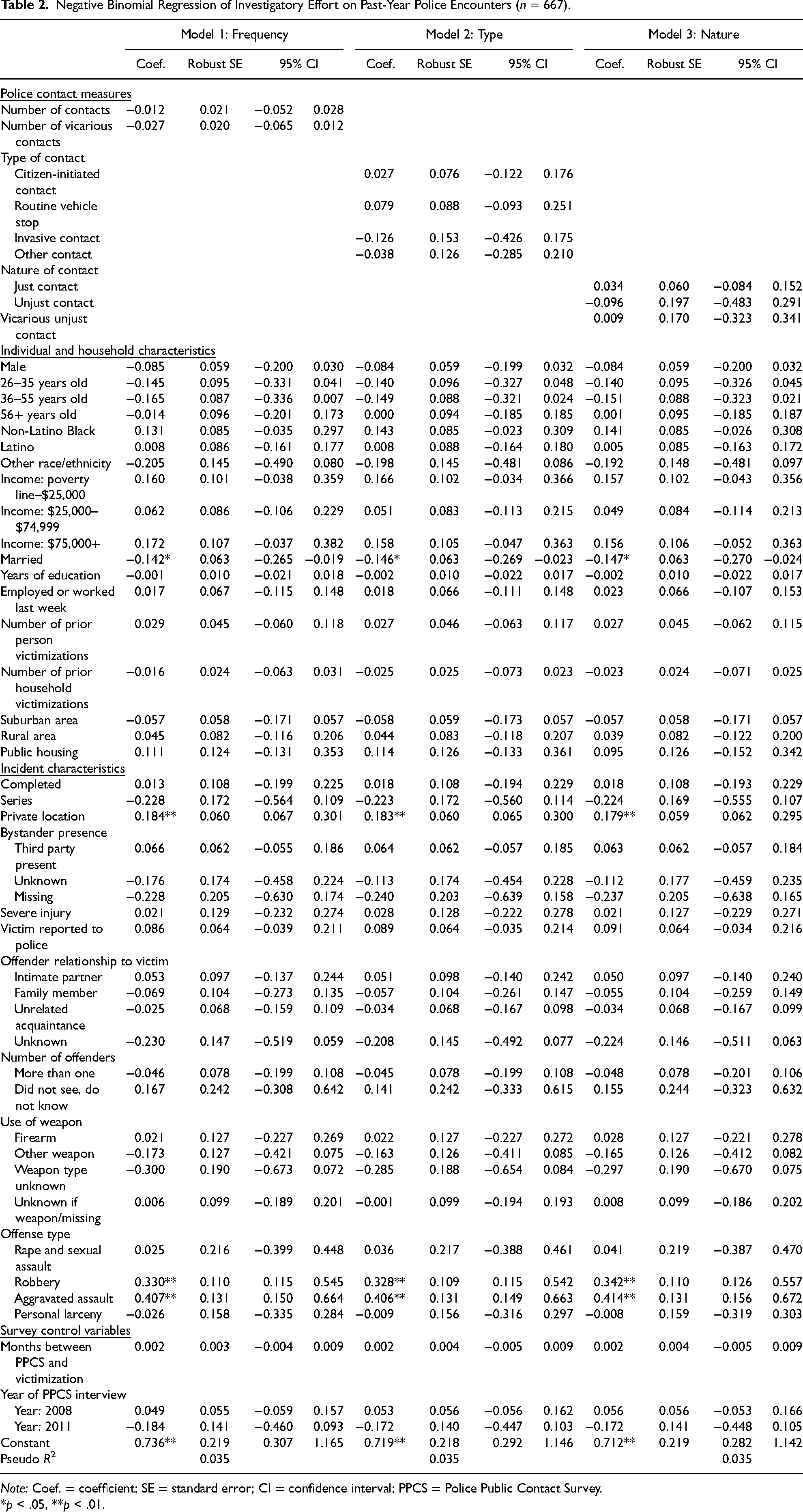
Table 2 presents results from multivariate regressions estimating the relationships between each of our police contact measures and victims’ reports of police investigatory effort. Model 1 presents the findings for number of past-year personal and vicarious police encounters. Model 2 includes most recent type of personal encounter. Measures of personal and vicarious unjust contact are included in Model 3.
Negative Binomial Regression of Investigatory Effort on Past-Year Police Encounters (n = 667).
Note: Coef. = coefficient; SE = standard error; CI = confidence interval; PPCS = Police Public Contact Survey.
*p < .05, **p < .01.
Few measures are significantly associated with victim-reported investigatory effort. None of the past-year contact measures are statistically significant. 17 Instead, married individuals report lower levels of police effort than unmarried individuals. In addition, perceived investigatory effort is higher when the incident took place in a private location, perhaps because this setting is more conducive to the forms of investigation included in our measure of effort. Finally, compared to simple assault, victims of the more severe crimes of robbery and aggravated assault report the police engaged in more investigatory actions.
Complaint Signed
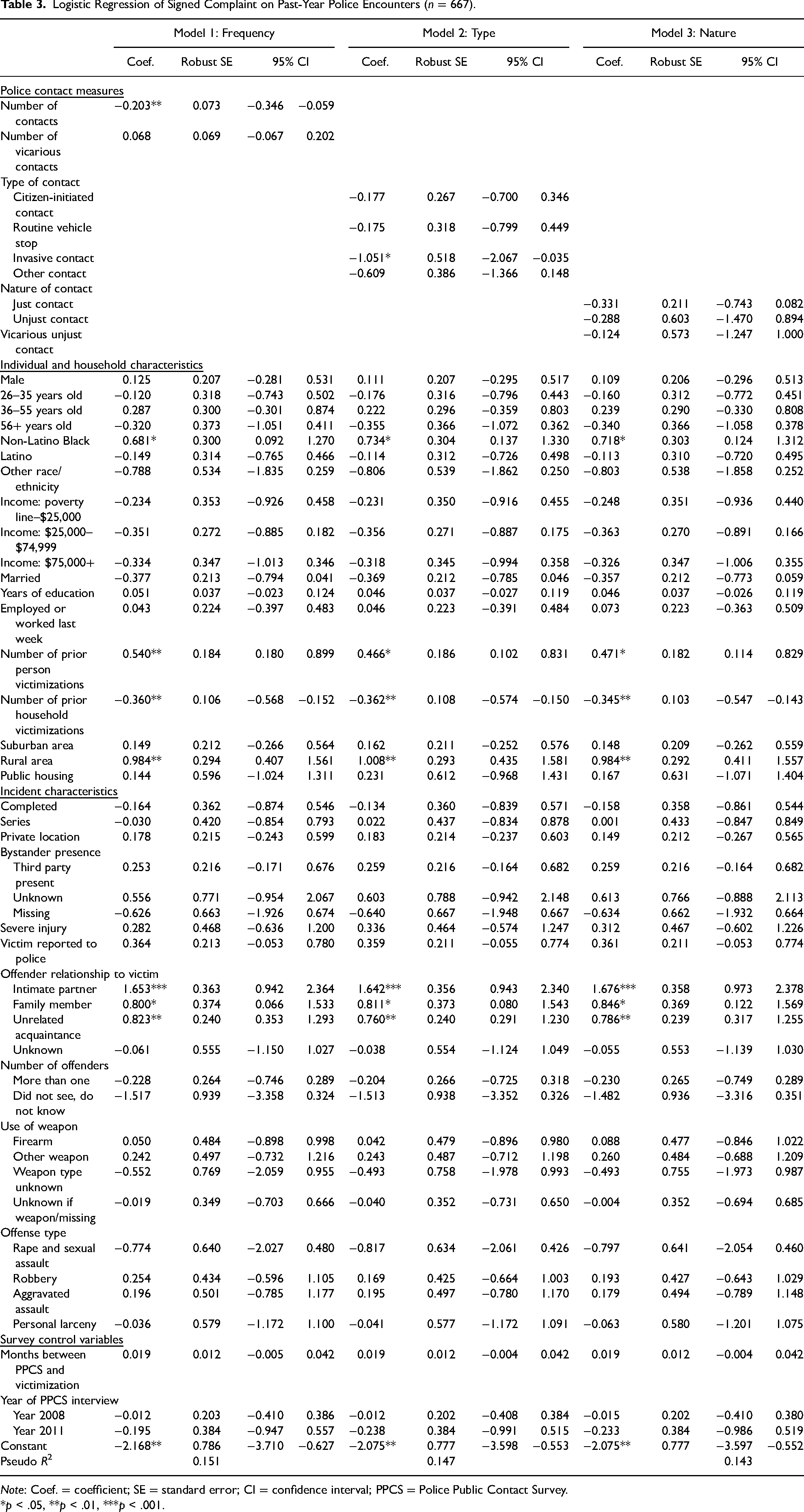
Victims’ recent police experiences are related to whether a complaint was signed. As the number of past-year police encounters increases, the likelihood a complaint was signed decreases (Table 3, Model 1). As presented in Figure 1(A), the probability that a person who reported no past-year police encounters signed a complaint is .34. This probability decreases to .29 for individuals with one, .25 for those with two, and .22 for those with three police contacts. Furthermore, victimizations involving individuals whose most recent contact was invasive are less likely to have a complaint signed than those involving victims with no face-to-face police encounters in the past year (Table 3, Model 2). For individuals with invasive contact, the probability a complaint was signed is .15 versus .33 for those with no recent police encounters (Figure 1(B)). Complaint signing is unrelated to perceived unjust treatment (personal or vicarious) during the most recent police encounter (Table 3, Model 3).
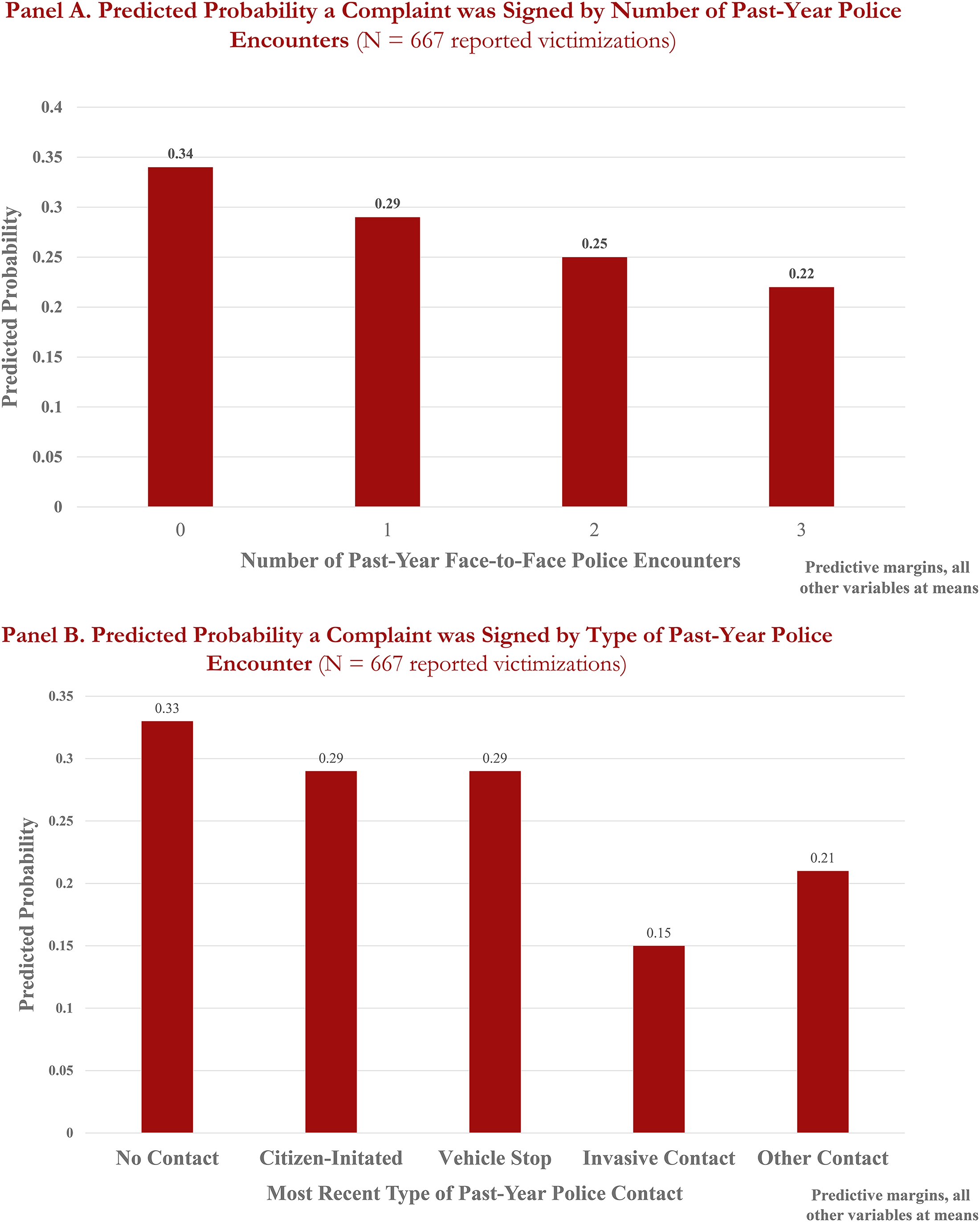
Effects of police contact on complaint signing (N = 667).
Logistic Regression of Signed Complaint on Past-Year Police Encounters (n = 667).
Note: Coef. = coefficient; SE = standard error; CI = confidence interval; PPCS = Police Public Contact Survey.
*p < .05, **p < .01, ***p < .001.
Several other variables are consistently related to whether a complaint was signed. Black individuals are more likely to sign a complaint than those who are White. Complaint signing is also more prevalent among people living in rural areas versus urban areas. Incidents involving offenders who are unrelated acquaintances, spouses or intimate partners, or family members are more likely to have a signed complaint than those involving strangers. This is likely due, in part, to the fact that signed complaints identify the party accused of committing the crime, and suspect identification is facilitated when the victim knows the offender (Felson 2008). 18 Complaint signing is positively related to the number of prior personal victimizations but negatively related to the number of household victimizations.
Clearance
Table 4 presents the findings for clearance. Respondents who had more past-year face-to-face encounters with the police are less likely to report someone was arrested or charged in relation to their victimization (Model 1). As displayed in Figure 2, all else being equal, individuals who did not have contact with the police in the past year have a .29 probability of having their cases cleared. This probability drops to .25 for victims with one prior recent encounter, .22 for those with two, and .18 for those with three. None of the other measures capturing past-year police related experiences are statistically significant.
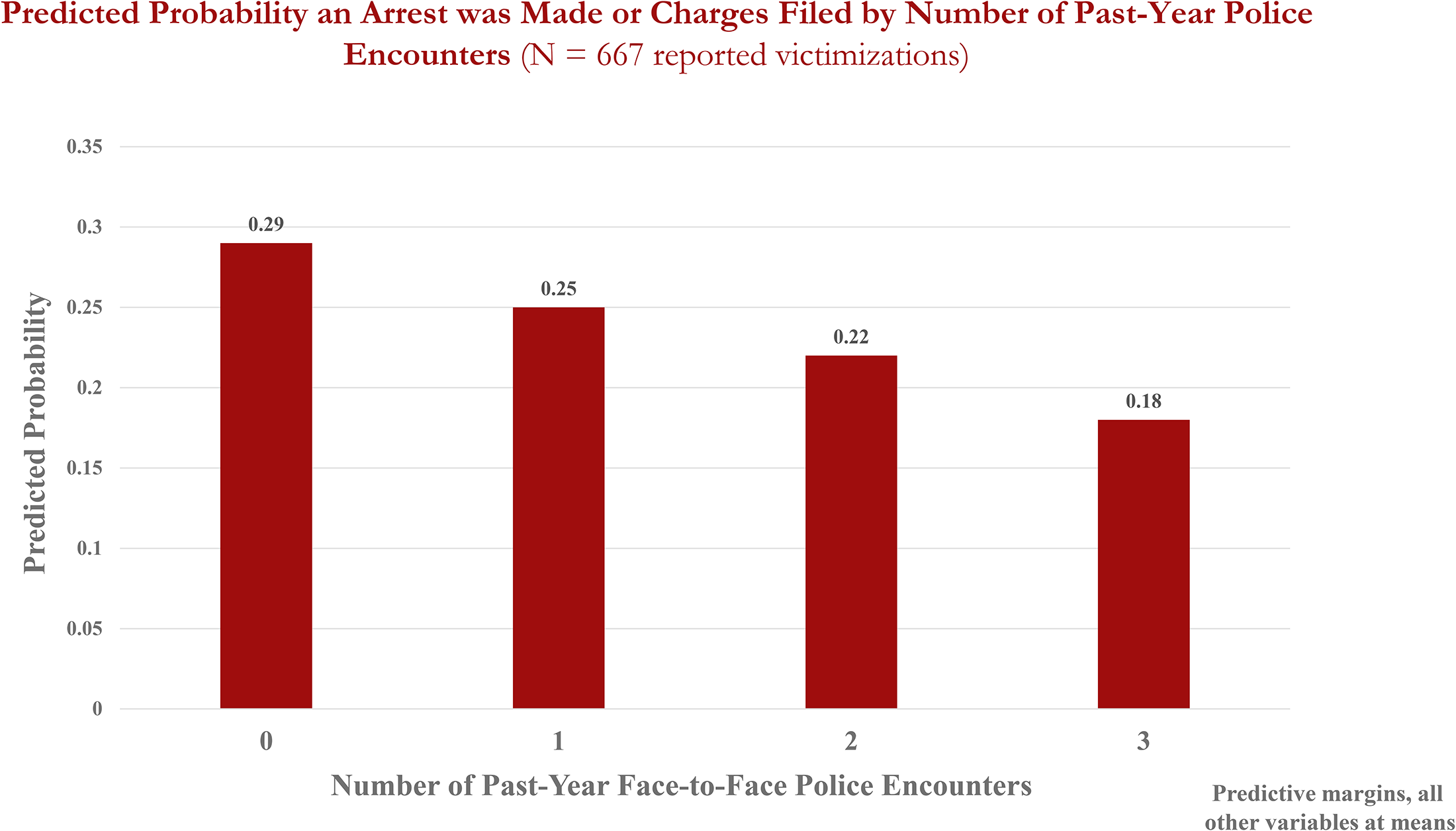
Effects of police contact on clearance (N = 667).
Logistic Regression of Clearance on Past-Year Police Encounters (n = 667).
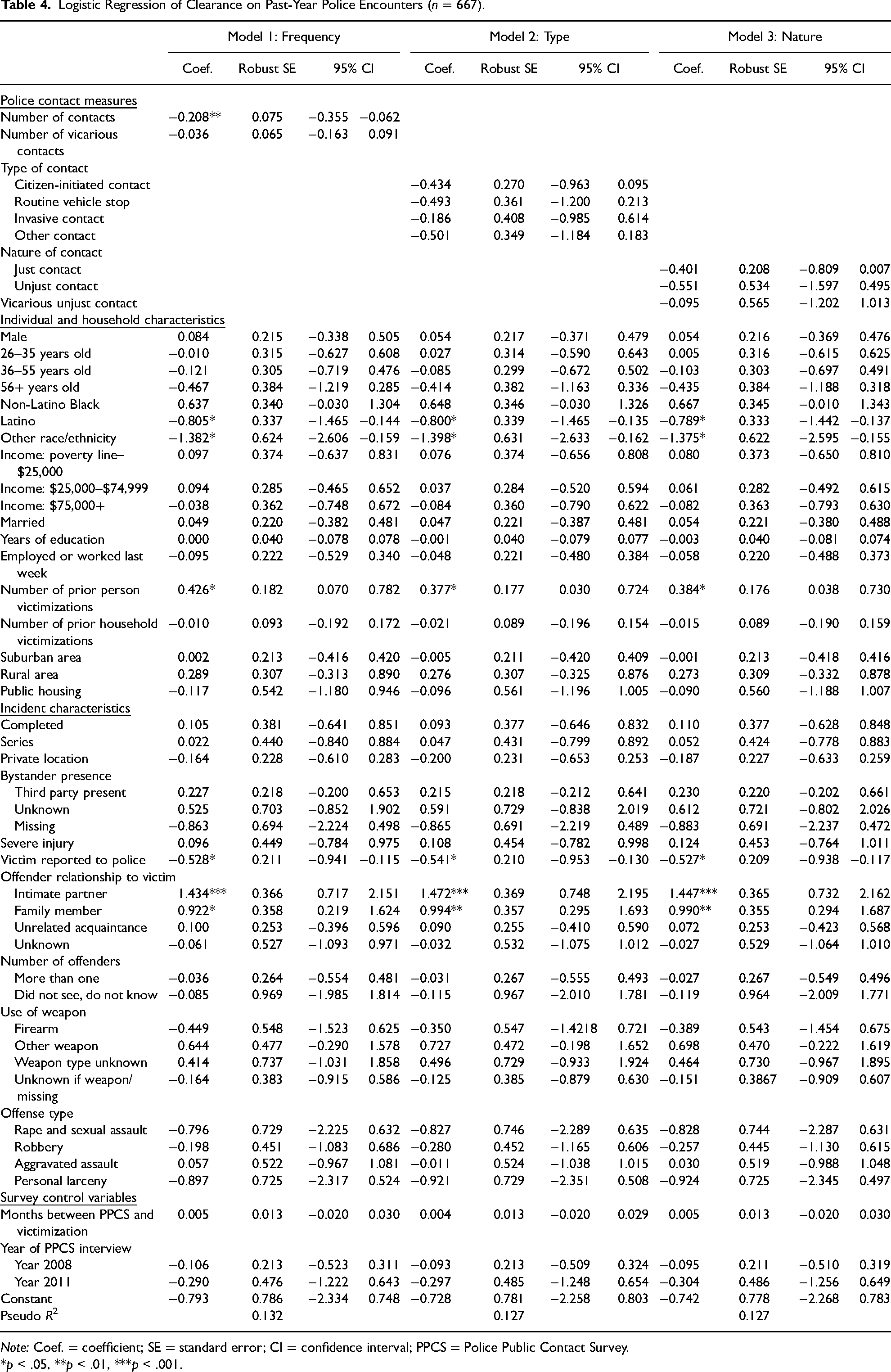
Note: Coef. = coefficient; SE = standard error; CI = confidence interval; PPCS = Police Public Contact Survey.
*p < .05, **p < .01, ***p < .001.
Compared to White victims, Latino victims and those who identified as a different race/ethnicity are less likely to report their case was cleared. The number of prior personal victimizations is positively related to clearance. In addition, when the victim (versus a third party) reported the incident to the police, the case is significantly less likely to end with an arrest or charges filed. Finally, cases are more likely to be cleared when the perpetrator was a spouse/intimate partner or family member versus a stranger.
When measures of police and victim actions are entered into the clearance models (Table 5), police investigatory effort and signed complaint are associated with a greater likelihood that a case is cleared. For example, in Model 1, each additional type of investigatory effort that the victim reported increases the odds the case was cleared by 38% (odds ratio [OR] = 1.38). The effect of complaint signing is particularly strong: When a complaint is signed, the odds of clearance increase more than sixfold (OR = 6.40). The coefficients for the measures capturing police-related experiences remain relatively unchanged. To formally assess mediation, we used the gsem function in Stata to estimate specific indirect effects for the number of contacts on clearance through complaint signing and investigatory effort. 19 We found a significant indirect effect via complaint signing only (b = −.38, SE = .15, p = .01), suggesting that one reason individuals with more police contact are less likely to have their future victimizations cleared is because they are less likely to sign a complaint, but much of the relationship remains unexplained.
Logistic Regression of Clearance on Past-Year Police Encounters, Complaint Signed and Investigatory Effort (n = 667).
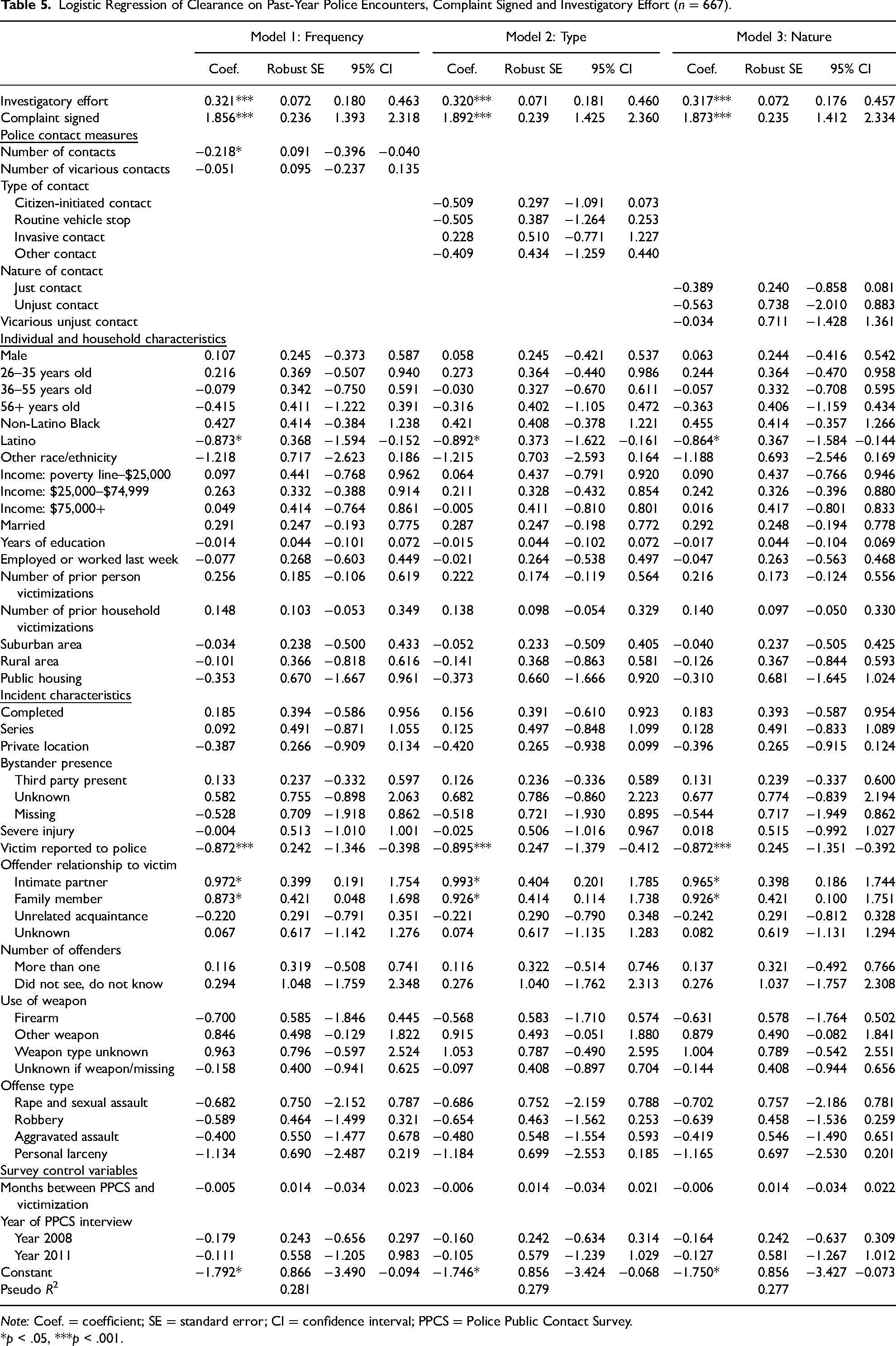
Note: Coef. = coefficient; SE = standard error; CI = confidence interval; PPCS = Police Public Contact Survey.
*p < .05, ***p < .001.
In the full models, the effects of most other variables remain unchanged, with two exceptions. Number of prior person victimizations is no longer significant and has a significant indirect effect via complaint signing (b = 1.00, SE = 0.34, p < .01). While other race/ethnicity is no longer significant, there are no significant specific indirect effects of this variable or identifying as Latino via complaint signing or investigatory effort. However, there is a significant indirect effect of identifying as Black on clearance via complaint signing (b = 1.26, SE = 0.60, p = .04).
Finally, we estimated a series of interaction models to explore (1) whether the effects of the number and type of most recent contact differ if the respondent reported their most recent police experience was unjust and (2) whether the effect of contact is moderated by other markers of devaluation, specifically race/ethnicity, sex, and income. Some of these findings should be considered preliminary due to small cell sizes and large confidence intervals around some of the estimates, making it challenging to detect interaction effects (Mize 2019). Online Appendix C includes additional information on the estimated models and provides figures displaying all results. Table 6 includes a summary of the results.
Summary of Interaction Effects.
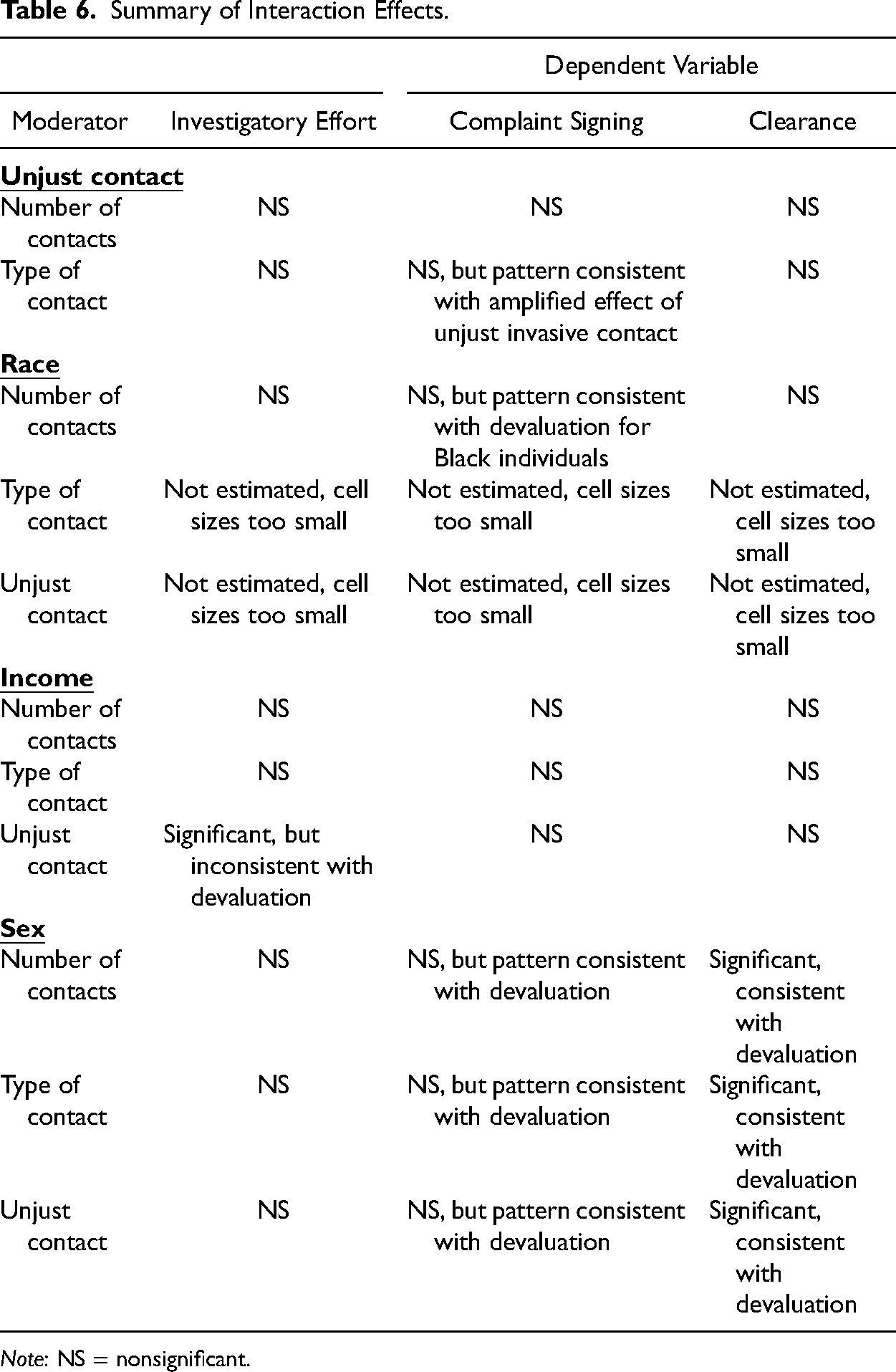
Note: NS = nonsignificant.
We found no evidence that the effect of number or type of contact is amplified when respondents reported their most recent contact was unjust. Moreover, only in the model predicting complaint signing that includes the interaction between unjust contact and type of contact do we observe a pattern of results consistent with procedural justice theory. In this model, individuals with invasive contact perceived as unjust have substantively lower likelihoods of complaint signing than other groups (e.g., predicted probability of unjust invasive contact = .12 vs. just invasive = .24 vs. no contact = .36).
There are also no statistically significant interactions between race/ethnicity and any measures of contact, and the pattern of findings is inconsistent with the hypothesis that the negative effects of police contact are amplified for people of color, with one exception: The significant negative relationship between contact frequency and complaint signing appears stronger for Black individuals (see online Appendix C). Cell sizes are not large enough to obtain reliable estimates for interactions of race/ethnicity with contact type or nature, and there are too few individuals in the “other” race/ethnicity group to include them in the analysis. Household income only moderates the effect of unjust contact on investigatory effort, but not in the expected manner. The relationship between unjust contact and investigatory effort is positive and stronger for individuals with household incomes less than $25,000 versus those with higher incomes (second difference = 1.23, SE = 0.56, p = .03).
In contrast, sex moderates the relationship between contact and clearance in ways consistent with the hypothesis that the negative effects of police contact are amplified for men. There is a stronger negative relationship between number of contacts and clearance for men (second difference zero vs. one contact = −0.07, SE = 0.03, p = .02; second difference zero vs. two contacts = −0.13, SE = 0.05, p = .01). The negative effects of all types of contact compared to no contact are also stronger for men (second difference, citizen = −0.08, SE = 0.03, p = .01; second difference, vehicle stop = −0.15, SE = 0.06. p = .01; second difference, invasive = −0.21, SE = 0.08, p = .01; second difference, “other” contact = −0.26, SE = 0.10, p = .01). Similarly, the negative effects of both unjust and just encounters (relative to no police encounters) on clearance are amplified for men (second difference, just = −0.15, SE = 0.07, p = .04; second difference, unjust = −0.17, SE = 0.13, p = .19); however, because there are relatively few cases with unjust contact, sex differences reach statistical significance only for just contact, even though the difference in effect sizes is substantively larger for unjust contact. Although not significant, the pattern of results for complaint signing is also consistent with amplified devaluation for males for frequency, type, and nature of contact.
In summary, results using these data provide no evidence that past-year police contact has an impact on victim reports of police investigatory effort. Instead, as hypothesized, people with more face-to-face police contacts and those whose most recent police encounter was invasive are less likely to sign complaints. In addition, cases involving victims with more frequent police-related experiences are less likely to be cleared. Investigatory effort and complaint signing are positively associated with clearance. Number of contacts has a significant indirect effect on clearance via complaint signing, but this does not fully account for the relationship between frequent police encounters and clearance. Having an unjust (personal or vicarious) police encounter is not related to any of our outcomes, and sex is the only devaluation marker that moderates the effect of police contact as hypothesized. Yet the findings regarding moderation effects should be considered conservative due to limited variability in some key measures.
Discussion
As Skogan (2005:304) notes, “[t]he world [is] not neatly divided between supplicants and suspects,” and the people most subject to police contact and control are often the same people who need their help (Lauritsen and Laub 2007; Maxfield 1988). Yet there are several questions that remain unanswered regarding how prior interactions with law enforcement shape victims’ perceptions of the fair and just distribution of the law. We contribute to this discussion by exploring the relationship between past-year encounters with law enforcement and victims’ reports of police investigatory effort, complaint signing, and, ultimately, case clearance. Using information provided by victims as part of a national longitudinal survey allowed us to incorporate many factors that are likely related to case processing and outcomes but have not received adequate attention. Perhaps more critically, these data provide insight into how victims perceive their cases were handled and resolved. This is important because it is the public's perceptions of what the police do, how they do it, and their effectiveness—not what the police report happened—that ultimately shape views of police legitimacy, legal cynicism, and future engagement with the law.
Contrary to devaluation and labeling perspectives, in these data, there is no evidence that victims with past-year police experiences perceive that law enforcement took fewer actions when investigating their case, nor does our pattern of findings overwhelmingly support the idea that people with characteristics that might make them seem less “deserving” in the eyes of law enforcement (e.g., being a member of a minoritized racial or ethnic group, living below the poverty line, residing in public housing, and being unemployed) perceive lower levels of investigatory effort. Instead, and in line with research that relies on police data (e.g., Smith and Visher 1981), victims report that the police engaged in more forms of investigation for more severe crimes, such as robberies and assaults. It is notable that we found no race differences in perceived investigatory effort. However, studies have found that the relationship between race/ethnicity and clearance is weakened when controlling for situational factors, as well as victim–offender racial dyads (e.g., Taylor, Holleran, and Topalli 2009; Vaughn 2020b). Moreover, race effects may be more likely to emerge in heavily surveilled places where the police repeatedly encounter the same people and, over time, may come to view them as less deserving of their effort. Data that allow for the examination of race, place, and police-related experiences are needed to explore this possibility. It is important to reiterate that our measure of investigatory effort cannot speak to actions the police took, some of which the victim may be unaware of. Thus, we are capturing devaluation from the victim's perspective, which is in line with a body of work that describes how certain groups (e.g., minoritized groups and people suspected of crimes) perceive they are stigmatized and underserved by the police (e.g., Brunson and Wade 2019).
We do find support for the salience of recent police-related experiences for victim cooperation in the form of complaint signing. Victims who reported more in-person police encounters in the past year and whose most recent contact was invasive were less likely to sign complaints. While we cannot definitively identify why this is the case, we can offer hypotheses to be explored in future research. One potential explanation is that people with more contacts and with invasive police-initiated encounters are less likely to view the police as legitimate. This may invoke a general desire to avoid cooperating with an institution they see as unfair, reducing the probability a suspect will be identified (Anderson 1999; Clampet-Lundquist, Carr, and Kefalas 2015; Gau and Brunson 2015; Moskos 2008), which is necessary for charges to be filed. However, the strength of this argument is somewhat weakened by the fact that we do not observe a similar effect for unjust contact. Moreover, we find little evidence that unjust contact amplifies the negative effects of frequent police encounters or the type of encounter on complaint signing.
A second hypothesis is that victims with frequent or invasive police contacts may be primarily concerned with instrumental outcomes, such as police efficacy and fair outcomes (i.e., distributive justice). If people with repeated police encounters or those who have been treated as “suspects” come to believe their cases will not be taken seriously and that justice is unlikely to be served, it may hardly seem worth their effort to sign a complaint, particularly in light of the potential costs, which include being seen as a “snitch,” facing retaliatory violence, and drawing unwanted attention from the police (e.g., Anderson 1999; Carbone-Lopez, Slocum, and Kruttschnitt 2016; Rosenfeld, Jacobs, and Wright 2003). To assess the merits of these hypotheses, there is a need for data that capture the type and nature of victims’ cumulative experiences with the police rather than just their most recent encounters. This includes how they perceived they were treated and outcomes of any prior cases in which they sought police assistance.
We also find evidence that the likelihood an arrest is made or charges are filed is lower for victims with more past-year police encounters, but the implications for theory are not straightforward. The solvability perspective specifies that a key mechanism linking prior police contact to case clearance is victim cooperation, while devaluation points to police investigatory effort. However, none of the effect of police contact operates via perceived investigatory effort, and only a small percentage is explained by complaint signing. Instead, most of the relationship remains unexplained, pointing to other mechanisms. For example, invasive contact is more prevalent in areas with higher crime rates, where police investigative resources are strained, potentially reducing the overall likelihood of clearing any one case (e.g., Mouzos and Muller 2001). It also may be that those with more past-year encounters have disproportionate involvement with drugs or gangs, making their crimes harder to solve (Litwin and Xu 2007). Or perhaps agencies with weak management oversight allow officers to engage with civilians at high rates on the street but do not utilize organizational best practices, such as maintaining good relationships with forensics units, that improve clearance (Prince, Lum, and Koper 2021).
Efforts to make sense of this finding are complicated by several factors. First, our measure of investigatory effort is based on victim reports, and we might find more evidence supporting devaluation using police reports of the investigation. Second, “complaint signing” is a relatively amorphous term that is a function of both the victim's ability to identify the perpetrator and their decision to sign a complaint. Frequent police contacts may affect clearance via forms of cooperation that we are unable to capture. For example, people who regularly experience unwanted police-initiated encounters may be less forthcoming regarding the details of the crime and perpetrator, or they may be more likely to withdraw their cooperation after signing a complaint due to fear of retaliation or harm to their reputation (e.g., Anderson 1999; Clampet-Lundquist, Carr, and Kefalas 2015; Dedel 2006; Gau and Brunson 2015; Moskos 2008), making it harder for the police to build a strong enough case to file charges. The roles of other forms of cooperation—such as providing information on one's case, reaching out to police and other criminal justice actors when new information comes to light, and responding to follow-up inquiries—should be explored in future research. Third, the mere count of past-year encounters is an imprecise measure that does not consider that some interactions, such as invasive ones, may be more salient than others. A measure that accounts for both the number and type of encounters would provide a cleaner and more comprehensive measure of contact that might be more strongly related to case processing and outcomes.
Other traditional markers of victim “worthiness” had complex relationships with cooperation and clearance that were in some ways unexpected. Black individuals were more likely to sign a complaint, and there is a significant positive indirect effect of identifying as Black on clearance via complaint signing. This is consistent with recent research showing that, despite having less trust in police, Black individuals are more likely to rely on them in some situations (e.g., Avakame, Fyfe, and McCoy 1999; Bell 2016; LaVigne, Fontaine, and Dwivedi 2017; Xie and Lauritsen 2012). Latino persons were less likely than White individuals to have their cases cleared, which is consistent with devaluation, but ethnicity was not related to either of the two potential mechanisms (effort or complaint signing). Any explanation for this finding is speculative; however, it is possible that out of distrust or fear of the police, fear of reprisal, or undocumented status (Alderden and Lavery 2007; Litwin 2004), this group is more reluctant to engage with the police postvictimization in ways aside from complaint signing. This idea is supported by research that finds that violent victimization reporting is lower among Latinos living in neighborhoods with high immigrant concentrations in nontraditional immigrant counties (Xie and Baumer 2019b). Furthermore, although our analyses were limited in scope, preliminary results indicate that income and race/ethnicity do not moderate the relationship between police contact and our outcomes. Instead, the negative ramifications of all forms of police contact on the likelihood of case clearance are amplified for men. This suggests that the stigma associated with being known to the police is triggered more strongly for men than for women. Future research should examine this issue to determine whether, for instance, the chivalry hypothesis is operating to protect women with prior police experiences (e.g., Visher 1983).
We found no evidence that vicarious past-year police experiences shape case processing or outcomes; however, our measures account only for household member experiences. Research suggests that a diverse array of vicarious experiences with the police—including those of friends and neighbors—can influence future interactions with the criminal justice system (e.g., Desmond, Papachristos, and Kirk 2016), as well as case outcomes such as clearance (e.g., Roberts and Michael Roberts 2022). Future research should incorporate other forms of indirect police experiences, especially given technological and social media advancements that provide for increased awareness of police–civilian interactions.
Our study has additional limitations that future research should address. First, these data omit people who have high levels of police distrust and are at elevated risk of victimization—incarcerated individuals, unhoused persons, and individuals who do not speak English. Although lack of trust in the police is prevalent among minoritized groups in our sample, the processes we expected to observe may be more evident in groups with more serious and extensive experiences with crime, the criminal justice system, and labeling by the police (Anderson 2022). Future studies should include such populations.
Relatedly, our sample includes only individuals whose victimizations are known to the police, which introduces the potential for selection bias. Because individuals with the most invasive or stigmatizing prior police experiences are least likely to report victimizations (e.g., Rengifo, Slocum, and Chillar 2019; Slocum 2018), our sample likely underrepresents those most at risk for devaluation and noncooperation. Supplemental analyses (presented in online Appendix D) indicate that at the bivariate level, the frequency, type, and nature of prior police encounters do not vary across reported and unreported cases. Among reported cases, we also tested whether police contact is related to how the police were notified (i.e., the victim or household member versus someone else), again finding no significant relationship. This suggests that police contact is not related to reporting propensity and minimizes some concerns about selection bias on our key independent variables, but it does not eliminate it, because prior research has found that the relationship between contact and reporting is complex and contingent on personal characteristics, such as race and poverty (Slocum 2018). To the extent that factors that influence both police notification and our outcomes, such as views of police legitimacy, are omitted from the models, selection bias may still be an issue. Additionally, we found that cases in which the victim or household member reported the crime had higher levels of perceived investigatory effort and greater likelihoods of complaint signing and clearance than those in which the police found out some other way. Thus, by analyzing only cases where police were notified, our sample consists of a set of incidents that already have elevated levels of police action and cooperation, limiting generalizability and potentially providing conservative estimates of the relationships among past-year police contact and case processing and outcomes. 20 This selection process is not merely a methodological concern but highlights the substantive linkage between overpolicing and underpolicing: The consequences of high levels of enforcement and surveillance—stigma, lack of trust in law enforcement, and prior negative police-related experiences—are expected to reduce police notification and shape perceptions of police effort and case outcomes among those who do report. Future research should explicitly model these dual selection processes, incorporating unreported victimizations and other measures likely to influence both reporting and case processing and outcomes, such as perceived legitimacy.
Finally, we were unable to determine the nature of every police interaction for people with multiple past-year encounters. Additional research that accounts for not only the quantity but also the nature of all prior interactions is needed to understand the mechanisms through which frequent police encounters affect case clearance. Some of this information is available in newer waves of the PPCS, which we currently are not able to match with the NCVS. Future research that incorporates newer waves of the PPCS and NCVS would allow for the use of more nuanced markers of marginalization, more detailed measures of contact type (e.g., pedestrian stops), and an exploration of the factors that shape case processing and outcomes within the context of newer social movements, such as “Black Lives Matter.”
To the extent that our findings can be replicated, they have several implications. Policing strategies that rely on intensive enforcement may harm community safety if the result is that victims refuse to sign complaints and instead pursue justice on their own (Clear et al. 2003; Sullivan and O’Keeffe 2017) or if those who cause harm continue to engage in crime because they are not arrested or charged (Natapoff 2006, 2009). Our results underscore the need to “right-size” policing to ensure that law enforcement remains responsive to community needs while minimizing unnecessary punitive contact. This will require identifying and evaluating focused approaches that address concerns about effectiveness and legitimacy and that encourage cooperation with the police. Relatedly, our findings underscore the importance of strengthening cooperation among those with frequent and invasive police encounters. Doing so will require that the justice system more fully attend to victims’ needs through improved communication and respect (Anderson 2022). Broader strategies that integrate law enforcement with community-based resources, such as housing and therapy (Anderson 2022; Camacho and Alarid 2008), and that enhance victim protection against retaliation (e.g., Dawson and Dinovitzer 2001; Healey 1995) are likewise promising but will require sustained investment and coordination.
Conclusion
Scholars and practitioners have long argued that the police can promote legitimacy and control crime through focused, responsive, and procedurally just policing (e.g., Gau and Brunson 2015; Leovy 2015). Conversely, failing to effectively respond to crime carries considerable costs, including increased violence, devaluation of law and order, and damaged police–community relations (Natapoff 2006, 2009). This study advances our theoretical understanding of investigative effort and clearance by integrating devaluation and solvability perspectives within a victim-centered framework. Our findings based on victims’ accounts of what occurred after the police responded suggest that frequent and invasive police encounters diminish victims’ cooperation—particularly their likelihood of signing a complaint—while investigatory effort and complaint signing each independently increase the odds of clearance. Together, these patterns highlight the dual importance of police and victim behaviors in the coproduction of justice.
Theoretically, this study makes several contributions. First, it reinforces the idea that clearance is a function of both institutional action and victim agency. By centering victims’ perceptions—an often-overlooked yet critical vantage point for understanding how police response is personally experienced—this perspective underscores that justice is not only about whether cases are solved but also about whether victims are comfortable with and see value in engaging with the system. Second, by showing that prior contact has an indirect relationship with clearance via victim cooperation, the findings connect work on overpolicing and underpolicing to broader theories of procedural justice, legitimacy, and help-seeking. Third, the evidence that these dynamics differ by sex adds a new dimension to theories of devaluation, suggesting that stigma and expectations of credibility are structured by gendered perceptions of deservingness. More work is needed to understand these processes. Finally, the complex and sometimes unexpected results around race/ethnicity further problematize research and dominant narratives on race, help-seeking, and overpolicing and underpolicing, highlighting the need for future research in this area.
Ultimately, our findings point to the need for continued theoretical and empirical investigation of the processes shaping victim and police responses to crime, with the goal of developing effective and equitable crime prevention and response strategies. Future research should integrate processes of overpolicing and underpolicing measured via cumulative and long-term experiences with law enforcement; incorporate measures of cooperation beyond complaint signing, such as follow-up communication and engagement with the courts; and explore how these patterns may be gendered and racialized. Doing so will further illuminate how everyday policing practices, patterns of contact, and perceptions of worthiness collectively reproduce disparities in justice outcomes and in the public's trust in the law.
Supplemental Material
sj-pdf-1-10.1177_00224278261421891 - Supplemental material for Disentangling the Relationships among Prior Police Contact, Victim Cooperation, Investigatory Effort, and Case Clearance: Evidence from the National Crime Victimization Survey (NCVS) and Police Public Contact Survey (PPCS)
Supplemental material, sj-pdf-1-10.1177_00224278261421891 for Disentangling the Relationships among Prior Police Contact, Victim Cooperation, Investigatory Effort, and Case Clearance: Evidence from the National Crime Victimization Survey (NCVS) and Police Public Contact Survey (PPCS) by Lee Ann Slocum and Paige E. Vaughn in Journal of Research in Crime and Delinquency
Footnotes
Acknowledgements
The opinions, findings, and conclusions or recommendations expressed in this publication/program/exhibition are those of the author and do not necessarily reflect those of the Department of Justice. The authors would like to thank Janet Lauritsen for her insightful comments and sharing her extensive knowledge of the NCVS with us.
Funding
The authors disclosed receipt of the following financial support for the research, authorship, and/or publication of this article: This project was supported by Award No. #2014-R2-CX-0022, awarded by the National Institute of Justice, Office of Justice Programs, U.S. Department of Justice.
Declaration of conflicting interests
The authors declared no potential conflicts of interest with respect to the research, authorship, and/or publication of this article.

Notes
Supplemental material
Supplemental material for this article is available online.
Author Biographies
References
Supplementary Material
Please find the following supplemental material available below.
For Open Access articles published under a Creative Commons License, all supplemental material carries the same license as the article it is associated with.
For non-Open Access articles published, all supplemental material carries a non-exclusive license, and permission requests for re-use of supplemental material or any part of supplemental material shall be sent directly to the copyright owner as specified in the copyright notice associated with the article.
