



Abstract
Disarmament, demobilization, and reintegration (DDR) provisions in peace agreements (PAs) are critical pillars of global peacebuilding efforts. Leading theories suggest that different DDR components address different peacebuilding challenges. Yet existing datasets conceptualize DDR as a binary variable, hindering our ability to observe which DDR components and in what combination are agreed upon by conflict parties and to assess their independent effects on peace. To address this problem, we introduce a global disaggregated dataset on DDR provisions in PAs from 1975 to 2021, identify third-party actors’ involvement, and whether women and children ex-combatants are referenced in the provisions. We show that DDR components do not always come together: 47% of all PAs contain at least one DDR component, but only 26.9% include the full DDR package. Moreover, third-party actors participate in more than half of PAs with at least one DDR provision, and the vast majority of DDR provisions do not reference women and child ex-combatants. We demonstrate the usefulness of our dataset by analyzing the determinants of DDR provisions in PAs. Our analysis shows that different covariates have different effects on different DDR constellations, highlighting the usefulness of our disaggregated approach. The DDR dataset can be a valuable source to better understand the processes, causes, and consequences of DDR provisions.
Introduction
Disarmament, demobilization, and reintegration (DDR) programs have become crucial pillars of international interventions to build and sustain peace after civil wars end (Howard and Stark, 2018; Muggah and O’Donnell, 2015). The theoretical literature on civil wars highlights that establishing credible commitment and labor market opportunities are crucial for preventing conflict recurrence (Fearon, 2004; Garfinkel and Skaperdas, 2000; Powell, 2006). DDR programs are expected to address these challenges through the following ways: disarmament strengthens actors’ commitment and increases the opportunity costs of war by reducing the availability of weapons (Walter, 1997); demobilization disrupts the war-time social networks between ex-combatants, making them less likely to re-mobilize (Humphreys and Weinstein, 2007; Nussio and Howe, 2016); and reintegration provides economic opportunities to ex-combatants, increasing the opportunity costs of conflict recurrence (Gilligan et al., 2013; Humphreys and Weinstein, 2007).
While there seems to be a consensus about the benefits of DDR programs, there is more debate on why, and under what conditions, states and insurgent groups agree on peace agreements (PAs) containing DDR programs. Neorealists highlight that insurgent groups are unlikely to disarm, because they will be vulnerable after laying down their arms, and governments will have incentives to repress and renege on the peace settlement. To overcome this ‘security dilemma in reverse’, a robust third-party actor is necessary to convince insurgents to disarm (Walter, 1997). Neoliberalists also acknowledge the presence of the security dilemma but argue that power-sharing can help to convince rebels to disarm (Hartzell and Hoddie, 2006). Constructivists emphasize the importance of the reintegration component, arguing that DDR provisions should focus on communities and combatants to develop a social contract between former combatants and their post-conflict environment (Knight and Özerdem, 2004).
While the three schools of thought point to the relevance of different DDR provisions, there is no empirical study assessing the independent impact of each provision (or their combinations) on conflict recurrence. This is partly due to the lack of disaggregated data on DDR programs. Current research is mostly based upon case studies (Gilligan et al., 2013; Giustozzi, 2016; Nussio and Howe, 2016; Özerdem, 2002; Sharif, 2023), which are insightful but have limited external validity. While existing data sources such as the UCDP Peace Agreement dataset (UCDP PA) (Davies et al., 2022) and the Peace Agreements dataset (PA-X) (Bell and Badanjak, 2019) provide data on disarmament, demobilization, and reintegration, DDR is aggregated into a single binary variable. This approach assumes that DDR components come together, as in Colombia’s 2016 Peace Accord or Uganda’s 2008 peace agreement. In many PAs, however, only one DDR component or a combination of two is present. For instance, the 1998 Good Friday Agreement during the Northern Ireland peace process only considered disarmament, while the 1993 peace agreement in Bosnia included disarmament and demobilization, but not reintegration. The lack of disaggregation masks important variation across cases and prevents scholars from understanding which DDR components and in what combinations are the most effective in preventing conflict recurrence.
We introduce the DDR dataset, the first global disaggregated dataset on DDR provisions in PAs between 1975 and 2021. 1 Figure 1 describes the conceptual approach guiding our data collection, showing seven possible combinations of DDR provisions.

Disaggregated DDR provisions in peace agreements.
While conventional wisdom suggests that DDR programs (i.e. all three components) help to address the challenges of peacebuilding (United Nations, 2019), we find that DDR components rarely come together: the full DDR package is included only in approximately 27% of all PAs. While 44% of all PAs contain at least one DDR component, disarmament is over-represented, being included in 88% of PAs with at least one DDR component. We also code third-party involvement and whether children and women ex-combatants are considered in the DDR provision. These are important because third-party actors are seen as crucial in DDR promotion (Walter, 1997, 2002), and because women and children combatants play a prominent role in conflicts but are often ignored in post-conflict environments (Annan et al., 2011; Loken and Matfess, 2023). We show that third-party actors participate in 55% of the PAs with at least one DDR component, while the vast majority of PAs that contain at least one DDR component do not reference children and women ex-combatants.
Existing datasets
Two existing comprehensive datasets contain information on DDR provisions, 2 each of which has helped to improve our understanding of PAs and DDR provisions. First, the UCDP PA dataset considers PAs in interstate and intrastate conflicts between 1975 and 2021. 3 According to this dataset, ‘a peace agreement is a formal agreement between at least two opposing primary warring parties, which addresses the disputed incompatibility, either by settling all or part of it, or by clearly outlining a process for how the warring parties plan to regulate the incompatibility’ (Högbladh, 2022: 2). In total, the dataset identifies 374 PAs that are classified into three types.
● A full agreement is a settlement where one or several dyads agree to settle the whole incompatibility.
● A partial agreement is a settlement where one or several dyads agree to settle a part of the incompatibility.
● A peace process agreement is a settlement where one or several dyads agree to initiate a process that aims to settle the incompatibility.
The ddr variable in the UCDP PA is a binary variable, indicating the presence/absence of a DDR provision in full, partial, or peace process settlements. Yet the ddr variable codes only whether a given PA ‘included provisions for the disarmament of the varying parties’, with no reference to the other components (Pettersson et al., 2019: 4). UCDP PA thus identifies the disarmament component, but not demobilization and reintegration.
Second, the Peace Agreements Database (PA-X) provides information on peace settlements between 1990 and 2022. It distinguishes between three types of DDR provisions: (1) general reference to DDR without reference to concrete mechanism, (2) reference to concrete mechanism with less enforceable terms, and (3) agreements with concrete mechanisms that are enforceable (Bell et al., 2022: 68–69).
There are three differences between these datasets. First, the datasets include different types of conflicts. PA-X considers PAs in interstate, inter/intrastate, intrastate, and intralocal conflicts, whereas the UCDP PA dataset focuses on interstate and intrastate conflicts. The second relates to the temporal scope: PA-X considers a shorter period (1990–2022) than the UCDP PA dataset (1975–2021). Third, in terms of conceptual scope, PAs in PA-X are understood as ‘formal, publicly available documents, produced after discussion with conflict protagonists and mutually agreed to by some or all of them, addressing conflict with a view to ending it’ (Bell and Badanjak, 2019: 2). This contrasts with the UCDP PA dataset’s focus on peace settlements that address an incompatibility (territorial and/or government) between the conflict parties. The datasets differ in their understanding of what a conflict-relevant agreement is. For an agreement to be coded into the UCDP PA dataset, it should incorporate at least one component that addresses the incompatibility between conflict parties. In PA-X it is not relevant whether a peace settlement contributes to solving the incompatibility. 4
The UCDP PA and PA-X datasets code DDR as a single variable, identifying the presence or absence of such provisions. They aggregate DDR into a single dichotomous variable. This is problematic because a large proportion of PAs only include one or two DDR components. The datasets overlook the seven possible combinations of DDR components and the variations in the content of the provisions. Figure 1 illustrates how the aggregated approach masks variation in DDR provisions, showing that more fine-grained data can capture different DDR constellations. Our DDR dataset can help to improve knowledge on why we see some DDR constellations in some PAs but not in others, and how each DDR component affects the prospects of peace after civil wars end.
The DDR dataset
The main rationale of our data collection is that existing datasets prevent scholars from assessing different theoretical explanations regarding the causes and consequences of DDR provisions. Neorealist, neoliberal, and constructivist theories underline the causal logic of different DDR components, namely disarmament and reintegration (Hartzell and Hoddie, 2006; Knight and Özerdem, 2004; Walter, 1997). Meanwhile, civil war scholars highlight that different DDR components address peacebuilding challenges (credible commitment and labor market opportunities) (Fearon, 2004; Garfinkel and Skaperdas, 2000; Gilligan et al., 2013; Humphreys and Weinstein, 2007; Walter, 1997). In sum, while prior theoretical work tends to emphasize the role of individual DDR components, existing datasets provide aggregated and binary measures of DDR, assuming that DDR components come together.
We rely on the UCDP PA dataset to identify PAs because its conceptualization matches standard approaches in civil war research. Accordingly, a peace agreement must have at least some element that seeks to solve the conflict incompatibility. DDR programs are more likely to be included in agreements seeking to solve incompatibilities because the presence of competing military forces challenges the monopoly of violence (Weber, 1918).
Whereas the UCDP PA dataset considers full, partial, and peace process agreements, our dataset only focuses on full and partial PAs. We exclude peace process agreements because in these accords ‘one or several dyads agree to initiate a process that aims to settle the incompatibility’ (Högbladh, 2022: 2). A peace process agreement thus neither guarantees the realization of a PA nor implies that DDR provisions are part of such agreements. Furthermore, DDR provisions are generally agreed upon in the final stages of a peace negotiation because of their intensely political nature (Walter, 1997).
We adopt the definition of disarmament, demobilization, and reintegration from the UN Integrated DDR Standards (IDDRS, 2019: 5–19):
● Disarmament is the collection, documentation, control, and disposal of small arms, ammunition, explosives, and light and heavy weapons of combatants and often also of the civilian population. It also includes the development of responsible arms management programs.
● Demobilization is the formal and controlled discharge of active combatants from armed forces or other armed groups.
● Reintegration is the process by which ex-combatants acquire civilian status and gain sustainable employment and income. It is essentially a social and economic process with an open time-frame, primarily taking place in communities at the local level.
We coded each DDR component separately, reading each PA and searching for DDR-specific provisions (see the Codebook in the Online Appendix). The dataset was coded by two research assistants who were trained by the first author. The few contentious cases were resolved by a two-stage review process, including the participation of country experts.
Our dataset does not address the implementation of the DDR provisions. While implementation data would be helpful to assess the impact of DDR programs, existing research suggests that implementation is difficult to measure, 5 and implementation data are hard to collect globally, especially for PAs signed decades ago and where there was no UN involvement.
Joshi et al. (2015) have made a valuable effort collecting implementation data, but their dataset only covers the 1989–2012 period (N = 34 PAs). We performed a scoping exercise to collect implementation data, but we found that there were not enough sources to collect data for our period of analysis (1975–2021). Consequently, we decided to focus on partial and full PAs and their DDR provisions over more than five decades, instead of a limited number of cases over a shorter period.
DDR provisions in PAs: An overview
In this section, we describe the evolution of DDR provisions in PAs. We then look at trends of third-party actors’ involvement and the inclusion of children and women in PAs with at least one DDR component.
Spatial and temporal trends
Figure 2 uses the UCDP PA dataset and the UCDP Armed Conflict dataset. It depicts conflict-dyads and full and partial PAs lumped together (1975–2021). We consider both categories for simplicity but note that the dataset allows users to compare DDR provisions across full and partial PAs. It shows that civil wars steadily declined after the end of the Cold War and increased after 2010, peaking in 2020. Figure 2 shows that the decline of conflict dyads after the end of the Cold War corresponds to a notable increase of PAs, in line with major changes in international norms after the Cold War (Howard and Stark, 2018). However, the rise in armed conflict in the 2000s was not matched with a similar rise in PAs. We can see that full DDR provisions were relatively rare before the mid-1990s, but have increased since the 2000s.
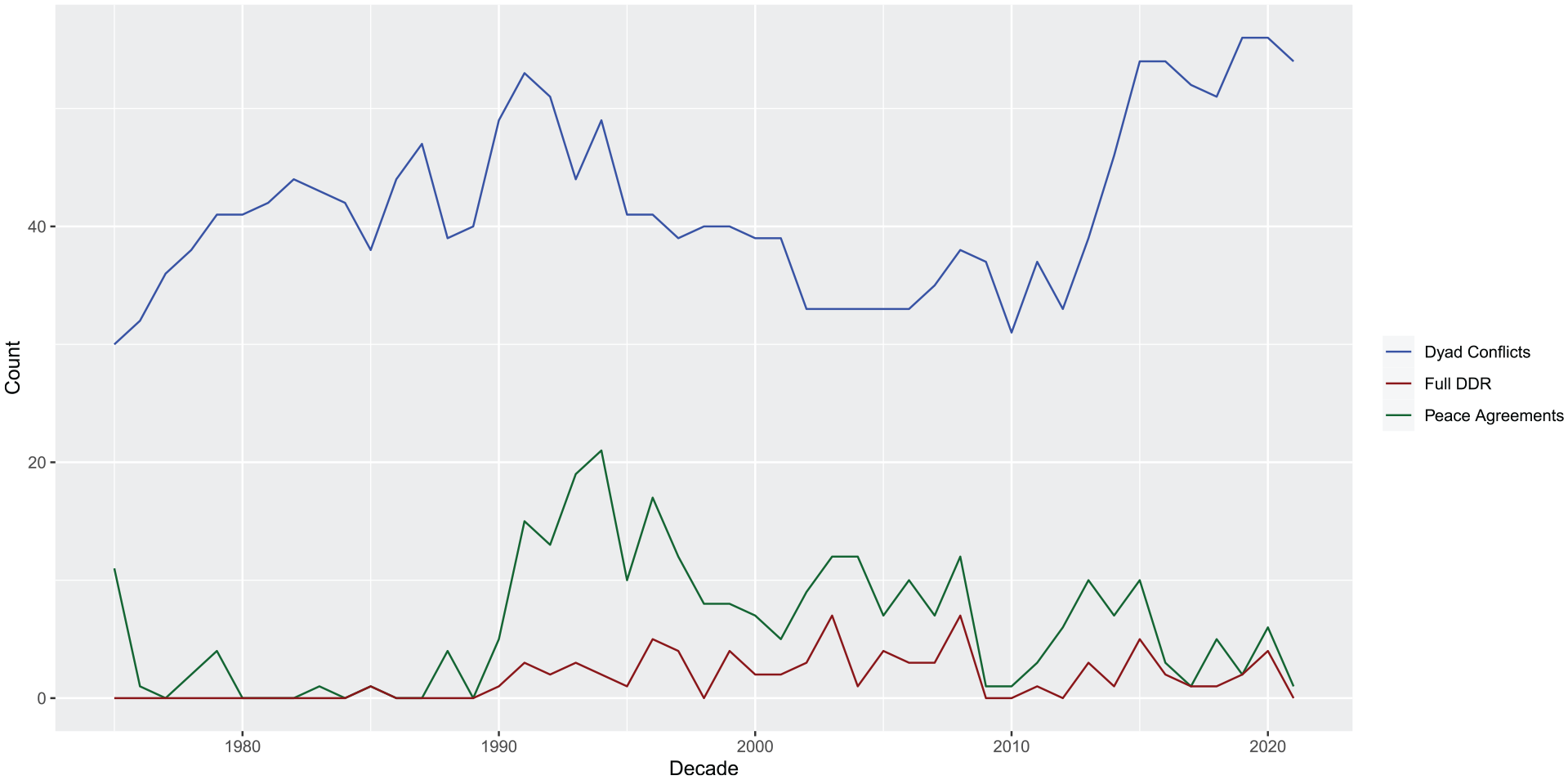
Temporal Patterns of civil wars, peace agreements and full DDR, 1975-2021.
Figure 3 shows the percentage of DDR provisions in PAs by decade. It identifies (i) disarmament, (ii) demobilization, (iii) reintegration, (iv) disarmament and demobilization, (v) disarmament and reintegration, (vi) demobilization and reintegration, and (vii) disarmament, demobilization, and reintegration. Figure 3 suggests that PAs without any DDR provision are the most common type between 1975 and 2021, accounting for nearly 55% (161) of all PAs. However, 45% of all PAs include at least one DDR component, highlighting that DDR provisions are an integral feature of PAs (Howard and Stark, 2018; UN, 2016). After the 1990s there was a significant reduction of PAs without DDR provisions.
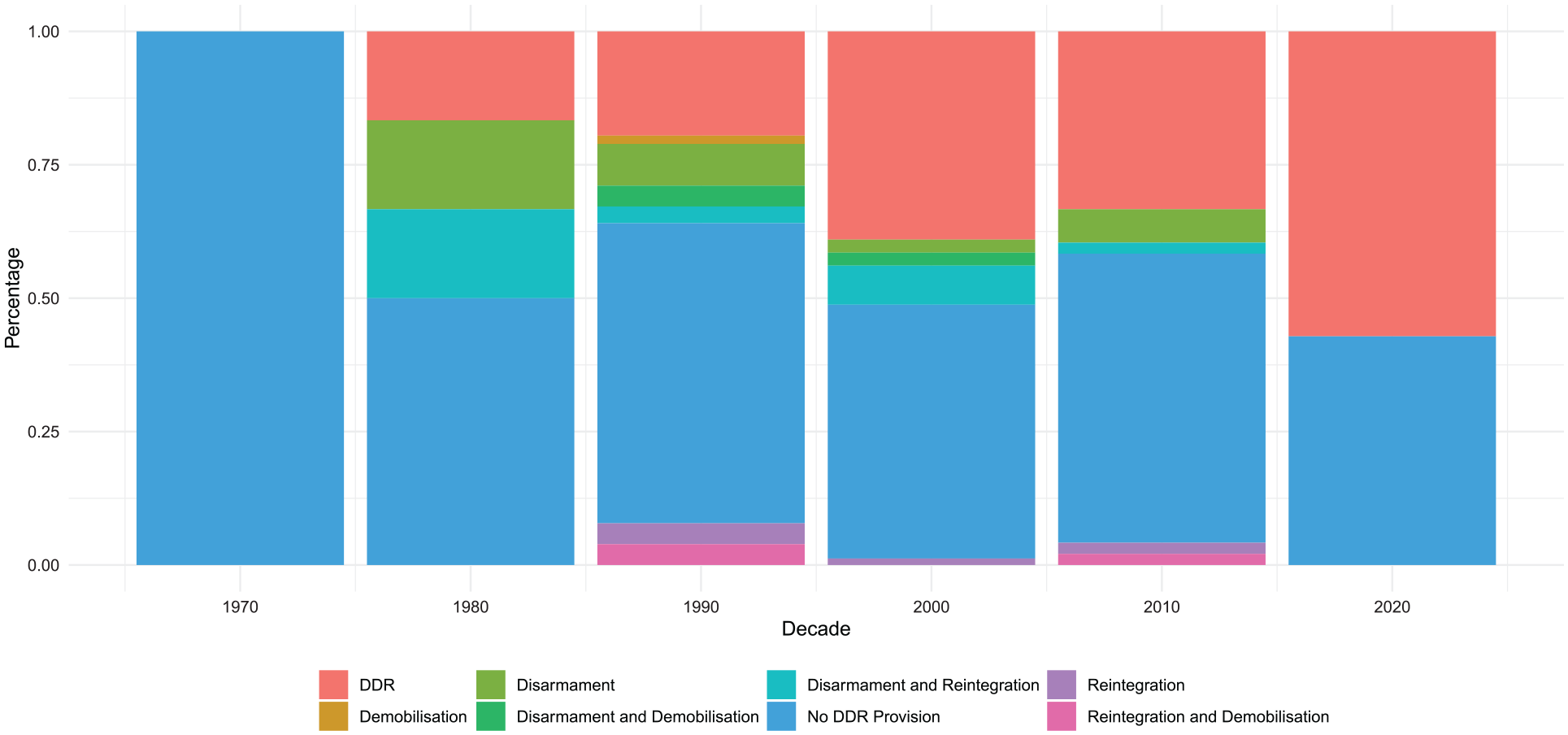
Percentage of DDR Provisions in PAs, 1975–2021.
Figure 3 shows that 27% of all the PAs (78) include the full DDR package, which has remained relatively stable over the last three decades, with a peak in the 2000s, corresponding to the ‘second generation’ of DDR programs (Muggah and O’Donnell, 2015). Despite the salience of DDR provisions over this period, we also find that DDR components often do not come together. We find that nearly 17% of all PAs incorporate only one or two components, disarmament and disarmament-reintegration being the most common. This is unsurprising since governments pursue a monopoly on violence, and disarmament implies that insurgent groups will not be able to sustain violence, at least in the short term.
The pre-eminence of disarmament and the relatively marginal presence of demobilization and reintegration components highlight that governments privilege security over social provisions to sustain peace. This is not surprising because most civil wars occur in low-income countries with limited state capacity (Hegre and Sambanis, 2006) and governments in these settings may be less capable of advancing demobilization and reintegration. Still, the relatively low share of these components is worrying because demobilization is expected to disrupt ex-combatants’ war-time social networks, and reintegration provides alternative economic opportunities (Daly et al., 2020; Schulhofer-Wohl and Sambanis, 2010).
Table 1 reports DDR provisions by region. Except for Africa, there is a lack of DDR provisions in the Americas, Asia, Europe, and the Middle East. Table 1 reveals some geographical clustering: Africa has the largest number of PAs with at least one DDR component, 81 out of 158 (51%). This is not surprising because Africa has experienced the largest number of armed conflicts. Importantly, almost 38% of all the PAs in Africa include the full DDR package, which may reflect donors’ involvement during peace settlements in the region. This contrasts with other regions, where the full DDR package is less prevalent. Moreover, Table 1 suggests that conflict actors across regions rank disarmament over other components, indicating that the trends reported above are not driven by a particular region.
DDR provisions by region.
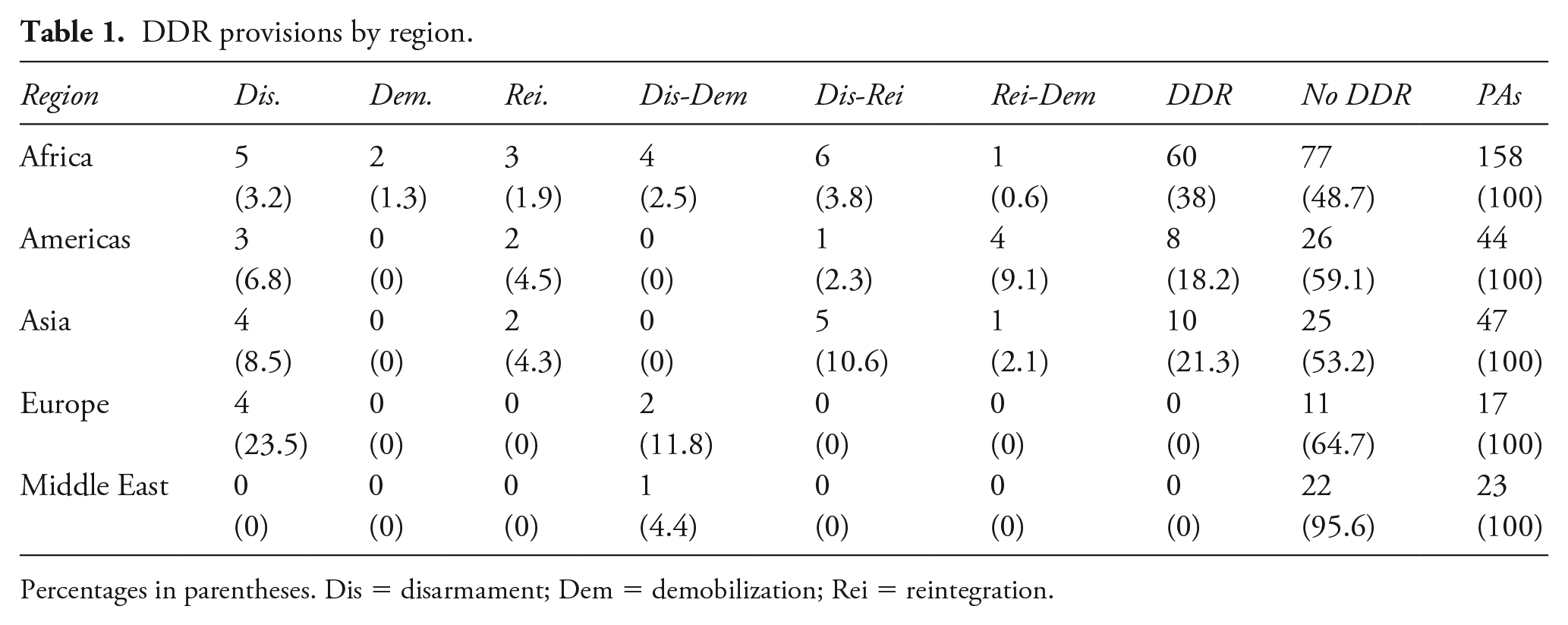
Percentages in parentheses. Dis = disarmament; Dem = demobilization; Rei = reintegration.
Actors
The DDR dataset codes whether a DDR provision provides for third-party involvement and if women and children ex-combatants are referenced in the provisions.
Figure 4a shows over-time variation in third-party involvement in PAs that include at least one DDR component, and Figure 4b shows third-party actors involvement in PAs that include the full DDR package. We consider the 1980–2021 period because there are no DDR provisions before 1980 (see Figure 3). Third parties include international organizations such as the UN, regional organizations like the African Union, and a state or a group of states.
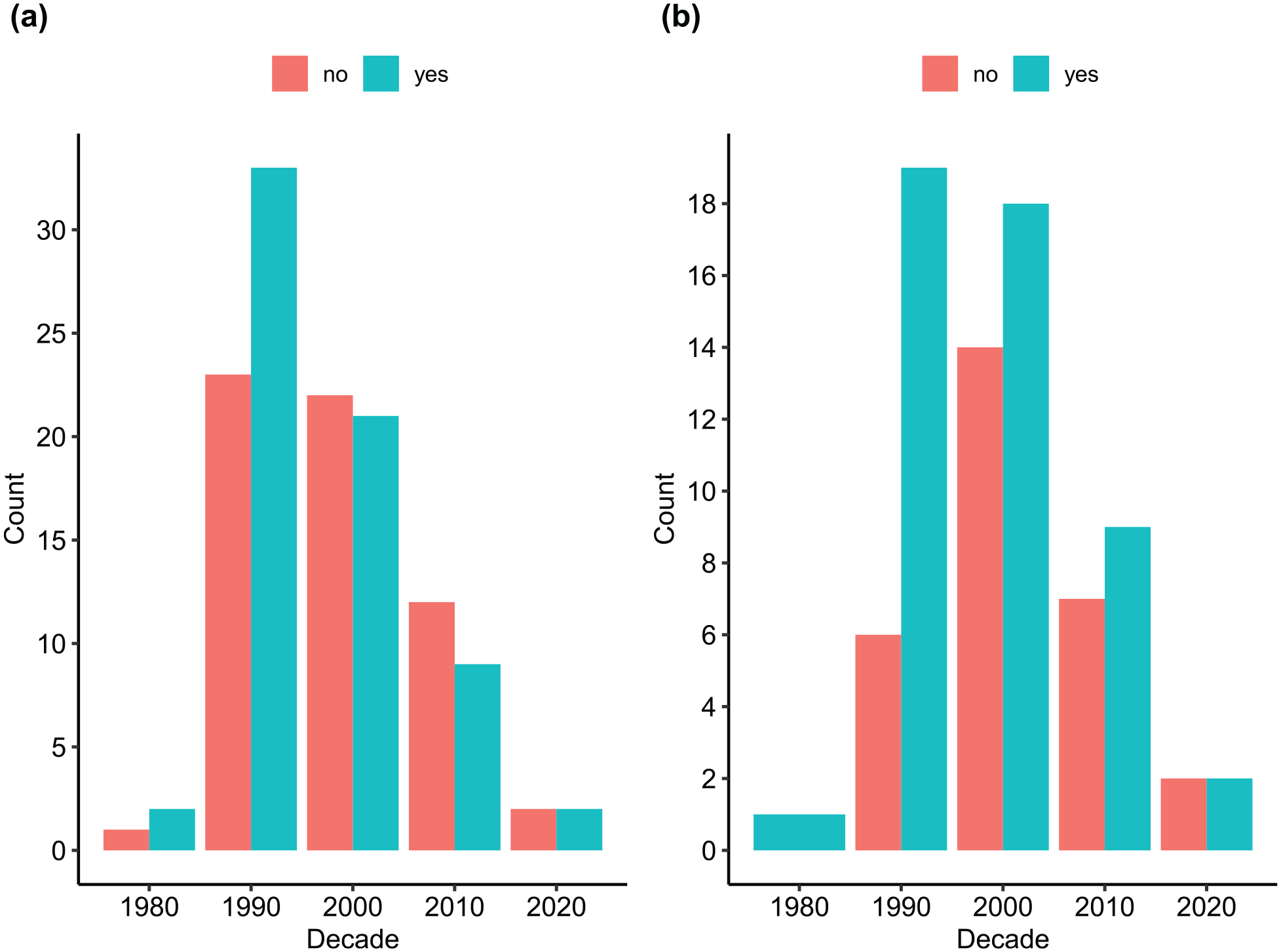
Involvement of third-party actors in DDR provisions, 1980-2021.
Figure 4 shows that third-party actors participate in 55% of the PAs with at least one DDR component. Third-party involvement peaked in the 1980s, but the number of PAs with at least one DDR component was very low at that time. Third-party actors participated in 64% of the PAs with at least one DDR component in the 1990s, reflecting the end of the Cold War. Third-party involvement in DDR provisions decreased to 49% in the 2010s. Importantly, third parties have been involved in 63% of PAs which included the full DDR package (see Figure 4b).
Figure 5 illustrates the involvement of the following types of actors and/or their joint participation in DDR provisions: (i) group of states, (ii) regional organization, (iii) UN, (iv) states and regional organization, (v) states and UN, (vi) regional organization and UN, and (vii) UN, regional organization, and states. We found that the UN is the main third-party actor in DDR, participating as a single actor or in combination with a group of states or a regional organization. Although the UN is involved in all the DDR component constellations, it is over-represented in PAs including either the full DDR package or the reintegration and demobilization components. Furthermore, while states have a relatively marginal role in third-party involvement, 6 regional organizations play an important role in PAs with the full DDR package.
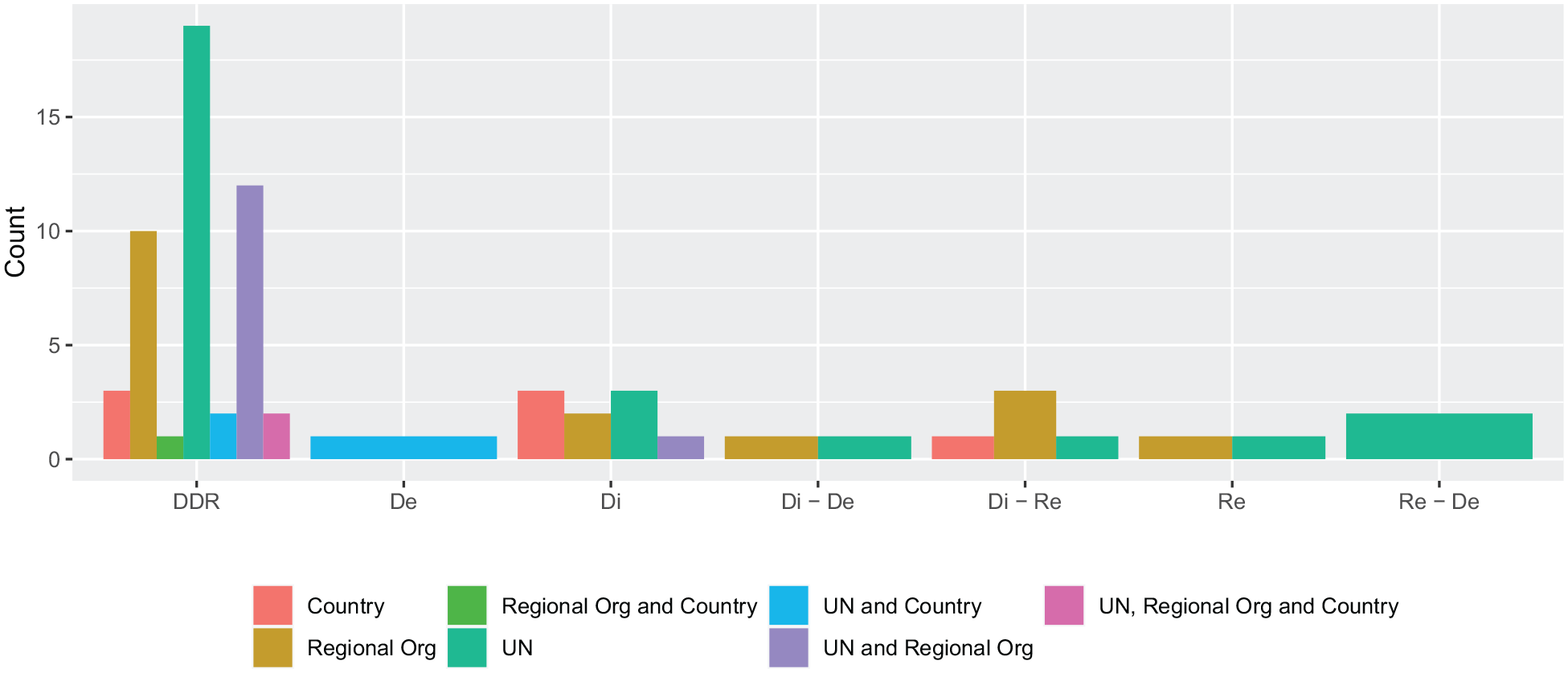
Type of involvement of third-party actors.
Figure 6 shows variation in the inclusion of children and women ex-combatants in PAs with at least one DDR component. The vast majority of these PAs do not reference children and women ex-combatants. Among the 128 PAs with at least one DDR component, only 2 contained references to women, 11 to minors, and 9 referenced both. This is worrying because children and women are often the most vulnerable actors in post-conflict environments (Annan et al., 2011), and because they perform important tasks within insurgent groups (Haer and Böhmelt, 2016; Loken and Matfess, 2023).
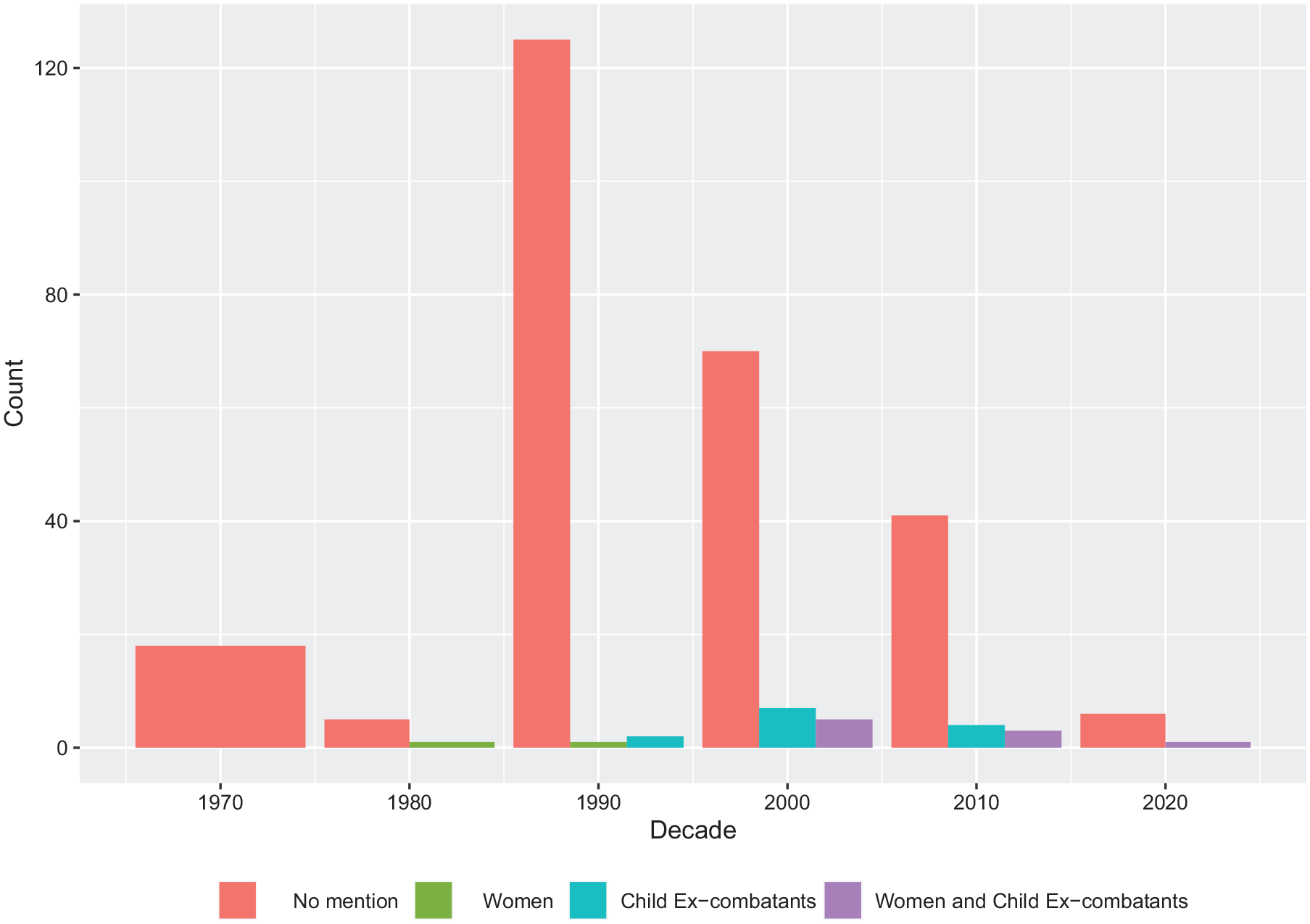
Inclusion of women and child ex-combatants in PAs with at least one DDR component, 1970–2021.
The lack of reference to these groups in DDR provisions contradicts the UN Security Council’s (2000) Resolution 1325 on Women, Peace and Security and the UN’s Integrated DDR Standards’ calls on all parties involved in DDR processes to incorporate women (IDDRS, 2006: 2).
DDR provisions in PAs: A preliminary test
We show the usefulness of our dataset by analyzing the determinants of DDR provisions in PAs. We consider all partial and full PAs between 1975 and 2021. Our dataset codes all the possible combinations of DDR provisions (i.e. disarmament, demobilization, reintegration, disarmament and demobilization, disarmament and reintegration, demobilization and reintegration, and DDR). Yet neither linear models nor multinomial or ordered response models are suitable for analyzing this outcome. The linear model fails to account for the categorical nature of the outcome, while multinomial and ordered response models produce inefficient estimates if there are seven categories or more, especially with a small sample size. We lump together a few of the original categories and report multinomial logit estimates where the outcome variable reflects PAs with (0) No provision; (1) Disarmament; (2) Disarmament and Demobilization, or Disarmament and Reintegration; (3) Demobilization, or Reintegration, or Demobilization and Reintegration, and (4) DDR. We describe our rationale in the Online Appendix.
There is no baseline model of DDR provisions in PAs; hence, we present a parsimonious model in which we regress DDR provisions against Democracy, GDP pc (logged), Third-party mediator, Conflict duration, Cumulative intensity, and Government conflict. Democracy is a binary indicator, based on the V-Dem Polyarchy Index (Coppedge et al., 2023), and GDP per capita (logged) (Fariss et al., 2022). Third-party mediator indicates whether a PA was signed/mediated/facilitated by a third-party actor (Pettersson et al., 2019). Conflict duration is the logged number of years since the conflict started, and Cumulative intensity is a dichotomous indicator coded 1 if the conflict has resulted in more than 1,000 battle-related deaths and 0 otherwise (Davies et al., 2023). Government conflict is a binary variable coded 1 if the conflict is driven by government incompatibility, and 0 if it is fought over territorial issues (Högbladh, 2022). We include decade fixed-effects to control for time-specific factors that may affect the outcome, and robust standard errors clustered on conflict dyad. The reduction in the number of observations from 289 to 265 is due to missing data for some covariates.
Table 2 summarizes the probabilistic relationship between DDR provisions and a set of covariates. Democracy increases the likelihood of the full DDR package, compared with No DDR provisions in PAs, suggesting that democracy provides more opportunities for comprehensive provisions. Table 2 displays relative risk ratios (RRR) for a more substantive interpretation of the results. For Democracy relative to Non-democracy, the relative risk for including the full DDR package is expected to increase by a factor of 3.9, holding other variables constant. The coefficient of GDP pc (logged) is positive but statistically insignificant for disarmament. Yet GDP pc (logged) is negatively and significantly related to Disarmament-Demobilization / Disarmament-Reintegration, and DDR. A unit increase in GDP pc (logged) is expected to decrease DDR by a factor of .742. These results may reflect that wealthier countries have a higher relative capacity to negotiate peace settlements, without offering demobilization and reintegration provisions to rebels. The coefficient of Third party mediator is positively signed for DDR, but this coefficient is not significant.
Multinomial logit estimates of DDR provisions in PAs.
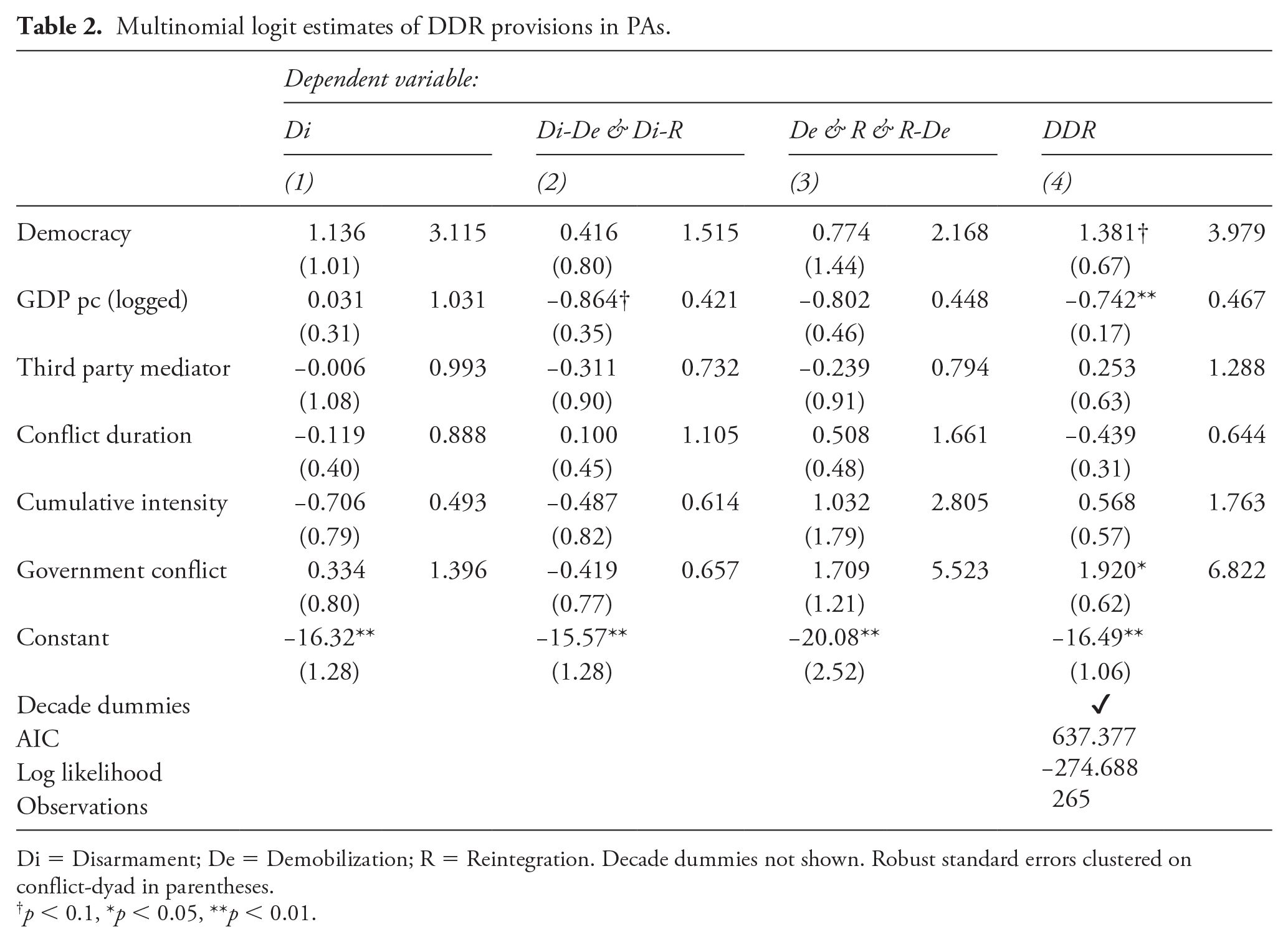
Di = Disarmament; De = Demobilization; R = Reintegration. Decade dummies not shown. Robust standard errors clustered on conflict-dyad in parentheses.
p < 0.1, *p < 0.05, **p < 0.01.
Table 2 also shows that neither Conflict duration nor Cumulative intensity significantly affects DDR. In turn, we find that Government conflict is positively linked with the full DDR package, compared to territorial conflicts. The RRR indicates that, compared to Territorial conflict, Government conflict is expected to raise DDR by a factor of 6.8, holding the other variables constant. This suggests that actors’ incompatibilities are less severe in conflicts over government than over territory, and thus governments may have more incentives to endorse full DDR provisions in PAs, relative to PAs after territorial conflict.
Our preliminary analysis reveals that different covariates have different effects on different DDR constellations, challenging standard analyses where disarmament, demobilization, and reintegration are lumped together. This highlights the usefulness of our disaggregated approach. We hope that our analysis will inspire theory-building and empirical analysis of DDR provisions in future research.
Conclusion
Conventional wisdom suggests that DDR provisions in PAs are crucial in peace-building efforts. Our dataset provides disaggregated data on DDR provisions in PAs between 1975 and 2021. The central message is that DDR provisions often do not come together: disarmament is the most common provision, while demobilization and reintegration are far less prevalent. This result highlights the potential limitations of peace settlements, particularly if the full DDR package – and not individual components – is expected to sustain peace in the long run (Schulhofer-Wohl and Sambanis, 2010).
The DDR dataset enables scholars to analyze the causes and consequences of DDR provisions. Our dataset helps to improve description and enables theory testing regarding DDR provisions. A better understanding of the determinants of DDR provisions is crucial in modeling their impact because actors behave strategically and PAs and DDR provisions may take place in contexts where sustained peace after a civil war is more likely (Gilligan and Sergenti, 2008).
The DDR dataset can motivate a new wave of research on the impact of DDR provisions. There is an expectation that DDR provisions improve the prospects of peace, but whether DDR provisions prevent conflict recurrence remains an open question. Empirical research identifying whether and which DDR component constellations can strengthen sustained peace would provide crucial input for policymakers. The DDR dataset will enable researchers to address this issue.
Footnotes
Acknowledgements
We have profited from helpful comments provided by three anonymous referees, the editor of JPR, and our colleagues. We thank Henrikas Bartusevičius, Helga Malmin Binningsbø, Gudrun Østby, Jakob Schram, Sebastian Schutte, and Chandler Williams for useful comments on an early version of this article. We also thank Pavel Baev, Jørgen Jensehaugen, Rahmat Hashemi, Stina Högbladh, and Sanja Badanjak.
Correction (February 2025):
Article updated to correct the affiliation and biography of Ida Rødningen.
Replication data

Authors statement
Conceptualization: JP, MRC, NM; Codebook: JP and NM; Data collection: JP, GM, IR; Data curation and visualization: DG; Statistical Analysis: MRC; Writing – original draft: MRC; Writing – review and editing: MRC and JP; Project administration and funding acquisition: JP.
Funding
Research funded by the Norwegian Research Council (grant no. 324997). Rivera acknowledges partial support from the Norwegian Ministry of Foreign Affairs (QZA-18/0227).
Notes
JULIA PALIK, PhD in International Relations and Political Science (Corvinus University Budapest, 2020); Senior Researcher, Peace Research Institute Oslo (PRIO, 2020–present). Recent articles in Security Dialogue and International Peacekeeping, among others.
MAURICIO RIVERA CELESTINO, PhD in Government (University of Essex, 2013); Senior Researcher at PRIO (2018–present). Recent articles in the European Journal of International Relations, European Journal of Political Research and Journal of Conflict Resolution.
DAVID GOMEZ-TRIANA, MA in Political Science (University of Oslo, 2021); Independent Researcher.
NICHOLAS MARSH, PhD in Political Science (University of Oslo, 2020); Senior Researcher at PRIO (2019–present).
IDA RØDNINGEN, MA in International Security (Sciences Po, Paris, 2019); Independent Researcher.