




Abstract
This article examines trends in organized violence based on new data from the Uppsala Conflict Data Program (UCDP). In 2023, fatalities from organized violence decreased for the first time since the rapid increase observed in 2020, dropping from 310,000 in 2022 to 154,000 in 2023. Despite this decline, these figures represent some of the highest fatality rates recorded since the Rwandan genocide in 1994, surpassed only by those of 2022 and 2021. The decrease was primarily attributed to the end of the conflict in Ethiopia’s Tigray region, which accounted for about 60% of battle-related deaths in both 2022 and 2021. Despite this positive development, the number of active state-based armed conflicts increased by three in 2023, reaching the highest level ever recorded by the UCDP, totaling 59. Non-state conflicts and one-sided violence decreased in 2023 when compared to 2022, evident in both the reduction of the active conflicts/actors and the decrease in fatalities attributed to these forms of violence. However, despite this overall decrease, fatalities resulting from non-state conflicts remained at historically high levels in 2023. Analysis of non-state conflict data spanning the past decade reveals that it comprises the ten most violent years on record. Organized crime groups have predominantly fueled this escalation. Unlike rebel groups, organized crime groups typically lack political goals and are primarily motivated by economic gain. Conflicts between these groups tend to intensify around drug smuggling routes and in urban areas, driven by shifts in alliances and leadership dynamics among the actors.
Organized violence 1989–2023 1
In 2023, the number of fatalities in organized violence decreased for the first time since it began increasing rapidly in 2020. As depicted in Figure 1, fatalities in organized violence halved from 310,000 recorded in 2022 to 154,000 in 2023. Despite this decline, these figures remain among the highest recorded since the Rwandan genocide in 1994, with only the years 2022 and 2021 surpassing them. This reduction can largely be attributed to the end of the Ethiopian intrastate conflict over government, which had consistently ranked as the most lethal conflict annually since 2020. As seen in Figure 1, fatalities decreased in all three categories of violence, though the downward trend was driven almost exclusively by the decrease in state-based violence, which recorded over 154,000 fewer fatalities in 2023 compared to 2022. Notably, the two most severe state-based conflicts in 2022, namely the conflict over government in Ethiopia and the interstate conflict between Russia and Ukraine, witnessed substantially diminished fatality rates in 2023.
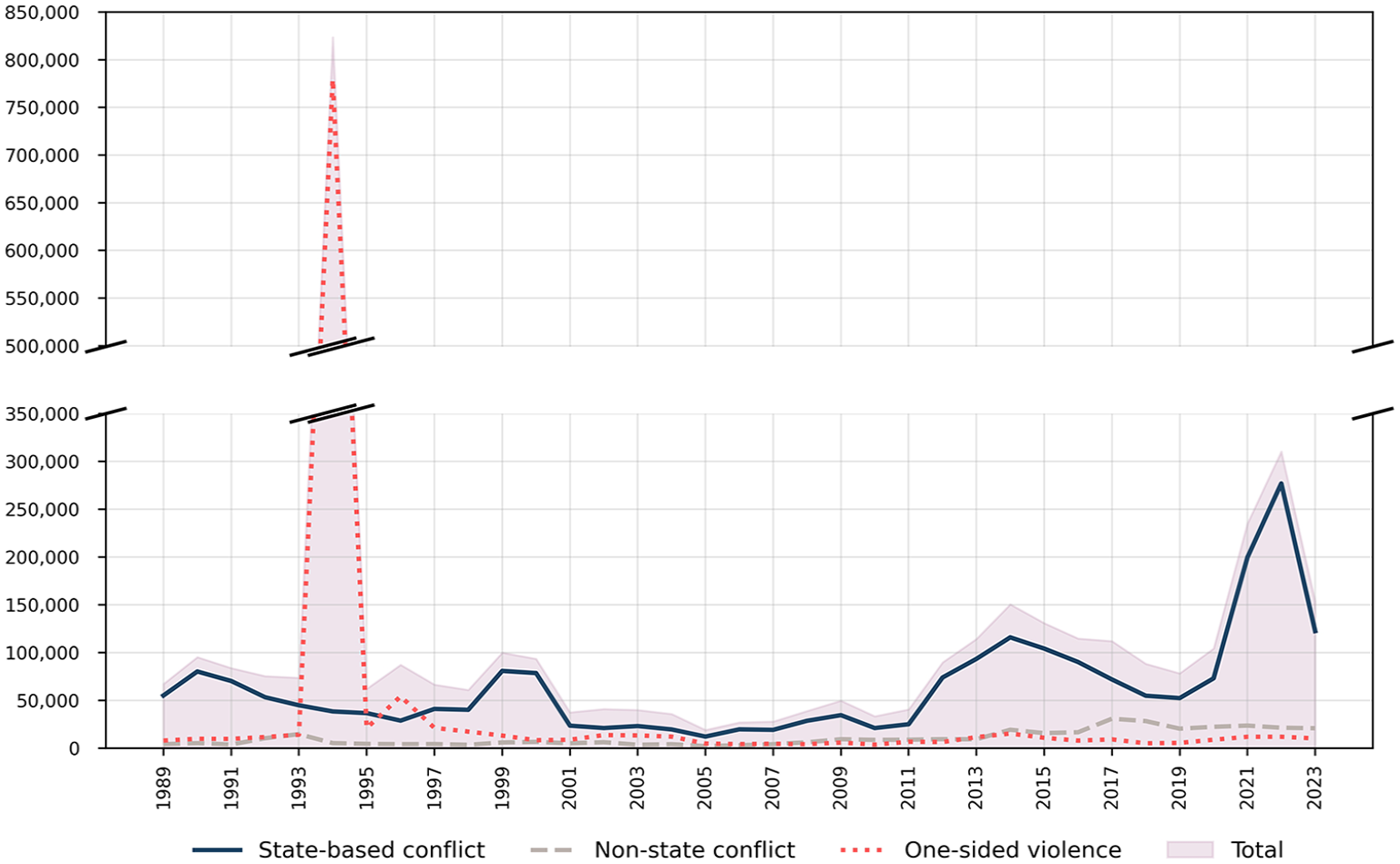
Fatalities in organized violence by type of violence, 1989–2023.
This article presents trends in the three types of organized violence with an emphasis on 2023, beginning with a section on the trends in state-based violence, followed by sections on non-state and one-sided violence, respectively. The final section examines a particular type of actor that has fueled the past decade’s extraordinarily high levels of non-state violence while remaining relatively understudied in the field of peace and conflict research, namely organized crime groups.
State-based armed conflict
Fatalities in state-based armed conflicts decreased markedly from 2022, yet remain at some of the highest levels recorded by the UCDP in the post-1989 period. In total, UCDP recorded over 122,500 battle-related deaths in 2023, less than half the nearly 277,000 fatalities documented in 2022. Despite this decline, 2023 marked the third deadliest year recorded by the UCDP since 1989, trailing only 2022 and 2021. The decrease can largely be attributed to the resolution of the conflict in Ethiopia’s Tigray region, which accounted for approximately 60% of the battle-related deaths in both 2022 and 2021. Consequently, Ethiopia witnessed about 161,000 fewer state-based fatalities in 2023 compared to the previous year. Fatality figures from Ethiopia have been significantly revised upwards for all years from 2020 onwards, based on new information on admitted losses provided by some of the warring parties themselves post-conflict. Specifically, fatality figures for the conflict between the government of Ethiopia and TPLF (Tigray People’s Liberation Front) have been revised upwards by around 62,000 in 2022, 115,000 in 2021, and 19,000 in 2020. Ukraine replaced Ethiopia as the world’s deadliest conflict in 2023, with nearly 71,000 fatalities recorded. The conflict between Israel and Hamas, which flared up in early October 2023, caused the second-highest number of battle-related deaths with over 22,000 fatalities recorded during only the last three months of the year.
Despite the reduction in fatalities, the number of state-based armed conflicts rose from 56 in 2022 to 59 in 2023, marking the highest number ever recorded by the UCDP since the data collection’s starting point in 1946. 2 State-based armed conflicts have remained at historically high levels since 2015, with an annual tally ranging from 52 to 56. This can be compared to the 31 to 39 conflicts recorded annually between 2000 and 2013. While most conflicts are relatively minor, their sheer number increases the risk of significant flare-ups, of which we have seen several in recent years. In 2023, UCDP recorded nine wars, meaning that the conflicts resulted in at least 1,000 battle-related deaths during the year. This is one more than in 2022, and the highest count since 2017. 3 Of these nine wars, five occurred in Africa, two in the Middle East, and one each in Asia and Europe. Regional conflict trends will be explored further below, after which current trends in the different types of state-based armed conflict will be discussed.
As seen in Figure 2, violence drastically decreased in Africa and, to a lesser extent, in Europe. This reduction can be attributed primarily to the end of the conflict over government in Ethiopia and a significant decrease in civilian fatalities in Ukraine. The conflict between the Ethiopian government, supported by Eritrea, and the former ruling party TPLF, broke out in late 2020. After two years of periodically extremely brutal fighting, a peace agreement was signed in November 2022, resulting in a steep decline in fatalities. However, the peace agreement caused severe divisions between the Ethiopian government and their former allies during the war, in particular with the Fano, a decentralized militia in the Amhara region which opposed the terms of the peace agreement with Tigray. Fano began its own armed struggle against the Ethiopian government, aiming to establish local rule in Amhara as well as ousting the Ethiopian president. Although the war in Amhara resulted in relatively fewer fatalities, with just over 1,200 recorded in 2023, it poses a significant risk of further escalation and of aggravating ethnic divisions within Ethiopia.
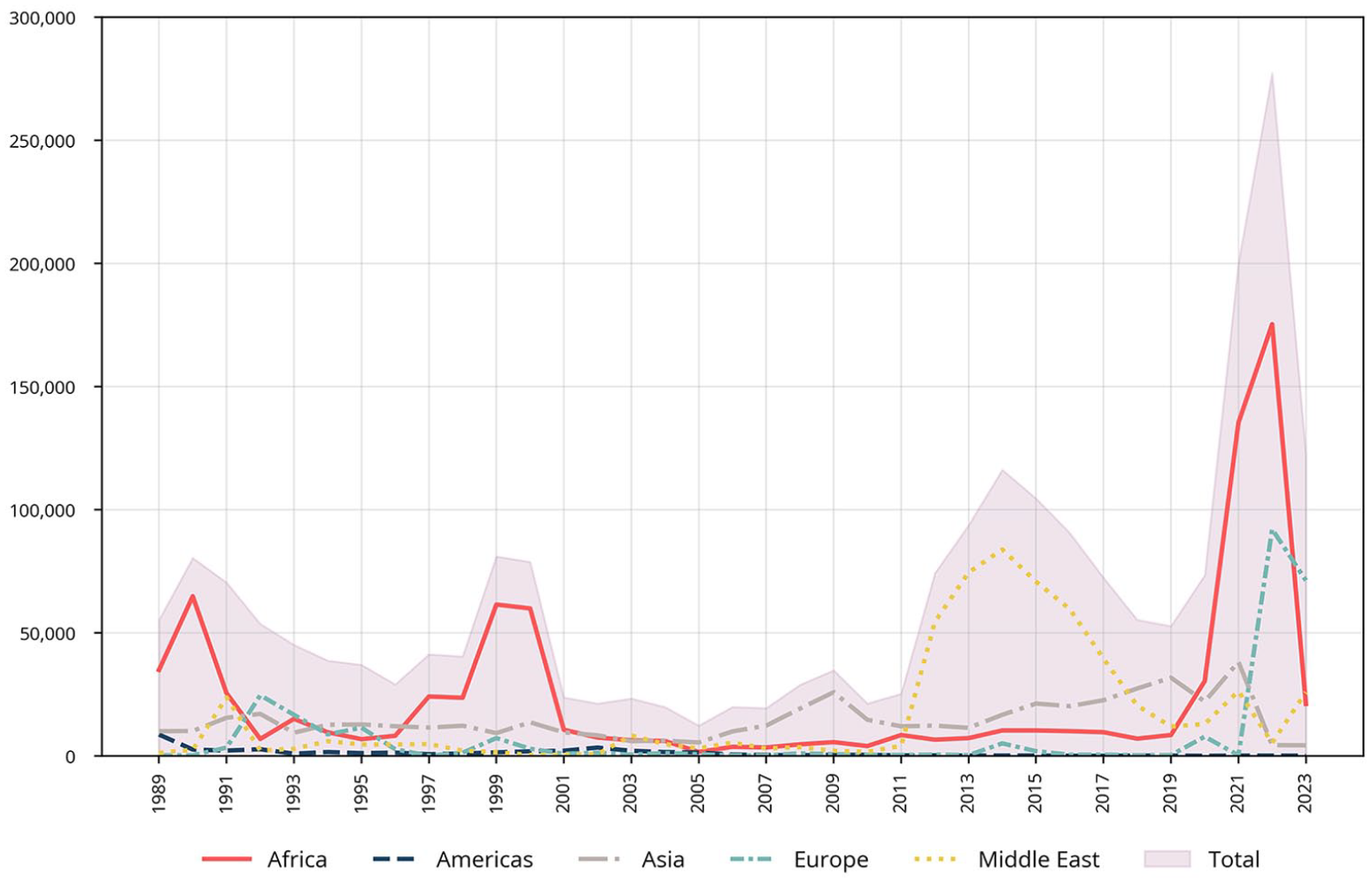
Fatalities in state-based conflicts by region, 1989–2023.
Africa remained the region with the highest number of state-based armed conflicts, a position it has held since 2013, increasing by 1 from the previous year to 28, the second highest number recorded by UCDP. 4 The deadliest conflict in Africa was the new war over government with RSF (Rapid Support Forces) in Sudan, which caused over 5,200 state-based fatalities, and thousands of interconnected non-state and one-sided fatalities. The remaining three wars, in Somalia, Burkina Faso, and Nigeria, were all active in 2022, but escalated further in 2023. The war with JNIM (Jamaat Nusrat al-Islam wal-Muslimin) in Burkina Faso saw the largest increase in violence, with more than twice as many fatalities in 2023 as in 2022.
Despite the interstate conflict between Russia and Ukraine causing nearly 71,000 battle-related deaths and being the deadliest conflict of 2023, responsible for almost 58% of all state-based fatalities during the year, violence in Europe decreased. Although around 21,000 fewer fatalities were recorded compared to 2022, combatant fatalities actually increased by a quarter, from 54,000 during 2022 to 68,000 in 2023. However, as violence shifted away from major population centers such as Kyiv, Mariupol, and Kharkiv, and instead became concentrated in largely evacuated cities such as Bakhmut and Avdiivka, the number of civilian and unknown deaths decreased by 93%, from over 37,000 in 2022 to just under 2,500 in 2023. 5
The Middle East was the only region in the world where violence increased, primarily due to the territorial conflict between Israel and Hamas. UCDP recorded over 22,000 fatalities in just three months of intense aerial and ground operations centered on the Gaza Strip following the October 7 attack by Hamas into Israel. 6 The Israel–Hamas war overturned the positive development in the region that had made 2022 the least violent year since 2011. The war threatens to derail ongoing peace processes in the region, such as the rapprochement between Iran and Saudi Arabia. This could spur further violence in Yemen, where an informal ceasefire during ongoing talks between Saudi Arabia and the Iran-aligned Ansarallah movement caused the conflict over government in Yemen to drop below the threshold for war for the first time since 2013.
On a positive note, Asia continued to record the lowest numbers of fatalities from state-based armed conflicts in the post-1989 period, with around 4,300 fatalities recorded in both 2022 and 2023. Another positive development is the decline in conflict internationalization, which will be discussed below.
Figure 3 illustrates a decline in internationalized intrastate conflicts, where one or both parties to an intrastate conflict receive troop support from an external state, in recent years. However, they remain at historically high levels with 20 such conflicts recorded in 2023, more than at any point prior to 2015, but a decrease by two since 2022, and a decline from the peak of 27 in 2020. This reduction is attributed to Western disengagement from combating transnational jihadist groups, prompted by shifts in global attention and deteriorating relations with host countries, especially in West Africa. The continued prevalence of conflict internationalization raises concerns, since research indicates that external troop involvement tends to both prolong conflicts and make them more lethal (e.g. Balch-Lindsay et al., 2008; Elbadawi and Sambanis, 2000). The average number of battle-deaths per conflict year is over four times higher compared to intrastate conflicts that are not internationalized.
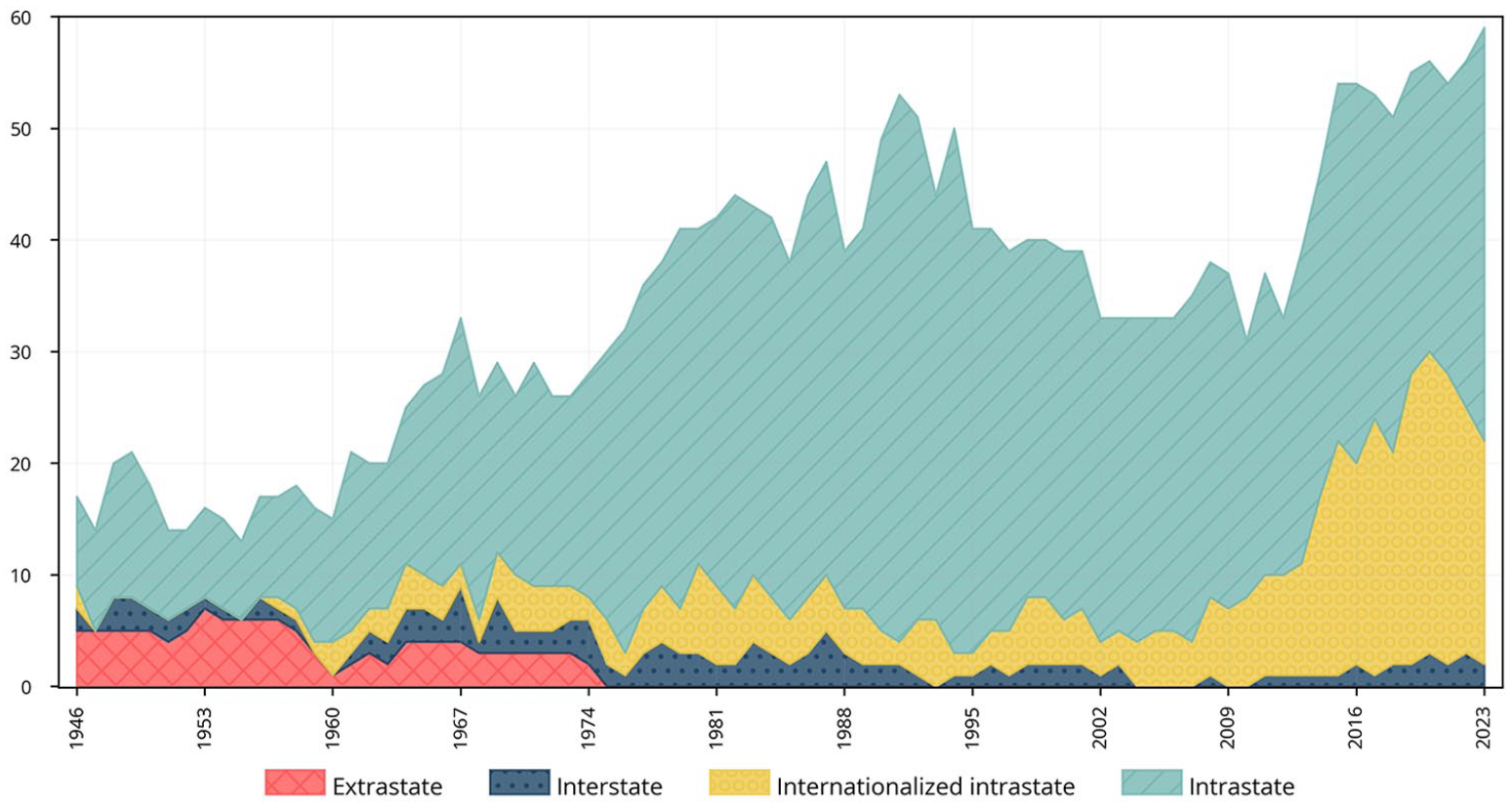
State-based armed conflict by type, 1946–2023.
The number of interstate conflicts decreased from three in 2022 to two in 2023. While interstate conflicts have been occurring more frequently in recent years, they remain relatively uncommon. Prior to 2020, the last instance of three or more interstate conflicts in a year was in 1988. Internationalized intrastate conflict, in which external states support non-state actors fighting against governments, has also increased in the past decade. This constitutes instances of state armies fighting each other outside of interstate conflicts. Whereas only seven such instances occurred throughout the entire first decade of the 2000s, the 2010s witnessed 22. The first four years of the 2020s have already recorded 17 instances, with four in 2020, 2021, and 2023, and five in 2022. 7 Increasing incidents of conflicts with two state armies involved against each other is especially concerning, as they carry the potential to be deadlier than other forms of conflict.
Non-state conflict
In 2023, UCDP documented 75 ongoing non-state conflicts, resulting in nearly 20,900 fatalities. This marked a reduction compared to 2022, with fewer conflicts recorded (down from 82) and a decrease in the number of deaths (down from over 21,400). Although there has been a slight reduction, fatalities from non-state conflicts remain at historically high levels. The data also reveal that the past decade comprises the ten most violent years on record, with organized crime groups predominantly driving this trend. In 2023, conflicts involving organized crime groups accounted for 79% of the total fatalities in non-state conflict.
Figure 4 illustrates significant regional disparities in non-state conflicts. Europe exhibits the least documented instances of non-state violence, followed by Asia. Throughout much of the post-Cold War era, Africa has maintained a relatively steady level of non-state violence, with exceptions including inter-ethnic conflicts in DR Congo and Burundi in 1993, preceding the Rwandan genocide in 1994. In contrast, the Middle East has experienced reduced violence following the turbulent years of the mid-2010s, characterized by several large-scale conflicts linked to the wars in Syria. Since 2017, the Americas have emerged as the region most severely affected by non-state violence, predominantly stemming from clashes between various criminal gangs vying for control over territories and drug trafficking routes. This trend is discussed further below. Despite a slight decrease in non-state fatalities in the Americas since the peak year of 2021, the region maintains a dominant role in the trend, contributing to 78% of the total fatalities in 2023. In 2023, nine of the ten deadliest non-state conflicts occurred in the Americas, with eight in Mexico. The Jalisco Cartel New Generation (CJNG) was involved in six of these conflicts, including the deadliest non-state conflict in 2023, pitting CJNG against the Sinaloa Cartel. CJNG has established dominance through brutality, exerting fear-based control over the population and other criminal groups. For four consecutive years, the CJNG conflict against the Sinaloa Cartel has been the deadliest non-state conflict in the world, causing between 4,000 and 5,500 fatalities annually. In total, CJNG was involved in seven different non-state conflicts, resulting in almost 10,300 deaths.
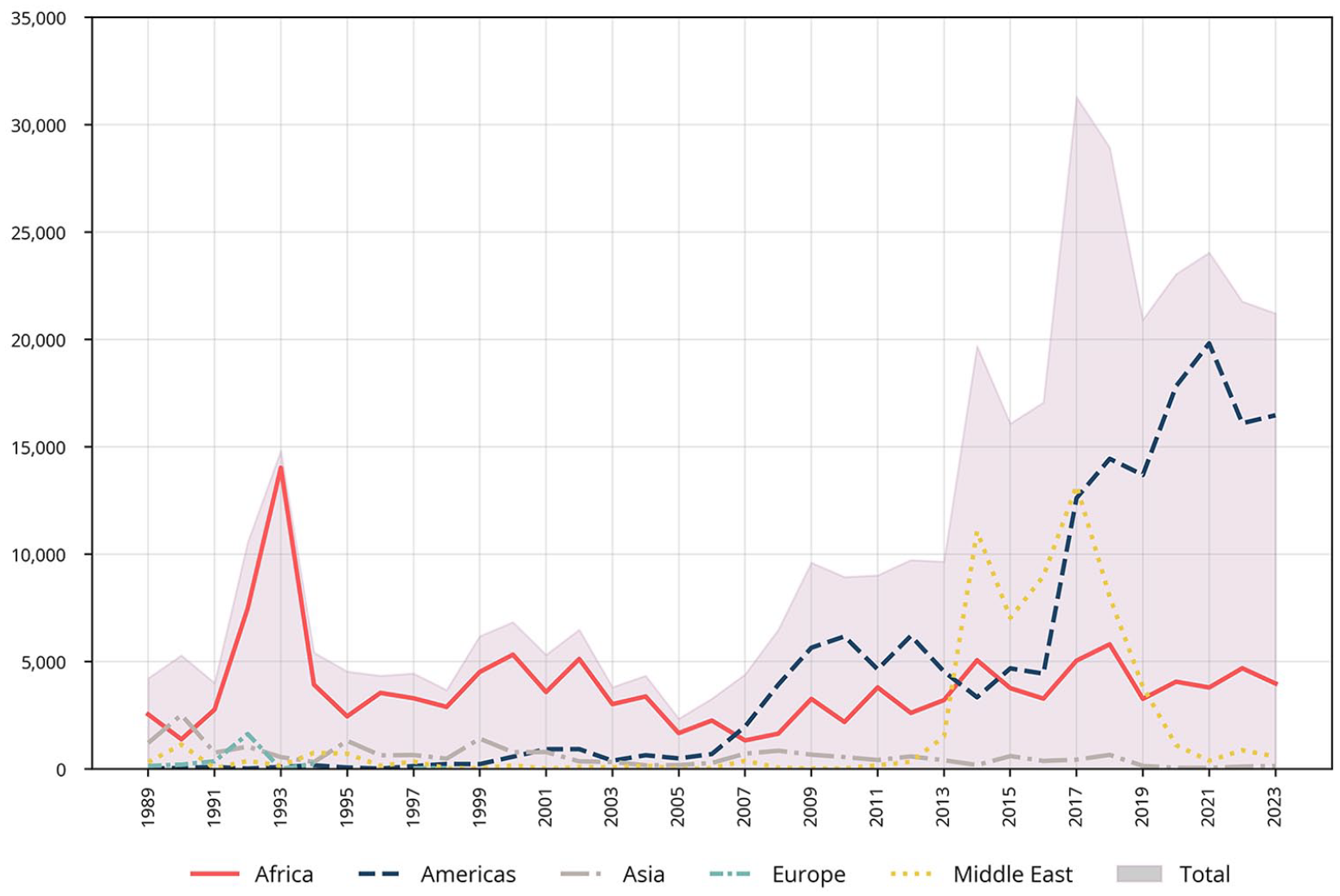
Fatalities in non-state conflict by region, 1989–2023.
For the first time since 2014, an active non-state conflict was registered in Europe. This conflict unfolded in Marseille, France, where a turf war between two rival gangs engaged in the drug trade claimed nearly 50 lives throughout the year. DZ Mafia and Yoda competed for control in the lucrative drug trafficking network within the city, leading to frequent shootouts resulting in casualties among innocent bystanders.
Non-state conflicts tend to be less lethal compared to state-based armed conflicts. States typically possess greater access to resources, weaponry, and superior training, rendering their engagements more deadly. Historically, few non-state conflicts have escalated to the threshold of at least 1,000 fatalities within a single calendar year, a criterion commonly used to define a conflict as a ‘war’ within the category of state-based armed conflicts. In fact, over 60% of all non-state conflicts result in fewer than 100 fatalities annually, with an average of 228 yearly fatalities across all non-state conflicts. With the exception of 1993, there were between one and four non-state conflicts causing 1,000 deaths or more annually from 1989 to 2016. Since then, the number of conflicts with at least 1,000 deaths per year has increased, with four to eight such conflicts occurring annually. Conflicts between drug cartels and criminal gangs in Mexico and Brazil, as well as inter-rebel fighting in connection to the Syrian wars, have resulted in numerous high-intensity non-state conflicts in the past seven years. Some of the groups involved, such as Syrian Democratic Forces (SDF) in Syria, have enjoyed support from external states, boosting their access to resources and intelligence. Others, like the CJNG, Carteles Unidos, and the Sinaloa Cartel, have become major players in the illicit economy, including drug trafficking, extortion, and money laundering, and have used their resources to build formidable armies with access to high caliber weapons and advanced technology, such as drones.
One-sided violence
In 2023, following a period marked by escalating levels of one-sided violence, there was a notable decline both in terms of the number of actors involved and civilian casualties inflicted by these actors. UCDP recorded a decrease from 49 to 42 actors involved in one-sided violence compared to 2022, marking the lowest figure since 2019. Additionally, intentional, direct killings of civilians decreased to at least 10,200 in 2023 from almost 12,000 in the preceding year.
Figure 5 illustrates that the most substantial change was observed among state actors, where killings decreased by over half compared to the previous year. Conversely, non-state actors intensified their targeting of civilians, resulting in fatalities reaching the highest levels since 2015.
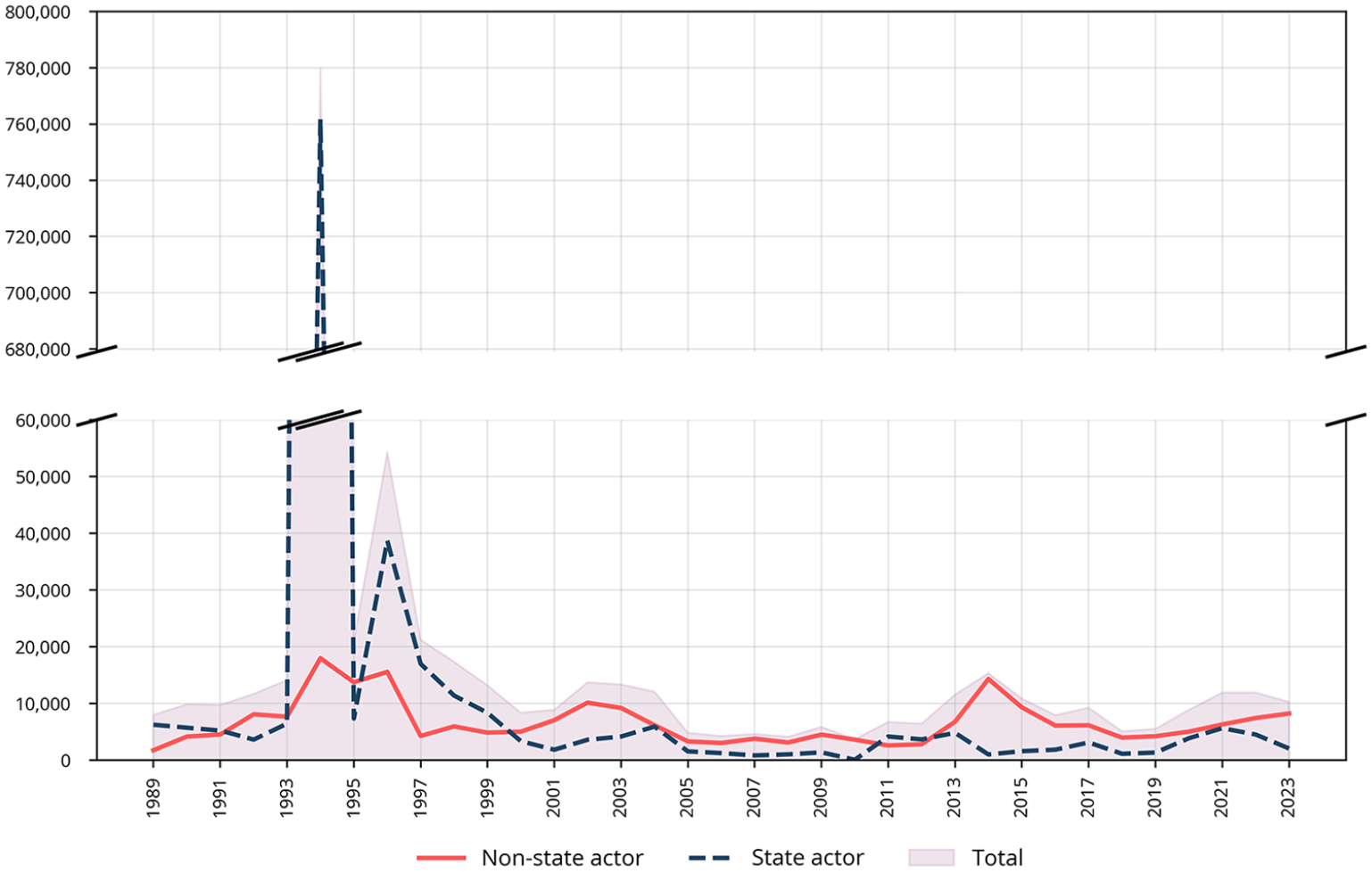
Fatalities in one-sided violence by type of actor, 1989–2023.
For the ninth consecutive year, IS was responsible for the most one-sided killings globally. Despite carrying out attacks in 16 different countries, up from 13 in 2022, total fatalities dropped from at least 3,800 in 2022, to almost 2,200 in 2023, marking a significant 43% decline. Most attacks occurred in DR Congo, Nigeria, Burkina Faso, Mali, and Niger. IS typically used small arms and light weapons in countries including Nigeria, Burkina Faso, Mali, Niger, and Syria, while short-range weapons such as knives or machetes were also common in DR Congo and Mozambique, with many beheadings recorded. In recent years, coordinated suicide attacks on civilian targets have been almost exclusively associated with the Islamic State Khorasan Province (ISKP), based in Pakistan and Afghanistan. ISKP has become infamous for its large-scale attacks on civilian targets, including schools, mosques, and churches. The Taleban government in Afghanistan has managed to suppress IS in the country, and attacks in Afghanistan decreased in 2023 compared to previous years. However, the group’s focus has shifted to the global scene and terrorist plots involving members of ISKP have been thwarted in several countries across Europe and Asia (Jadoon et al., 2023; Zelin, 2023). In January 2024, ISKP attacked a gathering of Shiite mourners in Kerman, Iran, killing around 90 people. In March 2024, the world’s attention was once again drawn to the global threat of ISKP as the group orchestrated an attack on a concert hall located in the outskirts of Moscow, Russia, claiming least 145 lives.
The second deadliest actor in one-sided violence was RSF in Sudan. Following the outbreak of civil war in April 2023, RSF has been responsible for the deaths of at least 1,700 civilians, though the UCDP’s high estimate reaches as high as 3,200. Eyewitnesses have recounted RSF’s ruthless tactics, including burning entire neighborhoods, executing individuals in their homes and on the streets, pillaging, raping, and plundering, primarily in West Darfur. Accusations of ethnic cleansing have surfaced, particularly as most victims belong to the Massalit community (HRW, 2023).
On 7 October 2023, Hamas and other Palestinian armed groups launched ‘Operation al-Aqsa Flood’ from Gaza into Israel, resulting in one of the most lethal days in terms of one-sided violence for the last year. What unfolded was a coordinated attack including both air assault and land attacks, when nearly 3,000 Hamas members breached the Gaza–Israel barrier and several thousands of rockets were fired into Israel. In addition to clashes with Israeli forces and attacks on police stations and military facilities, which are documented in the state-based conflict, Hamas carried out massacres on civilians in several kibbutzim around the Gaza strip. One of the deadliest incidents targeted a music festival near the town of Re’im, where authorities recovered the remains of at least 360 individuals. Hamas seized hundreds of hostages during the attacks on 7 October, and reports of rape, sexual assaults, mutilations, and arson surfaced (UN, 2024; Wille, 2024). UCDP registered at least 670 civilians killed by Hamas in one-sided violence during 2023, the vast majority on 7 October. While acknowledging the Israeli government’s involvement in one-sided violence, the tens of thousands of civilians killed by Israeli reprisals on Gaza since 7 October are mainly documented in the state-based category of UCDP organized violence. This category encompasses civilians killed in crossfire and in the indiscriminate types of warfare typically used by Israel, such as shelling and airstrikes.
Figure 5 further reveals that 13 state actors were responsible for one-sided violence in 2023, with the most prominent ones including the governments of Myanmar, Burkina Faso, and Russia. In Myanmar, the military junta continued to target civilians in resistance strongholds resorting to brutal tactics such as burning people alive, executions, mass detentions, rape, and other atrocities (GCR2P, 2024). Cluster munitions were also reportedly used against the civilian population (Amnesty International, 2023). Similarly, in Burkina Faso, one-sided violence occurred in the context of state-based armed conflict. The Islamist armed groups JNIM and IS have their primary base among the nomadic Peuhl (Fulani) community, which is why this ethnic group has been the focal point of government assaults on civilians suspected of affiliations with the armed groups. Both JNIM and IS also carried out large-scale one-sided violence during the year, closely connected to state-based attacks. JNIM was the world’s third most violent actor during 2023, following IS and RSF.
During 2023, the number of civilians intentionally killed by Russia decreased compared to 2022. However, many atrocities carried out by Russian forces in Ukraine were discovered and documented after Ukraine regained control of Russian-occupied territory, including mass killings in Bucha, Izyum, and Kherson. The ongoing Russian occupation of Ukrainian territory makes it challenging to fully comprehend the extent of one-sided killings in the occupied regions. In September 2023, the International Criminal Court (ICC) established a field office in the Ukrainian capital Kyiv to investigate Russian war crimes (Ukrainian Prosecutor-General’s Office, 2023). Russia continues to deny accusations of atrocities against civilians.
Trends in organized crime violence
While organized crime violence has primarily been explored through sociological and criminological lenses, its dynamics remain relatively understudied within the frameworks of peace and conflict research. Since 2018, organized crime groups have dominated UCDP’s non-state conflict category. Defined as formally organized groups primarily focused on economic gain, organized crime groups typically lack the clearly stated political goals similar to rebel groups. 8 Unlike rebel groups that struggle for regime change or independence, these groups aim to maintain and expand criminal enterprises, notably drug trafficking. Despite the absence of an ideology or political agenda to motivate their fight, fatalities resulting from conflicts between organized crime groups surpass those of conflicts involving rebel groups. This underscores the significant role of economic motives in fueling organized violence. Rather than seeking to replace legitimate state authorities, organized crime groups tend to establish parallel governance structures in areas of limited state presence, often through co-optation, intimidation, and bribery of political actors and state institutions to facilitate their illicit activities (Villa et al., 2021). Such groups pose distinct challenges compared to rebel groups due to their intricate interactions with the state.
In UCDP data, non-state violence involving organized crime groups is most prevalent in Latin America and the Caribbean. 9 As illustrated in Figure 6, organized crime violence has been increasing since the mid-2000s, with significant peaks in 2018 and 2021, driven by escalations in violence between Mexican cartels and Brazilian gangs. With organized crime violence reaching an all-time high and no end in sight, studying the patterns of violence and the circumstances under which these conflicts emerge becomes all the more important.
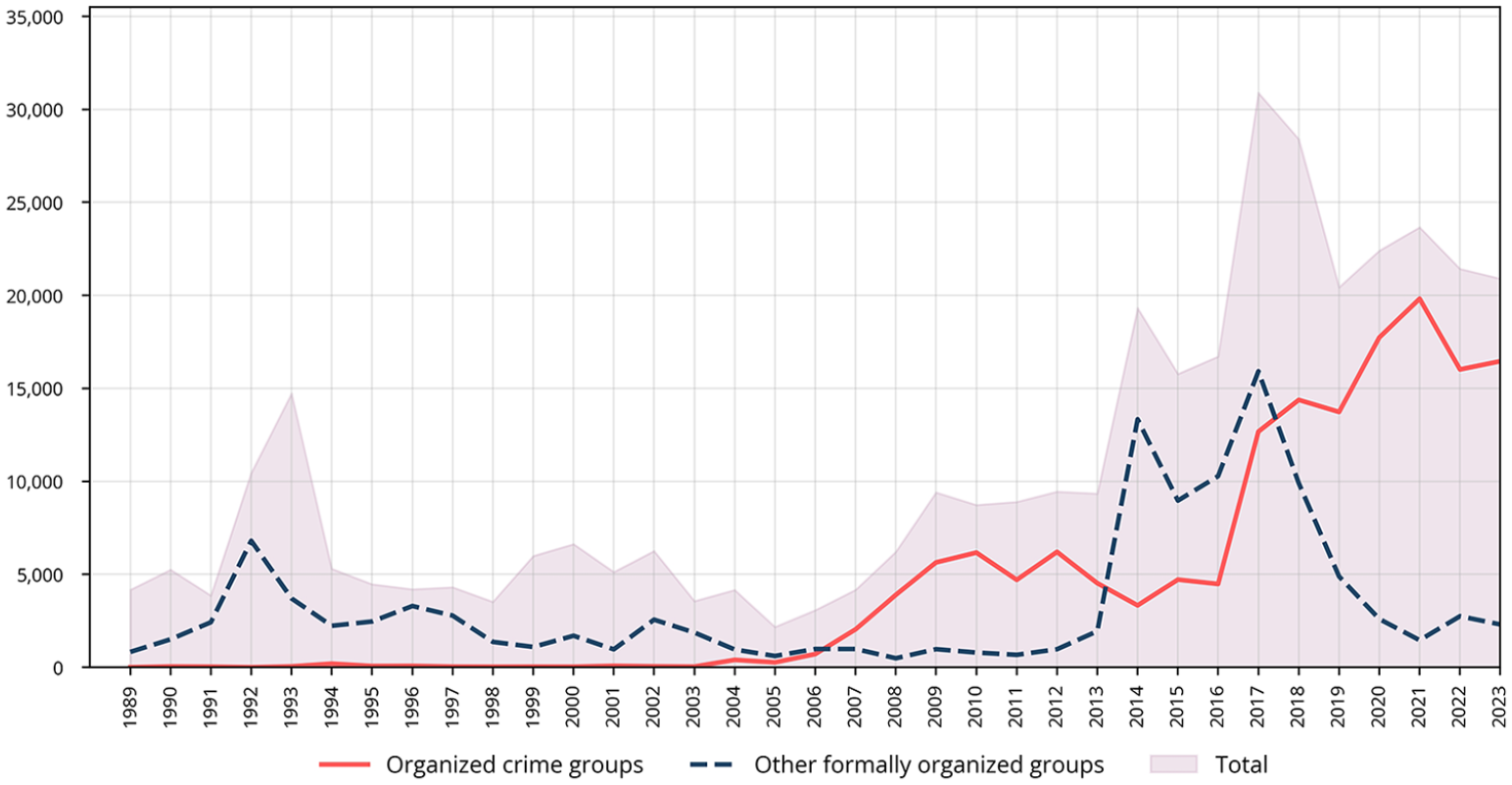
Fatalities in non-state conflicts involving organized crime groups compared to other formally organized groups, 1989–2023.
Conflicts between organized crime groups typically revolve around territorial control, resources, and smuggling routes, and are characterized by brutal acts of violence and violent messaging, such as executions, beheadings, dismemberments, and massacres. Notorious groups like Los Zetas and CJNG in Mexico and Mara Salvatrucha and Mara 18 in Central America are known for their brutality against both rival factions and civilians (Pereda, 2021; Suárez, 2023). Communicating through different channels, organized crime groups often use public banners, graffiti paintings, music, and social media to broadcast threats, claim responsibility for their actions, recruit members, and mark their territory.
Organized crime violence is particularly prevalent in urban settings, as demonstrated by the concentration of UCDP conflict events in cities and suburban areas. These groups often surge in marginalized neighborhoods or slums emerging from rapid urbanization, where resources are scarce and state presence is low (Jütersonke et al., 2009). In such areas, organized crime groups may establish governance structures providing public services and conflict resolution mechanisms, often in exchange for taxation or extortion (Lessing, 2021). Violence typically occurs as groups fight for control over drug distribution locations and other lucrative businesses. For instance, Rio de Janeiro, Brazil shows a notable concentration of conflict events, underscoring the presence of organized crime violence in its densely populated favelas. Gangs such as Comando Vermelho, Terceiro Comando, and Amigos dos Amigos have been disputing control over drug sales in the city’s favelas since the 1990s. These conflicts intensify as gangs attempt to seize control over a rival’s favela to expand their territory. Beyond the drug trade, these gangs often provide public services to communities under their control and enforce their own justice through ‘tribunals’ used to punish criminal offenses such as robbery or rape, at times killing offenders and innocent civilians (Magaloni et al., 2020). Similar patterns are observed in other urban centers across the region. In Haiti, the biggest gang coalitions, G-9 and G-Pep, have established control over neighborhoods in and around Port-au-Prince since June 2020, employing extreme violence to extend and defend their territories (UN, 2023).
Conflicts involving organized crime groups often cluster around drug smuggling routes throughout the Latin American and Caribbean regions. As notable in Figure 7, the Mexican cities of Tijuana and Ciudad Juárez, bordering the US, have been fierce battlegrounds for cartels, with over 20,000 fatalities recorded by the UCDP since 2006. The city of Acapulco along Mexico’s Pacific coast has also been heavily contested by the cartels due to its role as an entry point for drugs coming from South America. Figure 7 also highlights the intensity of organized crime violence in northern and northeastern Brazil, where port cities are key transit points for transatlantic cocaine shipments destined for Europe and Africa. For example, the port city Fortaleza and neighboring municipalities have seen the battle for control between Comando Vermelho, Guardiões do Estado (GDE), Primeiro Comando da Capital (PCC) and Massa causing thousands of deaths since 2017. Similarly, Manaus, situated along the Amazon River, appears as another focal point of conflict due to its importance in the regional drug trade, linking Brazil to Colombia and Peru (Asmann, 2018). In Acre state located by the Brazilian borders with producer countries Bolivia and Peru, criminal factions have been fighting over smuggling routes in the state capital and Rio Branco and neighboring towns since 2016.
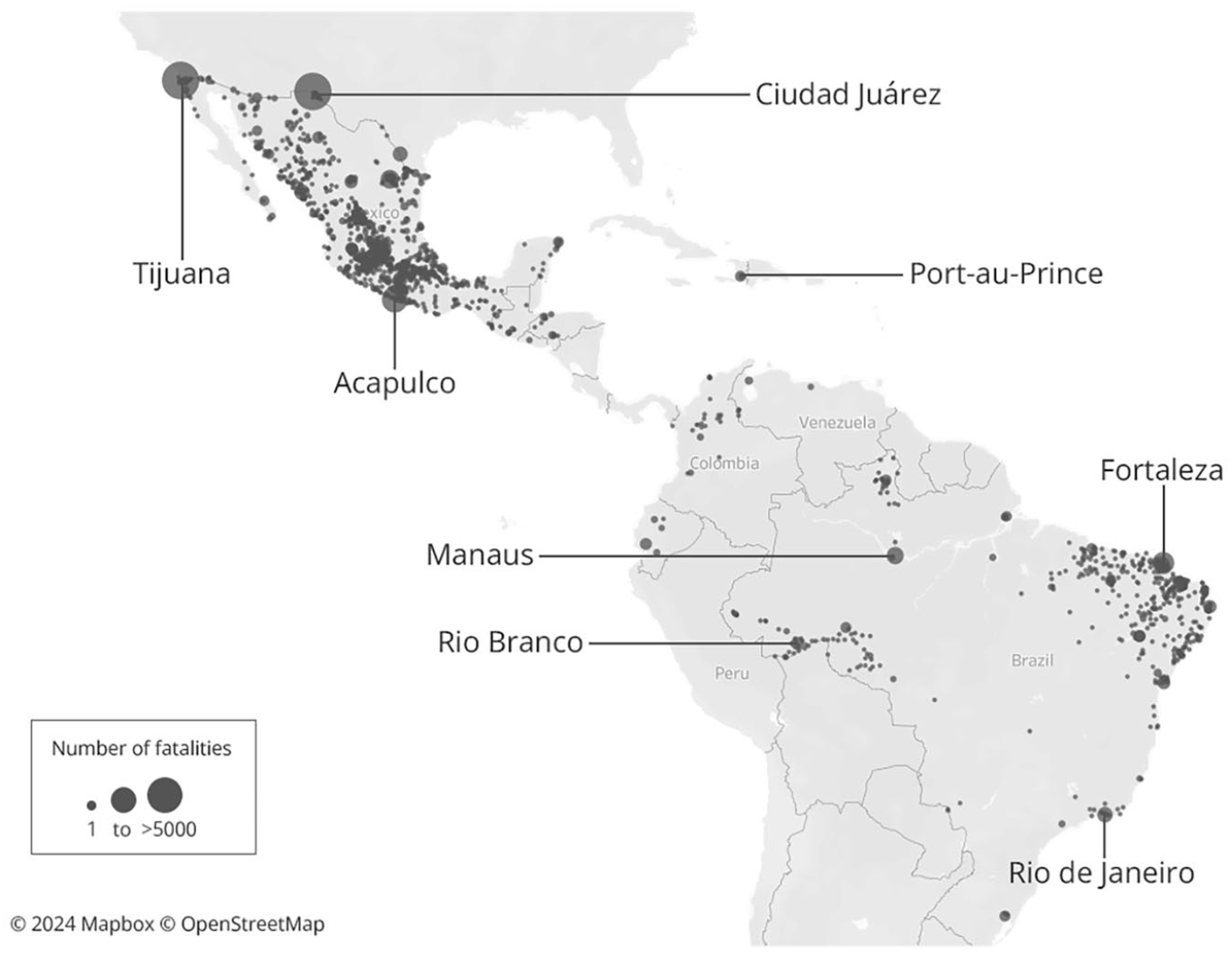
Fatalities in non-state conflict and one-sided violence involving organized crime groups across Latin America and the Caribbean, 1989–2023.
The evolution of organized crime groups is characterized by continuous cycles of strategic alliances and fragmentation, in response to internal and external pressures, often triggering increased violence (Atuesta and Pérez-Dávila, 2018). For instance, in Brazil, the breakdown of a long-standing truce between the largest groups Comando Vermelho and PCC in 2016 triggered a surge in organized crime, leading to over 300 gang-related deaths in northern and northeastern Brazil. Since then, organized crime violence in Brazil has primarily manifested in confrontations between either Comando Vermelho or PCC and local gangs allied with their rival faction. In Ecuador, organized crime violence has seen a sharp increase since 2021, after gangs Los Lobos and Los Choneros ended their alliance following the killing of Los Choneros’ leader. The involvement of Mexican cartels, CJNG and Sinaloa Cartel, further fueled the conflict, by supporting opposing factions.
Arrests of leadership figures often trigger organized crime violence, as potential successors attempt to fill the power vacuum (Phillips, 2015). In Mexico, the initiation of the ‘War on Drugs’ in 2006 and subsequent cartel crackdowns spurred violence as the original cartels fragmented into over a hundred new actors over the past decades. The arrest and extradition of Sinaloa Cartel boss ‘El Chapo’ Guzmán in 2017 caused a power struggle between his sons ‘Los Chapitos’ and Sinaloa Cartel leadership figure ‘El Mayo’ Zambada. Following an initial calm, tension reignited in 2019 after the arrest and subsequent release of El Chapo’s son Ovidio Guzmán López. He was rearrested in January 2023 and extradited to the US in September of that year. Although the Sinaloa Cartel has a long history of internal disputes, the outcome of these recent developments remains uncertain.
Conclusion
In 2023, fatalities from organized violence decreased for the first time since the rapid increase observed in 2020, with the number dropping to half of what was registered in 2022. The decrease was primarily attributed to the end of the conflict in Ethiopia’s Tigray region, which accounted for about 60% of battle-related deaths in both 2022 and 2021. Despite this decline, these figures represent some of the highest fatality rates recorded since the Rwandan genocide in 1994, surpassed only by those of 2022 and 2021. Furthermore, the number of active state-based armed conflicts increased by three in 2023, reaching a peak of 59 conflicts, the highest ever recorded by the UCDP. In non-state conflict and one-sided violence, UCDP noted a small decrease in 2023, although fatalities resulting from non-state conflicts remained at historically high levels. Analysis of non-state conflict data over the past decade reveals that it comprises the ten most violent years on record, with organized crime groups playing a predominant role. However, despite its significant impact, the phenomenon of organized crime-related violence remains relatively understudied within the frameworks of peace and conflict research.
Footnotes
Appendix 1. State-based Armed Conflicts Active in 2023
This list includes all conflicts that exceeded the threshold of 25 battle-related deaths in 2023 and fulfilled the other criteria for inclusion. 1 The column Year shows the latest range of years in which the conflict has been active without interruption. The start year is found in parenthesis in the Incompatibility column, which indicates when the armed conflict reached 25 battle-related deaths for the first time. If a conflict has been inactive for more than ten years or if there has been a complete change in the opposition side, the start year refers to the onset of the latest phase of the conflict. The column ‘Intensity in 2023’ displays the aggregated number of battle-related deaths. Thus, if more than one dyad is active in the conflict, the intensity column records their aggregated intensity. Three fatality estimates are given in the table: low, best and high.

| Location | Incompatibility | Opposition organization(s) in 2023 | Year | Intensity in 2023 | ||
| Low | Best | High | ||||
|
|
||||||
| Azerbaijan | Territory (Artsakh (Nagorno-Karabakh) (1991) |
Republic of Artsakh 2 | 2020-23 | 462 | 462 | 462 |
| Russia | Government (2023) |
LSR, RDK, Wagner | 2023 | 60 | 97 | 176 |
| Russia, Ukraine | Government/Territory (Crimea) (2022) |
2022-23 | 50896 | 70697 | 141521 | |
|
|
||||||
| Iran, Israel | Government
3
|
2018-23 | 160 | 160 | 160 | |
| Iran | Government |
Jaish al-Adl | 2023 | 34 | 34 | 34 |
| Iraq | Government
4
|
IS | 2004–23 | 203 | 203 | 205 |
| Israel | Territory (Palestine) |
PIJ, Hamas | 2021-23 | 22595 | 22659 | 22733 |
| Israel | Territory (Southern Lebanon) |
Hezbollah | 2023 | 139 | 139 | 140 |
| Syria | Government
5
|
Syrian insurgents 6 | 2011–23 | 1006 | 1006 | 1041 |
| Syria | Territory (Islamic State)
7
|
IS | 2013–23 | 458 | 458 | 564 |
| Syria | Government/Territory (Rojava Kurdistan) |
SDF | 2023 | 40 | 40 | 40 |
| Turkey | Territory (Kurdistan) |
PKK | 2015–23 | 350 | 350 | 465 |
| Yemen | Government |
Forces of the Presidential Leadership Council 8 | 2009–23 | 731 | 800 | 4710 |
|
|
||||||
| Afghanistan | Government |
AFF, NRF | 1978–2023 | 54 | 74 | 179 |
| Location | Incompatibility | Opposition organization(s) in 2023 | Year | Intensity in 2023 | ||
| Low | Best | High | ||||
| Afghanistan | Territory (Islamic State)(2015) | IS | 2015–23 | 102 | 149 | 224 |
| India | Government |
CPI-Maoist | 1996–2023 | 95 | 96 | 97 |
| India | Territory (Kashmir) |
Kashmir insurgents 9 | 1990–2023 | 111 | 119 | 173 |
| Indonesia | Territory (West Papua) |
OPM | 2021-23 | 39 | 59 | 75 |
| Myanmar | Territory (Arakan) |
ULA | 2022-23 | 80 | 80 | 140 |
| Myanmar | Government |
NUG, PSLF, CNF | 2021-23 | 1604 | 1757 | 6829 |
| Myanmar | Territory (Kachin) |
KIO | 2021-23 | 280 | 292 | 725 |
| Myanmar | Territory (Karen) |
KNU | 2021-23 | 174 | 174 | 1167 |
| Myanmar | Territory (Karenni) |
KNPP | 2021-23 | 149 | 150 | 413 |
| Myanmar | Territory (Kokang) |
MNDAA | 2023 | 49 | 49 | 169 |
| Pakistan | Government |
TTP, TJP | 2007–23 | 808 | 845 | 852 |
| Pakistan | Territory (Balochistan) |
BRAS | 2019-23 | 48 | 110 | 208 |
| Pakistan | Territory (Islamic State) |
IS | 2021-23 | 85 | 86 | 86 |
| Philippines | Government |
CPP | 1999–2023 | 164 | 164 | 167 |
| Philippines | Territory (Islamic State) |
IS | 2016-23 | 69 | 70 | 84 |
| Thailand | Territory (Patani) |
Patani insurgents 10 | 2003–23 | 19 | 30 | 30 |
|
|
||||||
| Benin | Government |
JNIM | 2022-23 | 28 | 28 | 33 |
| Burkina Faso | Government
11
|
JNIM | 2018-23 | 3771 | 3788 | 4786 |
| Burkina Faso | Territory (Islamic State) |
IS | 2019-23 | 572 | 817 | 925 |
| Location | Incompatibility | Opposition organization(s) in 2023 | Year | Intensity in 2023 | ||
| Low | Best | High | ||||
| Burundi | Government
12
|
RED-TABARA | 2019-23 | 32 | 92 | 99 |
| Cameroon | Territory (Ambazonia) |
Ambazonia insurgents | 2017–23 | 185 | 193 | 240 |
| Cameroon | Government |
JAS | 2022-23 | 108 | 113 | 138 |
| Cameroon | Territory (Islamic State) |
IS | 2023 | 33 | 53 | 67 |
| CAR | Government
13
|
CPC | 2018-23 | 223 | 230 | 251 |
| CAR | Territory (Logone)
14
|
MPC | 2023 | 31 | 31 | 31 |
| Chad | Government |
CCMSR | 2023 | 61 | 61 | 79 |
| DR Congo | Government
15
|
M23 16 | 2016-23 | 166 | 179 | 212 |
| DR Congo | Territory (Islamic State)
17
|
IS | 2019-23 | 340 | 349 | 505 |
| Ethiopia | Territory (Oromiya) |
OLA | 2019-23 | 391 | 455 | 5037 |
| Ethiopia | Government/ Territory (Amhara) |
Fano | 2023 | 1222 | 1222 | 1845 |
| Kenya and | Territory (Northeastern Province Coast) (2015) | Al-Shabaab | 2015–23 | 191 | 196 | 212 |
| Mali | Government
18
|
JNIM | 2012–23 | 900 | 913 | 1171 |
| Mali | Territory (Islamic State)
19
|
IS | 2022-23 | 182 | 182 | 215 |
| Mali | Government/Territory (Azawad) |
CSP-PSD | 2023 | 159 | 164 | 224 |
| Mozambique | Territory (Islamic State)
20
|
IS | 2019-23 | 85 | 176 | 247 |
| Niger | Government
21
|
JNIM | 2021-23 | 48 | 48 | 59 |
| Niger | Territory (Islamic State)
22
|
IS | 2015–23 | 217 | 275 | 637 |
| Nigeria | Government
23
|
JAS | 2011–23 | 251 | 464 | 502 |
| Location | Incompatibility | Opposition organization(s) in 2023 | Year | Intensity in 2023 | ||
| Low | Best | High | ||||
| Nigeria | Territory (Islamic State) 25 (2015) | IS | 2015–23 | 1279 | 1545 | 1914 |
| Nigeria | Territory (Biafra)
25
|
IPOB | 2021-23 | 98 | 116 | 138 |
| Rwanda | Government |
FDLR-FOCA | 2023 | 130 | 132 | 133 |
| Somalia | Government
26
|
Al-Shabaab | 2006-23 | 3846 | 3859 | 4851 |
| Sudan | Government |
RSF, SPLM/A-North | 2020-23 | 5292 | 5315 | 5742 |
| Togo | Government |
JNIM | 2022-23 | 26 | 26 | 43 |
|
|
||||||
| Colombia | Government |
ELN, FARC - EMC | 2018-23 | 86 | 87 | 88 |
|
|
|
|
|
|||
See online appendix for definitions.
Supported by troops from Armenia.
Israel supported by troops from United States of America.
Government supported by troops from France, Netherlands, United Kingdom, and United States of America.
Government supported by troops from Iran and Russia.
Supported by troops from Turkey.
Government supported by troops from Iran and Russia.
Supported by troops from Bahrain, Saudi Arabia, Sudan, and United Arab Emirates.
E.g. Lashkar-e-Toiba, Hizbul Mujahideen and Jaish-e-Mohammed.
E.g. BRN-C and RKK.
Government supported by troops from Mali and Niger.
Government supported by troops from DR Congo.
Government supported by MINUSCA, involving troops from Bangladesh, Benin, Bhutan, Brazil, Burkina Faso, Burundi, Cambodia, Cameroon, China, Congo, Djibouti, Egypt, Gambia, Ghana, Guinea, Indonesia, Ivory Coast, Jordan, Mali, Mauritania, Morocco, Nepal, Niger, Nigeria, Pakistan, Peru, Portugal, Romania, Rwanda, Senegal, Serbia, Spain, Sri Lanka, Sweden, Tanzania, Togo, Tunisia, Turkey, and Zambia.
Ibid.
Government supported by troops from Angola, Bangladesh, Burundi, Indonesia, Kenya, Nepal, South Africa, South Sudan, Tanzania, and Uganda.
Supported by troops from Rwanda.
Government supported by troops from Bangladesh, Indonesia, Kenya, Nepal, South Africa, Tanzania, and Uganda.
Government supported by MINUSMA, involving troops from Australia, Austria, Bangladesh, Belgium, Benin, Bhutan, Burkina Faso, Burundi, Cambodia, Cameroon, Canada, Chad, China, Czech Republic, Denmark, Egypt, El Salvador, Estonia, Finland, France, Gambia, Germany, Ghana, Guatemala, Guinea, Indonesia, Iran, Italy, Ivory Coast, Jordan, Kenya, Liberia, Lithuania, Luxembourg, Mauritania, Mexico, Nepal, Netherlands, Niger, Nigeria, Norway, Pakistan, Portugal, Romania, Senegal, Sierra Leone, Spain, Sri Lanka, Switzerland, Togo, Tunisia, Turkey, United Kingdom, and United States of America.
Ibid.
Government supported by troops from Angola, Botswana, Dr Congo, Lesotho, Malawi, Rwanda, South Africa, Tanzania, and Zambia.
Government supported by troops from Burkina Faso.
Government supported by troops from France.
Government supported by troops from Niger.
Government supported by troops from Cameroon and Niger.
Government supported by troops from Cameroon.
Government supported by AMISOM, involving troops from Burundi, Djibouti, Ethiopia, Ghana, Kenya, Nigeria, Sierra Leone, Uganda, and Zambia. Also, United States of America contributed troops on the side of the government.
Appendix 2. Non-state Conflicts Active in 2023
This list includes all non-state conflicts that exceeded the minimum threshold of 25 deaths in 2023 and fulfilled the other criteria for inclusion. 1 The column ‘Start Year’ shows the first year when the non-state conflict caused at least 25 fatalities (since 1989). The column ‘Fatalities in 2023’ displays the number of people killed, in the low, best and high estimate.
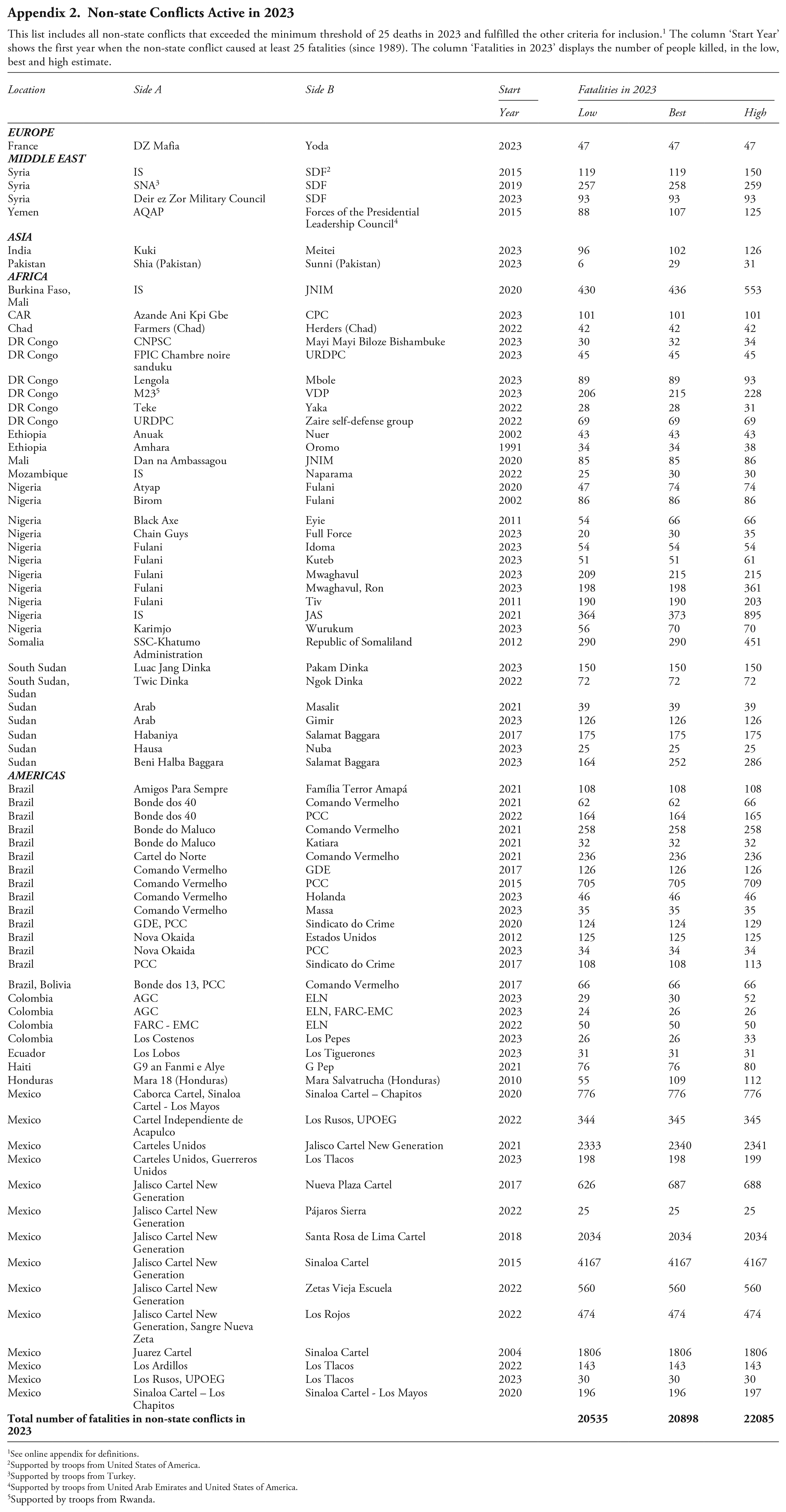
| Location | Side A | Side B | Start | Fatalities in 2023 | ||
|---|---|---|---|---|---|---|
| Year | Low | Best | High | |||
|
|
||||||
| France | DZ Mafia | Yoda | 2023 | 47 | 47 | 47 |
|
|
||||||
| Syria | IS | SDF 2 | 2015 | 119 | 119 | 150 |
| Syria | SNA 3 | SDF | 2019 | 257 | 258 | 259 |
| Syria | Deir ez Zor Military Council | SDF | 2023 | 93 | 93 | 93 |
| Yemen | AQAP | Forces of the Presidential Leadership Council 4 | 2015 | 88 | 107 | 125 |
|
|
||||||
| India | Kuki | Meitei | 2023 | 96 | 102 | 126 |
| Pakistan | Shia (Pakistan) | Sunni (Pakistan) | 2023 | 6 | 29 | 31 |
|
|
||||||
| Burkina Faso, Mali | IS | JNIM | 2020 | 430 | 436 | 553 |
| CAR | Azande Ani Kpi Gbe | CPC | 2023 | 101 | 101 | 101 |
| Chad | Farmers (Chad) | Herders (Chad) | 2022 | 42 | 42 | 42 |
| DR Congo | CNPSC | Mayi Mayi Biloze Bishambuke | 2023 | 30 | 32 | 34 |
| DR Congo | FPIC Chambre noire sanduku | URDPC | 2023 | 45 | 45 | 45 |
| DR Congo | Lengola | Mbole | 2023 | 89 | 89 | 93 |
| DR Congo | M23 5 | VDP | 2023 | 206 | 215 | 228 |
| DR Congo | Teke | Yaka | 2022 | 28 | 28 | 31 |
| DR Congo | URDPC | Zaire self-defense group | 2022 | 69 | 69 | 69 |
| Ethiopia | Anuak | Nuer | 2002 | 43 | 43 | 43 |
| Ethiopia | Amhara | Oromo | 1991 | 34 | 34 | 38 |
| Mali | Dan na Ambassagou | JNIM | 2020 | 85 | 85 | 86 |
| Mozambique | IS | Naparama | 2022 | 25 | 30 | 30 |
| Nigeria | Atyap | Fulani | 2020 | 47 | 74 | 74 |
| Nigeria | Birom | Fulani | 2002 | 86 | 86 | 86 |
| Nigeria | Black Axe | Eyie | 2011 | 54 | 66 | 66 |
| Nigeria | Chain Guys | Full Force | 2023 | 20 | 30 | 35 |
| Nigeria | Fulani | Idoma | 2023 | 54 | 54 | 54 |
| Nigeria | Fulani | Kuteb | 2023 | 51 | 51 | 61 |
| Location | Side A | Side B | Start | Fatalities in 2023 | ||
| Year | Low | Best | High | |||
| Nigeria | Fulani | Mwaghavul | 2023 | 209 | 215 | 215 |
| Nigeria | Fulani | Mwaghavul, Ron | 2023 | 198 | 198 | 361 |
| Nigeria | Fulani | Tiv | 2011 | 190 | 190 | 203 |
| Nigeria | IS | JAS | 2021 | 364 | 373 | 895 |
| Nigeria | Karimjo | Wurukum | 2023 | 56 | 70 | 70 |
| Somalia | SSC-Khatumo Administration | Republic of Somaliland | 2012 | 290 | 290 | 451 |
| South Sudan | Luac Jang Dinka | Pakam Dinka | 2023 | 150 | 150 | 150 |
| South Sudan, Sudan | Twic Dinka | Ngok Dinka | 2022 | 72 | 72 | 72 |
| Sudan | Arab | Masalit | 2021 | 39 | 39 | 39 |
| Sudan | Arab | Gimir | 2023 | 126 | 126 | 126 |
| Sudan | Habaniya | Salamat Baggara | 2017 | 175 | 175 | 175 |
| Sudan | Hausa | Nuba | 2023 | 25 | 25 | 25 |
| Sudan | Beni Halba Baggara | Salamat Baggara | 2023 | 164 | 252 | 286 |
|
|
||||||
| Brazil | Amigos Para Sempre | Família Terror Amapá | 2021 | 108 | 108 | 108 |
| Brazil | Bonde dos 40 | Comando Vermelho | 2021 | 62 | 62 | 66 |
| Brazil | Bonde dos 40 | PCC | 2022 | 164 | 164 | 165 |
| Brazil | Bonde do Maluco | Comando Vermelho | 2021 | 258 | 258 | 258 |
| Brazil | Bonde do Maluco | Katiara | 2021 | 32 | 32 | 32 |
| Brazil | Cartel do Norte | Comando Vermelho | 2021 | 236 | 236 | 236 |
| Brazil | Comando Vermelho | GDE | 2017 | 126 | 126 | 126 |
| Brazil | Comando Vermelho | PCC | 2015 | 705 | 705 | 709 |
| Brazil | Comando Vermelho | Holanda | 2023 | 46 | 46 | 46 |
| Brazil | Comando Vermelho | Massa | 2023 | 35 | 35 | 35 |
| Brazil | GDE, PCC | Sindicato do Crime | 2020 | 124 | 124 | 129 |
| Brazil | Nova Okaida | Estados Unidos | 2012 | 125 | 125 | 125 |
| Brazil | Nova Okaida | PCC | 2023 | 34 | 34 | 34 |
| Brazil | PCC | Sindicato do Crime | 2017 | 108 | 108 | 113 |
| Brazil, Bolivia | Bonde dos 13, PCC | Comando Vermelho | 2017 | 66 | 66 | 66 |
| Colombia | AGC | ELN | 2023 | 29 | 30 | 52 |
| Colombia | AGC | ELN, FARC-EMC | 2023 | 24 | 26 | 26 |
| Colombia | FARC - EMC | ELN | 2022 | 50 | 50 | 50 |
| Colombia | Los Costenos | Los Pepes | 2023 | 26 | 26 | 33 |
| Location | Side A | Side B | Start | Fatalities in 2023 | ||
| Year | Low | Best | High | |||
| Ecuador | Los Lobos | Los Tiguerones | 2023 | 31 | 31 | 31 |
| Haiti | G9 an Fanmi e Alye | G Pep | 2021 | 76 | 76 | 80 |
| Honduras | Mara 18 (Honduras) | Mara Salvatrucha (Honduras) | 2010 | 55 | 109 | 112 |
| Mexico | Caborca Cartel, Sinaloa Cartel - Los Mayos | Sinaloa Cartel – Chapitos | 2020 | 776 | 776 | 776 |
| Mexico | Cartel Independiente de Acapulco | Los Rusos, UPOEG | 2022 | 344 | 345 | 345 |
| Mexico | Carteles Unidos | Jalisco Cartel New Generation | 2021 | 2333 | 2340 | 2341 |
| Mexico | Carteles Unidos, Guerreros Unidos | Los Tlacos | 2023 | 198 | 198 | 199 |
| Mexico | Jalisco Cartel New Generation | Nueva Plaza Cartel | 2017 | 626 | 687 | 688 |
| Mexico | Jalisco Cartel New Generation | Pájaros Sierra | 2022 | 25 | 25 | 25 |
| Mexico | Jalisco Cartel New Generation | Santa Rosa de Lima Cartel | 2018 | 2034 | 2034 | 2034 |
| Mexico | Jalisco Cartel New Generation | Sinaloa Cartel | 2015 | 4167 | 4167 | 4167 |
| Mexico | Jalisco Cartel New Generation | Zetas Vieja Escuela | 2022 | 560 | 560 | 560 |
| Mexico | Jalisco Cartel New Generation, Sangre Nueva Zeta | Los Rojos | 2022 | 474 | 474 | 474 |
| Mexico | Juarez Cartel | Sinaloa Cartel | 2004 | 1806 | 1806 | 1806 |
| Mexico | Los Ardillos | Los Tlacos | 2022 | 143 | 143 | 143 |
| Mexico | Los Rusos, UPOEG | Los Tlacos | 2023 | 30 | 30 | 30 |
| Mexico | Sinaloa Cartel – Los Chapitos | Sinaloa Cartel - Los Mayos | 2020 | 196 | 196 | 197 |
|
|
|
|
|
|||
See online appendix for definitions.
Supported by troops from United States of America.
Supported by troops from Turkey.
Supported by troops from United Arab Emirates and United States of America.
Supported by troops from Rwanda.
Appendix 3. One-sided violence in 2023
This list includes all cases of one-sided violence that exceeded the minimum threshold of 25 fatalities in 2023 and fulfilled the other criteria for inclusion. 1 The column ‘Start Year’ shows the first year when one-sided violence caused at least 25 fatalities (since 1989). The column ‘Fatalities in 2023’ displays the number of civilians killed, in the low, best and high estimate.
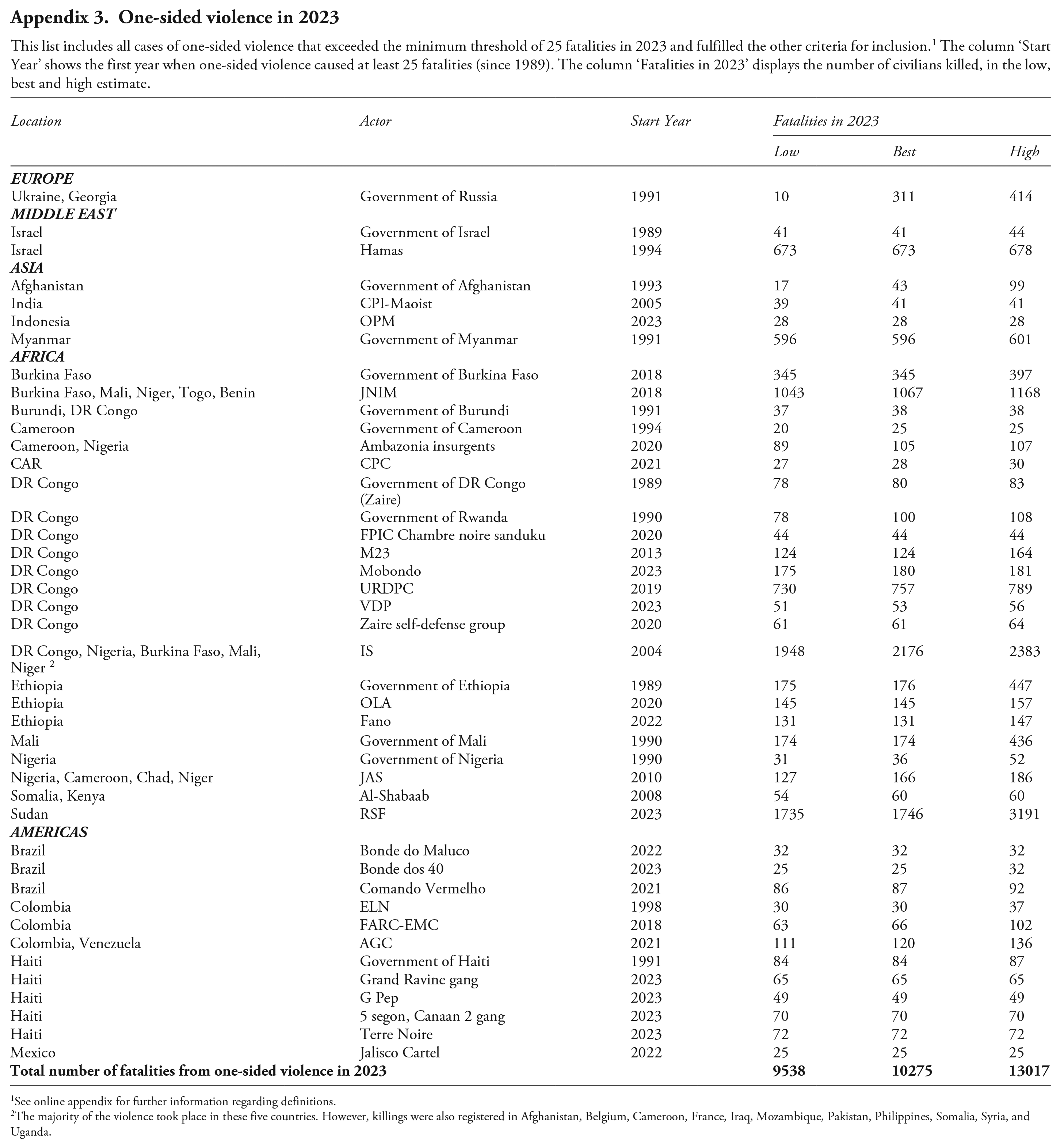
| Location | Actor | Start Year | Fatalities in 2023 | ||
| Low | Best | High | |||
|
|
|||||
| Ukraine, Georgia | Government of Russia | 1991 | 10 | 311 | 414 |
|
|
|||||
| Israel | Government of Israel | 1989 | 41 | 41 | 44 |
| Israel | Hamas | 1994 | 673 | 673 | 678 |
|
|
|||||
| Afghanistan | Government of Afghanistan | 1993 | 17 | 43 | 99 |
| India | CPI-Maoist | 2005 | 39 | 41 | 41 |
| Indonesia | OPM | 2023 | 28 | 28 | 28 |
| Myanmar | Government of Myanmar | 1991 | 596 | 596 | 601 |
|
|
|||||
| Burkina Faso | Government of Burkina Faso | 2018 | 345 | 345 | 397 |
| Burkina Faso, Mali, Niger, Togo, Benin | JNIM | 2018 | 1043 | 1067 | 1168 |
| Burundi, DR Congo | Government of Burundi | 1991 | 37 | 38 | 38 |
| Cameroon | Government of Cameroon | 1994 | 20 | 25 | 25 |
| Cameroon, Nigeria | Ambazonia insurgents | 2020 | 89 | 105 | 107 |
| CAR | CPC | 2021 | 27 | 28 | 30 |
| DR Congo | Government of DR Congo (Zaire) | 1989 | 78 | 80 | 83 |
| DR Congo | Government of Rwanda | 1990 | 78 | 100 | 108 |
| DR Congo | FPIC Chambre noire sanduku | 2020 | 44 | 44 | 44 |
| DR Congo | M23 | 2013 | 124 | 124 | 164 |
| DR Congo | Mobondo | 2023 | 175 | 180 | 181 |
| DR Congo | URDPC | 2019 | 730 | 757 | 789 |
| DR Congo | VDP | 2023 | 51 | 53 | 56 |
| DR Congo | Zaire self-defense group | 2020 | 61 | 61 | 64 |
| DR Congo, Nigeria, Burkina Faso, Mali, Niger 2 | IS | 2004 | 1948 | 2176 | 2383 |
| Ethiopia | Government of Ethiopia | 1989 | 175 | 176 | 447 |
| Ethiopia | OLA | 2020 | 145 | 145 | 157 |
| Ethiopia | Fano | 2022 | 131 | 131 | 147 |
| Location | Actor | Start Year | Fatalities in 2023 | ||
| Low | Best | High | |||
| Mali | Government of Mali | 1990 | 174 | 174 | 436 |
| Nigeria | Government of Nigeria | 1990 | 31 | 36 | 52 |
| Nigeria, Cameroon, Chad, Niger | JAS | 2010 | 127 | 166 | 186 |
| Somalia, Kenya | Al-Shabaab | 2008 | 54 | 60 | 60 |
| Sudan | RSF | 2023 | 1735 | 1746 | 3191 |
|
|
|||||
| Brazil | Bonde do Maluco | 2022 | 32 | 32 | 32 |
| Brazil | Bonde dos 40 | 2023 | 25 | 25 | 32 |
| Brazil | Comando Vermelho | 2021 | 86 | 87 | 92 |
| Colombia | ELN | 1998 | 30 | 30 | 37 |
| Colombia | FARC-EMC | 2018 | 63 | 66 | 102 |
| Colombia, Venezuela | AGC | 2021 | 111 | 120 | 136 |
| Haiti | Government of Haiti | 1991 | 84 | 84 | 87 |
| Haiti | Grand Ravine gang | 2023 | 65 | 65 | 65 |
| Haiti | G Pep | 2023 | 49 | 49 | 49 |
| Haiti | 5 segon, Canaan 2 gang | 2023 | 70 | 70 | 70 |
| Haiti | Terre Noire | 2023 | 72 | 72 | 72 |
| Mexico | Jalisco Cartel | 2022 | 25 | 25 | 25 |
|
|
|
|
|
||
See online appendix for further information regarding definitions.
The majority of the violence took place in these five countries. However, killings were also registered in Afghanistan, Belgium, Cameroon, France, Iraq, Mozambique, Pakistan, Philippines, Somalia, Syria, and Uganda.
Acknowledgements
Numerous colleagues in Uppsala have contributed to the data collection, notably, Igor Barreto, Leonard Bektas, Amber Deniz, Tania Estrada, Francisca Garcés, Helena Grusell, Victor Hasslöf, Nanar Hawach, Stina Högbladh, Amanda Löfström, Andrea Mularoni, Lotta Themnér, Anna Wadén, and Mert Can Yilmaz. Interns Maartje Blom, Mariana Brandão, Ana Carolina Castiglio, Heron Lopes, Felice Mantel, Marco Paulino, José Rojas, Daniela Sanchez, and Leticia Souza were also of great help. A special thanks to Mert Can Yilmaz for assistance with designing the figures. We also thank the editor and two anonymous reviewers for helpful comments.
Replication data
The complete UCDP datasets updated to 2023, as well as older versions of the datasets, are found at http://ucdp.uu.se/downloads/. The figures in this article were created directly from the Excel sheets at the UCDP web page. Detailed descriptions of the individual cases are found in the UCDP Conflict Encyclopedia at https://ucdp.uu.se/. Replication data for this article can be found both at http://ucdp.uu.se/downloads/ and  .
.
Funding
This work was supported by Uppsala University, the Swedish Research Council (Grant No. 2021-00162), and the Bank of Sweden Tercentenary Foundation (Grant No. IN22-0051).
Notes
SHAWN DAVIES, b. 1992, MA in Peace and Conflict Research (Uppsala University, 2018); Senior Analyst, Uppsala Conflict Data Program, Department of Peace and Conflict Research (2018–present); articles on conflict data published in Journal of Peace Research.
GAROUN ENGSTRÖM, b. 1992, BA in Development Studies (Uppsala University, 2014), BA in Linguistics (Uppsala University, 2019); Senior Analyst, Uppsala Conflict Data Program, Department of Peace and Conflict Research (2014–present).
THERÉSE PETTERSSON, b. 1982, MA in Peace and Conflict Research (Uppsala University, 2008); Project Leader and Senior Analyst, Uppsala Conflict Data Program, Department of Peace and Conflict Research (2010–present); articles on conflict data published in International Interactions and Journal of Peace Research.
MAGNUS ÖBERG, b. 1967, PhD in Peace and Conflict Research (Uppsala University, 2003); Director of the Uppsala Conflict Data Program (2018–present) and Senior Lecturer (2007–present), Department of Peace and Conflict Research; current research interests include the moral psychology of grievances, forced migration, and exposure to violence and pro-sociality; articles in inter alia Journal of Peace Research, European Journal of International Relations, Journal of Experimental Social Psychology, International Interactions, and Civil Wars.