




Abstract
Violent conflict is the key driver in global food crises. In response, researchers, humanitarians and policy stakeholders have sought to better predict, analyse and respond to food crises in conflict-affected contexts. However, efforts to model conflict’s impacts on hunger typically focus on ‘conflict’ as an aggregate category, rarely distinguishing between violence that directly involves food and food systems from wider insecurity. This study proposes a narrower measure of ‘food-related violence (FRV),’ in which food and food systems feature in acts of political violence. The study asks: to what extent is FRV a driver of food crises? To answer, it develops a measure of disaggregated food-related violence from the Armed Conflict Location & Event Dataset, then tests the comparative strength of the relationship between FRV and subsequent food crises in 16 Sub-Saharan African contexts, drawing on food security data from the Integrated Food Phase Classification system and Cadre Harmonisé. The analysis finds that FRV is more strongly correlated to subsequent food crisis than either general – or other subcategories of – violent events across the sample, pointing to the distinct profile of this modality of violence. The findings suggest that researchers, policymakers and practitioners seeking to understand and address the conflict–hunger nexus would benefit from integrating a measure of this specific modality of violence, as existing approaches with a broad focus on conflict-driven food crises may obscure the extent to which FRV, specifically, contributes to hunger.
Introduction
After years of progress in addressing global hunger, in 2017, famine was declared in South Sudan, and alerts issued for North-East Nigeria, Somalia and Yemen – all in the midst of violent conflict. By 2020, violent conflict and insecurity was recognized as the main driver of food crisis for over 100 million people globally (Food Security Information Network, 2021: 22). In response, humanitarian actors have sought to improve systems for anticipating conflict-driven food crisis, although analysis indicates that these systems remain ‘especially weak with regard to conflict analysis, or linking specific conflict acts to specific famine or crisis-related outcomes’ (Maxwell, 2019: 5). In parallel, the policy space has seen significant advancements in calls for accountability for mass starvation as an atrocity crime (de Waal, 2018). United Nations Security Council Resolution 2417 was passed unanimously in May 2018, the first to explicitly recognize the links between conflict and hunger (United Nations, 2018).
Research has also sought to advance understanding of the relationship between conflict and hunger. Over time, studies have increasingly highlighted the strategic manipulation of food in conflict, including intentional starvation in a range of contexts (Macrae & Zwi, 1992; de Waal, 1997; Marcus, 2003; Global Rights Compliance, 2019a). A growing field also explores the empirical relationship between conflict and hunger more broadly (Brück & d’Errico, 2019; Martin-Shields & Stojetz, 2019). Catalysed by advancements in micro-level data on both food security and conflict, recent research has analysed micro-dynamics, including inter alia, conflict’s effects on food production and access (Koren, 2019; Ujunwa et al., 2019) and household-level food security (Dabalen & Paul, 2014; Brück, d’Errico & Pietrelli, 2018).
While this growing agenda often explicitly recognizes important variations within and across conflicts, most disaggregated research on conflict and hunger continues to rely on measures of generalized insecurity, often aggregating diverse forms of violence into a single, undifferentiated category. The category rarely distinguishes between insecurity more widely, and that which involves food and food systems explicitly, in spite of strong reasons to believe the latter would have a particular impact on food security outcomes. As a result, to date, micro-level disaggregated data on conflict has not been widely leveraged in analyses of violence involving food and food systems specifically (cf. Koren & Bagozzi, 2017). This has implications for: (1) the potential accuracy of food crisis forecasting in conflict contexts; (2) understanding the logic of leveraging food and food systems in conflict; and (3) analysing the consequences of specific modalities of violence.
In response, this article proposes a narrower category than aggregate insecurity – ‘food-related violence (FRV).’ This is defined as violent conflict in which food and/or food systems feature in acts of political violence as either the setting in which violence takes place, the resources over which violent competition is centred, and/or the target of physical attacks. This study asks: to what extent is FRV a driver of food crises? To do this, it develops a measure of FRV from disaggregated, longitudinal conflict event data from the Armed Conflict Location & Event Dataset (ACLED). It then comparatively tests the relationship between this sub-set of violence at the subnational Admin1 level, and levels of food crisis, as measured by harmonized data from Integrated Food Phase Classification (IPC) system and Cadre Harmonisé (CH), in 16 Sub-Saharan African cases, over a period ranging from 2014 to 2020. The analysis finds that FRV is more strongly correlated to subsequent food crisis than either general, or other subcategories of, violence. As a modality, this subcategory has a distinct profile to wider insecurity that renders it particularly useful in understanding how specific subtypes of violence drive particular conflict outcomes.
The study seeks to make three contributions to scholarship. The first is empirical, as one of the first analyses to comparatively measure this specific violence modality across contexts and over time. Methodologically, the analysis also suggests that publicly available conflict data – although not specifically designed for documenting FRV– is a viable source of information on these acts. Second, the findings highlight the importance of identifying – and ultimately, preventing and resolving – FRV specifically, in efforts to address conflict-driven food crises. Third, and more widely, the study builds on a growing body of research that demonstrates the value of analysis of micro-dynamics of conflict (Cederman & Gelditsch, 2009; Justino, Brück & Verwimp, 2013). The findings suggest that far from food crises being an inevitable outcome of conflict, food and food systems play an important, and distinctive, role in contemporary violence, and there is theoretical and empirical value in increased specificity in the study of this particular modality, with potentially wider implications for scholarship and advocacy on specific protection threats beyond FRV alone.
The study proceeds as follows: the second section provides an overview of existing literature across several strands of scholarship; the third section outlines the data sources and methodology; the fourth section introduces the dataset and comparative analysis; empirical results and various sensitivity analyses are discussed in the fifth section; and the sixth section concludes by outlining implications and opportunities for further research.
Conflict and hunger: An overview
Most violent conflicts produce some degree of food insecurity, and violent conflict and insecurity are now classified as the primary driver of food crises worldwide (Food Security Information Network, 2021). Critically, however, not all conflicts produce the same level of food insecurity within or across communities (Sturge et al., 2017: 26). This points to the importance of understanding violence dynamics themselves, alongside the precise ways violence interacts with food systems.
Starvation in war: From inevitability to intentionality
Historically, extreme food insecurity was often framed as an unfortunate, but largely unavoidable, result of conflict. This is rooted in what de Waal (1997: 122) describes as the ‘idea of famine as something simple, huge and apocalyptic.’ This contributes to a persistent tendency to treat famine largely as ‘a failure to which scientific or technical solutions can be found,’ as opposed to the result of strategic actions and policies (Edkins, 2007: 51). Over time, however, scholars increasingly analysed the wider political and economic forces driving food crises (Rangasami, 1985), and highlighted the use of food as an ‘instrument’ of war (Macrae & Zwi, 1992: 299).
The use of food as a weapon of war has been documented in Yemen, Syria and South Sudan (Global Rights Compliance, 2019a, b), with recent civil society and state mobilization around demands for legal and criminal accountability for such actions (Global Rights Compliance, 2019c). However, for an act to rise to the level of a war crime, it must meet several key conditions, including that it took place in the context of an armed conflict; the perpetrator deprived civilians of objects indispensable to their survival; and the perpetrator did so with the intention to starve civilians as a method of warfare (Global Rights Compliance, 2019b: 5). This represents a relatively narrow category of violence: the specific intent to starve a civilian population may not be a feature of all violence involving food and food systems, although the latter may nevertheless have a direct, negative impact on food security outcomes.
Effectively, over time, the dominant understanding of conflict and food crises has evolved to recognize the political manipulation, and strategic functions, of extreme food insecurity. This is a valuable and important corrective to conventional framings of hunger as an inevitable consequence of conflict, but two outstanding gaps remain. First, starvation of civilians as a war crime represents a narrower category than the universe of ways in which food features in conflict, discussed further below. Second, much of the research in this vein is, moreover, generally concerned with famine – the most extreme manifestation of food crisis. Humanitarian stakeholders have continuously sought to better anticipate food crises at lower levels of food insecurity, to prevent further deterioration (see Maxwell et al., 2021). Together, these point to the value of building on key insights in this field, while broadening our analytical frame.
Conflict-driven food crises: Understanding and anticipating
Research on conflict’s wider impact on food security has also developed in several ways, increasingly demonstrating that violence dynamics – including type, frequency and intensity – are key determinants of the contours of food crises.
At aggregate levels, Gates et al. (2012: 1717) find that a median intensity conflict increases the percentage of under-nourished people in a country by 3.3%. However, conflicts vary enormously in their scale, intensity and specific interactions with food systems, producing highly differentiated impacts within and across territories, communities and even households (Sturge et al., 2017: 26). Fundamentally, not all conflicts result in the same severity of hunger: for example, studies demonstrate that conflict duration is significant for food security (Bundervoet, Verwimp & Akresh, 2009), and that cumulative effects of successive conflict cycles result in further deterioration of nutritional status (see Aldoori et al., 1994; Justino, 2012). A recent ‘revolution’ in micro-level conflict data has taken place alongside significant progress in collection and dissemination of disaggregated food security information, contributing to further advances in understanding these precise interactions (Brück & d’Errico, 2019: 169). As a result, several studies draw on disaggregated data to estimate conflict’s impact on food security.
A first group focuses on conflict occurrence and/or intensity, generally without differentiating between further features of that violence. For example, Dabalen & Paul (2014) use pre-conflict and post-conflict household data and disaggregated conflict data to test the impact of conflict occurrence on dietary diversity, though the model does not account for variation in conflict intensity or duration. D’Errico, Ngesa & Pietrelli (2020) draw on geographically and temporally disaggregated data to analyse the relationship between conflict intensity and the likelihood of receiving humanitarian assistance (including food aid), while in a regional study, Ujunwa et al. (2019) explore the relationship between conflict intensity and food security and production in West Africa.
A second strand of scholarship also draws on disaggregated conflict data, but further distinguishes between specific modalities of violence and differential impacts. George, Adelaja & Weatherspoon (2019) distinguish between battles and violence against civilians (VAC). Similarly, Sneyers (2017) distinguishes between typologies of violence, including one-sided, and low-intensity, conflict. Koren & Bagozzi (2017) study conflict motivated by food access, and its impact on VAC at different stages of conflict. While differentiating between wider conflict, battles and anti-civilian violence represents an advance, to the author’s knowledge, no micro-level study on conflict’s impacts on food security specifically differentiates types or modalities of violence beyond this.
A third body of work bridges the research, policy and practice divide in initiatives aiming to anticipate food crises. These seek to build on early warning systems to integrate measures of conflict (Lentz et al., 2019), and address the fact that conflict incidence is negatively associated with accuracy in food crisis forecasting in at least some conditions (Krishnamurthy et al., 2020; Backer & Billing, 2021). For example, the Global Report on Food Crises (Food Security Information Network, 2021) draws on ACLED data on the frequency and profile of perpetrators of violence to partly account for insecurity’s impacts on food crises. Other initiatives include the World Bank-led Famine Action Mechanism (Spencer, 2018); the World Food Programme’s Vulnerability and Assessment Mapping (World Food Programme, n.d.); and Action against Hunger’s Modelling Early Risk Indicators to Anticipate Malnutrition project for forecasting malnutrition ( Center for International Development & Conflict Management, n.d.). Each of these incorporates some form of conflict data in models seeking to anticipate – and facilitate early action to ultimately prevent – deterioration in food security. However, these initiatives typically distinguish types of violence, if at all, by differentiating between VAC and battles. There remains scope, therefore, to integrate conflict data more effectively in these systems (Maxwell, 2019) to better account for the precise impacts of violence on food crises.
Ultimately, while research on food crises is advancing in its integration of disaggregated conflict data, and consideration of characteristics of conflict – including conflict type, frequency and intensity – one particular modality, that in which food and food systems feature specifically, remains overlooked.
FRV: A more precise category
The subsections above demonstrate that scholarship in this field has made several key advances. However, a gap remains at the intersection of these bodies of research, drawing together insights from the more precise focus on food’s role in conflict, with the micro-analysis of violence dynamics.
This study seeks to address this gap by proposing a distinctive modality for analysis: FRV. This is defined as violence in which food and/or food systems feature in events of political violence as either the setting in which violence takes place, the resources over which violent competition is centred, and/or the target of physical attacks.
There are strong theoretical reasons to believe that FRV may be valuable for analysis of conflict’s impacts on hunger. First, it corresponds to a multi-dimensional concept of food security (Food and Agriculture Organization of the United Nations, 2006, 2008) that goes beyond the physical availability of food alone. Research demonstrates that food abundance and food insecurity – much like contexts affected by violence and those that are more peaceful – can coexist in close proximity (Brück & d’Errico, 2019; Koren, 2019). In capturing violence that relates to food and food systems across three dimensions – (1) the settings in which violence takes place; (2) the resources over which conflict is fought; and (3) the target of violence – the measure deliberately captures diverse interactions between violence and different components of food systems, from production, to trade and consumption. This better captures conflict’s impacts not only on food availability – through destruction of crops or loss of livestock – but also on accessibility through trade and exchange, and on household utilization and stability.
Second, this concept builds on insights from research on the starvation of civilians as a method of warfare, by recognizing the specific role food and food systems can play in conflict (de Waal, 2018). However, it differs from this existing body of research in important respects. In the first instance, key elements of this act, the intention to starve civilians, are not necessarily present. Intent is central to establishing individual responsibility and pursuing criminal accountability (Global Rights Compliance, 2019b: 8), but if our interest is in understanding how conflict drives food crises, this includes – but is not necessarily limited to – intentional starvation of civilians. For example, a violent attack on civilians carrying out agricultural work in fields in South Sudan, 1 may not have been carried out with the explicit intention of starving that population. However, this study hypothesizes that it is likely to have a detrimental impact on food security by contributing to civilians limiting mobility, not cultivating crops or doing so less often, and/or through subsequent agricultural losses.
Third, the concept is also narrower than aggregate measures of general insecurity, in a way that could more precisely identify specific impacts on food and food systems (Messer, Cohen & Marchione, 2001; Devereux, Sida & Nelis, 2017). For example, it is reasonable to assume that generalized insecurity may have an impact on transport and the movement of food items around a country and through this, on food security outcomes. However, a specific attack on a food aid convoy, 2 is likely to have a more direct and immediate effect on food security of vulnerable populations in the area than generalized insecurity. Similarly, while wider violence may negatively affect aspects of economic exchange, targeted attacks on local markets 3 may have a more direct impact on food systems through direct disruption of trade, access and consumption.
Together these point to the value of testing and assessing the relative strength of the relationship between this concept and subsequent food crises.
Methodology
The research proceeds in two stages. First, case selection and the steps involved in developing a measure of FRV are detailed; and then, a test which compares FRV measures with other forms of violence, and their relationships to food crises, is outlined.
Case selection
Sixteen Sub-Saharan African countries were included in the analysis: Benin; Burkina Faso; Cameroon; Chad; Ghana; Guinea; Liberia; Mali; Mauritania; Niger; Nigeria; Senegal; Sierra Leone; Somalia; South Sudan; and Togo. Case selection was based on several considerations. First, countries in Africa were selected because of the concentration of acute food insecurity, with almost two-thirds of all food crisis-affected populations living in Africa (Food Security Information Network, 2021: 16).
Within Africa, these cases are selected based first on availability of granular, longitudinal food security data. Drawing on publicly available datasets of food insecurity from both the CH and IPC (discussed further below), cases were excluded based on two criteria. First, where data collection years were insufficient (prohibiting longitudinal analysis and inclusion of meaningful lags of past food insecurity); and second, where data collection was recorded in administrative regions or sub-units (e.g. discrete urban centres, displacement sites, or similar) that did not correspond to designated Administrative Level 1 (Admin1) units, rendering data incompatible with corresponding independent variable and control data.
The time periods covered include years between 2014 and 2020. Owing to inconsistencies in the publicly available records of food security data, however, the time period varies over different cases, ranging for example, from 2014–2020 in Burkina Faso, Chad, Mali, Mauritania, Niger and Senegal, to just two years (2019–2020) in Cameroon, accounting for temporal lags. Online Table A1 in Appendix I summarizes the time periods of coverage for each case. The resulting dataset consists of semi-annual food insecurity data in 16 African countries, totalling 1,645 observations, and draws on, to the author’s knowledge, the most complete records of publicly available longitudinal, subnational food crisis data for Africa.
In considering the suitability of these cases for analysis, first, it is significant that all have recently experienced some level of both food crisis and violent conflict (Food Security Information Network, 2021). However, importantly, both across and within countries, levels of food crisis and violent conflict (and dynamics of conflict) vary significantly. Recorded conflict events in 2020, for example, varied from over 400 recorded in Extreme-Nord in Cameroon, to just one in Sud region of the same country. 4 The countries chosen also vary in the level of food crises, ranging from regions with no populations recorded in IPC Phase 3 (Crisis), to those with tens of thousands recorded as being in IPC Phase 5 (Catastrophe/Famine). Analysis at the subnational level, therefore, avoids selection on the dependent variable, and provides a useful test of the subnational dynamics of violent conflict and its impact on food security. Second, the countries selected are geographically diverse, representing countries in West Africa and the Sahel, Central, and East Africa. This provides a wide range of geographical, climatic and food systems conditions in which to test this relationship.
Measuring FRV
Coding categories, examples of key terms and examples of notes of included events
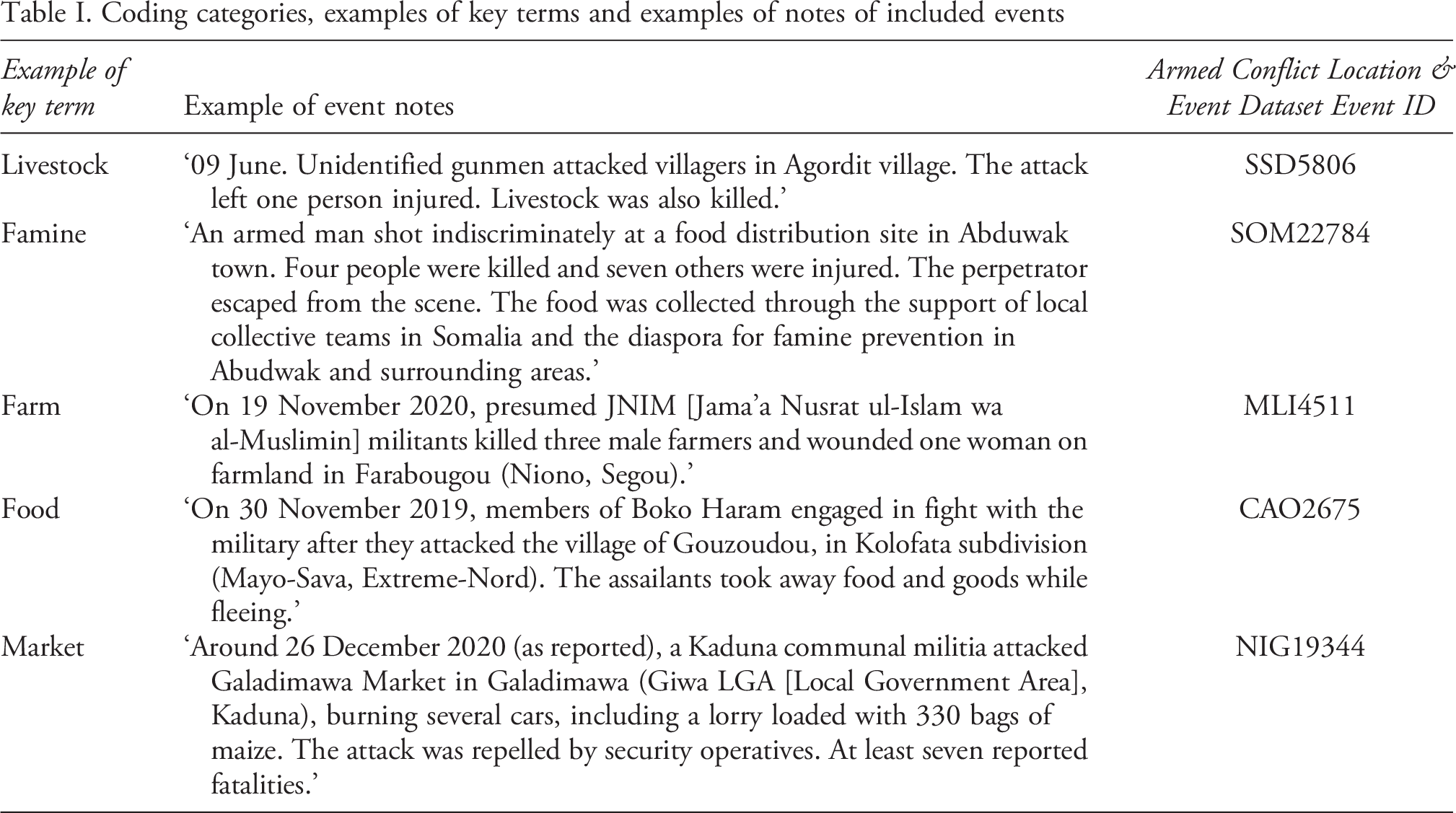
To produce the subset of food-related violent events, first, records of nonviolent events, strategic developments, and nonviolent protests are excluded. These are excluded on the basis that the focus of this analysis is on the relationship between political violence and food crises, and as such, a wider range of nonviolent actions are beyond the scope of analysis. Events coded as riots are also excluded: although food riots are an important phenomenon in themselves, these are often associated with demonstrations concerning food policy, governance and economic management (see Sneyd, Legwegoh & Fraser, 2013; Smith, 2014; Newman, 2020), with key terms related to food and food prices appearing in descriptive notes often as issues of contention, rather than the target or setting of violence. This renders them distinct from those events in which food stocks, food production systems or storage are leveraged or targeted in organized violence, often by coordinated conflict actors. Their exclusion, therefore, also partially addresses issues of reverse causality in the model, discussed further below. A full analysis of the relationship between nonviolent food-related unrest, food riots and other forms of political violence would be valuable, but is beyond the scope of this study.
Having made these exclusions, the descriptive notes of each event are coded as positive for FRV based on the presence of key search terms associated with food and food systems. Inclusion criteria for these include terms associated with key food resources (e.g. crops and livestock) as well as features of the food system (e.g. farm and market). Key terms associated with food resources such as specific crops were based on a review of the Food and Agriculture Organization of the United Nations’ list of the most important crops by production yield in the three regions of the study (Food and Agriculture Organization of the United Nations, 2021). Exclusion criteria include a range of common terms which, following an initial pilot and qualitative review of the data, were deemed likely to return false positives (e.g. football field or airfield, where the key term ‘field’ was intended to capture violence in or targeting agricultural fields). Table I gives examples of terms and events under each category; see Online Appendix I (Table A2) for a full list of terms.
Conflict and food crises
After constructing the measure of FRV, the relationship between this variable and subsequent food crisis is tested in the 16 country cases, at the Admin1 unit.
Dependent variables
Descriptive statistics of dependent variable

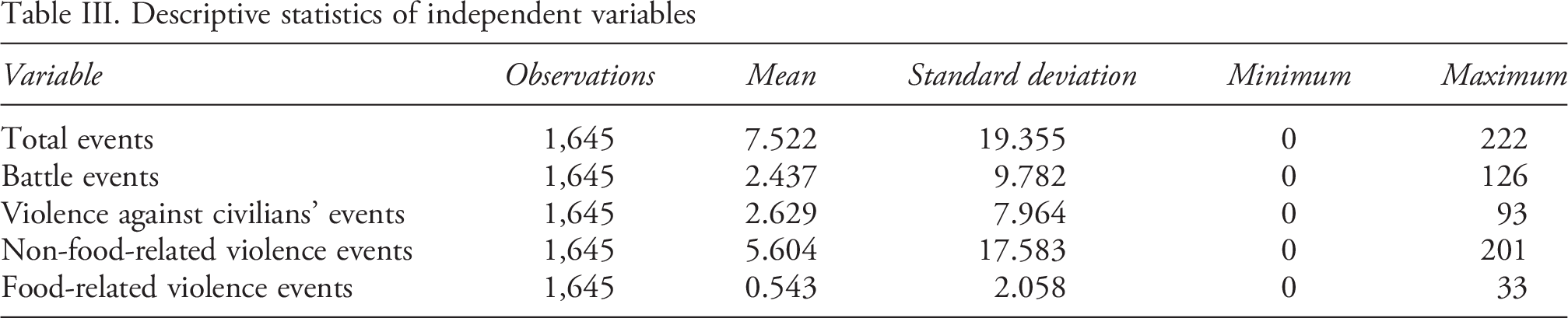
Descriptive statistics of independent variables
The IPC data are collected by analysis teams with stakeholders from across government, civil society, technical agencies and academia using the IPC Food Security Analytical Framework (Integrated Food Security Phase Classification Partners, 2018: 23–49). Data collected for the CH in West Africa are collected in a similar way, and have in recent years been harmonized with IPC data, rendering it possible to merge the two sources for analysis in all countries included ( Integrated Food Security Phase Classification Partners, n.d., OCHA Services, 2021). Phase 3 corresponds to ‘Crisis’ phase, Phase 4 to ‘Emergency’ and Phase 5 to ‘Catastrophe/Famine.’ (Integrated Food Security Phase Classification Partners, 2018) IPC/CH Phase 3 and above is a widely-used reference point for assessing food insecurity, with the percentage of the population in ‘Crisis’ or above frequently used as a simple representation of severity and for the allocation of funds (e.g. United Nations Central Emergency Response Fund, 2020).
It is important to note that estimated figures are snapshots of food crisis at given points in time, drawn from periodic data collection throughout the year. Although the precise timing of updates varies somewhat across the sample, a general pattern of collecting data once in Q1 (usually January) and once in Q3 (usually September) allows for some degree of control for seasonal changes in food security that might vary within years, and/or recur in successive years. The resulting dataset therefore contains 1,645 observations between 2014 and 2020, with gaps corresponding to periods of non-coverage in some country cases (see Online Table A1). Descriptive statistics are presented in Table II.
Independent variables
The independent variables are the count of recorded violent events per Admin1 that correspond to total, battle, VAC, non-food-related and food-related violent events that took place in the 90 days preceding the semi-annual IPC/CH estimates (Total events, Battle events, VAC events, Non-food-related violence events and Food-related violence events). A 90-day period was chosen because the impact of violent conflict on food security may take some time to take effect. For example, households whose agricultural activity is disrupted due to conflict may have stores of food to supplement their consumption in the immediate aftermath of violence, with the impact of conflict on food security evident only after the passage of time when agricultural outputs that were due to be harvested, consumed and/or sold are affected. Descriptive statistics are presented in Table III.
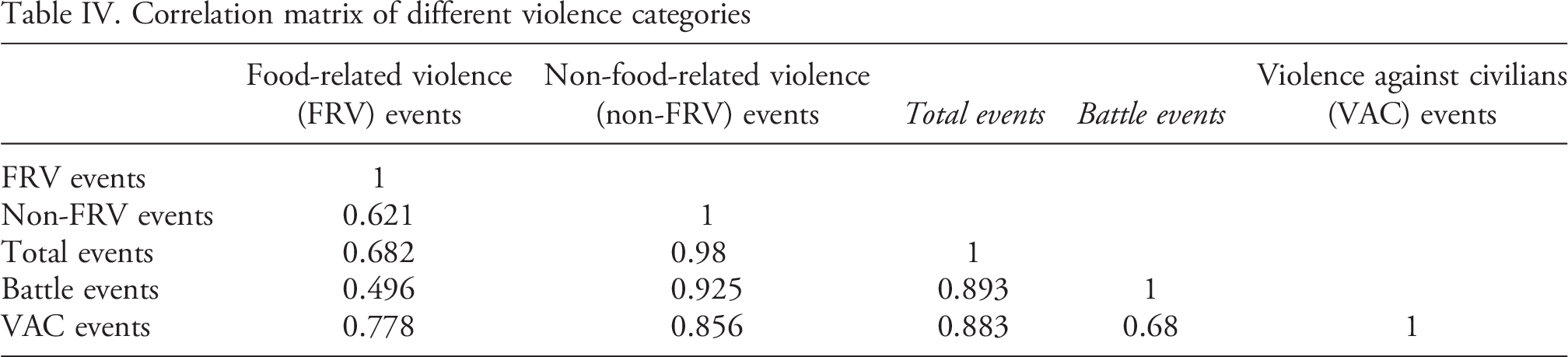
Analysis indicates that Food-related violence is substantively distinct from the other categories of violence coded. The correlation matrix presented in Table IV, illustrates that its correlation to both battle events and total events is weak to moderate, respectively, although it is more strongly correlated to VAC events (discussed further in the Results section).
Correlation matrix of different violence categories
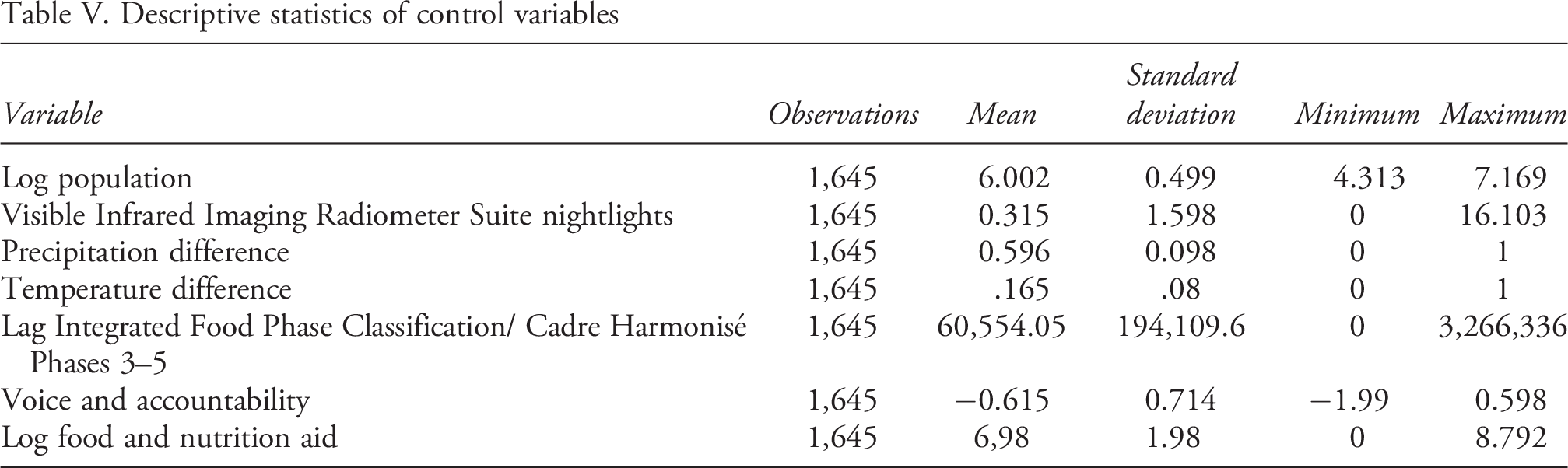
To account for the potential impact of climate factors, monthly measures of air temperature and precipitation are drawn from the Climatic Research Unit climate dataset 4.05 (Harris et al, 2020), a high-resolution monthly grid of land-based climate observations, including mean temperature and precipitation. Adapting an approach in similar studies (see Raleigh & Kniveton, 2012; von Uexkull, 2014; Raleigh, Choi & Kniveton, 2015; Koren & Bagozzi, 2017), variables capturing the impact of climatic factors are constructed in the following way: first, the mean precipitation and temperature for each Admin1 unit for the three months preceding food security estimates were calculated; next, precipitation and temperature averages for the preceding five years in the same three-month period were calculated; and finally, the difference between the most recent three-month period, and the five-year average for that period, was calculated. Because research suggests that variability in either direction (e.g. either unusually high or low levels of rainfall) is significant for both food security and violence, the measure of variability is normalized as a standard deviation from 0. The result is two measures, Precipitation difference and Temperature difference, which capture deviation from long-term means that is sensitive to seasonal and context-specific trends. 7 In robustness tests, the five-year period from which variability is calculated is substituted for 15-year and 30-year periods to account for medium-term and longer-term trends, respectively.
At national level, controls include an annual measure of governance, proxied by the ‘Voice and Accountability’ measure in the Worldwide Governance Indicators (Voice and accountability). This is a composite measure drawn from a range of sources capturing, inter alia, freedom of expression and free media, to control for the possible impact of public pressure and media coverage on response to either conflict and/or humanitarian consequences (Kaufmann, Kray & Mastruzzi, 2010). A logged estimate of annual, incoming food security and nutrition official development assistance in each country, measured in USD (Log food and nutrition aid) from the United Nations Office for the Coordination of Humanitarian Affairs’ Financial Tracking System ( United Nations Office for the Coordination of Humanitarian Affairs, n.d.) is also included to control for the potential impact of incoming aid on food crisis. Descriptive statistics are presented in Table V.
Following Koren & Bagozzi (2017), the base model is run using negative binomial regression, due to over-dispersion of the dependent variable. However, as almost 80% of observations have a value of 0 for IPC/CH Phases 3–5, this likely reflects the many observations in which food crisis was highly improbable, rather than conditions in which FRV could have driven food crisis, but did not. Consequently, models are also run with a zero-inflated negative binomial (ZINB) regression. Given that local conditions are likely to significantly affect both food and conflict systems, models are run using clustered standard errors at Admin1 level, to partly account for otherwise unmodelled characteristics at the subnational level.
Caveats and limitations
Descriptive statistics of control variables
On the independent variable, it is important to note that ACLED data are not coded with the aim of documenting violence featuring food and food systems specifically, and so descriptive notes may not be recorded in such a way as to document these acts explicitly, even if they were features of a violent event. On the one hand, therefore, there is a risk that the dataset under-estimates the extent of FRV, if the decision was taken not to include details of food resources or the food system in the original source, and/or in descriptive notes. On the other hand, it is possible that the notes relatively over-report FRV, where preconceptions about causes of violence in Africa in particular might emphasize natural resources, scarcity and poverty (Sneyd, Legwegoh & Fraser, 2013). 8 Related to this, in common with any dataset relying on open access sources, there may be underlying systematic biases in reporting sources that affect the type of violence recorded (Betts, 2016), although extensive triangulation, diversification and purposive selection of sources in the dataset seeks to mitigate this (see Armed Conflict Location & Event Dataset, 2020).
The author does not claim, therefore, that the data comprehensively capture the true universe of FRV. Factors ranging from the specific aims of the dataset, to the focus and coverage of its sources, may influence the comprehensiveness of the resulting measure. However, in the absence of dedicated data-gathering efforts to otherwise capture this modality of violence in a granular way, ACLED represents the best available conflict data for the intended analysis, and follows other studies in using descriptive notes as the basis for data categorization and interpretation (see Kishi, Pavlik & Matfess, 2019).
In considering the dependent variable, as with any data collection in conflict, estimates may be incomplete due to access constraints (Maxwell, 2019). Given that food security data are often used to mobilize policy and financial resources, these data may also be susceptible to potential biases and politicization (Maxwell & Hailey, 2020). However, IPC/CH estimates remain the most widely used reference for deteriorating food security globally, and therefore serve as a useful measure of food crisis. A further caveat is that food security data are not collected in all administrative units in all country cases. In some instances, no or only intermittent data collection was carried out in administrative units with limited food insecurity (the case in several capital cities, for example). This has the potential to bias the sample towards more extreme cases of food insecurity. However, as this article accepts as a starting point that food insecurity is a frequently documented outcome of conflict, its aim is primarily to test the comparative strength of the relationship between different modalities of violence. Therefore, the analysis remains valid, provided findings are interpreted bearing in mind the possibility that the relationship at lower levels of food insecurity may differ and warrants further research.
Lastly, in any study of conflict and hunger, analysis can be affected by two potential sources of endogeneity: unobserved confounding factors; and reverse causality (Messer, Cohen & Marchione, 2001; Martin-Shields & Stojetz, 2019). To address this, models include a range of social, economic and climatic controls at Admin1 and national levels, and also draw on longitudinal data, including temporally lagged variables, to control for time dependence. However, in common with wider studies on the conflict–hunger nexus, it must be acknowledged that these controls may not fully account for omitted variables and/or reverse causality.
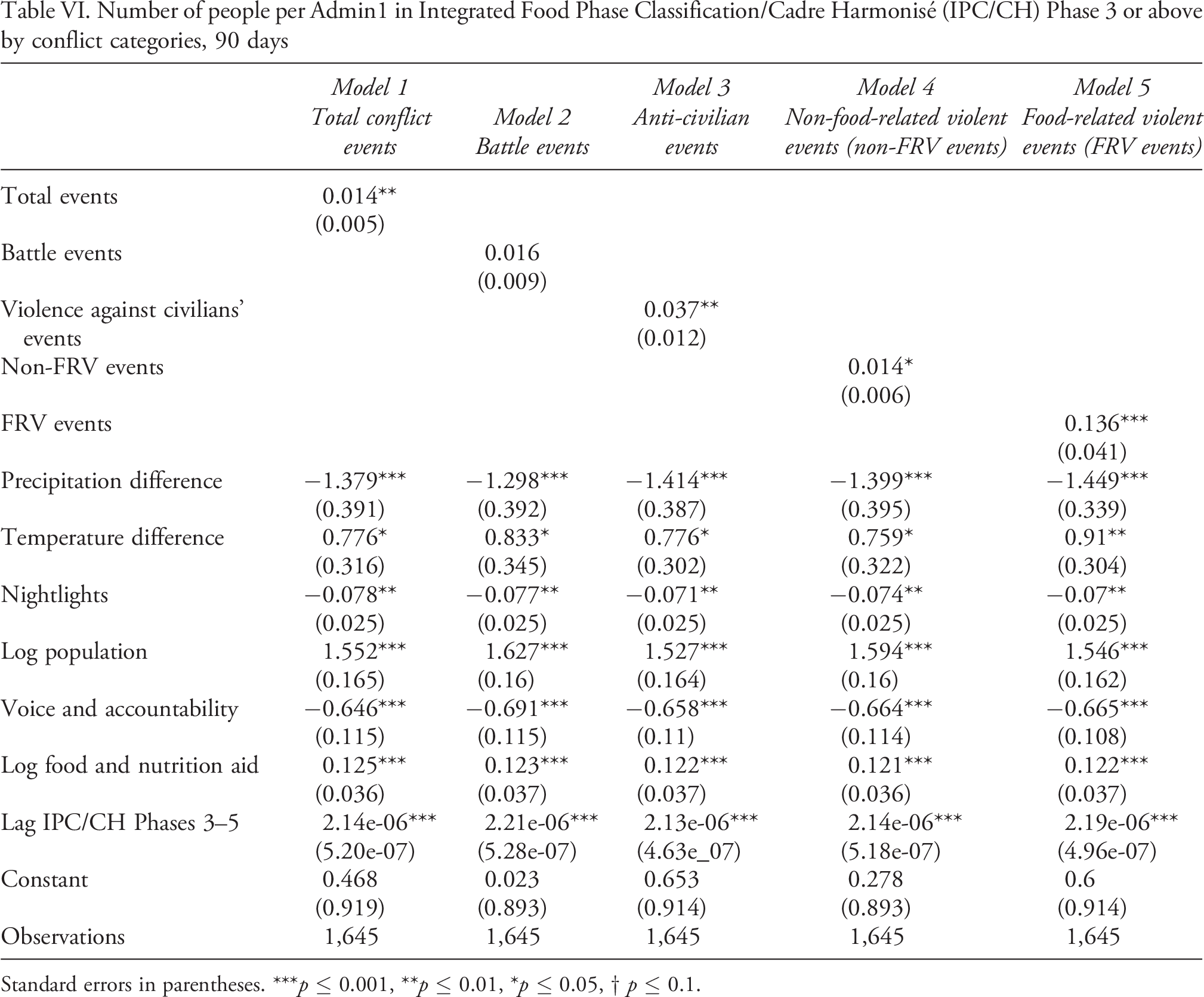
Number of people per Admin1 in Integrated Food Phase Classification/Cadre Harmonisé (IPC/CH) Phase 3 or above by conflict categories, 90 days
Standard errors in parentheses. ***p ≤ 0.001, **p ≤ 0.01, *p ≤ 0.05, † p ≤ 0.1.
Results
Table VI presents the results of the base model. Model 1 tests the correlation between total conflict events in the preceding 90-day period and subsequent numbers of people in food crisis, without further disaggregating by modality of violence; while Models 2 and 3 test battle events and anti-civilian events specifically. These models most closely replicate previous studies where either an aggregate category of conflict generally, or specific categories of battles and/or VAC, have been used to test conflict’s relationship to hunger. Models 4 and 5 test non-food-related and food-related violent events.
The results show that while all categories of events (barring battles), have a statistically significant, positive relationship to the number of people subsequently estimated to be in food crisis, FRV has the strongest correlation and is the most statistically significant. Notably, its coefficient is almost ten times larger than both total events and non-food related events, suggesting the comparatively outsized impact of FRV on subsequent food crisis. This result supports the central hypothesis of this article: that FRV has a strong relationship with subsequent food crisis and that this relationship is stronger than either general, or other subcategories of violence. A second important category is anti-civilian violence, which has both the second-largest coefficient and a high level of statistical significance. This suggests that the targeting of civilians in conflict has a particularly strong impact on subsequent food crises, indicating the importance of protection efforts in preventing and addressing food crises.
Other variables perform largely as expected and consistently across models. Temperature variability has a positive and significant relationship, suggesting that greater variation in either direction is associated with higher levels of food crisis. However, precipitation variability has a consistently negative and statistically significant relationship to subsequent food crisis, suggesting that the relationship between precipitation variability and subsequent food crisis is either less direct than that of temperature, or may be driven by longer-term trends of low rainfall with high variation from this in a positive direction driving the observation in key cases. More predictably, population is statistically significant and positively associated with the numbers people in food crisis, while economic activity (proxied by nightlights), is statistically significant and negative, suggesting that higher levels of economic development at the subnational level is associated with lower levels of food crisis. Politically, Voice and Accountability is also significant and negative, suggesting that accountability and government responsiveness are significant factors in effective prevention of, and responsiveness to, conflict-driven food crises. Lastly, both the level of food aid at the national level, and the lagged numbers of people in food crisis the previous year, are statistically significant and positive, pointing to dependence in food crises over time.
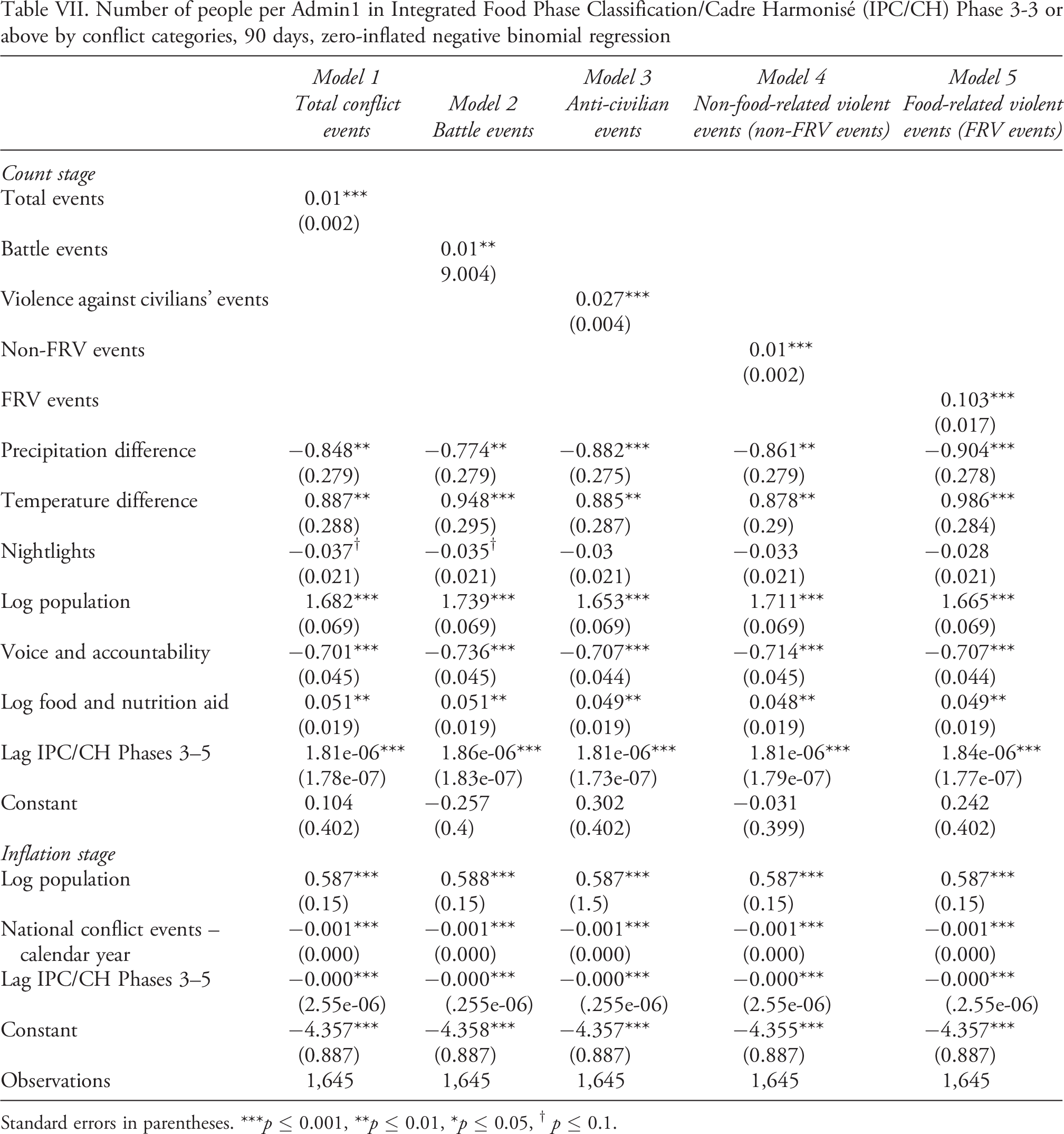
Table VII presents the results of the ZINB model. Following a similar strategy to Koren & Bagozzi (2017), the inflation stage includes a logged measure of population, which is positively and significantly associated with the risk of inflation throughout; alongside a measure of country-wide conflict in the preceding year, and a lagged measure of the number of people in IPC/CH Phases 3–5 one calendar year prior. Both are negatively and significantly associated with the risk of inflation, suggesting the value of all three variables’ inclusion. Returning to the count stage, the overall results are consistent with the findings of the base model: FRV remains positively and statistically significantly associated with subsequent food crisis, with a coefficient between three-times and ten-times the value of other (sub-)categories of violence.
Robustness tests
A series of sensitivity analyses test the robustness of results, detailed in Online Appendix II. First, the lagged dependent variable of the count of events in the 90-day period is replaced with the count from the preceding 180-day period (Online Table A2) and 365-day period (Online Table A3). The results hold: food-related violent events over the preceding periods have the strongest correlation to subsequent food crises, and a high level of statistical significance, suggesting that the relationship between FRV and subsequent crisis is robust across both short-term and medium-term periods.
Second, as food systems are complex, and neighbouring and national developments may intersect with local conditions in different ways, conflict in neighbouring areas and at the national level may affect food security outcomes at the subnational level, for instance through disruption to trade, or country-wide disruption to transport or imports. To account for this, models are re-run first, with a spatial temporal lag, accounting for all violence recorded in geographically contiguous Admin1 units in the preceding 90 days (Online Table A4). Second, models are re-run including a count of all conflict events across the country in the preceding 90 days (Online Table A5). The central results hold: once again, FRV has the highest coefficient and remains statistically significant, followed by anti-civilian violence. However, the statistical significance of total events, and non-food-related events falls once neighbouring and national-level conflict is taken into account.
Number of people per Admin1 in Integrated Food Phase Classification/Cadre Harmonisé (IPC/CH) Phase 3-3 or above by conflict categories, 90 days, zero-inflated negative binomial regression
Standard errors in parentheses. ***p ≤ 0.001, **p ≤ 0.01, *p ≤ 0.05, † p ≤ 0.1.
Fourth, the dependent variable of the count of events is replaced with the sum of reported fatalities by corresponding category (Online Table A11). This facilitates a test of whether violence intensity – over frequency – is correlated to subsequent food security outcomes. The results are consistent with event count models: FRV fatalities remain the strongest statistically and in size of coefficient of all (sub-)categories. This suggests that intensity of violence, as measured by fatalities, has a comparable relationship with subsequent food crises as event occurrence, indicating that both conflict systems in which FRV is very frequent, and those in which it is very intense, can both produce high levels of food crisis.
Finally, to test sensitivity to model specifications, models are re-run with a linear regression (Online Table A12); and separately, with country fixed effects (Online Table A13) and region fixed effects (Online Table A14), both clustered by year. The pattern of results is consistent across models. Together, these combined sensitivity analyses show that the results are robust to multiple specifications, and suggest that a non-spurious relationship exists between FRV and subsequent food crisis.
Conclusion
Taken together, the results suggest that FRV is an important driver of food crises. Analysis of 16 contemporary African countries reveals that, compared to general insecurity and various subcategories of violence, FRV had the strongest relationship to the number of people subsequently experiencing food crisis or worse, holding across numerous sensitivity analyses.
With these findings, this article seeks to make three contributions to scholarship on the relationship between conflict and hunger. First, empirically, the study seeks to fill a gap by comparatively analysing a specific modality of violence – FRV – across contexts and time, highlighting a hitherto understudied phenomenon. Methodologically, the analysis points to the value of publicly available conflict data as a source for monitoring such acts. Although the analysis is purposefully broader than the consideration of war crimes specifically, it may nevertheless point to potential utilities and complementarities of open-source data and wider accountability initiatives. This is particularly the case where obstacles to monitoring and reporting of violations of food rights have been identified as a barrier to prevention and accountability, such as where operational agencies face risks in documenting and publicizing attacks (Kellenberger, 2004; Global Rights Compliance, 2021). That coding has been carried out based on search terms furthermore means analysis could, in principle, be automated for larger studies and/or ongoing monitoring.
Second, the findings highlight the importance of FRV to understanding conflict-driven food crises in select contexts in Africa. While many studies have documented the broad relationship between conflict and hunger, and a growing number have leveraged more finely grained conflict data, the findings suggest that efforts could be advanced through a narrower measure of FRV. For scholars seeking to better understand food insecurity, the findings indicate that a more precise focus on violent events in which food and food systems specifically feature is valuable. For humanitarian initiatives seeking to better predict, anticipate and ultimately prevent food crises, conflict is currently a frequent source of uncertainty in food crisis early warning systems (Krishnamurthy et al., 2020: 8), and systems’ integration of conflict analysis remains weak (Maxwell, 2019). The findings suggest that greater precision could improve prediction and response. The findings also have implications for initiatives pursuing accountability for conflict-driven hunger. On the global stage, where some actors have continued to resist the framing of hunger as a security issue (see Security Council Report, 2021), the findings demonstrate that food crises are neither inevitable consequences of, nor incidental to, contemporary conflict. Rather, they are particularly strongly associated with FRV. This lends support to the relevance of food crises as central concerns of international security architecture.
Third, and more widely, the findings build on growing research on the micro-dynamics of conflict, highlighting the value of greater disaggregation and specificity in analysis of conflict dynamics and their consequences. Beyond studies of conflict and hunger alone, the findings may have implications for wider research on the humanitarian–development–peace nexus more generally, which could potentially likewise be advanced through more precise measures of specific protection threats.
In considering wider applicability, it is important to note that these findings are limited in their empirical scope to the cases discussed. Although representing a range of cases on the African continent, the generalizability of findings beyond these specific cases, and beyond Africa, should be tested. The methodology – through which context-specific key terms for important crops and food resources have been derived from agricultural sources – is amenable to other contexts, but requires adaptation to ensure that terms relevant to particular food systems are included.
Future research could also explore the dynamics of FRV further in three related fields. First, in conflict studies, future research could explore the determinants of FRV; and the relationship between wider FRV, mass atrocities and starvation crimes. Second, in peace research, further study on the role food and food systems could play in conflict prevention, peacebuilding and reconciliation efforts in crisis-affected contexts, would also be valuable. Lastly, in humanitarian studies, future research could test the relative predictive power of forecasting models that integrate measures of FRV specifically in early warning systems; and the interaction between FRV and features of complex emergencies, including forced migration, where displaced populations, who are particularly vulnerable to food insecurity, engage with food systems in distinct ways. 9
Footnotes
Replication data

Acknowledgements
The author thanks the three anonymous referees and editor for their helpful comments, and Ramesh Ganohariti for research assistance. Earlier versions of this manuscript were presented at seminars at the National University of Ireland, Galway, Trinity College Dublin, and Dublin City University, with thanks to participants for their helpful feedback.
Funding
The author disclosed receipt of the following financial support for the research, authorship, and/or publication of this article: I gratefully acknowledge support from Dublin City University’s Faculty Journal Publication Scheme (2019/2020).