




Abstract
Research shows that conflict parties engage in ceasefires in pursuit of a variety of objectives, some of which reduce while others fuel violent conflict. This article provides a framework that links these objectives to a larger process. Building on bargaining theory, three distinct bargaining contexts are specified for intrastate conflicts. In the Diminishing Opponent context, leaders believe that a military solution yields a better outcome than a political settlement. In the Forcing Concessions context, they recognize the benefit of conflict settlement, but expectations about a mutually acceptable agreement still widely diverge. In the Enabling Agreement context, expectations converge, and leaders seek to pursue settlement without incurring further costs. In line with these readings, conflict party leaders adapt their strategic goal, from seeking to set up a military advantage, to boosting their bargaining power, to increasing the chances of a negotiated settlement. They may use ceasefires in the pursuit of any of these three goals, shifting the function of a ceasefire as they gain a better understanding of bargaining dynamics. A comparison of violence and ceasefire patterns in six contemporary peace processes and a congruence test conducted on the 2012–16 peace negotiations between the Colombian government and the guerilla organization FARC offer support for the theoretical framework. The findings highlight the important, and shifting, role ceasefires play in the transition from war to negotiated peace.
Introduction
Ceasefires are a common phenomenon of intrastate conflicts. Since 1990, conflict parties have formally agreed to cease hostilities from a specific point in time on more than 200 occasions (Clayton & Sticher, forthcoming) – not counting the many more informal, often unilateral arrangements. 1 Many scholars highlight the risk that parties may use ceasefires simply to buy time in order to regroup, rearm, or improve their military position (Crocker, Hampson & Aall, 2004: 158; Gartner & Melin, 2009: 566; Toft, 2010: 15). Because ceasefires reduce the costs of conflict, they also reduce domestic and international pressure to negotiate. Power holders may thus be interested in implementing a ceasefire, without a genuine intention to move towards settlement (Zartman, 2008; Chounet-Cambas, 2011: 15).
Parties may also engage in a ceasefire in order to enable peace negotiations. Ongoing hostilities may make it impossible to attain a comprehensive settlement, and one side often requests a ceasefire as a precondition to engage in negotiations (Smith, 1995: 155–162; Mahieu, 2007: 209; Chounet-Cambas, 2011: 8). Even in the absence of preconditions, a ceasefire can stabilize a situation and thus may make it easier to negotiate (Mahieu, 2007: 210). Parties may engage in a ceasefire in an effort to gain international legitimacy or use ceasefires to send signals about the cohesion, command, and control of their group (Höglund, 2011). A ceasefire may also provide an opportunity for a conflict party to demonstrate good faith and can help parties establish confidence in each other (Höglund, 2011: 222–223, 238; see Akebo, 2013: 201–203). Finally, recent research has highlighted the role of ceasefires for state-building purposes by both state (Sosnowski, 2019) and non-state actors (Harrisson & Kyed, 2019).
In short, existing ceasefire research offers great insight into the breadth of possible objectives parties may pursue through a ceasefire. What we lack is a systematic framework that links these objectives to strategic decisionmaking processes. Yet such a framework is crucial to understand how ceasefires affect the transition from war to (negotiated) peace.
To fill this void, we turn to the bargaining theory of war, arguing that a conflict party leader’s reading of a bargaining situation shapes their use of ceasefires in relation to a military or political resolution of the war. We offer a typology of three distinct bargaining contexts. In the first, that is, the Diminishing Opponent context, conflict party leaders believe that a military solution yields a better outcome than political settlement and seek to set up a military advantage. In the second (Forcing Concessions) and third (Enabling Agreement) contexts, they recognize the benefits of settlement and strive to reach a peace agreement. However, in the Forcing Concessions context they are willing to endure further costs of war to reach a better settlement for their side, while in the Enabling Agreement context they want to settle without unnecessarily prolonging the war. Accordingly, leaders adapt their strategic goal, first seeking to gain a military advantage, then to increase their bargaining power, and finally to increase the chances of a negotiated settlement. They may use fighting, peace negotiations, and ceasefires in pursuit of these strategic goals. We focus in particular on the use of ceasefires, which has received less attention from bargaining scholars than the use of fighting and peace negotiations. 2
Our conceptualization of the three contexts resonates with previous work that conceives the bargaining process as made up of stages (Hopmann, 1996; Walter, 2006; e.g. Findley, 2013). Yet it is unique in that it views fighting, peace negotiations, and ceasefires as instruments that may be used in all bargaining contexts, rather than defining the stages around these instruments. This is consistent with a widely shared understanding that the onset of peace negotiations or ceasefires does not always represent a genuine shift in the bargaining process (see Richmond, 1998; Gartner & Melin, 2009; Toft, 2010). By conceptualizing our contexts around uncertainties, we contribute to the understanding of information provision in civil conflicts, which – despite its importance in shaping bargaining processes – has to date received scant attention in conflict resolution literature (Findley, 2013: 907).
To assess the validity of our framework, we pursue a two-stage empirical assessment. We first test two key implications in a comparative study of contemporary intrastate conflicts. We then conduct a within-case congruence test (George & Bennett, 2005: 181–204; see Beach & Pedersen, 2013: 4), assessing whether in the 2012–16 Colombian peace negotiations, observable implications of the theory with respect to the three bargaining instruments align. In both tests, we find supporting evidence for the theory, with important theoretical and policy implications.
Theory
To understand the parameters that shape the reading of a conflict and its expected outcome, we turn to the bargaining theory of war. Actors may go to war for various reasons, pursuing a wide range of issues. The bargaining theory of war adds a level of abstraction, disregarding the nature of contested issues or how they arose. Instead, it seeks to understand why – where there are contested issues – some parties go to war or fail to settle wars, whereas others find a negotiated agreement (Reiter, 2003; Walter, 2009). The underlying assumption is that war is costly, and hence parties should have an incentive to find an arrangement without resorting to fighting. Bargaining scholars have identified two key explanations to this puzzle: imperfect information and the credible commitment problem. All parties have an incentive to misrepresent information in order to press for concessions, so information provided by an opponent cannot be trusted. This may lead to a situation where parties overestimate what they can achieve outside negotiations, and refuse negotiated deals that would leave them better off than continued fighting (Fearon, 1995; Walter, 1997, 2009; Reiter, 2003). Because fighting and peace negotiations reveal information, parties should over time converge in their assessment of a bargaining situation (Wagner, 2000; Filson & Werner, 2002; Powell, 2004; Walter, 2009). But even when this happens, and parties have an incentive to settle, they may fail to do so, if they mistrust each other and are unable to credibly commit to implementing an agreement (see Fearon, 1995; Walter, 1997, 2009; Reiter, 2009).
From these insights, we derive three key assumptions for our theory: (1) actors compare the benefits of a military and a negotiated approach to a conflict (and may pursue them in parallel), (2) as long as actors believe that a military solution will render a better outcome than peace negotiations, other bargaining problems are secondary, as parties do not have an incentive to settle, and (3) as actors’ perceptions about a military outcome start to converge, other bargaining problems become salient.
These assumptions allow us to identify two pivotal moments in bargaining processes. The first moment occurs when a bargaining range emerges, that is, parties realize that a negotiated settlement may render a better outcome than continued fighting. At this moment, actors’ expectations about what constitutes a mutually acceptable agreement may still widely diverge (see Werner & Yuen, 2005: 265). Therefore, conflict party leaders will likely believe that the opponent poses unacceptable preconditions for talks or (if negotiations are underway) does not make sufficient concessions to reach a settlement that reflects the military balance. In such a situation, leaders have an incentive to further convey information about their party’s capabilities or resolve, as they believe that conveying such information will increase their bargaining position.
However, conveying such information is costly, particularly if this is done through fighting. Meanwhile, as actors’ expectations converge, the marginal utility of additional information diminishes, if the additional information is of a similar nature (see Howson & Urbach, 1989: 82). As a result, we discern a second pivotal moment in the bargaining process, when enough information is revealed so that the expected costs of continued bargaining (in the form of fighting) are higher than the expected benefits of continued bargaining (in the form of a better deal). Once this happens, conflict parties no longer have an incentive to fight in order to reveal information (see also Slantchev, 2003: 627).
Three bargaining contexts
This leads us to identify three distinct bargaining contexts in which actors may find themselves. In the first context, leaders see a military solution to the conflict as the preferred option. In the second context, having learned more about the opponent’s capabilities and resolve, leaders view the benefits of a negotiated agreement. However, they still believe that they can get a better future deal by conveying additional or more purposeful information to the opponent. In the third context, fighting no longer appears to offer any benefits, and leaders pursue a political settlement while keeping the costs of conflict to a minimum. In this context, information is no longer the most salient bargaining problem. Instead, parties have to overcome other obstacles to settlement, such as the problem of credible commitment or gaining the support of key constituents (Keller & Yang, 2008).
To pursue the overall aim of the bargaining process (i.e. improving the expected utility of the outcome), conflict party leaders need to adapt their strategic goal according to their assessment. In the first context, the goal is to gain a military advantage, with the aim of diminishing the opponent. We hence call this the Diminishing Opponent context. In the second, the aim is to increase their negotiation power, using force or the threat of a return to force in order to demonstrate strength and extract concessions. This is the Forcing Concessions context. In the third context, the strategic goal is to increase the chances of a peace agreement. We call this the Enabling Agreement context. In both the Forcing Concessions and the Enabling Agreement contexts, parties want a peace agreement, but in the former they are willing to endure impasses and breakdowns of the talks to get a better deal, while in the latter, they are willing to make necessary concessions to expedite peace negotiations and increase the chances of reaching settlement. Conflict parties may use fighting, peace negotiations, ceasefires, or a mix of these instruments in pursuit of their strategic goals.
Importantly, we argue that the three bargaining contexts arise from subjective readings of the bargaining situation – they do not ‘exist’ objectively. Different parties to the same conflict, or even different members of the same conflict party, may be in different bargaining contexts at the same time. We focus on the conflict party The Diminishing Opponent context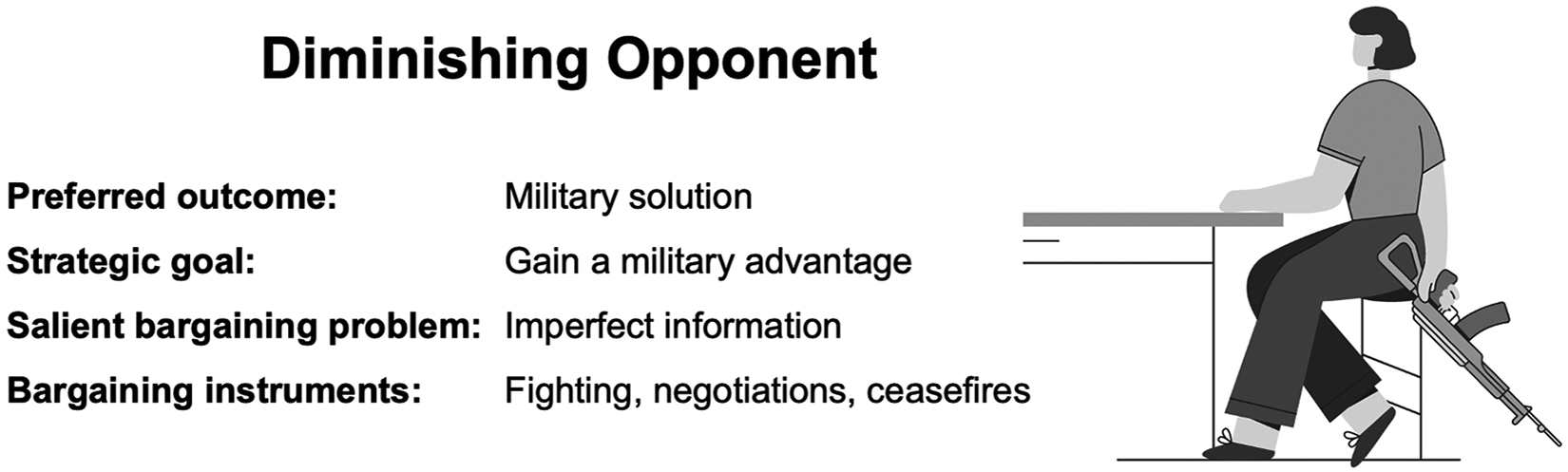
We are interested in examining how perceptions of the prospects of military victory relative to the potential benefit of a peace agreement affect movement through the three contexts. In an ideal-type bargaining process, leaders start in the Diminishing Opponent context when war breaks out, and move progressively through Forcing Concessions to Enabling Agreement, as they continue to uncover information about their relative strengths through fighting, ceasefires, and peace negotiations. However, in some cases, a leader may enter a war not with the expectation of winning, but with the intention of achieving something at the negotiation table that they could not achieve without taking up arms (Slantchev, 2003: 622). In such a case, they start in the Forcing Concessions context. Moreover, bargaining processes rarely unfold in a linear fashion. Information tends to fluctuate over the course of a conflict, in response to unanticipated events. Examples of such events include changes in context that favor a party’s odds on the battlefield (e.g. external intervention) or leadership changes (e.g. sudden death of a leader). This implies that leaders may proceed from Diminishing Opponent to Forcing Concessions and move back to the Diminishing Opponent, or proceed to Enabling Agreement and fall back to one of the earlier contexts.
We proceed to discuss each of the bargaining contexts in more detail, building on bargaining theory, existing ceasefire literature, and deductive reasoning.
Context one: Diminishing Opponent
As long as leaders view a military solution as the preferred outcome, they focus fully on favoring their odds on the battlefield. The key parameters affecting the chances of victory are their relative fighting capabilities and resolve.
The primary instrument in this context is fighting. By attacking the enemy, leaders seek to diminish the capabilities of the opponent and crush its morale. They may also try to counter an offensive, to avoid relative losses in capabilities or resolve. Leaders engage in peace negotiations if they believe that doing so will strengthen their capabilities and/or resolve vis-à-vis the opponent, but they are not genuinely interested in a political settlement, and rather negotiate to gain time or lower third-party audience costs (Richmond, 1998).
Similarly, they may engage in a ceasefire if they believe that doing so strengthens their party’s relative fighting capabilities or resolve. Leaders may announce or accept a ceasefire with the intention to defect when the opponent is most vulnerable, or use the stop in fighting to re-arm, re-group or re-organize (Crocker, Hampson & Aall, 2004: 158; Gartner & Melin, 2009: 566; Toft, 2010: 15; Chounet-Cambas, 2011: 7–8, 20). Parties may also engage in a ceasefire when morale is low, as a break in the fighting creates breathing space (Mahieu, 2007: 210). These objectives are against the interests of an opponent, and leaders who pursue them have an incentive to misrepresent their true intentions (see visualization in Figure 1). They only work if the opponent ceases fire, that is, for bilateral ceasefires or unilateral ceasefires that are replicated by the opponent.
The main reason to abstain from a ceasefire in the Diminishing Opponent context is a belief that continued fighting serves better to strengthen the fighting capabilities and resolve. Relatedly, leaders may reject a ceasefire if they expect the opponent to profit from such an arrangement or if they believe that a ceasefire could The Forcing Concessions context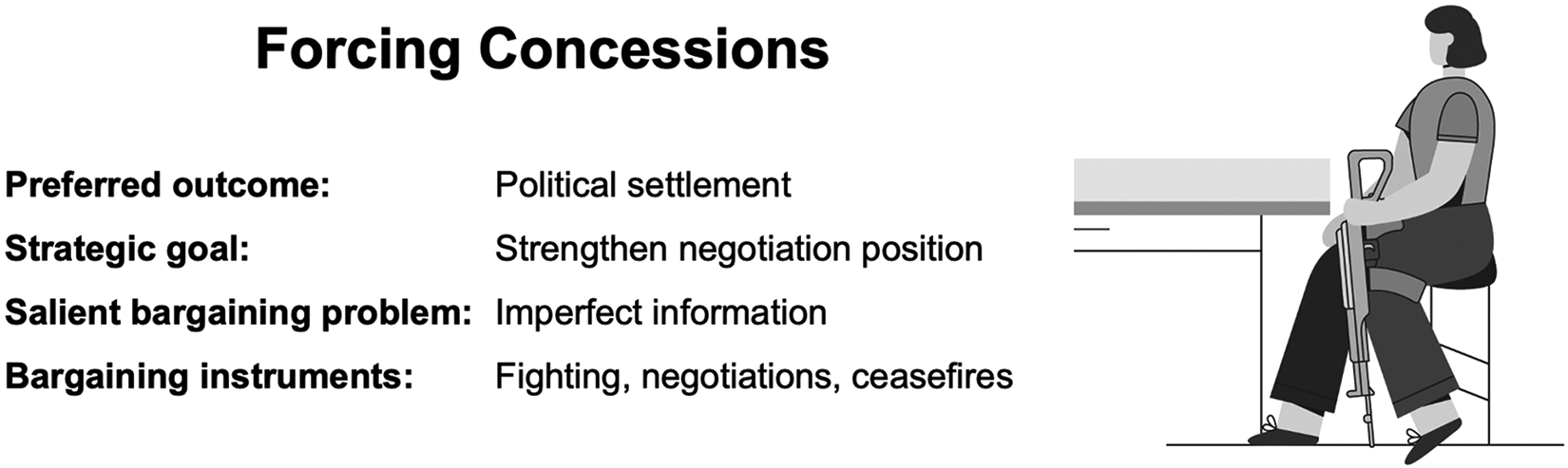
Context two: Forcing Concessions
At some point in time, conflict party leaders revealed enough information to recognize the benefits of a political settlement over a military outcome. However, bargaining in the Diminishing Opponent context only provides information with regard to military capabilities and resolve, and not with regard to what an opponent may view as an acceptable agreement. To reveal information in this regard, conflict party leaders need to engage in genuine peace negotiations (please see visualization in Figure 2). If opponents make (what leaders perceive as) unreasonable demands, or refuse to make (what leaders perceive to be) reasonable concessions, leaders learn that expectations about a military outcome – and consequently, what would reflect a fair political settlement – still widely diverge (see Filson & Werner, 2002; Powell, 2004).
If this is the case, leaders have an incentive to convey further information, as the perceived relative strength shapes expectations of the non-agreement option and by extension the bargaining position (Reiter, 2003). Fighting conveys such information and thus remains a key bargaining instrument in context two. However, after long periods of fighting, the value of additional information through fighting is limited (see Howson & Urbach, 1989: 82). By contrast, ceasefires provide an opportunity to convey new and complementary information. By successfully delivering on a ceasefire, leaders can demonstrate a high level of group cohesion and prove that their leadership is undisputed (Höglund, 2011; Akebo, 2016) – information that fighting alone cannot provide. At the same time, conflict party leaders may fear that engaging in a ceasefire may make them look weak (Smith, 1995: 70), which is precisely what they want to avoid. To counter perceptions of weakness, they will likely provide explicit information about when and for how long a ceasefire will remain in place, and threaten a return to violence should peace negotiations not progress (see Sisk, 2009: 41).
In general, leaders likely prefer bilateral over unilateral ceasefires, to avoid losses on their own side. However, there are many reasons why an opponent may refuse to reciprocate (Smith, 1995; Mahieu, 2007; see Dukalskis, 2015). Perhaps most importantly, an opponent may be uncertain about a leader’s intent (Fortna, 2003: 341). It may question whether a leader is genuinely interested in a political settlement, or merely engages in peace negotiations or a ceasefire to pursue a military advantage. In such a case, a leader may use a unilateral ceasefire to demonstrate that they have moved beyond the Diminishing Opponent context. If a unilateral ceasefire holds despite not being replicated, it sends a strong signal not only about internal group cohesion and leadership (Höglund, 2011), but also about a commitment to finding a negotiated solution to the conflict.
Context three: Enabling Agreement
Once conflict party leaders have revealed enough information through fighting, peace negotiations, and ceasefires, and are convinced that the opponent is negotiating in good faith, they have a realistic understanding about what may constitute a mutually acceptable agreement and seek to reach such agreement without incurring further costs. However, once the problem of imperfect information is overcome, other bargaining problems may become salient. In particular, conflict parties need to credibly commit to implementing a deal post-agreement (see Walter, 1997, 2009), and they need to gather sufficient support from key constituents to make agreement politically feasible (Keller & Yang, 2008).
In such situations, fighting is no longer a useful means to increase the expected outcome of the bargaining process. On the contrary, fighting may prove counterproductive, as it fuels hatred and continues to undermine support for a peace deal (Kelman, 2007). It also makes it The Enabling Agreement context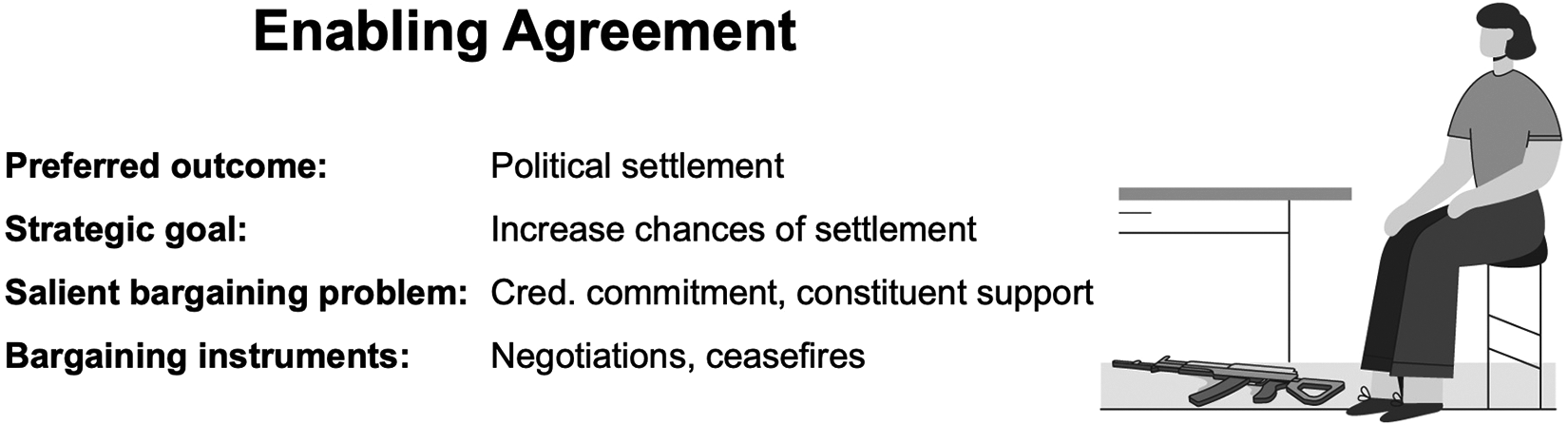
By contrast, peace negotiations play a major role in the Enabling Agreement context, as leaders need to find ways of addressing the contested issues between them. Ceasefires also play a key role, fulfilling functions that cannot be pursued through fighting. In contrast to earlier contexts, conflict parties no longer necessarily back a ceasefire with the threat to return to violence (see visualization in Figure 3). Instead, they may seek to use ceasefires to establish confidence in each other. By implementing an agreement and collaborating on the ground, they can build trust and start transforming their relationship (Höglund, 2011: 238; Akebo, 2013: 201–203; Brickhill, 2018). Ceasefires also help ensure support from a broader public, as they link what is happening at the negotiation table to what is happening on the ground, helping leaders demonstrate to the wider public that relations are indeed changing for the better.
To fulfill these functions, a ceasefire has to be reciprocal. Naturally, in some situations, it may be difficult for leaders to agree on a bilateral ceasefire – for example, if key constituents view a ceasefire as an important concession towards the opponent (see Mahieu, 2007: 211). But even in these situations, they will seek to mutually de-escalate the violence while working on a political solution, as violence hurts rather than helps in the Enabling Agreement context.
Comparative study
Incentives to misrepresent information make it hard to empirically assess the bargaining contexts. If it was easy for us to know in which bargaining context a leader is, it would be easy for the opponent – removing a major obstacle to end armed conflicts. That said, conflict parties do make inferences from the behavior of the opponent about their intent. In our assessment, we thus focus on observable implications with regard to the use of peace negotiations, fighting, and ceasefires in bargaining processes, and list contradicting evidence that would allow falsification of our framework.
We pursue a two-stage empirical assessment. In this first stage, we test two key implications of our framework on contemporary cases. In a second stage, we develop a more comprehensive list of supporting and contradicting evidence and conduct a within-case congruence test. The existence of a bargaining context in which conflict parties prefer a military over a political solution is widely accepted in bargaining theory, and our main theoretical contribution lays in distinguishing between the Forcing Concessions and Enabling Agreement contexts. Accordingly, we focus our empirical assessment on these two contexts.
Scope conditions
Our conceptual framework focuses on violent, political intrastate conflicts between a state and an armed non-state actor. It seeks to understand bargaining dynamics in the context of negotiated settlements, excluding cases where ceasefires or peace agreements are imposed by external actors or effectively reflect a military surrender. We expect the underlying logic of the three bargaining contexts to apply across different regime types. However, we expect some differences with regard to the specific challenges faced within the Enabling Agreement context. Democratic regimes are more accountable to public promises and thus are better able to credibly commit to the implementation of a peace agreement than authoritarian regimes (Walter, 2006). At the same time, in view of future electoral outcomes, governments in democracies likely care more about popular support of a peace agreement than authoritarian regimes (Tomz, Weeks & Yarhi-Milo, 2020).
Sequencing of ceasefires and battlefield violence
Forcing Concessions context
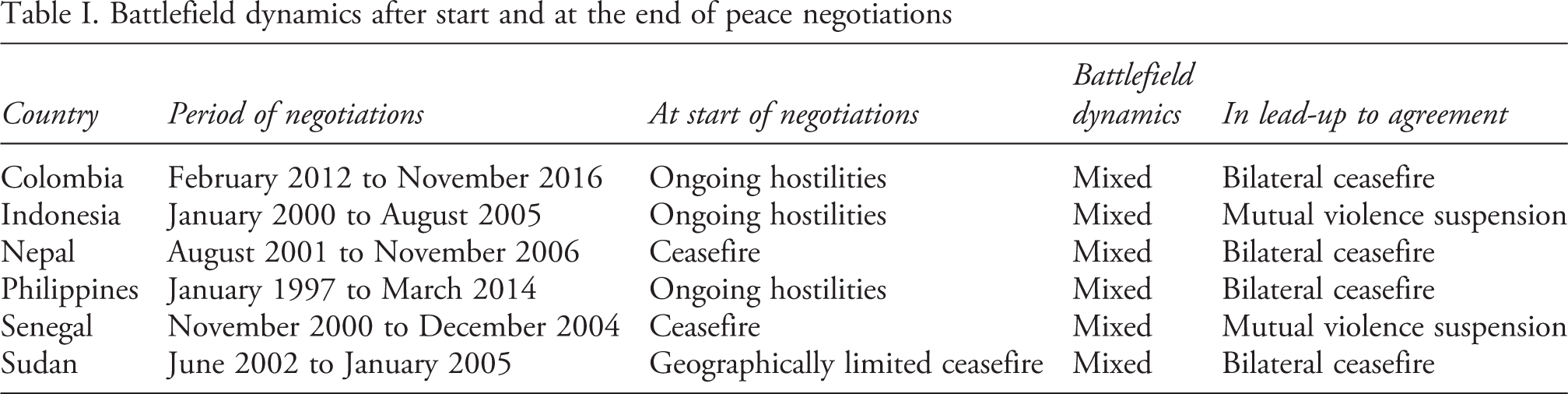
Battlefield dynamics after start and at the end of peace negotiations
Enabling Agreement
By contrast, conflict parties are expected to suspend violence in the lead-up to a peace agreement, as fighting inhibits rather than promotes the search for a mutually acceptable agreement. In most cases, parties will agree to a bilateral ceasefire in the lead-up to a peace agreement. However, the theory suggests that even in cases where parties cannot agree on a ceasefire, they will mutually suspend conflict violence to create a conducive environment to search for a joint solution. Failure to reduce fighting, or an escalation of fighting, in the lead-up to a peace agreement would constitute contradicting evidence.
Observed patterns
To ensure that we only look at cases where our findings can (in theory) be present (see Beach & Pedersen, 2016: 4), we limit the analysis to successful peace negotiations, that is, cases where we theoretically expect conflict parties to have transitioned through the Forcing Concessions and Enabling Agreement contexts. Table I lists all cases where parties reached a peace agreement after 9/11 and that clearly fall within the boundaries of our scope conditions. 3
Two of them started with a reciprocal ceasefire in the entire conflict area (Nepal and Senegal) and one had a geographically limited ceasefire in place (Sudan). In Indonesia, the Philippines, and Sudan, the parties agreed on a ceasefire for the full conflict area relatively early in the peace negotiation process. In Colombia, the non-state actor put in place several unilateral ceasefires, with a bilateral one only coming into force towards the very end of negotiations. As we detail in brief case studies in Online appendix 1, we find that in all cases, parties used a mix of battlefield violence and ceasefires after the start of peace negotiations. To assess the robustness of our findings, we include a discussion of how setting alternative start dates would affect our analysis, finding no strong contradicting evidence.
By contrast, and again in line with the theoretical expectations, conflict parties suspended their use of battlefield violence in the lead-up to the peace agreement. The graphs in Figure 4 show the monthly distribution of attacks in the last ten years of conflict leading up to the peace agreement.
4
The right border of each graph indicates the month in which the peace agreement was concluded. The graphical representation in the form of density plots allows us to discern information about trends. In addition, information about attack events is included in the form of rug plots at the bottom of each graph. All attacks attributed to the conflict dyad in the UCDP Georeferenced Events Dataset (v 19.1; Sundberg & Melander, 2013; Högbladh, 2019) are included, with Attack trends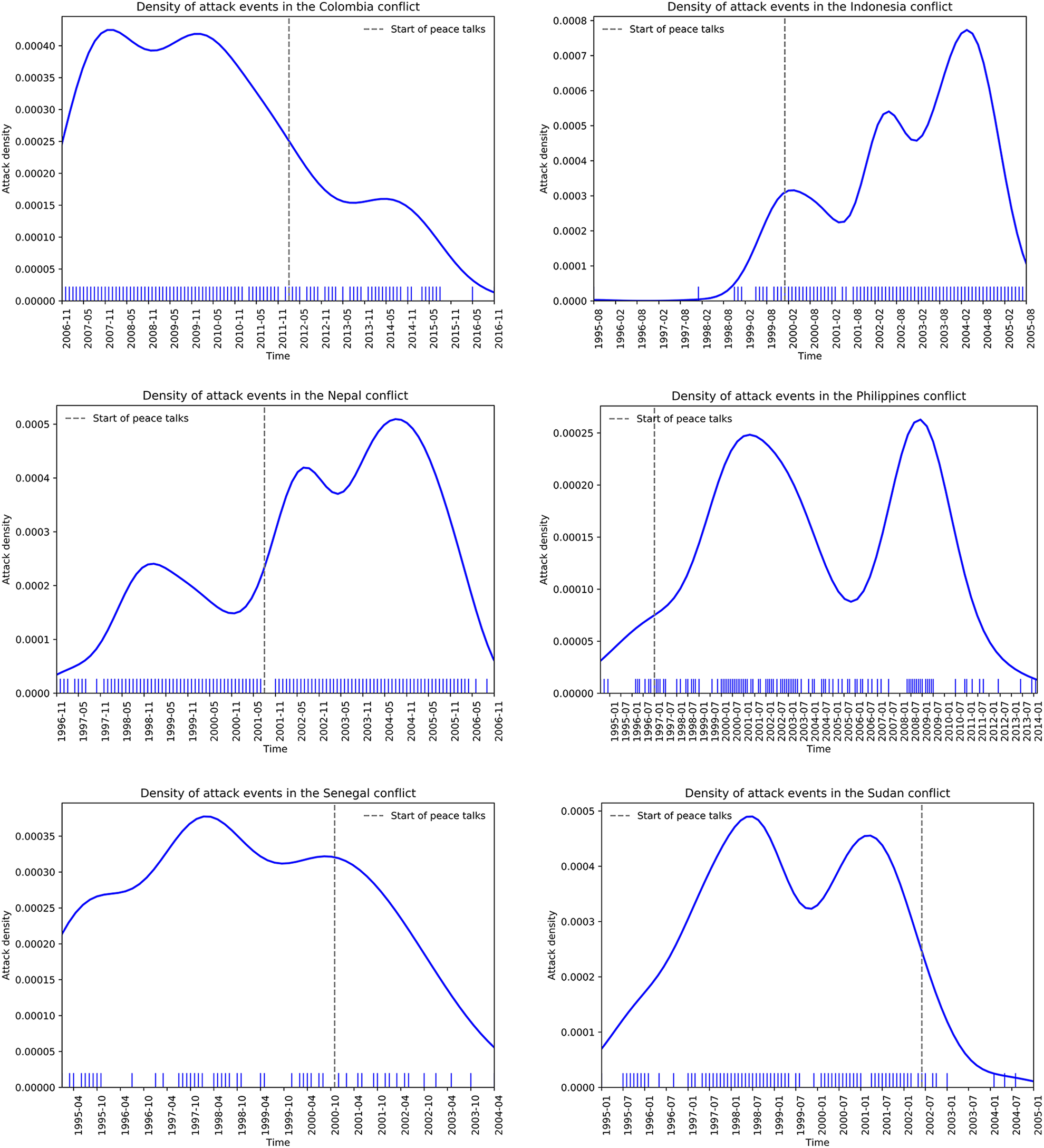
The use of ceasefires and violence after the start of peace negotiations and the mutual suspension of violence in the lead-up to an agreement offer supporting evidence for our framework. The bar for contradicting evidence in the Forcing Concessions context is relatively high, decreasing the leverage of these findings. The bar for finding contradicting evidence for the Enabling Context, meanwhile, is relatively low, rendering it a stronger test. The latter finding is also more interesting from a bargaining perspective, as it does not follow from established bargaining theory or the related ‘talking while fighting’ literature. 6 Explanations for such a violence suspension in the lead-up to a peace agreement tend to stem from other schools of thought, in particular from sociopsychologically oriented peace and conflict studies (e.g. Kriesberg, 2005; Kelman, 2007), and are often seen as contradicting a bargaining logic (see Greig & Diehl, 2005: 624–629).
Overall, the case comparison shows that our framework is plausible. However, there are limited inferences one can draw from the comparison, and the analysis (as here conducted) can only ever be applied ex post. A case study helps address these shortcomings.
2012–16 Colombian peace negotiations
We focus on the most contemporary case that meets our scope conditions, the 2012–16 peace negotiations between the Colombian government and the Revolutionary Armed Forces of Colombia (FARC). We select this case as it provides a strong test for our predictions: the government was adamant from the start of the talks that it would continue fighting until a peace agreement was reached, to maintain pressure on the FARC. As such it is unlikely that we find the expected changes in the battlefield and in the use of ceasefires unless the framework is valid, which increases the leverage of supporting evidence (see George & Bennett, 2005: 121).
To test the theoretical framework, we use a within-case congruence method (see George & Bennett, 2005: 181–204; Beach & Pedersen, 2013: 4). We start by systematically laying out observable implications and contradicting evidence for all bargaining instruments in the Forcing Concessions and Enabling Agreement contexts. We then analyze what happened in Colombia at the negotiation table, with the aim of identifying visible signs that a party leadership had transitioned to these contexts. Next, we assess whether the nature of fighting and ceasefires that follow aligns with the contexts we identify, that is, if we find supporting evidence for the expected use of violence and ceasefires in the identified context and can exclude contradicting evidence. To do so, we use primary sources (conflict party statements, joint communiques, and published interviews), secondary sources (such as think-tank reports and newspaper articles), and civil war datasets (Sundberg & Melander, 2013; Högbladh, 2019; Clayton et al., 2020).
Observable implications
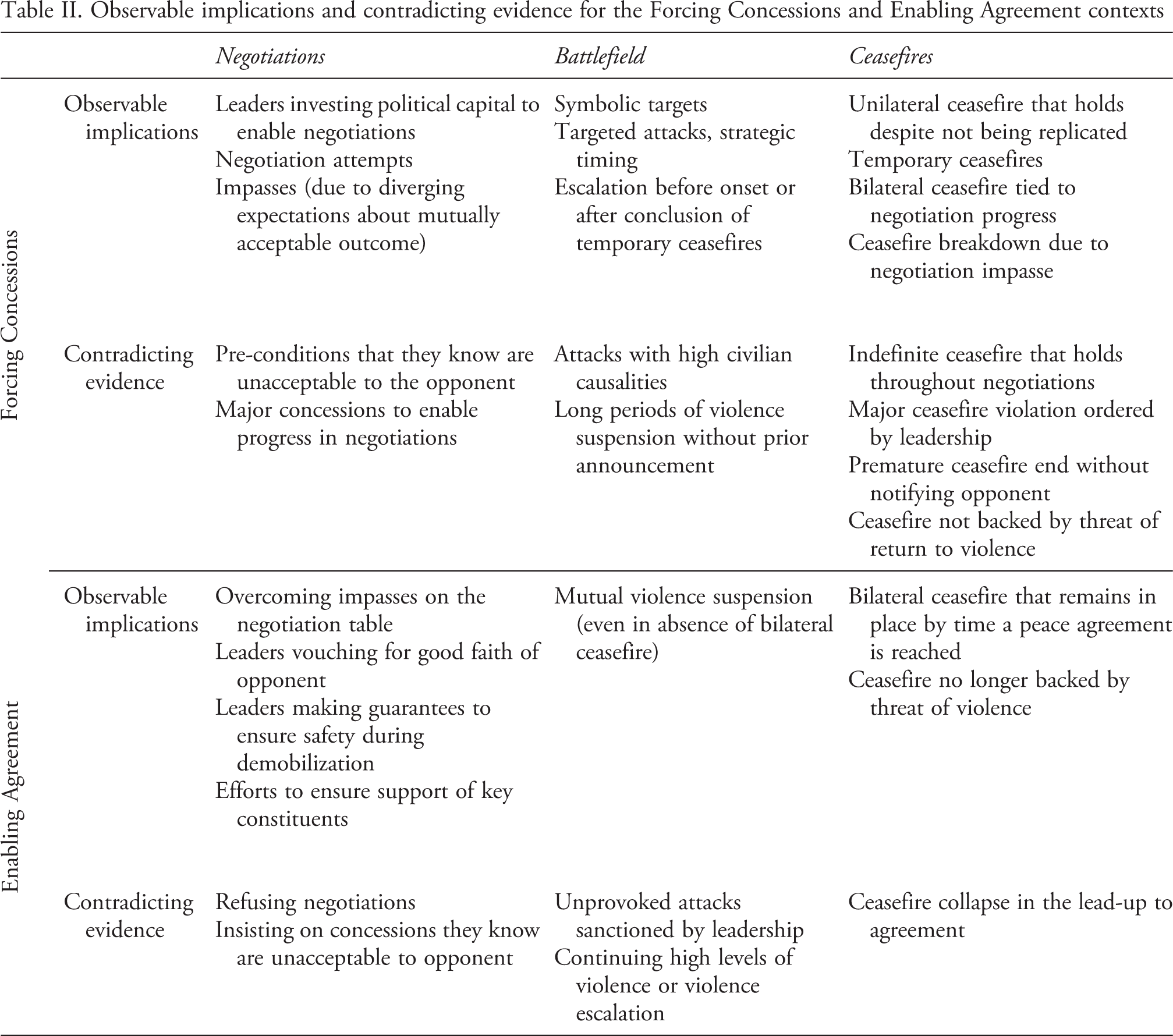
Table II provides an overview of observable supporting and contradicting evidence for each of the bargaining instruments in the Forcing Concessions and Enabling Agreement contexts. Not all supporting evidence may necessarily be present in each case that meets the scope conditions (George & Bennett, 2005: 189–192). Similarly, supporting evidence of one context may, though not always, constitute contradicting evidence for another context. The following two subsections clearly outline when and why this is the case.
Observable implications and contradicting evidence for the Forcing Concessions and Enabling Agreement contexts
Forcing Concessions
In the Forcing Concessions context, we expect conflict party leaders to engage in or seek peace negotiations, in order to learn about what constitutes an acceptable agreement to the opponent. Because they are genuine about exploring negotiations, we would not expect them to pose preconditions they know are unacceptable to the opponent. If the opponent doubts their goodwill, leaders may invest some political capital to signal good faith and enable peace negotiations. We would not expect to find such signals in the Diminishing Opponent context. At the same time, negotiations are unlikely to go smoothly, as expectations about a mutually acceptable agreement still widely diverge. An observable implication of this is an impasse in peace negotiations. In the Forcing Concessions context, we would not expect leaders to make major concessions that would be necessary to move towards an agreement.
On the battlefield, conflict parties will focus on signalling capabilities and resolve. The aim is no longer to eliminate the opponent (which they recognize is more costly than reaching settlement). An indiscriminate use of violence – such as large-scale attacks against civilians – may diminish the long-term prospects of settlement, and thus constitutes contradicting evidence for the Forcing Concessions context. Instead, conflict parties will likely become more targeted in their attacks and possibly shift to more symbolic targets. We would not expect them to suspend violence for long periods of time without prior announcement, as adherence to a ceasefire is only effective in conveying internal cohesion and leadership if it is declared ex ante.
A strong indication of the Forcing Concessions context is a unilateral ceasefire that holds despite not being replicated. Such a ceasefire is typically limited to a specific time period, and parties are likely to alternate between fighting and ceasefires. In the absence of temporal limits, conflict parties are likely to back ceasefires with a threat to return to violence, should talks fail to proceed. Similarly, a conflict party may stage attacks shortly before the beginning of, or shortly after the end of a temporary ceasefire, to demonstrate that they enter into it from a position of strength rather than weakness.
Parties may also use bilateral ceasefires that are, implicitly or explicitly, linked to progress in peace negotiations. Parties should explicitly warn about withdrawal from declared ceasefires if negotiations fail to progress. Major ceasefire violations ordered by the leadership or a premature end to a ceasefire without notifying the opponent in advance constitute contradicting evidence, as these would undermine the signalling of strength and good faith.
Enabling Agreement
In the Enabling Agreement context, conflict party leaders seek to increase the chances of a negotiated settlement. They need to carefully balance the need to make concessions and the need to ensure that key constituents support an eventual agreement. In such situations, we may observe signs of leaders willing to take on personal risks, such as vouching for the good faith of the opponent. Once both leaders have moved to the Enabling Agreement context, they will likely overcome key impasses at the negotiation table. By contrast, moves that seek to increase the negotiation position at the risk of derailing peace negotiations constitute contradicting evidence for the Enabling Agreement context. Leaders refusing negotiations altogether, or demanding excessive concessions to stall for time, also constitute contradicting evidence. As their assessments about a military outcome converge, conflict party leaders now face the problem of credible commitment and the need to ensure popular support for settlement. Leaders on both sides are likely to engage in moves aimed at securing support from key constituents, and leaders on the state side are likely to offer security guarantees for the eventual demobilization of the non-state actor.
We should no longer see leaders deliberately using violence, or the threat of violence, to achieve concessions. Instead, once leaders on both sides have transitioned to the Enabling Agreement context, they will seek to mutually suspend violence, regardless of whether a ceasefire is in place. An attack ordered by the leadership constitutes contradicting evidence, unless such a move is in reaction to another attack. Continued hostilities or a violence escalation in the lead-up to a peace agreement constitute further contradicting evidence, as discussed above.
Peace negotiations
Forcing Concessions
In the first years of the Santos presidency, both sides reached out to each other to explore the possibility of seeking a political solution to the conflict (see Segura & Mechoulan, 2017: 10–13). Yet all efforts aimed at fostering peace, including the entire phase of the exploratory talks, were kept secret, allowing both sides to test each other’s intent out of the limelight (Jaramillo, 2017: 6). Since they refrained from sending any political signal, the back-channelling and exploratory talks can only with hindsight be interpreted as signs that the leaders had moved beyond the Diminishing Opponent context. However, the dynamics shifted publicly in August 2012, after the two sides reached a framework agreement. Santos acknowledged the talks after a copy of the agreement had been leaked to the press. On 4 September 2012, both sides publicly announced the peace talks. This constitutes the first publicly perceivable shift that the leaderships had moved to the Forcing Concessions context, as both sides raised expectations about a political settlement that would incur ex post costs should the talks fail (see Fearon, 1997; Jaramillo, 2017: 7). 7
Enabling Agreement
The framework agreement set six agenda items. After reaching agreement on three substantive issues, the parties moved to discuss the most difficult agenda item (Jaramillo, 2017: 12), the victims item, which required agreement on how to deal with crimes committed during the armed conflict. What followed was a long period without much progress, with leaders on both sides insisting on different ways forward (see IFIT, 2018: 17–19). The dynamics started shifting in mid-2015. Amidst escalations in the battlefield (see discussion below), both leaderships made important gestures for peace. Some experts started noting a ‘state of maturity’ in the way the parties sought to jointly protect a process that was under immense pressure (see Semana, 2015). At the negotiation table, a shift towards the Enabling Agreement context became publicly visible on 12 July 2015, when the parties signed an agreement to ‘Expedite in Havana and de-escalate in Colombia’, published as a joint communiqué. The stated purpose of the agreement was, among other points, to strengthen the trust between the parties and the trust of the Colombian public in the peace process. As part of this agreement, the parties agreed on a change in negotiation methodology that allowed them to work on the remaining items simultaneously and helped speed up the negotiation process. Two months later, they reached a major breakthrough, agreeing on a transitional justice mechanism. 8
Fighting and ceasefires
Having identified two negotiation-related events that indicate a transition into the Forcing Concessions (public announcement of framework agreement) and the Enabling Agreement context (agreement to expedite in Havana and de-escalate in Colombia), the analysis now turns to analyze events in the battlefield, to assess whether the use of fighting and ceasefires match the pre-identified contexts (see Table II).
Forcing Concessions
In the period between the announcement of the framework agreement and December 2014, the FARC continued fighting, with the exception of a number of temporary unilateral ceasefires. 9 Multiple sources attest to the FARC’s overall compliance with these self-declared ceasefires. 10 There is evidence suggesting a strategic timing of attacks and ceasefires in this time period. For example, in the period preceding the formal opening of the peace negotiations in Norway, both sides had scaled back military operations; however, in the week following the opening, attacks intensified, particularly in FARC strongholds (Hurst, 2012a). The FARC remained on the offensive, ‘perhaps in an effort to fortify its position going into the talks’ (Molinski, 2012). On the first day of talks in Havana, it announced a two-month unilateral ceasefire. The ceasefire remained in place, even in December 2012, when government forces staged two large-scale attacks. The FARC resumed hostilities on the day the ceasefire expired (ICG, 2013). When the talks failed to progress over the sensitive issue of political participation – a key demand of the FARC – the group stepped up its attacks on energy and oil infrastructure (BBC, 2013). This alternate use of fighting and temporary ceasefires, and the clear link between battlefield dynamics and progress at the negotiation table, are indicative of the Forcing Concessions context.
On the government side, President Santos rejected any suggestion of a bilateral ceasefire and publicly committed to upholding military operations throughout the talks (see IFIT, 2018: 8–9 for a discussion). A week after the formal opening of the talks, he announced that the armed forces would be expanded in 2013, sending a message that the government would not neglect the military side of the conflict (Hurst, 2012b). Government operations against the FARC continued unabated, even during the FARC unilateral ceasefires, when indeed some of the largest offensives against the FARC were carried out. 11
Dynamics started shifting towards the end of 2014, when the FARC kidnapped a serving general and Santos responded by suspending the talks. Following this episode, the FARC declared a unilateral ceasefire for an indefinite period of time. In contrast to the previous (temporally limited) ceasefires, the new arrangement appeared designed to enable peace negotiations to continue, rather than to demonstrate strength. However, it was linked to a clear demand for the government to cease its military operations (FARC-EP, 2014a). In March 2015, Santos ordered a suspension of airstrikes, initially for a month, but operations on the ground intensified (ICG, 2015: 5). The most important test for the talks came in mid-April 2015, when – despite the indefinite unilateral ceasefire – the FARC killed 11 soldiers in an attack, setting off a vicious chain of reactions. The government immediately resumed airstrikes. The FARC initially maintained the unilateral ceasefire but, after a government offensive killed 26 FARC members, the group declared the end of the ceasefire and violence quickly escalated (ICG, 2015: 3–4).
In short, during the period pre-identified as the Forcing Concessions context, we find multiple observable implications of this context in the battlefield, including strategically timed attacks and temporary ceasefires. The indefinite unilateral ceasefire pronounced in December 2014, and the partial replication by the government, indicate a shift in dynamics, but the conditionalities and accompanying measures suggest that both sides were still primarily pressing for concessions at the negotiation table (see ICG, 2015: 5). With regard to contradicting evidence, attacks with high civilian causalities can be excluded, as these had already stopped years earlier (Sundberg & Melander, 2013; Högbladh, 2019). No ceasefire remained in place throughout the negotiations, all FARC ceasefire declarations were backed by a threat of returning to violence – either in the form of temporal limits or by outlining the conditions under which violence would re-emerge – and the suspension of the indefinite ceasefire was announced by the FARC leadership in advance.
This leaves one key event that could potentially constitute contradicting evidence: 12 the mid-April 2015 FARC attacks that amounted to a major ceasefire violation. To constitute contradicting evidence, this attack would need to have been ordered by the FARC leadership without prior warning to the government. We find multiple warnings by the FARC that the indefinite ceasefire may unravel, should the government’s military operations continue (e.g. FARC-EP, 2014b, 2015a). However, these warnings were generic in nature and may not amount to a specific warning (for example tied to pre-specified conditions). By contrast, the circumstances of the attack are contested and it appears hard to attribute the attack to the FARC leadership (see also FARC-EP, 2015b; Economist, 2015). Overall, our assessment does not suggest that the attack constitutes strong evidence against the Forcing Concessions context.
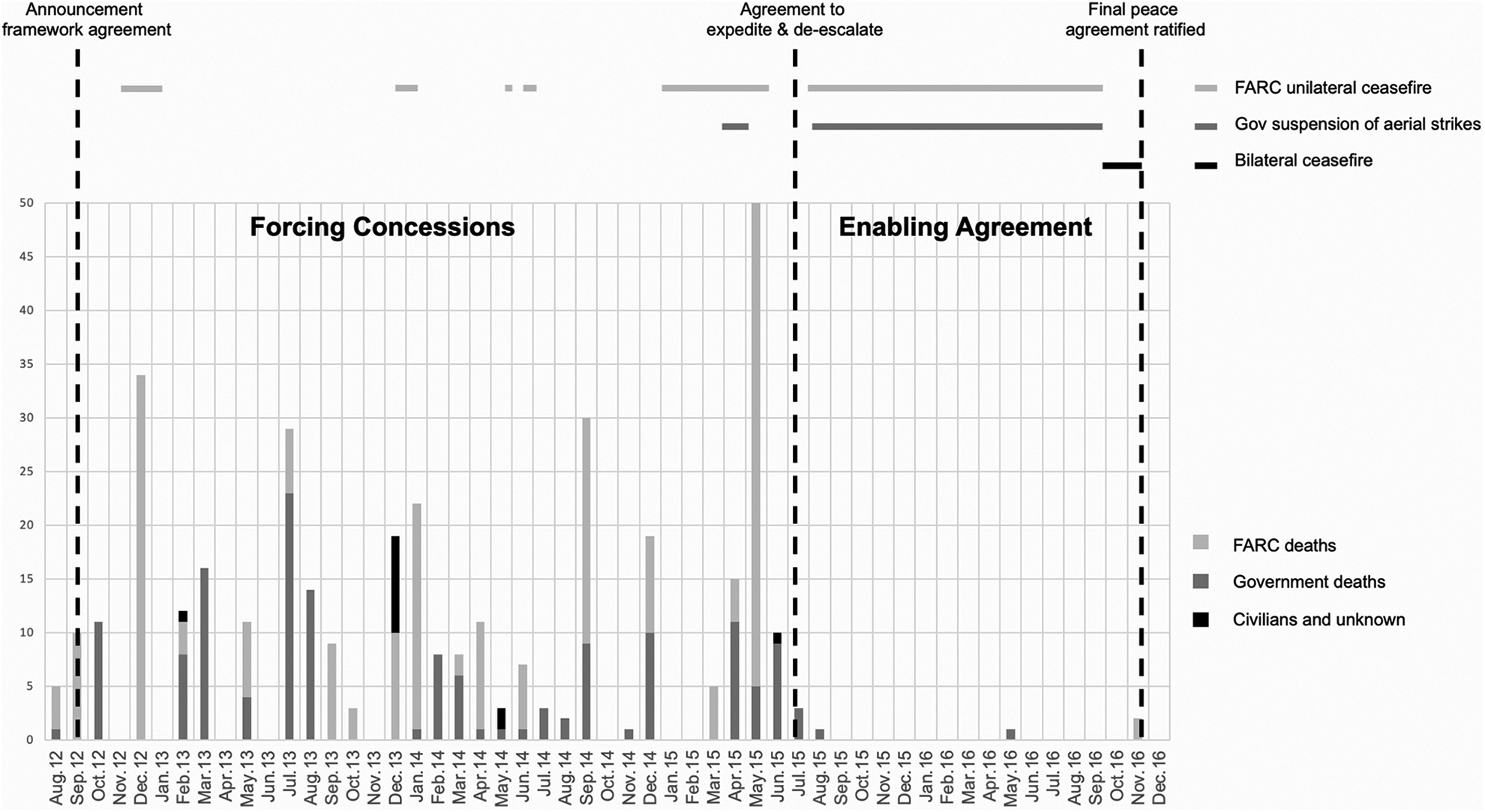
Timeline of peace negotiations, battlefield related deaths and ceasefires
Enabling Agreement
After the resumption of hostilities in mid-2015, support for the talks dropped to an all-time low (Gallup, 2016: 103). In early July 2015, the FARC announced a one-month unilateral ceasefire ‘to create favourable conditions’ to start a bilateral ceasefire (FARC-EP, 2015c). A few days later, as part of the agreement to ‘Expedite in Havana and de-escalate in Colombia’ (which we identified as the shift to the Enabling Agreement context), the two parties agreed that the FARC would maintain its unilateral suspension of offensive actions, and the government would respond with a de-escalation process consistent with the FARC action. Both sides complied and announced respective measures. There were some allegations of violations on both sides, but the parties did not return to open fighting (see Figure 5).
In June 2016, the two sides agreed on a definitive bilateral ceasefire as part of the final peace deal, which formally came into effect at the end of August 2016. A FARC negotiator publicly announced that the FARC would not return to war, even if the plebiscite failed (Colombia Reports, 2016), another clear indication for the Enabling Agreement context. Although the peace deal was rejected in a plebiscite, the bilateral ceasefire held until a revised deal was ratified by Congress.
In the entire period between the 12 July 2015 agreement and the ratification of the final peace deal by Congress in November 2016, the conflict dyad experienced only four events leading to battlefield-related deaths. To see if these four events might constitute contradicting evidence, we assessed whether they have likely resulted from unprovoked attacks sanctioned by the leadership. For three events, we find indications that they resulted from local clashes. The circumstances of the fourth event are contested, but it appeared linked to criminal activity (see Online appendix 2 for details). These events were unlikely to have been sanctioned by the party leaderships. With regard to other possible contradicting evidence, no ceasefire collapsed in the period pre-identified as the Enabling Agreement context, and continued fighting or an escalation of conflict violence did not take place after the July 2015 agreement (see Figure 5).
In sum, observable implications in the battlefield align with the pre-identified bargaining contexts. No strong contradicting evidence can be found, increasing our confidence in the validity of the framework.
Implications
The bargaining contexts increase our understanding of the strategic interaction between ceasefires, fighting, and peace negotiations. They systematize our understanding of the shifting role of ceasefires over the course of a conflict and of information provision in intrastate conflicts. As we argue, conflict party leaders’ overall assessment of a bargaining situation shapes their strategic goal, and by extension their intended use of ceasefires – from increasing the intensity of the military campaign, to pressing for concessions, to promoting a peace deal. While we have focused on how the use of ceasefires and other bargaining instruments are affected by a leader’s reading of the bargaining situation, our framework also has implications on how ceasefires may affect bargaining processes, pointing to an endogenous nature of interactions between ceasefires and peace negotiations. For example, if leaders use a ceasefire to press for concessions, such a ceasefire will likely reveal information about relative strength – whether or not it holds. And if leaders use a ceasefire to promote a peace deal, such a ceasefire will arguably more likely increase trust and popular support compared to ceasefires used to create a military advantage. This suggests that – far from simply interrupting the flow of information – ceasefires can be an important source to reduce uncertainties in intrastate conflicts and overcome other bargaining problems, particularly once conflict parties start recognizing the potential benefits of a political settlement. Future research could build on the three contexts proposed here to theorize and empirically assess the effect of ceasefires on peace negotiations.
Our case comparison and the Colombian case study offer tentative support for the validity of our framework. The findings for the Forcing Concessions context are consistent with extant bargaining frameworks and the related ‘talking while fighting’ literature, while the findings for the Enabling Agreement context are consistent with insights from sociopsychological peace and conflict studies. Our framework implies that, in contrast to common perceptions (see Greig & Diehl, 2005: 624–629), the logics associated with these different schools of thought are not competing, but instead complementary, as they apply in different moments of the bargaining process.
To keep the framework parsimonious, we have focused on leadership decisions and on the dyadic relationship between a state and non-state actor, setting aside some of the internal dynamics that may constrain or shape elite decisionmaking processes. Future research could expand the framework to account for these internal dynamics, analysing how interactions between different constituent groups and interactions outside the relationship of the primary belligerents shape the use of ceasefires as part of a military or political approach to a conflict. This article helps anchor such future research in bargaining theory, conceptualizing ceasefires as bargaining instruments alongside the use of fighting and peace negotiations.
While the analysis focuses on the conflict party perspective, it has important implications for third-party engagement. As the use of ceasefires shifts over the course of a bargaining process, the same third-party intervention may have a different impact at different moments in a conflict. Continued pressure on conflict parties to comply with a ceasefire may, in some cases, make sense in the Diminishing Opponent context, if it saves lives (see Mahieu, 2007 for an in-depth discussion) or helps ensure that neither side gains militarily from the arrangement. However, in the Forcing Concessions context, imposed ceasefires will likely fail to reveal important information about capabilities, resolve, and genuine interest in peace negotiations. And in the Enabling Agreement context, external enforcement may undermine important trust-building functions. This highlights the importance of a context-sensitive engagement by third-party actors seeking to facilitate the transition from war to peace.
Footnotes
Replication data
The python file used to compile the density plots included in Figure 4 of this article, along with the Online appendix, can be found at  .
.
Acknowledgements
Thank you to Leo Klenner for excellent research assistance and to Iryna Kovtun for the artistic illustration of the three bargaining contexts. We are grateful to Virginia Page Fortna, Sara Hellmüller, Simon Mason, Juanita Andrea Millan Hernandez, Elias Blum, Govinda Clayton, Allard Dursmaa, Owen Frazer, P Terrence Hopmann, Enzo Nussio, Andreas Wenger, Claudia Wiehler, and I William Zartman for insights and helpful comments on earlier versions of this article.