




Abstract
Costs associated with recognizing an internal armed challenger as a legitimate bargaining partner deter governments from initiating peace talks. Yet peaceful termination of conflict requires formal negotiations between the belligerents. This article presents evidence that democratic reforms provide a window of opportunity for peace talks. Democratic reforms represent an opportunity to break away from the past policies of the state and render the conflict as an artifact of the preceding authoritarian institutions. The article contributes to the research field by enhancing our ability to predict negotiations. It also highlights that democratic reforms can be undertaken during an ongoing civil conflict.
Introduction
A distinct feature of intrastate conflict is the frequent absence of explicit bargaining between the belligerents because state-parties are hesitant to negotiate with non-state armed actors. Unwilling to grant recognition and legitimacy to internal armed challengers, governments are predetermined to brand the rebels as mere criminals or terrorists (Bapat, 2005; Hoddie and Hartzell, 2005). This reluctance arises as a major obstacle against peace because negotiations are necessary for the peaceful resolution of armed conflict (Darby and Mac Ginty, 2000). The act of negotiating entails a shift from implicit bargaining, which refers to non-verbal communication through move and counter move, to explicit bargaining, which refers to verbal communication for the purpose of making a joint decision through compromise (Pruitt, 1981; Schelling, 1960). Although credible commitment problems emerging during explicit bargaining have attracted much scholarly attention (Fearon, 2004; Walter, 1997, 2002), getting parties to the negotiating table remains a major challenge that requires closer investigation (Cunningham and Sawyer, 2019). As put by, Kaplow (2016: 45) “there may be some situations in which warring parties would agree to a peace deal if only they could overcome barriers to negotiation”.
Yet parties in civil conflict may renounce their policy of not negotiating with the enemy and set the bargaining table. What explains such changes in the willingness to negotiate? Existing research predominantly focuses on factors that push parties to peace talks and shows that battlefield conditions, most notably mutually hurting stalemates, the geography of fighting, rebel strength and the rebel's ability to survive, control territory and inflict further costs, are influential on the willingness to negotiate (Bapat, 2005; Clayton, 2013; Ruhe, 2015; Thomas, 2014; Zartman, 1993). Moving beyond the battlefield conditions, this article investigates a pull factor instead and presents evidence that democratic reform periods provide a window of opportunity for peace talks. 1
Conceptualizing democratization as a Mutually Enticing Opportunity 2 that pulls the belligerents to the bargaining table, this article contributes to our understanding of conflict resolution in two ways. First, the article shows that democratic reform is a strong predictor of peace talks. Our statistical analysis indicates that incorporating democratic reform into model specification increases the out-of-sample predictive power. 3 This result also holds for inaugural negotiations, which is an important finding because the very first peace talks facilitate future talks by setting a precedent. Our results are also significant because anticipating ripe moments for peace initiatives is a challenging task (Zartman, 1993). Considering that mediation efforts of the international community often aim to bring warring parties to the bargaining table, enhancing our ability to estimate the willingness to negotiate is especially important.
Second, the article highlights democratic reforms during a civil conflict as an understudied, yet highly relevant phenomenon. The literature on the democracy–conflict nexus is largely confined to either conflict onset or post-conflict democratization (see Hegre, 2014). Most notably, democratization is relegated to the post-conflict domain (Huang, 2016). Yet democratic reforms can take place during an ongoing civil war and independently from a conflict resolution process. Although very few civil wars start in democracies (Fearon, 2004; Hegre, 2014), democratically elected governments do find themselves in conflicts inherited from an authoritarian past, as exemplified by the high-profile democratic transitions of Bangladesh in 1991, Indonesia in 1999, the Philippines in 1986, Spain in 1977 and Sierra Leone in 1996. 4
The literature recognizes that conflicts starting in democracies may have different characteristics than conflicts starting in non-democracies, as rebels targeting a democratic state are likely to have obdurate demands (Fearon, 2004). However, how the prospects of conflict resolution change once state institutions alter remains unclear. By recognizing that democratization can happen through various pathways (Haggard and Kaufman, 2016; Shin, 1994; Wood, 2001), this study sheds light on a previously unknown aspect of democratic reforms as a predictor of peace negotiations.
If societal actors that are willing and influential enough to pursue democratization are also more likely to try incorporating rebel groups into legitimate political processes through negotiations, as argued in this article, then we can better predict when a conflict is ripe for peace talks and help mediators to seize such a window of opportunity. This is not to suggest that the international community could or should externally induce democratization to precipitate peace talks. The emergence and development of democratic institutions take place through complex social changes with multiple underlying processes. As Hegre argues (2014: 10), such social changes may “explain both the development of democratic institutions and peaceful resolution of social conflicts”. This article expects social changes prompting democratic reform to also pave the way for negotiations between the belligerents. Although understanding such societal changes is beyond the scope of this study, the article shows that democratic reforms can be temporally independent from a conflict resolution process, pre-dating negotiations between the belligerents. Once democratic reforms happen, however, it manifests a profound shift in political preferences and indicates a window of opportunity for peace negotiations. Although democratization is itself deeply endogenous and multifaceted, it is an observable event that can be leveraged to enhance our ability to predict peace talks. This article shows that democratization is often a precursor to peace talks.
The next section provides a review of existing research on peace negotiations in internal armed conflicts. The theoretical framework follows. After presenting the corresponding empirical analysis, the article concludes by discussing how the findings of this study can contribute to conflict resolution research.
Explaining civil war peace talks
Negotiations in civil conflicts are puzzling events because they tend to be infrequent and prone to emerging and breaking down unexpectedly. Studies addressing this puzzle recognize that a state-party has little incentive to negotiate with an internal armed challenger unless the rebels can sustain inflicting costs to the government. Zartman (1993) proposes that a conflict is ripe for negotiations when parties perceive themselves to be in a mutually hurting stalemate. An important indicator of a mutually hurting stalemate is the presence of a military balance between the belligerents. When parties fail to establish a clear military superiority against each other, the conflict prolongs without a prospect of victory and war-weariness arises. As a result, parties become more likely to search for a way out and negotiations emerge as a viable option.
Building on this reasoning, subsequent studies turn to rebel strength, conflict duration and conflict intensity to capture the conditions of a mutually hurting stalemate (Bapat, 2005; Findley, 2013; Ogutcu-Fu, 2016; Ruhe, 2015). A prolonged conflict with sustained high costs may cause parties to perceive a mutually hurting stalemate. Bapat (2005) argues that a state-party is unlikely to engage in peace talks in the early phases of a conflict because of its calculation that it can militarily defeat the insurgents. Only after the rebels successfully survive against the state's military response will the government recognize the resilience of the insurgents and becomes more likely to offer peace talks. Bapat (2005) takes insurgent group survival as an indicator of strength. Empirical findings generally support the theoretical expectation that the stronger the rebels are, the more likely the government is to offer negotiations (Clayton, 2013; Ogutcu-Fu, 2016). Theoretically, a mutually hurting stalemate will not occur if the conflict is not sufficiently costly for parties. Hence, conflict intensity is relevant to capture this aspect (Ruhe, 2015). Following this reasoning, Ruhe (2015) presents evidence that conflict intensity is a predictor of mediation, conditional on the location of fighting. Further unpacking violent conflict dynamics, Thomas (2014) integrates the power-to-hurt argument and shows that governments are more likely to offer negotiations to rebel groups that carry out sustained terrorist attacks.
Investigating battlefield conditions helps us to understand an important part of the variation in willingness to negotiate, but for the remainder, scholars turn to factors outside of the battlefield. An emerging line of research investigates profound changes within conflict parties to explain shifts in the willingness to negotiate. Thyne (2017: 292) argues that coups during civil wars generate vigorous shocks to intrastate bargaining, “akin to hitting the reset button on a frozen computer“. According to this logic, coups condense and clarify government preferences, which facilitate bargaining. Thyne (2017) identifies the military as the most likely opponent of a peace process under a civilian government. However, if the military acquires executive power through a coup, then the state-party adopts a unified bargaining position reflecting the preferences of the military. Although Thyne (2017) does not distinguish tacit and explicit bargaining, he expects coups to enable peace agreements, which indicate an increased willingness to seek a negotiated settlement.
Like coups, leadership changes can provide shocks to civil war processes, resulting in increased willingness to negotiate. Ryckman and Braithwaite (2020) formulate that government leadership changes make civil war negotiations more likely, but this effect is conditional on whether the new leader is a regime-insider or a regime-outsider. They present evidence that new leaders are more likely to pave the way for peace talks if they ascend within the pre-existing regime. Cunningham and Sawyer (2019) turn to rebel leadership changes to argue that governments are more likely to offer negotiations to incoming rebel leaders who acquired power through a local selection process, such as an election.
Studies investigating coups and leadership changes are important in their recognition that such events can provide shocks to intrastate bargaining and lead to peace talks. Following this line of reasoning, we acknowledge that civil conflicts can span a long period of time within which institutions can undergo profound changes. We argue that democratic reform periods provide a window of opportunity for peace talks. To substantiate this argument, the next section demonstrates that democratic institutions may emerge during an ongoing conflict independently from a conflict resolution process.
Democratization during civil conflicts
Although the relationship between democracy and civil wars attracted extensive scholarly attention, the literature is largely confined to either the impact of democratic institutions on conflict onset or the post-conflict democratization (see Hegre, 2014 for a review). The former strand of the literature shows that very few civil wars start in democracies whereas the latter asks whether democratization is attainable after a civil war and produces two alternative answers. One view argues that there is an inherent trade-off between democracy-building and peace-building efforts, as power-sharing arrangements often go against the very principles of democracy (Jarstad, 2008). A competing view formulates that democracy can emerge as a solution to civil war (Wallensteen, 2011). In this formulation, democracy is a product of conflict resolution attempts between the belligerents.
Although scholarly attention often focuses on post-conflict democratization, democratic reforms can also be undertaken during an ongoing armed conflict and may precede a peace process (Huang, 2016). Investigating the democracy–conflict nexus in Guatemala illustrates both of the two trajectories (see Figure 1). A peace process between Guatemala and the rebel group Guatemalan National Revolutionary Unity (URNG) started in 1990, and after a series of interim agreements, negotiations concluded in 1996 with a comprehensive peace accord. Thanks to this peace agreement, Guatemala undertook democratic reforms, which are reflected in the increasing democracy scores in the V-Dem and Polity IV datasets (see Figure 1). This joint process of peacebuilding and institutional reform exemplifies post-conflict democratization (Wallensteen, 2011).
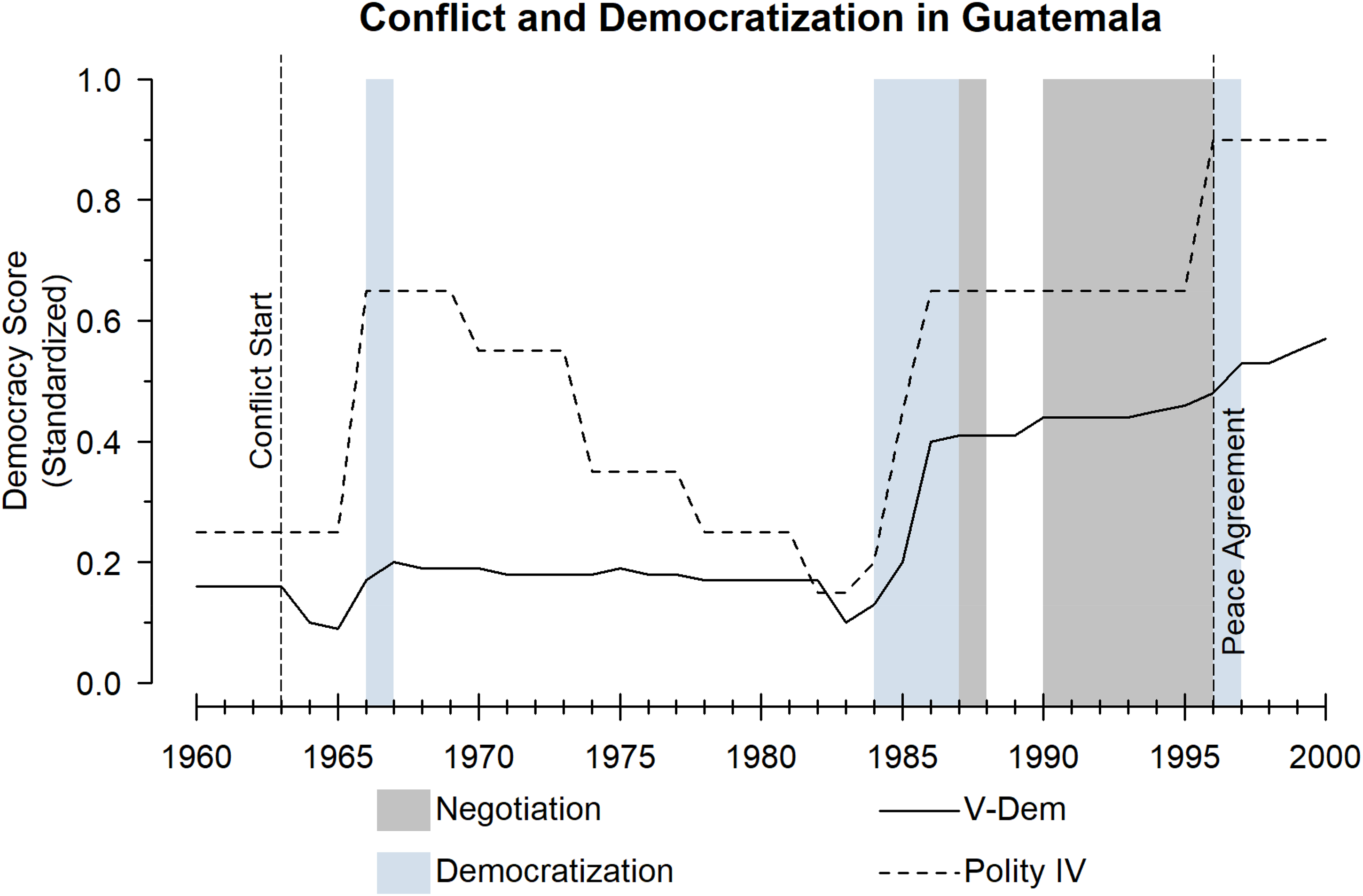
Conflict and democratization in Guatemala.
Besides the post-conflict democratization trajectory, however, Guatemala had also witnessed a period of democratization in the mid-1980s. The military dictator General Efraín Ríos Montt was ousted in 1983, which prompted a series of democratic reforms and led to the opening of greater space for political participation (Armon et al., 1997; Prado, 1996; Susanne, 1991). Legislative elections were held in 1984, followed by a general election in 1985. President Vinicio Cerezo was sworn in in 1986 and Guatemala transitioned into democracy. This democratization process is discernable in Figure 1, as shown by increasing democracy scores in 1984–1986. The National Reconciliation Commission, which was created following the democratic transition, initiated the National Dialogue in 1987 and sought reconciliation with the URNG. In the same year, the Guatemalan government and the URNG held their first peace talks on 7 October in Madrid. Although this first peace process eventually failed owing to the strong opposition of the military, it was nonetheless significant in terms of creating a precedent of negotiations with the insurgency (Prado, 1996; Susanne, 1991). Unlike its successors in 1996, the democratic reforms of 1984–1986 were not negotiated with the armed opposition. On the contrary, these institutional reforms paved the way for the first peace talks between the government and the insurgency.
This example illustrates that institutional reforms can be undertaken independently from a conflict resolution process. Democratization independent of a peace process does not mean that institutional change is exogenous to the civil war. For example, the democratic transition in Sierra Leone was linked to the armed conflict; the failure of the government to deal with the armed insurrection of the Revolutionary United Front (RUF) contributed to mass unrest, which forced the military junta to announce elections (Kandeh, 1998). However, this democratic transition did not emerge through a bargain between the state and the armed rebels. On the contrary, the RUF opposed the democratic transition and launched the “Operation Stop Elections”, which involved attacking polling stations and civilians to prevent voter participation (Kandeh, 1998). Nevertheless, Sierra Leone accomplished electing an executive into the office, and peace talks between the government and the RUF followed. Similarly, in the case of El Salvador, a sustained insurgency paved the way for eventual democratization through a bargain between the government and the rebel group Farabundo Martí National Liberation Front (FMLN) in 1992, but the initial democratic liberalization in the early 1980s preceded the peace process and negotiations with the FMLN (Wood, 2001: 870). The increasing costs of conflict generated a shift of power within the ruling elite, first strengthening regime moderates vis-à-vis hardliners and then prompting the initial democratic liberalization (Wood, 2001). A peace process only became possible after this initial democratic opening. As such, democratic reforms in the early 1980s were different from those in the early 1990s because the former were not a product of an explicit bargain between the belligerents.
Democratization can also take place through pathways not linked to civil conflict processes. A non-state actor who has taken the exit option by launching an armed rebellion is hardly the only entity to challenge the government. Numerous actors pressure for change in an authoritarian regime. The ruling elite often contain both hardliners who prefer to keep the “authoritarian power apparatus” fully intact and reformers who prefer to alter or partially dismantle the predominant repressive policies (Przeworski, 1988). The rivalry and non-violent conflict between the hardliners and the reformers can lead to the emergence of democratic institutions (Przeworski, 1988). Although the armed conflict itself can strengthen the hands of regime reformers, as in the case of El Salvador and South Africa (see Wood, 2001), democratic reforms can also take off for reasons tangential to an ongoing armed conflict, such as a global economic shock leading to mass protests and regime breakdown (Przeworski et al., 2000). For example, conflicts with non-state actors were largely irrelevant to democratization periods in several countries, including Bangladesh in 1991 (conflict with Shanti Bahini), Indonesia in 1998–1999 (conflict with Fretilin, GAM, and OPM), the Philippines in 1986 (conflict with CPP and MNLF), Turkey in 1983 (conflict with the PKK) and Spain in 1977–1989 (conflict with ETA). These examples demonstrate that factors not connected to violent conflict with an organized armed group may prompt episodes of democratization.
In short, democratization can happen for a plethora of reasons, but once it takes place, the government's willingness to negotiate with internal armed challengers profoundly alters. The next section unpacks such changes.
Democratization and the willingness to negotiate
Although the literature on civil conflict resolution considers democratization as a phenomenon located predominantly in the post-conflict domain, democratic reformers may succeed in altering the institutional configurations of a state while an armed group's rebellion is still ongoing. How do such political changes affect the willingness of conflict parties to search for a negotiated settlement? We propose that democratic reforms may provide what Zartman (1993) calls a Mutually Enticing Opportunity, pulling parties towards the negotiating table.
First and foremost, societal actors that are willing and influential enough to prompt democratic reforms are also likely to try to incorporate armed challengers into the legally recognized political processes. Providing an institutional setting to organize and manage competing interests lies at the heart of democracy. Democratic institutions are designed to regulate political conflict through non-violent channels. This requires integrating a broad spectrum of societal actors and their preferences into the political processes. Authoritarian institutions, on the other hand, operate through exclusion. Repressing outsiders who aspire to have influence in the political sphere is the main characteristic of authoritarian institutions. Undertaking democratic reforms, therefore, signifies a shift from exclusionary to inclusionary politics.
In this respect, the space that democratic reforms open up generates new opportunities for the belligerents to address their disagreements at the negotiating table. Such reform periods entail breaking away from the past policies of repression and exclusion. Most notably, democratic reforms aim at developing legal and peaceful channels through which dissent can be expressed and grievances can be aired and addressed. Reformers acknowledge the shortcomings of existing policies, amend the predominant discourse, revise the security paradigm of the state and generate new mechanisms to redress grievances. As a result, an enabling environment for peace talks emerges.
Democratization enhances the influence of the general population while diminishing the leverage of coercive state agencies. The coercive state agencies, which include the military, secret service, special forces and the police, specialize in the domain of controlling and exercising technologically advanced means of violence (Przeworski, 2010: 124). These coercive agencies inevitably become an essential part of the “authoritarian power apparatus” as the very survival of a non-democratic regime depends on their loyal functioning (Bueno de Mesquita et al., 2003: 46; Przeworski, 1988). Such agencies not only operate against internal and external armed challengers but also target the opposition, dissidents and social movements that might contest the interests of the authoritarian elite. When faced with adversaries, non-democracies have limited incentives to recognize the differences between armed organizations and civilian opposition. On the contrary, non-democratic regimes often find it useful to link civilian opposition movements to armed actors, such as a rival foreign government or rebel groups, to legitimize the use of repression and to deter citizens from showing any dissent. The diminishing influence of the authoritarian power apparatus vis-à-vis the general populace pulls the belligerents towards the negotiating table because compared with the latter, the former attributes a higher value to a full military victory over the rebels as crushing dissent has an intrinsic significance for coercive state agencies (Gurr, 1986, 1988). Democratic reforms thus directly challenge what can be summarized as “coercive habituation“ of authoritarian repression (Davenport, 2005; Gurr, 1986, 1988).
Democratization played a pivotal role in several peace processes in Southeast Asia and the South Pacific (see Wallensteen et al., 2009). Democratic transitions in the Philippines (in 1986) and Indonesia (in 1999) are two crucial cases that are worth mentioning, as in both countries democratic reformers revised the dominant security paradigm of the state and diminished the influence of the coercive state agencies, which paved the way for peace talks with insurgent groups. The popular revolution that contributed to the fall of the military dictatorship of Ferdinand Marcos and the subsequent ascension of the opposition candidate Corazon Aquino to the Presidency was the key development in the opening of peace talks with the internal armed challengers (Brillantes, 1987; Garcia, 1989; Nagel, 2020). The civilian government initiated efforts to revise the security paradigm inherited from the military dictatorship, released political prisoners, aimed at improving the human rights record of the state, tried to incorporate armed leftist groups into a peaceful democratic competition, negotiated autonomy with secessionist insurgencies and worked towards curbing the influence of the coercive state agencies by defusing a series of coup attempts. Most strikingly, President Aquino publicly reconsidered the entirely military response of the preceding authoritarian government by declaring that “the solution to the insurgency problem cannot be a total military solution. Otherwise, Marcos could have succeeded” (quoted in Brillantes, 1987: 3). Shortly after the democratic transition, the Philippines government opened peace talks with the CPP as well as the MNLF. Note that the former conflict was over governmental power whereas the latter was a secessionist conflict. In this regard, the pull generated by the democratic transition was strong enough to set the negotiating table regardless of the strength of rebel groups or the issue incompatibility. Also note that the opening of peace talks with the CPP was monumental in terms of creating a precedent because it was the first time that the Philippines had formally negotiated with an armed leftist organization carrying out guerrilla warfare to acquire governmental power.
Turning to Indonesia, the military was traditionally against negotiating with any insurgent groups. Until the democratic transition following the fall of the Suharto regime in 1998, it was successful at casting a security paradigm that rendered peace talks impossible (see Aspinall, 2005; Morfit, 2007; Schulze, 2007). Most notably, the military vehemently opposed negotiating with the Free Aceh Movement (GAM), which had taken up arms against the Indonesian government to establish an independent Aceh (see Figure 2 for a summary of the historical trajectory). After Suharto's resignation, a series of institutional reforms first paved the way for democratic transition in 1999 and then enabled democratic consolidation in 2004. During the same period, the Indonesian government also opened the very first peace talks with GAM in 2000, and despite several negotiation failures, parties signed a peace agreement in 2005. The case literature reveals that democratic reforms were pivotal in the opening of peace talks for two reasons. First, democratic reforms prompted the Indonesian government to revise its security paradigm. Under authoritarian institutions, the prevailing security paradigm considered negotiating with internal armed challengers a grave security threat that would undermine the territorial integrity of the state. Second, reforms strengthened the hand of the elected civilian government over the military. Thanks to democratic consolidation, the civilian government could overturn the veto of the military and open up negotiations with GAM.
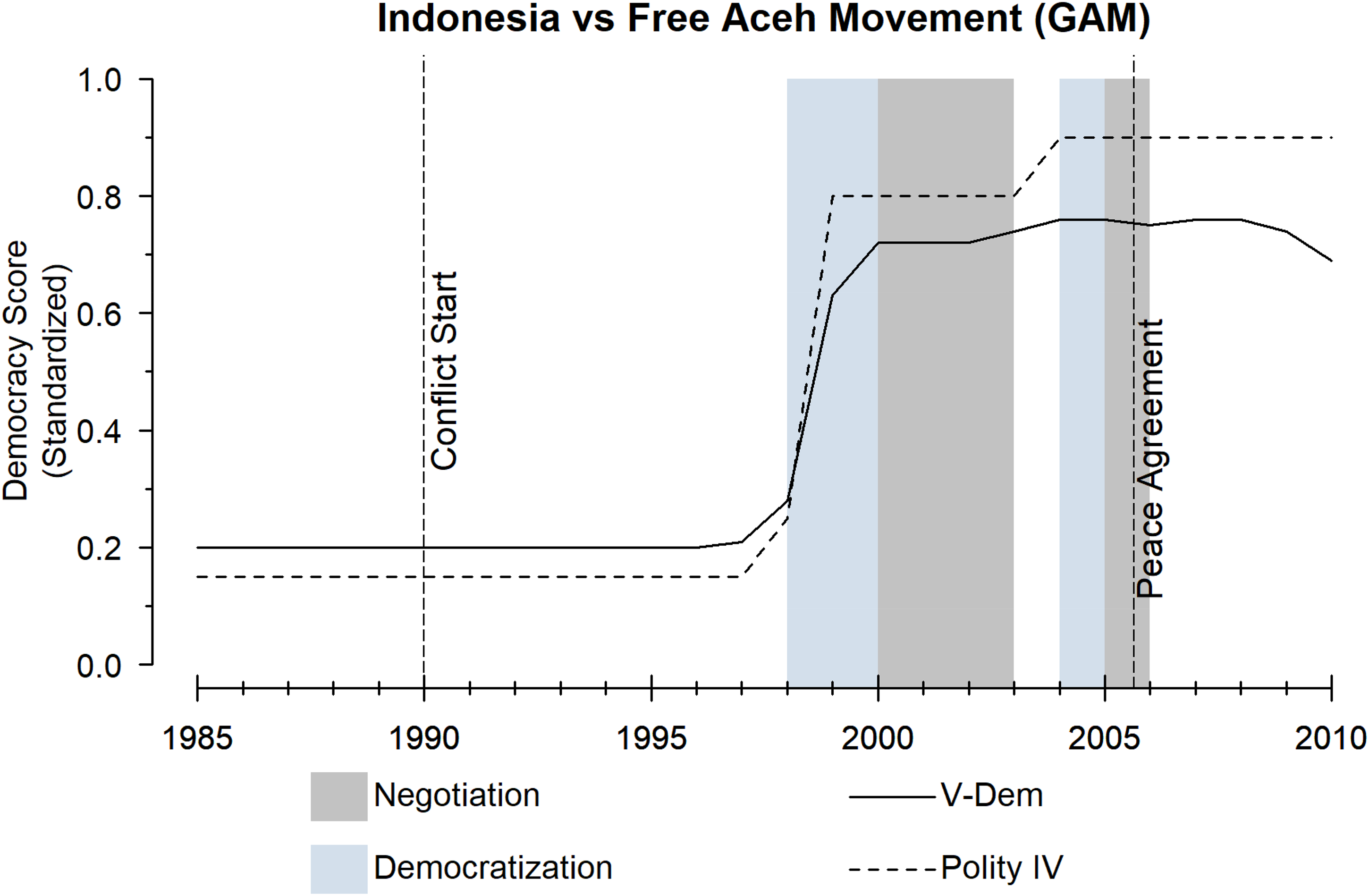
Democratization and conflict resolution in Indonesia.
Besides altering the civil–military relationship, democratic institutions also introduce restrictions to limit governmental power and distribute political authority across separate entities. These power-limiting and power-dividing properties of democracy generate opportunities for conflict resolution and pull the belligerents to the negotiating table. A state-party cannot credibly commit itself to abide by the concessions it may offer to the rebels during negotiations, which is a significant obstacle against resolving civil conflict (Walter, 1997). The initiation of democratic reforms acts as a conciliatory signal towards the armed opposition by indicating the willingness and sincerity of the state at limiting and dividing the governmental power. Although such costly signals do not solve the commitment problems by themselves, they enhance the credibility of the state as a negotiating partner and demonstrate a genuine willingness to resolve conflict through compromise (Hoddie and Hartzell, 2005; Wallensteen et al., 2009). This may pave the way for the opening of the peace talks. As put by Hoglund and Svensson (2006: 384), “conciliatory signaling can be a useful catalyst for negotiations to begin”.
Hoddie and Hartzell (2005) argue that the very act of institution building itself generates “costly signals of conciliatory intent necessary for fostering new norms of peaceful cooperation”. Indeed, a large literature discusses the importance of power-limiting, power-sharing and power-dividing institutions for resolving conflict (see Hartzell and Hoddie, 2015; Wallensteen et al., 2009). Although these studies restrict their scope to post-conflict institution building, they reveal that democratic reforms can enhance the legitimacy of government, foster trust between the conflict parties, and alleviate commitment problems. Indeed, even approaches that consider hard security guarantees by third-party actors as a necessary condition to address commitment problems concede that domestic institutions also matter. For example, Walter (2002) formulates a positive relationship between the level of democracy and a government's credibility as a negotiating partner, and recognizes that democratic institutions facilitate conflict resolution by limiting governmental powers. Leaders constrained by democratic institutions have less to lose from negotiating and conceding concessions to rivals compared with authoritarian leaders who successfully concentrated power (Walter, 2002).
The emergence and expansion of democratic institutions not only change incentives, but also bring in new enticements. Starting with the government side, political institutions “constitute the critical ‘transmission belt’ by which the preferences and social power of individuals and groups are translated into state policy” (Moravcsik, 1997: 518). Therefore, democratic reforms entail the proliferation of societal actors whose interests are relevant for the state and consequently change the incentives and preferences of the government (Bueno de Mesquita et al., 2003). As put by Acemoglu and Robinson (2005), authoritarian institutions represent the interests of the elite whereas democracies tend to produce policies favorable to the majority of the populace. A central feature of democracies is their tendency to provide public goods and social services at a much higher rate than non-democracies (Acemoglu and Robinson, 2005; Bueno de Mesquita et al., 2003). This is expected because the emergence and expansion of democratic institutions render the preferences of the general populace more and more relevant for the state, and the population has a clear preference toward public good provision and social spending. On the other hand, authoritarian institutions prioritize allocating resources for repressing dissent, regardless of whether the challenge is armed or unarmed. Therefore, the enlargement of the selectorate through democratic reforms not only diminishes the influence of coercive state agencies, but also introduces incentives to allocate resources away from the instruments of coercion and towards public good provision, welfare policies and investments in physical and human capital to stimulate economic growth (Acemoglu and Robinson, 2005; Bueno de Mesquita et al., 2003). As the opportunity cost of allocating resources to repress rebels increases, state-parties become more willing to search for a negotiated settlement.
Turning to the rebel side, non-state actors may also see the space in which democratic reforms open as a window of opportunity. Most notably, a non-state actor that challenges the state authority can finally achieve recognition as a bargaining partner. A state's categorical refusal to negotiate with non-state armed challengers is often a monumental obstacle to formal peace talks. As democratic reforms represent a break away from the past policies of exclusion and repression, these periods are precisely when the state becomes more likely to abandon its rhetoric of branding rebels as mere criminals or terrorists. As Hoddie and Hartzell (2005: 28) highlight, “the act of opening negotiations confers a level of legitimacy and recognition on groups that might previously have been dismissed as criminals or terrorists”. Therefore, incurring the cost of initiating negotiations and recognizing the rebels as a legitimate entity to negotiate with is itself a conciliatory signal (Hoddie and Hartzell, 2005). Coupled with the increase in the government's credibility as a bargaining partner, the prospect of achieving recognition by the state through formal peace talks pull the rebels towards the negotiating table.
Colombia's initiation of peace talks with several insurgent groups during the “democratic opening” of President Belisario Betancur is another example of how institutional reforms may pull conflict parties to the bargaining table by overturning the government's long-established refusal to negotiate with non-state armed challengers (Chernick, 1988). The democratic reforms initiated during the Betancur government (1982–1986) entailed the opening of the political space for previously excluded groups; the formation of new political parties, including those set up by former guerrillas; the expansion of local elections (Pardo, 2002); amnesty for political prisoners; and “dialogue among all key political actors (including representatives of the nation's guerrilla movements) and the establishment of ground rules for participation and democratic opposition” (Chernick, 1988: 53–54). Most strikingly, the Betancur government acknowledged past errors of the Colombian state and recognized that the lack of opportunities for political participation, poverty, inequality and injustice created an environment within which insurgents groups emerged and challenged the state (Kline, 1999; Pardo, 2002). As put by Pardo (2002: 3–4), “the Betancur government's search for peace could thus be seen as a kind of act of contrition by an establishment that recognized its errors, partially embraced the guerrillas’ concerns, and clearly demonstrated its willingness to make amends”. The Betancur government not only initiated public investment in the most impoverished areas but also passed reforms that introduced mayoral elections (Pardo, 2002). Such constitutional reforms, “sought to remove the basis for the guerrillas’ misgivings toward what had been a closed democracy and to convince the insurgents of the possibility of peace by demonstrating the government's goodwill and genuine desire to rectify past mistakes and embrace self criticism” (Pardo, 2002: 4). These reforms indeed acted as costly signals and pulled the insurgents to the negotiating table. The government recognized that formally acknowledging insurgents as a negotiating partner is a concession it is giving to the guerilla movements (Chernick, 1988). During this period, Colombia opened peace talks with the FARC, M-19, ELN and EPL. Note that the peace talks following the “democratic opening” were Colombia's first talks with the insurgent groups. These inaugural peace talks “inalterably transform[ed] the discourse” and set a precedent for subsequent negotiations (Chernick, 1988: 54). Therefore, democratic reforms were monumental in introducing the very possibility of peace talks and turning guerrilla movements from “mere criminals” to political actors that the government could pursue a joint decision with.
Zartman (2001) conceptualizes “Mutually Enticing Opportunities” as openings that pull parties to the negotiating table. Such openings refer to cases in which “enticement comes in the form of a new ingredient” and “the opportunity for a settlement grows more attractive because the issue of the conflict becomes depassé” (Zartman, 2001: 14). Mutually Enticing Opportunities enhance trust between conflict parties, bring about horizontal legitimacy and facilitate dialogue through increased confidence (Ohlson, 2008). Democratic reform periods qualify as such a Mutually Enticing Opportunity because they represent an opportunity to break away from the past policies of the state and render the conflict as an artifact of the preceding authoritarian institutions. In this respect, changing institutional setting also acts as a novel feature, bringing in new enticements while altering existing incentives. Moreover, democratic reforms provide conciliatory signals to armed rebels. They enhance the legitimacy of state institutions, which facilitate dialogue by increasing the credibility of possible governmental concessions and by building trust between conflict parties. In sum, democratic reforms are likely to provide a window of opportunity for peace talks. Earlier research showed that monumental events such as coups and leadership changes provide shocks that make peace talks more likely (Cunningham and Sawyer, 2019; Ryckman and Braithwaite, 2020; Thyne, 2017). Democratization has a similarly profound impact by opening space within which peace talks emerge as a viable option.
Research design
To test the proposed hypothesis, we estimate a series of models using the Peace Negotiations in Civil Conflicts (PNCC) dataset (Arı, 2018). The PNCC records instances of formal peace negotiations between a government-party and a non-state armed organization. It is structured on the dyadic version of the UCDP/PRIO Armed Conflict Dataset (ACD) (Melander et al., 2016). Using dyad-year as the unit of analysis is appropriate for this study because the point of interest is negotiations between governments and rebels. For robustness, models are also estimated at the state level. The data has global coverage for the 1975–2013 period. A rebel group is recorded from its first appearance in the ACD until it signs a peace agreement with the government or is no longer a non-state armed group, which refers to victory or defeat. More detailed information about the PNCC is available in Online Appendix A.
The main explanatory variable is democratic institutional reform. Thanks to several data sources measuring democracy, it is possible to identify an institutional reform period by capturing increases in the democracy score of a country from its previous year's value. We rely on two main datasets that are commonly used in political research: Polity IV (Marshall Monty et al., 2002) and V-Dem (Coppedge et al., 2016). A democratic reform period is identified if two conditions are satisfied at the same time; a one percentage point increase in V-Dem's Polyarchy score and a one unit increase in XPOLITY, which is constructed using Polity IV indicators and following Vreeland (2008). 5 This measurement strategy is visualized in Figures 1 and 2. Using multiple data sources to identify democratic reform has an important advantage because the measurement is not dependent on a single data source or specific coding practices. An alternative measurement using agreement in three data sources (Freedom House, 2015) also yields similar results, which are presented in Online Appendix B.
As the interest is democratic reform periods, our main measurement strategy aims to capture all types of reform, including authoritarian liberalization, democratic transition and democratic consolidation. Although the theoretical framework expects all three types to have a positive impact, as a robustness check, we also turn to categorical regime-type datasets to unpack the magnitude of reform. We start with the Lexical Dataset to verify our results. This alternative approach brings several advantages. First, the Lexical Dataset identifies seven categories to assess how democratic a country is (Skaaning et al., 2015). These categories are: (0) no elections; (1) no party or one-party elections; (2) multi-party elections for legislature; (3) multi-party elections for legislature and executive; (4) minimally competitive elections; (5) male or female suffrage; and (6) universal suffrage. As the Lexical measurement is ordinal with a few categories, an upward shift refers to a high-magnitude reform period that carries a country from one category to another. Furthermore, using a categorical democracy dataset not only allows the identification of an institutional reform period clearly, but also enables authoritarian liberalization to be distinguished from democratic transition in a straightforward manner. We consider any reforms that carry a country to 4 or above as democratic transition, whereas improvements that fall below minimally competitive elections are considered autocratic liberalization. Finally, the use of a categorical democracy dataset is desirable to enhance the confidence in our statistical results. Keeping this in mind, we turn to two more regime-type data sources, the Autocratic Breakdown and Regime Transitions Dataset (Geddes et al., 2014) and V-Dem's Regimes of the World variable (Coppedge et al., 2016), to further verify our results. Conclusions from these three additional measurement strategies overlap with each other as well as our main analysis (see Online Appendix B).
The main explanatory variable, Democratic Reform, is lagged one year in statistical estimation to consider the possibility that reforms can be undertaken as a bargain emerging from negotiations. Additional models using Markov transition and inaugural negotiations (i.e. the very first peace talks) at both the dyad and the state levels are also estimated. As the historical examples of Colombia, Indonesia and the Philippines demonstrate, democratic reforms can be especially consequential in terms of creating a precedent of negotiating with a non-state armed organization. Therefore, investigating inaugural peace talks is also relevant to see whether such a pattern is discernible in a larger dataset.
All models control for population, real GDP per capita, democracy and governmental leadership change as these can be correlated with democratic reform. Founding studies of the respective field proposed economic development as the main cause of democratization (see Haggard and Kaufman, 2016). A change in governmental leadership may also pave the way for peace talks (Ryckman and Braithwaite, 2020). 6 Population and GDP per capita are taken from Gleditsch (2002). V-Dem's electoral democracy index, Polyarchy, is used to measure the democracy level (Coppedge et al., 2016). For Executive Change, we rely on the Archigos dataset to identify changes in governmental leadership (Goemans et al., 2009).
Previous research has argued that conflict duration and intensity are important predictors of negotiations as they jointly reflect the presence (or absence) of a mutually hurting stalemate. Controlling for conflict duration and intensity is also necessary because a sustained rebellion with high costs can lead to shifts in influence among factions within the ruling elite and prompt democratic reforms (Wood, 2001). Dyad Duration measures the dyadic conflict duration in a calendar year. To measure conflict intensity, two alternative approaches are adopted. First, a variable is constructed to distinguish inactive, minor and major conflicts using the Intensity variable available in the ACD. Inactive refers to battle-related deaths below the ACD's inclusion criteria of 25, whereas minor conflicts have casualties between 25 and 1000 and major conflicts have casualties over 1000. Second, the natural log of battle-related deaths is calculated from the UCDP Battle-Related Deaths Dataset. As the coverage of this dataset starts from 1989, not all models include battle-related deaths to use the full data on negotiations.
The availability of mediators and peacekeepers may facilitate an environment favorable for explicit bargaining (see DeRouen Jr and Chowdhury, 2018; Greig et al., 2019; Howard, 2019; Wallensteen, 2011). Multiple conflict fronts may emerge simultaneously in a country, and peacekeepers and mediators going to one conflict may induce negotiations in another conflict in the future. The international community can also encourage countries to seek negotiations with rebels and undertake institutional reforms at the same time. To address these, three additional control variables are included. First, models control for previous mediation in the preceding two years at the country level. Note that controlling directly for mediation would introduce post-treatment bias because mediation is “a form of assisted negotiation” (Bercovitch and Jackson, 2001: 61). Previous mediation is a suitable indicator for the supply of international mediators as coded using the Civil War Mediation dataset (DeRouen et al., 2011) and the PNCC. We also control for UN peacekeeping to account for peace process spill-overs from one conflict to another as multiple rebel groups may observe and learn from the experiences of each other. UN peacekeeping operations are effective at addressing obstacles arising from conflict fragmentation and inspiring compliance with the peace process (Arı and Gizelis, 2020). Rebel groups outside of negotiations may bandwagon and join in negotiations when a credible peace process is developing thanks to UN peacekeeping. The data for UN peacekeeping personnel are taken from Kathman (2013). Finally, foreign aid may have an impact on both conflict processes and institutional reform. Official development assistance is included to account for this possibility.
Other control variables are as follows. Earlier research has argued that ethnic rivalry may influence the prospect of democratization (Haggard and Kaufman, 2016). Whether the conflict has an ethnic dimension is measured using Vogt et al. (2015). The relative rebel strength is incorporated into models using the Non-state Actors dataset (Cunningham et al., 2009). Following the convention, a dichotomous variable, Rebel Strength, is coded to take the value 1 if the rebel group is “at parity”, “stronger” or “much stronger” and 0 if it is “weaker” or “much weaker”. This conversion from ordinal to dichotomous is necessary because there are only 25 rebel groups in the sample that are “stronger” or “much stronger”. Missing values are imputed using the last non-missing value.
Although we control for a wide variety of observable variables proposed to be correlated both with conflict and democratization, it is vital to acknowledge that a strictly causal relationship between democratic reforms and negotiations cannot be drawn conclusively. As Hegre (2014) points out, complex social processes with multiple ties and temporal interactions may explain the formation of democratic institutions, and some of these societal processes are unobservable. A vast literature has proposed a plethora of explanations for democratization, but none of them explains a sufficiently large number of cases, and a wide variety of sui generis pathways may lead to democratic institutions (Haggard and Kaufman, 2016; Shin, 1994). In this regard, democratization is itself a deeply endogenous and multifaceted outcome. It cannot be considered as a single piece of policy or a treatment that can be randomly given or withheld. Instead, we consider democratization as a precursor event, which is itself manifesting the profound societal changes in a polity.
For these reasons, we also investigate the out-of-sample predictive power of democratization (see Ward et al., 2010 for out-of-sample predictive power). For all models, we compare specifications with and without the Democratic Reform variable. We compute and report changes in the area under the receiver–operator curve (AUC) through fourfold cross-validation with 1000 cycle runs. The receiver–operator curve plots the number of false positives and false negatives with respect to different cut-off thresholds, and a larger AUC indicates a better predictive power. If societal actors that are willing and influential enough to undertake institutional reforms are also more likely to try incorporating rebel groups into legitimate political processes through negotiations, as indicated by the theoretical framework, then incorporating the Democratic Reform variable into model specification should lead to an increase in the out-of-sample predictive power.
Empirical analysis
Starting with descriptive statistics, negotiations took place in 27.55% of all sample observations. For years immediately following democratic reforms, 56.38% of cases observed negotiations. This ratio drops to 26.62% for observations not following a democratic reform period, which suggests a large difference between the two groups of observations. Descriptive statistics for the full sample are available in Online Appendix A.
Table 1 presents a series of logistic regression models. Temporal dependency is controlled by constructing a time-since-last-negotiation variable and including its cubic polynomials (Carter and Signorino, 2010). Model 1 includes only the core variables. Model 2 controls for Rebel Strength, Ethnic, Executive Change, Foreign Aid and Previous Mediation. Model 3 further controls for Battle Deaths and UN Peacekeeping. Note that Model 3 is restricted to 1990–2013 because of data availability, which leads to smaller sample size. Based on model fit, dummies for Conflict Intensity and Battle Deaths are included together. Model 4 is estimated using a conditional logit (fixed-effect) estimator. A conditional logit estimator moves from a common intercept to dyad-specific intercepts, which is often called fixed effects. This approach captures dyad-specific unobservable factors and helps us to isolate how the prospects of peace talks change after democratic reforms by analyzing the within-case variation. Models 5 and 6 replicate Models 3 and 4 at the state level, respectively. The results indicate that dyad- and state-level analyses are consistent with each other.
Logistic regression on negotiation.
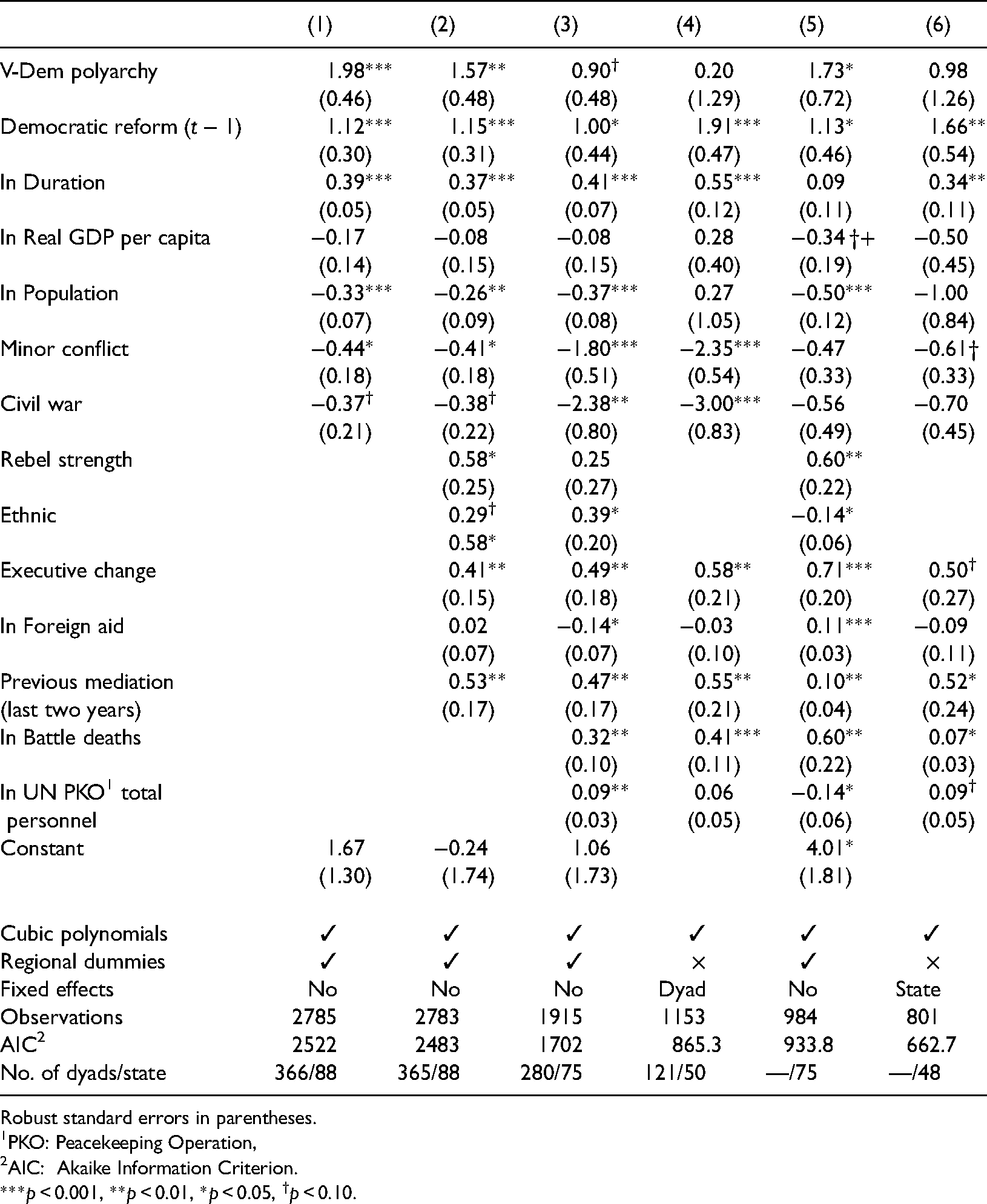
Robust standard errors in parentheses.
1PKO: Peacekeeping Operation,
2AIC: Akaike Information Criterion.
***p < 0.001, **p < 0.01, *p < 0.05, †p < 0.10.
The coefficient estimates of the main explanatory variable are positive and statistically significant across all models, suggesting that democratic reform periods are associated with an increased probability of peace talks in the following year. The level of democracy is also positive, but not significant in all models. As expected by previous research, the dyadic conflict duration is positive and highly significant, indicating that the longer a rebel group survives, the more likely the peace talks are. Similarly, findings for Battle Deaths and Rebel Strength are also compatible with existing research as both are positively associated with negotiations.
Figure 3 presents the average change in the predicted probability of negotiations (Model 3). Among the five variables presented in Figure 3, the first three, Democratic Reform, Rebel Strength and Previous Mediation, are dichotomous, thus their respective first differences refer to a discrete change from zero to one. The latter two, Duration and Battle Deaths, are continuous and their respective first differences refer to a change from the 25th percentile to the 75th percentile. Figure 3 shows that the estimated impact of Democratic Reform is substantively meaningful. A discrete change from institutional status quo to democratization is associated with a 14.5 percentage point increase in the probability of negotiations in the following year, which indicates a substantively meaningful relationship.
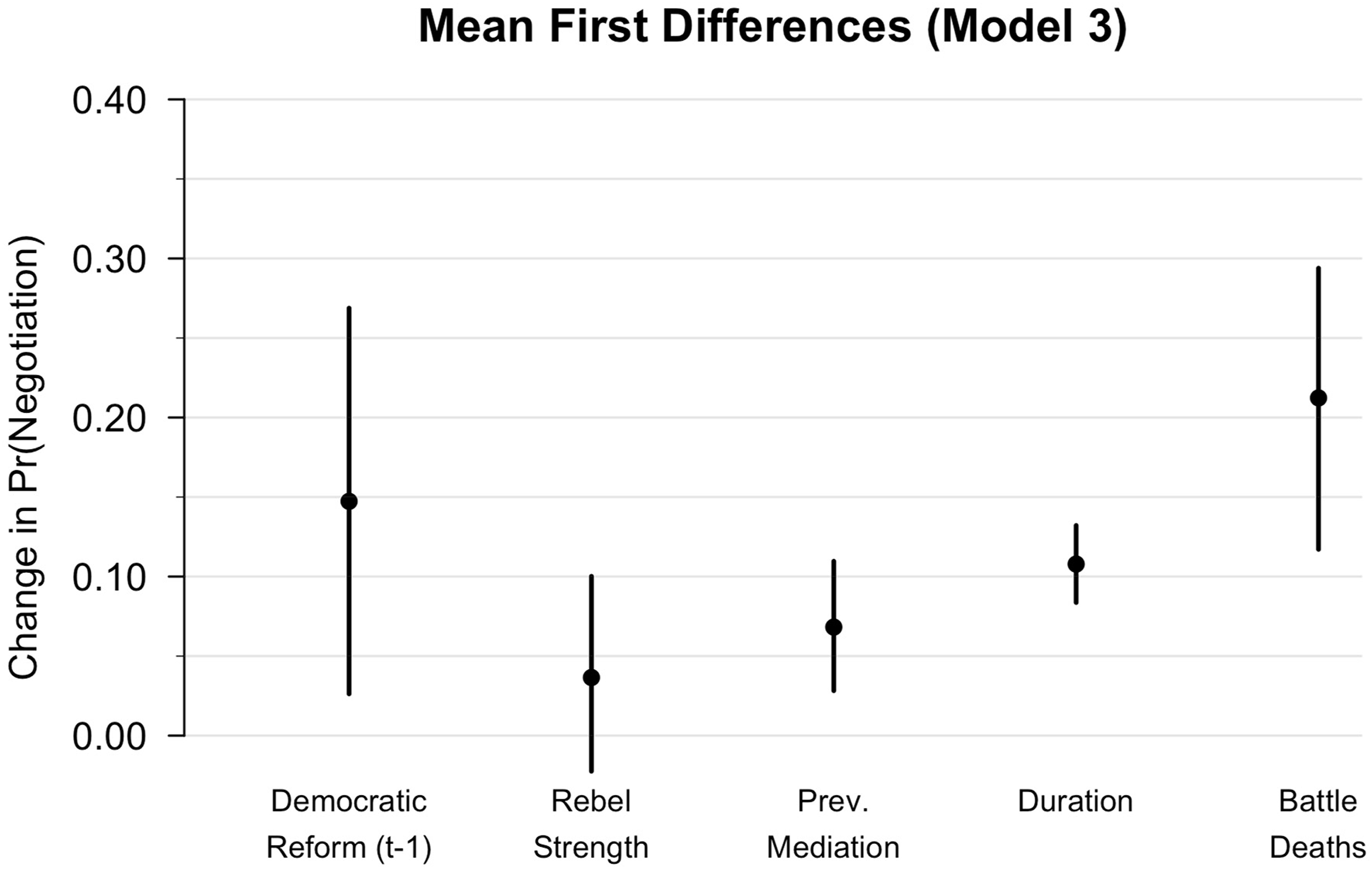
Mean first differences (Model 3) with 95% confidence interval. First differences refer to: a discrete change from 0 to 1 for Democratic Reform, Rebel Strength and Previous Mediation; an increase from 3 to 16 years for Duration; and an increase from 1 to 184 for Battle Deaths.
Predictive power
The main argument of this article is that the periods following democratic reform present a window of opportunity for peace talks. If democratization is a precursor to peace talks, then we should be able to use the former to predict the latter. Thus, the predictive power of Democratic Reform is of major interest. As statistical significance is a poor measure for judging the predictive power of a proposed variable, we follow Ward et al. (2010) and generate reduced models by excluding Democratic Reform from the specification. Comparing each full model (with Democratic Reform) with its reduced form (without Democratic Reform) enables evaluation of the predictive value of the proposed variable.
Starting with in-sample performance, Figure 4 presents a series of separation plots, which show a modest but consistent improvement in predictive power when Democratic Reform is included. For example, with a cut-off threshold of 0.5, the true positive rate is 66.40% for Model 3. When Democratic Reform is excluded from Model 3 specification, the true positive rate drops to 65.77%. For the cut-off threshold of 0.75, the respective true positive rates are 28.21 and 26.47%, which show that taking democratic reforms into account leads to better predictions.
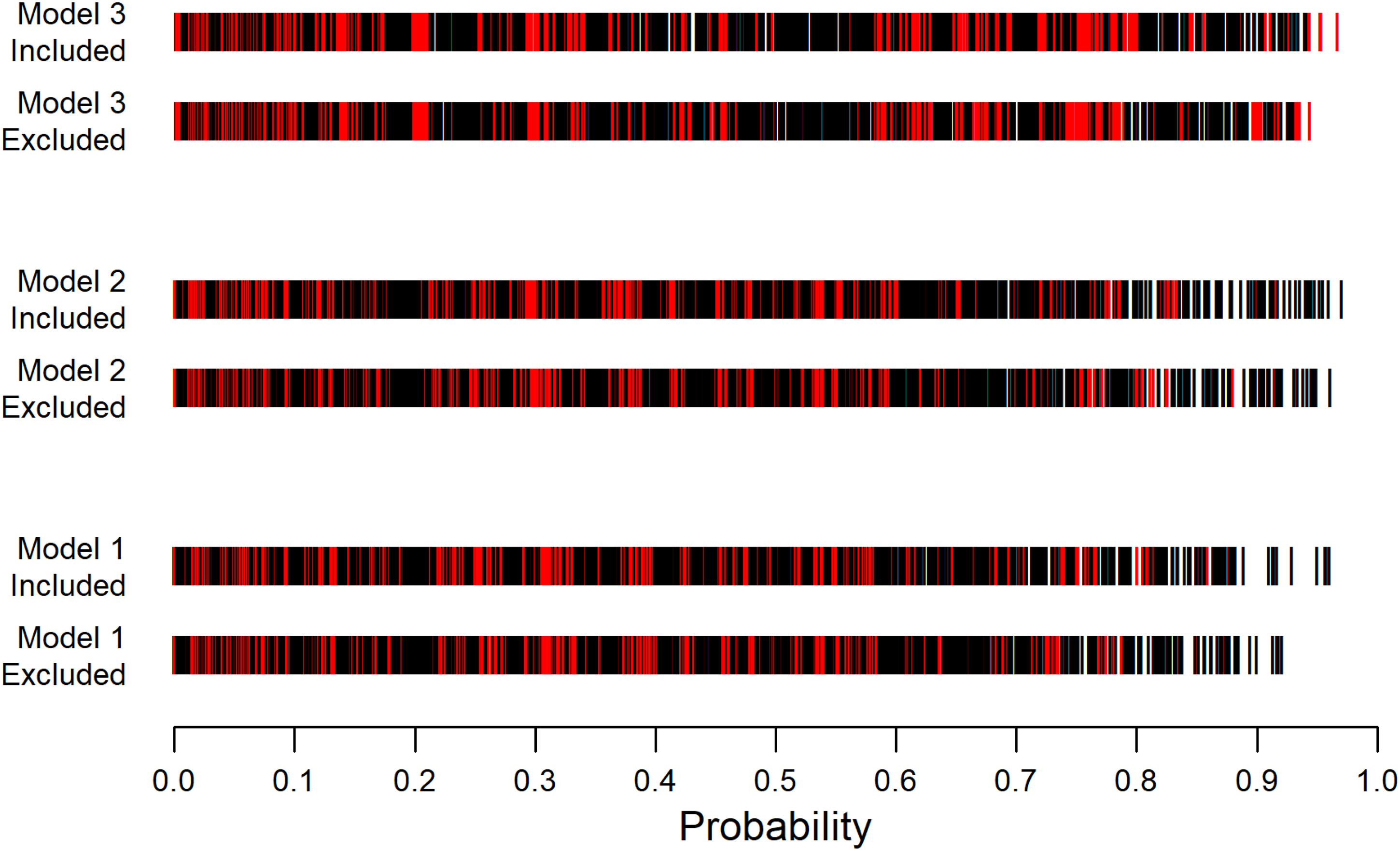
Separation plots when democratic reform (t − 1) is included/excluded from the specification.
Next, we turn to out-of-sample predictive performance through fourfold cross-validation with 1000 cycle runs (see Ward et al., 2010). We are interested in comparing the AUC for specifications including/excluding Democratic Reform. Figure 5 presents the results. For all models, the AUC decreases once Democratic Reform is removed from the specification, indicating that the predictive performance is worse if democratization is overlooked. Note that Model 3 is the most expensive model with all the main correlates of peace talk, but Democratic Reform still makes a meaningful contribution to the predictive performance. We contend that this is an important finding because it contributes to a more accurate prediction of ripe moments for negotiations, which has the potential to assist international mediators to craft timely peace initiatives.
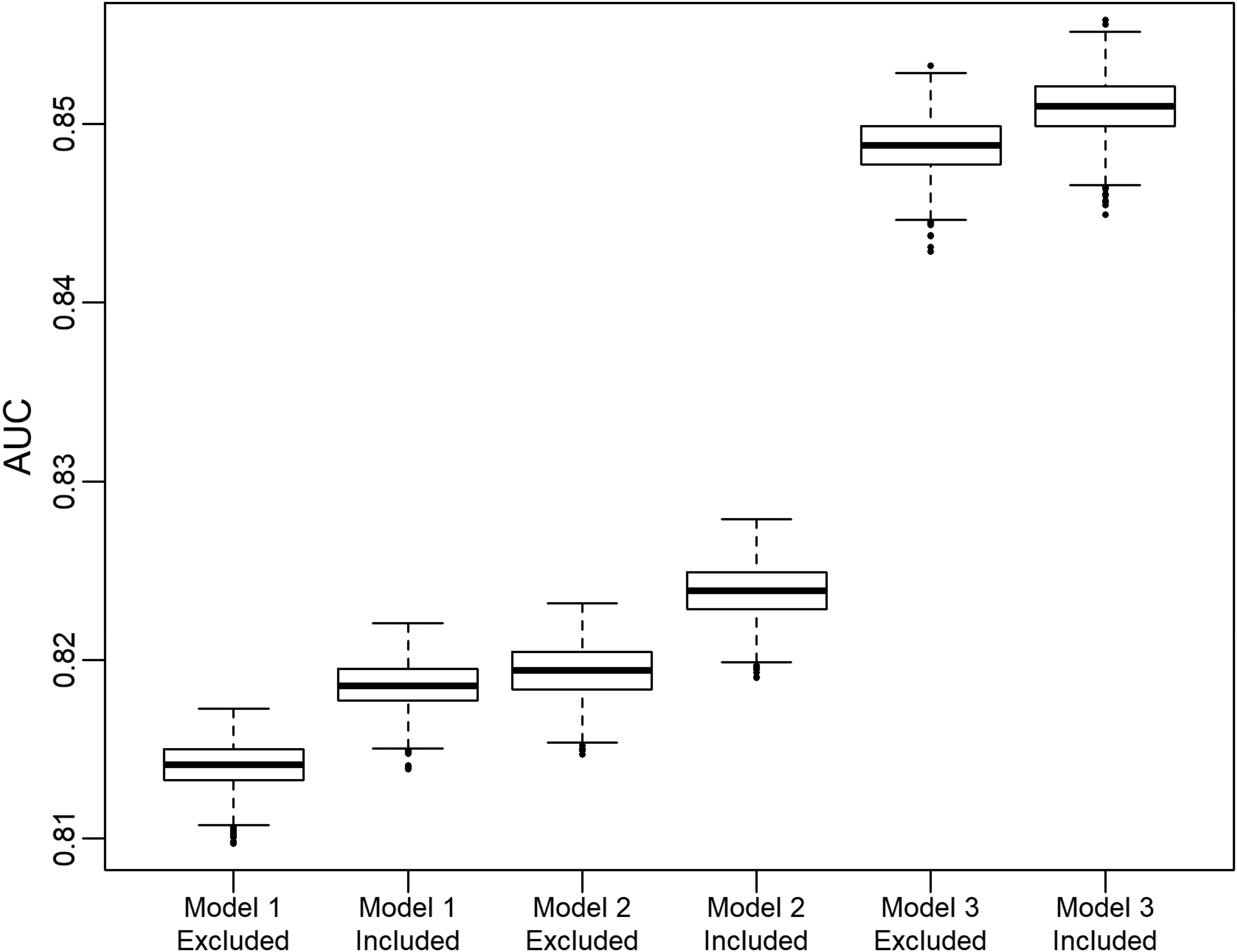
Out-of-sample fourfold cross-validation with 1000 cycle runs and the area under the receiver–operator curve when democratic reform (t − 1) is included/excluded from the specification.
Revisiting Indonesia vs. GAM dyad, Figure 6 demonstrates both the substantive significance and the predictive power of Democratic Reform based on out-of-sample predictions on a specific case. We focus on this case because qualitative studies on Indonesia informed our theoretical framework. We re-estimate the models after removing Indonesia from the sample. We are interested in whether predicted probabilities generated by these models are compatible with the Indonesian experience. Note that the democratic reforms in Indonesia took place in 1998, 1999 and 2004. Also note that predicting inaugural negotiations (i.e. very first peace talks) is particularly challenging because the history of peace talks (captured by cubic polynomials) is a strong predictor. This makes the inaugural negotiations in 2000 especially hard to predict.
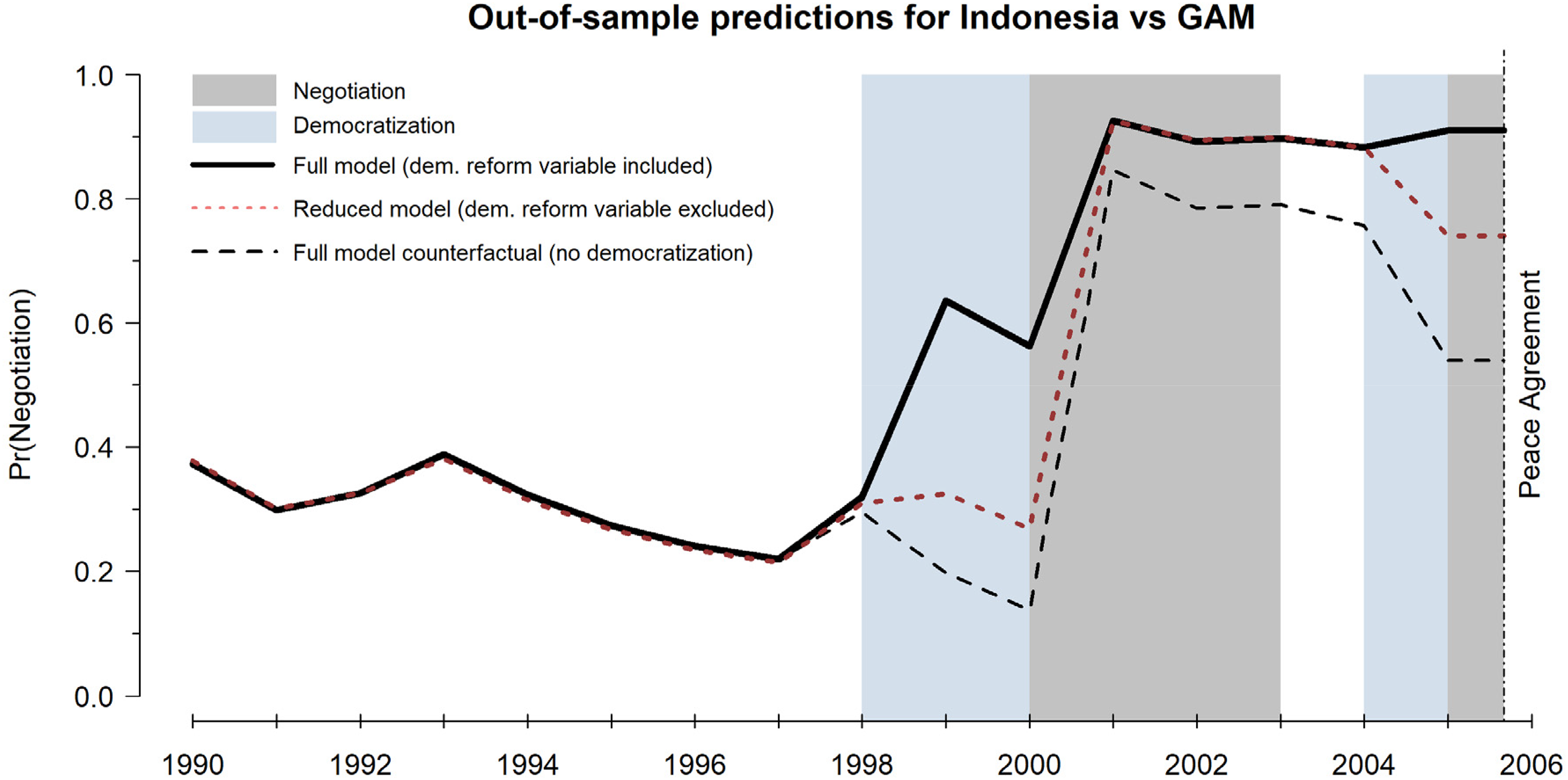
Predicted probability of negotiations for Indonesia vs GAM. Counterfactual (dotted line) is no democratization (fixing Polyarchy at its 1997 value).
The solid line in Figure 6 represents the Full Model and shows the predicted probabilities calculated by plugging factual data into the coefficients from the out-of-sample estimation. The dotted line (Reduced Model) also uses factual data, but its specification excludes Democratic Reform. The two estimation strategies are otherwise identical. In other words, the dotted line represents a scenario in which a researcher disregarded the impact of democratization.
The Full Model indicates a substantial increase in the predicted probability of negotiations from 0.32 in 1998 to 0.63 and 0.56 in 1999 and 2000, respectively. In other words, the Full Model warns us that in 1999–2000 the conflict might witness its inaugural negotiations. Indeed, the first peace talks do take place in 2000. The Reduced Model fails to capture such a change and assigns 0.33 for the probability of negotiations in 2000. Similarly, the Reduced Model performs worse in 2005. These differences in solid and dotted lines in Figure 6 present evidence for the predictive power of Democratic Reform.
To investigate the substantive impact of Democratic Reform, we turn to a counterfactual situation in which Indonesia had not democratized and kept its political institutions at its 1997 state. This synthetic data manipulates only Polyarchy and Democratic Reform variables, but everything else remains at its actual realization. The dashed line in Figure 6 shows the predicted probabilities from this counterfactual scenario. According to out-of-sample estimates, the probability of negotiations with GAM would be 0.14 in 2000 had Indonesia not democratized. This estimate is 42 percentage points below the estimate from the Full Model using factual data. Similarly, the probability of negotiations would be 37 percentage points lower in 2005 had there been no democratic consolidation in 2004. These substantial increases in the probability of negotiations in 2000 and 2005 are associated with democratization in preceding years. In sum, the analysis presented in Figure 6 takes a specific example to further investigate aggregate findings presented in Figures 3–5 regarding the substantive significance and the predictive power of the proposed variable.
Additional robustness tests
If democratic reforms gradually unbundle during negotiations as separate bargains prior to signing a peace agreement, this might generate a reverse causality problem.
7
To address this possible pitfall, two additional modeling strategies are adopted. First, Markov transition models are estimated. Markov transition models enable negotiation onset to be distinguished from negotiation continuation. A first-order Markov transition model with a logit link function yields the following two equations:

Logistic regression on negotiation.
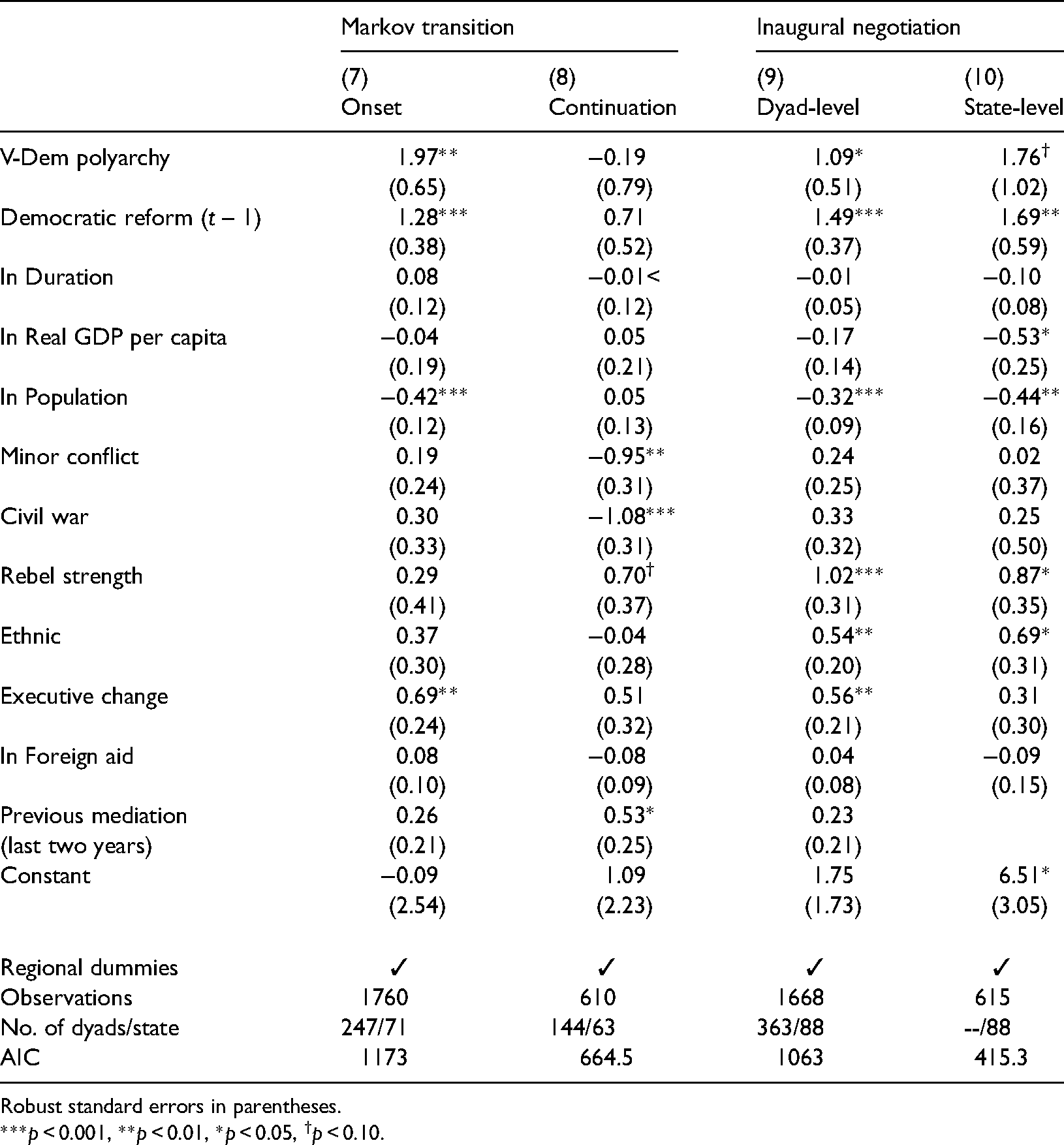
Robust standard errors in parentheses.
***p < 0.001, **p < 0.01, *p < 0.05, †p < 0.10.
Second, we redefine the outcome variable as inaugural peace talks. Accordingly, we restrict the data by excluding observations after the first negotiations. This effectively reformulates the question to “do democratic reforms increase the likelihood of the very first peace talks?” Although highly restrictive, reformulation of the question eliminates the possibility of previous negotiations influencing the likelihood of democratic reforms. Such a modeling strategy presents a hard test for the theoretical argument because the theory is employed to predict only the inaugural peace talks, which is a particular subset of negotiations. This reformulation also yields a much smaller sample size. Nonetheless, given the historical examples of Colombia, Indonesia and the Philippines, democratic reform periods might be monumental for getting the belligerents to the bargaining table for the very first time, and consequently setting a historical precedent.
The right panel of Table 2 presents the results for inaugural negotiations. Model 9 shows that democratic reform is positively associated with the likelihood of inaugural negotiations. Model 10 re-runs the analysis at the state level to rule out the possibility that negotiations in a dyad are generating democratization first and then spilling over to another dyad. These results indicate that the theoretical argument can be employed to predict even the inaugural peace talks at the state level.
Finally, we replicate our analysis using the Authoritarian Liberalization and Democratic Transition variables. Note that these variables are derived from the Lexical Dataset as outlined above in Research Design. We also look beyond a one-year period and allow a time-variant effect using alternative functional forms. Based on model fit, we report measurements using an exponential decay function with a half-life parameter of five years. As shown in Figure 7, we find a positive and meaningful impact of both authoritarian liberalization and democratic transitions, which is in line with our original findings. We also find that the magnitude of impact is higher for democratic transitions than autocratic liberalization. We further replicate these models using other categorical regime-type datasets and reach the same substantive conclusions (see Online Appendix B).
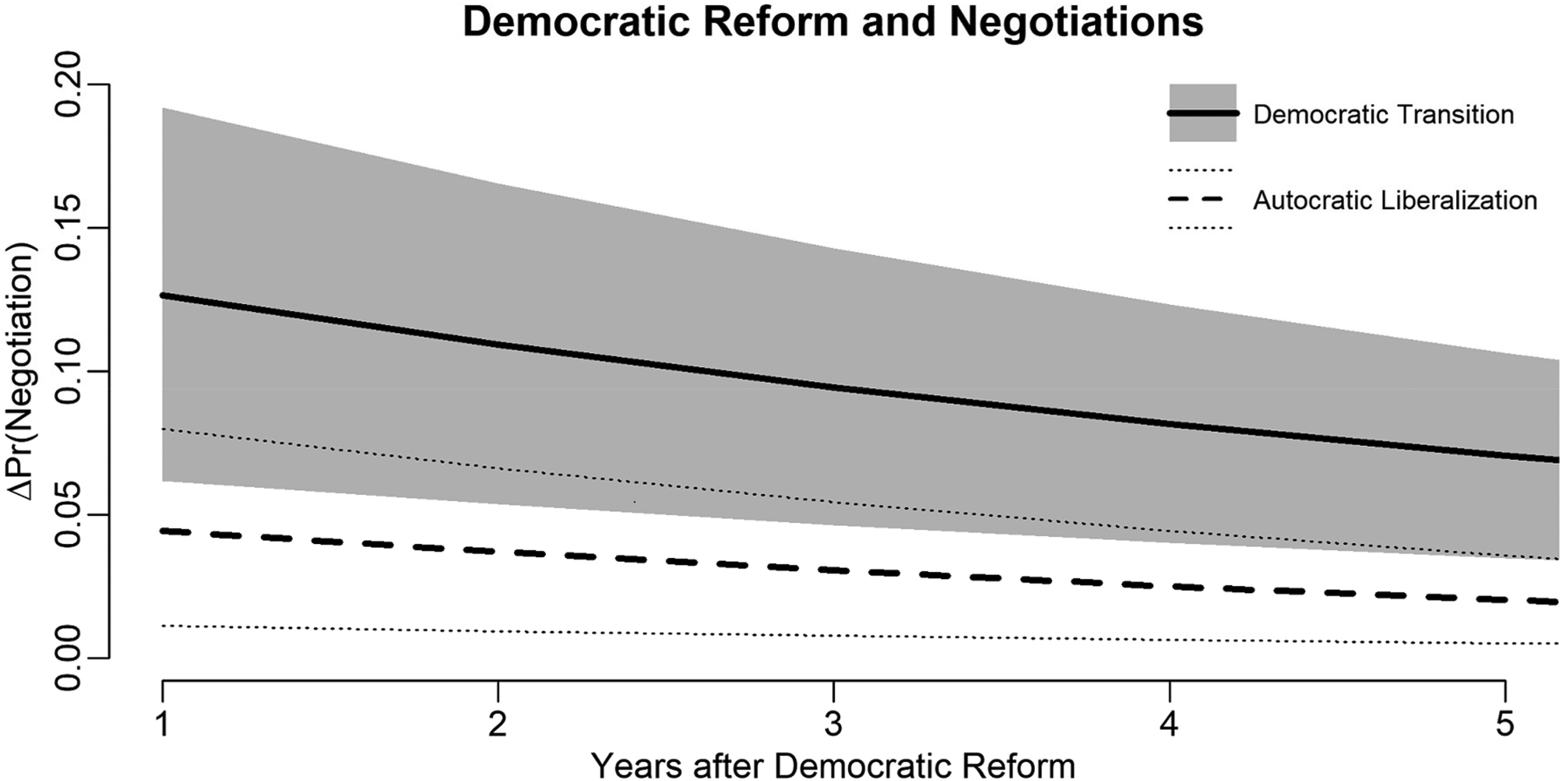
Average marginal effect of authoritarian liberalization and democratic transition.
Online Appendix B presents models with additional controls. These controls include the intervention of a democratic state, natural resources, socioeconomic inequality, non-violent protests and economic sanctions. The aim is to exhaust the list of observable correlates of democratization (Haggard and Kaufman, 2016). In sum, democratic reforms remain a robust predictor of negotiations.
Conclusion
This article argued that there are strong theoretical reasons to expect democratic reforms to pull parties in civil conflict to the bargaining table. It also showed that the empirical evidence overlaps with this expectation. This is an important finding because getting to the negotiating table is not a trivial task. A state-party's reluctance to recognize a non-state armed challenger as a legitimate bargaining partner is a major obstacle, but the window of opportunity provided by democratic reforms can be seized to undertake negotiations.
There are avenues for further research. First, this article focused on democratic reforms, but other institutional changes are possible during ongoing conflicts. Most notably, there is a rich variation within non-democratic institutions (Fjelde, 2010; Geddes et al., 2014). Different forms of authoritarian institutions generate different incentives and capabilities of repression and cooptation (Fjelde, 2010). A change from one type of authoritarian regime to another may also influence the willingness to negotiate.
Do democratic reforms make negotiated settlements more likely? Although this is plausible, the impact is likely to be conditional on various other factors because a negotiated settlement requires a complex process marred by credible commitment problems. As Findley (2013) argues, the likelihood of a negotiated settlement is different from the likelihood of negotiations. An expanding bargaining range increases the abilities of parties to negotiate, but this enhanced ability may not necessarily translate into a negotiated peace. As demonstrated by Fearon (2004), governments have stronger incentives to offer extensive concessions during times of economic or political crises, which include institutional transformation periods, but the rebels do not find these concessions credible owing to the possibility of reversals. Studies also show that factors increasing the probability of negotiations can even impede cooperation in a later stage (Findley, 2013; Ogutcu-Fu, 2016). Besides, the competition that democracy introduces can radicalize rebel groups and make them more violent (Tezcür, 2010). Reiss (2010: 84–115) shows that, during the democratic transition of Spain, the ETA increased its activities to provoke state repression and a military coup to undermine democracy, instead of cooperating with the newly elected government's attempts to find a negotiated settlement.
Very few civil wars start in democracies, but democratically elected governments may find themselves in conflicts inherited from an authoritarian past. An ongoing insurgency can be less relevant to current institutions than institutions at the onset of conflict. Rebels can overcome organizational barriers during an authoritarian era and survive well into the post-democratic transition. After democratization, however, rebel groups may pursue policies at odds with their declared goals to survive. At the same time, democratization introduces a wide range of changes for the state, from updating its security paradigm to reshuffling policy priorities. These features make democratization during civil conflict particularly interesting to study. Future research may further unpack how conflict processes transform with institutional change.
Supplemental Material
sj-docx-1-cmp-10.1177_07388942221081792 - Supplemental material for Democratization as an impetus for peace talks in civil wars
Supplemental material, sj-docx-1-cmp-10.1177_07388942221081792 for Democratization as an impetus for peace talks in civil wars by Barış Arı in Conflict Management and Peace Science
Supplemental Material
sj-docx-2-cmp-10.1177_07388942221081792 - Supplemental material for Democratization as an impetus for peace talks in civil wars
Supplemental material, sj-docx-2-cmp-10.1177_07388942221081792 for Democratization as an impetus for peace talks in civil wars by Barış Arı in Conflict Management and Peace Science
Footnotes
Acknowledgements
This work was supported by the Economic and Social Research Council (grant number 1511566 and ES/T006013/1). I am grateful to Tobias Böhmelt, Daina Chiba, Han Dorussen, Kristian Skrede Gleditsch, Håvard Hegre, Patrick Leslie, Isak Svensson, anonymous reviewers and the editor for their comments and suggestions.
Declaration of conflicting interest
The author declared no potential conflicts of interest with respect to the research, authorship, and/or publication of this article.
Funding
The author disclosed receipt of the following financial support for the research, authorship, and/or publication of this article: This work was supported by the Economic and Social Research Council (grant number 1511566 and ES/T006013/1).

Supplemental material
Supplemental material for this article is available online.
Notes
References
Supplementary Material
Please find the following supplemental material available below.
For Open Access articles published under a Creative Commons License, all supplemental material carries the same license as the article it is associated with.
For non-Open Access articles published, all supplemental material carries a non-exclusive license, and permission requests for re-use of supplemental material or any part of supplemental material shall be sent directly to the copyright owner as specified in the copyright notice associated with the article.
