




Abstract
Awe is commonly employed in marketing communications given its powerful ability to inspire consumers. Despite the prevalent use of awe in advertising limited edition (LE) products, research has yet to examine when and how awe can benefit or hurt these promotional efforts. Findings across nine studies demonstrate that awe typically has a negative impact on consumer engagement and product preferences toward LE items. This effect results from the reduced desire for exclusivity that a consumer has when experiencing awe. These findings are generalized to several contexts, including a field study of persuasive communications and consumer choices in a metaverse environment. However, awe can enhance consumer preferences toward LE products when promotional messages are framed to reduce this incongruence. This research provides insights for marketers on the conditions under which incorporating awe in LE product campaigns might prove beneficial or counterproductive.
Marketers often use emotions to appeal to customers given their powerful influence on cognition and subsequent behavior. One emotion with the ability to transform and reorient consumers is awe, which individuals frequently experience in response to stimuli that are vast and difficult to comprehend (Keltner and Haidt 2003; Perlin and Li 2020). Awe is widely used in advertising, promotions, and mass media because it evokes deep responses in the target of communication. For example, research highlights that common awe elicitors, such as nature, vast imagery, and art, are among the most frequently used displays in self-transcendent media (Dale et al. 2020).
Consistent with the widespread use of awe in media, a growing number of marketing campaigns for limited edition (LE) products are integrating awe elicitors into their promotional messaging (see Web Appendix A for recent examples). For example, Hennessy and Urbanears promote their LE products with expansive imagery from nature (see Figure 1). Similarly, video game companies such as Xbox and PlayStation frequently use awe-inspiring elements from their games when promoting LE console bundles. Moreover, marketers vary in how they position LE products with awe-inducing stimuli. For instance, Jeep promoted its LE 80th anniversary line of vehicles in vast outdoor terrains with the tagline “Only you can create the memories,” emphasizing personal distinctiveness. In contrast, Ram showcased its Red LE truck alongside firefighters in expansive outdoor settings with the message “Built to serve the greater good,” highlighting collective impact.
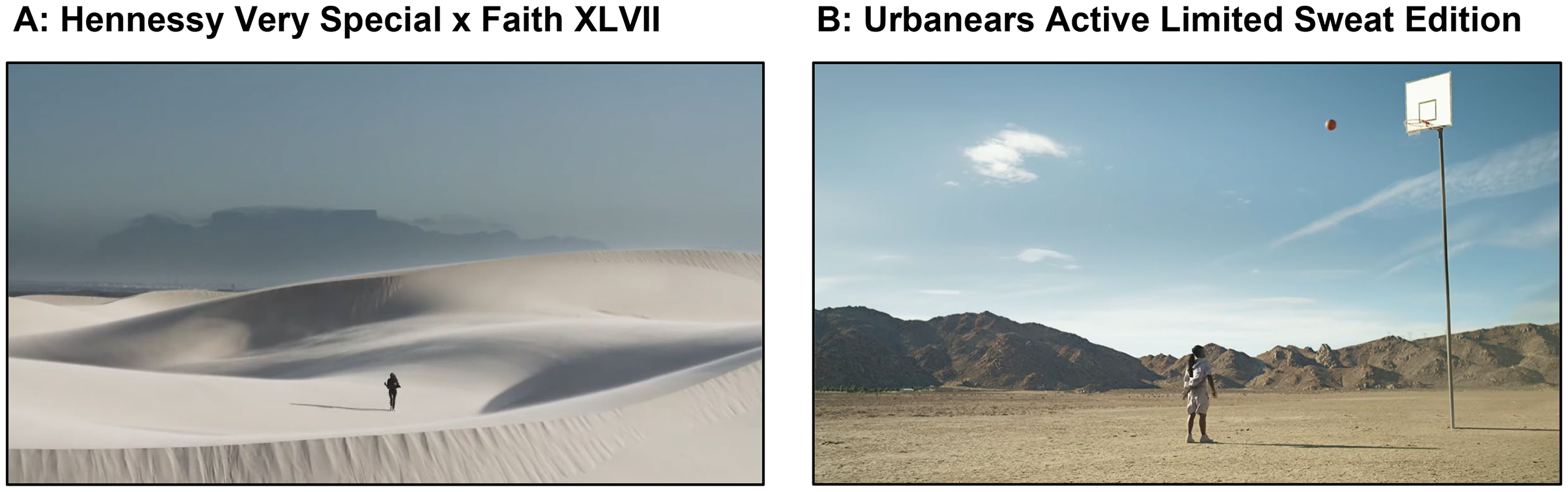
Examples of Awe in Limited Edition Product Promotions.
While awe is commonly featured in the promotion of LE products, few studies have considered how awe impacts consumer preferences toward these items. To gain initial insights on this topic, we conducted a pilot study using data from the TV ad measurement platform iSpot.tv (see Web Appendix B for complete details). Our analysis included 226 ads for LE products and 457 comparable ads for non-LE products. Four independent coders rated the level of awe in each ad. Results revealed that the proportion of ads using awe did not differ significantly between LE and non-LE products (79.6% vs. 74.2%, respectively). However, perceptions of awe interacted with product type to affect consumer engagement (β = −.08, t = −2.43, p = .015). Relatedly, simple effects revealed that while greater awe perception had no significant effect on consumer engagement for non-LE ads (β = .02, t = .47, p = .64), it decreased consumer engagement for LE product ads (β = −.10, t = 2.60, p = .010). Given the divergence of this finding from marketing practice, further research is needed to understand how awe impacts the promotion of LE products.
To better understand this issue, we first examine the unique properties of awe relative to other self-transcendent emotions. We theorize that when advertisements incorporate awe, they motivate consumers to seek interconnection and enhance collective well-being. However, LE products—known for their emphasis on exclusivity (Balachander and Stock 2009; Hamilton et al. 2019)—become incongruent with the motivational aspects of awe. Consequently, consumers are less favorable toward LE products when awe is featured in the promotion of these items. Across nine studies, we support this prediction and reveal the desirability of exclusivity as the key mechanism underlying the observed effects. Furthermore, this incongruity between awe and LE products can be mitigated when promotional messages emphasize product quality instead of status. Preferences for LE products can also be enhanced when promotional messages featuring awe highlight a connection to the world or include cause-related marketing.
Together, this research advances understanding of how awe influences consumer behavior and highlights its limitations in promoting exclusivity-focused products. Importantly, our findings distinguish awe from other self-transcendent emotions, such as elevation and gratitude, by demonstrating awe's unique effects on consumer preferences. This distinction addresses recent calls (e.g., Rudd, Hildebrand, and Vohs 2018) for a deeper understanding of awe's role in consumer decision-making.
Conceptual Framework
The Motivational Properties of Awe
Awe is defined as the feeling of wonder and amazement that arises from complex and perceptually vast stimuli, which transcend one's current frame of reference (Keltner and Haidt 2003; Piff et al. 2015). This vastness can be triggered by observing something physically large (panoramic landscapes, soaring mountains, deep abysses; Rudd, Hildebrand, and Vohs 2018) or through abstract concepts described as “deep” or “far-reaching,” such as virtuosic musical performances or religious and spiritual activities (Fredericks 2018; Keltner and Haidt 2003; Naclerio and Van Cappellen 2022). Regardless of the source, feeling awe makes individuals recognize that they are part of something grander, fostering a deeper sense of interconnectedness with others and the surrounding world (Krause and Hayward 2015; Yaden et al. 2016).
Awe belongs to the family of self-transcendent emotions that includes gratitude, compassionate love, and elevation (Haidt and Morris 2009; Pizarro et al. 2021; Stellar et al. 2017). While self-transcendent emotions make individuals more other-oriented and increase prosocial behavior (Stellar et al. 2017), they are distinctive in terms of the specific social motivations that individuals experience. Elevation drives individuals to emulate virtuous behavior in response to moral excellence (Algoe and Haidt 2009; Schnall, Roper, and Fessler 2010). Gratitude fosters reciprocal acts of generosity, encouraging social exchanges based on kindness (Bartlett and DeSteno 2006; Layous et al. 2017). Compassionate love motivates actions to alleviate the suffering of those in need, driven by empathy and care (Oveis, Horberg, and Keltner 2010). Unlike these self-transcendent emotions, awe uniquely motivates individuals to prioritize collective well-being and interconnectedness as a primary social goal (Perlin and Li 2020).
Prior empirical studies have demonstrated that awe induces a unique psychological state in which individuals experience a reduced emphasis on their personal identity, referred to as the “small self.” Self-diminishment is associated with less focus on personal goals and a feeling of being a small part of a larger whole (Bai et al. 2017; Piff et al. 2015; Shiota, Keltner, and Mossman 2007). This experience often results in increased prosocial behavior, as individuals are less driven by self-interest. However, recent research has put forth alternative theoretical perspectives that challenge the sense-of-self explanation of awe effects. Perlin and Li (2020) argue that a focus on others does not necessarily mean that self-focus is reduced, as individuals can simultaneously focus on the self and others. In other words, individuals become more motivated to have collective concerns associated with interdependence and cohesion while not necessarily mitigating or diminishing concerns for the self or others. Additionally, Perlin and Li argue that the small self account of awe effects does not consider the transformational capabilities (i.e., self-transcendence) that awe experiences can have on individuals. In line with this reasoning, Jiang and Sedikides (2022) empirically support a self-transcendence account of awe effects, whereby self-transcendence (defined as expanding one's self boundary to increase connection; p. 577) can lead to enhanced authentic self-pursuit and subsequent genuine (but not inauthentic) prosocial behavior. This expanded sense of interconnection aligns awe with motivations that emphasize unity and shared progress over individual distinction.
Given the unique motivational properties of awe, we propose that experiencing awe fosters a profound sense of connection to a larger whole, encouraging individuals to prioritize collective well-being. Drawing on recent theoretical advancements from Perlin and Li (2020) and Jiang and Sedikides (2022), we highlight awe's ability to inspire concern for interconnectedness and collective outcomes. Awe-inspiring marketing communications reshape how consumers evaluate products in alignment with their intrinsic values and needs. When exposed to awe-evoking messages, consumers tend to gravitate toward products and brands that emphasize interconnectedness and shared advancement. This motivational shift fundamentally alters the perceived desirability of various product attributes. We propose that this is particularly impactful to their evaluations of LE products, which we discuss next.
LE Products: Exclusivity and Distinctiveness
LE products are omnipresent in the marketplace, symbolizing exclusivity primarily through their perceived limited availability (Gierl, Plantsch, and Schweidler 2008). While the actual quantity of LE products can vary, it is their perceived exclusivity that enhances their desirability. Research consistently indicates that LE products are perceived by owners as being more exclusive than their standard counterparts (Jang et al. 2015; Wu and Lee 2016). Similarly, ownership of LE items has been linked to feelings of distinctiveness for consumers (Wu and Lee 2016), and collectors often prefer LE items to differentiate themselves through the exclusive nature of these items (Balachander and Stock 2009). This differentiation is a fundamental driver of consumer preferences for LE products. However, we propose that the incongruity between the properties of awe and the nature of LE products will negatively affect consumer preferences for those items. Next, we discuss this incongruity in more detail.
The Incongruity Between Awe and LE Products
Consumers actively seek meaning in the stimuli they encounter (Taylor and Noseworthy 2020). To better understand and provide meaning to stimuli in their environment, consumers often access new information in relation to their existing mental categorizations and expectations (Meyers-Levy and Tybout 1989). This process is explained by congruity theory (Osgood and Tannenbaum 1955), which was originally proposed to provide insights on how attitudes are formed within existing mental frameworks. Recent extensions of congruity theory include the “fit fluency” framework (Biliciler, Raghunathan, and Ward 2022; Williams, Duke, and Dunning 2020), which proposes that perceptions of congruity between the content of a persuasive message and consumers’ cognitive, motivational, or affective tendencies impact evaluative judgments.
Building on this framework, we argue that the motivational shift toward unity elicited by awe is fundamentally incongruent with the exclusivity and distinctiveness of LE products. Awe-inspiring stimuli amplify consumers’ desire for unity and interconnection (Krause and Hayward 2015; Piff et al. 2015). Awe fosters a profound perception of vastness, which intensifies consumers’ intrinsic motivation for collective advancement (Bai et al. 2017). Conversely, when a product is labeled as “limited edition,” it inherently promotes exclusivity or distinctiveness (Wu and Lee 2016). As consumers’ sense of unity heightens, LE products fail to satisfy this heightened desire for interconnection as their exclusivity inherently conflicts with the collective focus promoted by awe. In other words, the amplified sense of unity triggered by awe-driven marketing communication is fundamentally incongruent with the exclusivity and distinctiveness of LE products. As a result, when consumers experience an increased sense of unity, they are likely to perceive the attributes of LE products as less desirable, leading to a reduced preference for these items.
While awe is predicted to reduce preferences toward LE products, we do not predict the same tendency for other self-transcendent emotions such as gratitude, elevation, or compassionate love. We propose that the motives associated with other self-transcendent emotions do not reduce the desirability of exclusivity in the same manner as awe does. For instance, gratitude motivates the desire for reciprocal behavior that benefits others through acts of giving. Acts of reciprocity, however, do not necessarily reduce self-interest or are in direct opposition to the benefits of LE products (Griskevicius et al. 2007; Trivers 1971). Indeed, LE products could be purchased to strengthen bonds with close others (Liu et al. 2024, p. 624). Moreover, compassionate love and elevation enhance social connections without directly opposing the values of exclusivity and individualism that underpin the appeal of LE products. Compassionate love motivates a reduction in the suffering of others (Sprecher and Fehr 2005), which might enhance a person's sense of empathy without altering their perception of exclusivity as a desirable trait. Similarly, elevation motivates individuals to elevate their own behaviors to match those admirable qualities they observe. While this can strengthen community bonds, it does not directly conflict with the aspiration for exclusivity that LE products offer. Accordingly, purchasing such items can foster a sense of belonging to exclusive and prestigious social groups, thereby enhancing one's communal identity (Jang et al. 2015). As a result, while a desire to connect to close others or community may not be incongruent with LE preferences, the motivation for interconnection and advancing collective well-being is fundamentally incongruent with the benefit of exclusivity provided by LE products. Thus, we present our conceptual model with these predictions in Figure 2 and formally hypothesize:
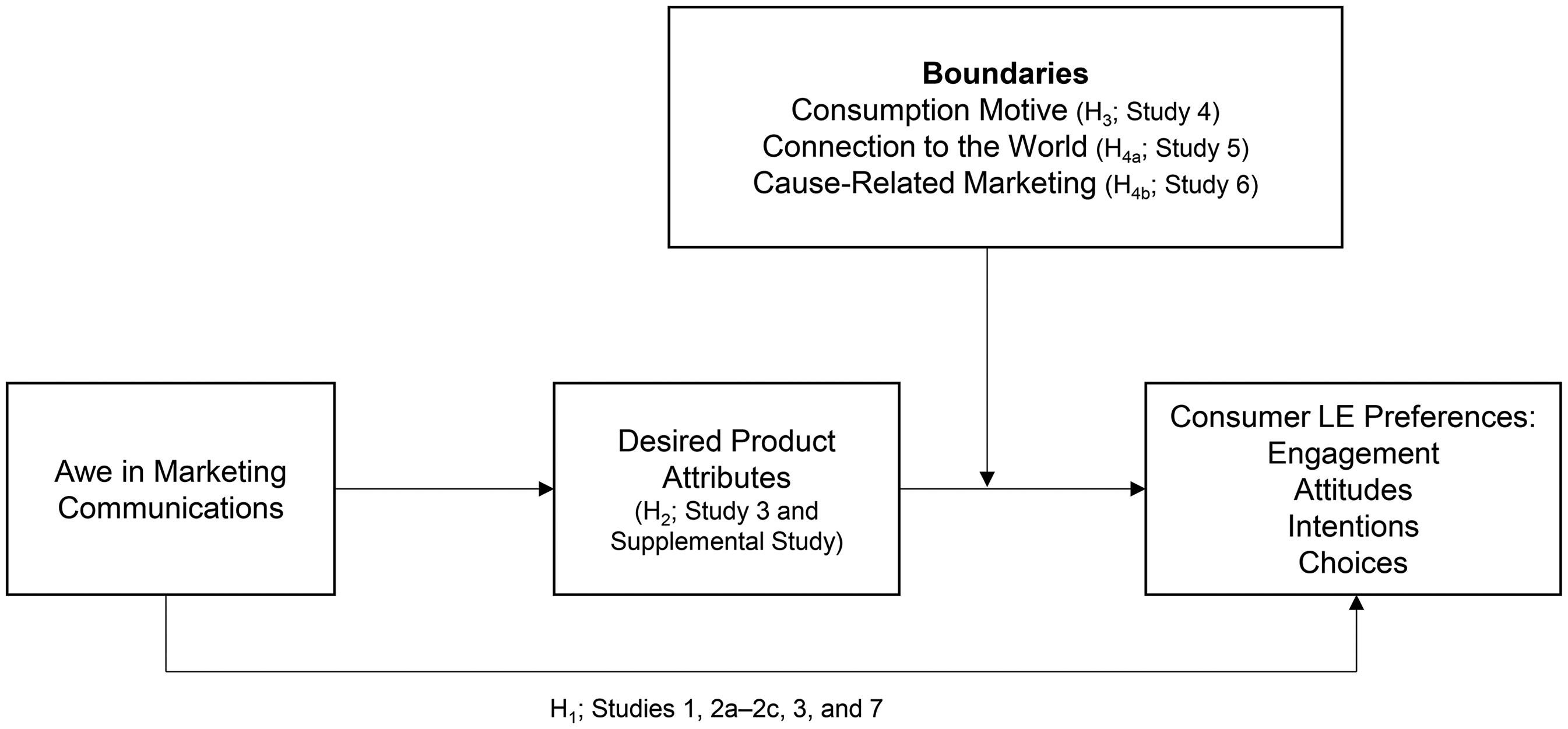
Conceptual Framework.
While we propose that awe generally hinders the promotion of LE products, we also identify boundary conditions of this effect. Since our conceptual model proposes that incompatibility exists between awe and LE products, we explore factors in consumption motives (H3) and promotional messaging (H4a and H4b) that can mitigate or reverse this effect.
Consumption Motives: Status Versus Quality
Marketers may highlight different consumption motives in promotion of LE products. For instance, consumers opt for LE products because of the exclusivity associated with them (Aggarwal, Jun, and Huh 2011; Gierl and Huettl 2010). Marketers often cater to this need by highlighting the exclusivity or distinctiveness as the defining attribute of the LE product. For instance, Toyota introduced its GR Supra GT4 Limited 100 Edition “exclusively for collectors” (Toyota Europe Newsroom 2023), while Dr. Pepper promoted its new LE flavor exclusively to its reward members (Falcon 2023). In contrast, marketers may promote other consumption motives such as superior quality or craftsmanship to enhance consumer preferences (Balachander and Stock 2009; Shin, Eastman, and Mothersbaugh 2017). In these cases, brands highlight the quality or exceptional performance of the LE products in comparison to their non-LE counterparts. For instance, Chrysler described its 300C John Varvatos Limited Edition series as its “most intelligent [driving] system” (Udy 2014), while Zenith's Defy Lab collector's watch was promoted as the “world's most accurate mechanical watch” (Altieri 2017).
We propose that these different consumption motives can impact the perceived incongruity between awe and LE product promotions. Specifically, we predict that the desire for collective well-being and advancement elicited by awe is fundamentally incongruent with the consumption motives associated with exclusivity and distinctiveness. Thus, when marketing LE products with an emphasis on exclusivity or status, featuring awe will reduce consumers’ preferences for LE products. However, when the product promotion shifts the focal consumption motive from exclusivity to the quality or craftsmanship of LE items, these product benefits are less incongruent with the motivational properties of awe. Thus, featuring awe in such LE product promotions should mitigate the observed incongruence effect on consumer preferences. Formally, we predict:
Promotional Messaging Emphasizing Connection
We also explore how promotional messaging emphasizing connection can alleviate the incongruency between awe and LE products. Fit congruency effects have been well-established in affect and framing literature (e.g., Coleman, Royne, and Pounders 2020; So et al. 2015). For instance, Agrawal, Menon, and Aaker (2007) and Duhachek, Agrawal, and Han (2012) show that the fit between primed emotions (e.g., happiness, sadness, agitation) and characteristics of the promotional messages (e.g., self/other dimension, gain/loss frames) lead to greater fluency and message effectiveness. Further, Kim, Park, and Schwarz (2010) find that feeling excited (vs. peaceful) leads individuals to prefer adventurous (vs. serene) product appeals.
We extend these findings and propose that in the context of LE products, congruence between the conceptual associations elicited by awe and congruent appeals in the advertising message will enhance consumer preferences toward LE products. As awe elicitation in marketing communication leads individuals to seek connection with the larger “whole” and product attributes associated with connection become more important, an advertising message that emphasizes connection to the collective (e.g., “Be a part of something”) will help resolve the incongruity that exists between awe and LE products. This congruence will subsequently enhance preferences toward LE products relative to marketing messages that do not emphasize such a connection. Additionally, resolving the incongruity is expected to increase preferences for LE products relative to non-LE products, as consumers in general value and desire LE products (Aggarwal, Jun, and Huh 2011; Jung and Kellaris 2004). Therefore, we predict:
Cause-Related Marketing Cues
In further support of our framework, we propose that companies may also reverse the negative impact of awe on LE products by offering a cause-related marketing promotion along with the product. Cause-related marketing is a strategy companies use to achieve their marketing objectives by supporting social causes. Cause-related marketing strategies often have been associated with positive outcomes for the firm, such as enhanced consumer attitudes and purchase intentions (Lafferty and Edmondson 2014), as they directly or indirectly enable consumers to contribute to a social cause and engage in prosocial behavior (Barone, Miyazaki, and Taylor 2000). Engaging in prosocial behavior promotes social connection by shifting the focus from the self to others and increases consideration of others (Caprara, Alessandri, and Eisenberg 2012).
We propose that cause-related marketing cues will moderate the relationship between awe and LE products. LE products are not normally desirable to individuals when promoted with feelings of awe given the incongruence between the emotion and the product. However, since awe motivates interconnection and promotes prosocial behavior (Rudd, Vohs, and Aaker 2012), the congruence between awe and the cause-related marketing message should enhance attitudes toward the LE product. Given that LE products can be valued more highly when a cause-related marketing message is paired with the product (Kim, Park, and Shrum 2022), we expect that consumers feeling awe will prefer LE products that feature a cause-related marketing message relative to LE products that do not. Similarly, we also predict an increase in preferences for LE products relative to non-LE products due to their higher value and desirability (Aggarwal, Jun, and Huh 2011; Jung and Kellaris 2004). Thus, we predict:
Plan of Studies
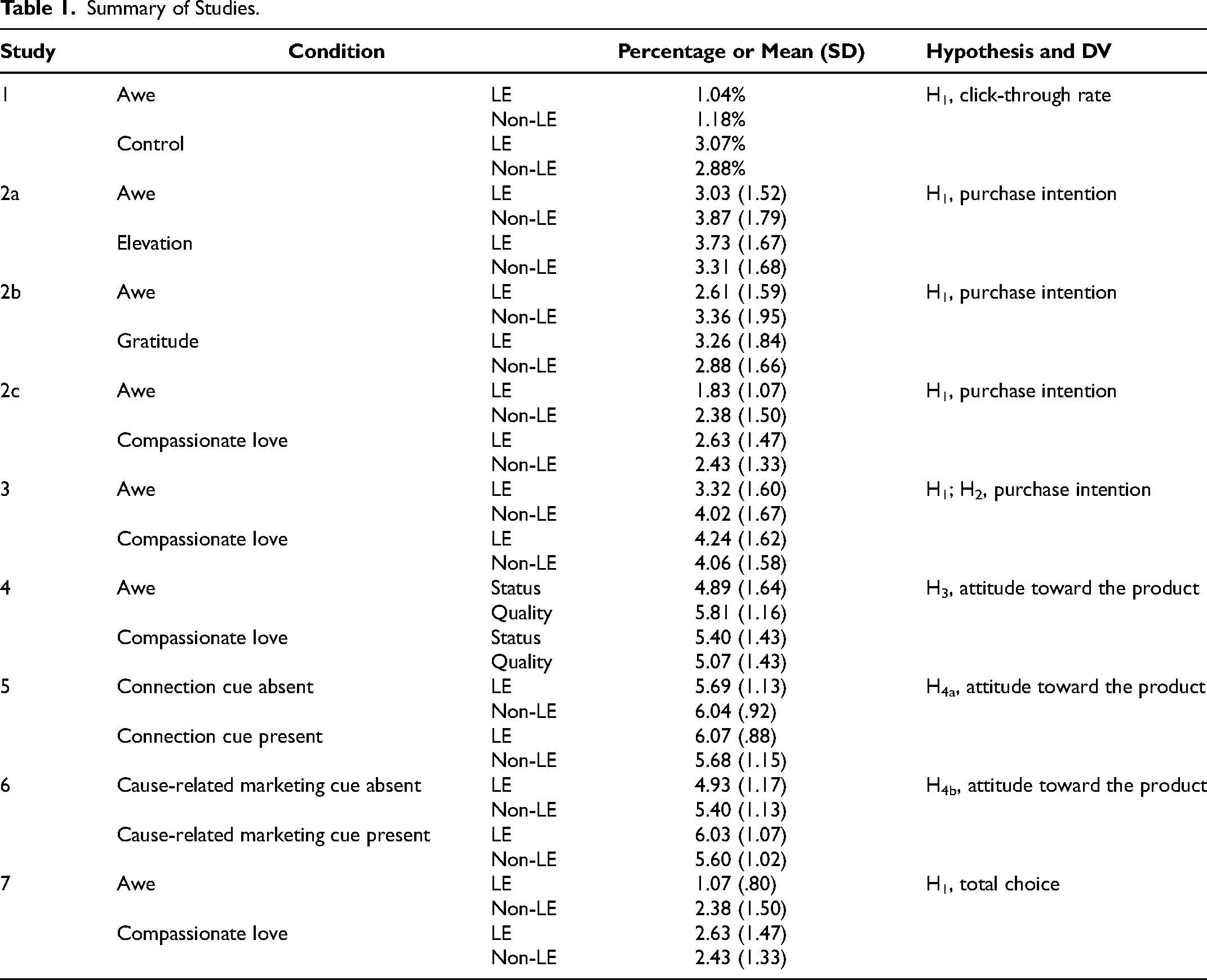
We present nine empirical studies to investigate the impact of awe in marketing communication on preferences for LE products. Table 1 provides a summary of the means in each study (see Web Appendix C for the full overview of the nine studies and main findings). Study 1 provides initial evidence to support our main hypotheses using field data from a restaurant. Studies 2a–2c experimentally manipulate feelings of awe in advertisements and examine how awe impacts consumers’ preferences toward LE products in comparison to other self-transcendent emotions. Study 3 then tests our full conceptual model and examines how the desirability of exclusivity mediates our effect. Study 4 further explores our conceptual model by manipulating consumption motives. Studies 5 and 6 explore boundary conditions of our observed effects by altering the marketing message (connection to the world and cause-related marketing). Finally, Study 7 extends our findings to consumer choice in the metaverse.
Summary of Studies.
Prior to the collection of experimental studies, we conducted an a priori power analysis using G*Power (Faul et al. 2007). For an a priori power of .80, an alpha error probability of .05, and a small to medium effect size of f = .20 (Cohen 1992), the sample size needed would be 199 for a 2 × 2 design with a continuous dependent variable. Thus, we collected a minimum of 50 participants per condition in our experimental designs for every study. We did not implement an exclusion criterion in the studies, and the data and materials for the studies are available at https://doi.org/10.7910/DVN/SUYYFF.
Study 1: Field Study on the Effects of Awe in LE Product Promotions
Study 1 was designed to investigate the effects of awe on consumer preferences for LE products using field data. We collaborated with a restaurant in a major southeastern U.S. city to conduct an online advertising campaign using Facebook ads. We predict that the click-through rate (CTR) will be lower for an awe-inspiring ad when it promotes an LE option.
Method
We prepared four ads to launch on Facebook ads platform in a 2 (emotion: awe or control) × 2 (product type: LE or non-LE) design. In the awe condition, the ads featured a picture displaying fireworks outside of the restaurant. In the control condition, the ads featured a picture displaying the inside of the restaurant. The pictures are omitted from the article to preserve confidentiality of the restaurant. A pretest was conducted to ensure the pictures elicited different levels of awe and did not differ in other emotions (see Web Appendix D). The control ads included information on an invitation to join the email list for sampling one of the restaurant's Spanish wines. In the LE product condition, “Limited-Edition” was added to the description of the wines. We used CTR as our dependent variable, calculated as the total number of clicks divided by the number of people who saw the ad. Our ads were live for one week and were shown to 119,169 Facebook users with 2,075 total clicks on the ads (see Web Appendix E for full details).
Results
We conducted a logistic regression with emotion (2 = awe, 1 = control), product type (2 = LE, 1 = non-LE), and their interaction predicting CTR (click = 1, no click = 0). Results revealed a significant effect of emotion (b = −.91, SE = .06, Wald χ2(1) = 217.74, p < .001), while the effect of product type was not significant (b = .07, SE = .06, Wald χ2(1) = 1.26, p = .26). Furthermore, the interaction of emotion and product type was also significant (b = −.20, SE = .09, Wald χ2(1) = 4.83, p = .028). For the LE product, CTR was lower for the awe-inspiring ads (1.04%) than in the control condition (3.07%; b = −1.11, SE = .07, Wald χ2(1) = 282.03, p < .001). For the non-LE product, the difference in CTR between awe-inspiring ads (1.18%) and the control condition was also significant (2.88%; b = −.91, SE = .06, Wald χ2(1) = 217.74, p < .001). Furthermore, for the awe-inspiring ads, CTR was marginally lower for the LE product than for the non-LE product (b = −.13, SE = .07, Wald χ2(1) = 3.74, p = .053). However, the difference in CTR between the LE product and the non-LE product was not significant in the control condition (b = .07, SE = .06, Wald χ2(1) = 1.26, p = .26).
Discussion
Study 1 provides initial support for the conceptual model of feeling awe and preferences for LE products. Using a real advertising campaign on Facebook, we found that consumers were 66.2% less likely to click on an LE product advertisement when it featured an awe-inspiring image relative to a control image. Similarly, they were 12.2% less likely to click on an awe-inspiring advertisement when it featured an LE product relative to the non-LE version of the same product. One limitation of this field study is the use of a picture taken outside (inside) of the restaurant for the awe (control) condition. Users may have associated the photo taken inside the restaurant as a better fit for the product promoted in the advertisement (wine) and hence have higher CTR in the control condition (Chang 2013). Thus, in the following studies, we examine the awe–LE product effect in more controlled settings.
Studies 2a–2c: Comparing Awe to Other Self-Transcendent Emotions
Next, we aim to replicate our prior findings in a controlled experimental setting to further support our predictions while comparing awe to other self-transcendent emotions. Specifically, we compare awe to elevation, gratitude, and compassionate love. We theorize that awe is distinct from other self-transcendent emotions in that awe motivates collective advancement and cohesion by enhancing an individual's sense of unity. As a result, we propose the perceived incongruity with LE products to be unique to awe elicitation in marketing communications and not to occur with other self-transcendent emotions.
Additionally, in Studies 2a–2c, we present different awe-inspiring stimuli to test our predictions. Specifically, in Study 2a, we use pictures in nature to compare awe and elevation. One limitation of this stimulus is the absence (presence) of people in the awe (elevation) condition. Thus, in Study 2b, we have nature pictures featuring people in both emotion conditions and compare awe to gratitude. Finally, Study 2c employs a different emotion elicitor than nature. Specifically, we feature inspiring people to compare awe and compassionate love.
Study 2a: Comparing Awe to Elevation
Two hundred forty-seven participants recruited from Prolific (70.4% female, 29.6% male; Mage = 40.4 years) were randomly assigned to a 2 (emotion: awe or elevation) × 2 (product type: LE or non-LE) between-subjects design. Participants started the study by indicating their mood (see Web Appendix F), were shown an advertisement for a camera brand, and were asked to evaluate it. The ad featured either an awe-inspiring or elevation-inspiring image within the camera. The awe-inspiring picture depicted scenery of a mountain and a lake, while the elevation-inspiring picture depicted a child helping another child stand up. A pretest was conducted to ensure the pictures elicited feelings of awe and elevation, respectively, and did not differ in other emotions (see Web Appendix G for full results). Participants were randomly assigned to either the LE condition (presence of “Limited Edition” tagline in the product slogan) or the non-LE condition (absence of LE tagline). The ads are provided in Web Appendix H.
After viewing the ads, participants reported their purchase intention for the product on a seven-point scale (“The likelihood of your purchasing the product is:” 1 = “very low,” and 7 = “very high”). To conclude, participants indicated their age and gender.
Results
We conducted an ANOVA with emotion and product type predicting purchase intention. Results revealed a significant interaction of emotion and product type (F(1, 243) = 8.65, p = .004). The main effects of emotion (F(1, 243) = .09, p = .76) and product type (F(1, 243) = 1.00, p = .32) were not significant. Planned comparisons revealed that individuals in the awe condition had lower preferences for the LE product (M = 3.03, SD = 1.52) relative to individuals in the elevation condition (M = 3.73, SD = 1.67; 95% CI: [−1.29, −.09], p = .024). However, there were no significant differences for the non-LE product for individuals in the awe condition (M = 3.87, SD = 1.79) and the elevation condition (M = 3.31, SD = 1.68; 95% CI: [−.02, 1.15], p = .06). Furthermore, individuals in the awe condition had lower preferences for the LE product relative to the non-LE product (95% CI: [−1.44, −.24], p = .006), while there were no significant differences in preferences between the LE product and the non-LE product for individuals in the elevation condition (95% CI: [−.17, 1.00], p = .17).
Study 2b: Comparing Awe to Gratitude
Two hundred ninety-two participants recruited from Prolific (50.3% female, 49.7% male; Mage = 40.7 years) were randomly assigned to a 2 (emotion: awe or gratitude) × 2 (product type: LE or non-LE) between-subjects design. To begin, participants indicated their mood and read definitions of several emotions including awe, defined as the strong feeling of wonder in the presence of something grand, and gratitude, defined as the feeling of being grateful for a kindness received (see Web Appendix F for full details). Next, participants were given an advertisement for a mug and were asked to evaluate it. The advertisement featured either an awe-inspiring or gratitude-inspiring image accompanying the product. The awe picture depicted a person looking at mountain scenery, while the gratitude picture depicted a person posing with palms pressed together in a thankful manner. A pretest was conducted to ensure the pictures elicited feelings of awe and gratitude, respectively, and did not differ in other emotions (see Web Appendix I for full results). Our product type manipulation was the same as in Study 2a. The ads are provided in Web Appendix J.
After viewing the ads, participants provided their purchase intention on three items (“The likelihood of your purchasing the product is”; “The probability that you would consider buying the product is”; “Your willingness to buy the product is”; α = .97) measured on seven-point scales (1 = “very low,” and 7 = “very high”). To conclude, participants indicated their age and gender.
Results
We conducted an ANOVA with emotion and product type predicting purchase intention. Results revealed a significant interaction of emotion and product type (F(1, 288) = 7.25, p = .007). The main effects of emotion (F(1, 288) = .18, p = .67) and product type (F(1, 288) = .80, p = .37) were not significant. Planned comparisons revealed that purchase intention was lower for LE products for individuals in the awe condition (M = 2.61, SD = 1.59) relative to individuals in the gratitude condition (M = 3.26, SD = 1.84; 95% CI: [−1.23, −.06], p = .031). However, there were no significant differences in purchase intention for non-LE products between individuals in the awe condition (M = 3.36, SD = 1.95) and those in the gratitude condition (M = 2.88, SD = 1.66; 95% CI: [−.10, 1.04], p = .10). Furthermore, individuals in the awe condition had lower preferences for the LE product relative to the non-LE product (95% CI: [−1.33, −.16], p = .013), while there were no significant differences between preferences for the LE product and the non-LE product for individuals in the gratitude condition (95% CI: [−.20, .94], p = .20).
Study 2c: Comparing Awe to Compassionate Love
Two hundred forty-three undergraduate students (50.6% female, 49.4% male; Mage = 20.7 years) participated in this study for course credit. Participants were randomly assigned to a 2 (emotion: awe or compassionate love) × 2 (product type: LE or non-LE) between-subjects design.
To begin, participants indicated their mood and read definitions of several emotions including awe, defined as the strong feeling of wonder in the presence of something grand, and compassionate love, defined as feelings that are focused on caring, helping, and understanding other people, particularly when they are in need (see Web Appendix F for full details). Next, participants were given an advertisement for a photo book and were asked to evaluate it. The advertisement featured either an awe-inspiring or a compassionate-love-inspiring image accompanying the product. In the awe condition, the photo book featured a portrait of Einstein on the cover, and the advertisement text highlighted the awe-inspiring aspects of him as a person (inspiring and amazing). In the compassionate love condition, the photo book featured a portrait of Mother Teresa, and the advertisement text highlighted the compassionate love aspects of her as a person (loving and caring). A pretest was conducted to ensure that the people elicited feelings of awe and compassionate love and did not differ in other emotions, likeability, advertisement fit, and advertisement quality (see Web Appendix K). We used the same procedure to manipulate product type as in prior studies. The ads are provided in Web Appendix L. After viewing the ads, participants completed purchase intention items from Study 2b (α = .93). To conclude, participants indicated their age and gender.
Results
We conducted an ANOVA with emotion and product type predicting purchase intention. Results revealed a significant main effect of emotion (F(1, 239) = 6.06, p = .015), while product type was not significant (F(1, 239) = 1.04, p = .31). These effects were qualified by a significant interaction of emotion and product type (F(1, 239) = 4.76, p = .030). Planned comparisons revealed that purchase intention was lower for LE products for individuals in the awe condition (M = 1.83, SD = 1.07) relative to individuals in the compassionate love condition (M = 2.63, SD = 1.47; 95% CI: [−1.28, −.33], p < .001). However, there were no significant differences in purchase intention for non-LE products between individuals in the awe condition (M = 2.38, SD = 1.50) and those in the compassionate love condition (M = 2.43, SD = 1.33; 95% CI: [−.54, .44], p = .85). Furthermore, individuals in the awe condition had lower preferences for the LE product relative to the non-LE product (95% CI: [−1.04, −.07], p = .025), while there were no significant differences between preferences for the LE product and the non-LE product for individuals in the compassionate love condition (95% CI: [−.28, .68], p = .41).
Discussion
Studies 2a–2c provide further support for our conceptual model. Using different elicitors of awe, we demonstrate that participants evaluating an awe-inspiring ad had lower preferences for the LE product relative to ads featuring elevation (Study 2a), gratitude (Study 2b), and compassionate love (Study 2c). Next, we test our full conceptual model by examining the mediating role of the desirability of exclusivity.
Study 3: Test of Conceptual Model
Study 3 was designed to test our process explanation for why individuals feeling awe are less favorable toward LE products. We propose that feeling awe impacts what attributes consumers desire in a product. Specifically, exclusivity should be viewed as less desirable in LE products, ultimately decreasing consumer preferences.
Method
Two hundred seventy-eight participants recruited from Prolific (54.3% female, 45.7% male; Mage = 36.2 years) were randomly assigned to a 2 (emotion: awe or compassionate love) × 2 (product type: LE or non-LE) between-subjects design.
At the beginning of the survey, participants watched a commercial designed to manipulate the focal emotions. Manipulating emotions using real commercials enhances external validity (Rudd, Vohs, and Aaker 2012). Here, participants watched a 30-second commercial from a major action camera brand (modified to a fictitious brand named Expass camera to eliminate brand associations) eliciting either awe or compassionate love and for an LE or a non-LE product. The awe videos featured a snowboarder skiing from the top of a mountain with many scenes of snow and the surrounding mountains. The compassionate love videos featured a baby skateboarding while smiling throughout the video. The videos were accompanied by music and are provided via links in Web Appendix M.
After watching the commercials, participants evaluated an ad that featured the camera from the videos. Participants were randomly assigned to view one of the two versions of the ad. In the non-LE condition, the ad featured a new Expass camera and a description of the features of the product. In the LE condition, the ad was identical except for an additional note stating that the product was “limited edition” (see Web Appendix M). After viewing the ads, participants provided their purchase intention with items from Studies 2b and 2c (α = .93).
Then, participants completed a three-item, seven-point scale to report the desired product attributes associated with exclusivity (“Products emphasizing my exclusivity appeal to me”; “I am interested in products that emphasize being exclusive from others”; “I am not drawn to products that make me exclusive” [reverse-coded]; 1 = “strongly disagree,” and 7 = “strongly agree”). The items were averaged (α = .84) to form a measure assessing the desirability of exclusivity as a product attribute. It was expected that participants in the awe condition would report lower desire for exclusivity when evaluating LE products relative to participants in the non-LE condition.
After providing their perceptions, participants indicated their feelings on seven-point scales for awe and compassionate love (1 = “not at all,” and 7 = “very much”) as well as control emotions including happy, excited, calm, and peaceful (1 = “not at all,” and 7 = “extremely”). To conclude, participants indicated their age and gender.
Results
Manipulation checks
An ANOVA with emotion and product type predicting feelings of awe was conducted. Results revealed a significant main effect of emotion (F(1, 274) = 42.36, p < .001), as individuals in the awe condition reported higher feelings of awe (M = 4.98, SD = 1.57) relative to the participants in the compassionate love condition (M = 3.58, SD = 1.95). Next, an ANOVA with emotion and product type predicting feelings of compassionate love revealed a significant main effect of emotion (F(1, 274) = 73.54, p < .001), such that individuals in the compassionate love condition reported higher feelings of compassionate love (M = 4.82, SD = 1.69) relative to the participants in the awe condition (M = 3.05, SD = 1.76). Furthermore, the main effect of product type and emotion × product type interactions were not significant (ps ≥ .11). Manipulation checks and further analyses for control emotions are provided in Web Appendix N.
Purchase intention
We conducted an ANOVA with emotion and product type predicting purchase intention. Results revealed a significant main effect of emotion (F(1, 274) = 6.15, p = .014), while product type was not significant (F(1, 274) = 1.84, p = .18). These effects were qualified by a significant interaction of emotion and product type (F(1, 274) = 5.06, p = .025). Planned comparisons revealed that purchase intention was lower for LE products for individuals in the awe condition (M = 3.32, SD = 1.60) relative to the individuals in the compassionate love condition (M = 4.24, SD = 1.62; 95% CI: [−1.47, −.37], p = .001). However, there were no significant differences in purchase intention for non-LE products between the individuals in the awe condition (M = 4.02, SD = 1.67) and those in the compassionate love condition (M = 4.06, SD = 1.58; 95% CI: [−.58, .49], p = .87). Furthermore, individuals in the awe condition had lower preferences for the LE product relative to the non-LE product (95% CI: [−1.26, −.15], p = .014), while there were no significant differences between preferences for the LE product and the non-LE product for individuals in the compassionate love condition (95% CI: [−.35, .70], p = .52).
Desired product attributes
We conducted an ANOVA with emotion and product type predicting exclusivity as a desired attribute. Results revealed a significant interaction of emotion and product type (F(1, 274) = 5.01, p = .026). The main effects of emotion (F(1, 274) = 1.38, p = .24) and product type (F(1, 274) = 1.56, p = .21) were not significant. Planned comparisons revealed that the desire for exclusivity in product preferences for the LE products was lower for individuals in the awe condition (M = 3.20, SD = 1.53) relative to individuals in the compassionate love condition (M = 3.82, SD = 1.31; 95% CI: [−1.13, −.10], p = .019). However, there were no significant differences in desire for exclusivity in product preferences for non-LE products between the individuals in the awe condition (M = 3.83, SD = 1.64) and those in the compassionate love condition (M = 3.64, SD = 1.51; 95% CI: [−.30, .68], p = .44). Furthermore, individuals in the awe condition had lower desire for exclusivity in product preferences for the LE product relative to the non-LE product (95% CI: [−1.14, −.11], p = .017), while there were no significant differences between desire for exclusivity for the LE product and the non-LE product for individuals in the compassionate love condition (95% CI: [−.31, .67], p = .47).
Mediation analysis
To test the full conceptual model, we conducted a moderated mediation analysis via PROCESS Model 8 (Hayes 2017). In the model, the emotion × product type interaction predicted the desire for exclusivity with purchase intention as the dependent variable. In the analysis, the 95% confidence interval of the index of moderated mediation excluded zero (index = −.2077; 95% CI: [−.4605, −.0238]). Additionally, the indirect effect was significant for the LE condition (effect = −.1583; 95% CI: [−.3356, −.0316]), but not for the non-LE condition (effect = .0493; 95% CI: [−.0863, .1995]). Together, these results provide support for H2 and the full conceptual model of feeling awe and preferences for LE products.
Discussion
Study 3 provides support for our conceptual model of feeling awe and preferences for LE products. The findings demonstrate that individuals presented with awe-eliciting advertisements had lower desire for exclusivity in the LE condition relative to the compassionate love condition and relative to the non-LE condition. To further support our proposed process, we also conducted a supplemental study with the stimuli from Study 2a and measured the desirability of exclusivity (see Web Appendix O), replicating the findings of this study. Together, these findings, coupled with those from Studies 2a–2c, further demonstrate that the observed awe–LE product effect is unique to awe and does not occur with other self-transcendent emotions. Next, we examine consumption motives in promotional messaging to further support our conceptual model.
Study 4: Consumption Motives
Study 4 was designed to explore the moderating role of consumers’ consumption motives on the relationship between awe and LE product preferences. Promotions of LE products can highlight different consumption motives (Balachander and Stock 2009; Gierl and Huettl 2010). Based on our theoretical framework, we expect to see a negative impact of feelings of awe on LE purchases when the consumption motive highlighted in the marketing message focuses on status and exclusivity relative to quality and craftsmanship. By manipulating the desired product attributes of the LE products, this study examines our proposed conceptual model through process by moderation (Spencer, Zanna, and Fong 2005).
Method
Two hundred seventy-two participants recruited from Prolific (51.8% female, 48.2% male; Mage = 36.8 years) were randomly assigned to a 2 (emotion: awe or compassionate love) × 2 (consumption motive: status or quality) between-subjects design.
At the beginning of the survey, participants watched a commercial designed to manipulate the focal emotions. Specifically, participants watched a 25-second commercial for a fictitious hotel resort, named Belmari, eliciting either awe or compassionate love. The awe video featured information and slogans about the resort, accompanied by awe-inspiring scenes, while the compassionate love video featured similar information and slogans about the resort, accompanied by pictures of babies. The videos also included music and are provided via links in Web Appendix P. The videos were pretested to elicit the focal emotions and were found not to differ in other emotions (see Web Appendix Q).
After watching the commercials, participants were presented with a product ad, bathroom slippers, to be used during their stay at the resort. The ad also featured information regarding the LE products based on the consumption motive. In the status condition, information provided was “These slippers are exclusive, elite, and unique. They are exclusively designed for prestigious visitors,” while in the quality condition, the information included “These slippers are designer, handcrafted, and exquisitely crafted. They are the definition of premium quality and craftsmanship” (see Web Appendix P). Participants were asked to indicate their attitudes on three items (1 = “negative,” and 7 = “positive”; 1 = “unfavorable,” and 7 = “favorable”; 1 = “good,” and 7 = “bad” [reverse-coded]; α = .96). A pretest was conducted to ensure that the status LE ad was perceived to be more exclusive than the quality LE ad (see Web Appendix R for full results).
Next, participants completed manipulation checks for the consumption motive highlighted in the choice scenario. Participants were provided with definitions of status products (valued for their ability to confer social status, prestige, and recognition) and quality products (valued for their superior craftsmanship, materials, and attention to detail). They then rated the extent to which they perceived the product in the ad as a status product or quality product with a single-item seven-point scale (1 = “not at all,” and 7 = “very much”). Participants also indicated the extent to which they perceived the product to remain true to its espoused values, felt loyal to the product, and thought that the product is expensive (Ko, Costello, and Taylor 2019). To conclude, participants indicated their age and gender.
Results
Manipulation and confound checks
An ANOVA with emotion and consumption motive predicting product status perceptions was conducted. Results revealed a significant main effect of the motive condition (F(1, 268) = 5.15, p = .024), such that individuals in the status motive condition reported higher perceptions of status (M = 4.66, SD = 1.75) relative to the participants in the quality motive condition (M = 4.15, SD = 1.88). Furthermore, the main effect of emotion and the emotion × motive condition interaction were not significant (ps > .21). Next, an ANOVA with emotion and consumption motive predicting product quality perceptions was conducted. Results revealed a significant main effect of the motive condition (F(1, 268) = 11.65, p < .001), such that individuals in the quality motive condition reported higher perceptions of quality (M = 4.73, SD = 1.79) relative to the participants in the status motive condition (M = 4.02, SD = 1.66). Furthermore, the main effect of emotion and the emotion × motive condition interaction were not significant (ps > .28).
Additionally, results of a series of ANOVAs did not reveal significant differences between motive conditions regarding the perception that the product remains true to its espoused values, price perception, and loyalty (ps ≥ .09). The main effect of emotion was significant for loyalty (p = .046), while it was not significant for espoused value and price (ps ≥ .13). Importantly, no interactions between emotion and motive condition were significant (ps > .66).
LE product attitudes
We conducted an ANOVA with emotion and consumption motive predicting product attitudes. Results (Figure 3) revealed a significant interaction of emotion and motive (F(1, 268) = 13.09, p < .001). The main effects of emotion (F(1, 268) = .45, p = .50) and motive (F(1, 268) = 2.90, p = .09) were not significant. Planned comparisons revealed that participants in the awe condition had significantly lower attitudes for the status LE product (M = 4.89, SD = 1.64) relative to participants in the compassionate love condition (M = 5.40, SD = 1.43; 95% CI: [−1.00, −.02], p = .041). However, participants in the awe condition had higher attitudes for the quality LE product (M = 5.81, SD = 1.16) relative to participants in the compassionate love condition (M = 5.07, SD = 1.43; 95% CI: [.27, 1.22], p = .002). Furthermore, product attitudes were lower for participants in the awe condition for the status LE product relative to the quality LE product (95% CI: [−1.41, −.44], p < .001), while this difference was not significant for participants in the compassionate love condition (95% CI: [−.15, .81], p = .17).
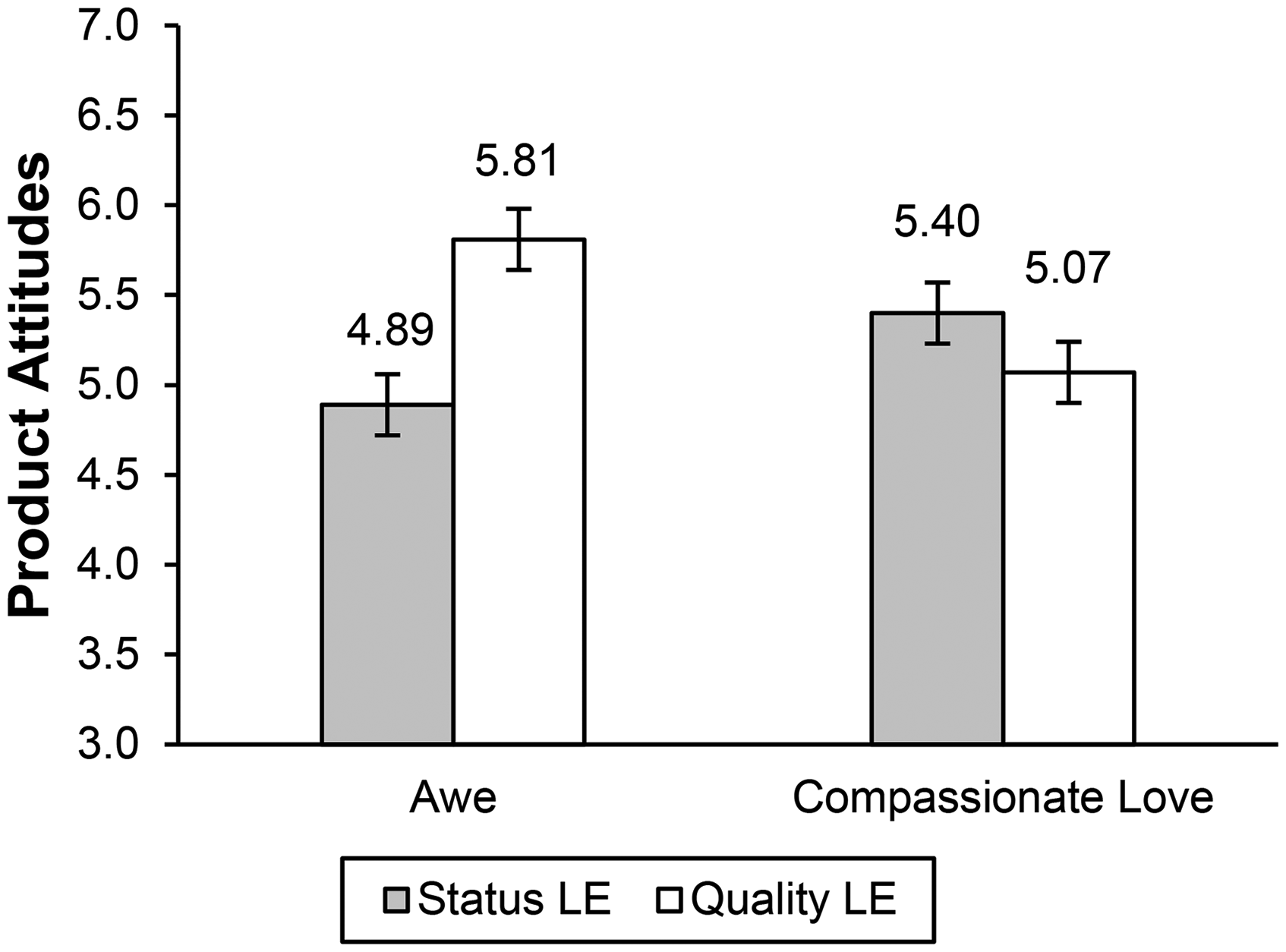
Study 4 Results.
Discussion
Study 4 provides additional evidence that the desirability of product attributes underlies the observed awe–LE effect through process by moderation. Specifically, the incongruence between awe in marketing communications and LE products is observed when consumption motives focus on high status to highlight exclusivity and distinctiveness. However, this effect is mitigated when the consumption motive is based on quality. Next, we explore differences in promotional messaging as moderators of the observed awe–LE product effect.
Study 5: Connection in Promotional Messaging
Study 5 tested differences in promotional messaging strategies. We predict that when the awe-inspiring ads emphasize connection with the world, the incongruence between awe and LE products will be reduced and consumer preferences for LE products will increase (H4a).
Method
Two hundred sixty-seven participants (46.8% female, 53.2% male; Mage = 38.5 years) recruited from Prolific were randomly assigned to a 2 (product type: LE or non-LE) × 2 (connection message cue: present or absent) between-subjects design. All participants were presented with a modified one-minute version of the awe-eliciting commercial from Study 3. In the connection message cue absent condition, participants watched the awe-eliciting video commercial and saw the non-LE or LE Expass camera ad. In the connection message cue present condition, the video commercial featured taglines related to interconnection (i.e., “Nature Is Calling,” “Be Part of Something Big) and the ad featured the taglines “Be better, greater, and limitless” and “Enjoy the connection to the world” (see Web Appendix S for ads). A pretest was conducted to ensure the connection message cue made interconnection with everything more salient (see Web Appendix T for full results).
After viewing the ads, participants provided their attitudes for the product on the three items (1 = “bad,” and 7 = “good”; 1 = “negative,” and 7 = “positive”; 1 = “unfavorable,” and 7 = “favorable”; α = .95). To conclude, participants indicated their age and gender.
Results
We conducted an ANOVA with product type and message predicting product attitudes. Results (Figure 4) revealed a significant interaction of message and product type (F(1, 263) = 8.91, p = .003). The main effects of product type (F(1, 263) = .03, p = .87) and message (F(1, 263) = .004, p = .95) were not significant. Planned comparisons revealed that when a connection message was absent in the awe-inspiring commercial, preferences for the LE product were lower (M = 5.69, SD = 1.13) than for the non-LE product (M = 6.04, SD = .92; 95% CI: [−.71, −.002], p = .049). However, when the connection message was present, product attitudes were higher for the LE product (M = 6.07, SD = .88) relative to the non-LE product (M = 5.68, SD = 1.15; 95% CI: [.05, .75], p = .026). Furthermore, product attitudes were higher in the LE product condition when the connection message cue was present relative to absent (95% CI: [.03, .75], p = .036).
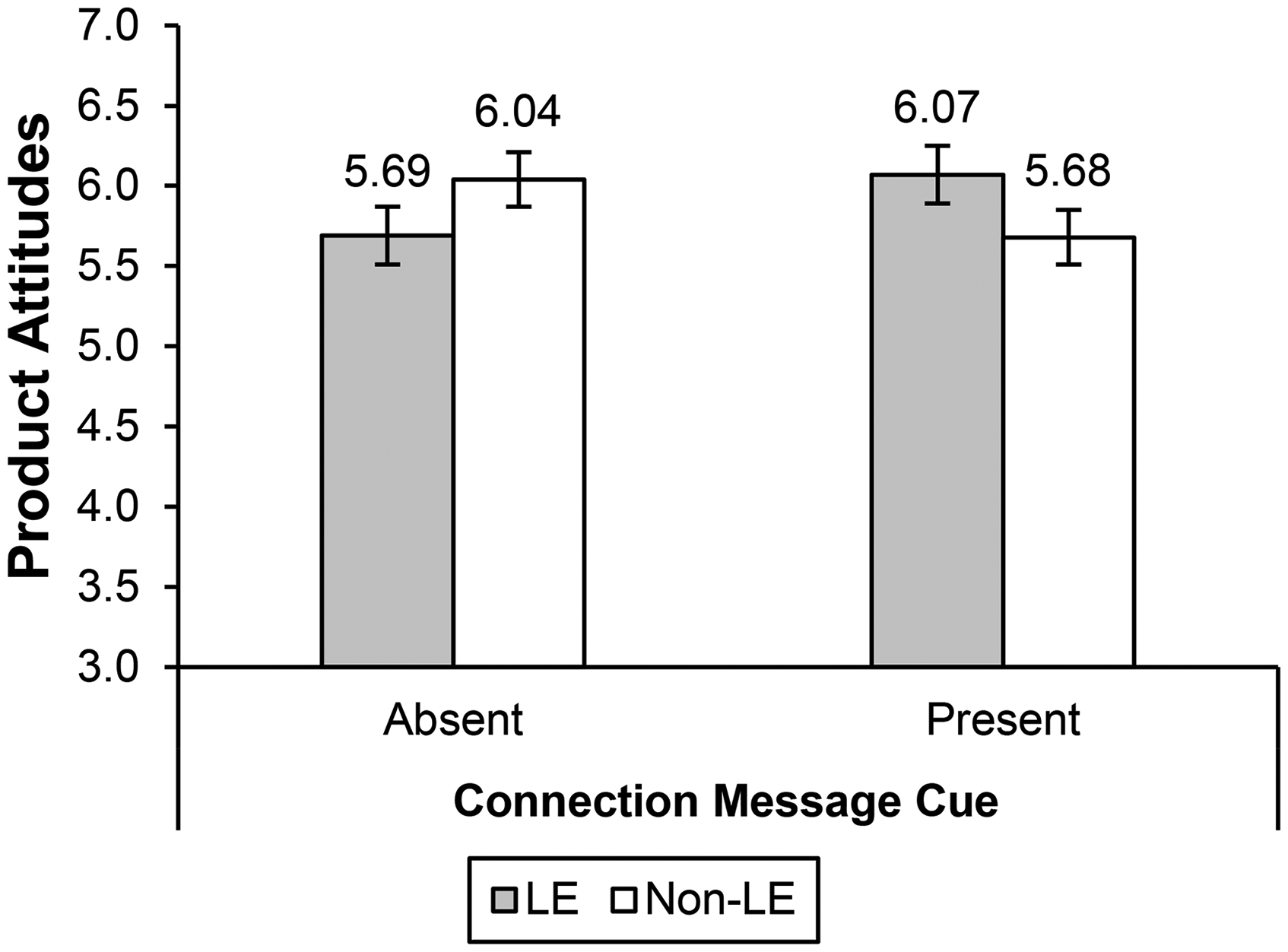
Study 5 Results.
Discussion
Study 5 explores conditions under which awe may enhance consumer preferences toward LE products. When the awe-inspiring commercial did not feature an additional marketing message highlighting the connection to the world, the results replicated our previous studies. However, when the ad included a message highlighting connection to help resolve the incongruity between awe and LE products, this effect was reversed, leading individuals to have higher preferences for LE products. Next, Study 6 explores how cause-related marketing messages impact our focal effect.
Study 6: Cause-Related Marketing Cues
Study 6 was designed to explore the role of cause-related marketing cues in our observed effects. We predict that when the awe-inspiring ad features a cause-related marketing cue, individuals’ preferences toward LE products will increase.
Method
Two hundred twenty-eight participants (57.9% female, 42.1% male; Mage = 35.3 years) recruited from Prolific were randomly assigned to a 2 (product type: LE or non-LE) × 2 (cause-related marketing cue: absent or present) between-subjects design.
To manipulate the product type and cause-related marketing cue, we prepared four different advertisements for a fictitious photo book brand named “Mega” from Study 2c. All ads included green mountain scenery to elicit awe. In a pretest, 71 individuals recruited from Amazon Mechanical Turk (40.8% female, 59.2% male; Mage = 38.4 years) were asked to indicate how much awe the picture made them feel on a seven-point scale (1 = “not at all,” and 7 = “very much”). The results of a one-sample t-test comparing feelings of awe to the scale midpoint (4) were significant (M = 6.20, SD = 1.01; t(70) = 18.35, p < .001), suggesting that the picture was awe-eliciting. In the non-LE product conditions, the tagline included “Some pictures speak louder than words. Mega Photobook is for those pictures.” In the LE product conditions, the product was written as “Mega Limited Edition Photobook.” In the cause-related marketing cue absent condition, participants saw either the control or LE version of the advertisement. In the cause-related marketing cue present condition, the ads included information on a partnership with the Clear Water Project and stated that every purchase would lead to a full month of clear water access for a family in an underdeveloped economy (see Web Appendix U).
After viewing the ads, participants indicated their attitudes toward the product on three items from Study 5 (α = .95). Next, participants completed manipulation checks. Specifically, they indicated their perceptions of cause-related marketing with three seven-point scale items (“The product featured in the ad supports a social cause”; “With my purchase of this product I support a cause”; “The advertisement is related to a social cause”; 1 = “strongly disagree,” and 7 = “strongly agree”; α = .98). We conducted an additional pretest to demonstrate that advertisements featuring a cause-related marketing cue made interconnection more salient relative to ads that did not feature such cues (see Web Appendix V for further details). To conclude, participants indicated their age and gender.
Results
Manipulation check
We examined our cause-related marketing manipulation. An ANOVA with product type and cause-related marketing cue predicting perceptions of cause-related marketing was conducted. Results revealed a significant main effect of the cause-related marketing cue (F(1, 224) = 588.62, p < .001), such that individuals in the cue present condition reported higher scores on the cause-related marketing check (M = 5.88, SD = 1.37) relative to the participants in the cue absent condition (M = 1.75, SD = 1.20). Furthermore, the main effect of product type and the interaction of cause-related marketing cue and product type were not significant (ps > .11).
Product attitudes
We conducted an ANOVA with product type and cause-related marketing cue predicting product attitudes. Results (Figure 5) revealed a significant main effect of cause-related marketing cue (F(1, 224) = 19.88, p < .001) and a nonsignificant effect of product type (F(1, 224) = .02, p = .90). These effects were qualified by a significant interaction of product type and cause-related marketing cue (F(1, 224) = 9.58, p = .002). Planned comparisons revealed that when the cause-related marketing cue was absent, participants in the LE condition reported lower product attitudes (M = 4.93, SD = 1.17) relative to those in the non-LE condition (M = 5.40, SD = 1.13; 95% CI: [−.87, −.07], p = .021). Conversely, when the cause-related marketing cue was present, higher product attitudes were observed among participants in the LE condition (M = 6.03, SD = 1.07) relative to the non-LE condition (M = 5.60, SD = 1.02; 95% CI: [.02, .84], p = .040). Furthermore, product attitudes were higher for individuals in the LE product condition when the cause-related marketing cue was present versus absent (95% CI: [.69, 1.51], p < .001).
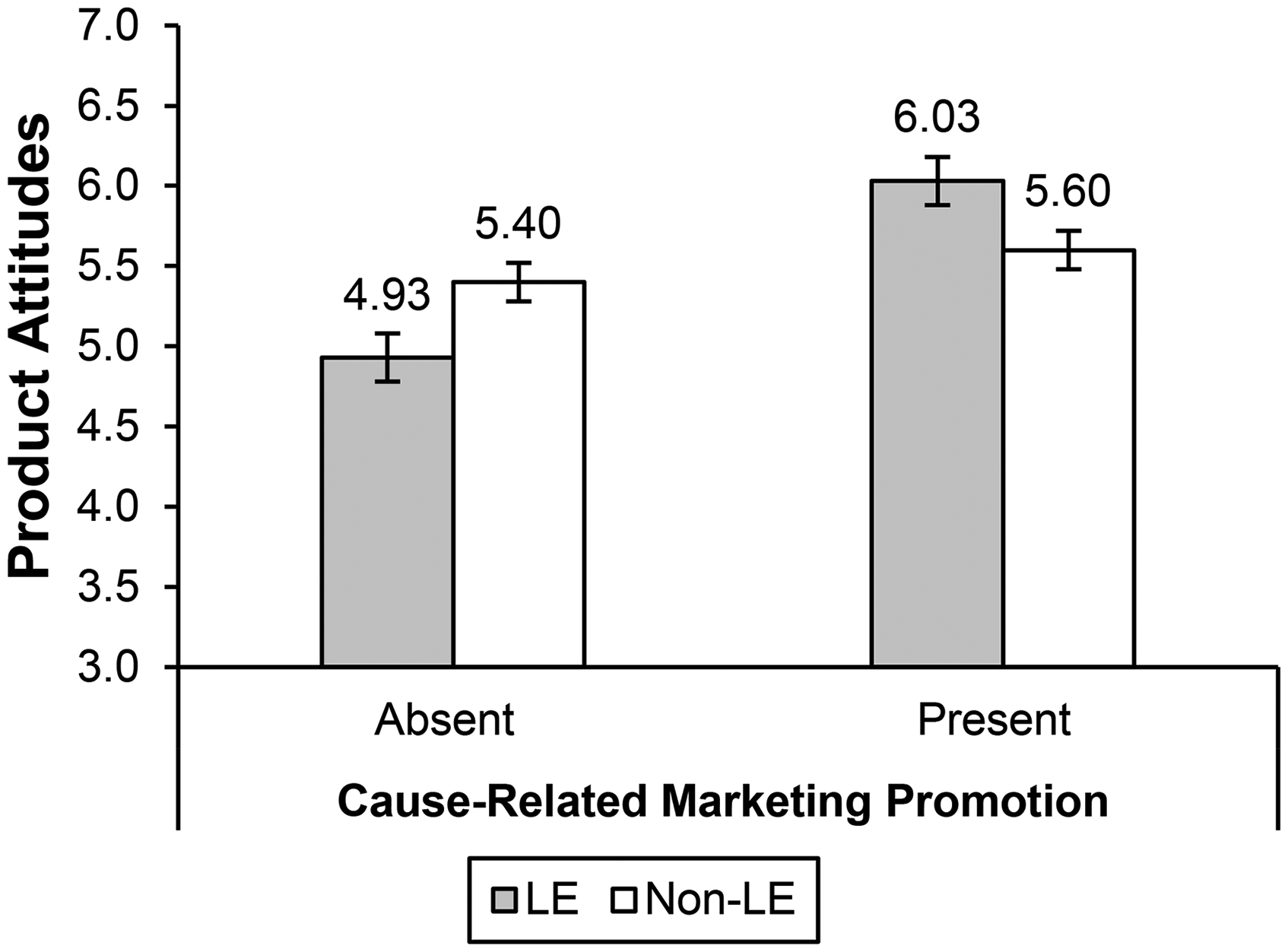
Study 6 Results.
Discussion
Study 6 identifies another boundary condition of our observed awe–LE product effect. When a cause-related marketing cue was not present in the awe-inspiring ad, results replicated previous studies. However, when the awe-inspiring ad featured a cause-related marketing cue, this effect was reversed, leading individuals to have higher preferences for the LE product. Next, we examine the implications of awe in consumer preferences toward LE products with a product choice study in the metaverse.
Study 7: Product Choice in the Metaverse
Study 7 was designed to investigate the effects of awe on consumer preferences for LE products within a metaverse scenario. With the increasing growth of virtual worlds, companies are shifting their focus to online consumption through the metaverse (Rauschnabel et al. 2022). The virtual environment enables users to create, buy, and sell products, and many leading brands invest in their metaverse identity (Ravenscraft 2023). For instance, Nike acquired the digital design company RTFKT and started to launch collectibles that include LE options to be worn in the virtual world (Ryder 2022). In this study, we developed metaverse environments for participants and asked them to indicate their preferences for their character in the metaverse. We predict that an awe-eliciting environment will decrease preferences toward LE options.
Method
Two hundred fifty-two undergraduate students (65.5% female, 34.5% male; Mage = 21.2 years) participated in this study for course credit. Participants were randomly assigned to a 2 (emotion: awe or control) × 2 (product type: LE or non-LE) between-subjects design. 1
To begin, participants were told that a gaming company was developing homes in the metaverse, and they were being asked to test the simulation. The simulation was designed as part of a metaverse where players can explore where they live and make choices for their characters. The first part of the study was designed as emotion manipulation. In this part, participants were given time to explore their home and surroundings in their metaverse. Specifically, in the awe-eliciting condition, the home was surrounded with mountains. In the control condition, the home was located in a neighborhood. Both conditions featured the same background music and bird sounds. Sample screenshots from the environments are provided in Figure 6.
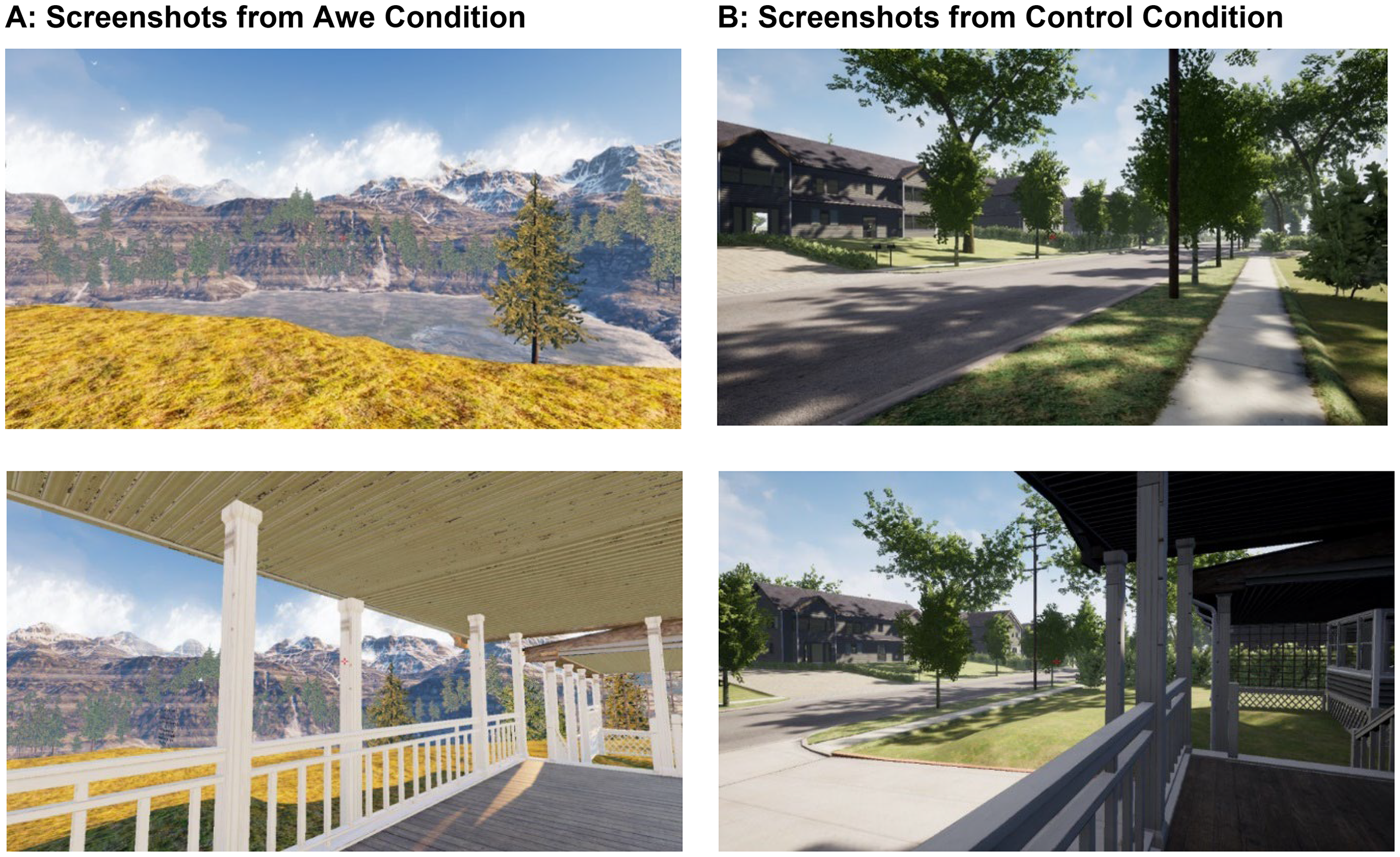
View from the Participants’ Metaverse Home and Surroundings.
In the next part of the study, players were asked to choose from different products to have in their metaverse profiles. Given that the home in the control condition was located in a neighborhood while the home in the awe condition was located in the mountains, participants in the control condition might have stronger social validation motives. To eliminate this potential bias, we included both private and public products. Participants were informed that the private products would be used in their metaverse home and that other players would not see them. They were also informed that public products would be used as part of avatar characters and that other players would see them. The private products were a blanket, a photo frame, and an artwork, and the public products were a pair of sneakers, a car, and a cap. The product categories were randomly presented to the participants. Each product category (see Figure 7) included three options, with one option, the LE condition, featuring the “limited edition” label. In the non-LE condition, the same options were presented, but without the LE label. For each product category, participants indicated which option they would like to have in the metaverse. In the analyses, we summed the total number of choices of each option that was presented as LE in the LE condition, which served as our dependent variable.
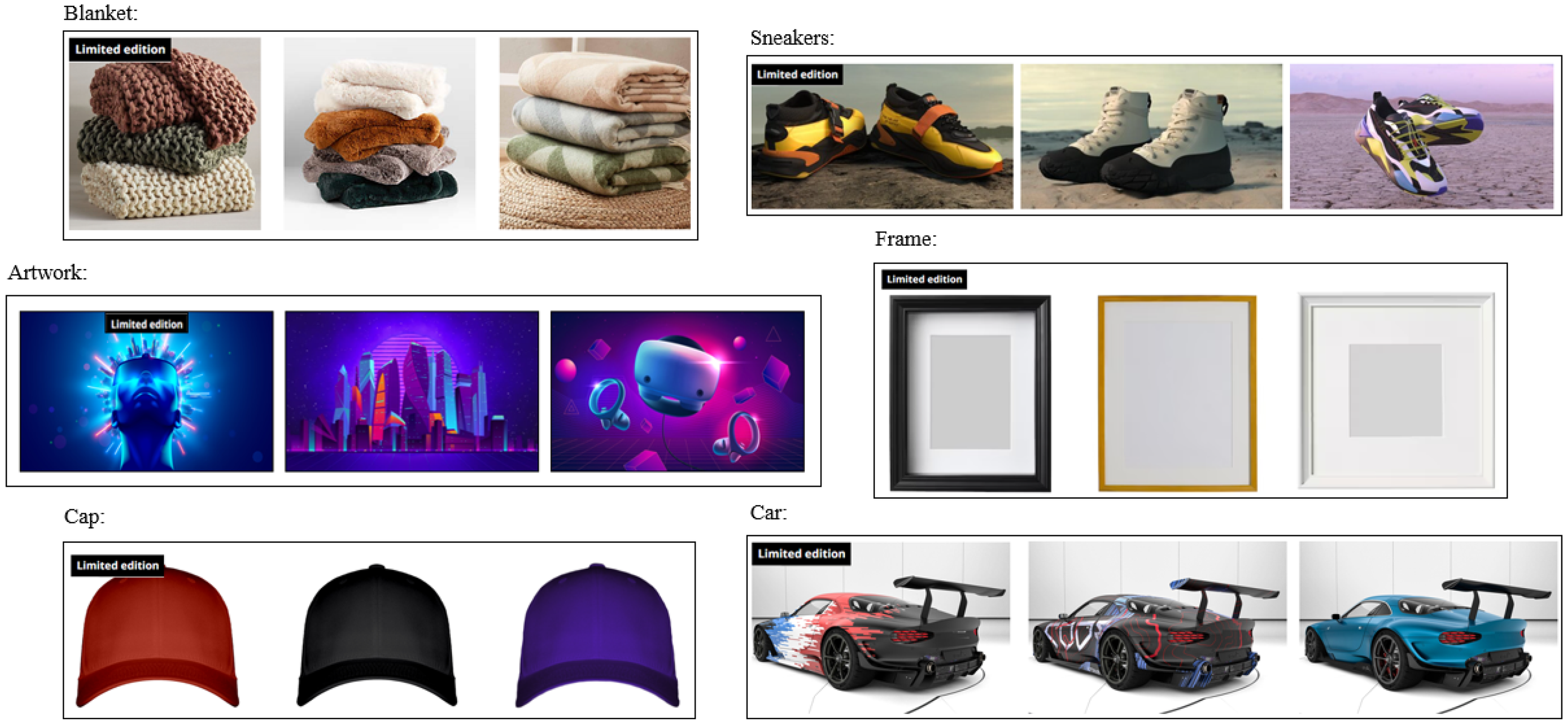
Product Choices in Study 7 (LE Condition).
After providing their choices, participants indicated their feelings during the simulation on seven-point scales for awe (1 = “not at all, and 7 = “very much”) as well as happy, excited, calm, peaceful, amused, and relaxed (1 = “not at all, and 7 = “extremely”). Amused and relaxed were added as additional potential confounds that we examined in our analyses. To conclude, participants indicated their age and gender.
Results
Manipulation check
An ANOVA with emotion and product type predicting feeling of awe was conducted. Results revealed a significant main effect of emotion (F(1, 248) = 15.10, p < .001), such that individuals in the awe condition reported higher feelings of awe (M = 4.53, SD = 1.54) relative to the participants in the control condition (M = 3.72, SD = 1.59). Furthermore, the main effect of product type and the interaction of emotion and product type were not significant (ps > .34). Additionally, the awe and control conditions did not significantly differ across the other emotions (ps ≥ .06; full details are provided in Web Appendix W).
Product choices
We conducted an ANOVA with emotion and product type predicting focal product choices. Results revealed a significant interaction of emotion and product type (F(1, 248) = 12.49, p < .001), while the main effects of emotion (F(1, 248) = .09, p = .77) and product type (F(1, 248) = .13, p = .72) were not significant. Planned comparisons revealed that individuals in the awe condition made fewer selections of the focal products in the LE product condition (M = 1.07, SD = .80) relative to the participants in the control condition (M = 1.55, SD = 1.15; 95% CI: [−.83, −.14], p = .007). However, individuals in the awe condition made more selections of the focal products in the non-LE product condition (M = 1.56, SD = .93) relative to the participants in the control condition (M = 1.15, SD = .84; 95% CI: [.05, .77], p = .024). Furthermore, preferences for focal products in the LE condition were lower relative to the non-LE condition for individuals in the awe condition (95% CI: [−.89, −.09], p = .016), but higher for individuals in the control condition (95% CI: [.11, .70], p = .008). Comparisons for each individual product category are provided in Web Appendix X.
Discussion
Study 7 provides further support for the conceptual model of feeling awe and preferences for LE products in a metaverse simulation. When the participant's home was placed in an awe-eliciting environment, preferences for LE products were reduced. This result further demonstrates the implications of awe for the marketing and consumption of LE products.
General Discussion
A growing number of marketers are leveraging awe-inducing stimuli to promote LE products. While various message cues and positioning strategies are employed in these campaigns, our research investigates the conditions under which awe enhances or diminishes the effectiveness of such persuasive appeals. Across nine studies, we identified that awe inspiration in advertisements negatively impacts consumer attitudes, purchase intentions, and choice of LE products. Our findings reveal that when advertisements incorporate awe-inspiring elements, product attributes associated with exclusivity become less desirable to consumers, ultimately reducing their preferences for LE products. Furthermore, we identify boundary conditions that can either mitigate (e.g., emphasis on product quality) or reverse (e.g., cues highlighting connection to the world or cause-related marketing) the awe–LE product effect. Together, these findings provide several theoretical and managerial implications.
Theoretical and Practical Implications
The present research advances the existing literature on the role of positive emotions in the marketing of LE products. Prior research has noted that LE products are generally evaluated more favorably by consumers when paired with emotional appeals that evoke conspicuous pride and romantic desire (Decrop and Derbaix 2010; Griskevicius et al. 2009). However, our research identifies the unique effect of awe on consumer preferences for LE items. Specifically, we propose that awe motivates a desire for collective advancement that facilitates a sense of unity among consumers. This heightened sense of unity impacts what attributes are desired by consumers. When exposed to awe-evoking marketing communications, consumers tend to gravitate toward products or brands that emphasize interconnectedness. Since LE products fall short in fulfilling this need due to their inherent exclusivity (Hamilton et al. 2019), preferences toward these products decrease. Our findings collectively demonstrate that feelings of awe can extend beyond self-perceptions to affect product-related perceptions and create a negative effect toward LE products.
This research also makes contributions to the study of self-transcendent emotions, particularly with respect to awe. It deepens our understanding of self-transcendent emotions by emphasizing their distinct social motivational properties, moving beyond the traditionally highlighted similarities such as their capacity to shift individuals from self-focused to other-focused orientations and prosocial behavior (Stellar et al. 2017; Van Cappellen et al. 2013). While other self-transcendent emotions, such as gratitude, elevation, and compassionate love, also encourage social connection, they do so through different motivational pathways: Gratitude fosters reciprocity (Layous et al. 2017), elevation inspires moral emulation (Algoe and Haidt 2009), and compassionate love drives actions aimed at alleviating the suffering of others (Oveis, Horberg, and Keltner 2010). In contrast, awe motivates a desire for collective advancement, driving behaviors that prioritize group benefits over individual gains (Jiang and Sedikides 2022). This distinction is crucial for understanding how awe influences consumer decision-making regarding product perceptions and choice. The drive for interconnection and collective advancement motivated by awe makes product attributes such as exclusivity and distinctiveness less desirable to consumers. This insight provides a fresh perspective on how featuring awe in marketing communications can affect consumer preferences.
Whereas traditional studies often compare self-transcendent emotions to general positive emotions (e.g., happiness), our research highlights nuanced differences between self-transcendent emotions, thereby providing a richer understanding of their influence on individual behavior. This empirical differentiation offers critical implications for marketers, who can strategically evoke specific self-transcendent emotions to align with desired consumer outcomes, particularly in contexts that involve exclusivity and inclusivity in product offerings (Chirico and Yaden 2018; Dale et al. 2020). Taking this approach contributes to a more sophisticated understanding of self-transcendent emotions (Siegel, Thomson, and Navarro 2014), underscoring the importance of recognizing their distinct motivational properties in consumer psychology and marketing, particularly in domains beyond prosociality and other-focused behavior.
Our research also provides several practical implications for marketers. Based on our data collection for the pilot study including 50 different brands, marketers appear to use awe elicitors to a similar degree in LE versus non-LE product ads (scores higher than “no awe at all” on the scale: LE = 79.6% and non-LE = 74.2%, χ2 (1) = 2.48, p = .12). The findings from our pilot and subsequent experimental studies demonstrate that this can be detrimental to consumer preferences. For example, the results of our field study (Study 1) showed that consumers were less likely to click on an awe-eliciting ad when it was paired with an LE product relative to a non-LE version of the same item. Therefore, companies that use online advertising to promote their LE products should avoid including elicitors of awe in their ads. However, shifting the focus from exclusivity of the LE product to other product features (such as its high quality) could help marketers eliminate the negative impact of awe-evoking promotional campaigns.
Our moderator studies also highlight several strategies to make LE products more appealing to customers. Marketers may consider adding taglines or slogans that emphasize interconnection and collective advancement if marketing LE products with awe. Marketers can also incorporate cause-related marketing messages into their promotional campaigns. A widely adopted strategy among companies, including luxury brands, is to release LE products in partnership with nonprofit organizations. Some examples include the Bvlgari and Save the Children jewelry collection, the Montblanc watch collection for UNICEF, the Estée Lauder Breast Cancer Research Foundation pink ribbon collection, and (Product)RED campaigns from companies such as Apple, Ram, and Dell. Cause-related marketing messages emphasize how an item or purchase contributes to the greater good, which is congruent with consumer responses to awe. Results of our Study 6 support this approach from practice and suggest that cause-related marketing may be particularly effective when coupled with awe-inspiring stimuli and an LE product.
Limitations and Future Research
While this research offers valuable insights into how and when awe impacts preferences for LE products, several limitations should be acknowledged. First, this research does not examine negatively valenced awe, such as threat-based awe experienced due to thunderstorms, volcanoes, or floods (Gordon et al. 2017). While in this research we focus on awe as a positive emotion, future research can examine how the dark side of awe can have an impact on consumers’ preferences for LE products. One possibility is that fear-based awe may cause individuals to feel low status and have low confidence (Gordon et al. 2017), which may increase their preferences for LE products to restore their self-esteem. Exploring how negatively valenced awe in marketing communications may influence the results observed here can provide further insights to marketing managers and consumers.
Additionally, in this research we do not examine different brand perceptions such as luxury versus value or symbolic versus functional. Findings from Study 4 indicate a negative effect of awe in advertising when the consumption motive focuses on status and exclusivity. However, this effect is attenuated when the consumption motive is driven by superior product quality. These findings can potentially be relevant to luxury product consumption as well. It is noteworthy, though, that the definition of luxury is complex. Hudders, Pandelaere, and Vyncke (2013) identify three facets of luxury: exclusivity, premium quality, and extraordinary aesthetics. Similarly, Ko, Costello, and Taylor (2019) define luxury along five dimensions: high quality, authentic value, prestigious image, premium price, and capability to inspire a deep connection. 2 In view of our findings, when marketing luxury products for status and exclusivity, featuring awe in such promotions may dampen preferences. However, if other facets of luxury products are emphasized in the marketing communication (e.g., superior quality or craftsmanship), our observed awe effects may not directly apply. Additionally, some luxury brands inherently evoke awe (Kim, Bang, and Campbell 2021). Future research should delve deeper into how awe affects the promotion of luxury products and brands.
Furthermore, it is important to note that all self-transcendent emotions encourage individuals to seek interconnection with others, to varying degrees. For example, compassionate love may drive individuals to seek connection with family (Sprecher and Fehr 2005), while gratitude can lead to a desire to connect with a benefactor (Algoe, Haidt, and Gable 2008). While acknowledging these similarities, our research posits that the social motivations associated with awe differ from those of other self-transcendent emotions, particularly in terms of collective advancement and the “we-concern” (Perlin and Li 2020, p. 294) that awe inspires. Future research may continue to examine the unique motivational properties of awe and other self-transcendent emotions, demonstrating how they distinctively influence consumption behavior.
Last, in this research, we examine awe as an emotional tool used in marketing communications for LE products. However, emotions could also arise from the consumption experience (Richins 1997). Previous research has revealed that awe experiences can be associated with peak experiences based on responses to the extraordinary (Konecni 2005; McDonald, Wearing, and Ponting 2009), which could be found in domains such as art and technology (e.g., vast artwork or inspiring high-tech products). How would our results change if individuals perceive the consumption of the LE product as awe-inspiring? Exploring the influence of product-evoked awe on the effects observed in this research could extend our findings and provide valuable insights for marketing managers.
In conclusion, the current research offers new insights into the marketing of LE products, revealing how awe can either diminish or elevate their attractiveness. We advance the understanding of how awe influences consumer behavior by demonstrating that awe elicitation reduces consumers’ desire for exclusivity. Considering that awe is commonly employed in a variety of marketing messages, we encourage further research to continue exploring its multifaceted implications within the realms of advertising and persuasive communication.
Supplemental Material
sj-pdf-1-mrj-10.1177_00222437251333742 - Supplemental material for How Awe in Marketing Communications Decreases Consumer Preferences for Limited Edition Products
Supplemental material, sj-pdf-1-mrj-10.1177_00222437251333742 for How Awe in Marketing Communications Decreases Consumer Preferences for Limited Edition Products by Aysu Senyuz, Jonathan Hasford and Ze Wang in Journal of Marketing Research
Footnotes
Acknowledgments
The authors thank Robert Bareuther for providing access to the iSpot.tv database and Mackenzie Bland for her research assistance. They also express deep gratitude to the JMR review team for their guidance and invaluable feedback. This research is based on the first author's dissertation.
Coeditor
Rebecca Hamilton
Associate Editor
Karen Winterich
Declaration of Conflicting Interests
The author(s) declared no potential conflicts of interest with respect to the research, authorship, and/or publication of this article.
Funding
The author(s) received no financial support for the research, authorship, and/or publication of this article.

Notes
References
Supplementary Material
Please find the following supplemental material available below.
For Open Access articles published under a Creative Commons License, all supplemental material carries the same license as the article it is associated with.
For non-Open Access articles published, all supplemental material carries a non-exclusive license, and permission requests for re-use of supplemental material or any part of supplemental material shall be sent directly to the copyright owner as specified in the copyright notice associated with the article.
