




Abstract
Many firms struggle with how to craft their messages in conversations with customers on social media. The problem is compounded by the fact that these conversations take place in multiple simultaneous threads, each of which potentially requires a different approach depending on the conversation. This article studies how firms can adapt their responses in individual social media conversations such that the sentiment in different conversations becomes more favorable. The authors examine a comprehensive set of firm-generated content elements inspired by the theory of dialogic listening that emphasizes that a conversation partner should offer (1) empathetic understanding, (2) unconditional positive regard, a spirit of mutual understanding expressed through (3) topic matching and (4) linguistic style matching, (5) presentness, and (6) genuineness. They augment this set by also considering (7) whether the agent takes the conversation to a one-on-one channel and (8) whether agent signs their response with their own name, indicating a personal connection. The authors furthermore test whether these elements’ effectiveness depends on preceding user sentiment. Based on an analysis of nearly 1 million tweets capturing over 206,000 threads involving four major U.S. banks across ten years, this article provides concrete managerial guidance on responding effectively on social media to maximize the positive impact on the sentiment of subsequent user-generated content and shows that this guidance depends on preceding user sentiment.
Customers increasingly use social media to talk directly to firms. Indeed, 80% of customers expect firms to interact with them on social media, and 78% are more willing to purchase from a brand with which they have had a positive social media interaction (Gomez 2021). Initiating and managing conversations with customers on social media can lift customer engagement, satisfaction, and advocacy (Pansari and Kumar 2017). However, firms report that a key social media challenge is the lack of guidance for interacting with customers, including decisions related to content and how to drive engagement (Calus 2025), and many struggle with how to craft messages to users 1 on social media (McFerran, Moore, and Packard 2018).
Users on social media converse using threads, which are made up of posts and replies to posts. We define social media conversations as online interactions between a firm agent (e.g., a representative on a social media platform) and one or more social media users, in the context of a thread referencing a focal brand or firm. A key challenge for firms is determining how to create their firm-generated content (FGC) to steer conversations in a more favorable direction, as reflected by more positive user sentiment in later posts. User sentiment is defined as the valence (ranging from positive to negative) of a user post (Homburg, Ehm, and Artz 2015). For firms, it is crucial to ensure that user sentiment stays or becomes more positive, given its impact on key performance outcomes such as investor decisions (Tirunillai and Tellis 2012).
Some research has tested FGC's impact on the sentiment of user-generated content (UGC), aggregated across multiple conversations (e.g., Homburg, Ehm, and Artz 2015). However, aggregating content across conversations masks the components of posts, which limits the ability to derive insights on specific FGC components that firms should employ and how those components should be adapted based on the nature of preceding UGC. Other studies explore issues related to complaint handling on social media (Golmohammadi et al. 2021; Gunarathne, Rui, and Seidmann 2017; Herhausen et al. 2019, 2023; Hill Cummings et al. 2024). While this work is valuable, complaints are only part of the spectrum of social media conversations, and in our data, negative posts are a minority. It is also unlikely that insights on complaint handling generalize to more positive conversations or those on different topics, such as general inquiries.
We capture the full spectrum of social media conversations (not just complaints) and study how FGC in those conversations affects the sentiment of subsequent UGC. We view social media conversations through the lens of dialogic listening, which suggests that a communication partner should offer (1) empathetic understanding, (2) unconditional positive regard, a spirit of mutual understanding (which we capture by (3) topic matching and (4) linguistic style matching), (5) presentness, and (6) genuineness. Empathetic understanding involves showing warmth, compassion, and concern for others (Allard, Dunn, and White 2020; Herhausen et al. 2023). Unconditional positive regard means expressing positive feelings while signaling acceptance of another as a person of “unquestioned worth.” Creating a spirit of mutual understanding involves listening such that “everyone has the right to communicate freely and openly” (Floyd 1985, p. 124). Presentness is a party making it clear that they are fully attending to another and are accessible (Floyd 1985). Lastly, genuineness reflects authenticity, which arises when one party perceives comments as truthful and reflecting another's thoughts.
We augment the elements suggested by dialogic listening theory with two elements suggested by an empirics-first approach (Golder et al. 2023) and observing the real-world of marketing (Van Heerde et al. 2021). Based on our observations of how firms and consumers are interacting, we study two more social-media relevant FGC variables that reflect the current state of firm–consumer social media interactions but that were not yet typical in offline contexts, the main context when the theory of dialogic listening was introduced (Johannesen 1971). These variables are (continuing the previous list) (7) the firm taking action to continue a conversation using direct messages (DMs) and (8) whether firm agents reveal personal information (i.e., sign their name).
Our overarching questions are (1) How can firms improve customer sentiment in social media conversations? And (2) Does the effectiveness of FGC depend on the preceding user sentiment? To address these questions, we develop a model of social media conversations, which can consist of multiple exchanges and vary in topic, tone, and length. We model tweets as parts of interactions that consist of repeated sequences: preceding UGC → FGC → UGC, enabling us to gauge different FGC elements’ effects on user sentiment and the moderating role of preceding user sentiment. Using a dataset with nearly 1 million tweets and over 206,000 conversations involving the four largest U.S. banks (Bank of America, Wells Fargo, Citibank, and JPMorgan Chase) from 2011 to 2020, we study FGC's impact on subsequent user sentiment, accounting for the endogeneity of firm reactions and for selective user and firm reactions.
Our study makes two key contributions. While the extant literature has studied isolated FGC variables or up to three at the same time (see Table 1), we study seven FGC variables concurrently for a more complete view of how firms can steer social media conversations. Not only does our analysis overcome omitted variable bias, but it also allows us to gauge FGC variables’ relative strength for lifting user sentiment. Topic matching (new to the literature) is the most effective FGC variable. Along with the second-most effective FGC variable (linguistic style matching), a key takeaway is that conveying a spirit of mutual understanding through topic and linguistic style matching is the most potent way to lift user sentiment. The next-strongest pair of FGC variables are sentiment (capturing unconditional positive regard) and empathetic understanding. The least effective FGC variables for lifting UGC sentiment are response time (capturing presentness), agent signing, DMing, and FGC authenticity (capturing genuineness).
Representative Studies Examining the Impact of FGC in Firm–User Social Media Interactions.
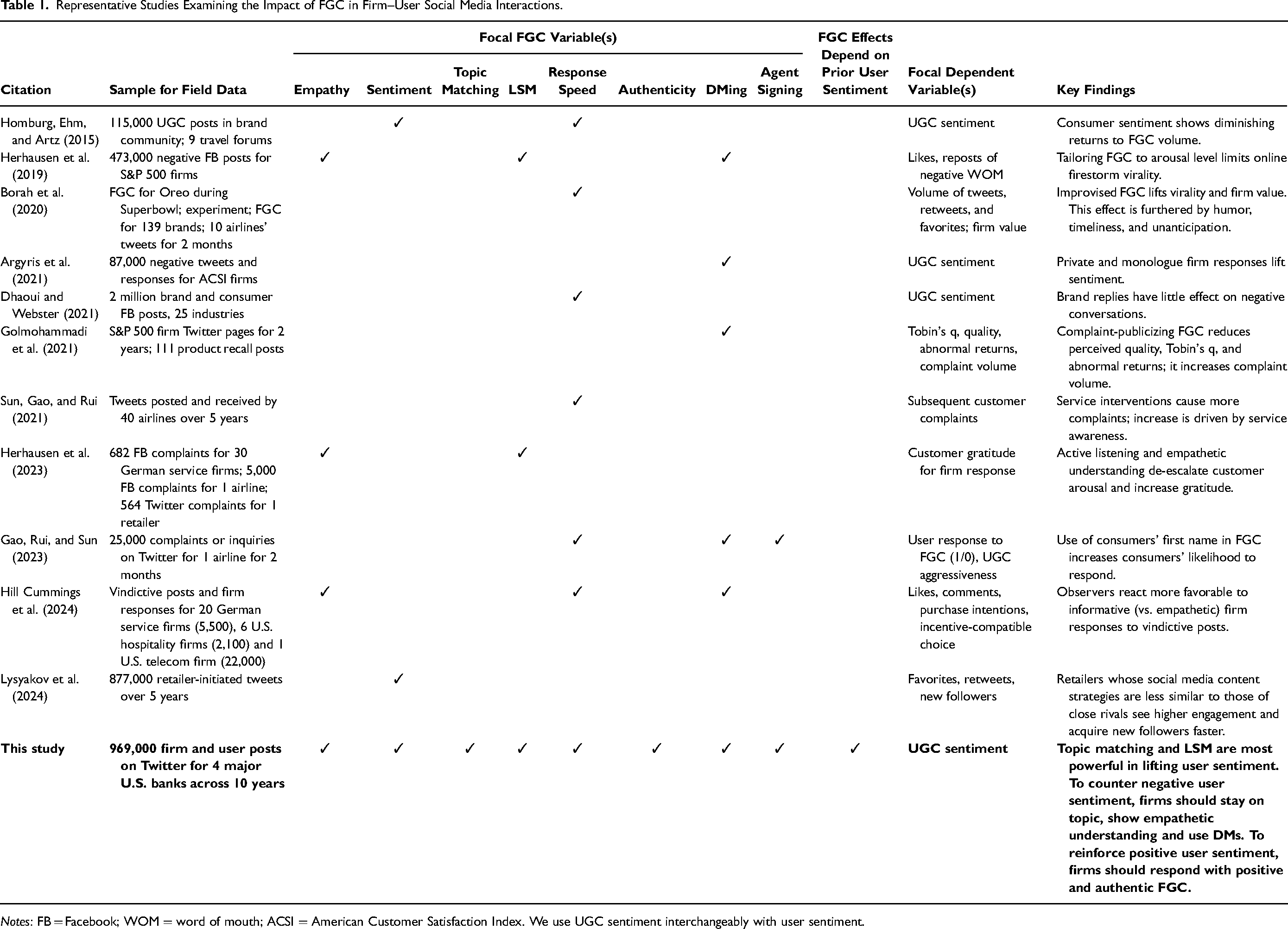
Notes: FB = Facebook; WOM = word of mouth; ACSI = American Customer Satisfaction Index. We use UGC sentiment interchangeably with user sentiment.
Our second contribution is that we are the first to study how preceding user sentiment moderates the effectiveness of FGC. Unlike the previous literature, which has mainly focused on negative conversations (e.g., Herhausen et al. 2023), we study the entire spectrum of conversations. In contrast to prior literature that does not tailor responses to preceding user sentiment, we show that firms should respond differently depending on how positive or negative the ongoing conversation is. 2 We find that to counter negative user sentiment, firms should focus on staying on topic, showing empathetic understanding, and using DMs. To reinforce positive user sentiment, firms should respond with positive and authentic FGC. We also find that when using the elements correctly, FGC can turn neutral user sentiment into positive user sentiment.
Prior Research
Table 1 provides a representative collection of extant research on the impact of FGC features in firm–user social media interactions. With a few exceptions (e.g., Dhaoui and Webster 2021), we note a lack of studies in marketing that examine user sentiment after FGC as an outcome. This is surprising given user sentiment's importance for firm outcomes such as investor decisions (Tirunillai and Tellis 2012) and sales (Sonnier, McAlister, and Rutz 2011).
Whereas many studies examine the role of FGC volume or the act of responding, others focus on one or a few FGC features such as sentiment (Lysyakov et al. 2024), humor (Borah et al. 2020), response speed (Dhaoui and Webster 2021; Sun, Gao, and Rui 2021), empathy (Herhausen et al. 2019, 2023; Hill Cummings et al. 2023), use of DMs (Golmohammadi et al. 2021), whether the agent signs their name (Gao, Rui, and Sun 2023), whether FGC is accommodative or defensive (Johnen and Schnittka 2019), or monologue versus dialogue (Argyris et al. 2021).
We view conversations through the lens of dialogic listening (Floyd 1985; Johannesen 1971; Kent and Taylor 1998) to propose that FGC that contributes to a supportive psychological climate can steer conversations in a positive direction. Corresponding with this lens, we use the FGC elements (captured using variables in parentheses) derived from empathetic understanding (empathy), unconditional positive regard (sentiment), spirit of mutual understanding (topic, linguistic style matching), presentness (response time), and genuineness (authenticity). We also study two more FGC elements that we observed in practice and heard during manager interviews (discussed subsequently) that firms often use in social media interactions: using DMs to move conversations offline and agents signing their name.
As Table 1 shows, prior research on social media has not studied topic matching or authenticity. Also, prior research has studied up to three FGC elements concurrently (omitting the others), which can induce omitted variable biases. By analyzing eight FGC variables’ impact simultaneously, we test their relative strength and significance in driving user sentiment.
Furthermore, studies on social media FGC tend to focus on complaints or reviews and not the full spectrum of social media conversations such as we do. We also note that the literature does not consider how the ongoing conversation moderates the impact of FGC elements. This omission is also surprising given evidence of emotional contagion in interactions in social media in both the academic (Hewett et al. 2016) and practitioner literature (Lee 2014), which suggests an important role of the prior sentiment in a conversation for the sentiment of subsequent posts.
We address this gap by considering FGC's role in the context of any conversation (i.e., not just complaints). We find that FGC's effect on user sentiment depends on preceding user sentiment, and that we cannot assume that the insights based on negative conversations (as with complaints) also apply for neutral or positive conversations. By studying all conversations, we find that the FGC variables work differently for negative as opposed to positive user sentiment, as evidenced by the significant interactions found between FGC and preceding user sentiment.
Conceptualizing FGC and Its Effects
Social Media Data Preview
Our conceptualization of social media conversations is rooted in the empirical world (Golder et al. 2023). Previewing our data, we observe 969,000 tweets capturing over 206,000 conversations involving four major U.S. banks and users over ten years. These tweets can cover any topic, including complaints, compliments and inquiries. Social media conversations are centered around one thread (topic) and require two or more participants, each with at least one post. We observe individual posts and conversations consisting of strings of UGC and FGC posts. In our data, on average a conversation is nearly five tweets long, but the length varies.
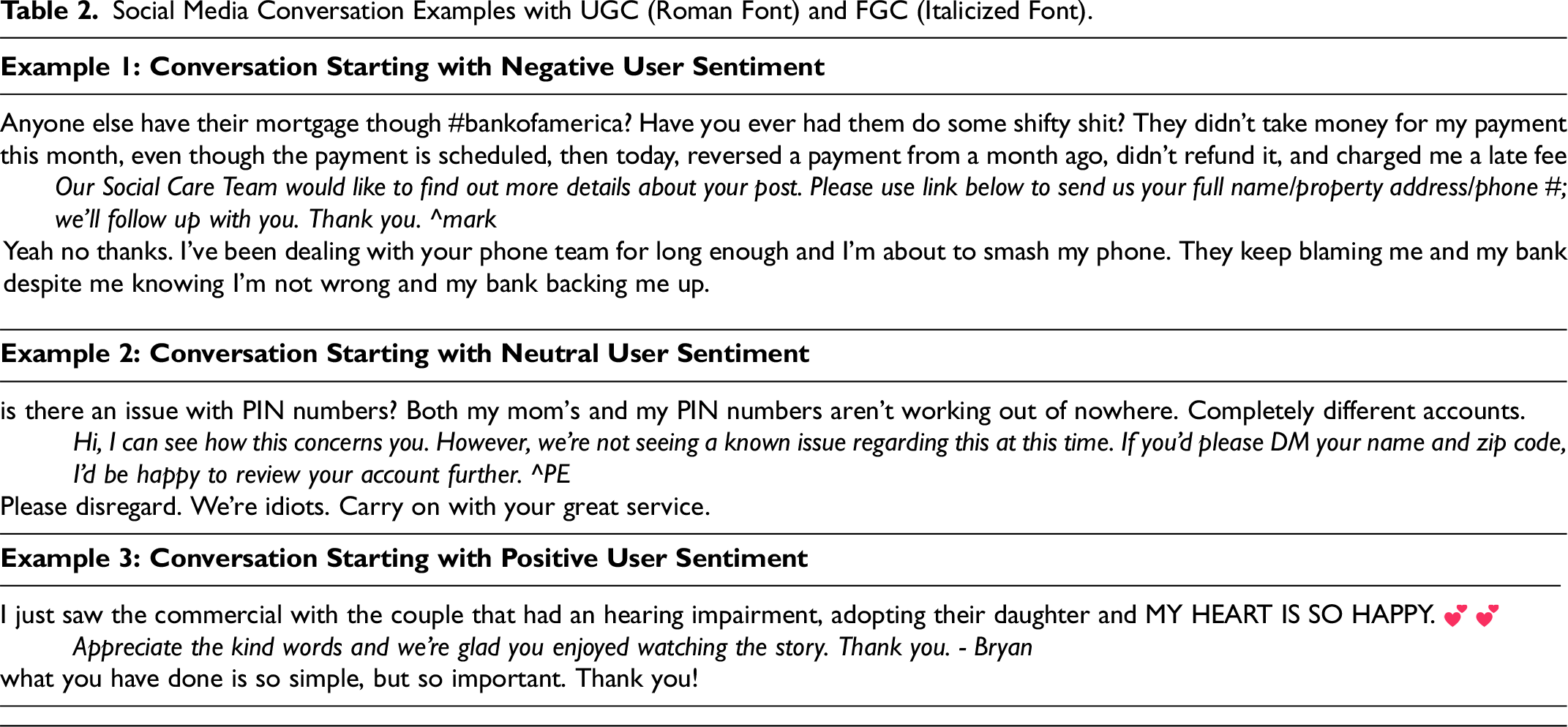
Table 2 shows three example conversations, starting with negative user sentiment (Example 1), neutral user sentiment (Example 2) and positive user sentiment (Example 3), respectively.
Social Media Conversation Examples with UGC (Roman Font) and FGC (Italicized Font).
Model of a Conversation
In a conversation, posts by one party (e.g., UGC) may affect subsequent content by others (e.g., FGC) and vice versa. Hence, UGC and FGC posts in a conversation depend on each other. We study how FGC influences user sentiment and how the effect depends on preceding user sentiment. We adopt a stylized model for conversations as repeated sequences of three components: preceding UGC → FGC → UGC (Figure 1). We expect that preceding user sentiment may trigger FGC (arrow C, Figure 1). Yet firms can use FGC (arrow A) to steer conversations, and FGC's effects may be moderated by preceding user sentiment (arrow B). In our analysis, the effects represented by arrows A and B are focal, whereas arrow C is auxiliary and accounts for the selective occurrence of FGC following UGC. 3
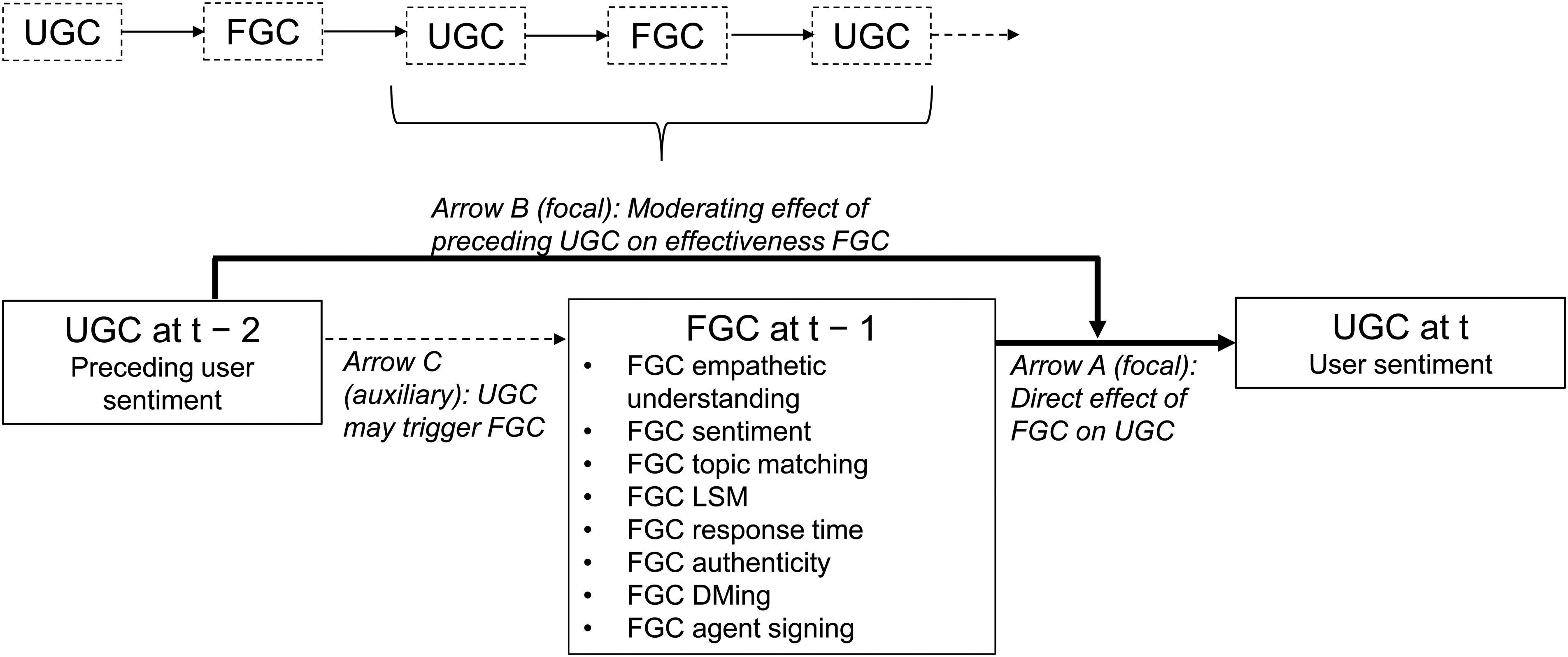
Model of a Conversation.
Deriving the Focal FGC Elements
To ground our conceptualization in the real world of marketing (Van Heerde et al. 2021), we draw on research in marketing, sales, psychology and communications on interactions in online and offline contexts. We also interviewed four managers responsible for their firms’ social listening activities (see Web Appendix A). Each discussed their firm's practices for engaging with users on social media. A social media coordinator described her firm's practice of responding to all comments, whether positive or negative. Consistent with the findings of Herhausen et al. (2019, 2023) regarding the importance of empathy in firms’ responses to complaints, the need for empathy was also mentioned. A social media coordinator also discussed the role of positivity, saying, “If we see users going through a hard time, we love to reach out and do what we can to spread joy.” A retail manager noted that “every guest deserves clarification on their situation,” suggesting the need to convey an understanding of the user's situation. Others noted that letting users express themselves fully using DMing puts the focus on the user (vs. a social media audience) and enables users to tell their story in detail so firms can understand and resolve issues while protecting customer data (Gingiss 2018).
To examine how firms can steer social media conversations, we build on these insights and on research on firms’ dialogs with others. In communications, listening is viewed as attending to, understanding, and responding to messages (Floyd 1985). We leverage dialogic listening, also called empathetic listening, studied in both in-person and digital contexts (Kent and Taylor 1998). Building on findings that a conversation partner's attitude depends on the other partner's response to them (Dai et al. 2016), that listening builds positive relationships and enhances conversation partners’ attitudes (Rogers and Farson 1987), and that dialogic listening builds trust between firms and others (Yang, Kang, and Cha 2015), we argue that by employing dialogic listening, firms can steer social media conversations in a positive direction.
FGC Elements Derived from Dialogic Listening
We first define the components of dialogic listening and describe our expectations regarding their role in firms’ ability to steer social media conversations. According to Floyd (1985), the cumulative efforts to show empathetic understanding, unconditional positive regard, a spirit of mutual equality, presentness, and genuineness all contribute to a supportive psychological climate. As such, we expect FGC that exhibits these qualities to positively impact user sentiment. We also describe our expectations for the influences of agent signing and DMing on user sentiment to provide a comprehensive understanding of a firm's interactions with customers on social media that is also grounded in the real world of marketing. In the following discussion of the constructs, we refer to Table 2 for examples.
Empathetic understanding
Based on dialogic listening, empathetic understanding entails recognizing others’ feelings (Yang, Kang, and Cha 2015) and creating an atmosphere in which others want to participate (Kent and Taylor 2002). In marketing, empathy is defined as “a vicarious emotional response to observing another person's situation that is marked by the ability to feel warmth, compassion, and concern for others” (Allard, Dunn, and White 2020, p. 90), and empathetic responses involve understanding others’ experiences (Granzin and Olsen 1991) and reacting to their thoughts and feelings (Iglesias, Markovic, and Rialp 2019). We draw on Herhausen et al. (2023, p. 211) to define empathy as “connecting emotionally with complaining customers by indicating understanding of their feelings, using explicit expressions of validation and affirmation.” In Example 3 (Table 2), the firm shows empathy by recognizing the feelings of the user.
Herhausen et al. (2023) argue that empathetic FGC conveys understanding of customers’ feelings and find that it can evoke gratitude even if complaints are not resolved. Empathy is seen as human-centered, implying compassion (Pedersen 2021), can prompt mutually supportive attitudes (Wieseke, Geigenmüller, and Kraus 2012), and shows that a firm is taking complaints seriously (Golmohammadi et al. 2021). Likewise, conversation partners showing empathy can transfer positive feelings to others (Howard and Gengler 2001), enhancing affective commitment (Mende and Bolton 2011). Thus, we expect empathetic FGC to enhance user sentiment.
Unconditional positive regard
The second dialogic listening component involves conveying unconditional positive regard for a conversation partner (Potdevin, Clavel, and Sabouret 2021). According to this theory, positivity refers to the expression of positive feelings in communications. Positivity is a signal that a speaker accepts another as a person of “unquestioned worth” regardless of their behaviors or expressed ideas (Floyd 1985, p. 123). We define positivity in FGC as content that is overall positive in sentiment. In Example 3 (Table 2), the firm expresses appreciation for the user's compliment. Greater positivity can (1) convey a sense of closeness between conversation partners (Burgoon and Le Poire 1999), (2) indicate compassion toward another (Younas et al. 2023), and (3) reflect caring (Rogers 1980). Positivity is reflected in the exhibition of positive emotions, and demonstration of compassion (Younas et al. 2023). As a result, we expect the expression of positive sentiment in FGC to enhance subsequent user sentiment.
Spirit of mutual understanding
According to Floyd (1985), listening with a spirit of mutual understanding involves listening such that “everyone has the right to communicate freely and openly” (p. 124). Such a spirit is argued by Baryshnikov (2014) to be upheld by “symmetrical mirror communication,” a concept that views communication as a dialogic process aimed at facilitating mutual understanding among people and firms (Grunig and Hunt 1984). Building on this research, we define FGC that features a spirit of mutual understanding as content that exhibits symmetry with that of a conversation partner in terms of both the topic and the linguistic style of a user's post. Such symmetrical communication will signal that the firm is entering the conversation in a spirit of mutual equality and can build trust and stronger relationships.
Studies in psychology suggest that related responses can facilitate interaction goals (Davis and Perkowitz 1979) and that liking is enhanced when responses reflect the content of another's message (Dai et al. 2016), which we define as topic matching. In Example 3 (Table 2), the firm's response mirrors the user's topic. Davis and Perkowitz (1979) argue that mirroring content serves four functions: (1) maintenance of the interaction, (2) predictability, (3) facilitation of conversation partners’ interaction goals, and (4) communication of interpersonal affect. Moreover, Davis and Perkowitz suggest that off-topic responses can signal a lack of interest, a point reinforced by our interviewees. One respondent stressed that “feedback is a gift—negative or positive” and her firm's practice to not “avert the conversation.” Another added that staying on topic “creates brand trust and loyalty.” Thus, we expect staying on topic to lift user sentiment.
Next, linguistic style matching (LSM) occurs when the words a conversation partner uses positively covary with those of another (Cappella 1996) and is captured by the stylistic similarity of utterances in the use of function words (Babcock, Ta, and Ickes 2014). In Example 2 (Table 2), the firm's responses matches the linguistic style of the user by having the same number of articles, prepositions, negations, and common adverbs and very similar numbers of auxiliary verbs, conjunctions, and quantifiers. LSM can prompt perceptions of approval and trust in others (Ireland and Pennebaker 2010), and aid in reaching an agreement in negotiations (Ireland and Henderson 2014). Shared communication norms such as LSM can also signal identification with others in computer-mediated communication such as our context (Hardy, Lawrence, and Grant 2005). Thus, we expect greater LSM in FGC to positively influence user sentiment.
Presentness
Floyd (1985) defines presentness as actively attending to another and argues that, without it, a speaker cannot respond effectively. We draw on prior research to define presentness as one communication party making it clear to another that they are attending and demonstrating accessibility (Johannesen 1971; Tompkins 2003). We propose that presentness can be shown by the speed of the firm's response. In Examples 1, 2, and 3 (Table 2) the response times were 17, 17, and 610 minutes, respectively. In goal-directed contexts such as ours, rapid responses can reduce ambiguity and offer greater value to recipients (Daft and Lengel 1984). Quick responses to negative situations can reduce user distress (Lewis and Manusov 2009) and are related to the perceived value of response content (Weiss, Lurie, and MacInnis 2008). In computer-mediated communications, trust is distinguished by a partner's responsiveness, and when trust is weakened, communication is difficult (Tompkins 2003). Thus, we expect quicker responses to enhance user sentiment.
Genuineness
Across contexts, conceptualizations of genuineness share the notion of authenticity. In public relations, genuineness is often tied to authenticity and demonstrated through transparency (Johnston and Lane 2019), which results in consumer trust and positive attitudes and behavioral intentions toward firms (Reynolds and Yuthas 2008). We define FGC that exhibits genuineness as content that is perceived as authentic by a conversation partner. In Example 2 (Table 2), the firm response feels unfiltered and “off the cuff,” whereas Example 1 is more of a boilerplate response. In marketing, authenticity has been shown to increase a message source's credibility (Ertimur and Gilly 2012) and to lead to positive consumer brand-related behaviors (Zhang and Patrick 2021). Thus, we expect greater FGC authenticity to enhance user sentiment.
Two Further FGC Elements: Direct Messaging and Agent Signing
As the theory of dialogic listening was developed before the rise of social media, it does not necessarily include elements specific to social media. Thus, we expand this theory to include other FGC elements derived from the real world of (social media) marketing (Van Heerde et al. 2021) and reinforced during our manager interviews, specifically: DMing and agent signing.
Direct messaging
The use of DMing involves firms suggesting to move conversations to a private channel where the interaction can continue in a one-on-one fashion. The practitioner literature and our interviews suggested that DMing may be needed to understand a user's story due to character restrictions on some platforms. As such, offering to continue conversations through DMing signals a desire to allow users to express themselves fully. Example 2 in Table 2 shows the use of DMing. Privacy restrictions may also apply to information needed to resolve a user's issue (Gingiss 2018). Removing conversations from public view can enable firms to develop relationships with users in a one-on-one way, making users feel heard (Smallbiztools 2021). Likewise, Golmohammadi et al. (2021) argue that reducing complaint publicization by using DMing can be beneficial for firms, and Argyris et al. (2021) find a positive, marginally significant effect of DMing on user sentiment.
Our interviewees offered further support for the role of DMing. One described the use of DMing as enabling the firm to “hear them [customers] out” and as allowing a more complete narrative regarding the experience that triggered the UGC. As such, we expect that DMing will lift user sentiment. Importantly, as researchers we cannot observe what is being said within direct messages. Hence, when we discuss DMing affecting user sentiment, we refer to the public UGC after the firm's request to move to a private channel.
Agent signing
Another FGC factor suggested by research on social media and by practice is agent signing, defined as the firm's agent signing the FGC with their first name. In Examples 1 and 3 (Table 2), the agents sign with their first names, whereas in Example 2 the agent just uses initials. In social psychology, a party revealing who they are increases liking (Dai et al. 2016). Agents signing their names can convey interpersonal concern and that they are revealing their true identity (Markovic et al. 2018). Doing so can “humanize” a corporate voice (Van Noort and Willemsen 2012) and signal emotional involvement (Packard, Moore, and McFerran 2018) and a desire to help (Davidow 2000). As relational development begins with sharing personal information (Dai et al. 2016), we expect agents signing their names to lift user sentiment.
By not only studying six FGC elements suggested by dialogic listening but also two more FGC elements inspired by the real world of social media, our study is the hitherto most complete assessment on how FGC can steer user sentiment. This comprehensiveness allows us not only to control for the other elements while assessing each element's effect (mitigating omitted variable biases) but also to compare the effect sizes of the FGC elements to identify the most effective elements to move the needle of user sentiment.
Moderating Effects of Prior User Sentiment
We expect different FGC elements to be more effective in moving conversations in a positive direction depending on the sentiment of the ongoing conversation. We begin by discussing FGC elements that we expect to be especially important when prior UGC is negative.
FGC elements that become more effective for negative preceding user sentiment
We expect FGC that (1) exhibits empathetic understanding, (2) mirrors both the topic and linguistic style of prior UGC, (3) demonstrates presentness by responding quickly, (4) suggests taking the conversation one-on-one using DMing, and (5) has agents sign their names is especially important when prior UGC is negative. First, from a dialogic listening perspective, empathetic understanding involves conveying to another that they are understood, which is more critical when the partner is experiencing negative emotions (Jones 2011). Empathetic responses to complaints have been shown to lift UGC sentiment (Herhausen et al. 2023; Hill Cummings et al. 2024). However, with neutral or positive UGC, the need for empathy may be less important since these exchanges center on inquiries or positive experiences.
With negative UGC sentiment, it is also vital to stay on topic and mirror users’ linguistic style to convey that the firm grasps and takes the cause of the negative sentiment seriously. Conversely, positive UGC sentiment may reduce the need for firms to mirror the topic and linguistic style of the UGC, as the interaction is already positive.
Next, from a dialogic listening perspective, presentness in FGC indicates that a firm is actively involved in the conversation (Floyd 2014), which should be more crucial when users are upset. With positive UGC, we expect there to be less urgency for firms to respond.
We expect using DMs to be crucial with negative UGC based on complaint research (Argyris et al. 2021; Golmohammadi et al. 2021). For positive UGC, moving things offline may seem needless or disruptive. We also expect agents signing their name to be more effective when prior UGC sentiment is negative as personalizing interactions conveys interpersonal concern (Verhagen et al. 2014), which is especially relevant when customers are upset.
FGC elements that become more effective for positive preceding user sentiment
A key feature of our study is its focus on the full spectrum of UGC and not just complaints. 4 With positive conversations, we expect FGC that expresses unconditional positive regard (positive sentiment) and genuineness (authenticity) to be especially effective in lifting UGC sentiment. First, from a dialogic listening perspective, positive UGC can indicate consumers’ greater openness to positively perceiving firm responses (Younas et al. 2023). Firms’ affirming responses (positive FGC) will align with users’ positive emotions, reinforcing positive experiences. Genuineness is associated with a climate in which parties have a sincere interest in communicating (Yang, Kang, and Cha 2015). We expect users in a positive mode (indicated by positive UGC) to be more open to interacting with firms and to respond more positively to what is perceived as genuine FGC. Authenticity can intensify users’ baseline affective reactions to positive posts, suggesting that positive reactions to authentic FGC will be amplified if users are already in a positive mode (Lee 2020). Moreover, positive emotional states can enhance users’ reactions to content perceived as authentic (Hollebeek, Glynn, and Brodie 2014).
Data
Our research context is the U.S. banking industry, a setting with complex firm–customer interactions on social media (Hewett et al. 2016). Nearly all U.S. adults (94%) have bank accounts (Federal Reserve 2022). The industry is valued at $4.85 trillion in revenue as of 2021 and contributes 7.4% to the U.S. GDP (Statista 2021). Moreover, 94% of banks are active on social media; 87% agree or strongly agree that social media is important and report deepening customer relationships as reasons to use social media (American Bankers Association 2019).
We use Twitter (renamed X) as the focal platform. Banks use Twitter more than Facebook, Instagram, or LinkedIn: of 123,000 posts by financial brands, 79% were posted to Twitter compared with 12% on Facebook (Macheel 2017). Unlike Facebook, with more personal interactions and a default private setting, Twitter's default format is public and allows users to observe communication between firms and others (Hewett et al. 2016). More so than Instagram and TikTok, Twitter's design enables publicly viewable back-and-forth firm–user exchanges. Our initial sample comprised over 5.5 million tweets made by or about four major U.S. banks (Bank of America, Wells Fargo, Citibank, and JPMorgan Chase), from 2011 to 2020. These banks are among the most active banks in terms of Twitter engagement (Financial Brand 2021). After removing duplicates and retweets, we were left with 2,781,888 unique tweets.
Using the Twitter API we can trace tweet replies and any preceding tweets and assemble them to create a conversation. That is, if a tweet is relevant to this research (i.e., includes any of our focal banks’ Twitter handles), we can recreate the conversation leading up to that tweet and after it. We found 1,455,924 threads varying in length and patterns of user and firm turn-taking; some have user-only and firm-only tweets, others end after two posts, and some have only one user post. Table 3 lists seven possible combinations (denoted by C1, …, C7) and the number of threads for each. For example, in pattern C1 there are one or more user tweets but no firm tweets. There are 1,186,137 threads with this pattern, for a total of 1,639,391 tweets. In pattern C7, a firm posts one or more tweets, then one or more users reply at least once (turn 1), then the firm replies with one or more tweets (turn 2) and gets one or more user replies (turn 3). This thread may then end or continue. There are 7,107 threads with pattern C7, for a total of 107,427 tweets.
Possible Turn-Taking Combinations of Firm and User in a Conversation.
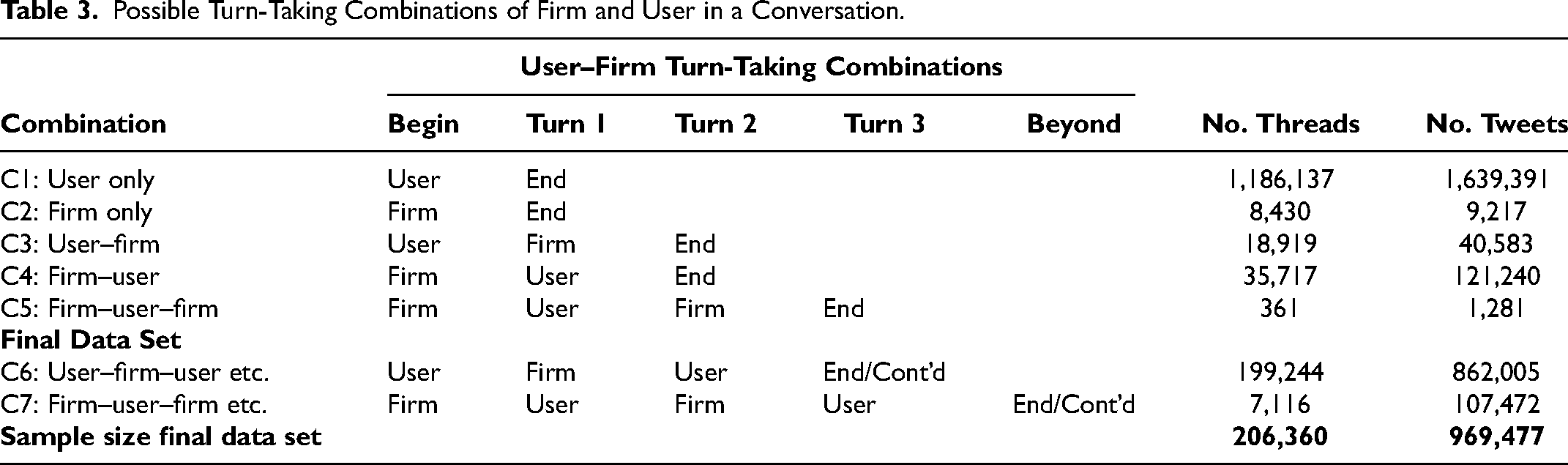
Each analysis stage includes different combinations of observations. For instance, when we model the firm's decision to post or not, we use features of UGC that may result in a firm responding or not. Hence, that stage uses datasets (C1–C7) (except for C2, since C2 contains no user tweets). Our focal model of a conversation (Figure 1) considers the effect of preceding user tweets, firm tweets, and their interaction on user sentiment. Hence, this model only utilizes the “final data set” of observations in C6 and C7, for a total of 206,000 threads and 969,000 tweets. 5
Prior to performing any text analysis, we preprocessed the tweets as follows: (1) We removed anything that was not alphanumeric, punctuation, or emoji, such as links, photos, GIFs, or line breaks; (2) we ran a spell-check to correct typos, and (3) we lemmatized words but did not use their stems, since words with the same stem but are distinct parts of speech can differ in sentiment. Next, we used the following tools and techniques to extract our variables of interest from the processed text. Since the variables could have a wide range but our dependent variable can vary between −1 and 1, we used the natural log + 1 of any variables whose range exceeded 1 in our focal model. We used the variables’ original (nonlog) values as a robustness check. Finally, we group-mean-centered each variable for each firm to remove any firm policy effect.
Measures
Measurement of UGC and FGC sentiment
To measure tweet sentiment, we use the Valence Aware Dictionary and sEntiment Reasoner (VADER), which is explicitly attuned for sentiment analysis in contexts with limited characters, such as Twitter. VADER performs as well as humans at measuring tweet intensity; outperforms them at tweet sentiment classification, such as negative, neutral, or positive (Hutto and Gilbert 2014); and is widely used in marketing (Klostermann et al. 2018). VADER is a rule-based model that combines lexical features with grammatical conventions used by humans to express emotions. It considers the effect of the following on sentiment magnitude: (1) punctuation (e.g., full stop vs. one exclamation mark vs. three), (2) capitalization (e.g., great vs. GREAT), (3) degree modifiers (e.g., good vs. extremely good), (4) contrastive conjunctions such as “but” (e.g., the place is pretty, but the service is bad), (5) negation (e.g., not that great), and (6) emojis (e.g., thank you vs. thank you ♥). After measuring word sentiment, VADER adjusts its intensity, then sums the values and normalizes the sum to obtain a value from −1 (very negative) to 1 (very positive).
We note that only around 30% of the user tweets in our sample are negative (those with sentiment < −.01), 22% are approximately neutral (those with sentiment between −.01 and +.01), and the remaining 48% are positive. Neutral and positive posts reflect topics such as inquiries, reports, and thanks, while negative posts mainly include complaints.
Measurement of empathetic understanding
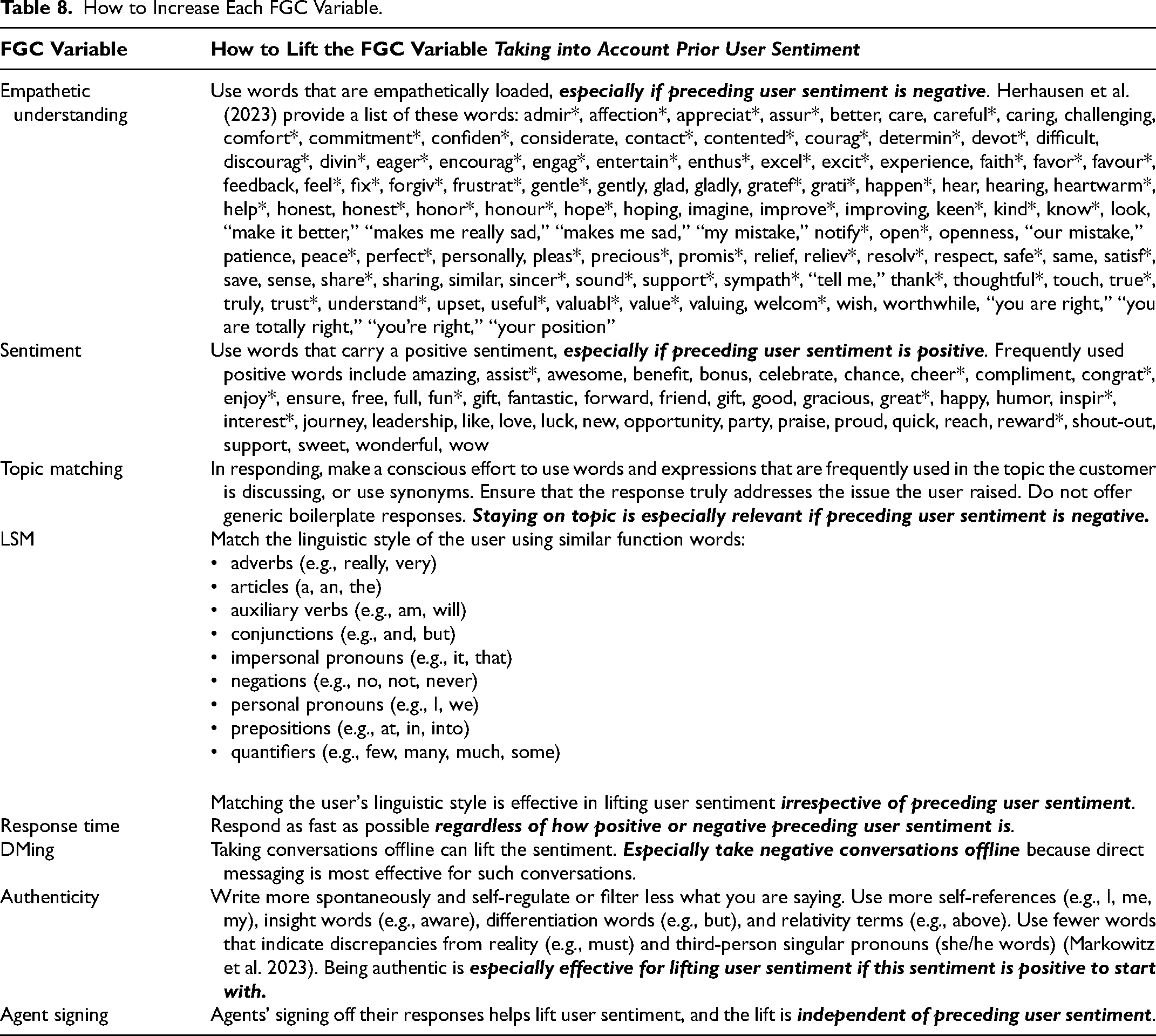
We measure empathetic understanding using Herhausen et al.’s (2023) dictionary of empathetic words, which includes 112 words or stems that suggest an attempt to empathetically engage with another (see Table 8). Herhausen et al. provide an extensive validation of the measure. Since it is a count variable that can exceed 1, we use the log (n + 1) to measure it. Table 4 shows examples of the FGC elements at weak (first quartile), medium (second or third quartiles), and strong (fourth quartile) levels.
Examples of the FGC Elements (Weak, Medium, Strong).
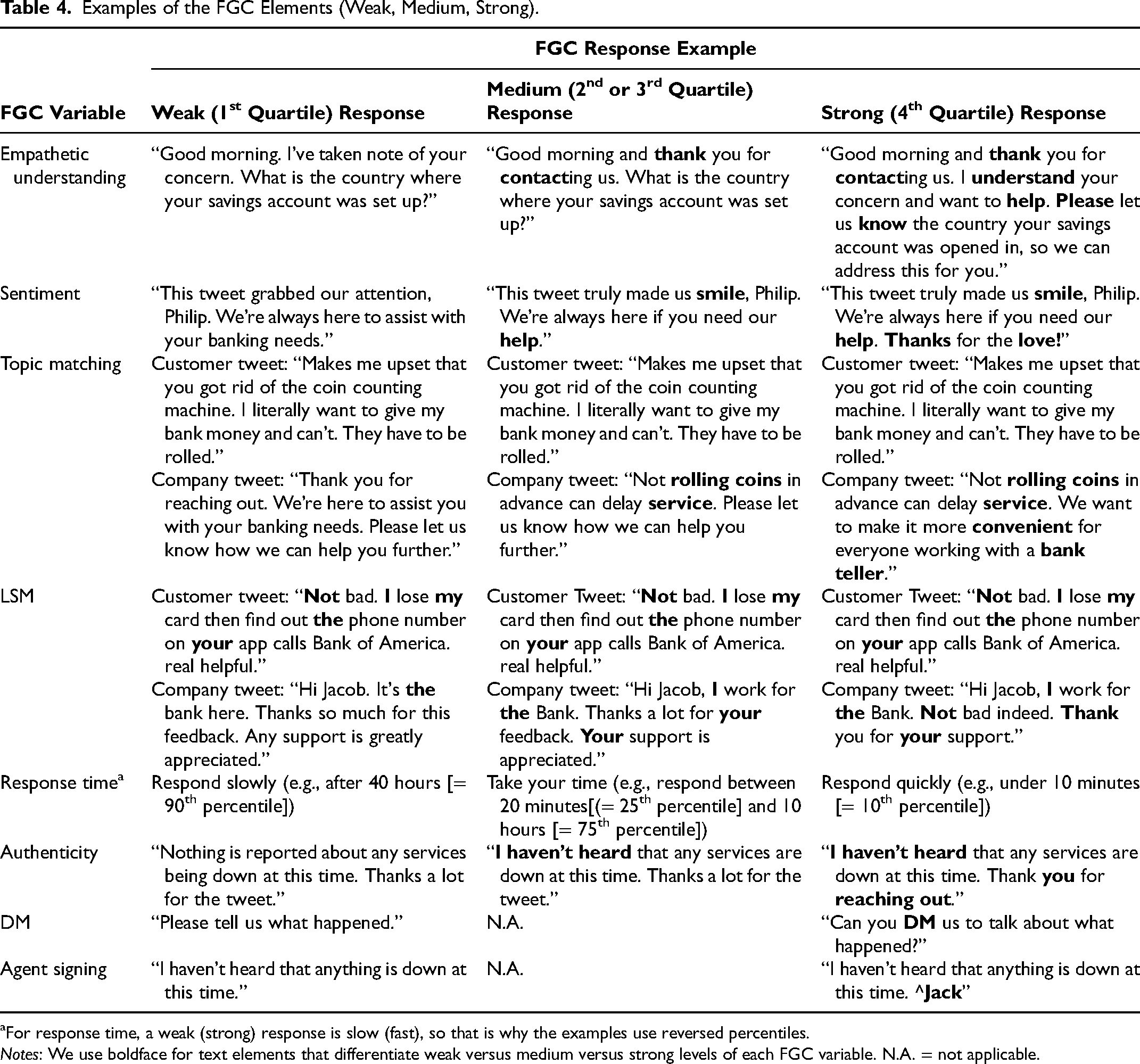
For response time, a weak (strong) response is slow (fast), so that is why the examples use reversed percentiles.
Notes: We use boldface for text elements that differentiate weak versus medium versus strong levels of each FGC variable. N.A. = not applicable.
Measurement of topic and topic matching
Latent Dirichlet allocation (LDA) is widely used in marketing to assign texts to topics (Berger et al. 2020), and results using it have been validated in many domains, including information processing (Hagen 2018) and public policy (Nowlin 2016), among others. Since LDA is unsupervised, the user must determine the number of topics (Blei, Ng, and Jordan 2003). We use coherence value and expert opinion and found that in our data, the optimal number of topics is 11. Web Appendix B shows example tweets for topics and Web Appendix C provides coherence scores for the number of topics varying from 2 to 25.
To measure topic matching, we use cosine similarity between the LDA score of FGC and preceding UGC (Kim et al. 2022; Lahitani, Permanasari, and Setiawan 2016). A value of 1 means FGC and UGC are perfectly aligned on the same topic and 0 indicates no overlap. If there is more than one user tweet before FGC, we calculate cosine similarity for each FGC–UGC pair, then take the average.
Measurement of linguistic style matching (LSM)
We measure LSM as the extent to which the firm's writing style (FGC) corresponds to that of the user (UGC). In line with Boyd et al. (2022), we use nine categories (from Linguistic Inquiry and Word Count [LIWC]) of functional words for firm and users. If a firm uses the same categories (e.g., personal pronouns such as “I” or “we”) as users, their linguistic styles match. This approach to measuring LSM has been validated in marketing (Herhausen et al. 2023) as well as other contexts such as psychology (Ireland and Pennebaker 2010) and psychotherapy (Aafjes-van Doorn, Porcerelli, and Müller-Frommeyer 2020). We calculate LSM between the firm's and the user's tweets in a sequence using the following formula:
Measurement of response time
We observe the response time in seconds between the user's initial tweet and firm's first response. We divide it by 3,600 to convert it to (decimal) hours and take the log + 1 to measure response time, consistent with Herhausen et al. (2023).
Measurement of authenticity
We use the log + 1 of the authenticity measure calculated by LIWC (Boyd et al. 2022) to measure authenticity for FGC. In measuring authenticity, several linguistic cues associated with more honest, personal, and unguarded interactions are considered, including the use of more personal pronouns, positive emotional expressions, and cognitive process words (Newman et al. 2003). This measure has been used by Moon, Kim, and Iacobucci (2021) in marketing and has been extensively validated by Boyd et al. (2022). Evidence of the validity of all LIWC measures, including authenticity, is offered by Schultheiss (2013).
Measurement of direct messaging
We use “direct message” or “dm” as well as their derivations (e.g., capitals, past tense) to measure if those keywords exist in the FGC. A similar approach has been used in marketing (Golmohammadi et al. 2021; Herhausen et al. 2019).
Measurement of FGC agent signing
Customer service agents often end tweets with a carat, followed by either their first name (e.g., ^John) or their initials (e.g., ^JS). Accordingly, we measure agent signing by whether a firm tweet included the customer service agent's first name (= 1) or used only their initials or no name at all (= 0). 6
Validation
While we use well-established measures for our FGC variables (and several are objective, such as agent signing, DMs, and response time), four of our variables are relatively new or can change depending on the study context: empathy, sentiment, topic matching, and authenticity. We use two coders to establish the validity of these measures and report details in Web Appendix D. First, we explained each of the constructs and provided a few examples of low (first quartile), medium (second and third quartiles), and high (fourth quartile) values of each construct. Then, we asked each rater to read and rate 240 tweets (80 from low, 80 from medium, and 80 from high) for each of the four constructs, for a total of 4 × 240 = 960 tweets.
We measured the Pearson correlation between each measure and each rater as well as our measure and the average of the raters. The Pearson correlation between our measures and the two raters’ average is .87 for empathy, .92 for sentiment, .86 for authenticity, and .91 for topic matching. To measure interrater reliability, we used Cohen's weighted kappa (Cohen 1968), a widely used method to assess reliability for nominal and ordinal variables. The results are .70 for empathy, .73 for sentiment, .67 for authenticity, and .69 for topic matching. Kappa values between .61 and .80 suggest “substantial agreement” between raters (Landis and Koch 1977).
Table 5 provides a list of all variables used in our model along with their operationalization. The variables are grouped by their category (e.g., dependent, independent, controls, instrumental variables). Table 6 and Web Appendix F show the descriptive statistics and correlations for the main model variables and control variables, respectively.
Data Sources and Variable Operationalizations.
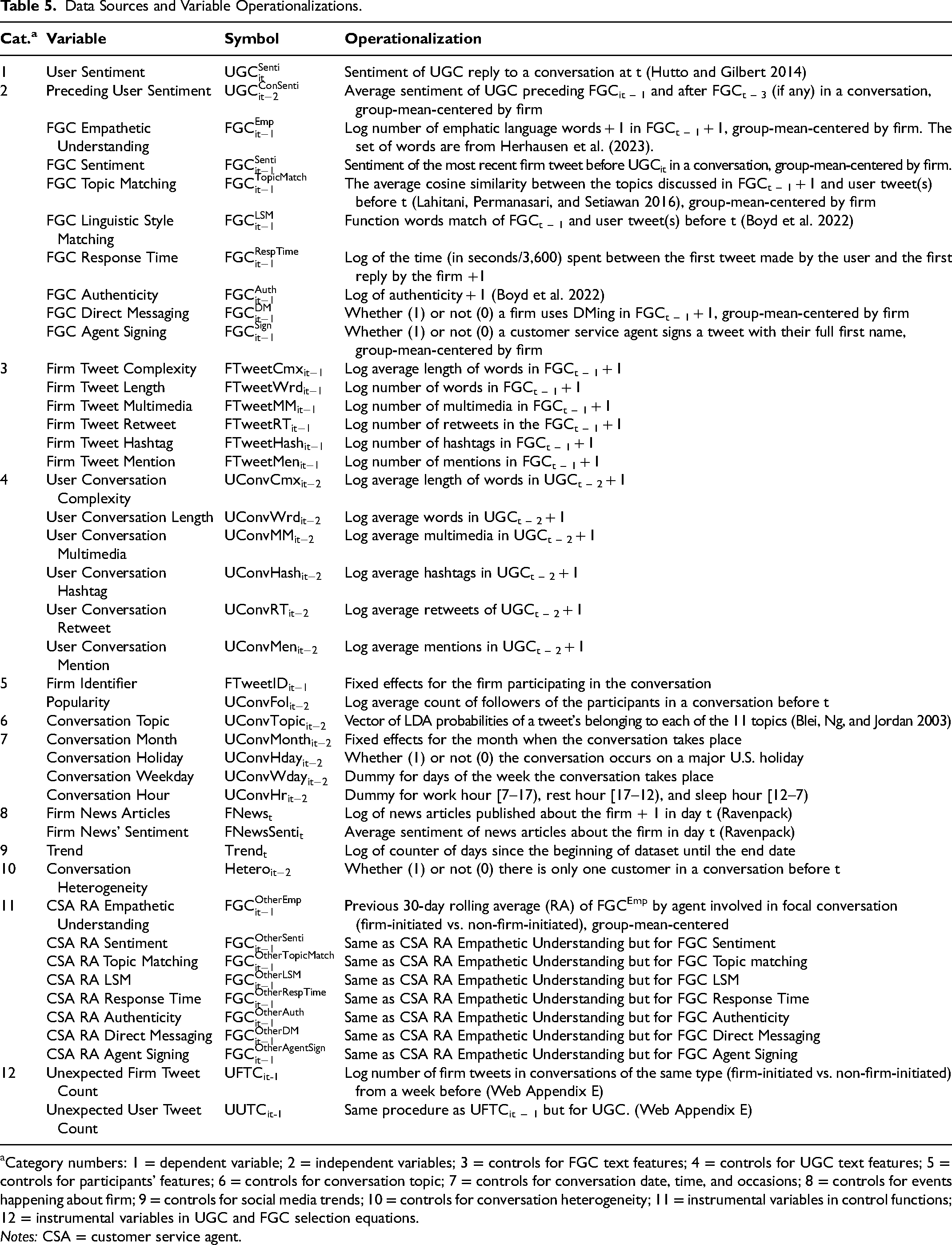
Category numbers: 1 = dependent variable; 2 = independent variables; 3 = controls for FGC text features; 4 = controls for UGC text features; 5 = controls for participants’ features; 6 = controls for conversation topic; 7 = controls for conversation date, time, and occasions; 8 = controls for events happening about firm; 9 = controls for social media trends; 10 = controls for conversation heterogeneity; 11 = instrumental variables in control functions; 12 = instrumental variables in UGC and FGC selection equations.
Notes: CSA = customer service agent.
Descriptive Statistics for Focal Variables.
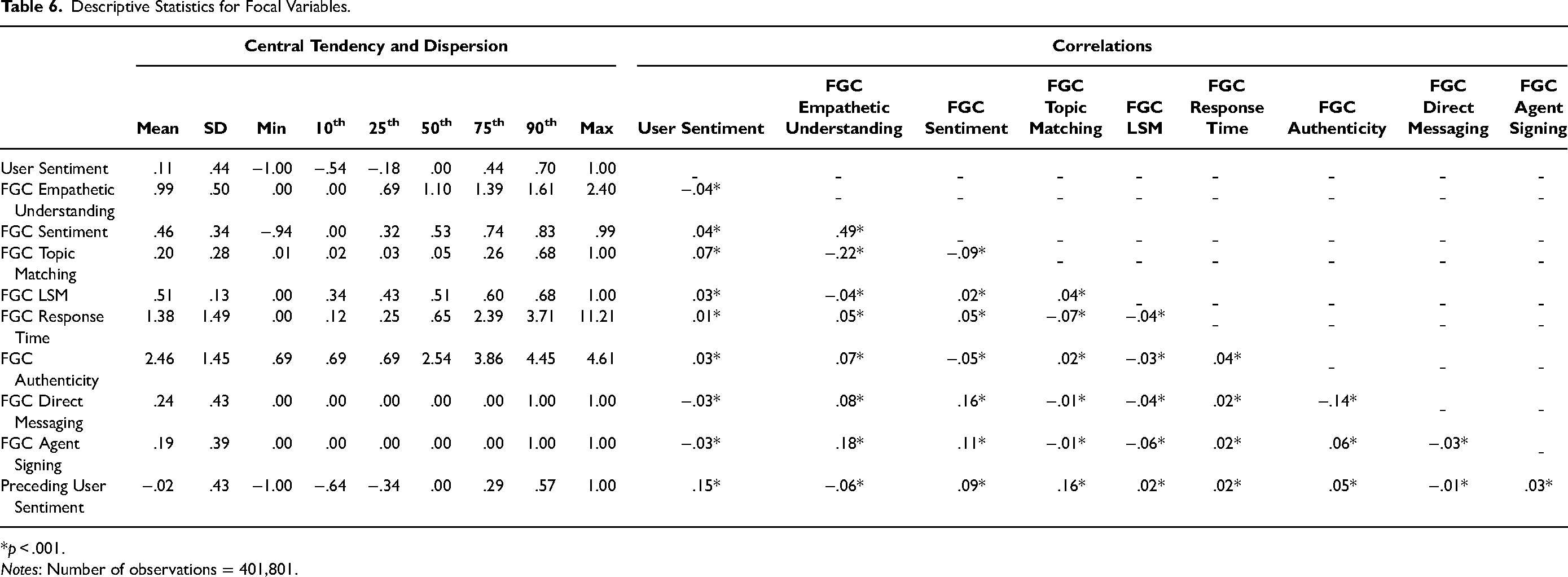
*p < .001.
Notes: Number of observations = 401,801.
Measurement of Control Variables
The control variables include (1) conversation topic (Pauwels, Aksehirli, and Lackman 2016); (2) textual FGC and UGC features such as the text and word length (Valsesia, Proserpio, and Nunes 2020); (3) nontextual features, including numbers of retweets, 7 hashtags, and mentions as well as the use of pictures and videos (Colicev et al. 2018; Valsesia, Proserpio, and Nunes 2020); (4) conversation participant features (their number of followers and number of tweets) (Colicev et al. 2018); (5) conversation time and date (Valsesia, Proserpio, and Nunes 2020); (6) firm-related events reported by traditional media; (7) a trend variable (to capture general tendencies in user sentiment); and (8) whether a conversation is between a firm and one or multiple users.
Econometric Analysis
We use a regression model with user sentiment as the dependent variable. The independent variables are (1) FGC empathetic understanding, FGC sentiment, FGC topic matching, FGC linguistic style matching, FGC response time, FGC DMing, FGC authenticity, and FGC agent signing; (2) preceding user sentiment; (3) control variables (see Table 5); and (4) bank fixed effects. We next elaborate on the identification strategy.
Identification Strategy
We note that because we use bank fixed effects, any systematic time-invariant differences between banks are accounted for. However, two identification challenges could undermine the causal interpretation of the estimates. First, time-varying, firm-specific FGC content could be endogenous, as it could be affected by unobservable factors that also drive user sentiment, creating a potential correlation between the FGC variables and the error term of Equation 1. Second, users and firms are likely to be strategic regarding whether they post the next tweet in the conversation, which means that their reactions are potentially prone to selection issues.
Endogeneity
Since FGC might be affected by unobserved factors driving user sentiment, we use instrumental variables (IVs) in a control function (CF) approach to address endogeneity concerns. The IVs should correlate with FGC but not with the error term of user sentiment. In the spirit of Borjas (1992), we base the IVs for FGC in focal conversation i on day t on FGC produced by the same customer service agent in prior conversations between days t − 30 and t − 1. To be precise, the IV is the 30-day rolling average (across days t − 30 to t − 1) of an individual agent's FGC usage (for all FGC variables) before day t on which the focal conversation happens.
The rationale is that stylistic, connotational, and emotional differences in FGC across customer service agents may be related to that individual's FGC style, which does not change from one conversation to another and hence is predictive for the endogenous FGC variable. That is, suppose an agent tends to exhibit above-average empathy in their FGC in the period t − 30 until t − 1 before focal conversation i on day t. The same agent will likely feature above-average empathy in conversation i (as it is their response style) on day t, leading to instrument relevance. However, an agent's response style in the period before conversation i is unlikely to be correlated to the error term of user sentiment on day t. That is, it is unlikely that prior FGC (e.g., empathy level) on days t − 30 to t − 1 is strategically chosen based on the error term of user sentiment conversation i on day t, because the conversation on day t is yet to happen. Thus, we argue that the IV satisfies the exclusion restriction.
One potential threat to the exclusion restriction is that large shocks such as firm-wide outages may affect the entire customer base over multiple days. In theory, this could lead to a correlation between the IV for FGC and the error term of user sentiment. In practice, we alleviate this threat by controlling for firm-wide news articles and sentiment in our model, which means that such events are no longer part of the error of user sentiment.
The strength of the IVs for the eight FGC variables is confirmed by significant Sanderson–Windmeijer (2016) multivariate F-tests for instrument strength (Web Appendix G). We used a CF as our estimation approach since it yields equivalent results to a two-stage least square model for linear models but also addresses endogenous interaction effects (Papies, Ebbes, and Van Heerde 2017). The eight CF terms in Equation 1 are the residuals of the first-stage regressions of the eight endogenous FGC variables on the exogenous variables and the instrumental variables. We use a bootstrap approach (n = 1,000) to obtain correct standard errors (Karaca-Mandic and Train 2003).
Selection Models
Both firms and users may decide whether to post the next tweet in a conversation. These choices are likely based on both observed and unobserved characteristics of the ongoing conversation, creating the potential for selection bias. For example, a firm may be more likely to respond when a user has many followers (an observable variable included in the model) but also because of something in the user tweet that we do not measure. To correct for this potential selection bias, we use two Heckman sample selection corrections (Heckman 1979): one for the firm and one for the user. For each party, we estimate a probit model:

For identification purposes we use the instrumental variable lagged unexpected user tweet count in Equation 1; see Table 5 and Web Appendix E for details on its calculation. Unexpected tweet count is the difference in the number of user tweets today and the number of user tweets on the same day a week before, and we lag this variable by a week. The idea is that if a week ago there were unexpectedly many user tweets to respond to, the firm may still struggle to keep up, reducing its capacity to respond in the focal conversation, ceteris paribus.
In line with the argument for instrument relevance, we find a negative effect for lagged unexpected user tweet count (see Web Appendix E). As for the exclusion restriction, focal conversation i participants are unlikely to notice carryover pressures on a firm's social media agents due to other conversations that took place a week ago, apart from a lower likelihood that the firm responds (captured by the IMR term). Analogously in Equation 2 we use the instrumental variable lagged unexpected firm tweet count for identification purposes (details in Table 5 and Web Appendix E). An unexpectedly high tweet volume (high levels of unexpected firm tweet count) a week ago may affect whether a user responds in the focal conversation. Still, unlike the limited number of firm agents, the number of Twitter users who can respond is virtually infinite. Indeed, an unexpected tweet volume a week ago may still energize users to respond today. In line with this idea, we find a positive effect for unexpected firm tweet count in Equation 3 (see Web Appendix E). For the exclusion restriction, user sentiment in conversation i is unlikely to be directly affected by the firm's unexpected tweet volume in other conversations from a week ago.
Since Model 1 (firm selection) only requires threads with at least one user tweet (UGC), we estimate it using the observations in C1, C3, C4, C5, C6, and C7 (Table 3). Also, since Equation 2 user selection needs at least one UGC and FGC, we use the observations in C3, C4, C5, C6, and C7 (Table 3) to estimate it. To account for the decision by both firm and users to not post after the last observed tweet, which leads to zeros in the selection equations, we explicitly include these zeros in the data used for model estimation. We use bootstrapping (1,000 replications) when including IMRs in our main Model 1 to obtain correct standard errors.
Model Specification
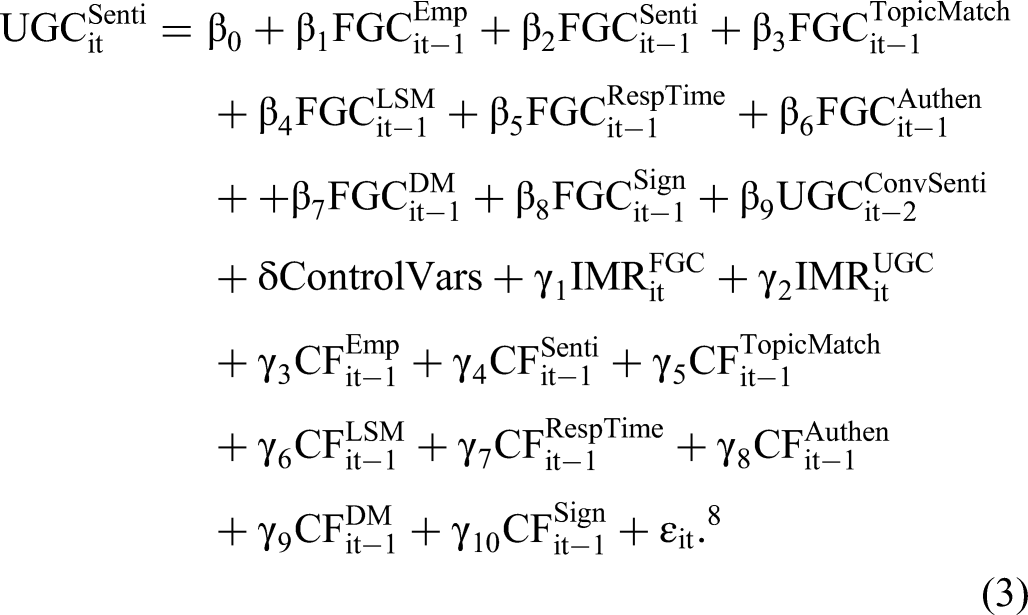
Equation 3 shows the user sentiment model (see Web Appendix H for the full model):
Results
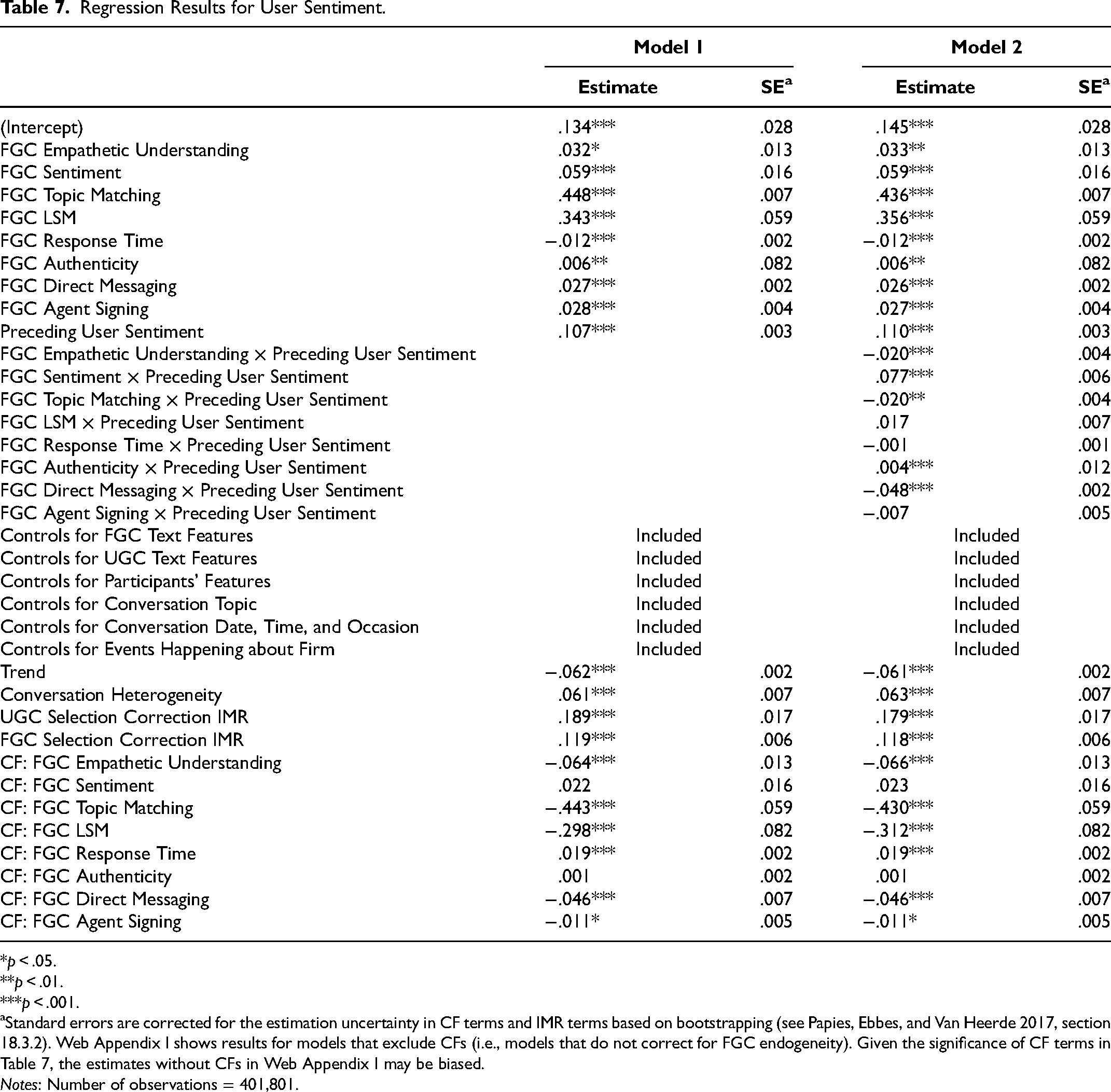
Table 7 reports the results. Model 1 has main effects only while Model 2 adds interaction effects between the FGC variables and preceding user sentiment. All main effects of the eight FGC variables on user sentiment are significant in Model 1 and they are consistent in sign, significance, and magnitude of the direct effects in Model 2. We focus on Model 1 as our main model next but discuss the interactions in Model 2 subsequently.
Regression Results for User Sentiment.
*p < .05.
**p < .01.
***p < .001.
Standard errors are corrected for the estimation uncertainty in CF terms and IMR terms based on bootstrapping (see Papies, Ebbes, and Van Heerde 2017, section 18.3.2). Web Appendix I shows results for models that exclude CFs (i.e., models that do not correct for FGC endogeneity). Given the significance of CF terms in Table 7, the estimates without CFs in Web Appendix I may be biased.
Notes: Number of observations = 401,801.
In Model 1, FGC empathetic understanding (i.e., a firm using empathetic words) has a significant positive effect on user sentiment (β = .032, p < .05). FGC sentiment also positively affects user sentiment (β = .059, p < .001), in line with our expectation unconditional positive regard of one party can improve the other party's attitude. In line with the notion of creating a conversation environment based on an equal footing and mirroring, both topic matching (β = .448, p < .001) and LSM (β = .343, p < .001) enhance user sentiment. A longer response time negatively affects user sentiment (β = −.012, p < .001), in line with the notion that presentness (in the form of a quick response) is valued by users and enhances sentiment.
Being genuine also pays dividends, as authenticity has a positive impact on user sentiment (β = .006, p < .01). DMing lifts user sentiment (β = .027, p < .001), in line with the notion that taking conversations private can remove friction by letting users fully describe their issue and allows for more complete firm responses. Likewise, showing oneself through agent signing (β = .028, p < .001) positively impacts customer sentiment.
Interaction Effects (Model 2)
While dialogic listening is a general theory on how responses steer conversations, we have argued that its dimensions will play different roles depending on user sentiment in the ongoing conversation and report the interaction results in Table 7 (Model 2).
FGC elements that become more effective for negative preceding user sentiment
While we argued that six of the FGC elements would help improve negative sentiment, we find that empathy, topic matching, and DMing are especially effective. Consistent with our expectations, the significant negative interaction between FGC empathetic understanding and preceding user sentiment (β = −.020, p < .001) suggests that using empathetic words lifts user sentiment more when the preceding user sentiment is more negative. Likewise, when users show negative sentiment (e.g., they are upset) it is especially important to stay on topic (β = −.020, p < .01). This finding suggests that staying on topic shows that the firm takes the cause of their negative sentiment seriously. This is also true for FGC DMing, as it interacts negatively with preceding user sentiment (β = −.048, p < .001). That is, especially when ongoing sentiment is negative, it pays to move conversations offline, consistent with findings in studies on complaints (Argyris et al. 2021; Golmohammadi et al. 2021). Contrary to our expectations, we find no significant interactions with prior user sentiment for LSM, response speed, or agent signing.
FGC elements that become more effective for positive preceding user sentiment
We also expected that FGC exhibiting unconditional positive regard (sentiment) and genuineness (authenticity) would be especially valuable with positive prior UGC sentiment. In support of these expectations, we find positive interactions between preceding user sentiment and both FGC sentiment (β = .077, p < .001) and FGC authenticity (β = .006, p < .01). These findings suggest that when preceding user sentiment is positive, being positive and authentic as a firm is relatively effective. These findings are in line with the notion that it is easier to lift sentiment when it is already positive (Teeny et al. 2021). It also confirms our expectations that positive FGC that aligns with consumers’ positive emotions can reinforce their positive experience, and that authentic FGC can show sincere interest in communication (Yang, Kang, and Cha 2015) and amplify the ongoing positive sentiment in conversations (Lee 2020).
Comparing the Measured Impact of FGC on User Sentiment
Direct effects
The coefficients discussed so far are not directly comparable because some of the FGC variables are continuous and some discrete, and their distributions differ. To compare apples with apples, we change the value for one FGC variable at a time from a low (10th percentile of its distribution) to a high (90th percentile) value while keeping other FGC variables at their means. This approach creates a level playing field between the continuous FGC variables (empathetic understanding, sentiment, topic matching, LSM, authenticity, and response time) that are lifted by a continuous amount and the dummy FGC variables (DMing and agent signing) that both vary from 0 to 1 as these correspond to their 10th and 90th percentiles. We multiply the change in each FGC variable (going from low to high) by their regression coefficient to assess its effect on user sentiment and report the findings in Figure 2.
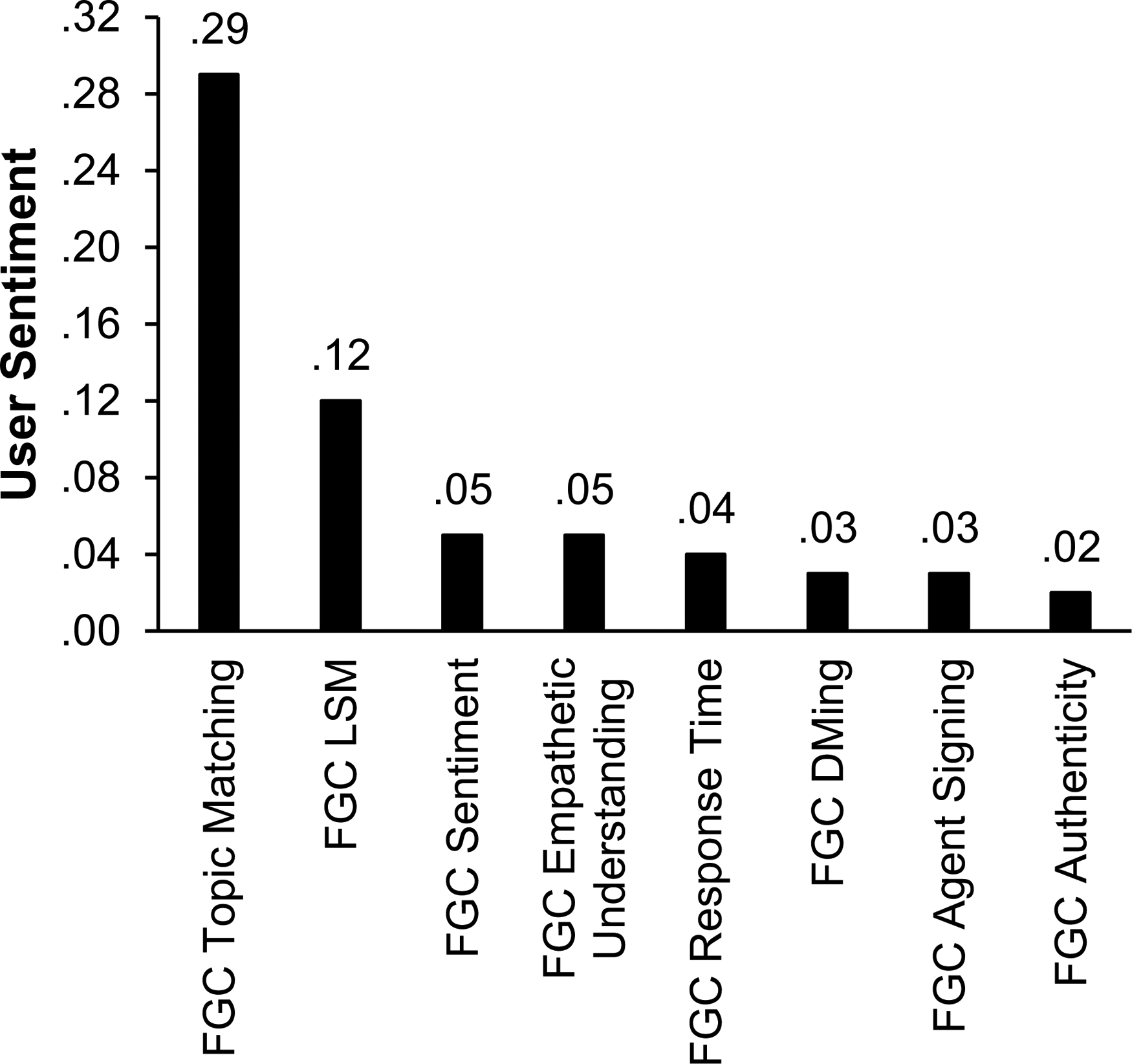
Effect of the FGC Variables on User Sentiment.
A few takeaways emerge. One is that staying on topic is the single most effective FGC element, given that the impact of lifting topic matching from low to high on user sentiment (.29) is by far the strongest of the FGC variables. The second-most effective strategy (at .12) is LSM, which belongs to the same dimension (spirit of mutual understanding) of dialogic listening.
The next-strongest pair of variables are FGC sentiment and FGC empathetic understanding, both lifting UGC sentiment by .05 when they go from low to high. The least effective FGC variables, in terms of lifting UGC sentiment, are response time (.04), agent signing and DMing (both at .03), and FGC authenticity (.02).
The findings in Figure 2 hold for exactly neutral preceding user sentiment (=.00). If we define approximately neutral conversations as those for which sentiment is between −.01 and .01, Figure 2 shows that correct use of each FGC element that we consider can turn neutral user sentiment into positive sentiment, since the minimum effect on sentiment is +.02 in all cases.
Interaction effects
To understand the magnitude of the significant interaction effects between FGC and preceding user sentiment (see Table 7), we start with a scenario where preceding user sentiment is exactly neutral (i.e., .00). Next, Figure 3 shows how the FGC effect on subsequent user sentiment changes when preceding user sentiment is low (10th percentile) versus high (90th percentile). For each FGC variable, Figure 3 uses different scales to make it easier to see how the effect differs across different levels of preceding user sentiment.
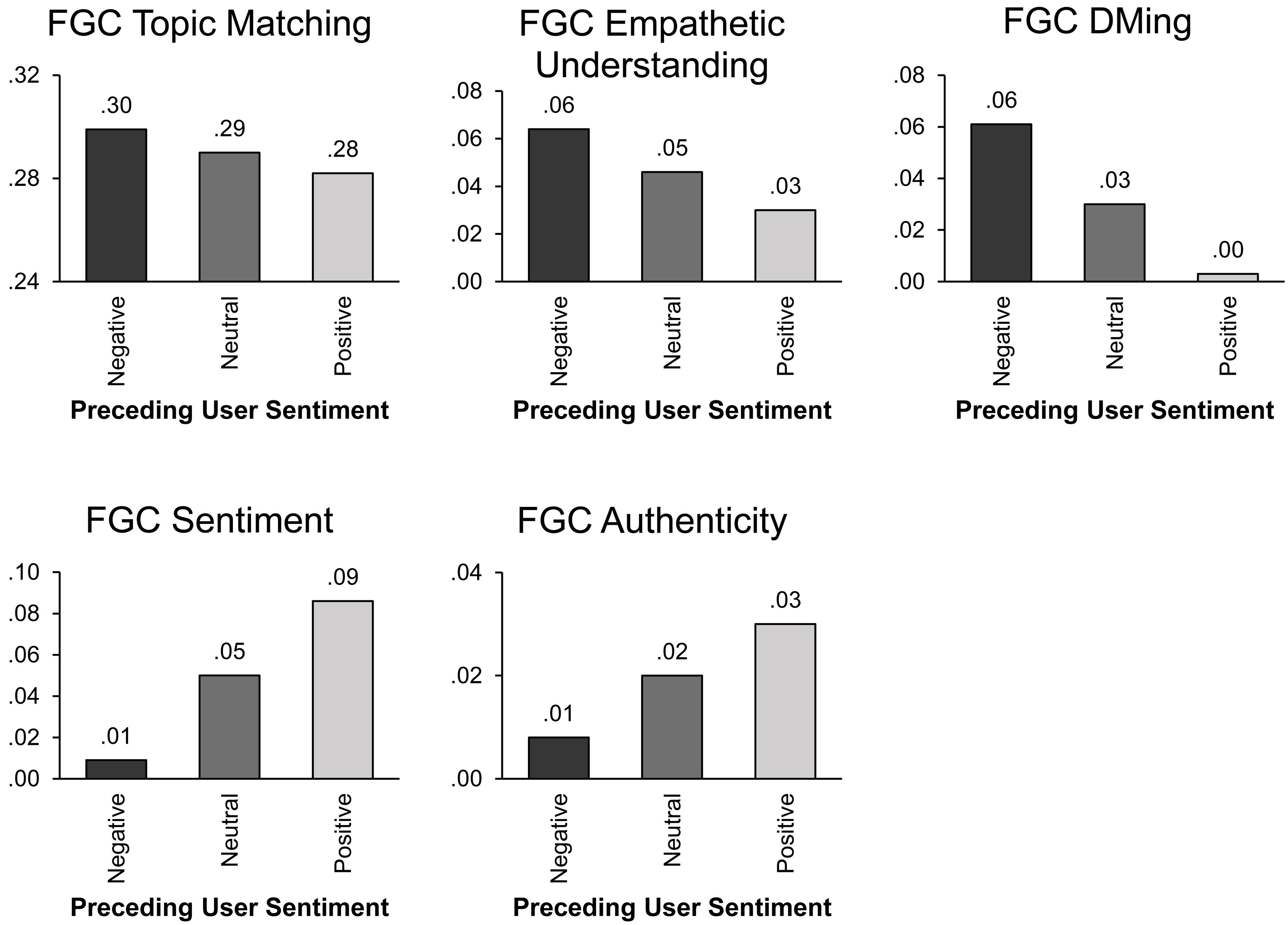
Effect of FGC Variables on User Sentiment for Different Levels of Preceding User Sentiment.
For topic matching, there are small differences in its effectiveness across these levels (yet the interaction is significant; see Table 7). Especially when preceding user sentiment is negative, FGC should remain on topic, but it is also highly effective when preceding user sentiment is neutral or positive. With negative preceding user sentiment, empathetic understanding and DMing are at their most effective levels. In that case, both empathetic understanding and DMing can lift user sentiment by .06. This is much stronger than an uplift of .03 (through empathetic understanding) and .00 (for DMing) when preceding user sentiment is positive. Thus, showing empathy and using DMing are especially effective when user sentiment is negative to start with.
For FGC sentiment and authenticity, Figure 3 shows a strong uplift in effectiveness when preceding user sentiment is positive, showing that especially when preceding UGC is upbeat, a firm can further lift the spirit by being positive (+.09) and authentic (+.03). Conversely, when preceding user sentiment is low, FGC is less effective in lifting user sentiment by being positive (+.01) or authentic (+.01). This may be because sad or angry users see a positive response as tone deaf and inconsiderate of their emotions, and an authentic response (especially if unguarded and truthful) may be seen as too blunt with negative preceding user sentiment. This result may also reflect authenticity's bolstering effect on users’ baseline affective reactions to positive FGC.
Robustness Checks
We ran several alternative model specifications as robustness checks. First, to investigate potential multicollinearity concerns, we estimate a series of increasingly complete models, where we added the focal FGC variables one by one. The results (for models with and without interactions) show that all variables have the same sign and significance and similar magnitude for all direct effects and interactions, suggesting the model is robust (see Web Appendix J).
Moreover, while we use logs for variables that assume values above 1, we also estimated versions with (1) no control variables, (2) no focal variables, and (3) neither focal nor control variables logged. For each of these three variations, we estimate models with and without interaction effects. Across the 3 × 2 = 6 combinations, the findings are robust in terms of signs, magnitude, and significance of direct effects compared with the focal model. Furthermore, not only do all interactions in all alternative models show the same sign as the focal model, but also in several cases some insignificant interactions in the focal model become significant (Web Appendix K).
Discussion
Theoretical Implications
Conversation-level view of firm–customer interactions
While customers increasingly engage in social media conversations with firms, prior research has had little to offer regarding how to steer these conversations. This gap has led to many calls by academics and practitioners to study social media conversations by focusing on their components and interactions (e.g., Abney et al. 2017). Extending research on FGC's impact on UGC and guided by the notion of dialogic listening augmented with an empirics-first approach (Golder et al. 2023), we examine conversations as opposed to discrete words or posts and study the effects of the FGC variables empathy, sentiment, topic matching and LSM, response time, authenticity, DMing, and agent signing on user sentiment.
Not only are some of these elements new to the marketing literature on social media (topic matching and authenticity), the comprehensiveness of the FGC elements we examine allows us to assess whether they all play a role in shaping user sentiment when controlling for the other elements (they do) and their relative strengths. Our results suggest that the components of dialogic listening may not be equal in terms of their ability to lift user sentiment. For example, we find that staying on topic is the most effective strategy to lift user sentiment. Thus, whereas research dialogic listening theory does not propose a hierarchy of roles of the dialogic listening components, our findings suggest that there may be an inherent hierarchy. The most powerful FGC elements (topic matching and LSM) stem from the same dialogic listening component: a spirit of mutual understanding. The next most powerful forms are conveying positive sentiment (reflecting unconditional positive regard) and empathy (reflecting empathetic understanding). We also offer implications for the theory of dialogic listening in an environment that increasingly involves interactions in social media, by taking new elements, such as DMing (which enables longer forms of messaging) and signing (sharing personal information), into consideration.
Interaction with preceding user sentiment
Our study is the first to investigate how FGC's effect on user sentiment depends on preceding user sentiment, which may help explain why prior research sometimes finds conflicting effects of FGC on UGC. For instance, whereas Homburg, Ehm, and Artz (2015) find that FGC volume reduces UGC sentiment, Dhaoui and Webster (2021) find that the volume and format of FGC (videos and photos) improves UGC sentiment. These previous studies overlooked the nature of the preceding conversation.
Our study overcomes this limitation by regarding discrete posts as part of a conversation. By studying conversations of any type (not just complaints), we assess how FGC's impact on UGC sentiment depends on how positive or negative UGC is up to that point. Given our finding that FGC's effect on user sentiment depends on preceding user sentiment, we cannot assume that insights based on negative conversations are the same as those for more neutral or positive ones. That is, the FGC variables work differently for negative and positive user sentiment, as evinced by significant interactions between FGC and preceding user sentiment. Thus, our study uncovers preceding user sentiment as a key boundary condition for FGC's effect on user sentiment.
Managerial Implications
Our findings offer important implications for social media managers as each FGC variable has significant and sizable effects on user sentiment as shown in Figures 2 and 3. To explain how to adjust FGC to steer social media conversations, Table 8 and the following subsections give concrete advice for each variable. Web Appendix D gives FGC examples that are high, medium, and low on empathetic understanding, sentiment, topic matching, and authenticity.
How to Increase Each FGC Variable.
Mirror the user
Users contact firms on social media for many reasons, such as to offer advice, complain, vent frustration, or give compliments. Our results show that mirroring the user by staying on topic and matching their linguistic style can most effectively improve user sentiment. Staying on topic is especially effective with negative preceding user sentiment.
Stay positive
Using unconditional positive regard (positive sentiment) will signal that the firm accepts the user as a person of “unquestioned worth” regardless of their behaviors or their expressed ideas. It also conveys a sense of closeness between conversation partners and compassion toward another and can be associated with caring. One caveat is that when preceding user sentiment is negative, FGC that is unconditionally positive can come across as tone deaf, leading to very little lift in subsequent user sentiment. In contrast, when user sentiment is positive to start with, positive FGC leads to an additional boost in user sentiment.
Show empathy
Users post about firms on social media for a reason. Understanding why a user is posting requires a firm agent to take the user's perspective. We show that by using empathetic understanding, FGC can lift user sentiment, and even more so when preceding user sentiment is negative. Obviously, just using empathetic words is not enough, as the core issue the user faces requires addressing as well, but it provides assurance that the firm is listening to the user.
Be present
Being quick to respond to social media posts signals involvement and presentness. An hour is an eternity on social media, and users expect firms to respond swiftly. Response speed is required independent of preceding user sentiment.
Be genuine
Genuine FGC is typified by authenticity and by the firm agent revealing something truthful and personal to users. We find that FGC content that uses authentic words lifts user sentiment, especially when prior user sentiment is positive, suggesting that in such cases users are more open to interacting with firms and respond more positively to genuine FGC. However, authenticity is less effective when preceding user sentiment is negative. We posit that the unfiltered, personal nature of authentic responses may not come across well if a user is upset.
Take conversations private
Our results shows that DMing can lift user sentiment, especially when it is already negative. Firms’ use of DMing is subject to time constraints (e.g., agents need to understand a customer's case details) which restrict agents’ ability to address other social media conversations. Taking many conversations private also conflicts with the notion of social media as a public communication channel. Thus, we suggest firms should use DMing strategically, offering it especially when the preceding user sentiment is negative.
Don’t be anonymous
We also show that user sentiment is lifted when agents sign posts with their name (e.g., “Kate”) rather than their initials (e.g., “^KS” for Kate Smith) or do not sign them. A straightforward recommendation is to use first names in FGC on social media unless there are privacy concerns about a particular agent. We observe (across each firm) considerable heterogeneity in our sample, with ∼20% of the posts signed by first names, ∼75% by initials, and ∼5% with no signoff. Our suggestion is to create standards for the way posts are signed, and if possible, this should be done by using the agent's first names rather than initials.
Don’t ignore neutral or positive user sentiment
Firms may naturally be more focused on quelling negative user sentiment on social media, but our findings show there is significant scope to steer neutral sentiment into positive territory and to further propel already positive sentiment. As neutral and positive user messages represent 70% of all social media posts in our data, there is a tremendous opportunity to create or strengthen positive public user sentiment through FGC.
Generalizability
This article uses a dialogic listening lens to study social media conversations based on ten years of close to a million firm and user social media posts in the banking industry. These data give our study a solid empirical base, and using data from one industry eliminates confounding effects from industry-specific factors, thereby improving internal validity (Eilert et al. 2017).
However, our focus on large banks raises the question as to whether our results generalize to smaller firms or across industries. For example, interactions involving products as opposed to services may reveal different patterns. Moreover, business-to-business contexts may utilize social media differently (Swani, Brown, and Milne 2014). Still, in our arguments for the influence of the six dialogic listening components and other FGC elements we examine, we built on theoretical and empirical evidence across a wide range of domains, including marketing, sales, psychology, psychotherapy and psychiatric nursing, and communications. As such, in general, we expect an engagement partner that follows a strategy of dialogic listening to be more likely to lift the sentiment of another party than when these elements are not used.
Limitations and Further Research
While this study offers novel insights on FGC's effect on UGC at the tweet level within a conversation, it also faces limitations. Users have different motives and perspectives when they talk to/about a firm, and these factors may influence the course of a conversation (Hu et al. 2019), which future research can address. Thus, we hope this article will stimulate follow-up research on how firms can better interact with their customers on social media.
One implication of our findings is that the components of dialogic listening could inform other marketing communications, such as personal selling. For example, social cognition theory proposes that trade-offs between salesperson competence, reflected in resolving behaviors, and warmth, reflected in relating and emoting behaviors, are inherent in customers’ perceptions of salespeople (Singh et al. 2018). Singh et al. (2018) conceptualize relating behaviors as being displayed by empathy and verbal cues of agreeableness, consistent with the empathetic understanding and unconditional positive regard components of dialogic listening. Future research should study the applicability of the components of dialogic listening and other FGC elements examined here to sales interactions, another form of dialogue between firm agents and customers.
Supplemental Material
sj-pdf-1-mrj-10.1177_00222437251329816 - Supplemental material for How Firms Can Steer Social Media Conversations
Supplemental material, sj-pdf-1-mrj-10.1177_00222437251329816 for How Firms Can Steer Social Media Conversations by Mohammad “Mike” Saljoughian, Kelly Hewett, Harald J. van Heerde and William Rand in Journal of Marketing Research
Footnotes
Acknowledgments
The authors wish to thank Dr. Matthijs Meire for his review and suggestions. They also thank the audience of the Theory and Practice in Marketing (TPM) Conference for their helpful comments.
Coeditor
Kapil Rajendra Kumar Tuli
Associate Editor
P.K. Kannan
Declaration of Conflicting Interests
The author(s) declared no potential conflicts of interest with respect to the research, authorship, and/or publication of this article.
Funding
The author(s) received no financial support for the research, authorship, and/or publication of this article.

Notes
References
Supplementary Material
Please find the following supplemental material available below.
For Open Access articles published under a Creative Commons License, all supplemental material carries the same license as the article it is associated with.
For non-Open Access articles published, all supplemental material carries a non-exclusive license, and permission requests for re-use of supplemental material or any part of supplemental material shall be sent directly to the copyright owner as specified in the copyright notice associated with the article.
