




Abstract
Prior research on the use of scent in advertising has shown that scent can enhance the memorability of and engagement with an ad. However, can scenting an ad also change the way consumers perceive and react to the advertised product? This research provides new insights for this question and demonstrates an additional facet of scent: its ability to physically represent the essence of a target product and thus induce a sense of proximity. Through six studies, the authors show that scented ads enhance consumers’ sense of proximity of the advertised product and consequently increase product appeal. In line with the proposed visceral nature of the effect, this effect holds even for unpleasant scents but is contingent on the scent’s ability to represent the advertised product. The effect is weakened when the product is physically close. The findings of this research have implications for when and why firms should use scented ads.
The use of ambient scents is on the rise, and companies such as Singapore Airlines, British Airways, Victoria’s Secret, Sheraton, and Verizon have significantly invested in signature scents (Biswas and Szocs 2019; Gershman 2015; Klara 2012). Olfactory cues are also increasingly finding their way into advertising (Kelly 2012). In fact, olfactory advertising is considered an important advertising trend (Hemsley 2016), and scents are used to advertise a growing range of products (Hemsley 2016; Kelly 2012). Yet the literature still holds no clear answer as to whether and how the use of scent in print ads might influence the appeal of the advertised product.
Existing evidence suggests that scents can enhance the memorability of and engagement with an advertisement (Lwin, Morrin, and Krishna 2010; Morrin and Ratneshwar 2003). However, memorability and engagement need not always be positively valenced and can also emerge when consumers intensely dislike an ad or an advertised product. Evidence on whether the presence of scents enhances the appeal of the advertised product has been mixed and mostly circumstantial. For example, Bosmans (2006) finds that a scented environment increases the appeal of a beverage brand promoted with a print ad. Similarly, Krishna, Morrin, and Sayin (2014) find that advertisements that stimulate olfactory imagery or are cookie-scented increase the desire for the advertised cookies. In contrast, Ellen and Bone (1998) report no increase in product appeal when participants received scratch-and-sniff ads for a holiday. Deeper theoretical insights are needed that explain when and why scented ads influence how consumers perceive and judge a product.
In this research, we propose that olfactory cues on a print advertisement can enhance the sense of proximity of the advertised product. Drawing on prior work on sensory distance (Elder et al. 2017; Hall 1966; Rodaway 1994; Skurnik and George 1967) and magical contagion (Argo, Dahl, and Morales 2008; Nemeroff and Rozin 1994), we propose that this happens because scents represent the very essence of their source (Meir 2005) and thus instill an enhanced sense of visceral proximity of this source. Because a target tends to become more appealing when it is physically close (Newcomb 1956; Shin et al. 2019; Vohs and Heatherton 2000), we further posit and show that scenting an ad improves consumers’ reactions to the advertised product through its enhanced sense of proximity.
Given that the proposed effect emerges due to a scent’s ability to viscerally represent the advertised product, we also suggest and find that the effect emerges only when the product is expected to have a scent and if the scent on the ad is congruent with the expected scent of the promoted product. In addition, the effect of a scented ad on sense of proximity is weakened when the advertised product is physically present. Beyond these boundary conditions, the effect is robust regardless of centrality of scent to the product, scent pleasantness, or scent information salience.
Contributing further to our conceptual understanding, we differentiate the proposed mechanism from other known effects of scent, such as scent’s ability to stimulate product imagery (Lwin, Morrin, and Krishna 2010); cognitive engagement (Mitchell, Kahn, and Knasko 1995; Morrin and Ratneshwar 2003); affective reactions (Bosmans 2006); and, potentially, construal level (Amit, Algom, and Trope 2009; Trope and Liberman 2010). The ability of a scented ad to enhance a sense of proximity emerges as a consistent predictor of product appeal above and beyond existing accounts. Finally, we explore whether scent-enhanced proximity increases product appeal because it instills psychological ownership of the product.
Together, these insights contribute to the burgeoning theorizing on the multifaceted nature and effects of olfaction. That is, these insights highlight the importance of scent’s unique ability to physically convey part of the essence of things and to bring them perceptually closer. Apart from adding to literature streams on sensory marketing and proximal experiences, these insights help answer the managerially relevant question of whether and when to invest in scented advertising.
Conceptual Framework
Olfaction and Sensory Distance
Different senses are inherently associated with different distances. This is due to how the different sensory stimuli are processed and the various degrees of distance needed for a sensory stimulus to be sensed (Elder et al. 2017; Hall 1966; Rodaway 1994; Skurnik and George 1967). Visual and auditory cues come in the form of light and sound waves, respectively (Köster 2002; Rodaway 1994). Light waves are electromagnetic waves. They can travel large distances even in a vacuum. Sound waves are mechanical waves that can also travel large distances, but only through a medium (e.g., air, water; NASA 2010). Therefore, both visual and auditory cues of a target can be obtained from a distance (Hall 1966; Rodaway 1994). In contrast, gustatory and tactile cues are embedded in the physical properties of the target. Taste involves contact with gustatory molecules, and touch involves physical interaction with surface properties. Taste and touch can thus only be experienced through direct physical contact with a target (Chandrashekar et al. 2006; Lederman and Klatzky 1987) and their experience signals the ultimate proximity of a target (Hall 1966; Rodaway 1994).
Olfaction is situated in between these more distant and more proximate sensory modalities (Skurnik and George 1967), even when people imagine sensory experiences (Elder et al. 2017). The olfactory system is a chemo-sensory system and, similar to gustatory cues, olfactory cues have a molecular composition that stems from its emitter (Krieger and Breer 1999). Odor is thus an embedded part of the target from where it emits. Unlike gustatory molecules, olfactory molecules are able to separate from their emitter (Dyson 1938), but they quickly dissipate below the detection threshold with increasing distance (Hall 1966). Thus, even though scents naturally occur close to their emitter, smelling does not require direct physical contact with a target.
Scent as a Proximity Cue
Research suggests that scents do in fact act as a powerful proximity cue. One of olfaction’s most important roles is its approach or avoidance function (Yeshurun and Sobel 2010), a function that mainly matters when people are in relative proximity to a target (Balcetis and Dunning 2009). This function is at least partially innate (Steiner 1979). The sense of smell, and its function in the approximation of distance, is developed even in newborns (Eliot 1999). When a newborn seeks his mother or her lactating breast, olfactory cues serve as a primary distance indicator and are used for navigation (Varendi, Porter, and Winberg 1996; Winberg and Porter 1998). Pieces of clothing containing the mother’s smell serve as pacifying tools because they are capable of bringing her, and the sense of security she stands for, closer (Sullivan and Toubas 1998). Similarly, toddlers sniff at special objects such as blankets or toys to compensate for the absence of things they long for (e.g., their home) when, for example, staying at a daycare facility (Schaal 1988). As a result, washing toddlers’ special possessions, and thus removing their scent, can provoke anxiety (Eliot 1999). Adults also sniff their partner’s unwashed clothes to simulate the visceral presence of the absent partner (McBurney, Shoup, and Streeter 2006; Shoup, Streeter, and McBurney 2008). Drawing on the molecular composition of personal belongings, the biotech company Kalain recently even introduced the custom-made fragrances “Temporary Absence” and “Definite Absence,” which are supposed to help bring us closer to those dear to us (Kalain 2019).
Because olfactory cues stem from the target that emits them (Dyson 1938; Köster 2002), they serve as the authentic representation of an object (Khan et al. 2007; Köster 2002). Even in religion, scents are often highlighted as capturing the emitting object’s “innerness” or “essence” (Meir 2005). The power of scent to viscerally represent an object, in its absence, is also supported by research on magical contagion (Argo, Dahl, and Morales 2006, 2008; Nemeroff and Rozin 1994). This stream of research suggests that the residuals or parts of a target, including its scent (e.g., a flower’s scent or a person’s sweat), can represent its essence and, thus, the target as a whole (Nemeroff and Rozin 2000).
Scents’ unique capability for representing the essence of their emitter and the notion that scent is associated with moderate levels of proximity suggest that scents can instill a visceral sense of proximity of the source object, even if the source object itself is physically absent. Translating this to an advertising context, we predict that the presence of olfactory product cues in an ad will increase the sense of product proximity. Figure 1 illustrates the overall conceptual framework.

Conceptual model.
Moderating Effects of Scent Expectations: Product Category and Scent Congruence
Consumer judgments about a target object are often based on information about the “parts” of the object. The ability of the “part” to represent the “whole” hinges on perceivers’ ability to intuitively attribute these parts to the whole (Nemeroff and Rozin 2000). If this connection is absent, the “part” cannot credibly represent the “whole.” For example, the physical essence of a person can be represented through residue left on a product only when one believes that an interaction between the person and the product has occurred (Argo, Dahl, and Morales 2008). In the context of the current research, we expect that intuitive beliefs about a promoted product emitting a scent determine whether scented ads induce a sense of proximity. This implies boundary conditions for our hypothesized effect.
One boundary condition is the type of product. Specifically, products differ in whether their composition incorporates scents. Some product categories (e.g., perfumes, soaps) have naturally embedded scents and are expected to smell, whereas other types of products are not usually expected to smell (e.g., tableware, electronics). For products that are not expected to smell (e.g., a drinking glass), scented ads are unlikely to be perceived as representing the products’ essence. Scented ads are likely to bring closer only those products that consumers intuitively expect to emit a scent.
Even when a product is expected to have a scent (e.g., soap), the scent on the ad may or may not match consumers’ specific expectations about the actual product scent. For instance, a scented soap ad featuring vanilla blossom would match consumers’ expectations when the ad is vanilla-scented but not when it is mint-scented. We predict that scented ads enhance the sense of proximity of the advertised product only if the scent on the ad is congruent with specific scent expectations:
Intuitive scent expectations and attributions that allow for product representation are a key contingency of our framework. They enable scent to simulate physical product’s presence and, thus, induce a visceral sense of its proximity. Given that our account has visceral underpinnings, we predict that the effect proposed by H1 will be robust across specific characteristics of the scent, such as whether it is pleasant or unpleasant, and independently of how salient the scent is.
Downstream Effects on Product Appeal
Physical proximity is a powerful experience that can influence the way in which one reacts and responds to the proximal target. It is thus likely that, through a sense of proximity, scented ads affect the appeal of advertised products. Specifically, research suggests that physical proximity may lead to a “close is good” heuristic (Shin et al. 2019), also known as the propinquity effect (Bossard 1932). This effect has been documented for various targets. For example, the visible presence of a close and rewarding object has been shown to instill desire and raise its appeal among adults (Metcalfe and Mischel 1999) and children (Mischel and Grusec 1967). Similarly, a bowl of candy is considered more appealing when it is nearby versus across the room (Vohs and Heatherton 2000), and people tend to like other people more if they are in close spatial proximity than if they are farther away (Newcomb 1956; Shin et al. 2019). In the context of marketing, the physical presence of a promoted product increases product claim believability and purchase intent (Fajardo and Townsend 2016). We therefore posit:
Exploratory Downstream Effects
Although the propinquity effect is well established, there is still a limited understanding about why it arises. In addition to testing our formal hypotheses, we deepen current theorizing on the propinquity effect by exploring a mechanism through which proximity may translate into increased appeal. Our starting point is that proximity can shift consumers’ reference points (Hoch and Loewenstein 1991; Loewenstein 1996) and enhance the target’s perceived accessibility (Shin et al. 2019). This, in turn, has been suggested to facilitate development of psychological ownership for a target (Pierce and Jussila 2011). Lack of physical proximity and accessibility helps explain why people struggle to feel ownership of physically less accessible goods such as digital goods (Atasoy and Morewedge 2017) or data (Kamleitner and Mitchell 2018), while extreme physical proximity via touch (Peck and Shu 2009) increases psychological ownership. Previous research has even explicitly suggested that a sense of proximity facilitates psychological appropriation (Claus and Warlop 2017; Kamleitner 2014). If perceived proximity of the product enhances feelings of ownership, this would readily explain its effect on product appeal (for the effects of psychological ownership on appeal, see, e.g., Peck and Shu 2009). We thus additionally explore psychological ownership as a potential explanation for why scent-induced proximity leads to enhanced product appeal.
Overview of Studies and Pretests
Study 1a demonstrates the predicted main effect of scent on the sense of proximity and the downstream effect on appeal. This study also examines the moderating effect of product category and shows that the effect of scent on sense of proximity emerges only for a product that is expected to carry a scent (i.e., glass candle vs. drinking glass). In addition, Study 1a addresses alternative accounts related to imagery vividness, depth of elaboration, engagement, and affect. In Study 1a, participants were informed about the presence of the scent. Study 1b replicates Study 1a without making scent information salient. It thus provides evidence for the visceral nature of the effect and rules out demand effects. Study 2 further distinguishes our visceral account from more cognitive accounts, such as construal-level theory, by showing that the effect emerges independent of how central the scent is as a product attribute. It also explores the proposed role of psychological ownership. Study 3 shows that a scented ad enhances the sense of proximity only when the scent on the ad is congruent with the product’s expected scent. Study 4 examines the managerially relevant variable of physical product proximity and shows that the effect of scent is weakened when the advertised product is physically present. Finally, Study 5 demonstrates that the proposed effects generalize to products that are expected to have unpleasant scents. Across all studies, the key downstream consequence is product appeal. We also examine other downstream variables, such as product preference and willingness to pay, to ensure broader managerial relevance and vary product categories and scents to ensure robustness across stimulus materials. Tables 1 and 2 provide overviews of the measures and key results across our studies.
Main Study Results.
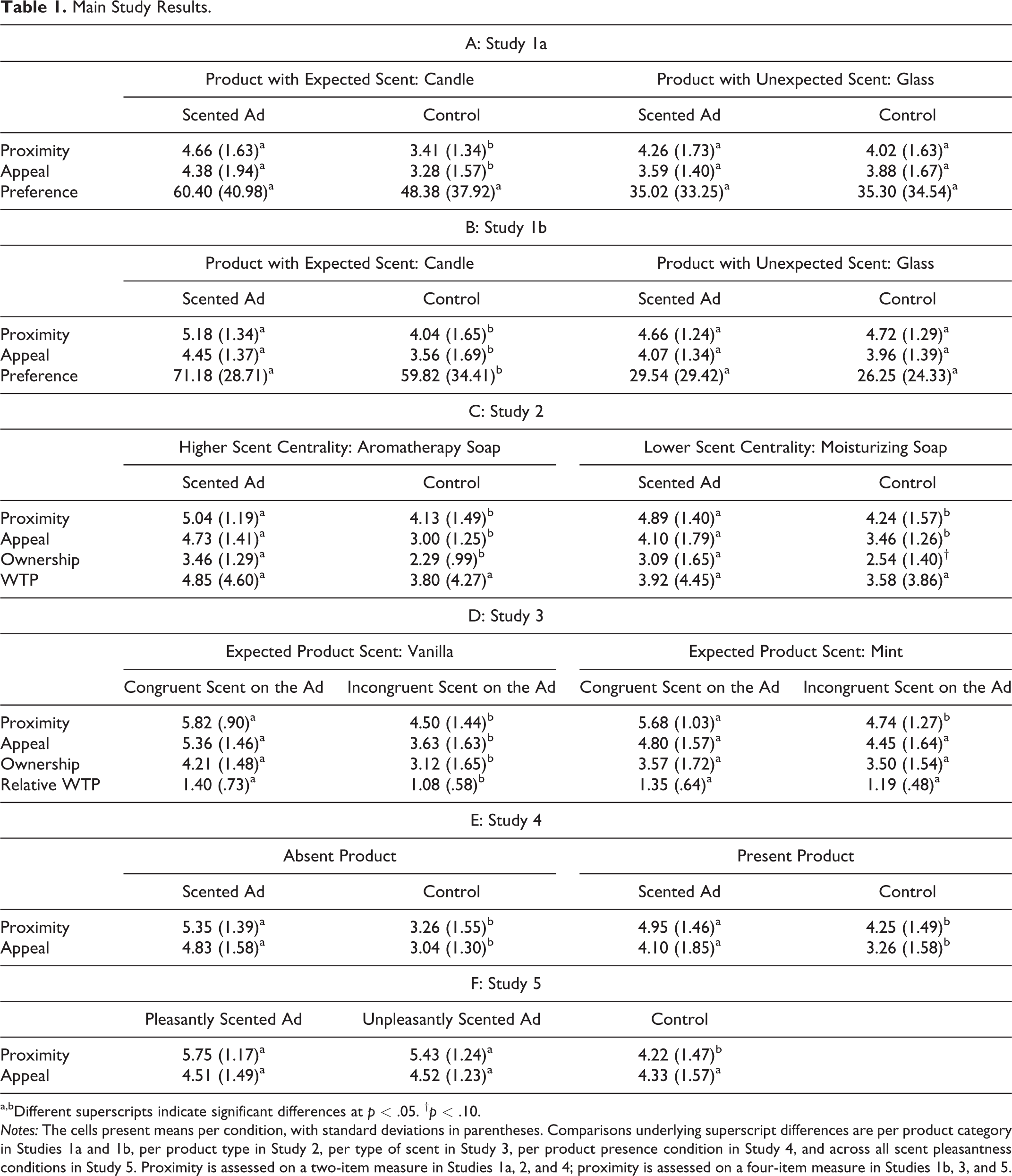
a,bDifferent superscripts indicate significant differences at p < .05. † p < .10.
Notes: The cells present means per condition, with standard deviations in parentheses. Comparisons underlying superscript differences are per product category in Studies 1a and 1b, per product type in Study 2, per type of scent in Study 3, per product presence condition in Study 4, and across all scent pleasantness conditions in Study 5. Proximity is assessed on a two-item measure in Studies 1a, 2, and 4; proximity is assessed on a four-item measure in Studies 1b, 3, and 5.
Mediation and Moderated Mediation Analyses.

a Coefficients and confidence intervals based on moderated mediation analyses (Model 7, SPSS PROCESS; Hayes 2017) in case of significant moderation.
b Coefficients and confidence intervals based on mediation analyses (Model 4, SPSS PROCESS; Hayes 2017) in absence of significant moderation per both conditions merged; also in absence of moderator. Additional direct and total effects are based on simple mediation analyses across the studies.
Notes: DV = dependent variable.
To generate the appropriate stimuli, we conducted three pretests (see Web Appendix A). The first pretest identified product categories that are expected to have a scent. The second pretest identified scents that are congruent with these product categories (see Table 3). The third pretest was designed to identify an unpleasant scent for Study 5. One hour prior to each study session, we gently scented the backsides of print ads, using fine sprays or cotton pads saturated with essential oils, and then placed the ads into the plastic envelopes. In Study 5, we used scented inserts. In all studies, the ads differed in terms of olfaction but were identical on visual and tactile dimensions.
Scent Characteristics and Product Category Fit.

a,bDifferent superscripts indicate significant differences at p < .05.
†Indicates significant difference in temperature ratings of rosemary, but not lavender.
Notes: Pleasantness, arousal and temperature ratings are based on seven-point scales (1 = “very unpleasant/more relaxing/cold,” and 7 = “very pleasant/more stimulating/warm”). Fit to the product was rated on five-point scales (1 = “not at all,” and 5 = “very much”). N = 25.
In line with recent research incorporating behavioral experiments (e.g., Lowe and Haws 2017), we aimed for 40–50 participants per cell when collecting data for the main studies. Variations in cell sizes are due to variations in the number of participants attending different randomized sessions. Each study’s data were analyzed only after completion of data collection for that study. Prior to data collection and analyses, we decided to exclude participants who failed checks of olfactory sensitivity (i.e., those who could not smell scents). That is, in the studies where information about scent was salient (i.e., Studies 1a, 2, and 3), we ensured that participants in the scent conditions did not suffer from olfactory impairment and were able to perceive the scent (Doty, Shaman, and Dann 1984). Participants who reported smelling nothing when sniffing the scented ad at the end of the study were excluded from the analyses. Removal of these participants did not change the pattern of results (see Web Appendix B).
Study 1a: Scented Ads and the Role of Product Scent Expectation
Study 1a examined the effects of a scented ad on the sense of proximity of the advertised product (H1) and consequently on product appeal (H4). In addition, Study 1a investigated whether, as proposed, these effects are contingent on scent expectations (H2). To do so, we contrasted products that are visually equivalent but differ in terms of whether they are expected to have a scent: a glass candle and a drinking glass. Finally, we tested for the role of several competing processes that vary in response to olfactory stimuli, such as imagery, engagement (Lwin, Morrin, and Krishna 2010; Morrin and Ratneshwar 2003), and affect (Herz and Engen 1996). Unlike sense of proximity, these processes should be less sensitive to whether the product is expected to have a scent. Further details on these constructs and analyses can be found in Web Appendices C and D.
Participants, Design, and Procedure
Study 1a had a 2 (scent: present vs. absent) × 2 (product: candle vs. glass) between-subjects design. One hundred seventy-nine university students (54% female; Mage = 21.99 years) participated in this lab study in exchange for course credit.
Upon arriving at the lab, each participant was randomly assigned to a workstation, which was equipped with a computer and separated from other workstations by dividers. Every workstation had an envelope that contained an ad (size: 5.8 × 8.3 inch, A5 format; stimuli available upon request). Half of the participants saw an ad for a candle (scent expected, as per pretest) and the other half saw an ad for a drinking glass (scent not expected, as per pretest). To make both products visually and conceptually comparable, we framed the candle as an aromatic candle in a glass container. In the “scent present” condition, ads were scented with a vanilla scent (see pretest Table 3) and participants were notified about the presence of a scent on the ad. The “scent” and “nonscent” conditions were run on separate days to avoid possible carryover effects of the scented ads to the control condition. The time of day for the conditions was identical. The lab was ventilated during the night.
After inspecting the ad, participants proceeded with the online questionnaire. To obtain a proxy for ad engagement, we measured the time participants took to examine the stimulus ad. Subsequently, we assessed sense of proximity of the product by using a two-item, seven-point semantic differential scale (“feels close/far away from me,” “feels like here/feels far away from here”; reverse coded; r = .61, p < .001) and product appeal (“How much do you like this candle/glass?,” “How likely is it that you would buy this candle/glass?”; r = .77, p < .001; 1 = “not at all,” and 7 = “very much”). We also measured imagery vividness (“clear/vague,” “detailed/not detailed,” “strong/weak,” “sharp/fuzzy,” “vivid/dull”; α = .87; seven-point semantic differential scale) and elaboration (“I fantasized about this candle/glass,” “I imagined what it would be like to use this candle/glass,” “I imagined how this candle/glass would feel”; α = 78; 0 = “strongly disagree,” and 100 = “strongly agree”; adapted from Babin and Burns [1998]) as well as participants’ affective state (“unhappy/happy,” “unsatisfied/satisfied,” “annoyed/pleased,” “bored/relaxed,” “depressed/contented”; α =. 86) and arousal (“relaxed/stimulated,” “calm/excited,” “sleepy/wide awake,” “unaroused/aroused”; seven-point pleasure and arousal subscales of the Pleasure-Arousal-Dominance (PAD) scale, Mehrabian and Russell 1974). Because the arousal items had low scale reliability (α = .19), we later tested the effect of scent on each item independently (see Web Appendices C and D).
Toward the end of the survey, participants in the scent condition were asked to sniff the ad and report whether they could smell the scent on a seven-point scale (1 = “I could not smell the scent,” and 7 = “the scent was very strong”). Participants who chose 1 (= “I could not smell the scent”) did not pass the olfactory sensitivity check and were screened out from further analyses. In addition, we measured liking of the scent (“I like the scent a lot”) and the scent’s fit with the advertised product (“The scent fits the candle/glass”) on 100-point slider scales (0 = “strongly disagree,” and 100 = “strongly agree”).
We also obtained an additional behavioral proxy measure of product preference, framed as compensation for participation. Participants could bid 100 points on four prizes (a candle, a glass, a soap bar, and a pen; the candle and the glass were the same as the ones presented in the ads) of similar monetary value (see Web Appendix D). Participants were asked to provide their email addresses to be notified if they won and were then debriefed. Email addresses were saved separately from survey answers and deleted after the lottery was completed.
Results and Discussion
Two participants who failed the olfactory sensitivity check were screened out from the analyses. Participants in the scented ad condition rated the scent equally pleasant across both product categories (Mcandle = 62.40, SD = 34.74; Mglass = 60.42, SD = 33.26; t(88) = .28, p = .78). Moreover, the scent was rated as being a significantly better fit for the candle than the glass (Mcandle = 79.56, SD = 24.37; Mglass = 34.11, SD = 30.41; t(88) = 7.82, p < .001).
An analysis of variance (ANOVA) with scent and product category as predictors of sense of proximity revealed a main effect of scent (F(1, 173) = 9.44, p < .01) qualified by an interaction with product category (F(1, 173) = 4.40, p < .05). There was no main effect of product category (F(1, 173) = .19, p = .67). As predicted by H2, adding scent to the ad increased the sense of proximity of the product only in the case of the glass candle (Mscent = 4.66, Mcontrol = 3.41; F(1, 173) = 12.98, p < .001). Scent did not affect the sense of proximity of the advertised drinking glass (F(1, 173) = .49, p = .49).
To examine how the effects of scented ad on sense of proximity in turn influences product appeal, we conducted a moderated mediation analysis (SPSS PROCESS Model 7; Hayes 2017) with scent (absent vs. present) as the independent variable, product category as a moderator, proximity of the product as the mediator, and product appeal as the outcome variable. A 5,000 resample bootstrap test revealed a significant moderated mediation effect (index = −.48, 95% confidence interval [CI95] = [−.99, −.05]). The effect of scent on appeal was mediated by sense of proximity only for the candle ads (coefficient = .59, CI95 = [.27, .97]) but not for the glass ads (coefficient = .11, CI95 = [−.22, .46]), as evidenced by whether the CI included zero. Scented ads increased the sense of proximity of a product when scent was expected for the product, which in turn boosted the product’s appeal. The same moderated mediation pattern was observed for the amount of lottery points participants bid on the product seen in the ad (for analyses, see Web Appendix D). A more detailed report of these analyses can be found in Table 2, and the means are reported in Table 1.
Finally, we tested for the potential alternative accounts related to imagery, engagement, affect, and arousal, which could also drive the effects of scented ads on product appeal. Only engagement was affected by scent, and none of these variables revealed the same interaction as observed with sense of proximity (for means, see Web Appendix C; for details of analyses, see Web Appendix D). These variables are thus unlikely to account for the observed effects of scent.
In support of H1, H2, and H4, Study 1a demonstrates that scented advertising can increase the sense of proximity of the advertised product only when scent was expected to be relevant for the product; this effect in turn enhanced product appeal and product preference. The results of this study also rule out important alternative accounts related to imagery, engagement, affect, and arousal.
Study 1b: Replicating Study 1a When Scent Information Is Nonsalient
In Study 1a, as in many real-world settings (Kelly 2012), the ad’s scent was made salient to participants. Given that our account has visceral underpinnings, we should find the same effect even if the scent is not mentioned explicitly to participants. However, alerting participants to the scent could have induced demand effects. To rule out this possibility and provide a further test of our account, Study 1b replicated Study 1a in a setting in which the scent information was not made salient.
Participants, Design, and Procedure
In exchange for course credit, 277 students (49% female; Mage = 21.94 years) participated in a lab study replicating the 2 (scent: present vs. absent) × 2 (product: candle vs. glass) design. We used the same experimental stimuli (ads and scent) as in Study 1a but introduced two changes to the study procedure. First, participants were not alerted to the scent; thus, the information about scent was nonsalient. Second, the study took place in group settings (one condition per group) with up to 14 participants per session seated around a large table. Each experimental condition was run in separate sessions. The time of day between the conditions was counterbalanced.
Participants reported appeal (r = .75, p < .001) and expressed their product preference by bidding points on products as in Study 1a. To better reflect its visceral nature, we added two items to the sense of proximity measure used in Study 1a. The following four items were assessed on seven-point scales: “It somewhat feels that this candle/glass is physically here,” “It somewhat feels that this candle/glass is in this room,” “This candle/glass feels close/far away from me,” “This candle/glass feels like here/feels far away from here”; the last two items were reverse coded (α = .85).
Results and Discussion
As in Study 1a, the results of an ANOVA showed a main effect of scent (F(1, 273) = 9.34, p < .01) on the sense of proximity qualified by an interaction with product category (F(1, 273) = 11.52, p < .001). There was no main effect of product category (F(1, 273) = .22, p = .64). As predicted by H2, the scent on the ads enhanced the sense of proximity for candles (Mscent = 5.18, Mcontrol = 4.04; F(1, 273) = 26.39, p < .001) but not for glasses (F(1, 273) = .05, p = .83).
We also replicated the expected moderated mediation effect (index = −.40, CI95 = [−.70, −.16]) using SPSS PROCESS Model 7 (Hayes 2017). The positive indirect effect of scent on appeal was mediated by sense of proximity for the candle ads (coefficient = .38, CI95 = [.19, .61]) but not for the glass ads (coefficient = −.02, CI95 = [−.19, .14]). We observed the same pattern of results for the points bid on the advertised product in the lottery (for analyses, see Web Appendix D; for a full report of analyses, see Table 2; for means, see Table 1).
Study 1b replicated the key findings of Study 1a in a different study setting, used a more comprehensive measure of sense of proximity, and ensured that there was no demand effect due to alerting participants to the scent. For another study that addresses this potential concern and corroborates our insight that the results are robust regardless of whether information about the scent is made salient, see additional Study 1 in Web Appendix E. Next, we test the robustness of the effect across products with expected scents but with different degrees of centrality of the scent.
Study 2: Scented Ads and Additional Process Insights
Because our proximity account is visceral (i.e., based on a feeling of an object’s presence), it predicts not only the robustness of the effect across different modes of scent presentation but also the robustness across different degrees of scent centrality. Even if we typically associate a product with a scent, this does not mean that its scent is a central feature of the product. For example, scent serves a less central and important role for a moisturizing soap than for an aromatherapy soap. According to our theorizing, such differences should not matter as long as a scent matches intuitive scent expectations. This prediction distinguishes our account from more cognitive accounts, which should be sensitive to the objective importance of a scent because the scent becomes more versus less important product information. A specific alternative account in this respect is construal-level theory (Trope and Liberman 2010). This theory assumes that the concrete construal of an object, which could be induced through a concrete feature such as its scent, shrinks the encompassing perceived psychological (as opposed to merely visceral) distance to the object. Notably, this account hinges on the cognitive construal of an object and would thus predict that the effect of scent on the sense of proximity varies in response to the centrality of scent as a product attribute. It also predicts a change in object construal parallel to a change in perceived object proximity. If we observe neither a change in the level of construal nor moderation in response to scent centrality, it means that we would provide stronger support for our visceral account and rule out more cognition-based accounts. In addition to providing further evidence for the nature of the effect, Study 2 generalizes results to a different product category and scent (i.e., lavender-scented soap) and explores psychological ownership as a potential explanation as to why scent-enhanced proximity increases product appeal.
Participants, Design, and Procedure
Study 2 had a 2 (scent: present vs. absent) × 2 (scent centrality: more vs. less) between-subjects design. The laboratory settings and the study procedure were similar to that of Study 1a. Participants (n = 187; 42% female; Mage = 21.95 years; course credit remuneration) were randomly assigned to a lab workstation, where there was an envelope with a printed ad.
Soap bars served as a scent-expected product category for this study (for the pretest, see Web Appendix A). To manipulate the centrality of the scent to the product, we framed the advertised soap as either an aromatherapy (scent more central) or a moisturizing (scent less central) soap. A pretest (n = 35) suggested that these types of soap differ in terms of how central and relevant (r = .83, p < .001; seven-point scales) scent is as a product attribute (Maromatherapy = 6.20, SD = 1.14; Mmoisturizing = 3.69, SD = 1.52; paired t(34) = 6.66, p < .001). To ensure the ecological validity of the advertising stimulus, we redesigned an existing print ad (size: 5.8 × 8.3 inch, A5 format) from another country The ads in the scent-present condition were scented with lavender oil (for the pretest, see Web Appendix A), and scent information was made salient to the participants.
The sense of proximity of the product (r = .43, p < .001) and product appeal (r = .76, p < .001) were measured using the same items as in Study 1a. In addition, participants were asked about the highest price they were willing to pay (WTP) for the advertised soap and about psychological product ownership (three items assessed on seven-point scales [e.g., “It somewhat feels like this soap belongs to me”] adapted from Peck and Shu [2009]; α = .90). To capture the construal level of processing, we employed three commonly used proxies. First, we assessed the use of concrete language by asking participants to describe the soap in an open-ended question (Fujita et al. 2006); the responses were later coded on the basis of the linguistic category model (Semin and Fiedler 1991). Note that these open answers also served as an additional test for elaboration (for details, see Web Appendices C and D). Second, we assessed the importance of central and peripheral product features (e.g., “How relaxed it makes you feel”; seven-point scales; for details, see Web Appendix D) across both types of soap (Trope and Liberman 2000). Third, we measured product-related action representations (Liberman et al. 2007) by asking participants what they had thought about most (seven-point scale; 1 = “how you would use the soap,” and 7 = “what you would use it for”; similar to Van Boven et al. [2010]). As in Study 1a, in a final section, we assessed olfactory sensitivity for participants in the scent condition and asked them to rate scent pleasantness and fit to the advertised product (nine-point scales). After providing basic demographic information and indicating the presumed aim of the study, participants were debriefed.
Results and Discussion
One participant who did not detect any scent in the scented ad condition was screened out. Nineteen participants guessed that the study was related to scent. Their answers on all main variables did not differ from those who did not make this guess (all ps > .20) and controlling for guessing the study’s purpose did not change the results; thus, these participants were retained. Participants in the scented ad conditions rated the lavender scent as being equally pleasant (Maromatherapy = 6.35, SD = 2.31; Mmoisturizing = 6.07, SD = 2.46; t(103) = .61, p = .55) and fitting (Maromatherapy = 5.75, SD = 2.17; Mmoisturizing = 5.19, SD = 2.48; t(103) = 1.21, p = .23) for both types of soap.
In support of H1, and distinguishing our visceral account from alternative cognitive accounts, an ANOVA on sense of proximity showed the expected main effect of scent (F(1, 182) = 14.10, p < .001) but neither a main effect of type of soap (F(1, 182) = .01, p = .92) nor an interaction effect (F(1, 182) = .36, p = .55). Regardless of how central the scent was to the product, scented ads elicited higher levels of felt proximity than unscented ads (Mscent = 4.96, SD = 1.31; Mcontrol = 4.18, SD = 1.52; for individual cell means, see Table 1). Further ruling out the alternative account of construal-level theory, we find no main or interaction effects on any of the three proxies for concrete processing (for means, see Web Appendix C; for additional analyses details, see Web Appendix D).
Next, we tested for H4 and its robustness across scent centrality through moderated mediation tests (SPSS PROCESS Model 7; Hayes 2017) with scent as the independent variable, product appeal and WTP as respective outcome variables, and sense of proximity of the product as the mediator. As we expected, there was no evidence for moderation by soap type (all moderated mediation indices included 0 in their CIs). Therefore, we ran a mediation test (Model 4) across both soaps. As we predicted, sense of proximity mediated the effect of scent on appeal (coefficient = .38, CI95 = [.17, .64]). We observed the same pattern for WTP (for a full report of analyses, see Table 2; for means, see Table 1). A final exploration of the role of psychological ownership reveals evidence for serial mediation (Model 6), with proximity as the first mediator and psychological ownership as the second mediator (for details of the analyses, see Web Appendix D).
The results of Study 2 corroborate our predictions that scenting an ad with a product-congruent scent can boost the sense of product proximity (H1), which in turn enhances product appeal (H4). Moreover, it increased the amount participants were willing to pay for the exact same product. Notably, we also found that this effect is unlikely to be cognitive in nature because it neither depends on scent centrality nor affects product construal, thus effectively ruling out construal level as a competing process explanation. In addition, the results of Study 2 suggest that scent-enhanced proximity increases product appeal at least partly because it induces psychological ownership.
Study 3: Congruence with Scent Expectations
Study 3 tested H3, which predicts that a scented ad would enhance sense of proximity—and, consequently, product appeal—only when there is congruence between the scent on the ad and the expected scent of the product. To test for this, we focused on ads that raised specific expectations of the product’s scent (vanilla or mint) and were given a scent that was either congruent or incongruent with expectations. Regardless of expected type of scent, we predict that sense of proximity will be higher when the scent on the ad is congruent with manipulated product scent expectations versus when it is not. In addition, Study 3 aims to corroborate results on psychological ownership.
Participants, Design, and Procedure
Study 3 had a 2 (expected type of product scent: vanilla vs. mint) × 2 (congruence of scent on the ad: congruent vs. incongruent with expected product scent) between-subjects design. One hundred seventy-one university students (54% female; Mage = 21.53 years) participated in the study in exchange for course credit. Similar to Study 1a, participants were assigned to individual work stations and presented with a print ad for a liquid soap. To manipulate specific expectations about the product’s scent, participants were informed that the advertised soap was infused with either vanilla or mint oils. A pictorial reference to these scents on the ad, a vanilla blossom or mint leaf, reinforced this manipulation. Participants in the congruent condition received a scented ad that was infused with the scent participants expected (i.e., a vanilla-scented ad advertising vanilla-infused soap or a mint-scented ad advertising mint-infused soap). Participants in the incongruent condition received a scented ad that was incongruent with the expected product scent (i.e., a vanilla-scented ad advertising mint-infused soap or a mint-scented ad advertising vanilla-infused soap). Both scents were perceived as equally pleasant but differed with regard to their overall congruence with the product category (for details, see Table 3 and Web Appendix A). Because we manipulated specific product scent expectations, we expect results to generalize across scents.
After inspecting the ad, participants rated sense of proximity (α = .85) and product appeal (r = .81, p < .001) as in Study 1b. To explore further downstream consequences, we computed a measure of relative WTP by assessing and then dividing the maximum price participants were willing to pay for the advertised soap and the price they normally paid for liquid soap (both WTPs assessed on sliding scales from €0–€25). This was done to improve the scale properties of the open-ended measure. We measured psychological ownership (α = .93) as in Study 2, checked for olfactory sensitivity as in Study 1a, and included a one-item congruence manipulation check (“I expected the advertised soap to smell…” 1 = “exactly the same,” and 7 = “much different than the scent on the ad”).
Results and Discussion
One participant who indicated not being able to perceive the scent was screened out from further analysis. A two-way ANOVA with expected type of scent and congruence between expected product scent and actual scent on the ad showed a main effect of scent congruence (F(1, 166) = 32.07, p < .001) but no main effect of expected type of scent (F(1, 166) = .16, p = .69). When the scent on the ad was congruent with expectations of the advertised scent, participants reported that the scent matched their expectations of the product’s scent more (M = 2.99, SD = 1.65) than if it did not (M = 4.67, SD = 2.23). Though the scent congruence manipulation worked for both scents, an additional significant interaction effect (F(1, 166) = 7.94, p < .01) indicates that it worked better when the soap was expected to smell like vanilla rather than mint.
A two-way ANOVA on sense of proximity showed no main effect of type of scent expected (F(1, 166) = .09, p = .77) and no interaction (F(1, 166) = 1.12, p = .29) but the predicted main effect of congruence (F(1, 166) = 38.94, p < .001). Consistent with H3, the advertised product felt closer if the scent on the ad was congruent with expectations of the product’s scent (M = 5.75, SD = .96) than when it was not (M = 4.62, SD = 1.36) (for details, see Table 1).
To test whether sense of proximity of the product mediated the effect of congruence on appeal across expected type of scents, we conducted a moderated mediation analysis (SPSS PROCESS Model 7; Hayes 2017) with 5,000 resample bootstraps. Because type of scent did not moderate the mediation through sense of proximity (all moderated mediation indices included 0 in their CIs), we conducted mediation analyses (Model 4) across type of scent expected. As theorized, congruence affected product appeal through sense of proximity (coefficient = .77, CI95 = [.48, 1.07]). We observed the same mediation pattern for relative WTP as an outcome variable. When the scent on the ad was congruent (vs. incongruent) with expectations of the product’s scent, product appeal and relative WTP increased (for additional details, see Table 2; for means, see Table 1). Final serial mediations (Model 6) corroborate the role of psychological ownership. An enhanced sense of proximity raised psychological ownership, which in turn increased product appeal and relative WTP (for analyses, see Web Appendix D).
In Study 3, we used a product that is generally expected to hold a scent and manipulated scent expectations, just as marketers may do with text and visual references. In support of H3 and H4, we find that scent expectations matter. Scented ads that were congruent (vs. incongruent) with olfactory expectations induced by the advertisement enhanced sense of proximity of the product and eventually product appeal and relative WTP, at least partly through an increase in psychological ownership. An additional Study 2 in Web Appendix F replicates the main findings and further shows that incongruently scented ads do not differ from nonscented ads. Thus, infusing an ad with a scent that does not meet expectations of the product’s scent is likely to be an ineffective strategy.
Study 4: Scent and Physical Product Presence
In Study 4, we investigated a managerially relevant condition. If a visceral sense of proximity of the product increases its appeal, then the effect of scent can be weakened for products that are physically present, and thus close already. To test this prediction, we manipulated the physical presence (vs. absence) of the product. Because this amounts to a manipulation of sense of proximity, this study allows us to test for this key process through a moderation approach in addition to providing managerially relevant insights.
Participants, Design, and Procedure
Study 4 had a 2 (scent: present vs. absent) × 2 (physical product: present vs. absent) between-subjects design. Two hundred twelve university students (51% female; Mage = 20.67 years) participated in exchange for course credit.
As in Study 2, we used a soap bar as a stimulus product. To ensure robustness of the results, we designed new stimulus materials (fictional brand and ad design) and extended the investigation to vanilla-infused ads. Participants were not alerted to the presence of a scent on the ad. This study mirrored the group setting of Study 1b. In the “product present” condition (but not in the “product absent” condition), the advertised soap bar was placed in the middle of the table and participants were asked to inspect the soap visually without touching it. The soap was about 39 inches away from the participants. We assessed the sense of proximity (r = .80, p < .001) and product appeal (r = .79, p < .001) as in Study 1a.
Results
An ANOVA on sense of proximity showed a significant main effect of scent (F(1, 208) = 47.49, p < .001). As we expected, scented ads led to a higher sense of product proximity than nonscented ads (see Table 1). Notably, this was qualified by a significant interaction effect with product presence (F(1, 208) = 11.86, p < .001). When the product was not physically present, a scented (vs. unscented) ad led to a higher sense of product proximity (Mscented = 5.35 vs. Munscented = 3.26; F(1, 208) = 50.54, p < .001). As predicted, this effect was weakened, though still statistically significant, when the product was physically present (Mscented = 4.95 vs. Munscented = 4.25; F(1, 208) = 6.30, p < .05). It is worth noting that even when the product was physically present, there was a significant effect of ad scent on sense of product proximity; however, the effects were stronger when the product was not physically present.
To obtain further evidence on how product presence influences the effectiveness of scented ads, we conducted moderated mediation tests (SPSS PROCESS Model 7; Hayes 2017) with scent as the independent variable, product presence as the moderator, sense of proximity as the mediator, and product appeal as the outcome variable. Moderation indices verify that the effect of scent on sense of proximity was moderated by product presence (index = −.48, CI95 = [−.86, −.17]). The indirect effect of scent on product appeal through proximity was stronger when the promoted product was physically absent (coefficient = .72, CI95 = [.38, 1.08]), versus when it was present and thus physically close (coefficient = .24, CI95 = [.05, .47]) (for additional details, see Table 2).
Follow-Up Analyses and Discussion
The results of Study 4 support H1 and H4. Importantly, they also show that scenting ads is more effective when the actual product is not physically present. This provides evidence for our proposed process through moderation. Notably, we find that scented ads can increase perceived proximity even when products are physically present. It is likely that this observation reflects the fact that olfaction is a proximal modality, whereas vision is a more distal sensory modality (Hall 1966). In fact, when we contrast the product present (visual cue only) and scent present (olfactory cue only) conditions, we find that the scent instilled a more intense sense of product proximity (M = 5.35) than when the product was visually present (M = 4.25; t(106) = 3.98, p < .001). We believe that this is because the visually present soap was still more distant from the person than the odor molecules, which were in participants’ olfactory processing system (which is internal to the body). Interestingly, the olfactory cue alone (M = 5.35, p = .15) directionally enhanced proximity more than the olfactory cue in combination with the visual presence of the product (M = 4.95). Because visual cues tend to dominate other sensory cues (Krishna 2012), it is possible that the proximity judgment was dominated by the visual cue, which placed the product slightly farther away than the olfactory cue, which entered participants’ body through the olfactory system. Managerially, these findings suggest that the effectiveness of scented ads is higher when the promoted product is not directly visible, such as when customers encounter an ad outside, rather than inside, a store.
Study 5: Effects of Unpleasant Scent
A final implication of our theoretical account relates to what happens when product scents are unpleasant. If scented ads affect the sense of proximity because scents represent a product’s essence, then we should observe enhanced proximity for all product-congruent scents, including unpleasant ones. We thus predict that H1 generalizes to unpleasant scents, though we hold no predictions with regard to H4, which relates to the subsequent effect on product appeal. Scent-induced proximity may enhance appeal even for unpleasantly scented products, but it may also motivate people to disgustedly distance themselves from the product (Balcetis 2016). Beyond extending the inquiry to unpleasant scents, Study 5 also addresses the final alternative account, namely ad liking, which could be enhanced by (congruent) scents and subsequently affect product appeal (Mitchell and Olson 1981).
Participants, Design, and Procedure
Study 5 had a one-factorial design with three between-subjects conditions (scent: control vs. pleasant vs. unpleasant) to which 146 undergraduate students (58% female; Mage = 22.79 years; course credit remuneration) were randomly assigned. All participants were exposed to an ad for a medical tincture for wounds, which was placed in a plastic envelope. Across all conditions, a white sheet of paper was inserted and attached to the plastic envelope containing the ad. In the scented conditions, a drop of congruent scent, pleasant lavender or unpleasant turpentine, was applied to this paper (for a pretest, see Web Appendix A), without making scent information salient.
After opening the envelope, participants were asked to inspect the ad visually and then report on sense of product proximity (α = .89) and product appeal (r = .67, p < .001), as in Study 1b. In addition, we assessed ad liking (1 = “not at all,” and 7 = “very much”). To once more rule out construal level as an alternative account, we adapted the Behavioral Identification Form (Vallacher and Wegner 1989) and provided ten behaviors (e.g., “Locking a door”) accompanied with two options (concrete vs. abstract) to describe it (e.g., “Putting a key in the lock” vs. “Securing the house”).
Results and Discussion
An ANOVA showed a main effect of scent condition (F(2, 143) = 19.68, p < .001) on the sense of proximity of the advertised product. Consistent with H1, participants in the control condition felt that the product was farther away than participants in the pleasant (Mpleasant = 5.75, Mcontrol = 4.22; t(100) = 5.81, p < .001) and unpleasant (Munpleasant = 5.43; t(95) = 4.36, p < .001) scent conditions, which did not differ from each other (t(91) = 1.28, p = .21).
Next, we tested whether sense of proximity of the product mediates the relation between scent and product appeal for both pleasant and unpleasant scents (SPSS PROCESS Model 4; Hayes 2017). As an independent variable, we contrasted pleasant and unpleasant scents respectively with the scent-free control condition. Proximity served as a mediator and product appeal as an outcome. Proximity mediated the effect of scent on product appeal for both pleasant and unpleasant scents (control vs. pleasant: coefficient = .53, CI95 = [.15, .95]; control vs. unpleasant: coefficient = .42, CI95 = [.13, .81]). When the ads were scented, appeal increased (for details of the analyses, see Table 2). Follow-up analyses reported in Web Appendix D ruled out ad liking and the Behavioral Identification Form score as competing processes; for means, see Web Appendix C.
Using an unpleasant scent, Study 5 replicates the previously observed effects of scent on sense of proximity (H1). Although we held no predictions for effects on product appeal, the indirect effect on product appeal (H4) also generalized. The congruently but unpleasantly scented ad induced the same levels of sense of proximity as the pleasantly scented ad. We replicated this finding in an additional study using a different product (prank candle) and unpleasant scent (fish scent) and find that psychological ownership emerges as a serial mediator for pleasantly and unpleasantly scented products (see Web Appendix G). Together, these findings provide strong evidence that the effects observed in our studies are not merely congruent reactions to particularly pleasant ads. In addition, Study 5 reconfirms that a shift in construal level cannot account for the effect of scent and shows that the increase in product appeal is not due to scent-enhanced ad liking.
General Discussion
The power of scent is multifaceted. It can boost the memorability of products (Krishna, Lwin, and Morrin 2010; Lwin, Morrin, and Krishna 2010; Morrin, Krishna, and Lwin 2011), people, and events (Herz and Engen 1996); stimulate engagement (Mitchell, Kahn, and Knasko 1995; Morrin and Ratneshwar 2003); affect product preference and consumption (Krishna, Morrin, and Sayin 2014; Madzharov, Block, and Morrin 2015); and influence food choices (Biswas and Szocs 2019). In this article, we highlight a novel facet of the power of scent: its ability to physically represent the essence of an object, thus bringing it viscerally closer. Six studies documented this effect across several product categories (e.g., soap bars and liquid soap, candles, medical tincture) and across different scents (e.g., vanilla, lavender, mint, turpentine). Scented ads consistently enhance the sense of product proximity regardless of whether the information about the scent is made salient (Studies 1a, 2, and 3) or not (Studies 1b, 4, and 5) and regardless of how central scent is as a product attribute (Study 2). Even unpleasant scents enhanced proximity of the advertised product (Study 5).
There are moderating factors for this effect. In line with our account of a visceral representation of an object through its scent, scented ads are more effective when the promoted product is physically absent than present (Study 4) and fail to work when the scent does not credibly represent the product’s essence (Studies 1a, 1b, and 3). Importantly, this scent-induced sense of proximity is of managerial relevance. In all studies, it enhanced the advertised product’s appeal. Moreover, we explored and found its positive effect on other managerially important outcomes, such as preference over other alternatives (Studies 1a and 1b) and willingness to pay a price premium (Studies 2 and 3). We also find that these downstream consequences may at least partly arise because scent-induced proximity can stimulate psychological ownership for the advertised product (Studies 2 and 3).
Theoretical Contributions
This research makes several theoretical contributions. First, it adds to the literature on sensory marketing and our understanding of the influence of olfactory cues on product perceptions. To the best of our knowledge, this is the first study to systematically investigate the effectiveness of scented adverting in the nonfood sector (for prior studies in the context of food, see Bosmans [2006]; Krishna, Morrin, and Sayin [2014]). Our findings suggest that scented ads can be effective beyond instigating immediate visceral product cravings, such as hunger or satiation, which is specific to the context of food (Krishna, Morrin, and Sayin 2014). Our results also help resolve possible inconsistencies in the literature on effects of scents. For example, prior research (Ellen and Bone 1998) found no significant effects of scented ads for an advertised holiday. We show that the effectiveness of scented advertising hinges on whether the scent can credibly represent the product. The abstract notion of a holiday may not be easily represented by a scent, and thus a scented ad would be unlikely to influence appeal.
Other key contributions relate to sense of proximity. We add to the literature on sensory distance (Elder et al. 2017; Hall 1966; Rodaway 1994; Skurnik and George 1967). To the best of our knowledge, this study is the first to empirically demonstrate that the actual experience of scent triggers a sense of proximity, a suggestion that has only been hinted at before (Hall 1966; Rodaway 1994). Moreover, we add to the literature explaining the relevance of proximity. Proximity is often mentioned in the context of sensory stimuli (Hoch 2002; Peck and Shu 2009) but has barely been recognized as a potential mechanism. In line with prior studies from different contexts (Newcomb 1956; Shin et al. 2019; Williams, Stein, and Galguera 2014), we show that a scent-induced sense of proximity may enhance the appeal of products. In further explorations, we also provide novel insights into why felt proximity may enhance appeal. To the best of our knowledge, we are the first to provide empirical evidence (Claus and Warlop 2017; Kamleitner 2014) that proximity enhances psychological product ownership, which in turn has managerially relevant consequences. This also entails the intriguing insight that a target’s scent may facilitate its psychological appropriation.
It is important to note that the effect of scent on appeal through proximity prevails even if we address alternative mechanisms, such as imagery vividness and elaboration, ad engagement, arousal, affect, ad liking, and level of construal (see Web Appendices C and D). The key difference between these alternatives and our account is that our account is visceral rather than cognitive or affective. The visceral nature of the effect explains its unique boundary conditions and generalization. For example, while our proximity account is contingent on an intuitive attribution of the scent to the product, some affect-based (ad liking, arousal, and affect) or cognitive (ad engagement) accounts do not hold such contingencies and predict reactions to the mere presence of a scent. Similarly, affect-based and cognitive accounts would predict attenuated effects when the scent is unpleasant, yet our results generalize to unpleasant scents. The visceral nature of our proximity account also provides an explanation for why the effects were obtained regardless of whether the scent information was salient. The key contingency to our account is scent expectations. While scent expectations can be manipulated (Study 3), the process of attributing the scent to the product is likely intuitive (Taylor and Fiske 1978).
Relation to Psychological Distance and Construal-Level Theory
In line with the original literature on sensory distance (Hall 1966; Rodaway 1994; Skurnik and George 1967), our “sense of proximity” is grounded in the actual physical sensory experience and instilled by the inhalation of olfactory molecules. These are present “in the here and now” and are experienced directly through our physiological olfactory system. In contrast, psychological distance is a mental journey “from the here and now.” It enables us to experience material or immaterial targets beyond their actual presence (Maglio, Trope, and Liberman 2013; Trope and Liberman 2010) and relates strongly to how these targets are cognitively construed. Thus, while our proximity construct denotes a more viscerally sensed physical distance, psychological distance is a cognitively constructed distance (Trope and Liberman 2010). This more cognitive rather than visceral definition of the construct holds several implications, and we do not find much support for this in our studies. For example, Yan, Sengupta, and Hong (2016) show that imagery processing underlies the representation of psychologically close targets. This explains why imagined sensory cues were able to shift psychological distance toward the target in Elder et al.’s (2017) study. We, however, found no differences in imagery processing when actual scents were present versus absent in Study 1a. We did, however, find a difference in felt proximity. This suggests that felt proximity operates independently from mental imagery.
Another consequence of psychological distance that we find little evidence for is its effect on the way people mentally construe targets. Construal-level theory (Trope and Liberman 2010) predicts that psychologically close targets are construed in more concrete terms, whereas psychologically distant targets are construed in more abstract terms (for evidence in the context of product experience, see Hamilton and Thompson [2007]). We used a range of approaches to test for this prediction (Studies 2 and 5) but found no support for it. This is in line with other research finding that some experiences of proximity, in particular those based on feelings, fail to translate into shifts in construal level (Chang and Pham 2012; Van Boven et al. 2010; Williams, Stein, and Galguera 2014). Adding our insights to these prior findings could suggest that visceral experiences of proximity may be less likely to affect construal than more cognitive experiences of proximity.
Finally, building on construal-level theory, psychological distance would predict the opposite pattern of effects on product appeal than the one observed in our studies. That is, concrete processing tends to reduce perceptions of favorability (Eyal et al. 2004), whereas we observed a consistent increase in product appeal.
Generalizability Across Sensory Cues
This research focused on a particular sensory modality: olfaction. Our broader theoretical underpinnings of sensory distance (Hall 1966), however, suggest that our insights may extend to other proximate sensory modalities and thus gustatory and haptic inputs. Like olfactory molecules, gustatory molecules or haptic properties are part of the emitting target. They, too, could represent the essence of their source. Unlike olfactory cues, gustatory or haptic inputs tend to be contingent on the presence of their source. We also suspect that visual and auditory cues are less effective in enhancing the sense of product proximity than olfactory cues. In fact, in Study 4 we found preliminary evidence that a visual cue induces less proximity than an olfactory cue. Additional research is needed to examine the interplay of different modalities in greater depth.
Future Research Directions
Our research highlights several relevant and unexplored areas. We viewed scent mainly from the perspective of it being a physical product attribute (e.g., Krishna, Lwin, and Morrin 2010). We do not know what would happen if scents did not convey the product itself but rather the idea it stands for. For example, Fiat promoted its fresh summer-edition 500 model with mint-scented newspaper ads. Scented ads such as these may or may not work. Our results suggest that if they do work, they may not do so through a mechanism of enhanced proximity.
The ad stimuli used in the current set of studies mirrored actual ads that simply focus on a visual product depiction. Such ads are prevalent in marketing practice. However, there are other types of advertising that include more verbal copy. Verbal processing may distract from sensory experiences (Yan, Sengupta, and Hong 2016). It would be interesting to examine in future research whether the type of advertising (i.e., predominantly verbal vs. visual ads) affects the effectiveness of scented ads.
Future studies should also explore potential parallel processes that could operate along the effects of scent on sense of proximity. We find consistent evidence for the effect of scent on proximity as well as a follow-up effect on downstream consequences, such as product appeal. However, the total effects do not consistently emerge in every study (e.g., Study 5; see Table 2) and for every downstream consequence (e.g., Study 2, WTP). This suggests the presence of unmeasured competitive effects (Zhao, Lynch, and Chen 2010) that we have yet to understand. For example, total effects did not emerge for the medical tincture, which is a highly functional product. It may be that people feel manipulated if the scent does not serve a diagnostic function (Bradford and Desrochers 2009). Although the pattern of results was consistent, the total effects for the more behavioral downstream consequences did not reach significance in every study too. For example, a significant total effect for preference emerged only in Study 1b, which had a considerably larger sample size than Study 1a. Similarly, total effects for WTP did not reach significance in Study 2 but it did in Study 3, which adopted a relative WTP measure that reduced the measurement noise. Thus, this spread in results may simply reflect differences in measurement, but it may also signal the presence of additional factors that may sometimes counteract the positive effects of scent-induced proximity on downstream consequences. Additional research is needed to examine these findings in greater depth.
Another interesting direction relates to the valence of the advertised product. In the current set of studies, we show that the proposed effect holds regardless of scent pleasantness. However, across all studies, we used ads that promote generally neutral or positive products (tincture, aromatic candles, and soaps). It could be that adding a congruent scent to ads that promote products that might be perceived as negative (e.g., funeral candles) or disgusting (e.g., a facial mask containing bird droppings, currently available in the marketplace) may backfire due to these undesirable products feeling even closer.
Managerial Implications
Our research suggests that scent can be an effective tool in print advertising. The positive effects of scent can be obtained for different product categories as long as the product is expected to have a scent. Therefore, scented ads can benefit products with scent as a central (e.g., aromatic candle) or peripheral feature, such as when product ingredients have naturally and unavoidably occurring smells. Notably, scent expectations and the scent’s congruence with the product also matter, and marketers can manage these expectations, as highlighted by Study 3. Scent-congruent visual and textual references can help boost the effectiveness of scented ads. In contrast, surprising consumers with an unexpectedly scented ad may not result in favorable returns on investment. Notably, the advantage of scented advertising is robust regardless of whether information about scent on the ad is made salient. This implies that marketers have flexibility in choosing whether to draw consumers’ attention to the scent (e.g., by prompting them to sniff the ad).
The findings of our studies suggest that the specific performance indicators managers aim to influence may help determine whether to invest in scented ads. In particular, scented ads promoting products with expected scents appear well suited to increase purchase likelihood but may not always increase consumers’ willingness to pay higher prices. However, it is important to note that scented ads are unlikely to pay off when the advertised product category does not usually carry a scent or when there is a mismatch between the scent on the ad and product scent expectations. Scented ads are also relatively less effective when encountered simultaneously with the advertised product, such as at the point of purchase or in show rooms. When using scented ads in such settings, it is thus advisable to have them placed in a location that does not facilitate viewing the advertised product in its physical presence.
Our research focused on the context of print advertising, but the scope of our insights may generalize to other advertising practices, such as outdoor advertising. Billboards that emit scent or bus shelters that invite sniffing could experience similar increases in felt product proximity and appeal. In the near future, the advancement of digital scent delivery technologies (Costello 2018) may extend the relevance of our findings even to online and mobile advertising practices.
Supplemental Material
Supplemental Material, Web_Appendix__UPDATED - Designed to S(m)ell: When Scented Advertising Induces Proximity and Enhances Appeal
Supplemental Material, Web_Appendix__UPDATED for Designed to S(m)ell: When Scented Advertising Induces Proximity and Enhances Appeal by Ruta Ruzeviciute, Bernadette Kamleitner and Dipayan Biswas in Journal of Marketing Research
Footnotes
Acknowledgments
This article is based in part on the first author’s dissertation under the supervision of the second and the third authors. The authors thank Aradhna Krishna for her helpful comments.
Associate Editor
Juliano Laran
Declaration of Conflicting Interests
The author(s) declared no potential conflicts of interest with respect to the research, authorship, and/or publication of this article.
Funding
The author(s) disclosed receipt of the following financial support for the research, authorship, and/or publication of this article: This research was partially supported by a Dr. Maria Schaumayer Internationalization Grant awarded to the first author.

References
Supplementary Material
Please find the following supplemental material available below.
For Open Access articles published under a Creative Commons License, all supplemental material carries the same license as the article it is associated with.
For non-Open Access articles published, all supplemental material carries a non-exclusive license, and permission requests for re-use of supplemental material or any part of supplemental material shall be sent directly to the copyright owner as specified in the copyright notice associated with the article.
