




Abstract
With the advent of access-based platforms bringing phenomenal growth in rentals, consumers can rent products from person providers (e.g., Alex on Airbnb) and company providers (e.g., Apex Vacations on Airbnb). But does it matter from whom a consumer rents? Across nine experiments (including one real-world experiment), the authors demonstrate that despite the product being the same, consumers’ feelings about the product differ depending on whom they rent from. Consumers feel stronger psychological ownership of a product when renting from company providers than they do when renting from person providers. These feelings of psychological ownership drive consumers to engage in territorial behaviors—behaviors that assert their claim on the rented product (e.g., moving furniture around in a rental cabin). Consequently, consumers are more willing to exhibit such behaviors when renting from company providers than when renting from person providers. These behaviors impose real costs on rental providers through increased operational burdens and property damage, as exemplified through additional analyses of providers’ comments on Airbnb's community platform and interviews with providers. The authors identify strategies to mitigate consumers’ territorial behaviors by altering consumers’ feelings of psychological ownership through its antecedent in the rental context: providers’ connections to the rental product.
There has been a phenomenal rise in renting since 2009, fueled by access-based platforms (Osztovits et al. 2015; Rudmin 2016) that enable consumers to access a wider range of products. These platforms have also shifted the way rental transactions take place, with consumers now renting products not only from companies but also from other individuals (e.g., Alex on Airbnb or Taylor on Turo). While this increased access to products brings many benefits to consumers, it also raises an important question: Does it matter whether consumers rent from a company or a person? Imagine renting a cabin on Airbnb. The cabin’s coffee table seems far away, so you consider moving it closer. If you did, you could put your feet up and reach your drink. Would you be more willing to engage in this behavior if the owner of the rental cabin was a company or a person?
This article focuses on two distinct rental provider identities on access-based platforms: company providers (in a business-to-consumer rental model) and person providers (in a consumer-to-consumer rental model). We examine whether the identity of the rental provider (company vs. person) influences consumers’ feelings toward rental products and, consequently, their willingness to engage in territorial behaviors with potential financial and reputational implications for providers.
One key way that renting affects the consumer is by influencing their psychological ownership of the product (Bardhi and Eckhardt 2017; Eckhardt et al. 2019; Lamberton and Rose 2012; Morewedge et al. 2021). Unlike a typical sales transaction (in which complete ownership of a product shifts from one party to another), a rental transaction involves two distinct parties—the rental provider and the consumer—that exert feelings of ownership over the same product simultaneously. During the rental period, a consumer has physical access to the product, whereas the rental provider retains ownership of the product. We propose that the identity of the provider on access-based platforms (whether a company or a person) shapes the extent to which consumers feel psychological ownership over a rented product, which in turn influences their subsequent behaviors toward the product.
Across nine studies in the main article and 16 studies in the Web Appendix, we provide support for our assertion that consumers exhibit stronger psychological ownership over the rented product when renting from a company provider than when renting from a person provider. To examine how this ownership manifests behaviorally, we draw on the theoretical framework of territoriality (Brown 1987; Brown, Lawrence, and Robinson 2005; Kirk, Peck, and Swain 2018; Peck and Luangrath 2023). In the context of rentals, consumers’ feelings of psychological ownership toward the rental product drive territorial behaviors that aim to establish a claim over the rented product. These behaviors fall into two categories: marking (adapting the product to personal preferences, e.g., moving furniture in a rental cabin, highlighting a rented book, or going off-road in a rental car) and defending (reacting negatively to perceived encroachment, e.g., leaving poor reviews when amenities are restricted in a rental property). Our findings show that consumers are more willing to exhibit territorial behaviors over the rental product when renting from company providers than when renting from person providers, due to stronger feelings of psychological ownership toward the product.
Our work contributes to the literature in three important ways. First, renting in the access-based economy has been historically studied in comparison to ownership (Bardhi and Eckhardt 2012; Eckhardt et al. 2019; Lamberton and Rose 2012). We adopt a novel perspective by investigating how the identity of the rental provider on access-based platforms influences the behavior of consumers who use these products. Second, we examine the impact of rental provider identity through the lens of psychological ownership. Prior research has primarily studied psychological ownership in contexts in which products are clearly possessed by the individual (e.g., mugs or digital goods; Atasoy and Morewedge 2018; Peck and Shu 2009) or in which ownership is ambiguous—for example, public goods (Peck et al. 2021). We extend this work by exploring how provider identity, whether a company or a person, shapes consumers’ psychological ownership of access-based products. In these contexts, consumers occupy a dual role: They are both actors with temporary access to the rental product and observers aware of the provider's connection to the rental product. Our work adds to the call for research on psychological ownership from an observer’s perspective (Boyer 2023; Morewedge and Weiss 2023) and extends recent work on contexts in which products do not fully feel like one's own (e.g., public goods; Mardon, Denegri-Knott, and Molesworth 2023; Peck et al. 2021).
Lastly, we draw on the concept of territoriality (Brown 1987, 2009; Brown, Lawrence, and Robinson 2005) to examine how provider identity shapes consumer behavior in the rental economy. Given the limited attention to territoriality in rental contexts, we conversed with Airbnb providers (Web Appendix A), analyzed provider comments from the Airbnb community platform (Web Appendix B), and conducted a consumer survey (Web Appendix C) to assess the prevalence of territorial behaviors in a rental context (e.g., moving furniture, as described in the first paragraph of this article). We found these behaviors to be common and financially burdensome for providers. Although prior research has emphasized the benefits of psychological ownership (e.g., increased willingness to pay; Peck and Shu 2009), our findings underscore its potential costs—an underexplored area (Morewedge et al. 2021).
Conceptual Development
The Access-Based Rental Marketplace and Rental Provider Identity
“Renting” is defined as a transaction in which a consumer makes a payment to the owner of a product for its temporary access (Bagga, Bendle, and Cotte 2019). Prior to the advent of the access-based economy, consumers primarily rented products from companies (e.g., Hilton, Hertz). Access-based platforms transformed traditional rental transactions by enabling individuals to offer products to consumers temporarily. Although these platforms began as peer-to-peer (P2P) setups, their models have since evolved, with companies now entering the space to leverage the large consumer base (Andreassen et al. 2018; Gil and Sequera 2022; Wirtz et al. 2019). For instance, Airbnb's initial public offering filing highlighted two provider types—individuals and professionals—with “professionals” defined as property management businesses. Those businesses constituted 10% of the listings, and the number was expected to grow (Airbnb IPO Prospectus 2020). Likewise, Uber's strategic plan to utilize autonomous vehicles allowed access to vehicle rentals not only from person providers but also from company providers (Uber Technologies Inc. 2023). Consumers can now rent similar products from either companies or individuals, even on the same platform (e.g., Mountain Vacations on Airbnb vs. Alex on Airbnb), making it important to understand how provider identity shapes consumers’ attitudes and behaviors.
Past research on access-based platforms has examined the dynamics between the various parties involved (e.g., the platform, person providers, and consumers; Benoit et al. 2017, 2022), differences between various types of platforms (e.g., capacity-constrained vs. capacity-unconstrained and P2P vs. company-owned platforms; see Wirtz et al. [2019] for a detailed comparison of access-based platform dimensions), and differences in consumers’ perceptions when they purchase from providers on the platform versus from the platform itself (e.g., Sam on Airbnb vs. just Airbnb the platform; Costello and Reczek 2020). Our work extends these findings, distinguishing between the identity of providers on access-based platforms (i.e., company providers vs. person providers) and its impact on consumer rental behaviors.
Understanding consumer responses to provider identity distinctions (company vs. person) on access-based rental platforms is crucial for several reasons. First, the identity of a provider, whether a company or a person, is clearly and prominently displayed through platform profiles, which often include photos and biographies. For instance, on Airbnb, consumers can readily access details such as a provider's name, location, photo, and personal description. Second, as the access economy grows, an increasing number of companies are joining these platforms as providers (Gil and Sequera 2022), making it more likely that consumers will have the option to rent from both company and person providers for a given rental transaction. Furthermore, person providers are starting to adopt a more professional approach on these platforms (Abrate, Sainaghi, and Mauri 2022; Deboosere et al. 2019), contributing to an increase in providers that operate and appear as companies.
However, the impact of provider identity on consumer behavior in access-based platforms remains unclear. These platforms operate outside communal norms, and consumers are primarily motivated by practical and monetary considerations in their interactions (Aggarwal 2004; Heyman and Ariely 2004). Supporting this notion, in a preliminary study, we found that consumers did not view transactions with providers on for-profit access economy platforms as embodying communal norms (Web Appendix D). Although transaction norms may not vary between company and person providers, distinct aspects of a provider's identity can still vary and significantly influence consumer decisions. For instance, Graul and Brough (2021) find that a provider's attachment to the rental product, as expressed in their descriptions of the rental product on P2P platforms, can impact consumers’ likelihood to rent the product. Though Graul and Brough’s work examines only rental products from person providers, it substantiates the assertion that rental consumers recognize and attend to provider traits when making rental decisions. Building on this, we propose that a provider's identity impacts the rental experience, such that consumers perceive and interact with the product during the rental period differently depending on whether they rented from a company versus a person provider.
Company Versus Person Providers and Psychological Ownership Within Renting
Because renting a product involves accessing the product temporarily, a salient notion explored in renting is how much one feels that the product is theirs (i.e., their feelings of psychological ownership) during the rental period (Bagga, Bendle, and Cotte 2019; Morewedge et al. 2021; Ross, Kim, and Meloy 2026). Consumers’ psychological ownership of a product “is a state in which they perceive that a product is theirs even without any legal claim to it” (Pierce, Kostova, and Dirks 2003). Psychological ownership within an access-based rental transaction is unique, as two distinct parties (i.e., the rental provider and the consumer) exert ownership over the same product concurrently. Consumers who rent products play a dual role: as actors having feelings of ownership for the rental product and as observers of the provider's ownership of the rental product during their temporary access (Boyer 2023; Morewedge and Weiss 2023). This dual role suggests that consumers’ psychological ownership of the rental product is shaped by their assessment of the provider's ownership of that product (Kirk, Peck, and Swain 2018; Pierce, Jussila, and Cummings 2009). Although both companies and individuals have ownership over the products they rent to consumers (Boyer 2023), we propose that consumers perceive a provider's ownership differently depending on whether the provider is a company or a person. Previous research (Genesove and Mayer 2001) on home sales found that owner-occupants exhibited a stronger personal connection to their homes than owner-investors. Likewise, prior work in marketing has acknowledged that products that appear more associated with a person (e.g., handmade products) embody perceptions of greater connection with that person (Fuchs, Schreier, and Van Osselaer 2015; Graul and Brough 2021). In rental contexts, while companies primarily rent products for business purposes, individuals often rent items they have personally used (e.g., prior residences, cars; Benoit et al. 2017; Murad 2016). Accordingly, we suggest that consumers view company providers as less connected to the rental product than person providers, leading consumers to perceive company providers as exerting less or diminished ownership over the product than person providers. A pilot study (Web Appendix E) in which participants imagined renting a cabin from either a person or a company provider confirmed this: Company providers were perceived to have a weaker connection to the rental property than person providers (MC = 3.36, SD = 1.76 vs. MP = 4.91, SD = 1.63; p < .001), leading participants to perceive company providers as exerting less ownership over the rental product than person providers (MC = 5.70, SD = 1.71 vs. MP = 6.44, SD = .95; p < .001). Mediation analysis confirmed that perceived provider connection mediated the relationship between provider identity and perceived provider ownership of the product (b = .34, SE = .08; 95% CI: [.202, .496]). Further, a linguistic analysis of Airbnb consumer reviews provided external validity (see Web Appendix F): We found that consumers were more likely to acknowledge the provider's ownership of a rental product in the content of their reviews for properties rented from person providers than in reviews of properties rented from company providers (PP = 23.58% vs. PC = 2.52%; χ(1) = 120.72, p < .001). Together, the pilot studies (Web Appendices E and F) indicate that consumers perceive company providers as having less ownership over rental products than person providers.
As mentioned previously, when renting in the access economy, consumers take on a dual role: They have feelings of ownership toward the rental product and observe the provider's concurrent ownership of the product (Kirk, Peck, and Swain 2018; Pierce, Jussila, and Cummings 2009). Accordingly, when providers are perceived as having less or diminished ownership over the rental product, we anticipate that consumers develop more psychological ownership of the rental product. Another pilot study (Web Appendix G) confirmed that a consumer's perception of the provider's ownership is inversely related to their own psychological ownership of the rental product. Building on these pilot studies (Web Appendices E–G)—which show that company providers are perceived as having weaker ownership of the rental product than person providers and that consumers’ perceptions of provider ownership are inversely related to consumers’ psychological ownership—we hypothesize that consumers exhibit greater psychological ownership over the rental product when renting from a company versus a person provider.
Consumers feel more psychological ownership over a rented product when they rent from a company provider than when they rent from a person provider.
The Consequences of Psychological Ownership in Renting
To understand how consumers’ psychological ownership affects their behavior with rental products, we examined the antecedents of consumers’ psychological ownership. Consumers acquire feelings of ownership for a product by following three routes: (1) investment of the self in the product, (2) intimate knowledge of the product, and (3) control of the product (Pierce, Kostova, and Dirks 2003). For rentals on access-based platforms, certain barriers hinder the development of psychological ownership through some of these routes. Providers invest their primary effort into the product, whereas consumers gain only basic working knowledge, preventing consumers from acquiring ownership feelings through intimate knowledge and deeper investment. However, consumers do have temporary control over the product during the rental period. As a result, we suggest that control, rather than self-investment or product knowledge, plays a key role in fostering consumer psychological ownership in access economy rentals, aligning with findings that consumers engage with accessed products mainly for their use value rather than forming a deeper identification with the products (Bardhi and Eckhardt 2012). A pilot study comparing the antecedents of psychological ownership for renting versus owning confirmed that control plays a primary role in fostering psychological ownership in renting, whereas other routes were more prominent when owning (Web Appendix H).
When control drives psychological ownership, individuals often express ownership through territorial behaviors, exerting a claim over a territory (Brown, Lawrence, and Robinson 2005). Territoriality is a social behavioral concept, encompassing “an individual's behavioral expression of his or her feelings of ownership toward a physical or social object” (Brown, Lawrence, and Robinson 2005, p. 578). Unlike other behaviors that are considered downstream consequences of psychological ownership (e.g., willingness to pay for goods, purchase intention; Atasoy and Morewedge 2018; Kirk and Swain 2018; Spears and Yazdanparast 2014), territoriality involves establishing ownership relative to others in the social environment, which aligns with the context of access-based renting, as both the consumer and rental provider coexist and exert ownership over the product concurrently.
Territorial behaviors include marking and defending (Brown, Lawrence, and Robinson 2005). Marking involves adapting products to one's preferences (e.g., rearranging furniture in a rental property, adjusting the radio presets in a rental car, going off-road in a rental car, or highlighting rented books) to assert a claim over them during the rental period (Kirk, Peck, and Swain 2018; Sundstrom and Sundstrom 1986). Defending or reactionary defense behaviors include expressions of anger when one's perceived territorial claim over the product is threatened (e.g., leaving negative reviews when access to a rental product is restricted or seeking compensation when access is revoked—for example, when a rental booking is canceled).
The literature on territoriality suggests that higher levels of psychological ownership increase consumers’ propensity to engage in territorial behaviors (Brown, Lawrence, and Robinson 2005; Kirk, Peck, and Swain 2018). Extending this theoretical premise, we propose that consumers are more willing to engage in territorial behaviors when they rent from company providers as opposed to person providers. This behavior is driven by higher levels of psychological ownership over company-provided rentals (vs. person-provided rentals).
Consumers are more willing to engage in territorial behaviors with a rented product when they rent from a company provider than when they rent from a person provider.
Feelings of psychological ownership mediate the effect of rental provider identity on consumers’ willingness to engage in territorial behaviors with the rented product.
We contend that territorial behaviors are not only theoretically significant, given that control is a key antecedent of psychological ownership in access-based renting, but also critically important to rental providers because of their prevalence and consequential impact. To demonstrate the existence and prevalence of these behaviors, we surveyed consumers with recent access-based rental experience. In a free-response format, respondents described territorial behaviors they engaged in to assert their claim over the product (Web Appendix C). Commonly mentioned behaviors included adjusting the temperature and lighting, rearranging furniture, using amenities freely, and hosting gatherings. For instance, one participant stated, “I didn’t quite like the placement of the bed and simply moved it around.” Another shared, “We used the patio furniture to host a small gathering with friends.” These examples illustrate the prevalence of territorial behaviors in the access-based rental context.
To assess the impact of territorial behaviors on providers, we analyzed publicly available comments made by providers on the Airbnb Community Center (https://community.withairbnb.com/t5/Community-Center/ct-p/community-center). Our analysis focused on two behaviors that were identified in the consumer survey (Web Appendix C) and employed in our experimental studies: moving furniture and hosting parties (Web Appendix B). Regarding the moving of furniture, an analysis of 153 provider comments revealed that providers associated this behavior with time management issues (most frequently cited in 64.7% of comments). Other providers associated the behavior with additional costs (37.9%) and monetary damages (17.6%). Similarly, an analysis of 218 provider comments related to guests hosting parties highlighted time management as the top concern (52.8%), followed by additional costs (22%) and monetary damages (17.4%). In addition, providers often expressed frustration over the burden these behaviors imposed (see Table 1 for excerpts from provider comments regarding these two behaviors). These findings were corroborated when we conversed with Airbnb providers, who consistently emphasized how time intensive it is to prepare a rental for the next guest, especially when prior users engage in territorial behaviors such as moving furniture or throwing a party (Web Appendix A). Because additional time for addressing changes caused by consumers’ territorial behaviors came up frequently in provider comments and conversations with providers, we conducted a back-of-the-envelope calculation to estimate the potential impact of additional cleaning time on operational costs for providers. In conservative estimates, an additional 15 minutes spent preparing a rental for the next guest could cost a single provider $502.20 annually (Web Appendix I). Collectively, these analyses (Web Appendices A, B, C, and I) highlight the significant impact of consumers’ territorial behaviors on rental providers and underscore the importance of understanding how provider identities influence such behaviors—an area of clear relevance for rental providers.
Excerpts from Airbnb Providers Regarding Consumers’ Territorial Behaviors.
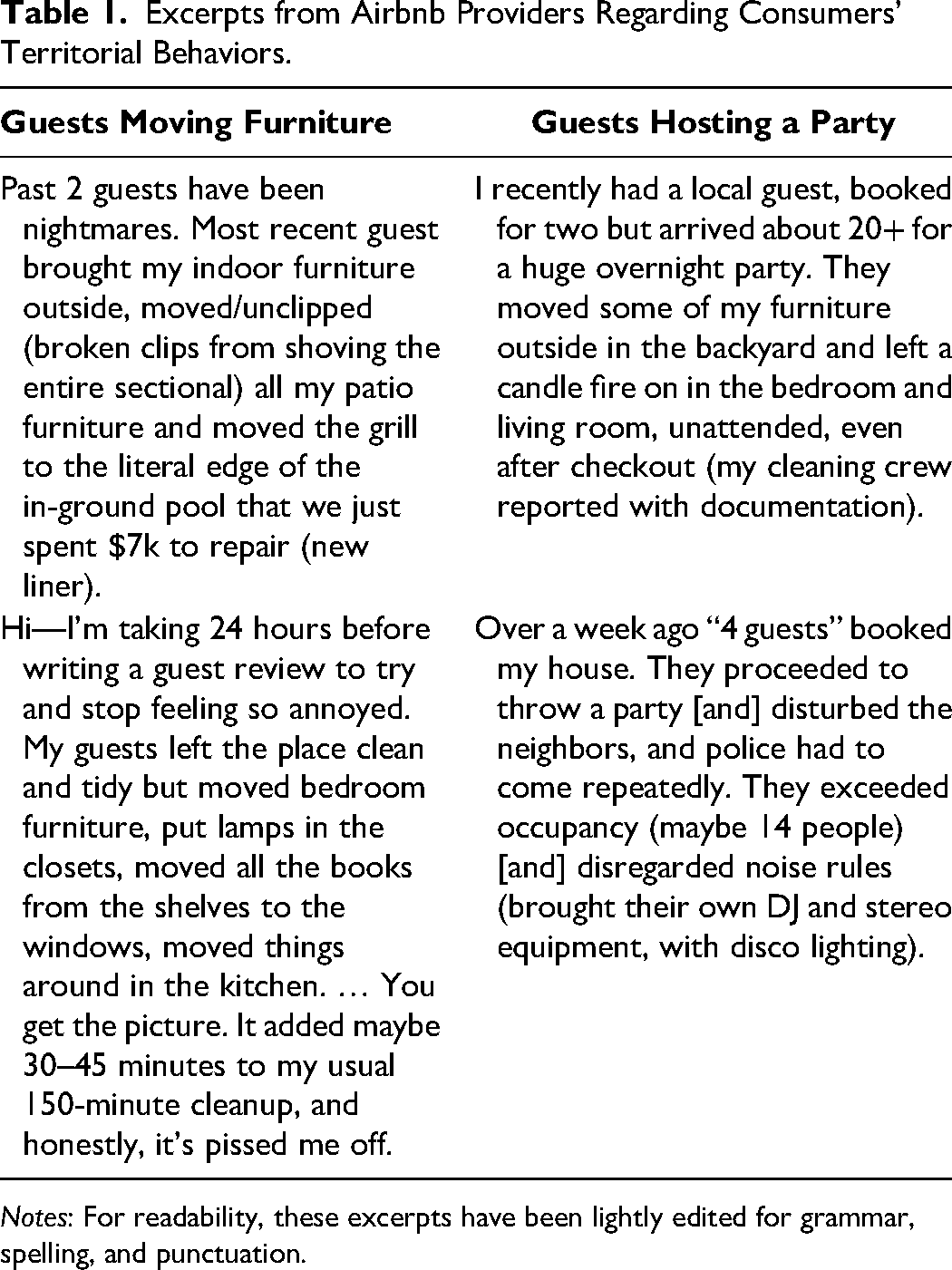
Notes: For readability, these excerpts have been lightly edited for grammar, spelling, and punctuation.
Overview of Studies
We test our hypotheses across nine studies in three access-based rental domains (vacation properties, vehicles, and books). Studies 1a–1c test our hypothesis regarding the effect of provider identity on consumer psychological ownership (H1) and territorial behaviors in the form of marking (H2), and they demonstrate that consumer psychological ownership mediates these territorial behaviors (H3). Study 1a provides initial support for our hypothesis, and Study 1b tests whether differences in feelings of responsibility might explain the disparity in consumer engagement in territorial behaviors when renting from company versus person providers. Study 1c examines the effect of provider identity on real observed territorial behavior. Moving beyond marking territorial behaviors, Studies 2a and 2b demonstrate the impact of provider identity on the defending type of territorial behaviors in response to perceived provider infringements.
In the next set of studies (Studies 3a, 3b, 4a, and 4b), we investigate how consumers’ dual roles—as observers of the provider's ownership and as actors with psychological ownership over the product—moderate these effects. Based on our theorizing that consumers’ psychological ownership (as actors) is inversely related to their perceptions of the provider's ownership (as observers), Studies 3a and 3b manipulate the antecedent of perceptions of the provider's ownership: the perceived connection between the provider and the product. In Study 3a, we weaken this connection to show that it amplifies territorial behaviors, whereas in Study 3b, we strengthen it to reduce engagement in such behaviors. Further, in Studies 4a and 4b, we focus on consumers’ role as actors by manipulating their feelings of psychological ownership. In Study 4a, we increase consumers’ psychological ownership, amplifying territorial behaviors, whereas in Study 4b, we use provider-imposed rules that should restrict the development of psychological ownership, thereby reducing these behaviors. All sample sizes, manipulations, and measures are reported for each study. All datasets are available on OSF (https://osf.io/k63nu/?view_only=fc56553e1a6d4ae68bf7dd697cbe6ab4).
Studies 1a–1c: Provider Identity, Psychological Ownership, and Territorial Behaviors—Marking
Studies 1a–1c were designed not only to examine how the identity of the rental provider influences consumers’ psychological ownership of a rented product, but also to assess its downstream effects on territorial behaviors of marking (i.e., actions reflecting the consumer's personal preferences, such as use or modification of the product; Brown, Lawrence, and Robinson 2005; Kirk, Peck, and Swain 2018). Additionally, we rule out the alternative explanation that differences in territorial behaviors are driven by perceptions of differences in responsibility (Study 1b). Further, we demonstrate that the territorial action can be real and detrimental to the rental product (Study 1c). Extending the generalizability of our findings, we explore three rental domains: vehicle rentals, vacation home rentals, and book rentals.
Study 1a
In Study 1a, we examined how provider identity influenced territorial (i.e., marking) behaviors in a vehicle rental context. Specifically, we assessed participants’ willingness to drive a rental vehicle on unpaved, off-road routes—a behavior that exerted renters’ claim over the product through their preferred use and that was likely to cause significant wear and tear.
Method
Three hundred Prolific workers (33.3% male, 65.3% female, 1.3% third gender; 32.7% between 26–35 years of age 1 ) completed the study for payment. Participants were randomly assigned to one of two conditions (provider: company vs. person) in a between-subjects design. They were then asked to indicate their psychological ownership of the rental product and their intent to engage in territorial behavior. This study was conducted as part of a larger series of studies, and participants provided their demographic information (e.g., age and gender) before proceeding to the specific scenario.
In the scenario, participants were told to imagine they were taking a vacation on the island of Kauai in Hawaii (see Web Appendix J for all experimental stimuli). To explore the island on their own, they decided to rent a car for one day from an app that offered various rental options. Participants in the company-provider condition imagined renting a midsize sedan from a company called Apex Rental, whereas participants in the person-provider condition imagined renting the same midsize sedan from a person named Alex Smith. To measure psychological ownership, participants were asked to what extent they felt that the car was theirs during the rental period (1 = “not at all,” and 7 = “very much”; adapted from Peck and Shu [2009]). To assess territorial behavior, participants were told that while driving, they saw a sign that said “Scenic Lookout Trail with Great Views!” and indicated the trailhead to start the hike was three miles away, down an old, rugged logging road. They were then asked how comfortable they would feel driving the car they had rented down the unpaved road to reach the secluded trailhead (1 = “not at all comfortable,” and 7 = “very comfortable”).
Results and Discussion
As hypothesized, a one-way ANOVA revealed that participants felt significantly more psychological ownership of the car when it was rented from a company provider than when it was rented from a person provider (MC = 3.42, SD = 1.80 vs. MP = 2.59, SD = 1.59; F(1, 298) = 18.12, p < .001,
We ran a supplementary study to replicate our findings with another form of territorial marking behavior previously tested in the access-based vehicle rental literature (Bardhi and Eckhardt 2017; Web Appendix K): altering a rental vehicle's preset radio stations to align with personal preferences. To further validate the robustness of our findings, we controlled for vehicle rental price and reversed the order of our measures, asking about psychological ownership after territorial behavior, rather than before, as we did in Study 1a. The results replicated those of Study 1a.
Next, we examined a new type of territorial marking behavior in the context of vacation home rentals, while addressing a competing alternative mechanism.
Study 1b
Territorial behaviors exhibited by consumers in access-based rentals could also be interpreted through the lens of responsibility. Rather than reflecting stronger feelings of psychological ownership, these actions might indicate and be driven by a lower sense of responsibility toward the product. Research on public goods, a context in which ownership is ambiguous, suggests that psychological ownership often leads to a heightened sense of responsibility, which then drives positive caretaking behaviors (Peck et al. 2021). Thus, in the context of access-based rentals, increased engagement in territorial behaviors when renting from a company provider, as opposed to a person provider, could be interpreted as reduced responsibility (i.e., less caretaking) toward the product. We tested this alternative explanation in this study.
Method
Four hundred one Amazon Mechanical Turk workers recruited via CloudResearch (41.6% male, 56.4% female, 1.2% other, .7% prefer not to answer; Mage = 41.13 years, SD = 12.59) completed the study. Participants were randomly assigned to one of two conditions (provider: company vs. person) in a between-subjects design in which they were given a cabin rental scenario and asked to indicate (1) their likelihood of engaging in a territorial marking behavior with the rental product, (2) their feelings of psychological ownership over the rental product, and (3) their sense of responsibility toward the rental product.
All participants were told to imagine that they wanted to rent a cabin for a weekend in the mountains and were looking for options on an online platform. Participants assigned to the company-provider condition were told they had rented a cabin for the weekend from a company called Mountain Vacation Rental, whereas participants assigned to the person-provider condition were told they had rented the cabin from a person named Alex Smith. All participants saw the same cabin picture, to control for quality perceptions. Next, to measure the likelihood of engaging in a territorial behavior that depicted one's claim over the rental property, we asked participants how likely they would be to move some furniture in the cabin to a position they preferred (1 = “not at all,” and 7 = “very much”). This specific territorial behavior was referenced in the consumer survey (Web Appendix C) and had a consequential impact for providers, as revealed in provider comments on the Airbnb community platform (Web Appendix B).
Participants then indicated their feelings of psychological ownership over the rental cabin using a measure similar to the one used in Study 1a (i.e., how much they felt that the cabin was theirs during the time they were renting it; 1 = “not at all,” and 7 = “very much”). We also asked participants how responsible they felt for the cabin during the time they were renting it (1 = “not at all,” and 7 = “very much”). The order of the psychological ownership and responsibility measures was randomized. Lastly, participants completed a manipulation check, identifying their rental provider as a company or a person, and answered demographic questions about their age and gender.
Results and Discussion
A one-way ANOVA analysis revealed results in line with Study 1a. Supporting H1, participants felt significantly more psychological ownership of the cabin when renting from a company provider than when renting from a person provider (MC = 4.11, SD = 1.81 vs. MP = 3.48, SD = 1.73; F(1, 399) = 12.63, p < .001,
We also examined whether differences in responsibility affected participants’ willingness to engage in territorial behaviors and found that the mediating pathway through responsibility was not significant (provider identity → responsibility → territorial behavior; b = −.03, SE = .03; 95% CI: [−.092, .011]). Next, we tested whether psychological ownership influenced responsibility, which, in turn, could lead to engagement in territorial marking behaviors. However, a serial mediation analysis (using PROCESS Model 6; Hayes 2018) did not find support for this proposed serial mediation model (b = .003, SE = .004; 95% CI: [−.003, .014]). Only the single mediating pathway through psychological ownership was significant.
We did not find empirical support for responsibility as an explanation of our documented effect, which aligns with our theory that provider identity influences territorial behaviors through psychological ownership (rather than responsibility). Access-based rentals create a dual-entity dynamic in which consumers’ temporary access (as actors) creates ownership feelings, even though, as observers, they recognize that a specific provider owns the product. This dynamic differs from contexts in which ownership is either clearly assigned to one party or is ambiguous. For example, in the case of public goods (Peck et al. 2021), the absence of a specific owner encourages individuals to feel heightened responsibility for those goods, often leading to caretaking behaviors. In contrast, access-based rentals have a clearly identifiable owner (the provider), so responsibility attributions remain unchanged. Nonetheless, consumers differ in their feelings of ownership over the product and in their willingness to engage in territorial behaviors.
In the next study, we replicated the effects observed in prior studies by examining actual territorial behavior in another rental context: book rentals. In this context, such behavior can negatively affect the condition of the product. Unlike previous studies, which measured behavioral intentions, this study captured real-world territorial behavior.
Study 1c
In this study, we examined the domain of book rentals and measured participants’ actual engagement in territorial marking behaviors (i.e., marking the book with a pen, pencil, or highlighter), which, in this context, impact the rental product's condition and future value. The study design and analysis were preregistered on AsPredicted.org (https://aspredicted.org/wxn6-fwxy.pdf).
Method
Three hundred four behavioral lab participants (37.5% male, 60.5% female, 1.3% other, .7% prefer not to answer; Mage = 29.86 years, SD = 10.84) at a private university completed this study for payment. Participants were randomly assigned to one of two conditions (provider: company vs. person) in a between-subjects design with a book rental scenario. Participants were provided with a book and asked to answer some questions related to its content. Their engagement in territorial marking behaviors with the book was recorded.
Upon entering the lab, all participants were provided with a poetry book, three writing utensils (a highlighter, a pen, and a pencil), an index card with their completion code, and a piece of scrap paper. We created a book of poetry titled Poetic Reflections, which was printed and bound by a university press. Each book contained approximately 23 pages, with a single poem featured on each page. The book also contained information about the owner inside the front cover: In the person-provider condition, the inside had a stamp that said, “This Book Belongs To,” with the provider listed as Alex Smith (written in ink). In the company-provider condition, the provider was listed as Apex Book Rental (uniformly stamped) (see Web Appendix J for stimuli). Books designated for person versus company provider conditions were distributed to incoming participants in an alternating order to provide randomization of conditions.
After collecting the materials from the lab manager in the lobby, participants took their seats in the lab and began the survey session. Participants were informed that they would be using a rented poetry book for a 25-minute session designed to study how people perceived and consumed poetic content. Participants were then asked to identify whether the book they were using was rented to them by a person provider or a company provider and to write the name of the provider that had rented the book to them in a text box.
Following this, they were asked task-based questions that required them to read portions of the poetry book and acknowledge various aspects of its content. For example, they were asked to count the number of times the words “me” and “we” appeared in a specific poem. Participants completed the three task-based questions, answered demographic questions about their age and gender, and then submitted their completion code. Upon exiting the lab, they returned the book and all supplies (writing utensils, index card with completion code, and scrap paper) to the lab manager.
Our dependent variable was whether participants made any sort of mark in the rental book using any writing utensil (i.e., pen, pencil, or highlighter). We provided a piece of scrap paper at each participant's desk so that participants had the option to complete the task without making any marks in the book. In this context, participants’ actions of writing in the book reflect their sense of comfort with or desire to modify the book for their own purposes, serving as a form of territorial marking behavior. The completion code provided with the book enabled us to match each rental book with the participant's survey responses.
Results and Discussion
Per our preregistration, for each participant, we recorded the total number of marks made in their book with a highlighter, pen, and pencil. As people have preferences regarding their favored writing utensil, our focus was not on whether any participant used a specific writing utensil or not, but whether participants engaged in making some type of mark (regardless of writing utensil) in the book. Thus, we coded our dependent variable of territorial marking behavior as 1 if a participant made any type of mark in the book. Those who did not make any marks were coded as 0. Supporting H2, participants were more likely to mark in the rental book when it was rented from a company provider (25.81%) as opposed to a person provider (PP = 13.42%; χ2(1) = 6.59; p = .010); a detailed analysis of marks made with each type of writing utensil can be found in Web Appendix L). This study replicated the effect of provider identity on consumers’ territorial behavior with a rental product, examining behaviors that negatively impacted the product's condition. These results strengthened the ecological validity by capturing actual behavior and highlighting the tangible consequences for rental providers.
Overall, Studies 1a–1c provided robust support for our three hypotheses (H1–H3) across three distinct rental contexts, demonstrating how territorial behaviors articulate consumers’ claims over rented products. Importantly, psychological ownership drove territorial behaviors (H3), and we ruled out responsibility as an alternative explanation for the effect of provider identity on territorial behaviors.
Studies 2a and 2b: Provider Identity, Psychological Ownership, and Territorial Behaviors—Defending
Whereas Studies 1a–1c focused on territorial behaviors in the form of marking (actions that assert a consumer's claim over their territory—i.e., the rental product), Studies 2a and 2b expanded the scope to examine the other documented form of territorial behavior: defending. Defending is characterized as behavioral manifestations of anger in response to perceived violations of one's territory (Brown, Lawrence, and Robinson 2005; Hingston and Whelan 2024). These reactions typically arise when individuals perceive ownership over an item, only to have that infringed on by another party. Unlike marking behaviors, which could be misconstrued as driven by responsibility toward the product, defending arises from anger and reflects a protective response to perceived territorial infringement. Thus, Studies 2a and 2b tested our hypotheses (H1–H3) and reinforced that psychological ownership, rather than responsibility, shapes territorial behaviors in access-based rentals.
Study 2a
In Study 2a, we used the context of property rentals to examine participants’ likelihood of leaving a negative review when faced with access restrictions perceived as an infringement on their territory. Whereas time and financial costs were associated with territorial marking behaviors, this behavior underscores the reputational consequences rental providers could face.
Method
Four hundred one participants on Connect, an online platform offered by CloudResearch (50.1% male, 49.4% female, .5% prefer not to answer; Mage = 40.87 years, SD = 11.36) completed the study for payment. Participants were randomly assigned to one of two conditions (provider: company vs. person) in a between-subjects design with a cabin rental scenario. They were asked to indicate their feelings of psychological ownership over the product as well as their intention to engage in a reactionary defense territorial behavior.
All participants were told to imagine they were searching an online platform for a place to rent for a weekend getaway in the mountains. Participants assigned to the company-provider condition were told that they booked a cabin owned by a company called Alpine Rental, whereas participants in the person-provider condition were told that they had booked a cabin from a person named Alex Smith. All participants were shown a picture of the same cabin, to control for any differences in expectations.
Participants then indicated their feelings of psychological ownership toward the cabin using an measure analogous to that employed in Study 1b (i.e., how much they felt that the cabin was theirs during the time they were renting it; 1 = “not at all,” and 7 = “very much”). Subsequently, to suggest infringement by the property owner (i.e., provider), all participants were informed that access to one of the outdoor spaces of the property, which included an outdoor grill, was restricted. This restriction highlighted the provider's infringement on consumers’ perceived territory during the rental period. In response, participants were asked to indicate how likely they would be to leave a negative review for the property owner (1 = “not at all likely,” and 7 = “very likely”). This measure captured participants’ emotional responses to the infringement, representing a form of territorial behavior expressed as defending. Lastly, participants answered demographic questions about their age and gender.
Results and Discussion
A one-way ANOVA showed that participants felt significantly more psychological ownership of the cabin when renting from a company provider as opposed to a person provider (MC = 4.00, SD = 1.81 vs. MP = 3.50, SD = 1.78; F(1, 399) = 7.77, p = .006,
Study 2b
Another way providers may be seen as infringing on a consumer's territory is by canceling rental agreements after consumers have booked the rental but before the consumer gains physical access to the product. Booking a rental transaction gives consumers a sense of ownership before obtaining physical access. Canceling a booking restricts access to what consumers view as contractually theirs, constituting a form of territorial infringement. Managers, historically, offer compensation to mitigate consumer anger from service failures (Gelbrich 2010), such as booking cancellations. In this study, we used the compensation demanded by consumers as a sign of defending, reflecting consumers’ anger over a perceived infringement by the provider. We hypothesized that consumers demand higher compensation from company providers compared with person providers due to having stronger psychological ownership over the rental product. However, an alternative explanation could be that consumers perceive company providers as having greater resources than person providers. To address this, we included an additional condition featuring a person provider with greater resources (i.e., multiple properties).
Method
Three hundred sixty-five Amazon Mechanical Turk workers recruited via CloudResearch (50.1% male, 49.3% female, .5% prefer not to answer; Mage = 36.35 years, SD = 11.30) participated in the study for payment. Participants were randomly assigned to one of three conditions (provider: company vs. person vs. person with multiple resources) in a between-subjects design. In this cabin rental scenario, participants indicated how much compensation they would require upon being denied access to the property they had booked.
All participants imagined they were planning a vacation in Colorado and had rented a two-bedroom cabin for one night. Participants in the company-provider condition were told they had rented the cabin from a company provider called Aspen Management Company, whereas those in the person-provider condition were told they had rented the cabin from a person provider named Donna Smith. Additionally, participants in the person-provider-with-multiple-resources condition were informed that the provider, Donna Smith, “had multiple properties in the area.” A potential concern was that if the provider had multiple properties, that might reduce perceived provider–product connection; however, a separate posttest confirmed this was not the case (see Web Appendix M). All participants were informed that upon their check-in, the provider unexpectedly needed to reclaim the cabin. They were then asked to indicate the compensation amount they would accept for relinquishing the cabin, using a sliding scale from $1 to $400. Lastly, participants completed a manipulation check to identify their rental provider as either a company or a person and provided their demographic information.
Results and Discussion
A one-way ANOVA revealed a significant main effect of provider identity on defending territorial behavior, measured by the amount of compensation requested (F(2, 362) = 4.82, p = .009,
While, Study 2a confirmed that psychological ownership explained the difference in defending behaviors associated with provider identities, we did not measure psychological ownership in Study 2b. However, a supplementary study (Web Appendix N) employing a two-cell design confirmed that psychological ownership mediated the difference in compensation amounts between company and person providers. Overall, Studies 2a and 2b provided evidence supporting our three hypotheses (H1–H3) regarding territorial behaviors, specifically in the form of defending as a behavioral expression of consumer anger in response to perceived territorial infringements.
In the next set of studies, we strengthened support for our mechanism by examining how the effect of provider identity on territorial behaviors can be moderated. Our theory suggests that consumers renting products assume a dual role: actors having psychological ownership and observers recognizing the provider's ownership. Studies 3a and 3b focus on the consumer's role as an observer, exploring how consumer perceptions of the provider's ownership influence the effect. Studies 4a and 4b examine the consumer's role as an actor, investigating how their psychological ownership over the product moderates the effect.
Studies 3a and 3b: Moderation of Territorial Behaviors from Consumer’s Role as Observer of Provider's Ownership
Building on the dual-role framework, our theory suggests that consumers’ psychological ownership (as actors) is inversely related to their perceptions of the provider's ownership (as observers). Consumers frequently perceive company providers as exerting less ownership over rental products compared with person providers, creating an opportunity for consumers to have stronger feelings of psychological ownership (Web Appendix G). This perceived lack of ownership among company providers largely stems from their weaker perceived connection to the product compared with person providers (Web Appendix E). In this set of studies, we proposed that in consumers’ role as observers of a provider's ownership, variations in the perceived connection between the provider and the product influence consumers’ engagement in territorial behaviors. A weaker provider–product connection increases consumers’ willingness to engage in territorial behaviors (Study 3a), whereas a stronger provider–product connection discourages such behaviors (Study 3b).
Study 3a: Weak Provider–Product Connection Leads to Increased Territorial Behaviors
In this study, we weakened the perceived connection between the provider and the rental product by introducing an intermediary employee, creating distance between provider and product. We anticipated this strategy would have a particularly strong impact on person-provider rentals, a context in which the connection between the person provider and the product is perceived to be stronger. Beyond its theoretical significance, this study offered managerial insights, given the trend of person providers transitioning to professional providers by establishing companies that have property managers to handle rental operations.
Method
Six hundred fifty-two Prolific workers (48.3% male, 50.8% female, .9% prefer not to answer; Mage = 35.42 years, SD = 11.75) completed the study. Participants were randomly assigned to one of four conditions in a 2 (provider identity: company vs. person) × 2 (provider–product connection: control vs. weak) between-subjects design. In this scenario, involving a Jeep rental, participants were asked to indicate their likelihood of engaging in a territorial marking behavior with the rental product.
All participants were told to imagine they had rented a two-door Jeep for one day for $70. Participants in the company-provider condition were told they had rented the Jeep from a company called Mountain Jeep Rental, whereas those in the person-provider condition were told they had rented the Jeep from a person named Alex Smith. Participants then completed a manipulation check identifying their rental provider as either a company or a person. We added this check early, as we wanted the participants to be sure of the provider’s identity before introducing the employee in the provider–product connection manipulation.
Subsequently, participants in the weak provider–product connection condition were told that upon reaching the rental location to obtain the Jeep, they met an employee. Participants read the following description of the employee: You meet Taylor, an employee of Alex Smith (Mountain Jeep Rental), who personally manages the specific Jeep that you are renting. Taylor attends to this Jeep daily and knows the ins and outs of it, as if it were their own.
Not only should the introduction of an employee into the rental transaction weaken the connection between the rental product and its owner (i.e., the rental provider), but our manipulation also utilized the concepts of control (i.e., personally managing the Jeep) and intimate knowledge (i.e., knowing the ins and outs of the product) to convey the employee's connection to the rental product, further distancing the provider from the product (a separate posttest validated the effectiveness of this manipulation on weakening the provider–product connection for a person provider; see Web Appendix O).
Alternatively, in the control condition, participants were provided the same text about going to the rental location to obtain the Jeep, but there was no mention of an employee. Then, all participants were informed that the Jeep came with a stereo that had preset radio station buttons. To measure their likelihood to engage in a territorial behavior that communicated their claim over the product (i.e., marking), we asked participants to indicate their likelihood to change the radio station preset buttons to something reflecting their preference (1 = “not at all likely,” and 7 = “very likely”); this dependent variable was based on a prior behavior examined in the context of access-based car rentals (Bardhi and Eckhardt 2017).
Immediately following the exercise, participants answered questions about whether an employee was present, as well as demographic questions about their age and gender.
Results and Discussion
A 2 × 2 between-subjects ANOVA revealed significant main effects of provider identity (MC = 3.62, SD = 2.32 vs. MP = 2.78, SD = 2.22; F(1, 648) = 22.28, p < .001,
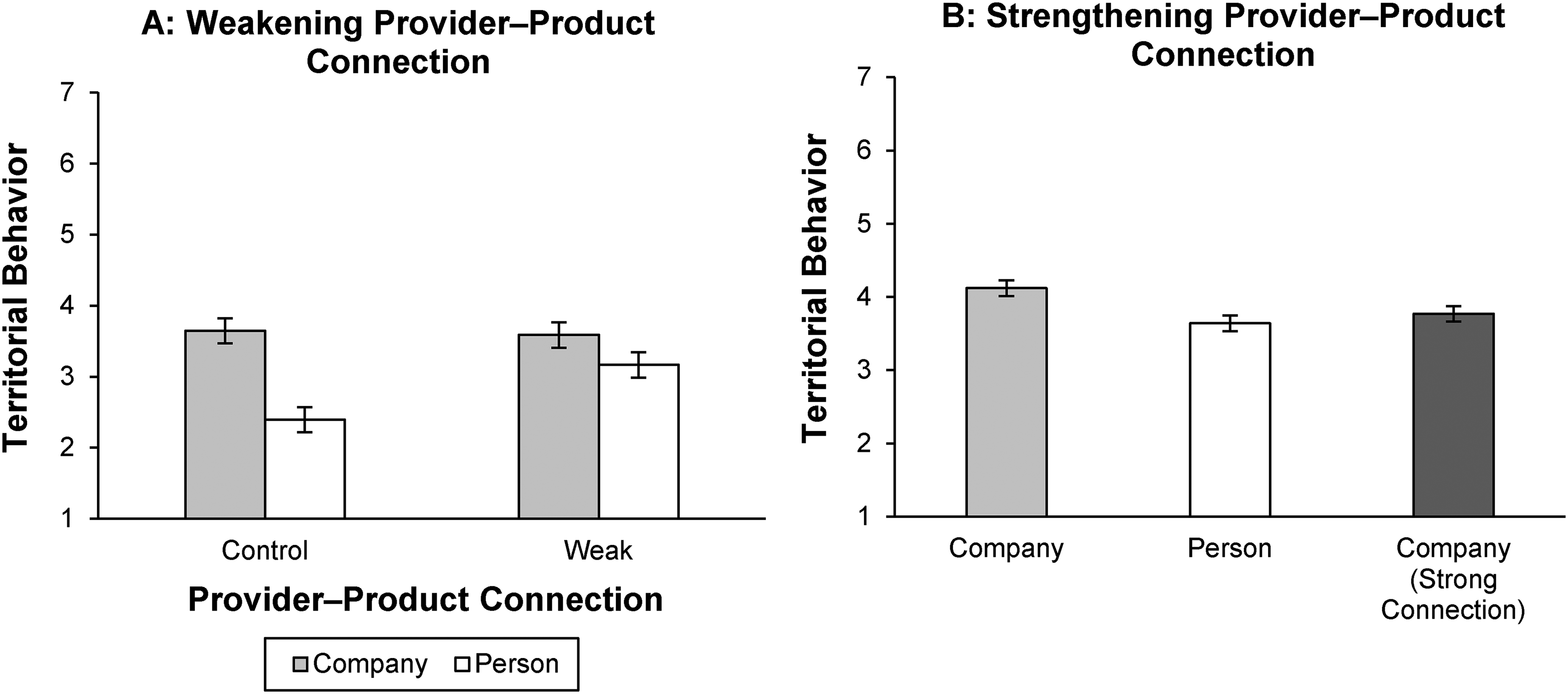
Effect of Provider Identity and Provider–Product Connection on Territorial Behaviors.
While this study demonstrated that a weaker connection between the provider and the rental product can encourage consumers to engage in territorial behavior, the next study showed that a stronger provider–product connection can discourage territorial behavior.
Study 3b: Strong Provider–Product Connection Leads to Decreased Territorial Behavior
In this study, we strengthened the provider–product connection by communicating to consumers cues of providers’ connection with the product. We did so by incorporating these cues into a provider welcome note about the rental product. These welcome notes are a common practice, often used by rental providers to share personal stories about their products (e.g., “We built this beach house,” or “This was my first car”). We expected this strategy to have a particularly strong impact on rentals from company providers, where the provider–product connection is typically perceived as weaker.
Method
Six hundred one participants on Connect (49.6% male, 49.8% female, .3% others, .3% prefer not to answer; Mage = 39.31 years, SD = 12.13) completed the study for payment. Participants were randomly assigned to one of three conditions (provider: company vs. person vs. company with strong provider–product connection) in a between-subjects design in which they were given a cabin rental scenario and asked to indicate their likelihood to engage in territorial behavior with the rental product.
All participants were told to imagine that they were searching an online platform to rent a place for a weekend getaway. Participants were told they had rented a cabin for the weekend either from a company called Lake Rental (company provider) or a person named Alex Smith (person provider). All participants were shown a picture of the same cabin, to hold quality perceptions constant (see Web Appendix J for stimuli).
Additionally, in the company with strong provider–product connection condition, participants read a welcome note from the provider that incorporated cues communicating the provider's connection to the property (e.g., “This was the first house Lake Rental started renting out 4 years ago”; full text in Web Appendix J. These cues sought to strengthen provider connection to the product by focusing on self-investment (Pierce, Kostova, and Dirks 2003) and creating a narrative (Escalas 2004).
Next, analogous to the process for Study 2a, participants were told that during their rental period, they did not have access to some areas in the property. To measure territorial behavior in the form of defending (a context in which restricting consumers’ access to the property can be viewed as an infringement of their territory), we assessed participants’ likelihood to leave a negative review (1 = “not at all likely,” and 7 = “extremely likely”). To validate our manipulation, we measured participants’ perception of the provider's connection to the rental property (1 = “no personal connection,” and 7 = “a very strong personal connection”). Finally, participants answered demographic questions about their age and gender.
Results and Discussion
First, a one-way ANOVA confirmed the effectiveness of our provider–product connection manipulation (F(2, 598) = 33.30, p < .001,
Importantly, a one-way ANOVA revealed a significant main effect of provider identity on likelihood to engage in territorial behavior with the rental product (F(2, 598) = 5.77, p = .003,
We found that communicating cues of the provider's connection to the rental product enhanced perceptions of the provider–product connection, which helped mitigate the detrimental effect of company provider identity on consumers’ territorial behaviors. These findings suggested that providers, especially those transitioning to a professional model, should share details about their connection to the rental product to deter territorial behaviors.
Studies 4a and 4b: Moderation of Territorial Behaviors from Consumer’s Role as an Actor Having Psychological Ownership
Whereas Studies 3a and 3b explored how consumers’ perceptions of the connection between the provider and the rental product impact their territorial behavior in their role as observers of the provider's ownership, Studies 4a and 4b examined impacts on consumers’ territorial behavior by focusing on their role as actors having feelings of psychological ownership toward the rental product. We hypothesize that emphasizing consumers’ psychological ownership increases engagement in territorial behaviors (Study 4a), whereas diminishing consumers’ psychological ownership decreases engagement in territorial behaviors (Study 4b).
Study 4a: Emphasizing Consumer Psychological Ownership
Based on our theory that consumers operate as actors with feelings of psychological ownership over the rental product, we proposed that enhancing consumers’ psychological ownership of a rental product increases their likelihood of engaging in territorial behaviors. In access-based marketplaces, providers could foster this sense of ownership by emphasizing that the product was theirs (i.e., the consumer's)—for instance, through personal messages or welcome notes (e.g., “Welcome to your cabin”). In this study, we examined the impact of this strategy on consumers’ willingness to engage in territorial behaviors.
Method
Six hundred one participants on Connect (49.9% male, 49.9% female; .2% prefer not to answer; Mage = 38.79 years, SD = 11.93) completed the study for payment. Participants were randomly assigned to one of three conditions (provider: company vs. person vs. person with consumer psychological ownership emphasis) in a between-subjects design. In this cabin rental scenario, participants were asked to indicate their likelihood to engage in a territorial marking behavior with the rental product.
All participants were told to imagine that they were searching an online platform to rent a place for a weekend getaway. Participants assigned to the company-provider condition were told they had rented a cabin for the weekend from a company called Lake Rental, whereas participants assigned to the person-provider condition were told they had rented the cabin from a person named Alex Smith. All participants were shown a picture of the same cabin. Additionally, in the person-provider condition with an emphasis on consumer psychological ownership, participants were told that upon reaching the cabin, they found a welcome note from Alex Smith that presented the cabin as theirs, with phrases like “Welcome to your personal cabin—your very own haven” (see Web Appendix J for details on all stimuli).
All participants were then asked about their intention to engage in a territorial behavior with the rental product. Using a different type of dependent variable in this cabin rental context than was used for prior studies, we told participants that despite planning for only their family to stay at the cabin, they were considering inviting a friend and a few others over for a celebration. Participants were asked how likely they would be to throw a party and decorate the cabin (1 = “not at all likely,” and 7 = “very likely”). We employed this specific form of territorial behavior because it reflects consumers’ willingness to do what they want with the cabin and is managerially relevant, as consumers acknowledge doing such activities (Web Appendix C) and rental providers complain about the damage caused by these behaviors (Web Appendix B). Lastly, participants answered demographic questions about their age and gender.
Results and Discussion
A one-way ANOVA revealed a main effect of provider condition on likelihood to engage in territorial behavior with the rental product (F(2, 598) = 3.89, p = .021,
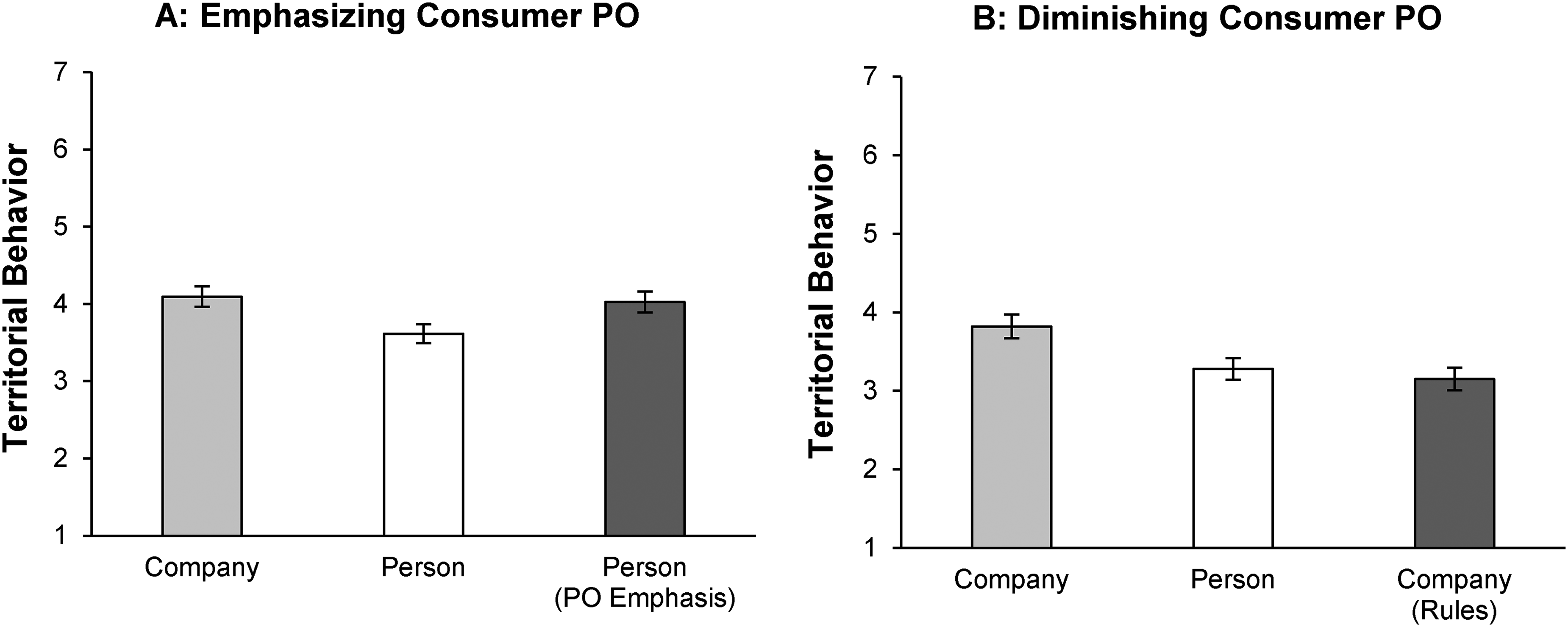
Effect of Provider Identity and Consumer Psychological Ownership on Territorial Behaviors.
Study 4b: Diminishing Consumer Psychological Ownership
The previous study explored how emphasizing consumers’ psychological ownership increased territorial behaviors, but this study focused on how reducing psychological ownership, in turn, decreased consumers’ engagement in territorial behaviors. One of our pilot studies (Web Appendix H) identified control over the rental product as a key driver of psychological ownership in access-based rentals. Building on this insight, we employed a strategy designed to reduce consumers’ feelings of psychological ownership by diminishing their sense of control over the rental product. Specifically, we used a common approach seen on platforms like Airbnb: Providers imposed rules governing how consumers could use the rental property, to restrict consumers’ perceived control. The study was preregistered (https://aspredicted.org/pcnd-vpzq.pdf).
Method
Six hundred two participants (49.3% male, 49.7% female, and 1.0% prefer not to answer; Mage = 41.10 years, SD = 12.12) on Prolific completed this study for payment. Participants were randomly assigned to one of three conditions (provider: company vs. person vs. company with rules) in a between-subjects design. They were given a cabin rental scenario and asked to indicate their willingness to engage in a territorial behavior with the rental product.
All participants were told to imagine that they were searching an online platform to rent a cabin for a weekend in the mountains. They then imagined renting a cabin from either a company called Mountain Vacation Rental (company provider) or a person named Alex Smith (person provider), per their assigned condition. All participants saw a picture of the same cabin, to control for quality perceptions. Additionally, in the company-provider condition with rules, participants were presented with nine rules established by the company that guests were to abide during their stay (e.g., keep noise to a normal level, no outside guests besides those listed in the reservation, no pets allowed; see Web Appendix J for full stimuli). This is a common practice that rental providers employ for their properties, and there are lots of templates on how rental providers can develop these rule lists for rental consumers (iGMS 2020; Lodgify 2025). Note that none of the rules were related to the measured territorial behavior of moving furniture. Next, participants indicated their willingness to engage in the territorial marking behavior of moving furniture in the cabin to a position of their preference (1 = “not at all likely,” and 7 = “extremely likely”). Lastly, participants answered demographic questions about their age and gender.
Results and Discussion
A one-way ANOVA revealed a significant main effect of provider identity on willingness to engage in territorial behavior (F(2, 599) = 6.07, p = .002,
General Discussion
Across nine studies examining both intended and actual behavior with rental products, and 16 additional studies and analyses in the Web Appendix, we found support that whom the consumer rents from matters. Spanning various rental product domains (including high-value rentals, such as vacation properties, and low-value rentals, such as books), we demonstrated that consumers engage in territorial behaviors with rental products significantly more when renting from company providers as opposed to person providers. This difference in territorial behaviors is driven by varying levels of psychological ownership consumers have toward the product—specifically, that consumers feel more psychological ownership over products rented from a company than they do with products rented from a person. Importantly, our hypotheses hold across two types of territorial behaviors: marking and defending. These behaviors have financial (e.g., extended cleaning time, costs to repair damages, greater requested compensation for a service failure) and reputational (e.g., negative reviews) consequences for rental providers. Further, consumers assume a dual role in access-based rentals: observers of providers’ ownership and actors expressing psychological ownership toward the rental product. Consequently, factors that affect either role influence consumer engagement in territorial behaviors.
Theoretical Implications and Future Research
Our work makes three key theoretical contributions. First, we build on existing research on renting by exploring the consumer-provider interaction beyond the traditional contrast between renting and ownership. Previous studies on the access economy have focused on understanding platform operations, particularly the dynamic between person providers offering resources and consumers using them (e.g., Benoit et al. 2017; Cusumano 2014; Wirtz et al. 2019; Zervas, Proserpio, and Byers 2017). However, business models on access economy platforms are evolving (Andreassen et al. 2018), with one major change being the inclusion of company providers alongside person providers. Our research sheds light on this change and its implications for consumer behavior. While previous research has explored the impact of marketing communications (Costello and Reczek 2020) and attachment cues (Graul and Brough 2021) on consumers’ willingness to pay for rental products, as well as the impact of provider and consumer interactions on consumer loyalty (Pino, Nieto-García, and Zhang 2022), we build on this growing work by showing that the rental provider identity impacts consumers’ feelings about and behaviors with rental products once they have rented them.
Second, our work adds to the literature on psychological ownership by answering calls to explore it in nontraditional domains and dynamics (Morewedge and Weiss 2023). Specifically, our work highlights how psychological ownership operates in access-based rental contexts, in which consumers serve a dual-role: an actor having feelings of psychological ownership toward the rental product during their temporary access to it and an observer aware of the provider's salient and overarching ownership of the product during their rental.
Lastly, we use the framework of territoriality to explore how psychological ownership shapes consumer behaviors within access-based rentals. These behaviors—such as marking and defending, which may damage the product, increase cleaning time and labor costs, or harm the provider's reputation—highlight how consumers’ psychological ownership of the rental product can have negative consequences for the rental provider, extending prior work that has traditionally documented the positive effects of psychological ownership (Peck and Shu 2009; Peck et al. 2021). Consequently, our research contributes to understanding the potential pitfalls associated with psychological ownership, addressing a critical area that has received calls for further exploration (Morewedge et al. 2021).
Managerial Implications
Territorial behaviors are prevalent among consumers in access-based rentals, as demonstrated by our consumer survey (Web Appendix C) and provider comments on the Airbnb Community Center platform (Web Appendix B). These behaviors carry reputational and financial consequences. A secondary analysis of Airbnb comments revealed both the financial impact and negative perception of these behaviors among providers (Web Appendix B), and a back-of-the-envelope calculation (Web Appendix I) estimated that even acts like rearranging furniture could lead to approximately $502 in extra cleaning expenses per year for a single provider.
Given the consequences of consumers’ territorial behaviors for rental providers, our work provides valuable insights for managers. First, as provider identity shapes consumers’ behaviors toward rented products, rental providers should thoughtfully consider how they present themselves on access-based platforms. Prior work has acknowledged that professionalized providers (i.e., those managing multiple listings) can often earn higher revenues (Deboosere et al. 2019), especially on Airbnb, where the platform's API favors multiproperty providers (Bosma and Van Doorn 2024). However, less attention has been given to how providers choose to present or position themselves to consumers and how this presentation may influence consumer behavior.
Our findings suggest that individuals who operate rental properties as professionals may benefit from presenting themselves as person providers rather than company providers on access-based platforms. This strategy enables them to retain the advantages of professionalization while potentially reducing operational and maintenance costs. Indeed, a pretest for Study 2b confirmed that owning multiple properties as a person provider does not weaken their perceived connection to the property (Web Appendix M). Even those who identify as company providers (e.g., limited liability companies or those using company-sounding names) and are typically viewed as having a weaker connection to the product can reduce territorial behaviors by emphasizing a personal connection with their rental product, as demonstrated in Study 3b and echoed in our conversations with Airbnb providers (Web Appendix A). For example, one provider described decorating the space with original artwork, noting, “I have all original artwork. … I don’t expect people to ever share my taste in art,” to signal their connection to the property. Sharing personal context and a narrative about the provider and the rental product can enhance the perceived connection between the provider and their product and reduce consumers’ willingness to engage in territorial behaviors. Our findings suggest that providers would benefit from referencing personal stories in listing descriptions and highlighting meaningful details about their space.
Second, rental providers should carefully consider how they communicate with consumers, as their messaging can influence consumers’ feelings of psychological ownership and in turn territorial behaviors. For example, rental providers sometimes encourage consumers to treat the rental product as their own, a strategy likely based on the belief that if consumers see the product as theirs, they will care for it just as the provider does. However, this approach instead increases territorial behaviors (Study 4a) rather than responsible behaviors (Study 1b). It overlooks the dual role consumers play, in which they develop psychological ownership of the product while recognizing the provider's ownership, attributing caretaking to the provider and exhibiting territorial behaviors themselves. But we did find that providing specific rules and usage guidelines for how consumers interact with the rental product (Study 4b) can reduce consumer engagement in territorial behaviors. Our conversations with Airbnb person providers (Web Appendix A) further confirmed that many use a mix of explicit and implicit rules to manage guest behavior. For instance, one provider clearly prohibited grill usage, smoking (including in outdoor areas), and pets. Others framed house rules, such as composting food waste or encouraging recycling, around personal values. Some providers relied on more implicit approaches, such as greeting guests in person and walking them through the space to set expectations for appropriate product use. Taken together, providers may benefit from combining explicit rules with subtle, value-driven cues and personal interactions to guide consumer behavior and reduce territorial actions.
Lastly, although most access-based rentals are short term (i.e., under two weeks; Airbtics 2024), we also examined slightly longer rentals (i.e., rentals lasting a few months) on access-based platforms (Web Appendix P). We found that, despite the extended duration, access still felt temporary, and the effect of provider identity on territorial behaviors remained consistent.
Limitations and Future Research
Our examination of how provider identity influences consumers’ feelings about and behaviors toward rental products is a step forward in understanding how dynamics within the access economy shape the rental experience. As the marketplace continues to evolve and given that most research on the access economy is recent, there is still much to learn. For instance, although we focused on one-off rental transactions, there is the possibility that consumers who repeatedly rent the same product from a provider may develop stronger feelings of ownership, even when renting from a person provider. Gruen (2017) finds that consumers who rent the same product repeatedly (e.g., the same model of car from an access-based service) develop greater familiarity with and knowledge of the product, which precedes psychological ownership. Future work may consider how consumer territorial behaviors with a rental product might change if they rent it multiple times.
Additionally, even though we theorize that territorial behaviors are viewed negatively by rental providers—supported by secondary analyses of provider comments (Web Appendix B)—one might wonder whether such behaviors, particularly those involving marking, could also result in positive outcomes for consumers and rental providers. In two supplementary studies, we explored whether provider identity influenced positive outcomes. In Web Appendix Q, we found no difference in caretaking intentions (e.g., changing the vehicle's oil) or rental rebooking intentions when renting from a company versus a person provider. Similarly, provider identity did not affect consumer satisfaction with the rental experience (Web Appendix R). Based on these findings (Web Appendices Q–R), we suggest that if providers neither explicitly encourage consumers to engage nor restrict consumers from engaging in territorial behaviors with the rental product, then provider identity should not affect consumer satisfaction. However, when providers specifically encourage or discourage such behaviors, positive outcomes could follow. To test this notion, we conducted another study (Web Appendix S) and found that when providers did not mention consumers’ territorial behaviors, satisfaction with the rental experience remained consistent regardless of the provider's identity. In contrast, when providers explicitly encouraged territorial behaviors, satisfaction increased, whereas discouraging such behaviors led to a decrease in satisfaction.
These findings suggest that prompting consumers to engage in or refrain from territorial behaviors—rather than allowing them to act naturally with the rental product—significantly influences their satisfaction with the rental experience. If encouraging territorial behaviors can enhance consumer satisfaction, providers should consider evaluating the benefits and costs of allowing such behaviors. Future research could explore how providers can strategically manage this tension to optimize both guest satisfaction and property upkeep.
Lastly, one might also consider how our insights on provider identity might be extended to other marketplaces. For instance, in the secondhand goods market, consumers might view items from company providers, like consignment stores, differently than those from individuals on platforms like eBay or Facebook Marketplace. Given the varying levels of psychological ownership when renting from different providers, similar behaviors might occur with secondhand goods, depending on the source from whom it is obtained.
Supplemental Material
sj-pdf-1-jmx-10.1177_00222429251382533 - Supplemental material for Psychological Ownership and Territorial Behaviors in Rental Transactions: Why “Who” You Rent from Matters
Supplemental material, sj-pdf-1-jmx-10.1177_00222429251382533 for Psychological Ownership and Territorial Behaviors in Rental Transactions: Why “Who” You Rent from Matters by Nirajana Mishra and Sarah C. Whitley in Journal of Marketing
Footnotes
Acknowledgments
The authors wish to thank multiple research assistants from the UGA Master of Marketing Research program for their assistance in conducting this research, as well as Rakesh Kumar for his help with secondary data analysis. They also express gratitude for the helpful comments they received from the JM review team throughout the review process. The authors declare no conflicts of interest.
Author Note
The first author collected all experimental data in collaboration with the second author. Both authors contributed to the study design and data analysis.
Coeditor
Vanitha Swaminathan
Associate Editor
Ashlee Humphreys
Declaration of Conflicting Interests
The author(s) declared no potential conflicts of interest with respect to the research, authorship, and/or publication of this article.
Funding
The author(s) received no financial support for the research, authorship, and/or publication of this article.
