




Abstract
Scholarly interest in research on travelers’ psychological ownership has recently increased given its relationship with traveler behavior. This study provides a systematic literature review centered on travelers’ psychological ownership, thus organizing extant work and developing guidelines for future research. We employ bibliometric analysis to reveal current research progress in the domain, acknowledge influential contributions, and identify major research streams. Then we use framework-based thematic analysis and develop a Targets-Antecedents-Consequences-Interventions (TACI) framework to explore the theoretical underpinning of travelers’ psychological ownership, yielding structural insights and knowledge gaps. Based on our review, we develop 18 propositions to guide future research. The findings provide academics with a roadmap to advance research on travelers’ psychological ownership.
Introduction
In today’s competitive marketplace, tourism service providers increasingly offer opportunities for travelers to feel ownership of tourism products and services. For instance, Disney World enables tourists to design and customize phone cases with their names. Intercontinental Montreal provides guests a chance to purchase souvenirs that they make on-site. Psychological ownership is a psychological state in which travelers perceive that they own the target (e.g., a tourism destination, a souvenir) or that a piece of that target is “theirs” (J. Kumar & Nayak, 2019). It pertains to a traveler’s strong feeling of possession toward particular tourism objects, as manifested in expressions such as “my,”“mine,” and “our,” and “ours” (Pierce et al., 2003). Psychological ownership combines an innate tendency to collect and a desire to take possession of such objects (Pierce & Jussila, 2011).
Psychological ownership theory explains the theoretical underpinning of the ownership concept (Pierce et al., 2003). It avers that human needs for efficacy, effectance, self-identity, ownership of a place, and stimulation motivate individuals to seek psychological ownership. Scholarly interest in understanding psychological ownership has increased recently. According to the Web of Science, the number of articles with psychological ownership as a keyword and the frequency of citations of psychological ownership research have augmented consequentially—especially in 2021—with a rise of 60% in both metrics. Although the volume of research on psychological ownership in a tourism context is relatively small, travelers’ psychological ownership is quickly gaining academic attention. Indeed, from 2020 to 2021, the number of articles in the “Hospitality Leisure Sport Tourism” category climbed 117%.
The concept of travelers’ psychological ownership pushes forward the boundaries of tourism research. It does so because it expands the theoretical horizon for understanding the relationship between travelers and travel-related targets (e.g., tourism service vendors, tourism destinations). Moreover, the theoretical lens of psychological ownership advances understanding of travelers’ behavior by demonstrating the mechanisms underlying how travelers’ psychological state influences their perceptions, attitudes, and behaviors (Peck et al., 2021). Previous literature suggests that psychological ownership plays a critical role in influencing travelers’ attitude and behavior toward the target, as it could trigger a sense of engagement (Sembada, 2018), foster a sense of responsibility (Peck et al., 2021), and improve satisfaction (Moon et al., 2020). Psychological ownership is a valuable asset for travelers, as it facilitates their quest to control and master the target. Additionally, it has positive outcomes for business. In particular, scholars have shown that travelers’ psychological ownership positively influences both in-role (e.g., willingness to pay, revisit intention) (Atasoy & Morewedge, 2018; Kokkoris et al., 2020) and extra-role (e.g., citizenship behavior, eco-friendly behavior, stewardship behavior) (Kuo et al., 2021; H. Lee et al., 2019; S. Li et al., 2020) behavior. In addition, evoking travelers’ psychological ownership toward public goods offers solutions for policymakers to maintain environmental sustainability and address the tragedy of the commons (Peck et al., 2021).
Although travelers’ psychological ownership typically results in positive outcomes toward the target, there is also evidence that it has a dark side. For example, Usher and Gómez (2016) found that travelers with a strong sense of ownership exhibit territorial behavior by refusing to share the tourism space with others. Comley (2011) indicated that travelers’ high level of psychological ownership leads to conflict with those who attempt to enter their territory. Therefore, travelers’ psychological ownership is a double-edged sword that requires enhanced understanding for effective management.
Furthermore, psychological ownership has received increasing research interest owing to transformative phenomena in the tourism market, especially with respect to the prevalence of the sharing economy (e.g., sharing accommodation) and the immense digital transformation in the industry (e.g., digital souvenirs, virtual tourism) (Morewedge et al., 2021). These technological innovations have disrupted travelers’ psychological ownership, as travelers do not have legal ownership or material ownership. Instead, they register with the tourism service provider to gain access to products or services (Fritze et al., 2020). Given the lack of actual ownership, psychological ownership plays a key role in meeting travelers’ innate desire to take possession and satisfying human needs (Pierce et al., 2003).
Extant research on travelers’ psychological ownership has focused on various aspects, thus engendering a diverse and scattered picture. Specifically, researchers have investigated travelers’ psychological ownership toward distinct tourism targets (Atasoy & Morewedge, 2018; S. Lee & Kim, 2020). Some studies have considered antecedents (Joo, 2020; I. T. Lee et al., 2022) and consequences (e.g., W. S. Lee et al., 2013; Purrington & Zinn, 2011) of travelers’ psychological ownership. In addition, work has investigated interventions that influence travelers’ psychological ownership (J. Kumar & Nayak, 2019; S. Li et al., 2020).
Because the foregoing research streams have grown separately, the dispersion of research findings appear to lack coherence, thus seemingly restricting the practical value of each study. Moreover, lacking a holistic view of extant knowledge hampers understanding of travelers’ psychological ownership (Yang et al., 2017). Accordingly, a rigorous literature examination on this topic is necessary to integrate isolated knowledge and develop meaningful new insights (Paul & Criado, 2020). Such an undertaking would afford comprehensively analyzing previous academic articles and improving the clarity of the knowledge base of travelers’ psychological ownership.
Past studies of psychological ownership in other disciplines have summarized existing literature and sought to guide future psychological ownership research. For example, L. Zhang et al. (2021) reviewed the literature on psychological ownership in the workplace with a meta-analysis. However, that research method relies on statistical analysis of data from independent investigations to calculate an overall effect on the same focal variable without considering the particular research context. Dawkins et al. (2017) conducted a narrative review of psychological ownership from work in organizational behavior. Despite their synthesizing conceptualizations of psychological ownership, that undertaking lacked structured steps and did not classify the research streams or indicate the research publication trends. In addition, Jussila et al. (2015) provided an overview of customers’ psychological ownership in the marketing field and discerned that the effects of psychological ownership are context specific.
Admittedly, the preceding studies have provided important insights and enhanced understanding of psychological ownership. Nonetheless, travelers’ psychological ownership is essentially distinct from psychological ownership in an organizational behavior or marketing setting. Employees, for example, often remain in an organization for a long time, share its organizational values, and are familiar with its rules and procedures, which facilitate emergence of psychological ownership (L. Zhang et al., 2021). In contrast, tourists travel to places outside their usual environment and stay for a relatively short period. They also normally lack knowledge about and do not share the values of the specific tourism service provider. Relatedly, customers develop psychological ownership toward tangible products that they purchase, consume, and possess. Tourism products, though, tend to be mostly intangible and experiential in nature.
Because of these foregoing differences, understanding psychological ownership from a tourism perspective should be particularly beneficial to advance knowledge in the tourism domain. However, lack of a systematic literature review in the tourism sphere impedes obtaining requisite apprehension of travelers’ psychological ownership. To address this research gap, we systematically review extant research regarding individual travelers’ psychological ownership. As such, the current work seeks to answer the following five research questions:
Research Question 1. What are the general trends and current status of research on travelers’ psychological ownership?
Research Question 2. What is the knowledge base of travelers’ psychological ownership?
Research Question 3. What are the major research themes of travelers’ psychological ownership?
Research Question 4. What are the targets, antecedents, consequences, and interventions of travelers’ psychological ownership?
Research Question 5. What are future research avenues concerning travelers’ psychological ownership?
We answer these research questions using a mixed-method review that combines bibliometric analysis and thematic analysis (Figure 1).
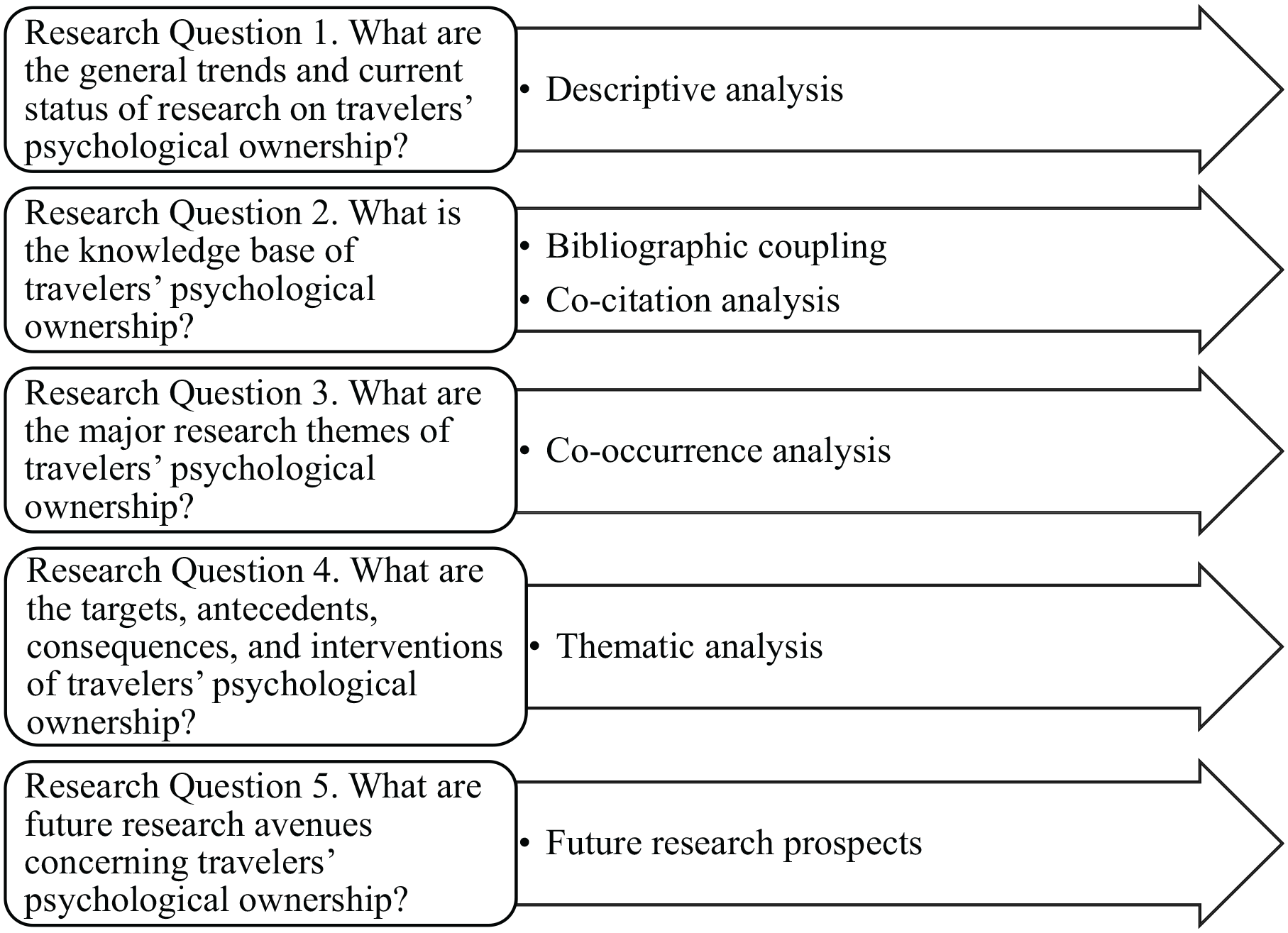
Research questions and protocol.
The significance of this review is threefold. First, it provides a comprehensive landscape of current research progress of travelers’ psychological ownership and develops a future research agenda through a systematic and reproducible method. Moreover, this study addresses limitations of previous literature reviews of psychological ownership through utilizing structured literature selection steps that are directed at identifying germane academic articles and investigating psychological ownership effects in specific tourism settings. Second, we adopt a Targets-Antecedents-Consequences-Interventions (TACI) framework, hence responding to a call for framework-based systematic reviews (Lim et al., 2021). Employing this framework, we classify and organize the previously diverse literature on travelers’ psychological ownership into four dimensions. The framework enables us to identify tourism-specific results in terms of targets (e.g., tourism destinations), antecedents (e.g., destination belongingness), consequences (e.g., travelers’ environmentally responsible behavior), and interventions (e.g., the presence of others at tourist attractions) associated with psychological ownership. It thus affords unifying the fragmented knowledge and scrutinizing the state of the field to identify knowledge gaps (Y. Wu et al., 2020). Third, this undertaking highlights future research opportunities for scholars to advance the field. The findings also have implications for tourism practitioners.
Methodology
Literature Selection
We identified the relevant literature through five steps (Loureiro et al., 2020). After delineating the review goals and objectives, we developed an identification strategy, searched and selected academic articles, extracted eligible outcomes, and examined the findings. Presented in Figure 2 is the number of papers screened and excluded at each stage of the literature selection process.
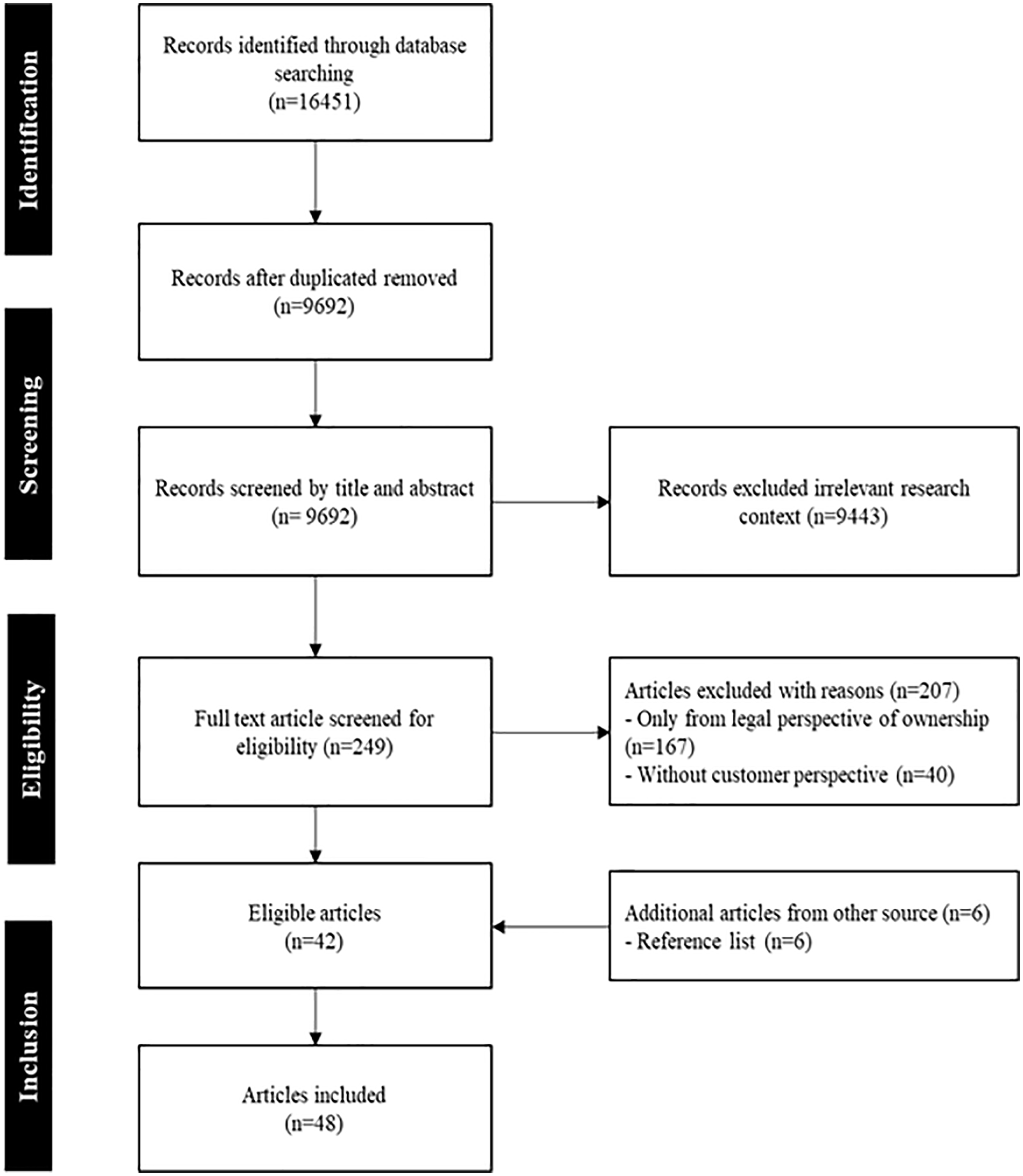
Literature selection process.
The identification phase involved identifying keywords and databases and establishing the literature selection criteria. Following previous studies (Figueroa-Domecq et al., 2020; Le et al., 2019; Wut et al., 2021), three researchers determined the keywords by reading extant literature reviews, research articles, and books (e.g., Jussila et al., 2015; Kirk et al., 2018). The search strings were developed through several rounds of discussion among the three researchers. Previous research has used different terms to represent psychological ownership, such as “perceived ownership,”“sense of property,” and “feelings of possession.” Therefore, our search string was expanded to “ownership,”“property,” and “possession.” Multiple relevant keywords were used as well, including “territorial,”“infringe,”“endowment effect,”“loss aversion,” and “mine-ness.” These concepts capture the meaning of “my,”“mine,”“a part of my,” or “a part of mine.” For example, “territorial” contains the meaning of “my place” (Moon et al., 2020). “Infringement” involves others’ threats to “my possessions” (S. Lee & Kim, 2021). Furthermore, psychological ownership is considered a main psychological mechanism underlying the “endowment effect” (Purrington & Zinn, 2011). Psychological ownership has also been used as a proxy for “loss aversion” in previous research (W. S. Lee & Moon, 2018). Additionally, we used terms related to tourism scenarios, such as “accommodation” and “travel.”
To ensure comprehensiveness, three academic databases were used: Web of Science, Scopus, and Business Source Complete. The command ((“ownership” OR “property” OR “possession” OR “territory*” OR “infringe*” OR “endowment effect” OR “loss aversion” OR “mine-ness”) AND (“tourist*” OR “travel” OR “hospitality” OR “hotel” OR “events” OR “restaurant” OR “catering” OR “accommodation” OR “airline” OR “leisure” OR “holiday” OR “vacation”)) was employed to search the “Title, Keywords, and Abstract” in these databases. Only articles published in English in peer-reviewed journals were considered. Moreover, additional filters were utilized to exclude irrelevant subject domains, such as medicine and biochemistry.
Articles were initially obtained using the above query in December 2021. Then we identified three newly published papers in April 2022. A total of 16,451 articles were screened in Web of Science (n = 4,786), Scopus (n = 8,515), and Business Source Complete (n = 3,150). After eliminating duplicate and non-full text record articles, 9,692 publications remained. The records were exported into a Microsoft Excel spreadsheet shared among three researchers. Next, one researcher screened the titles, abstracts, and keywords. Work that did not accord with the research context (i.e., tourism, hospitality, and leisure)—such as that in fashion and banking—was excluded manually at this stage. In addition, articles that aligned with the research context but belonged to other disciplines—such as those centered on corporate ownership structure—were also discarded. The other two researchers checked and assessed the selection. Discrepancies were further discussed until a consensus was reached.
The screening process yielded 249 records. The three researchers were involved in the eligibility process. Each independently identified potentially relevant articles by reviewing the full text. Conflicts among the researchers were further discussed until the final selection of the articles was consentient. A total of 207 publications were discarded, as they centered on stakeholder (e.g., residents, employees) ownership or ownership from a legal rights perspective rather than from a psychological perspective. Both of these foci were outside the scope of this study. Also, publications that only examined travelers’ collective psychological ownership were beyond the purview of our undertaking, but research involving both the collective and individual levels of travelers’ psychological ownership was included (e.g., Kirk & Rifkin, 2022). The foregoing eligibility process led to selection of 42 publications. Subsequently, six additional studies were identified by cross-checking the reference lists of these six articles. They were not identified in the previous selection process because they either were not in the databases (Comley, 2011; Usher & Kerstetter, 2015a) or did not include the requisite keywords (Atasoy & Morewedge, 2018; Griffiths & Gilly, 2012; Kou & Powpaka, 2017; Usher & Kerstetter, 2015b). Work that cited these 48 papers was also examined using our inclusion criteria, but no new articles were found. Thus, our analyses were predicated on the 48 publications (see Supplemental Appendix A for a list of these studies). The 48 publications addressed three research areas: tourism (n = 16), hospitality (n = 25), and leisure (n = 7).
Data Analysis Approaches
Bibliometric Analysis Approach
We undertook bibliometric analysis in several steps. First, descriptive analysis was conducted to determine the status of the publications over time. Second, relational techniques were used to investigate connections between study disciplines, the formation of new research subjects and methods, and patterns of co-citation (Koseoglu et al., 2016). More specifically, three analyses (i.e., bibliographic coupling, co-citation, and co-occurrence analyses) were performed using the VOSviewer software (v.1.6.13).
Thematic Analysis Approach
A thematic analysis was conducted based on the summary of bibliometric analysis findings and an overview of the literature. We searched for themes critical to the description of the phenomenon to discover and analyze the emerging trends. In particular, we developed a TACI framework (Y. Wu et al., 2020) to obtain structured insights and identify gaps and research directions. The “target” was the object that the traveler psychologically owned. The “antecedents” represented the route(s) leading to the traveler’s psychological ownership of a target. The “consequences” reflected the outcomes stemming from psychological ownership. The “interventions” functioned as boundary conditions or moderators on the relationships between psychological ownership and its antecedents and consequences.
Findings
Bibliometric Analysis
Descriptive Analysis
Presented in Figure 3 is the number of journal articles published annually on travelers’ psychological ownership. The first publication on this topic was published in 1997. Subsequently, the relevant literature has grown rapidly since 2017—especially between 2019 and 2021 when 26 articles (54%) were published. Our descriptive analysis thus revealed that research on travelers’ psychological ownership apparently is at a nascent stage but demonstrates a growing trend.
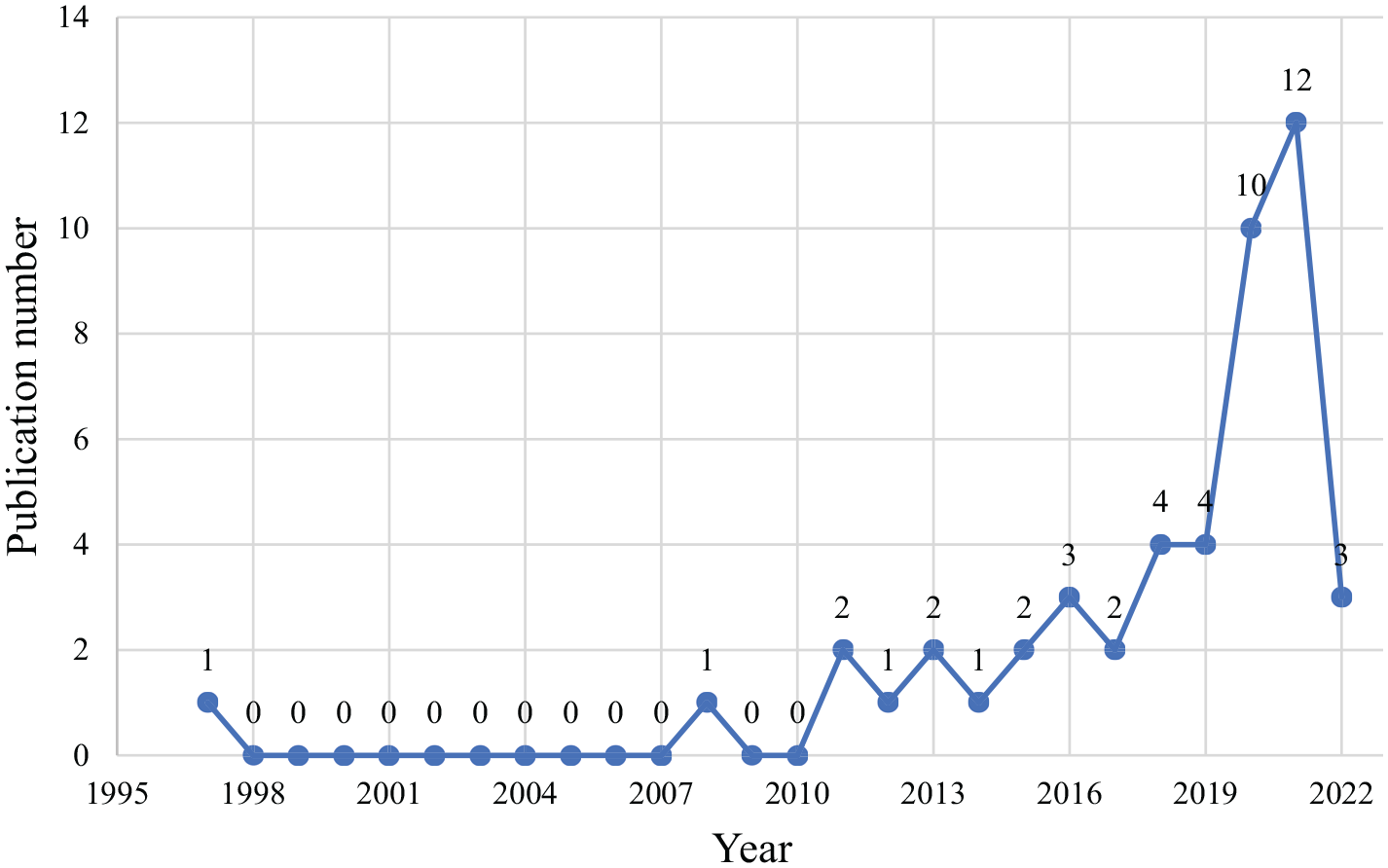
Articles published per year.
Bibliographic Coupling
Bibliographic coupling explores the relationship between two published works by identifying the number of references in common (Kessler, 1963). The greater the overlap in common references between the two articles, the stronger their association. As shown in Figure 4, bibliographic coupling analysis generated three clusters. The red cluster included the largest number of studies (i.e., 26) addressing antecedents and outcomes of customers’ psychological ownership (e.g., Joo, 2020). Work in the green cluster focused on a human territoriality perspective (e.g., Y. Wang & Li, 2021). Those in the blue cluster comprised publications centering on loss aversion and endowment effects (e.g., Teixeira et al., 2020).
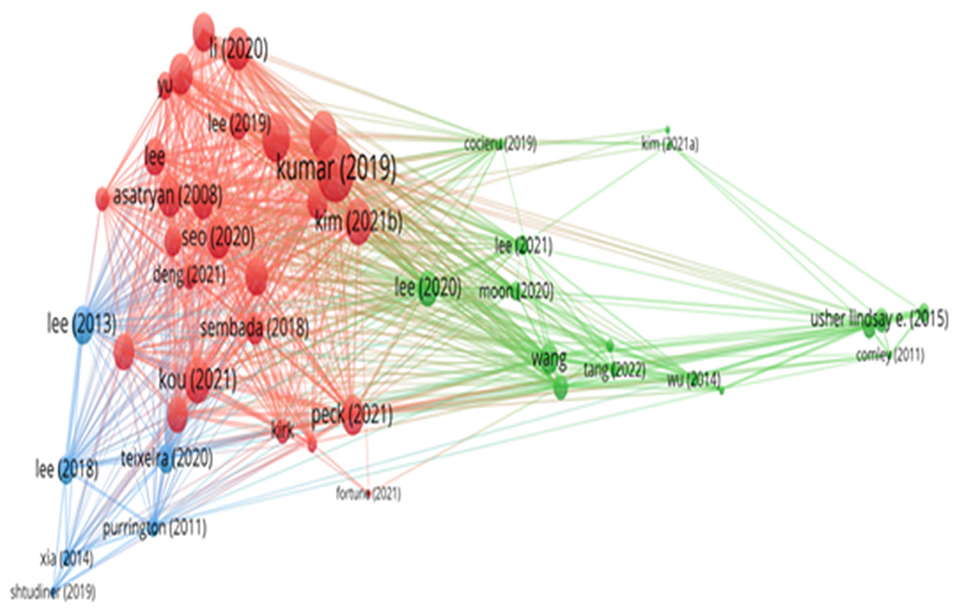
Bibliographic coupling of documents.
Co-citation Analysis
When two selected publications cite the same set of authors, these authors are viewed as co-cited. The greater the number of articles to which a set of authors is jointly referred, the stronger is the co-citation relationship between them. Consequently, the closer they will be visually displayed in a network.
The authors chosen for our analysis were cited at least nine times (Agapito, 2020). As a result, 29 authors were identified and classified into three groups. Depicted in Figure 5 is the co-citation network map that reveals three main author networks. Authors in the red cluster established the psychological ownership theory (Pierce et al., 2001, 2003) and developed psychological ownership research frameworks (Asatryan & Oh, 2008; Jussila et al., 2015). The green cluster included authors who explored psychological ownership from a customer’s perspective (i.e., customer psychological ownership). The contributions of Joann Peck are highlighted in this group. This is a function of her work which demonstrated that touching a product increases customer psychological ownership toward that product (Peck & Shu, 2009). Colleen Kirk is also prominent in this group, owing to her contribution to the “dark side” of customer psychological ownership (e.g., Kirk et al., 2018). The research of authors in the blue cluster was related to human territoriality theory. These authors discussed human territoriality theory in various disciplines, including organizational behavior, environmental psychology, and political geography (Brown et al., 2005; Sack, 1983), thus contributing to research on travelers’ territorial behavior.
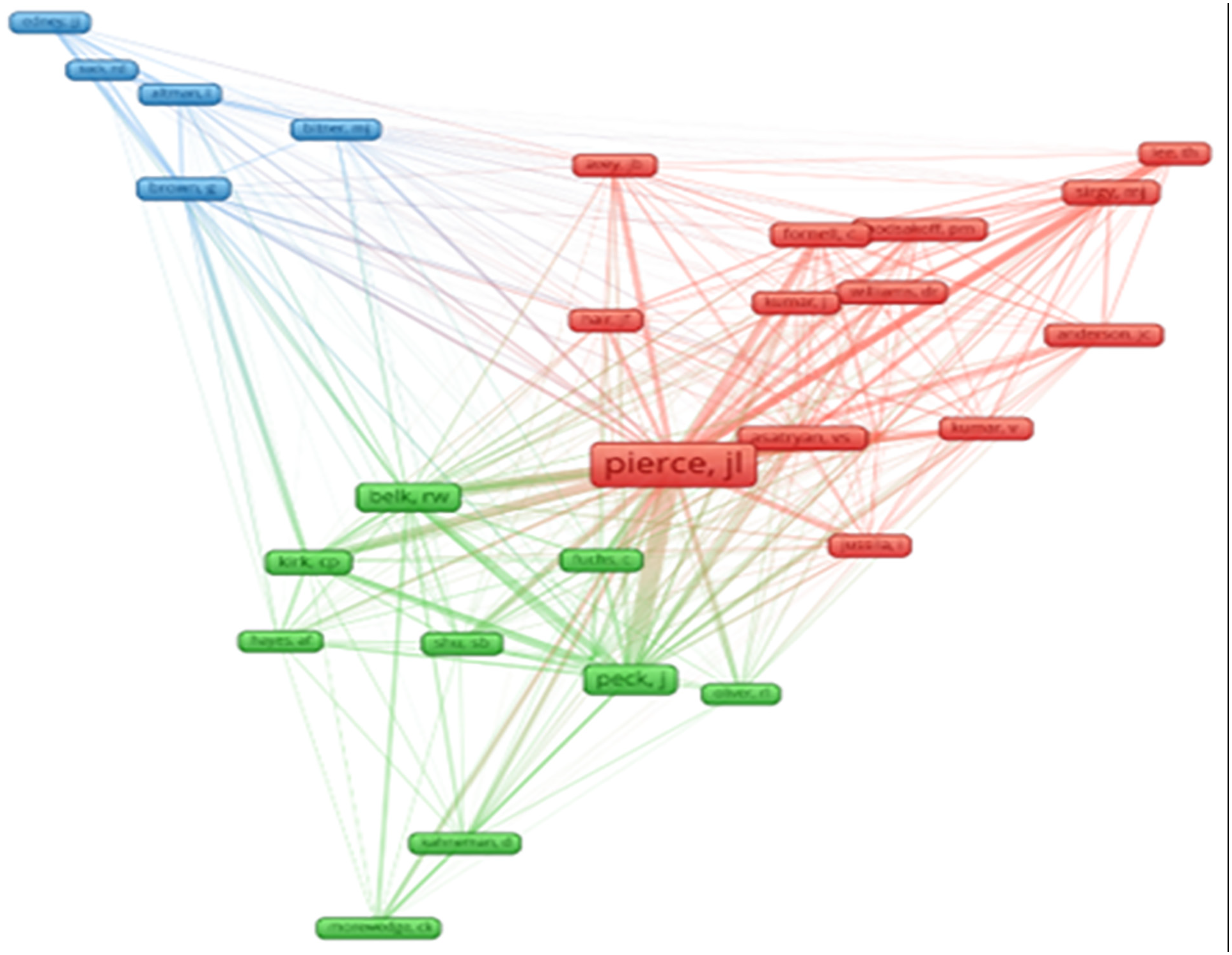
Co-citation network by cited authors.
Co-occurrence Analysis
All keywords were used in this study, including author keywords and keywords plus of Web of Science (i.e., the keywords automatically extracted from the title of the article’s references, which can supplement important terms not listed among the author’s keywords). The links between keywords in the visual map (Figure 6) showed that research themes on psychological ownership should not be treated as mutually exclusive but related. Of 367 keywords, 20 met the threshold of four occurrences (Agapito, 2020). These keywords were grouped into three clusters. One was the red cluster, where the keyword “psychological ownership” was particularly prominent, followed by “antecedents,”“place attachment,” and “possession.” As evidenced, this group included research that mainly focused on antecedents of psychological ownership. The second grouping was the green cluster; it comprised keywords such as “perception,”“impact,”“attitudes,”“territoriality,” and “tourism,” hence implying that psychological ownership could be associated with territoriality in tourism. The blue cluster constituted the third, with its most frequent keywords being “satisfaction,”“quality,” and “trust.” As such, this group of research focused on consequences of psychological ownership.
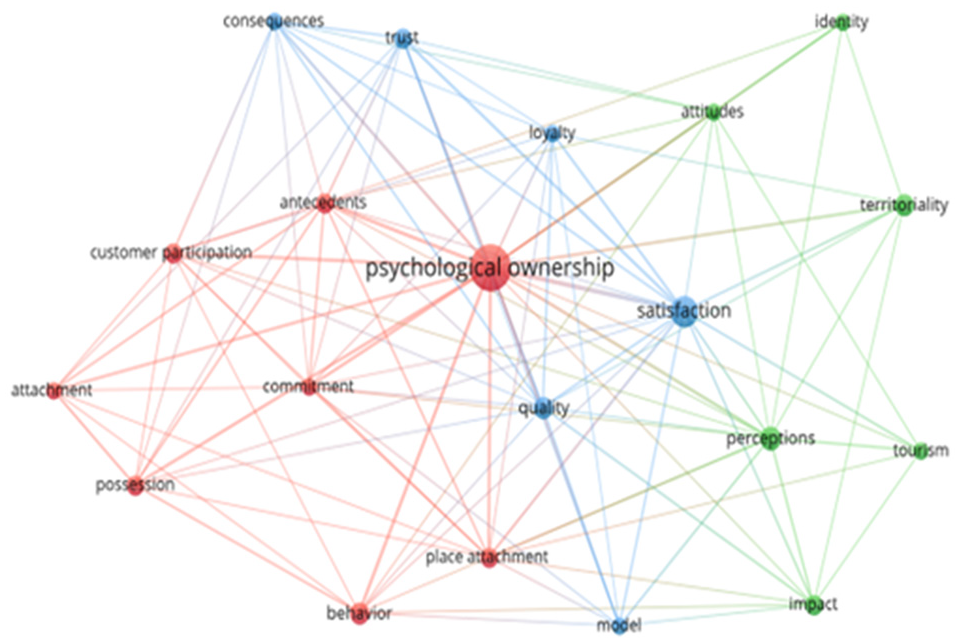
Co-occurrence network of keywords.
Thematic Analysis
Targets
According to psychological ownership theory (Pierce et al., 2001), travelers may perceive ownership toward both material (e.g., souvenirs) and nonmaterial (e.g., places) tourism products. Attributes including “attractiveness, accessibility, openness, and manipulability” play a crucial role in determining whether an object can become the potential target of travelers’ psychological ownership (Asatryan & Oh, 2008, p. 17). Previous research has examined psychological ownership toward four types of targets: public space, private space, product, and event (Table 1).
Targets of Travelers’ Psychological Ownership.
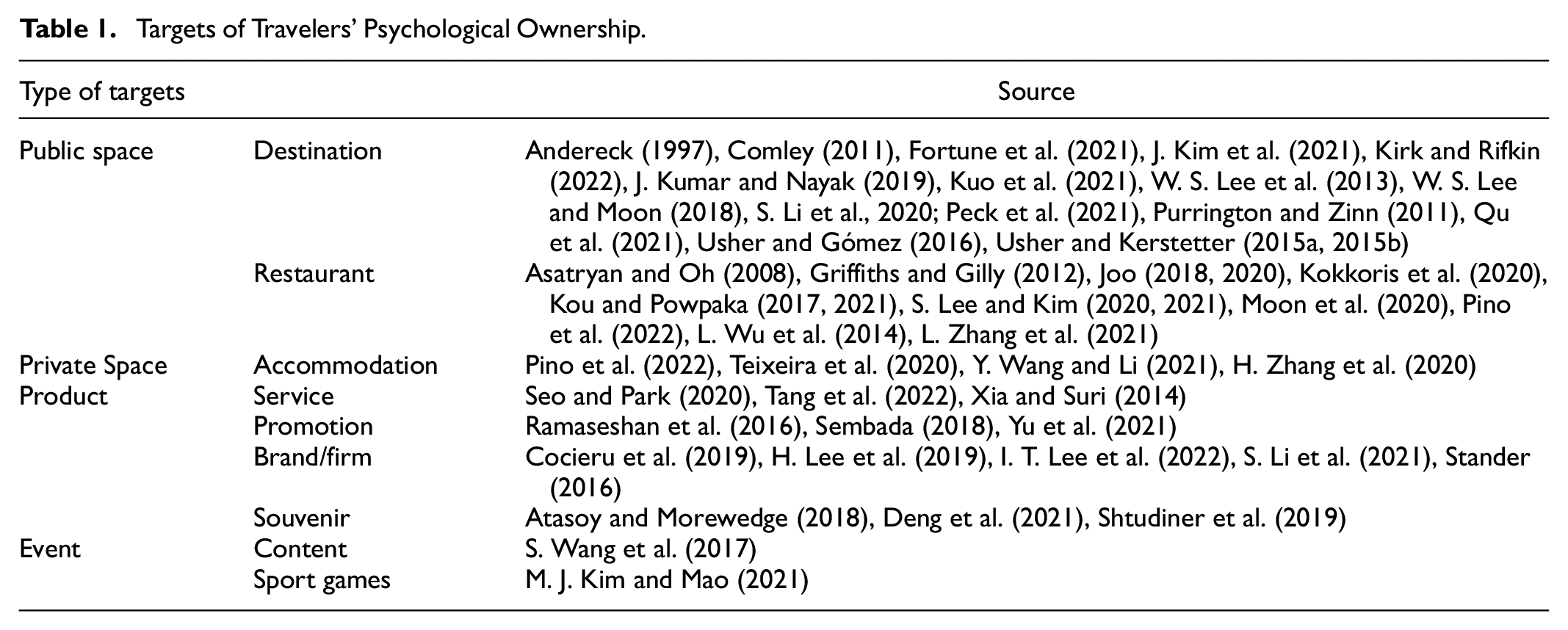
Public spaces are open and publicly accessible, whereas in private spaces, travelers have high expectations of privacy (Andereck, 1997). Research to date (i.e., 28 studies) has explored travelers’ psychological ownership toward public spaces, such as tourist attractions (e.g., Kuo et al., 2021), hiking trails (e.g., J. Kim et al., 2021), hotel lounges (S. Lee & Kim, 2020), cafés (e.g., Joo, 2018), and restaurants (e.g., Moon et al., 2020). In addition, four studies have examined travelers’ psychological ownership toward private spaces, such as peer-to-peer accommodations (e.g., Pino et al., 2022) and short-term rentals (H. Zhang et al., 2020).
The product involves travel-related services, promotions, brands/firms, and souvenirs. Eleven studies have focused on intangible products, including hotel services (Xia & Suri, 2014), food ordering (Tang et al., 2022), restaurant recommendations (Seo & Park, 2020), and promotion of hotels (Ramaseshan et al., 2016) and restaurants (Yu et al., 2021), as well as sports teams (Cocieru et al., 2019), peer-to-peer accommodations (H. Lee et al., 2019), and hotels (I. T. Lee et al., 2022). Three investigations have examined psychological ownership of souvenirs, such as souvenir photographs (Atasoy & Morewedge, 2018), religious souvenirs (Shtudiner et al., 2019), and souvenirs made by travelers (Deng et al., 2021).
Travelers can also develop psychological ownership toward events, but only two articles have focused on this area. S. Wang et al. (2017) found that travelers’ psychological ownership of food-related content on social media motivated them to share food experiences on social network sites. M. J. Kim and Mao (2021) determined that psychological ownership toward sports games actuated fans to attend spectator sports.
Antecedents
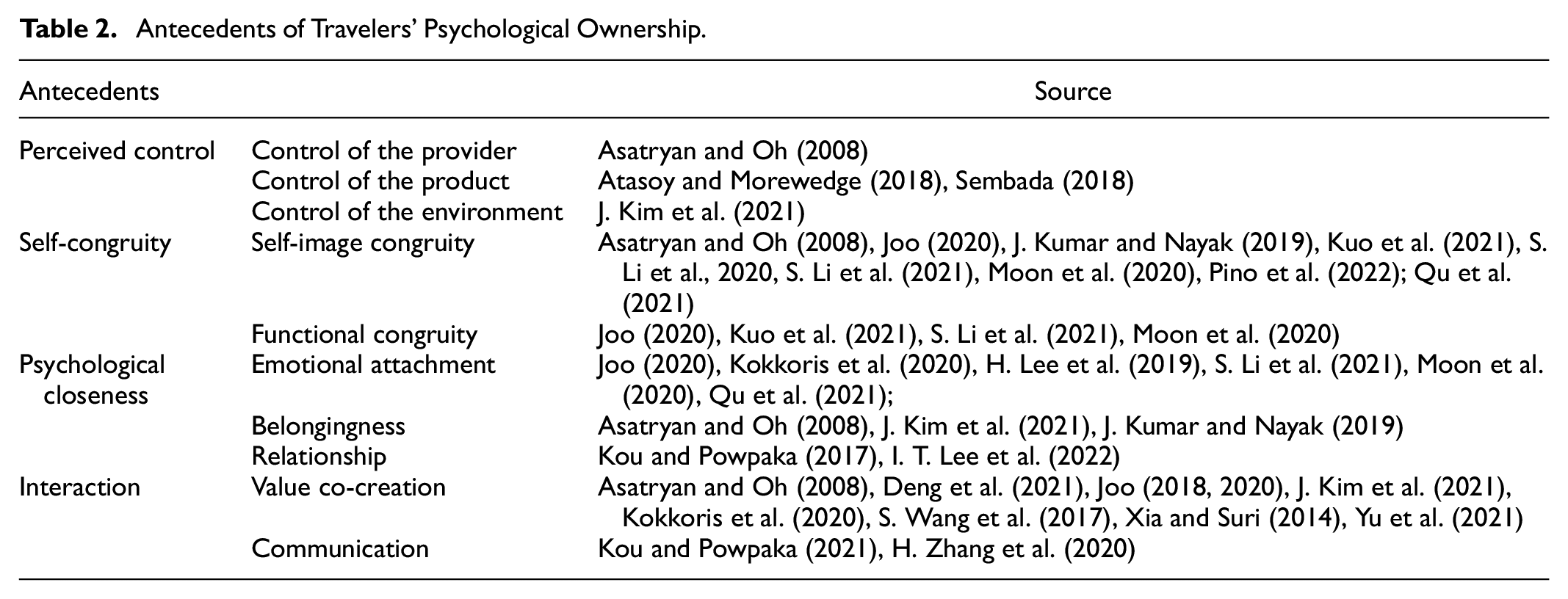
Four antecedents were identified from the existing research: perception of control, self-congruity, psychological closeness, and traveler interaction (Table 2). These antecedents may individually or jointly determine psychological ownership in specific research settings (Deng et al., 2021).
Antecedents of Travelers’ Psychological Ownership.
Perceived Control
Perceived control is defined as a traveler’s perception of his/her ability and control over the surrounding environment (J. Kim et al., 2021). Psychological ownership theory (Pierce et al., 2001) suggests that the degree of control a traveler exerts over a target increases his/her experience of its being part of him/herself and promotes perceived ownership of that target. Some studies in hospitality and tourism have employed a self-report survey method and revealed no relationship between perceived control and psychological ownership (Asatryan & Oh, 2008; J. Kim et al., 2021). However, recent experimental research has obtained the opposite finding; specifically, consumers who were able to co-design a service felt an increase in control and power, which led to a greater perception of psychological ownership (Sembada, 2018). Similarly, Atasoy and Morewedge (2018) found a positive relationship between perceived control and psychological ownership of souvenirs. The foregoing findings thus suggest that the relationship between perceived control and psychological ownership may vary by target type (Asatryan & Oh, 2008).
Self-congruity
Two types of congruity were examined as antecedents of travelers’ psychological ownership: self-image and functional congruity. The former is the consistency between the traveler and the value-expressive features of products or brands (S. Li et al., 2021). Scholars have used self-congruity theory (Sirgy, 1986) to show that congruity between travelers’ self-image and identities of tourism targets positively influences psychological ownership of destinations (e.g., J. Kumar & Nayak, 2019), accommodations (e.g., Pino et al., 2022), and restaurants (e.g., Asatryan & Oh, 2008). Functional congruity involves alignment between the functional attributes of a product or service and an individual’s needs (Kuo et al., 2021). It has attracted researchers’ attention recently, revealing that there is no concordance concerning its influence on psychological ownership. For example, studies have found that place dependence (i.e., functional congruity of a place with travelers’ needs) affects customers’ psychological ownership of destinations (Kuo et al., 2021) and restaurants (Moon et al., 2020). S. Li et al. (2021), however, did not find a significant relationship between them in a hotel context. Of note is that Moon et al. (2020) and S. Li et al. (2021) used procedural remedies and statistical remedies to minimize the risk of common method bias caused by their self-report survey method (Podsakoff et al., 2003).
Psychological Closeness
Psychological closeness refers to the sense of attachment and connection with another entity (Kirk & Rifkin, 2022). According to psychological ownership theory (Pierce et al., 2001), a sense of ownership arises when travelers associate themselves with the target and have an intimate understanding of it (Joo, 2020). In the literature, three types of psychological closeness have been examined as antecedents of travelers’ psychological ownership: emotional attachment, belongingness, and relationship.
Emotional attachment refers to strong affectionate bonds between a traveler and the target (S. Li et al., 2021). Empirical studies have demonstrated a positive relationship between emotional attachment and travelers’ psychological ownership. For example, place attachment was found to increase customers’ psychological ownership of the place (Joo, 2020). Additionally, emotional attachment derived from the memory of a hotel (S. Li et al., 2021) and a dining experience in a restaurant (Kokkoris et al., 2020) were determined to generate psychological ownership in customers. Belongingness reflects a feeling like one’s home (J. Kumar & Nayak, 2019). Research has ascertained that customers develop psychological ownership when they feel belongingness toward a tourism destination or furniture at a restaurant (Asatryan & Oh, 2008; J. Kumar & Nayak, 2019). Moreover, extant work has indicated that various kinds of social relationships induce travelers’ psychological ownership. For instance, friendship between customers and restaurant service providers promotes psychological ownership of the service (Kou & Powpaka, 2017). Furthermore, customers’ trust in hotel and restaurant service vendors was discerned to have a positive impact on their psychological ownership of the service vendor (I. T. Lee et al., 2022).
Interaction
Travelers can interact with travel-related targets, such as destinations, promotional materials, service providers, local residents, and travel activities (Asatryan & Oh, 2008). Psychological ownership theory (Pierce et al., 2001) indicates that, when travelers actively interact with travel-related targets, they establish a psychological connection with them (Kokkoris et al., 2020). This process leads travelers to regard the travel-related targets as their extensions and develop psychological ownership (Deng et al., 2021). Scholars have investigated two types of traveler interactions as antecedents of travelers’ psychological ownership: value co-creation and communication.
Customer participation in value co-creation was found to have a positive effect on psychological ownership of restaurants (Asatryan & Oh, 2008), tourism destinations (J. Kim et al., 2021), and social network contexts (S. Wang et al., 2017). Also, travelers’ value co-creation through their making souvenirs (Deng et al., 2021) and performing the housekeeping of their room (Xia & Suri, 2014) has been determined to influence psychological ownership. In terms of marketing communications, an emotional advertising appeal (H. Zhang et al., 2020) and a pseudo-ownership advertising appeal (Kou & Powpaka, 2021) have been found to affect travelers’ psychological ownership.
Consequences
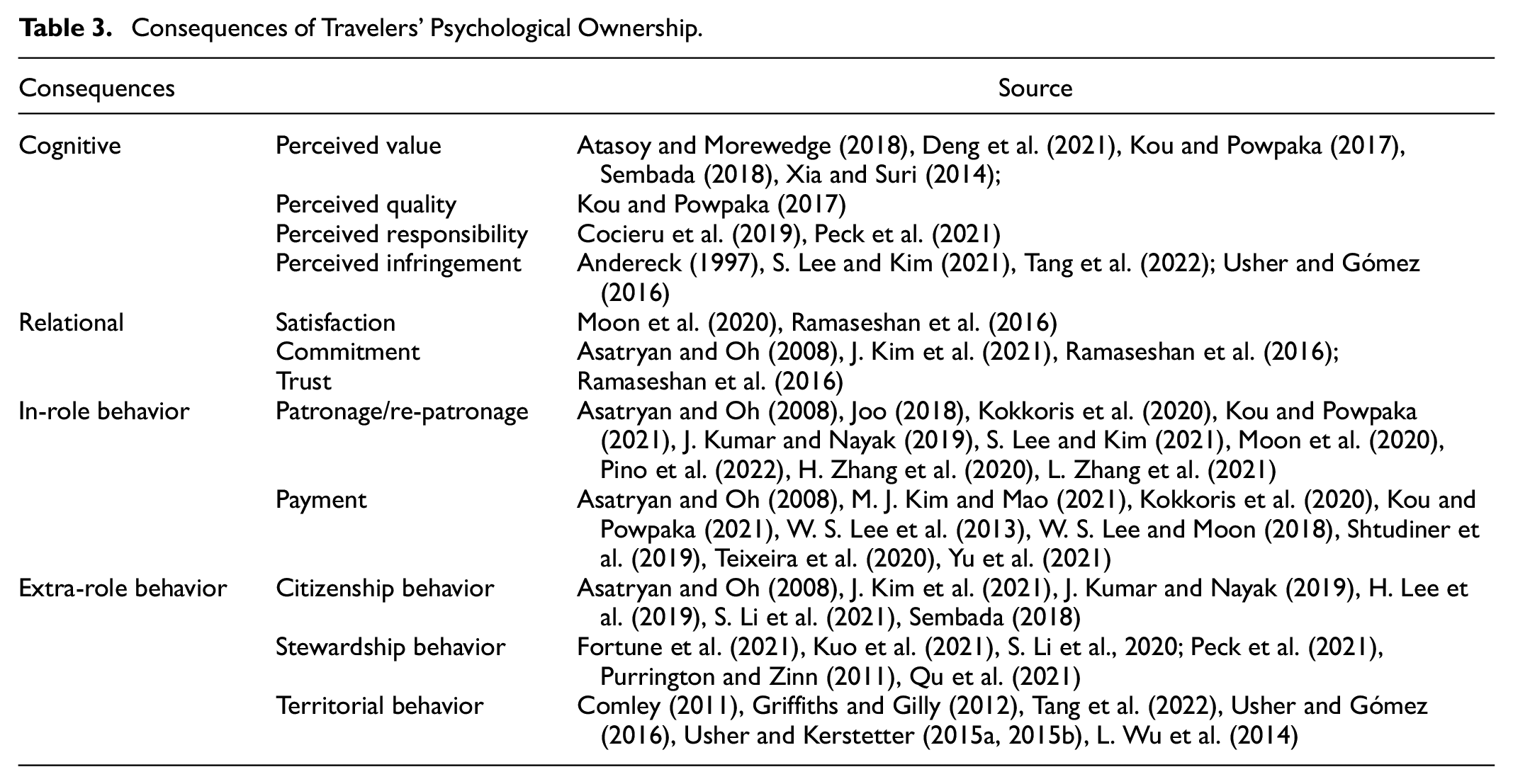
Psychological ownership has been discerned to have an impact on a range of outcomes. The consequences can be categorized into four groups: cognitive consequences, relational consequences, in-role behaviors, and extra-role behaviors (Table 3).
Consequences of Travelers’ Psychological Ownership.
Cognitive Consequences
According to endowment effect theory (I. T. Lee et al., 2022), people tend to assign a given target a higher value than comparable objects because of their psychological ownership of that target (Purrington & Zinn, 2011). Scholars have found that psychological ownership has a positive impact on the perceived value of souvenirs (Atasoy & Morewedge, 2018) and hotel services (Sembada, 2018), as well as on the perceived quality of a restaurant’s food (Kou & Powpaka, 2017). Furthermore, travelers’ psychological ownership of a given tourism destination has been ascertained to increase their sense of responsibility to protect and care for that destination (Peck et al., 2021). In addition, extant research has revealed an association between travelers’ psychological ownership and perceived infringements on tourism destinations (Andereck, 1997), surf breaks (Usher & Gómez, 2016), luxury hotel amenities (S. Lee & Kim, 2021), and restaurant ordering services (Tang et al., 2022).
Relational Consequences
Travelers with ownership of a target have been shown to develop and maintain an enduring link and a close bond with the target (Ramaseshan et al., 2016). Prior studies have used the theory of affective attachment (Lawler, 1992) to demonstrate that psychological ownership plays a key role in establishing the relationship between the traveler and the target (Kou & Powpaka, 2017). For instance, when customers viewed the tourism product as part of themselves, they tended to be more satisfied and committed to the relationship (J. Kim et al., 2021). Furthermore, Ramaseshan et al. (2016) found that psychological ownership had a positive impact on trust in an airline loyalty program.
In-role Behavior
Travelers’ in-role behaviors are actions required of them to consume a tourism product or service, such as financial transactions or product purchases (Kokkoris et al., 2020). Based on psychological ownership theory (Pierce et al., 2001), Jussila et al. (2015) contended that, when travelers generated psychological ownership toward a given target, they maintained the relationship with that target through in-role behavior. Scholars have identified two in-role behaviors resulting from travelers’ psychological ownership: (re-)patronage and payment behavior. Psychological ownership has been found to increase a customer’s intention to (re-)patronize a restaurant (Asatryan & Oh, 2008). This association has also been manifested in hotels (Kou & Powpaka, 2021), peer-to-peer accommodations (Pino et al., 2022), and tourism destinations (J. Kumar & Nayak, 2019). In addition, prior studies have determined that a customer’s psychological ownership of a specific tourism target—such as a souvenir (Shtudiner et al., 2019), destination (W. S. Lee & Moon, 2018), restaurant (Kokkoris et al., 2020), or peer-to-peer accommodations (Teixeira et al., 2020)—positively affects their willingness to pay or pay more for the offering.
Extra-role Behavior
A traveler’s extra-role behavior is not required for consumption but adds value to the consumption process (H. Lee et al., 2019). The extra-role behaviors that have been examined as a consequence of travelers’ psychological ownership include citizenship, stewardship, and territorial behavior. Citizenship behavior is a traveler’s voluntary helpful and constructive behavior (I. T. Lee et al., 2022). The effect of ownership on citizenship behavior is supported by psychological ownership theory (Pierce et al., 2001). It suggests that travelers will consciously contribute to a target when they perceive the target as their own. Citizenship behaviors, as consequences of travelers’ psychological ownership, include recommending tourism destinations to others (J. Kumar & Nayak, 2019), sharing feedback with hotels (S. Li et al., 2021), and offering positive word-of-mouth about restaurants or hotels (Asatryan & Oh, 2008; Sembada, 2018).
Stewardship behavior is prosocial and benefits the long-term welfare of others (Kirk & Rifkin, 2022). Stewardship theory (Davis et al., 1997) suggests that travelers’ psychological ownership leads to perceived responsibility, which motivates their stewardship behavior. Scholars have found the positive influence of travelers’ psychological ownership on their stewardship behaviors toward tourism destinations, including financial behavior (e.g., donating funds to support a resource’s sustainability) (Peck et al., 2021) and effortful behavior (e.g., arranging and cleaning community leisure spaces) (Fortune et al., 2021). Moreover, travelers’ psychological ownership of destinations exerts a positive effect on their environmentally responsible behavior (Kuo et al., 2021).
Territorial behavior is driven by psychological ownership with the goal of forming, communicating, sustaining, and restoring attachment to a target (S. Lee & Kim, 2020). According to human territoriality theory (Sack, 1983), when a traveler has psychological ownership toward a travel-related target and perceives that another individual may have access to the same target, the traveler tends to protect the psychologically owned territory (L. Wu et al., 2014). For example, when travelers with high psychological ownership toward a given destination sense others’ intent to invade that destination, they may confront such infringement through negative expressions and conflict (Usher & Gómez, 2016). In addition, customers’ psychological ownership of a restaurant has been found to have a positive effect on their intention to mark or claim the temporary, exclusive ownership of the restaurant space (L. Wu et al., 2014). Moreover, customers ordering food via their smartphones have been observed to refuse the restaurant’s food recommendations to protect their psychological ownership of the food ordering device (Tang et al., 2022). However, Usher and Kerstetter (2015a, 2015b) determined that sometimes, even if travelers have high psychological ownership toward a destination, they may shift their territorial boundaries (e.g., surfers are willing to share their space with others) rather than conduct defensive behaviors when perceiving others’ boundary markers.
Interventions
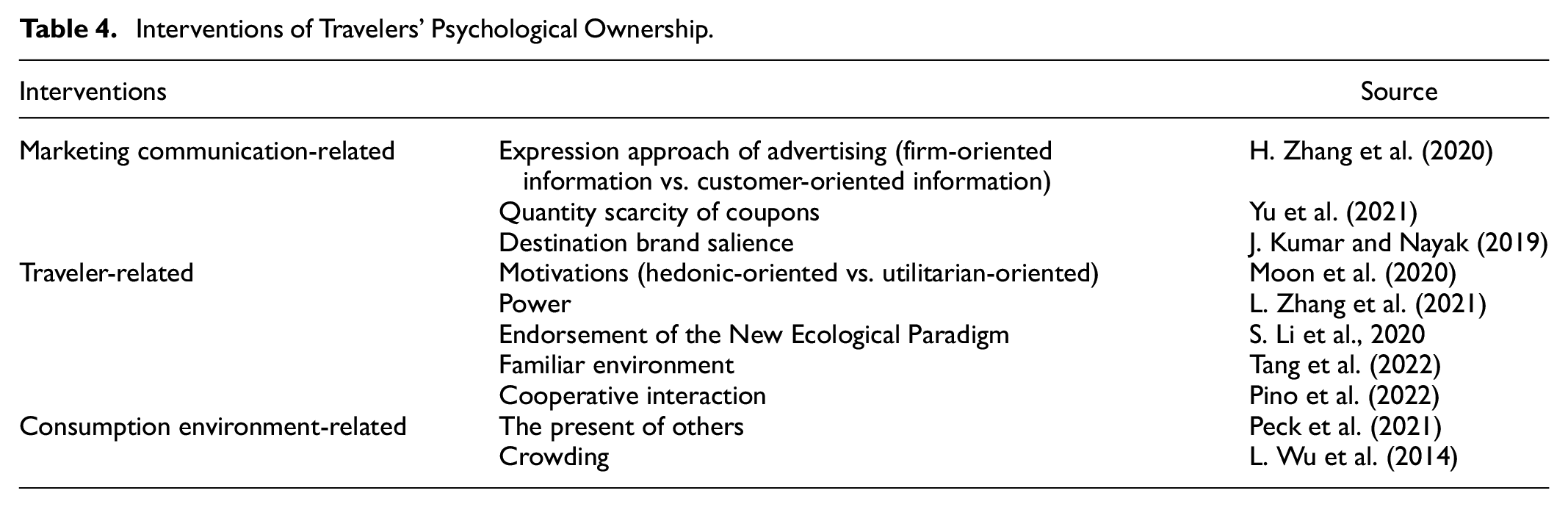
Three types of interventions have been identified in the literature: marketing communication-related, traveler-related, and consumption environment-related interventions (Table 4).
Interventions of Travelers’ Psychological Ownership.
Marketing Communication-related Interventions
Marketing communication-related interventions cover a series of marketing practices, such as advertising, promotion, and branding activities, which moderate travelers’ psychological ownership mechanisms. For example, the expression approach of advertising (i.e., firm-oriented information vs. customer-oriented information) has been shown to moderate the effect of an emotional advertising appeal on psychological ownership (H. Zhang et al., 2020). Specifically, consumer-oriented information strengthens the positive impact of an emotional advertising appeal on psychological ownership toward tourism accommodations. Moreover, perceived scarcity has a moderating effect on the relationship between customer participation and psychological ownership. The scarcity of the target improves its perceived value and leads customers to attach more importance to it. For example, when the quantity of coupons is limited, customer participation in a restaurant promotion leads to higher psychological ownership of coupons and willingness to use them (Yu et al., 2021). Furthermore, when a destination has high brand salience, destination identification and destination belongingness lead to greater psychological ownership of the destination (J. Kumar & Nayak, 2019).
Traveler-related Interventions
These interventions focus on travelers’ characteristics. Research has found that customers’ motivation (i.e., hedonic-oriented vs. utilitarian-oriented) moderates the relationship between place identity and psychological ownership. In particular, for solo diners with a hedonic-oriented motivation, the impact of place identity on their psychological ownership of the restaurant is stronger (Moon et al., 2020). In addition, a customer’s sense of power has been found to moderate the influence of psychological ownership on attitudes and revisiting intentions toward the restaurant. Specifically, L. Zhang et al. (2021) defined perceived territoriality as customers’ psychological ownership of the dining space and discerned that the positive effect of perceived territoriality on attitude and revisiting intention is stronger among powerless customers. Moreover, S. Li et al., 2020 ascertained that the positive impact of psychological ownership on travelers’ environmentally responsible behavior is stronger among those with a high endorsement of the New Ecological Paradigm, which reflects an individual’s general belief that a destination’s natural environment is fragile, so environmental conservation is necessary (Kiatkawsin & Han, 2017). Familiarity with the service environment has also been demonstrated to act as a moderator. Tang et al. (2022) examined customers’ psychological ownership of self-service food ordering devices. They observed that customers’ familiarity with the restaurant environment weakens the relationship between the customer’s smartphone as a food ordering device and perceived infringement on his/her food ordering process. Another traveler-related intervention is the customer’s cooperative interaction with service providers (Pino et al., 2022). Consistent with psychological ownership theory (Pierce et al., 2003), Pino et al. (2022) found that, when customers engaged in cooperative interactions with the service provider, the positive impact of customer-service provider identification on psychological ownership toward the accommodation is stronger.
Environment-related Interventions
These interventions focus on the characteristics of the environment. In terms of the consumption environment, the presence of others at the same tourism destination reduces the effect of travelers’ psychological ownership on their perceived responsibility and stewardship behavior toward the destination (Peck et al., 2021). Additionally, familiarity with the service environment serves as a moderator; it does so because, in an unfamiliar environment, customers have less perceived control and higher fear of invasion (S. Lee & Kim, 2021). Scholars have also determined that crowding has a moderating effect on the relationship between psychological ownership and customers’ fairness perception. L. Wu et al. (2014) defined territorial tendency as a customer’s propensity to psychologically own a restaurant. Based on deontic justice theory (Cropanzano et al., 2003), their research shows that, in a non-crowded restaurant, guests with a high (vs. low) territorial tendency regard the territorial behaviors of other guests to be fairer.
Methodological Analysis
Eighty-one percent (i.e., 39) of the articles on this topic applied quantitative approaches. Another 19% (i.e., 9 publications) adopted qualitative approaches, including interviews, ethnography, and observations (Table 5). The majority of quantitative studies employed surveys to investigate the relationship between antecedent variables and travelers’ psychological ownership, while a few used experiments (e.g., Atasoy & Morewedge, 2018; Kokkoris et al., 2020). Survey studies rely on single-source data or self-report measures (e.g., Kuo et al., 2021; Qu et al., 2021), leading to the risk of common method bias (Podsakoff et al., 2003). Relatively few scholars utilized procedural remedies (e.g., ensuring respondents’ anonymity) or statistical remedies (e.g., Harman’s single-factor test) to minimize common method variance (e.g., J. Kim et al., 2021; I. T. Lee et al., 2022; S. Li et al., 2021).
Overview of Research Approaches.
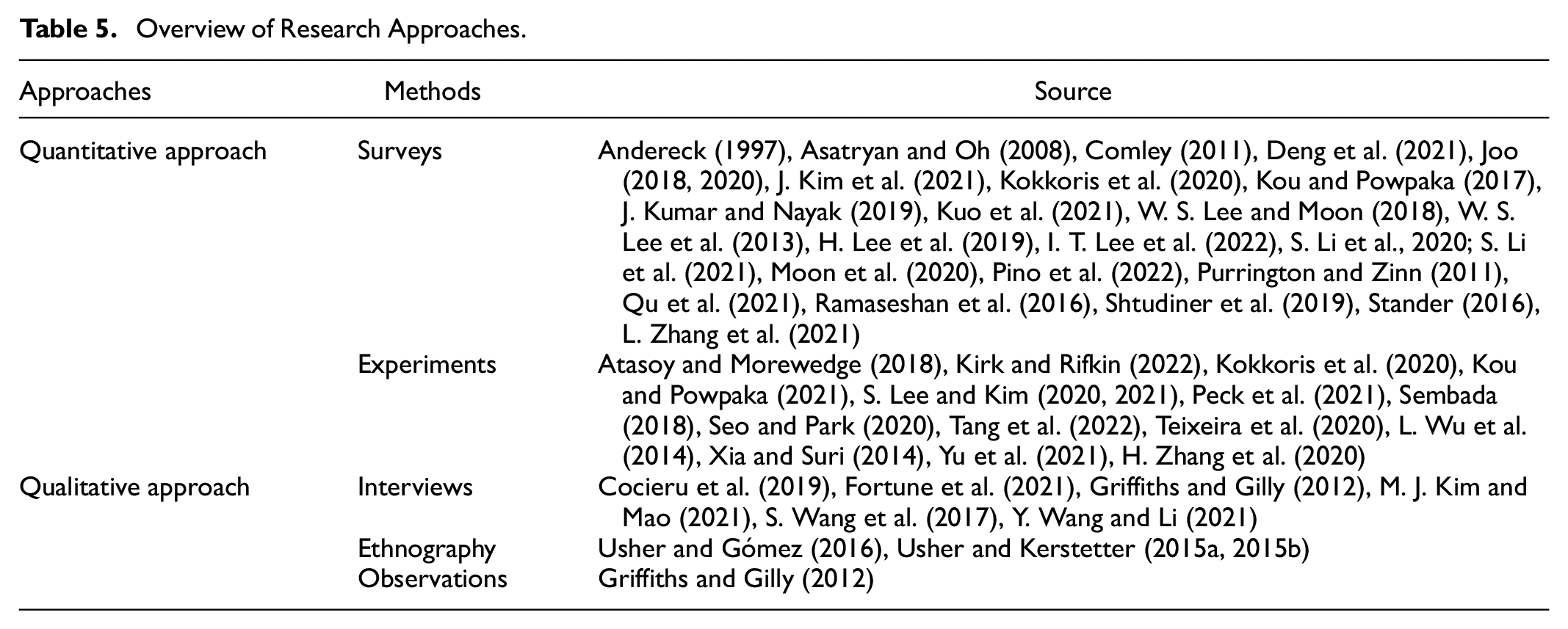
Notably, extant literature has found a correlational relationship between self-congruity and travelers’ psychological ownership (S. Li et al., 2021; Moon et al., 2020). No study, though, has revealed the causal relationship between these two constructs. In contrast, most of the causal relationships between travelers’ psychological ownership and its outcomes have been found through experiments—especially cognitive consequences (e.g., S. Lee & Kim, 2021; Peck et al., 2021) and in-role behaviors (e.g., Kokkoris et al., 2020; Kou & Powpaka, 2021). Moreover, three experimental studies examined relationships between travelers’ psychological ownership and extra-role behaviors (Peck et al., 2021; Sembada, 2018; Tang et al., 2022). Curiously, no study has investigated the causal relationship between travelers’ psychological ownership and relational consequences. Both survey and experimental methods have been used to test interventions concerning the relationship between travelers’ psychological ownership and its antecedences or consequences. Interestingly, all consumption environment-related interventions have been examined via experiments (e.g., Peck et al., 2021). All traveler-related interventions, though, were investigated through surveys (e.g., S. Li et al., 2020).
Most quantitative studies have applied Pierce et al.’s (2001, 2003) conceptualization of travelers’ psychological ownership as an individual’s sense of possession for a target, as well as implemented adaptations of the scale of individual-level psychological ownership from Peck and Shu (2009) (e.g., Peck et al., 2021) and Van Dyne and Pierce (2004) (e.g., Asatryan & Oh, 2008). Qu et al. (2021) and S. Lee and Kim (2020), though, included both individual-level and group-level items in their measurement. Moreover, the Van Dyne and Pierce (2004) scale has been widely adopted in previous studies. In contrast, I. T. Lee et al. (2022) and Stander (2016) assessed travelers’ psychological ownership as employing a multidimensional scale that contains four components: accountability, self-efficacy, self-identity, and belongingness. Although items in their scales appear to clearly reflect more each of the bases of travelers’ psychological ownership, Stander (2016) measured travelers’ psychological ownership as a multidimensional concept with four subdimensions, while I. T. Lee et al. (2022) treated travelers’ psychological ownership as a unidimensional construct.
Future Research Agenda and Propositions
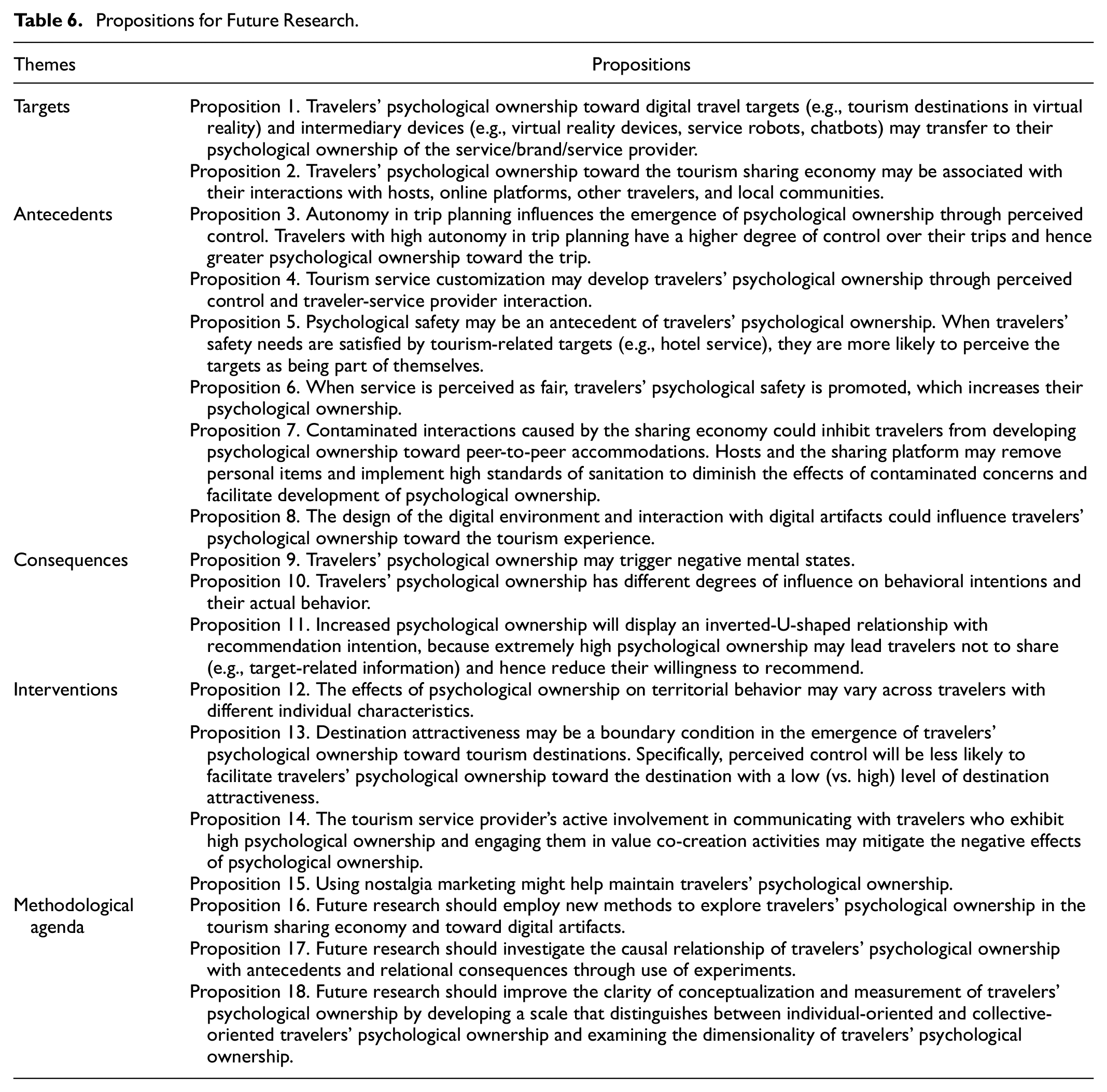
The thematic analysis summarized research findings of travelers’ psychological ownership over the period from 1997 to 2022. The analysis results structured in a TACI framework are portrayed in Figure 7. This framework not only explored the mechanisms underpinning travelers’ psychological ownership but also provided conclusions vis-à-vis a synthesis of the findings and a discussion that identified knowledge gaps and suggestions for future research avenues. Moreover, given the popularity of the sharing economy (Balaji et al., 2022), the increasing attention given to travelers’ mental wellbeing (L. Zhang et al., 2022), and the penetration of digital technology into travelers’ behavior (Jeong & Shin, 2020), corresponding propositions were posited to advance research on this topic. We also considered travelers’ psychological ownership toward digital travel targets, as COVID-19 largely disrupted the landscape of tourism and accelerated development of digital travel products. Consistent with our TACI framework, the sections below discuss research gaps and propose research directions for further investigation into the targets, antecedents, consequences, and interventions of travelers’ psychological ownership (Table 6).
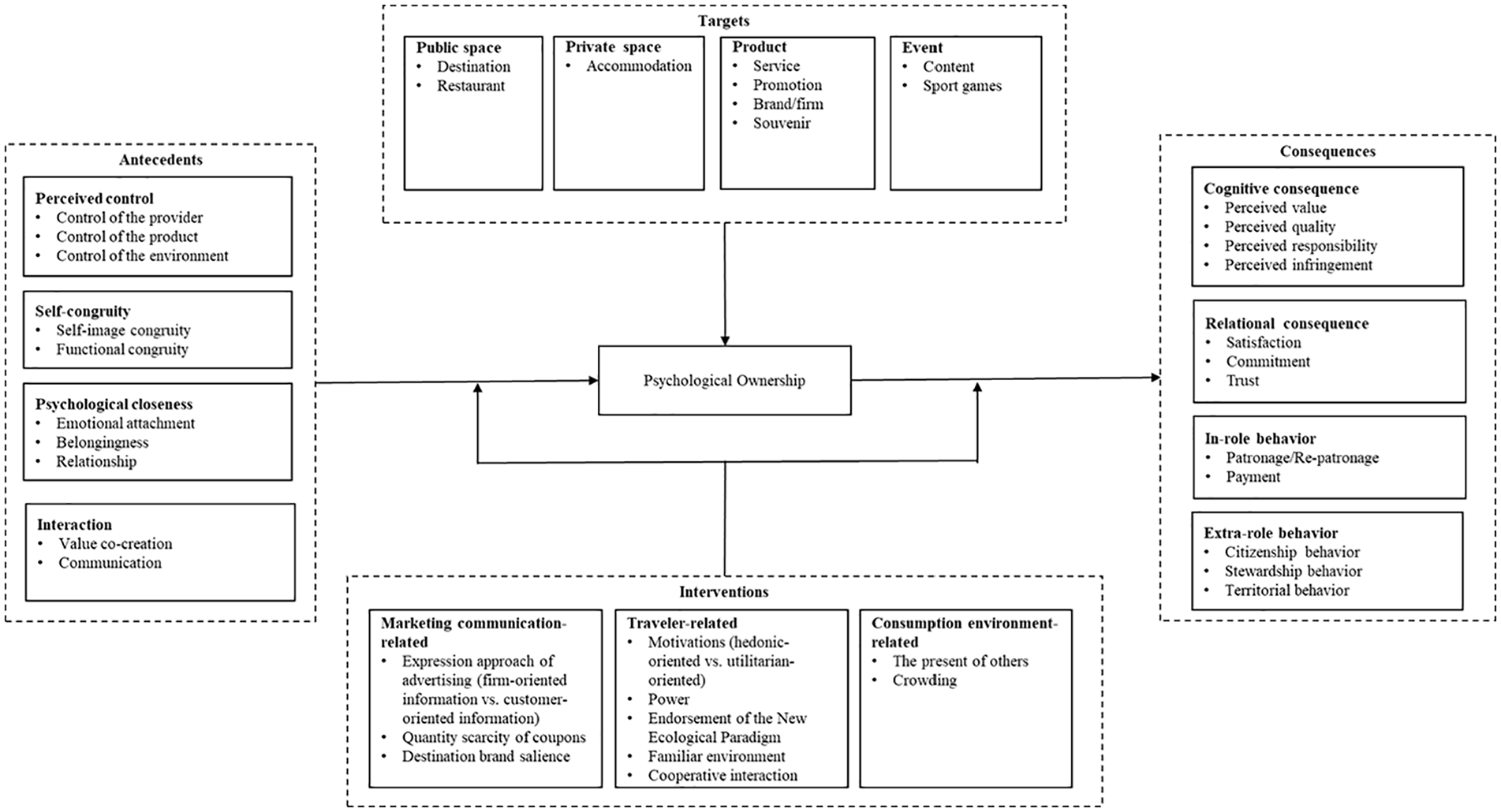
The TACI conceptual framework.
Propositions for Future Research.
Targets
Owing to the COVID-19 outbreak and subsequent travel bans, travelers’ demand for travel without leaving home has increased (Jiang & Wen, 2020). Meanwhile, technological development has accelerated digital transformation of the tourism industry, giving rise to virtual reality tourism, tourism live streaming, and online travel products (e.g., Airbnb “Online Experiences”) (Liu et al., 2022; Zheng et al., 2022). Travelers’ psychological ownership toward digital travel targets (e.g., tourism destinations in virtual reality) and intermediary devices (e.g., the virtual reality viewer) used to access digital travel services conceivably can transfer to tourism service providers/brands (e.g., tourism destinations) (Morewedge et al., 2021). Therefore, policymakers and managers in the digital tourism industry could affect travelers’ behavior through psychological ownership. Furthermore, the emergence of innovative technologies such as service robots and chatbots is transforming the tourism industry (Pillai & Sivathanu, 2020). In addition to service delivery, these artificial intelligence-enabled devices are also used to interact directly with customers (Solakis et al., 2022). As a result, it is important to understand how travelers’ interactions with artificial intelligence-enabled devices affect their perceived ownership toward the service and the service provider. Therefore, the following proposition is proposed:
Although existing studies have focused on public space (e.g., tourism destinations) as the psychological ownership target, research exploring psychological ownership toward private space (e.g., accommodations) is limited. In particular, we identified only one study that explored an antecedent (i.e., customer–service provider identification) and a consequence (i.e., loyalty) of travelers’ psychological ownership toward peer-to-peer accommodations (Pino et al., 2022). Considering the complex nature of the tourism sharing economy, stakeholders such as hosts, other travelers, online platforms, and local communities (Balaji et al., 2022) could influence the travel experience. Therefore, travelers’ psychological ownership may be related to their interactions with these different stakeholders.
Antecedents
Extant literature has suggested that perceived control is perhaps the most powerful “route” for developing psychological ownership, as it can be more quickly used than investing in the self or getting to know the target (J. Kim et al., 2021). We propose that autonomy in trip planning—travelers’ independence and discretionary capacity to organize their trips and select their travel processes—might influence psychological ownership through perceived control. This is because travelers with high autonomy in trip planning have more latitude over the choice of their trips, which may contribute to the development of psychological ownership toward the trip. Thus, we present the following proposition:
Although customization of tangible products can develop psychological ownership through identity-oriented markers (e.g., engraving one’s name) on products (Kou et al., 2021), whether and how customization of intangible products (e.g., hotel services) would affect psychological ownership is unknown. Service customization refers to meeting individual travelers’ needs through adapting or tailoring the service process. For example, hotel service customization allows guests to choose the type of pillows. Service customization enables customers to influence the service process and outcomes, which facilitates the emergence of psychological ownership through perceived control over service (Ding & Keh, 2016). Service customization, as a result of customer participation in value co-creation with the service provider, may also develop psychological ownership through traveler-service provider interaction. Therefore, the following proposition is proposed:
Apart from the four types of antecedents mentioned above, travelers’ psychological safety may be an antecedent of psychological ownership (L. Zhang et al., 2021). Travelers’ psychological safety refers to a feeling of confidence, security, and freedom when exposed to environmental stimuli (M. Li et al., 2022). When travelers’ safety needs are satisfied by tourism-related targets (e.g., hotel service), they are more likely to perceive the targets as being part of themselves, which provides a foundation for the emergence of psychological ownership. Therefore, we present the following proposition:
Furthermore, we propose that service fairness has a positive impact on psychological ownership through psychological safety. This is because service fairness reflects a traveler’s perception of justice toward the service provider’s behavior, which signals to the traveler that s/he is respected and hence less likely to be mistreated by the service provider (Roy et al., 2020). This enhances the traveler’s psychological safety, leading to development of psychological ownership. Thus, we present the following proposition:
Because peer-to-peer accommodation allows hosts to rent private homes to guests, this kind of sharing economy may lead to contaminated interactions (Bardhi & Eckhardt, 2012). This phenomenon refers to interactions tainted by the presence of some real (e.g., the host’s personal items in the room) or imagined (e.g., another guest having slept in the bed previously) contaminant, which may inhibit development of travelers’ psychological ownership toward the peer-to-peer accommodation (Morewedge et al., 2021). Therefore, hosts and sharing economy platforms can make efforts to decrease the negative effects of contaminated interactions, for example, by removing evidence of the host’s occupancy (e.g., personal items) and implementing high standards for sanitation to counter travelers’ contamination concerns (Y. Wang & Li, 2022). Thus, the following proposition is proposed:
In the new digital and intelligent industrial revolution, digital technologies (e.g., mobile devices, touch screens, virtual reality, Metaverse, artificial intelligence) have become an integral part of the travel experience. As such, travelers are accustomed to constant information access and various services provided by digital technologies. Furthermore, digital platforms—such as social media (e.g., Facebook), online travel communities (e.g., Tripadvisor), and micro-video sharing platforms (e.g., Tik Tok)—have become popular channels for interaction between travelers and travel-related targets (e.g., destinations, service providers) (Kirk & Swain, 2018). Nonetheless, few studies have explored how these digital technologies influence the development of travelers’ psychological ownership. Traveler interaction with a travel-related target through digital artifacts and digital platforms helps communicate their self-identity and enhance their self-efficacy, thereby stimulating psychological ownership toward that target (Pierce et al., 2003). The design of the digital environment and travelers’ interaction with digital artifacts may play a key role in the emergence of psychological ownership. Thus, the following proposition is proposed.
Consequences
Past studies on travelers’ psychological ownership have mostly focused on the positive consequences of psychological ownership. However, psychological ownership has been found to increase perceived responsibility, which may result in a responsibility burden, thereby giving rise to traveler stress and fatigue (Pierce et al., 2003). In addition, travelers may feel discomfited when others trample on a target toward which they have developed psychological ownership. For example, surfers may become rankled when other surfers invade their surf space or catch their waves (Usher & Kerstetter, 2015a). Moreover, the damage or destruction of psychologically owned targets might evoke travelers’ feelings of losing themselves. Therefore, future research should explore the negative consequences of travelers’ psychological ownership and examine when and how they arise. Doing so would offer a balanced perspective through demonstrating that travelers’ psychological ownership is a double-edged sword. Hence, policymakers and managers should avoid focusing excessively on increasing travelers’ psychological ownership. Accordingly, the following proposition is posited:
Behavioral intention has been investigated as the proxy of behavior in most prior studies about psychological ownership (e.g., Kokkoris et al., 2020). However, there can be a discrepancy between behavioral intention and actual behavior. Moreover, the relationship between behavioral intention and subsequent deportment is weak in many cases (Sheeran, 2002). Thus, future research could assess how psychological ownership influences travelers’ actual behaviors. So, the following proposition is proposed:
Existing literature has revealed a positive relationship between travelers’ psychological ownership and their recommendation intention (J. Kumar & Nayak, 2019), but it has overlooked the possibility that an extremely high psychological ownership may have a negative impact on recommendation intention. Extremely high psychological ownership leads to a refusal to share (e.g., target-related information) because sharing with others means losing a part of the extended self (Pierce & Jussila, 2011). Thus, psychological ownership cannot endlessly drive recommendation intention. Rather, customers may display an inverted-U-shaped intention to recommend because of psychological ownership. In other words, there exists an optimal point beyond which psychological ownership will induce travelers not to share (e.g., target-related information) to avoid personal loss, thus reducing their willingness to recommend. Therefore, the following proposition is proposed:
Interventions
Despite the finding that consumption motivations (Moon et al., 2020) and a sense of power (L. Zhang et al., 2021) moderate the link between psychological ownership and behavioral intentions, future research can explore other traveler-related factors on which this relationship is contingent. Some individual characteristics may influence travelers’ psychological ownership and territorial behavior, such as culture, gender, and self-construal (Kitayama et al., 1997). For example, compared with individualistic travelers, collectivist travelers prefer to congregate in public spaces and believe that they are sharing rather than owning the tourist space (Griffiths & Gilly, 2012). Hence, the effects of psychological ownership on perceived infringement and territorial behavior may be weaker among collectivist travelers. Furthermore, the same relationship can has been found among female travelers because of their feelings toward the community and desire to connect with others (Carlson, 1971). Moreover, because individuals with interdependent (vs. independent) self-construal pay more attention to their relationships with others (E. C. Wu et al., 2019), the positive impact of psychological ownership on territorial behavior may be weaker in such travelers. Thus, the following proposition is presented:
Different attributes of targets—such as tangibility, visibility, openness, attractiveness, accessibility, and manipulability—influence whether and the extent to which they can become targets of psychological ownership (Jussila et al., 2015). However, how the attributes of travel-related targets affect the development of travelers’ psychological ownership remains unclear. Destination attractiveness refers to the perceived capability of a destination to fulfill travelers’ goals and satisfy their needs (Hu & Ritchie, 1993). A decrease in the attractiveness of a destination may result in a loss of interest and concentration among travelers. Therefore, in a less attractive destination, fostering travelers’ psychological ownership may be difficult, even if they have a high level of perceived control over the destination. Thus, the following proposition is proposed:
Territorial behavior has been found to engender negative consequences such as conflicts and aggressiveness (Comley, 2011). Therefore, scholars should explore the necessary approaches from a psychological ownership perspective that can alleviate its negative impacts on a tourism service provider. For example, tourism destinations and hotels may look for words such as “my,”“mine,” or “not yours” in travelers’ comments and responses posted on social media. After identifying travelers who might have a high level of psychological ownership, the tourism service provider can proactively communicate with these travelers by thanking them for their feedback and providing a personalized response to them. Additionally, the tourism service provider might attempt to draw these travelers’ attention away from the threat to their psychological ownership by engaging them in value co-creation activities. Therefore, we offer the following proposition:
Although feelings of psychological ownership may not be constant over time (Jussila et al., 2015), rarely has any study examined travelers’ psychological ownership through a temporal lens. Indeed, past research has found that psychological ownership manifests a life cycle (Peck et al., 2021) where travelers may acquire, maintain, and relinquish ownership of tourism products and services. For example, because of the COVID-19 pandemic and subsequent place confinement, people have become less likely to travel to tourism destinations or stay at hotels for leisure purposes. This may reduce their attachment to the travel-related targets to which they previously visited. This raises important questions concerning what interventions should be implemented to maintain travelers’ psychological ownership over a longer period of time. After all, psychological ownership can generate positive business outcomes, such as satisfaction, revisiting intention, and willingness to pay. For instance, nostalgia marketing could create enchantment for travelers and enhance belongingness (Hartmann & Brunk, 2019) toward a travel-related target that the traveler has previously patronized, thereby maintaining the traveler’s psychological ownership toward that travel target. Thus, we offer the following proposition:
Methodological Agenda
Given that recent developments in the tourism field have brought disruptive changes to travelers’ psychological ownership (Morewedge et al., 2021), future research on this topic should employ methods that facilitate enhancing understanding of travelers’ psychological ownership in the tourism sharing economy and toward digital tourism targets. Specifically, because multiple parties are involved in the service process in the tourism sharing economy, subsequent scholars of travelers’ psychological ownership in this context should adopt the triadic network approach. Doing so should augment apprehension of travelers’ psychological ownership in the dynamics of the business model that comprises the service enabler (e.g., the Airbnb platform), service provider (e.g., the accommodation host), and the traveler. In addition, studies on travelers’ psychological ownership toward digital artifacts may consider using analytics and machine learning techniques. Hence, we propose the following proposition:
Our review has demonstrated that the evidence for the causal relationship between antecedent variables and travelers’ psychological ownership is limited. Although survey studies have provided initial indications or additional evidence for possible causal relationships between variables, the correlational research design cannot confirm whether a given factor is clearly a cause or an effect (Viglia & Dolnicar, 2020). Moreover, there has been no experimental attempt to investigate the causal relationship between travelers’ psychological ownership and relational consequences. To err on the side of caution, future research should employ experiments to test the relationship between travelers’ psychological ownership and antecedents, as well as relational consequences. Accordingly, we posit the following proposition:
Our review has also suggested that additional research is necessary to improve the clarity of the conceptualization and measurements of travelers’ psychological ownership. Whether travelers’ psychological ownership is comprised solely of individual-oriented psychological ownership or both individual-oriented and collective-oriented psychological ownership remains opaque. Thus, future research could develop a scale that distinguishes between individual-oriented and collective-oriented travelers’ psychological ownership to arrive at an increased understanding of the construct’s nature, as well as validate those instruments. Furthermore, whether items that represent different motives of travelers’ psychological ownership reflect a unidimensional construct (I. T. Lee et al., 2022) or independent sub-dimensions of the overarching travelers’ psychological ownership (Stander, 2016) has been under-researched. Considering this, future investigations could examine the multidimensionality of travelers’ psychological ownership by examining the factors that emerge. Therefore, we propose the following proposition:
Conclusions
By analyzing 48 publications from three databases, this study presented a comprehensive systematic review of research on travelers’ psychological ownership and provided insights and guidelines for those interested in investigating travelers’ psychological ownership. We employed both bibliometric analysis and thematic analysis as data analysis tools to minimize the subjectivity of traditional systematic reviews. We also developed a TACI framework to integrate current understanding of travelers’ psychological ownership. The findings were suggestive of directions for future research vis-a-vis targets, antecedents, consequences, interventions, and methodology.
We employed bibliometric analysis to reveal the research progress, acknowledge influential contributions, and identify major research streams on travelers’ psychological ownership. The analysis results revealed that, although travelers’ psychological ownership has attracted academic attention, it is still in its nascent stage but has become a growing trend (Research Question 1). The existing knowledge structure about psychological ownership has mainly been based on psychological ownership theory and human territorial theory from an organizational perspective (Brown et al., 2005; Pierce et al., 2003), and in-depth understanding of it in tourism and hospitality settings is relatively deficient (Research Question 2). In addition, current research themes have mainly focused on antecedents of psychological ownership, territoriality in tourism, and consumption outcomes (Research Question 3).
Using thematic analysis, we explored the mechanism underpinning travelers’ psychological ownership (Research Question 4). In terms of targets, previous research has centered on public space, private space, products, and events. We then identified four antecedents: perceived control, self-congruity, psychological closeness, and traveler interaction. Regarding consequences of psychological ownership, researchers have has investigated cognitive consequences, relational consequences, in-role behavior, and extra-role behavior. Three categories of interventions were identified: marketing communication-related, traveler-related, and consumption environment-related interventions. We also analyzed the methodology of extant literature on travelers’ psychological ownership.
Based on our bibliometric analysis and thematic analysis results, we proposed several propositions that offer new research avenues (Research Question 5). Subsequent scholars can investigate travelers’ psychological ownership toward digital travel targets and in the shared accommodation context. Moreover, we posited that autonomy in trip planning, psychological safety, service customization, and service fairness may lead to travelers’ psychological ownership. We also call for empirical research to investigate the relationship between psychological ownership and negative mental states, actual behavior, and recommendation intentions. In addition, we recommended exploration of how travelers’ individual characteristics, travel-related targets’ attributes, and nostalgia marketing moderate the relationships between psychological ownership, its antecedents, and consequences. Apart from these research directions, our study provided a methodological agenda about research methods, conceptualization, and measurement of travelers’ psychological ownership.
Theoretical Contributions
Our study contributes to theory development of travelers’ psychological ownership on three fronts. First, it fills research gaps by providing a comprehensive literature analysis and timely review. Through identifying and analyzing research on travelers’ psychological ownership, we consolidate extant work and integrate the fragmented knowledge to propose a research agenda that guides subsequent research on travelers’ psychological ownership. Moreover, responding to a call for investigations of psychological ownership in specific research settings (Jussila et al., 2015), we present the first systematic literature review focusing on psychological ownership in the tourism field.
Second, our study develops a TACI framework that extends classic psychological ownership theory (Jussila et al., 2015; Pierce et al., 2003) to the tourism context. It reveals the distinctiveness of the travelers’ psychological ownership mechanism and enhances understanding of psychological ownership’s effect in tourism settings. It also answers the call for using frameworks to gain holistic insights into the reviewed subject (Lim et al., 2021). The TACI framework enabled us to analyze the tourism-specific targets, antecedents, consequences, and interventions associated with travelers’ psychological ownership. It also afforded integrating previously fragmented knowledge to enrich apprehension of travelers’ psychological ownership. Additionally, the framework facilitated examining the status of research in the field, detecting knowledge gaps, and guiding future research on psychological ownership in a tourism context.
Third, we proposed 18 propositions for scholars to advance research on this topic. These propositions address the knowledge gaps concerning targets, antecedents, consequences, and interventions of travelers’ psychological ownership, as well as research methodology. In terms of targets, we consider emerging trends in the tourism industry and highlight the opportunities of studying travelers’ psychological ownership in the digitalized environment and sharing economy scenarios. These are valuable in guiding future investigations of travelers’ psychological ownership regarding technological innovations and new business models. The propositions about antecedents identify causes of travelers’ psychological ownership by considering the specific tourism settings and thus extending the classic route of psychological ownership. In terms of consequences, we provide a balanced view of travelers’ psychological ownership and emphasize its role as a double-edged sword by proposing research directions that address both the bright and dark sides of it. In addition, we propose potential traveler-related, consumption environment-related, and marketing communication-related interventions that can inspire scholars to explore boundary conditions. We also discuss existing problems with current research methods and measurement instruments of travelers’ psychological ownership and proffer a methodology agenda.
Managerial Implications
This study draws attention to travelers’ psychological ownership and indicates its evident role in driving travelers’ behavior. Accordingly, tourism service providers can design products and service processes with elements that enhance perceived control, self-congruity, psychological closeness, and traveler interaction, as these factors were found to have a positive impact on the traveler’s psychological ownership. Doing so will help tourism service providers obtain positive marketing outcomes by improving travelers’ perceived value and satisfaction, as well as by impelling their in-role and extra-role behaviors.
Moreover, our study offers tourism service providers a balanced view of travelers’ psychological ownership by presenting both its positive and negative consequences. Given the negative consequences, tourism service providers should focus on psychological ownership to reduce travelers’ territorial behavior in public spaces (e.g., tourist attractions, hotel lobbies). In addition, tourism service providers should pay keen attention to travelers with a higher level of psychological ownership. This is because, if their expectations are not met, there is an increased likelihood that inimical outcomes will arise (e.g., a reduced likelihood of their recommending the tourism service provider).
Our study also helps tourism service providers and policymakers gain augmented understanding of travelers’ psychological ownership and provides them with increased insights into traveler behavior. The study findings can foster managerial decision- making by directing tourism service providers and policymakers to articles about particular challenges encountered in the tourism industry. For instance, destination marketing organizations that seek to discern how they should encourage travelers’ pro-environmental behavior may concentrate on articles that address this issue. Moreover, the lens of psychological ownership offers a solution for policymakers to protect the environment and address the tragedy of the commons by encouraging travelers’ stewardship behavior. In addition, our future research agenda proffers implications for practice and policy. For instance, tourism managers can promote travelers’ psychological ownership by considering the proposed antecedents in the design of their products and services. The propositions about interventions suggest that managers and policymakers should consider travelers’ individual characteristics, consumption environment attributes, and marketing communication to maintain travelers’ psychological ownership and reduce its negative effects. Moreover, viewing traveler interaction through the lens of psychological ownership allows tourism service providers to shift from a “traveler-as-an-object” mentality to a “traveler-as-a-participant-in-the-value-creation-process” perspective. Tourism service providers can thus encourage travelers’ value co-creation behavior by improving their psychological ownership.
Limitations and Future Research
Although our review has provided insight into extant literature on psychological ownership in the tourism and hospitality fields, it has several limitations. First, our review only examined English-language articles published in peer-reviewed journals. Future reviews should consider additional sources, such as conference proceedings and books. Second, we focused solely on individual-level psychological ownership without exploring psychological ownership at the collective level (i.e., a sense of “ours”). Investigating collective-level psychological ownership, though, is warranted. This is because collective ownership is a personal feeling of shared ownership, and the conditions that affect the development of individual psychological ownership are likewise required for the development of collective psychological ownership (Pierce & Jussila, 2011). Future research thus should include psychological ownership at the group level to provide augmented understanding of this topic. Third, because statistical methods can help improve the accuracy of the strength and direction of the relationships between variables, future empirical endeavors can adopt statistical methods (e.g., meta-analysis) to synthesize previous research on travelers’ psychological ownership toward specific targets.
Supplemental Material
sj-docx-1-jtr-10.1177_00472875231151395 – Supplemental material for Travelers’ Psychological Ownership: A Systematic Review and Future Research Agenda
Supplemental material, sj-docx-1-jtr-10.1177_00472875231151395 for Travelers’ Psychological Ownership: A Systematic Review and Future Research Agenda by Cenhua Lyu, Yangyang Jiang and M. S. Balaji in Journal of Travel Research
Footnotes
Declaration of Conflicting Interests
The author(s) declared no potential conflicts of interest with respect to the research, authorship, and/or publication of this article.
Funding
The author(s) received no financial support for the research, authorship, and/or publication of this article.

Supplemental Material
Supplemental material for this article is available online.
Author Biographies
References
Supplementary Material
Please find the following supplemental material available below.
For Open Access articles published under a Creative Commons License, all supplemental material carries the same license as the article it is associated with.
For non-Open Access articles published, all supplemental material carries a non-exclusive license, and permission requests for re-use of supplemental material or any part of supplemental material shall be sent directly to the copyright owner as specified in the copyright notice associated with the article.
