




Abstract
In coordinated market economies, nonstandard forms of employment are more common among women than among men. However, the existing scholarly literature devoted little attention to the examination of gendered employment patterns by skill level in newly emerged coordinated economies. This article employs a gender-based approach within the Varieties of Capitalism framework to analyse the effects of gender segmentation across diverse occupational skill levels in South Korea. The findings, derived from workers’ surveys and workplace interviews, indicate that the features of gender segmentation in employment outcomes vary according to skill level. Although the feminist critique on dualisation scenarios is supported, it is evident that the strict employment protection afforded by standard employment contracts does not benefit women uniformly. This discrepancy arises from employers' gendered logic, which is embedded in the country-specific gendered institutional structure of the production regime. The South Korean experience problematises the skill-based approach to dualisation scenarios, underscoring notable divergences from the evidence observed in mature coordinated market economies.
Keywords
Introduction
Abundant literature documents that standard employment relationships in coordinated economies (CMEs) provide strict labour protection for skilled workers at the expense of nonstandard workers (e.g. Emmenegger et al., 2012; Peng, 2012; Thelen, 2014). They emphasise that employers in CMEs are willing to build distinctive capacity by delegating core work to these skilled workers in exchange for full-time, training, good pay and long-term employment. Meanwhile, nonstandard contracts, such as part-time, are designed for non-core work with low-skill requirements, such as packaging.
Feminists stress that in this institutional setting, the standard contract reinforces the labour market duality which systematically excludes women from skill development and disadvantages them in the labour market (Estévez-Abe, 2009; Soskice, 2005). The dual system underpins the feminisation of low-quality jobs by placing women in various nonstandard forms of work, exposing them to higher labour market risks than men (Eichhorst and Marx, 2012). Compared to the segmented features of liberal market economies (LMEs), the dual labour markets of CMEs create higher rates of gender segregation, keeping women from the core workforce and leaving them to be domestic care workers and experience greater disproportionate care burdens (Smyth and Steinmetz, 2015). Consequently, many women are constrained to low-quality service jobs (German Federal Statistical Office, 2022). However, regardless of institutional features, women's participation in various skill development activities, particularly attending tertiary education, has significantly increased in all post-industrial societies (Durazzi, 2019; England, 2010; Walby, 2011).
Enhanced skill development opportunities in CMEs now empower women to enter occupations across all skill levels, including core works traditionally dominated by men. This diversification in women's skill profiles offers new dynamics to existing patterns of gender segregation. It is therefore essential to explore how gender dynamics operate at varying levels of occupational skill within CMEs. In doing so, this study aims to elucidate the mechanisms driving gender segregation, with a specific focus on the influence of occupational skill levels on employment types. This study is guided by two key research questions: First, under which occupational skill levels are women more likely to be employed in nonstandard work compared to men? Second, how do gender and institutional factors shape the ways employers determine employment relationships? By addressing these questions, we seek to contribute to a deeper understanding of the intersection between gender, skill levels, and employment types in CMEs.
Within feminist scholarship, debates exist regarding explaining the feminisation of the dual labour market. From a macro-level perspective, institutional approaches, particularly those of the Varieties of Capitalism (VoC) school, to gendered labour markets concentrate on societal effects, resulting in cross-national variations in women's access to skill development, education, and occupational gender segregation (Grimshaw et al., 2017; Rubery and Fagan, 1995). However, the VoC approach falls short of adequately considering the gendered organisational processes. Conversely, the micro-perspective zooms in on dynamics within organisations, emphasising that employers’ gendering logic establishes organisational hierarchy (Acker, 1990; Crompton and Harris, 1998; Williams et al., 2012). Yet, this view places limited emphasis on the country-specific institutional environment, such as the strictness of the standard employment contract, which crucially shapes the features of gendered labour market outcomes.
Drawing on the feminist literature of both the institutional approach and organisation studies, this article examines the chances that a (non)standard employment contract is offered to women in different occupations, which require different levels of skills. This analysis delineates gender segregation among occupations of the same skill level as well as between occupations of different skill levels.
Among other CMEs, the case of South Korea (hereafter, Korea) is examined. Korea is a newly emerged CME which designed its business system to achieve rapid economic development that would allow it to catch up with other advanced economies (Haggard, 1990). Unlike other mature CMEs (Busemeyer and Trampusch, 2012), Korea's production regime was originally designed to produce low-cost exports (Amsden, 1992), and the patriarchal culture is deeply rooted in the country's production regime (Cho and Chang, 1994; Higo and Klassen, 2015; Renshaw, 2011). Korea enforces protection measures for standard employment that are as strict as those in Germany and Japan. However, the country now has one of the highest proportions of temporary workers within the total workforce among OECD nations (OECD, 2024). Nonstandard working arrangements in Korea, in contrast to standard employment, offer significantly lower levels of protection. These include reduced job security, limited training opportunities, and lower remuneration. Additionally, nonstandard workers usually face restricted rights to unionise and limited access to parental support, which disproportionately impacts long-term career development, especially for women, who frequently bear the burden of caregiving responsibilities.
Korea serves as an extreme case for examining the relationship between skill and employment for women. The level of gender inequality in the Korean labour market is ranked higher than that of any other OECD member. The expansion of nonstandard jobs has led to extremely high gender differentials in labour market outcomes; for example, the gender wage gap in Korea is the biggest in the OECD (OECD, 2022), the country experiences much higher job turnover rates for women than men (Cho et al., 2010), and Korean women's labour market participation rate has barely increased since it reached 48.6% in 1997 (it was last measured at 50.7% in 2020; c.f. the male participation rate of 69.8%). Meanwhile, gender equality in Korean education and skill development has shown significant improvement, as education is now equally provided between men and women (Lee, 2017). Korea's tertiary education enrolment rate is now the highest among OECD countries, with women's rate of enrolment having surpassed men's since 2005.
This paper contributes to the growing body of research on the future of standard employment relationships (Aloisi and De Stefano, 2020; Fudge, 2017). The originality of the analysis lies in a multi-method approach that integrates quantitative analysis of the Korean Labor & Income Panel Study (2001–2020) with qualitative interview data. This approach allows for a multi-level analysis that provides a more comprehensive illustration of the patterns of gender segregation shaped by broad historical-institutional contexts and the gendering processes employed within jobs. Specifically, zooming in on the mechanisms of a deviant case following the statistical analysis allows for the reassessment of assumptions in gendered dualisation scenarios. Consequently, the multi-method approach enhances studies that usually provide a bird's eye view of occupational segregation (e.g. Kowalewska, 2023).
In particular, the findings from a newly emerged CME call into question the tight coupling between high skills and standard employment contracts, as expected by the dualisation scenario in mature CMEs such as Germany. They suggest that the gendered segmentation effects of standard employment contracts vary across skill levels. The gendering logic of the employer is fundamental to this differentiation, as standard employment contracts do not always provide women workers with strict labour market protection due to the reinterpretation of the gendered institutional structure of the production regime. The Korean case extends the feminist critique of VoC-based dualisation, highlighting that skills are insufficient and loosely coupled in securing quality and stable work for women despite significant improvements in women's access to education, skills development and employment opportunities.
Gender, skill, and institutions in Korea
Marriage and work
Since the mid-1960s, the trajectory of Korean firms from low-cost manufacturing to capital-intensive sectors like heavy and chemical industries (HCIs) has entrenched a male-breadwinner system, reflecting developments in other CMEs (Kim, 2020; Nam, 2009). However, unlike these economies, Korea has grossly neglected the development of a comprehensive livelihood security system. This negligence has led to a failure to provide adequate earnings and fringe benefits necessary to support families (Arita et al., 2019). Consequently, married Korean women, especially those from less privileged backgrounds, have been compelled to re-enter the workforce out of economic necessity (Brinton et al., 1995; Koo, 2001).
The labour market in Korea perpetuates gender segregation, particularly affecting married and young single women. Low-skill jobs have traditionally been earmarked for women, fostering a divide wherein big firms favour young, single women over their married counterparts, who are expected to resign upon marriage (Kim, 1996). This systemic bias forces married, unskilled women with limited education back into the workforce under more onerous conditions offered by subcontracted firms. These firms exploit the low status and supplementary income roles of married women, thereby benefiting from their diminished bargaining power. As a result, married women are relegated to a distinct and lower-paid labour market.
Gendered business strategy and organisational structure: subcontracting relations
Post-Korean War low-cost, export-oriented industrialisation brought subcontracting relations to prominence. Interfirm relationships disintegrated non-core production processes, with Japanese firms outsourcing to Korea in the mid-1960s due to rising labour costs in Japan (Castley, 1997). Korean firms, initially assembling low-technology products like textiles, expanded to electronics and other manufacturing sectors, exporting primarily to the USA. As some Korean firms grew and moved into HCIs, subcontracting relationships spread to other sectors (Amsden, 1992).
A critical feature of these subcontracting relationships is the employment of young, unskilled women from low social classes, reinforcing their status as low-wage, deskilled labour (Koo, 2001; Nam, 1994; Park, 1995). Conversely, core work at lead firms, or Chaebol, was dominated by trained, well-paid male workers (Kim, 2020). This segmentation has systematically excluded female factory workers from training and skill development, leading to persistent gender disparities in job stability and pay (Bai and Cho, 2003; Cho, 2001).
Enterprise-based unions have further entrenched these disparities by fragmenting labour solidarity between contractor and subcontracted firms. Subcontracted firms, often too small for effective collective action, remained largely non-unionized, despite female workers’ militancy during industrialisation (Koo, 2001; Nam, 1994; Nam, 2021). As large enterprises upgraded to heavy industries, male-dominated unions gained political power, especially during the democratisation movement and post-AFC reforms (Kwon and O'Donnell, 2003; Lee and Kaufman, 2018). These unions, focused on the interests of skilled male workers, neglected the bargaining rights of female subcontracted workers, perpetuating gendered job inequality (Song, 2012).
Policy reforms: post-Asian Financial Crisis (AFC) labour market and family policy reforms
The labour market reforms following the 1997–98 Asian Financial Crisis (AFC) exacerbated gender inequalities under the guise of partial liberalization. Nonstandard worker regulations were relaxed, yet paradoxically, protections for standard workers through social insurances were strengthened. Family policy programs, like maternity leave associated with unemployment insurance, predominantly benefited standard workers (Kim, 2008). This dichotomy escalated the cost of standard employment contracts for employers, fostering a preference for nonstandard contracts and disproportionately affecting women.
Subsequent countermeasures purportedly aimed to protect women, especially the married group. Efforts to protect nonstandard workers included new social assistance programs, stricter enforcement of the minimum wage policy, and the introduction of the Nonstandard Employment Protection Acts, which established a non-discrimination principle. Path-breaking family policy reforms aimed to reduce the family's care responsibilities, thereby supporting women's continuous labour market participation (Baek et al., 2011). This new care regime led to a significant expansion of official childcare enrolment (Estévez-Abe and Naldini, 2016).
However, the non-discrimination rule by sex and the defamilialisation of care seem ineffective since women often do not work the same jobs as men, masking direct gender discrimination (Lee, 2017). By 2011, dual-income couples constituted 44.6% of the population, increasing to 46.3% by 2018. This shift resulted from male breadwinners’ rising job insecurity and reduced wages, coupled with improved family policies. Nevertheless, domestic responsibilities and parenthood continued to disproportionately burden women. In 2019, women with children worked an average of 37.2 h per week, compared to 45.4 h for their male counterparts. A recent survey revealed that one in six married women quit their jobs due to child-rearing (43.2%), marriage (27.4%), and pregnancy/childbirth (22.1%).
Skill institution: towards tertiary education
The expansion of educational opportunities for women in Korea reflects a significant shift towards tertiary education. Initially, vocational high schools, managed by the state, supplied skilled workers to the HCI manufacturing industry (Kim, 2020). Over time, these schools were replaced by colleges and universities to meet new business requirements (Park, 2013). This shift was also driven by the democratisation movement of the late 1980s, which framed college education as a democratic right (Fleckenstein and Lee, 2019). Consequently, the number of colleges increased, and the college entry rate peaked at 81% in 2008, with females surpassing males in enrolment rates since 2005, reaching a 7.4% higher enrolment rate in 2017.
Despite these gains, empirical studies show that female degree holders face more severe qualification-job mismatches compared to their male counterparts due to higher job change and turnover rates associated with nonstandard employment (Cho et al., 2010; Kim et al., 2020; Lee and Kim, 2020; Park and Shahiri, 2015).
Theoretical approaches
Macro-level approach: VoC perspective
Macro-level approaches to gender segregation contend that the gender regime in each country is a complex product of its unique historical trajectory. Patriarchy and gender relations that influence policy reforms and occupational segregation have evolved differently through each nation's path of industrialization, globalization, and specific institutional domains (Shire and Walby, 2020).
Institutionalists from the VoC school argue that the coordination of skills in different countries shapes women's insertion into the job structure, leading to varied occupational segregation by gender (Estévez-Abe, 2005; Grönlund and Magnusson, 2016). In economies where specific skills are highly valued, such as Germany, strong family policies reinforce male-dominant skill formation, marginalising women as non-core workers in temporary jobs within a dual labour market. In contrast, liberal economies like the USA, with weaker family policies and less emphasis on coordinated skill development, promote more equal access for women to the workforce. Nordic countries, despite supporting women's access to part-time public sector jobs, still view women primarily in domestic roles, perpetuating gender biases in skills and family policies that disadvantage women economically relative to men (Estévez-Abe and Hethey, 2008). Therefore, despite the expansion of defamilialisation of care (Estévez-Abe and Naldini, 2016), cross-national patterns of employment outcomes seem resilient (Aisenbrey and Fasang, 2017; Korpi et al., 2013).
Despite the labour market reforms aimed at accommodating motherhood, the persistence of breadwinner institutions makes married female workers more likely to engage in nonstandard employment than their male counterparts.
Female workers with a high-skilled job are more likely to be on a nonstandard employment contract than their male counterparts.
Organisational-level approach
Organisational scholars argue that embedded gender logic critically shapes managerial decisions, such as job design and allocation. Gender segmentation arises from gendering processes within organisations, where gender is continually constructed through workplace interactions (Kim et al., 2020; Rubery and Hebson, 2018). Domestic work and parenting, traditionally viewed as women's responsibilities, are overlooked in employment decisions, reinforcing gender discrimination and organisational hierarchies (Crompton and Harris, 1998; Stacey, 1981).
The gendered organisational logic perpetuates practices and structures that legitimise temporary jobs, lower pay, and more frequent layoffs for women. Women are deprived of opportunities to develop specific skills (Rubery, 1995) or are confined to certain professional occupations, such as teaching (Leuze and Strauß, 2016). These organisational practices and structures create and sustain job gender segmentation, leading to persistent inequities in job opportunities (Acker, 1990; Kwon and Doellgast, 2018; Williams et al., 2012). This gendered logic even extends to intra-occupational gender segregation among high-skilled professionals, such as software engineers (Campero, 2021).
However, the complex interplay of gender and class within organisations may result in sex segregation to different degrees. Marginalised groups, particularly less-educated women, face compounded discrimination within hierarchical organisational structures (Acker, 2012; Shalev, 2008). This vulnerability is exacerbated by the limited resources available to these households, making it more challenging to balance work and motherhood compared to their high-skilled counterparts (Cooke, 2014; Ruiz Castro and Holvino, 2016). Consequently, this complexity often confines this low-educated group to part-time, low-quality jobs.
Due to the intersection of gendered business strategies and organisational practices with class dynamics, the likelihood of holding a nonstandard employment contract decreases for married female workers as occupational skill levels increase. Consequently, the gender gap narrows.
Methodology
This study follows Seawright (2016)'s multimethod approach to multi-level analysis for investigating the gendered skill-employment relationship. This multimethod does not triangulate between quantitative and qualitative evidence. Instead, the qualitative findings complement the quantitative findings as they help to identify a causal mechanism behind the identified statistical correlations. In other words, by identifying the patterns of employment relationship, the regression analysis answers the first research question “Under which occupational skill levels are women more likely to be employed in nonstandard work compared to men?” The subsequent case study explores the underlying mechanism intending to answer “how do gender and institutional factors shape the ways employers determine employment relationships?”. Importantly, this approach suggests that a deviant case be selected from the quantitative results and involves tracing the causes of treatment through undertaking an in-depth study of that particular case.
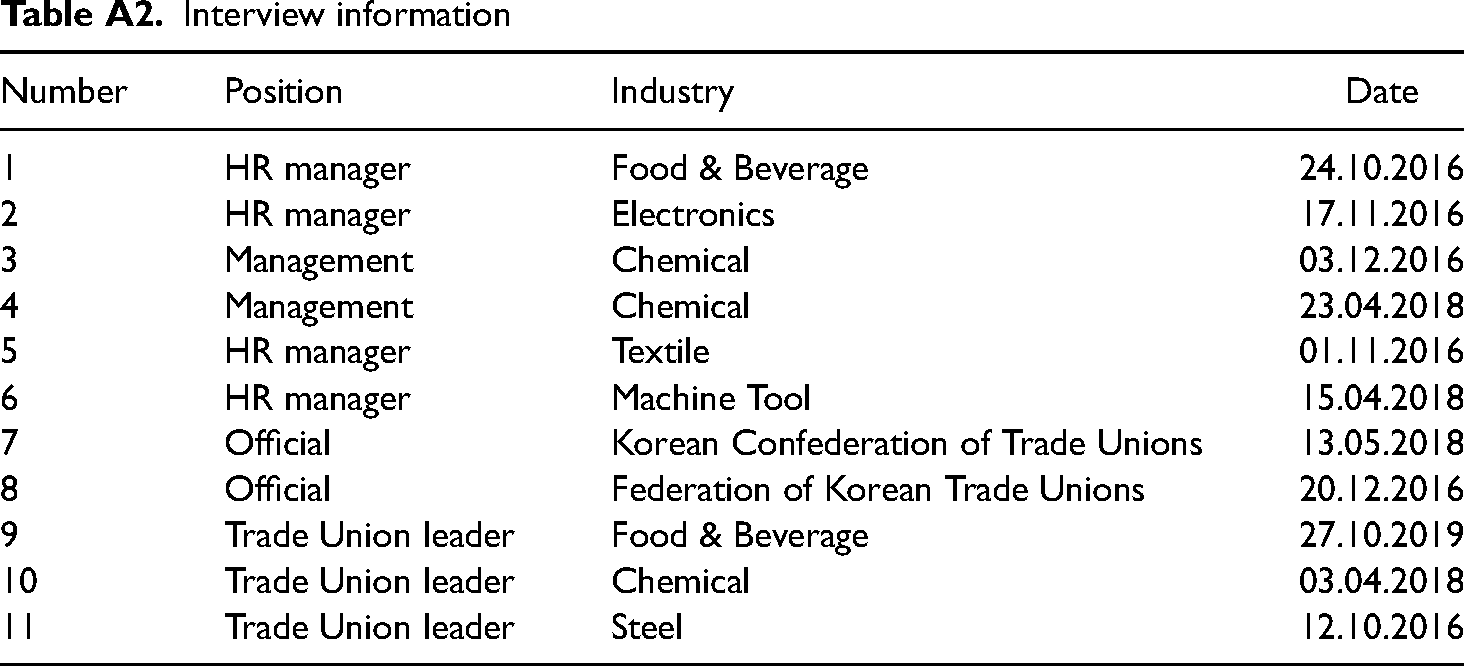
The case study focuses on the correlation between the low-skilled job and standard employment for women: that is female workers with low-skilled jobs on a standard employment contract. Figure 1 summarises the framework. The packaging firm was selected due to its position at the lowest point of the value chain, employing extremely a workforce with minimal skill levels. The findings are derived from interview accounts, which elucidate the employment dynamics to demonstrate the operation of the established gendered institutions within the workplace. The case study is based on semi-structured interviews with management, which have been cross-verified through additional interviews with the management of similar firms and union leaders. Interview information is available in the Appendix. Finally, the case firm is a specialist in the shampoo bottling business and is outsourced by Chaebol firms.
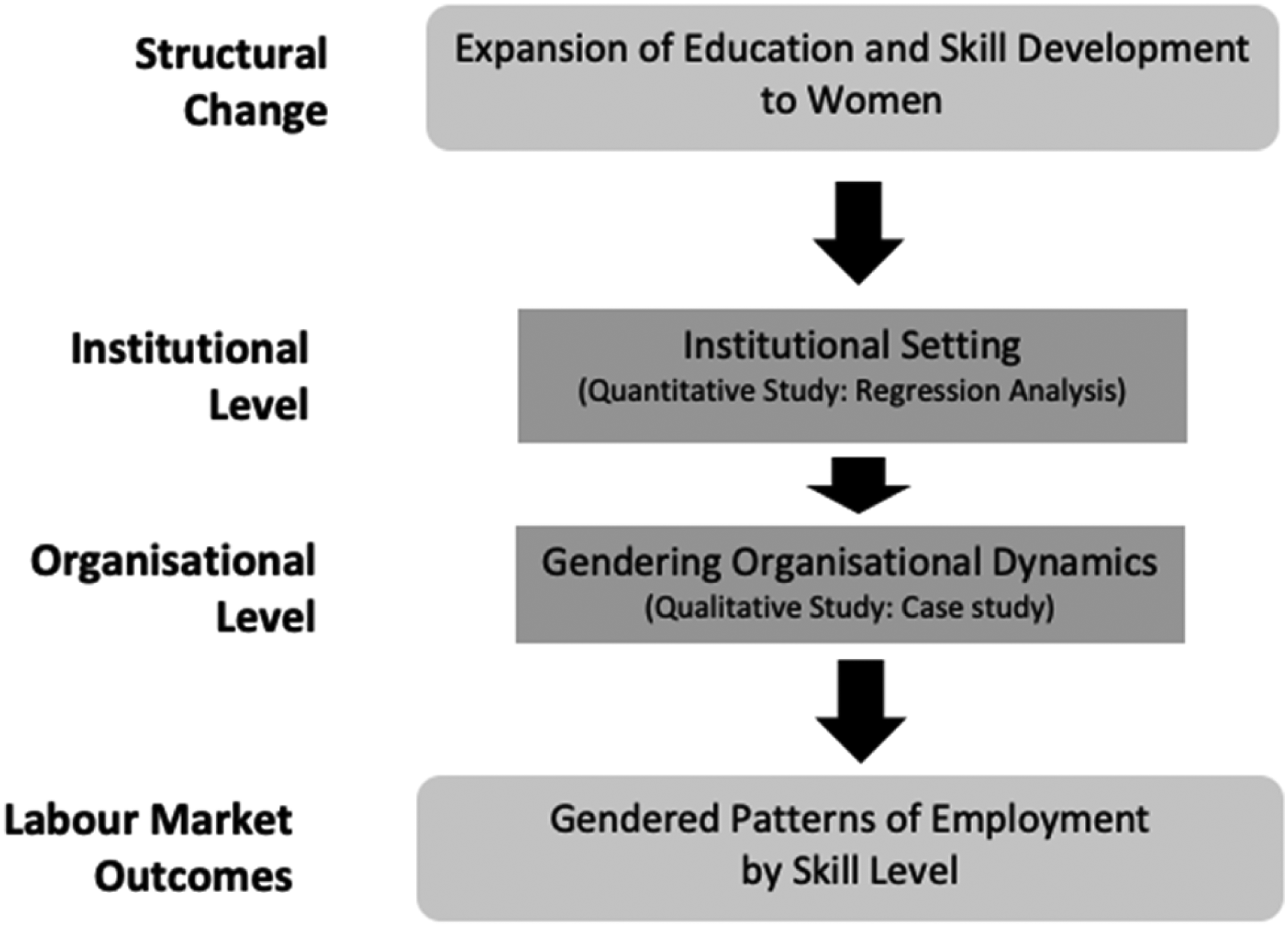
Framework.
The regression analysis employs datasets from the Korean Labour & Income Panel Study (KLIPS) conducted by the Korea Labour Institute. The analysis considers five waves: 2001, 2005, 2010, 2015, and 2020. The number of observations is 17,421. 1 The sample is representative of the population from each survey year, as the survey follows the same individuals over time. The population includes workforces from all industries, encompassing both private and public services.
For all panel datasets, pooled logistic regressions were conducted using STATA. Despite the Hausman Test indicating that fixed-effects logistic regression (FE) would be more appropriate than random-effects logistic regression (RE), the FE model was not employed due to the time-invariant nature of a key explanatory variable, female, which remains constant over time. This characteristic makes the fixed-effects model unsuitable (Collischon and Eberl, 2020).
A sensitivity test was conducted using the RE and pooled OLS models with interaction terms, as these terms can be time-variant. The direction and statistical significance of the interaction terms with female are consistent across the FE, pooled OLS, and RE models, though the magnitude of the interaction terms in the FE model is smaller than that in the other models (refer to the online appendix). This result demonstrates that since the FE model focuses exclusively on within-individual variation, it likely cannot fully capture the interaction effects stemming from between-individual differences, such as gender. This limitation is reflected in the marginplot for the FE model, which shows a zero marginal effect for the interaction term, such as female*skill. The marginplot highlights the FE model's inability to estimate the effect of time-invariant variables, even though the coefficients of the interaction term in the models are non-zero.
Omitted variables might not generate significant bias in this context. Occupational skill level is closely related to unobserved individual characteristics, such as ability. While ability is generally unobserved, skill serves as a partial proxy for ability, capturing some of its variation. Therefore, even though the FE model is not applied, individual heterogeneity is still accounted for, to some extent, through observable proxies like skill. To ensure robustness, educational attainment was included as an additional indicator of ability, but no significant differences in the results were found. Furthermore, according to labour market segmentation theory, an individual's employment status is not primarily determined by personal attributes like ability but is constrained by the structure of specific labour market segments, which limit mobility between primary and secondary labour markets. These dynamics restrict opportunities for upward movement, thereby reinforcing labour market stratification (Reich et al., 1973).
Despite the potential bias from omitted variables, pooled OLS allows this study to estimate relationships between individuals rather than within-individual effects. Particularly, since time is not a critical driver of variation in the dependent variable, pooled OLS simplifies the analysis by focusing on cross-sectional data. This approach avoids unnecessary time-related assumptions, which are not essential for examining the propositions. Therefore, pooled OLS is considered the most appropriate method in this study, providing reliable and interpretable results.
The dependent variable, Employment type, is operationalised through the survey question (p_0317): ‘Is your job standard or nonstandard?’ It is recoded (1 = nonstandard contract; 0 = standard contract). Nonstandard working arrangements encompass fixed-term, part-time, agency, and freelancing contracts, as well as in-house subcontracts. This measurement aligns with other research based on KLIPS datasets and interview findings in this paper. In the survey, in-house subcontracts fall under nonstandard employment, while other subcontracting forms are classified as standard (or regular) employment, such as outsourcing arrangements taking place on third-party sites, for example, packaging. The accountability of this variable may be considered questionable as the survey relies on individuals’ perceptions, and the classification of these indirect contracts can be ambiguous (Song, 2006). However, observations from the KLIPS survey are collected through a verbal questionnaire administered by interviewers, minimising such errors. Moreover, insights from interviews for the case study with subcontracted companies in this paper suggest that management reasonably emphasises different employment contract types when negotiating contracts with their workers.
The regression analysis tests a simple model and two interactive logistic models, which aim at testing the conditional effect of gender on the probability of being on a temporary contract given policy changes and the growth of highly educated women over time, job skill levels, and age group. Models II and III contain one interaction term each for testing for Propositions 1 and 2, respectively. Model IV is the full interactive model, containing all three interaction terms and the constituent terms. This model furthers the analysis of the interaction effect between females, skill and marriage on the probability of being on a nonstandard employment contract (Proposition 3).
All models include control variables such as age (three age groups), firm size (the number of employees), unions (firm with unions = 1 or without unions = 0), industry and firm type (1 = private or 0 = non-private). Besides, to account for potential correlations within individuals, clustered standard errors were employed.
The simple model and the interactive models look as follows:
Nonstandard contract Nonstandard contract Nonstandard contract Nonstandard contract
I operationalise my independent variables as follows. The dummy variable Female refers to workers who are women (women = 1; men = 0). The continuous variable Skill refers to the skill levels of jobs. I added this category to KLIPS from KNOW, occupational skill datasets, which follow the USA's O*NET survey dataset approach (American Dictionary of Occupational Titles). O*NET measures occupational effects, which are more useful than other measures, as they provide standardised measures of attributes of tasks and skill attributes (Fernández-Macías and Hurley, 2016; Spitz-Oener, 2006). The KNOW dataset
2
comprises 145 occupations that are prevalent in Korea. Skill is assessed based on the average proficiency across five skill domains associated with each occupation and is then transformed into natural logarithms. This concept of skills is understood in the context of various physical and mental faculties required for different occupations (Green, 2013). This measurement ensures that even seemingly straightforward works entail certain skill levels. The measurement is continuous and encompasses a broader spectrum compared to the typical dichotomy found in the political economy literature, such as high versus low skills (e.g. Crouch et al., 1999).
The post-AFC enforcement of protection measures for nonstandard workers and the maturation of deregulation policy subsequent to the AFC as well as the expansion of highly-educated female workers were operationalised through the time variable. Since the surveys only started after the 97–98 AFC, the time variable only starts from year 2001. However, the consequence of corporate restructuring as an immediate reaction to the crisis has been widely studied. Year, the time variable, was coded as a continuous variable taking values from 1 to 5.
Marriage is operationalised as an indicator of one's marital status, to measure the impact of breadwinner institutions (married = 1; unmarried = 0). The category of unmarried status specifically denotes individuals who have ‘never married’. The designation of married status encompasses individuals who are currently married, divorced, or widowed. This classification is particularly relevant in the context of women's career breaks, given that such breaks are significantly influenced by their marital status, especially considering the prevalent pattern of childbirth within marriage in Korea.
An analysis of gender, skills, marriage and nonstandard workers
Descriptive statistics
Table 1 shows the average ratios of nonstandard jobs by gender and marriage. Women work in nonstandard forms of employment more often than men, regardless of marriage status. Yet, the size of gender gap with reference to the ratio of nonstandard workers differ by marriage status. If unmarried, the ratio is bigger for women than for men over time with about 0.04, while the gender gap, if married, is far wider with an increase from 0.15 to 0.21.
Average ratio of nonstandard workers by year, marriage, and gender.
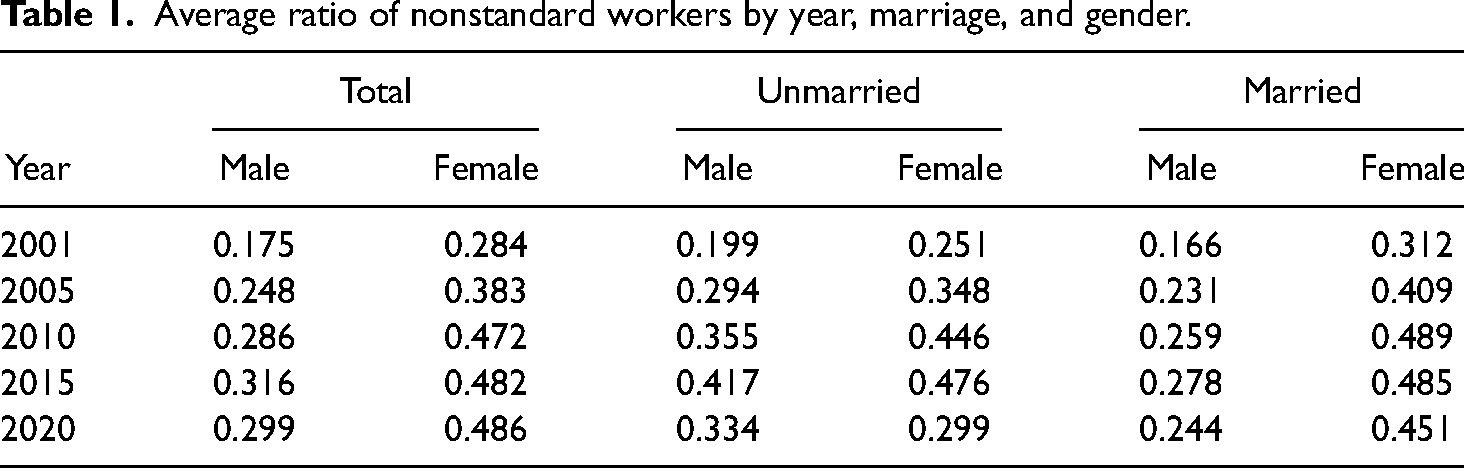
However, the ratio in 2020 deviates from the patterns observed in other years. The decline across both groups indicates layoffs among temporary workers attributable to the impact of COVID-19. Notably, the ratio for unmarried workers exhibits a reversal, with males outnumbering females. This shift is particularly pronounced among the majority of the unmarried subgroup, representing those who have never been married, predominantly composed of young workers. One plausible explanation is that while sectors such as lodging, restaurants, and retail, which employ a significant proportion of young workers, faced substantial challenges during the pandemic, delivery services business absorbed young male workers (Kim, 2022: 51–55).
Concerning skill distribution, Figure 2 indicates that, although there are no significant gender differences, it is noteworthy that the median value for women is higher than that for men. Additionally, Figure 3 shows that the influence of marriage differs between men and women, with more married women tending to transition to jobs with lower skills. Taking into account the considerable gender gap in nonstandard employment, as indicated by Table 1, women are more inclined to secure nonstandard positions, particularly for high-skill jobs. A correlation table is available in the Appendix.
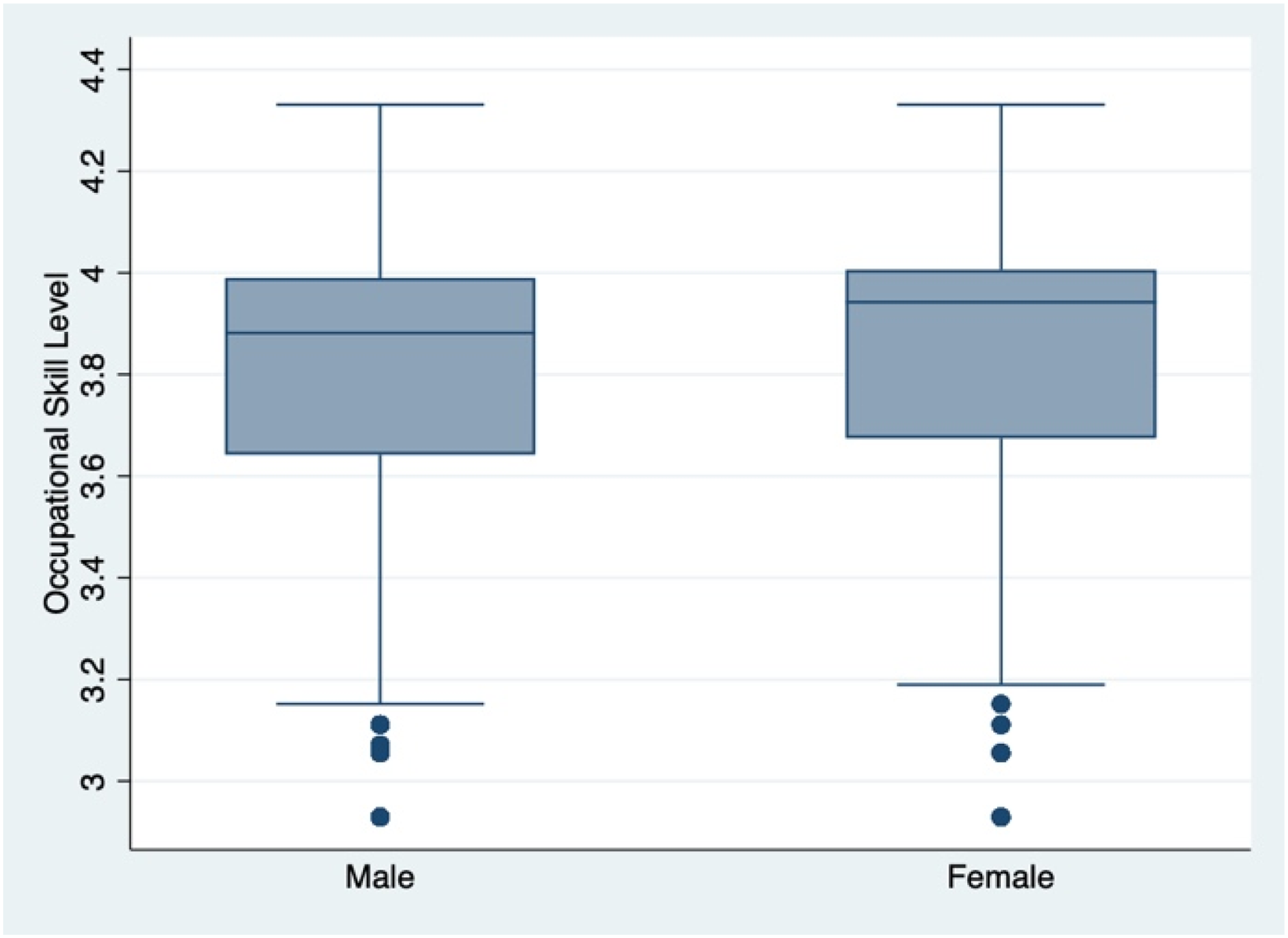
Distribution of skills by gender.
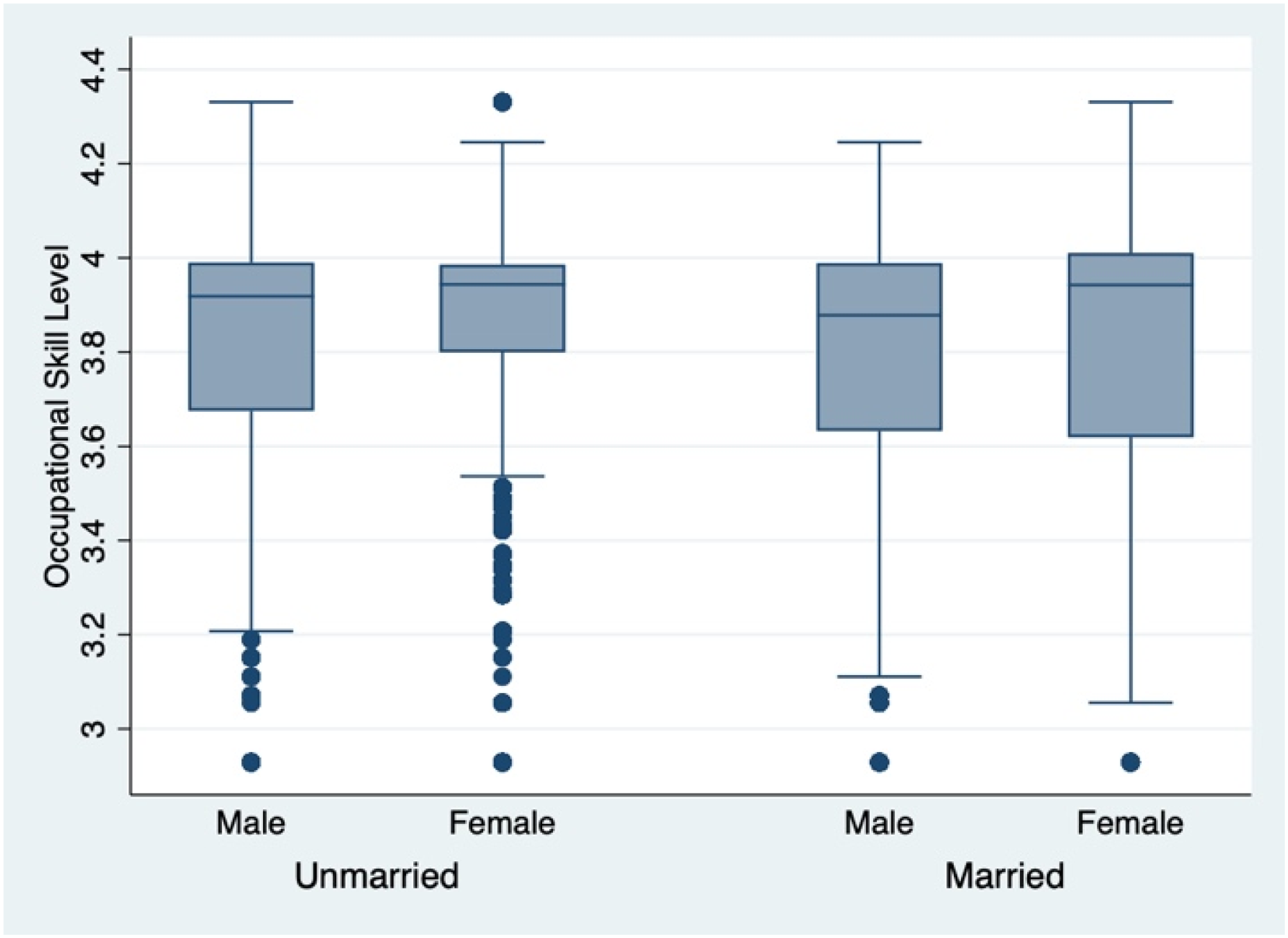
Distribution of skills by gender and marriage status.
Regression results
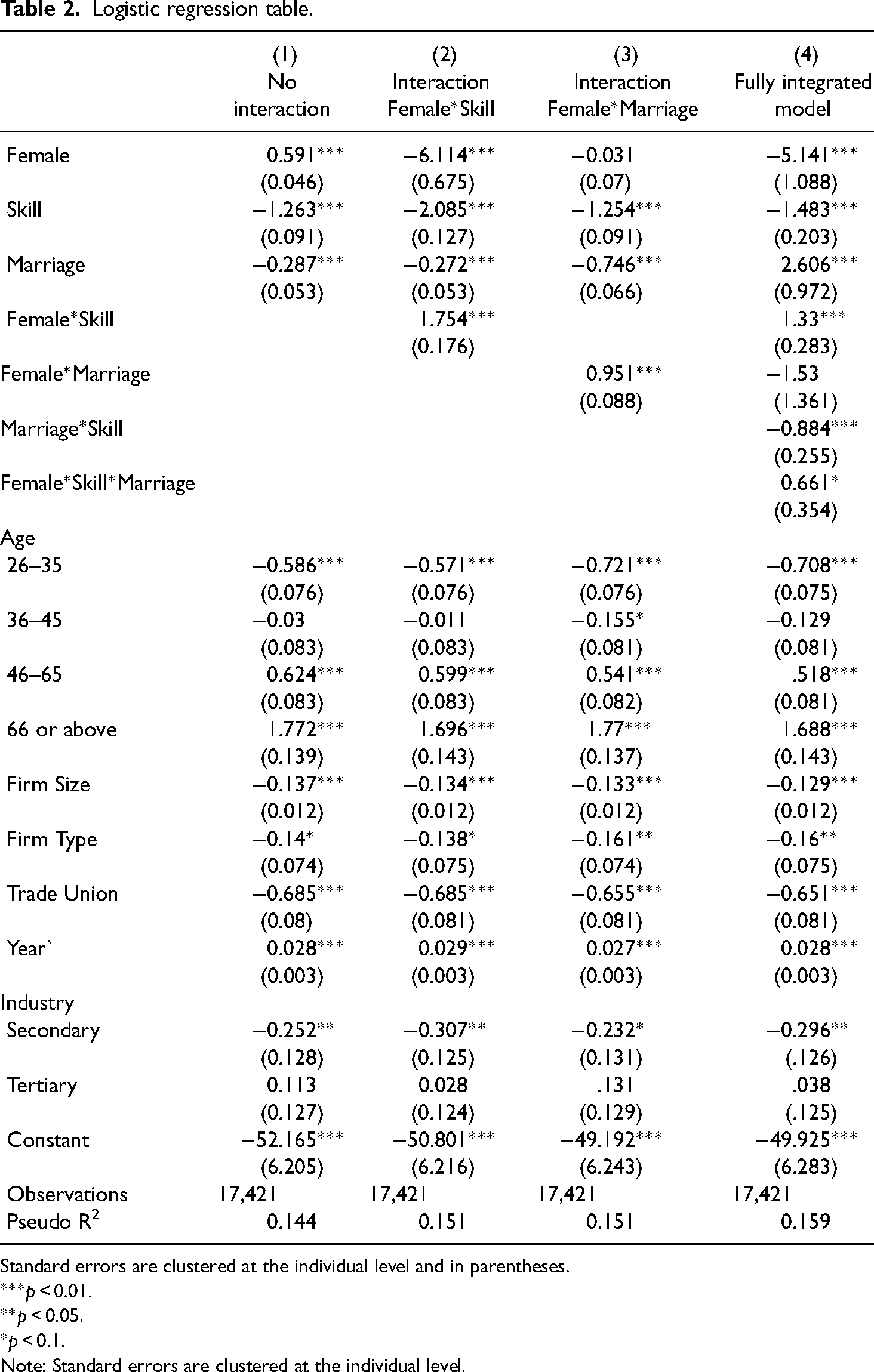
Table 2 shows the results of the logistic regression analysis. The logistic regressions with clustered standard errors have been run using the STATA commands logit and cluster.
Logistic regression table.
Standard errors are clustered at the individual level and in parentheses.
p < 0.01.
p < 0.05.
p < 0.1.
Note: Standard errors are clustered at the individual level.
The results of Model I are the following: The variables firm size and trade union are negatively correlated with the probability of being on a nonstandard contract. The characteristics of different industries lead to varying outcomes. While firms in the secondary sector, that is manufacturing, exhibit negative correlations, it is not statistically significant for firms in the tertiary sector, that is services. Age shows divergent results by age groups: Workers in their prime age, which is up to 45, are negatively correlated, while the older groups are positively associated with being on a nonstandard contract. Firm type is not statistically significant. Yet, having trade unions with the firm has a negative effect. The time variable, year, shows that workers are more likely to be on nonstandard contracts over time. Skill shows that the higher skills that their jobs require, the less likely workers are to be on a nonstandard contract. While marriage is negatively correlated, female is positively correlated with being on a nonstandard contract.
Models II, III in Table 2 contain, respectively, interaction terms, Female*Skill and Female*Marriage. Both of them are significant with a positive coefficient. However, in Model VI, the interaction term Female*Skill*Marriage is non-significant. The non-significant interaction terms can be interpreted from the table because the analytical interest lies ‘in the marginal effect of×on Y for substantively meaningful values of the conditioning variable Z’ (Ai and Norton, 2003; Brambor et al., 2006). Following the command routine recommended by Brambor et al. (2006), the command margins was used to estimate the marginal effects of gender given each value of the time variable, each value of the job skill variable, and marriage status. The plot graphs are reported, which give a clear representation of the interaction term.
Figure 4 reports the plot for the marginal effect of female on the probability of being on a nonstandard contract over job skill levels. The line shows that the marginal effect is negative up to skill level 3.3 but turns positive from skill level 3.6. This means that the negative effect of females on the probability of being on a nonstandard employment contract decreases up to skill level 3.3 and then the positive effect increases as the job skill level increases from 3.6. The marginal effect of marriage on the probability of being on a nonstandard contract is statistically significant and much higher for women than for men: indeed, Figure 5 shows that the marginal effect of marriage is positive for women, while negative for men. Figure 6 represents the interaction term through predicted probabilities: The probability of being on nonstandard employment for both women and men decreases as job skill level increases but it shows that the male group shows a dramatic decline, while the female group shows a flat change. Finally, it is also worthy to note that the probability of being in nonstandard employment is lower for females than males for jobs in the lower-skill groups.
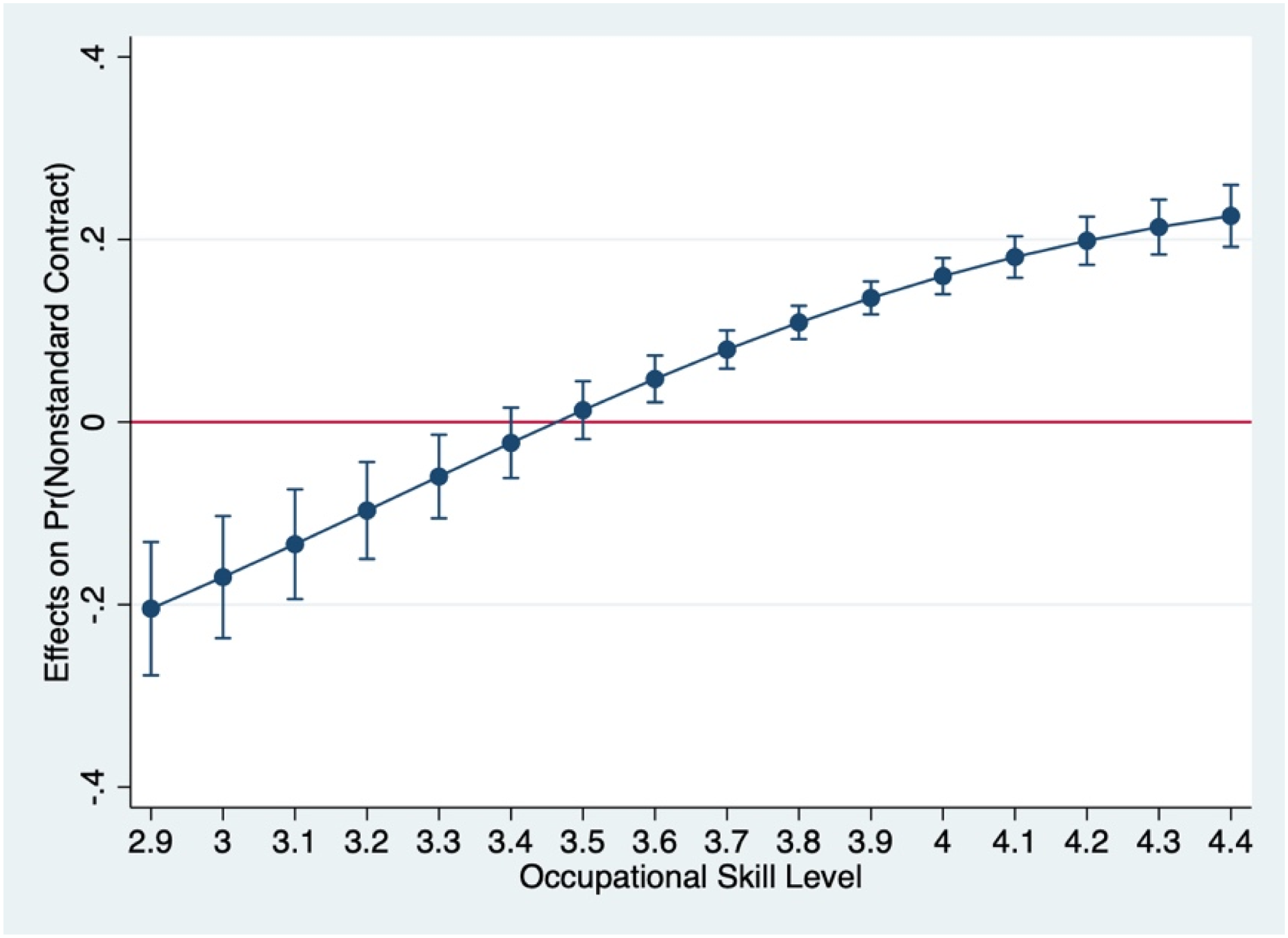
Average marginal effects of females with 95% confidential intervals.
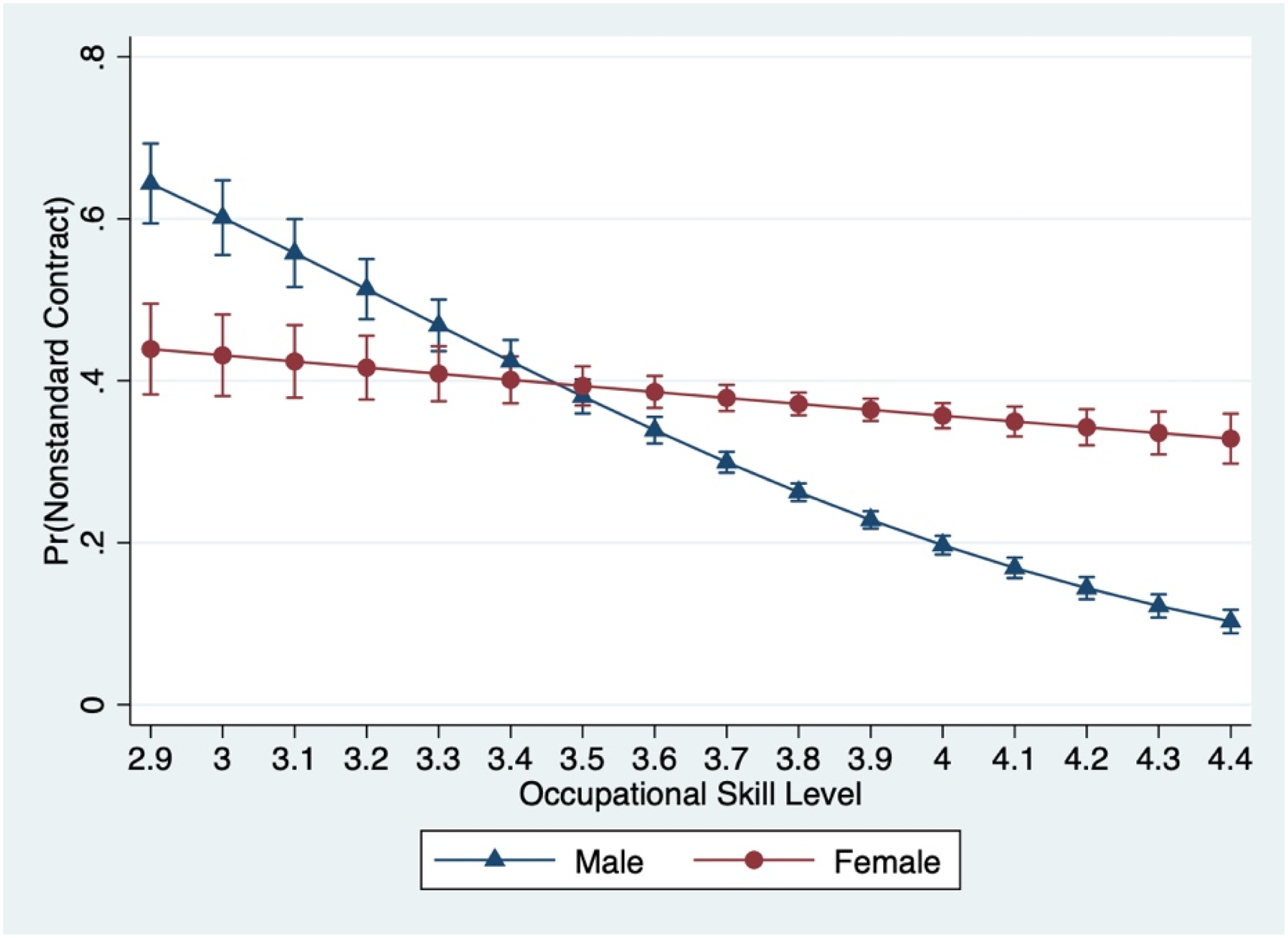
Predictive margins of females with 95% confidential intervals.
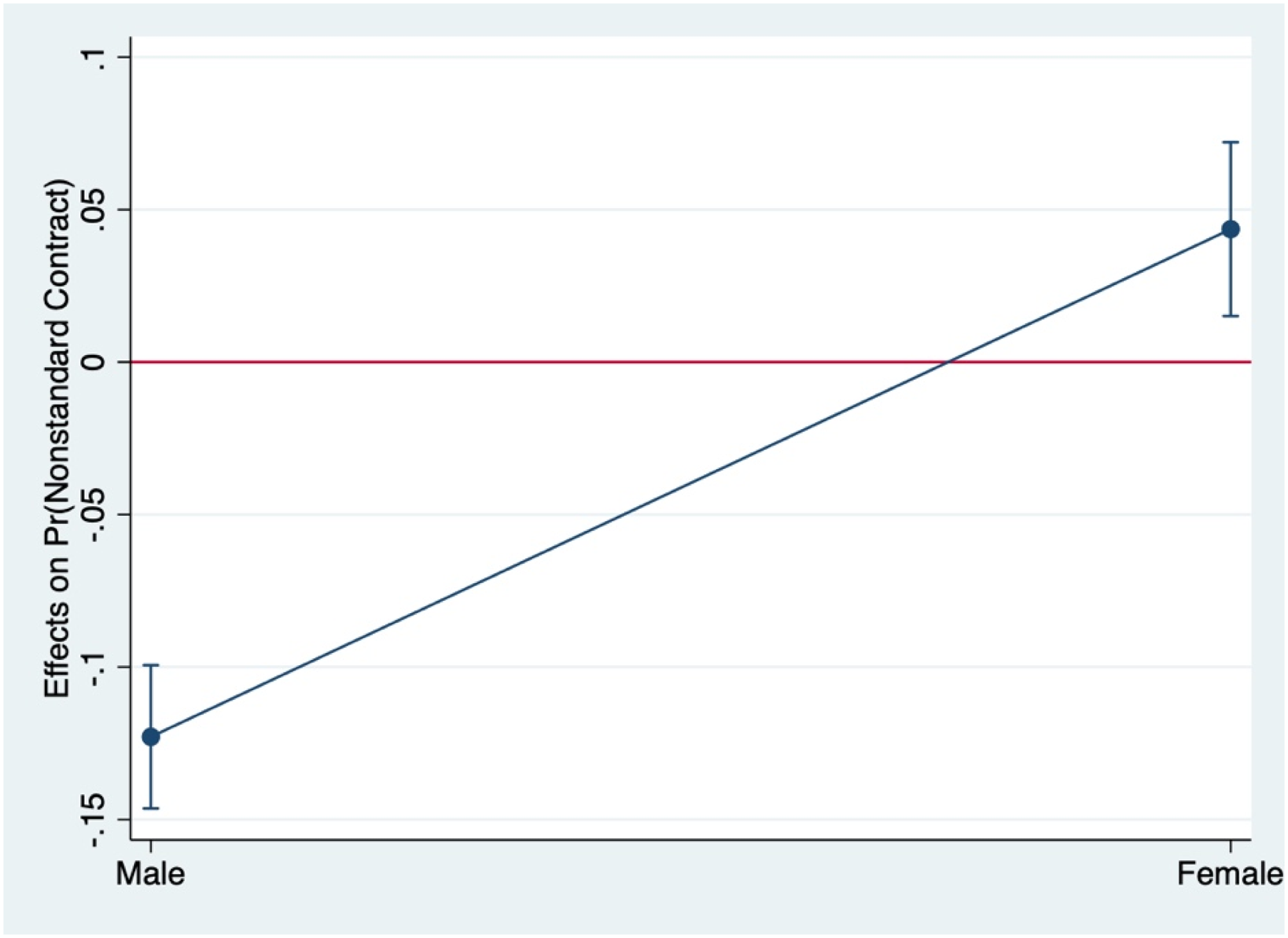
Average marginal effects of marriage with 95% confidential intervals.
Model IV includes two additional interaction terms. The term female*skill*marriage is used for the analysis of how the marginal effect of female on the probability of being on a nonstandard contract varies over different job skill levels, if married. Figure 7 shows that among the married workers, the marginal effect of female on the probability of being on a nonstandard contract increases for lower-skill jobs, when compared to Figure 4.
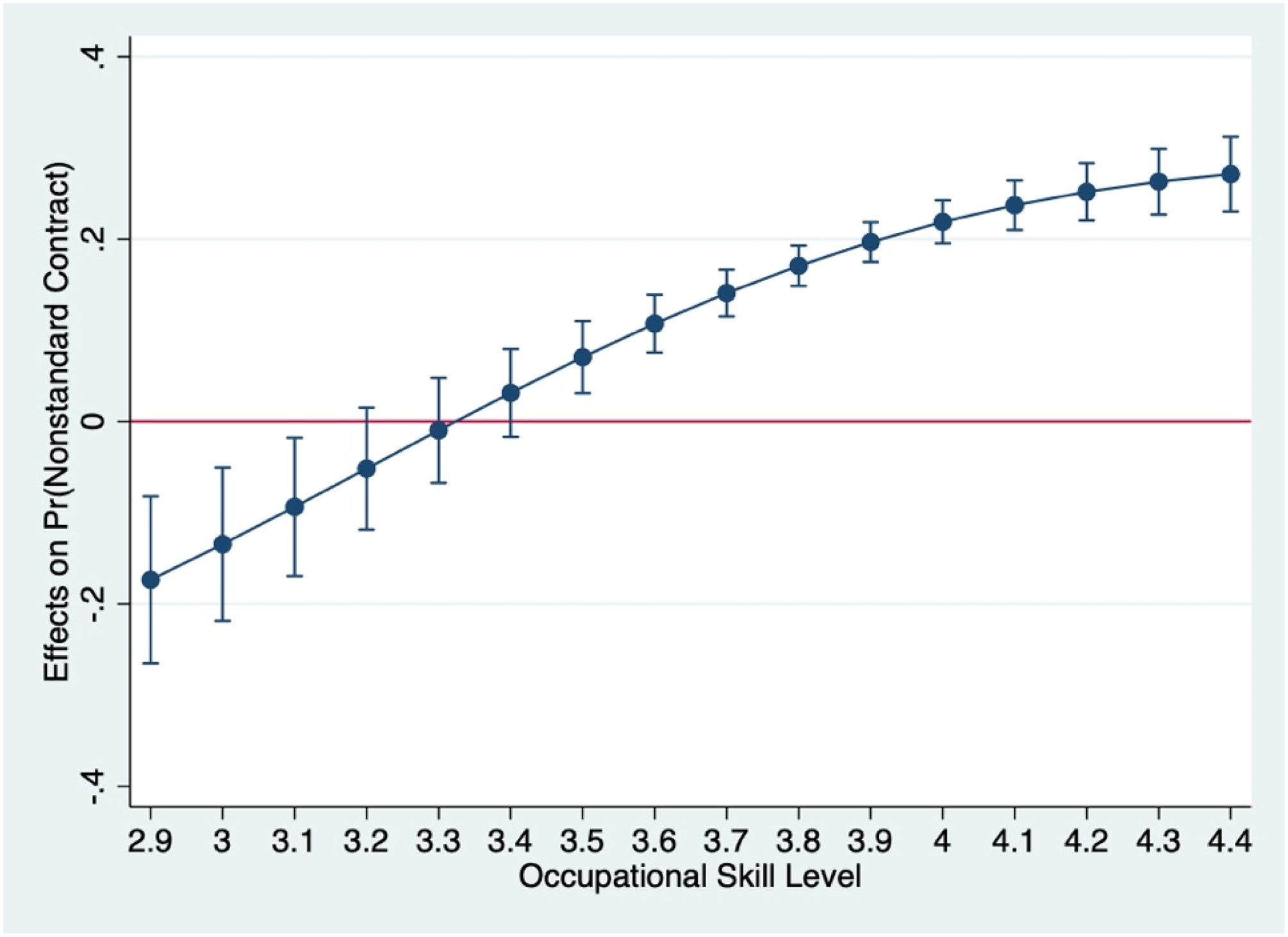
Average marginal effects of females among the married workers with 95% confidential intervals.
Additional logistic regressions have been conducted as robust checks (refer to the online Appendix). In the first set of models, educational achievement is incorporated into the model. Education and occupational skill levels are often correlated, given that individuals with higher levels of educational attainment tend to occupy positions with higher skill requirements. The result indicates no significant change.
In a second set of analyses, separate regressions were conducted for the secondary (i.e. manufacturing and construction) and tertiary (i.e. service) sectors, acknowledging that observations within these sectors may be correlated based on organisational structures or technology. Furthermore, sectors may entail distinct skill requirements, and the nature of work can exhibit significant variation. Firstly, the results for the secondary sector, which encompasses manufacturing and construction, reveal no change in statistical significance. Yet, there is a higher prevalence of standard female workers in higher-skill jobs. Secondly, the findings from the service sector indicate a partial change (see Figure OA1 in the online Appendix). While the gender gap for high-skill service jobs remains unchanged, the gender gap for low-skill service jobs is statistically non-significant as there is an increased presence of female nonstandard workers in more skilled service positions (see Figure OA2 in the online Appendix). This result aligns with numerous empirical studies suggesting the feminisation of temporary service jobs (e.g. Standing, 1999). Nevertheless, this sectoral variation guides the selection of a manufacturing job for a case study, as the observed gender gap in the manufacturing industry aligns with the characteristics of the overall labour market in main models. Besides, this alignment is not substantiated by the existing literature.
This section has shown that women are more likely to occupy nonstandard positions than men and the discrepancy following marriage becomes greater, thereby confirming Proposition 1. This finding, however, serves to partially corroborate the gendered dualisation scenario. In occupations requiring higher levels of skill, women are more likely than men to become nonstandard workers (thus, Proposition 2 is supported). While skills undoubtedly enhance men's prospects of becoming standard workers, the likelihood of such an outcome for women is relatively low. This is also the case for marriage although the likelihood of women taking a nonstandard contract for jobs of a lower skill level is increased by marriage. Therefore, the gender gap widens for higher-skilled jobs, resulting in the rejection of Proposition 3. However, in contrast to expectations, as occupational skill levels decrease, women are more likely than men to become standard workers. The evidence deviates from the gendered dualisation scenarios in that low-skill jobs tend to be coupled with standard job contracts for women, suggesting that there is a distinctive gendered logic operating for these low-skill jobs.
The qualitative analysis in the following section investigates the gendering process underlying the low-skill jobs for women and for the gendered relationship between skills and standard employment contracts.
Case-study finding
Is stable employment with a standard contract unnecessary for low-skilled jobs?
Management reports that although low skills are required, management puts the standard employment contract forward in light of long-term relationship. Standard employment contracts in light of permanency smoothen and stabilise day-to-day operations even though employing low-skilled workers. Some proficiency that is developed through routinised work is beneficial for quality control to reduce errors and faults although there is no technical training required. Accordingly, some elements of internal labour markets, such as internal promotion, have been established to increase productivity, promote loyalty and teamwork, and reduce transaction costs such as turnover rates. Productivity from standard workers is different…there are processes that require full-time employment of our employees. There are processes that require proficiency, skills, [and] functions that mediate mistakes rather than developing special skills. If nonstandard workers become proficient in new skills, they can apply them quickly (HR Manager#4). [Some nonstandard workers] do not come again the next day… some work in the morning and disappear after lunch. We pay for it on a monthly basis, a monthly salary. If you multiply the hourly wage by 209 h, the basic salary is the monthly basic salary. So, if you don’t come today, you will get a day deducted from your weekly benefits as well as your wages (Management#3). In particular, large corporations have been pressured by strong industrial relations, so there's a wage increase. We don’t blush here [from conflicts], workers don’t ask for it. The company raises wages every year according to the minimum wage, so they know better. On top of that, [workers think,] if they get extra, it's good…it would be nice to get even extra 100,000 won [USD 100] for summer vacation…it's also ok if they don’t get any. There could be people who think that they work harder [than others]. However, as I said before, the employees are housewives, so they don't ask for more. As long as they get a pay cheque every month, they don't ask the company for anything special.
The qualitative findings show the gendered organising mechanism which allows a broad scope for employers to utilise standard contracts for low-skill roles. The findings indicate that the gendered institutional legacy underpins the business strategy and the organisational structure of the firm, as the subcontracting relations perpetuate the marginalisation of women at the bottom of the value chains, where almost all workers are married women. Secondly, although the core work for a packaging business only requires low technical skills, the internal labour market operates to some extent. The limited training practices enhance productivity and reduce the associated costs of human resource management. Third, wages are set at a low level. Wages for both standard and nonstandard workers are set and adjusted following the statutory minimum wage; with no differential between the two worker groups. This strategy enables management to maintain low wages and avoid industrial relations issues. Consequently, the gendered organisation of the workforce resulted in female workers being hired through standard employment contracts, yet they are exposed to high labour market risks due to the firms that hire them being positioned at the bottom of the value chain. These firms offer their workers low-quality jobs, coupled with simple skillsets and low pay.
Discussion
This article illustrates patterns of gender employment outcomes by occupational skill levels in the Korean labour market and provides an overview of the underlying gendering mechanism in the workplace.
This study reveals that gender segregation patterns vary by skill level. It emphasises the significance of intersectionality with skills, demonstrating that gendered employment outcomes differ by occupational skill level. Firstly, highly-skilled females are constrained into nonstandard working relationships, despite the increased labour market participation and expanded woman-friendly policy. This finding corroborates the feminist critique on VoC, indicating unfavourable employment outcomes for women with highly skilled jobs in the CMEs. The significant gender segmentation for the same high skills implies that employers’ gendered institutional logic of skills in a view of long-term use of specific skills may overrule the expanded defamililisation policy, as hiring costs on firms still seem higher when hiring female workers. Due to this strong reliance on firm-specific skills, the generous parental leave would rather reinforce gender discrimination against female workers in occupational segregation (Kang, 2021). The discrepancies between occupations at the same high-skill levels may be attributed to gender segregation in skills, which differentiates between investment in firm-specific skills for men and the development of occupation-specific skills for women. This is particularly relevant in occupations that are sufficiently broad to accommodate employment opportunities after periods of absence and/or on a part-time basis (Soskice, 2005).
This differentiation is related to the gendering of job design, which results in intra-occupational segregation. Jobs such as quality control within the software engineering occupations are usually coupled with nonstandard contracts (Slaughter and Ang, 1996). These jobs tend to be delegated to women (Campero, 2021). This significant discrepancy in employment types further strengthens the view of the VoC on the segmentation of female workers with higher educational qualifications or skills. The nonstandard contracts in CMEs are typically associated with low remuneration, which contributes to a wider gender wage gap for highly skilled groups in CMEs than in LMEs (Grönlund and Magnusson, 2016). This occupational skill segregation serves to illustrate the horizontal dimension of the gender-based dualisation scenario, thereby confirming that educational or skill development rewards differ between men and women (Blackburn et al., 2002; Peng, 2012).
Second, this study highlights that the employers’ gendered coordination of institutions differs by occupational skill level. The results show that in contrast to high-skilled jobs, women in low-skill jobs are more likely than their male counterparts to become standard workers. The case study shows that employers can also use a standard employment contract for low-skilled jobs. These contracts for married women are of low quality. The study additionally highlights that this gendered logic is embedded in the production regime, that is gendered interfirm relations, which allowed employers greater scope in applying the recently reformed labour market policies to low-skilled female worker groups (Cooke, 2010; Iversen et al., 2020; Waylen, 2014). This gendering mechanism has resulted in trivial differences between types of employment, as women on standard contracts are no better off than their counterparts on nonstandard contracts. In other words, the quality of their standard contracts is as low as that of their nonstandard contracts. This gendered organisation of low-skilled jobs leads to significant intra-job discrimination in the secondary market such as wage differentials between those employed by small firms (Kim, 2017). These different gendering processes with jobs at different skill levels serve as a critical dynamic that creates class differences as an unexpected consequence of the advanced gender-friendly family policies (Iversen et al., 2020).
The findings underline that the agency of employers is understated in the VoC-based and macro-level feminist literature (Estévez-Abe, 2009; Shire and Walby, 2020), corroborating the claims voiced by organisational studies scholars. Employers’ use of institutions is more extensive than simple ‘avoidance’ (Oliver, 1991), such as offering women a nonstandard contract. Employers can also convert the quality of the standard contract for low-skill female workers as well as circumvent the need to offer standard contracts to high-skill female workers. Therefore, the gendering logic of employers is fundamental, adding complexity to the relationship between skills and employment (Rubery, 2009; Rubery and Hebson, 2018).
This study contributes to the literature on gender and employment relationships in CMEs. Previous studies have mainly focused on women's adverse labour market participation. By examining the association between employment types and skill levels, this study extends the feminist critique on the skill-driven dualisation scenario (Rubery, 2009). The findings show gender segregation patterns ‘within’ the labour market that include an important dimension of the punishment of women's employment opportunities.
Second, previous studies on CMEs have assumed that standard working contracts guarantee quality of work. This study on Korea indicates that the quality of a standard employment contract can vary across worker groups since despite the strict legal protection measures, standard employment contracts do not always serve as a panacea to protect low-skilled women from labour market risks. This study provides a specific gendering mechanism to examine the claims about the temporalisation of standard employment (Appelbaum, 2017; Rème-Harnay, 2024). It points out that a gendered organisational logic plays a key role in blurring the institutional boundaries between protected and unprotected labour market segments (Grimshaw et al., 2017), hinting that gendered dualisation is a pathway to a precarious labour market (St-Denis and Hollister, 2023; Yulee, 2021).
Furthermore, the Korean CME case provides an insight into the ‘segmenting gendered effects of the standard employment relationship (SER) (Fudge and Mundlak, 2022),’ suggesting a potential future trajectory for currently emerging economies. The experience of gendered coordination for rapid development in Korea continued to serve as an important institutional logic for organising jobs of different skill levels in a more precarious way than in mature CMEs. Its resilience is manifest in the increasing hierarchisation of inter-firm networks (Doellgast and Greer, 2007), including on-site subcontracting (Hertwig et al., 2019), as well as the exclusion of women within the organisations (Kim et al., 2020).
The findings of this study offer practical insights for policymakers and unionists aiming to create sustainable labour markets in CMEs. While traditional policies have focused on promoting the SER, this study highlights that SER is not a universal solution, particularly for women in low-skill occupations. Additionally, other research suggests that in certain high-skill occupations, such as software developers, SER often manifests as shorter tenures, reflecting the preferences of both employees and employers (Yoon, Forthcoming). Therefore, efforts should be directed toward making SER more inclusive and negotiating with employers the balance between flexibility and cost for nonstandard arrangements, which are typically characterised by high flexibility and low cost in CMEs. This would ensure that various working arrangements accommodate diverse worker needs, such as caregiving responsibilities. A broader, more inclusive approach is essential for advancing sustainable labour markets in CMEs.
This article has limitations and indicates some directions for future research. The individual-level surveys and employer interviews employed in this study overlook the aspect that the gendering process reflects workers’ personal experiences, raising the question of under what conditions female workers take up a standard contract on a short-term basis. Similarly, the experiences of women in high-skill occupations have not been sufficiently explored. While some studies have addressed the experiences of female professionals in male-dominated corporate cultures (e.g. Um, 2019), it is crucial to elucidate the intricate country-specific institutional dynamics at play. Finally, there is an urgent need to collect more evidence from newly emerged economies. These CMEs may suggest different mechanisms or variables such as the extensive utilisation of interfirm relations that operate as functional equivalents in employee relations in the other mature CMEs (Thelen, 2014). This study shows organisational gender regimes should be seriously considered in explaining organisational networks in CMEs.
Supplemental Material
sj-docx-1-jir-10.1177_00221856241300716 - Supplemental material for Is standard employment contract good for all? The gendered institutional logic of employment in South Korea
Supplemental material, sj-docx-1-jir-10.1177_00221856241300716 for Is standard employment contract good for all? The gendered institutional logic of employment in South Korea by Francis K. Yoon in Journal of Industrial Relations
Footnotes
Declaration of conflicting interests
The author declared no potential conflicts of interest with respect to the research, authorship and/or publication of this article.
Funding
The author received no financial support for the research, authorship and/or publication of this article.

Supplemental material
Supplemental material for this article is available online.
Notes
Biographical note
Appendix
Interview information
| Number | Position | Industry | Date |
|---|---|---|---|
| 1 | HR manager | Food & Beverage | 24.10.2016 |
| 2 | HR manager | Electronics | 17.11.2016 |
| 3 | Management | Chemical | 03.12.2016 |
| 4 | Management | Chemical | 23.04.2018 |
| 5 | HR manager | Textile | 01.11.2016 |
| 6 | HR manager | Machine Tool | 15.04.2018 |
| 7 | Official | Korean Confederation of Trade Unions | 13.05.2018 |
| 8 | Official | Federation of Korean Trade Unions | 20.12.2016 |
| 9 | Trade Union leader | Food & Beverage | 27.10.2019 |
| 10 | Trade Union leader | Chemical | 03.04.2018 |
| 11 | Trade Union leader | Steel | 12.10.2016 |
References
Supplementary Material
Please find the following supplemental material available below.
For Open Access articles published under a Creative Commons License, all supplemental material carries the same license as the article it is associated with.
For non-Open Access articles published, all supplemental material carries a non-exclusive license, and permission requests for re-use of supplemental material or any part of supplemental material shall be sent directly to the copyright owner as specified in the copyright notice associated with the article.
