




Abstract
This article aims to empirically explore how European labour markets are segmented and who the outsiders are. The article moves beyond the dichotomous approach to understanding labour market division, often based solely on examining employment relationships. Taking a multi-dimensional approach to defining labour market precariousness, this study incorporates aspects such as income, job prospects and subjective insecurity. Latent Class Analysis is used on data taken from the 2015 European Working Conditions Survey to extend the traditional definition of outsider-ness. Four labour market segments are found: insiders and three different types of outsiders: typical outsiders, dead-end insiders and subjective outsiders. Looking at the cross-national aspect, variations are found in the segmentation patterns, especially in terms of who the outsiders are. The findings show the need to examine various aspects of labour precariousness in order to capture the complexity of post-industrialised labour markets and identify different types of outsiders across Europe that need to be protected for building a more cohesive society.
Introduction
This study aims to empirically examine segmentation patterns in the European labour market using different indicators of labour market precariousness. The five indicators used incorporate both objective and subjective insecurities as well as future prospects. Against a background of increasing calls for labour flexibilisation and the deregulation of employment protection, labour market inequality has become one of the major features of post-industrialised societies (Emmenegger et al., 2012). The labour market is increasingly divided by income levels, employment contracts and skill levels, with a growing number of workers in precarious work (Kalleberg, 2018). This in turn has eroded previous achievements in protecting workers’ rights, with diverse types of precariousness now leading to the individualisation of the risks experienced by workers (Standing, 2011). Moreover, while (strong) unions have protected core workers from increasing demands for deregulation (e.g. Chung, 2019; Emmenegger et al., 2012; Palier and Thelen, 2010), their protection of all workers is called into question. Thus, to build a more inclusive labour market and cohesive society, it is important to gain a deeper understanding of how labour markets are segmented and identify who the outsiders are.
While there are different types of precariousness (e.g. low-wage work, part-time work, temporary work, agency work, subjective insecurity), the labour market segmentation literature (e.g. Doeringer and Piore, 1971; Emmenegger et al., 2012; Lindbeck and Snower, 1986) often highlights two non-competing segments in the labour market: those on standard employment contracts and thus well-protected, and those on non-standard contracts with little or no protection – namely, insiders and outsiders. This standard/non-standard dichotomy has been considered a key dividing line in post-industrialised labour markets (Rueda, 2005). However, recent studies report evidence of diverse combinations of precariousness not fully captured by dichotomised understandings of the labour market. For instance, having a standard employment relationship does not necessarily guarantee income security (Eichhorst and Tobsch, 2015; ILO, 2019), nor does it guarantee one’s sense of job or employment security (Chung, 2019). Thus, focusing on employment contracts alone has limitations in examining how the labour market is actually divided. It is therefore important to examine how the different aspects of precariousness combine to form different segments in the labour market, revealing both the heterogeneity of labour market outsiders as well as precarisation patterns.
A number of recent studies have taken this approach, focusing on different types of labour market precariousness such as labour market status (i.e., various non-standard employment arrangements; Emmenegger, 2009) or the risks involved, whether objective (i.e., low income; Yoon and Chung, 2016) or subjective (i.e., perceived insecurity; Chung, 2019). Nevertheless, further research is required to bring these factors together, especially as the literature is often limited to objective and not subjective characteristics. Moreover, dependent self-employment also needs to be included as a type of non-standard employment, as it is not covered by labour protection in most countries (due to workers being de jure self-employed but de facto employees) and is becoming more prevalent in the gig economy. Lastly, more needs to be known about cross-national variations in precarisation patterns. While dualisation and liberalisation are the two prevailing theoretical paths of precarisation in post-industrialised societies when focusing on employment contracts (e.g. Emmenegger et al., 2012; Palier and Thelen, 2010; Prosser, 2016), the question remains as to how the patterns would look when comprehensively considering the various aspects of precariousness discussed above.
This study thus examines the patterns of labour market divisions in Europe by encompassing various aspects of precariousness, with the aim of understanding who the outsiders are. This study uses the approach taken in recent literature (e.g. Lukac et al., 2019; Yoon and Chung, 2016), empirically examining labour market divisions using Latent Class Analysis (hereafter LCA), instead of starting from certain assumed types of divisions. LCA is a useful tool for examining how different types of precariousness (e.g. low-income, non-standard employment) tend to coincide but in different combinations to form segments in the labour market. This study differs from previous studies in proposing a typology incorporating a wider range of factors contributing to labour market precariousness: objective characteristics of the employment contract (including the dependent self-employed), future job prospects and income, and the subjective perception of the workers concerned. Using data from the 6th European Working Conditions Survey and five indicators of outsider-ness – namely, part-time work, insecure employment, subjective job insecurity, income insecurity and job prospects – I explore labour market segmentation patterns across 30 European countries and their cross-national variations. I specifically focus on Europe due to the availability of comparable data and the extensive literature on labour market segmentation that enables interpretation of the empirical findings.
This study finds that, while the European labour market is divided largely into two segments – insiders and outsiders –, the ‘outsider’ segment is not homogeneous. It can in turn be divided into three segments – typical outsiders, dead-end insiders and subjective outsiders –, each of which presents different challenges in terms of regulation and workers’ organisation. Thus, while the findings support the general perception of labour market dualisation, they also highlight the importance of looking at different categories of those in precarious employment. While many of the previous studies drew on specific national contexts, possibly limiting the applicability of their findings (e.g. Yoon and Chung, 2016), this study covers 30 European countries (the EU-28 in 2015, Norway and Switzerland), thus offering a more general framework for the study of labour market segmentation in Europe. The findings point to the countries featuring different patterns of labour market segmentation, especially in terms of which outsider groups predominate. These cross-national variations have implications a) for dualisation researchers examining different patterns of dualisation, and b) for trade unions in understanding who needs to be considered for more inclusive movements in different countries.
Theoretical background
Diversity of labour market typologies
Criticising the neoclassical assumption of labour economics that inequalities in the labour market status depend on one’s human capital, some scholars came up with the Labour Market Segmentation Theory. They argue that the labour market is segmented into non-competing markets where barriers between the markets protect those in a secure market (i.e., primary market), while at the same time hindering others (in the secondary market) from entering such a market (Doeringer and Piore, 1971; Reich et al., 1973). They show that the allocation of wages or jobs cannot be explained through differences in human capital, but rather through the divisions in the labour market based on institutional and social factors, thereby providing more structural and institutional explanations for labour market inequalities. Depending on the institutional and societal contexts, different theories focused on different outsiders from whom the institutions protected the insiders. Yet, the core of these debates was always the question: How is the labour market segmented?
The literature often assumes two big non-competing segments – insiders and outsiders. However, how the dividing line is drawn between these two segments varies depending on the research focus. The Segmentation Theory focuses on secure employment in large firms (i.e., internal labour market; Doeringer and Piore, 1971) or wage differentials (Boston, 1990). Insider-Outsider Theory divides the labour market based on the employment status (i.e., whether one is employed or not; Lindbeck and Snower, 1986), while the Dualisation Theory often defines insiders as those with a standard employment relationship, characterised as full-time, fully insured and with a secure employment relationship (e.g. Schwander and Häusermann, 2013).
On the other hand, considering the increasingly diversified post-industrialised labour market, the assumption of a ‘dual’ labour market has been questioned (e.g. Jessoula et al., 2010; Lukac et al., 2019; Yoon and Chung, 2016). Looked at from the perspective of income protection when unemployed, Jessoula et al. (2010) argue that there is a third group of workers in between the insiders and outsiders in Italy – the ‘Mid-siders’; while Paugam (2007) uses perceived employment security and the quality of employment to come up with four types of jobs: ‘non-precarious’, ‘instability-good quality’, ‘stability-poor quality’ and ‘instability and poor quality’. Recent studies have used LCA with several indicators of labour market outsider-ness to examine labour market divisions. For instance, Yoon and Chung (2016) found a third segment in the UK labour market which they call ‘future insecure’ (based on their insecure pension coverage despite their current employment security); and Lukac et al. (2019) categorised the seven segments they found into three groups – ‘managerial’, ‘standard’ and ‘disadvantaged’ – based on data from 11 European countries. Rather than starting out from assumptions on certain types of labour market divisions, these studies empirically examine how the labour market is segmented. This approach to analysing labour markets is especially useful in cross-national comparisons. For example, the assumption of labour market segmentation based on employment contract types may not apply to different contexts, such as the UK and southern European countries where employment protection is generally low (see Prosser, 2016; Yoon and Chung, 2016).
Labour market outsiders and the heterogeneity of precariousness
Labour market outsiders (hereafter outsiders) are often defined as those excluded from (social) security, whereas insiders have employment security, income security, prospects for advancement and social protection (see review in Davidsson and Naczyk, 2009). The literature on dualisation (e.g. Rueda, 2005; Schwander and Häusermann, 2013) uses non-standard employment as a key indicator for outsiders, as employment security is often directly linked to income and social protection (ILO, 2016). The inclusion of non-standard employment (e.g. part-time or temporary contracts) in the operational definition of an outsider captures an important aspect of the post-industrialised societies, that having a job does not necessarily guarantee security in the labour market (as opposed to industrialised societies where labour market insecurity was more closely linked to being unemployed or in informal work – thus, not in wage work).
However, what differentiates outsiders from insiders is not only their employment status, but also (and more precisely) the concomitant disadvantages, such as a low or unstable income, job insecurity, and lack of opportunities for upward mobility (Davidsson and Naczyk, 2009). Despite the significance of non-standard employment as an indicator of outsiders, there are some key outsider characteristics not captured by the employment contract alone: income insecurity (i.e., objective insecurity), subjective insecurity and future insecurity.
Income insecurity is a key indicator of labour market precariousness (see review in Olsthoorn, 2014), indicating the ‘actual’ outsider-ness of those who are more likely to be outsiders (Häusermann and Schwander, 2009). It is not only an important indicator of the current state of security but also for the future, especially in institutional settings where welfare benefit levels (including pensions) are based on prior earnings. While income insecurity may be due to low income or unstable income, previous studies have often focused on low income, as it is linked to one’s lack of economic autonomy and subsequent insecurity in living even when the income is stable. Although the incidence of low income is often higher in non-standard employment, low income may also be a feature of standard employment, especially for women (ILO, 2019; see German case in Eichhorst and Tobsch, 2015). Moreover, low income was found to be a key indicator for defining outsiders in the UK, even more so than employment contract types (Yoon and Chung, 2016).
Subjective insecurity is another important indicator of ‘actual’ outsider-ness (Chung, 2019; Häusermann and Schwander, 2009), covering workers’ lived experiences that are often neglected by objective measurements. Green et al. (2001) found that it is highly relevant to the actual level of security experienced by workers in their job/employment (in relation to past, present and future (un)employment), even more than the current employment contract. What is more, having a secure employment contract does not necessarily guarantee a sense of security, though effects vary across countries (Chung, 2019). A general sense of employment security may be reduced by circumstances such as the lack of employment protection witnessed through the dismissal of colleagues (Klandermans et al., 2010), or increased flexibilisation through deregulation of non-standard workers that may induce standard workers’ fear of losing their jobs (Jaehrling, 2017).
A further indicator, future insecurity, needs to be included in order to identify whether outsider-ness is just temporary (a worker’s current status is merely a stepping stone towards an insider job) or permanent (and thus ‘trapped’). The lack of mobility into insiders is an important feature here, differentiating outsiders from labour market entrants who are likely to become insiders in the future. The very possibility for advancement was one of the key indicators defining insiders in the early Segmentation Theory (Doeringer and Piore, 1971). Future prospects are especially important in terms of a worker’s sense of security, as they may directly relate to their perceived status in the labour market and political attitudes (see Marx and Picot, 2020). This aspect also has the added advantage of addressing the limitation of cross-sectional studies in examining mobility between groups, as outsider-to-insider mobility can be partially inferred. Thus, future insecurity as an indicator can incorporate another dimension of precariousness – namely, the temporariness of outsider status.
Finally, there are workers who are de jure self-employed but de facto employed (ILO, 2016; Hunter and Leslie, 2018), the so-called dependent self-employed. The dependent self-employed are often neglected in labour market analyses due to their statutory self-employed status. However, although this grey area of the labour market is not large (4.3 per cent among EU workers; Williams and Horodnic, 2018), the number of workers belonging to this group is growing in the creative industry and gig economies (ILO, 2016), and in their de facto employment relationship share the level of insecurity experienced by temporary workers (Jansen, 2019).
While this study includes indicators often neglected in the literature (e.g. subjectivity, future prospects, dependent self-employment), several indicators used in previous studies are not included for the following reasons. First, this study focuses strictly on different aspects of precariousness from the job, which differentiates from the predictors/antecedents of job precariousness (i.e., gender, age, occupational classes) used in other studies (e.g. Schwander and Häusermann, 2013; Yoon and Chung, 2016). This is because their inclusion may blur the precariousness of the job itself with the risks that come from individual characteristics (see also Marx and Picot, 2020). However, while they are not included in the main analysis, I use them to examine who the outsiders are in the results section. Second, social protection (i.e., pensions, unemployment protection) is not included as an indicator. Pension coverage was an important indicator differentiating between future insecure and secure (i.e., insiders) workers in Yoon and Chung (2016). Similarly, unemployment protection can distinguish the risks/security exogenous to the jobs that could enhance/reduce precariousness on top of one’s job precariousness (Olsthoorn, 2014). While these are important indicators for understanding the precariousness a worker (will) ‘actually’ experience due to macroeconomic and institutional contexts, they are not included in this study for the simple reason that the insecurities resulting from the (lack of) welfare institutions are conceptually different to those deriving from the labour market itself. Moreover, policies vary cross-nationally, making it difficult to examine the labour precariousness common across Europe.
This study thus aims to further the debates around non-dichotomous labour market segmentation by incorporating different aspects of labour market precariousness, answering the research question: how is the post-industrialised labour market segmented? I hypothesise that (1) it is divided into more than two segments, with several outsider segments reflecting different combinations of labour market precariousness. Based on studies showing different labour market segmentation patterns in different countries (e.g. Eichhorst and Marx, 2012; Schwander and Häusermann, 2013; Yoon and Chung, 2016), I further hypothesise that (2) segmentation patterns vary across countries.
Methodology and data
Data and variables
This study uses data from the 6th (2015) European Working Conditions Survey (hereafter EWCS) to examine the divisions in the general European labour market. Thirty European countries are examined (the then EU-28 plus Norway and Switzerland). Their selection was based on their comparability in terms of political, administrative and legal institutions and the availability of comparable data. A sample of residents above the age of 15 (16 for Bulgaria, Norway, Spain and the UK) and in employment (including self-employment) were surveyed, and samples were randomly selected in each country. This study uses the EWCS because it includes a wide range of work-related topics necessary to examine labour market segmentation. 1
The study uses five indicator variables to examine how the labour market is segmented in Europe, based on the different characteristics of outsiders discussed in the previous section. They include variables indicating precarious labour market status (i.e., non-standard employment), subjective insecurity, income insecurity (i.e., low income) as an objective precarious outcome and future insecurity (i.e., prospects for advancement). All indicators are coded as binary variables, 0 for being secure and 1 for not secure. 2 This study does not consider the unemployed or inactive as it aims to focus on employed outsiders (in addition to the dependent self-employed) within the grey zone of social protection between the unemployed and the labour market insiders.
The first two variables indicate precarious labour market status 3 : part-time work – either working part-time (1) or full-time (0) 4 , and insecure employment – either the respondent is employed on a permanent contract (0) or an insecure contract (1). What distinguishes this study from the literature is the inclusion of dependent self-employment within the group of insecure contract holders. Based on the operationalisation of Hunter and Leslie (2018) and Williams and Horodnic (2018), I define them as self-employed without employees and who comply with at least one of the following criteria: 1) do not have the authority to hire or dismiss employees, 2) do not have more than one client or customer, and 3) do not make important decisions on the business. The dependent self-employed are the only type of self-employed included in the analysis. The third indicator is subjective job insecurity, indicating whether a worker feels secure (0) or insecure (1) about their employment. This is based on the EWCS question ‘To what extent do you agree or disagree with the following statements about your job? – I might lose my job in the next 6 months’, an indicator used by previous research to define ‘cognitive subjective insecurity’ (Anderson and Pontusson, 2007). The fourth variable is income insecurity, defined here as low income – those in the first three deciles of the income group within a country (1) and higher (0). This operationalisation is based on previous studies (e.g. Yoon and Chung, 2016) that defined low incomes as those below two-thirds of the median (hourly) wage. Lastly, this study uses lack of job (advancement) prospect – either the job offers prospects for advancement (0) or not (1).
Method
Latent Class Analysis (LCA) was conducted on the five indicator variables discussed above to examine how the general European labour market is segmented (see Figure 1). LCA is a statistical method used to discover unknown/unobserved (latent) subgroups (i.e., classes) using known/observed variables (Collins and Lanza, 2010). The method has proved its worth in examining labour market divisions in previous studies (e.g. Lukac et al., 2019; Yoon and Chung, 2016) arguing that labour market segmentation needs to be examined using a mix of indicators rather than just looking at one single aspect of the employment relationship. The Mplus 8.1 mixture modelling function is used to estimate the maximum likelihood of individuals clustering to form segments. LCA is conducted for five models with different numbers of classes (i.e., segments), with the model best representing the data selected on the basis of the two information criteria – Akaike Information Criterion (AIC; see Akaike, 1987) and Bayesian Information Criterion (BIC; see Schwarz, 1978) – and testing for local independence between the indicators using Bivariate Residuals (Collins and Lanza, 2010). Using the results from the LCA, this study conducts Multi-group LCA (hereafter MLCA) to examine variations across countries. For the simplicity of the research, this study limits the item probabilities to be equal across countries (i.e., equality constraints) and fixes the segments to be the same as the LCA results (i.e., fixed value constraints 5 ). The same is conducted with gender, 6 occupational class, educational level and age groups, as discussed briefly in the results section (results are in Appendix 2).
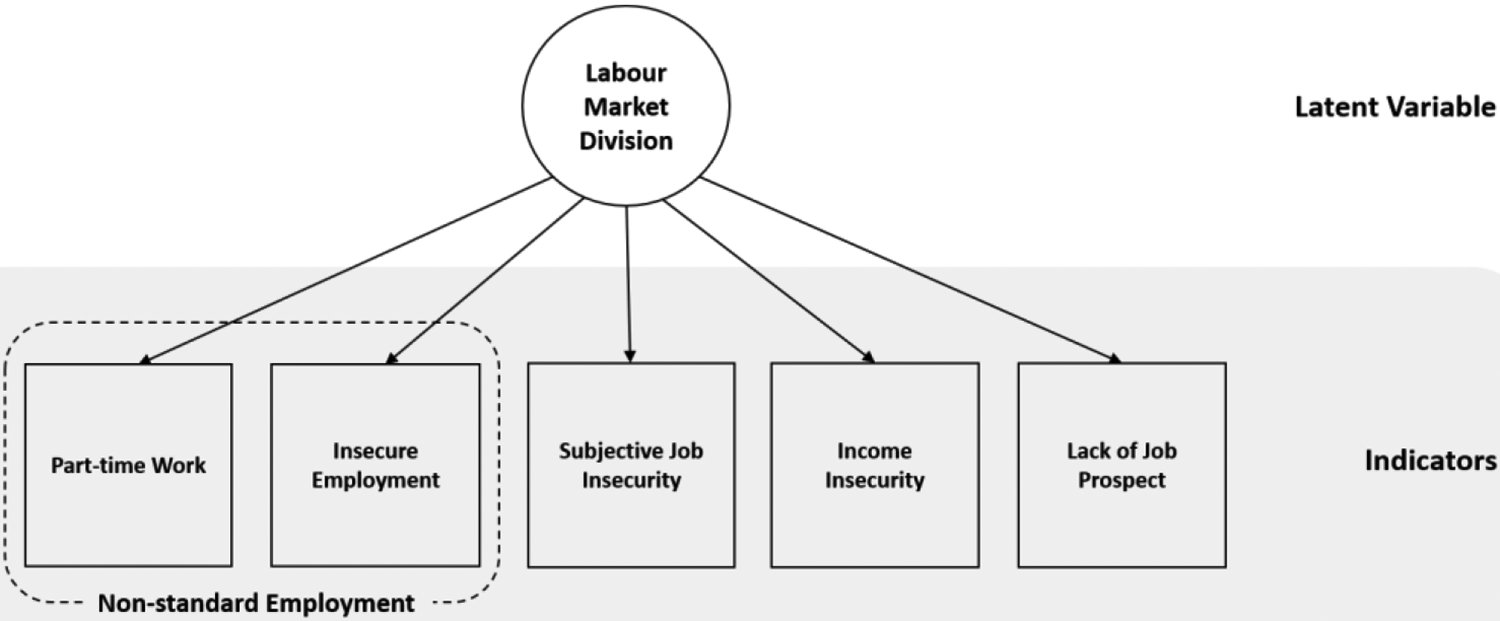
LCA model to examine labour market divisions.
Results
Latent Class Analysis: insiders and three types of outsiders
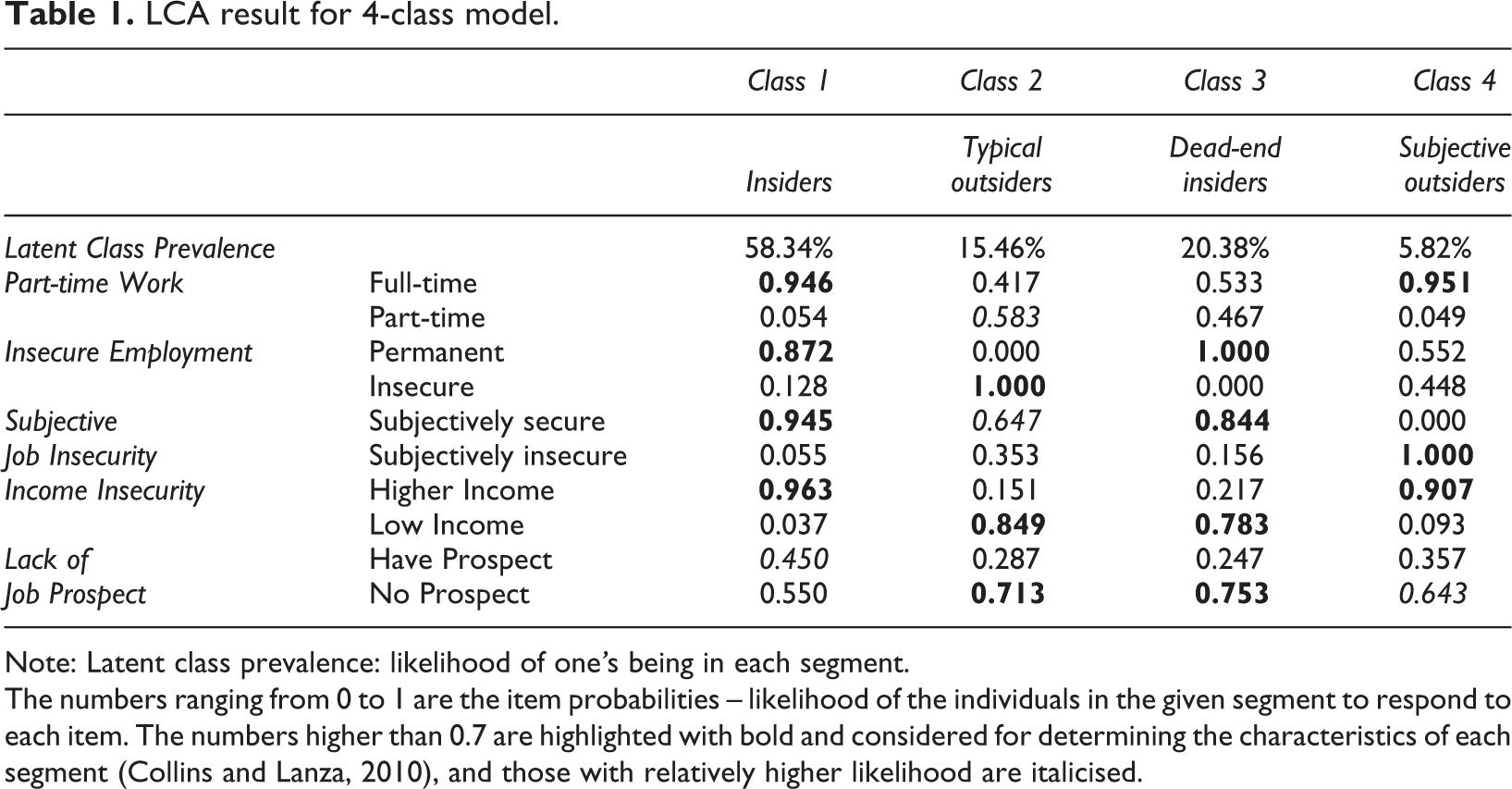
The LCA result is presented in Table 1. The number of labour market segments is found through comparing the model fit of the five models 7 with different numbers of labour market segments. Based on the information criteria (i.e., AIC, BIC) and testing for local independence (i.e., comparing Bivariate Residuals), four labour market segments are found for the European labour market, but largely two – an insider segment and three outsider segments (for details see the supplementary material). This supports the recent labour market segmentation literature that the post-industrialised labour market is divided into more than two segments (e.g. Jessoula et al., 2010; Lukac et al., 2019; Yoon and Chung, 2016), while not neglecting the validity of the ‘dual’ labour market framework. 8 Characterised by different combinations of labour market precariousness, the segments are labelled insiders, typical outsiders, dead-end insiders and subjective outsiders based on their distinguishable characteristics.
LCA result for 4-class model.
Note: Latent class prevalence: likelihood of one’s being in each segment.
The numbers ranging from 0 to 1 are the item probabilities – likelihood of the individuals in the given segment to respond to each item. The numbers higher than 0.7 are highlighted with bold and considered for determining the characteristics of each segment (Collins and Lanza, 2010), and those with relatively higher likelihood are italicised.
The first segment is characterised by a high likelihood of full-time and permanent employment (i.e., standard employment), subjective job security and decent (i.e., non-low) income. It should also be noted that, although job prospects for workers in Europe are generally low, this group of workers has relatively better prospects for advancement. Covering the majority of the employed population in Europe (58.34 per cent), this group is labelled insiders due to its similarity with the insiders from the literature (e.g. Doeringer and Piore, 1971; Schwander and Häusermann, 2013; Yoon and Chung, 2016).
The second segment accounts for 15.46 per cent of the European labour market and is characterised by insecure employment, low incomes and a lack of job prospects. Although the difference is not significant (namely, neither likelihood is higher than 0.7, the threshold for determining a group (Collins and Lanza, 2010)), this group is more likely to be part-time than full-time. As a group of individuals with coinciding characteristics of different labour market insecurities, it is labelled the typical outsiders due to its characteristics being similar to that typically associated with outsiders in the literature (e.g. Doeringer and Piore, 1971; Rueda, 2005; Schwander and Häusermann, 2013). They are more likely to be young, female and working in service occupations (see Appendix 2). What requires further investigation is the fact that this group has a higher likelihood of feeling secure than insecure, although the difference is not significant. One possible explanation would be that the temporary contract for some may not expire within six months, i.e., guaranteeing the employment security for the next six months.
What distinguishes this study from previous studies is the examination of the third and the fourth segments, with the former (dead-end insiders) accounting for roughly 20 per cent of the employed population in Europe and the latter (subjective outsiders) 6 per cent. The third segment is characterised by permanent employment and subjective job security, but insecurities in income (which in this study refers to low income) and job prospects. Thus, this is the group whose employment status is stable (which is expected of insiders from the literature), but who are actually not secure due to low income and the lack of prospects in their jobs. The difference between part-time and full-time workers is not significant in determining the segment, although the likelihood of working part-time is greater than for insiders or subjective outsiders (but smaller than for typical outsiders). Though members of this segment might be considered insiders when only considering the permanency of the employment contract, they are in reality not insiders as they face insecurities due to their low incomes and lack of prospects. Consequently, this segment is labelled the dead-end insiders. It needs to be noted that, although labelled ‘insider’, this group is considered to be an outsider segment, as it is similar to the outsider group found in previous studies (e.g. Eichhorst and Tobsch, 2015; Lukac et al., 2019; Yoon and Chung, 2016) and its relatively higher proportion of part-time workers. This group is predominantly composed of women (roughly 80 per cent), i.e., accounting for a huge part of women’s overrepresentation among outsiders (see Appendix 2).
The fourth segment is composed of workers who work full-time with a decent income, but do not feel secure about their employment. This segment is labelled subjective outsiders, as their outsider-ness comes from their sense of insecurity regarding employment, regardless of their actual employment contract. Their status in terms of the insider-outsider scale is not as clear as the other segments, since some of them may have been classified as insiders had it not been for their subjective job insecurity. They may be either insiders or outsiders based on the objective employment insecurity. Nevertheless, this ambiguous segment supports Chung (2019) that under certain conditions workers with permanent contracts are as likely to feel insecure about their jobs as those with precarious contracts. This resonates with recent studies (e.g. Jaehrling, 2017) illustrating the divergence in the sense of security amongst insiders, which may be caused by increasing flexibility or deregulation, in turn inducing a fear of dismissal. This fear thus hints at a prevalent precariousness in the labour market not limited to traditional outsiders. On the other hand, the higher likelihood of them being blue-collar workers (see Appendix 2) shows that, even with seemingly similar contractual status, blue- and white-collar workers may experience different levels of security. Thus, the subjective insecurity indicator allows us to examine the often-neglected lived experience of workers, highlighting the importance of this group despite its small size.
Cross-national variations in segmentation patterns
Using the results from the LCA, this section examines how the estimated share of each segment varies across countries (see Figure 2; estimates in Appendix 3). The findings show that labour market patterns vary across countries, especially in terms of the varying shares of the outsider groups. While insiders account for the biggest share in all countries – albeit ranging from 48 per cent to 69 per cent –, more notable differences are found among the outsider segments, with some convergence within regimes. For instance, while southern European countries (e.g. Portugal, Greece, Italy) tend to feature larger shares of typical outsiders, countries often referred to as Bismarckian welfare states (e.g. Belgium, Austria, Germany) tend to have larger shares of dead-end insiders. This resonates with the literature on cross-national variations of labour market dualisation (e.g. Bürgisser and Kurer, 2021; Eichhorst and Marx, 2012; Schwander and Häusermann, 2013). From this, we can infer that welfare arrangements and political economy may shape different patterns of labour market segmentation. However, existing knowledge on dualisation based on the standard/non-standard division does not provide sufficient explanations as to why we see greater numbers of dead-end insiders in some countries but more typical outsiders or subjective outsiders in others.
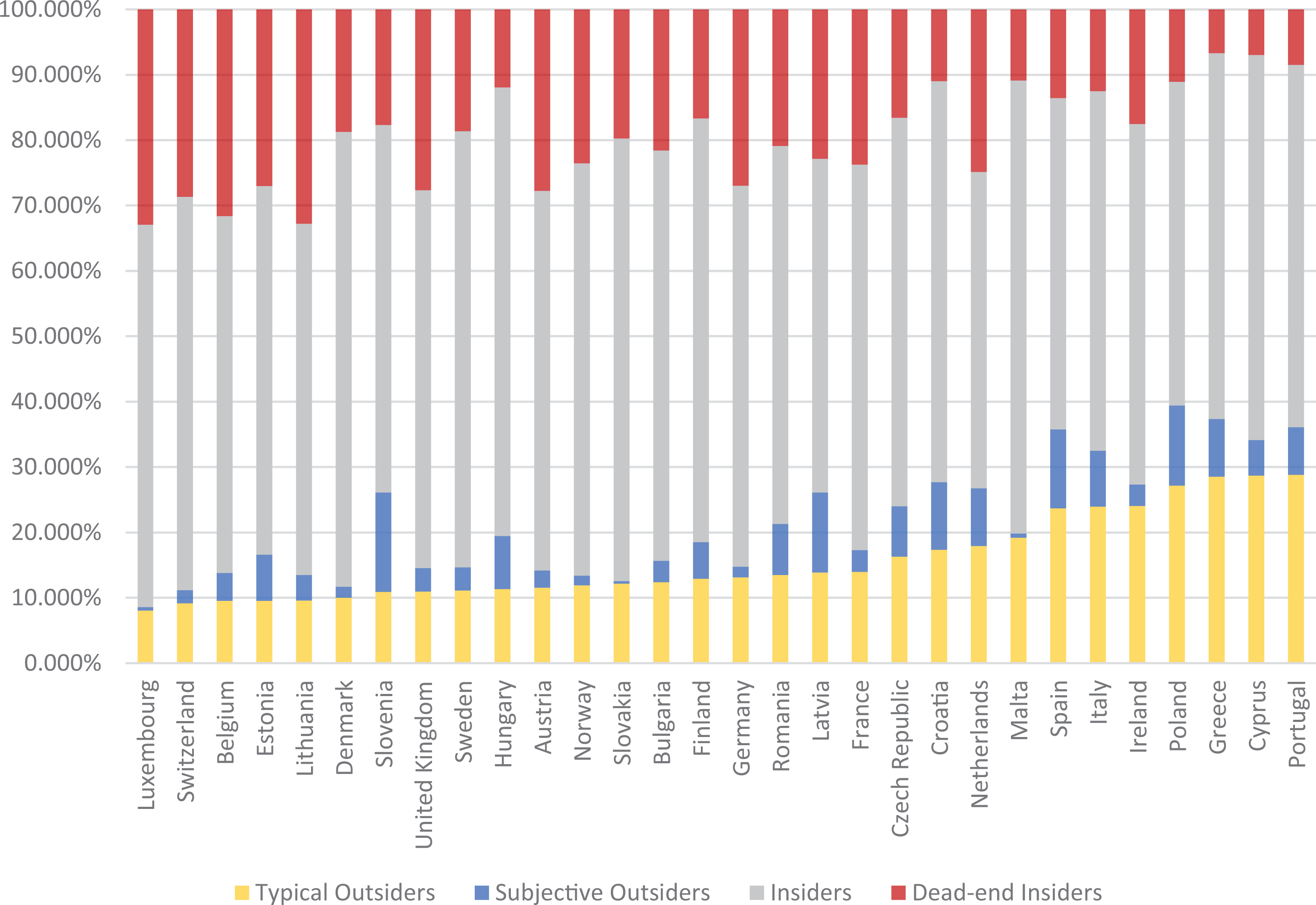
Estimated share of each segment in 30 European countries.
Nevertheless, some assumptions can be made based on the literature. First, looking at the social composition of these segments (see Appendix 2), we can infer who was externalised as Europe went through labour market deregulation/flexibilisation. For instance, the over-representation of women among outsiders, especially dead-end insiders, shows that dualisation may have been at the cost of women’s job security, especially in the Bismarckian welfare states. This resonates with the findings of Schwander and Häusermann (2013) who found greater gendered patterns in these countries than others. This can be linked to the deregulation measures primarily targeting the female-dominated service industry (see Eichhorst and Marx, 2012), and the more traditional family/gender norms likely to keep women (especially mothers) as second-earners (e.g. Pfau-Effinger, 2012). Second, the findings show cross-national variations in employment protection for both insiders and outsiders, as subjective outsiders include those who may be insiders but feel insecure about their employment. Deviating somewhat from the dualisation theory of protected core workers, this supports the hypothesis that precariousness is not limited to objective outsiders in countries such as Greece and Spain where austerity-driven deregulation and flexibilisation affected the overall labour market, including insiders (e.g. Prosser, 2016). The relatively smaller size of the subjective outsiders segment in the corporatist countries also resonates with Chung (2019), in that permanent workers in these countries feel more secure than in other countries, while the level of insecurity remains similar across countries for temporary workers.
However, caution is required when interpreting these cross-national variations, as the similar patterns found in the UK and Germany do not for instance mean that workers there share similar levels of employment security. These results will have to be matched with other variables such as social protection, especially for unemployment, and complemented with case studies. The UK is an interesting case requiring further investigation, as it features relatively few subjective outsiders, despite the higher level of labour flexibilisation driven by liberalisation (e.g. Prosser, 2016). This is to a certain extent consistent with the findings of Chung (2019: 709) which reveal a relatively lower level of subjective employment insecurity for both permanent and temporary workers in the UK. On the other hand, The Netherlands is known for its wider prevalence of part-time work, especially among women (e.g. Yerkes, 2009). However, while it does not show a particularly high level of dead-end insiders, it does feature a relatively larger share of typical outsiders compared to the other continental European countries. This indicates the varieties in part-time work (see also Nicolaisen et al., 2019) and the usefulness of the four-segment framework to capture such complexities. Thus, while this article identifies some general trends in labour market segmentation across Europe, further research is required to interpret these cross-national variations.
Discussion and conclusion
The aim of this study was to examine general patterns of labour market segmentation in Europe and how it varies across countries. Drawing on labour market segmentation literature, this study started out from the question how is the labour market segmented?, considering the growing diversity of precarious workers that is not limited to having non-standard work (e.g. Kalleberg, 2018; Standing, 2011). In line with recent literature questioning the ‘dual’ structure of the labour market (e.g. Lukac et al., 2019; Yoon and Chung, 2016), this study used LCA on EWCS data to empirically examine the hypotheses that (1) the labour market is divided into more than two segments, but more specifically with different outsider groups composed of different combinations of precariousness, and (2) segmentation patterns vary across countries. Outsiders differ from the insiders not only in terms of their employment status, but also (and more precisely) the consequent disadvantages (i.e., income and job security) (Davidsson and Naczyk, 2009). I therefore used different indicators of outsiders along with non-standard employment to fully capture the complexity of the post-industrialised labour market, such as income insecurity (i.e., objective precarious outcome), subjective insecurity and the future insecurity.
Using LCA, this study found that, in line with the ‘dual’ labour market literature, the European labour market is divided largely into two segments – insiders and outsiders, but with three different types of outsiders: typical outsiders, dead-end insiders and subjective outsiders. The findings show that having a standard employment relationship does not necessarily guarantee job or income security. This confirms the importance of income and subjective insecurity in identifying the ‘actual’ precariousness, an aspect often neglected when considering seemingly secure employment contracts. More importantly, these segmentation patterns vary significantly across countries, especially in terms of who the outsiders are. They highlight varieties not sufficiently captured by the dichotomised insider/outsider framework, further confirming the importance of a non-dichotomous approach to labour market analysis.
Nevertheless, the study has limitations. First, it uses an MLCA model restricted to the four-segment framework derived from LCA (which is an average of the 30 countries) to examine cross-national variations in labour market segmentation patterns. This has limitations in capturing distinct employment arrangements in countries that deviate from the four-segment labour market structure or the different level of insecurity each group experiences. While this study provides insights into general labour market segmentation patterns, future studies can examine individual country cases in greater detail. Second, this study has limitations regarding mobility between the groups, especially from outsiders to insiders, i.e., examining whether precariousness is temporary or permanent. Though the future prospects variable identifies advancement within a worker’s current job, it neglects advancement via a different job, as is usually the case among students who take on part-time temporary jobs before finding full-time jobs furthering their careers. Likely to vary across countries depending on the institutional settings (see Biegert, 2014), this aspect can be explored in future studies using longitudinal data. Finally, the relationship or interaction between segmentation patterns and institutions can be further explored in future studies. The results in this study show that there are cross-national variations in segmentation patterns which are likely to be due to different institutional contexts, as suggested by the literature on dualisation and liberalisation (e.g. Palier and Thelen, 2010; Prosser, 2016). What requires further research is how these differing patterns influence changes in institutions, for instance in the form of policy responses to the gap in social protection or new workers’ movements.
However, the findings in this study contribute significantly to the dualisation literature. Over the last few decades, dualisation has been a useful tool for understanding the increase in labour market inequality in Europe, comparing those protected by the existing system and those excluded from it (often non-standard workers). This study provides evidence supporting the dualisation theory that, while post-industrialised labour markets largely feature dualised patterns, the latter vary across countries in terms of who the outsiders are. It can be inferred from previous studies that these patterns have been shaped through varying deregulation processes across countries (e.g. Eichhorst and Marx, 2012; Prosser, 2016). What this means is that, depending on the institutional context, we may have more outsiders in the form of young temporary workers, women working in low-income dead-end jobs, or workers with standard employment but in fear of losing their jobs.
Trade unions have an important role to play in protecting workers’ rights, which can be clearly portrayed in the rights and protections of insiders. However, the labour market has changed, with a growing neoliberal trend towards labour deregulation and flexibilisation. At the same time, women’s labour market participation has increased, a trend which has coincided with the expansion of the outsiders. While the literature shows the role of unions in protecting the core workers despite the increasing demand for deregulation (e.g. Chung, 2019; Emmenegger et al., 2012; Palier and Thelen, 2010), the representation of unions in protecting all workers is called into question. The systematic precariousness of workers, which makes atypical employment no longer ‘atypical’, stresses the need for more inclusive unions that protect both insiders and outsiders. The findings in this article can therefore help inform unions of different types of outsiders and the varying labour market patterns of outsider-ness across Europe that can be considered for new strategies to protect all workers and build a more cohesive society.
Supplemental Material
Supplemental Material, sj-pdf-1-trs-10.1177_10242589211061070 - ‘Dual’ labour market? Patterns of segmentation in European labour markets and the varieties of precariousness
Supplemental Material, sj-pdf-1-trs-10.1177_10242589211061070 for ‘Dual’ labour market? Patterns of segmentation in European labour markets and the varieties of precariousness by Hyojin Seo in Transfer: European Review of Labour and Research
Footnotes
Appendix
[Appendix 1] Basic Statistics
Funding
This research received no specific grant from any funding agency in the public, commercial, or not-for-profit sectors.
Supplemental Material
Supplemental material of this article is available online.
Notes
References
Supplementary Material
Please find the following supplemental material available below.
For Open Access articles published under a Creative Commons License, all supplemental material carries the same license as the article it is associated with.
For non-Open Access articles published, all supplemental material carries a non-exclusive license, and permission requests for re-use of supplemental material or any part of supplemental material shall be sent directly to the copyright owner as specified in the copyright notice associated with the article.
