




Abstract
Although the belief in free will is widespread, some individuals (skeptics) do not believe in free will. The study sought to identify some of the factors underlying skeptics’ disbelief in free will. Data taken from a larger study focusing on free will skeptics showed participants’ (N = 129) skeptical position broadly came from sources related to education and personal features. The most frequently cited sources included websites (e.g. forums and YouTube), social media, formal teaching, and rationality. The study provides information about the influences of disbelief in free will. We discuss the implications of these findings for those who wish to either strengthen or weaken the belief in free will.
Introduction
The debate about the existence of free will has raged on for centuries (Dennett, 1984). Philosophically, defining free will is a complex challenge, as is measuring its existence empirically. Psychological scientists have therefore focused less on whether free will exists and more on the consequences of believing more or less strongly in free will. Psychological scientists generally operationalize free will as involving a sense of agentic control, lack of constraints, and the capacity to choose one’s actions (Baumeister, 2008; Carey & Paulhus, 2013; Walter, 2001); and studies suggest that most laypersons define free will in a similar fashion (Monroe & Malle, 2010; Vonasch et al., 2018). Although philosophers and scientists view the existence of free will as a topic of heated debate, research suggests that most laypersons – across cultures – believe in free will (Sarkissian et al., 2010; Wisniewski et al., 2019). Much research has examined the consequences and correlates of believing more or less strongly in free will; however, little work has been done examining why individuals do or do not believe in free will in the first place. The present paper examines specifically those factors associated with a disbelief in free will, focusing on the factors that lead free will skeptics to disbelieve in free will.
Distinguishing Free Will from Other Agency Constructs
As noted above, psychologists generally define free will as the capacity to exercise choice free from internal or external constraints. This makes free will a class of phenomena underlying personal agency. This class also includes constructs such as locus of control and self-regulation. Similar to Feldman (2017), we argue that free will is related to – but distinct from – these constructs. Specifically, we conceptualize free will as the most abstract of these phenomena, such that believing in free will is believing that people – including oneself – are, in theory, capable of making choices and controlling their actions. Locus of control reflects the more concrete belief that, in one’s own life, most choices are made based on internal motivation (Rotter, 1966). Finally, self-regulation reflects a person’s perception of their own ability to actually control their actions rather than being overwhelmed by temptations (Baumeister & Vohs, 2007). Past work supports the idea that free will belief is distinct from these and other related constructs (Crescioni et al., 2016; Rakos et al., 2008; Stroessner & Green, 1990; Waldman et al., 1983). We focus here on the antecedents of the disbelief in free will, arguing that personal experience with locus of control (i.e. whether one’s environment has provided strong or weak external constraints) and self-regulation (i.e. whether one has generally succeeded in resisting temptations) might well factor into one’s belief or disbelief in the more abstract concept of free will.
The Purpose of Believing in Free Will
A relatively straightforward explanation for the prevalence of the belief in free will could be that the experience of choosing is subjectively intuitive (Deery et al., 2013; Searle, 1986). From choosing a shirt to wear to choosing a career to pursue, subjective experience is filled with the sense that we are making decisions. While the ubiquity of the experience of choice does nothing to further the argument that such choices are indeed freely made, it can certainly be seen as one reason that so many people believe they have the capacity to make choices.
Aside from the ubiquity of experiencing choice, another reason the belief in free will is so widespread could be that such a belief is adaptive. Baumeister (2008; Baumeister et al., 2011; Baumeister & Monroe, 2014) has argued that free will could be a biological evolution enabling people to self-regulate, resist selfish impulses, and interact on a societal level. Consistent with this argument, greater belief in free will is associated with a host of prosocial outcomes, including greater self-efficacy (Crescioni et al., 2016), better academic performance (Feldman et al., 2016), greater perceived meaning in life (Crescioni et al., 2016; Moynihan et al., 2017), greater job satisfaction (Feldman et al., 2018), lower levels of life stress (Crescioni et al., 2016), engagement in various health behaviors (St Quinton & Crescioni, 2024), less destructive gambling behavior (St Quinton et al., 2022), and greater life satisfaction (C. Li et al., 2017). Related to the idea of control, free will could also enable people to pursue and achieve intrapersonal goals (Dennett, 1993).
Free will might also be an essential component of moral responsibility (Nichols & Knobe, 2007). Greater belief in free will is associated with the endorsement of harsher punishments for wrongdoings (Carey & Paulhus, 2013; Clark et al., 2017; Martin et al., 2017; Shariff et al., 2014), and inducing reduced belief in free will leads to less guilt over one’s own misdeeds (Stillman & Baumeister, 2010).
As well as correlational designs, researchers have experimentally manipulated belief in free will and measured the downstream cognitive and behavioral consequences. These manipulations typically comprise participants reading text denying the existence of free will. For example, a popular approach involves participants reading a text passage taken from Francis Crick’s book “The Astonishing Hypothesis” (Crick, 1994). Introduced by Vohs and Schooler (2008, Study 1), this text declares free will to be illusory and behavior to be driven by unconscious brain activity. Another popular approach is a mood induction method introduced by Velten (1968), whereby participants are provided anti-free will statements attempting to threaten belief in free will.
When manipulations have successfully weakened belief in free will, participants have been shown to cheat (Vohs & Schooler, 2008), exert aggression (Baumeister et al., 2009), and be less grateful (MacKenzie et al., 2014). Participants with stronger free will beliefs are also more likely to demonstrate self-control (Rigoni et al., 2012) and perseverance (J. Li et al., 2018), and to set more meaningful life goals (Crescioni et al., 2016). Thus, free will research could be relevant to psychologists and therapists seeking to enhance the human condition (Smith et al., 2023). It is not always the case, however, that stronger beliefs about free will lead to positive outcomes. For example, participants with weaker belief in free will have been shown to be humbler (Earp et al., 2018) and more forgiving (Clark et al., 2014). And although belief in free will might be an important factor in ascribing moral responsibility to wrongdoers, there is also evidence that greater belief in free will is associated with greater blaming of victims (Genschow & Vehlow, 2021). Therefore, despite most research focusing on the positive consequences of believing in free will, disbelieving in free will may not be entirely bad (Earp et al., 2018).
Factors Influencing the Belief (or Disbelief) in Free Will
As previously stated, most laypeople believe in free will (Nahmias et al., 2005; Sarkissian et al., 2010). Indeed, when manipulations attempt to strengthen belief in free will, participants’ beliefs tend to be similar to those of participants not receiving a manipulation (Vohs & Schooler, 2008). Thus, the default position appears to be that free will exists (Baumeister et al., 2009; Vohs & Schooler, 2008). Nevertheless, some people do genuinely disbelieve in free will, and even among those who believe in free will, there is variability in how strongly they hold that belief.
Free will skeptics not only consider free will to be incompatible with determinism but also take the view that free will does not exist (Caruso, 2012, 2019; Pereboom, 2001; Sapolsky, 2023). According to this position, behavior stems from myriad factors beyond the person’s control (Caruso, 2012; Pereboom, 2006), such as the environment (Sapolsky, 2023) and unconscious brain activity (Libet et al., 1983). Although people are aware of their goals and intentions, skeptics contend these ultimately play out in the absence of conscious choice (Bargh & Ferguson, 2000). Free will, according to skeptics, therefore, is merely an illusion (Harris, 2012; Wegner, 2002).
The aforementioned explanations can provide insight into why some people do not believe in free will. However, no research has yet been conducted to understand the sources of these beliefs. That is, what has influenced people to come to this skeptical conclusion? Answering this question may have two main benefits. First, given the apparent number of desirable outcomes associated with believing in free will, it would be useful to better understand where such a belief – or lack of belief – comes from in the first place. However, since researchers undertaking manipulations tend to demonstrate small effects on free will beliefs (Genschow et al., 2022) and some have not managed to change these beliefs (Buttrick et al., 2020; Nadelhoffer et al., 2020), a second benefit relates to manipulation efforts. Specifically, identifying the influential sources may improve manipulations modifying belief in free will. This could then help better understand the outcomes associated with belief in free will, whether that be positive or negative. Therefore, the purpose of the study was to identify the sources underlying people’s disbelief in free will.
Methods
Participants and Procedure
The qualitative data for this study were taken from a larger study involving free will skeptics. Recruitment was undertaken using social media advertisements and announcements on free will forums. The study was hosted on JISC Online Surveys. To recruit free will skeptics only, the survey first asked participants whether they disbelieved in free will and identified as a free will skeptic. Participants not responding “Yes” were screened out and thanked for their interest. Once it had been established that participants were free will skeptics, participants then proceeded to complete the questionnaire. All participants provided consent to participate, and the study received ethical approval from the Department of Psychology ethics board.
Measures
Two items were used to generate the data for this study. The items asked participants to explain what initially influenced their disbelief in free will (e.g. “Please explain what influenced you to take a skeptical position” & “Please describe what you believe persuaded you to hold this view”). Participants were encouraged not to justify why free will does not exist but instead reflect on how their skeptical views were shaped. The questions were open-ended, and participants were allowed text responses. Demographics of age, gender, and nationality were also taken.
Analysis
Content analysis was conducted on the data. To do this, survey responses were exported to Microsoft Excel and read several times for familiarity. The data were then inductively coded, which enabled the development of initial themes. These initial themes were then reviewed and amended into final themes. The first author analyzed all the data and generated the themes. A research assistant checked 13 randomly selected responses (10% of the sample) to determine inter-rater reliability. There was excellent agreement between the two raters (κ = .814).
Results
Of the 132 participants accessing the survey, 129 passed the inclusion checks and were therefore included in the study. Participants were largely British (n = 71), followed by U.S. American (n = 49), and other nationalities (n = 9). The sample included more males (n = 74) than females (n = 55), with a mean age of 23.53 years (Standard deviation = 4.50).
As shown in Table 1, sources were categorized into four levels: superordinate, subordinate, main, and basic. Two superordinate sources were identified: education and personal features. Education refers broadly to the transmission of information used to persuade and has four main sources: media, relationships, formal teaching, and philosophy clubs. Two main sources comprised relationships: family and friends; and four main sources comprised media: websites, social media, print, and digital. Websites had four basic sources: YouTube, forums, TED Talks, and other websites; social media had two basic sources: Twitter (X) and Facebook; print had three basic sources: books, newspapers, and magazines; and digital had six basic sources: television, movies, video games, podcasts, audiobooks, and radio. Personal features refer to features attributed to the individual and have three subordinate sources: experiences, rationality, and dreams.
Identified sources.
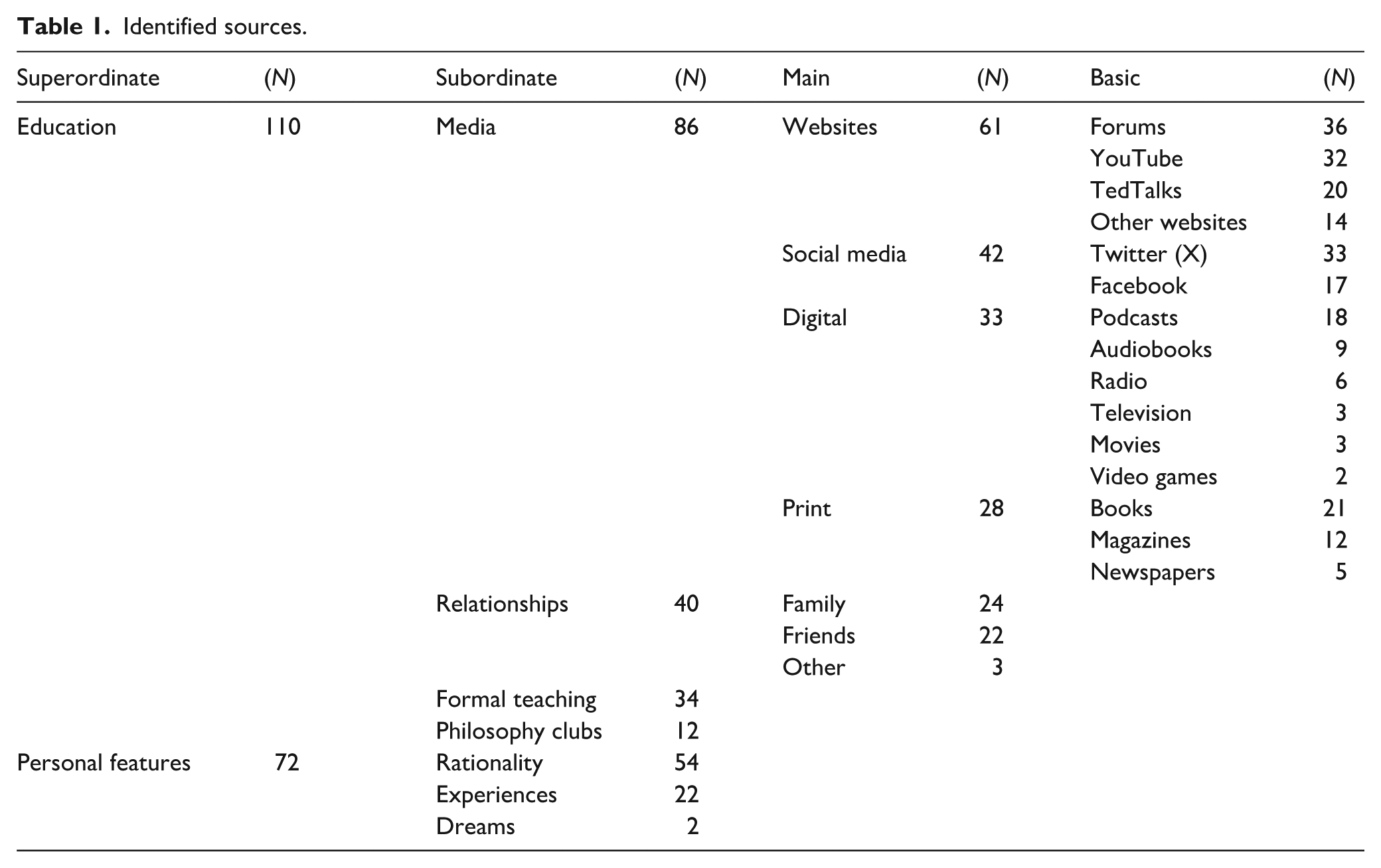
Most participants identified education (n = 110; 85.3%) as an important source, with 72 participants (55.8%) citing personal features. Within the superordinate source of education, media (n = 86/110; 78.2%) was the most frequently mentioned subordinate source, with websites (n = 61/86; 70.9%) and social media (n = 42/86; 48.8%) prominent main sources. Participants frequently mentioned forums (n = 36/61; 59%), YouTube (n = 32/61; 52.5%), and Twitter (n = 33/42; 76.2%) as influential basic sources. The second most frequently cited subordinate source, relationships (n = 40/110; 36.4%), was influenced more by family (n = 24/40; 60%) and friends (n = 22/40; 55%). Although not mentioned as frequently, some participants were influenced by formal teaching (n = 34/110; 30.9%) and philosophy clubs (n = 12/110; 10.9%).
Within the superordinate source of personal features, the most frequently mentioned subordinate sources were rationality (n = 54/72; 75%) and experiences (n = 22/72; 30.6%).
Fifty-three participants cited sources related to both education and personal features (41.1%), while 44.2% mentioned only education (n = 57) and 14.7% cited only personal features (n = 19). The number of sources mentioned per participant was as follows: 1 source = 15 participants (11.6%); 2 sources = 21 participants (16.3%); 3 sources = 44 participants (34.1%); 4 sources = 30 participants (23.3%); and 5 sources = 19 participants (14.7%). When more than 1 source was mentioned, the most frequently cited combinations included forums and YouTube (n = 29); YouTube and Twitter (X) (n = 26); forums and rationality (n = 24); and forums, YouTube, and rationality (n = 22).
Discussion
Despite most people believing in free will, this belief is not held by some. The research examined the sources underlying skeptics’ disbelief in free will.
The superordinate source mentioned most frequently broadly captured education. This suggests free will skeptics are mostly influenced by sources providing information and knowledge about free will. Within this superordinate source, the role played by several media platforms, such as websites, social media, and digital platforms, was prominent in providing such information. This is perhaps unsurprising given the influence that these platforms can have on providing knowledge and shaping perceptions and beliefs (Diehl et al., 2015; Friedman et al., 2022). Participants were mostly persuaded by free will forums. These forums enable people to discuss, debate, and share information about philosophical topics. It is, therefore, likely that participants became persuaded through engaging with this platform. Other basic sources, including YouTube, Twitter, and podcasts, were also frequently identified. The use of these platforms has grown exponentially over the past couple of decades (Auxier & Anderson, 2021), and with information able to be transmitted easily and frequently (Kaplan & Haenlein, 2010), these platforms appear to shape opinions toward free will.
Although mentioned less frequently, other relevant subordinate sources of education included relationships and formal teaching. The data indicated that friends and family specifically have an influence on shaping beliefs about free will. It may be that if close referents hold views about free will, people are more likely to conform to the disbelief argument. In addition to these close relationships, skeptics were also influenced in educational settings such as universities and colleges. Academia, which encourages a critical mindset through debates and discussions (Franco et al., 2018), could provide people with the opportunity to take a skeptical position.
The second superordinate source is related to personal features. This was mostly derived from participants believing that they had thought rationally about the existence of free will. Although the debate about free will is shrouded in various complexities, participants reasoned that free will was an illusion. This is interesting given the fact that, perhaps, it is intuitive and logical to believe in free will (Baumeister et al., 2009). After careful thought and deliberation, skeptics appear to conclude that the presence of free will is illogical (Bargh, 2008). In addition to rationality, some participants’ skepticism was borne out of personal experiences. People often claim that particular experiences, such as the act of deliberating, evidence that free will does exist (Nahmias et al., 2004). However, participants here suggested that particular encounters indicated otherwise.
Most participants identified more than one source underlying their disbelief in free will. This suggests people’s doubts about free will may originate from a number of sources. Participants indicating more than one source most frequently stated that their skeptical stance derived from the subordinate sources related to the media and rationality. Of particular relevance was how beliefs were shaped by free will forums coupled with YouTube and rationality, as well as YouTube and Twitter (X). It should be noted that the study did not identify the causal direction of these sources. It could be that once introduced to the skeptical position on the internet, participants then internally rationalize the argument. Alternatively, it could be that after participants come to a logical conclusion, they then seek confirmation through these educational means. Because fewer participants mentioned education, and also cited personal features, than did the number of participants stating personal features and education, this could indicate that personal features alone are insufficient to influence a skeptic. In contrast, people persuaded via educational means are more convinced by these arguments and do not need to refer to personal experiences.
Limitations and Implications
There are some limitations worth noting. Because of the sampling strategy, the data may not be representative of all free will skeptics. Indeed, given that participants were recruited primarily from free will forums, it is perhaps unsurprising that this was a prominent source. Similarly, the role played by websites could reflect the relatively young age of participants. The research was also conducted on a Western sample, which limits generalizability. In fact, although here the skeptical position was suggested to represent the minority, some research has shown belief in free will is not necessarily universally shared (Berniunas et al., 2021). Another limitation is that of memory recall. Specifically, the accuracy of identified sources relied on participants’ ability to accurately recall influential sources. Finally, the research is not able to explain why people disbelieve in free will. Although the important sources were identified, it is not clear precisely what it is about these sources that encourages a skeptical position.
The study has some potentially useful implications. Because research has found difficulty weakening belief in free will, the study here identifies potential avenues to modify this belief. Specifically, researchers could use media sources such as websites or social media to weaken belief in free will. It is interesting that previous manipulations have largely focused on providing participants with text passages. Our findings suggest that instead of providing text from books, researchers could use platforms such as forums, YouTube, and Twitter (X). However, if disbelieving in free will ultimately leads to negative consequences, the findings can be used to understand the sources influencing these beliefs. Therefore, the research may not only be useful in weakening belief in free will, but it could also be used to prevent people from holding these views, too.
Of course, the study did not seek to explain why people disbelieve in free will. Therefore, it is not clear precisely what it is about these sources that makes them influential. For example, in relation to forums, it could be the content provided on these platforms, the interactive nature of discussions, or the sense of community. Future research should shed light on these issues, which could then inform the nature of manipulation attempts.
Conclusion
Although most people believe in free will, skeptics refute its existence. The study found these skeptical views to be shaped by two overriding sources related to education and personal features, with websites, social media, and rationality proving to be especially influential. These findings may provide important insights for researchers seeking to weaken belief in free will, if indeed doing so does not lead to detrimental consequences.
Footnotes

Funding
The authors received no financial support for the research, authorship, and/or publication of this article.
Declaration of Conflicting Interests
The authors declared no potential conflicts of interest with respect to the research, authorship, and/or publication of this article.