




Abstract
Can belief in free will alter our perceptions of social mobility? Five studies manipulated free will beliefs and assessed subjective individual social mobility (Study 1), subjective social status across time (Study 2), objective social class 10 years (Study 3) and 20 years (Study 4) into the future, and counterbalanced subjective and objective social mobility measures (Study 5). Challenging free will beliefs reduced subjective perceptions of upward mobility in Study 1 and led to lower perceptions of subjective social status in the distant, but not in near future in Study 2. Studies 3 and 4 found that threatening free will beliefs did not influence perceptions of future objective social class. Study 5 revealed that weakening free will beliefs affected subjective and objective social mobility, with the latter under specific boundary conditions. The differential effects of belief in free will on perceived social mobility are discussed.
Free will has been labeled an illusion (Wegner, 2004), mistaken causation (Bargh, 2008), and incompatible with brain processes (Libet et al., 1983). However, the notion of free will remains pervasive, with many advocating that individuals can freely behave according to their own volition (Nahmias et al., 2005). While the possibility or impossibility of free will percolates through different scholarly circles, social and personality psychologists have instead focused on how varying belief in free will has meaningful outcomes (Baumeister & Brewer, 2012). In the present research, we took a similar approach to investigate whether manipulating belief in free will alters perceptions of social class mobility. We predicted that weakening free will beliefs would lead people to perceive less opportunity to move up the socioeconomic ladder.
Belief in Free Will
Belief in free will is understood as the ability to make your own choices and determine your own outcomes free from constraints (Baumeister & Brewer, 2012). Most people believe in free will (Nahmias et al., 2005), and early experiments found that inducing disbelief in free will leads to costly behavioral consequences including increasing aggression (Baumeister et al., 2009) and conformity (Alquist et al., 2013). Altering free will beliefs also influences judgments about the self and others. People with reduced belief in free will report greater self-alienation (Seto & Hicks, 2016) and pursue less meaningful goals (Crescioni et al., 2016). Believing in free will also influences severity of punishment for wrongdoings (Clark et al., 2014).
Embedded in free will beliefs is the notion of personal agency (Baumeister & Brewer, 2012). People are active agents, capable of exercising control over the outcomes of a situation. Research has found that disbelief in free will reduces components of self-agency (Lynn et al., 2014). Belief in free will is also associated with agentic traits such as self-efficacy (Crescioni et al., 2016) and internal locus of control (Paulhus & Carey, 2011). Given that free will beliefs invoke agency, is it possible that altering these beliefs can transform something as consequential as our social positions in life? To explore this possibility, we focus on perceived social class mobility.
Perceived Social Class Mobility
Perceived social class mobility refers to people’s beliefs about their ability to move up and down the socioeconomic ladder (Day & Fiske, 2017). While the United States has one of the lowest rates of actual social mobility among industrialized countries (Fiske & Markus, 2012), beliefs about climbing the socioeconomic ladder remain widespread. Americans believe that upward social mobility is more prevalent than downward social mobility (Davidai & Gilovich, 2015). Similarly, Americans tend to overestimate upward income and education mobility when compared to real census data (Kraus & Tan, 2015). The finding that Americans consistently misjudge social mobility was directly replicated (Kraus, 2015), suggesting that many people have misperceptions about socioeconomic opportunity.
The idea that perceptions of social mobility is at odds with reality is not surprising. Exposure to social mobility information (Kraus & Tan, 2015), political ideology differences (Chambers et al., 2015), and optimism about equality (Kraus et al., 2017) contribute to different perceptions of social mobility. A recent global investigation about upward social mobility found that income inequality, education privatization, and historical events contribute to changes in perceived mobility to various degrees (Chan et al., 2021). Thus, perceptions of social mobility fluctuate depending on social context.
Belief in Free Will and Perceived Social Class Mobility
The prevalence of both free will beliefs (Nahmias et al., 2005) and perceptions of upward social mobility (Davidai & Gilovich, 2015) suggests that these constructs might be intertwined. No research has directly tested whether belief in free will influences perceptions of social mobility. One publication, however, has examined the association between free will beliefs and related measures of social mobility. Vonasch and Baumeister (2013) assessed belief in free will, attitudes toward income inequality, and causes of poverty. They found that greater free will beliefs were associated with higher desire for income equality and less belief that people were fated to live in poverty. These relationships suggest that people who believe in free will may also believe that social mobility is possible. Of course, these findings are correlational and do not speak to the direct consequences of belief in free will.
We propose that free will beliefs shape our thoughts about moving up the socioeconomic ladder. Unlike other social categories such as race and gender, social class is relatively malleable (Kraus & Stephens, 2012), and perceptions about socioeconomic opportunity are influenced by context (Chan et al., 2021). Given that belief in free will invokes agency and perceptions that one can exert some control over their environment (Baumeister & Brewer, 2012), it stands to reason that altering free will beliefs can influence how much people believe they can change their social standing. We predicted that attenuating belief in free will would reduce perceptions of upward social class mobility. Specifically, dampening free will beliefs should make people feel less confident about their ability to ascend the socioeconomic ladder.
Overview
In the present research, we tested whether manipulating belief in free will would influence perceived social mobility. Study 1 assessed subjective perceptions of changing one’s own societal position. Study 2 investigated perceptions of subjective social status across future time points. Studies 3 and 4 examined perceptions of objective social class standing 10 years and 20 years in the future, respectively. Study 5 measured subjective and objective social class. Across all studies, we predicted that threatening free will beliefs would decrease perceptions of upward social mobility. 1
Sample Size Determination
For Studies 1, 3, 4, and 5, an a priori power analysis was conducted to achieve a power equal to .95 with a medium effect size (d = .50) at α = .05. A sample of 176 was required. An a priori power analysis was conducted to achieve a power equal to .95 with a small-medium effect size (f = .14) at α = .05 for Studies 2 and 5. A sample of 108 and 162 was required, respectively. We collected more than 1.5× the sample size requirement across all studies to maximize power. Data collection was terminated once these goals were met. 2
Study 1
Study 1 investigated whether varying free will beliefs would influence perceived individual social mobility. We predicted that lowering free will beliefs would reduce people’s perceived ability to move into higher societal positions.
Method
Participants
Two hundred and ninety-six participants (162 female, 133 male, 1 non-binary; Mage = 35.77, SDage = 11.33, range 19–72; 77% White) were recruited from Amazon Mechanical Turk (MTurk) using CloudResearch and compensated with $2.00. We recruited CloudResearch-approved participants to ensure high data quality (Litman et al., 2017).
Materials and Procedure
Participants completed the measures discussed below and were debriefed.
Free Will Belief (FWB) Manipulation
Participants completed a FWB manipulation (Seto & Hicks, 2016). They were randomly assigned to read a description about recent FWB research. The high FWB condition described how “most of our behavior is determined by personal choices.” The low FWB condition described how “most of our behavior is determined by situational factors.” They were then presented with a list of 10 statements that reflect FWB (e.g., “People are responsible for their behaviors because they have free will to control their actions”; “I demonstrate my free will every day when I make decisions”). In the high FWB condition, participants selected three statements and described how each statement was true based on their experiences. In the low FWB condition, participants selected three statements and described how each statement was false based on their experiences.
Manipulation Check
Participants completed two face-valid items as a manipulation check. One item reflected general FWB (“People have complete free will”; FAD+; Paulhus & Carey, 2011). The other item reflected personal FWB (“I have complete free will”; FWDS; Rakos et al., 2008). Both items used a 7-point scale (1 = strongly disagree, 7 = strongly agree) and were averaged to produce a composite score. Higher scores indicated greater belief in free will (M = 5.28, SD = 1.47, α = .83).
Perceived Individual Social Mobility
Participants completed an eight-item measure of perceived individual social mobility (e.g., “There are many opportunities for me to move up in society”; Day & Fiske, 2017). Responses were made on a 7-point scale (1 = strongly disagree, 7 = strongly agree). Items were averaged to produce a composite score. Higher scores indicated greater perceived individual social mobility (M = 4.37, SD = 1.26, α = .92).
Results
An independent samples t-test was conducted to assess the FWB manipulation. There was a significant difference in FWB, t(239) = 11.99, p < .001, d = 1.41, 95% CI [1.42, 1.98]. Participants in the high FWB condition reported greater FWB (M = 6.09, SD = .93) than those in the low FWB condition (M = 4.39, SD = 1.43), suggesting the manipulation was successful.
An independent samples t-test found a significant difference in perceived individual social mobility, t(293) = 4.29, p < .001, d = .50, 95% CI [0.33, 0.89]. Participants in the low FWB condition reported lower perceptions of individual social mobility (M = 4.06, SD = 1.29) than those in the high FWB condition (M = 4.67, SD = 1.16). See Figure 1.
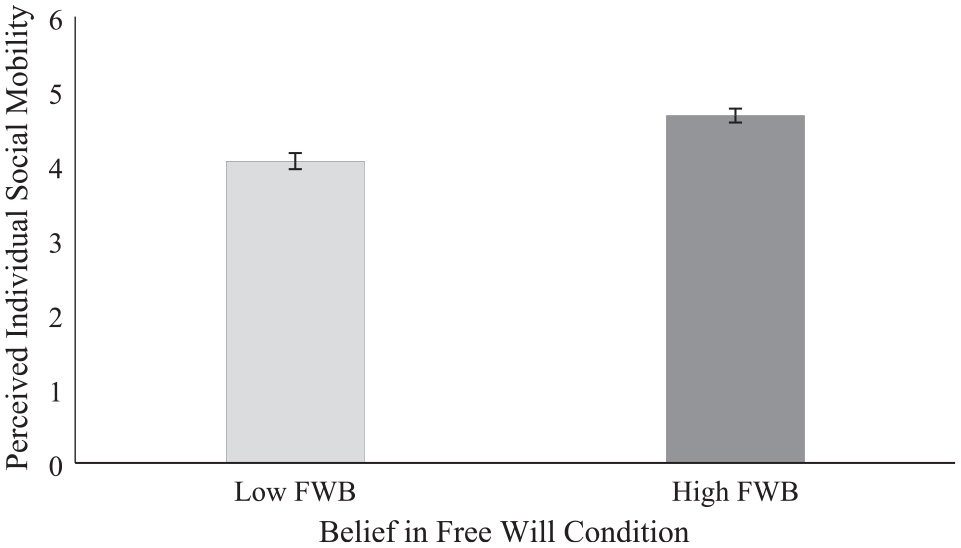
Differences in Perceived Individual Social Mobility as a Function of Belief in Free Will Condition in Study 1
Study 2
Study 1 found that weakening belief in free will made people feel less certain about their opportunities to move up in society. To expand on our findings, we used subjective social status as a new measure of social mobility in Study 2. Subjective social status refers to people’s perceived position in the social hierarchy and is a meaningful measure of subjective social class (Kraus & Stephens, 2012). In addition, Study 1 assessed views about social mobility without references to when changes in social class occur. To obtain a measure of time, we evaluated subjective social status from the present to the distant future. We predicted that attenuating belief in free will would lower perceptions of subjective social status across all future time points.
Method
Participants
Three hundred and fifty participants (214 female, 2 female-to-male transgender, 128 male, 1 male-to-female transgender, and 5 other; Mage = 35.62, SDage = 11.92, range 18–73; 73% White), were recruited from MTurk using CloudResearch. CloudResearch-approved participants completed the study for $1.50.
Materials and Procedure
Participants completed a FWB manipulation (Seto & Hicks, 2016). Then, they indicated where they perceived themselves standing on a visual ladder of society in the present, 5 years from now, 10 years from now, and 20 years from now and were debriefed.
FWB Manipulation and Manipulation Check
Participants completed the same FWB manipulation and manipulation check (M = 5.24, SD = 1.45, α = .86) as Study 1.
Time Manipulation
To assess perceived social mobility across time, participants thought about themselves at four different times in society: present (“at this time”), 5 years from now, 10 years from now, and 20 years from now. They were told to consider their income, education, and level of employment at each time period.
Subjective Social Status
Participants completed the MacArthur Scale of Subjective Socioeconomic Status measurement (Adler et al., 2000) to assess perceived social mobility across the four time points. The measure contains an image of a ladder with 10 rungs representing where people stand in society. The top rung represents the “best off” while the bottom rung represents the “worst off.” Participants indicated which ladder rung they stood on.
Results
An independent samples t-test found a significant difference in FWB, t(263) = 11.00, p < .001, d = 1.21, 95% CI [1.25, 1.80]. The manipulation was successful. The high FWB condition reported greater FWB (M = 5.91, SD = 1.02) than the low FWB condition (M = 4.39, SD = 1.46).
A 2 (belief in free will: high vs. low) × 4 (time: present, 5 years, 10 years, 20 years) mixed analysis of variance (ANOVA) examined the effect of belief in free will and time on subjective social status. There was a significant main effect of belief in free will, F(1, 348) = 4.00, p = .046, partial η2 = .01. Participants in the low FWB condition (M = 6.20, SD = 1.63) reported a lower overall social status than participants in the high FWB condition (M = 6.55, SD = 1.61). There was also a significant main effect of time, F(2, 571) = 288.42, p < .001, partial η2 = .45, sphericity not assumed. Pairwise comparisons with Bonferroni corrections indicated that participants perceived greater social status 20 years into the future (M = 7.14, SD = 2.09), followed by 10 years (M = 6.95, SD = 1.86), 5 years (M = 6.38, SD = 1.72), and then the present (M = 5.10, SD = 1.67; all means significantly different, p < .01).
These main effects were qualified by a significant belief in free will × time interaction, F(2, 571) = 5.13, p = .010, partial η2 = .02. Four ANOVAs were conducted to test for the effect of belief in free will at each level of time. There were no significant differences in perceived social status between FWB conditions in the present, F(1, 348) = .06, p = .805, partial η2 = .00, nor 5 years into the future, F(1, 348) = 2.38, p = .124, partial η2 = .01. However, there were significant differences in perceived social status between FWB conditions 10 years, F(1, 348) = 5.45, p = .020, partial η2 = .02, and 20 years, F(1, 348) = 7.30, p = .007, partial η2 = .02, into the future. Across these future time periods, participants perceived a lower social status under the low FWB condition (M = 6.69 and M = 6.81 for 10 years and 20 years from now, respectively) than under the high FWB condition (M = 7.15 and M = 7.41 for 10 years and 20 years from now, respectively). See Figure 2.
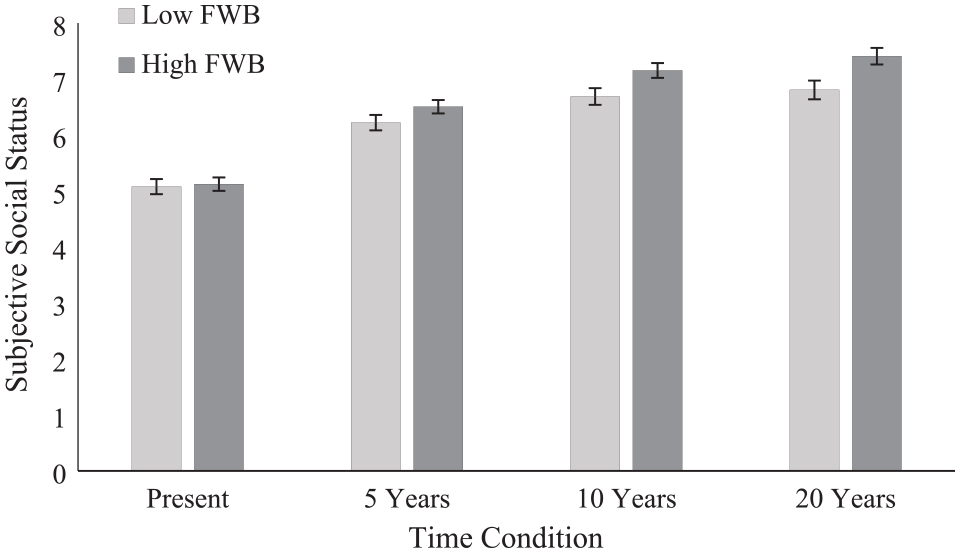
Differences in Subjective Social Status by Belief in Free Will and Time Conditions in Study 2
Study 3
Study 2 demonstrated that belief in free will changes our perceptions of social status across different time points. Altering free will beliefs did not lead to differences in subjective social status in the present or 5 years into the future. However, reducing free will beliefs led to lower perceived subjective social status 10 years and 20 years into the future.
In Study 3, we focused on objective social mobility. Objective social class refers to people’s access to material and social resources (Kraus & Stephens, 2012). To examine objective social mobility, we assessed future perceptions about occupation, education, income, and lifestyle. Occupation, education, and income are common indicators of objective social class (Lareau & Conley, 2008), and people’s lifestyle (e.g., restaurant dining) signals access to financial resources.
We examined whether manipulating belief in free will would influence perceptions of objective social mobility 10 years into the future. We chose 10 years as our future time index since Study 2 indicated that people perceive upward social mobility as close as a decade. We predicted that weakening belief in free will would lead to lower perceptions of objective social class standing 10 years into the future.
Method
Participants
Two hundred and ninety-four participants (206 female, 2 female-to-male transgender, 84 male, and 2 other; Mage = 32.90, SDage = 11.71, range 18–77; 79% White) were recruited from MTurk using CloudResearch. CloudResearch-approved participants completed the study for $1.25.
Materials and Procedure
Participants completed the measures discussed below and were debriefed.
FWB Manipulation and Manipulation Check
Participants completed the same FWB manipulation and manipulation check (M = 5.15, SD = 1.48, α = .87) as Studies 1 and 2.
Objective 10-Year Social Class Standing
We developed a 15-item measure to capture objective social mobility. Three items assessed occupation (e.g., “What job level position will you have 10 years from now?”), four items assessed education (e.g., “What is the highest educational degree will you have 10 years from now?”), four items assessed income (e.g., “What total household income will you have 10 years from now?”), and four items assessed lifestyle (e.g., “What type of restaurants will you dine at 10 years from now?”). Responses were made on a 4-point scale, with each scale point representing different levels of socioeconomic status. Items were averaged to produce a composite score. Higher scores indicated greater perceived objective social standing (M = 2.82, SD = .42, α = .80).
Results
An independent samples t-test found a significant difference in FWB, t(253) = 8.09, p < .001, d = .96, 95% CI [0.97, 1.59]. The manipulation was successful. The high FWB condition reported greater FWB (M = 5.75, SD = 1.15) than the low FWB condition (M = 4.47, SD = 1.52).
An independent samples t-test did not find a significant difference in perceptions of objective social class mobility 10 years into the future, t(292) = .83, p = .408, d = .10, 95% CI [−0.06, 0.14]. Participants in the low FWB condition (M = 2.80, SD = 0.43) reported similar objective social standing as those in the high FWB condition (M = 2.84, SD = 0.42). See Figure 3.
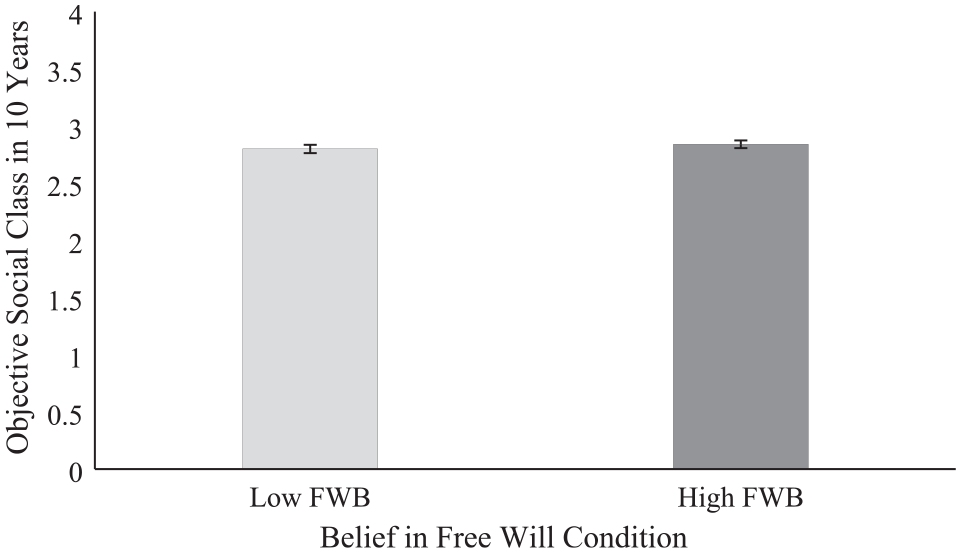
Differences in Objective Social Class in 10 Years as a Function of Belief in Free Will Condition in Study 3
Study 4
Unexpectedly, Study 3 found that manipulating free will beliefs had no influence on objective social class standing 10 years into the future. Because Study 2 found differences in perceived social mobility across the 10-year and 20-year future time points, it is possible that making predictions about objective social standing 10 years into the future still feels anchored in the present. To better examine objective social class in the distant future, Study 4 focused on perceived objective social standing 20 years into the future.
Method
Participants
Two hundred and ninety participants (182 female, 102 male, 3 male-to-female transgender, and 3 other; Mage = 35.26, SDage = 11.09, range 18–71; 73% White) were recruited from MTurk using CloudResearch. CloudResearch-approved participants completed the study for $3.00.
Materials and Procedure
Participants completed the same measures as Study 3 except with a modified objective social mobility measure and were debriefed.
FWB Manipulation and Manipulation Check
Participants completed the same FWB manipulation and manipulation check (M = 5.23, SD = 1.47, α = .86) as Studies 1 through 3.
Objective 20-Year Social Class Standing
Participants completed the same perceived objective social mobility measure as Study 3 except they thought about their social class standing 20 years into the future (M = 2.88, SD = .52, α = .87).
Results
An independent samples t-test found a significant difference in FWB, t(224) = 9.03, p < .001, d = 1.10, 95% CI [1.11, 1.72]. The manipulation was successful. The high FWB condition reported greater FWB (M = 5.88, SD = 1.03) than the low FWB condition (M = 4.46, SD = 1.54).
An independent samples t-test did not find a significant difference in objective social class mobility 20 years into the future, t(288) = 1.49, p = .138, d = .18, 95% CI [−0.03, 0.21]. Participants in the low FWB condition (M = 2.83, SD = .55) reported similar objective social standing as those in the high FWB condition (M = 2.92, SD = .50). See Figure 4.
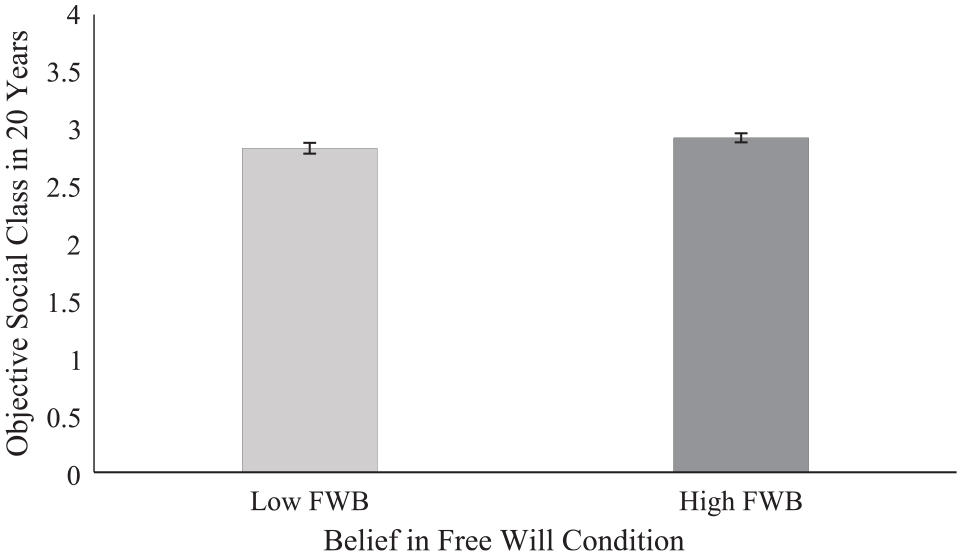
Differences in Objective Social Class in 20 Years as a Function of Belief in Free Will Condition in Study 4
Study 5
Studies 3 and 4 found that manipulating belief in free will did not lead to perceived differences in objective social class standing at two different future time points. One explanation is that multiple projections about social class 10 and 20 years into the future required greater reflection and may have eliminated the effects of our manipulation. The manipulation may also have been futile because the objective social mobility measure was incompatible with the age of participants. Predictions such as the highest educational degree would produce little variability, as participants were of the age range 18 to 77 years and 18 to 71 years with an average age of 33 and 35 years, respectively. The inconsistent findings may further be due to how social class was measured. Studies 1 and 2 assessed subjective social mobility while Studies 3 and 4 assessed objective social mobility.
Study 5 aimed to overcome these limitations. Participants completed an abbreviated objective social class measure to clarify whether long reflections about future social standing eliminated the effects of our manipulation. They completed one item each about occupation and income 10 and 20 years into the future, as they most directly reflect objective social class. We also recruited participants between the ages of 18 and 45 years to reduce measure incompatibility from a wider age range. Finally, to determine whether there are differences between subjective and objective social class measures, we included an abbreviated subjective social mobility measure from Study 1. The measures were counterbalanced to reduce potential order effects.
Method
Participants
Two hundred and eighty-eight participants (195 female, 3 female-to-male transgender, 87 male, 2 non-binary, and 1 not sure; Mage = 32.24, SDage = 6.54, range 18–44; 69% White) were recruited from MTurk using CloudResearch. CloudResearch-approved participants completed the study for $3.00.
Materials and Procedure
Participants completed the measures discussed below and were debriefed.
FWB Manipulation and Manipulation Check
Participants completed the same FWB manipulation and manipulation check (M = 5.07, SD = 1.46, α = .86) as Studies 1 through 4.
Perceived Individual Social Mobility
Participants completed a shortened four-item measure of perceived individual social mobility (M = 4.64, SD = 1.33, α = .87) from Study 1.
Objective 10-Year and 20-Year Social Class Standing
Participants completed a shortened four-item measure that captures objective social class mobility 10 years and 20 years into the future. Two items assessed occupation (e.g., “What job level position will you have 10 [20] years from now?”), and two items assessed income (e.g., “What total household income will you have 10 [20] years from now?”). Responses were made on a 7-point scale, with each scale point representing different levels of socioeconomic status. 3 The two 10-year items were averaged to produce a composite score. Higher scores indicated greater perceived objective social standing in 10 years (M = 4.89, SD = 1.32, α = .66). The two 20-year items were averaged to produce a composite score. Higher scores indicated greater perceived objective social standing in 20 years (M = 5.49, SD = 1.36, α = .76).
Results
An independent samples t-test found a significant difference in FWB, t(259) = 8.95, p < .001, d = 1.07, 95% CI [1.07, 1.68]. The manipulation was successful. The high FWB condition reported greater FWB (M = 5.73, SD = 1.13) than the low FWB condition (M = 4.36, SD = 1.45). 4
Perceived Individual Social Mobility
An independent samples t-test found a significant difference in perceived individual social mobility, t(271) = 5.61, p < .001, d = .67, 95% CI [0.55, 1.14]. Participants in the low FWB condition reported lower perceptions of individual social mobility (M = 4.20, SD = 1.36) than those in the high FWB condition (M = 5.05, SD = 1.17), replicating Study 1’s findings. See Figure 5.
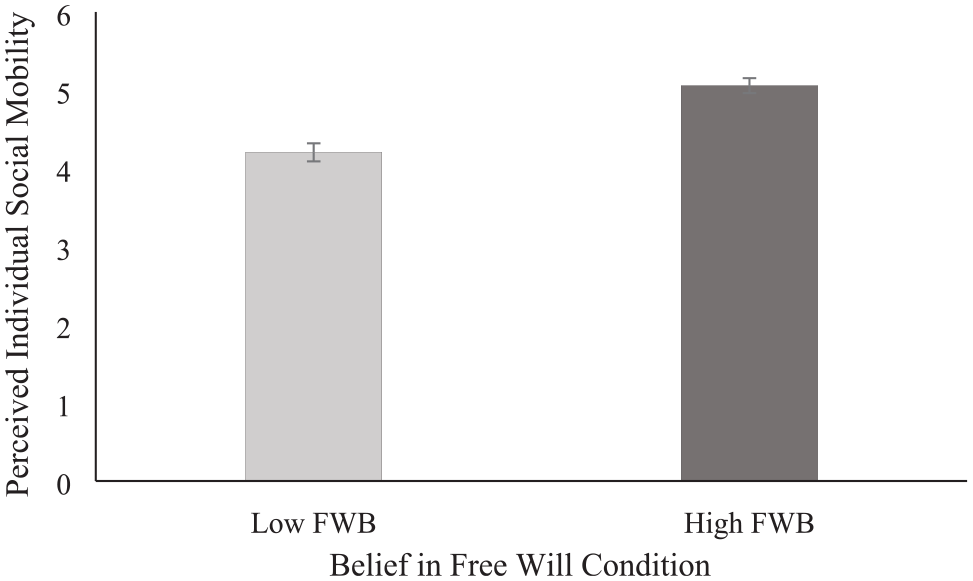
Differences in Perceived Individual Social Mobility as a Function of Belief in Free Will Condition in Study 5
Objective 10-Year and 20-Year Social Class Standing
A 2 (belief in free will: high v. low) × 2 (time: 10 years, 20 years) mixed ANOVA examined the effect of belief in free will and time on future objective social class standing. There was a significant main effect of belief in free will, F(1, 286) = 8.01, p = .005, partial η2 = .03. Participants in the low FWB condition (M = 4.98, SD = 1.35) reported lower overall future objective social class than participants in the high FWB condition (M = 5.40, SD = 1.19). There was also a significant main effect of time, F(1, 286) = 190.61, p < .001, partial η2 = .40, sphericity not assumed. Participants perceived greater objective social class 20 years into the future (M = 5.48, SD = 1.36) than 10 years into the future (M = 4.89, SD = 1.32).
These main effects were qualified by a significant belief in free will × time interaction, F(1, 286) = 5.23, p = .023, partial η2 = .02. We tested for the effect of belief in free will at each level of time. There were significant differences in objective social class between FWB conditions 10 years, F(1, 286) = 4.45, p = .036, partial η2 = .02, and 20 years, F(1, 286) = 11.00, p = .001, partial η2 = .04, into the future. Participants perceived lower objective social class under the low FWB condition (M = 4.73 and M = 5.22 for 10 years and 20 years from now, respectively) than under the high FWB condition (M = 5.05 and M = 5.74 for 10 years and 20 years from now, respectively). See Figure 6.
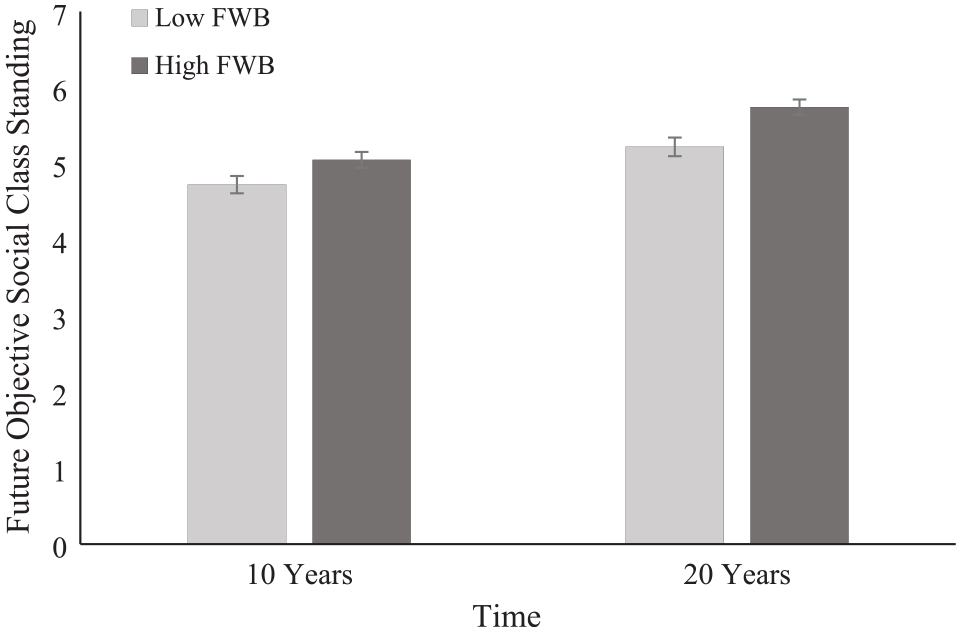
Differences in Future Objective Social Class as a Function of Belief in Free Will and Time Conditions in Study 5
Discussion
The present research examined whether manipulating belief in free will alters perceptions of social mobility. Weakening free will beliefs reduced subjective perceptions that one can move up in societal position in Study 1 and led to lower perceptions of subjective social status in the distant future, but not near future, in Study 2. Unexpectedly, manipulating free will beliefs did not lead to perceived differences in objective social class standing at two different future time points in Studies 3 and 4. Threatening free will beliefs led to lower subjective individual social mobility and objective social class, with the latter under specific boundary conditions, in Study 5. These findings suggest that free will beliefs change perceptions about social mobility depending on how it is assessed.
Because free will beliefs reflect agentic control (Baumeister & Brewer, 2012), we expected that weakening free will beliefs would lead people to perceive less opportunity to move up the socioeconomic ladder. Studies 1, 2, and 5 supported this prediction. When belief in free will was challenged and people became less certain about their ability to determine their own outcomes, upward social mobility felt less feasible. This is consistent with characterizations of free will as achieving positive outcomes and working toward long-term goals (Stillman et al., 2011). Study 2 also found that belief in free will led to perceived changes in subjective social status only when projecting 10 and 20 years into the future. This was conceptually replicated in Study 5 using occupation and income as indicators of objective social class. This suggests that people recognize that personal agency has temporal boundaries. It takes time to fundamentally alter our societal positions, especially through our choices and actions.
Surprisingly, manipulating belief in free will did not influence perceptions of social mobility in Studies 3 and 4. This is likely attributed to how social class is measured. Studies 1 and 2 assessed subjective social mobility, whereas Studies 3 and 4 evaluated objective social mobility, and Study 5 utilized both types of measurements. It is plausible that weakening free will beliefs influences subjective social mobility more strongly. That is, altering free will beliefs easily changes our broader views about social class and bears a smaller influence on distinct indicators of social class. Subjective thoughts about social mobility are perhaps more variable than certain objective markers of social mobility when belief in free will is made salient.
The inconsistent findings from Studies 3 and 4 could also be due to our objective social mobility measure. It is possible that many of the future projections reflected aspirations rather than realistic perceptions of objective social class, thereby reducing the expected variability between the belief in free will conditions. However, altering free will beliefs was effective in changing objective social class in Study 5. Given that we used a shorter, more nuanced objective social class measure and recruited participants of the age range 18 to 45 years, perhaps perceptions of objective social mobility are more malleable to manipulations of belief in free will only when certain boundary conditions are present.
Our research identifies belief in free will as an important context to examine perceptions of social mobility. Our investigation contributes to ongoing conversations about the best measure of social class (Kraus & Stephens, 2012). We found that free will beliefs consistently influenced subjective social mobility and only objective social mobility under specific boundary conditions. Future research might employ both types of measurements to fully capture the complex construct and continue to investigate the malleability of objective social class. Our participants also represent the WEIRD demographic (Western, educated, industrialized, rich, and democratic societies; Henrich et al., 2010) and do not speak to intersectionality. Future research might employ non-WEIRD participants and examine the intersection of social identities to enhance the generalizability of our findings.
Achieving upward social mobility is highly entrenched in our collective unconscious. Varying free will beliefs can help temper expectations about climbing the socioeconomic ladder. While belief in free will makes us feel capable of ascending social ranks, our actual ability to change societal positions in life is likely more challenging than imagined. Belief in free will can only propel us so far up the rungs of society.
Footnotes
Handling Editor: Christopher Federico
Declaration of Conflicting Interests
The author(s) declared no potential conflicts of interest with respect to the research, authorship, and/or publication of this article.
Funding
The author(s) received no financial support for the research, authorship, and/or publication of this article.
