




Abstract
In three studies, we examined the relationship between free will beliefs and job satisfaction over time and across cultures. Study 1 examined 252 Taiwanese real-estate agents over a 3-months period. Study 2 examined job satisfaction for 137 American workers on an online labor market over a 6-months period. Study 3 extended to a large sample of 14,062 employees from 16 countries and examined country-level moderators. We found a consistent positive relationship between the belief in free will and job satisfaction. The relationship was above and beyond other agency constructs (Study 2), mediated by perceived autonomy (Studies 2-3), and stronger in countries with a higher national endorsement of the belief in free will (Study 3). We conclude that free-will beliefs predict outcomes over time and across cultures beyond other agency constructs. We call for more cross-cultural and longitudinal studies examining free-will beliefs as predictors of real-life outcomes.
Introduction
Do we have free will? This simple and abstract question has been the center of a heated philosophical debate dating back to ancient Greece and ongoing till this very day. This discussion seems far from any resolution, yet research in the last decade based in social-personality psychology and experimental philosophy has moved beyond the discussion of whether free will exists or not to a new direction examining people’s free will related cognition and beliefs and their impact on behavior. Although the concept of free will may seem theoretical and philosophical in nature, a growing number of studies have shown that the belief in free will is associated with a wide array of cognitive and behavioral outcomes (see reviews; Baumeister & Monroe, 2014; Brass, Lynn, Demanet, & Rigoni, 2013).
The research on the consequences of the belief in free will has so far been focused on experimental manipulations or cross-sectional studies showing the immediate or short-term effects of the belief in free will in a single cultural context. In this research, we aimed to extend and test the generalizability of these findings by examining the effects of the belief in free will for outcomes over time and across cultures and context. For that purpose, we were specifically interested in implications of the belief in free will outside the lab, in real-life settings, and with actual implications for individuals. Only a few studies examined such implications in field settings, with initial findings indicating that the belief in free will is predictive of better academic performance (Feldman, Chandrashekar, & Wong, 2016) and better job performance (Stillman et al., 2010). To supplement these findings on performance-related outcomes, we examined workplace satisfaction addressing the research question of whether the higher productivity associated with higher perceived free will would be accompanied with a higher satisfaction for believers in their work life, supported by higher perceived autonomy. Beyond the hypothesized link between free will beliefs and work satisfaction, we also aimed to make the following contributions to the free will beliefs literature: (a) predicting outcomes over time, (b) examining cross-cultural differences, (c) assessing unique variance above and beyond other agency constructs in the literature, and (d) providing further evidence for the prediction of real-life outcomes outside the lab.
Belief in Free Will
The debate regarding the existence of free will begins with the discussion of the meaning of free will, and free will has been conceptualized in many different ways. In recent years, a group of psychologists and experimental philosophers has concluded a joint simple definition of free will as being the capacity to act freely (Feldman, 2017; Haggard, Mele, O’Connor, & Vohs, 2010). This capacity lies both in the cognition that the person can choose from several alternative options for action and in the person’s perceived ability to choose among options available freely without constraints (Kane, 1996, 2002) The freedom of action is from two types of constraints—internal and external. Internal constraints include internal factors that humans have little or no control over, such as genes, gender, disabilities, intelligence, urges, desires, and needs, and even individual factors that have a strong impact on one’s life trajectory, such as social status, wealth, and personality. For example, a person who believes that free will exists tends to view people as capable of choosing their own actions and path in life regardless of their genes, social backgrounds, or personality traits, and believes that internal urges and desires can be resisted and overcome. External constraints include any factors outside the person which may be perceived as determining a person’s life, such as nature (science), fate, God, or even pressures from the environment such as from society or other agents. For example, a person may perceive that everything in life is causally determined by the laws of nature or that all actions are predestined by the rule of God or fate, with no capacity for humans to effectively choose their own course of action. Importantly, in both the academic conceptualization and in laypersons’ understanding of the concept of free will, free will is not about metaphysics and is not a mysterious dualistic force, but rather it is a concept representing the capacity for choice and agency (Baumeister, 2008; Feldman, 2017; Monroe, Dillon, & Malle, 2014; Monroe & Malle, 2014; Nadelhoffer, Shepard, Nahmias, Sripada, & Ross, 2014; Nahmias, Shepard, & Reuter, 2014).
Most modern societies and religions operate under some assumption of human agency and the belief in free will is endorsed by high percentage of people from around the world in different cultures (Sarkissian et al., 2010), although people do differ in the degree to which they perceive their will as free and the extent to which they endorse the belief in free will (Carey & Paulhus, 2013; Paulhus & Carey, 2011). The belief in free-will has been theorized as serving a functional role in societies and in people’s lives (Hume, 1758; Kant, 1788/1997), and there is increasing empirical evidence showing that this implicit and abstract philosophical belief holds important implications for both cognition and behavior, many of them positive, which would explain the popularity of the belief in free will.
One of the dominant theories regarding the functional role of free will is that free will is only worth having if it serves to help pursue what the person wants or needs (Dennett, 2003; Edwards, 1754; Hume, 1758), by providing the self with a stronger sense of autonomy, meaning, and self-direction (Kane, 2002). It has been argued that the mechanism of unpredictability has historically evolved as means of survival by enabling humans to evade predators in nature that hunt by anticipating their prey’s movement (Brembs, 2011). It has since developed to a controlled mechanism that serves the person in overcoming short-term selfish urges and needs in pursuit of long-term higher level complex motivations such as self-actualization (Seligman, Railton, Baumeister, & Sripada, 2013) as well as for the successful coexistence with others in an organized society (Baumeister, 2008).
In support of the functional role of free will, research has shown that the belief in free will is associated with a variety of positive outcomes for the self (see review in Baumeister & Monroe, 2014). The belief in free will is predictive of higher autonomy and more proactive behavior (Alquist, Ainsworth, & Baumeister, 2013), lower helplessness and higher self-efficacy (Baumeister & Brewer, 2012), stronger identity (Seto & Hicks, 2016), higher meaningfulness (Seto, Hicks, Davis, & Smallman, 2015), and has been associated with enhanced volitional functions (Brass et al., 2013; Rigoni & Brass, 2014), such as more efficient error processing (Rigoni, Pourtois, & Brass, 2015; Rigoni, Wilquin, Brass, & Burle, 2013), better suppression of pain (Lynn, Van Dessel, & Brass, 2013), and heightened brain readiness potential for motor actions (Rigoni, Kühn, Sartori, & Brass, 2011). Together, these mechanisms help those who believe in free will in achieving better outcomes, such as better academic performance (Feldman, Chandrashekar, & Wong, 2016) and better workplace performance (Stillman et al., 2010).
Feldman (2017) provided an in-depth review highlighting belief in free will as a unique and important agency construct, discussing conceptual differences from other well-known agency constructs in the literature and the related empirical evidence.
Belief in Free Will and Job Satisfaction
The belief in free will is a fundamental factor in human agency, and perceptions of agency have positive consequences for satisfaction, underlying people’s sense-making, search for meaning and purpose, true self-knowledge, and the attainment of higher well-being (Crescioni, Baumeister, Ainsworth, Ent, & Lambert, 2015; Feldman & Chandrashekar, in press; Leotti, Iyengar, & Ochsner, 2010).
A key factor underlying these agency processes leading to positive outcomes is autonomous choice. Choice is the basis for people’s understanding of free will (Davidov & Eisikovits, 2015; Monroe et al., 2014), and the belief in free will is cognitively linked in layperson’s minds to the concept of choice (Feldman, Baumeister, & Wong, 2014). In modern capitalist societies, especially in the West, choice is generally regarded as positive and desirable 1 (Deci & Ryan, 1985; Schwartz, 2004). To be able to make decisions effectively and enjoy the process of decision-making and related outcomes, one must perceive that choices are available and that the self is capable and in charge of making a choice (Baumeister, Sparks, Stillman, & Vohs, 2008; Monroe & Malle, 2010). The belief in free will enables the person to view life as filled with choices, to regard ordinary actions as choices, thereby driving higher motivation for facing choice, resulting in lower difficulty in tackling decisions, and finally higher satisfaction in making decisions (Feldman et al., 2014). Thus, at the workplace, people who believe in free will would perceive work life as filled with choices—that working for a company or an institution is a choice rather than an uncontrolled or deterministic obligation and that the work done for the company or institution involves a high degree of choice with little coercion or predetermination. As a result, those who believe in free will would be more likely to see their ongoing work and related actions as their own choice, to face workplace choices with greater ease, to better enjoy the outcomes of their labor, and to take pride in associated workplace achievements as their own.
We therefore expected a positive relationship between the endorsement of the belief in free will and job satisfaction, and that this relationship would be mediated by perceived autonomy, which captures the perceived degree of choice afforded in the work context.
Free Will Beliefs Across Cultures
Do cultures differ in their endorsement of the belief in free will? Very little research has been done to assess cultural differences (Wente et al., 2016). The most comprehensive study to date is by Sarkissian and colleagues (2010) on free will intuitions in experimental philosophy and it concluded no significant differences in ratings of free will universe as more likely than a fully deterministic universe between participants from the United States (82%), India (85%), Hong Kong (65%), and Columbia (77%). However, research on the concept of choice suggested that perceptions of choice are socially constructed (Kitayama, Snibbe, Markus, & Suzuki, 2004; Savani, Markus, Naidu, Kumar, & Berlia, 2010; Savani, Wadhwa, Uchida, Ding, & Naidu, 2015) and recent studies on free will beliefs in children (rather than intuitions assessed by Sarkissian et al.) indeed found some support for cultural differences. Chernyak, Kushnir, Sullivan, and Wang (2013) compared Nepalese and American children and summarized that “while basic notions of free choice are universal, recognitions of social obligations as constraints on action may be culturally learned” (p. 1343), and differences were also found when comparing children from China and the United States (Gopnik & Kushnir, 2014; Wente et al., 2016). These findings are in support of the idea that the notion of free will and freedom of choice is cultural and meant to facilitate coexistence with others in society (Baumeister, 2005, 2008; Feldman, 2017; Gopnik & Kushnir, 2014; Kushnir, 2012; Martin, Rigoni, & Vohs, 2017).
We therefore expected to find cross-cultural differences in the endorsement of free will beliefs, and further hypothesized that these differences will moderate the link between free will beliefs and outcomes. If free will beliefs indeed serve social purposes and there are cultural variations, then it is likely that people will enjoy greater benefits from believing in free will in cultures that value the concept of free will.
Free Will Beliefs Over Time
Do free will beliefs predict outcomes over time? Research on free will beliefs has so far focused solely on studying the consequences of free will beliefs in one point in time. Experimental methodology typically aimed to activate mindsets either endorsing or rejecting free will and then assessed dependent variables immediately following activation. Surveys asking about individual differences in free will beliefs typically measured outcomes at one point in time and together with free will beliefs. Thus, we so far have no indication of whether free will beliefs are predictive of outcomes over a period of time.
Beliefs are the building blocks of action (Fishbein & Ajzen, 1975), and considered broad and stable (Feldman, 2017). Free will beliefs even more so, as they are socially construed and facilitate long-term prospection and coordination that goes beyond immediate short-term goals and needs (Baumeister, 2008; Seligman et al., 2013). We therefore expected that free will beliefs would predict outcomes even in the long-term.
Present Investigation
The present investigation examines the relationship between belief in free will and job satisfaction. Beliefs are generally considered to be stable over time with relatively minor fluctuations and prevalent in most cultures, yet so far there have been very little empirical data on the belief in free will as a predictor of outcomes over time and across cultures. Three studies investigated the link between the belief in free will and job satisfaction in various contexts, several cultures, and in more than one point in time. Study 1 included a sample of real-estate agents in Taiwan over a 3-months period. Study 2 examined an American sample over a 6-months period. Study 3 extended to a large cross-cultural cross-occupational sample using the World Values Survey (WVS) from 16 countries. The supplementary file includes power analyses and materials used in the three studies, and data and code were made available on the Open Science Framework (https://osf.io/d2e6s/).
Study 1: Taiwanese Real-Estate Agents’ Job Satisfaction
Method
Participants and procedure
We conducted the study in 54 branch offices of a publicly listed real-estate agency company in Taiwan. We distributed the surveys to the agents (in Chinese) in two waves of surveys separated by a 3-months time-lag. A total of 293 returned questionnaires in Time 1 (Mage = 30.46; SDage = 5.43; 79% males; 89.9% with higher education), and of those 252 also returned the questionnaire in Time 2 (Mage = 30.77; SDage = 5.15; 82% males; 91% with higher education; 74% response rate).
Measures
Scales were translated from English to Chinese using back translation procedure (Brislin, 1970) and were then verified by senior researchers who are Chinese native speakers (see supplementary for details).
Belief in free will
Belief in free will was measured using the eight-item personal will subscale of the FWD scale (Rakos, Steyer, Skala, & Slane, 2008), in which participants rated their agreement with statements regarding having free will, such as “I have free will” and “I am in charge of my actions even when my life’s circumstances are difficult” (1 = strongly disagree; 6 = strongly agree). Belief in free will ratings were collected in Time 1 (α = .74).
Job satisfaction
Job satisfaction was measured using the Dubinsky and Hartley (1986) three-item scale, with the following items: “Generally speaking, I am very satisfied with my job,” “I am generally satisfied with the feeling of worthwhile accomplishment I get from doing this job,” and “I am satisfied with the kind of work I do in this job” (1 = strongly disagree; 7 = strongly agree). Job satisfaction ratings were collected at both Time 1 and Time 2 (Time1: α = .95, Time2: α = .93).
Results and Discussion
Means, standard deviations, and correlations for the measures are detailed in Table 1. The two job satisfaction measures in Time 1 and Time 2 were significantly correlated (r = .43, p < .001), and the belief in free will was positively correlated with both job satisfaction measures (Time 1: r = .36, p < .001, confidence intervals [CI] [.25, .45]; Time 2: r = .19, p = .002, CI [.07, .31]). A repeated-measures analysis revealed no significant temporal differences in job satisfaction, and there was no interaction between free will beliefs and time in predicting job satisfaction.
Study 1 Means, Standard Deviations, and Correlations.
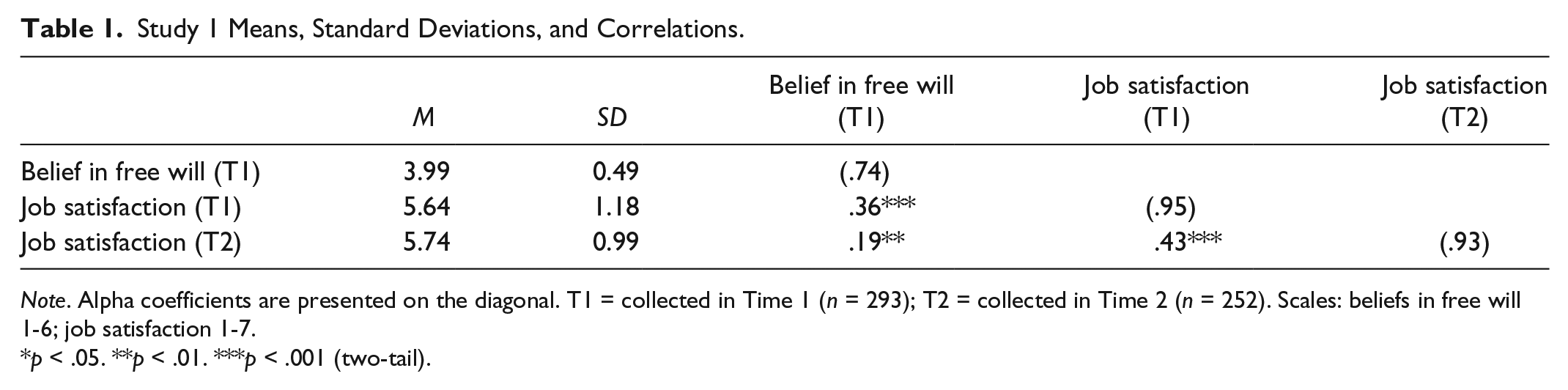
Note. Alpha coefficients are presented on the diagonal. T1 = collected in Time 1 (n = 293); T2 = collected in Time 2 (n = 252). Scales: beliefs in free will 1-6; job satisfaction 1-7.
p < .05. **p < .01. ***p < .001 (two-tail).
Study 1 showed support for the positive relationship between the belief in free will and job satisfaction for real-estate agents in Taiwan. The relationship was consistent over a 3-month time-lag between the collection of free will beliefs and ratings of job satisfaction.
Study 2: Amazon Mechanical Turk (MTurk) American Workers’ Job Satisfaction
Study 2 was constructed to (a) test the generalizability of the findings in Study 1 by examining a workplace in a different culture and for diverse types of tasks, and (b) compare free will beliefs to other related agency constructs (for a review, see Feldman, 2017).
MTurk is a diverse online labor market for hundreds of thousands of people from all over the world, serving as a connecting platform between employers (“requesters”) and employees (“workers”). Requesters offer tasks (“HIT”s) in return for a specified amount of money, and workers that match the HIT criteria and are interested in the task and the offered compensation may choose to accept the HIT and complete the task. Upon a successful completion of the task and the approval by the requester, MTurk facilitates the payment from the requester to the worker. The tasks offered on MTurk can be anything from simple tasks answering a single-item questionnaire to very complicated tasks requiring specialized skills such as copy-editing or sophisticated calculations or data analysis. The level of compensation per task starts as low as one cent and ranges to very high compensation for complicated tasks, but on average is around several dollars for around half an hour. The MTurk workers engage in a wide variety of tasks for a large number of employers, and therefore, the measure of job satisfaction for work on MTurk captures the overall satisfaction that MTurk workers have from their overall work across all tasks and employers. MTurk is typically used in academic studies to collect data, yet in this study we examined behavior on MTurk for what it is—a real-life workplace.
Method
Participants and procedure
Participants were surveyed in two waves. A total of 209 American participants were recruited online using MTurk and answered a questionnaire regarding their work on MTurk in return for 1 US$. Six months later, we contacted the workers and invited them to participate in a follow-up study in return for 2 US$. In both times, we allowed data collection for a period of 15 days. In Time 2, we sent three email reminders at 3-day intervals to those who have not yet answered the invitation to participate again. A total of 137 participants responded to our invitation and completed the second part of the survey, representing a 66% response rate.
Measures
Belief in free will
The Rakos et al. (2008) scale includes subscales measuring beliefs related to the question of free will. The scales can be categorized either by personal-general or by topic. In Study 1, we collected the personal free-will subscale, yet some of the items in that subscale were about moral responsibility and religiosity rather than purely about agency (e.g., “my decisions are influenced by a higher power”; “my choices are limited because they fit into a larger plan”; both reversed). These items capture more than the mere belief in free will, and may have resulted in weaker effects in Study 1 and may result in different effect size in societies with different religions.
Therefore, in Study 2 we collected the full scale. The free-will and personal-agency scales were the closest empirically to the conceptual idea of the belief in free will, and were indeed found to exhibit the strongest relationship to job satisfaction. The responsibility subscales (moral responsibility and personal responsibility) and religiosity (higher power control, personal limitations) were not specifically about free-will and agency, and showed weaker effects. In Study 2, we therefore report the effect for a combined scale of free-will and personal agency subscales as the free will belief measure. The measure includes the nine-item of the free-will and personal agency subscales of the scale (α = .88). In the supplementary materials we report correlations for the entire scale and subscales with further details and analyses.
Job satisfaction
Job satisfaction on MTurk at both Time 1 and Time 2 was measured using an adaptation of the five items short scale of Brayfield and Rothe (1951) constructed by Judge, Locke, Durham, and Kluger (1998). The items were adjusted to reflect satisfaction with the online work on MTurk—“I feel fairly well satisfied with my present job doing MTurk tasks,” “Most days I am enthusiastic about the work I do on MTurk,” “Every time I work on tasks on MTurk it feels like forever” (reversed), “I find real enjoyment in the work I do on MTurk,” and “I consider the kind of work I do on MTurk rather unpleasant” (reversed) using a 7-point scale (1 = strongly disagree; 7 = strongly agree; Time 1: α = .79; Time 2: α = .84).
Job autonomy
Job autonomy was measured using the Hackman and Oldham (1980) scale adjusted for MTurk with the following three items: “I have significant autonomy in determining how I do my job on MTurk,” “I can decide on my own how to go about doing my work on MTurk,” and “I have considerable opportunity for independence and freedom in how I do my job on MTurk” (1 = strongly disagree; 7 = strongly agree; Time 1: α = .83; Time 2: α = .85).
Related agency constructs
We measured a number of other agency constructs that were previously linked with job satisfaction as controls and for comparison of effect size: trait locus of control (Rotter, 1966; α = .58), implicit beliefs (Dweck, 2000; α = .90), trait self-esteem (Rosenberg, 1965; α = .92), job self-efficacy (Judge et al., 1998; α = .90), and trait self-control (Tangney, Baumeister, & Boone, 2004; α = .89).
Results and Discussion
Means, standard deviations, and correlations are detailed in Table 2. The belief in free will was positively correlated with job satisfaction in Time 1 (r = .31, p = .001, CI [.18, .43]) and Time 2 (r = .31, p < .001, CI [.15, .45]), even when controlling for trait locus of control, implicit beliefs, trait self-esteem, job self-efficacy, and trait self-control (Time 1: partial r = .15, p = .04, CI [.02, .28]; Time 2: partial r = .18, p = .042, CI [.01, .34]). We again found no indication for temporal differences in job satisfaction or for an interaction between free will beliefs and time.
Study 2 Means, Standard Deviations, and Correlations.
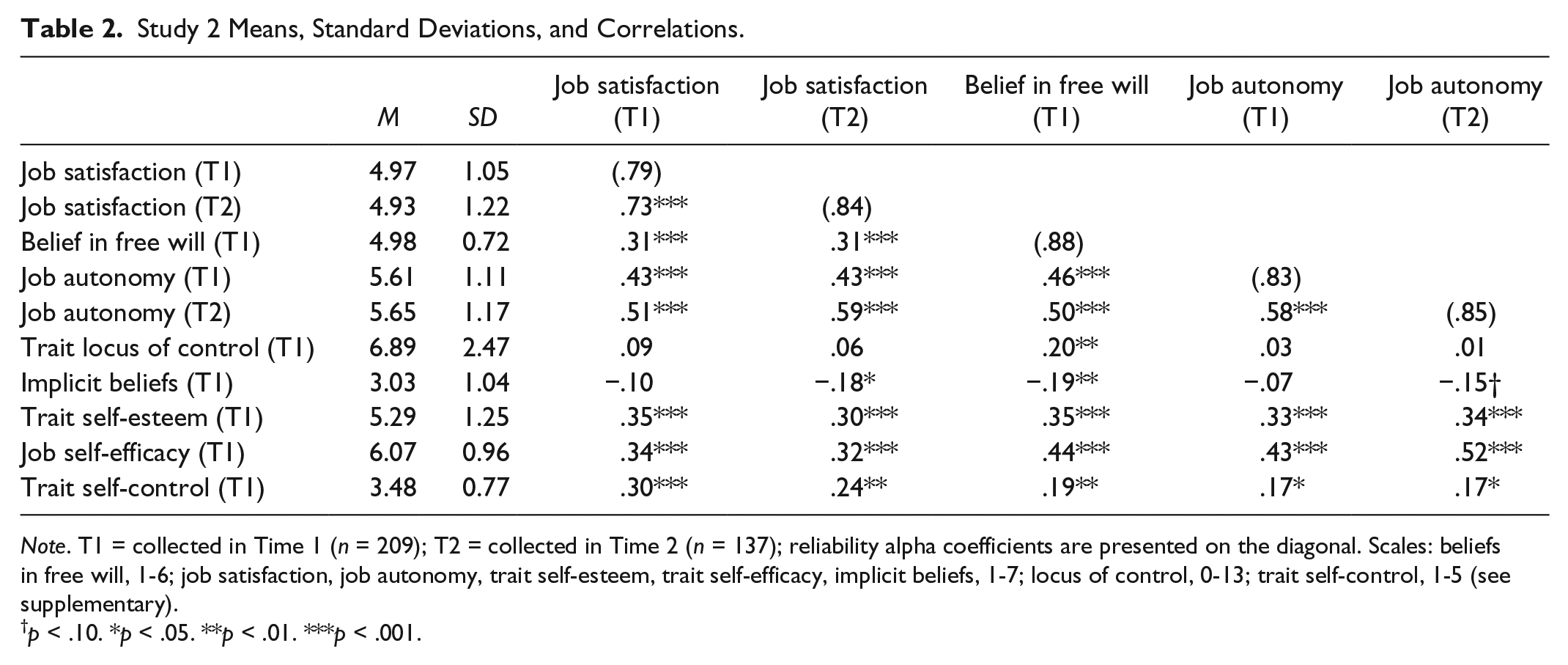
Note. T1 = collected in Time 1 (n = 209); T2 = collected in Time 2 (n = 137); reliability alpha coefficients are presented on the diagonal. Scales: beliefs in free will, 1-6; job satisfaction, job autonomy, trait self-esteem, trait self-efficacy, implicit beliefs, 1-7; locus of control, 0-13; trait self-control, 1-5 (see supplementary).
p < .10. *p < .05. **p < .01. ***p < .001.
Following the method reported by Stillman et al. (2010) to determine relative impact on an outcome, we included all agency constructs in a stepwise multiple regression on job satisfaction. The analysis revealed free will beliefs as a significant predictor of Time 1 job satisfaction (ΔR2 = .02, p = .039) together with trait self-esteem, job self-efficacy, and trait self-control, and of Time 2 job satisfaction (ΔR2 = .04, p = .016) together with only job self-efficacy. Next, a hierarchical multiple regression on job satisfaction controlling for all agency constructs showed that free will beliefs significantly improved the model beyond the other predictors: Time 1, F(6, 202) = 8.62, p < .001, ΔR2 = .02, p = .035; Time 2, F(6, 130) = 4.83, p < .001, ΔR2 = .03, p = .042.
We proceeded to examine job autonomy as a mediator. Free will beliefs correlated with job autonomy (Time 1: r = .46, p < .001, CI [.34, .56]; Time 2: r = .50, p < .001, CI [.36, .62]), even when controlling for the agency constructs (Time 1: partial r = .32, p < .001, CI [.19, .44]; Time 2: partial r = .36, p < .001, CI [.21, .54]) and job autonomy correlated with job satisfaction (Time 1: r = .43, p < .001, CI [.31, 53]; Time 2: r = .59, p < .001, CI [.47, .69]). We ran a bootstrapping mediation analysis (bias-corrected confidence estimates, 95%, 10,000 bootstraps; Preacher & Hayes, 2008) which showed that the relationship between free will beliefs and job satisfaction was mediated by job autonomy (Time 1: indirect β = .25, CI [.14, .39], direct β = .21, CI [.00, .41], p = .048, SOBEL p < .001; Time 2: indirect β = .50, CI [.27, .57], direct β = .03, CI [−.25, .30], p = .851 n.s., SOBEL p < .001).
Study 2 showed further evidence of the direct relationship between the belief in free will and job satisfaction for work conducted by Americans in an online labor market over a 6 months’ period, above and beyond other agency constructs, and with job autonomy as a mediator of the relationship.
Study 3: Job Satisfaction Across Cultures
Studies 1 and 2 demonstrated that the belief in free will predicted job satisfaction for Taiwanese real-estate agents and for Americans online workers. Study 3 aimed to generalize the findings even further, to include a large cross-cultural sample with participants from all over the world and working in a wide array of professions. We again tested job autonomy as a mediator of the relationship, and further explored country-level differences and moderators.
Method
Participants and procedure
The WVS (2008) is a survey collected between 1990 and 2008 of 257,597 participants from over 40 countries (over 70% of the countries in the world). Of the participants included in the WVS sample, 14,062 participants from 16 countries answered the measures of the belief in free will, job satisfaction, and job autonomy.
Measures
Belief in free will
One item was used to assess the belief in free will in the WVS data set (a173) through perceptions of freedom of choice and control: “Indicate how much freedom of choice and control you feel you have over the way your life turns out” (1 = no choice and control to 10 = a great deal of choice and control). This WVS item was previously used as a measure of the belief in free will (e.g., Clark et al., 2014; Martin et al., 2017).
Country-level beliefs in free will
Individual-level beliefs in free will (above) were aggregated to form a measure of country-level endorsement of belief in free will.
Job satisfaction
One item measured job satisfaction (c033): “Overall, how satisfied or dissatisfied are you with your job?” (1 = dissatisfied to 10 = satisfied). For a discussion in support of single-item measures for job satisfaction, see Dobrow Riza, Ganzach, and Liu (2016).
Job autonomy
One item measured participants’ perceptions of freedom of choice autonomy at work (c034): “How free are you to make decisions in your job?” (1 = none at all to 10 = a great deal).
Results and Discussion
Means, standard deviations, and correlations for the measures are detailed in Table 3. The belief in free will positively correlated with job satisfaction (r = .22, p < .001, CI [.21, .24]) and job autonomy (r = .22, p < .001, CI [.21, .24]). Job autonomy also positively correlated with job satisfaction (r = .48, p < .002, CI [.47, .49]). Controlling for job autonomy reduced the main effect (partial r = .13, p < .001) suggestive of a mediation. A bootstrapping mediation analysis (bias-corrected, 95% intervals, 10,000 resamples; Preacher & Hayes, 2008) revealed that the relationship between the belief in free will and job satisfaction was indeed mediated by job autonomy (β = .10, CI [.09, .11]). 2
Study 3 Means, Standard Deviations, and Correlations.
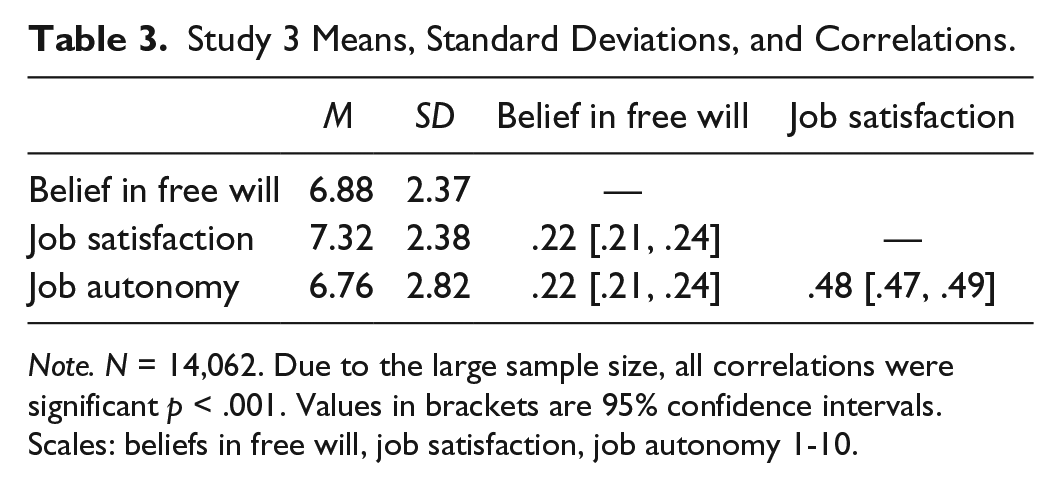
Note. N = 14,062. Due to the large sample size, all correlations were significant p < .001. Values in brackets are 95% confidence intervals. Scales: beliefs in free will, job satisfaction, job autonomy 1-10.
The strength of the correlation between the belief in free will and job satisfaction varied among countries. Table 4 details the correlations between the belief in free will and job satisfaction by country. Some countries showed a very weak correlation (e.g., Japan: r = .05, p = .209 n.s., CI [−.02, .12]; Poland: r = .03, p = .466 n.s., CI [−.04, .10]) and some countries exhibited much stronger correlations (e.g., Mexico: r = .42, p < .001, CI [.37, .47]; South Africa: r = .34, p < .001, CI [.29, .38]), suggestive of a national-level moderator. The correlations were found higher in the countries with a higher average endorsement of the belief in free will (r = .59, p = .015, CI [.13, .84]; see Table 4 for country-level scores for free will beliefs). We proceeded to conduct a multilevel modeling analysis. Country-level differences accounted for 5% of the variance in job satisfaction, and country-level endorsements of the belief in free will was a significant predictor of job satisfaction, with a significant interaction between individual-level and country-level beliefs in free will (see Table 5 for summary of findings, and Figure 1 for a plot of the interaction).
Study 3: Correlations Between Belief in Free Will and Job Satisfaction by Country in the WVS.
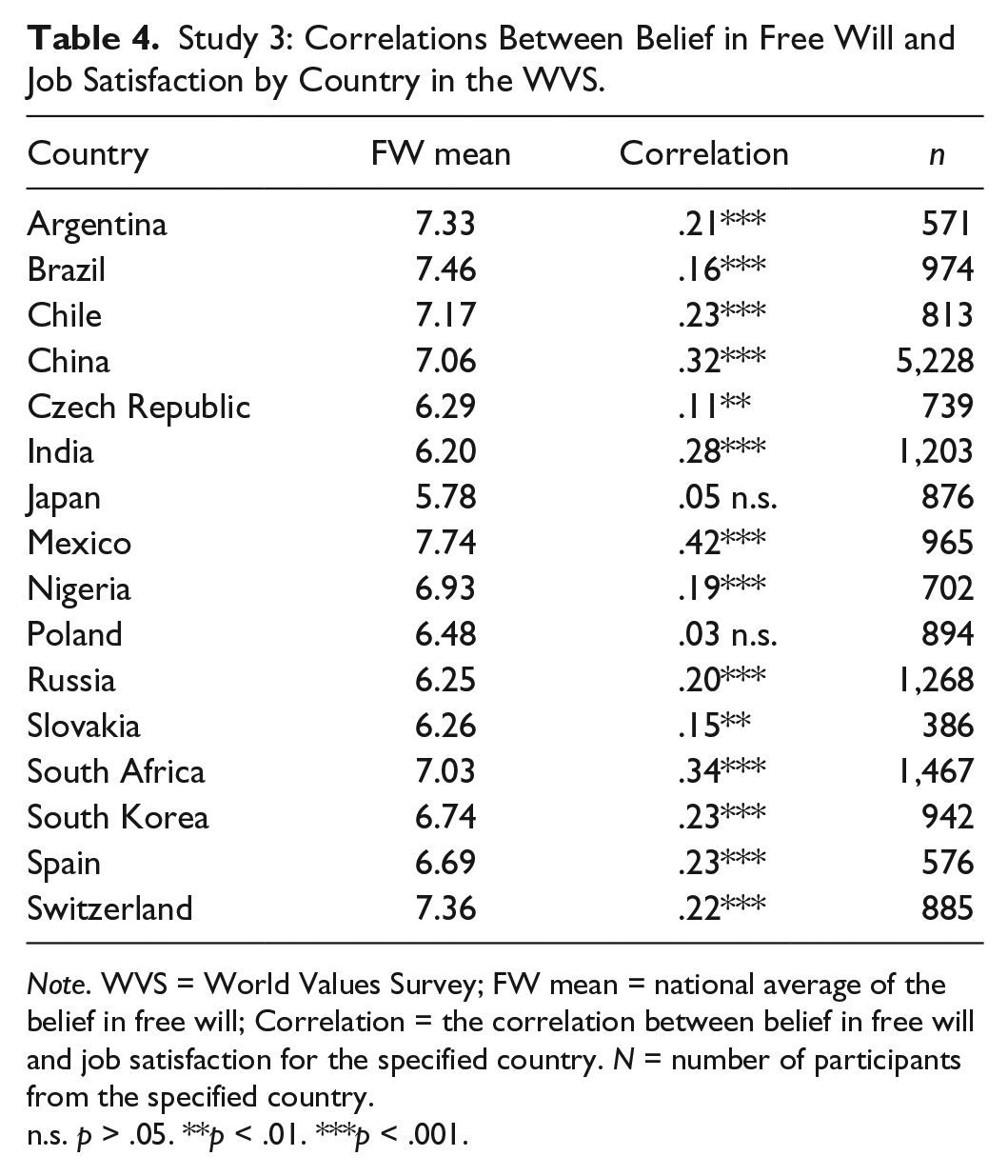
Note. WVS = World Values Survey; FW mean = national average of the belief in free will; Correlation = the correlation between belief in free will and job satisfaction for the specified country. N = number of participants from the specified country.
n.s. p > .05. **p < .01. ***p < .001.
Study 3: Multilevel Modeling Analysis Examining the Interaction of Individual-Level and Country-Level Free Will Beliefs in Predicting Job Satisfaction.
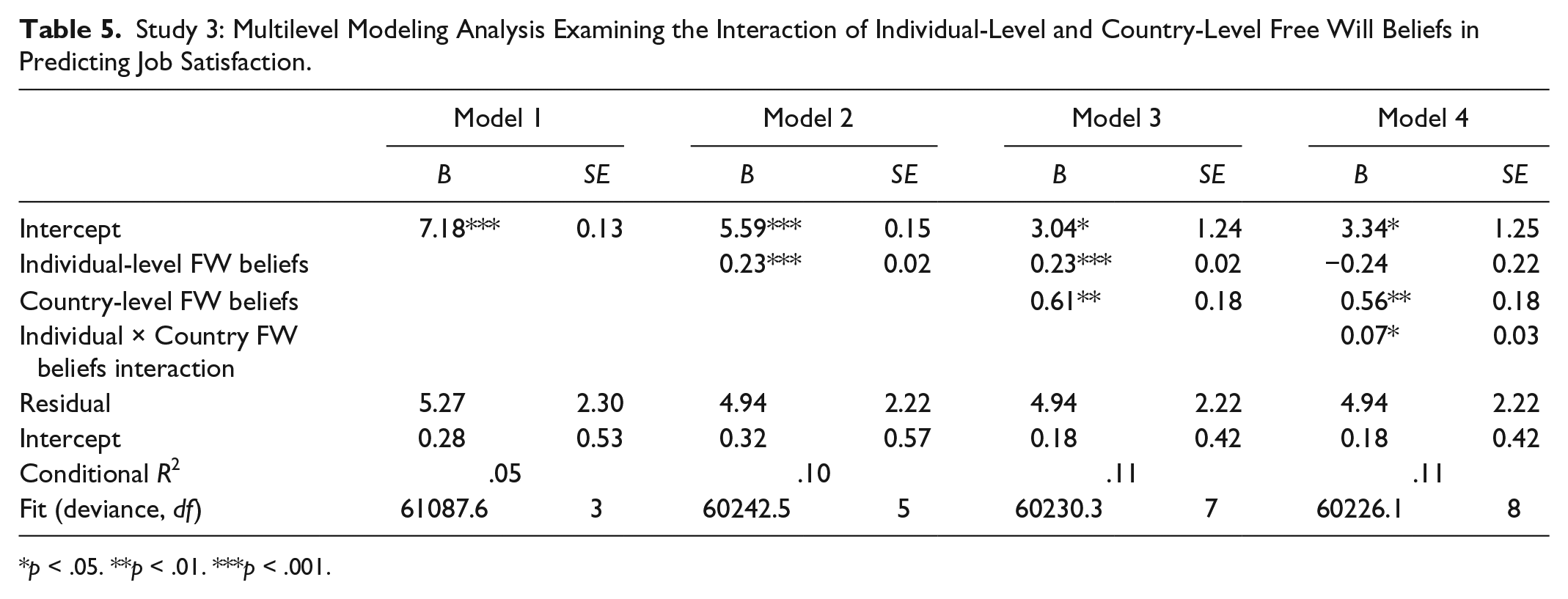
p < .05. **p < .01. ***p < .001.
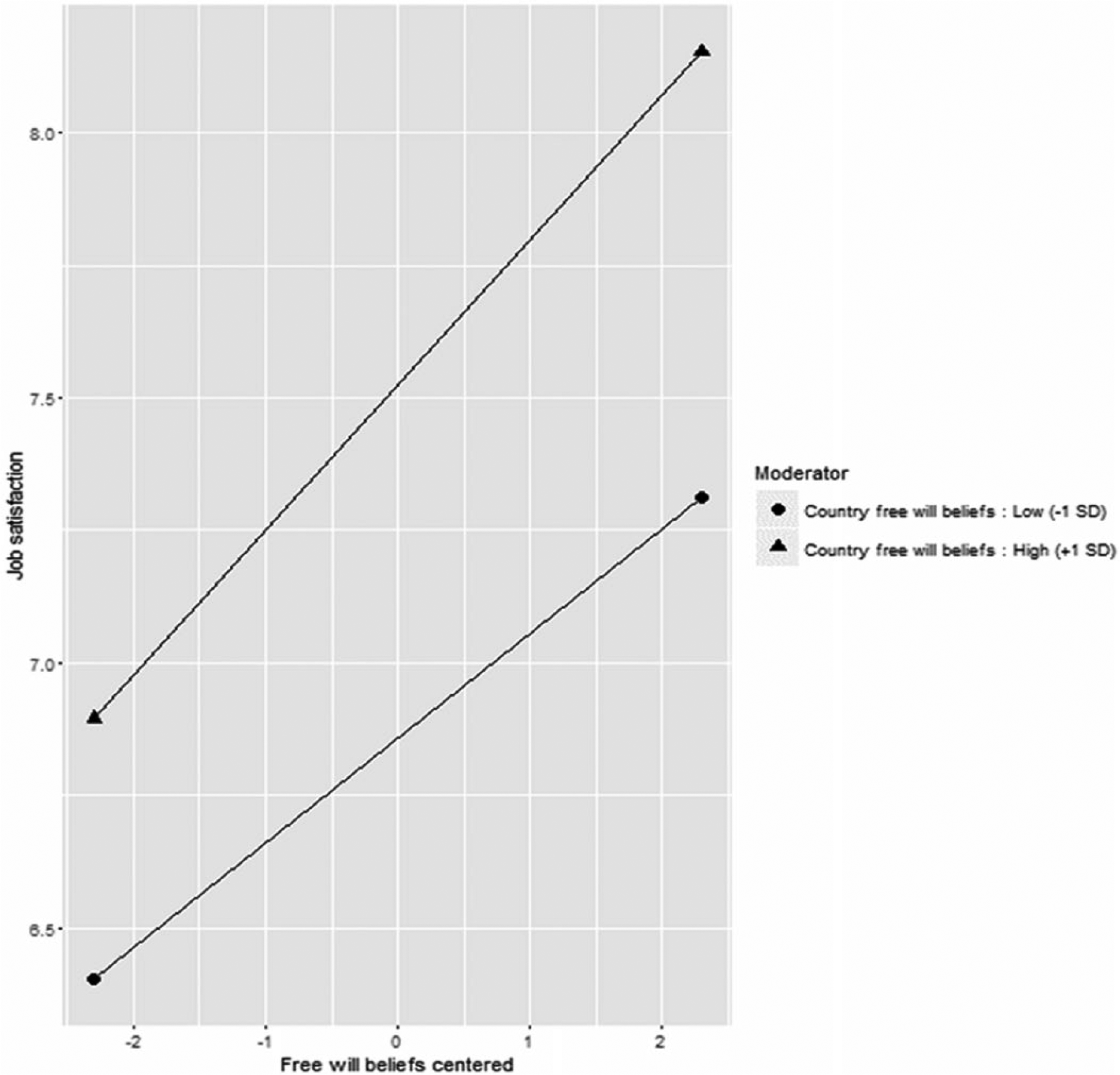
Study 3: Plot of the interaction between individual-level and country-level beliefs in free will in predicting job satisfaction.
In summary, findings from the WVS large-scale cross-cultural data archive supported the findings from Studies 1 to 2 showing the belief in free will as a predictor of job satisfaction. As in Study 2, the relationship was mediated by job autonomy. Findings also revealed that the relationship was strongest in countries with a higher average endorsement of the belief in free will, meaning that in countries where the belief in free will was more important, believing in free will was more likely to predict higher job satisfaction.
General Results: Mini Meta-Analysis
We followed the emerging practice of performing a mini meta-analysis of all studies to assess the overall effect size (Goh, Hall, & Rosenthal, 2016; Lakens & Etz, in press; McShane & Böckenholt, 2017). The overall effect size for the basic link between free will beliefs and job satisfaction in Time 1 (Studies 1-3) was .29 [.19, .39] and the effect for Time 2 (Studies 1-2) was .25 [–13, .38] (Schulze, 2004 using metacor R package, DerSimonian-Laird method). These can be summarized as typical to large effects (Gignac & Szodorai, 2016; Richard, Bond, & Stokes-Zoota, 2003).
General Discussion
Three studies demonstrated the positive relationship between the belief in free will and job satisfaction. Table 6 provides a summary of the results. In Study 1, the belief in free will predicted higher job satisfaction for real-estate agents in Taiwan following a 3 months’ time-lag. In Study 2, the belief in free will predicted higher job satisfaction of Americans working in diverse tasks for multiple employers in an online labor market over a 6-months period, and when controlling for other agency constructs. In Study 3, the belief in free will was associated with better job satisfaction in a large sample across 16 cultures and a wide array of occupations, and country-level belief in free will was shown to moderate the effect. In Studies 2 and 3, perceived job autonomy mediated the relationship.
Summary of the Studies and Findings.
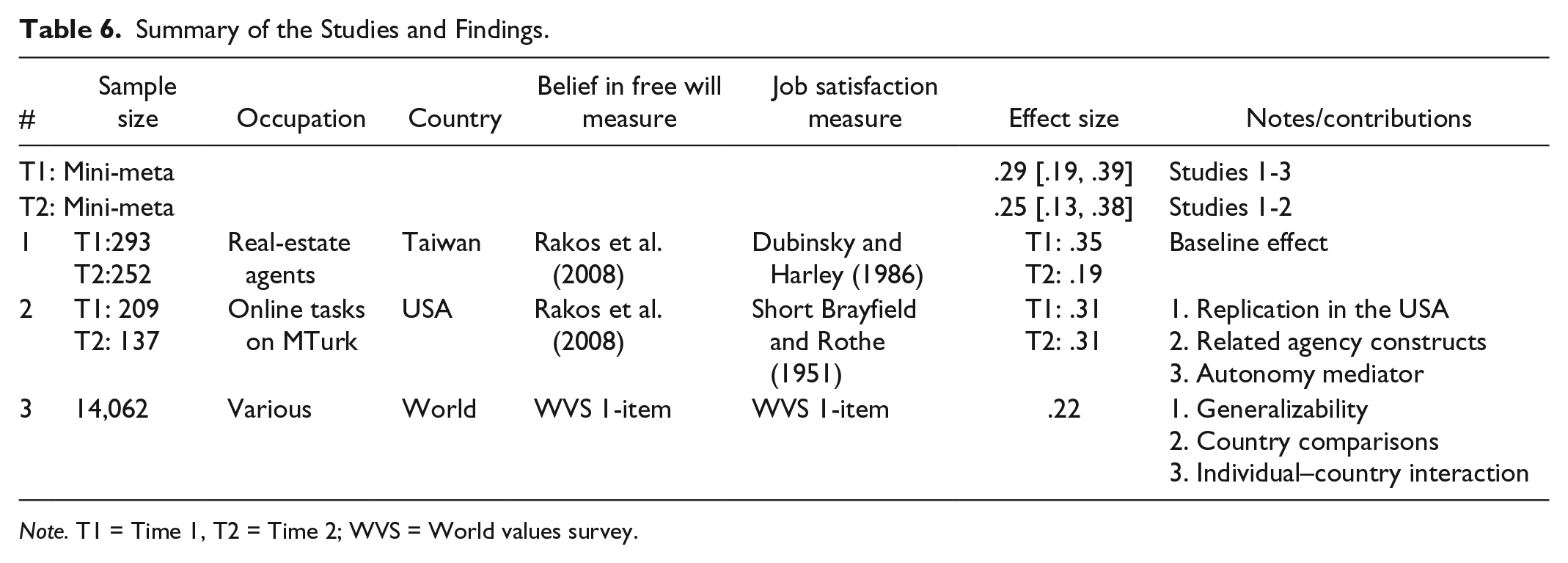
Note. T1 = Time 1, T2 = Time 2; WVS = World values survey.
Belief in Free Will as a Predictor of Workplace Outcomes
We contribute to a growing line of research showing that the abstract philosophical belief in free will is an important predictor of everyday life cognition and behavior (Baumeister & Monroe, 2014), and that this belief is predictive of positive outcomes in the workplace. The belief in free will has previously been shown to predict better job performance (Stillman et al., 2010), and our findings show that not only is the belief predictive of higher productivity but that it also predicts higher satisfaction with work performed. The relationship between job satisfaction and job performance has received wide attention in the literature with several suggested models, but over time findings have converged on a weak correlation between the two outcomes (Judge, Thoresen, Bono, & Patton, 2001), and the belief in free will is a significant predictor of both positive outcomes.
We also demonstrated that the belief in free will predicts job satisfaction above and beyond other agency constructs. The belief in free will goes beyond other agency constructs in making the differentiation between agentic versus nonagentic actions (Malle, 2011), rather than between internal versus external (i.e., locus of control) or between the perceived ability or inability to execute (i.e., self-efficacy) which overlook the importance of agency in perceived choice in making decisions leading to outcomes (Feldman, 2017).
Studies 2 and 3 showed that job autonomy mediated the relationship between the belief in free will and job satisfaction. The belief in free will facilitates perceiving work tasks as free choices, which in turn predicts higher job satisfaction. Choice and autonomy are important in the work context (Rosso, Dekas, & Wrzesniewski, 2010; Wrzesniewski, Dutton, & Debebe, 2003), and it is very likely that these positive factors and the associated job satisfaction would also be reflected in other positive organizational outcomes, such as higher organizational citizenship behaviors and lower counterproductive work behaviors.
Belief in Free Will for the Person and in Society
In this investigation, we focused on job satisfaction as the dependent variable, yet the implications for believing in free will are broader and affect many aspects of personal and social life. In the introduction, we reviewed the growing literature showing that free will beliefs predict a variety of cognitive and behavioral outcomes in real-life. In terms of individual differences, in our Study 2 we controlled for a number of well-known agency and individual differences factors, which were also significantly correlated with free will beliefs. Those who believed in free will tended to report higher self-esteem, higher self-efficacy, higher self-control, and higher tendency for internal locus attributions (Feldman, 2017). Self-efficacy, self-esteem, and locus of control, together with emotional stability, are categorized as core self-evaluations (Chang, Ferris, Johnson, Rosen, & Tan, 2012; Judge, 2009), and are considered strong predictors of outcomes in life. Higher trait self-control is considered one of the most important factors for achieving favorable personal outcomes and for better coexistence with others in society (de et al., 2012; Duckworth & Gross, 2014). In terms of social processes, our findings from Study 3 suggest that country-level free will beliefs can serve as meaningful moderators of relationships between individual-level factors. Combined, we demonstrated that free will beliefs are associated with a wide array of social and personality processes extending beyond the workplace.
Belief in Free Will as a Predictor of Outcomes Over time
Free will beliefs were predictive of outcomes over time. Research on the belief in free will has so far been mainly focused on examining the consequences of the belief in free will in one point of time, with mostly priming or cross-sectional studies (see Baumeister & Monroe, 2014, for a review), and our findings take the first step in showing that the belief in free will is predictive of outcomes over a period of several months and across a wide variety of jobs and cultural contexts.
Belief in Free Will Across Cultures
We found that the relationship between the belief in free will and job satisfaction extends across cultures. Study 1 was conducted using a Taiwanese sample, and Study 2 was conducted using an American sample. The cross-cultural sample of 16 countries in Study 3 further allowed us to examine the impact of cross-cultural differences in the relationship between the belief in free will and job satisfaction. A test of country-level moderators revealed that the national endorsement of the belief in free will is a moderator of the relationship such that the relationship was strongest in countries with stronger beliefs in free will. To our knowledge, Study 3 is the first test of cross-cultural differences in the national endorsement of the belief in free will and its implications, and it challenges previous research which argued for only minor variations in free will beliefs across cultures (Sarkissian et al., 2010). Our findings reveal that not only are there differences between countries in the popularity of the belief in free will, but that these may serve as a meaningful moderator of the relationship between the belief in free will and outcomes.
The belief in free will is conceptually related to the concept of choice (Feldman et al., 2014) and it has been shown that the concept of choice holds different meanings across cultures (Savani, Markus, & Conner, 2008; Savani et al., 2010). It is therefore also plausible that cross-cultural differences in regard to free will beliefs are not limited to the extent to which different cultures endorse the belief in free will, but also extend to the meaning that they give free will. Future research is needed to better understand such cultural variations. An extended discussion of limitations and future directions is provided in the supplementary.
Mechanism and Function of Free Will
Why is belief in free will associated with positive outcomes? In the introduction we reviewed the literature showing that the belief in free will is associated with many positive outcomes for the self. A complementary line of research has shown that the belief in free will is also predictive of positive social outcomes. Free will beliefs have been associated with higher honesty (Vohs & Schooler, 2008), higher morality (Carey & Paulhus, 2013; Caspar, Vuillaume, Magalhães De Saldanha Da Gama, & Cleeremans, 2017; Clark, Shniderman, Baumeister, Luguri, & Ditto, 2017; Feldman, Wong, & Baumeister, 2016), less prejudice (Zhao, Liu, Zhang, Shi, & Huang, 2014), more prosocial behavior and less aggression (Baumeister, Masicampo, & DeWall, 2009), better learning from and more guilt over own misdeeds (Stillman & Baumeister, 2010), more cooperation (Protzko, Ouimette, & Schooler, 2016), less objectification of others (Baldissarri, Andrighetto, Gabbiadini, & Volpato, 2016), and higher gratitude (MacKenzie, Vohs, & Baumeister, 2014). It would seem that there is overwhelming evidence for free will beliefs as predicting positive outcomes both for the self and for social behavior. What is it about the concept of free will and the associated abstract philosophical belief that may lead to such an impact?
In our studies, we focused on one mechanism, the concept of choice. Choice is very strongly linked with the concept of free will (Baumeister, 2008; Baumeister & Monroe, 2014; Feldman, 2017; Feldman et al., 2014). Choice is an important element for a number of reasons. It is perceived as an essential element for deliberation, goal pursuit, and planning, which in turn lead to stronger associations with responsibility, accountability, reflection, learning, meaningfulness, and finally, well-being and satisfaction (Deci & Ryan, 1985; Patall, Cooper, & Robinson, 2008; Ryan & Deci, 2000). Free will beliefs are about the capacity for choice rather than choice itself, and so does not necessary suffer from some of the possible downsides of choice, such as the demotivation with having too much choice (Grant & Schwartz, 2011; Iyengar & Lepper, 2000; Schwartz, 2004). Other factors associated with free will, such as action-control, self-regulation, and theory of mind, may operate on a higher level to direct choices toward the less selfish, less harming, and overall less negative options.
Regardless of whether free will exists or not, the belief in free will, or the “illusion of free will” (Wegner, 2004), seems to have real implications for people in their lives and is considered an essential component for culture, modern societies, and legal systems (Baumeister & Monroe, 2014; Monroe, Vohs, & Baumeister, 2016).
Implications
Beliefs matter, not only generally in life, but more specifically in the organizational context. The belief in free will has previously been shown as a predictor of performance (Stillman et al., 2010), and our findings complement that research in showing that the increased productivity is also accompanied with higher job satisfaction. Together, these findings suggest that it is important for managers to understand employees’ beliefs and perceptions of agency, as these are linked to the perceptions of choice and satisfaction with achievements. Beliefs in free will, like any other set of beliefs, are important for the people who hold them, and we therefore caution against a conclusion that beliefs should be manipulated or that employees should be selected based on their set of beliefs. What our research suggests is that the understanding of employees set of beliefs can help managers better adjust to specifically address individual needs. If those who disbelieve in free will find it harder to naturally experience satisfaction with their work, managers should work with these employees more closely to either find other means of raising satisfaction or compensating for the lack of satisfaction in other respects.
Another important aspect is that there are cultural differences in the societal endorsement of the belief in free will and these differences may affect certain outcomes and moderate well-established predictors of organizational outcomes. Managers working with diverse multicultural teams should take note of the cultural differences in the endorsement of core beliefs associated with desired outcomes in the workplace.
Limitations and Future Directions
We also note limitations in our research. All studies are correlational, which prevents any causal interpretations. Some research about the psyche of free will perceptions demonstrated the illusion of free will, that people associate more freedom with positive outcomes, meaning that it is possible that those who enjoy greater satisfaction with their work also come to endorse stronger beliefs in free will. However, beliefs are considered stable and enduring in comparison to context-specific job satisfaction, and we have shown that the relationship holds across job contexts and over time. To address this limitation, future studies may aim to conduct an experimental intervention of free will beliefs at work to observe its impact on job satisfaction and other work-related outcomes.
Another possibility related to the correlational nature of the studies is that there are other factors that may influence both free will beliefs and job satisfaction, such as the job context or occupation. For example, it could be possible that a relatively independent work context or an organization granting high levels of job autonomy would lead to endorsing higher beliefs in free will and higher job satisfaction. This concern is particularly relevant for Study 3 where occupation varies among participants, but this is partially addressed by Studies 1 and 2 where occupation was fixed. Still, there could be other factors at work. Future studies may aim to examine the importance of job context and occupation for the endorsement of free will beliefs, and explore other factors that may impact both free will beliefs and job satisfaction.
So far most of the literature on the outcomes associated with the belief in free will have linked this belief to positive outcomes, yet there are few things in life that are all positive, and therefore more research needs to be done to understand the possible downsides of believing in free will. For example, some of the recent research has shown that the link between belief in free will and moral responsibility leads to believers showing higher punitiveness (Carey & Paulhus, 2013; Clark, Baumeister, & Ditto, 2017; Clark et al., 2014) and retribution (Shariff et al., 2014), such that they are more likely to attribute high accountability to bad behavior and seek stronger penalties, possibly even when outcomes were a result of uncontrollable circumstances or when penalties are less efficient than facilitating learning in other ways.
Conclusion
In three studies, we highlighted the importance of agency beliefs, establishing the link between the belief in free will and job satisfaction, showing that the link persists over time, and shedding light on the mechanism and possible cultural moderators, thereby paving the way for many promising future research directions.
Footnotes
Authors’ Note
Jiing-Lih Farh and Kin Fai Ellick Wong made equal contribution as second author and are listed alphabetically in the author byline.
Declaration of Conflicting Interests
The author(s) declared no potential conflicts of interest with respect to the research, authorship, and/or publication of this article.
Funding
The author(s) received no financial support for the research, authorship, and/or publication of this article.
Notes
Supplemental Material
Supplementary material is available online with this article.
References
Supplementary Material
Please find the following supplemental material available below.
For Open Access articles published under a Creative Commons License, all supplemental material carries the same license as the article it is associated with.
For non-Open Access articles published, all supplemental material carries a non-exclusive license, and permission requests for re-use of supplemental material or any part of supplemental material shall be sent directly to the copyright owner as specified in the copyright notice associated with the article.
