




Abstract
We investigate how loneliness develops over the marital dissolution process in older age (i.e., transition at or after age 50) while paying close attention to heterogeneities by the dissolution pathway—widowhood and separation—and gender. Using data from over 8,000 Household, Income and Labour Dynamics in Australia survey respondents, we assess the association of interest using fixed effects regressions. Findings indicate that loneliness increased in the year before widowhood or separation among both women and men. Levels spiked in the year of dissolution, particularly for widowhood but less for separation. Widowed men were substantially more affected than widowed women, and gender differences were negligible for separation. Although loneliness levels gradually declined, widowed men remained vulnerable for remarkably long periods. Such chronic loneliness might be linked to other health disadvantages. These findings highlight the importance of long-term and gender-specific approaches to social support and integration after marital dissolution.
Across Western societies, the total share of older individuals has increased steadily, making experiences of life course transitions during older age an important theme in recent discussions. Social integration and active societal participation of older adults have become important indicators of productive aging (Rowe and Kahn 2015). At the same time, individuals have become increasingly disconnected from each other across high-income societies, and social, instrumental, and economic support is primarily provided within the family unit—with spouses as the primary source of support (Cacioppo, Fowler, and Christakis 2009). This has created a narrow and potentially fragile space within which essential human needs of social relations and interactions must be fulfilled. This raises the probability of feeling a discrepancy between the desired and achieved quality or quantity of social connections and interactions (i.e., loneliness) if spousal support is lost (Chen and Feeley 2014; Perlman and Peplau 1981). The current study focuses on marital dissolution—defined as widowhood or separation—during older age (i.e., at or after age 50) as a cause of loneliness for women and men.
A small body of previous research from various high-income countries assessed average differences in loneliness levels between widowed, separated/divorced, and married individuals using cross-sectional study designs (e.g., Ben-Zur 2012; Högnäs 2020; Pinquart 2003; Savikko et al. 2005; van Baarsen 2002; Wright et al. 2019). These studies highlight that widowed and divorced older women and men report higher loneliness levels than married women and men. Widowed or divorced older men were found to be lonelier than women in these marital states. Additionally, divorced men were found to be lonelier than widowed men, although no difference was found between widowed and divorced women. However, these cross-sectional results may be biased because they ignore potentially underlying compositional group differences that may be linked to loneliness levels and the selection into widowhood or separation/divorce (Carr and Bodnar-Deren 2009). Thus, although marital dissolution and loneliness are common experiences in individuals’ life courses, it has been challenging for researchers to capture their causal link. Specifically, research has been limited by a lack of high-quality longitudinal data on both widowhood and separation experiences of women and men in older age.
Recently, longitudinal data have become available to study family dynamics and loneliness. Using such data from Australia, Freak-Poli et al. (2022) explored how widowhood is linked to loneliness of both women and men. Their study highlights that the likelihood of experiencing loneliness was the highest in the year of widowhood for women and men before declining slightly immediately after. No anticipation effects were found immediately before widowhood, and mid- to long-term developments were not assessed.
Using the same longitudinal data source as Freak-Poli et al. (2022), we expand on the study by Freak-Poli et al. (2022) and other cross-sectional research in three relevant ways while also addressing methodological shortcomings of cross-sectional study designs. First, the longitudinal data allow an extensive exploration of loneliness trajectories around marital dissolution considering anticipation effects and dynamic loneliness developments after marital dissolution up until 19 years after dissolution. Thus, we acknowledge the complex and potentially dynamic relationship between marital dissolution and loneliness and go beyond previous research that commonly conceptualized “marital dissolution” as a dummy variable without including “time since the event” in the analyses (e.g., Pinquart 2003; Wright et al. 2019). Only Freak-Poli et al. (2022) considered dynamic developments focusing on anticipation effects and immediate developments after marital dissolution (i.e., one and two years after). However, the authors did not disaggregate years of three or more years after widowhood and thus were unable to explore more mid- to long-term developments of loneliness probabilities. This is critical because it remains unclear whether higher loneliness levels associated with marital dissolution are temporary or develop into a chronic “state.” Although short spells of loneliness have been deemed unproblematic, chronic loneliness has been identified as a major health risk associated with raised levels of stress, impeded sleep, augmented depression or anxiety, and an increased risk of dementia or heart disease (e.g., Sutin et al. 2018; Valtorta et al. 2016).
Second, we consider both widowhood and marital separation as pathways of marital dissolution, which was not done by Freak-Poli et al. (2022). Although some cross-sectional research considered widowhood and separation/divorce, this research was unable to account for underlying group differences, providing potentially biased results, or assess dynamic loneliness developments. A thorough consideration of separation in addition to widowhood is particularly relevant in light of the rising incidence of older age separation across Western societies (Brown and Lin 2022; Solaz 2021). Distinguishing the two pathways is relevant because they are likely associated with different feelings, levels of support, and ways of social network restructuring. As a result, loneliness may develop differently depending on the dissolution pathway, affecting the required support strategies. Our study provides relevant insights into these differences.
Third, we explicitly explore loneliness trajectories of both women and men as they experience widowhood or marital separation. Due to different social networks or norms, women and men likely anticipate, cope, and adjust differently across marital dissolution (Sasson and Umberson 2013; Wright et al. 2019). Indeed, widowhood is more often experienced by women than men due to intracouple age and mortality differences (Carr and Bodnar-Deren 2009). Nevertheless, a substantial share of men experience widowhood, and men are more likely than women to experience a marital separation at or after age 50 (Brown et al. 2018). Our study contributes important insight into men’s experiences of family transitions in older age and hence goes beyond previous research that often presented loneliness as a female experience.
Based on these contributions to previous research, we pose three research questions:
Research Question 1: How do levels of loneliness change over the marital dissolution process, starting in years before the transition until almost two decades after?
Research Question 2: Do loneliness levels develop differently depending on whether the marriage dissolves due to the death of a partner or separation? 1
Research Question 3: Do loneliness trajectories over the marital dissolution process differ for women and men?
We use longitudinal data from the Household, Income and Labour Dynamics in Australia (HILDA) survey to address our research questions. These data are unique in measuring loneliness for all survey participants over 21 waves. Combined with detailed information on family dynamics, this enables us to use fixed effects regression models to provide a methodologically more robust approach that gets closer to a causal analysis than was previously possible with cross-sectional study designs.
Background
Understanding Loneliness
As mentioned in the introduction, loneliness is commonly defined as a perceived discrepancy between desired and achieved levels of social relationships (Perlman and Peplau 1981). As such, loneliness needs to be distinguished from social isolation, which refers to an objective and quantitative measure of one’s social network (e.g., the number of friends, the frequency of contact, etc.). Individuals may (choose to) have small social networks without feeling lonely. Vice versa, large social networks do not necessarily lead to low loneliness because loneliness is a fundamentally subjective experience (Perlman and Peplau 1981). Two types of loneliness have been distinguished within the literature: emotional and social (Weiss 1974). Whereas the former refers to a deficiency in close emotional connections that provide, for instance, intimacy, understanding, and shared interests, the latter refers to the absence of an engaging and supportive social network.
Tapping into the human need for close emotional connections and instrumental support, spouses are commonly considered a unique and highly relevant source of such connection and support. As a result, spousal loss is perceived to be an incisive and emotionally demanding life event that triggers profound deficits in social needs and requires coping and adjustment in line with the two most prominent approaches, stress theory and attachment theory (Bowlby 1980; Hazan and Shaver 1992; Lazarus and Folkman 1984)—including its various extensions such as Stroebe’s deficit model (Stroebe and Stroebe 1987; Stroebe et al. 1980). Feelings of loneliness are rooted in this deficit of emotional and instrumental support. Depending on whether adjustment demands can be met or exceed personal coping resources (e.g., personality, network, etc.), individual experiences with a trigger event such as marital dissolution will vary. Failure to cope can lead to chronic loneliness.
Loneliness Trajectories and Marital Dissolution
Previously discussed theoretical approaches around the emotional effects of marital dissolution and the life course perspective highlight that marital dissolution should be considered a process rather than a single point-in-time event (e.g., Bernardi, Huinink, and Settersten 2019). Specifically, loneliness might increase in months or years before dissolution and may develop dynamically once dissolution has occurred. This process of marital dissolution can broadly be classified into four stages that can be expected to be relevant for exploring loneliness trajectories: The process starts with (1) the anticipation of marital dissolution in the years or months before partner loss—either through separation or through partner’s death. This is followed by (2) the dissolution itself, which marks the physical loss of the partner and thus, critical loss of emotional and instrumental support. Emotional stress is likely the highest immediately around the dissolution as it triggers the need to adjust and cope. Finally is the time (3) mid- to (4) long-term after the dissolution, which refers to the time when individuals start to adapt to the new situation. Adaptation does not necessarily mean that loneliness levels decline, but it could also mean that heightened loneliness solidifies and becomes the new normal. Although this four-stage process has been discussed in previous research (Kapelle and Baxter 2021), there is no consensus on exact cutoff points between the phases.
Loneliness trajectories likely differ depending on the marital dissolution pathway—widowhood or separation—based on differences in the anticipation, feelings associated with partner loss, the type and level of adjustment, and required coping mechanisms and resources such as social support or income. Considering the anticipation of marital dissolution, health declines may foreshadow spousal death. Ill health may inhibit spouses’ activity levels and thus engagement with others outside the household, but it likely also triggers grief in anticipation of spousal loss. In the case of separation, one or both spouses may be dissatisfied with the marriage and drift apart, leading to emotional estrangement and a lack of emotional support in the years before physical separation.
Immediate and long-term coping with and adjustment to spousal loss is assisted by social support and connections outside of the marriage—although research is divided about the degree to which social support alleviates negative feelings associated with partner loss (Dykstra and de Jong Gierveld 2004; Stroebe et al. 1996). Whereas widowhood should activate the support of the entire social network (Kitson et al. 1980), support after marital separation is likely more inconsistent as friends and family take sides and may predominantly or exclusively support the partner that is closest to them (Carr and Pudrovska 2012; Kalmijn 2007). Thus, separation is additionally associated with changes in the social network, although this would be less the case for widowhood (Wrzus et al. 2013). Forming a new close, romantic bond can reestablish previously lost social and instrumental support (Carr 2004). However, repartnering is more likely after separation than widowhood (Wu and Schimmele 2005).
Similarly, it can be expected that women and men anticipate, adjust, and cope differently. Women are more likely to experience widowhood than men, and women commonly instigate separation (Hewitt, Western, and Baxter 2006). Additionally, women are more likely to report stronger relationships with others outside of the marriage, including more support and greater benefits from relationships with friends and relatives than men. As such, women are often the kin keeper within the partnership, whereas men tend to rely on their female partner’s direct support and social network to connect outside the marriage. Thus, women may be better equipped to cope and adjust to marital dissolution than men (Sasson and Umberson 2013; Wright et al. 2019). On the contrary, men are more likely than women to repartner (Brown et al. 2018).
Previous Research
Several studies reaching back to the early 2000s illustrate that widowhood is associated with elevated loneliness—particularly for men and to a lesser degree for women—compared to married individuals (Ben-Zur 2012; Savikko et al. 2005; van Baarsen 2002). However, because “gray” divorce is a rather recent demographic development, only a few studies examine the link between separation and loneliness in older age. An exception is a cross-sectional study by Högnäs (2020), who finds that Dutch divorcees who divorced at or after age 50 report higher levels of emotional loneliness than continuously married respondents. How this compares to widowed individuals is not explored. Pooling United States Health and Retirement Study data, Wright et al. (2019) showed that divorce at or after age 50 is associated with higher loneliness compared to widowhood for men. No substantial differences in loneliness levels between the two dissolution pathways were found for women. Overall, Wright et al. (2019) showed that women reported lower loneliness levels than men when divorced or widowed, which was also confirmed by Pinquart (2003) for older Germans. It needs to be noted that the study by Pinquart (2003), however, refers to a time when divorce in older age was less common and characteristics of gray divorcees potentially differed from those of more recent years. All mentioned studies worked with cross-sectional designs (due to data limitations) that could not account for dynamic loneliness changes around marital transitions and underlying group differences, potentially biasing results.
Recent data advancements allowed Freak-Poli et al. (2022) to circumvent limitations associated with a cross-sectional study design. They used 19 waves of Australian HILDA data to assess the loneliness probability around widowhood between ages 55 and 85. Based on fixed effects regressions, they showed that the likelihood of feeling lonely did not increase substantially within the two years before widowhood for women or men. Loneliness probabilities peaked for women and men in the year of widowhood and the year after, before decreasing slightly two or more years after widowhood. Whether loneliness probabilities declined to prewidowhood levels in the longer term is unclear from this study because years beyond two years after widowhood were not disaggregated. It also remains an open question of how loneliness develops over separation. We address both aspects in the current study.
Although our review of the previous literature focused on our main interest of the present study—the link between spousal loss in later ages and loneliness—it needs to be highlighted that a range of longitudinal studies has considered the effects of spousal loss on other well-being-related outcomes, including life satisfaction or depressive symptoms (Infurna et al. 2017; Szabó et al. 2019). A review of this literature is beyond the scope of the current study.
The Australian Context
Given this study’s focus on Australian data, it is important to understand the potential specifics of the Australian context and highlight commonalities with other Western societies.
Mandatory separation periods and subsequent divorce
Inherited mainly from the British common law, the Family Law Act 1975 and the Family Law Rules 2004 are the binding Australian legal frameworks dealing with matters around separation and divorce. According to this framework, spouses can only file for legal divorce after separating and living separately and apart for a continuous period of not less than 12 months. Although the minimum separation length is shorter in some European countries, particularly if spouses mutually agree on the divorce, mandatory separation requirements can be found across Europe. Regulations are less uniform within the United States, with some states requiring no mandatory separation period before a divorce can be filed and others requiring at least a separation period of six months to one year.
Divorce rates and ages
With a crude divorce rate of 1.9 divorces per 1,000 residents in 2020, the Australian divorce rate was higher than the average in the European Union (1.6) for the same year (Australian Bureau of Statistics 2022; Eurostat 2023). The crude divorce rate of 2.3 in the United States in 2020 was higher than in Australia and most European countries (Centers for Disease Control and Prevention 2023). Considering the age at separation and divorce, Australia has shown similar trends to most Western societies where the age at separation and divorce has increased since the 1980s. In 2021, Australia’s median age at separation was 39 for women and 42 for men. For divorce, the median ages were 43 and 46, respectively (Australian Bureau of Statistics 2022).
Data and Methods
Data
For our analyses, we exploited 21 waves of longitudinal data from the HILDA survey (Release 21, years 2001–2021; Summerfield et al. 2022). The HILDA survey is a multipurpose panel survey that is largely representative of the Australian population except for remote areas. Since 2001, it has collected annual information from respondents age 15 and older in eligible households via face-to-face interviews and self-completed questionnaires. In Wave 11, a top-up sample was added to the original sample. The data were particularly well suited for our purposes because they (a) contain annual longitudinal information on respondents’ levels of loneliness, (b) include detailed information on respondents’ prospective and retrospective marital status, (c) enable the analyses of later life marital dissolution outcomes for both men and women due to the relatively large subsample of respondents who experience either the death of their spouse or separation during their panel participation, and (d) measure a wide range of other relevant variables.
We imputed missing values with chained equations for all analytical variables and a range of auxiliary variables to deal with missing data. Out of all sample observations, 10% had a missing value on at least one of the analytical or auxiliary variables (see Table A.1 in the online version of the article). Using Stata’s mi procedure, we created 10 imputed data sets and combined results using Rubin’s (1987) rule.
Sample
For the analytical sample, we commenced with the generation of three samples consisting of successfully interviewed individuals that experienced (a) widowhood or (b) separation during their panel participation or that are (c) continuously married. Note that we focused on (permanent) separation as the trigger event rather than divorce because separation marks the emotional and physical loss of the spouse, whereas divorce commonly follows months or even years after and marks the legal ending of the marriage.
To identify widowed and separated respondents, we first and foremost relied on self-reported information on the year of the partner’s death or separation. For a partner’s death before 2015, the HILDA team updated and validated this information through a match with the national death register (Watson and Summerfield 2014). To avoid bias in estimating anticipation and immediate effects, we considered whether marital dissolution occurred before or after the interview within the dissolution year. In addition to identifying marital dissolutions through the year of dissolution, we also used information in the self-reported marital status to identify any additional dissolution events. Respondents were only included in the sample if widowhood or separation occurred after individuals reported living in a marriage with the deceased or separated partner. Thus, respondents who, for instance, experienced a former spouse’s death are omitted. Widowed and separated respondents were followed irrespective of whether they stay unpartnered or enter a new partnership. Repartnering was rare, particularly for widowed respondents (see Table 1). In total, 23 widowed women (4%) and 19 widowed men (9%) ever repartnered, whereas 26 separated women (13%) and 80 separated men (31%) were observed entering a new partnership. Thus, although men were more likely to repartner than women after separation or widowhood, sample sizes were too small to separate our analyses by respondents who stay unpartnered and those that repartner. Separated respondents who repartner with their predissolution partner at any point after their separation were excluded from the sample. We focused on the last dissolution if respondents experienced several widowhood or separation transitions during their panel participation.
Descriptive Statistics (Means and Standard Deviations) across the Different Samples by Gender.
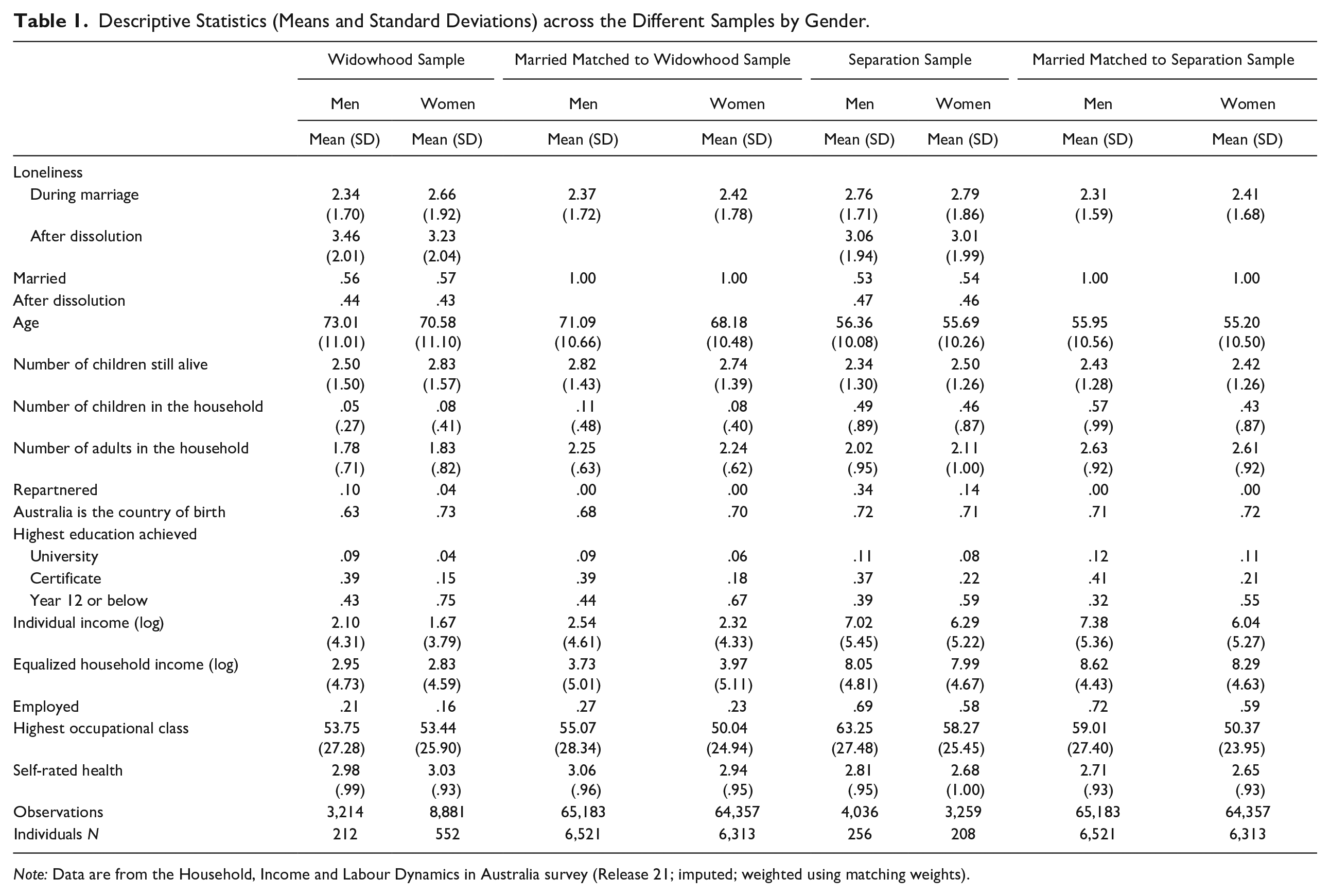
Note: Data are from the Household, Income and Labour Dynamics in Australia survey (Release 21; imputed; weighted using matching weights).
Two further restrictions were implemented for the widowhood and separation sample. First, in line with our focus on later-life marital dissolutions, we restricted the samples to respondents who experienced their dissolution at or after age 50. Second, due to the analytical requirements of the fixed effects models, we excluded a small number of respondents who were not successfully interviewed in at least two waves: one before and one in or after the year of the dissolution. Figure 1 provides an overview of the sample selection process.
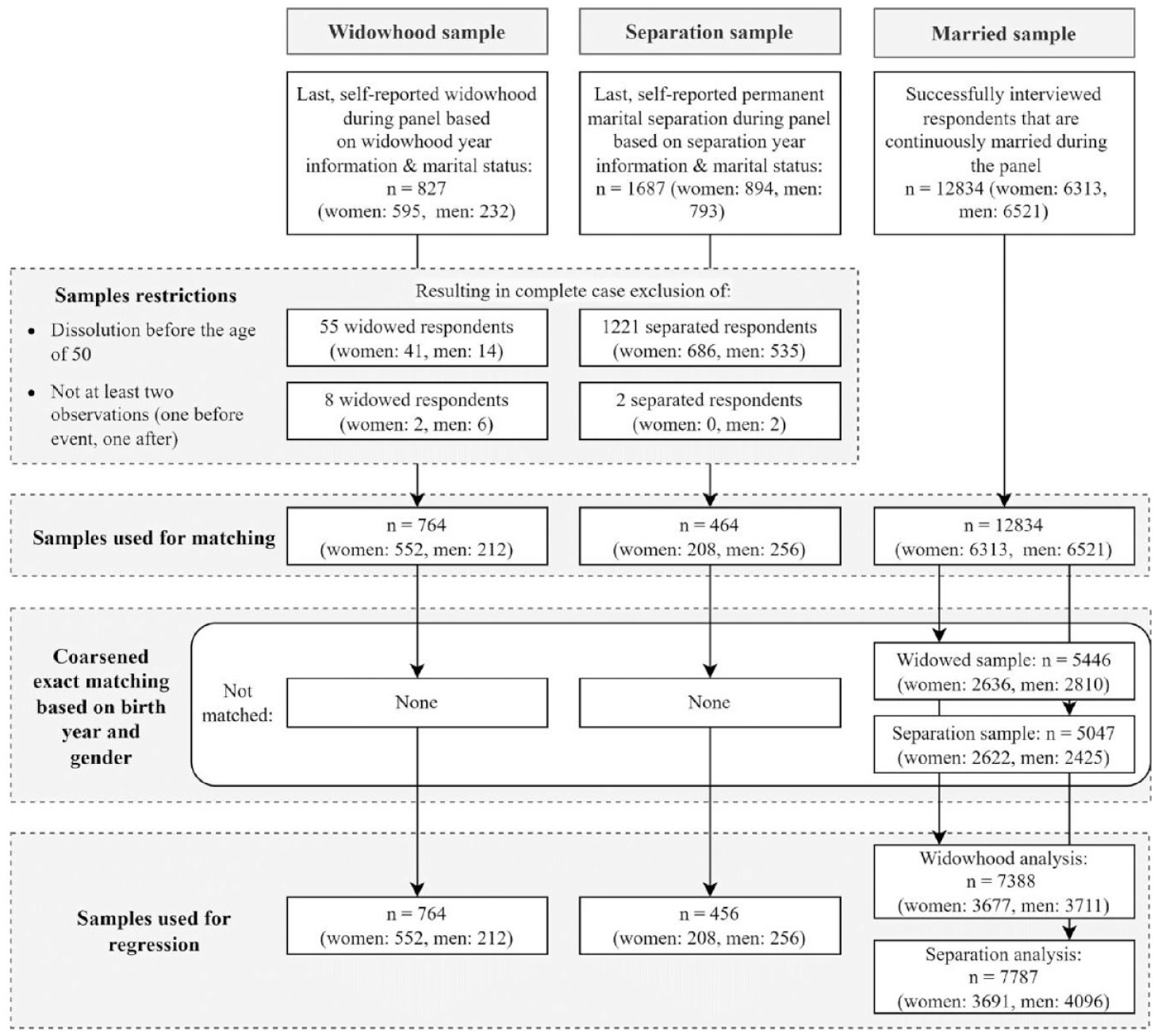
Sample Selection Process.
Selecting an appropriate sample of continuously married respondents was challenging because married persons naturally have no comparable age cutoff criteria (i.e., late-marital dissolution at or after age 50). This introduced extreme age dissimilarity between the groups resulting in dissimilarity in a vast range of factors as illustrated in Table A.3 in the online version of the article, which can introduce selection bias when estimating the regression coefficients. Therefore, we balanced the samples to generate a more appropriate continuously married sample and improve estimations, particularly of our covariates, which improved estimations of our main association (for regression results that did not adjust the samples for underlying differences, see Figures A.1 and A.2 in the online version of the article). To this end, we used coarsened exact matching, as also suggested by Kung (2020) and Freak-Poli et al. (2022) in similarly designed studies.
We coarsened exact matched the married sample separately to the widowhood sample and the separation sample based on gender and birth year resulting in two matched married samples: one matched to the widowhood sample and one matched to the separation sample. The matching created a stratum for each unique combination of values of selected covariates. Once respondents were selected into the different strata, each respondent was weighted. Respondents who experienced marital dissolution during the panel received a weight of 1, and married respondents were weighted by the size and composition of their stratum. Strata that did not contain at least one married and one widowed or separated respondent were weighted with 0 and were thus excluded from the analysis. Although all widowed or separated respondents could be matched and therefore receive a weight of 1, not all married respondents were matched and thus received a weight of 0. Figure 1 provides the number of nonmatched and matched married respondents. Table 1 additionally shows that the matching results in a balance between the samples.
Measures
Outcome variable
Our outcome measure was self-reported loneliness, collected annually within the HILDA data. Specifically, survey respondents were asked to provide to what level—on a scale of 1 (strongly disagree) to 7 (strongly agree)—they agree with the following statement: “I often feel very lonely.” Although a large share of research into loneliness has used multiple items, research by Newmyer et al. (2020) has illustrated that single items such as the one included in the HILDA data perform similarly well to capture loneliness.
Direct, single-item measures of loneliness—such as the one used in our study—have been shown to tap into the emotional dimension of loneliness rather than the social one (Flood 2005; Koropeckyj-Cox 1998). Additionally, previous research has highlighted that feelings of loneliness associated with spousal loss refer to unfulfilled needs related to emotional rather than social loneliness (Bennet and Victor 2012; Szabó et al. 2019; van Baarsen et al. 2001). However, it needs to be emphasized that losing a partner may have flow-on effects that result in overall changes to a person’s broader social network. For instance, in the case of separation, social networks may reduce, whereas widowhood may improve and mobilize the existing social network (Guiaux, Van Tilburg, and Broese Van Groenou 2007; Kalmijn 2012). These aspects are associated with the social dimension of loneliness.
Predictor variables
Our explanatory variable was reflected by a set of dummy variables for the marital dissolution process—one set for widowhood and one set for separation—at or after age 50. To this end, we generated 12 dummies: (1) 2 to 3 years before dissolution, (2) 1 year prior, (3) the year of marital dissolution, (4) 1 year after marital dissolution, (5) 2 years after, (6) 3 to 4 years after, (7) 5 to 6 years after, (8) 7 to 8 years after, (9) 9 to 10 years after, (10) 11 to 13 years after, and (12) 14 to 19 years after marital dissolution. The reference category for the dissolution process referred to being married and at least 4 years before marital dissolution. Overall, these categories mapped onto the stages of the dissolution process identified in the background section. Whereas the first 2 dummy variables referred to the anticipation of marital dissolution, the remaining 10 dummy variables related to the immediate, midterm, and long-term effects of marital dissolution. Clustering some years into categories (e.g., 3 to 4 years after dissolution) guaranteed appropriate cell sizes across the categories by gender and dissolution pathway and thus sufficient statistical power. Nevertheless, cell sizes were lower in later years, making estimations for those times less stable. Table A.2 in the online version of the article provides an overview of cell sizes. Finally, to assess gender differences, we generated a gender dummy (male = 0, female = 1).
Other covariates
Parsimonious fixed effects regression models were estimated with a small set of time-variant control variables: A categorical measure of respondents’ age (younger than 50 [reference], 50–59, 60–69, 70–79, 80 and older) was added to capture, for instance, maturation effects (Pinquart 2003; Wright et al. 2019). Note that although we focused on widowhood and separation at or after age 50, respondents were also observed before this event and thus when they were younger than 50. We also adjusted for potential period effects by including a categorical measure for years (2001–2005 [reference], 2006–2010, 2011–2015, and 2016–2021). Because we included age and cohort as categorical indicators, we avoided issues around perfect collinearity and could account for maturation and cohort effects. Finally, we included a dummy to flag imputed data.
We refrained from the inclusion of other variables, such as health measures, employment status, family support, repartnering, or other economic and social resources. The association between marital dissolution and loneliness likely works through those factors (Perlman and Peplau 1981; Shin et al. 2020). For instance, repartnering or the presence of other individuals in the household likely provides emotional support after the loss of the partner. Similarly, being employed may provide a social support network outside of the home. Health issues may hint at a reduced ability to fully participate in social life within and outside of the household. Thus, such factors should be considered mediators or moderators rather than simple covariates within the context of the present study. To appropriately assess and explore the influence of such variables on or within the association of interest, mediation analyses or interactions should be used. Although such analyses were unfeasible within the present study considering our sample sizes, we conducted some supplementary analyses to gain a first impression of how such factors may change our association of interest. Specifically, we reran our main models adding an employment dummy (0 = not employed, 1 = employed), a continuous measure of individual income (log-transformed), a categorical indicator of self-rated health ranging from 1 (excellent) to 5 (poor), a continuous measurement of the number of respondents within the household to reflect repartnering, shared living after dissolution or the presence of children or other support figures within the household, and a dummy to explicitly account for repartnering (0 = not married or cohabitating, 1 = married or cohabiting). Overall, including such measures changed results only marginally—if at all, changes were only present in later years after dissolution—compared to our main results (see Figures A.3 and A.4 in the online version of the article). Repartnering may be a particularly relevant “coping” mechanism as a new social bond with a romantic partner is formed. To further assess to what level repartnering drives trends in years after dissolution, we excluded observations from our analyses once they repartnered (see Figures A.5 and A.6 in the online version of the article). Results for these supplementary analyses were consistent with our main results particularly for widowhood. However, after separation, men’s loneliness levels stay more elevated once we excluded repartnered respondents. No substantial differences were found for women. Although a more thorough exploration of coping mechanisms was not feasible within the current study, this should be viewed as an important avenue for future research once more longitudinal data are available.
Analytical Strategy
We used fixed effects regression models with impact functions reflecting the different time points/intervals along the dissolution process to analyze the association between marital dissolution and loneliness. Using impact functions allowed us to model highly flexible loneliness trajectories without making overly strict assumptions about their functional form. Fixed effects regression models use the within-individual variation in the explanatory and outcome variables over time and more appropriately address selection effects (Allison 2009). Thus, time-invariant observed or unobserved factors did not bias our fixed effects estimates, reducing omitted variable bias. The analyses were segregated by the pathways of marital dissolution (i.e., widowhood or separation) and gender. To assess whether results were statistically significantly different for women and men, we additionally reran analyses with gender interactions. Across all models, we used cluster robust standard errors and weighted analyses using matching weights. The results are plotted in figures to ease their readability. Regression tables are provided in the Appendix in the online version of the article.
To compare loneliness estimations between the models for widowhood and separation, we used a standard test of significance for two independent regressions (Clogg, Petkova and Haritou 1995; Paternoster et al. 1998). Specifically, the tests for the equality of coefficients between the different groups were performed using the following formula:
The replication code is available at https://osf.io/qnyh9/.
Results
Sample Description and Bivariate Results
Table 1 provides an overview of the samples, including average loneliness across the samples based on imputed data that were weighted using matching weights. On average, the widowhood sample—referring to respondents who experience widowhood and their matched, continuously married counterparts—is older than the separation sample. Respondents in the widowhood sample are less likely to be employed or live with children and have lower labor market income. Due to matching, differences within the samples are minimal.
Focusing on loneliness, widowed respondents report the highest loneliness levels, followed by separated respondents. Married persons report the lowest loneliness levels—continuously married or married before marital dissolution. Within the married group, respondents who eventually separate have the highest loneliness levels. Widowed and separated men report higher loneliness levels than widowed and separated women, respectively—although differences between separated women and men are negligible. Within the groups of married respondents, women report higher loneliness than men.
Multivariate Regressions: Loneliness Changes over the Marital Dissolution Process
Mean loneliness differences in Table 1 suggest an association between dissolution and loneliness. However, these associations may be biased due to observed and unobserved compositional differences between respondents who experienced a marital dissolution and other idiosyncratic changes that may occur over time. We formally assess the development of loneliness levels over the marital dissolution process with fixed effects regressions. We plot regression coefficients for loneliness trajectories across the widowhood transition (Figure 2) and the separation transition (Figure 3). Additionally, we plot results for analyses where we operationalize marital dissolution using a dummy (i.e., married [reference], marriage dissolved [1]). Dummy results are plotted using line graphs and will be discussed briefly at the end of the results section compared to our main results.
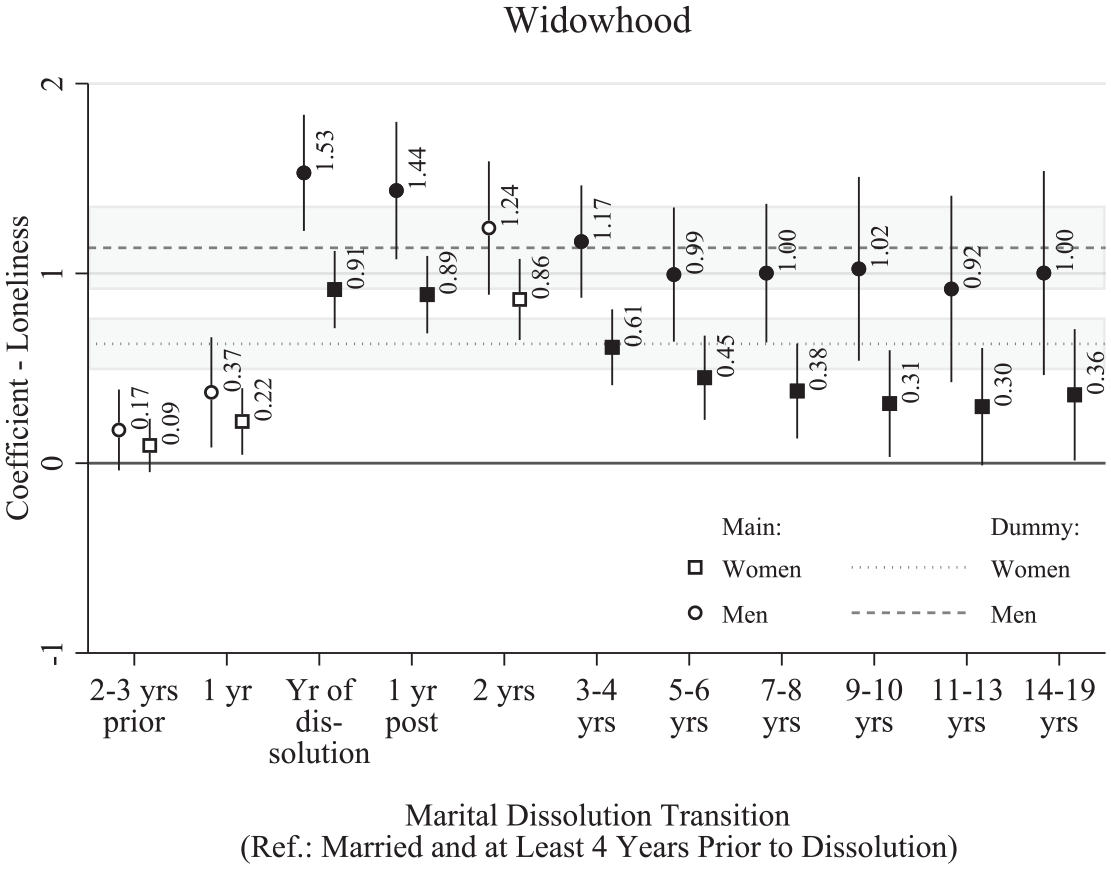
Fixed Effects Regression Coefficients for Loneliness over the Widowhood Process by Gender.
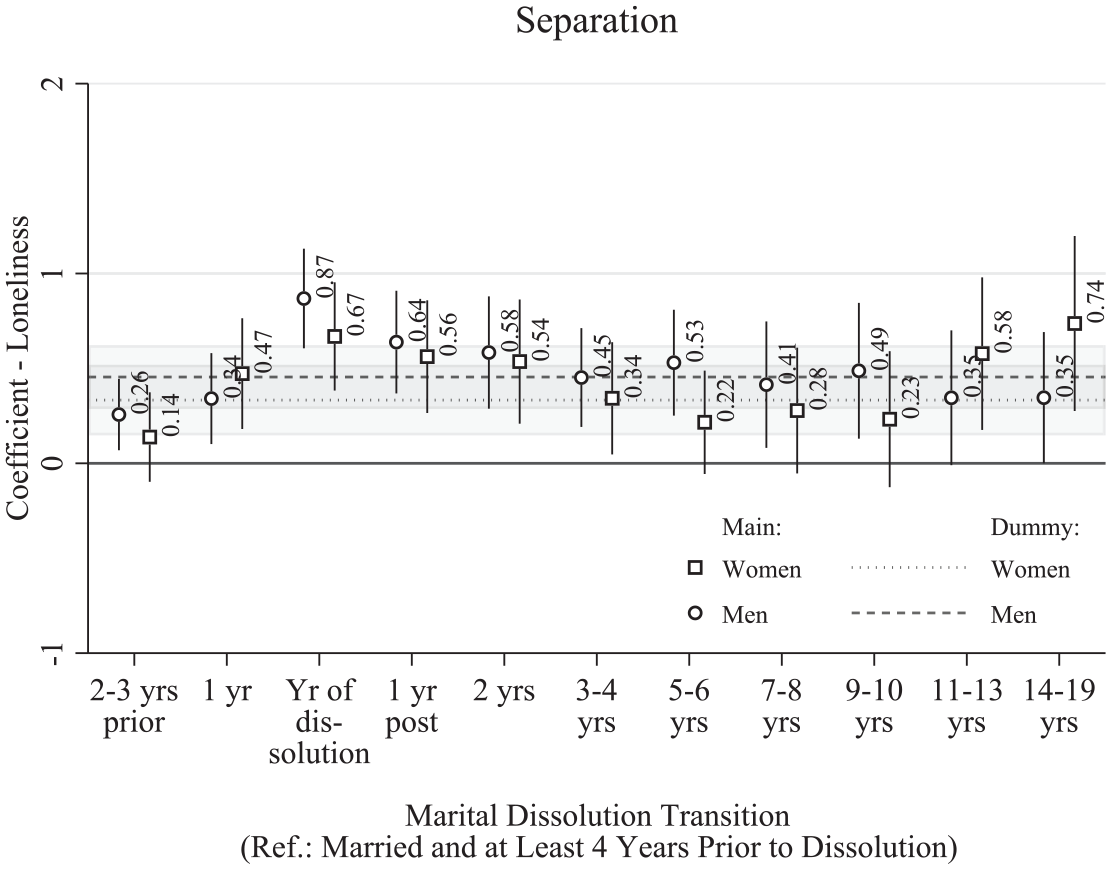
Fixed Effects Regression Coefficients for Loneliness over the Separation Process by Gender.
Starting with an examination of how widowhood is linked to loneliness trajectories, we find that women’s and men’s loneliness levels increase substantially and statistically significantly in the year before widowhood compared to the reference time of (at least) four years before widowhood (see Figure 2). However, it is in the year of widowhood when loneliness levels increase drastically and reach their peak. Women report .91 higher loneliness levels compared to the reference. Increases are substantially more severe for men, with 1.53 higher loneliness levels than during marriage (at least 4 years before widowhood). In the years after widowhood, we find a slow but steady decline in loneliness levels for both genders at least until 5 to 6 years after widowhood. Although women’s loneliness levels continue to decline slightly—although not reaching predissolution levels—men’s levels stay at these elevated levels for the remainder of the observation period. As a comparison, men’s coefficient 14 to 19 years after widowhood is similar and even slightly higher to women’s coefficient right at widowhood. Gender differences are substantial and statistically significant for most categories starting with the year of widowhood.
Focusing on separation, we also find an anticipation effect for women and men. However, compared to widowhood, loneliness levels increase more moderately in the year of separation, with .67 to .87 point increases for women and men, respectively, without substantial or statistically significant gender differences. Increases associated with separation are thus considerably more moderate compared to widowhood. Loneliness levels decline in years immediately after the separation but stay consistent and slightly elevated until 14 to 19 years after separation for women and men. Loneliness levels even seem to increase in the last two intervals, although those estimates are rather imprecise due to smaller sample sizes.
Comparing coefficients between the models for widowhood and separation using a test of equality of coefficients, we find that men’s coefficients across the marital dissolution processes differ statistically significantly starting in the year of widowhood and separation until seven to eight years after marital dissolution. Despite some substantial differences for women, tests reveal no statistically significant differences across the dissolution processes.
In addition to using an elaborate measure of the marital dissolution process, we reran our models with a marital dissolution dummy. These dummy results are presented with lines—dotted for the coefficients and shaded gray for the confidence intervals—in Figures 2 and 3. Dummy measures were used in most previous research in combination with a cross-sectional approach. As shown in Figures 2 and 3, using a dummy would substantially conceal dynamic and complex developments of loneliness levels over the marital dissolution transition—particularly for widowhood. This highlights the relevance of our analytical approach compared to simpler approaches.
By focusing solely on marital separation after age 49, we implicitly assume that the loneliness trajectories would differ depending on whether separation occurs before or after age 49. For instance, social networks and living arrangements may vary between the two groups, with the younger groups more likely to live with (young) children and have more extensive social networks (Wrzus et al. 2013). To assess this, we ran our analyses with a sample of earlier separations and matched married respondents (for results, see Figure A.7 in the online version of the article). Overall, we find that marital separation at or after age 50 is associated with slightly higher loneliness increases compared to separation at younger ages, particularly for men but less so for women. Earlier separation is also associated with almost complete recovery to preseparation loneliness levels in years after separation, which is not the case for separation at or after 50. This highlights the relevance of considering family transitions at different stages in the life course.
Supplementary Analyses: Addressing Nuances in Loneliness and Perceptions of Social Support
Next to a direct single-item measure of loneliness, the HILDA data cover more nuanced aspects. Specifically, respondents are asked to rate to what level they agree with the following statements on a scale of 1 (strongly disagree) to 7 (strongly agree): “People don’t come to visit me as often as I would like,” “I often need help from other people but can’t get it,” “I seem to have a lot of friends” (reverse-coded), “I don’t have anyone that I can confide in,” “I have no one to lean on in times of trouble,” “There is someone who can always cheer me up when I’m down” (reverse-coded), “I enjoy the time I spend with the people who are important to me” (reverse-coded), “When something’s on my mind, just talking with the people I know can make me feel better” (reverse-coded), and “When I need someone to help me out, I can usually find someone” (reverse-coded). Although some of these items may be comparable to items in the de Jong Gierveld Loneliness Scale (de Jong Gierveld and van Tilburg 2006), which distinguishes between social and emotional loneliness, Flood (2005) showed that the HILDA items do not clearly cluster into two underlying constructs around social and emotional loneliness based on factor analyses. Thus, a combination of the items into two scales seems unadvisable. To explore more nuanced aspects associated with loneliness, we assess each item separately in supplementary analyses that use the same methodological approach as our main analyses. The results of these additional analyses are illustrated in Figures A.8 to A.16 in the online version of the article.
Overall, results for the more specific, single-item measures are more moderate and less substantial than our main results for the direct, single-item measure of loneliness. Nevertheless, several results are noteworthy. First, men indicate an increased experience of fewer visitors after widowhood and separation. At the same time, women show no substantial changes in their assessment on this matter after widowhood or separation, indicating women’s potentially stronger network ties outside of the marriage and men’s higher reliance on women as the kin keeper even before the dissolution. At the same time, however, men do not report substantial changes in their number of friends. Second, separated women report higher levels of lacking help two or more years after separation than when they were still married. Third, men report slight increases in lacking someone to lean on or cheer them up before or in the year of separation, which might, to some degree, hint at anticipation effects in the sense of lower marital quality. Overall, changes in these more nuanced measures related to loneliness are less substantial. This highlights that widowhood and separation at or after age 50 do not necessarily lead to substantial changes in women’s and men’s perceptions about the help and support they get from others despite relevant increases in loneliness.
Additionally, we follow the approach by Flood (2005) and use a single social support indicator based on all 10 HILDA items of the support scale battery. It needs to be acknowledged that it is unclear to what level this support index captures loneliness. To generate this index, we reserve-code 5 of the items to consistently reflect scores ranging from 1 (least lonely or most supported) to 7 (most lonely or least supported) among all 10 items. Summing up the 10 items and dividing the score by 10, we end with a social support index ranging from 1 to 7, in line with our other items. As illustrated in Figure A.17 in the online version of the article, widowhood increases the perceived lack of social support particularly for men. This perceived lack stays persistently elevated in years after widowhood. No substantial changes in the perceived social support are found for women over the widowhood process. Separation is associated with an increased lack of social support in the years immediately around separation and the year of separation for both women and men. However, compared to the substantial increases found in the single-item loneliness measure, results for the social support index are less pronounced.
Robustness Analyses
We conduct five robustness analyses (detailed results provided in the Appendix in the online version of the article). First, we assess whether the imputation of data impacts our results. To this end, we reran our analyses without imputed data (i.e., using listwise deletion to deal with missing data). Although sample sizes were reduced through this restriction, which reduced the power of the analyses, the results reflect our main results, as illustrated in Figures A.18 and A.19 in the online version of the article.
Second, we run ordinary least squares (OLS) regressions instead of fixed effects regressions—using the same sample—to assess whether our panel approach indeed provides different results than a cross-sectional approach commonly used in previous research. Although overall trends are similar between the models, particularly gender differences after widowhood are substantially underestimated within the OLS models, highlighting the need for a longitudinal approach to provide methodologically more robust estimates. Results for these analyses are provided in Figures A.20 and A.21 in the online version of the article.
Third, selective attrition around marital dissolution might lead to an underestimation of the association between marital dissolution and loneliness if the likelihood of attrition associated with spousal loss is larger for those experiencing a larger increase in self-rated loneliness than for those experiencing a more minor increase in loneliness. To this end, we predict the likelihood to attrite between wave
Fourth, and building on our attrition analyses, we apply longitudinal weights. Longitudinal weights are meant to account for potential issues such as attrition, unit nonresponse, and sample design effects. However, they have also been seen critically because the different approaches to constructing those weights are currently poorly understood, and no single approach has been established as superior (Lynn and Watson 2021). Applying longitudinal weights provided by the HILDA team instead of our matching weights, loneliness peaks are marginally more pronounced, particularly for widowed respondents. However, overall trends over time mirror our main results, as illustrated in Figures A.22 and A.23 in the online version of the article.
Finally, we dichotomize our loneliness measure in line with the approach taken by Freak-Poli et al. (2022). The dummy indicator combines values of 1 to 4 to reflect no to lower agreement with the statement about feelings of loneliness and values of 5 to 7 to reflect higher or strong agreement with that statement. Using linear probability fixed effects regression models, we show changes in loneliness probabilities over the dissolution process in Figures A.24 and A.25 in the online version of the article. Overall, these results mirror our main results.
Discussion and Conclusion
In this study, we examined the development of loneliness levels before and after marital dissolution in older age, disaggregating analyses by dissolution pathways—widowhood and separation—and gender. Our theoretical expectations were informed by the idea that marital dissolution is a process that commences months and years before the physical partner loss and that continues to shape individuals’ experiences years after. Furthermore, we expected that loneliness trajectories vary by the dissolution pathway and gender because of differences in anticipation, coping, and adjustment. To test our expectations, we used panel regressions with data from the HILDA survey, which are unique in capturing loneliness and family dynamics across 21 waves.
We found that widowhood and separation at or after age 50 are associated with increased loneliness levels with substantial gender differences to the disadvantage of men for widowhood. Compared to previous research, our results advance our knowledge about the link between marital dissolution and loneliness in several ways. First, our results highlight important limitations of conceptualizing marital dissolution through a point-in-time measure. Conceptualizing marital dissolution as a process, including years before and over a decade after dissolution, we found substantial dynamics in loneliness over this process. Specifically, we showed that loneliness increases before dissolution but reaches its peak in the year of dissolution before declining in the years after. These dynamics would have remained hidden within a dummy approach.
Second, considering up until over a decade after dissolution, this study is the first to examine the long-term consequences of marital dissolution for loneliness. Our results highlight a lack of full recovery, meaning that loneliness levels stay elevated after dissolution. This points toward the development of chronic loneliness after marital dissolution, which has been associated with a wide range of other negative health consequences. Thus, better support for people experiencing spousal loss may have substantial well-being and health benefits.
Third, in contrast to an earlier finding for the United States by Wright et al. (2019), where divorce at or after the age of 50 was associated with higher loneliness compared to widowhood for men, we found that widowhood is associated with substantially larger loneliness increases for both women and men compared to separation. This discrepancy in findings could result from differences in the conceptualization of analytical measures (i.e., marital dissolution and loneliness). It is also conceivable that differences in the analytical approach drive differences. Specifically, Wright et al. (2019) could not consider pretreatment loneliness differences in their cross-sectional approach. This could be critical because we find that loneliness levels are elevated before dissolution. However, more research is needed to fully conclude what drives the different results. To this end, international comparisons based on longitudinal data would be a fruitful line for further research.
Finally, our results emphasize the importance of considering gender differences in the outcomes of later-life marital dissolution. Particularly widowhood has been considered a female experience because more women than men are affected by widowhood, resulting in a lack of research on men. We show that widowhood is substantially more taxing for men than women, highlighting the need to discuss how support after widowhood can be gender-sensitive.
Several limitations of the present study are noteworthy. First, the gender differences we find in our study might be conservative estimates. Despite loneliness being a universal feeling, those affected often remain hidden, with feelings of loneliness considered taboo. This is particularly the case for men for whom feelings of loneliness—and associated perceptions of weakness and vulnerability—are unlikely to align with common stereotypes around masculinity, potentially resulting in underreporting of loneliness (Borys and Perlman 1985; Ratcliffe, Wigfield, and Alden 2021; Victor et al. 2006). Thus, actual gender differences could even be higher than reported in our study.
Second, HILDA respondents are asked to report if they feel “very lonely” rather than just “lonely.” Our results may thus refer to severe rather than more moderate levels of loneliness. This means that our results likely underestimate loneliness trajectories around marital dissolution. This makes our findings even more striking, considering that severe loneliness stays such a persistent part of older individuals’ lives after spousal loss.
Third, and following how loneliness is assessed within the HILDA data, it needs to be acknowledged that we cannot distinguish between emotional and social loneliness. As previously highlighted, our results likely relate predominantly to emotional loneliness considering that we focus on loneliness around separation and widowhood. However, ideally, we would have had additional items that clearly distinguish between emotional and social loneliness.
Fourth, and connected to the previous two points, our loneliness measure ranges from 1 (strongly disagree) to 7 (strongly agree). By comparison, well-established loneliness scales, including the UCLA Loneliness Scale (Russell 1996) or the de Jong Gierveld Loneliness Scale (de Jong Gierveld and van Tilburg 2006), use potentially more concise categories to capture the frequency of experiencing loneliness (e.g., often, sometimes, rarely, never). Such categories may provide more consistency between respondents and leave less room for individual interpretation of the scale.
Fifth, although our study is the first to explore the link between marital dissolution and gendered loneliness trajectories using a longitudinal approach for separation and widowhood, sample sizes were not sufficient for additional analyses of mechanisms. As longitudinal data grow, future research should scrutinize other heterogeneities (Pinquart 2003).
Overall, this study provides a thorough understanding of how marital dissolution—considering widowhood and separation—after the age of 49 is linked to loneliness in women and men. Considering both pathways of marital dissolution, the study explicitly acknowledges the increasing diversity of family dynamics in older age. Using a longitudinal approach, we can provide methodologically more robust results than previously possible and show an alarming persistence of loneliness over time after marital dissolution. Although this was particularly striking for widowed men, gender-sensitive support to overcome loneliness after marital dissolution would be beneficial for the health and well-being of all women and men after marital dissolution to dampen loneliness experiences and associated public health problems (Cacioppo and Cacioppo 2018).
Supplemental Material
sj-docx-1-hsb-10.1177_00221465231223719 – Supplemental material for Transitory or Chronic? Gendered Loneliness Trajectories over Widowhood and Separation in Older Age
Supplemental material, sj-docx-1-hsb-10.1177_00221465231223719 for Transitory or Chronic? Gendered Loneliness Trajectories over Widowhood and Separation in Older Age by Nicole Kapelle and Christiaan Monden in Journal of Health and Social Behavior
Footnotes
Acknowledgements
The article greatly benefited from discussions with participants of the Spring Meeting of the Research Committee 28 on Social Stratification and Mobility held at the London School of Economics, United Kingdom, from April 21 to 23, 2022. Additionally, we would like to thank Alicia García Sierra, Carla Rowold, Antonino Polizzi, and Ruonan Ji for helpful comments and suggestions on earlier versions of the article.
Funding
The authors disclosed receipt of the following financial support for the research, authorship, and/or publication of this article: This work was supported by the European Research Council under the European Union’s Horizon 2020 research and innovation program under Grant Agreement 681546.

Supplemental Material
Appendix Tables A.1 to A.7 and Figures A.1 to A.25 are available in the online version of the article.
Notes
Author Biographies
References
Supplementary Material
Please find the following supplemental material available below.
For Open Access articles published under a Creative Commons License, all supplemental material carries the same license as the article it is associated with.
For non-Open Access articles published, all supplemental material carries a non-exclusive license, and permission requests for re-use of supplemental material or any part of supplemental material shall be sent directly to the copyright owner as specified in the copyright notice associated with the article.
