




Abstract
The reintegration of former armed group affiliates into formal politics is a fundamental challenge for post-conflict societies. Arguably, this challenge is even more difficult in settings where ethnic discrimination is pervasive, since discrimination implies comparatively higher barriers to political reintegration for racialized ex-combatants. In this paper, we explore how ethnicity and armed group affiliation interact to shape electoral prospects. Specifically, we investigate whether participants in a conjoint experiment in Colombia discriminate between political candidates of European and African descent and whether politicians of different ethnic identities are differentially punished for ties to armed groups. We find that participants display a strong aversion toward politicians with armed group affiliations and that they discriminate against Afro-Colombian candidates. Furthermore, we demonstrate that biases are additive, in the sense that Caucasian and Afro-Colombian candidates are equally punished for associating with armed groups. Finally, we explore heterogeneous treatment effects to shed light on sources of ethnic discrimination and aversion toward former armed group affiliates.
Introduction
On June 19, 2022, Colombia elected the first left-wing cabinet in the history of the country. However, the victory of President Gustavo Petro and his running mate, vice president Francia Marquez, was even more exceptional considering the identity traits of both candidates: Petro is a former member of a guerrilla group and Marquez became the first ever Afro-Colombian vice president. Historically, these groups have been scarcely represented in formal Colombian politics; the Afro-Colombian community has faced significant discrimination and affiliates of armed groups have been both excluded from, 1 and persecuted in, 2 the political arena.
Political exclusion may both trigger and entrench conflict (Wucherpfennig et al., 2012). Given that the opportunity to enter formal politics is a key concern for armed groups when negotiating peace terms, understanding voter aversion to former combatants and how such biases interact with ethnic discrimination can shed light on rebel incentives to demobilize as well as the prospect of successful post-conflict reintegration.
Using experimental survey data gathered just months before the 2022 Colombian presidential election, we analyze the impact of candidate ethnicity and (past) armed group affiliation on electability. The survey comprised two rounds with the same participants in Meta—a conflict-ridden department of Colombia—where the majority of residents are either white (Caucasian) or of mixed ethnic origin (Mestizo). In the first survey round, we gauge voter preferences through a conjoint experiment (Hainmueller and Hopkins 2015; Loizides et al. 2022), in which participants vote on candidates with randomly composed profiles in fictional elections (881 participants, 2579 choices), to tease out how candidates’ traits influence their electability. The experiment subtly manipulates candidates’ implied ethnicity by randomly varying their names as more Caucasian/European-sounding (Sebastían/Mariana) or more Afro-Colombian-sounding (Candelario/Petrona). Furthermore, we alter candidates’ armed group affiliation by randomly composing politicians who are rumored to have no, past, or present ties to an (unnamed) armed group. Since the conjoint experiment holds other relevant candidate traits constant by design, 3 we can infer the causal impact of having an Afro-Colombian-sounding name (evaluated against having a Caucasian-sounding name) and armed group affiliation by estimating the average effect of the respective candidate trait on the likelihood of being chosen. The empirical analysis was pre-registered (https://aspredicted.org/NGJ_51R).
The results reveal that participants strongly punish politicians who have (had) ties with armed groups: past affiliation reduces the likelihood of being chosen by 14 percentage points, whereas present ties reduce the likelihood by 17.7 percentage points. Participants thus marginally distinguish candidates who have had ties with armed groups in the past from those who have current armed group affiliations. 4 Furthermore, we find that Afro-Colombian candidates are chosen almost 6 percentage points less frequently than candidates with the exact same traits but with Caucasian-sounding names. Finally, we demonstrate that the effects of stigmatized candidate traits on electability are additive; the penalty for being associated with armed groups is of similar magnitude for Caucasian and Afro-Colombian candidates.
What can explain these results? After each fictional election, we ask participants to indicate whether they trust candidates to fulfill their campaign promises. We find significantly lower trust in candidates with armed group affiliations as well as in candidates with Afro-Colombian names. Accordingly, biases can, to some extent, be attributed to the fact that participants appear to trust both (former) armed group affiliates and Afro-Colombian candidates less. Finally, we investigate participant heterogeneity along two pre-registered dimensions: participants’ own ethnic identities and their support for (or opposition to) the peace agreement signed between the Colombian state and the FARC-EP in 2016. The first analysis reveals that the ethnic bias against Afro-Colombian candidates is strongest among participants who identify as Caucasian or “without ethnic identity”. Conversely, there is no evidence of an ethnic bias among participants who identify as Afro-Colombian, Indigenous, or report “Other ethnic identity”, although it should be noted that those latter tests are underpowered and, hence, the results should be interpreted with caution. The second analysis demonstrates that opponents of the peace accord are significantly less likely to vote for candidates who have had ties to armed groups in the past.
Our work links closely with an emergent strand of research using experiments to understand civilian preferences in post-conflict settings (see, e.g., Tellez 2019a; Kao and Revkin 2021), and especially studies focusing on preferences for ex-combatant reintegration (Bauer, Fiala and Levely 2018; Blair et al. 2021; Godefroidt and Langer 2021). We also relate to the significant scholarship concerned with empirically documenting discriminatory practices (see, e.g., Zschirnt and Ruedin 2016; Teele, Kalla and Rosenbluth 2018), a phenomenon that is inherently hard to measure. Methodologically, we build upon a burgeoning research paradigm using names to proxy for ethnicity (Doherty, Dowling, and Miller 2019; Thrasher et al. 2017; Portmann and Stojanović 2019; Portmann 2022), a practice that reduces the risk of social desirability bias (which otherwise mitigates the likelihood of detecting discrimination). The use of names to imply ethnicity and its application in a conjoint experiment jointly ensure participants “plausible deniability”, which increases the likelihood of exposing true preferences. By combining research on ex-combatant reintegration with the study of racial discrimination, the present paper provides the first experimental evidence of how ethnic identity shapes former combatants’ opportunities for political reintegration. 5
The paper proceeds as follows. In the next section, we discuss the underlying theory and derive hypotheses. After that, we outline the study setting and describe the data. We then present the results. Finally, we discuss the findings and conclude.
Theory and Hypotheses
Social Identity and Differential Prospects for Political Reintegration
Social identity theory posits that individuals place themselves and others into different categories (Tajfel 1974). These categories, or social identities, create boundaries between “us” (the ingroup) and “them” (the outgroup) and provide cues (stereotypes) about individuals’ characteristics based solely on their group membership. Because members of the outgroup are typically ascribed more negative attributes, group identification tends to result in ingroup favoritism and/or outgroup discrimination (Everett, Faber, and Crockett 2015). This psychological tendency has been found to shape behavior across a range of domains, including moral decision-making (Chae et al. 2022; Agneman and Chevrot-Bianco 2023) and voting behavior (Portmann and Stojanović 2022).
Strong group identification can incite inter-group violence (Coser 1956), as group membership facilitates coordination and can be used to legitimize violent attacks (Bornstein 2003; Aspinall 2007). At the same time, conflicts tend to exacerbate group identification (Strömbom 2014), manifested, e.g., by an increase in group-based symbolism after conflict events (Martínez, Valentim and Dinas 2023). But what is the role of group identity in a society transitioning from war to peace? Specifically, how does social identity influence prospects for political reintegration of (past) armed group affiliates?
Protracted civil conflicts often breed animosity and mistrust toward rebels and their allies. Politicians and other authorities may intentionally exacerbate hatred as a strategic choice (Sierra and García 2019), e.g., in order to minimize civilian-enemy collaboration. In the aftermath of war, however, strategic incentives are typically reversed. For a stable and durable peace to materialize, former enemies need to be able to lay down arms and return to a normal life, which in turn requires popular acceptance of such a transition (Murillo Orejuela and Restrepo-Plaza 2021).
Since insurgencies often have political motives, the prospects for former combatants to enter formal politics are of first-order importance (Gilligan, Mvukiyehe, and Samii 2013). This objective is, however, challenging due to voters’ propensity to retrospectively punish ex-combatants for past transgressions (Podder 2012) as well as to consider their prospective political involvement a threat to post-conflict stability (Annan et al. 2011). Yet, attitudes vary both across and within contexts. Popular attitudes toward ex-combatant reintegration depend on factors such as conflict experiences and political views (Tellez 2019b), reintegration campaigns (Annan et al. 2011; Gilligan, Mvukiyehe, and Samii 2013), the general discourse (Blair et al. 2021), and the behavior of combatants during conflict (Godefroidt and Langer 2021). In addition, Bauer, Fiala and Levely (2018) emphasize structural conditions by explaining a lack of preference-based prejudice against former rebel fighters in Northern Uganda through the low levels of rebels’ agency (many of whom were abducted as children).
The temporal dimension also matters, although the speed of reconciliation varies significantly. In Colombia, for instance, the stigma against former members of the insurgent group the FARC-EP has decreased over time (Murillo Orejuela and Restrepo-Plaza 2021), but indicators of forgiveness and willingness to reintegrate remain low (López López et al. 2018). An illustrative case is the lack of success of The Commons (the political successor of the FARC-EP) after its foundation in 2016, attracting less than 0.4 percent of the votes in the 2018 general elections and even fewer votes in 2022 (Yordi 2022). Similarly, the inclusion of former right-wing paramilitaries in conventional Colombian institutions has sparked popular resistance, such as when President Petro appointed a former senior commander of the AUC (United Self-Defense Forces of Colombia) as a “peace manager”, responsible for peace negotiations (Taylor 2023). Taken together, previous research and aspects of the Colombian context 6 suggest that voters may punish even weak and past links to armed groups. We propose the following interlinked hypotheses:
Participants punish politicians for rumored associations with armed groups.
Participants punish politicians with past and present ties to armed groups equally.
The expectation is that armed group affiliations significantly reduce electability on average. But armed group affiliates certainly experience varying barriers to political reintegration. Conflict is typically intertwined with other identity dimensions, such as ethnicity. For instance, while the civil war in Colombia was ideological rather than ethnic in nature, the conflict disproportionately affected peripheral regions characterized by weaker state presence and a higher concentration of Afro-descendant communities (Lambardi and Palacios 2022). The conflict thus further entrenched inter-ethnic inequalities, 7 which can be traced to the systemic racism inherent to colonial institutions.
One reason for the lingering ethnic divide is that ethnic markers such as skin color allow for an external categorization that is both salient and impermeable (Huddy 2001). According to recent studies, it suffices to carry a name that implies group membership of a marginalized minority to face discrimination (see, e.g., Portmann and Stojanović 2022). In an investigation of discrimination in six Latin American countries, Colombia stood out as the country with the strongest association between skin color and perceived discrimination (Canache et al. 2014). Among other things, this tendency may influence descriptive representation in the political arena. Despite formal efforts to promote diversity in Colombian politics, e.g., through affirmative action guaranteeing two seats in the House of Representatives (Chavez-Dueñas, Adames, and Organista 2014), Afro-Colombians remain under-represented (Soendergaard 2014). A potential explanation for this pattern is ethnic prejudice among the electorate, or bottom-up discrimination, which implies a penalty to Afro-Colombian candidates solely due to their ethnic group membership. Our second hypothesis reads as follows:
When deciding between identical politicians who differ only with respect to their implied ethnicity, participants tend to choose Caucasian over Afro-Colombian candidates.
Social identity is not unidimensional but rather constructed by a plethora of overlapping identity dimensions (Roccas and Brewer 2002; Kalin and Sambanis 2018). According to an emergent strand of research concerned with the intersectionality of biases, the signals of different group memberships may interact to shape discriminatory behavior (Lahey and Oxley 2018; Dahl and Krog 2018; Magni and Reynolds 2021). Related research suggests that marginalized groups are held to different moral standards. In a study of third-party punishment in a small-scale society, Bernhard, Fischbacher, and Fehr (2006) demonstrate that members of the outgroup are more harshly punished for moral transgressions than ingroup members. In a similar vein, Bauer et al. (2023) find that a stigmatized ethnic minority serves as a scapegoat and is punished even for moral transgressions for which they bear no blame.
Taken together, the experimental research (see also Schiller, Baumgartner and Knoch 2014; Yudkin et al. 2016) suggest that punishment is conditional upon group membership, a conjecture which is supported by research on judicial biases (Shayo and Zussman 2011; Alesinaand La Ferrara 2014). The key implication for the present study is that stigmas associated with armed group affiliation might be more sticky for Afro-Colombian candidates compared to Caucasian candidates. In other words, while Colombians of both African and European descent featured across different ranks of the major non-state armed factions (see a brief description in the Online Appendix Section A), the extent to which the public assigns them blame in the aftermath of war may vary.
At the same time, aspects such as forced recruitment, which should reduce perceived agency and, hence, ascribed blame (Bauer, Fiala and Levely 2018), may intersect with ethnic identity. For instance, forced recruitment was more widespread in Chocó (Uberti 2022), a predominantly Afro-Colombian department. If this statistical property reduces the perceived agency ascribed to Afro-Colombian candidates, this tendency might counteract the pre-supposed ethnic bias.
Yet, on balance, previous research point in the direction that stigmatized minorities are more likely to be punished for the very same moral transgressions. Accordingly, we propose a final hypothesis:
Afro-Colombian political candidates are more likely to be electorally punished for ties to armed groups compared to their Caucasian counterparts.
Methodology
Sample
In order to investigate voter biases, we gather experimental data from the Colombian department Meta, located just south of the capital city, Bogotá. The population of Meta is largely White or of mixed ethnic origins (Mestizo); in our sample, 16.5 percent stated that they were White/Caucasian, 36.3 percent Mestizo, 6.7 percent Afro-Colombian, 6.9 percent indigenous, and 4.7 percent reported other ethnic identity. In addition, 21.7 percent reported “no ethnic identity” and 7.3 percent preferred not to state their ethnicity. The choice not to report ethnic identity may in some cases reflect a preference for a “Colombian identity”, which allegedly transcends ethnic boundaries. 8
Meta was severely affected by the civil war that plagued the country for decades, with a strong presence of the major factions throughout the conflict. While left-wing guerrillas (FARC-EP) exercised considerable power, especially in the department’s western parts, right-wing paramilitary groups and other criminal syndicates were strong in the central areas. The resulting divide is evident in politics to this day. In the second round of the presidential elections in Colombia in 2022, the support for the left-wing candidate Gustavo Petro was strongest in the west and weakest in municipalities located in the center (Llaneras, Borja and Sevillano Pires 2022).
We sampled 16 of the 27 municipalities in Meta. The municipalities were purposefully selected to provide a sample of participants with diverse experiences with regard to the civil war. To this end, we sampled four municipalities that had been part of a demilitarized zone (DMZ) during the late 1990s and early 2000s and then featured strong presence by the FARC-EP and weak presence by the Colombian state; the eight municipalities closest to the DMZ (areas that were often contested by the armed factions); 9 and the capital of Meta, Villavicencio, as well as the two most geographically proximate municipalities (areas where the Colombian state had a relatively strong presence). 10
In each municipality capital, we randomly sampled eight urban and six rural areas (manzanas) from the universe of logistically reachable manzanas. We visited the areas on the ground instead of conducting online or telephone interviews to ensure a participant pool that reflected well the overall population of the sampled municipalities. 11 Between January 22 and February 4th, 2022, a team of 14 enumerators recruited participants following a door-to-door random-walk procedure in accordance with a number of predetermined rules (described in the Online Appendix Section B). The interviews were conducted in Spanish, and the enumerators recorded the answers on tablets. During the conjoint experiment, the enumerators would hand the tablets to participants so that they could read the candidate profiles themselves and make decisions in private. 12
Surveying participants on sensitive matters in a post-conflict zone requires careful implementation to ensure the safety of both participants and enumerators. In the Online Appendix Section E, we discuss a number of measures that were taken and present information about the ethical approval, which was granted by a local institutional review board. In the next subsection, we describe the conjoint experiment and the key variables of interest.
Conjoint Experiment
We rely on conjoint experiments to identify the effect of candidate traits on electability. First, participants are introduced to the experiment through a short text stating that they will take part in fictitious elections and that they should vote as if they were real (Online Appendix Figure 4). Then, in three separate conjoint experiments, participants were presented with two different candidates and asked which candidate they would support if it was a real election. We randomly vary the traits (attributes) of would-be candidates along five dimensions (levels): their names (implies either an Afro-Colombian or Caucasian ethnic identity); their professions (business or union leaders); (rumored) armed group affiliation (none, past, or present); election promise (programmatic or clientelistic); and vote monitoring (a statement about whether candidates will monitor voter choices or respect the anonymity of ballots). In the Online Appendix Table C1, we present an example of a binary choice between candidates that a participant could have been presented with.
As per the pre-registration, the two attributes of main interest are candidates’ implied ethnicity and armed group affiliation, and how each of these factors influences electability. Nevertheless, the other features support the identification strategy as well. By informing participants about the candidates’ prior professions (and hence implicit socio-economic status) as well as political platforms, we mitigate the risk that such attributes, which may intersect with ethnicity and armed group affiliation, confound the analysis. Providing these additional pieces of information mitigates the risk that the factors of main interest (candidate ethnicity and armed group affiliation) are ascribed variation caused by omitted variables. Moreover, these additional variables ensure that the research question remains unknown to participants, thereby reducing the risk of social desirability bias (Gutiérrez-Romero and LeBas 2020). A paired conjoint design, as employed in the present study, has been shown to reveal real-world voting behavior remarkably well (Hainmueller, Hangartner, and Yamamoto 2015).
After each hypothetical election, participants are asked two additional questions: (1) whether they believe that not voting for a certain candidate might cause them problems (fear of retribution) and (2) whether they believe that candidates would fulfill their election promises (candidate trustworthiness). These variables were measured to enable the identification of participants’ underlying motives.
Participant-level Data
In addition to the conjoint experiment, we collected data on a number of respondent-level characteristics that enable treatment validation as well as investigations of heterogeneous treatment effects. In order to validate that names signaled ethnicity in the intended way, we collected additional data through a follow-up telephone survey (319 participants), where we asked participants to assign ethnic identities to hypothetical people with the names used in the conjoint experiments (Candelario; Petrona; Sebastián; Mariana). In the Online Appendix Section D, we demonstrate that Candelario and Petrona are assigned Afro-Colombian identities 82 percent and 68 percent of the time, respectively. 13 In the follow-up survey, we also asked participants to declare their willingness to support an Afro-Colombian candidate in a hypothetical future presidential election. This variable enables us to investigate if presupposed ethnic discrimination is confined to participants who self-report as unwilling to support Afro-Colombians.
Finally, we gauge a number of participant traits that allow us to investigate treatment heterogeneity. First, in accordance with the pre-registration, we asked participants to self-report their ethnic identity. This variable allows us to shed light on the role of ingroup bias in shaping the hypothesized voter behavior. Second, in another pre-registered heterogeneity analysis, we investigate how participants’ views of the peace agreement shape their (assumed) biases against armed group affiliates and racialized candidates. Since peace agreement supporters displayed a stronger willingness to reconcile with ex-combatants (Tellez 2019a), the underlying hypothesis is that they should be more likely to vote for candidates with past armed group affiliations compared with participants who are negative to the peace agreement. In the specifications that investigate heterogeneous treatment effects, we focus on the electability of candidates with past armed group affiliation, since the purpose is to shed light on differences in the public’s willingness to support racialized and former armed group affiliate candidates. The operationalizations of all variables used in the empirical analysis are described in the Online Appendix Table F1.
Identification Strategy
Each of the 881 participants was asked to complete three (binary) elections and, hence, could consider six separate candidates, implying 5286 potential observations. However, 26 respondents participated in only two elections and 19 in only one election, yielding a total of 5158 observations. The dependent variables indicate whether Candidate X was (1) chosen; (2) feared; and (3) trusted, as a function of the independent variables (candidates’ traits and participants’ attributes). In accordance with the approach suggested in Hainmueller, Hopkins, and Yamamoto (2014), the data are analyzed through OLS regressions to infer statistical significance. We also rely on marginal means to graphically present how candidates’ electability depends on their traits. The regressions are all based on variants of the following equation:
14

Results
Baseline Results
The first hypothesis holds that participants should display aversion toward politicians with past and present ties to armed groups. According to the second hypothesis, we should further expect participants to discriminate against candidates with Afro-Colombian ethnic identities. To infer how candidates’ traits affect their vote shares, we leverage the fact that the conjoint experiment randomly composes candidate profiles, and compute the statistical links between traits (attribute levels) and a dummy variable indicating whether the candidate was selected (1) or not (0).
In Figure 1, we present the descriptive results (marginal means). In the graph’s bottom half, we display the likelihood that a candidate with a certain armed group history was selected. We find, as hypothesized, that participants display strong aversion toward politicians who are rumored to have an armed group affiliation, both past and present. In corresponding regression analyses presented in the Online Appendix Table G1, we show that the electoral penalty for a rumored armed group affiliation (compared to having no such affiliation) is about 16 percentage points (Column 1; p-value Marginal means for different candidate traits.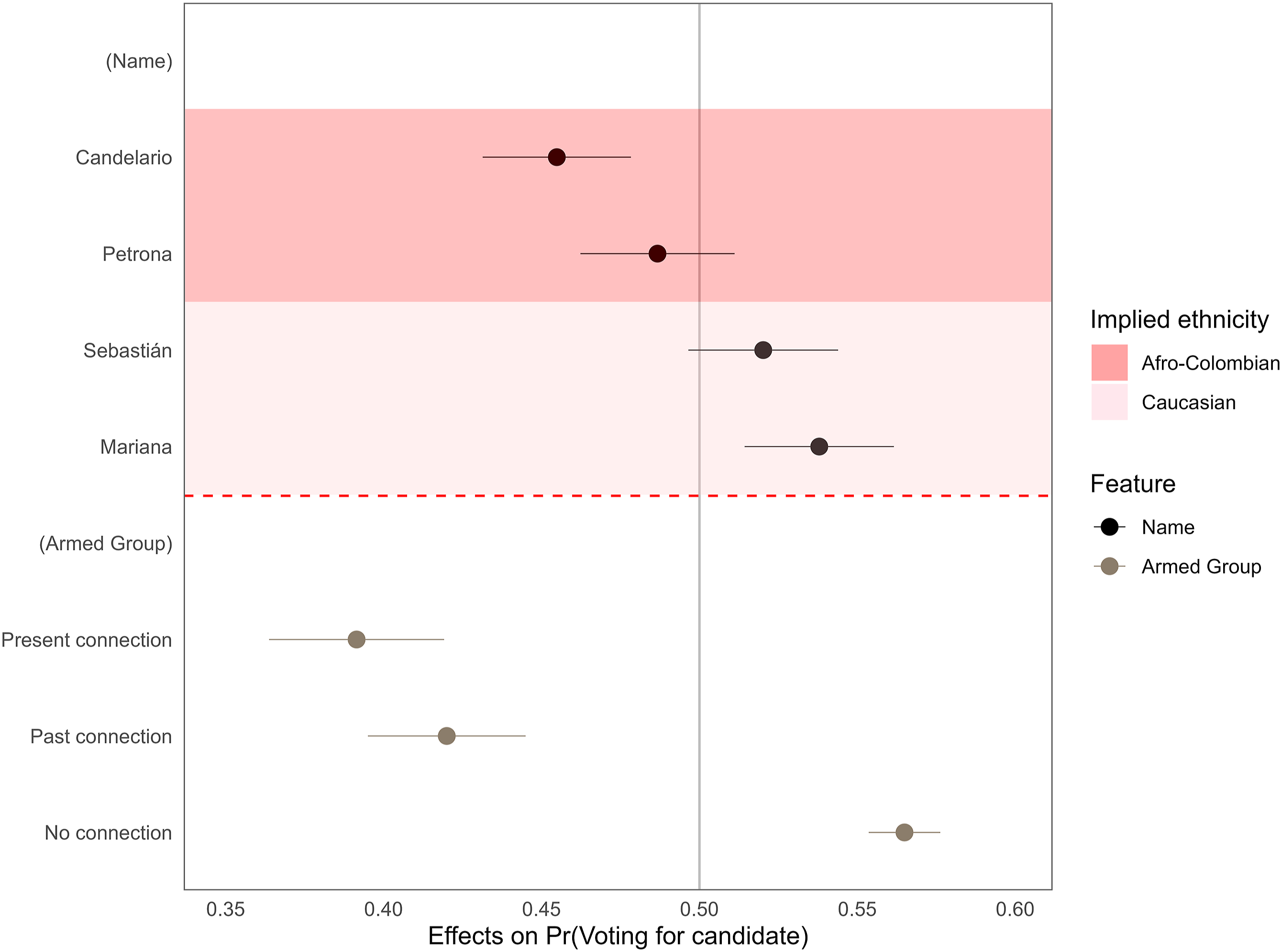
Turning to the role of ethic identity, we confirm the pre-registered hypothesis that candidates with (implied) Afro-Colombian identities are less likely to attract votes, even though all other characteristics are held constant. The estimates in the red-shaded area depict the likelihood that candidates with Afro-Colombian names are chosen, whereas the pink-shaded area displays the estimates for candidates with Caucasian names. On average, participants are 6 percentage points less likely to select a candidate if they have an Afro-Colombian rather than a Caucasian-sounding name (Online Appendix Table G1 Columns 1 and 2; p-values
In what follows, we consider how armed group affiliation and Afro-Colombian identity jointly determine politicians’ electability. The third hypothesis suggests that the penalty for armed group affiliation could be higher for Afro-Colombian candidates than for Caucasian candidates. To evaluate this assertion, we aggregate the identity traits into two categories: Afro-Colombian name (Candelario and Petrona) and armed group affiliation (past and present).
In Figure 2, we display the marginal means when these traits are interacted. As has already been established, the likelihood of being chosen is considerably lower if the candidate is Afro-Colombian and if s/he has an armed group affiliation. Accordingly, the least favored candidates are those that combine these two traits. However, there is no “Afro-Colombian penalty” for armed group affiliation, according to our data. We find that armed group affiliation reduces the likelihood that a voter selects an Afro-Colombian candidate by 14.9 percentage points, while it reduces the likelihood that a Caucasian candidate is selected by 17.1 percentage points (Online Appendix Table 4 Columns 1 and 2). Column 3 of the same table shows that the interaction term between Afro-Colombian identity and armed group affiliation is statistically insignificant. In sum, while participants display aversion toward both Afro-Colombian and armed group-affiliated politicians, there is no interaction between these traits. Rather, biases are found to be additive. Interactions between ethnic identity and armed group affiliation.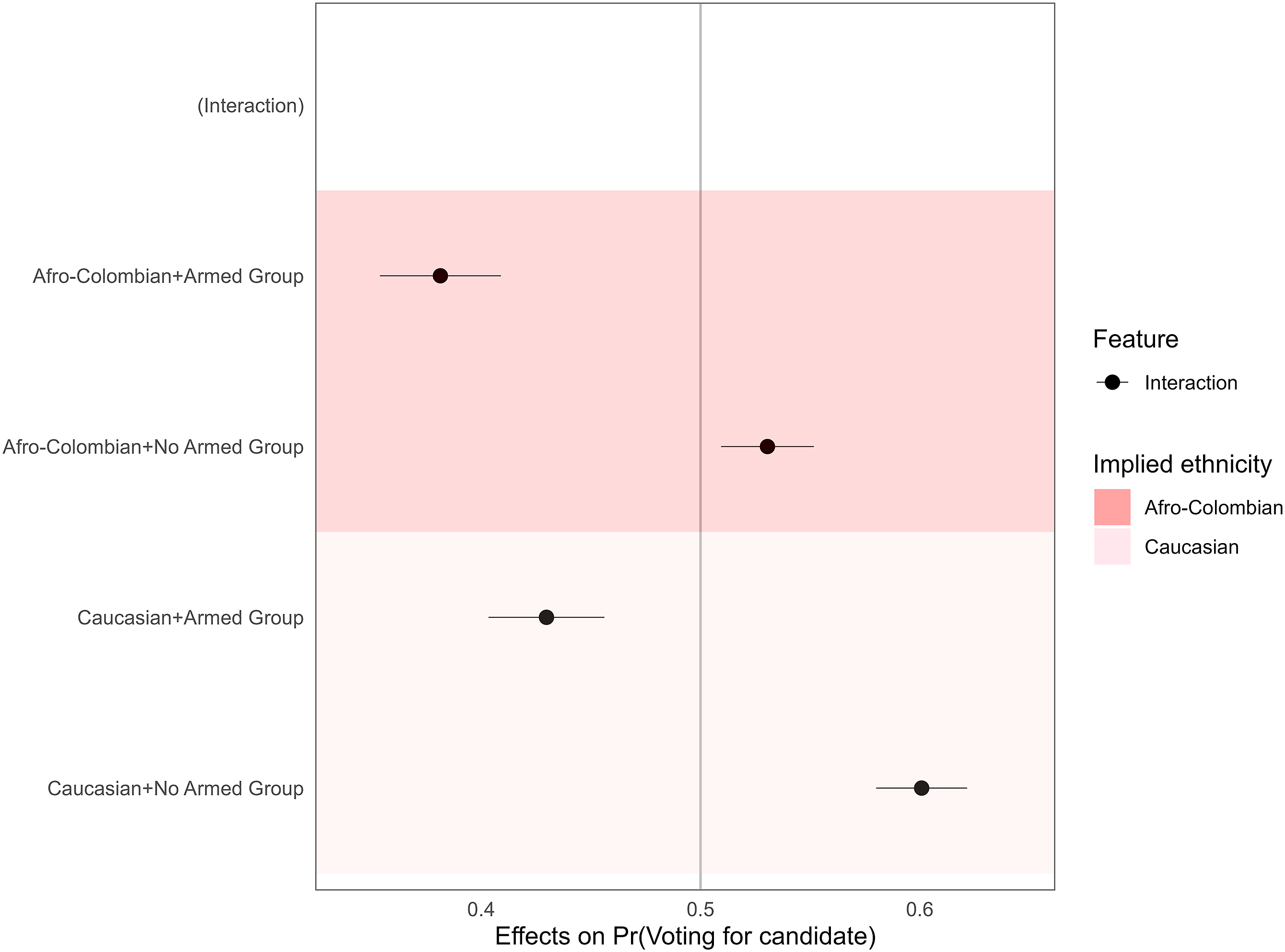
Next, we find support for the hypothesis that the impact of ethnically coded names is due to ethnic discrimination. In the follow-up survey, we asked participants to indicate their willingness to support a (hypothetical) Afro-Colombian presidential candidate. The majority of participants indicated that they would be willing to vote for an Afro-Colombian presidential candidate, but around 11 percent “definitely” or “probably” would not (Online Appendix Figure 5). In the Online Appendix Table 6, we show evidence of more pronounced discriminatory behavior among participants who self-report as unwilling to support an Afro-Colombian presidential candidate. For this group of participants, the effect of an Afro-Colombian name on the likelihood of being chosen is approximately three times as large compared with participants who self-report as willing to support Afro-Colombian candidates (Columns 1 and 2 of Online Appendix Table 6). Yet, even among participants who self-reportedly are open to voting for Afro-Colombians, we find evidence of systematic ethnic biases.
Finally, in the Online Appendix Table 5, we investigate whether Afro-Colombian candidates are more severely punished for other moral transgressions, namely clientelism and vote monitoring. We do not find statistically significant evidence of “Afro-Colombian penalties” in these domains either, although the signs of the interaction effects are negative. In the Online Appendix Table 10, we show that ethnic discrimination as well as electoral punishment for armed group associations is somewhat greater for candidates with a background as union leaders than for candidates with a background as business leaders.
What Explains Voter Biases?
Next, we ask why participants systematically decide against supporting Afro-Colombian and armed group-affiliated politicians. In line with social identity theory, we argue that ethnic identity and (rumored) armed group affiliation may activate an ingroup/outgroup logic among participants in our survey (who are largely White or Mestizo). Group membership, in turn, may provide cues as to whether candidates are trustworthy or dangerous. To investigate whether such inference played a role, we measured participants’ fear of retribution 16 and their beliefs in candidates’ trustworthiness. 17
In Figure 3, we display how the pre-registered mediators are influenced by the candidate traits of main interest. As should be expected, we observe that participants make no associations between candidates’ ethnicity and their capacity for retribution (left-hand graph of Figure 3; Column 1 of Online Appendix Table 7). However, participants are more likely to fear retribution from candidates who are/were affiliated with armed groups. Strikingly, participants believe that politicians with past ties to armed groups are just as likely to create problems for them as candidates with current ties to armed groups. These results offer a tentative explanation for why candidates with past ties to armed groups perform comparably to those with present ties; participants seem to attribute the same unfavorable qualities to candidates rumored to associate with armed groups regardless of whether the links are past or present. Trait effects on fear and trustworthiness.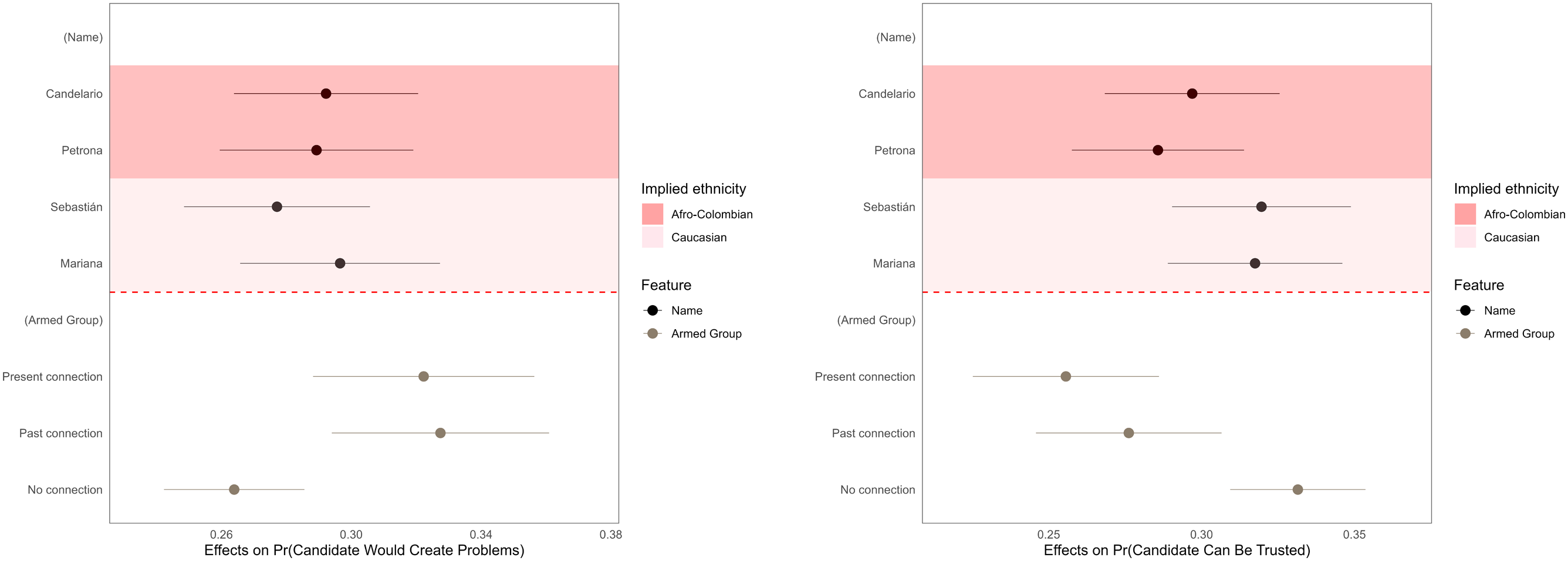
In the right-hand graph of Figure 3 (Online Appendix Table 7 Column 3), we demonstrate lower levels of trust in both (implied) Afro-Colombian candidates and (rumored) armed group-tied candidates. The effect on trustworthiness is somewhat larger for candidates with present ties than for candidates with past ties. Since trustworthiness is a first-order concern for voters (Born, van Eck, and Johannesson 2018), this pattern may further explain the bias against Afro-Colombian and armed group-affiliated candidates. Indeed, we find that participants’ trust in candidates strongly predicts whether they will vote for them (Column 1 of Online Appendix Table 8). However, when we include fear or retribution and candidate trustworthiness as controls in the baseline specification, we find that the parameters for Afro-Colombian name and (rumored) armed group affiliation remain statistically significant (Online Appendix Table 8, Column 3). This implies that while fear of retribution and candidate trustworthiness partly explain voter biases, other mechanisms are also at play. Whether those other mechanisms are belief- or preference-based is beyond the scope of the present study, but this line of research constitutes a promising avenue for future work.
Heterogeneous Responses
In what follows, we turn to pre-registered heterogeneity analyses along two dimensions where we should expect variation in the propensity to select candidates based on their ethnic profiles and armed group affiliation. First, we investigate whether participants’ own ethnic identities condition their voting behavior. Second, we study how participants’ views on the peace agreement predict voting preferences. We are interested in whether these participant traits influence the willingness to reintegrate former armed group affiliates in politics and, hence, confine the analyses to candidates with no (reference group) or past armed group affiliations. Given that the experimental design pitted (implied) Afro-Colombian candidates against (implied) Caucasian candidates, social identity theory would predict more pronounced discriminatory behavior among participants of European descent. Conversely, we should expect less bias among Afro-Colombian participants and those of other minoritized ethnic groups.
Heterogeneous Effects: Participants' Ethnic Identities.
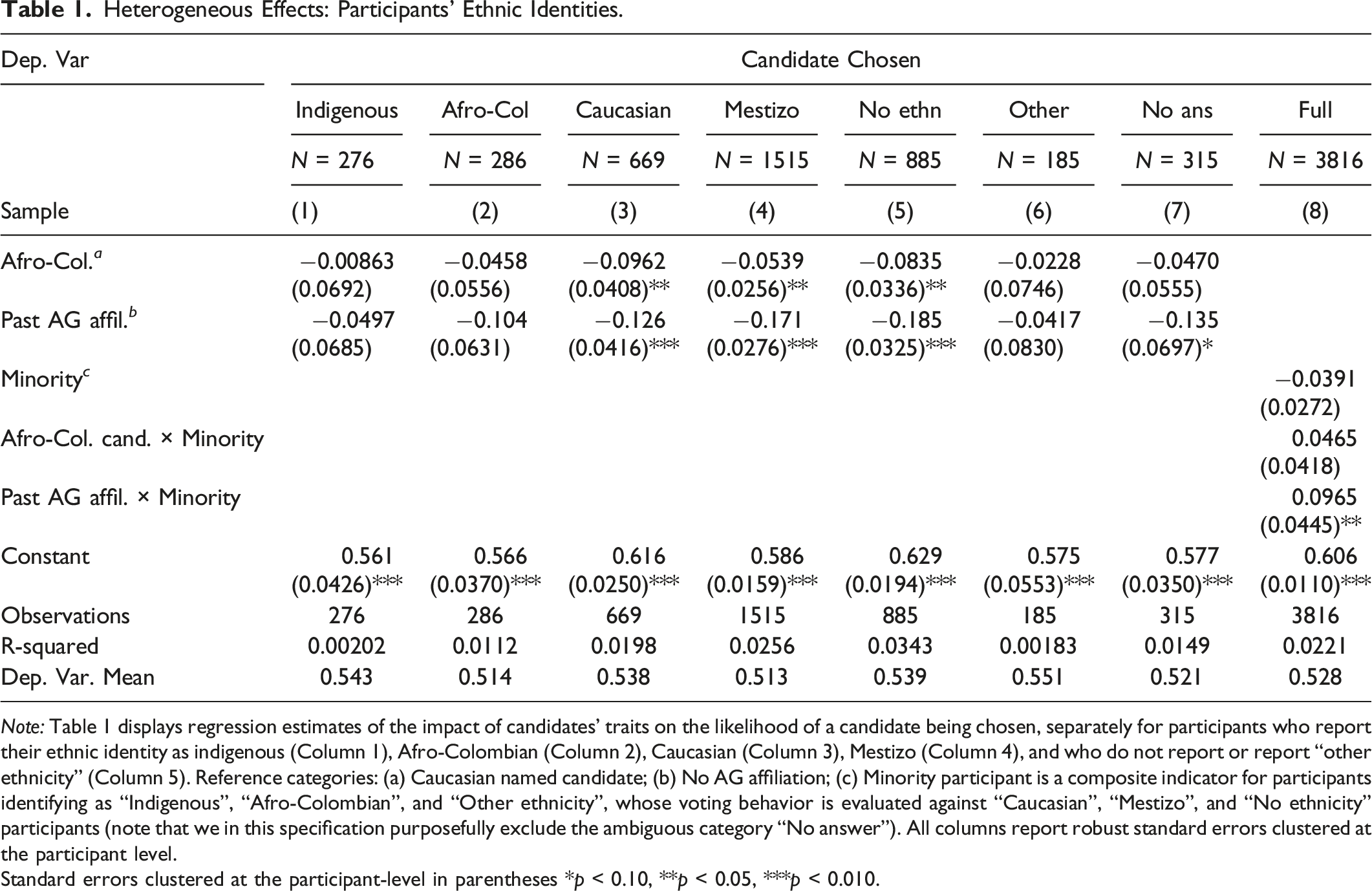
Note: Table 1 displays regression estimates of the impact of candidates’ traits on the likelihood of a candidate being chosen, separately for participants who report their ethnic identity as indigenous (Column 1), Afro-Colombian (Column 2), Caucasian (Column 3), Mestizo (Column 4), and who do not report or report “other ethnicity” (Column 5). Reference categories: (a) Caucasian named candidate; (b) No AG affiliation; (c) Minority participant is a composite indicator for participants identifying as “Indigenous”, “Afro-Colombian”, and “Other ethnicity”, whose voting behavior is evaluated against “Caucasian”, “Mestizo”, and “No ethnicity” participants (note that we in this specification purposefully exclude the ambiguous category “No answer”). All columns report robust standard errors clustered at the participant level.
Standard errors clustered at the participant-level in parentheses *p < 0.10, **p < 0.05, ***p < 0.010.
Next, we turn to an investigation of how peace agreement views predict voter behavior. We measure peace agreement views through two survey questions: one gauging voting intentions were Colombia to hold another referendum on the peace agreement 18 and one measuring participants’ views of the FARC-EP’s compliance with the peace agreement (both questions are detailed in the Online Appendix Table F1). We dichtomize and aggregate these items into a count variable, Peace Agreement Views (PA Views), which indicates negative (1), neutral (2), or positive (3) views on the peace agreement. 19
Heterogeneous Effects: Views on the Peace Agreement.
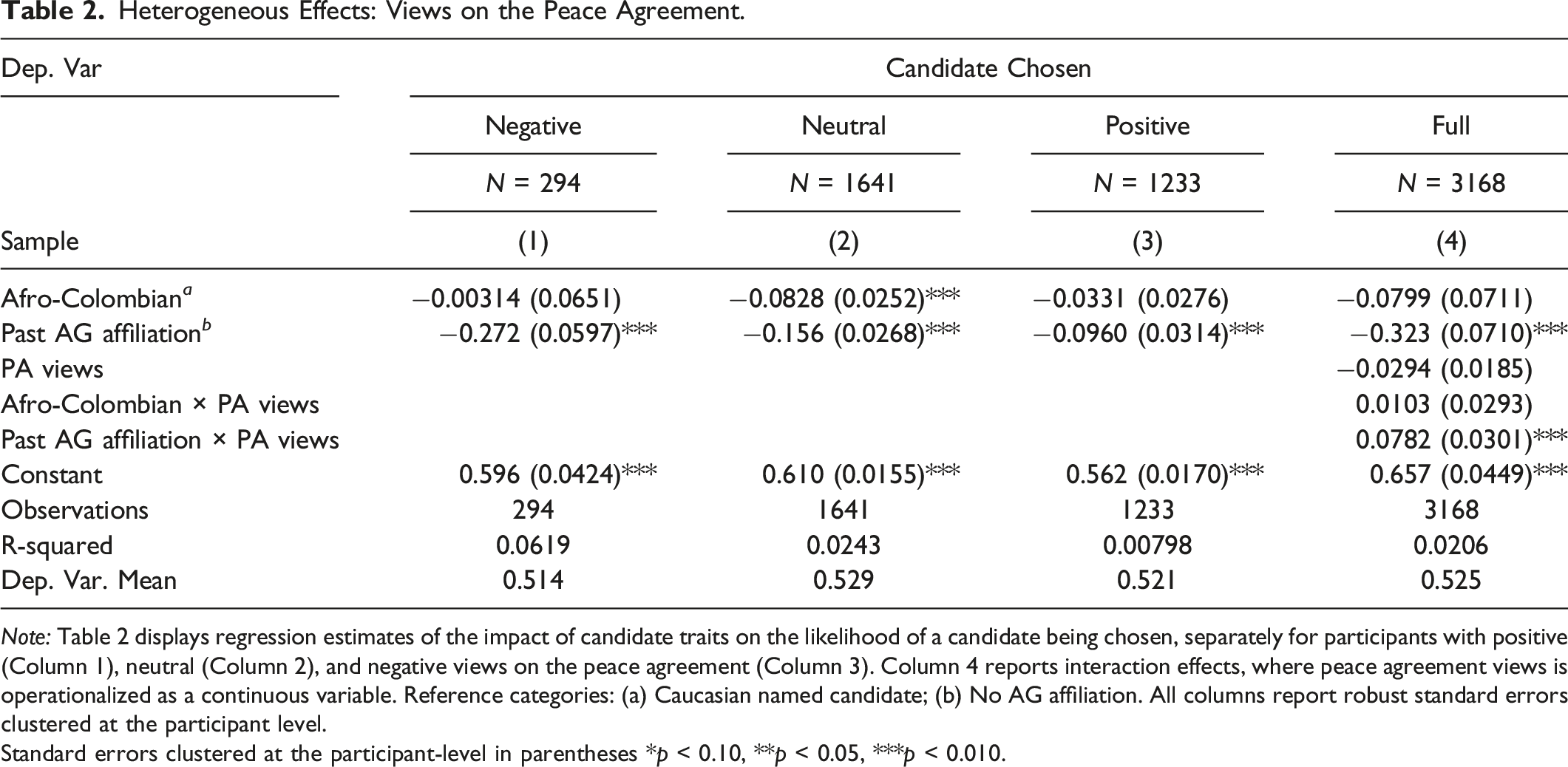
Note: Table 2 displays regression estimates of the impact of candidate traits on the likelihood of a candidate being chosen, separately for participants with positive (Column 1), neutral (Column 2), and negative views on the peace agreement (Column 3). Column 4 reports interaction effects, where peace agreement views is operationalized as a continuous variable. Reference categories: (a) Caucasian named candidate; (b) No AG affiliation. All columns report robust standard errors clustered at the participant level.
Standard errors clustered at the participant-level in parentheses *p < 0.10, **p < 0.05, ***p < 0.010.
The findings align with Tellez (2019a), who finds that supporters of the peace agreement are more willing to accept the political reintegration of members of the FARC-EP. In the Online Appendix Table 9, we go a step further and demonstrate that opponents of the peace agreement also are less likely to trust candidates with past armed group affiliation. 20
Taken together, the results of the heterogeneity analyses highlight significant variation in voter biases against Afro-Colombian and former armed group affiliated candidates. The investigation of how participants’ ethnic identities shape voter behavior aligns with social identity theory, while the study of how peace agreement views influence voter preferences indicates that ethnicity-based discrimination is not uniform. Indeed, if we study the interaction between participants’ ethnic identities and their peace agreement views, we find that participants reporting Caucasian, Mestizo, or no ethnic identity and who support the peace agreement (i.e., are coded as “positive” according to PA views) 21 display smaller ethnic and past armed group biases compared to participants of the same ethnic identities that do not support the peace agreement (i.e., are coded as “neutral” or “negative”). 22
Discussion and Conclusion
Peace agreements often entail provisions for the reintegration of former rebels into conventional politics (Godefroidt and Langer 2021). However, low popular demand for ex-combatant politicians complicates such a transition. Given that rebels anticipate the public’s reluctance, they may worry that demobilization would result in marginalization, which, in turn, could prevent them from realizing political objectives. Consequently, a peace agreement that comprises political reintegration will appear less appealing if there are no prospects for future reconciliation with the general electorate.
Moreover, as the present study showcased, the attractiveness of a political solution may vary within armed groups, since members differ along dimensions (e.g., ethnicity) that shape their personal electoral prospects. We considered how (past) armed group affiliation and ethnic belonging, separately and jointly, shape political candidates’ electoral prospects. To this end, we investigated candidate electability through a conjoint experiment implemented in a conflict-ridden department of Colombia. The experiment unveiled a strong bias against candidates with (past) armed group affiliations and significant voter discrimination against candidates with Afro-Colombian names. The use of names to proxy for ethnicity allows us to circumvent issues of social desirability bias common to studies of discriminatory behavior. Yet, since a share of participants are unaware of the ethnic cue embedded in the names (resulting in treatment non-compliance), the results are arguably a lower-bound estimate of the true extent of discrimination against Afro-Colombian candidates.
We did not find evidence of a hypothesized interaction between Afro-Colombian identity and armed group affiliation, i.e., an ethnically differentiated punishment for ties to armed groups. Still, since former armed group affiliates from the Afro-Colombian communities face significantly weaker electoral prospects compared to former armed group affiliates of European descent, the desirability of a political solution may still be ethnically differentiated. We further showed that voter biases can partly be attributed to stereotyping, since participants displayed lower trust in armed group-affiliated candidates as well as in Afro-Colombian candidates. The magnitudes of biases, however, vary between groups of participants. In pre-registered heterogeneity analyses, we found that participants who identified as Indigenous, Afro-Colombian, or of “other ethnic origin” were more likely to support candidates with Afro-Colombian ethnicity and past armed group affiliation, as were participants who supported the peace accord.
Understanding voters’ aversion toward former combatants and how this bias interacts with ethnic discrimination can shed light on rebel incentives to demobilize as well as on the prospects of successful post-conflict political reintegration. Although Colombia recently elected a president with past ties to an armed group and a vice president from the Afro-Colombian community, our study demonstrates that voter biases remain widespread. While the present study did not find evidence of an “Afro-Colombian penalty” for being associated with armed groups, the lack of interaction does not imply that the public judges Afro-Colombian and Caucasian armed group affiliates in the same way. For instance, the expected ethnic bias in voting might have been balanced out by people ascribing different levels of agency to Caucasian and Afro-Colombian candidates, considering that Afro-Colombians were more likely to be forcibly recruited during the conflict. Future studies should attempt to unpack the causal pathways from ethnic belonging to reintegration prospects.
More generally, peace and conflict research should build on the present study to investigate other instances of discrimination and ethnic barriers after war. The contextual and (sometimes) subtle nature of discriminatory behavior underscores the need for scholars to consider a range of methodologies and settings when mapping the phenomenon and its implications for peace processes. Ultimately, applying social identity theory to the dynamics of reconciliation, in a similar manner as we have done to the dynamics of war, can pave the way for more context-sensitive and effective approaches to peace building.
Supplemental Material
Supplemental Material - How Ethnic Discrimination Shapes Political Reintegration After War: Insights From a Conjoint Experiment in Colombia
Supplemental Material for How Ethnic Discrimination Shapes Political Reintegration After War: Insights From a Conjoint Experiment in Colombia by Gustav Agneman and Lisa Strömbom in Journal of Conflict Resolution
Supplemental Material
Supplemental Material - How Ethnic Discrimination Shapes Political Reintegration After War: Insights From a Conjoint Experiment in Colombia
Supplemental Material for How Ethnic Discrimination Shapes Political Reintegration After War: Insights From a Conjoint Experiment in Colombia by Gustav Agneman and Lisa Strömbom in Journal of Conflict Resolution
Footnotes
Acknowledgments
We are grateful for generous feedback provided by Priscyll Anctil Avoine, Maria del Mar Morales Burkle, Isabel Bramsen, Anne Lene Stein, the Comparative Politics Group at Lund University, and conference participants at the MPSA Conference 2023.
Declaration of Conflicting Interests
The author(s) declared no potential conflicts of interest with respect to the research, authorship, and/or publication of this article.
Funding
The author(s) disclosed receipt of the following financial support for the research, authorship, and/or publication of this article: The research was funded by the Bank of Sweden Tercentenary Foundation within the umbrella project “Pushing the Boundaries of Peace Research: Reconceptualizing and Measuring Agonistic Peace” (RIK18-14416).
Data Availability Statement
Data and code necessary for the replication of the main findings are available at Zenodo (Agneman, 2023). The study was pre-registered at AsPredicted #85836 ( ).
).
Supplemental Material
Supplemental material for this article is available online.
Notes
References
Supplementary Material
Please find the following supplemental material available below.
For Open Access articles published under a Creative Commons License, all supplemental material carries the same license as the article it is associated with.
For non-Open Access articles published, all supplemental material carries a non-exclusive license, and permission requests for re-use of supplemental material or any part of supplemental material shall be sent directly to the copyright owner as specified in the copyright notice associated with the article.
