




Abstract
In democratic societies, governments cannot act in isolation from public opinion. This is especially true regarding terrorism, where public perception is the instrument targeted by terrorists to achieve their political goals. Nevertheless, governments must also be able to resist public pressure and preserve individual rights. All this suggests that researching public perception of terrorist attacks is crucial. We make an important contribution in this direction by measuring the importance the public assigns to various attributes of terrorist attacks. Using novel methodology (conjoint experiment) and survey data from the UK and The Netherlands (N = 6,315), we find that people are concerned with attacks by immigrants (in the Netherlands), and by individuals acting as part of a terror cell, and with jihadist motivation. Furthermore, past experience with specific terrorist tactics drive preference to address such attacks more than others. In both countries people strongly focus on the severity of attacks, and under-weigh probabilities. The terror attack in the Netherlands in 2019 provided an opportunity to examine perception right after an actual attack. Also there we have found that people’s concerns are driven by experience with specific attacks. A better understanding of terrorism perception can inform policymakers about the gap between optimal strategies to combat terrorism and the expectations of the public.
Introduction
In recent years, Europe has witnessed numerous terrorist attacks, with the most salient being driven by jihadism. From the simultaneous attacks in Paris in 2015, that killed over 100 people, to the bombing in Manchester Arena in 2017 (START, 2022). Even in 2021, when the most urgent problem seemed to be the COVID-19 pandemic, terrorism has not become the problem of the past (Kantorowicz et al., 2023). On 15 October 2021, a British parliament member was stabbed to death as part of, what seems to be, a terrorist attack. 1 This situation precipitates state reaction and the development of counterterrorism measures. For this purpose, governments need to estimate objective direct risks of terrorism, as well as the long-term impact on society. Optimally, all threats would be fully addressed. However, given in particular the importance of civil liberties and privacy, there are limitations on the measures governments should adopt.
Besides the objective components of terrorism, public perception of terrorism also plays a role in governments’ policies (Schuurman, 2013; D’Orazio & Salehyan, 2018). It is well known that public perception is the main instrument terrorists use to achieve their political or ideological goals (Mueller, 2005; Enders & Sandler, 2006; Breckenridge & Zimbardo, 2007; Renard, 2016). Terrorist attacks lead to fear which is disproportionate to the actual risk of harm (Breckenridge & Zimbardo, 2007; Mueller & Stewart, 2012). As a result, even if limited in frequency, such attacks can have long-term political and social implications (Stern, 2003). For example, they can create a shift to more conservative attitudes such as limitation of civil liberties and support for military action abroad (Huddy & Feldman, 2011; Epifanio, 2016); diminish governments’ respect for basic human rights (Dreher, Gassebner & Siemers, 2010); render stronger support for right-wing parties in the elections (Berrebi & Klor, 2006, 2008; Kibris, 2011); or even affect the outcome of elections (Bali, 2007). The over-reaction to terrorism might constitute a bigger problem than terrorism itself (Wolfendale, 2007; Mueller & Stewart, 2012; Renard, 2016). Given that public perception is central to terrorism, it must also receive significant attention in the battle against terrorism.
How the public perceives terrorism and in turn, how it perceives the adopted counterterrorism measures, will impact upon whether the public trusts their leaders and perceives them as competent managers of the situation (Breckenridge & Zimbardo, 2007). If the public focuses on certain elements of a terrorist attack, they might have a different understanding of how terrorism should be addressed by their government. Consequently, governments, interested in securing re-election, might be pressured to invest in salient, potentially civil- and human-rights violating measures (Bueno de Mesquita, 2007).
Therefore, in this article, we try to identify how people perceive terrorist attacks. In particular, we aim to examine how people prioritize different aspects of a terrorist attack when expressing their opinion on how the government should address terrorism. By employing a novel methodology in this context – a conjoint experiment – we can identify the independent and relative weight given to each component among multiple components of a terrorist attack and avoid confounding factors. This aspect is crucial in the context of perception of terrorism, which can be affected by multiple components such as the identity of the attacker, the tactic used in the attack, its motivation, its direct impact, etc.
From a scholarly contribution perspective, we offer the possibility to derive causality between the different components and people’s perception. Thus, we add a nuance to recent observational quasi-experimental studies (e.g. Nussio, Bove & Steele, 2019; Nussio, Bömelt & Bove, 2021; Epifanio, Giani & Ivandic, 2023), where the terrorist attacks are examined as bundles of characteristics thus making it difficult to estimate what component of attacks specifically drives the perception. The advantage of these quasi-experimental studies is that they employ the actual emotional contexts of terrorist attacks, while our baseline experiments do not provide for such a context. To remedy this, we re-launched our study shortly after one such real-world attack, allowing us to examine whether the results from our baseline experiment (no emotional context) replicate in the emotionally laden context. By and large, we found that the results replicate, proving that the heightened emotional context is not key.
To the extent we know, this is the first study to employ a conjoint analysis to directly test the perception of terrorism components. Huff & Kertzer (2018) were the first to utilize a conjoint experiment in the context of terrorism. However, they tested a different question, that is, which elements of an attack render it to be classified by the public as a terrorist attack. Previous literature in political science has demonstrated the link between people’s perception of the terrorism risk and their policy preferences (Davis & Silver, 2004; Huddy et al., 2005; Huddy & Feldman, 2011; Burke, Kosloff & Landau, 2013; D’Orazio & Salehyan, 2018; Friedman, 2019; Liu et al., 2019). A handful of studies in psychology also examined experimentally the effect of behavioral biases on the perception of terrorism risk (Lerner et al., 2003; Fischhoff et al., 2005). Finally, political science literature has also examined how particular components, for example, the ethnicity of the attacker or proximity of the attack, affect the classification or perception of the attack (D’Orazio & Salehyan, 2018; Avdan & Webb, 2019; Kearns, Betus & Lemieux, 2021). However, to the best of our knowledge, no empirical study has measured how the different components of a terrorist attack simultaneously play a role in the way people perceive the attack and the necessity to address it.
This is the advantage of a conjoint experiment as compared to the previously employed methods. For example, using traditional (vignette) experimental design to examine people’s preferences would require an excessive amount of treatment groups to investigate the independent and interactive effect of each component on the perception of the attack and the choice of which type of attacks to counter. Not only would such an endeavor be prohibitively costly, but it may also lack external validity. The public makes such judgments having in mind the variety of components. Singling out only one component might distort the judgment. Traditional vignette survey experiments also suffer from ordering effects, which can be easily dealt with in conjoint experiments when the attributes are displayed in tabular form. Conjoint experiments also allow the collection of much more data from respondents, that is, respondents are typically asked to perform several tasks. Lastly, conjoint experiments have the potential to reduce a social desirability bias and satisficing and, hence, on average, have a higher external validity (Hainmueller, Hangartner & Yamamoto, 2015).
In this study, we use a quota sample of 6,315 participants in total from two European countries. The first country is the United Kingdom (UK) that has experienced a moderate number of attacks by jihadists in recent years, and a large number of attacks by separatists over the years. The second country is the Netherlands, which until the beginning of the study had not experienced a single successful terrorist attack by jihadists, or others, in recent years (START, 2022). Examining our question about the perception of terrorism in two European countries is another novelty of the study. To the best of our knowledge, previous experimental studies that examined terrorism risk perception were not comparative and were conducted on samples in the USA. Since terrorism is not a unique problem of the United States, it is important to conduct such research in other countries. Furthermore, comparing two countries with different experiences with terrorism allows us to examine to what extent experience correlates with how people perceive terrorist attacks.
Finally, the terrorist attack that took place in the Netherlands in March 2019 2 created a unique situation that enabled us to test whether and how perceptions of terrorist attacks and the focus on particular elements change right after an attack.
We found that in both countries (to different extents) participants overweighed certain components of a terrorist attack in their decision on how to allocate the limited counterterrorism resources. For example, participants were very sensitive to changes in the severity of the attack (number of casualties) and much less sensitive to changes in probabilities of the attack, despite the symmetric effect those two components have on the expected harm. This may explain why public fear is so disproportionate to its objective likelihood of occurrence. Concerning the tactic of an attack, UK participants prioritized counterterrorism measures to prevent bombing attacks, whereby Dutch participants treated the same all tactics besides stabbing. Another example is the preference, albeit small, to focus on attacks which are committed by immigrants (as found in the Dutch sample). Such perception may lead to pressure for discriminatory policies. An indication for the public shift can be found in the recent rise in Europe of right-wing, anti-immigration parties, which managed to join coalitions of the ruling governments (Sniderman et al., 2019). We further find that people prefer more those counterterrorism strategies which target jihadist attacks (as opposed to right-wing attacks). Members of terrorist cells (as opposed to lone wolves) are also singled out, even though all the jihadist attacks in the EU in the year of the study were committed by lone actors.
Theoretical framework: Terrorist attacks’ components
A terrorist attack is a complex event that entails multiple characteristics. The expected harm, the attacker and the tactics of the terrorist act all matter for the way it is perceived by the public. In this section we use theoretical and empirical studies from political science, as well as from cognitive and social psychology, to identify the main components of a terrorist attack, and discuss how those might affect the way the public perceives a particular terrorist act. This will provide the basis for the empirical investigation which will be discussed in the next section.
The number of casualties and the probability of an attack
How many people died in an attack is the most vivid information and usually is presented already in the headlines of any news story. In addition, the number of casualties also plays a role in the question of whether the public would classify an attack as a terrorist act or as a ‘regular’ crime (Huff & Kertzer, 2018). Lethality was also shown to matter in shaping attention to terrorism across Europe (Nussio, Bömelt & Bove, 2021). However, when thinking about future attacks, the expected harm is not only a function of the number of people losing their lives (or injured) but also the probability of it happening. Terrorist attacks, as deadly as they are, do not occur with high probability, at least in modern democracies. Nevertheless, they evoke intense reaction and fear from future attacks (Wolfendale, 2007).
Disproportionate public reaction may potentially be explained by the way people perceive the harm versus its probability. In one of the first comprehensive studies on risk perception, Lichtenstein et al. (1978) demonstrated that people over-estimate rare causes of death, and under-estimate frequent causes of death. Scholars from psychology and risk analysis offered different explanations for people’s erroneous perception of certain risks. Some focus on cognitive fallacies in the perception of risks and the effect of saliency (e.g. Tversky & Kahneman, 1974). Other scholars emphasize the importance of affect in decisionmaking under uncertainty (e.g. the risk-as-feeling hypothesis by Loewenstein et al., 2001). It has been observed in different studies that when an event evokes strong emotions, people become less sensitive to changes in probabilities (Loewenstein et al., 2001: 276). This could result from people’s tendency to perceive vivid outcomes in mental images (e.g. a terrorist attack). Because mental images are discrete (the event occurred or not), the feeling they evoke does not depend on the probability of its occurrence (Elster & Loewenstein, 1992: 227). Giving different weights to the outcome as compared to its probability can also be explained by the attitudes of people to certain types of risks due to the nature of the risk even when they do not over-estimate mortality rates (psychometric paradigm, Slovic, 1991).
Finally, another explanation to the often-observed discrepancy between risks of different events and the policy preference of the public was offered by Friedman (2019). The author demonstrated that when knowing mortality rates, people’s policy preferences (which risks to address) depend on the perceived fairness of the harm to the victims and the question of whether the government is perceived as responsible for reducing or preventing this type of risk. Terrorism is one such case, since the victims are often innocent and have no control over the situation, and the government is expected as one of its roles to protect the public from such a risk.
Therefore, we predict that:
H1: the public will be more sensitive to changes in the severity rather than the probability of an attack when choosing which type of an attack to counter.
The status of the perpetrator (immigrant vs. citizen)
Whether the terrorist is a citizen or an immigrant might evoke different perceptions and different demands for governmental reaction. With the current general anti-immigration atmosphere in Europe, people might focus more on salient cases where non-citizens were involved in a terror attack and attribute to this group a higher probability of being involved in such an attack. However, such focus might not reflect reality. For example, in 2018, EU and non-EU citizens were almost equally represented in jihadism-related arrests (Europol Report, 2019: 30). The negative attitudes toward immigrants were even suggested as one of the drivers of Brexit (Arnorsson & Zoega, 2018).
The prediction of such focus relies on several streams of literature (theories and empirical evidence). First, it might be the result of in-group bias. That is the tendency to favor people who belong to the same group (in-group) over people who belong to other groups (out-group). One relevant theory is the integrated theory of threat. Stephan & Stephan (2001: 25–27) identified four types of threat that can explain attitudes and prejudice toward out-groups in general, and immigrants in particular: realistic threats, symbolic threats, intergroup anxiety, and negative stereotypes. The first type refers to a threat to the existence of the in-group, be it physical, political, or economic. The threat can also be perceived rather than actual. Symbolic threat covers perceived worldview (morals, values, traditions) disagreements. The third type – intergroup anxiety – concerns the feeling of personal threat (rejection, embarrassment) in interactions with members from the out-group. Finally, the negative stereotypes threat refers to the fear of negative consequences which arises from the stereotypes of the out-group. 3
This theory was applied in the investigation of attitudes towards immigrants. For example, Stephan et al. (1998) found that intergroup anxiety and stereotypes were significant predictors for prejudice against Russians, and intergroup anxiety and symbolic threats predicted prejudice against Ethiopians in Israel. Realistic threats were relevant for such attitudes against Moroccan immigrants in Spain. This has been explained by the past animosities between the Spanish and Moroccan population, which did not exist with the immigrants in Israel. This theory has been also found relevant for attitudes towards Muslims in some of the European countries, including the UK (Croucher, 2013) and the Netherlands (Velasco González et al., 2008) where prejudice was affected by symbolic threats and stereotypes.
In the context of terrorism, terrorist attacks, in particular, might have negative effects on the attitudes towards immigrants (e.g. Legewie, 2013; Ferrín, Mancosu & Cappialdi, 2020). 4 Furthermore, ethnicity has been found relevant to the classification of a person’s violent acts as terrorism as opposed to crime. For example, D’Orazio & Salehyan (2018) found that the acts of Muslims are more frequently categorized as terrorist attacks than the same acts committed by white perpetrators. These findings are supported by Huff & Kertzer (2018).
Different perceptions of an attack committed by an immigrant as opposed to by a citizen can also be predicted using theories and evidence from cognitive psychology. For example, one potentially related psychological mechanism is the representativeness heuristic. In questions about how probable it is that a particular person, for example, belongs to a certain group, people tend to rely on the heuristic of the extent to which this person resembles this group, and ignore the base rate (Tversky & Kahneman, 1974). The representativeness heuristic can explain the way stereotypes work (Bordalo et al., 2016), and why certain types of individuals are associated with terrorism more than others.
Therefore, we predict that:
H2: the public will support more those policies that target immigrants rather than citizens.
Affiliation of the terrorist
An important element that is often communicated in the aftermath of a terrorist attack is whether the perpetrator acted alone or as part of an organization. Despite the common perception that terrorism is committed by members of terrorist organizations (Spaaij, 2010; D’Orazio & Salehyan, 2018), terrorist attacks are also committed by unaffiliated individuals. Those individuals are often termed lone wolves, and their violent actions are becoming more prevalent (Davies, 2018). Such activities are even encouraged by the leaders of terrorists’ groups, who aspire for a world where many individuals are committing uncoordinated terrorist acts in the name of their common ideology (Bakker & De Graaf, 2011). In Europe, for example, according to a Europol Report (2019) all completed jihadist attacks in 2018 were perpetrated by lone actors. Even though terrorist attacks by organizations are considered generally more lethal, under certain circumstances, lone actors’ violence can become deadlier. For example, terrorist attacks by individuals become more lethal in countries where counterterrorism measures are particularly strong, which makes it harder for collective terrorism (Phillips, 2017).
Lone actors committing terrorist attacks are a particular challenge for the authorities and counterterrorism measures (Spaaij, 2010; Davies, 2018). The reason is that they tend not to share their plans with anyone and not to communicate with others about the attack. Therefore, it is almost impossible for the authorities to identify and monitor the actions of such terrorists before they commit the attack. This is different from terrorist organizations where the number of members and the communication between them increases the chances of foiling their attacks. It is also very difficult to build a profile of a lone actor, whose characteristics often vary. And in particular, in countries with strong protection of freedom of speech, it is difficult to distinguish the radicals who simply express their extreme opinions from those who take violent actions (Bakker & De Graaf, 2011; Spaaij, 2012). As correctly formulated by Bakker & De Graaf (2011: 46) – ‘while most terrorists are radical, not all radicals are terrorists’. Therefore, if citizens perceive lone actors as the problem, they might pressure for measures which violate the privacy rights of individuals.
People associate more organizations with terrorism attacks than individuals. Furthermore, since terrorism is often discussed in the media in the context of organizations, this feature might be more salient for the public. Therefore, we predict that:
H3: the public will support more those policies that target terrorist cells rather than lone actors.
The terrorism tactic
The tactics terrorists use in their attacks are also highly salient after an attack. Furthermore, this component is relevant for people’s classification of a violent act as a terror act. Some means of an attack, such as bombing, are more closely associated with terrorism than others (Huff & Kertzer, 2018). Bombing is considered one of the deadliest types of attack. For example, the suicide bombing in 2015 in Paris killed 90 people and injured 217, and the 2017 suicide bombing in Manchester killed 22 people and injured 119 (START, 2022). Nevertheless, in recent decades other tactics have become more prevalent in Europe. For example, stabbing and vehicle ramming (Europol Reports, 2017–18).
One theory that is particularly relevant to the question of how people would perceive a terrorist attack tactic and how their priorities of counterterrorism measures would be formed is the psychometric paradigm. The psychometric paradigm measures people’s perception of risks and their preferences concerning regulating and reducing risks. One of the main conclusions from this theory is that even if the general public has a good rough estimate of mortality rates, they might perceive risk (and desire governmental interventions) differently than experts who rely solely on numbers. Research into risk perception has found that different characteristics of risks, such as dread and familiarity with the risk, can influence people’s perception (Slovic, 1991). Dread risk is defined as a risk over which people have no or less control, with catastrophic potentials, such as nuclear weapons. Unknown risk is defined as being unobservable, new, and delayed in the harm it imposes, such as chemical technologies (Slovic, 1991). Even though this paradigm was developed in the context of activities that also provide benefits (e.g. new technologies), it is relevant for risks such as terrorism.
Given the psychometric paradigm, terrorism as such is already a risk that evokes more fear and negative reaction than other risks, because it scores high on the relevant dimensions. However, it might be the case that different tactics of terrorism evoke different responses. Depending on its dreadfulness and the extent to which some attacks are perceived as unknown, people might have a stronger preference to prevent one type of attack over another. For example, bombing (or chemical attacks) would lead to stronger support to counter such attacks even if they are much less probable than other tactics, such as vehicle-ramming or shooting. Focusing on bombing might be generally logical since the expected harm (to life and property) is higher than other common types of attacks. However, in the trade-off between restricting people’s rights and preventing deadly attacks, the government also needs to consider the probability of different types of attacks taking place. Based on the psychometric paradigm, we predict that:
H4: the public will support more those policies that target more dreadful tactics.
Another phenomenon that might lead to public pressure for (over)reaction is the availability heuristic. If some countries recently experienced a specific type of attack, those attacks might be perceived as more salient. If the availability heuristic affects people’s choices, participants from that country are expected to prefer measures that would counter such tactics over others. Also here, if a single vivid attack escalates public demand to target this specific tactic, at the expense of potentially more general measures, the government might be pressured to respond less efficiently. Hence, we predict:
H5: the public will support more those policies that target tactics with which their country had recent experience.
The motivation for the attack
Following the rapid growth of the IS, jihadism became a prominent motivation behind terrorist attacks in Europe. More people died in such attacks in Europe between the years 2014 and 2018 than in the preceding 20 years (Marone, 2021). 5 The motivation behind an attack is often reported following a violent event, and speculations are common while the investigation is ongoing. Therefore, the motivation behind the attack may also be important to how people perceive the attack, and which measures they demand from their governments.
Despite the prevalence of jihadist attacks, one should not forget that other motivations, such as far-right extremism, anarchism, separatism, environmental and animal extremism, white supremacy, etc. also drive terrorist attacks (Bakker & De Graaf, 2011). A vivid example that comes to mind is the two deadly attacks by Andres Breivik, a right-wing extremist, in Norway in 2011, which resulted in the deaths of 77 people. 6
In case of the motivation behind an attack, at least in the year of the study, the perception of the public is expected to align with what would potentially drive an efficient counterterrorism policy. Even though in 2018 (the year of the study) there were 103 failed, foiled or completed attacks driven by ethno-nationalist and separatist, or left- or right-wing motivations, as compared to ‘only’ 24 jihadist attacks, only the latter resulted in casualties (Europol Report, 2019: 6, 12). In 2017, the majority of convictions for terrorism were of jihadists A choice example
H6: the public will support more those policies that target jihadism rather than other motives.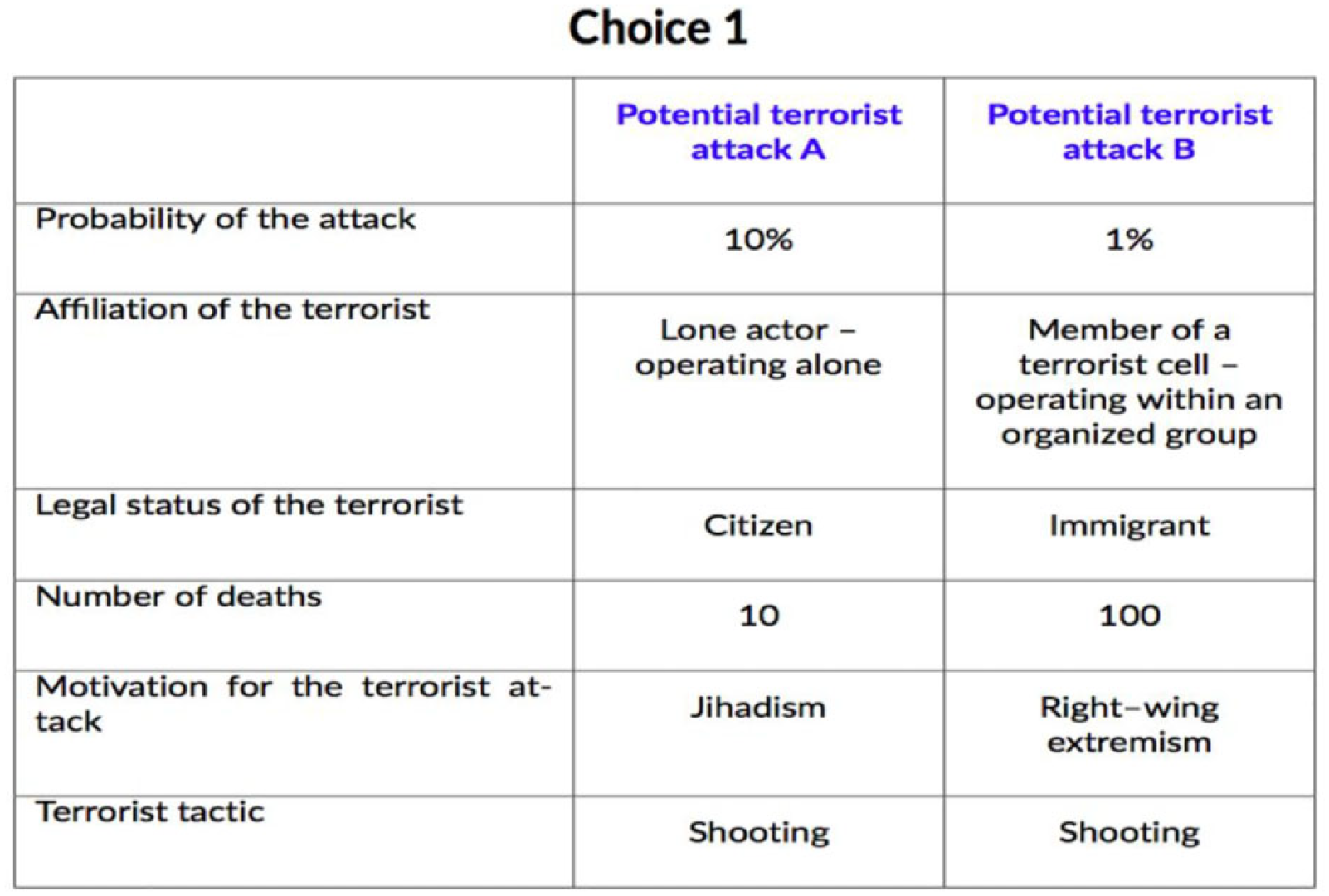
Experimental design
In this article, we are interested in investigating how people perceive terror attacks and how the different components of such attacks affect their prioritization of counterterrorism measures. For this purpose, we employ a conjoint experimental method (Hainmueller & Hopkins, 2015). Conjoint experiments offer a cost-effective alternative to more traditional survey experiments (Hainmueller, Hopkins & Yamamoto, 2014). They allow for simultaneous testing of multiple hypotheses as conjoint experiments, in their fractional factorial form, typically enable the manipulation of many attributes, minimizing the problem of confounding. They also overcome the ordering effects, from which traditional vignette experiments are suffering. Finally, conjoint experiments have the potential to reduce a social desirability bias and satisficing and, hence, on average, have a higher external validity (Hainmueller, Hanhartner & Yamamoto, 2015).
In the experiment, we asked participants to assume that the government has a limited budget and can focus its efforts only on one type of attack. Under real circumstances, governments invest in many different measures to prevent different attacks. However, the assumption that the budget is scarce and therefore requires a certain trade-off is reasonable. To tease out the effect of each component on the perceptions and priorities of participants, we presented participants with five pairs of hypothetical terror attacks with different attributes (see Figure 1 for an example). After seeing each pair, participants needed to choose which of the two attacks they would like the government to focus its efforts on.
Conjoint treatments
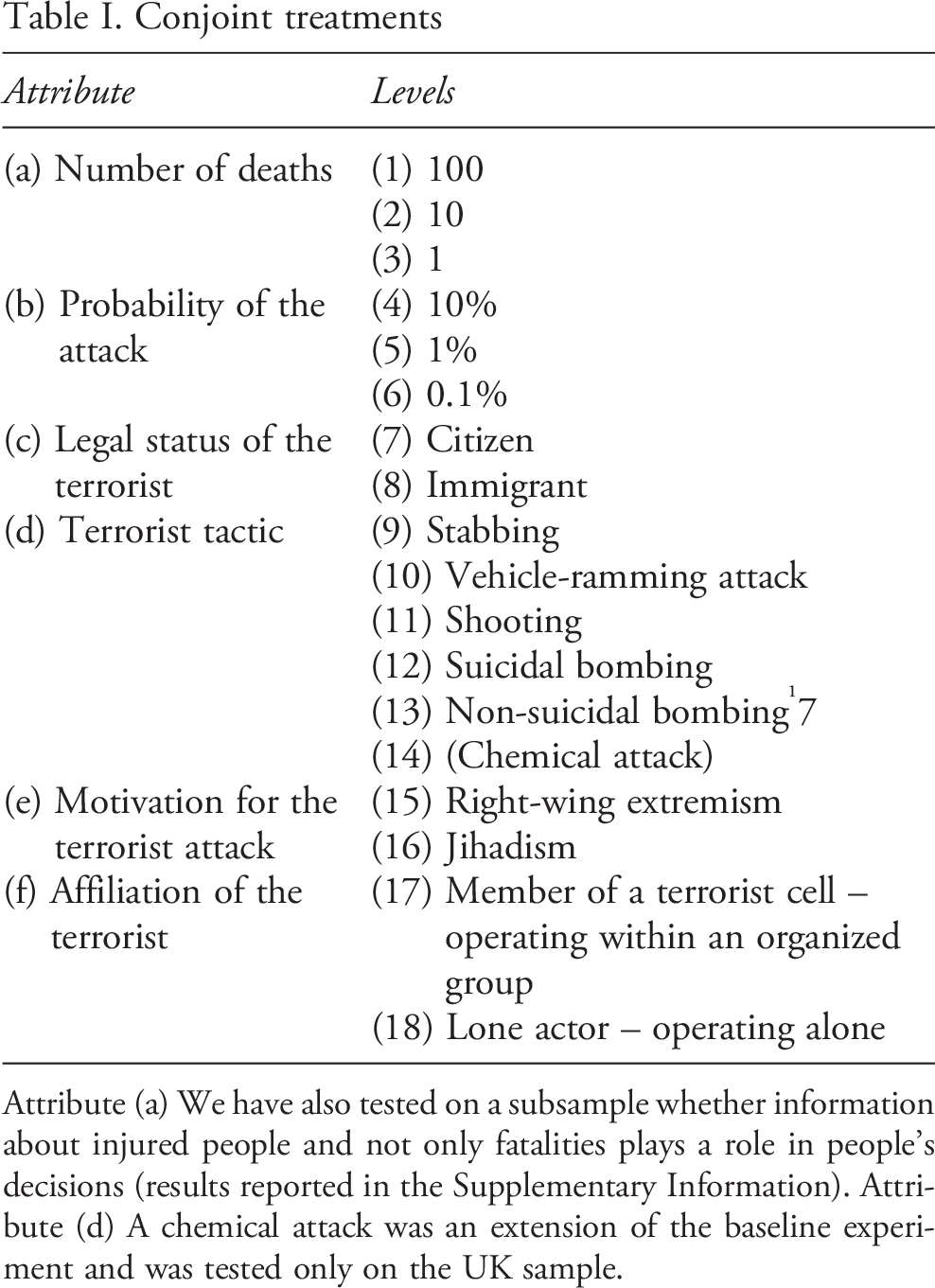
Attribute (a) We have also tested on a subsample whether information about injured people and not only fatalities plays a role in people’s decisions (results reported in the Supplementary Information). Attribute (d) A chemical attack was an extension of the baseline experiment and was tested only on the UK sample.
Each participant received five different pairs and had to answer the question five times. The attributes, derived based on our theoretical discussion, are presented in Table I. The order of attributes was random for every respondent, but it was kept constant within respondents.
To distinguish the effects of availability from the psychometric paradigm, we also performed an extension on the UK sample (N = 544) where we added the terrorism tactic of a chemical attack. On the one hand, if choices are driven by availability heuristics, this addition should not change the results since none of the European countries experienced such an attack. On the other hand, if people are indeed treating risks differently based on their level of dreadfulness and unfamiliarity, the chemical attack becomes the worst risk which people would like to prevent. In this case, we would expect this feature to increase the likelihood of choosing such an attack to prevent. 8
To increase the external validity of the results, we disallowed the combination of stabbing appearing together with 100 deaths, as this scenario is simply implausible. With these sets of attributes and levels, there were overall 360 combinations (3x3x2x5x2x2–number of constraints).
Procedure
This study is part of a larger project on Perceived Risk of Terrorism and its Implications for (Counter-Terrorism) Communication Strategies, which was approved by the Human Research Ethics Committee at TU Delft. 9 The conjoint experiment was launched in November–December 2018 for both the UK and the Netherlands. The sample comprises 2,537 British respondents and 2,342 Dutch respondents. The survey respondents were recruited by Dynata and were quota representative in terms of gender, age and education in both countries.
Results
In this section, we report the main results from the conjoint experiment. 10 We first discuss the main results juxtaposing the severity and probability of the attacks, thus the main elements of expected harm. Then, we discuss the remaining components of the attack, which go beyond the expected harm, examining the role they are playing in participants’ decisions.
Severity vs. probability
The lethal outcome of a terrorist attack is a clear drive of public perception and fear. However, probabilities of occurrence are also relevant to counterterrorism policy. First, expected harm depends on the combination of the The effects of severity and probability in the UK The effects of severity and probability in the Netherlands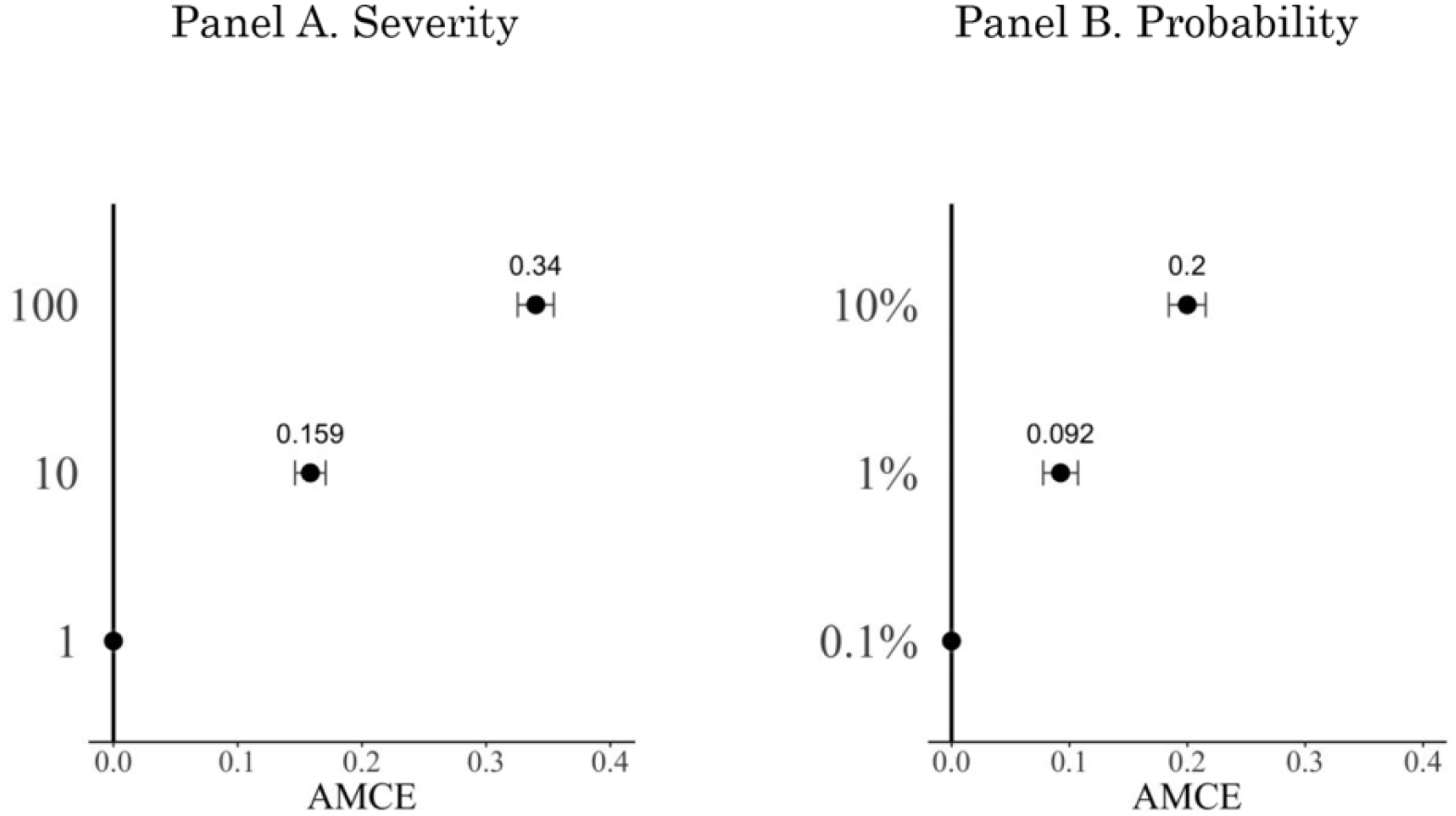

It is evident from Figure 2 and Figure 3 for the UK and the Netherlands, respectively, that increasing both severity and probability leads to higher chances that a given attack is chosen for prevention. Panel A of Figure 2 presents the results for severity in the UK. From estimated average marginal component effects (AMCE), we see that an increase of severity from one victim (reference category) to ten victims (a ten-fold increase) increases the likelihood of choosing the attack by nearly 16 percentage points. Comparing the scenario of one victim to 100 victims (a 100-fold increase) leads to a 34 percentage points increase in the likelihood of choosing the attack. The effects displayed in Panel B of Figure 2 also increase monotonically as the probability of a terror attack grows. However, these effects are The effects of legal status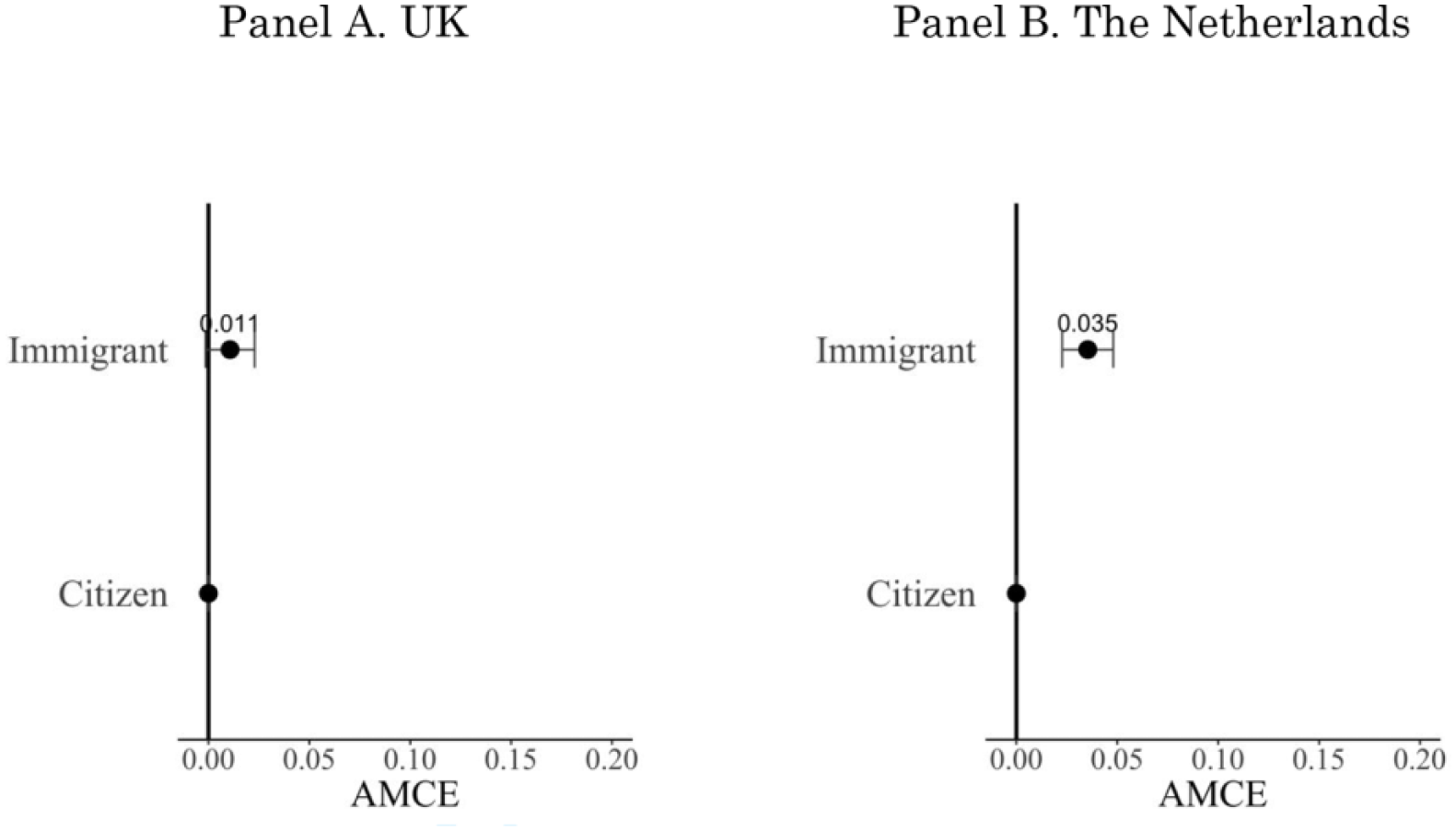
The results generated for the Netherlands show similar patterns (panel A regarding severity and B for the probability in Figure 3). It is of note, however, that the effect of severity is somewhat smaller in the Netherlands than in the UK.
The finding that severity receives a larger weight than probability can also be demonstrated by comparing the likelihoods of choosing attacks, which inflict the same level of expected harm but vary in levels of severity and probability. For instance, an attack with a probability 0.1% and severity 100, equals in expected terms to an attack with a probability 1% and severity 10. Yet we find that in the UK sample, the scenarios containing 100 deaths and 0.1% probability are chosen with the average likelihood of roughly 59%, while the scenarios combining ten deaths and 1% probability are chosen with the likelihood of roughly 49%. For additional examples and figures illustrating these results, see the Supplementary Information (Figures S1 and S2).
Legal status (immigrant vs. citizen)
Moving away from the perception of severity and probability, we look at whether attackers who are immigrants raise more concern among participants than citizens. As have been discussed, in-group bias might lead to a preference for targeting immigrants.
Figure 4 presents the results for the UK and the Netherlands. In the UK, respondents do not seem to display preferences for preventing the attacks by immigrants as compared to those performed by citizens (Panel A). Independent of all other factors, an immigrant changes the focus of participants only by 1 percentage point, which is however not statistically significant. The results on the Dutch participants are somewhat different. As clear from Panel B of Figure 4, the immigration status of the attacker increases the probability to target such an attack by 3.5 percentage points. This difference is small but statistically significant. Therefore, participants from the Netherlands have a slightly stronger preference to target immigrants, and this is irrespective of the expected number of casualties or the probability of the attack, nor any of the other components. Hence, we find evidence for H2 in the Netherlands, but not in the UK.
This result is surprising in light of the literature that suggests terrorist attacks increase perceived threat from immigrants. People from the UK experienced more terrorist attacks than the Netherlands. However, looking more closely at the background of the terrorists who committed their attacks in the UK in recent years, and especially the deadliest attack in Manchester, even though committed with the jihadist motivation, it was perpetrated by UK citizens (START, 2022). Furthermore, from the Eurobarometer report which was conducted just before our fieldwork (in November 2018) it The effects of affiliation
In addition, Giani (2021) demonstrates that even though the level of fear increases following a jihadist attack, the prejudice against the out-group (Muslims) does not. Similarly, Van Hauwaert & Huber (2020) find no evidence for out-group hostility following the deadly 2015 terrorist attacks in Paris and Saint Denis. Therefore, suggesting that the mere fact a country experienced a terrorist attack does not always lead to negative attitudes toward the out-group (e.g. immigrants).
Affiliation
Next, we examine whether the attacker’s affiliation plays any role in the way participants perceive such an attack. Figure 5 presents the results for participants from the UK (Panel A) as well as from the Netherlands (Panel B). Unlike the ‘legal status’ of the attacker, their affiliation matters for the UK participants. Membership in a terrorist organization increases the likelihood of choosing the attack for prevention by 11.4 percentage points. This result is again irrespective of the number of casualties such an attack imposes or the probability of its occurrence. A similar effect has been identified among the Dutch participants. For them, an attack that included an affiliated terrorist increased the likelihood of desired prevention by almost 14 percentage points as compared to a lone actor. Therefore, we find evidence in favor of H3.
This is an interesting result, especially given two factors, which have been mentioned in Section 2. First, in the year of the study, all successful terrorist attacks were committed by lone actors, rather than members of a terrorist cell. Furthermore, even though membership in organizations is more associated with terrorism, lone actors impose a particular challenge for the enforcement authorities. Therefore, while governments might prioritize, at a certain point, measures that particularly target lone actors and their special form of preparing and committing an attack, the public might perceive counterterrorism measures focused on organizations as more important.
Terrorism tactic
The chosen tactic of a terrorist influences the perception and choices of participants. Looking first at Panel A of Figure 6, we can see that respondents in the UK prefer counterterrorism strategies that particularly target suicidal bombings. Stabbing, as potentially the least dreadful of the attacks, leads to choices with lower likelihood. The difference in the probability of choosing the attack for prevention between those two tactics is 8 percentage points. Respondents do not differ in their preferences towards non-suicidal bombing, shooting, and vehicle-ramming attacks. Those tactics increase the likelihood of choosing the attack for prevention by 3–5 percentage points relative to stabbing. Those preferences are again irrespective of the size of the harm and its probability.
One might argue that the reason for singling out a suicidal bombing might be the expected damage to facilities and property, beyond the casualties. However, we The effects of terrorism tactic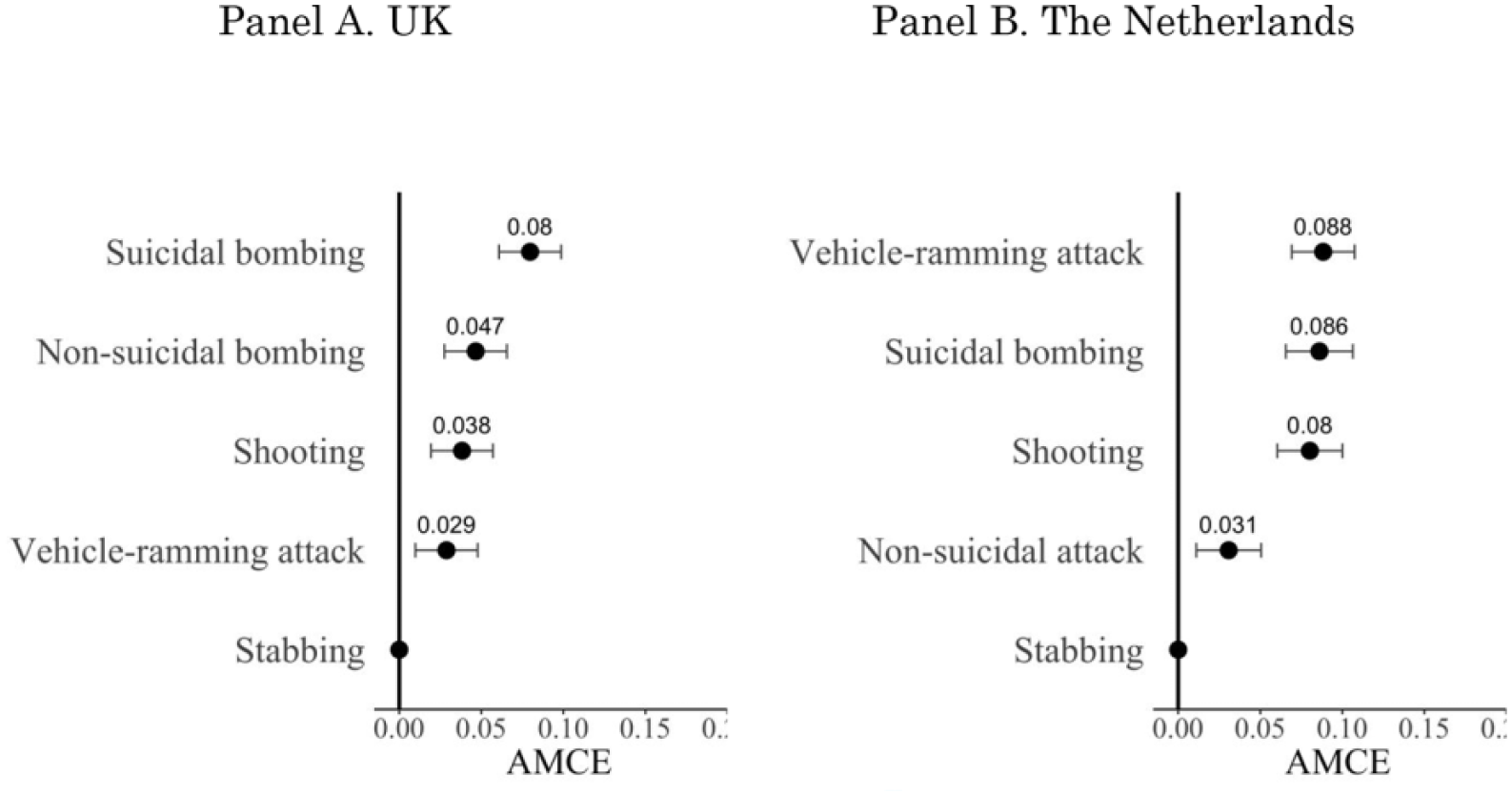
The difference between respondents from the UK and the Netherlands might be explained by the availability heuristics. While the UK experienced in the period preceding the study all those tactics (besides shooting), the suicide bombing in Manchester in 2017 was the deadliest. In this attack, 22 people were killed and 119 were injured. In other recent attacks not more than ten people were killed, and up to 50 people were injured (START, 2022). On the contrary, the Netherlands did not experience any terrorist attacks in the short period before the study. 11 Stabbing is perceived as the least important tactic to target with counterterrorism measures in both countries. This is not surprising since this is expected to be the least lethal and does not usually impose significant damage to property. It is also consistent with the psychometric paradigm, being the least dreadful of the presented tactics.

The effects of adding a chemical attack, the UK sample
We extended the analysis on the UK sample by including ‘chemical attack’ to the terrorism tactics attributes to further distinguish the effect of availability from the psychometric paradigm. We find that chemical attack affects the choice almost to the same extent as bombing, which in the UK is salient due to the Manchester bombing in 2017 (see Figure 7). At the same time, whereas bombing is significantly different in statistical terms from the other tactics, chemical attack is not (apart from the comparison with stabbing). Chemical attacks might be presumed to be the most dreadful and unknown. Yet bombing is still on the top of the respondents’ priority list when it comes to investment The effect of motivation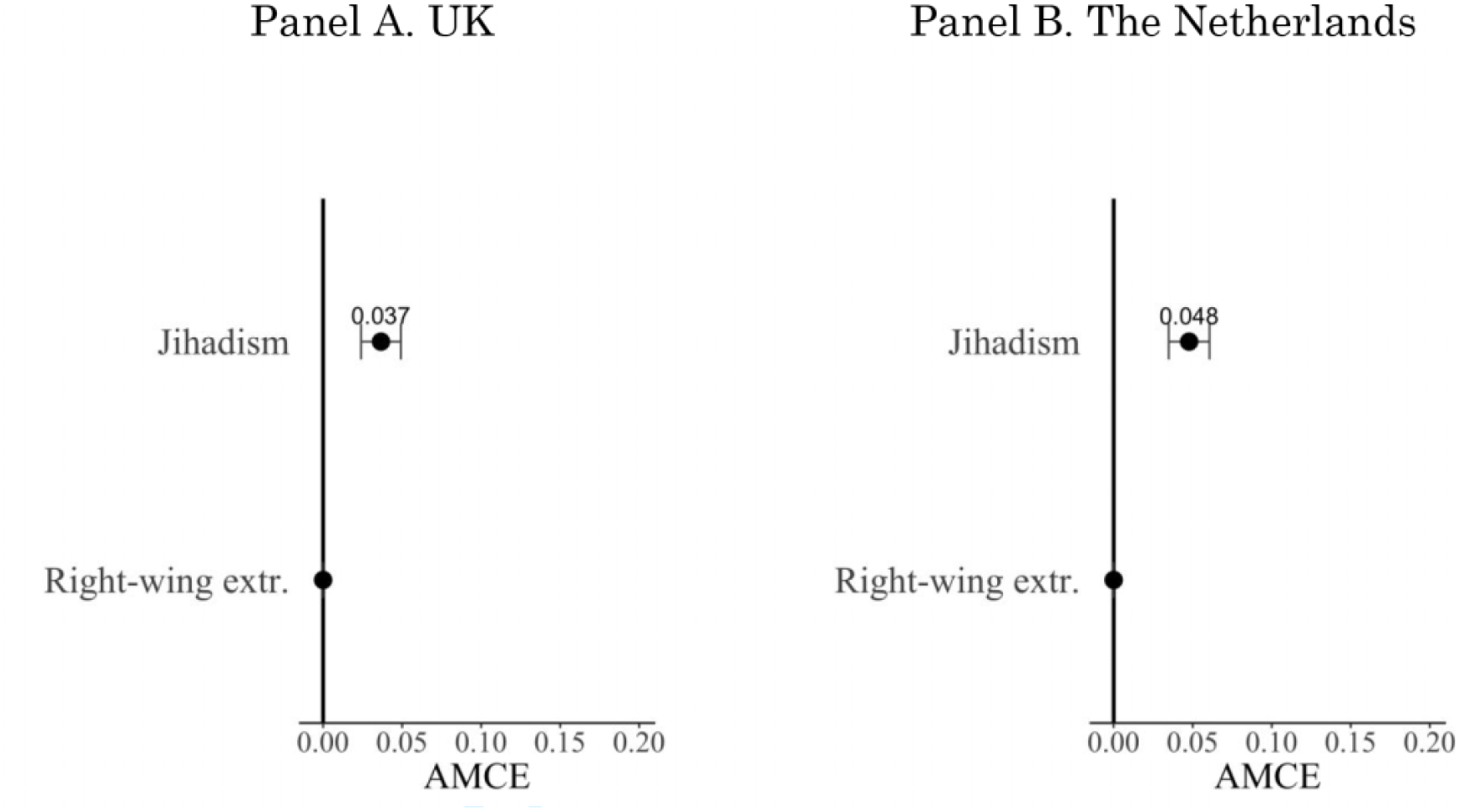
Motivation
Finally, we look at the importance of the attacker’s motivation for the decision about which type of attacks the government should focus on. Figure 8 presents the results for participants from both countries. The results are very similar in both countries. Participants seem to distinguish between the two motivations, right-wing extremism and jihadism, holding all else constant. The presence of jihadist motivation increases the likelihood to prefer such an attack for prevention by around 4 and 5 percentage points among the UK and Dutch respondents, respectively. Given that the motivation is not expected to affect the size of the expected harm, 12 and in the experimental design it clearly doesn’t, one potential explanation might be the availability heuristic. Jihadist attacks are more salient in the recent decade than right-wing extremism attacks. Therefore, we find evidence to support H6.
Jihadism is also associated with Muslims, thus potentially creating a stronger sense of out-group threat than right-wing extremists, who – in general – belong to the same ethnic group as the participants in this study. On the one hand, the fact that right-wing attackers might be perceived as participants’ in-group, might reduce their classification as a terrorist. They might be simply perceived as outliers of a generally compliant society, whose acts are less threatening. Jihadism, on the other hand, is easier for people to classify as a terrorist act because it is probably associated with an out-group (D’Orazio & Salehyan, 2018). Furthermore, an average participant may also feel that jihadists are more likely to target them or their close ones, than right-wing extremists, who usually target minorities in the country. Consequently, the public is more likely to prioritize counterterrorism measures that target actors who attack with the jihadist motivation.
Given its particular relevance in this country’s context, in the pilot on the UK sample, we also included the ‘separatist’ motivation. Interestingly, despite its prevalence, especially as compared to jihadists attacks, separatism was perceived no differently than other motives (Figure S6 in the supplemental information).
The effect of an actual attack on perception and choices
On 18 March 2019, a terrorist attack, which was later termed the ‘Utrecht shooting’, took place in the Differences in marginal means before and after the ‘Utrecht shooting’
Figure 9 presents the differences between the choices before and after the Utrecht shooting (differences in marginal means; performed in line with the procedures devised by Leeper, Hobolt & Tilley, 2020). This way we can observe whether certain components became more important for the respondents’ decision where counterterrorism efforts should be focused. We see that some characteristics of the terrorist attack did translate into a higher likelihood of choosing the scenarios which contain these characteristics. Most notably, these are the ‘lone actor’ and ‘shooting’ features (see Figure 9). Both of these features relate to the Utrecht terror attack. Nevertheless, ‘motivation’, as well as ‘legal status’, did not play a larger role in respondents’ choices. Therefore, it seems, that availability heuristics is partially at work.
Discussion
Governments in democratic societies have limits on their power and must respect civil and human rights. However, when facing extreme threats to safety and security, those rights often become vulnerable to restrictions (e.g. the US Patriot Act 2001 which was enacted following the 9/11 terror attacks). In particularly in countries where the public can impose political costs on policymakers, public perception of terror attacks becomes relevant. Terrorism is meant to activate public fear, which may result in the public pressuring politicians to over-react and restrict individual liberties, more than necessary. Therefore, it is important to research and understand better how the public perceives the different components of terror attacks.
Using a novel methodology which has been used in the context of terrorism perception only once before, we have identified several interesting perception patterns. First, it seems that the public might wish to focus too much on particular groups (as the Dutch sample demonstrated by focusing on immigrants), which are more salient in the media in the context of terrorist attacks. Yet, empirical studies suggest that, despite the perception and public demand to introduce anti-immigration laws (Bove, Böhmelt & Nussio, 2021), there is no evidence that immigrants import terrorism (Dreher, Gassebner & Schandt, 2020), even when the source countries are conflict-torn Muslim countries (Forrester et al., 2019). Furthermore, the Europol Report (2019: 30) demonstrates that in 2018 (the year of our study), EU and non-EU citizens were almost equally represented among those arrested for jihadists attacks. Interestingly, McAlexander (2020) found that in fact, immigration flows are strong predictors of right-wing terrorism rather than terrorism by the immigrants themselves. Therefore, discriminatory policies against immigrants are not only violating norms of democratic societies but are also not expected to offer an efficient solution to the terrorism threat.
We have also found that salient events drive people’s preference, beyond its expected harm. In particular, we found evidence that people are more concerned about terrorism tactics they have experienced in the past. This finding was further strengthened when we replicated the study on the Dutch sample right after a terror attack.
Interestingly, juxtaposing our additional findings with the finding by Huff & Kertzer (2018) suggests that the components of terrorist attacks which people are concerned about, are also those which they generally associate with terrorism (as compared to ‘regular’ crimes). For example, magnitude of the attack (the number of casualties) was identified as the strongest factor that drove preferences in our study. It received much higher weight than the probability of the attack, which also plays a role in the expected scale of casualties, and is often low. But magnitude is also a component that perceptually distinguishes between a regular crime and a terror attack (Huff & Kertzer, 2018). Similarly, a violent attack by a person who is affiliated with an organization raises more concern than individual attackers (our findings), and also constitutes an element that perceptually distinguishes regular crimes from terror attacks (Huff & Kertzer, 2018).
A better understanding of terrorism perception can inform policymakers about the gap between optimal strategies to combat terrorism and the expectations of the public. For instance, as our findings compared to the Europol Report (2019) demonstrate, people’s perception does not reflect the actual nature of terrorism in Europe. Non-EU citizens are usually not more prominent in the group of terrorists; lone actors play a more significant role than is attached to them by the public; some terrorism tactics (e.g. stabbing) are more frequent than people assume, etc. Understanding public perception can help governments to avoid overreaction to terrorism and increase support for more cost-effective policies while preserving democratic values (Stern, 2003).
Future research can build on the results of this study to discuss how precisely the identified perceptions can be addressed. In particular, which communication strategies can be developed to better align public perception with desired public policies. Furthermore, the actual effectiveness of those strategies can then be examined.
Footnotes
Replication data

Acknowledgments
We are indebted to Jeanine de Roy van Zuijdewijn and Stef Wittendorp for their helpful comments on the draft of this article. We are also grateful to Bart Schuurman, Yannick Veilleux-Lepage, James Shires, Milos Popovic, and other participants of the ISGA research seminar for their suggestions. We likewise would like to thank the editor and two anonymous reviewers for comments on earlier versions of this article.
Funding
The authors received financial support for the research from the Leiden-Delft-Erasmus Centre for Safety and Security (LDE CSS) and Rotterdam Institute of Law and Economics.