




Abstract
Citizen engagement in and support for peace processes have been deemed important for sustainable peace after civil wars. Yet much of what we know about peace processes in civil wars centers on the interests of elite actors. This special feature aims to advance a research agenda focusing on citizens in peace processes to address this mismatch. In the introduction to the special feature, we first present empirical evidence situating citizens in relation to civil war peace processes. We then trace the current state of the literature on the roles of citizens in peace processes. Following that, we introduce a conceptual framework designed to improve scholarly analysis of the political behavior of citizens in peace processes. We also locate the individual contributions to the special feature within the framework in order to demonstrate its utility and as a means of helping to identify directions for future research.
Keywords
Introduction
Ordinary citizens typically bear the brunt of the destruction and violence in civil wars. Their engagement in and acceptance of peace processes increasingly has come to be considered a crucial ingredient for sustainable peace. In 2003, for instance, the protest movement Women for Liberia Mass Action for Peace played an influential role in bringing Liberia’s warring factions to the negotiation table to strike a peace deal that ultimately ended the country’s 14-year civil war. And in Mindanao, in the southern Philippines, the Moro and Indigenous peoples felt that previous peace processes (e.g., those that produced the 1976 Tripoli Agreement and the 1996 Jakarta Accord) had failed to address historical injustices in the region. This perception helped to shape the content of the Bangsamoro Basic Law, the product of a long-drawn peace negotiation between the Government of the Philippines and the Moro Islamic Liberation Front. However, despite the important roles that citizens play in waging war and making peace, much of what we know about peace processes in civil wars centers on the interests of elite actors and the groups that they lead (Hartzell and Hoddie 2007; Mason and Mitchell 2016; Walter 2009).
An emerging literature has begun to address this gap by investigating more closely how citizens’ political behavior shapes—and is shaped by—peace processes. 1 Some scholars have pointed to the importance of local agency in peace processes, using qualitative and interpretive methods to critique the predominant focus on institutions and elites (Autesserre 2010; Mac Ginty 2014; Mac Ginty and Richmond 2013). Others have used statistical methods and advanced research designs to study the causes and consequences of citizens’ behavior during and after peace processes (Ditlmann et al., 2017). Although these studies have helped to highlight the importance of individual political behavior in conflict contexts, the disparate nature of these works, in combination with the absence of an integrative framework, has thus far inhibited the emergence of a research agenda focused on citizens in peace processes. As a result, we have only a limited understanding of how peace processes shape citizens’ political behavior and the opportunities peace processes provide for citizen action. We also do not know much yet about how that behavior may be shaped by the peace process and the effects that these factors may have on the nature of the peace itself.
The objective of this special feature is to advance a new research agenda on citizens in peace processes that helps to foster an integrative analysis of citizens’ perspectives of and roles in peace processes. Our hope is that a research agenda focused on developing a better theoretical understanding of these issues will provide insights into why and how some citizens advance, while others resist, efforts to build peace. To that end, we construct a conceptual framework that focuses on citizens in relation to two dimensions: the first, a temporal dimension, centers on the points during a peace process in which citizen involvement may take place (i.e., during negotiations of a war-ending agreement; agreement implementation; and/or as “legacies” of the peace process that manifest themselves in the post-conflict period). The second, a behavioral dimension, examines citizens’ political behavior as an input into the peace process (i.e., an explanatory variable) and as an output of the peace process (i.e., an outcome variable).
Civil Wars, Peace Processes, and Citizens
Peace processes are a ubiquitous feature of civil wars (Howard and Stark 2018). As such, they have consequences for the lives and deaths of persons living in the shadow of these conflicts. Figure 1 shows that attempts to negotiate an end to intrastate conflicts closely follow the number of armed conflicts active each year. Peace processes are therefore not single, isolated events that may or may not end civil wars. Instead, they are a core feature of internal armed conflicts and an important political process with tangible effects. This can be seen in Figure 2, which displays trends in battle and civilian fatalities before and after the first full or partial peace agreement has been signed. The plot shows that levels of fatalities drop considerably once an agreement has been reached.
2
Importantly, it is not only battle deaths that decline after a peace agreement has been signed, but civilian deaths as well. Active armed conflicts and peace agreements. Note: Data on conflicts are from the Uppsala Conflict Data Program (Gleditsch et al. 2002; Pettersson and Öberg 2020). Data on peace agreements are taken from the PA-X database (Bell and Badanjak 2019). The number of peace agreements can exceed the number of conflicts since multiple peace agreements can be signed each year. Thin lines represent exact annual counts, thick lines display a smoothed trend. Peace agreements and conflict intensity. Note: Data on conflicts are from the Uppsala Conflict Data Program (Gleditsch et al. 2002; Pettersson and Öberg 2020). Data on peace agreements are taken from the PA-X database (Bell and Badanjak 2019). To create the plot, we normalized each year in a conflict with respect to the conflict’s first full or partial peace agreement. We then computed the average fatalities for each year over all conflicts. Thin lines represent exact annual counts, thick lines display a smoothed trend.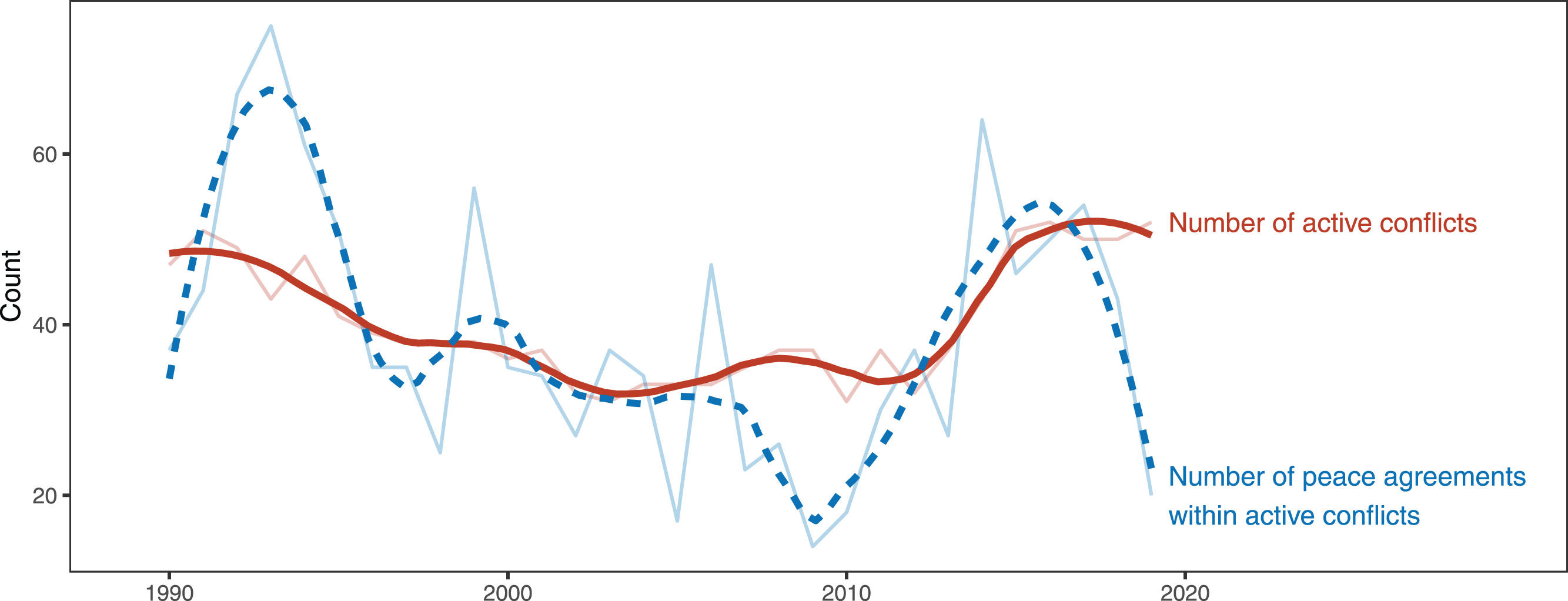
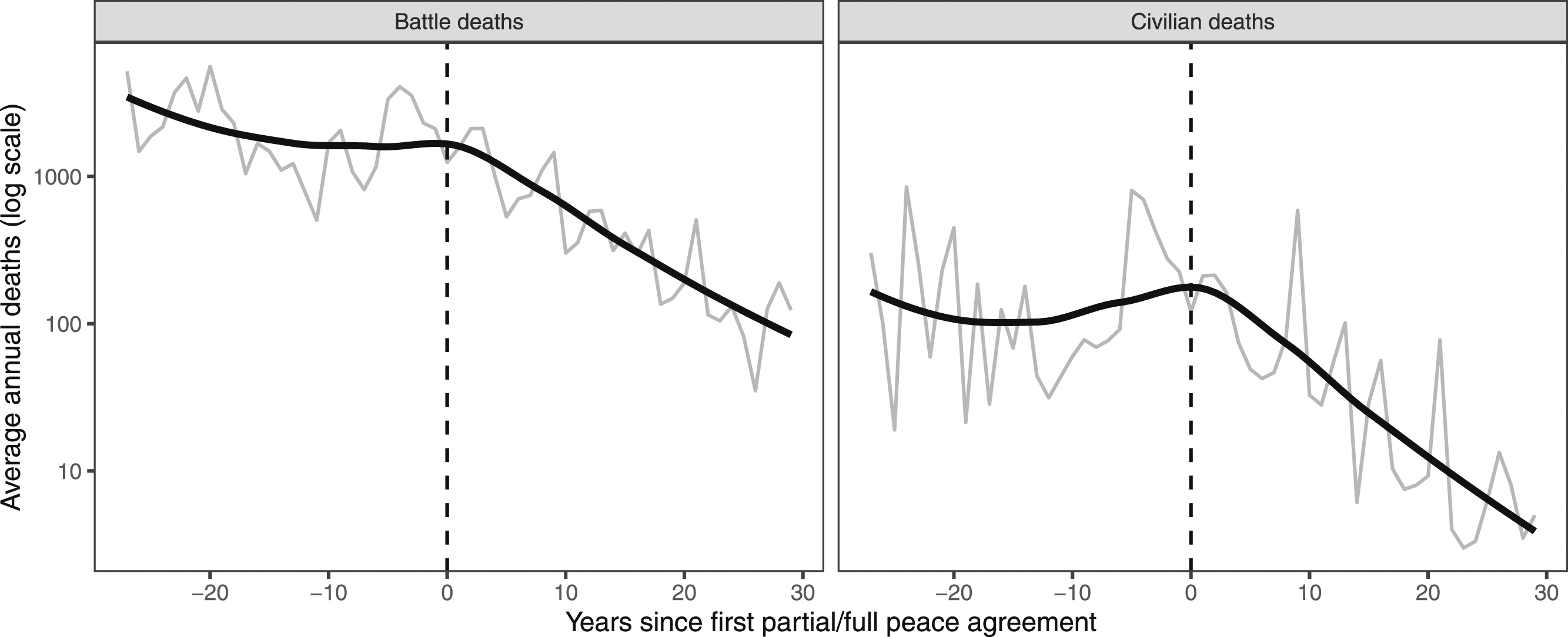
Figure 3 suggests that the signatories to peace agreements recognize the importance of peace processes for the broader population, with provisions regulating topics on citizens, such as social groups or civil society, featuring almost as frequently as topics that are typically thought of as being “elite-focused,” such as security sector reform and power sharing.
3
Many, if not most, rebel groups claim to fight on behalf of a broader population. Consequently, it is not surprising that peace agreement architects pay at least lip service to these groups when signing peace agreements and advancing peace processes. What is remarkable, however, especially given the almost equal distribution of elite vs. citizen topics, is that the academic study of peace processes has mostly focused on country-, group-, and elite-level explanations for the occurrence, nature, and outcomes of those processes. Citizen- and elite-focused topics within peace agreements. Note: Data on peace agreements are drawn from the PA-X database (Bell and Badanjak 2019). The Y-axis displays the annual share of peace agreements that mention at least one of the respective topics. “Security sector reform” refers to at least one provision on SSR for armed forces, police, or rebel forces. “Power sharing” refers to at least one provision on political, territorial, economic, or military power-sharing. “Social groups” refers to at least one provision on any of the groups listed as special social groups, for example, ethnic groups, in the PA-X database, and includes gender. “Civil society” refers to provisions that regulate civil society organizations and/or traditional leaders.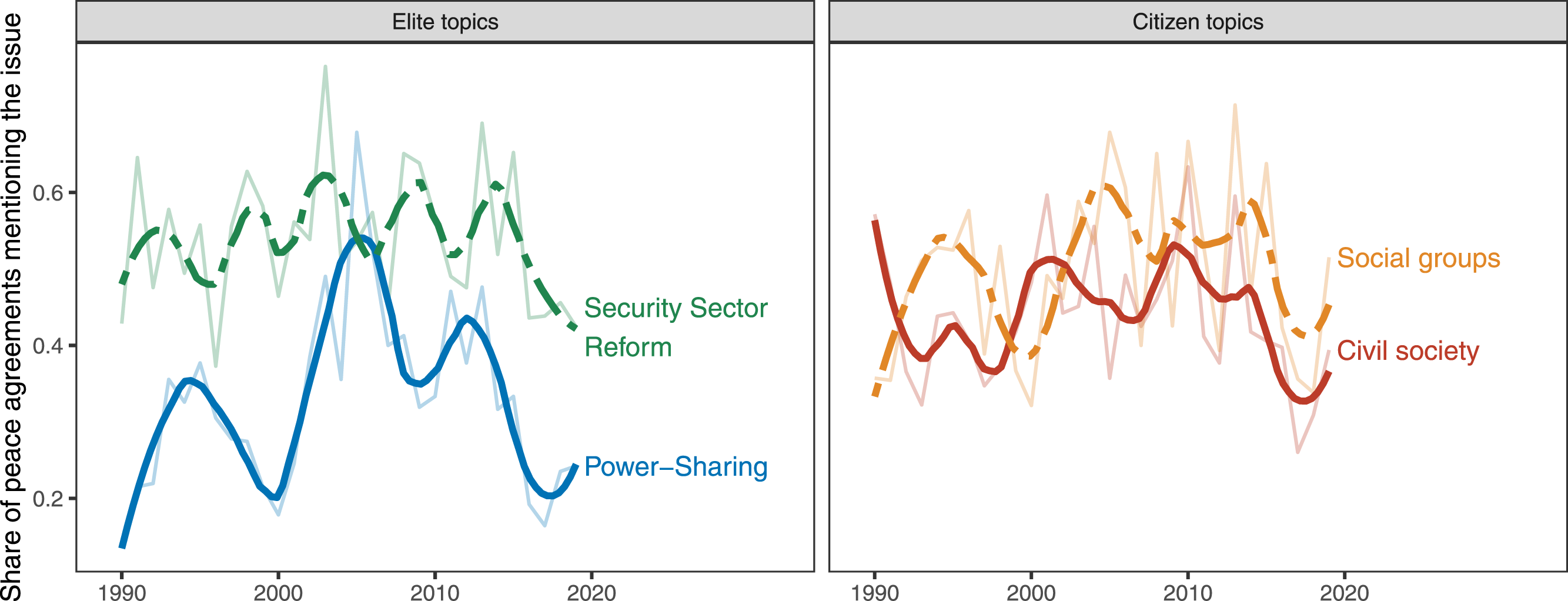
Literature
A large literature has investigated the conditions for peace after civil war at the analytical level of countries or dyads between rebel groups and governments. This scholarship focuses on the design of political institutions, international involvement and peacekeeping, and domestic context factors, such as ethnic diversity, colonial history, or demography (Cederman, Gleditsch, and Buhaug 2013; Gates et al. 2016; Hartzell and Hoddie 2007). What has remained unexplored so far, however, is the interplay between citizens’ political behavior and these conditions of peace. The analysis of this interplay is one that would bridge the micro-/macro-gap in existing research and thus help to inform a more holistic understanding of post-war politics.
Given this challenge, recent research on citizens in post-conflict settings has provided a first set of innovative and unique insights into peace processes. Three distinct strands of inquiry have emerged from this literature, each with its associated strengths and limitations. First, a number of studies explicitly examine citizen attitudes towards ongoing peace processes and the support citizens are willing to lend in order to make peace settlements a reality (Fabbe, Hazlett, and Sınmazdemir 2019; Haas and Khadka 2020; Tellez 2019b). Thus far, most of these studies focus only on the immediate aftermath of fighting. As a result, there is a need to explore the medium- and long-term dimension of peace processes to build better theories of citizens’ actions and attitudes in peace processes (Matanock 2021).
Second, several studies have their roots in impact evaluations of conflict prevention measures and peacebuilding interventions funded by international donors (Blattman, Hartman, and Blair 2014; King and Samii 2014). However, as Ditlman et al. (2017) point out, research in this strand often fails to link perceptions and attitudes at the micro-level and actual peacebuilding behavior on the meso- and macro-levels (Balcells and Justino 2014).
Finally, scholars explore the extent to which war experiences can shape behavior. One strand of research finds that affected individuals increase their participation in social organizations and display more cooperative behavior (Bellows and Miguel 2006; Fearon, Humphreys, and Weinstein 2009). Others have highlighted the “dark” side of conflict legacies: there is evidence that increased prosociality might be driven by cooperative behavior towards a people’s own in-group (Bauer et al. 2016), such as ethnic or religious groups. This is consistent with the finding that conflict exposure hardens attitudes toward the rival group (Grossman, Manekin, and Miodownik 2015). At the same time, there is evidence from Colombia that conflict experiences do not automatically translate into acceptance/rejection of a peace agreement (Liendo and Braithwaite 2018). Thus, the implications of conflict experiences for peace processes are not yet fully understood.
How Do Citizens Shape Peace Processes? And How Are They Affected by Peace Processes?
We define “citizens in peace processes” as encompassing the political behavior of non-combatants in contexts where two or more organized actors engage in efforts to end an armed confrontation in which they have been involved. This definition is deliberately broad, including everyone from villagers to refugees, bureaucrats, children, urban elites, and even close relatives of combatants. We are aware that, in practice, the boundaries between who is a combatant and who is not are fluid and thus may not be clearly drawn. 4 Nevertheless, we believe this concept of citizens in peace processes provides a useful starting point for efforts to theorize about the roles such actors play in efforts to end armed conflicts.
We use the term “political behavior” to refer to the perceptions and actions of citizens in these contexts. More specifically, we look at “any form of (individual or collective) involvement in the political process, or any activity which has political consequences in relation to government and policy” and at “political ideologies, values, and attitudes as the basis of participation and non-participation in the political sphere” (Scott and Marshall 2015, 571ff). 5 In the context of peace processes, this definition includes how peace processes shape citizens’ political belief systems, trust in political institutions, and/or attitudes towards other religious or ethnic groups, while citizens’ actions refer to a range of political behaviors. Often studied outside of conflict processes, such political behavior ranges from activism/volunteering, participating in protests, to electoral choice.
We propose a conceptual framework that examines citizens’ political behavior in peace processes across two dimensions (see Figure 4): Citizens’ political behavior as input into the peace process (i.e., an explanatory variable) and as output of the peace process (i.e., an outcome variable). The temporal order of a peace process. The temporal order rests on a continuum ranging from negotiation during/after fighting to implementation to long-term implications.
6
Input/Output and Temporal Dimensions of Citizens in Peace Processes.
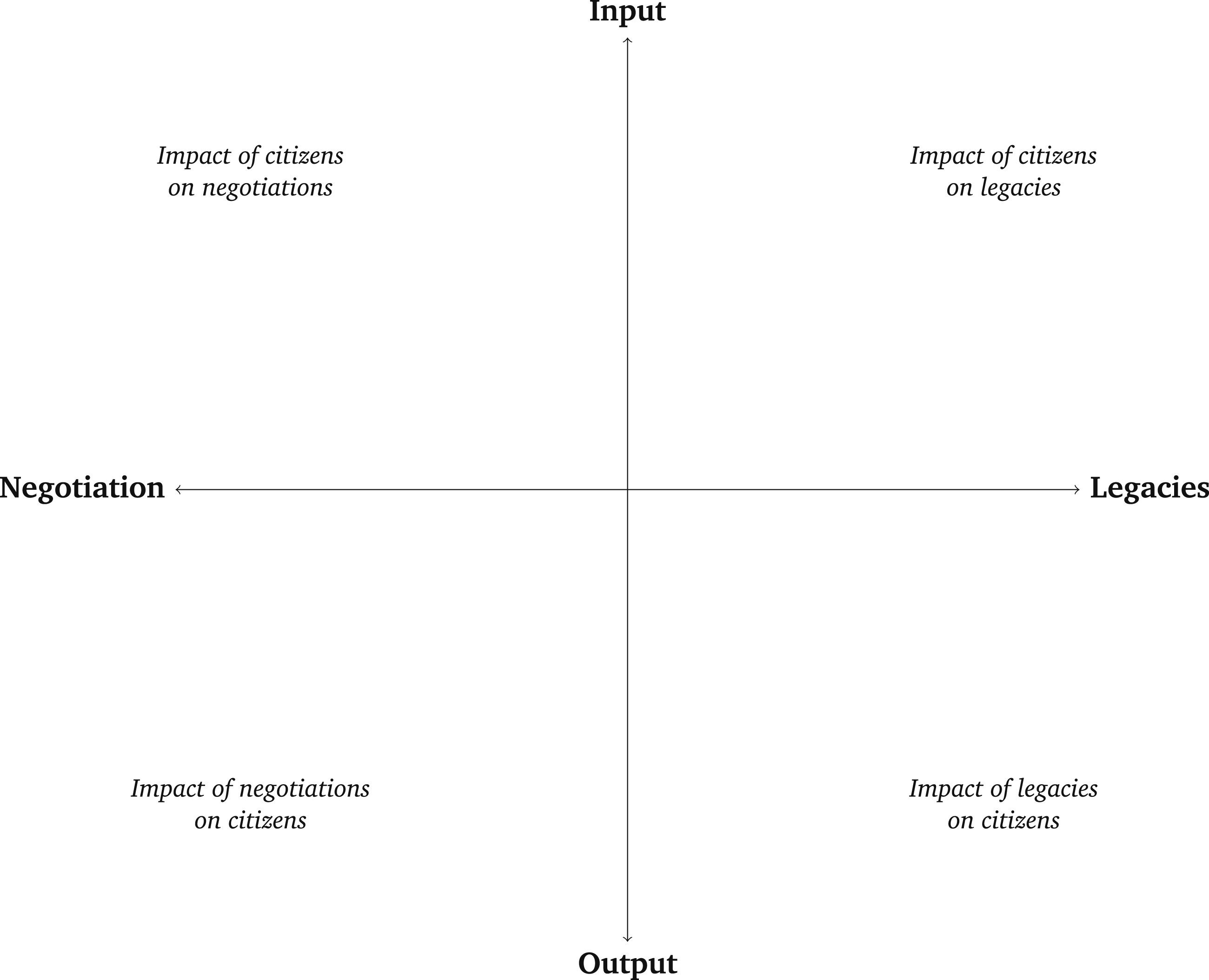
We combine both dimensions into a coordinate system that identifies four categories: (1) impact of citizens’ behavior and/or attitudes on peace negotiations (and, subsequently, implementation); (2) impact of citizens’ behavior and/or attitudes on peace process legacies; (3) impact of negotiations on citizens’ behavior and/or attitudes; and (4) impact of legacies on citizens’ behavior and/or attitudes. Even though these categories are conceptually distinct, we conceptualize them as continuous.
This conceptual framework has several benefits. First, the framework works as a useful heuristic device. It helps us to sort existing research as well as the contributions to this special feature into categories that capture the ways in which citizens can shape and are affected by peace processes. Second, the framework helps us to identify existing theoretical approaches that can be brought to bear when analyzing works within a particular category, for example, theories from related subfields regarding how public opinion impacts political outcome (input dimension) or how policies shape public attitudes (output dimension) (Kertzer and Zeitzoff 2017). By combining both the framework’s heuristic function as well as its ability to identify theoretical approaches that could be brought to bear in explaining the respective categories, the framework is useful for detecting research gaps, either theoretical and/or empirical. We use the framework in this fashion in the final section of this introduction.
Impact of Negotiations on Citizens
In the early stages of a peace process, citizens’ identities and beliefs are likely to be shaped by wartime cleavages, elite signaling and grievances. Research questions relevant to this part of the framework address the ways in which the peace process itself affects citizens’ propensity to become politically active, for example, through strikes or protests. Other questions focus, for instance, on how certain elements within peace processes, such as ceasefires, mediation, or negotiations, affect popular support for the fighting factions and resulting peace agreements (Fabbe et al., 2019; Matanock and Garbiras-Díaz 2018; Tellez 2019a). Two contributions to the special feature directly address such questions with respect to two crucial areas: the effect of agreement design on citizen support and the acceptance of transitional justice policies.
Loizides et al.’s “Citizens and Peace Mediations in Divided Societies: Identifying Zones of Agreement through a Conjoint Survey Experiment” focuses on the extent to which citizens from opposing sides of a conflict share a similar understanding of particular agreement provisions and the concessions needed to reach a settlement. The theoretical argument claims that each side can be compensated for compromises if the available options are bundled together in balanced packages. Loizides et al. demonstrate that the specific institutional design matters less for support among both groups than do other peace deal elements such as territorial settlement, security, and compensation. This is highly relevant as it indicates that elements of a deal that are crucially important to many of the negotiating parties (e.g., who gets a seat at the table, veto power) may not be as relevant to citizens themselves.
Mironova and Whitt’s “Due Process and Accountability under Transitional Justice: Evidence from Mosul, Iraq” addresses a long-running debate in the peacebuilding literature regarding the dilemma between peace and justice (Elster 2004). Mironova and Whitt offer an original contribution to this debate through an explicit focus on citizens’ attitudes towards post-conflict justice. Their study investigates whether the public supports government efforts to pursue justice through the punitive prosecution of insurgents. To examine their argument, Mironova and Whitt focus on the case of former Islamic State (IS) fighters standing trial in courts for their role in the 2014–17 occupation of Mosul, Iraq. The analysis rests on a survey of Mosul residents and former IS affiliates in camps outside the city and experimental survey vignettes involving trials of IS detainees. The central finding is that citizens on each side of the main conflict have widely differing understandings of the rule of law under transitional justice. Mosul residents generally are supportive of capital punishment for former IS fighters, but they are less likely to see harsh judicial outcomes as just or fair when due process has been violated. Individuals with IS affiliations, however, primarily focus on judicial outcomes. They do not see capital punishment as just or fair—irrespective of due process violations.
Impact of Citizens on Negotiations
In the early stages of a peace process, when conflict actors bargain over ceasefires and the conditions for initiating negotiations, some individuals become politically active and participate in protests in order to attempt to pressure conflict parties to sign and implement (or refuse to sign and/or implement) a peace treaty. Once negotiations have wound down and an agreement has been reached, the implementation period of a peace agreement begins. Citizens’ views and opinions can play a crucial role at this stage, influencing whether and how agreements are translated into political practice (Daly 2019; Hadzic, Carlson, and Tavits 2020; Tellez 2019a, 2019b; Wayne et al. 2016).
García-Sánchez, Matanock, and Garbiras-Díaz’s “Do Citizens’ Preferences Matter? Shaping Elite Attitudes towards Peace Agreements” focuses precisely on this relationship between citizens’ attitudes and political practice. While citizens’ support for peace negotiations is often pivotal to getting the process off the ground (and to keeping it going), political elites make the actual decisions regarding specific agreement provisions. García-Sánchez, Matanock, and Garbiras-Díaz therefore consider the extent to which citizens influence these decisions as well as whether political elites at the negotiating table are responsive to the concerns and preferences of citizens. Focusing on the peace negotiations in Colombia, they investigate what members of Congress think their constituents want out of the peace process and whether legislators change their positions on specific components of the peace agreement in response to revealed constituent preferences. The empirical findings indicate that legislators systematically underestimate citizen support for a key provision of the peace agreement, and that this misconception is shaped by the policy platforms of their respective political parties.
Impact of Legacies on Citizens
Legacies of peace processes encompass the lasting political effects that stem from the ways in which conflict parties conduct peace processes, civilian agency in those processes, and the relations between elites and citizens during peace processes. While we have learned much about how direct war legacies shape post-war political behavior (Bauer et al. 2016), our knowledge about the drivers and effects of legacies of peace processes for citizens is more limited. A core finding of existing research is that past events shape contemporary politics through specific transmission mechanisms, one of which is the degree to which people and their ancestors were directly or indirectly affected by violence (Walden and Zhukov 2020). However, we do not know yet how these transmission mechanisms can be triggered by peace processes themselves.
In light of this, Dyrstad, Binningsbø, and Bakke’s “Wartime Experiences and Popular Support for Peace Agreements: Comparative Evidence from Three Cases” explores the interplay between wartime experiences of violence, grievances, and how the combination of both affects individual attitudes towards agreement provisions. Dyrstad, Binningsbø, and Bakke rely on a set of comparative public opinion surveys from Guatemala, Nepal, and Northern Ireland. Their analysis reveals that the peace agreements in each case enjoy strong popular support years after the signing of the respective agreements—albeit with substantive variation across specific provisions. Dyrstad, Binningsbø, and Bakke also find that experiences of wartime violence and the grievances that fueled the civil war in the first place exert a significant effect on attitudes towards the settlement decades after the conflicts concluded.
In contrast, Carey, González, and Gläßel’s “Divergent Perceptions of Peace in Post-Conflict Societies: Insights from Sri Lanka” investigate the quality of the peace in a case resolved not by a negotiated settlement but by a government military victory: Sri Lanka. Their original survey enables them to explore how perceptions differ across the clear divide between the Sinhalese victors and the Tamils they defeated. The empirical findings show that the Sinhalese are more likely to favorably rate intergroup relations, personal security, freedom of speech and civil liberties in the aftermath of the conflict. Remarkably, however, the results indicate that the Sinhalese are also more concerned about the prospects for future peace and political stability than are the Tamils. This negative outlook appears to be partly the product of a lack of Sinhalese support for the heavy-handed treatment of the Tamil minority by the Sri Lankan government and a sense of weariness regarding political activism.
Impact of Citizens on Legacies
Finally, we turn to the input citizens can have on the long-term legacies of peace processes. One important topic in this regard is the question of how the inclusion of certain groups during peace negotiations affects the quality of post-conflict peace. For example, does the presence of women’s groups at the negotiation table and during the implementation period lead to improved human rights in the long term? Does public support during war and negotiations subsequently shape elite strategies for voter mobilization and, ultimately, electoral outcomes (Daly 2019)? While none of the special feature contributions speak directly to this dimension of our conceptual framework, some of the contributors’ findings and their policy implications do so indirectly.
The main finding of Mironova and Whitt’s “Due Process and Accountability under Transitional Justice: Evidence from Mosul, Iraq,” for example, is that citizens from opposing groups have very different understandings of the rule of law under transitional justice. While this divide in the perceptions of post-conflict justice does not appear to bode well for building peace, Mironova and Whitt still see potential for citizens to shape the legacies of peace processes. In this instance, the value attached to the rule of law by ordinary Iraqi citizens could be used to promote restorative and reconciliatory transitional justice measures, thus offering incentives for IS followers to surrender arms.
Similarly, Dyrstad, Binningsbø, and Bakke’s “Wartime Experiences and Popular Support for Peace Agreements: Comparative Evidence from Three Cases” presents a—at first glance—rather sobering conclusion. As they note, wartime grievances are likely to persist long after a civil war has been resolved through negotiated settlements. However, as Dyrstad, Binningsbø, and Bakke emphasize, these settlements can only begin to transform the underlying root causes of the conflicts when citizens actively begin to exert influence on the legacies of civil war and peace processes.
Conclusion
The emerging literature on citizens in peace processes can best be described as one united primarily by its diversity. In this special feature, we propose a conceptual framework that can help scholars contextualize existing studies as well as provide a means for thinking theoretically about when, how, and why citizens engage in peace processes and the effects their political behavior may engender. Our framework distinguishes between a temporal dimension and an input/output dimension of a peace process. The contributions to the special feature illustrate the diverse political behavior of citizens within the resulting categories.
The framework—and the findings of the special feature contributions—highlight a number of avenues for future research. To begin with, scholars need to further explore what the concept of citizens’ political behavior in peace processes entails and what it does not entail. While citizens’ actions and perceptions are typically closely linked (Dalton and Klingemann 2007), this might not directly translate to (post-)conflict contexts. For instance, persons who hold grievances against one ethnic group might not automatically also participate in public protests against this ethnic group. The reason for this disconnect is what Timur Kuran (1995) has described as “preference falsification”—a phenomenon that captures a situation in which citizens’ public behavior does not reflect true individual conviction. These situations can arise when the public display of behavior comes with costs, such as repression in an authoritarian system, or violence against civilians in conflict settings. Since the costs for public display of certain behaviors might persist in post-conflict settings, there is also a chance for a disconnect between attitudes and behavior. Several of the studies in this Special Feature section suggest that individual grievances can persist long after the formal end of a conflict, giving us reason to believe that the possibility of a disconnect between behavior and beliefs needs to be taken into account in the future study of citizens in peace processes.
Another overarching theme is the need to integrate the different phases of peace processes into a coherent theoretical perspective capturing the role of citizen involvement during the negotiation phase of a peace process and its effects on peace agreement implementation. Existing theoretical approaches that could advance this endeavor include the notion of so-called “two-level games,” bargaining situations in which the negotiating partners’ positions and behavior depend on the policy preferences of a larger group to which they are accountable (Brutger and Kertzer 2018; Putnam 1988). The core advantage of such an approach is the insights it can provide into the interactions between elites and their constituencies and how these ultimately shape the peace process, thus contributing to an explanation of the microfoundations of peace stabilization (Matanock 2021).
To explore the impact of peace negotiations/implementation on citizens, on the other hand, scholars could turn to the subfield of public policy and, in particular, the policy feedback loop. Of relevance here is the idea that, unless citizens perceive the policy changes in question as relevant to their lives, large reforms (which peace agreements certainly constitute) do not always lead to measurable changes in public opinion (Soss and Schram 2007). Such a finding has implications for the ways in which a peace agreement design and its implementation can shape citizens’ acceptance of the agreement and/or its implementation process.
Turning to the long-term implications of peace processes, our conceptual framework also offers a starting point for a more systematic exploration of the effects of more inclusive peace processes on citizens’ support for peace and—crucially—how citizens can shape these legacies themselves. One example of these key legacies is the extent to which the type of conflict termination—negotiated agreement or military victory—creates perceived “winners” or “losers” of a war (and its subsequent peace process) and whether, and if so, how, these outcomes then affect intergroup attitudes (Gibson 2004).
Regarding the question of citizen agency, on the other hand, the idea of deliberative democracy holds potential. Deliberative democracy denotes democratic practices that involve citizens in the political decision-making process beyond simply voting, such as citizen summits or town-hall meetings (Michels and Binnema 2019). While typically analyzed in the context of Western democracies, the purported effects of such policies, especially improved legitimacy of decisions, might be even more relevant in post-conflict societies. Empirical findings from a field related to conflict resolution, democratic transition, suggests that early deliberative practices and organizational features of non-violent campaigns lead to higher rates of democratic survival after successful regime transitions (Bayer et al., 2016). An exciting avenue for future research is whether early inclusion of citizens in peace processes leads to longer survival of peace in the long term. Connecting these windows of opportunity for citizen engagement theoretically and empirically should enable scholars to build a more comprehensive understanding of post-war peacebuilding. Such an understanding is crucial if researchers are to play a role in helping to empower those who need it most in the context of violence and destruction: the citizens themselves. Our hope is that this work constitutes one step in that direction.
Footnotes
Acknowledgments
We thank all the authors in the special feature section as well as two anonymous reviewers for helpful and constructive feedback on earlier versions of this introduction.
Declaration of Conflicting Interests
The author(s) declared no potential conflicts of interest with respect to the research, authorship, and/or publication of this article.
Funding
The author(s) received no financial support for the research, authorship, and/or publication of this article.
