




Abstract
Pre-negotiation is widely accepted as a means to convince intrastate conflict parties to negotiate formally; however, research has not yet established a causal link between early efforts to bring warring parties together and the outcome of any negotiated settlement. This gap begs the question: To what extent do activities during the pre-negotiation phase contribute to the signing of a peace agreement? Theory on interstate conflict suggests that pre-negotiation reduces risk, thereby convincing conflict parties that they have more to gain from negotiating than from fighting. However, in conflicts between governments and non-state armed actors, this article argues that reciprocity paves the way for reaching peace agreements. This article introduces a new dataset on pre-negotiation including nearly all intrastate armed conflicts between 2005 and 2015. Confirming previous findings, mediation is significantly and positively correlated with reaching a type of peace agreement; conflicts over government are more likely to end in a negotiated agreement than conflicts over territory or both government and territory. In contrast to existing qualitative research, this study finds little evidence that pre-negotiation increases the likelihood that conflict dyads sign peace agreements. Future quantitative research on this topic requires more nuanced measures of the conditions under which conflict parties shift from unilateral to joint decisionmaking.
Introduction
Pre-negotiation – the discreet interactions that move conflict parties closer to initiating formal peace talks – is considered best practice within the international negotiation field. Getting to the table is a major hurdle to clear without which there is no potential for a negotiated settlement (Zartman & Berman, 1982), given the plausible link between pre-negotiation and the outcomes of formal negotiation. Previous studies on pre-negotiation emphasize qualitative methods, rather than quantitative methods (Pantev, 2000: 57; Stein, 1989a,b) and no study has tested the generalizability of existing theories (Schiff, 2008: 389; Zartman, 2008: 308) due to the lack of comprehensive data. Information on pre-negotiation is typically not available systematically and processes are often kept secret. Scholarship has not reached a consensus on whether specific activities in pre-negotiation are significantly more important than others for reaching agreements (Zartman, 1985, 1989; Druckman, 1986; Druckman & Hopmann, 1989; Schiff, 2008: 388; Rothman, 1995). Moreover, the external validity of theories of pre-negotiation remains untested as theories have almost exclusively been derived from interstate conflicts (Stein, 1989a; Tomlin, 1989; Cohen, 1997; Griffiths, 1979).
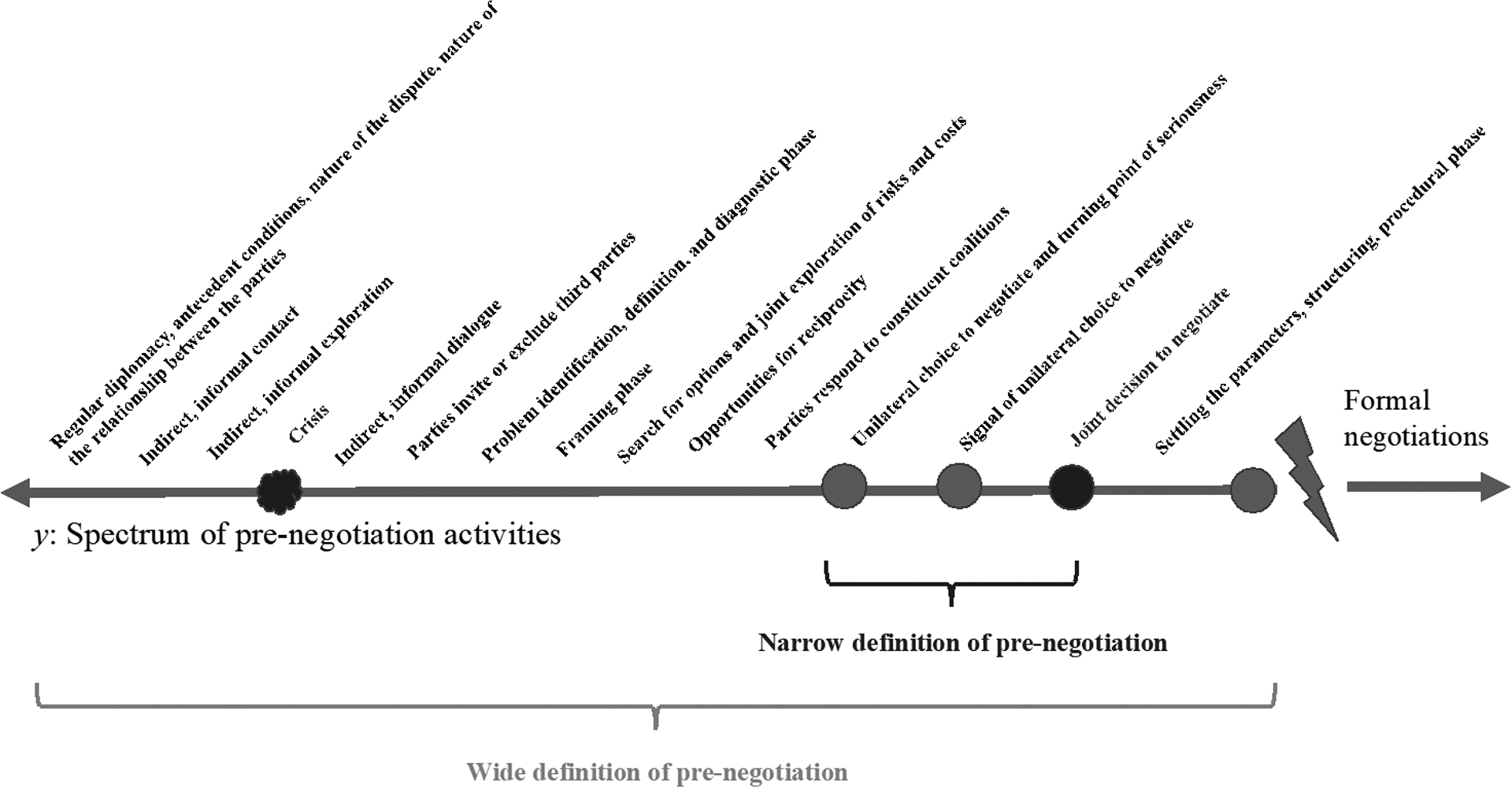
Wide verses narrow definitions of pre-negotiation
To begin to fill these gaps, this article examines the effectiveness of pre-negotiation in the context of intrastate armed conflicts by inquiring: To what extent does pre-negotiation affect the likelihood that governments and non-state actors in conflict will reach a negotiated settlement? Pre-negotiations are theorized to socialize parties away from adversarial bargaining towards problem-solving (Kelman & Cohen, 1976; Fisher, 1989; Rothman, 1995). The hypothesis that intrastate conflicts are more likely to be resolved in a negotiated agreement when parties engaged in pre-negotiations is tested against a novel dataset on pre-negotiations between intrastate conflict dyads from 2005 to 2015.
We could not address the data availability limitation caused by process secrecy; however, the dataset represents the first systematic, quantified collection of various secondary and tertiary sources. The meta-framework captures 23 activities and decision points during pre-negotiation with which the theories developed in qualitative studies on interstate conflicts are tested. The 14 models provide little support for the hypothesis that pre-negotiation contributes to the signing of peace agreements. The findings highlight the importance of reciprocal, early decisionmaking in the conflict resolution process, thereby lending support for socialization theories to explain the impact of intrastate pre-negotiation on negotiated outcomes.
Debated scope of pre-negotiation
Based on pre-negotiation in interstate and intrastate conflict cases such as the talks prior to the Oslo process between Palestinian and Israeli officials (Gewurz, 2000), or talks ahead of the Strategic Arms Limitations Talks between the Soviet Union and the United States (Griffiths, 1979), scholars have developed theories about the onset, development, and effects of pre-negotiation (see also Corbacho, 2008; Schiff, 2008; Fisher, 2007: 317; Chigas, 1997; Saunders, 1996; Stein, 1989a,b).
In pre-negotiations – a time period punctuated by ‘turning points’ – parties move from an adversarial to a cooperative approach to conflict and work toward a joint commitment to formally negotiate (Zartman, 1989; Tomlin, 1989; Saunders, 1991). Decisions by the conflict parties to negotiate can result from direct and indirect interaction (e.g. shuttle diplomacy or ‘informal dialogue processes’), thereby reducing uncertainty and managing complexity (Zartman, 1989; Druckman, 1986; Druckman & Hopmann, 1989; Schiff, 2008: 388; Rothman, 1995; Kelman, 1997; Fisher, 2007; Slim & Saunders, 1996; Susskind, Chayes & Martinez, 1996). There is no consensus, however, on the relevance of and optimal order for such decisions (Zartman & Berman, 1982: 42, 87; Tomlin, 1989; Stein, 1989a). These differences can be characterized as points along a spectrum that delineate wide and narrow definitions of pre-negotiation. This meta-framework (Figure 1) illustrates the internal activities and decision points occurring within pre-negotiation. 1 The progression from left to right roughly denotes time (t), with the caveat that components often overlap or repeat.
Among the widest of definitions, Jackson (2000) discusses ‘antecedent conditions’ of international negotiations, highlighting the ‘nature of the dispute’ and the ‘nature of the parties and their relationship’ (Jackson, 2000: 327). A mutually hurting stalemate is an often-cited external condition in the literature on ‘ripeness’ that forces the hands of parties to consider negotiations (Zartman & Berman, 1982; Zartman, 1989: 232). 2 Likewise, Cohen (1997) begins his framework with ‘preparation’ and ‘beginning’ and emphasizes the differences between high- and low-cultures in being either relationship-oriented or task-oriented in their approach to pre-negotiation (Cohen, 1997: 67).
Diagnostics and framing
Moving toward the right along the spectrum in Figure 1, most pre-negotiation scholars include a ‘diagnostic’ or ‘framing’ phase in which the conflict parties seek common definitions of their issues and problems (Zartman, 1989; Rothman, 1990; Saunders, 1991; Tomlin, 1989; Stein, 1989a). For pre-negotiation to progress, parties need a ‘mutually acceptable definition of the problem’ (Zartman, 1989: 247), though not necessarily a shared understanding of how the problem emerged (Saunders, 1991; Stein, 1989a).
Here, parties generally agree, at least in appearance, that the status quo no longer serves their interests, begin to ‘overcome suspicion’ of each other and accept the asymmetrical distribution of power (Saunders, 1991: 67). To specify which trade-offs exist, parties create options and reduce uncertainty about underlying interests (Zartman, 1989; Tomlin, 1989), thereby revealing bargaining ranges and a ‘zone of possible agreement’ for non-zero-sum agreements (Raiffa, 1982). Parties may delineate what will be on the agenda by ‘selection and elimination’ of themes and issues, or decide whether they are seeking a partial or comprehensive solution (Zartman, 1989: 246; Stein, 1989a; Schiff, 2008). Theoretically, throughout this process, the conflict parties slowly devalue the goals they held while fighting.
Actor inclusion and exclusion
The inclusion or exclusion of actors, such as mediators, peace support units or guarantors (Fisher, 2007; Stein, 1989a; Zartman, 1989) has bearing on the available resources for complexity reduction and information exchange, since these parties can offer negotiation training (Chigas, 1997; Fisher, 1989), problem-solving workshops (Kelman & Cohen, 1976; Fisher, 1989, 2007), financial support (Saunders, 1991), or give other types of support. Each offer entails a decision point to accept, modify, or reject.
Domestic and transnational constituencies (e.g. diasporas, electorates, elites, and elected officials) may put pressure on either or both parties (Tomlin, 1989; Putnam, 1988; Stein, 1989a; Kelman, 1997), creating another inflection point. Conflict parties may act upon these groups to augment or dismantle coalitions according to their interests (Stein, 1989a; Kelman, 1997), and may make public commitments to generate bargaining leverage (Leventoğlu & Tarar, 2005). Even at the Track 1 level, parties must sometimes derive a mandate or requisite level of authority to be able to represent all constituents, not just a portion of them, in a way that supports a settlement (Saunders, 1991). These outside conditions create opportunities for the parties to modify their relationship.
Trust- and confidence-building measures
Lack of trust constitutes a major impediment to formal negotiations (Saunders, 1991; Kelman, 1997: 193). Trust-building between conflict parties in the early stages (Schiff, 2008; Kelman, 1997; Stein, 1989a) can increase confidence that rules and norms of the process will be upheld, and that parties will not take advantage of an enabling security situation to harm their opponent (Fearon, 1995). Problem-solving workshops and cultural elements such as linguistic power dynamics, meeting space orientation, or attending artistic performances or sporting matches increase ‘liking and trust’ (Rothman, 1995; Zartman, 1989: 249–250; Fisher, 1989: 455–456). Another form of trust-building involves testing of chains of command through temporary ceasefires, exchanging or releasing prisoners and hostages, and preliminary disarmament.
Signals of commitment
With an agreement in sight that serves the parties’ self-interests and benefits them more than their ‘security point’ or ‘best alternative to a negotiated settlement’ (Zartman & Berman, 1982; Ury & Fisher, 1981; Fisher, 2007), parties signal their ‘commitment to negotiate’ (Saunders, 1991; Tomlin, 1989) which marks the beginning of the narrowest definition of pre-negotiation (Zartman, 1989: 240). Tomlin (1989) differentiates between the respective parties’ internal decision calculus to commit to negotiation and the subsequent expression of that commitment to the other party. This distinction is important because ‘leaders [tend] to maintain their option to exit at the lowest possible cost by delaying [the expression of their] commitment to negotiate’ (Stein, 1989a: 251). Zartman & Berman’s (1982: 87) ‘turning point of seriousness’ is when parties decide that multilateral negotiation is optimal (see also Fisher, 2007). Zartman (1989: 240) and Schiff (2008: 389) argue that this marks the end of pre-negotiation and the outer bound of the narrow definition.
Procedures
The widest definitions of pre-negotiation include decisions regarding procedural elements of how the formal talks will progress. Parties take time to jointly structure the negotiations (Saunders, 1991: 68–69; Rothman, 1990; Tomlin, 1989: 261), for example by deciding on a start date, location for formal talks, and seating arrangements (Saunders, 1991). Scholars tend to agree that this component takes place right before formal negotiations begin. In the widest frameworks, pre-negotiation ends where ‘formal’ negotiation begins (Tomlin, 1989; Saunders, 1991).
Theoretical argument and hypothesis
Reducing the costs generated by uncertainty may help parties get to the formal table, yet, social learning explains why parties support a final agreement (Griffiths, 1979; Fisher, 1989; Stein, 1989a; Kelman, 1997). A social-psychological approach suggests that pre-negotiations socialize parties to shift their approach from adversarial bargaining to cooperative problem-solving (Kelman & Cohen, 1976; Kelman, 1997; Fisher, 1989; Rothman, 1995). Social learning, as a non-continuous, incremental process, broadens the available options for action and helps parties move away from hard, positional bargaining. Parties do so by encouraging frequent, iterated, joint decisionmaking that normalizes nonviolent means of problem-solving. As conflict parties make incremental, low-cost decisions together, they learn about themselves, their opponents, and the new rules of the conflict resolution mechanism (Stein, 1989a: 266–267). More specifically, parties learn about ‘the trade-offs, the risks, the opportunity costs of alternatives, and the nature of their domestic constraints and opportunities’ (Stein, 1989a: 266). They learn about the technical components of the key issues of contention (Nye, 1987: 383), update their views of their own abilities to find a unilateral, military solution (Griffiths, 1979), and revise their perceptions, attitudes, and ‘win–lose orientation’ toward their opponent (Fisher, 1989: 442). Each joint decision made signifies learning.
Iterated decisionmaking generates a heightened sense of reciprocity (Kelman, 1997). Kelman (1997: 207) argues that ‘a strategy of mutual responsiveness is likely to have an impact that goes beyond compliance, inducing changes at the level of identification and potentially at the level of internalization’. This creates a feedback loop that Kelman calls ‘mutual reassurance’ or ‘mutual responsiveness’ in which the more they know about themselves, their opponents, and their context, the better they manage their likely contentious relationship (Kelman, 1997: 204, 207).
3
The more responsive the parties are to each other’s needs, the more likely they are to generate more options and cooperatively find a ‘zone of possible agreement’ (Kelman, 1997; Raiffa, 1982), increasing the likelihood that they will reach an agreement. Understood this way, pre-negotiation encourages increased contact, mutual understanding, and the creation of cooperative habits to resolve incompatibilities.
Hypothesis: Intrastate armed conflict dyads that engage in pre-negotiation are more likely to reach a peace agreement than those that do not.
The peace process in Nepal that culminated in the signing of the Comprehensive Peace Accord (CPA) in November 2006 illustrates the importance of testing this hypothesis. In 1996, the Communist Party of Nepal-Maoist (CPN) instigated an armed conflict with the goal of abolishing Nepal’s monarchic political system. In 2000, the CPN and Congress party leader Sher Bahadur Deuba engaged in informal dialogue to develop recommendations on how to resolve the conflict. In July 2001, Deuba had become the prime minister and engaged with the CPN in three rounds of formal peace talks until November 2001 (Whitfield, 2008). During the intervening period from 2000 to 2006, the parties experienced many aspects of pre-negotiation ranging from informal dialogues to formal attempts at peace talks.
A recurring issue in this process was the frequent turnover of actors who claimed to negotiate on behalf of the government. From the CPN’s viewpoint, this churn made it difficult to determine who was the legitimate negotiating partner, spurring them to refuse to negotiate with the political party instated by the Nepali king in 2003 (Whitfield, 2008). In February 2005, King Gyanendra dissolved the parliament (Whitfield, 2008; Khatiwada, 2014). In response, the political parties, civil society, and the CPN formed an alliance. Deuba called for collaboration among these actors, culminating in the Seven Party Alliance (SPA) (Fisas, 2007), thereby ‘ripening’ the conflict for formal negotiations.
The agenda of the official talks in 2006 had already been subject to negotiation back in 2000 (Whitfield, 2008: 5). The complexity of a 75-point demand list issued by one negotiating party was transformed into a manageable 12-point agenda that became the basis for the peace agreement.
Under a narrow definition of pre-negotiation, only the post-2005 phase would be considered to be a significant factor in achieving a peace agreement; however, the informal channels that remained open proved crucial, allowing parties to take advantage of a window of opportunity. Using the wide definition, the proximity of the positions of Maoists and other stakeholders prior to their alliance was the result of continuous exchanges in informal backchannels and the release of political prisoners (Fisas, 2007: 94).
Research design
Case selection
Information on pre-negotiations in intrastate conflicts were gathered primarily from the tertiary data in the Yearbooks on Peace Processes (Yearbook) covering the years 2005 to 2015 (Fisas, 2006–16). Governments often begin exploratory talks with one of many armed groups that are challenging their authority, or run separate pre-negotiations with multiple armed groups as part of a piecemeal strategy (Zartman & Berman, 1982). Even when parties meet in good faith, pre-negotiation often progresses in fits and starts as conflict parties may engage in several pre-negotiation attempts before a formal negotiation ensues. Therefore, the conflict dyad-year is the unit of analysis.
Inherent in many studies on peace processes is selection bias based on non-random sampling of governments and rebel groups that self-select into negotiation processes (Reed, 2002). Moreover, military victory cannot be dismissed as a conflict outcome (Kreutz, 2010). To know whether the conditions present in the cases that negotiated are different from those that pursued a military end to the conflict, this study includes all intrastate armed conflicts from 2005 to 2015. The pre-negotiation variable and its components are integrated with the fourth version of the UCDP/PRIO Dyadic Dataset on armed conflict (Melander, Pettersson & Themnér, 2016; Harbom, Melander & Wallensteen, 2008). This captures all armed conflicts in which ‘at least one conflict actor is the government of a state’ and which had more than 25 battle-related deaths per year (Melander, Pettersson & Themnér, 2016: 727).
Pre-negotiation often takes place during times of so-called ‘inactive’ conflict when there are fewer than 25 battle-related deaths per year; to account for this, conflict dyad-years that fell below this threshold are included. The data include observations of conflict dyad-years once the group appeared in the Yearbook 4 within the time period of study, and had not yet ended in military victory by the government or non-state armed group. The existence of an armed conflict actor is determined by using the outcome variable within the UCDP Conflict Termination Dataset that is based on the ‘events during the first year of non-activity’ (Kreutz, 2010, 2016: 9). The conflict dyads are coded for every year until they are terminated by military victory or if the conflict actor ceases to exist under that particular name. This study continued to follow dyads that were coded as terminated with a peace agreement, ceasefire, or low-level activity to include both active and inactive intrastate armed conflicts in the sample.
The choice of source material plays a role in reducing selection bias. The Yearbook includes 67 country-level cases 5 of inter- and intrastate armed conflict between 2005 and 2015. The Yearbook includes successful and failed peace processes. Additionally, it reports on those peace processes that had major pre-negotiation processes and those with little to no pre-negotiation. The source also documents interruptions in the processes, not just the rounds of pre-negotiation that resulted in formal negotiations. The Yearbook’s selection criteria are: (1) most, though not all conflicts in the Yearbook ‘relate to armed conflict’ in that they are either active or inactive (Fisas, 2006: 4); (2) included conflicts moving towards some form of negotiations; and (3) ‘conflicts are included regardless of [their level of success] whether the negotiations are: formal; currently in an exploratory phase; proceeding satisfactorily; or at a standstill’ (Fisas, 2006: 4). The Yearbook documents ongoing peace processes at the time of each edition, and the history of the conflict.
The methodology by which the Yearbook collects the empirical data for its reports is somewhat unclear. 6 Each country-conflict report is accompanied by additional readings that appear to be the citations, but this is not made explicit. Some of the types of sources used to compile the case descriptions include media outlets, research institutes, mediation and negotiation support organizations, multilateral organizations, and foreign ministries, among others. As a result, potential biases are difficult to decipher.
Additional selection criteria for the sample included the type of conflict dyad and time period. Interstate and non-state, 7 as defined by the UCDP, are excluded (see Online appendix A for excluded cases) (UCDP, 2017). 8 The primary reason for this criterion was the research gap on pre-negotiation in intrastate conflicts, the most prevalent type of conflict in the period of study (Melander, Pettersson & Themnér, 2016: 729). Pre-negotiation cases were excluded if the connection between a non-state actor and its ‘non-violent’ political affiliates (political party or tribe) was not explicitly clarified, to avoid misattribution of cases or making assumptions about the command and control structure of organizations. Due to data availability, the time period of study is 1 January 2005 to 31 December 2015. The sample for this study consists of 1,079 intrastate conflict dyad-years.
Independent variable: Pre-negotiation
Figure 2 illustrates the structure for determining the degree of pre-negotiation. This operationalization invokes the definition of pre-negotiation as an iterative process during which parties move from unilateral to joint decisionmaking. This simulates the progression from bargaining to problem-solving and captures the five main components of narrow and wide definitions: (1) diagnostics and framing, (2) actor inclusion and exclusion, (3) trust- and confidence-building measures, (4) signals of commitment, and (5) procedures. In line with most pre-negotiation theories (Zartman, 1989: 237), there is no requisite time order for the variables.
The information in the Yearbook is coded according to the parameters in Figure 2, including a pre-negotiation dummy. If the conflict dyad-year had any one of the pre-negotiation activities listed in Figure 2, it received a value of 1. Pre-negotiation is also captured as a nominal variable by summing the number of activities within each of the five components of pre-negotiation. The wide definition of pre-negotiation was operationalized as a sum of the values of all five categories (all pre-negotiation activities count). Commitment count captures the narrow definition of pre-negotiation, using only a sum of the values of the commitment variables – offers to negotiate formally and public commitments to that decision.
Pre-negotiation is terminated when conflict dyads break off talks or begin formal negotiations. Conflict dyads involved in formal peace negotiations prior to the period of study were coded as having no pre-negotiation, until subsequent years showed otherwise.
9
The formality of negotiations was determined by the presence of at least one of these factors: (1) parties agreed to a peace process agreement, set a date, and pursued the agreed-upon format; (2) contextual factors such as whether the parties changed location from an informal space (e.g. outpost, jail) to good offices or a capital city; (3) whether there was a shift in negotiation tactics from third-party shuttle diplomacy to direct talks; or (4) whether the talks were more widely publicized. At least one of these criteria had to be met for a particular process between conflict dyads to be considered a ‘formal’ negotiation. If the Yearbook reported on a particular conflict dyad and it contained no evidence to suggest the presence of any one subcomponent of pre-negotiation, it was assumed that the subcomponent had not happened. The same coding techniques were applied for armed groups that appeared within the UCDP Dyadic Dataset and whose respective country of operation was covered in the Yearbook, even if the Variables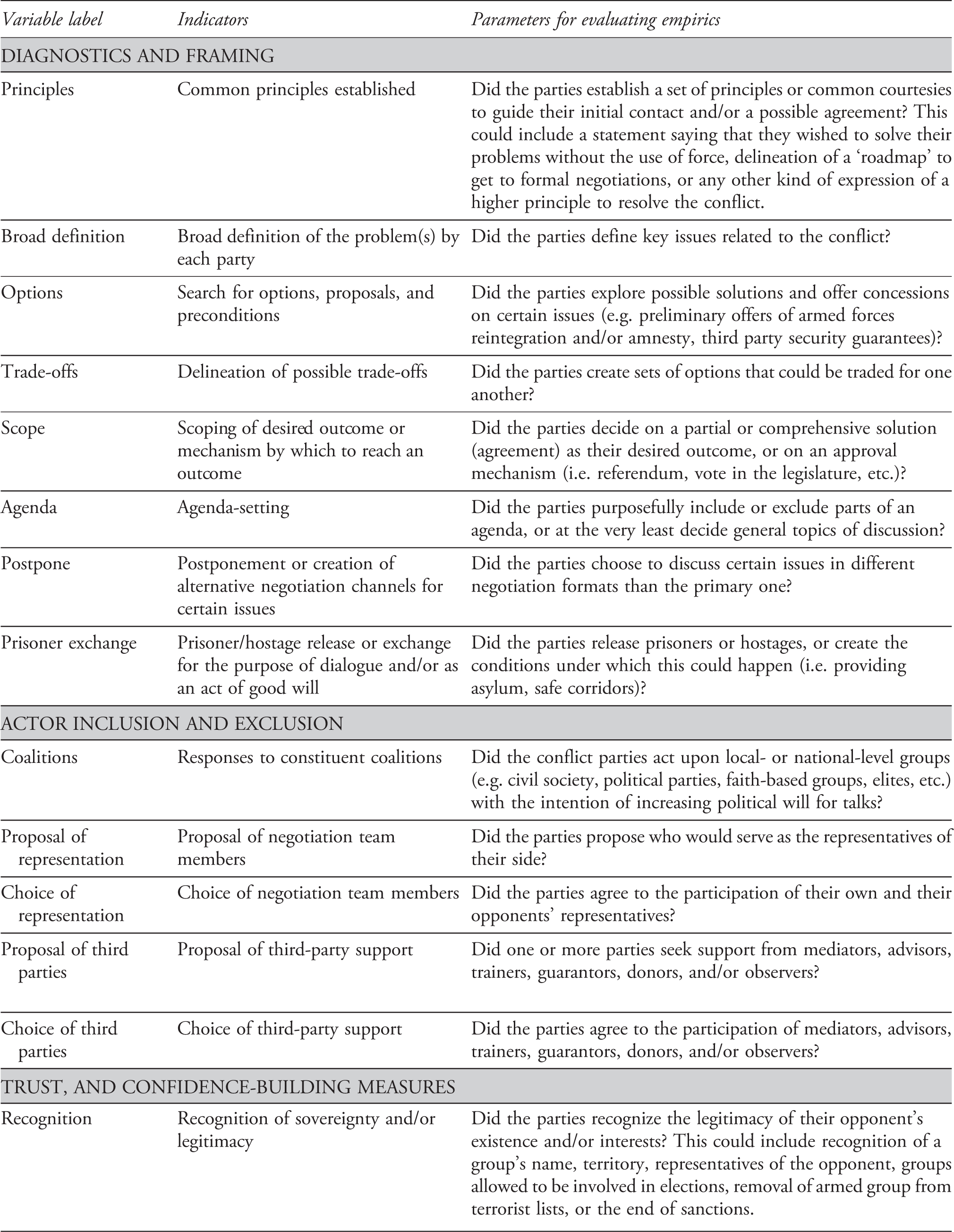
Actors in the Yearbook and the UCDP Actor Dataset (UCDP, 2016) were matched manually by their respective names. Those actors that could not be matched, for example with additional corroborating sources, were excluded (see Online appendix A). This article follows the coding conventions established by the UCDP Dyadic Dataset for groups that splinter and create coalitions (Themnér, 2016: 3–4; 2014: 9, 13). If an armed group joins a coalition and the coalition enters into pre-negotiation with the government, every group in the coalition is coded as having the same attributes of pre-negotiation.
Dependent variable: Peace agreements
Data on the Peace agreement type was drawn from the UCDP Peace Agreement Dataset that covers ‘peace agreements signed between at least two opposing primary warring parties in an armed conflict from 1975 to 2011’ (Högbladh, 2011; Harbom, Högbladh & Wallensteen, 2006). The variable is disaggregated by conflict dyad-year as Full agreement, Partial agreement, or Peace process agreement according to definitions already established by the dataset (Högbladh, 2011). The Peace agreement dummy (Högbladh, 2011) condensed the ordinal variable for peace agreements into a dichotomous variable: a value of 1 signifies that at least one peace agreement of the three types of agreements was signed in that year. A dyad-year with more than one type of agreement has the value 1.
The Peace Agreement Dataset recorded 37 armed conflict dyads that reached an agreement between 2005 and 2011. Agreements that were interstate and non-state in nature were dropped. Subsequent articles on peace agreements filled in data gaps between 2012 and 2015 where the Peace Agreement Dataset left off (Pettersson & Wallensteen, 2015; Themnér & Wallensteen, 2014, 2013). Information on the year 2015 is bolstered by media and International Crisis Group reports to cover the remaining months of that year (Jezequel, 2015; ICG, 2016), since Melander, Pettersson & Themnér (2016) did not discuss peace agreements.
Control variables
The model controls for three additional variables that potentially affect the relationship between pre-negotiation and instances of peace agreements: difficulty of the conflict, previous pre-negotiation attempts, and mediation.
The difficulty of conflict has been established as a possible confounder for negotiation and peace processes, suggesting that it may also affect pre-negotiation. The longer the conflict has been occurring, the longer it takes to negotiate a settlement (Albin & Druckman, 2014; Fisas, 2006, 2015). To capture the effect of the difficulty of the conflict on pre-negotiation and coming to agreement, this study used Intensity and Incompatibility in the UCDP Dyadic Conflict Dataset as controls. Intensity is an ordinal variable with two categories: between ‘25 and 999 battle-related deaths’ and 1,000 or more battle-related deaths in a given year (Kreutz, 2010: 6). If a case had between 0 and 24 battle-related deaths in a given year, a value of 0 for Intensity was assigned. Incompatibility is ‘what the parties claim to be fighting over’ and is coded in three categories (Kreutz, 2016: 6): territory, government, or both. The conflict Incompatibility is considered time-consistent, thus ‘inactive’ years were coded with the same value as preceding ‘active’ years.
Previous attempts at pre-negotiation may affect both pre-negotiation and subsequent peace agreements in opposite ways. If parties need to meet in the context of pre-negotiations multiple times, it may suggest that their positions prevent forming a win-set needed for a formal agreement, or that issue indivisibilities inhibit the creation of a bargaining range (Toft, 2006). Previous studies highlighted that parties sometimes perpetuated a state of pre-negotiation to enhance their public image (Stein, 1989a: 247), thereby elongating the process and decreasing the likelihood of agreement. Alternatively, multiple failed attempts at pre-negotiations can galvanize war-weary constituencies to pressure the parties, creating image costs for them and incentivizing agreement. In addition, sunk political costs serve as another motivation to continue the path of pre-negotiation (Stein, 1989a: 243). Moreover, conflict parties likely learn from mistakes and try new approaches to reach an agreement (Ury & Fisher, 1981).
Previous pre-negotiation attempts by conflict parties prior to 2005 were denoted with a Previous pre-negotiation dummy. Any attempts made among the conflict dyads from 1981 to 2004 referenced in the Yearbooks were captured and the corresponding years of pre-negotiation were listed (Previous pre-negotiation year). If a group splintered, but its predecessor engaged in pre-negotiation before 2005, Previous pre-negotiation for the splinter group received the value 1. If a group changed its name or all the combatants joined the new group, the new group inherited the Previous pre-negotiation coding decision from the old group.
Mediation is a possible confounder, as it may increase the likelihood of pre-negotiation occurring in the first place, as well as affect the outcome. Prospect theory predicts that the initially high levels of risk aversion that conflict parties experience can be reduced over time by actors – such as mediators – who work to reframe choices, problems, and solution sets (Kahneman, 2011). The framing and options-creation tasks that mediators support make negotiations appear less risky than the parties initially perceive (Fisher, 1989). By engaging both parties while they are still making unilateral decisions in pre-negotiation, a mediator likely increases the probability that the parties make it to the table and subsequently agree (Beardsley, 2008).
Results
Descriptive statistics
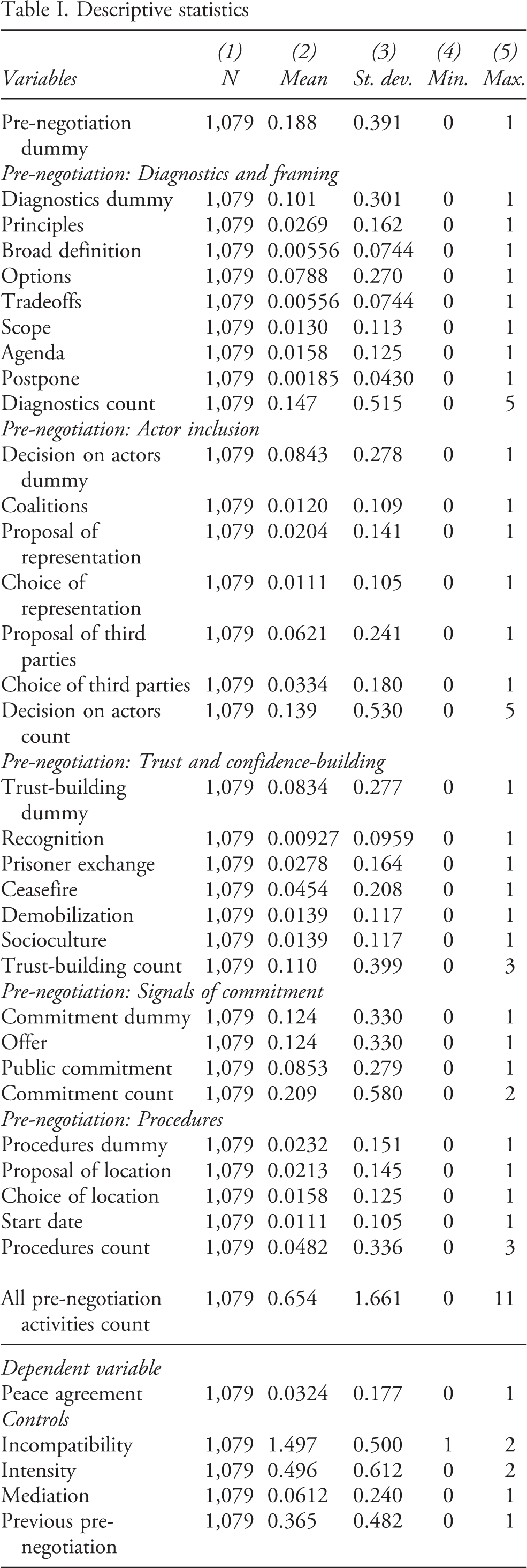
The regression results can be found in Table II. Model 1 is a baseline model of the dummy variable for pre-negotiation and the dependent variable, peace agreement. Model 2 includes four additional, theoretically relevant controls: Incompatibility, Intensity, Mediation, and Previous pre-negotiation. Model 3 carries forward the two control variables that were significant – Incompatibility and Mediation – and tested the variables associated with the first component of pre-negotiation: diagnostics and framing. Model 4 does the same with actor inclusion and exclusion; Model 5 with trust- and confidence-building measures; Model 6 with the conflict parties’ signals of commitment; and Model 7 with the procedural elements of pre-negotiation.
Logistic regression results of components of pre-negotiation
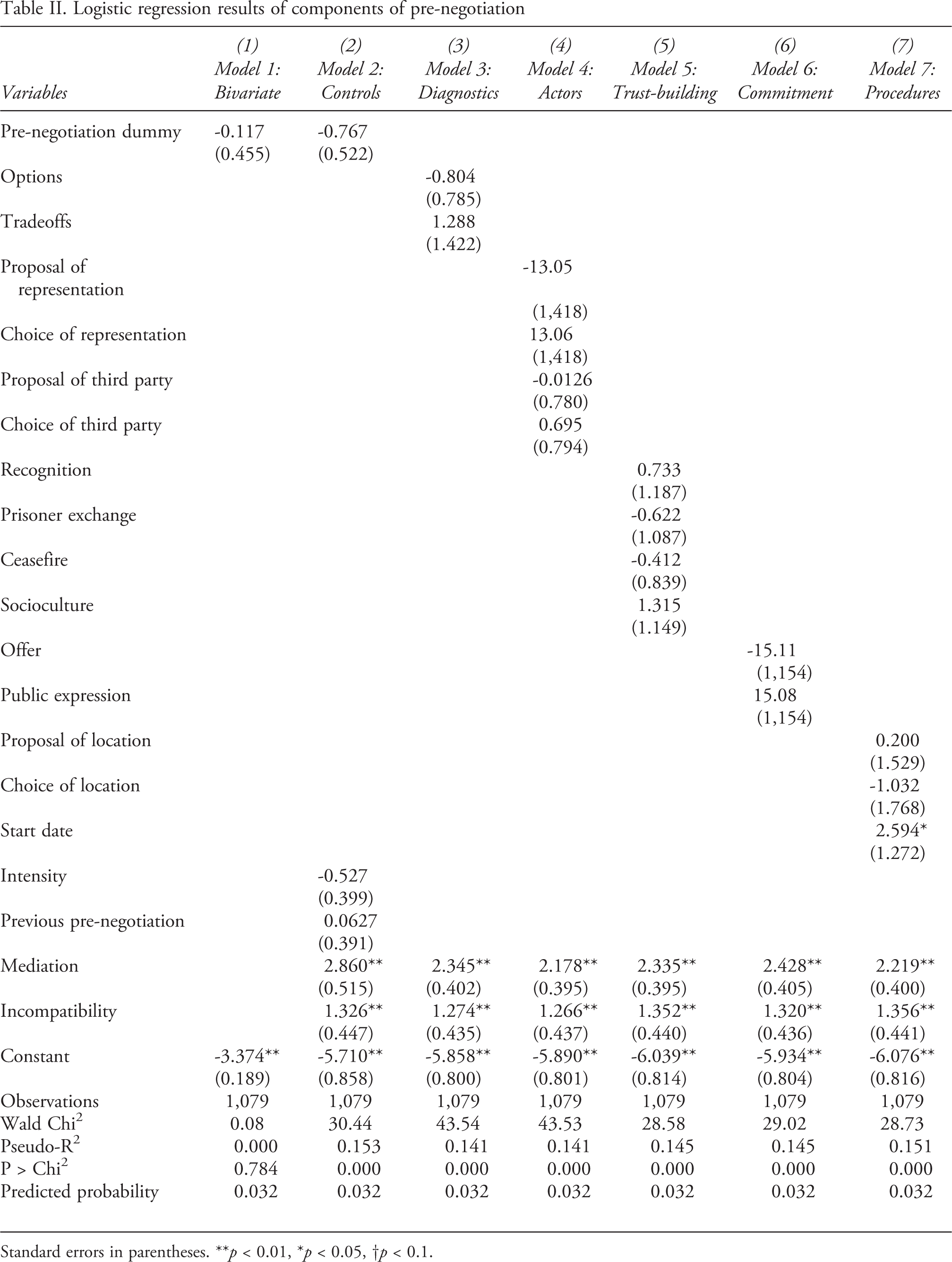
Standard errors in parentheses. **p < 0.01, *p < 0.05, †p < 0.1.
Logistic regression of dummy variables for pre-negotiation components, standard error clustered by conflict dyad
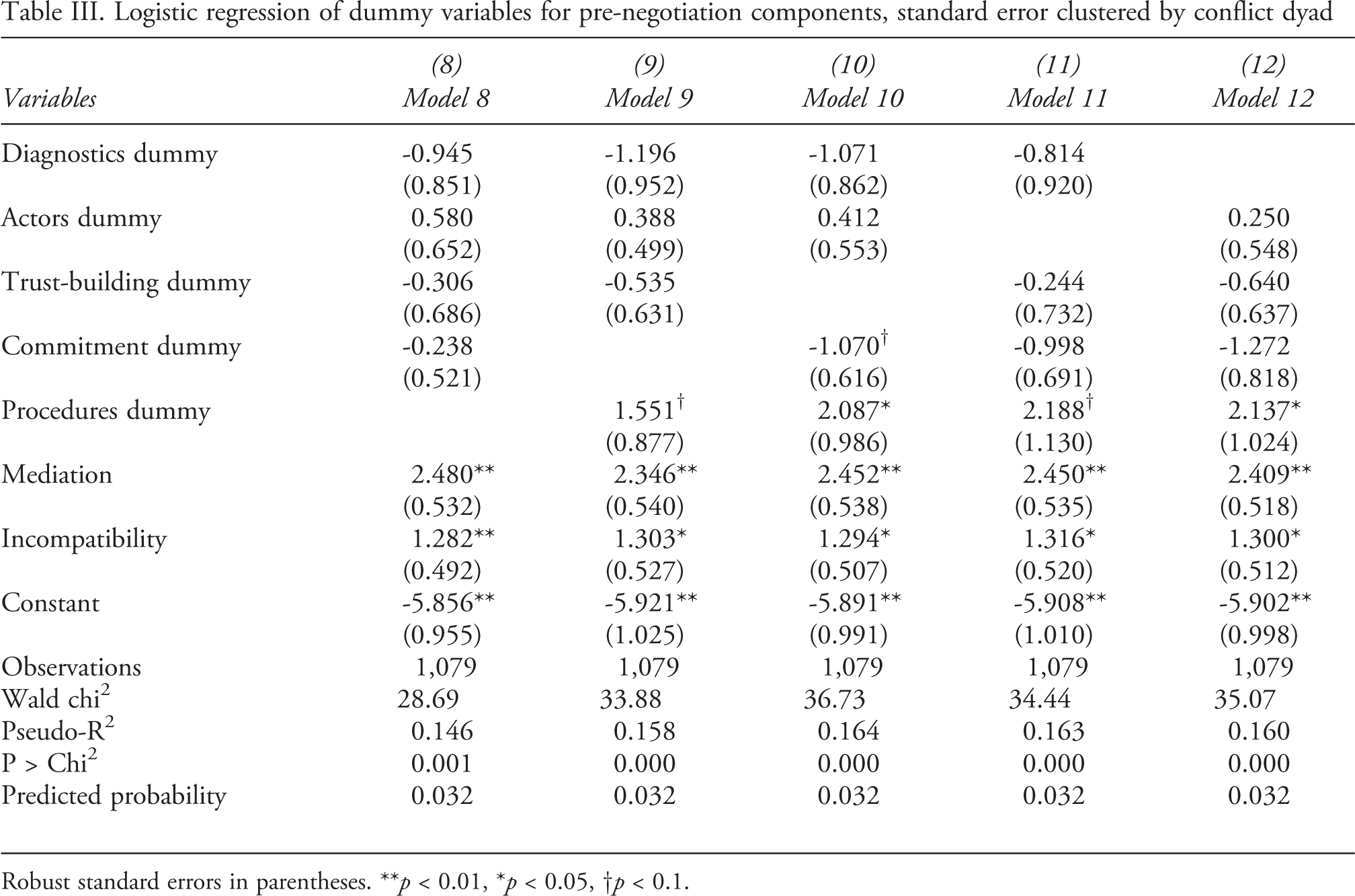
Robust standard errors in parentheses. **p < 0.01, *p < 0.05, †p < 0.1.
Models 13 and 14 in Table IV compare logistic regressions of the nominal variables representing wide pre-negotiation (All pre-negotiation activities count) and narrow pre-negotiation (Commitment count) and the relevant controls.
Sixty three conflict dyad-years dropped out of the models, as the variables Principles, Broad definition, Scope, Agenda, Demobilization, and Postpone were either multicollinear or perfectly predicted that no peace agreement was signed. Due to the small number of observations lost and the presence of many other variables measuring the five components of pre-negotiation, the omission is unlikely to have significantly influenced inferences made. Agenda-setting can be argued to be an important part of the pre-negotiation process: if the parties cannot agree on agenda items, there is nothing to negotiate. This can call into question the quality of other pre-negotiation measures of agenda setting.
Analysis
Main findings
Pre-negotiation in intrastate armed conflict, as operationalized in this study, has little to no statistical effect on the likelihood of peace agreements between conflict dyads in a given year. In addition, the negative coefficient sign contradicts the hypothesized positive effect of pre-negotiation on reaching a peace agreement. The identical predicted probabilities of the wide and narrow definitions of pre-negotiation call the theoretical boundaries of pre-negotiation into question: the purported difference between these two concepts may be too small for it to be represented in the data. This supports theories that characterize pre-negotiation as amorphous (Zartman, 1989: 241; Zartman & Berman, 1982; Stein, 1989a: 240).
Logistic regressions testing wide versus narrow definitions of pre-negotiation
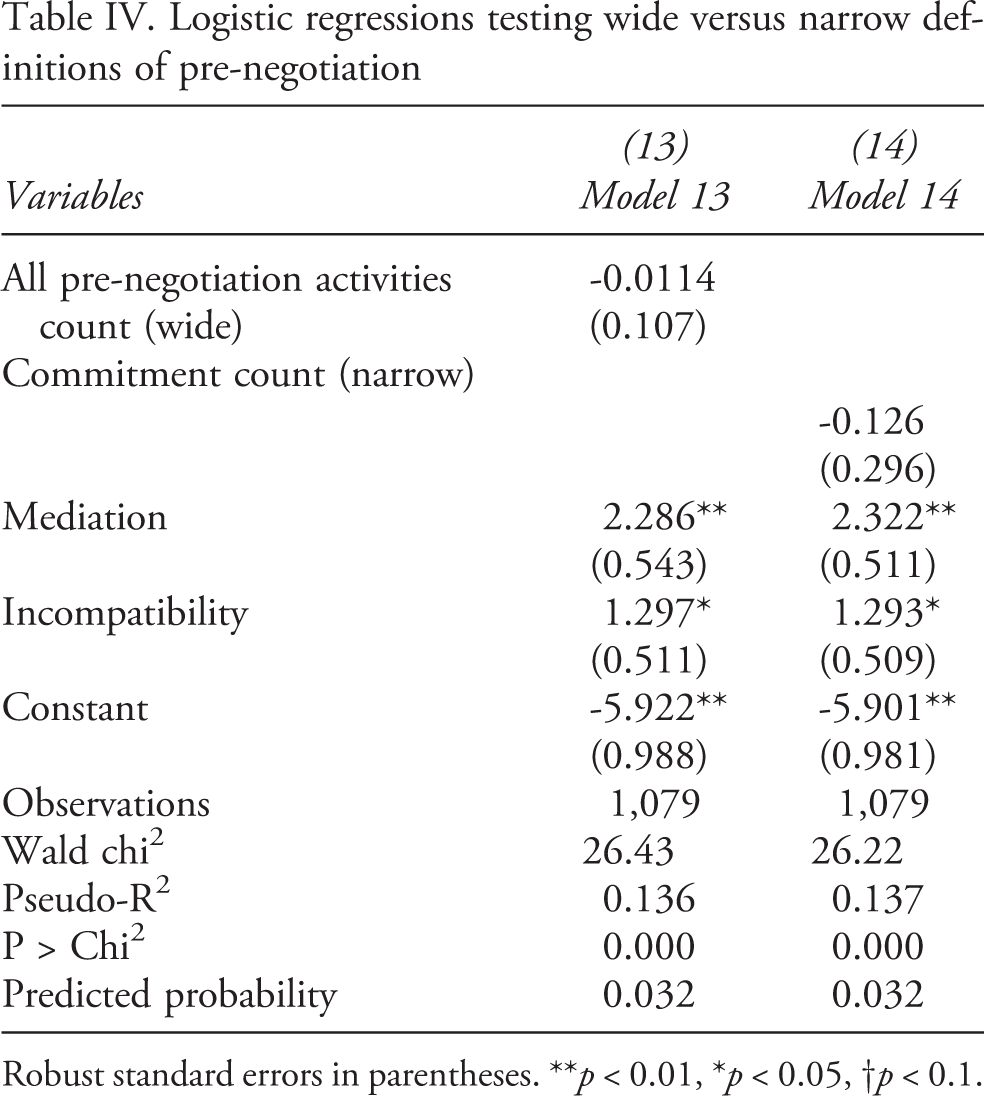
Robust standard errors in parentheses. **p < 0.01, *p < 0.05, †p < 0.1.
The pre-negotiation framework captures two steps in the decisionmaking process: unilateral proposals and joint decisions. The opposing directions of effect of these steps provide support for this conceptualization. For example, on the Offer to negotiate and Public commitment to negotiate, there could be many reasons why conflict parties decide to pre-negotiate, not all of them consistent with efforts to end a conflict. In some cases, such as the government of Chad’s tumultuous relationship with ever-shifting armed coalitions (Fisas, 2009: 83), the offer to negotiate was used as a threat. Military offensives were ongoing when one side expressed the desire to negotiate, suggesting that the armed group was attempting to coerce its opponents into conceding on certain issues. An analogous example occurred in Burma/Myanmar when the government began pre-negotiating with various armed ethnic groups using hardline pre-conditions in an attempt to consolidate them under their power as ‘border guards’ prior to the 2010 elections to quell any opposition to the state (Fisas, 2010: 186).
These examples illustrate why the variable capturing offers to negotiate was negatively related to peace agreements while a public commitment by the parties to negotiate was positively related, albeit not statistically significantly. Zartman’s definition of pre-negotiation as the reaching of a ‘decision to negotiate’ is not as applicable when conflict parties are constantly expressing offers to pre-negotiate for many different reasons, not all with the ambition for peace. The expression of a desire to negotiate can be used as a stick rather than a carrot: it might not be the most valid indicator of pre-negotiation, despite the emphasis of this point in previous literature (Tomlin, 1989; Zartman, 1989). Because it is difficult from the outside to reasonably distinguish between ‘good’ and ‘bad’ faith offers to pre-negotiate, reciprocity in such a decision may be the more valid indicator.
Similarly, theory predicts that creating options among parties should facilitate reaching agreements. This study found that the creation of options was negatively correlated with peace agreements, yet trade-offs were positively correlated. This is consistent with the logic of unilateral proposals compared to joint decisions. The Options variable captures whether conflict parties shared ideas about things they could do to resolve their issues, but it does not capture the reactions to those suggestions or whether the suggestions were being used to strong-arm their opponents. In the earliest days of contact between conflict parties, options are instead pre-conditions which can stall pre-negotiations before they get started. Tradeoffs, however, captures whether parties began exchanging offers of concessions, thereby binding the decisions and gradually creating pairs of options. These tentative findings support the idea of ‘mutual responsiveness’, and elucidate the ‘options to trade-offs hurdle’.
In terms of trust- and confidence-building measures, ceasefires were negatively correlated with peace agreements: perhaps reciprocity in this area is too difficult in the early days of peace talks. Similarly, prisoner exchanges within the context of pre-negotiation anecdotally seemed important in cases such as in Colombia (Fisas, 2007–09); however, prisoner exchange was negatively correlated with reaching peace agreements. This raises the point that although certain tactics appear to be reciprocal on the surface, when they are tied up in perceptions of physical security, they might not be the most expedient routes to peace. This tentatively supports existing research on third-party security guarantees and their effects on negotiated outcomes (Walter, 2002), and provides reasoning to explore whether there are types of decisions that better help conflict parties move from unilateral to joint decisionmaking.
In addition, the controls Incompatibility and Mediation were statistically significant at the 95% or 90% confidence interval in every model. These findings confirm previous results on the effectiveness of mediation in supporting peace processes (Olson Lounsbery & DeRouen, 2016; Clayton & Gleditsch, 2014; Clayton, 2013) as well as the difficulty of resolving territorial incompatibilities (Walter, 2002).
Alternative explanations
People are typically slow to update their view of their adversaries (Kelman, 1997: 226–227; Stein, 1989a). ‘Mutual responsiveness’ is a possible key for the successful ending of a conflict, but it is a gradual process: ‘[t]he needs and fears of parties engaged in intense conflict impose perceptual and cognitive constraints on their processing of new information, with the resulting tendency to underestimate the occurrence and the possibility of change’ (Kelman, 1997: 208–209). When applied to pre-negotiation, it is unsurprising that breaking conflictual habits is a steep learning curve. The logic underpinning the causal mechanism could easily work in the opposite direction to explain why pre-negotiation had little effect.
The evaluation criteria point to three limitations of this study when contrasted with Kelman’s (2008) pre-negotiation (in his text, interactive problem-solving workshops) evaluation effectiveness criteria. First, occurrence of a process is not synonymous with quality. Bad faith procedures can lead to more adversarial attitudes. This illustrates how our operationalization of ‘occurrence of pre-negotiation’ captures both pre-negotiations that facilitated a shift towards problem-solving and a consolidation of adversarial viewpoints (or no change).
Second, process secrecy conceals the occurrence of pre-negotiations and its quality. The quality of such processes depends on, for example, the agenda, the involved people, the nature and degree of interaction between participants (Kelman, 2008). These process quality indicators are typically confidential to ensure nothing is leveraged politically. Third, several studies show that the effects of pre-negotiation are not bound to the peace process itself (see Fisher, 2016). Pre-negotiations can be evaluated by measuring changes outside of the pre-negotiation processes. In a process Kelman (2008) terms ‘transfer’, the effects of pre-negotiation – changes in attitudes, behaviors, and beliefs – can be observed in changes in speech acts, policy decisions, and the political culture.
Perfect pre-negotiation processes may still fail, as they are but one step in a peace process and conflict parties or third parties assume positions or take action during the negotiations stage that may undermine the negotiations (Schiff, 2008: 389). In addition, Wagner & Druckman (2017) found that procedural justice during negotiation correlates positively with the creation of a stable agreement, emphasizing the importance of some semblance of equality and justice, otherwise power asymmetries may not shift in a way conducive for agreement (Albin & Druckman, 2014). Hence, the key mechanism may not be learning and ‘mutual responsiveness’ (Kelman, 1997), but rather, whether norms of justice are upheld in pre-negotiation and the formal negotiation processes. This could explain why the procedural elements of pre-negotiation were significant.
Analogously, Walter’s research on negotiated settlements demonstrates that ‘getting warring parties to the bargaining table […] does not guarantee peace’ (Walter, 2002: 5). She shows that ‘only third-party security guarantees, territorial and political pacts, mediation, and nonterritorial goals have a sizeable effect on the decision to sign a peace agreement’ (Walter, 2002: 78). Pre-negotiation may improve relations between parties, but not necessarily guarantee the inclusion of critical factors that determine the likelihood of an agreement; pitfalls may manifest further into the negotiation process, long after parties have committed to negotiate formally.
Areas for future research and conclusion
In a relatively understudied area of peace research, this article makes several key empirical and theoretical contributions to the understanding of pre-negotiations: a new dataset on pre-negotiation in nearly all active and inactive intrastate armed conflict dyads between 2005 and 2015; a meta-framework of pre-negotiation that seeks to capture all major activities within the earliest phase of any peace process; statistical analysis of the degree to which pre-negotiation supports the signing of peace agreements that adequately takes selection effects into account; and three connected areas for future research.
Specifically, more data on the quality of pre-negotiation activities is necessary. This is motivated by the fact that process occurrence does not equate to good faith interactions (Kelman, 2008), and because the quality of pre-negotiations can be assessed by observable processes outside of the bounds of the process itself (Kelman, 2008; Fisher, 2016). Such data would enable: (1) investigations into whether multiple successive pre-negotiation attempts can shift from ‘bad quality’ to ‘good quality’, (2) a more robust test of the social learning approach that would represent the more nuanced nature of peace processes, and (3) a direct test of ‘transfer’ effects. Second, quantified process data will allow an understanding of the unobserved factors influencing the progression from pre- to formal negotiations, testable with unified statistical models that treat pre-negotiation and negotiation as interdependent (Reed, 2000, 2002). Third, the increasing number of foreign and domestic parties involved in intrastate conflicts merit an investigation into the interdependent effects of parallel pre-negotiations with multiple dyads in the same country on reaching a negotiated settlement and on, for example group cohesion. Olson Lounsbery & Cook (2011) show that mediation increases the likelihood of rebel group fragmentation.
This article concludes that the differences between wide and narrow definitions of pre-negotiation are negligible. Moreover, it bolsters research that focuses on reciprocity in pre-negotiation – potentially one of the most important elements of transforming conflict.
Footnotes
Replication data

Acknowledgements
We would like to thank Isak Svensson and Kristine Eck for their invaluable academic counsel, Kristina Petrova for providing thoughtful feedback, and Susan Blair for her detailed copyediting.
Funding
Lindsey Doyle was funded for studies by the Rotary Peace Fellowship during the time of this research.