




Abstract
Why do governments severely punish some dissidents while showing mercy to others? This study argues that when constrained by limited information on dissent, states have incentives to cast the net of repression wider by executing not just key dissent actors but also members closely connected to them to ensure demobilization. States also crave information, and granting clemency to defectors who bring in information improves state intelligence. Given that tips have different values, regimes will grant clemency to defectors who are closely connected to key dissent actors and possess high-value tips, allowing the state to pursue top fugitives and dissolve resistance more efficiently. Using newly declassified data on political victims during Taiwan’s White Terror authoritarian period, I find that the regime tends to execute both key actors (i.e., leaders and recruiters) and their closely connected members. Defectors who share information tend to receive mercy, but defectors closely connected to key actors are much less likely to face execution than less connected defectors. These findings shed new insight into the toolkit dictators use to gather intelligence on dissent and how strategic clemency induces defection and betrayal among dissidents, helping destroy dissent networks from within.
Keywords
The first responsibility of state actors is building and maintaining order. It is particularly vital for autocracies as their survival hinges critically on enforcing order and exerting political control. In the literature of authoritarian politics and state repression, scholars often assume that autocrats possess the necessary tools to control the population; for example, dictators can use violence and deploy surveillance to penetrate society and preempt dissent. Yet, evidence from previous research suggests otherwise (Zhukov, 2014; Dimitrov and Sassoon, 2014; Greitens, 2016). Dictators often struggle to find the resources they need to exercise control, and one of the main resources they struggle with is information and intelligence (Kalyvas, 2006, Berman et al., 2011). Few states function like contemporary China or Russia, where the state apparatus possesses tremendous information-gathering capacities with which to wield state power. Most dictators fight dissent movements in information-poor environments and seek ways to gather intelligence to aid their repression campaigns. However, we know relatively little about how regimes employ repression as a strategy to obtain information on dissent. Thus, important but previously unanswered questions emerge: Under information-limited environments, why do regimes selectively repress certain dissidents while showing mercy to others? What strategies do regimes use to counter information deficit and maximize control?
This study proposes a network-based explanation for state repression and argues that regimes leverage network relationships to gather dissent information and punish political opponents. When operating with limited information, states are uncertain whether they have captured all key actors and whether removing these actors can sufficiently demobilize dissent movements. This insecurity motivates regimes to widen the net of repression by executing people closely connected to key actors to ensure that all important figures are eliminated and movements are sufficiently demobilized. Strategically eliminating central actors and the closely connected members in the dissent network also strikes a delicate balance between costly massive killing and the risk of targeting too narrowly.
More importantly, states crave information, and this hunger drives them to extract information and enhance intelligence. Violence can be substituted by clemency if dissidents defect and share information “tips” that help state repression campaigns. Given that not all tips have equal value, regimes will reward defectors who are closely connected to key dissidents and possess high-value intelligence, such as leaders’ identities and whereabouts, allowing the state to pursue top fugitives and dissolve resistance organizations more efficiently. Generally, tips from inside dissent movements cost less and provide better intelligence than information gained from external surveillance. Substituting between violence and clemency incentivizes dissent defection and insider tipping, aiding the regime with extra power to combat resistance and destroy it from within.
I test this argument using new data on political victims in the authoritarian period of Taiwan (1949–1991) collected from the Injustice Compensation Foundation and the Transitional Justice Commission. The data provide a rare opportunity to empirically study relational punishment and dissident defection in authoritarian regimes at the individual level. Taiwan’s authoritarian period features a highly repressive regime seeking to seize control of its remaining territory after a failed civil war against Mao’s communist party, offering a useful context to study how regimes leverage repression to control society. Back then, multiple secret agencies monitored society in the name of fighting communist infiltration. The regime employed a wide variety of repressive tactics—ranging from mass surveillance and informant networks to physical arrests, torture, and expedited execution of political prisoners—against a broad set of regime challengers and would-be challengers that included military personnel, politicians, doctors, students, and many social elites who were believed to show interest or have connections with underground communist organizations and dissent movements. Taiwan’s history of repressive violence makes the country a fruitful setting to test my argument. The fine-grained nature of this dataset also allows us to inspect how regimes select repression targets and leverage relationships to flip their enemies against each other.
Empirical results affirm the notion that dissident network position shapes the strategy of repression targeting. In the military trial of political dissidents, execution targets not just people who lead or actively recruit new members into underground organizations but also people closely connected with these leaders or active recruiters. I also find that the regime is less likely to execute defectors who bring in information, but defectors closely connected to key actors are much less likely to face execution than less connected defectors. It supports the theoretical argument that information has different values, and clemency is strategically rewarded to people who provide high-value tips. I also provide additional qualitative and quantitative evidence to support the information-gathering argument, showing that information gathered through defection or arrests contributes to more rapid crackdowns on the remaining organization members.
These findings contribute to the literature on state repression, information theories of violence, and authoritarian rule in several important ways. First, previous literature on information and violence has put heavy emphasis on how information determines the use of violence. I instead direct research to consider how limiting violence by clemency can encourage defection and increase the information flow to the authorities. Second, existing scholarship on intelligence gathering in dictatorships largely focuses on external monitoring (through secret police or mass surveillance) and gives insufficient attention to internal monitoring (through insider defection and informing). This research highlights this understudied behavior of defection and internal tipping that supplies dictators with cheap but valuable intelligence to aid in repression. Lastly, the findings on strategic clemency for high-quality tips improve our understanding of how regimes manage information intake and avoid an overflow of low-quality information that can undermine repression efforts.
Information and State Repression
Enforcement of political order remains the highest priority for autocratic survival. Order construction relies critically on states’ ability to gather good information on dissent and suppress political challenges before they post serious threats to the regime. Following this logic, repression studies have developed two bodies of work analyzing how information shapes the deployment of violence. One body of work views preventive and reactive repression as two distinct approaches. Traditional threat-response theories argue that repression is used when threats have emerged (Gartner and Regan,1996; Moore, 1998; Davenport, 2007; Wood, 2008; Carey, 2010). Reactive repression responds to existing acts of dissent and uses violence to limit further challenges to the regime. By contrast, preventive repression attempts to curb mobilization before challenges can take to the street (Danneman and Ritter, 2014; Ritter and Conrad, 2016; De Jaegher and Hoyer, 2019; Dragu and Przeworski, 2019; Liu and Sullivan, 2021; Esberg, 2021). State leaders prefer prevention to reaction as preventive measures mitigate their risk of being overthrown, but this preference depends on whether states have enough information and capacity to anticipate challenges and root them out before they can take place.
The other body of research emphasizes the choice between targeted and indiscriminate violence and ties states’ information capacity close to the use of different repression strategies. Primarily driven by discussions on state violence in civil war (Kalyvas, 2006; Lyall, 2009; Kalyvas and Kocher, 2009; Souleimanov et al., 2013; Zhukov, 2014; Balcells, 2017; Rozenas and Zhukov, 2019), this line of research suggests that governments use targeted violence when they already have good intelligence on insurgents’ identities and activities. By contrast, untargeted violence is used to indiscriminately repress all individuals within an area where regimes lack local intelligence (suggesting insufficient local control) even though killing innocent people can drive recruitment to insurgents and eventually hurt the regime. States prefer targeted violence, if information permits, rather than untargeted violence due to the potential for backfire that limits the regime’s efforts in controlling territories.
While the link between information and the typology of repression (either on the timing or targets) is well-presented in the existing literature, characterizing governments into fully informed versus poorly informed regimes fails to sufficiently explain the rich variation in state violence. Very few countries in reality are fully informed or completely uninformed when fighting domestic enemies. Most regimes have a certain level of information on dissent and start with what they have to craft repression tactics. Also, it is problematic to assume that states have little agency to change their information environment (or so-called information endowment). As information is much theorized to be static and exogenous to state violence in the literature, few studies have considered how supplying or limiting violence can improve states’ information capacity and facilitate information flow from dissent to the regime.
Of great relevance to this research is the work on surveillance and information enhancement in dictatorships. The mainstream discussion focuses on external information-gathering via surveillance technologies (i.e., traditional wiretapping or modern digital surveillance on the Internet) and how they penetrate dissent movements and aid repression targeting (Xu, 2021; Gohdes, 2020; Keremoglu and Weidmann, 2020; Dragu and Lupu, 2021). It is also widely discussed that dictators often employ secret police to spy on citizens and surveil the population (Greitens, 2016; Hager and Krakowski, 2021). Stasi, the notorious secret police agency in East Germany, is an iconic example. However, external monitoring via delegated agents can be expensive and time-consuming since building a sophisticated and functional surveillance system takes time and requires substantial infrastructure development (Xu, 2021), equipment and personnel (Scharpf and Glaßel, 2019), and resources to purchase civilian informants (Piotrowska, 2020). Thus, external monitoring systems are usually supplemented by cheaper but more effective internal monitoring to gather dissent information (Heckathorn, 1988). Yet, existing research rarely examines the use of internal information-gathering through defection and insider tipping. A black-box–like process in which disloyalists and defectors reveal information from within dissent organizations to the state remains largely unstudied.
Some scholarly attempts have begun to analyze these information flows despite difficulties in accessing data. The rare documentation on dissent defection and ratting behavior has forced existing studies to rely on proxies for the information flows, such as measuring defection by repression intensity which assumes that defection will occur with repression (Condra and Shapiro, 2012), studying reported willingness to inform via surveys (Lyall, Shiraito and Imai, 2015), or measuring defection with aggregated virtual tip counts (Shaver and Shapiro, 2021). While these works have advanced our understanding of informing behavior, they remain limited in their explanatory power because individual defection either is not directly observed or does not differentiate between civilian tipping and actual insider tipping. It is also unclear how governments incentivize defection through rewards and whom regimes target to flip that maximizes quality intelligence feeds. This study complements and refines previous arguments on state information-gathering with a new explanation and empirical evidence, showing that dictators target connections to key actors in underground dissent networks and encourage their flipping behavior through reduced penalty or immunity.
Repressing Dissent Networks: The Strategic Use of Violence and Clemency for Defection
We typically assume that autocrats have substantial resources at their disposal to control populations due to their relative freedom to use violence and to deploy surveillance technologies to penetrate society and enforce order. Yet, research has shown that dictators often struggle to extract the information they need to maintain control. Thus, how states control dissent with limited information is an important question to answer. The aims of this study are twofold: to understand how states strategically use violence and clemency to offset their information deficit and why targeting certain individuals in dissent networks helps achieve that goal.
I conceptualize states as order-seeking entities in which violence plays a central role in political control. When the information on dissent is abundant, states can easily target repression toward groups or individuals who mobilize others and eliminate them with minimal cost. Literature on counter-terrorism or counter-insurgency has shown that targeting top dissent officials with a surgical strike represents the most effective approach because it demobilizes resistance quickly with little effort and with limited casualties (Siegel, 2011; Shapiro, 2013; Zech and Gabbay, 2016). However, repression campaigns become complicated when information on dissent is constrained. When regimes are unsure if all key actors have been captured, they may not know whether removing them can sufficiently demobilize opposition movements. This sense of insecurity motivates dictators to cast their net of repression a bit wider than they would have done with complete information to ensure network demise. But it does not necessarily mean that indiscriminate violence, the opposite of targeted violence, becomes the only viable option. Dictators understand the obvious cost of massive killing, as it may backfire and push people to side with dissidents. Instead, regimes can choose a safer route by selectively targeting key actors and their close connections to maximize the utility of repression while keeping costs low. Both key actors and high-ranking members closely connected to them (perhaps through direct recruitment or immediate command-and-control relationship) pose greater threats to the regime because they tend to be more committed to group missions and ideologically more motivated than the rest of the rank-and-file members. These close associates also have a high potential to revive resistance by assuming leadership or recruitment roles after leaders are removed. Strategically eliminating central nodes and the closely connected members in the dissent network strikes a delicate balance between costly massacres and the risk of targeting too narrowly.
While violence enforces order, limiting violence can also facilitate regimes’ order-preserving campaigns. The utility of clemency is vastly underestimated in the repression literature because current approaches focus on violence itself. When regimes’ information on dissent is rich, clemency may be unnecessary because regimes know who is culpable and who is not and have enough information to calculate appropriate punishment. However, the utility of clemency increases when states have limited intelligence on dissent. When dissidents are afraid of being captured and repressed, regimes can use clemency to attract defectors who can share high-value insider tips that help repression. Tipping from inside dissent networks by defectors presents valuable internal intelligence because dissidents themselves generally know better about their peers’ behavior than external monitoring agents, and getting information from insiders is easier than fetching intelligence from the outside. When states threaten dissent with heavy-headed repression but offer mercy to defectors, dissidents are motivated to betray their organization and trade information for immunity.
If clemency offers an alternative to violence as a means to encourage defection and informing, who would regimes target to do so? Not all information is useful to the regime, and an overflow of low-quality information, including unhelpful or misleading information, can actually hurt repression campaigns. In the information-clemency exchange, regimes will want to reward high-value tips that make repression more successful and more efficient. I characterize dissent organizations as networks of interconnected dissidents. Dissidents’ network positions are linked to their roles and, more importantly, information access. I argue that the network position of dissidents matters for regimes’ strategy of using clemency to exchange high-value tips that aid repression.
Underground resistance networks usually adopt a hierarchical structure of command and control with limited horizontal connections to maintain secrecy, and their members can be typically characterized into three groups: key actors (i.e., leaders and recruiters), high-ranking members, and low-ranking members. Key actors are the most wanted because they lead operations and expand networks. They have valuable information about the network but are unlikely to defect and flip because they are ideologically extreme and have too many perks of power as core figures of the resistance. They are also hard to capture given their importance in the organization. Low-ranking members are cheap to sway since they have less ideological affinity and little to gain from staying with resistance. But, they also know the least about clandestine networks given the hierarchical structure and their low connections to the top. By contrast, high-ranking members closely connected to key actors represent high-value targets for regimes to flip because they are less ideologically extreme and more likely to defect when the incentives are in place. More importantly, they harbor crucial pieces of information about the organization that regimes crave. Being close to key actors means that they know more than anyone else in the organization about the identities and locations of leaders and active recruiters. Plus, they usually sit between the top and the bottom, serving as communication channels that pass insider intelligence that the authorities desire to know. If these high ranks cannot be swayed and refuse to defect, severely punishing them when captured helps eliminate highly committed members. Threatening severe violence if they do not defect also builds up pressure for high ranks to surrender and inform. However, if the high-ranking members can be swayed and defect, information-clemency exchange allows regimes to tap into valuable insider intelligence that helps them capture key actors as well as remaining fugitives more effectively, leading to quicker destruction of resistance movements.
Targeting high-ranking members for high-value tips implies that regimes will review and verify information submitted to ensure they are useful and truthful. Unconditionally offering mercy to all defectors can lure in opportunists attempting to exploit the clemency system, so regimes will want to fend off by reviewing tips and evaluating usefulness. High-quality information features tips that help regimes capture key dissent actors faster and clues that result in a rapid crackdown on the entire organization. Low-quality information can be tips that are few in quantity, unuseful, and barely connects to the core dissent leaderships or information that is false and intentionally misguides the authority to buy time for others to escape. High-ranking members closely connected to key actors are more likely to provide valuable information that regimes want, but we should also expect that regimes will establish procedures to review and verify the usefulness of tips before rewarding clemency to defectors and will punish insincere tippers to increase the quality of information feeds.
Information-clemency exchange can be tempting for dissidents when they are heavily repressed. Yet, the commitment problem may overshadow the promise of mercy and dissuade potential defectors. Defection remains a risky behavior because potential defectors are unsure if regimes will renege on their promise and kill them after the information is submitted. Recognizing this, regimes should provide credible assurance that defectors will not be punished (or punished less severely). The typical solution is to publicly advertise that defectors have received mercy. In East Germany, for example, the government used radio and newspapers to advertise that surrendered defectors were pardoned from sentencing (Solbrig, 2017). It was also public knowledge that citizens who aided the Stasi with information on would-be dissidents were given better jobs, educational opportunities, and better pay in the troubled economy (Piotrowska, 2020). Institutionalizing information-clemency exchange in legislation to protect defectors from harm can also alleviate the commitment problem and build credibility. In Taiwan, for example, information-clemency exchange was formally stipulated into the martial law to increase public trust. 1
Two theoretical implications can be drawn from the above discussion. First, under limited information on underground dissent, regimes will cast their net of repression wider by selectively killing both key actors and members closely connected to them to minimize the risk of regrouping while avoiding costly massacres that can incur backlashes and eventually hurt the regime. Therefore, I derive the following hypothesis:
Regimes will execute not just key actors, such as operation leaders or active recruiters, but also members closely connected to them in the underground dissent network. In addition to using violence, regimes can limit violence and reward clemency to individuals who defect and inform. But information value differs, and regimes tend to reward those closely connected to top actors in the organization who possess more valuable intelligence to help capture the “big fish” than those less connected and cannot provide such intelligence. Therefore, I derive the following hypotheses:
Regimes are less likely to execute resistance members who defect.
Regimes are less likely to execute defectors who are closely connected to key actors than defectors who are less connected.
Empirical Case: Taiwan’s White Terror Period
The period under investigation (1949–1991) was a highly repressive time in Taiwanese history. Historians commonly refer to it as “Taiwan’s White Terror,” when the Taiwanese government was ruled under a single-party regime, the Republic of China’s Nationalist Party (or Kuomintang, KMT). Chiang Kai-shek, the leader of KMT, was defeated by Mao and retreated to Taiwan in 1949. In the same year, KMT announced the Martial Law Act (臺灣省戒嚴令) and introduced the Betrayers Punishment Act (懲治叛亂條例) to control Taiwanese society and defend against infiltration by mainland communists.
It was well acknowledged that high-level violence supplied by Chiang’s regime was linked to the poor quality of the KMT’s intelligence on the island only recently returned from Japan’s colonization (Greitens, 2016, p. 187). The 2–28 Incident in which Nationalists cracked down on anti-regime protests in 1947 caused the death of nearly 10 thousand islanders. It was evident that Chiang lacked sufficient intelligence on dissent and the control over the island, which resulted in a more heavy-handed approach when Chiang’s regime retreated to Taiwan. Leaked documents from the National Security Bureau also pointed to the need to reform national intelligence agencies when officials in the 1950s found that defectors’ tips could be several steps ahead of government intelligence (Li, 1991). Information deficit prompted the regime to reform secret agencies and national police departments, aiming to tighten social control and prevent communist infiltration. The enhanced surveillance and policing, persecution of political dissent, abusive arrest and interrogation, and over-repression against suspected civilians led to many political victims and traumatized Taiwanese society (Chen, 2008, 2014; Su, 2019).
Coercive Institutions in Taiwan
Taiwan’s security apparatus was both professional and relatively unconstrained in its use of coercion. The main actors in the security apparatus were the Secrets Bureau (國防部保密局), Taiwan Garrison Command (臺灣警備總司令部/保安司令部), and the Investigative Bureau (內政部調查局). These organizations created complementary, overlapping, and coordinated layers of surveillance to monitor Taiwanese society, and the entire intelligence network became well established in the late 1960s after several waves of reform. These security agencies serve two main functions: intelligence collection and punishment. To collect intelligence on regime opponents, security agencies installed spies and informants in government offices and civil groups to monitor potential subversive activity. After intelligence was collected and the suspects were arrested, Taiwan Garrison Command took over to conduct interrogation, trials, and execution, which makes it a terrifying agency for political prisoners. Tortures or threats of torture were often used to extract information and confessions, and police compared confessions among prisoners who were interrogated separately to increase reliability. Arrested individuals were then sent to military tribunals and tried based on intelligence provided by secret agencies and information from Taiwan Garrison Command through interrogations. The Betrayers Punishment Act was the legal basis that judges used to justify and determine punishment. Executed dissidents were advertised in newspapers or posters to create an atmosphere of terror and deter participation. People released after imprisonment were also believed to be monitored by local police, and many people struggled to find jobs since they were blacklisted by the regime.
Underground Dissent Movements
Underground communist movements represented the main dissent activity in the early years seeking to overthrow Chiang’s regime. After 1945 when the civil war between the Nationalist Party and Mao’s communist party heated up, mainland communists sent delegates to Taiwan to mobilize supporters. The iconic organization, the Taiwan Operation Committee (臺灣省工作委員會, 簡稱省工委), was then created by Chinese communists smuggled into Taiwan and key members of the committee were sent to different counties in the island to build subordinate branches and expand membership. Taiwan has only recently returned to China after decades of Japanese colonization; however, the corrupt KMT administration in Taiwan, exclusiveness in political power, and shattered economy all frustrated Taiwanese islanders, fueling the sentiment to join Mao’s communist China and overthrow Chiang’s regime. Official documents show that more than 250 underground branches were established throughout the island by 1949 with over 2000 members joining organizations (Lin, 2009). The subversive activity ranged from armed activity that plans to steal, purchase, and make weapons or explosives, to unarmed activity that focused on expanding membership, educating communist ideology, and training to prepare for the mainland Communist’s takeover when the Red Army marches ashore. The recruitment network of underground communists was highly hierarchical, strictly limiting cross-referencing and cross-ladder tie creation. Low density in the network protects the secrecy and increases operation efficiency through a clear command-and-control system. Figure 1 plots the network in one of the branches in southern Taiwan in two layouts. They show very little cross-referencing where subordinates recruited each other or multiple people recruited one person; cross-branch membership was also rare in the hierarchy. Recruitment Network in Tainan’s Operation Committee Sub-branch in two layouts. (a) Hierarchical layout (b) Hub layout. Note: Nodes are members and directed edges indicate who recruited whom into the organization. Red nodes represent operation leaders, whereas blue nodes are non-leaders. Red edges indicate direct recruits by leaders. Source: Author’s Data.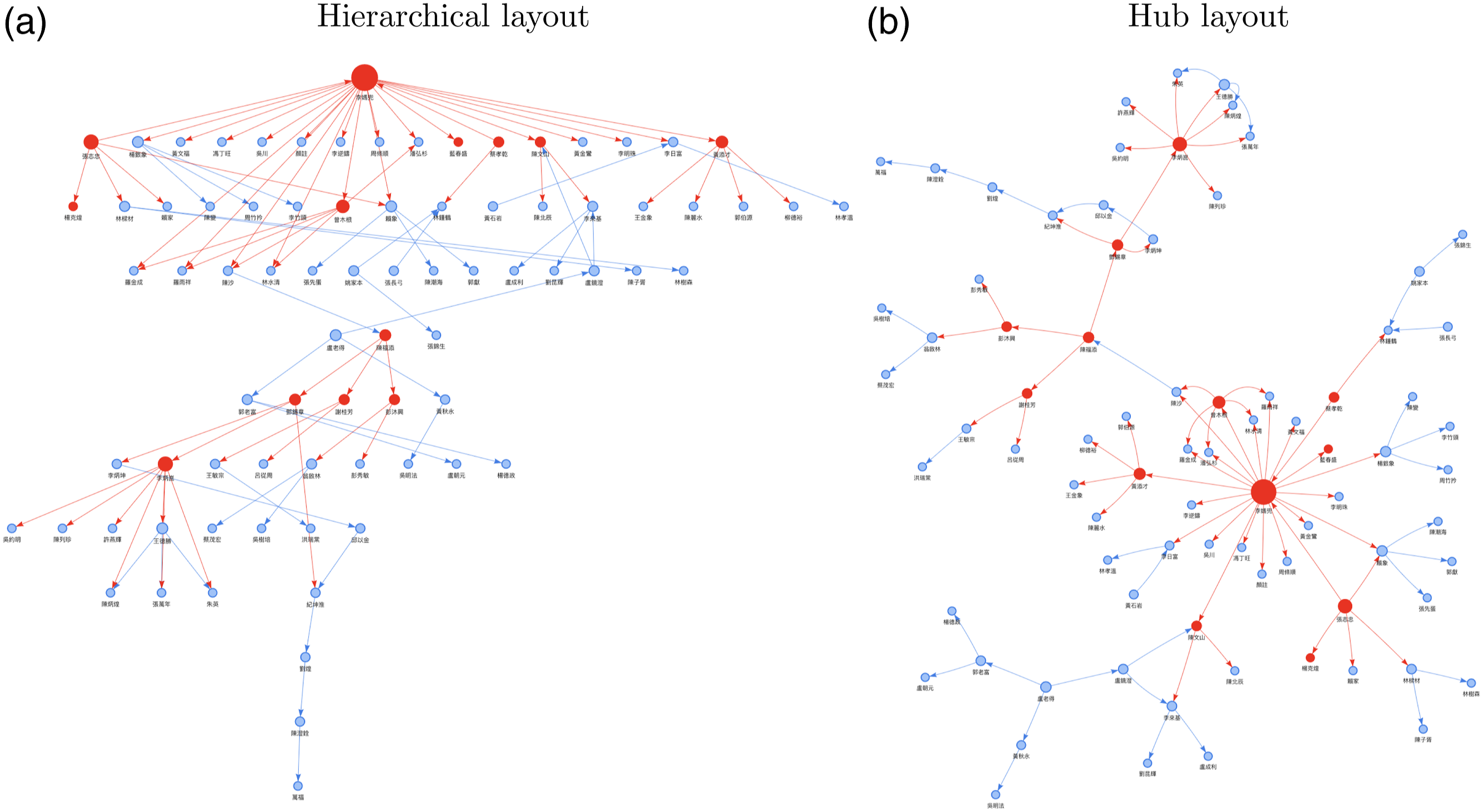
As repression intensified, underground communists were largely eradicated and dissent forces waned over time. Chiang consolidated control of the island and state intelligence grew as well as both formal and informal policing infrastructure (e.g., The baojia and hoko system). Oppositions after the mid-1960s were mostly dissent movements seeking separation and democratization. These dissidents were labeled as subversives and repression continued in the name of national security until the Betrayers Punishment Act was formally abolished in 1991.
Data and Measurement
The dataset of political victims is collected from the Injustice Compensation Foundation and the Taiwanese Transitional Justice Commission.
2
The original source of victim data came from the Injustice Compensation Foundation and I incorporated it into the Transitional Justice Commission database, which has more complete trial information for victims. The Foundation accepted compensation claims from victims or their families, compiling a list of victims by investigating their claims via official trial documentation. More than 10 thousand claims were filed and around 20 billion New Taiwan dollars (700 million USD) were compensated to confirmed cases from 1999 to 2014. This investigation process led to the declassification of trial documents, which reveals important information on victim identity, charged crimes, case description, and the eventual sentencing. Figure 2 shows an example of a declassified trial document with a detailed case description. These documents are digitalized by the Foundation and the Commission. I read through these texts and extracted key information about individuals’ roles in the dissent organization (e.g., leadership) and their recruitment strategies (who recruited whom in the organization), defected members, occupations, and other basic biographic information. The dataset records individuals who stood trial, and the trial outcomes range from the death penalty to life imprisonment, fixed-term imprisonment, and not guilty. A sample military trial document. Source: Taiwan National Archives.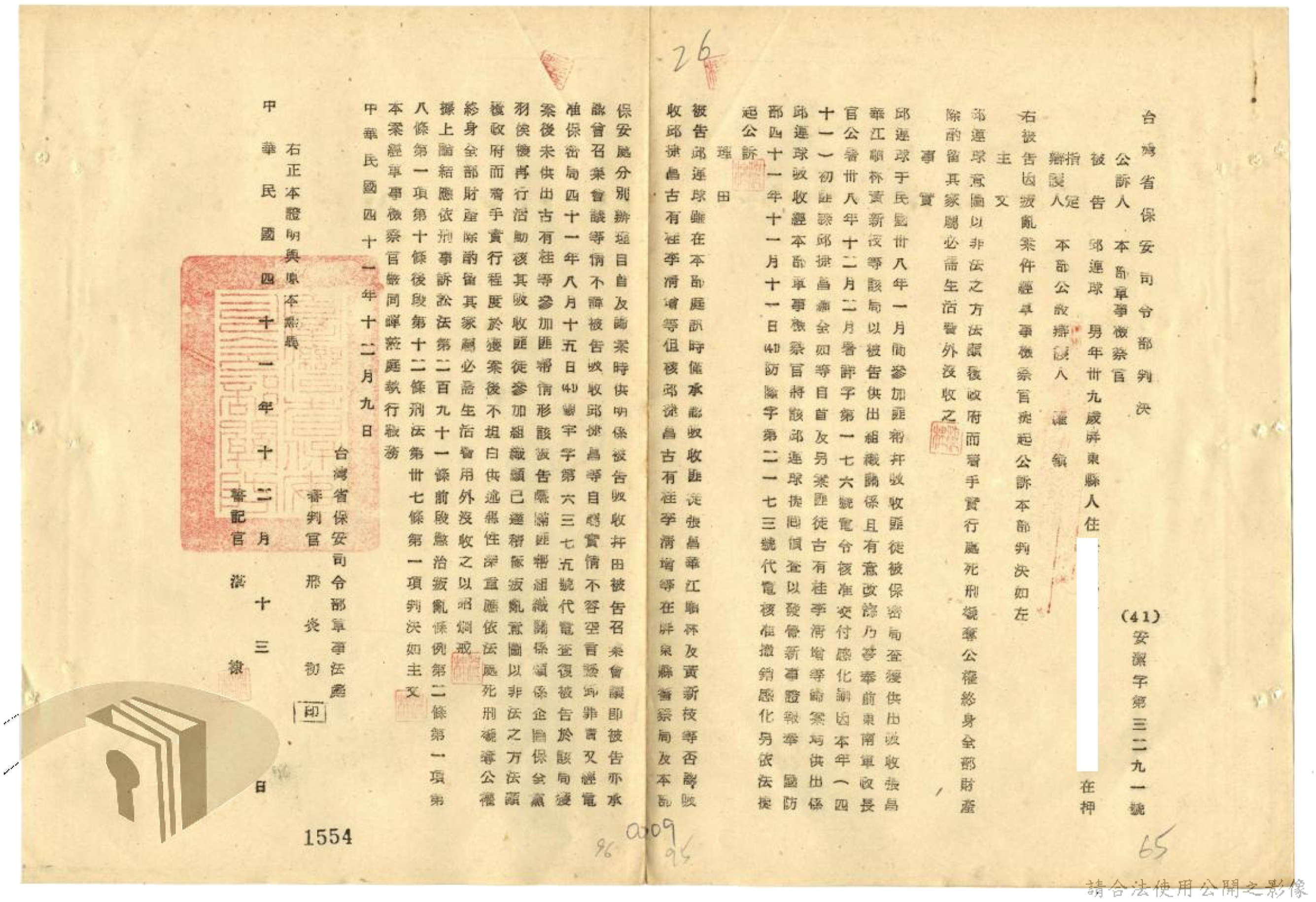
Since this study focuses on how regimes calibrate repression, I cleaned the data to only include confirmed cases with complete trial documentation, excluded individuals not officially tried (such as killed in police pursuit or still at large), and removed duplicated individuals who were released and recaptured to avoid inflation of observations. This leaves a total of 7266 observations with complete trial descriptions, court decisions, and relevant biographical information. I will show in the robustness test that the findings remain unaffected by dropping cases with incomplete trial information. The temporal distribution of charges is displayed in Figure 3. Repression against underground communist organizations was concentrated in the 1950s and early 1960s, consistent with existing findings in the literature (Lin, 2009; Taiwan Truth Promotion Association, 2015). As underground communists were largely uprooted, repression from the mid-1960s to the 1980s was mostly against sporadic political dissidents pursuing separation and independence. The number of individuals being charged over time.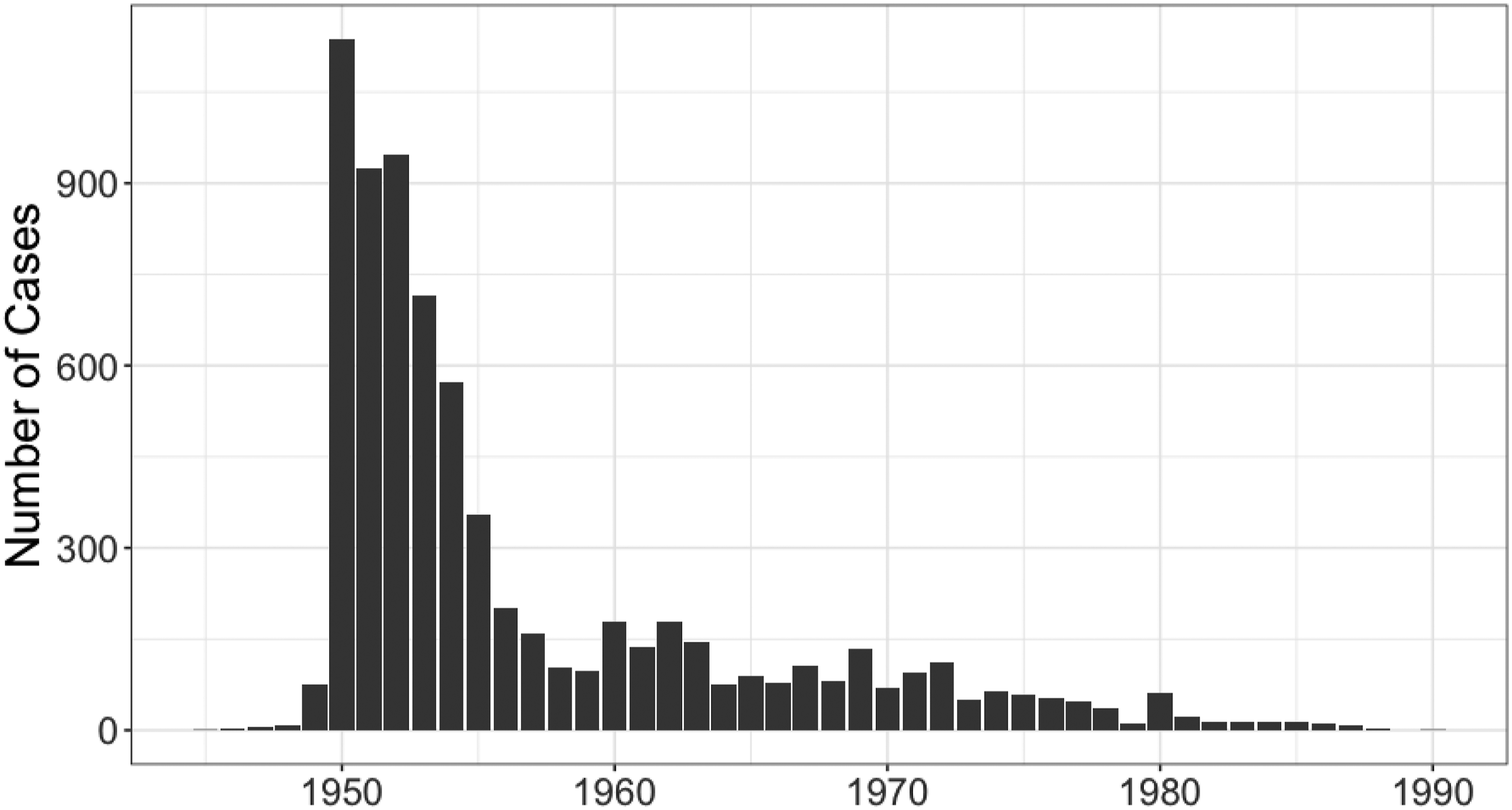
While victim data from the Foundation and the Commission are by far the most comprehensive data collection of political repression in Taiwan, it is still possible that some individuals are missed, and the likely missingness ought to be pointed out. First, since the data collection started by receiving compensation and reputation restoration requests from victims or their families, individuals without living relatives and who do not share trial documents with other victims may be missed in the dataset. This likely includes a small number of victims who were foreign nationals (perhaps foreign students at the time) and who were potentially unaware of the compensation program, or victims who have emigrated and do not intend to seek compensation. Second, this data only include political victims going through military tribunals, excluding those who were tried in ordinary courts. While information for those tried in ordinary courts is unavailable, it likely represents only a small fraction of victims because Chiang’s regime favored and prioritized the use of military courts for repression. Military tribunals were highly controlled by the regime, providing a necessary channel of legitimacy (under the martial law) and efficiency in execution. Extra-judicial killing or disappearing was unpopular as the regime desired for publicity to showcase strength and deter participation. Over the years, officials have provided different estimates of the number of victims; however, thanks to recent waves of declassification, it is believed that the recent effort conducted by the Foundation and the Commission provides the most comprehensive picture of political repression and victimization in Taiwan’s authoritarian period. 3
What makes the data unique is that when the Foundation and the Commission worked on victim compensation and reputation restoration, a large amount of official documents and trial records were declassified which security agencies believed would never become public. They were released without the oversight of the regime responsible for the repression. More importantly, while other datasets have been forced to draw inferences about repression based on country or group-level targeting, this data allow direct observation of targeted repression under a secret police regime at a fine-grained individual level, allowing researchers to probe deeper into the logic of state violence against underground dissent movements that planned anti-government activity.
Measurement
The outcome variable is the severity of state repression. I choose the most direct measure by examining whether a prisoner received capital punishment (1 if yes, 0 if not) as the outcome of the military trial. Death sentencing represents the harshest method of repression and guarantees that these convicts will not return to society and engage in further subversive operations. Dissidents were often executed soon after sentencing to ensure that no information or messages leaked back to the groups.
For independent variables, I leverage trial verdicts for each individual to identify their roles in the organization. Personal connections and organizational leadership are frequently mentioned in the verdict text. Operation leadership is a variable indicating whether an individual leads the group or serves as the party secretary commanding a communist organization. Court verdicts also describe recruitment relationships frequently (e.g., who recruited whom into the group) and the directed ties are coded by the author reading through the text of verdicts. Active recruiter refers to the degree centrality of the nodes in the recruitment network, in which a higher out-degree means that more dissidents were brought in by this actor, suggesting a key role in expanding the organization.
Defection is coded when the verdict mentions an individual turning themselves in. 4 Surrendering behavior was typically accompanied by trading information that helped the government capture more dissidents in exchange for clemency. These defectors still stood trial and judges weighed their “contribution” and determined the level of clemency. The informing-clemency linkage can be buttressed by anecdotal and qualitative evidence. 5
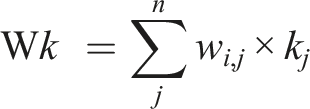
I leverage the recruitment data to measure the member’s degree of closeness to key actors. The recruitment network highlights the importance of in-group connections, as it not only specifies the command-and-control relationship but also helps infer dissident ranks within a hierarchical organization and information accessibility in relation to the central position. Clandestine networks typically feature a hierarchical structure where little cross-ladder connections can be formed to protect secrecy. It means that lower-ranking members rarely know top leaders, and only a few higher-ranking members are closely connected to them to protect core members and organization secrecy. Closeness is operationalized by the network distance between nodes, and distance is calculated by the order of connections. The higher the order is between two nodes, the closer these two nodes are. Two measures, closeness to leaders and closeness to recruiters, are created. The calculation can be summarized as following
Variable statistics.
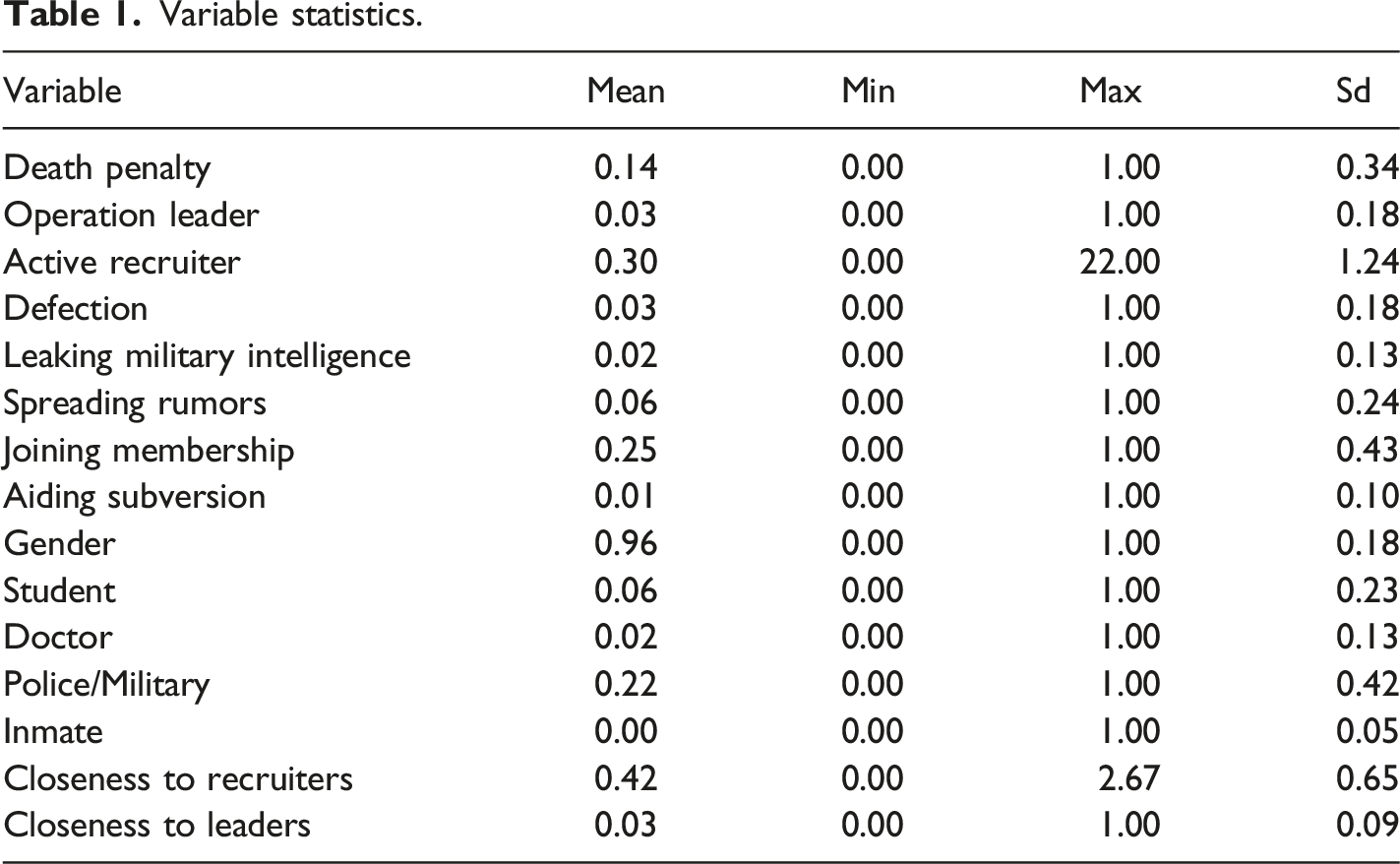
Empirical Analysis
The effect of network relationships on severity of repression.
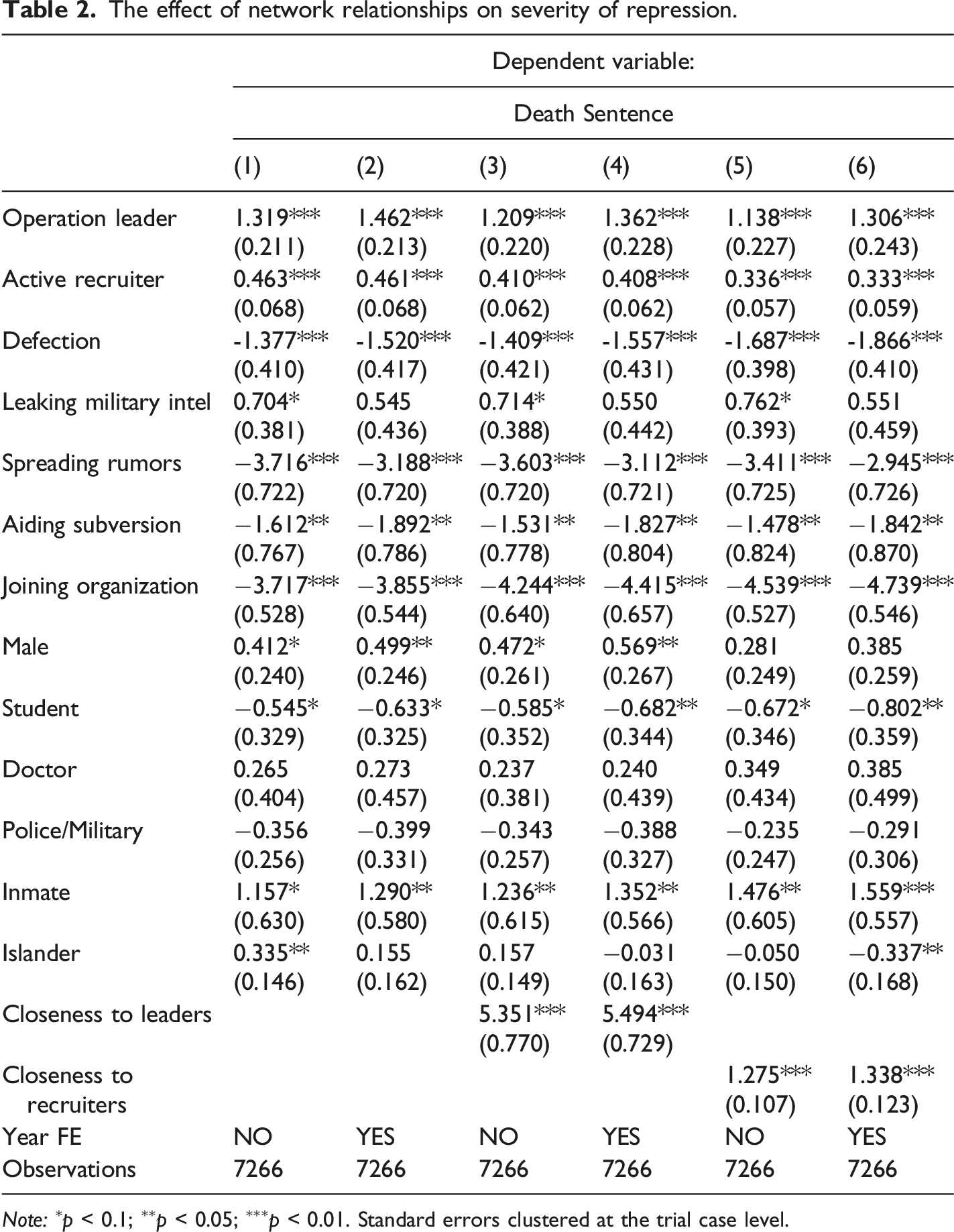
Note: ∗p < 0.1; ∗∗p < 0.05; ∗∗∗p < 0.01. Standard errors clustered at the trial case level.
Figure 4 plots the marginal effects. It shows that leaders experience a three-fold increase in the predicted probability of execution; recruiters also experience nearly a three-fold increase when the number of recruits goes from 0 to five and are almost guaranteed execution if they recruit more than 15 people. Defection yields about a four-time decrease in the probability of the death penalty. Closeness to leaders or recruiters also shows substantial increases in the likelihood of execution. Effect plots.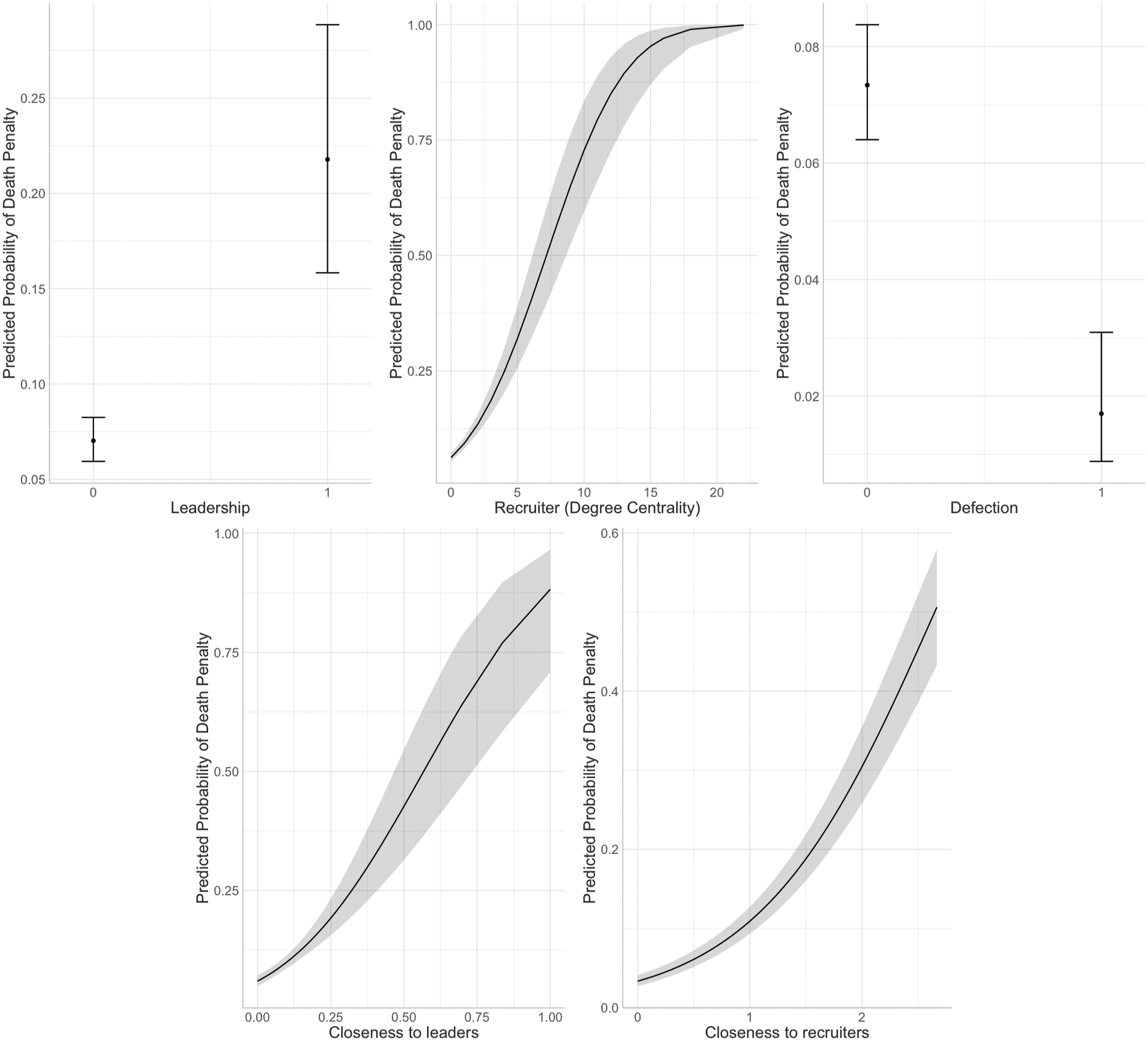
The conditional effects of defection.
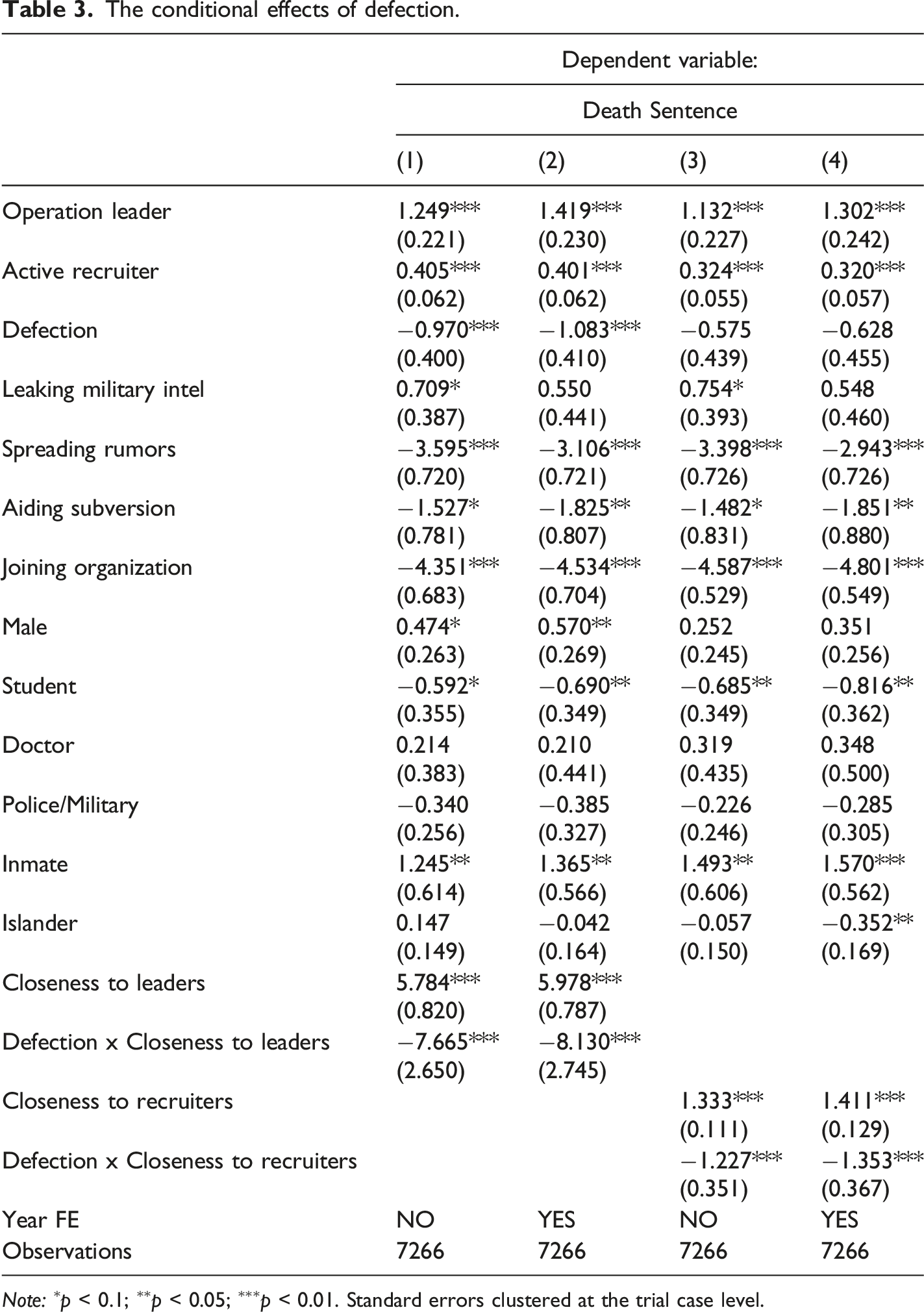
Note: ∗p < 0.1; ∗∗p < 0.05; ∗∗∗p < 0.01. Standard errors clustered at the trial case level.
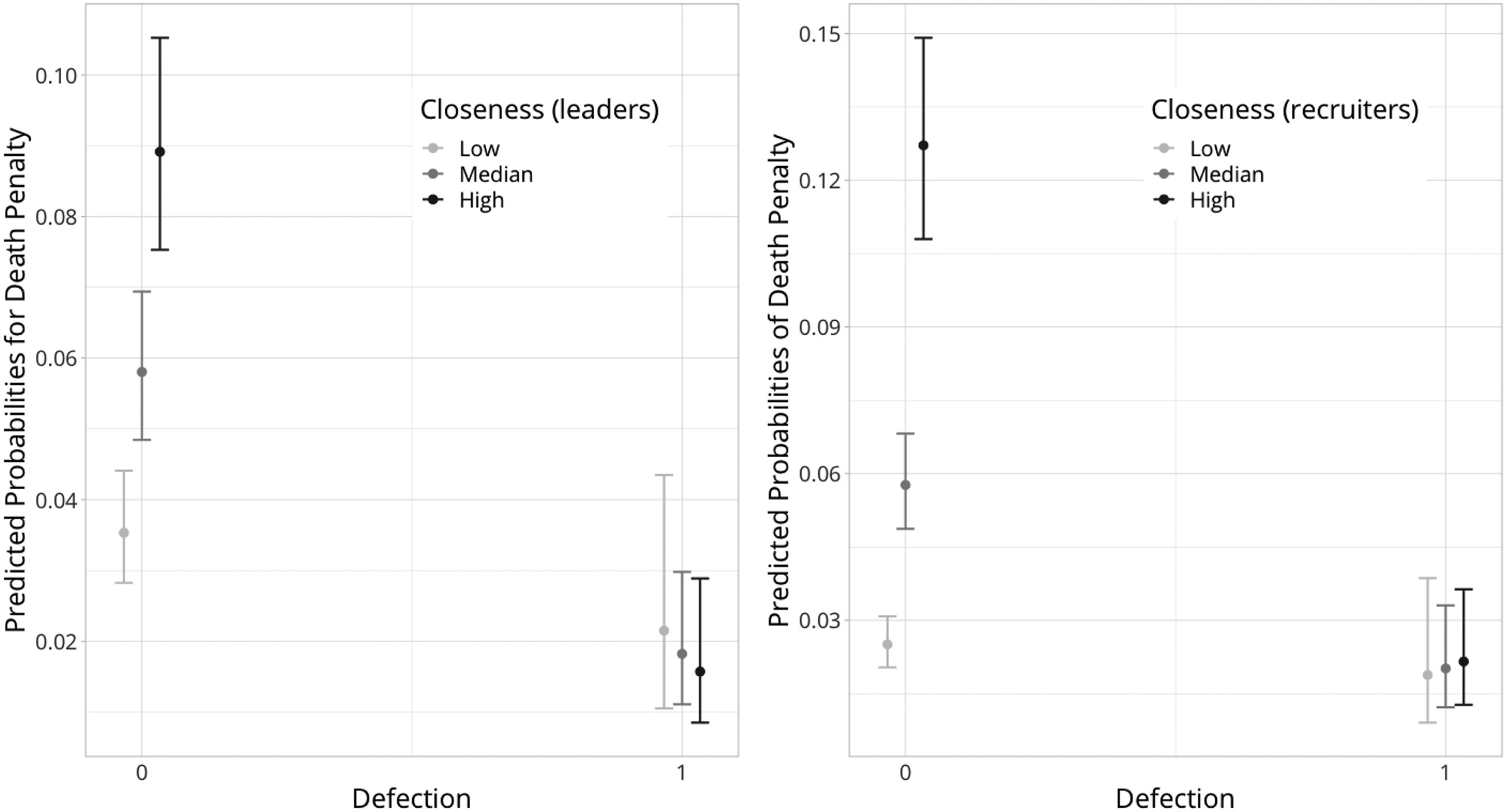
Interaction effect plots.
The results of the control variables reveal additional information on targeted repression. Committing more severe crimes, like leaking military intelligence to dissidents, seems to increase the chance of capital punishment, but it is not statistically significant across all models. Inmates tend to receive aggravated punishment. Less severe activities (e.g., spreading anti-government speech and rumors, financially aiding subversion, and joining dissent groups) are negatively correlated with capital punishment, conforming to the general impression that the regime imprisoned but did not kill individuals engaged in less severe crimes. Dissident’s occupations do not play an important role in explaining outcomes. Lastly, some have argued that local Taiwanese people (Islanders) were the primary victims under Chiang’s repressive regime, and this statement was widely used by politicians to foment ethnic confrontations and conflicts in Taiwan. My findings, largely consistent with existing research (Wu, 2005; Taiwan Truth Promotion Association, 2015), do not find support for the claim of ethnicity-based targeting, at least not at the level of the death penalty.
Death penalty is used to measure punishment severity because this study seeks to understand whom the regime targeted to kill to demobilize resistance. However, there are other forms of punishment that can be considered as a part of the punishment strategy. I therefore created an ordinal outcome variable that captures four main outcomes—innocence (14%), fixed-term imprisonment (70%), life imprisonment (2%), death penalty (14%)—and estimated it with ordered logit regression. Appendix Table A9 and A10 show that the findings are consistent.
Space may also shape states’ repression strategies (Christensen, 2018; Bautista et al., 2021). For instance, regimes may have a strong incentive to kill more people when dissent movements cluster in an area. Repression may also be more severe when movements operate in regions closer to the capital, which poses a greater threat to the regime. Unfortunately, it is difficult to control for regional variation in the data because the locations where dissidents were initially captured are not recorded in trial documents. Victims’ residential address is also omitted intentionally in the declassified document to protect their privacy. However, it is possible to use victims’ hometowns as a rough proxy for the locations where they were arrested, given that cross-county relocation was relatively infrequent. The replication of the results with county fixed effect is reported as supporting evidence in Appendix Table A.11 and A.12, showing a consistent finding. 6
Testing the Information-Gathering Mechanism
One may worry that information-gathering or internal tipping may not be the mechanism at play that links defection with clemency. An alternative explanation can be that the government may simply want more surrenders because they facilitate dissent self-destruction. High-ranking members may receive clemency because their defection causes more damage to the organization. Additionally, clemency may simply be a signaling strategy that shows regime’s mercy and encourages more surrenders, which may have little to do with information-gathering. To address these concerns, I present qualitative and quantitative evidence to further corroborate the information-clemency mechanism.
First, I combed through court documents to show that the government rewarded clemency by weighing the defector’s information contribution. Although systemically coding information-clemency exchange is difficult because they are not always described in the court documents and can happen behind the scene, we still observe many cases where the court documents described how the government granted clemency by weighing defectors’ information values. Appendix Table A19 describes two positive-reward cases where a defector’s plea for mercy was accepted because they provided information that resulted in successful crackdowns and a series of underground communists arrested. The verdict suggests that this informing behavior should be rewarded so more willing defectors will come forward to inform. Table A20 then shows a negative-reward case where the defector’s confession was found to be insincere because he did not provide information about all the relationships he knew, including some individuals he recruited, which led to more severe punishment. These cases all point to the importance of informing and information quality in determining clemency.
Additionally, if governments do care about informational value in granting clemency and use these tips to capture more subversives in the dissent network, we should expect that repression becomes more efficient in targeting. People close to defectors or previously arrested members will be captured faster than those less connected. This expectation implies that the state may be more capable of targeting fugitives (particularly in the speed) with better quality information. To test this expectation, I created an outcome variable measuring the time (number of years) before each individual is arrested to see how an individual’s network position related to previously arrested members or defectors affects individuals’ risk of survival. 7 Appendix Table A15 and A14 show estimated results from Cox Regression and time-corrected BCSTS logit model, respectively, which are both commonly used in survival analysis. They show that increased prior captures of any group members, members close to the top, or members close to the defectors in the resistance network contribute to a greater risk of an individual in the same network being captured and shortened survival time in their escape. These findings lend additional support to the informing mechanism and argument that information gathered by the government facilitates further pursuit and arrests of remaining fugitives.
Robustness Checks
One might suspect that these victims in documents were not real dissidents but simply “made up” by the regime. Given that the government threatened people and tortured them during interrogations, the extent to which we can believe that these identified leaders or recruiters are true rebels and not framed by the regime is uncertain. These victims may have been easier to capture and thus convenient to frame into more severe crimes so the regime could use these cases to show strength and intimidate the public.
To address this concern, other sources of information are needed to validate victims’ roles. However, this is not an easy task due to the secrecy of these underground movements and limited official documents available beyond the released court documents. To overcome these hurdles, I utilized three additional sources—a leaked document from the National Security Bureau, interviews of surviving victims and families, and published case studies—to verify organization leadership. Although no single source of information records all victims and their roles, combining these pieces of information can help replicate what was described in the trial documents and validate it. The leaked intelligence document from National Security Bureau provides a good source of reference because the Bureau at the time oversaw all security agencies in the country and the leaked files describe in detail how intelligence was gathered from informants and how it guided police in arresting key subversives and resolving their cases from 1949 to 1958. 8 Although it only covers ten years, this document improves our understanding of how intelligence helped target leading actors before arrests, which were already captured and which were still at large, and how intelligence provided by informants and defectors enabled captures of remaining fugitives. In addition to leaked documents, I also leverage several published interviews and oral histories to help identify their roles (Lu and Qiu, 1999; Jiang, 2002; Zhang et al., 2015; Shi et al., 2016). These interviews form part of ongoing programs by various research institutions and local governments, covering many victims and their recounts. While these recounts could still be biased by their personal perspective and limited by how much information victims knew, they are very useful in reconstructing the history. Using these materials, I am able to confirm 176 leaders (out of the 214 officially tried leaders) who were most likely leading or taking a major role in commanding their organizations. Table A1 and A2 in Appendix replicate the analysis using these confirmed leadership and produce broadly consistent results, showing that these leadership designations are less likely made up by the government and reflect the state’s intent to target leaders and eliminate them.
Relatedly, one might be concerned about potentially made-up recruitment connections in trial documents and it would be helpful to verify connections with other sources. Compared with verifying leaderships, empirically replicating these connections is more difficult even with the above new sources because the leaked document focuses more on describing leaders and their operations rather than their relationships. When relationships are mentioned, they are scattered throughout cases, making consistent identification difficult. Interviews provide only limited information as survivors know very few connections beyond themselves, given the secrecy of the network. Relatives of deceased victims know little about who recruited their husbands or wives and who was recruited by them. However, it is reasonable to believe that the identified recruitment connections in trial documents to some extent reflect true relationships. Existing literature demonstrates that police verified confessions through cross-interrogation and would increase punishment if they found confessed connections were insincere (Zhang et al., 2015; Shi et al., 2016), suggesting that the regime evaluated intelligence and disincentivized false information. Theoretically, if fabricated connections were systematically introduced and welcomed by the police, we should see a continuous growth of dissent movements because true subversives would remain at large and connections would keep expanding. Instead, underground communist movements were largely uprooted after severe repression in the 1950s and early 1960s, as existing literature has confirmed (Lin, 2009; Greitens, 2016), suggesting that relationships revealed to the regime were instrumental in capturing real members and are less likely to be false connections. Importantly, even though some charges and connections may have been fictitious, it would not jeopardize the inference of this study because the regime’s incentive remained the same: to eliminate as many subversives as possible within its knowledge and to broaden its intelligence boundary. Nonetheless, future research is needed to further probe members’ connections when more complete surveillance data and informant reports become declassified and available to the public.
Finally, one might also worry that relational repression (repressing close connections to key dissidents) may be independent of the information environment. Regimes may want to kill all key dissent actors and people surrounding them even with complete information. Empirically, if true, we should continue to see relational punishment be used even when the state intelligence has grown strong and the society is largely controlled after the mid-1960s as the literature has pointed out (Lin, 2009; Taiwan Truth Promotion Association, 2015). However, as shown in Appendix A.17 we do not see this pattern to hold when Chiang has substantively controlled Taiwanese society after 1965, suggesting that information does matter for how repression is used.
Conclusion
This study shows how network relationships in the dissent organization shape state repression strategy. Drawing from new data on state violence against underground resistance in Taiwan, I show that when fighting resistance with limited information regimes tend to widen the scope of repression by executing key actors and their close connections to ensure network dismantling. More importantly, regimes crave information, and this hunger drives them to grant clemency to individuals willing to defect and share intelligence. Given that not all information has an equal value to the regime, clemency tends to target defectors who are close to key actors and thus have high-value tips that can facilitate further crackdown of key fugitives and quicker destruction of resistance organizations. This claim is supported by the findings that regimes tend to execute not just key actors but also members closely connected to them when captured. Regimes also tend not to kill defectors, and the likelihood of execution drops significantly for defectors closely connected to key actors than those less connected.
Overall, these findings paint a potentially worrying picture from the perspective of scholars and policymakers interested in understanding state repression. By replacing the democratic constitution with wartime martial law, state actors and security agencies can exercise extreme violence against civilians under the call to fight subversion with minimal oversight. Maneuvering relational targeting that punishes ties to disloyalists and rewards insider defection shows how creative and terrifying dictators could be in working to achieve political control. International intervention may be needed to protect human rights when regimes employ extreme violence against alleged subversives under the name of defending national security.
One broader implication of this study pertains to how we conceive of state repression. Existing repression literature primarily focuses on how state violence (external to dissent) kills dissidence from the outside; however, this study shows that dissent can be killed by both external coercion and internal defection. This finding echoes the canonical work by Davenport (2015), advocating that social movement demobilization is better understood through the simultaneous intersection of external and internal explanations, where the external means state violence and the internal broadly includes the dynamic within dissent organizations such as momentum, ideology, and fragmentation. Insider defection and flipping behavior (sometimes called ratting) represent a crucial repression mechanism that is largely overlooked in the repression scholarship. A closer look at both external coercion and internal defection helps us understand how dictators dissolve opposition in a more integrated way.
The importance of dissent network position in shaping repression targeting also points to the need to revise our understanding of state coercion. Existing research pays less attention to how social networks shape repression targeting. It is even rarer to see studies that discuss the substitution between violence and clemency to incentivize defection and informing. While this study shows that targeting high-ranking members to flip and inform can be very effective in destructing centralized dissent networks with little cross-ladder ties, these tactics may be less effective against leaderless networks (i.e., spontaneous anti-regime protests) or networks where in-group ties are less hierarchical and much denser. Insider information is easier to obtain in this scenario and thus less valuable. More research is necessary to study the heterogeneous value of defection and insider tipping under different dissent network structures.
Finally, this study speaks to the broader literature on information and violence in conflict studies. My argument implies that bifurcating governments into fully informed versus poorly informed regimes fails to explain the rich variation of state violence. Most regimes have some level of dissent information and try to enhance intelligence and sharpen their targeting. It is thus important to study these middle-level information regimes and understand how they diversify methods of violence and information-gathering mechanisms rather than see them as simply restrained by their information endowment. The findings also show the potential for future research to look beyond broad demographic-based (i.e., ethnicity or identity) collective punishment and examine more micro-level relationship targeting to help us understand how governments carefully calibrate repression to balance the use of violence with civilian casualties.
Supplemental Material
sj-pdf-1-jcr-10.1177_00220027221077220 – Dissent Networks, State Repression, and Strategic Clemency for Defection
Supplemental Material, sj-pdf-1-jcr-10.1177_00220027221077220 for Dissent Networks, State Repression, and Strategic Clemency for Defection by Howard Liu in Journal of Conflict Resolution
Footnotes
Acknowledgments
I would like to thank participants at the Asian Politics Online Seminar Series (2020), including Lynette Ong, Killian Clarke, Martin Dimitrov, Travis Curtice, and the host Charles Crabtree for their helpful comments. I also thank Kyle Beardsley, Joseph Wright, Bruce Desmarais, Matt Golder, Sona Golder, Douglas Lemke, and Christopher Sullivan for their support and suggestions. I am also grateful to the journal editors and three anonymous reviewers for their helpful feedback.
Declaration of conflicting interests
The author(s) declared no potential conflicts of interest with respect to the research, authorship, and/or publication of this article.
Funding
The author(s) received no financial support for the research, authorship, and/or publication of this article.
Supplemental Material
Supplemental material for this article is available online.
Notes
References
Supplementary Material
Please find the following supplemental material available below.
For Open Access articles published under a Creative Commons License, all supplemental material carries the same license as the article it is associated with.
For non-Open Access articles published, all supplemental material carries a non-exclusive license, and permission requests for re-use of supplemental material or any part of supplemental material shall be sent directly to the copyright owner as specified in the copyright notice associated with the article.
