



Abstract
The emerging literature dealing with transnational repression has identified several strategies used by authoritarian states to control and coerce their populations abroad. This article builds on existing research by investigating the domestic determinants of transnational repression. It argues that an increase in domestic repression is likely to lead to a subsequent increase in transnational repression because crackdowns at home drive dissent abroad and incentivize the state to extend its repressive gaze beyond its borders. To evaluate its arguments, the article draws on a database of approximately 1200 cases in which authoritarian states around the world threatened, attacked, extradited, abducted, or assassinated their own citizens abroad between 1991 and 2019. Offering a first quantitative test of domestic drivers of transnational repression, using multivariate regression analysis, the paper finds that as repression intensifies domestically, the likelihood of that state subsequently escalating its transnational repression also increases substantively.
Living in exile since 2017 after fleeing a domestic crackdown in Saudi Arabia as Crown Prince Mohammed bin Salman (MBS) consolidated power over the kingdom, Jamal Khashoggi was murdered in a Saudi consulate in Turkey in October 2018. A former Saudi insider, he had become a critic of MBS, authoring articles in the Washington Post criticizing the autocratic style of the country’s emerging de facto leader. Khashoggi’s murder was only the most dramatic of several cases of MBS’s men coercing the kingdom’s exiles. MBS reportedly authorized a dedicated team – the Rapid Intervention Group – to target dissidents abroad, ranging from journalists to women’s rights activists to princes from rival royal power centers (Hubbard 2021).
Saudi Arabia is far from alone in targeting its critical exiles by using methods of transnational repression (TR). While it is common to think about state repression unfolding domestically – and indeed the vast majority still does – recent research has begun to examine the contours of TR, particularly as perpetrated by authoritarian states. In the age of globalization, authoritarian states are increasingly extending their rule across borders with the aim of increasing control over their populations abroad and containing potential regime challengers.
TR has become a newly salient aspect of the international dimensions of authoritarian rule. While the literature on TR has built considerable knowledge about regime-diaspora interactions, our understanding of the relationship between domestic and transnational forms of repression is still emerging. Studies examining TR usually focus on one or a small number of states (Baser and Ozturk 2020; Glasius 2018; Glasius 2023; Moss 2016; Tsourapas 2021). Through in-depth qualitative case study analysis, such research provides important insights into TR dynamics, including its forms, targets, and outcomes. Yet, we still lack an adequate cross-case understanding of how domestic developments lead state repressive practices to expand transnationally. Using publicly available data on TR events, the article takes this initial step to establish the relationship between domestic and transnational repression by building on the existing scholarship that examines the politics of transnational repression (e.g. Lewis 2015; Moss 2016; Cooley and Heathershaw 2018; Michaelsen 2018; Glasius 2018; Conduit 2020; Tsourapas 2021; Dukalskis 2021; Moss 2021; Glasius 2023).
Our main argument is that domestic crackdowns increase the likelihood that TR will occur subsequently. We argue that this can arise for two main reasons. First, an increase in domestic repression can drive activists, dissidents, and/or victims abroad. When they flee, the state still views them as a threat, and thus targets them abroad. Second, campaigns of domestic repression can make real or perceived international linkages between domestic dissidents and international exiles newly salient. The result is that the state views the latter with renewed suspicion and thus as fair game for repression.
We use multivariate regression analysis to examine the relationship between domestic and transnational repression. Our central finding is that as repression intensifies domestically in an authoritarian state, the likelihood of that state escalating its TR also increases substantively. We show that domestic repression and TR go hand in hand and reinforce existing authoritarian regime practices. Our study further shows that the process of domestic state repression spilling over into the transnational sphere depends on the state’s diplomatic capacity.
This is among the first quantitative analyses of TR. The study provides the first statistical test examining the relationship between domestic and transnational repression, and maps out distinct theoretical pathways to explain its findings. Our findings improve our understanding of the relationships between domestic dynamics of authoritarian repression and its transnational effects.
Methodologically, the study offers a new approach to studying TR and contributes to the emerging literature on the subject. It advances existing explanations on state repression and authoritarian politics (e.g. Carey 2010; Svolik 2012; Frantz and Kendall-Taylor 2014; Frantz et al. 2020b; Dukalskis 2021; Keremoğlu, Hellmeier, and Weidmann 2022) as well as the aforementioned literature on the international dimensions of authoritarian rule.
New Contexts and Newly Salient Forms of Repression
State repression, according to Davenport (2007b, 2), involves “the actual or threatened use of physical sanctions against an individual or organization within the territorial jurisdiction of the state” to punish or prevent action threatening to the existing political order. Research in the field of repression has been characterized by questions related to how, when, and why states use repressive practices (for a review, see deMeritt 2016). In general, repression aims to squelch political threats and to deter popular mobilization and regime challengers.
Repression is a key tool of political rule in authoritarian states specifically. Research on authoritarian survival holds that repression constitutes an essential element of the regime’s stability and longevity (Bellin 2004; Gerschewski 2013; Svolik 2012). Although the use of repressive strategies varies across authoritarian regimes, all regimes use it to some degree (Frantz and Kendall-Taylor 2014). The perceived need for repression arises when the use of repressive tactics is expected to outweigh the costs, with the state using repressive tactics most immediately to maintain power (Bellin 2004; Edel and Josua 2018; Schlumberger 2015). Democracies generally repress less than autocracies (Davenport 2007b; deMeritt 2016), and there are debates over variation in state repression among different subtypes of autocracies (Frantz et al. 2020b; Møller and Skaaning 2013).
However, scholarly research examining state repression has been almost entirely focused on the domestic sphere (e.g. Goldstein 1978; Davenport 1995; Gartner and Regan 1996; Davenport 2007b; Carey 2010; Ritter and Conrad 2016; deMeritt 2016; Frantz et al. 2020b; Hassan, Mattingly, and Nugent 2022). Widely used indices of repression like the Political Terror Scale or the Cingranelli-Richards (CIRI) Human Rights Data Project explicitly exclude instances of state repression that take place outside that state’s borders (Dukalskis et al. 2022). This means that no studies of domestic repression which rely on these or similar sources capture dynamics of TR, leaving important new questions to be explored in an age of resurgent authoritarian powers and global interdependence.
The forms of repression and tools available for authoritarian governments to carry out or substitute other methods of political control evolve (Frantz, Kendall-Taylor, and Wright 2020a; Guriev and Treisman 2022; Morgenbesser 2020; Olar 2019; Xu 2021). Recent literature across disciplines of international security, migration studies, sociology, and international relations demonstrates that repression originating from authoritarian states extends transnationally. This literature (see among others, Lewis 2015; Collyer and King 2015; Dalmasso et al. 2018; Glasius 2018; Adamson 2019; 2020; Tsourapas 2021; Dukalskis 2021; Moss 2021; Glasius 2023) highlights the lengths to which states go to control and coerce their populations abroad. This entails “extending the scale of domestic political controls across borders into transnational spaces occupied by diasporic and exile communities” (Lewis 2015, 141).
This emerging research demonstrates a global turn in spatialization and extra-territorialization of authoritarian security measures (Cooley and Heathershaw 2018). As argued by Furstenberg, Lemon, and Heathershaw (2021, 361), “for authoritarian governments, extraterritorial security practices form an extension of their domestic pursuit of regime security.” Such trends represent important transformations in the way states are organized and governed. As further argued by Conduit (2020, 2): “actors (be they regimes or exiled oppositions) may therefore seek to stretch space to make power more diffuse or shorten that distance to make their presence felt somewhere where they are not.” States can harness aspects of globalization and technological advances to maintain control over their populations abroad. Digital tools, for example, facilitate activism but also instantaneous surveillance and intimidation of exiles thousands of miles away (Moss 2018; Michaelsen 2018; Michaelsen and Thumfart 2022).
To be sure, TR is not the only way in which autocracies engage with their diaspora populations. They also try to legitimate their rule, co-opt potential challengers, and otherwise bind their diaspora populations to the homeland controlled by the government (Baser and Ozturk 2020; Dalmasso et al., 2018; Glasius 2018; Needham and Grubb 2022; Tsourapas 2021). Yet like the domestic analog of Gerschewski’s Three Pillars of Authoritarian Stability model (Gerschewski 2013), repression is often deployed when persuasion or co-optation measures fall short. Extra-territoriality transforms each pillar. Transnational legitimation is more challenging than its domestic equivalent because the government has less control over the information sphere, while co-optation may be facilitated in some respects through the state’s monopoly over technologies of citizenship and access, like passport renewal, voting, and the like. Repression also changes transnationally because of barriers erected by sovereignty and reduced state capacity abroad. Nonetheless, autocracies adapt to such challenges and innovate tactics like digital methods mentioned above, or punishment of exiled dissidents’ families at home to pressure the dissident abroad (Moss et al., 2022).
While TR can be used by any state (Glasius 2018; Schenkkan and Linzer 2021), there are strong reasons for it to be more commonly used by authoritarian states than democratic ones. Democratic states repress less than their authoritarian counterparts (Davenport 2007b). Democracies in general protect civil liberties better than do autocracies (Møller and Skaaning 2013) and typically have institutional channels through which dissenting voices can advocate for their causes with less fear of repression (deMeritt 2016). Taken together, this means that democracies are likely to generate fewer exiled dissidents in the first place, which by extension means that TR is less likely to be used by democratic states.
The rationale for TR is to neutralize politically threatening citizens and their activities abroad. In this sense, TR is like domestic repression in which governments aim to counter or eliminate behaviors that threaten the political system or the status quo (Davenport 2007b; on the complementarity of different forms of state repression, see Fariss and Schnakenberg 2014). Research on social mobilization and diaspora advocacy (Adamson 2002; Sheffer 2003; Shain 2005; Tarrow 2005; Waldinger and Fitzgerald 2004) has long highlighted that once people leave their country of origin and settle in another, they can still have a ‘voice’ and opportunity to raise their concerns about homeland politics by engaging in activities from abroad. For example, during the Arab Spring, social media and the internet facilitated social mobilization and allowed people to make their voices heard from abroad against their authoritarian home states (Beaugrand and Geisser 2016; Moss 2018; Niekerk, Pillay, and Maharaj 2011).
Such transnational activism can threaten authoritarian leaders, and in the face of threats, dictators have the capacity to learn and adapt to the repertoires of their regime opponents (Guriev and Treisman 2022; Morgenbesser 2020). As mentioned above, TR differs from traditional forms of repression with respect to the ease with which regimes can develop the capacity to carry it out. It requires spatial reach and different personnel and tactics to repress in another sovereign jurisdiction (Dukalskis 2021, 71). Beyond digital techniques, authoritarian states engage in TR via their embassies or consulates (Adamson 2019) or through shadow structures like unofficial police stations (Giuffrida 2022). It can further include wings of the ruling political party (Needham and Grubb 2022), educational associations of the host state (Lemon et al. 2022, 11), intelligence officers sent abroad clandestinely for short periods of time (Hubbard 2021), sub-contracting to criminal gangs (Glasius 2023), or through cooperation with host state personnel (Lemon 2019), among others.
Authoritarian states learn to exploit contextual changes in technology, the international legal environment, and foreign relations to pursue their objectives and mitigate challenges and vulnerabilities introduced by globalization (Frantz, Kendall-Taylor, and Wright 2020a; Ginsburg 2020). While TR is not in itself new (e.g. Lessa 2019), in the context of globalization and migration, today’s authoritarian states have turned to TR as a newly salient tool to neutralize political threats. Recent research shows the truly global dimension of TR, with dozens of states around the world involved as perpetrators of TR incidents (Dukalskis 2021; Dukalskis et al., 2022; Lemon et al., 2022; Schenkkan and Linzer 2021). And yet, there is still to our knowledge no global quantitative study on the drivers of TR.
Domestic Repression and TR: Proposing Linkages
One open question is what the relationship is between domestic repression and TR. As noted long ago by Davenport (1995), the intensity of repressive actions employed by governments is often dependent on the level of threat perception. We therefore attempt to theorize the threats that stem from the transnational sphere in relation to domestic authoritarian stability. Following Moss’ (2021, 71) definition of TR as “attempts by regimes to punish, deter, undermine, and silence activism in the diaspora” we elaborate on two main pathways through which domestic repression can generate threats that then precipitate TR. The threat pathways are not mutually exclusive and may overlap in many cases, but we present them separately for analytical clarity.
There are reasonable grounds to believe that higher levels of state capacity are likely to aid the effectiveness of either pathway. While some work has found that higher levels of state capacity are associated with lower levels of repression domestically because leaders in stronger states feel more secure (Young 2009), our theory begins from the premise of a domestic crackdown. State leaders are already likely to feel threatened in that context, meaning that the more capacity at their disposal to neutralize challenges the more effective they are likely to be in doing so.
Diplomatic capacity as a specific aspect of state capacity is especially germane to TR. As discussed in the previous section, TR is enabled by diplomatic infrastructure abroad, surveillance and intelligence capabilities, and the ability to mobilize non-state or quasi-state actors abroad like religious institutions or a ruling party to assist in the effort (Glasius 2023, 53-56). In the official political sphere, diplomacy can facilitate TR through cooperation from other like-minded states through international organizations like the Shanghai Cooperation Organization, where collaboration between states on ‘security issues’ can help arrange the subcontracting of TR (Cooley and Heathershaw 2018). Therefore, our baseline expectation is that state capacity, and diplomatic capacity in particular, enhances the ability to engage in TR after a domestic crackdown.
Fleeing Crackdowns, Becoming Targets
First, increasing domestic repression may drive some dissident actors and/or victims abroad. Despite their flight, authorities may still wish to ensure that these dissidents do not become politically threatening from abroad. For example, they may have witnessed domestic repression and be able to communicate stories about it widely. Human rights organizations and activists, as well as some governments and international organizations, commonly use the tactic of “naming and shaming” governments that violate human rights in the hopes of mitigating the severity of repression and/or achieving accountability. Transnational activism has long relied on publicizing human rights abuses by a state to garner sympathy and support for the victims and to pressure the state to change its behavior (Keck and Sikkink 1998). Researchers debate the effectiveness of “naming and shaming”, and find that incentives to change repressive behavior when facing international condemnation vary across regime type, source of the criticism, the types of rights violations in question and their severity (Esarey and deMeritt 2017; Hafner-Burton 2008; Hendrix and Wong 2013). Naming and shaming becomes a possible threat to the offending regime’s power insofar as effective campaigns can bring punishments like sanctions, reduced aid, and/or isolation from international fora. A country’s diaspora can play a key role in naming and shaming as they have insider knowledge, linguistic skills, connections, and motivation to work for change from abroad (e.g. Quinsaat 2019). Individuals fleeing authoritarian rule and domestic crackdowns can have a particularly outsized role as they can testify first-hand to the human experience of repression, which can be used in human rights reporting as a powerful spur to action (Moon 2012). Exiles with knowledge of the crackdown thus become potential threats to their home state.
Consider the May 2005 uprising, repression, and aftermath in Andijan, Uzbekistan (Cooley and Heathershaw 2018, 201–10). Uzbek security services shot protesters in the city, which killed perhaps several hundred people and led to hundreds leaving the country to escape further repression. They were thus in a position to publicize the violence and press their case for change and accountability from abroad. Cooley and Heathershaw (2018, 203) find that the Uzbek government of Islam Karimov was ultimately unsuccessful in shaping the international narrative about what happened in Andijan but that it was “more successful in harassing the exiles who escaped to Russia or further afield.” Not only did the government disseminate propaganda domestically to discredit Andijan exiles, but it also engaged in an international campaign to attack, kill, or forcibly return dozens of people who had fled abroad.
Beyond witnesses or victims, former regime insiders who were purged or defected amid intensifying repression may present a direct threat to the regime. Former insiders have intimate knowledge of how the regime works and perhaps some of its closely guarded secrets. They are sometimes in unique positions to confirm specifics about repression, corruption, or personally embarrassing details about the government. Because of their privileged status, they often have the connections and wherewithal to be a genuine threat to their home regime from abroad. They can lobby foreign decision-makers, publicize unseemly details to discredit their home regime, and/or fund and support domestic regime opponents.
Consider the case of Paul Kagame’s Rwanda. As Kagame and his Rwandan Patriotic Front (RPF) consolidated power and repressed domestic opponents, some insiders defected. Seth Sendashonga, a former Minister of the Interior in a unity government with the RPF, was one of the first to resign and defect to Kenya in 1995. He was the target of an assassination attempt in 1996 and was ultimately killed in May 1998 in Nairobi (Human Rights Watch 2014). While abroad, he organized a non-violent opposition political party in cooperation with other prominent exiles (Betts and Jones 2016, 128). He was also potentially privy to details about a massacre in April 1995 of displaced persons in Kibeho in southern Rwanda, having arrived at the scene shortly after the violence (Prunier 2009, 37–41; Thomson 2018, 90–91). Sendashonga is one of at least four former Rwandan government officials who has been assassinated abroad, with several others facing other forms of extraterritorial repression as Kagame increasingly clamped down on dissent both at home and abroad (Wrong 2019).
Seeing Enemies and Severing Links
Second, a campaign of domestic repression may mean that the international connections of domestic targets are met with newfound suspicion. Exiles not only publicize human rights abuses and build international networks and allies, as discussed above, but they can also assist domestic activists with resources, connections, and advice. For these reasons, authoritarian states strive to destroy the links between domestic opponents of the regime and international activists (Cooley and Heathershaw 2018; Michaelsen 2018; Moss 2018; Tsourapas 2021). Sheltered from censorship and physical repression that would likely limit them domestically, activists abroad are uniquely placed to communicate to international audiences about human rights abuses in their home state. They can put their cause on the international agenda, lobby decision-makers, and connect groups in their home state with international networks of supporters (Moss 2021). However, their location abroad also means they are farther from the context they wish to change.
Amid a repressive domestic campaign, real or perceived connections to international networks can be viewed as potential threats in the eyes of an authoritarian government. The state may see transnational groups as threatening their latitude to deepen control at home. On this logic, the effort to control the domestic sphere entails taming international threats and severing the links between the two. As demonstrated during the Arab Spring, diasporic activism can be detrimental to authoritarian regime survival and stability (Beaugrand and Geisser 2016; Moss 2016). They can play the role of ‘enablers’ by facilitating the transfer of social and political norms, including democratic values, which can, in turn, threaten authoritarian rule (Koinova 2009). Linkages between politically active diasporic groups may thus be looked on with suspicion by the government and thus become targets of state repression.
Consider the case of Turkey after the coup attempt in 2016. The administration of Recep Tayyip Erdoğan quickly pinned the blame on the movement of Pennsylvania-based cleric Fethullah Gülen, which the Turkish government defines as a terrorist group. The domestic crackdown was dramatic and severe. The government launched a campaign against Gülenists in all corners of society, detaining or arresting tens of thousands of people, and closing more than 100 media outlets and hundreds of civil society organizations (Bayulgen, Arbatli, and Canbolat 2018, 357). Almost immediately, “Ankara initiated a ‘global purge’ that mirrored its domestic crackdown” (Schenkkan and Linzer 2021, 39). Turkish authorities intimidated activists, rescinded the passports of tens of thousands of Turks to prevent them from traveling abroad, and sought the forced repatriation of some of its citizens abroad. In addition to trying to convince the United States to extradite Gülen himself to Turkey, Turkish authorities attempted to upload 60,000 names to Interpol’s Red Notice System (Lemon 2019). According to Russell (2018), the objective of the global crackdown was to “sow discord among diaspora communities, to create an atmosphere of fear and mistrust, and to prevent individuals from criticizing the government.”
In some contexts, the simple act of being abroad amid a repressive campaign can make one a target of TR. The case of China’s repressive campaign against Uyghurs, mainly in Xinjiang, illustrates this point. The People’s Republic of China (PRC) drastically escalated the intensity of repression of the group between 2014 and 2017, building a massive technological and human intelligence surveillance system to monitor the population for possible signs of disloyalty and re-education camps on a massive scale (Byler 2021; Leibold 2020; Roberts 2020; Smith Finley 2019). The campaign soon entailed the PRC extending its repressive horizons abroad. Uyghurs with international connections, such as relatives overseas or a history of travel outside China even for non-political reasons, were viewed as suspicious. The PRC's TR tactics range from surveillance to threats to forced repatriation in its efforts to control Uyghurs with foreign links (Lemon et al. 2022). The apparent aims of the transnational dimensions of the crackdown on Uyghurs are “to persuade citizens to return to China for re-education; to create mistrust among diaspora members and thereby limit collective mobilization; and to discourage Uyghurs from making appeals for host-country support or engaging in public advocacy” (Greitens, Lee, and Yazici 2020, 20).
These examples from Turkey and China highlight how the logic of intensified domestic repression can see international linkages being perceived as a threat to the regime, which in turn can result in the expansion of repression across borders. Authorities wishing to crack down domestically look for the support sources of domestic opponents, which can include exiles. In some cases, this logic can swell to result in a generalized paranoia, putting ordinary citizens abroad in the crosshairs of the state’s repressive agents.
The discussion so far has offered compelling theoretical reasons to think that authoritarian crackdowns at home would make subsequent TR more likely. This is the main hypothesis we investigate. In this sense, the use of TR practices can be linked back to the traditional sovereign concerns regarding political control (Brand 2010, 86). It is an attempt to prevent acts of political dissent against an authoritarian state by targeting diaspora groups or individuals deemed to represent a (potential) threat to the regime. This section has provided some illustrative examples, but the next section turns to the data and methods we use to provide an initial quantitative test of whether domestic repression leads to TR.
Data and Methods
In the following sections, we describe the data and methods used to evaluate the proposition that widespread domestic repression results in intensified TR. We present a description of the Authoritarian Actions Abroad Database and describe our TR variable, which is our dependent variable. Following this discussion, we present measures used to capture our independent and control variables. We then outline our analytical method.
TR Data: The Authoritarian Actions Abroad Database (AAAD)
To measure authoritarian TR, this paper uses the Authoritarian Actions Abroad Database (AAAD) (for more details, see Dukalskis 2021, 67–79). 1 The database includes publicly available information about authoritarian TR from 1991 through the end of 2019. The AAAD was chosen as a data source over other TR databases for its combination of geographical and temporal scope relative to other options (e.g. Furstenberg, Lemon, and Heathershaw 2021; Schenkkan and Linzer 2021; Lemon et al. 2022; on TR data, see Dukalskis et al. 2022). The sample of states under consideration consists of 88 authoritarian regimes in line with the typologies of Geddes, Wright, and Frantz (2014) and Wahman, Teorell, and Hadenius (2013). The recorded repressive actions include threatening the dissident’s family remaining in the perpetrating state, threatening the exiled dissident directly, arresting/detaining, attacking, abducting, extraditing, and/or assassinating the dissident. To the extent possible, the AAAD also records attempted but unsuccessful abductions, extraditions, and assassinations. It is important to note that in line with the TR literature, the AAAD captures instances of states repressing their own citizens abroad and is therefore distinct from targeting the citizens of other states. The extraordinary rendition of foreign citizens (Cordell 2021), for example, is not included as TR.
Reliable information about TR is difficult to obtain and verify. By design, the actions are usually meant to be secretive and deniable. It is unlikely that the full scope of TR will ever be known, and yet there is an impressive amount of information in the public domain about the phenomenon. The AAAD draws on this data by using existing databases of dissidents and transnational repression (e.g. Front Line Defenders 2022; Xinjiang Victims Database 2019; Furstenberg et al. 2020), credible news sources, and trusted non-government organization sources such as Amnesty International and Human Rights Watch. Information was obtained mainly using English language searches, but follow-up searches were completed in Arabic, Chinese, French, Korean, Russian, and Turkish to capture new cases and to illuminate more details on existing cases for verification purposes. These procedures yielded 1205 events from 1991 to 2019 involving 35 perpetrating source states.
The AAAD is organized at the event level with each data point consisting of one incident happening to one or more targets at one time. The example of Jamal Khashoggi referenced at the outset of this article, for example, is recorded as case ID (673), source country (Saudi Arabia), target country (Turkey), action (assassinated), target (journalist), target name (Khashoggi), year (2018), month (11) along with a link to an Al Jazeera article with details about the killing. Figure 1 shows the most active source states between 1991 and 2019. Uzbekistan (199), China (162), North Korea (151), Turkey (163) and Russia (74) are the top five most active states during the entire period, but the map further illustrates the global scope of TR. Latin America stands out as a notable exception, although in the 1970s, prior to the time period of the AAAD, Operation Condor saw dictatorships in the region cooperate to neutralize one another’s exiles (Lessa 2019). Perpetrators of Transnational Repression by Number of Cases (1991-2019). No data available for democracies (white). Data source: Dukalskis (2021).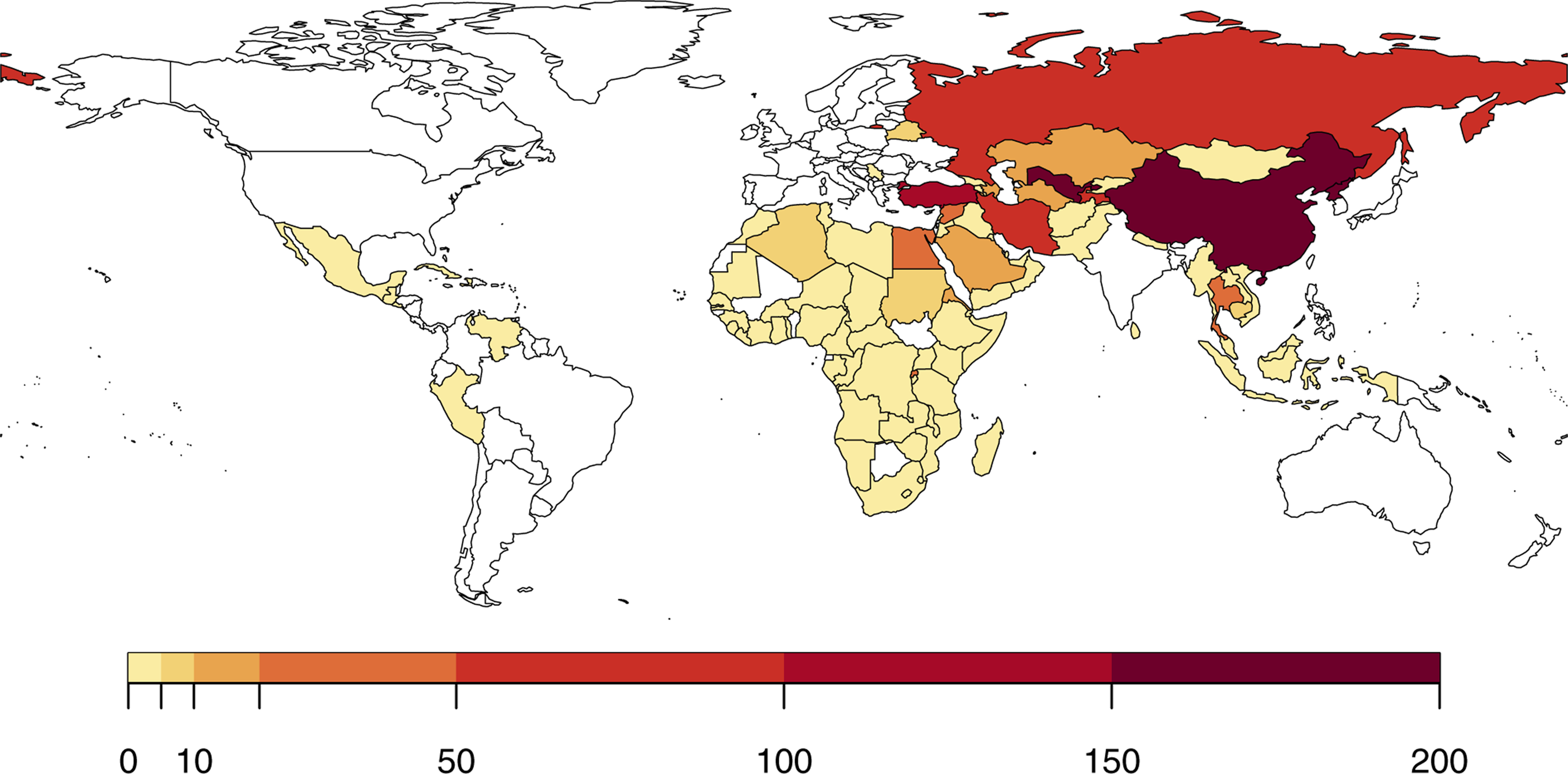
Figure 2 tracks the number of TR events annually in the data from 1991 to 2019. The figure points to an increase in TR over time, which coincides with the claim that there has been a “normalization” of TR in recent years facilitated both by more tools available to states and a changed threat environment (Schenkkan and Linzer 2021). Transnational Repression Events Per Year, 1991-2019. Data source: Dukalskis (2021).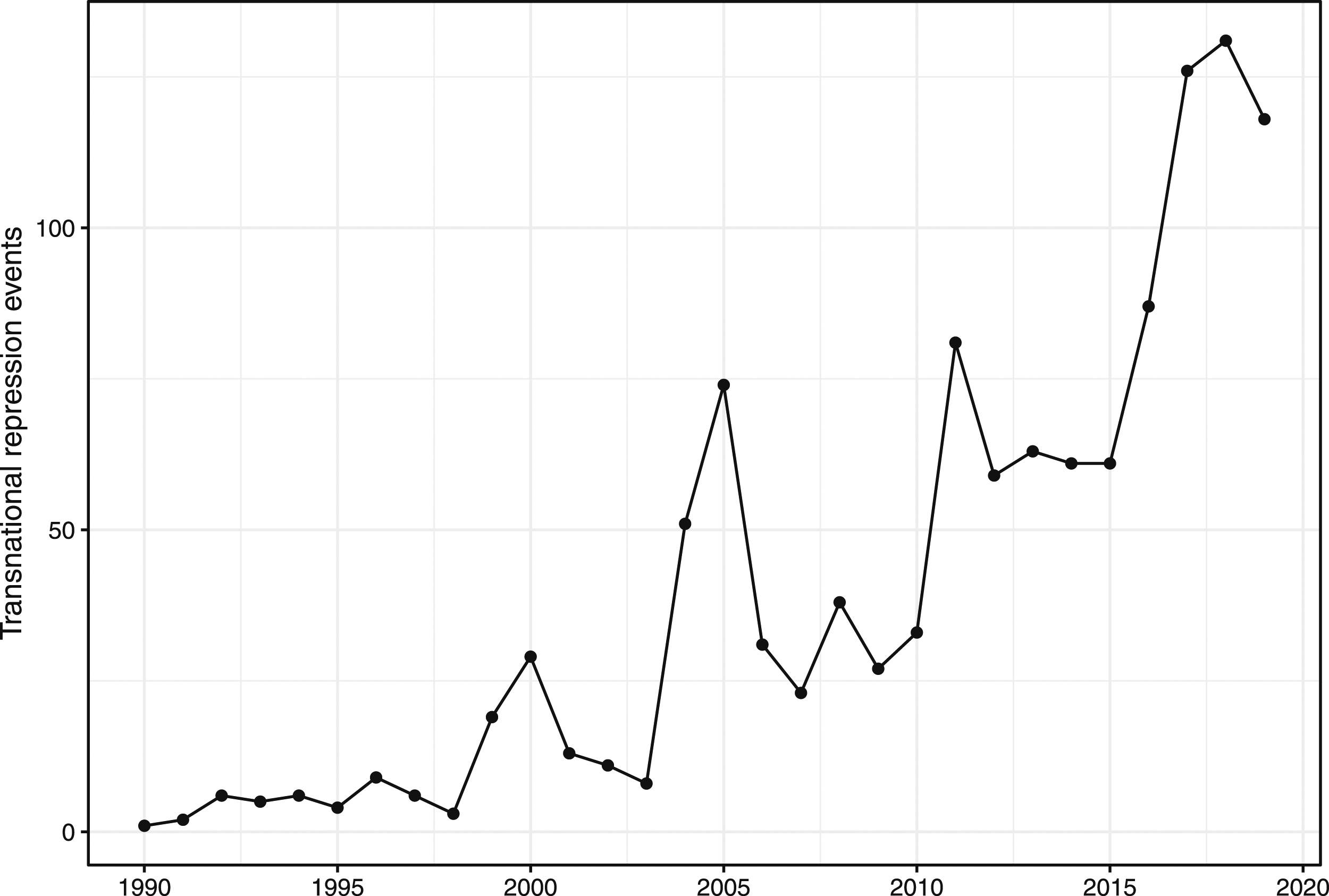
Figure 3 illustrates the ways source states attempt to repress dissent outside their territory. The most popular tools in the repertoires of many authoritarian states are the ability to threaten (234), threaten the family members (183), extradite (176), arrest (215) and/or attempt to extradite one of its citizens (205). Threats often come via transnational technological platforms, such as when Chinese security agents use the messaging app WeChat to threaten political dissidents and activists (Ruan, Knockel, and Crete-Nishihata 2021), but they may also be in-person and organized through embassies in the host state. Arrest/detention and extradition often require the complicity of the host state and/or the abuse of international agreements (on the politics of extradition see Krcmaric 2022). Interpol’s Red Notice system, for example, allows states to advertise international arrest warrants for their citizens overseas. This system can be, and frequently is, abused to target political opponents (Lemon 2019). While these international arrest warrants may be fabricated, a Red Notice still results in serious disruption and insecurity for the dissident until the (il)legitimacy of the warrant can be verified. On the other hand, threats to family members of the dissidents who are still in the host country allow the authoritarian state to use the institutions of territorial sovereignty to its advantage. Methods of Transnational Repression and their Frequency, 1991-2019. Data source: Dukalskis (2021).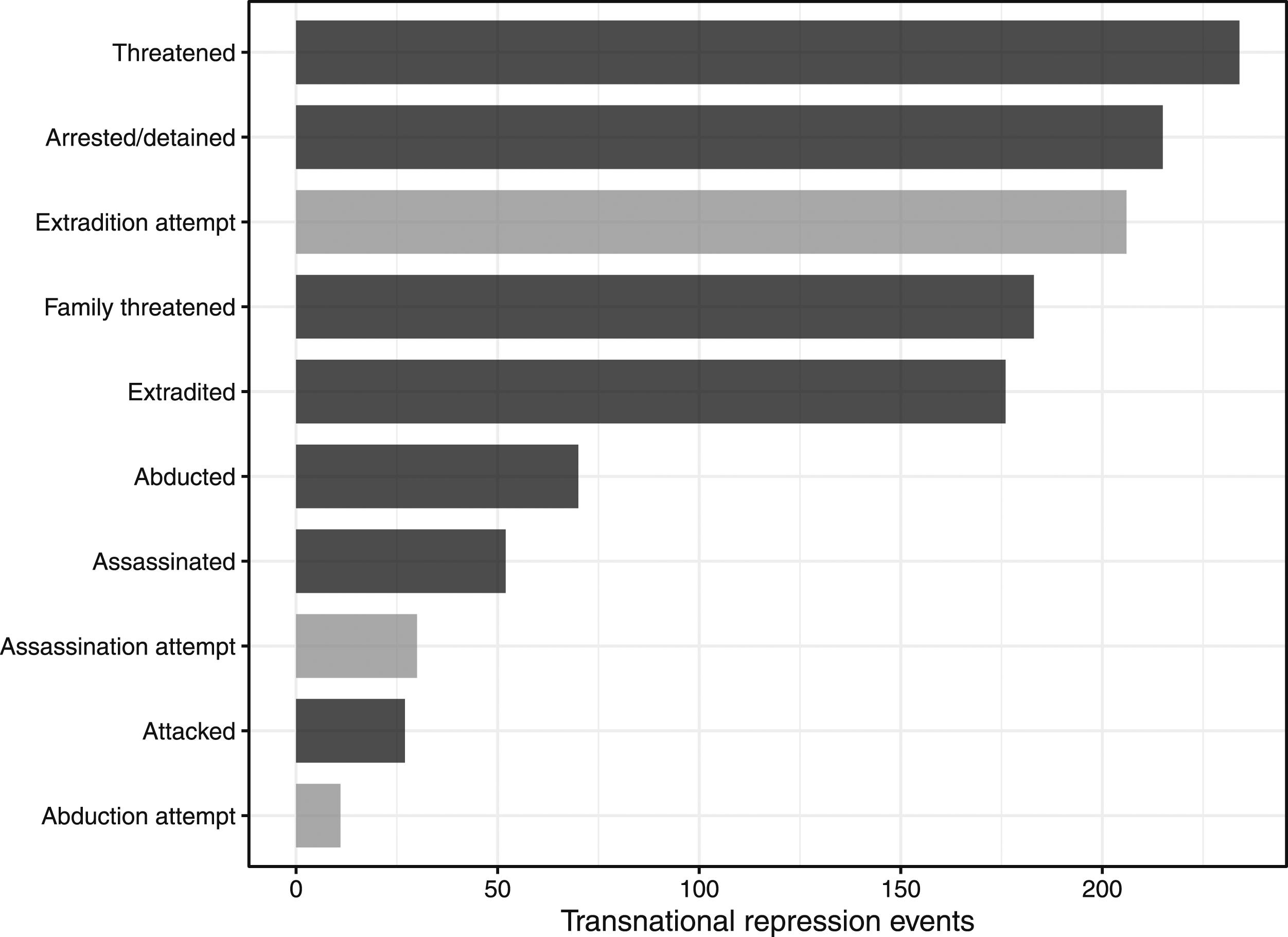
Figure A.1 in the Appendix shows a summary of the types of individuals targeted by authoritarian states. “Citizens”, a category that includes people who are deemed politically threatening by the source government due to something about their identity (e.g. Uyghurs abroad in the case of China, see Lemon et al. 2022) or simply due to the fact that they are abroad (e.g. North Korean defectors, see Fahy 2019, 131) are the most frequent targets of TR. Activists and journalists constitute the second and third most frequently targeted groups, respectively. While they are often not an immediate threat to unseat the regime, they often have the skills and networks to disseminate information that may be harmful to the state’s image and power.
Dependent Variable: Transnational Repression
For our analysis of the relationship between domestic and subsequent TR, we aggregate all repressive actions in the AAAD as outlined above to a panel dataset at the country-year level. Our main dependent variable of interest consists of a binary indicator that takes the value one if one or more TR events have been carried out by an authoritarian source state each year and zero otherwise. We also run additional analyses with the yearly number of repression events as the dependent variable. This count variable ranges from zero in many country years to highs of 61 events for Uzbekistan (2005), 41 for Syria (2011), and 40 for North Korea in 2004. The distribution of the number of TR incidents is summarized in Figure A.2 in the Appendix. For the main models in our analysis, we treat all repression events as equal, irrespective of the target and action. However, we conduct additional analyses where we break up each repressive action by target and action to assess the probability of specific repressive actions.
Independent Variable: Domestic Repression
To capture domestic repression, we rely on the Civil Liberties Index (CLI) provided by the Varieties of Democracy (V-Dem) Project, which measures the “absence of physical violence committed by government agents and the absence of constraints of private liberties and political liberties by the government” (Coppedge, Gerring, Knutsen, Lindberg, Teorell, Altman, et al. 2022, 296) based on expert ratings. V-Dem relies on Bayesian Item-Response Theory to take measurement error into account (Pemstein et al. 2022) and provides estimates of the CLI for every state from 1900 to 2021. The CLI estimate represents the average of three component indicators: the physical violence index (torture, killings), the political civil liberties index (censorship, parties, civil society) and the private civil liberties index (forced labor, property rights, religion). The three component indicators tap into slightly different aspects of state repression but are highly correlated (Rubin and Morgan 2021). Scholars contend that the index provides “[…] reliable and valid information on restrictions and violence under authoritarian rule” (Tanneberg 2020, 57), and it has been used as a measure of repression in prior quantitative work (e.g. Dinas and Northmore-Ball 2020). 2 We use an inverted form of the CLI as the main independent variable to measure domestic repression; higher values correspond to more state repression. 3
Control Variables
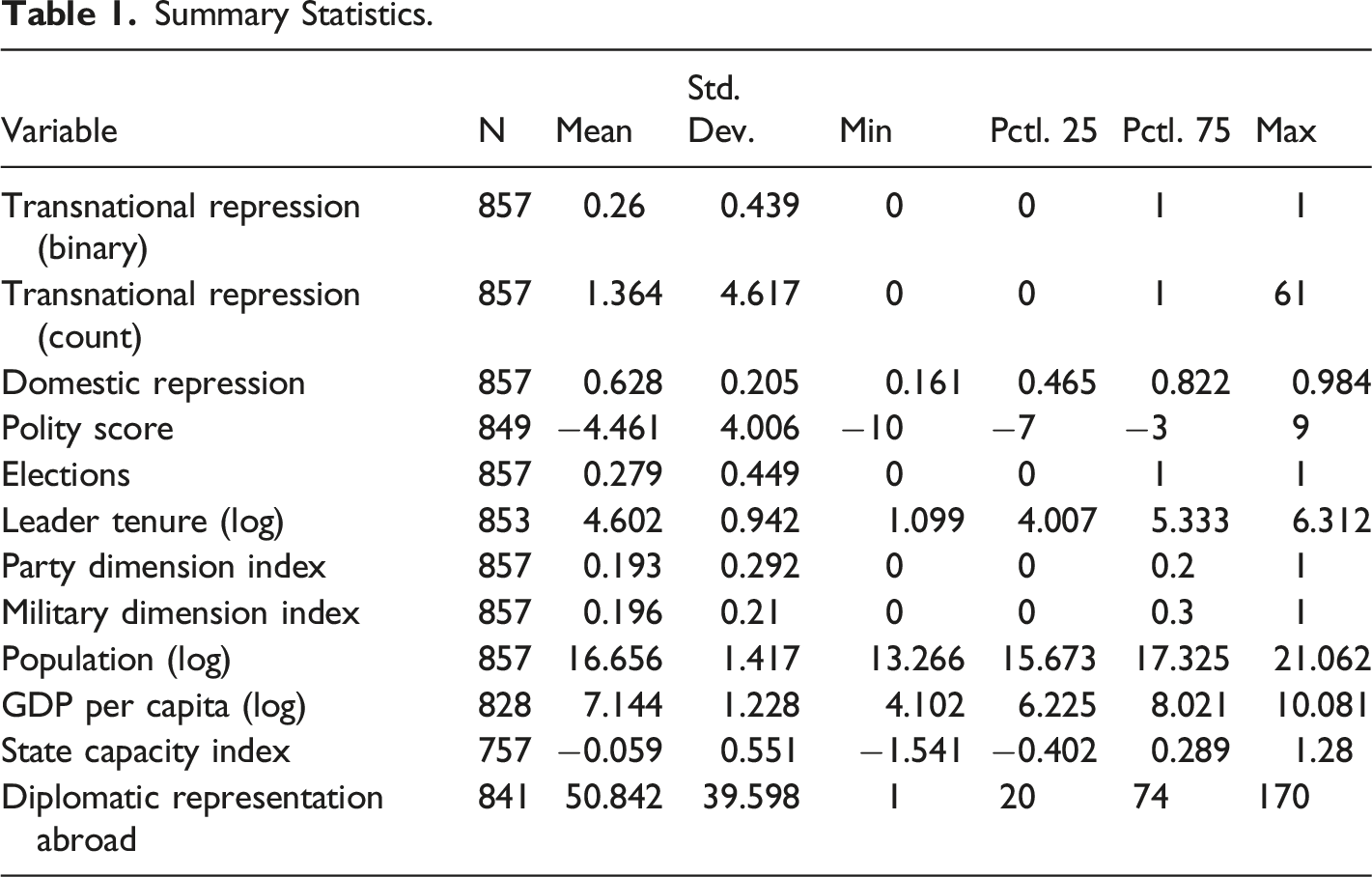
We include a series of political and economic variables in our analysis to reduce concerns that third variables confound the relationship between domestic and transnational repression. First, the (revised combined) Polity score (Marshall and Gurr 2020) of the source states is used to control for each state’s level of authoritarianism over time. More authoritarian regimes are expected to be more repressive domestically and transnationally. The Polity score ranges from −10 (full autocracy) to 10 (full democracy). 4
Second, we control for regime stability by including information on the recent occurrence of elections (Coppedge, Gerring, Knutsen, Lindberg, Teorell, Alizada, et al. 2022, v2eltype_0 and v2eltype_6) and the incumbent ruler’s time in office (Bell, Besaw, and Frank 2021). Therefore, we account for the possibility that clampdowns around election time would drive the results (see Freyburg and Garbe 2018), that repression inside and outside the country spikes during regime transitions (Licht and Allen 2018), and that regime consolidation is a confounding factor.
Third, we include state capacity. As discussed above, state capacity can influence the ability of the regime to logistically carry out repression. We use the Hanson and Sigman (2021) measure of state capacity, which aggregates 21 variables within three conceptual pillars of state capacity (extractive, coercive, and administrative) to arrive at a latent measure. Fourth, and relatedly, we account for diplomatic capacity abroad using the Diplomatic Representation Dataset by Moyer et al. (2021) which accounts for the number and type of diplomatic ties a country has abroad each year.
Fifth, existing work has shown that who rules makes a difference in authoritarian regimes. For example, single-party regimes have been shown to be less repressive in comparison to military regimes or monarchies (Davenport 2007b). To gauge the importance of different actors in authoritarian regimes we use continuous estimates of the executive’s sources of power contained in the V-Dem data set: the military and party dimension index (Teorell and Lindberg 2019). Fifth, we control for the size and wealth of each state by adding the log value of its population and GDP using data from the World Bank (World Bank 2021). Studies have shown that factors like lower levels of income and population density can shape patterns of resistance and therefore the level of domestic repression at home (Hill and Jones 2014).
Summary Statistics.
Methods
To investigate whether repression abroad is a consequence of more repression at home, we run several multivariate regression models with country and year fixed effects. Thus, we leverage variation within countries to reduce unobserved confounding and to control for common time trends. Given that countries for which the AAAD does not record at least one repression event during the coding period are removed from the estimation in this setting, our sample consists of 857 country-year observations from 35 states (1991 to 2019). For our main models, where the occurrence of one or more TR event is the dependent variable, we use logistic regression models with mixed bias-reducing score adjustments (Kosmidis et al. 2020). For additional models with the absolute number of repression events per year as the dependent variable, we employ standard count models such as Poisson and the negative binomial model. Given the panel data structure, we use clustered standard errors developed by Newey and West (1986) at the country and year level in most models.
Results
We begin our analysis by describing the bivariate relationship between changes in domestic repression and the likelihood of one or more TR event based on a logistic regression model in Figure 4. The plot shows that an increase in V-Dem’s domestic repression indicators between t-2 and t-1 is associated with a strong increase in the likelihood that one or more TR event occurs at time t. Bivariate relationship between changes in domestic repression and the probability of one or more subsequent transnational repression event. Dots represent raw data.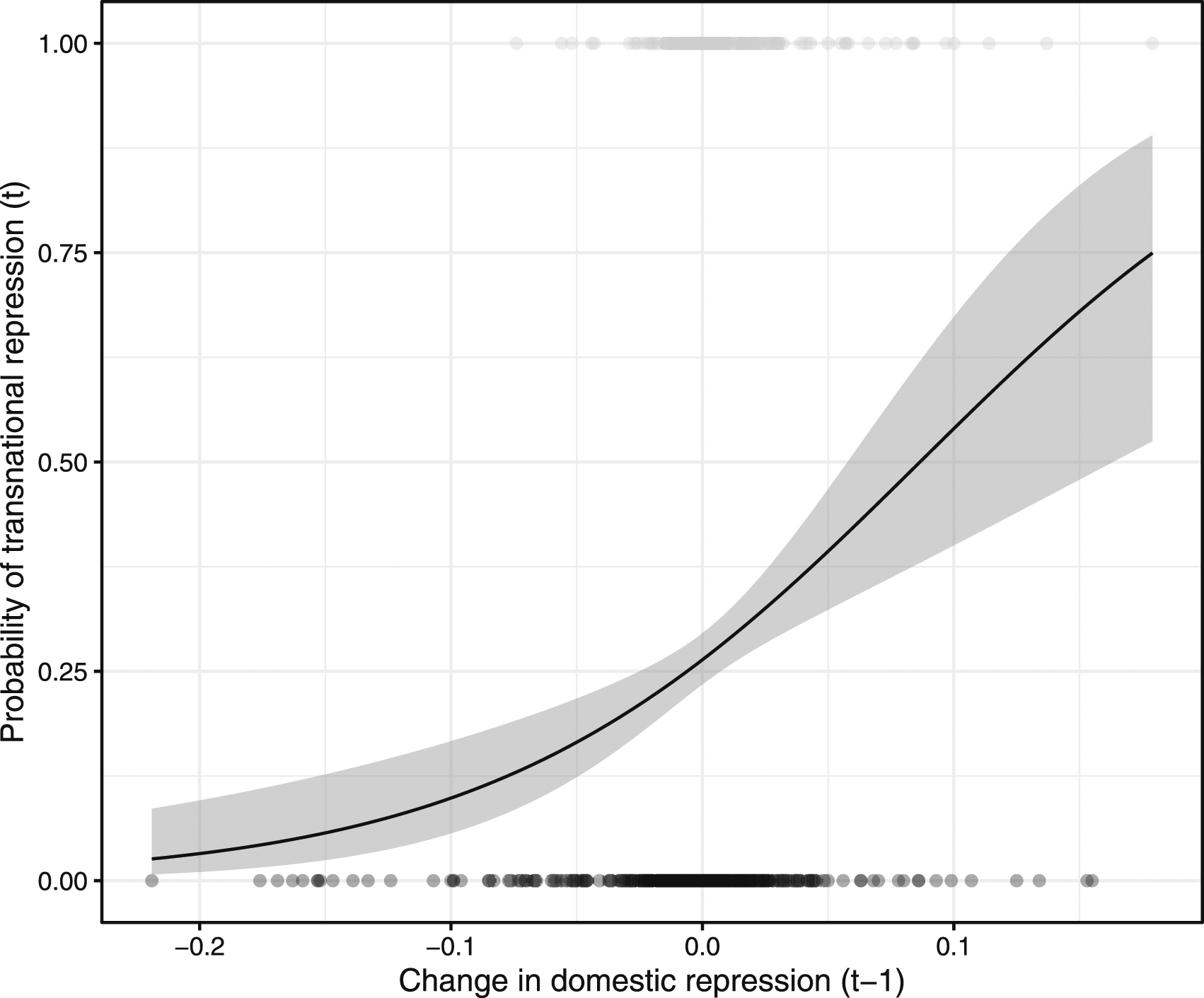
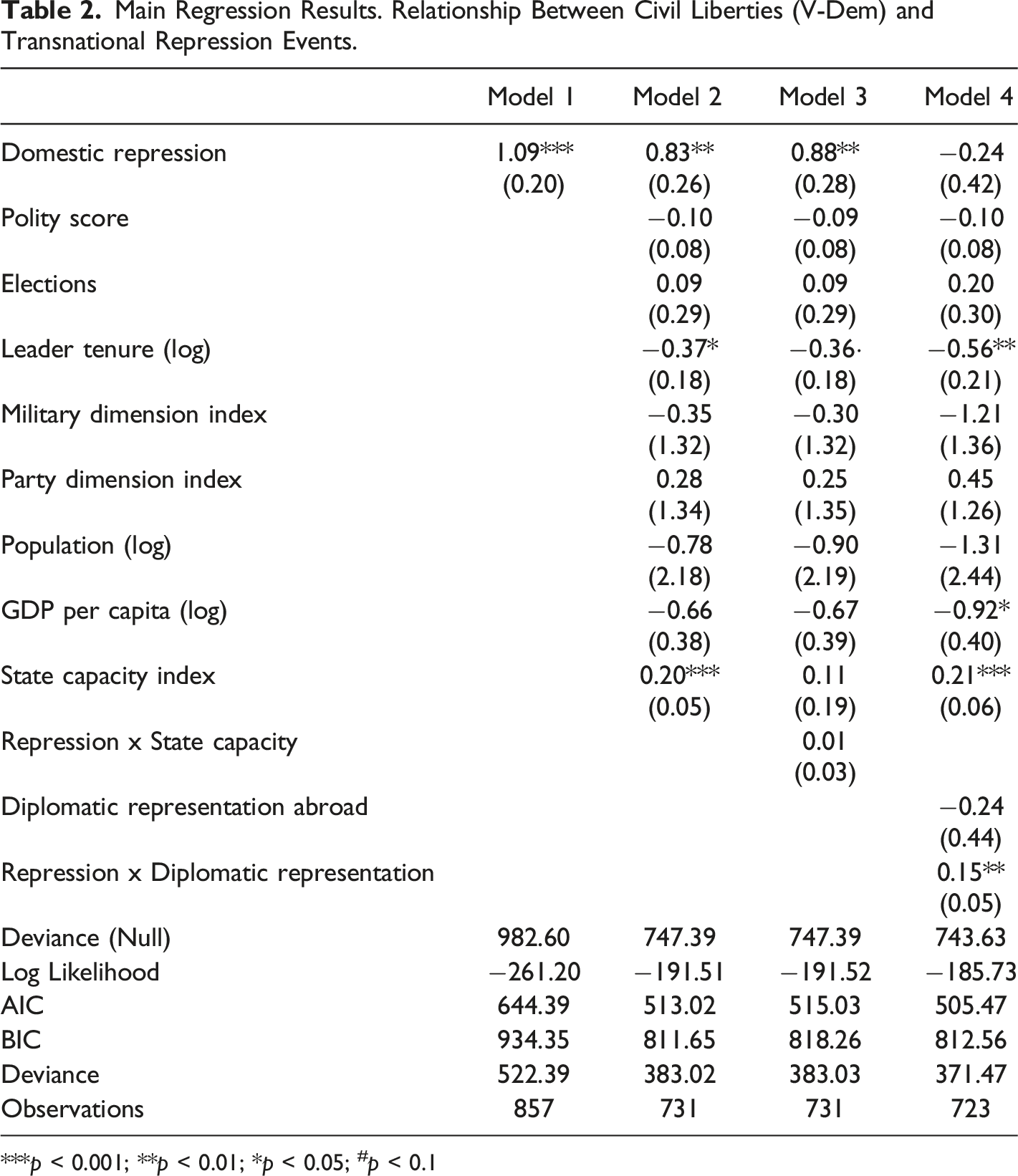
Main Regression Results. Relationship Between Civil Liberties (V-Dem) and Transnational Repression Events.
***p < 0.001; **p < 0.01; *p < 0.05; #p < 0.1
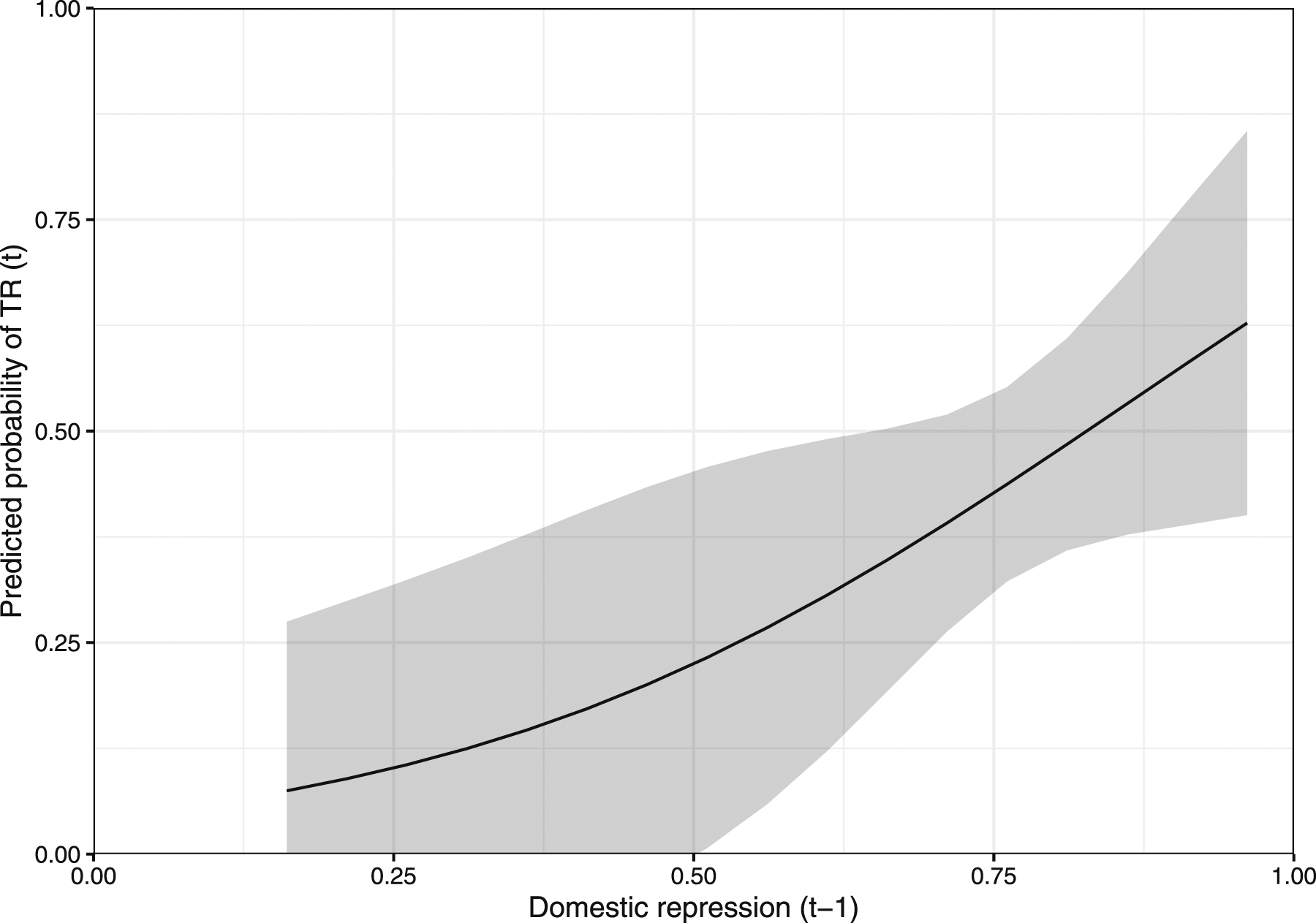
Predicted Changes in Transnational Repression Given Changes in Domestic Repression (based on Model 2).
Subsequently, we explore whether the relationship between domestic and transnational repression is conditional on two theoretically relevant factors discussed in the theory and literature review sections: general state capacity (Model 3) and diplomatic representation abroad (Model 4). As outlined earlier in our theoretical discussion, it seems plausible that strong states are more likely to reach beyond borders to stifle dissent. More specifically, a wide network of diplomatic ties and infrastructure (embassies, consulates) could facilitate the execution of acts of repression outside the country’s territory. Model 3 shows the interaction between latent state capacity measured by Hanson and Sigman (2021) and domestic repression. The coefficient for the interaction effect is not statistically significant at conventional levels. This null result is substantiated in Figure 6 (left panel) where we plot the predicted probability of TR in response to changes in domestic repression for high-capacity and low-capacity states (one standard deviation above/below the mean). Overall, high-capacity states are more likely to engage in TR as domestic repression increases but the difference to less capable states is not very pronounced. Predicted Changes in TR Given Different Levels of State Capacity (left, based on Model 3) and Diplomatic Capacity (right, based on Model 4).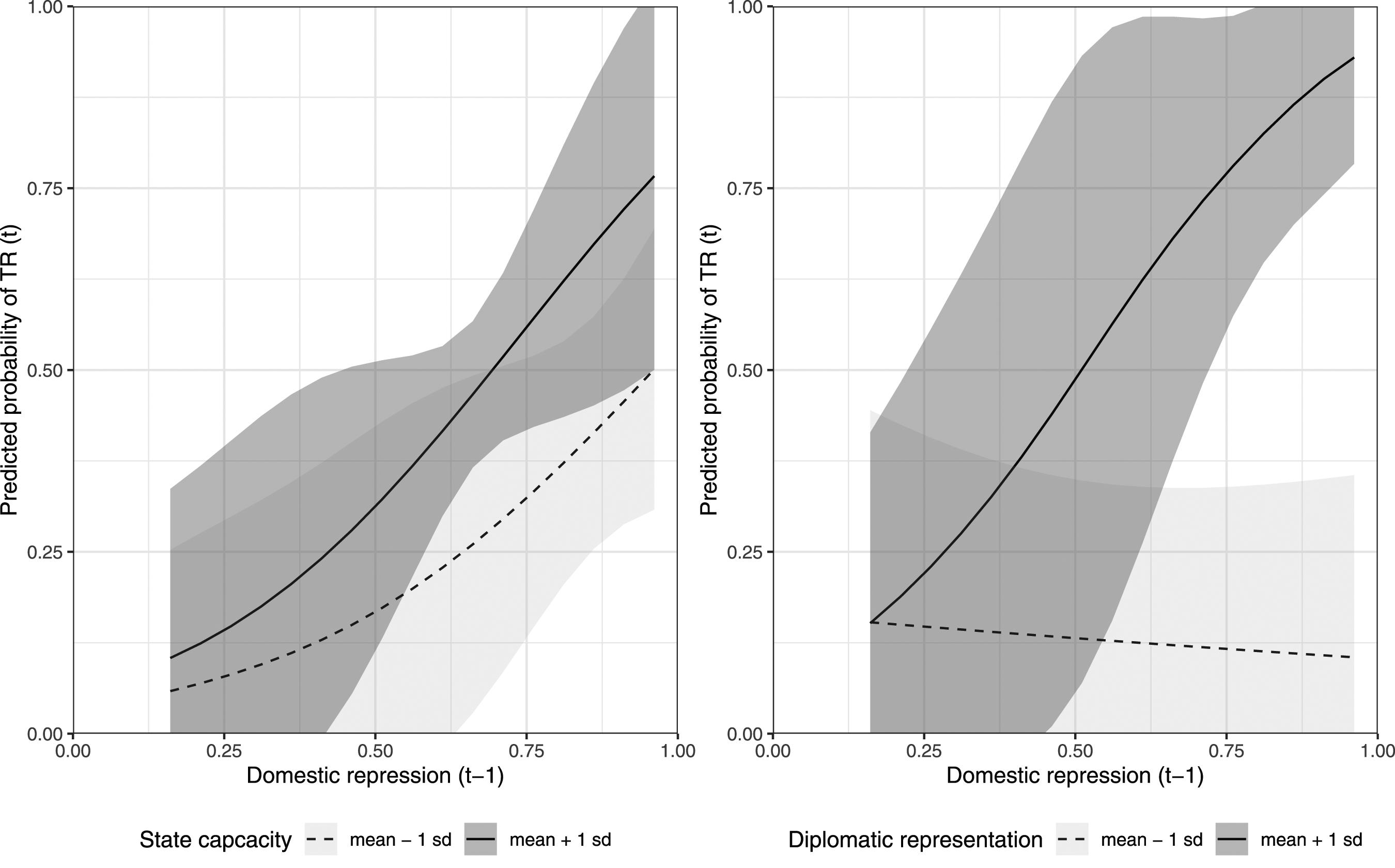
The results look different for the interaction between domestic repression and a state’s diplomatic representation abroad using the data by Moyer et al. 2021. The variable for diplomatic representation abroad measures the number of representations such as embassies each state has in a given country year. Model 4 shows that the interaction between domestic repression and diplomatic representation is positive and statistically significant. Domestic repression is more likely to translate into TR if a state is well represented abroad, granting it the logistical means to execute TR. The right panel in Figure 6 shows how the probability of TR changes for states with one standard deviation above and below the mean values of diplomatic representation abroad. For states with few diplomatic ties, we do not find an increase in TR in response to domestic repression. However, the probability increases drastically for states with high levels of diplomatic representation abroad. These additional analyses indicate that whether repression transcends borders depends on additional factors such as diplomatic networks. A comprehensive study of all potential moderating factors, however, is beyond the scope of this paper and identifying and disentangling additional moderators must be left to future research.
Robustness tests
We run several additional analyses to test the robustness of our main findings from Table 2. First, we run separate regression models by target and repressive action using the same model specifications as in Model 2. Figure A.3 in the Appendix shows the coefficients for the repression variable for different subsets of the data. For example, we disaggregate repression by type of actions (threats, attempts and “successful” repressive actions). All models support our main finding and display a significant and positive relationship between domestic and subsequent transnational repression. When it comes to the targets of repression, we find similar results. Thus, we can rule out that the results are driven by a particular target or type of repression.
In a similar vein, we re-run our analysis separately for all 21 component indicators of V-Dem’s CLI. Figure A.4 shows a statistically significant relationship in the hypothesized direction for 13 out of 21 indicators. In line with our theoretical argument, the relationship holds for the indicators of the physical violence index (torture, killings), civil society repression and, importantly, the freedom of foreign movement. By contrast, there is no effect for indicators tapping into forced labor and restrictions on domestic movement. We find these results encouraging for two reasons. First, they suggest that our results are not driven by a single indicator of repression, instead, repression in several domains is associated with subsequent TR. Second, we expect that indicators, such as torture and killings, but also the repression of civil society and the harassment of the opposition, best capture when autocrats mount a comprehensive repression campaign of political repression and, therefore, they should show the strongest relationship. Forced labor, for example, is a less frequently used repressive tool during a political crackdown.
Finally, we provide additional tests using alternative model specifications. Table A.1 in the Appendix shows the results for conditional logistic regression models using the bife package in R (Bergé 2018). 5 In Table A.2 we re-run our main model (Model 2) as Poisson, negative binomial and standard OLS regression. All models yield similar results to our main models in Table 2. Finally, for Table A.3 we include our control variables stepwise and show that the coefficient for our main variable of interest remains robust. In sum, our main argument that TR follows domestic political crackdowns finds confirmation in models with different variables and specifications.
Discussion
These findings are substantively and theoretically important for at least three reasons. First, and most obviously, to the best of our knowledge, this is the first large-N finding on the determinants of TR. As a relatively new area of research pioneered by the scholars discussed in the literature review above, cumulative findings are still emerging. This finding helps to map the basic determinants of TR. It highlights the role of domestic crackdowns and diplomatic capacity abroad as drivers of TR.
Second, our findings illustrate a link between domestic and transnational repression. We find that the use of TR is associated with changes in domestic repression. The increase in domestic state repression leads to a likelihood of escalation of the state’s TR. This suggests that TR is not serving as a substitute for more repressive acts but instead complements domestic repression and political violence at home. Prior to a few years ago, most research on repression was focused on the domestic level (see discussion in Glasius 2018). State repression research has been potentially one of the most significant areas of knowledge-building in comparative politics in the past two decades. Recent trends in the subfield have moved toward ever more fine-grained and local analysis of repression using spatial mapping tools (for an excellent recent example, see Scharpf, Gläßel, and Edwards 2022). Our paper pulls in the other direction and examines the global, outward, and spatially diffuse realm of TR. The findings suggest that amid repressive crackdowns, states not only pay attention in detail to the domestic sphere to reduce threats, but also “see” a link between the domestic and international spheres (here we borrow from the classic work Scott 1999). If at its most basic, the calculus behind the use of state repression is that states repress what they deem to be threatening (Davenport 2007a), these findings suggest that authoritarian states include transnational exiles in their perception of threat. This accords with other research that shows how mass mobilization is a frequent and destabilizing threat faced by contemporary dictatorships (Frantz et al. 2020b, 1). At the same time, our results suggest that domestic repression does not always lead to TR and that diplomatic capacity abroad might moderate the relationship.
Third, our findings demonstrate the resilience of contemporary authoritarianism in a globalized age. Authoritarian states learn and adapt their methods of control over time (Guriev and Treisman 2022; Morgenbesser 2020), including when it comes to modes of repression (Olar 2019). They have sought to meet the challenge of a networked, globalized world, in which “a national public sphere need not be co-terminus with territorial boundaries, and hence physical exit no longer necessarily implies exit from the national public sphere” (Glasius 2018, 181). To be sure, TR is not an entirely new phenomenon (Adamson 2019; Lessa 2019), but the tools of globalization allow authoritarian states to pursue it with a broader scope and deeper reach than previously (see Moss 2018). In this sense, TR demonstrates the extraterritorial reach of authoritarian states and how such actions can also influence the international conversation about the state’s politics in a globalized age. TR is newly salient and is not likely to disappear anytime soon.
However, we do acknowledge limitations, primarily when it comes to data. Gathering reliable data on TR is difficult (see Dukalskis et al. 2022). It is often designed to be hidden and there may be patterns in which cases come to light. In addition, the close dyadic relationships between autocratic states may act as a cloak for states to carry out such events in ‘friendly’ states without being seen. As a result, our analysis may underestimate the relationship between domestic and transnational repression. Better data may open new avenues to test the relationships we examine with more precision in terms of timing, action, and location.
Conclusion
This paper has sought to contribute to the burgeoning literature on transnational repression and the broader scholarly body of literature examining globalized authoritarianism. We offer evidence that domestic repression is associated with subsequent TR especially when a state has the diplomatic capacity to wield its power abroad. We have argued that this is likely due to two overlapping pathways. First, a domestic shrinking of political space will drive some dissenters abroad, where they can publicize government human rights abuses and/or continue their activism. Second, amidst a domestic crackdown the state may construe foreign ties as suspicious and therefore deserving of repression. We evaluated these arguments quantitatively using the Authoritarian Actions Abroad Database, which captures instances of authoritarian transnational repression between 1991 and 2019. Here we identify three ways in which these findings may be built upon, refined, or even challenged.
First, although we control for different underlying dimensions of autocracy, we have largely discussed TR by treating democracy and authoritarianism as binary. As our analysis demonstrates all types of authoritarian states, from single-party regimes like China and North Korea to monarchies like Saudi Arabia to personalist regimes like Putin’s Russia, engage in TR. Given that there is some evidence for variation in domestic repression by autocratic regime subtype (Davenport 2007b), it is worth investigating in more detail whether and if so, how, the same logic holds for TR.
Second, and following on from the first point, we have focused on non-democratic states, but future research could consider more the role of democratic states in facilitating or enabling TR. This may come in two forms. On the one hand, investigating democratic states as the source of transnational repression may be fruitful. As discussed above, we would expect democracies to engage in this behavior far less than autocracies. Nevertheless, democracies repress also, and investigating further TR by democratic states may be useful. There may also be differences in the type of repression between the two regime types, for example between individual forms of punishment (e.g. arrest) and collective punishment (e.g. threats to family). On the other hand, it will be useful to examine democracies as the host site for transnational repression. States where exiles often settle, like the United States, United Kingdom, France, or Belgium, appear to be more exposed to TR. There may be useful variation or processes that are worth investigating in terms of host state contextual factors.
Third and finally, there is more scope to research in detail the timing and sequencing of the arguments we have proposed. The findings could be expanded upon to discern better between the two pathways we propose. This may be done by closely tracing repressive episodes with due attention to timing and the observable implications of the two pathways. Additionally, researchers could further explore the impact of macro-level domestic factors (e.g. international economic linkages, international determinants of human rights, and transnational activities of NGOs) and how they are associated with TR. To this end, future research could further examine the repression-dissent nexus and how this escalates into transnational spaces. Such an approach could deepen our understanding of the political decisions underlying the use of TR and the various international factors that affect the costs/benefits calculus of leaders contemplating it as a tactic. It is not our intention to treat our results as definitive answers. Rather our analysis explains the relationship between domestic and transnational repression and how cross-national domestic patterns can be helpful in informing future work on TR as well as on state repression in general.
Supplemental Material
Supplemental Material - The Long Arm and the Iron Fist: Authoritarian Crackdowns and Transnational Repression
Supplemental Material for The Long Arm and the Iron Fist: Authoritarian Crackdowns and Transnational Repression by Alexander Dukalskis, Saipira Furstenberg, Sebastian Hellmeier and Redmond Scales in Journal of Conflict Resolution
Supplemental Material
Supplemental Material - The Long Arm and the Iron Fist: Authoritarian Crackdowns and Transnational Repression
Supplemental Material for The Long Arm and the Iron Fist: Authoritarian Crackdowns and Transnational Repression by Alexander Dukalskis, Saipira Furstenberg, Sebastian Hellmeier and Redmond Scales in Journal of Conflict Resolution
Footnotes
Acknowledgments
The authors would like to thank the two anonymous reviewers for their helpful comments as well as Aurel Croissant, Jamie Gruffydd-Jones and Maria Josua for their thoughtful remarks on the manuscript. The authors also thank Nikolina Klatt for research assistance. A previous version of this article was presented at the 2022 American Political Science Association’s conference in Montreal, at the “Violence and Democratic Backsliding” Workshop at WZB Berlin and the Demscore conference in Gothenburg.
Declaration of Conflicting Interests
The author(s) declared no potential conflicts of interest with respect to the research, authorship, and/or publication of this article.
Funding
The author(s) received no financial support for the research, authorship, and/or publication of this article.

Supplemental Material
Notes
References
Supplementary Material
Please find the following supplemental material available below.
For Open Access articles published under a Creative Commons License, all supplemental material carries the same license as the article it is associated with.
For non-Open Access articles published, all supplemental material carries a non-exclusive license, and permission requests for re-use of supplemental material or any part of supplemental material shall be sent directly to the copyright owner as specified in the copyright notice associated with the article.
