



Abstract
We introduce the Anatomy of Resistance Campaigns (ARC) dataset, which records information on 1,426 organizations that participated in events of maximalist violent and nonviolent contention in Africa from 1990 to 2015. The ARC dataset contains 17 variables covering organization-level features such as type, age, leadership, goals, and interorganizational alliances. These data facilitate new measurements of key concepts in the study of contentious politics, such as the social and ideological diversity of resistance episodes, in addition to measures of network centralization and fragmentation. The ARC dataset helps resolve existing debates in the field and opens new avenues of inquiry.
Most resistance movements are composed of organizations that mobilize people, make tactical decisions, issue demands, and accept or reject concessions (Braithwaite & Cunningham, 2020; Cunningham et al., 2017; Haggard & Kaufman, 2016; McAdam, 2010; Metternich et al., 2013; Tarrow, 2011). Organizations often head transitional regimes, assume power after post-conflict elections, and remobilize when democratic institutions are threatened (Haggard & Kaufman, 2016; Wood, 2000). However, we lack systematic cross-national data on dissident organizations spanning a variety of tactics, goals, and group identities.
This matters because organizational dynamics are often central to theories of the onset, dynamics, and outcomes of violent and nonviolent resistance campaigns (Bethke & Pinckney, 2019; Belgioioso, 2018; Brancati, 2016; Celestino & Gleditsch, 2013; Chenoweth & Stephan, 2011; Huang, 2016; Schaftenaar, 2017; Sutton, Butcher & Svensson, 2014; Svensson & Lindgren, 2011; Thurber, 2019). Empirical analyses, however, usually depend on broad indicators of contention summarized over a campaign or campaign-year (Chenoweth & Stephan, 2011), which leaves uncertainty around whether the theorized mechanisms drive observed effects (Schock, 2005). Case studies show that resistance campaigns involve complex networks of organizations and social groups (Metternich et al., 2013; Osa, 2003; Schock, 2005) and demonstrate – with detailed assessments of actors and their characteristics – that the features of these organizations and networks help explain tactical choices, campaign outcomes, and democratization (Collier, 1999; Nepstad, 2011; Pearlman, 2011; Schock, 2005; Thurber, 2019; Wood, 2000). Yet, it is difficult to generalize these findings to a larger sample of cases.
The Anatomy of Resistance Campaigns (ARC) dataset provides information on 1,426 distinct organizations across 3,407 organization-country-years associated with events of ‘maximalist’ collective dissent in Africa from 1990 to 2015. ARC includes information on organization types, origins, leadership, mobilization bases, goals, network ties, relationships with the state, and more. These data enable detailed observations of actor- and network-level characteristics across a large sample of cases, allowing scholars to unpack the organizational composition of resistance campaigns and their network structures. The ARC data can help answer lingering questions: how do ideological diversity and unity (through fronts and alliances) impact campaign outcomes and post-conflict institutional change (Bayer, Bethke & Lambach, 2016; Celestino & Gleditsch, 2013; Chenoweth & Stephan, 2011)? Are some campaigns more resilient to repression than others because of their network structures or the nature of participating organizations (Siegel, 2009; Sutton, Butcher & Svensson, 2014)? How do coalitions evolve through periods of institutional reform – especially democratic transitions (Pinckney, 2020)? To the extent that data availability shapes theoretical horizons (Gleditsch, Metternich & Ruggeri, 2014), ARC can stimulate additional research questions in myriad areas.
Core concepts in ARC
The ARC dataset focuses on organizations that participated in acts of collective dissent for goals of maximalist change. Organizations are structures designed to cohere people and resources – often through collective action – to pursue common goals (Daft, 1992: 2; North, 1990). The presence of a formal structure (however thin the hierarchy) intended to aggregate individual efforts towards a defined goal distinguishes organizations from broad social categories such as ‘students’, ‘protesters’, or the ‘working class’. We discuss our operationalization of this concept in a subsequent section.
Collective dissent is observable action involving multiple people, beyond normal institutional procedures for realizing political goals (Tilly, 1978). This ranges from demonstrations and strikes to rebellion and terrorist attacks, while excluding actions lacking a clear political goal and everyday or institutional political activities such as lobbying politicians or electoral participation. Organizations engage in collective dissent when they deploy their mobilization infrastructure to encourage individual participation in these events.
We define maximalist demands as calls for changes in the political structure that would significantly alter the executive’s access to state power, the rules with which executives are selected, or the policy or geographic areas for which the executive has the right to make laws. Examples of maximalism include demands that a head of state resign via a non-institutional method, for democratization in autocratic settings, to enfranchise an excluded social group, and for regional or ethnic autonomy or independence. 1
Maximalist demands exclude calls that fall short of altering these fundamental aspects of executive power, such as improved human rights protections or changes in public spending. Demands by a disenfranchised group for better protections can be addressed with legislation that typically does not change the process for deciding who holds executive power or who has lawmaking authority. Demands for enfranchisement of that excluded group are maximalist because – if implemented – they would include a new group in the process of deciding who holds executive power.
Relationship to existing datasets
ARC is distinct from existing resources because it provides information on the features of organizations that participated in nonviolent and violent dissent, while also going beyond self-determination or ethnonationalist movements (Cunningham, Dahl & Frugé, 2020; Wilkenfeld, Asal & Pate, 2011), or armed groups alone (Braithwaite & Cunningham, 2020; Cunningham, 2013; Cunningham, Gleditsch & Salehyan, 2009; Harbom, Melander & Wallensteen, 2008; Pettersson & Öberg, 2020; Stewart, 2018; Svensson & Nilsson, 2018). Events datasets often identify participating actors, but lack information on their features (Chenoweth, Pinckney & Lewis, 2018; Chenoweth, Hendrix & Hunter, 2019; Clark & Regan, 2021; Raleigh et al., 2010; Salehyan et al., 2012). The Revolutionary and Militant Organizations Dataset (REVMOD) does provide information about resistance organizations but seems to oversample on violent organizations (75% of REVMOD organization-years are rebel or terrorist groups) and does not account for relationships between organizations (Acosta, 2019). ARC is unique in capturing interorganizational ties that help us understand network structures in resistance episodes.
Creating ARC
To construct the ARC dataset, we first identified organizations that participated in events of maximalist collective dissent, and then we recorded information on the features of those organizations. To maximize transparency and replicability, coding decisions at each step were recorded in RMarkdown files. 2
Identifying participants
Participating organizations were identified by drawing on five events datasets: the UCDP Georeferenced Event Dataset (Sundberg & Melander, 2013), the Social Conflict Analysis Dataset (Salehyan et al., 2012), the Mass Mobilization Dataset (Clark & Regan, 2021), the Armed Conflict Location Event Dataset (Raleigh et al., 2010), and the NAVCO 3.0 data covering African countries (Chenoweth, Pinckney & Lewis, 2018). Together, these datasets provide a comprehensive catalogue of nonviolent and violent collective dissent across Africa. We began by creating a list of candidate maximalist events by subsetting on variables related to dissident demands and a customized text-matching string.
We then determined whether event participants made maximalist demands, and whether one or more named organizations participated, by conducting newswire searches in FACTIVA and LexisNexis using a targeted search string. Event IDs from the events datasets are stored with the organization-year observations in ARC, allowing users to integrate variables from events data with ARC.
We added the constituent organizations of ‘fronts’ according to a ‘three-year’ rule. Fronts are distinct, umbrella organizations coordinating the actions of member organizations. Some projects like the UCDP treat fronts as unitary actors, but this obscures variation in the preferences and features of member organizations. However, always treating fronts as decentralized organizational networks can be impractical – and empirically inaccurate. Fronts often become more unified over time (or they split apart), but systematically determining when a front ceases to consist of semi-autonomous groups and becomes a single organization is extremely difficult. We adopted an arbitrary but empirically informed rule to resolve this issue, whereby member organizations of a front were added as participants when those organizations had been members of the front for three or fewer years. Member organizations were identified in newswire databases and primary and secondary sources, and through an iterative process when coders collected information on front organizations. A more detailed description of the rules for coding fronts can be found in the codebook.
This three-year rule means that some organizations may be included that were relatively new members of fronts but did not participate in protests, or played only a peripheral role. However, we argue that this risk is outweighed by the inclusion of organizations that often participate in protests but are overlooked by news media, such as local human rights organizations, women’s organizations, and youth groups. Since front participants are identified through newswires and primary and secondary sources, our inclusion criterion is less subject to media biases and provides a new, more comprehensive picture of opposition networks.
Coding organization features
This process produced a list of organizations linked to events of dissent. Organization-years of maximalist dissent were then generated from events data and a team of coders recorded information on the features of participating organizations. Some variables are constant across organization-years (e.g. ‘birth date’), while others are dynamic. Organization-years are only included in ARC when the organization was identified as participating in collective dissent with maximalist demands in a given year. Organizations often continue to exist when they are not participating in dissent; however, their non-participation means these observations are omitted from ARC. Constructing a full panel for organizations between 1990 and 2015 is not possible for this reason and because we do not record if and when organizations cease to exist (versus entering into abeyance). Table I summarizes several organization-feature variables in ARC. 3
ARC includes information on two types of ties between organizations: fronts and alliances. Front ties connect a constituent organization to a higher-level organization (a front) when the constituent organization is formally a member of the front, or its leaders participate in the front’s leadership. 4 Organizations identified by the aforementioned ‘three-year’ rule have front ties to the main front.
Organization-level variables
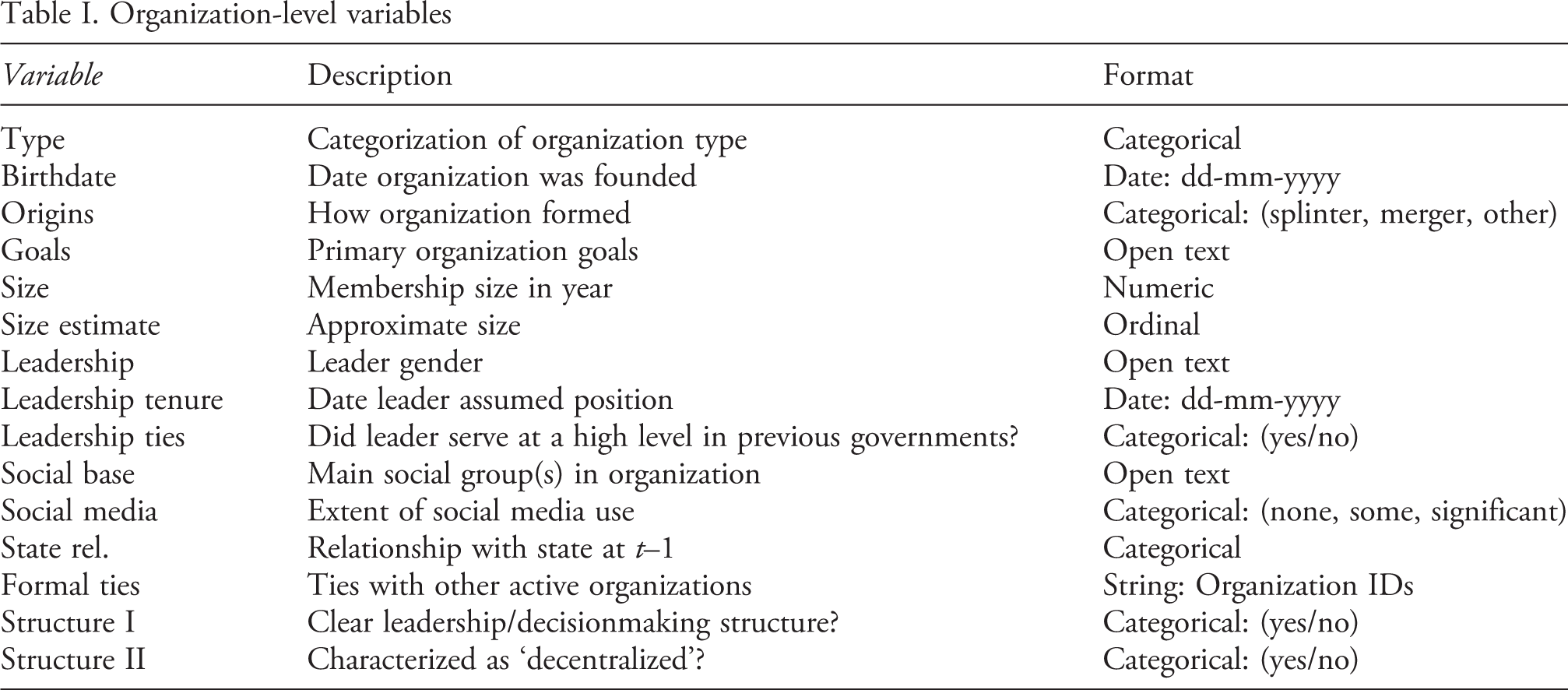
Alliance ties connect two or more organizations that declared they were coordinating resistance activities, or where sources indicated that organizations coordinated efforts, but no standalone organization (front) was formed to manage coordination. Fronts and their constituent organizations can have alliance ties with non-front organizations. For example, in Malawi in 1993, the Public Affairs Committee (PAC, a front of civil society organizations and religious groups) allied with the Alliance for Democracy (a political party), which was not part of PAC. Users can assemble alliance-pairs with these front and alliance variables to explore factors driving interorganizational ties. Figure 1 illustrates the potential structures of these ties. The organization at the bottom-center has alliance ties to two other organizations and is a member of a front. That front is also a member of another front.
Our method for identifying organizations might introduce bias. Participation is coded when newswires identify named organizations engaged in maximalist dissent. Journalists may view some organizations – especially political parties and trade unions – as more deserving of a proper noun when describing events. Parties are skilled at attracting media attention and might be over-represented in reporting. Urban organizations may also be over-represented because events in cities receive more media coverage than events in rural locations (Day, Pinckney & Chenoweth, 2015; Eck, 2012; Kalyvas, 2004).
5
Media biases could affect inferences ARC ties example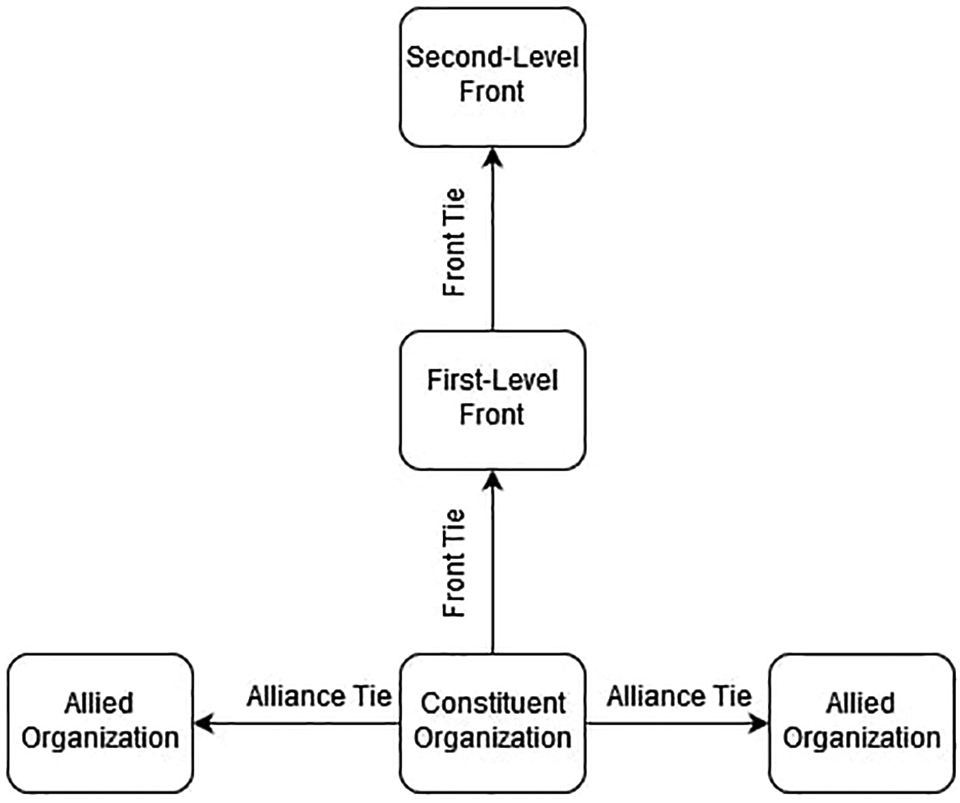
Maximalist demand-making is strategic and may occur after initial campaign-building, following high levels of past participation in non-maximalist protest, or when repression offers ‘no other way out’ (Goodwin, 2001) – factors that independently generate regime concessions or democratization (Brancati, 2016; Klein & Regan, 2018). Researchers should control for omitted variables capturing these selection processes wherever possible, and inferences from ARC should be informed by the limitations of selecting on maximalist demands.
Comparison of ARC and NAVCO 2.1: Egypt 2003–15
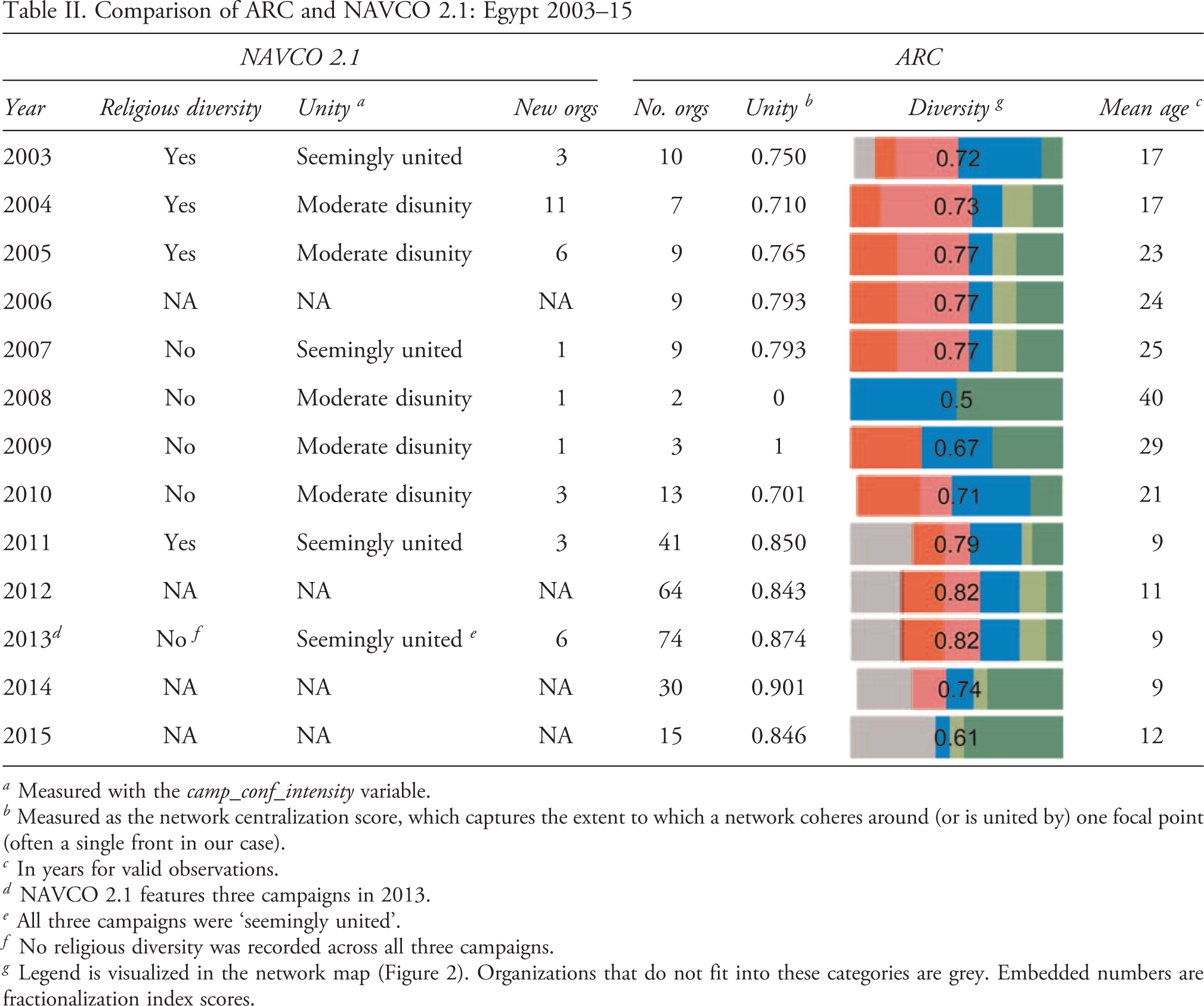
Table II shows continuous measurements of ideological diversity and opposition unity generated from ARC and compares them to similar (but categorical) measures in the NAVCO 2.1 dataset (Chenoweth & Shay, 2019) from Egypt between 2003 and 2015. ARC also encompasses years of democratic transition, identifies more organizations, and enables new measurements of features such as organization age. Figure 2 shows a network map for Egypt in 2011, generated using front and alliance variables in ARC.
Descriptive statistics
Political parties and rebel groups
6
are the most common types of organizations in ARC. Figure 3 shows the number of organizations in maximalist dissent by year and country. Stretches of little dissent are sometimes followed by bursts (Burkina Faso), while the number of Egypt 2011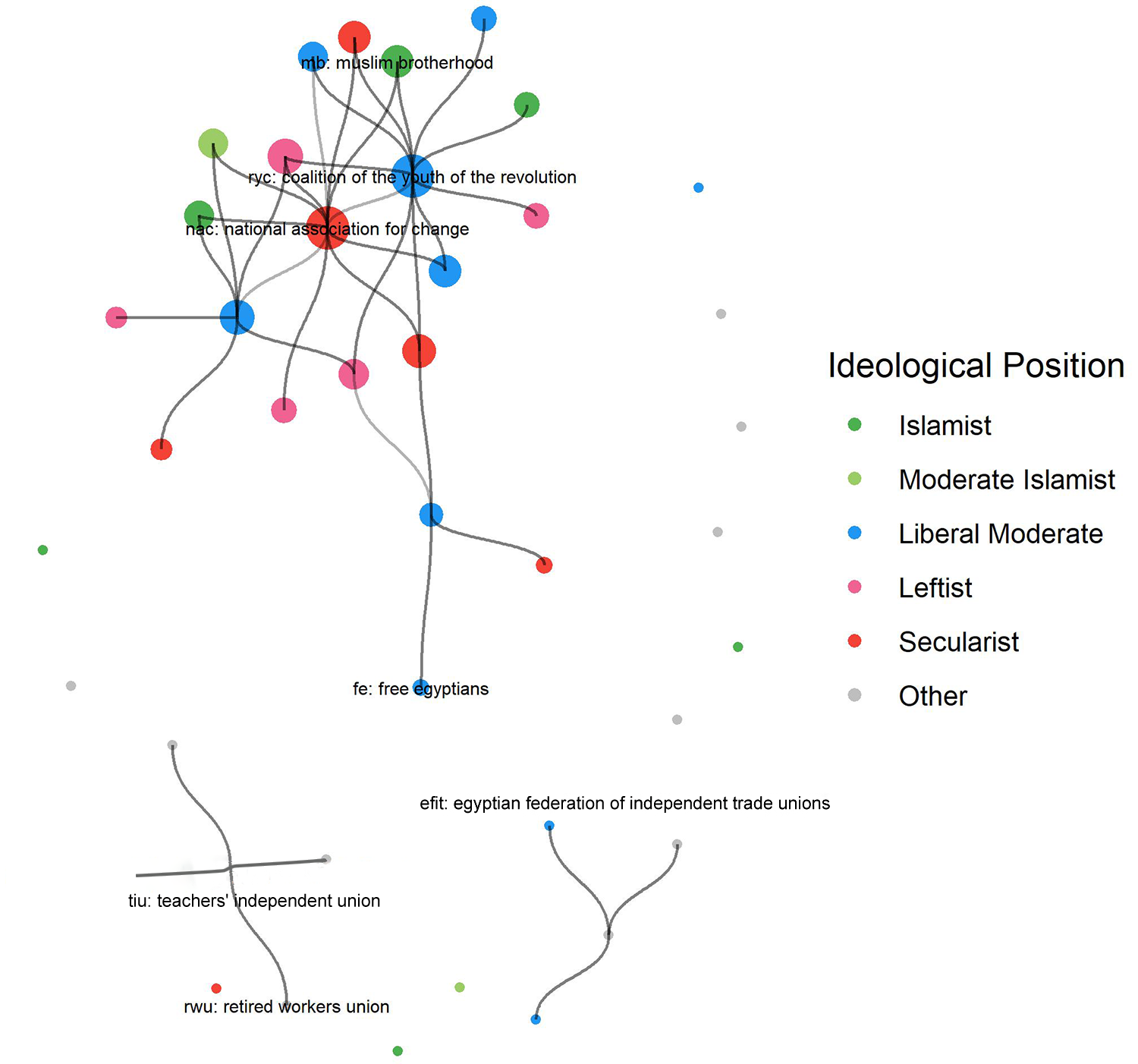
Rebel groups and political parties commonly split from other organizations. Rebel groups dissent for longer (3.6 years on average) and more continuously (they have the lowest variance around the mean participation year) than other organizations. Participation by other types of organizations in ARC is ‘bursty’, perhaps concentrated around elections or other focal points. Trade unions tend to be large, old, and more connected to the state and other opposition organizations than most other organizations. As one would expect, fronts are the most highly connected, with ties to 5.67 other organizations on average. Only civil society organizations (CSOs) have moderate levels of female leadership. Decentralization is most common in fronts, religious groups, and trade unions.
Correlates of organizational participation
Different types of organizations should have distinct correlates of participation in resistance given their varied constituencies and goals.
7
We use negative binomial models for overdispersed count data to explore associations between socio-economic factors and the number of organizations of different types engaged in maximalist dissent. Specifically, we examine inequality, economic modernization, industrialization, economic growth, natural resource wealth, democratic institutions, the number of other participating dissident organizations of various types and a lagged dependent variable. Past research highlights these possible explanations for participation in maximalist dissent (Acemoglu & Robinson, 2005; Aksoy, Carter & Wright, 2012; Ansell & Samuels, 2014; Bueno de Mesquita & Smith, 2010; ARC organizations over time and space Features of organization-years in resistance by type All summary statistics are means except for the Size estimate which is a median. Included measures whether the organization was formally or informally included in the governing coalition at 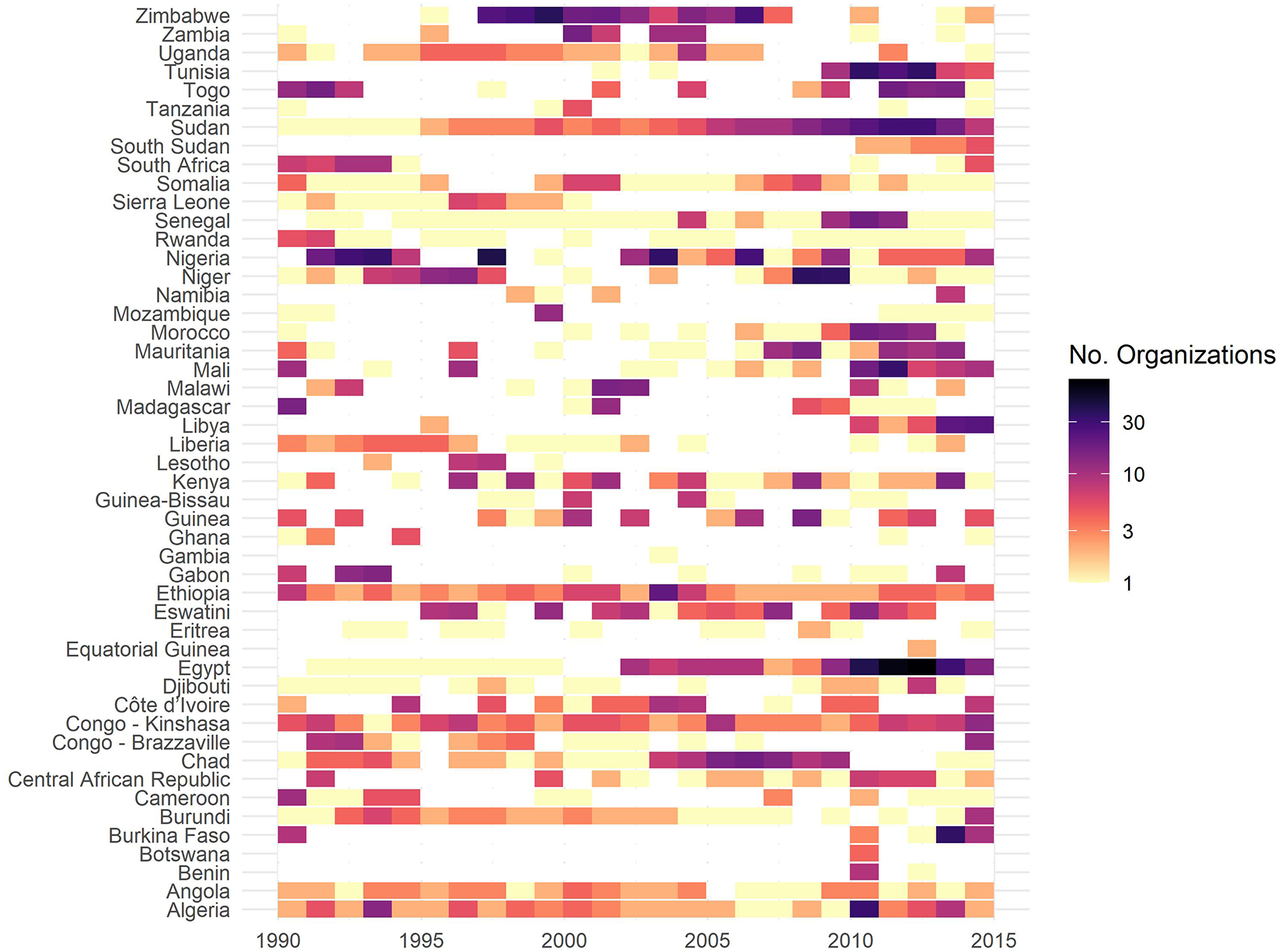
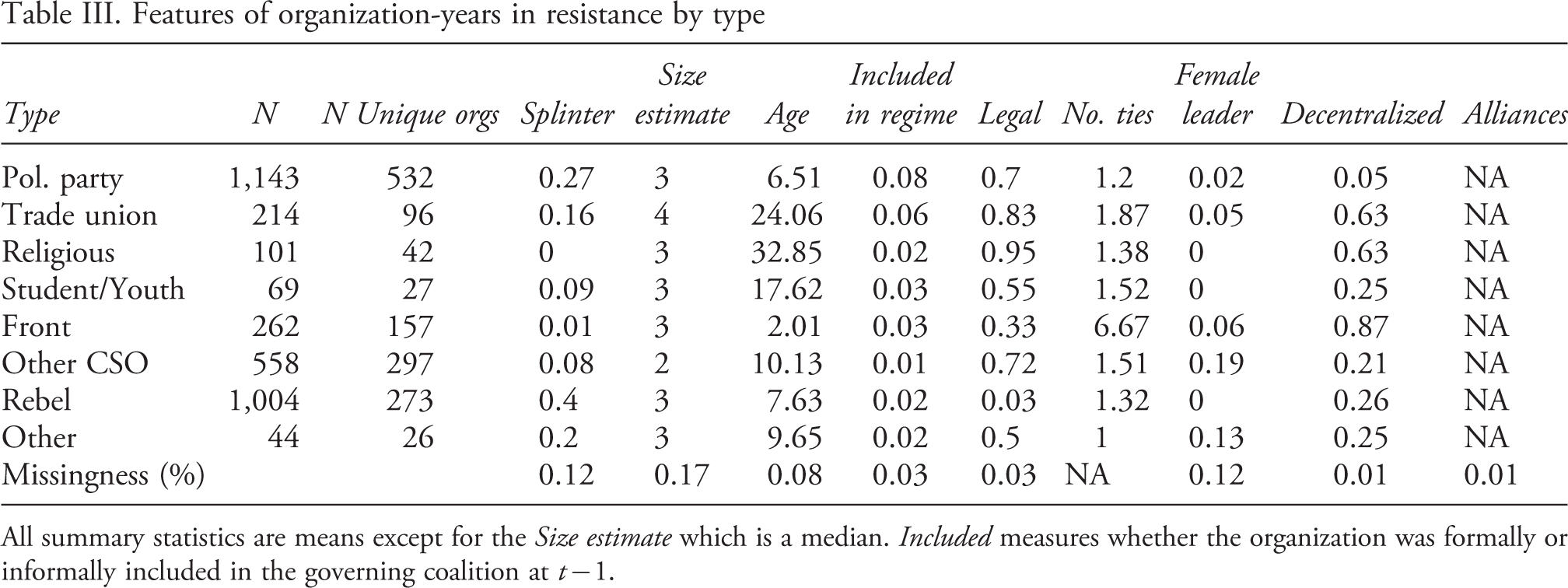
Correlates of organizational participation
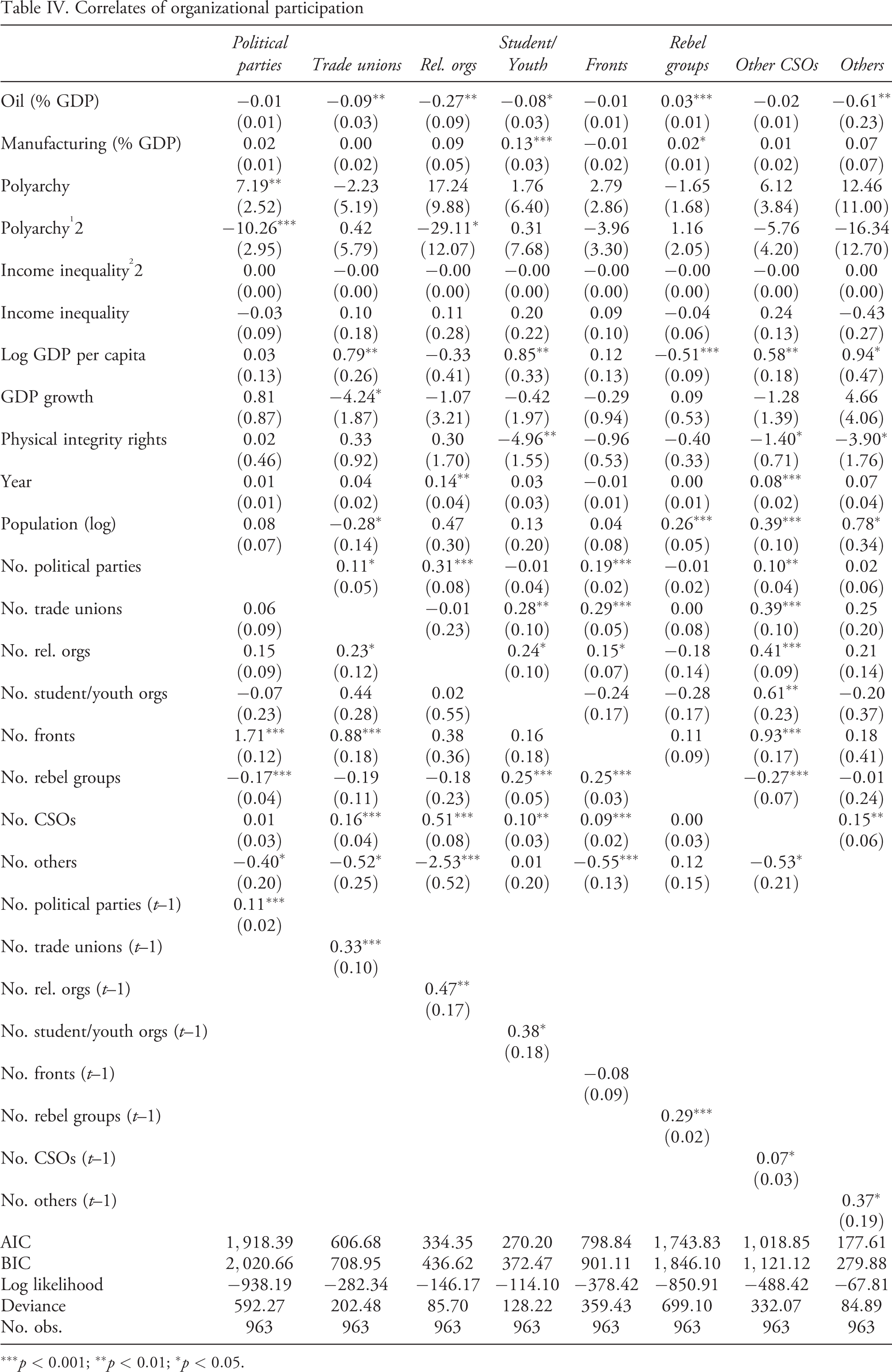
Table IV presents our findings. Visualizations can be found in the Online appendix. The results for economic development are striking. A greater number of rebel groups mobilize in poorer countries, while more trade unions, student organizations, and other CSOs dissent in more developed countries. Broad, labor-based civil society coalitions may be an important link in the chain from modernization to democracy (Bayer, Bethke & Lambach, 2016; Boix, 2003; Celestino & Gleditsch, 2013; Chenoweth & Stephan, 2011; Dahlum, Knutsen & Wig, 2019). Movements underpinned by thinner, technology-driven networks may be more brittle (Weidmann & Rød, 2018). Oil dependency is associated with fewer trade unions, student groups, ‘other’ organizations, and religious organizations engaging in maximalist dissent, but a greater number of active rebel groups. These models are a first, descriptive look at patterns of participation but offer little about the deeper mechanisms involved in moblization. For example, structural factors may alter the underlying organizational ecology, drive participation in maximalist dissent directly, or activate other processes, such as splintering.
Structural variables appear to be poor predictors of the number of fronts in dissent. Coalition formation may occur after shorter term shocks related to food prices (Abbs, 2020) or severe repression events (Chang, 2008). This is worth investigating in future work. Models addressing censorship and international media coverage (in the Online appendix) do not indicate strong media biases across most organization types.
Table IV also reveals patterns of organizational co-participation. Parties mobilize with fronts, but alongside fewer rebel groups. Trade unions and CSOs dissent alongside one another and with more parties, religious organizations, and fronts. Religious organizations have narrower co-participation profiles, mobilizing alongside other CSOs. Student groups dissent alongside rebel groups, in addition to trade unions, religious organizations, and other CSOs. Rebel groups tend to act without large numbers of other types of organizations. Finally, fronts assemble many group types including parties, rebels, trade unions, religious organizations, and other CSOs. These findings highlight the usefulness of ARC for (re)examining mechanisms emphasized in theories of social change, as well as the ability to uncover previously un(der)theorized relationships.
Conclusion
The ARC dataset advances our understanding of anti-government mobilization and has many potential applications. ARC provides details about organizations that engaged in violent and nonviolent dissent at various periods of their existence and could be used to identify correlates of tactical shifts. ARC should be useful to scholars of repression and dissent; connections to events datasets facilitate exploration of how organizational networks interact with repression to produce backlash and demobilization. ARC can also be collapsed into a country-year format and merged with data on campaign outcomes (e.g. Chenoweth & Shay, 2019; Kreutz, 2010), regime change, and democratization (Coppedge et al., 2019; Djuve, Knutsen & Wig, 2020; Goemans, Gleditsch & Chiozza, 2009). Information on interorganizational ties can be used to generate network maps that span conventional violent–nonviolent dichotomies and even link campaigns cross-nationally. We look forward to seeing how others engage ARC to expand our knowledge of the causes, dynamics, and consequences of maximalist dissent.
Footnotes
Replication data

Acknowledgements
We thank Alice Dalsjø, Nina Bjørge, Xiran Chen, Stephanie Clinch, Tyler DeMers, Kelly Gordell, and Luna Ruiz for valuable research assistance. For valuable comments and feedback we thank three anonymous reviewers, Margaret Ariotti, Alex Bruens, Scott Gates, Kristian Skrede Gleditsch, Katelyn Knapp, Janet Lewis, Nils Metternich, Jakana Thomas, participants at the 2017 Peace Research Society Workshop on Conflict Networks, the NTNU VIP seminars, participants in the SECVIC workshops, the 2019 workshop on Actors and Conflict Processes at NTNU, and the 2019 workshop on ‘Introducing ARC’ at the Conflict Research Society annual meeting at the University of Sussex.
Funding
We gratefully acknowledge funding from the Norwegian Research Council and the United States Institute of Peace, and support grants from the Department and Faculty at NTNU. Braithwaite received funding from USIP prior to Pinckney accepting a position at USIP.