



Abstract
This paper presents a game-theoretic model where dissidents with heterogeneous abilities and motivations contribute to collective action. A regime demotivates dissidents by preemptively increasing their costs of contributing, using a budget that can be spread across them in any way desired. The regime’s optimal targeting strategy is shown to depend on the (technological) degree of complementarity between dissidents’ contributions. For low complementarity, it is optimal to equalize all dissidents’ strengths (where strength depends both on motivation and ability; tall-poppies strategy). For intermediate complementarity, it is optimal to focus all repression on the most able dissidents (key-player strategy). For high complementarity, it is optimal to focus all repression on the least-motivated dissidents (weakest-link strategy). The range of intermediate complementarities for which the key-player strategy is optimal is larger, the larger heterogeneity in abilities. The paper finds indication for the use of these strategies in concrete examples of preemptive repression.
Recent studies argue that modern surveillance techniques have drastically reduced regimes’ surveillance costs (e.g., Gohdes 2020; Xu 2021). Informed regimes may no longer wait and see where dissent arises to respond with reactive repression, but shift towards preemptive repression. This may not only occur in autocracies, but also in democracies, with a shift in protest policing away from negotiated management (Howe and Monaghan 2018). Keeping the traditional focus on reactive repression then leads one to underestimate both the level of grievances among the population (Ritter and Conrad 2016), and the overall level of repression itself: the fact of not observing open protests with the ensuing reactive repression may merely be a sign of successful preemptive repression.
This paper seeks to answer the question: at whom will well-informed regimes target preemptive repression, given their limited resources? Answering this question is non-trivial, as regimes use a wide range of targeting strategies across time and space (Hassan et al. 2022). Repression can be targeted at those ideologically most remote from oneself, with the example of “radicals” in Guatemala (Sullivan 2016), or on the contrary at those ideologically closest, with the example of swing voters in Zimbabwe (Robinson and Torvik 2009). In other instances, repression is not based on ideology, but on demographic characteristics such as ethnicity (Rozenas 2020). Repression may be targeted at leaders, such as in the case of Navalny (Ma 2020), or instead spare leaders (Esberg 2021). It may be targeted at intellectuals (Zeng and Eisenman 2018) and members of the elite, and include within-regime purges (Sudduth 2017), or may on the contrary target groups that are already disadvantaged (Rozenas 2020). Repression may hit entire populations collectively and indiscriminately (e.g., curfews, Aksoy et al. 2023), or may on the contrary be highly surgical (Siegel 2011). Repression may have a low intensity and merely constrain dissidents, or on the contrary have high intensity and violently eliminate them (Davenport 2007, 46-47). Violent, high-intensity repression may moreover be applied to an arbitrary dissident among a number of peers (Herreros 2006), in contrast with the blanket application of restrictions. What explains this diversity of targeting strategies?
To answer this question, this paper develops a game-theoretical model where a regime exerts targeted preemptive repression with the purpose of minimizing collective dissent. In my stylized model, dissidents are heterogeneous and differ along two broad dimensions, namely their ability to contribute to collective dissent, and their motivation to do so, where dissidents are assumed to perfectly observe each other’s abilities and motivations. Dissidents individually decide how much to contribute. Targeted repression consists of reducing individual dissidents’ motivations. The determining factors in explaining the regime’s optimal targeting strategy are, first, the degree of complementarity between dissidents’ contributions, and second, the degree of heterogeneity in dissidents’ abilities and motivations. The degree of complementarity reflects the technology of dissent, and measures to what extent the level of collective dissent is determined by the smallest effort among the dissidents, where with the largest degree of complementarity this level if fully determined by the smallest effort. The degree of complementarity and degree of heterogeneity determine to what extent the regime targets dissidents using their ability and/or motivation as a criterion. Holding the degree of heterogeneity fixed, my model predicts that for low complementarity, the regime optimally employs what I call a tall-poppies strategy, 1 where dissidents’ post-repression strengths are equalized (with strength a measure positively determined by both ability and motivation); for intermediate complementarity, the regime employs a key-player strategy, and minimizes the motivations of the most able dissidents, independently of their initial motivations; for large complementarity, the regime employs a weakest-link strategy, and minimizes the motivations of the least-motivated dissidents (where repression is more biased towards high-ability dissidents as the technology deviates more from perfect complementarity). It is shown that the range of degrees of complementarity for which the key-player strategy is optimal is larger, the larger the heterogeneity in the dissidents’ abilities.
Targeted Repression
Following Siegel (2011, 993), I define repression broadly as any actions to deter a population from participating in collective dissent. Existing explanations for how regimes choose to target repression can be grouped in three categories. First, the extent to which repression is targeted has been argued to depend on a regime’s surveillance capacity, or on its costs of investing in surveillance. In the model of Gregory et al. (2011), a regime represses a larger part of the population the lower the quality of its information. Shadmehr and Haschke (2016) present a model where single-party, non-military regimes have the capacity to gain information on the loyalty of citizens and to selectively distribute benefits among them, but not to selectively repress; for military regimes without a party, the opposite is the case. For this reason, in response to a youth bulge, military regimes will repress less, as selective repression of the young then becomes too costly. Single-party non-military regimes will on the contrary repress more, because selective cooptation of the young becomes more costly (for other authors that stress the link between institutions and the ability to gather information, see e.g., Dimitrov and Sassoon 2014, Greitens 2016; Steinert 2023). Yet, the argument that regimes selectively repress when they have sufficient information to do so, cannot explain why well-informed regimes sometimes deliberately ignore information on dissidents’ past behavior, and base the targeting of repression purely on demographic characteristics (Rozenas 2020). Moreover, before we can assess whether or not a regime will invest in gathering information, we need insight in the extent to which regimes selectively repress once they are informed; providing such insight is the focus of this paper.
A second strand in the literature explains targeted repression by referring to the differential costs to regimes of repressing particular individuals or groups. Beiser‐McGrath (2019) presents a simple game between a regime and dissident groups as unitary actors. The regime can either adopt a level of preemptive repression that raises a group’s costs just enough to stop if from challenging, or can instead not repress and put up with the challenge. Whether the government represses and avoids the challenge by a group, or does not repress and puts up with it, depends on the audience costs that repression causes, which in turn are determined by the visibility of repression. Other authors who attribute the targeting of repression to differential repression costs include Kalyvas and Kocher (2007, 191) arguing that civilians form easier targets, and Savun and Gineste (2019) arguing the same about refugees. Lust-Okar (2004, 160) and Svolik (2012, 163) argue that regimes repress radicals rather than moderates, because the cost of coopting radicals is relatively large. Yet, these arguments do not consider that dissidents whom it is equally costly to repress, may still contribute differently to collective dissent, justifying targeting them differentially.
A third category of explanations argues that regimes base the targeting of repression on whom they perceive as the largest threat (Josua and Edel 2021, 595-596). In the model of Ma (2020), a regime can use repression to eliminate candidates from elections. If the regime highly values staying in power, it represses to eliminate all candidates that could beat it in elections. If it does not value staying in power that much, it represses to let a desirable successor win. Similarly, Brathwaite (2014) argues that regimes target preemptive repression at ethnic groups whose co-ethnics have revolted abroad, and Zhu and Zhang (2017) argue that leaders use anticorruption campaigns to eliminate their most threatening rivals. However, regimes may not typically face a single rival or rival group, and successful action against a regime may require contributions from several dissidents or dissident groups (Woo and Conrad 2019). For this reason, my model focuses on targeted repression aimed at minimizing the level of collective dissent.
Collective Dissent, and its Repression
Before setting out the model, I additionally position it in the collective-dissent literature (for a wider perspective, see SI Appendix A), and in scarce literature that considers strategically targeted repression of collective dissent.
In order to allow for fine-tuned optimal repressive strategies, in my model dissidents with heterogeneous motivations and abilities decide how much to contribute from a continuum, and produce an outcome from which they collectively benefit according to a continuous production function, with a parameter allowing for a range of technologies. This contrasts with theories of collective dissent specifically focused on regime change, which assume that contributing is an all-or-nothing decision by homogeneous dissidents, and assume that the outcome is determined by a step function where a fixed positive benefit is only obtained when a threshold of contributing dissidents is achieved. With perfect information, dissidents can either coordinate on an equilibrium where none of them contributes, or where the threshold is achieved. Adding imperfect information about the rewards of collective dissent (Shadmehr and Bernhardt 2011) or about the size of the threshold (Bueno De Mesquita and Shadmehr 2023; Shadmehr 2021) leads to a unique equilibrium, and moreover can determine whether contributions are strategic substitutes or complements. In my model, collective dissent is not a coordination problem, and I assume that dissidents have perfect information about each other’s types and about the type of the government. Whether there is strategic substitutability or complementarity is purely driven by the technology of collective dissent, 2 and this strategic dependence in turn drives the optimal repressive strategy, which is not typically the focus in the collective-dissent literature. Extensions in SI Appendix F and G suggest that allowing for imperfect dissident information does not change my results.
The two most related models in the broader collective-action literature are the following. In Ray et al. (2007) players collectively produce output according to a similar production function as I assume here, and also have heterogeneous costs, but deviating from these authors I add heterogeneity in dissidents’ abilities, and most of all add a strategic saboteur. 3 Sandler (2013) models a terrorist organization as a unitary actor producing output by means of two homogeneous inputs (who could be two individuals), the prices of which a counterterrorism agency can selectively increase. He considers the extreme cases of a linear production function, and a production function with perfect complementarity, and shows that in the former case it is optimal to increase all prices to the same extent (similar to my tall-poppies strategy), whereas in the latter case it is optimal to increase a single price to the full extent (similar to my weakest-link strategy). My model instead considers decentralized collective dissent, allows for a continuum of technologies, and allows for heterogeneity. For these reasons, my tall-poppies and weakest-link strategies detail different characteristics based on which dissidents are targeted. Moreover, I obtain a third optimal strategy in the form of the key-player strategy, which though intuitively appealing is never optimal in Sandler’s model. To derive these strategies, I offer a novel way of representing equilibrium output as a function of dissident characteristics.
To my knowledge, the only theoretical paper combining collective dissent and strategic targeting of repression is Rozenas (2020). In his model with two dissidents, a non-supportive dissident tends to obtain higher randomly drawn expressive benefits from opposing the regime than a supportive dissident. The regime first commits to a scheme that individually punishes each dissident conditional on the future observance of a noisy signal indicating opposition, with the purpose of deterring opposition. Rozenas first shows that, in case dissidents obtain no further collective benefit of opposing the regime, the regime punishes the dissidents equally, independently of whether they are supportive or not. Next, defensive opposition is added, where opposing the regime linearly increases the probability that the regime collapses and that the punishment is not incurred. Punishing a dissident can now make her both less and more likely to oppose. Strategic complementarity between dissidents’ decisions to oppose is obtained because of dissidents’ imperfect information about each other’s expressive benefits. The main result is that the regime punishes the non-supportive dissident more severely. The following intuition explains this result. Repressing the supportive dissident leads her to oppose more often, so that the non-supportive dissident opposes more often as well, causing a negative externality for the regime. Repressing the non-supportive dissident makes her oppose less often, meaning that the supportive dissident opposes less often as well, creating a positive externality for the regime. 4
However, Rozenas’ model cannot explain why in the typical case where dissidents obtain collective benefits, regimes sometimes still treat opposing and supportive dissidents equally, or even treat supportive dissidents more severely. In my model, interpreting dissidents with a lower ex-ante motivation as supportive, and those with a higher ex-ante motivation as non-supportive dissidents, all of these are possible. My model differs from Rozenas in that the regime does not commit to a punishment scheme as a function of the level of the future contributions of individual dissidents, but instead increases the cost to individual dissidents of making contributions. There is no defensive opposition in my model: the only way in which dissidents can avoid incurring higher costs is by making lower contributions. My assumption of allowing for a continuum of collective-dissent technologies allows for strategic substitutability as well as complementarity between the dissidents’ contributions, and this fact, along with the assumption of heterogeneous abilities and motivations, leads to a diversity of optimal repressive strategies.
The Model
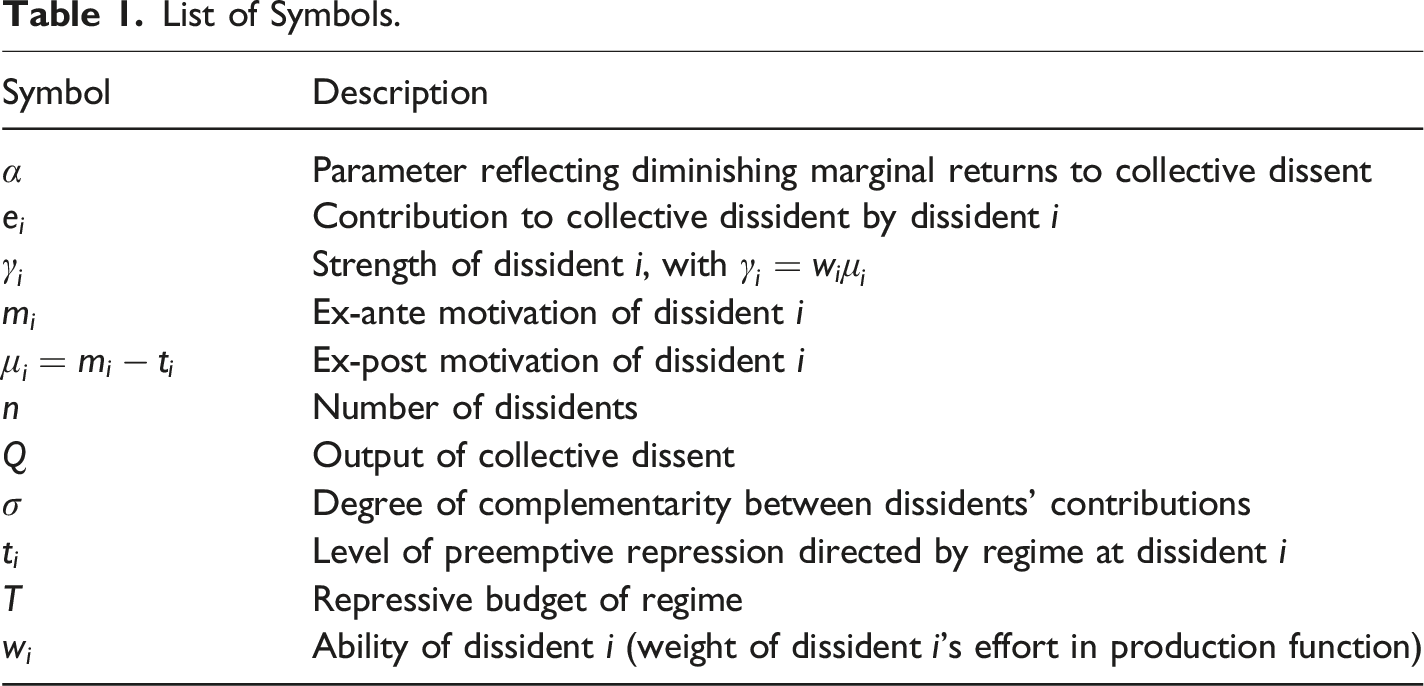
List of Symbols.
Output is determined by a function
The parameter
At stage 1, the regime decides what level of preemptive repression
Summarizing, I consider a sequential game where at stage 1 the regime (which observes the abilities and ex-ante motivations of all dissidents) sets a repression level
Interpretation of the Model
Collective-dissent problems can arise at several levels, such as between the rank-and-file members of a dissident group, between several leaders of such a group, or between several dissident groups. While SI Appendix D shows that the results extend when allowing for collective-dissent problems taking place simultaneously at several levels, the focus in the body of the paper is on a single collective-dissent problem considered in isolation. The
Repression in the model is preemptive repression, as it is set ex-ante (Dragu and Przeworski 2019; Oztig 2023), rather than reactive repression that is set ex-post. 7 Preemptive repression in the model consists of increasing the costs of contributing goods or services to output (Tilly 1978, 55), that is of reducing dissidents’ motivations. In terms of classifications of repression specified in the literature, such repression can consist of restrictions, which raise the costs of contributing by for example “increasing the difficulty of engaging in speech, association, and assembly” (Davenport 2007, 47), but also of elimination, where the regime represses a dissident to such an extent that it becomes prohibitively costly to contribute. 8 SI Appendix E also considers preemptive repression that reduces individual dissidents’ ability to contribute. While any real-world case of preemptive repression may both affect dissidents’ motivations and abilities, my focus is on demotivating repression, as it is this aspect of repression that accounts for a wide set of repressive strategies.
More intensive repression in the model takes up a larger part of the budget’s regime. 9 This makes sense even for collective repression such as curfews, as enforcing such measures is more costly the larger the number of people to whom they are applied (Davenport 2007, 49), or the more strictly they are imposed. The assumption that the repressive budget is fixed corresponds to a short-run perspective, where the regime cannot change its budget (Bueno De Mesquita and Shadmehr, 2023). Assuming a fixed budget makes sense, given my focus on obtaining insight into the optimal targeting of repression.
In the absence of repression, dissidents may perceive the relative costs of contributing to collective dissent differentially based on ideological, ethnic, or religious distance to the regime. This distance determines a dissident’s ex-ante motivation, which is heterogeneous. Repression decreases the dissident’s motivation by increasing the costs of contributing. When dissidents are interpreted as individuals within a single group, ability may be reflected by age, education, or physical condition. In case each dissident is a leader of one of several dissident groups, the leader’s ability depends on the size of the group that she leads, and on her popularity within her group (as she will then be more able to mobilize within her group).
Complementarity in the model can be determined by the degree of specialization, or of criticality. Specialization refers to the extent to which the dissidents take up differentiated roles in contributing to collective dissent. This may be determined by the extent to which dissidents have diverse skills. For instance, consider dissidents as a group of leaders within one and the same movement. Then if this group is composed of task-oriented and people-oriented leaders (Goldstone 2001, 157-58), these may be expected to coordinate on taking up separate roles in protest mobilization (high complementarity), with people-oriented leaders specializing in inspiring protestors and task-oriented leaders specializing in the practical organization of a protest; whereas this is not the case if the leaders have similar skills (low complementarity). The degree of specialization also depends on the extent to which dissident groups are formal rather than informal, where they are informal at their inception and gradually formalize with more division of labor (Staggenborg 1988). Finally, as stressed in sociology, groups may have overlapping membership (Carroll and Ratner 1996). Consider now the interpretation of the model where dissidents are leaders of separate groups, and where a leader’s contribution to collective dissent consists of mobilizing protest within the group that she leads. If membership overlaps only to a limited extent (e.g., because the population is segregated along ethnic or religious lines), leaders’ mobilization efforts are specialized in that they only reach a small part of the population (high complementarity), whereas this is less the case if membership overlaps.
Criticality refers to the extent to which dissidents’ contributions are critical for achieving any given level of collective dissent. Criticality may be determined by the type of the collective dissent. For instance, consider a petition or any other form of collective voice (Dowding et al. 2000), versus a general strike. For a general strike, each dissident’s contribution (interpreted as the number of days one stops working) is critical in the sense that to make the general strike last an extra day, each dissident needs to stop working for an extra day (high complementarity); for collective voice, output (e.g., in the form of obtained concessions) may increase linearly in dissidents’ efforts in voicing their discontent (low complementarity). Also, criticality may be determined by the overall threat level perceived by the regime. When the regime faces a very large threat, a single dissident making a large contribution already suffices to produce a large output; this is the case when output is as high as the highest contribution (e.g., candidate elimination in Ma (2020), in case several candidates could beat the incumbent). When the regime faces a small threat, high output is only achieved if all dissidents make a large contribution; this is the case when output is as high as the lowest contribution. For instance, considering the collective-dissent problem of several groups, it has been argued that the Chinese regime could only be threatened by joint action of several population groups, such as students and workers (Perry 2018). In between these two extremes, collective dissent is a linear function of the contributions, and regimes face an intermediate threat. Given my focus on collective dissent, where all dissidents contribute in equilibrium, such an intermediate threat is the highest threat level I consider.
Results
All proofs are contained in SI Appendix B. Applying backward induction, I first characterize the outcome of the game between the dissidents after any level of preemptive repression has been set. Proposition 1 characterizes the Nash equilibrium of the dissident game at stage 2, where each dissident chooses its optimal effort given the efforts of all other dissidents. To describe the results, I interpret the multiple of the ex-post motivation and the ability of a dissident
Proposition 1(ii) establishes that the relative equilibrium contribution of any two dissidents is a positive function of their relative strengths, where for minimal complementarity the contribution of the stronger dissident is infinitely larger, and for maximal complementarity the contributions approach each other, so that in the limit dissidents take the same contribution whatever their strengths. Intuitively, for small complementarity, the fact that the strongest dissident sets a higher contribution, leads other dissidents to drastically reduce their contributions, which leads the stronger dissident to set an even higher contribution; in the limit, only the strongest dissident contributes. For large complementarity, as each dissident’s contribution is essential, there is little added value of one dissident contributing more than another.
Finally, Proposition 1(iii) establishes that equilibrium output is a positive function of a weighted power mean of the dissidents’ strengths, with abilities serving as weights. This novel way of presenting equilibrium output will turn out useful to derive the regime’s optimal targeting strategy at stage 1. Looking at some benchmark cases, for minimal complementarity (
In the Nash equilibrium of the stage-2 dissident game:
(i) Equilibrium contribution of any dissident is a positive function of her strength, and a negative (respectively positive) function of output for small (respectively large) complementarity, so that dissidents’ contributions are strategic substitutes (respectively strategic complements) ( (ii) The relative equilibrium contributions of any two dissidents are a positive function of their relative strengths. For minimal complementarity, the strongest dissident approaches being the only one to contribute; for maximal complementarity, dissidents’ contributions approach each other ( (iii) Equilibrium output is a positive function of a weighted power mean of the dissidents’ strengths, ranging from the maximum function of the strengths ( Anticipating the outcome for any level of preemptive repression as given by Proposition 1, the regime sets its optimal repressive strategy. In the simplified model in the body of the paper, I focus on the case where Consider first the case where all dissidents are homogeneous (i.e., for each dissident
In the homogeneous game, let
(i) for smaller complementarity ( (ii) for larger complementarity ( To analyze the heterogeneous case, consider first the benchmark cases. For minimal complementarity ( For maximal complementarity ( Finally, for a particular intermediate degree of complementarity ( The three optimal repressive strategies considered are defined in Definition 1, with a definition in analytical terms relegated to SI Appendix A. As I will now show, for the entire range of considered degrees of complementarity, either of these three strategies is the optimal targeting strategy. In order to consider degrees of complementarity beyond the benchmark cases above, both the weakest-link and tall-poppies strategies need to be generalized such that they can be biased in favor of targeting the most able dissidents (Definition 1). That the regime has such a bias is intuitive, since for
In the heterogeneous game, the following targeting strategies are considered:
(i) Tall-poppies strategy: equalize the ex-post strengths of the ex-ante strongest dissidents as much as possible (according to a modified measure of strength (ii) Key-player strategy: reduce as much as possible to zero the motivations of the most able dissidents; (iii) Weakest-link strategy: reduce as much as possible to zero the motivations of the ex-ante least motivated dissidents (where dissidents are ranked according to a modified measure of motivation It should be noted that these three strategies are not always mutually exclusive. For instance, if motivation and ability are perfectly negatively correlated, there is no distinction between the key-player strategy and the weakest-link strategy (only the most able, least motivated dissident is targeted). Also, if motivation and ability are perfectly positively correlated and the budget is small, there is no difference between the tall-poppies strategy and the key-player strategy (each time, only the strongest and most able dissident is targeted). However, it suffices that there are at least three dissidents and that the most able, the strongest, and the least-motivated dissident are different individuals, for the three strategies to be distinctive. Following a convention to only consider the regime as employing a tall-poppies or a weakest-link strategy if this strategy cannot at the same time be characterized as a key-player strategy (as makes sense given the intuitive appeal of the key-player strategy), Proposition 3 offers a full characterization of the regime’s optimal targeting strategies in the subgame-perfect equilibrium of the game when the budget is small. It follows that, starting from minimal complementarity, as complementarity increases, the regime decides whom to repress more and more based on ability rather than motivation, until a middle range of complementarities is reached where the most able dissident is targeted, independently of her motivation. However, as complementarity is again increased up from this middle range, the regime focuses repression more and more on the least-motivated dissidents, until for maximal complementarity only motivation counts, independently of ability.
In the heterogeneous game, let
(i) for small complementarity ( (ii) for intermediate complementarity ( (iii) for large complementarity ( With the exception of the case of perfect correlation between ability and motivation (for an example, see SI Appendix B),
In the heterogeneous dissident game, let
It should be noted that when differences between strengths are not too large, the regime tends to target fewer dissidents as complementarity increases up from minimal complementarity. For minimal complementarity, the regime applies the tall-poppies strategy to equalize the strengths of several ex-ante strongest dissidents. As can be seen from the modified measure of strength employed by the regime, As SI Appendix C shows, all results are qualitatively the same in a model of centralized collective dissent where a leader can decide on the contributions of individual dissidents. This is because the optimal contributions set by such a leader depend in similar ways on dissidents’ motivations and abilities, in spite of the fact that with decentralized collective dissent dissidents contribute less. However, if dissidents have differential benefits from collective dissent, a leader maximizing total payoff will not take these into account when setting contributions, and therefore differential benefits do not matter for the optimal repressive strategy. This contrasts with the decentralized collective-dissent problem, where dissidents contributions do depend on their benefits, which in turn matter for the optimal repressive strategy.
Applications
I now look at possible applications of the three optimal repressive strategies. Key for applying the model is to evaluate for the particular type of collective dissent considered how complementary dissidents’ contributions are, and how heterogeneous dissidents are in their ability to contribute. SI Appendix I shows that the model can be extended to targeted cooptation (as increasing a dissident’s benefit of being coopted raises her opportunity cost of contributing to collective dissent) and provides applications.
Key Player
Considering political parties as unitary actors, the key-player strategy may explain why the Egyptian regime prohibits the Muslim Brotherhood (Johnston 2012). As the largest opposition party, its ability to contribute to collective dissentagainst the regime, is much larger than that of smaller opposition parties. Even if opposition parties’ contributions are complementary, the large degree of heterogeneity caused by the presence of a dominant opposition party makes the key-player strategy optimal to the regime. When it comes to dissidents interpreted as leaders, as pointed out by Buckley et al. (2022), there are many historical examples of repression targeted at prominent regime members who get to be perceived as threats (such as Trotsky in the Soviet Union) or at prominent opposition members (such as Cardinal Romero in El Salvador; Bob and Nepstad 2007). Even if complementarity between opposition members’ contributions is low, when the popularity of prominent figures by far exceeds that of other dissidents, they are much more able to mobilize (Buckley et al. 2022), and following the key-player strategy will be targeted.
With large repressive budgets, the key-player strategy may also lead to the targeting of large numbers of dissidents. An example is found in the Anti-Rightist Campaign of 1950s China (Zeng and Eisenman 2018) targeted at intellectuals, seemingly possessing the highest ability to act against the regime; another example is found in the Cheka’s Red Terror in the early years of the Soviet Union, where repression took place depending on “education, upbringing, origin, or profession” (Rozenas 2020, 1257). In these examples, dissidents were targeted based on their abilities, independently of their motivations, as witnessed by the fact that the victims of the Anti-Rightist Campaign included highly-educated party members with apparently low motivation to act against the regime (Zeng and Eisenman 2018), rather than more motivated non-party members with a low education. Standard explanations for such a repressive strategy include an anti-intellectual ideology within the regime (ibid.), or statistical discrimination (Phelps 1972) by a regime able to observe abilities but not motivations and that therefore casts its net wide (Liu 2022). My model provides an alternative explanation that is only driven by the regime’s purpose to survive, and applies even if the regime does have information on motivations. Key is that heterogeneity in abilities, for example in education, is sufficiently large, in which case the key-player strategy is optimal for all but the lowest and highest degrees of complementarity.
Tall Poppies
In spite of the strong intuitive appeal of the key-player strategy, its effectiveness has been questioned in security studies (Johnston 2012; Ryckman 2020), studying for example counterinsurgency in Iraq and Afghanistan (Long 2014). Specifically, when all preemptive repression is targeted at the dissident who is expected to make the largest contribution (the “leader”), the result may be that another dissident takes over as the leader in doing most of the work (Long 2014), so that leadership targeting resembles a whack-a-mole game. This is what my model predicts when dissidents have similar skills and therefore take up similar roles when contributing to collective dissent, with low complementarity of dissidents’ contributions. In such circumstances, while in the absence of repression the strongest dissident does most of the work, once all repression is focused on this dissident, the second-strongest dissident takes over. Moreover, if the strengths of the two strongest dissidents differ only to a limited extent (low degree of heterogeneity), the level of collective dissent does not decrease that much when adopting the key-player strategy and focusing all repression on the strongest dissident. In line with the tall-poppies strategy, the best way for the regime to reduce collective dissent is then to broadly repress dissidents, even if this means spreading its budget thin, as dissidents that could take over doing most of the work are then also hit.
For another application, let us follow Josua and Edel (2015, 292) in considering restrictions on career opportunities as a form of preemptive repression. Gueorguiev and Schuler (2016) interestingly find that in China and Vietnam officials are less likely to be promoted when they stand out in their number of Internet search queries. These may constitute a good measure for officials’ ability to contribute to within-regime dissent, and possibly also for their motivations to do so. By failing to promote such officials, the regime relegates them to less visible jobs, ensuring that officials’ strengths to contribute to within-regime dissent are equalized. More generally, the tall-poppies strategy may explain the relation identified in social psychology between authoritarianism, and negative attitudes towards high achievers (Feather 1993). In terms of my model, the tall-poppies strategy is effective if the level of collective dissent approaches a linear function of contributions; this makes sense if the threat officials pose to the regime consists of the collective voice that these officials produce, where the pressure this puts on the regime may relate to contributions in a close to linear way, with complementarity between officials’ contributions low. The case for the tall-poppies strategy is moreover strengthened if heterogeneity between officials is relatively low.
Weakest Link
Again referring to the key-player strategy, in spite of the strong intuition behind it, targeted repression is sometimes focused on what appear the least-motivated dissidents, rather than the most able ones. For instance, in the Syrian civil war, the regime has been reported to target moderate insurgents rather than Islamist insurgents (Becker 2015; Shadmehr and Bernhardt 2019), even though the Islamist insurgents seem to constitute the largest threat to the regime in being the most able to overthrow it, and the moderate opposition seems ideologically the least distant from the regime and therefore the least motivated to overthrow it. A standard explanation is that in this way the regime ensured that the opposition was perceived as consisting of religious extremists (Becker 2015). In terms of my model, an alternative explanation is that, given the non-overlapping constituencies of these groups, each group was critical for overthrowing the regime, and that for this reason repression was focused on the weakest link. In a different civil war application, consider insurgency as a collaborative effort between specialized dissidents, with combatants’ contributions consisting of fighting, and civilians’ contributions of (possibly reluctantly) providing resources such as food. Even though combatants may provide the bulk of the contributions in the uprising, the insurgency cannot succeed if civilians do not provide resources. The strategy of “draining the sea to catch the fish” (Valentino et al. 2004) targets the less-motivated civilians, rather than the combatants themselves.
A final application may be found in the targeting of swing voters by the Mugabe regime in Zimbabwe, even though these were ideologically the closest to it (Robinson and Torvik 2009). The point may be again that in rigged elections, only votes against the regime from the entire opposition could overthrow the regime (high complementarity), and that the best strategy was therefore to target the voters that were already least motivated to vote against the regime. In each of these applications, the weakest-link strategy is optimal because each player’s contribution to collective dissent is highly critical, trumping the fact that dissidents are heterogeneous in their ability to contribute.
Discussion
While I have identified examples where regimes appear to apply the optimal repressive strategies predicted, the theory can only be rigorously tested by finding a proxy for the degree of complementarity in large data sets on repressive events, and by checking whether repressive events that are as similar as possible except for the proxy, lead to different targeting strategies as predicted. For an example where such an empirical analysis could be feasible, consider strikes and targeted cooptation. Complementarity may be measured in this context by the tightness of the labor market. In a tight labor market, a strike by a part of the personnel may suffice for a successful outcome (low complementarity), whereas in a slack labor market, only a general strike may achieve success (high complementarity). Indeed, in his treatment of US labor strikes in the 1910s and 1920s, Brown (2000) observes a variety of employer strategies to preempt strikes, including giving benefits to white workers (resembling the key-player strategy), and giving benefits to black workers (resembling the weakest-link strategy). The question to investigate is then whether the use of these strategies depends on the tightness of the labor market as predicted.
An alternative way to test the theory is to derive further predictions from extensions of the model. First, I have shown that depending on the degree of complementarity, the level of repression is conditioned on either dissidents’ motivations, on their abilities, or on both. Yet, motivations are harder to observe (Ritter and Conrad 2016, 87). To what extent will the regime invest in surveillance to observe motivations? My analysis suggests that such investments make sense both for low and high complementarity (as in these cases motivational levels matter for the targeting strategy), but not for intermediate complementarity (as in this case the key-player strategy is optimal and targeting takes place based on abilities only). Moreover, a wider range of complementarities count as intermediate the larger the heterogeneity in abilities (Proposition 4). Thus, the results predict less investment in surveillance when there is large heterogeneity in abilities.
Also, while the model can be applied to both targeted repression and cooptation, I have not looked at the choice between the two (Svolik 2012, 9-10; Shadmehr and Haschke 2016; Xu 2021). There are two reasons to expect that cooptation is used more often than repression for large complementarity, in which case my theory predicts that regimes should target the least motivated. First, if the least motivated are also the ones that have the smallest ideological distance to the regime, then the regime may incur extra costs when repressing these, which are avoided in case of cooptation. Second, cooptation counters the lack of information the regime may have about motivations, by making the least-motivated self-select into cooptation (see SI Appendix I). In contrast, with intermediate and small complementarity, cooptation self-selects the least motivated, which may not be the most able dissidents (as required by the key-player strategy) or the strongest dissidents (as required by the tall-poppies strategy).
Furthermore, I have assumed regimes have a fixed repressive budget. Endogenizing the budget, the question arises how effective budget increases are in reducing collective dissent. As formally treated in SI Appendix J, a budget increase away from zero has relatively large impact for large complementarity when the smallest motivational level is low; intuitively, the weakest-link strategy is very effective when the weakest link is already very weak to begin with. At the same time, a budget increase has relatively large impact for small complementarity when the ability of the most able dissident is very large; intuitively, output is then predominantly determined by this dissident, and reducing her motivation has a large impact. Given the large impact of preemptive repression in both these cases, regimes may then be expected to focus more on preemptive than reactive repression. Also, it follows from the model that for low complementarity, once the regime has equalized all ex-post strengths (tall-poppies strategy), raising the repressive budget leads to a relatively small reduction in the level of collective dissent, because the regime needs to spread its budget thin across all dissidents. Thus, as soon as the regime has expended enough preemptive repression to equalize dissidents’ strengths, it may put more emphasis on reactive repression.
Finally, while my model is focused on optimal repressive strategies, the analysis can be extended to look at what makes dissident groups resilient in the face of strategic preemptive repression, in terms of group heterogeneity and of the technology of collective dissent. In the absence of repression, dissidents are better off with heterogeneous motivations when complementarity is low, and better off with homogeneous motivations when complementarity is high (Ray et al. 2007). In the presence of preemptive repression, with high complementarity repression is very effective when the motivation of the least-motivated dissident is low; the advantage to dissidents of having homogeneous motivations is then further reinforced by the presence of strategic repression. With low complementarity, repression is less effective when dissidents are homogeneous in their strengths; while in the absence of repression it is better to have heterogeneous motivations, the presence of strategic repression creates a countervailing effect where homogeneous groups are more resilient. In general, I conclude that strategic preemptive repression mitigates any advantageous effects of forming heterogeneous groups.
Looking at the resilience of different technologies of collective dissent, in the absence of repression, the level of collective dissent is smaller the larger the degree of complementarity (cf. Cornes 1993). In the presence of preemptive repression, if the motivation of the least-motivated dissident is very low, this effect is only reinforced. However, if the most able dissident is much more able than the other dissidents, preemptive repression can do large damage for lower complementarity; in this case, there is a countervailing effect that makes technologies with lower complementarity less resilient. Given these ambiguous results, the resilience of dissident groups in the face of preemptive repression deserves separate attention.
Supplemental Material
Supplemental Material - Whom to Repress: Tall Poppies, Key Players, and Weakest Links
Supplemental Material for Whom to Repress: Tall Poppies, Key Players, and Weakest Links by Kris De Jaegher in Journal of Conflict Resolution
Footnotes
Acknowledgments
I would like to thank two anonymous referees, the editor, Joyce Delnoij and Emilie Rademakers for helpful comments. Thanks are also due to participants of the internal seminar of Utrecht University School of Economics, and of the 23rd Annual Conference of the Society for the Advancement of Economic Theory, Santiago de Chile, 2024.
Declaration of Conflicting Interests
The author(s) declared no potential conflicts of interest with respect to the research, authorship, and/or publication of this article.
Funding
The author(s) received no financial support for the research, authorship, and/or publication of this article.

Data Availability Statement
Data sharing not applicable to this article as no datasets were generated or analyzed during the current study.
Supplemental Material
Supplemental material for this article is available online.
Notes
References
Supplementary Material
Please find the following supplemental material available below.
For Open Access articles published under a Creative Commons License, all supplemental material carries the same license as the article it is associated with.
For non-Open Access articles published, all supplemental material carries a non-exclusive license, and permission requests for re-use of supplemental material or any part of supplemental material shall be sent directly to the copyright owner as specified in the copyright notice associated with the article.
