




Abstract
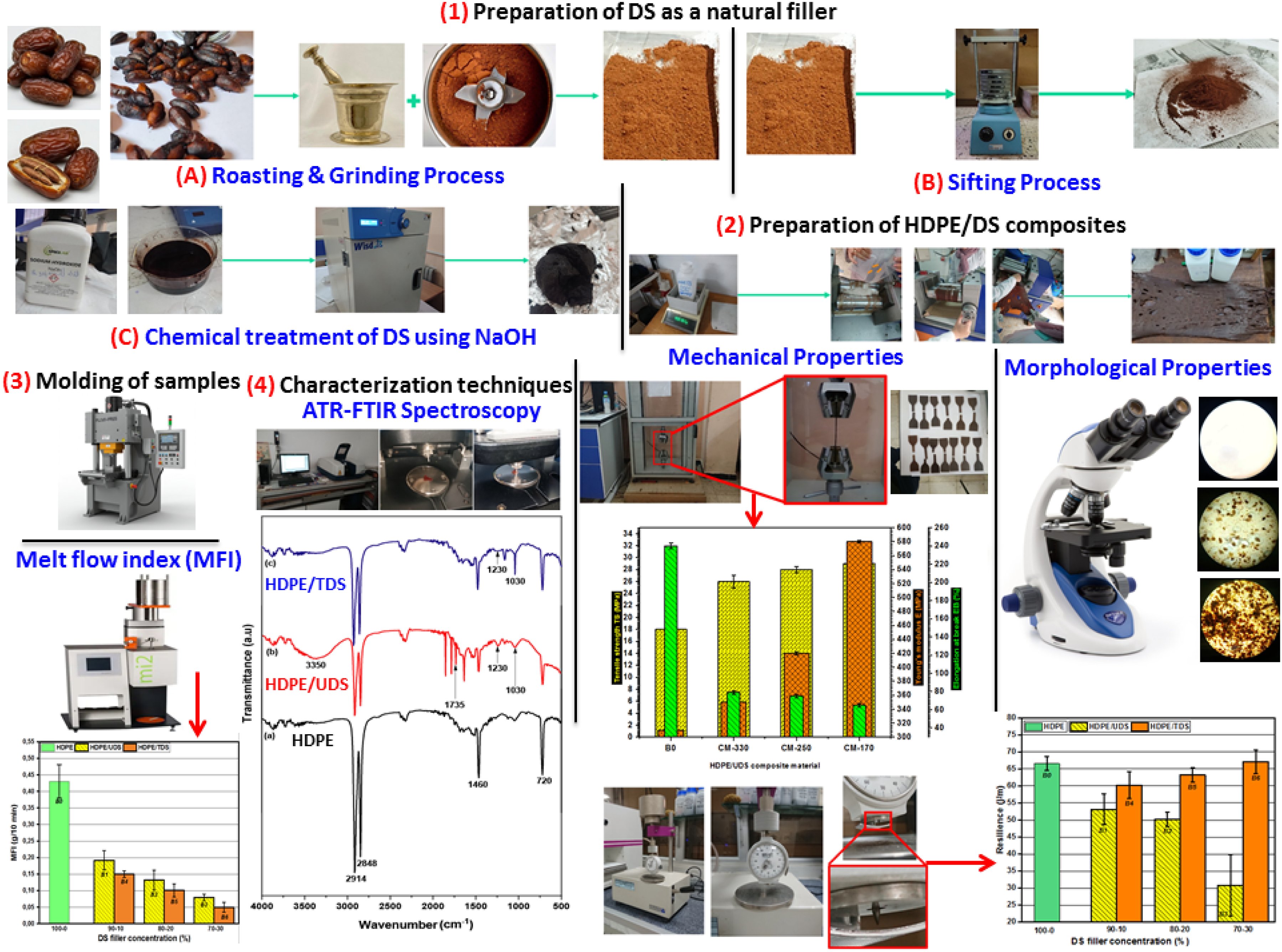
This study focuses on developing and characterizing high-density polyethylene (HDPE) composites with date seed (DS) fillers. Untreated DS (UDS) and alkali-treated DS (TDS) fillers were incorporated at 10, 20, and 30 wt% using two-roll mixing and compression molding, and their structural, rheological, mechanical, physical, and morphological properties were systematically characterized. Structural analysis by Fourier-transform infrared spectroscopy (FTIR) confirmed the removal of hemicellulose and lignin in treated fillers, enhancing filler–matrix compatibility. Rheological testing showed a decrease in melt flow index with increasing filler content, which was more pronounced in TDS composites due to stronger interfacial interactions. Mechanically, HDPE/TDS composites exhibited a ∼28% increase in tensile strength, a ∼35% improvement in Young’s modulus, and a ∼22% enhancement in impact resistance compared to neat HDPE. In contrast, elongation at break decreased, reflecting the trade-off between stiffness and ductility. Physically, water absorption decreased by nearly 65% in TDS composites compared to UDS counterparts, while density showed slight improvement due to reduced porosity and enhanced cohesion. Morphological analysis confirmed more homogeneous, uniform filler dispersion, and reduced agglomeration in TDS-based composites compared to HDPE/UDS composites. Overall, chemical treatment of DS significantly enhanced the structural, rheological, mechanical, and physical properties of HDPE composites. These findings demonstrate the potential of treated date seed as a sustainable reinforcement material for future industrial applications.
Keywords
Get full access to this article
View all access options for this article.