




Abstract
We examined existing problems relevant for education in global drylands and discuss their potential solutions in four fields, crucial for properly functioning educational systems: (a) response to low population densities, (b) governance, (c) language of instruction and (d) mismatch between education and the labour market. Our analysis leads us to the formulation of nine policy recommendations that may help create an educational system that strengthens resilience of dryland communities in the face of ongoing climate change. Our recommendations underline the necessity to combine systemic solutions with bottom-up ideas and extrinsic help coming from involvement of diaspora and non-governmental organizations.
Introduction
Global dryland areas, defined by the United Nations Environment Programme as areas with Aridity Index (a ratio of mean annual precipitation to potential evaporation) below 0.65, cover approximately 40% of the world’s land area (Environment Management Group, 2011; Koohafkan and Stewart, 2008). They support over two billion people, most of them living in developing countries (Environment Management Group, 2011; Middleton and Sternberg, 2013). Communities living in these areas have typically learned to cope with adverse conditions and have historically been among the most resourceful peoples on Earth. However, climate change combined with increasing population levels are challenging these peoples in new ways (Mortimore et al., 2009). Therefore, communities living in dryland areas need to be empowered to act in resourceful ways to deal with resulting threats and an educational system that strengthens community resilience to the on-coming changes is needed. 1 However, with progressing urbanization and globalization, people living in sparsely populated dryland areas become gradually more marginalized. Lack of proper social service provision and limited perspectives for professional careers are the drivers behind a constant drain of young, better educated people from dryland areas, leaving behind the elderly, the uneducated, the youngest and those who care for them.
Our article focuses on particular dryland areas and looks at the role education can play in building resilient communities, making use of experience gathered in Central Asia and in Africa. It reviews existing administrative and managerial problems in the field of education in dryland areas, analyses already applied countermeasures and ends with a discussion of best practices and/or potential alternative solutions. The problems are described in four thematic groups, related to (a) low population densities and marginalization of drylands, (b) poor governance in education in dry and remote areas, (c) inequalities in education related to language and ethnicity and (d) limited employment possibilities in drylands and general mismatch between skills taught and demands of the labour market. Although we focus on the organizational aspects of educational systems, we are aware that changes in both teaching programmes and methods are also necessary to increase the resilience of dryland communities.
In general, we show the problems relevant for education in dryland areas are common worldwide. However, differences in the economic situation and in historical and cultural backgrounds of dryland countries can lead to differences in their scope and impact on the population. This gives scope for mutual, South-South based learning. The article focuses on three groups of dryland countries characterized by different backgrounds and located in the arid areas of Sub-Saharan Africa (the stretch of countries running from Mauritania to Somalia, plus Botswana and Namibia), in Northern Africa (the Maghreb) and in Central Asia (Mongolia, Kazakhstan, Tajikistan and Uzbekistan).
The educational systems of Africa and of Central Asia grew out of historically very different circumstances, characterized on the one hand by colonization (for Africa) and on the other by the socialist experience under Soviet domination. In terms of education, the Soviet system was clearly superior to the colonial system and led to a much better starting position for Central Asia, compared to Africa. Thus, after the collapse of the USSR in 1991, the Central Asian countries faced the challenge of decentralizing, modernizing and maintaining the inherited, but usually underfunded, post-soviet educational system and its institutions (Mertaugh, 2004; Smolentseva, 2012). In contrast, by the time African countries gained independence (the 1950s and 1960s), their educational systems were almost non-existent, with only 10–15% of local children attending schools (Akkari, 2008). These different legacies remain relevant to the present day.
Population densities
Problem description
Drylands are characterized by low population densities, scattered settlements and, at best, only small cities. Therefore, all types of infrastructure are more difficult and more expensive to provide there, especially as these areas are often neglected during allocation of state resources. However, all in all, the numbers of people involved are significant. According to the Food and Agriculture Organization of the United Nations (FAO) there are almost 270 million people living in drylands in Africa and over 146 million in Central Asia (Koohafkan and Stewart, 2008). Nomadic pastoralists comprise a large part of dryland populations. For example, in Mongolia, pastoralists make up 20% of the population (Batkhuyag and Dondogdulam, 2018), whereas in Africa there are up to 40 million children who are members of nomadic or pastoralist households (IIRR Pastoralist Education Project, 2005). This situation poses a major challenge for educational systems, which are the most often oriented towards sedentary populations. As in the cities, in remote dryland areas, increasing numbers of people have come to expect various benefits from education, considering it a key driver leading to a professional career (Gitonga et al., 2013; Lind et al., 2016; Motsa and Morojele, 2018). However, these expectations are difficult to meet, due to significant disparities between urban and rural/remote areas in access to and quality of education. These inequities in education, as well as in other social services, result mostly from persisting urban bias in governmental politics, leaving remote areas permanently underfunded and complex urban-rural linkages insufficiently acknowledged in economic decisions. As a result, inequities between urban and rural areas and social polarization deepen (Mylott, 2009).
Potential solutions
Because continuing unequal allocation of resources can further exacerbate and reinforce the existing regional disparities, suitable mitigation programmes should be implemented (Habibov, 2012). In several developing countries hardship allowances for teachers working in remote areas were introduced. However, studies exploring influence of these allowances in developing countries on school functioning and students’ performance are sparse and their results remain inconclusive (Chelwa et al., 2019). Although the allowances in general decrease likelihood of teachers’ emigration and increase numbers of teachers and proportion of qualified teachers in remote schools, no effect has been found so far on average student performance (Chelwa et al., 2019; Pugatch and Schroeder, 2014). According to Pugatch and Schroeder (2014), although no effect on average student performance is observed, hardship allowances increase learning outcomes of top-performing students, simultaneously decreasing outcomes of those bottom performing, deepening the gap between them (Pugatch and Schroeder, 2014). Concerning the teachers, a hardship allowance strategy might work through two different channels – if it fails to encourage existing qualified teachers to move to rural areas it might attract more individuals, especially those born or living in remote areas, into the teaching profession (Pugatch and Schroeder, 2014). Another solution to a permanent lack of teachers in remote areas involves ‘contract teachers’, who are recruited from the local communities and typically lack formal teacher training (Pugatch and Schroeder, 2014). Remarkably, research has shown that the presence of contract teachers did have positive effects on average student outcomes (e.g. Muralidharan and Sundararaman, 2013; Pugatch and Schroeder, 2014). Possibly, due to their more appropriate language skills and their ties to the local community, unqualified teachers may be better positioned to help students learn (Pugatch and Schroeder, 2014).
In remote areas, where significant parts of the population rely on nomadic pastoralism (for example, mountains in Central Asia), the best educational solutions are mobile. One of the best models for such solutions was developed in Mongolia, where it functioned until the 1990s (Batkhuyag and Dondogdulam, 2018; Stolpe, 2016). It was based on the close connection between education policy and animal husbandry and encouraged upward mobility for pastoralists. The main part of this system were small-scale boarding schools that appeared for the first time in the 1930s. Situated in gers (yurts) even in the smallest administrative subunits, these schools did not encourage assimilation to a sedentary lifestyle, de-skilling, or cultural alienation. They rather provided a family atmosphere, with nearly all teachers being local and having a background in pastoralism (Dyer, 2001). Late school entry (at age 8) combined with long vacations and animal herds kept by almost every school ensured that schoolchildren kept permanent connection with pastoralism (Stolpe, 2016). In contrast to other parts of the world, Mongolian pastoralists had unhindered access to formal education, as all schools were part of the same educational system (Batkhuyag and Dondogdulam, 2018; Stolpe, 2016). Unfortunately, since the 1990s rural areas have been disadvantaged in service provision, a huge part of population moved to Ulaanbataar and the status of the pastoralist lifestyle has eroded. Mobile schools have become viewed and used as low-budget institutions to train clerks for menial tasks and underfunded dormitories begun to close, limiting access to secondary schools. Education, in general, became an instrument of sedentarization. Gradually, Mongolian citizens lost control over their educational system to foreign consultants. Children from nomadic families became the first victims of this situation, as they encountered significant structural discrimination. Thus, school attendance decreased, leading to statistically relevant recurrence of illiteracy in the 1990s (Batkhuyag and Dondogdulam, 2018; Krätli, 2001; Stolpe, 2016). Today, Mongolian education policy makers try to overcome the negative consequences of this transition, yet the country’s new urban centrism is a strong counterforce (Stolpe, 2016).
Currently, solutions similar to the traditional Mongolian education system are being experimented with in several countries in Sub-Saharan Africa. A well-known example, described by the FAO (FAO Capacity Development, 2017), is the establishment of Pastoralist Fields Schools, comprising usually a group of 25–30 pastoralists who meet regularly in a local field setting, under the guidance of a trained facilitator. They make observations on livestock production and rangeland ecosystems, focus on a topic of study and compare the effects of alternative practices. As a result of the observations and analyses done directly on-site, participants make decisions on how to improve their practices. This type of approach can clearly have consequences for the curriculum in schools: in addition to basic literacy and numeracy skills, a focus on basic animal husbandry education may be more relevant in these areas and education on what would be the most balanced diet available in local circumstances might be useful.
Governance in education
Problem description
Governmental budgets for education in much of Africa and in Central Asia have always been limited and have not kept pace with inflation and population growth. However, this situation slowly changes. Today, the percentage of gross domestic product (GDP) spent on education exceeds 4% in half of the studied countries, including Algeria, Morocco and Tunisia from the Maghreb; Botswana, Burkina Faso, Kenya and Namibia from Sub-Saharan Africa; and Kyrgyzstan, Mongolia, Tajikistan and Uzbekistan from Central Asia (World Bank Database at https://data.worldbank.org/). Additionally, education in developing countries is supported by international and national organizations and by private donors. Currently the most important problem is rather insufficient managerial and administrative capacity, impairing proper distribution and investment of accessible funds. As in the rural/remote areas transparent use and governance of available funds is often impossible (e.g. due to illiteracy or lack of managerial skills of people involved), cases of fraud, corruption or not-well-documented expenses in the context of educational services are quite common there (Chapman et al., 2005; Nkalu et al., 2019; Prew, 2018; Yembuu, 2010).
Problems with education governance are present in every country in question; however, they manifest themselves in different ways, depending on every country’s political and historical background (Akkari, 2008; Chapman et al., 2005; Winkler and Gershberg, 2004).
Potential solutions
As a direct response to governmental failures in the field of education and demand for market-based improvement of this situation, religious and commercial private education emerged. Many Islamic countries in the Sub-Saharan region have a long tradition of learning via a parallel Islamic educational system. This education is in Arabic and oriented towards Koran learning, knowledge of Islamic traditions and law (sharia).
Thus, although the Koranic schools offer education at the primary, secondary and tertiary levels, it is not comparable with curricula taught at state schools and offers at best limited employment opportunities to the graduates (Akkari, 2008). Nevertheless, in Ghana and other countries in the region, there have been attempts at integrating this type of education with mainstream education, with some success (Boyle et al., 2007). Generating this type of synergy may be beneficial for other countries as well, provided there are accreditation procedures put in place that will help ensure the quality of the Islamic educational system. In Central Asia, the collapse of state atheism and the revival of religion, particularly Sunni Islam (mostly Hanafi schools), have led to the emergence of new religious educational institutions throughout the region. Islamic education is under strict control of the ‘Spiritual Administration’, whose leaders answer directly to the state. Strict state control over religion in the Central Asian countries is justified as prevention of extremist group development (Olcott, 2016). In general, among parents, Koranic schools are often viewed as inferior, but less expensive and better accessible alternatives to public schools. However, they deepen a gender gap between boys and girls (Akkari, 2008).
In Africa, Christian private religious education also has a long tradition. In fact, many of the first educational initiatives in Africa were established by Catholic and Protestant missions. In recent years, private Christian education has proliferated, offering a large variety of degrees and an equally large variety of financial schemes. These establishments usually offer a somewhat better match between labour market needs and the education being offered.
Commercial private education has been introduced both in Africa and in Central Asia and is experiencing rapid growth. Apart from more expensive, state-approved private schools concentrated in big cities, many unofficial low-cost private schools are present in poorer urban neighbourhoods and in rural areas. This type of schools is especially popular in Sub-Saharan Africa (Baum et al., 2018). The quality of education offered in private schools is very differentiated. Often, the curricula being offered are imported from abroad, with limited attention to local needs. There tends to be an oversupply of ‘fashionable’ curricula, leading to qualifications that may be of little use in the labour market. Nevertheless, development of private schools significantly broadened access to education worldwide. Today, governments, donors and international stakeholders express interest in effective inclusion of private schools into national education systems (Baum et al., 2018).
Another response to impaired educational service provision in the developing countries, especially in the rural and remote areas, are community schools. They belong to state educational systems and are the most common form of its decentralization in Sub-Saharan countries. Community schools improve access to education and school infrastructure, adapt to local needs and demands and reduce student and teacher absenteeism. Moreover, they enhance parental and community involvement and strengthen social capital. Usually community schools remain lightly regulated and financed by school fees, often fully or partially covered by international non-governmental organizations (NGOs). However, the quality of education varies, as community schools in remote areas rely on inexperienced and uncertified teachers (Winkler and Gershberg, 2004).
To deal with this increasingly complex mix of state-funded, community-based and private schools, a key way of managing education seems to be through accreditation schemes. United Nations Educational, Scientific and Cultural Organization (UNESCO) plays a central role in helping to establish such schemes and in helping to improve their quality. An important body is the International Network for Quality Assurance Agencies in Higher Education. According to the Asia-Pacific regional network Asia Pacific Quality Network, accreditation schemes exist in Kazakhstan and Mongolia in Central Asia, but not in Tajikistan or Uzbekistan. According to the African regional network, Afriquan, there are no accreditation agencies in Chad, Mauritania, Niger, Somalia, South Sudan and Sudan. Establishing accreditation agencies where they do not yet exist and strengthening existing accreditation schemes must therefore be a key priority.
Language issues
Problem description
In most dryland countries in Africa, with the exception of Somalia and Sudan, former colonial languages have been maintained as languages of instruction in education, primary education included (usually from the third or the fourth year onward). Yet, this is considered to be the least advantageous model for education, due to the loss of effectiveness that results when teachers use a language that is not their own to teach children in a language that is also not their own (Skattum, 2008; Walter, 2014). The net effect of this is that only a small minority of children – the brightest – are able to pursue a successful educational career up to tertiary level. The great majority of children are left with only the most basic of skills after their education and effectively enter into ‘semilingualism’: a situation where they have inadequate levels of communicative abilities in all the languages that they speak.
In the Maghreb countries French and Arab are assigned different status, which is a part of the colonial legacy. Whereas the first is a language of scientific subjects, associated with modernity and economics, the second is a language of social and literary subjects, associated with tradition, religion and national identity (Akkari, 2008). Thus, instead of being an advantage, bilingualism here seems to generate social problems, especially in Tunisia (e.g. Daoud, 1991; Guellouz, 2016; Strengholt, 2009; Van Pinxteren, 2018).
In the former Soviet republics of Central Asia, up to 1989, Russian played a central role in education with mandatory use of the Cyrillic alphabet, where previously Arabic and Latin alphabets were used. In the post-Soviet period the Central Asian countries renewed interest in national languages and history (Deyoung, 2006). However, fluency in Russian still increases the chance of better education, which significantly disadvantages students from remote rural areas who are often barely literate in this language (Deyoung, 2006). As Mongolia was never a part of the Soviet Union, education there has always been in Mongolian, although there was a change from Mongolian to Cyrillic script in 1941. Today, the most popular foreign language in Mongolia is Chinese rather than Russian.
It is worth noticing that in all the countries discussed here ethnic biases influence language politics in educational services, although to a different extent (e.g. Daoud, 1991; Deyoung, 2006; Guellouz, 2016; Strengholt, 2009; Van Pinxteren, 2018).
Potential solutions
What these experiences suggest is that best practice would be to extend mother-tongue instruction to the whole of primary education. The International Commission on Financing Global Education Opportunity notes that ‘while evidence on the benefits of mother-tongue instruction is strong, half of all children in low-and middle-income countries are not taught in a language they speak.’ (2016: 17). One of the reasons behind this situation are problems with implementation. Mother-tongue education may be hampered by inadequate orthographies that were developed by missionaries with an insufficient appreciation for example of tonal systems, as shown by Trudell and Adger (2014) for the Maa of Kenya and Tanzania. Apart from it, ingrained biases may lead to societal resistance to mother-tongue education, as parents want ‘only the best’ for their children. Thus, they will prefer schools offering education in English, French or Russian instead of local languages. Though interestingly, there are also quite opposite examples – studies of marginal dryland communities in Ethiopia show that a change to instruction in local languages (as was introduced fairly recently) has led to higher overall attendance, higher attendance of girls and better educational achievement (Küspert-Rakotondrainy, 2014).
In general, education should not be designed or perceived as a way of ‘keeping people in their place’ and education perceived as second-rate, ‘Bantu education’ should be avoided. Those who have the talent should be given the opportunity to learn foreign languages and to earn advanced qualifications. However, education should not serve the interests of only a minority of learners. Another issue, a common prejudice, especially in Africa, is that teaching all children in their mother tongue is a hopeless task, due to the large number of languages spoken on the continent. However, this ignores two basic facts: one is that often, for those children who speak a minority language there are other languages in the area that are easy for them to learn, or at least far easier than European languages and, if used, would be a huge improvement over current practice. The other basic fact is that in many areas, children are bilingual from birth or almost from birth and more use could be made of the multilingual skills that are already prevalent in many parts of Africa (Prah, 1998). That being said, it will not be possible to use every indigenous language for these purposes – rational choices in indigenous language use are possible, as has been argued by Prah (1998) and will need to be made.
Efficiency in teaching does bring up the issue of the best way of teaching foreign languages. None of the languages spoken in the dryland countries of Central Asia are close to the dominant languages in the region (Chinese, Russian) or English. Learning Chinese, Russian and/or English to a higher level requires a considerable investment, both for the educational system as such and for individual learners. In Soviet times, this investment was indeed made. In modern times, emphasis has shifted to the national languages and English has been added to the language repertoire. Education systems in the Central Asian countries try to combine both international and national approaches. Governments emphasize national themes (history, heritage, culture, see e.g. Gaipov et al., 2013; Zharkynbekova et al., 2014). Simultaneously they try to make education more open to foreign influences, for example by trilingual education in Kazakhstan, where Kazakh, Russian and English language are taught as subjects from the first grade up to the 11th grade in Kazakh schools. The higher education system is also considered to provide tri-lingual education. In addition, Kazakhstan has shifted from the Cyrillic to the Roman alphabet (Gaipov et al., 2013). What can work for Central Asia could also work for Africa. Here as well, it is not necessary to use English or French as media of instruction – children can learn those languages to a reasonable level if the languages are taught as subjects, as is common outside Africa.
Mismatch between education and the labour market
Problem description
The mismatch between skills acquired during the education process and real needs of the labour market is a serious problem in many countries. The Maghreb, the Sub-Saharan and the Central Asian countries are no exception. On the one hand, reasons behind this situation are local and bound to the country’s history, on the other they result from global economic processes. Over the years educational systems of the post-Soviet countries used to be driven by employment demands of the command economy, even after the end of the Soviet period. Though old occupational profiles are no longer required in the market economy, educational institutions to a large extent continue to teach outdated skills and competences (Chapman et al., 2005). The educational system in the Maghreb countries was historically oriented towards preparing people for jobs in the public sector, which used to be the region’s principal employer. Due to continuing such an approach, the Maghreb countries are oversupplied with university students majoring in ‘soft’ subjects and undersupplied with engineers, scientists and technicians, who usually are the drivers of economic growth (Subrahmanyam, 2011). In Tunisia overproduction of graduates in the fields of social sciences and humanities was reinforced due to the phased Arabization process. The results are a lack of interest for technical degrees among students when they are about to enrol at universities and overproduction of graduates in ‘soft’ fields. This is associated with failed school-to-work transition and leads to a high unemployment rate (Akkari, 2008; Subrahmanyam, 2011). Some study programmes are considered as more prestigious or fashionable than others, resulting in oversupply of tertiary-educated youths that hold business, administration and law degrees (World Economic Forum, 2017; Yembuu, 2010). Finally, globalization and liberalization of education in developing countries led to adoption of imported one-size-fits-all teaching programmes that remain vaguely aligned with the needs of local labour markets (International Labour Organization, 2017). At the same time, vocational and technical education remains one of the most neglected areas of education (Yembuu, 2010).
All the above-mentioned processes described at the national level are also at work at the local scale. National education systems are geared towards training and recruiting the most talented youths for the urban-based sector of the economy. Thus, youths from rural communities acquire skills that are irrelevant for the day-to-day functioning of pastoralists or farmers. They are offered the opportunity to acquire a new life in metropolitan centres and become divorced from the people ‘back home’. Those who do not make it in the city are left with skills and knowledge that are of little use to them in their own communities and of little use on the formal job market. Thus, many become the menial workers in urban centres, both in Africa and in Central Asia. Others become unskilled workers and subsistence farmers in their own communities, lacking both the modern skills to deal with their changing environment and the skills that in the past used to be transmitted within extended family systems. In many areas, educational systems are wasteful from the point of view of resources invested, lead to intellectual impoverishment in communities and create for frustration for all involved. Those few who do ‘make it’ in ‘the big city’ then set an example for others back home, who also want to leave, reinforcing a negative feedback loop.
Potential solutions
To address youth unemployment, both at the national level and specifically in dryland areas, there are two fundamental requirements: skill development and job creation (Mourshed et al., 2014). Considering the first issue, the educational pyramid should be rethought and instead of conceiving it top down (as is still the case in many educational systems, both in Africa as well as in Central Asia), it has to be constructed bottom up. Such an approach has been confirmed by several studies, including the AdapTM – ‘Climate Change Management through Mitigation and Adaptation’ project (www.adaptm.eu). The starting point has to be that all education should be as relevant as possible. Even those who have received only a few years of primary education should have profit from that process. It means that education has to be relevant for the community, taught by people from the community and in the language of the community (something consistently recommended by UNESCO experts since the 1950s). Indigenous knowledge systems should be integrated and valued, although of course not sanctified. Simultaneously, curricula should be future ready, taking into account developing job automatization, the role of technology should not be underestimated and life-long learning, digital fluency and skills in information communication technology should be promoted (International Labour Organization, 2017; World Economic Forum, 2017).
Regarding creation of jobs that are attractive to educated youths, the possibilities in local dryland communities are limited, yet several things can be done to improve the current situation. Well-designed programs of public investment in the agricultural sector should be implemented, combined with necessary reforms to create new jobs offering meaningful work with considerable public and private benefits. Small-scale financial services (village banks, microcredits) should be promoted, providing dryland inhabitants with investment capital. Modern technologies, appropriate to the structural context should be implemented, favouring employment, the management of natural resources and low-carbon footprints (African Development Bank, 2016; International Labour Organization, 2017; Nkalu et al., 2019). Insecure and unclear land rights should be revisited, as currently ownership is strongly concentrated among older adults and often restricted to men, leaving the younger generation in an inferior position. Careful thought should be put into transformation of household enterprises, which may be an alternative for youths returning to their communities (African Development Bank, 2016).
Last but not least, the feedback loop between those who leave and those who stay behind should be turned into a positive one. Instead of the diaspora acting as an incentive for others to go the same route, the diaspora should be turned into a force of hope and strength and an engine for generating investment ‘back home’ that indirectly will serve to keep more talented youths in the communities.
Recommendations
The analysis made so far leads to a number of key policy recommendations that represent the best current thinking and practices developed for the countries described in this article (Figure 1). However, as under the strong influence of specific climatic conditions dryland inhabitants tend to develop convergent livelihood strategies, we believe these recommendations can be used as starting points for more profound changes in educational systems in different dryland areas. Yet, their implementation should be contingent on a careful assessment of local situations and consultations with relevant stakeholders.
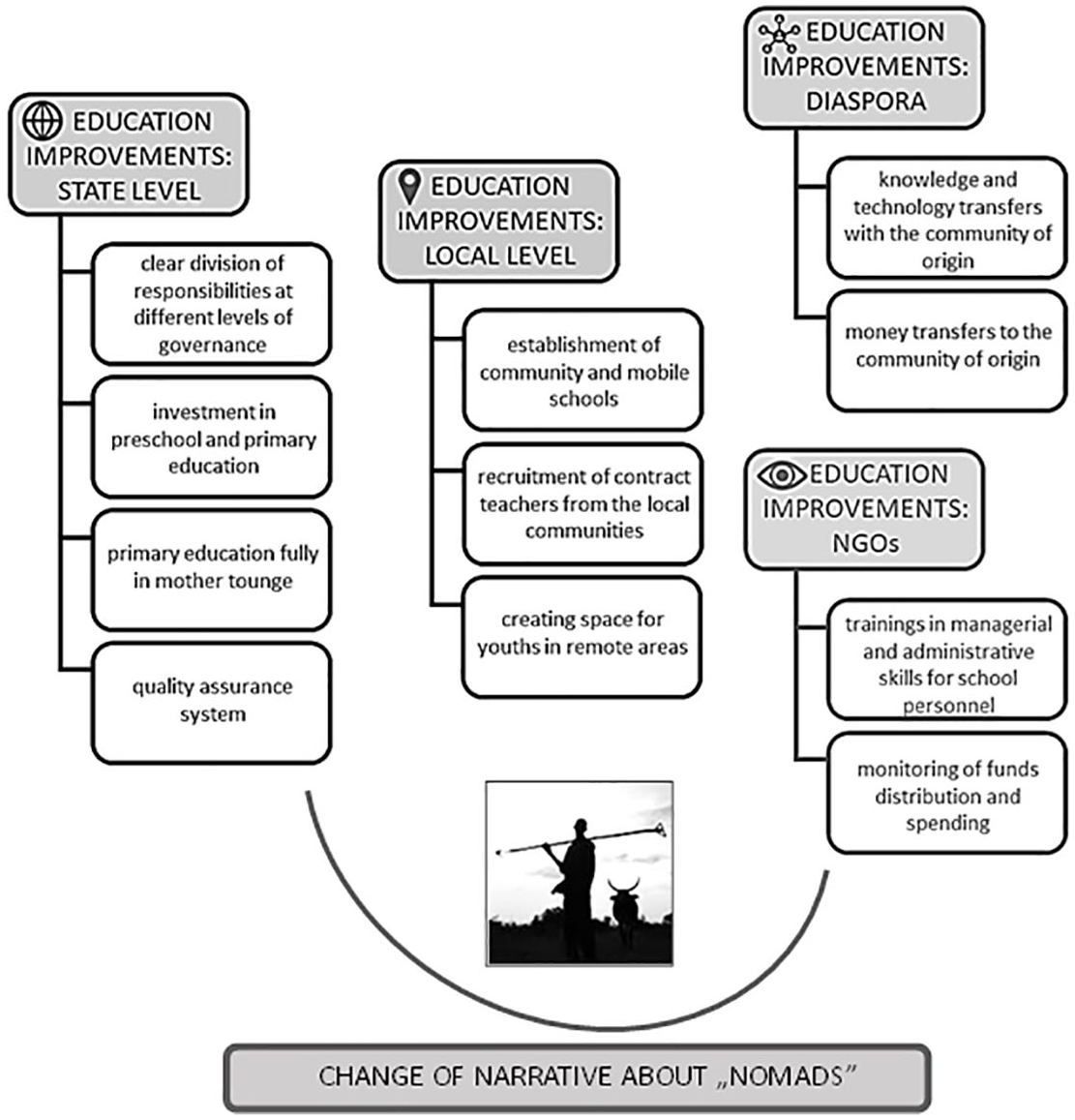
Recommendations for policy in education.
The general recommendations are not specific for dryland areas alone and their implementation will lead to a general improvement in education and to efficiency gains across the board. As the International Commission on Financing Global Education Opportunity writes in its report: ‘Funding should be shifted to the best-proven systemic changes and specific practices that improve learning, selected and adapted according to different country contexts.’ (2016: 17). Because education in dryland areas is often less funded than in other areas, dryland areas are likely to gain the most from such improvements in efficiency. The specific recommendations, in contrast, are especially suitable for dryland areas and pastoral peoples. However, it should be noted that pastoral societies are dynamic, evolving and not conflict free. Thus, these recommendations should always be adjusted according to ethnic, social and economic conditions in the given area.
General recommendations
Implement smart decentralization of educational systems combining bottom-up initiatives and management with state support and control. Start at the state level with reorganization of ministerial structures to clearly delineate authority and responsibility, reduce bureaucratic procedures and provide transparent and understandable information on results. Only this full accountability for performed actions will be achieved. Where possible, devolve managerial and financial responsibility to regional, local and community levels. With the help of NGOs, provide support to school personnel, parents and community leaders with training in managerial and administrative skills. Equip the people involved in direct implementation of educational politics with competences for proper governance at different levels of the educational system. Thus, the bottom-up procedures may function more efficiently.
To control functioning of this system, establish quality assurance procedures in education. The state, together with international stakeholders (for example UNESCO, various accreditation agencies), should develop accreditation schemes that enable evaluation of programme and performance of both public and private schools at different levels of education. Thus, the quality of teaching at different institutions could be compared and state or international funds could be distributed accordingly. The labour market will benefit from such systems, as employers would have more information on skills and competences mastered by graduates from different institutions.
Investing in preschool and primary education as the first stages of learning is crucial for future social functioning of individuals. The most important is development of numeracy and life skills, defined by UNICEF as ‘critical thinking and problem-solving skills, that builds their (i.e. young people’s) sense of personal worth and agency, and teaches them to interact with others constructively and effectively, has transformative potential’. This recommendation is key to ensuring that indeed even those who do not gain access to further education still profit from the schooling they received. It should be implemented at the state level and potentially supported by NGOs and international stakeholders.
Extend mother-tongue instruction to the whole of primary education to ensure the best teaching efficiency (both teachers and students communicating in their mother tongue) and proper development of numeracy and life skills in all students. As not all indigenous languages can be used by the state for these purposes, rational choices should be made. Instead of being languages of instruction, English or French should be taught as subjects. Inclusion of local languages in education should be accompanied by an increased respect for cultural differences. Teaching methods must be respectful of the cultural values and norms of local communities, without attempting to cast them in stone.
Use the new media to reach inhabitants of remote areas with online courses aimed at general audiences and presenting aspects of science that are important in daily life. This is compatible with the concept of functional literacy, which is being globally promoted. Use social media to build discussion platforms supporting teacher communities in a country, giving them the possibility of contact and exchanging their experience and ideas or involve diaspora members in knowledge and experience sharing activities with members of their communities of origin. 2
Specific recommendations
Develop stationary and mobile schools managed by local communities
Such schools will flexibly adapt to the needs of pastoralist families (for example flexible hours, specific breaks) and enable children to combine learning with performance of domestic duties. Apart from the obligatory teaching programme, curricula should include skills and competencies important for pastoralist communities, for example veterinary topics, human health and hygiene. Small school herds can be established to assure hands-on learning process. Classes should be delivered in local languages, using references to local culture and tradition (for example folk tales). Where necessary, parents can learn with children to increase adult literacy rates.
Invest in the training of ‘contract teachers’ recruited from local communities, as their involvement proves to be the best way of improving learning achievements of children in remote areas. Moreover, engagement of ‘contract teachers’ in community schools strengthens local communities and creates employment possibilities for educated people returning to their communities of origin. Having a pastoral background, ‘contract teachers’ easily adapt to the needs of the local community and implement teaching methods as described in the paragraphs above. As the teachers are part of the community, both children and parents feel more comfortable at school.
Create space for educated youths in the local communities
If they are to return to their communities of origin, educated youths should have some possibilities for initiatives and innovations. Financial means can be provided by a system of village banks and microcredits or by remittances sent by the diaspora. Members of the diaspora can additionally help their communities of origin by transfer of knowledge and technologies. Apart from the financial aspect, returning youths should cooperate with older community members, who own most of the land available. By building mutual trust among these two groups, older members could support ideas developed by youths and help them with counsel rather than control or restrict them. Where necessary, land ownership systems could be reorganized to include younger generations more fully.
Apart from both general and specific recommendations, there is a need of changing the narratives on pastoralist people in the scientific and political discourse. This is in line with Krätli (2001: 7) who concludes that the most successful education programmes are those that are ‘delivered within a non-antagonistic cultural environment and relying on a human interface strongly sympathetic to the nomadic culture’. Over the years nomadism had been considered as an outdated, inefficient way of life, resulting in social exclusion (Stolpe, 2016). The word ‘nomads’ is used worldwide to uniformly describe differentiated pastoralist communities. Although they have their own self-designations, carrying the inclusive meaning of positive collective identity, we preferably use the French-derived exonym, enclosing notions of inferiority and exclusion. Thus, the change of this narrative is necessary to consider a pastoralist way of life as an equal alternative to stationary way, neither exceptional nor marginalized.
Footnotes
Acknowledgements

Funding
The author(s) received no financial support for the research, authorship, and/or publication of this article.