




Abstract
Anthropogenic climate change-induced extremities have turned southwest Bangladesh into one of the most climate-vulnerable regions of the Earth. The southwestern coastal Satkhira District of the country is alarmingly exposed to climate change-driven salinity intrusion. This research attempted to explore the challenges faced by the informal livelihood-dependent households in the presence of salinity, changing livelihood patterns of the salinity-affected households and the nature of sector-specific adaptation strategies aimed at improving livelihood in Satkhira District. Based on the survey of 180 households and the in-depth interview, focus group discussion and participatory rural appraisal, this study uncovers different livelihood challenges faced by the local households. Increasing salinity forced 27% of households to change their livelihood patterns. Livelihood adaptation strategies of the local households are analysed according to their opinions. Saline-tolerant crop cultivation has emerged as a very effective adaptation measure in the area, where replacing crop fields with fish enclosures is not creating a substantial impact on the local community. The importance of nature-based solution has increased in recent days to adapt to the impacts of climate change. More than half of the respondents are satisfied with the recent adaptation initiatives championed by the government and non-government organisations.
Introduction
Southwest Bangladesh is one of the most climate-vulnerable regions on the Earth. Being close to the Bay of Bengal, this region confronts multiple climatic hazards all-year-round, such as temperature and precipitation variation, cyclones, tidal surges, salinity intrusion, high tides, floods and droughts (Ahmed et al. 2019). Anthropogenic climate change along with unfavourable geographical location, flat and low-lying topography, high-population density, poverty and dependence of various livelihoods on climate-sensitive sectors have made the region so vulnerable (Abedin and Shaw 2013; Alam and Murray 2005; Baten et al. 2015; Kundzewicz et al. 2007). Research reveals that globally, 600 million people living in the low-elevated coastal region are affected by increasing salinity (Dasgupta et al. 2015). The southwest region of the coastal belt of Bangladesh is no exception, as it is also predominantly affected by climate change-induced salinity. Many researchers have attributed increasing salinity in the ocean to human-induced climate change (Rosenzweig and Peter 2013; Silvy et al. 2020; Stott et al. 2008). According to the Fifth Assessment Report of the Intergovernmental Panel on Climate Change (IPCC), more than 40 regional and global studies on salinity patterns claimed that a detectable change in ocean salinity has been seen as more likely due to anthropogenic forcing since 1960s (Bindoff et al. 2013). Apart from climate change, the other factors influencing salinity intrusion, in the case of Bangladesh, are climate extremes such as cyclones, tidal surge and high tide enabling seawater to enter locality; inadequate precipitation; interlinked natural, socioeconomic and political systems; natural systems consist of geographical location and sedimentation; shrimp farming; diversion of water; irrigation; weak infrastructure and poor management and transboundary river policy (Dasgupta et al. 2015; Fahim and Sikder 2022; Khan et al. 2015; Mahmuduzzaman et al. 2014; Mukhopadhyay et al. 2020; Rahman et al. 2018; Vineis et al. 2011; Williams 2001). According to a 2010 report, in Bangladesh, salinity-affected area has been increased from 8,334.5 square km in 1973 to 10,562.6 square km in 2009, which shows a 26.7% increase in salinity-intruded area in 36 years (SRDI 2010). Rahman et al. (2018) showed that the excessive saline soil percentage has increased in Bangladesh from <1% in 1990 to 33% in 2015 due to growing salinity in the coastal area. It is also found that 53% of the country’s coastline territory is affected by salinity (Hoque et al. 2013). Figures 1 and 2 show the scenario of water and soil salinity of the country. In both maps, Satkhira District is depicted as being very susceptible to salinity intrusion. Salinity intrusion caused by various climatic extremes has caused huge losses and damage in the coastal communities of Satkhira District in recent years, according to researchers such as Rabbani et al. (2013), Habiba et al. (2014) and Islam et al. (2012).
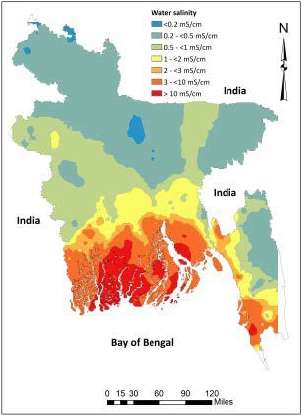
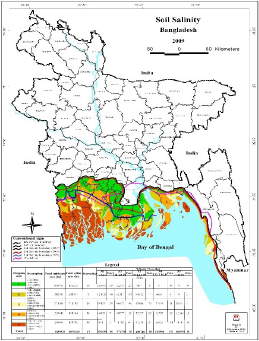
Maximum salinity intrusion occurs in March–April, and salinity is minimal during August–December due to heavy rainfall in the country (Mahmuduzzaman et al. 2014; SRDI, 2010). Increasing salinity in the coastal area terrifically poses threats to traditional agriculture, aquaculture, sources of potable water and other common livelihood options for farmers (Bernier et al. 2016; Rahman et al. 2017). The coastal belt of Bangladesh covers 32% area of the country, and this region contains 30% of the total cultivable lands too (Ahmad 2019; Haque 2006). Therefore, agriculture is the main source of income here. Salinity has a significant impact on agricultural processes, particularly crop production. Raising livestock and freshwater fish aquaculture are also impacted (Baten et al. 2015; Machado and Serralheiro 2017). Because of the considerable decline in traditional agricultural activities, changes in livelihood options have become frequent in this region. Diversification of livelihood is seen as an adaptation strategy that assures several seedbeds of income-earning, reduces livelihood risks during any stressor or shock and develops a well-balanced coping mechanism. The most common scenario of the study area is that people are converting their agricultural lands to shrimp and crab enclosures due to salinity (Hoque et al. 2013; Scoones 1998). Migration of people to urban areas is also frequently happening in this area as an adaptation option (Bernier et al. 2016). Irrigation stands for another major adaptation strategy in the salinity-prone area (Uddin et al. 2014). In recent times, nature-based solution (NbS) has emerged as one of the options for climate change adaptation globally, which also encourages conservation, restoration and enhancement of ecosystem and biodiversity (Kabisch et al. 2016). According to the International Union for Conservation of Nature (IUCN), ‘Nature-based Solutions (NbS) is defined as actions to protect, sustainably manage and restore natural or modified ecosystems, which address societal challenges (e.g., climate change, food and water security or natural disasters) effectively and adaptively, while simultaneously providing human well-being and biodiversity benefits’ (Cohen-Shacham et al. 2016). This approach is being promoted by governmental agencies and non-governmental organisations (NGOs) to help local people adapt.
Methodology
Study Area
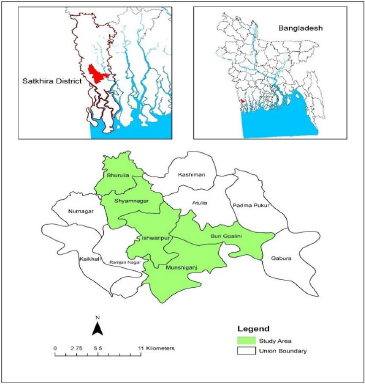
The study is based on a southwestern coastal district of the country, Satkhira. Satkhira District lies between 21°36′ and 22°54′ north latitudes and between 88°54′ and 89°20′ east longitudes. The Bay of Bengal and the world’s largest mangrove forest, Sundarbans, are adjacent to this district. The study location is Shyamnagar Upazila (sub-district) of Satkhira District, which is located at 22.3306°N and 89.1028°E. Data was collected from Bhurulia, Shyamnagar, Ishwaripur, Munshiganj and Buri Goalini Unions (Figure 3) of the Upazila (sub-district). Shyamnagar Upazila is the biggest Upazila of Bangladesh. It is one of the most exposed coastal areas to the Bay of Bengal, which is severely affected by salinity.
Study Area.
Data Collection and Analysis
Using mixed methods, the researchers have explored primary data sources in this study. Secondary data has been analysed by reviewing newspapers, research articles and relevant books. A household-level survey was conducted to get quantitative data. A total of 180 informal livelihood-dependent households in five unions of Shyamnagar Upazila were surveyed using a structured questionnaire. Purposive sampling was used for both the quantitative and qualitative parts of the study. For qualitative data collection, 5 focus group discussions (FGDs), 12 in-depth interviews (IDIs) and 10 key informant interviews (KII) were conducted in the study area. Each group was comprised of 10–13 people. Purposive sampling was used so that the researchers could purposively choose the respondent households that are dependent on informal livelihoods and whose livelihood options are directly affected by salinity intrusion, and also get information from those people who are able to respond to the survey. Locally knowledgeable farmers, political leaders, members of civil societies and government officials, as well as non-government officials, participated in the IDI. Mostly local, experienced subsistence farmers were considered for KIIs.
Collected data were statistically analysed using SPSS version 25. The authors developed graphs and charts using Microsoft Excel. ArcGIS version 10.3 was used to create the map of the study area.
Result and Discussion
Research Participants and Respondents
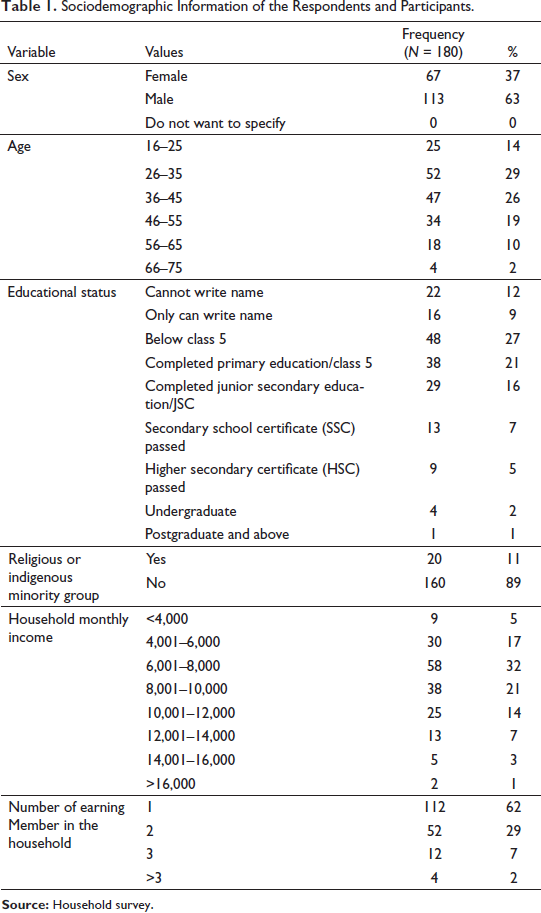
A total of 180 people responded to the quantitative study, and 22 people participated in KII and IDI. Among all the participants and respondents, 63% were men and 37% were women. Most of them belong to the age groups 26–35 (29%) and 36–45 (26%). Nearly 12% cannot write their names, 9% can write their names, 27% could not complete their primary education, 21% have completed primary education, 16% have completed junior secondary level and the remaining 15% have completed more than junior secondary education level (secondary school certificate, higher secondary certificate, undergraduate and postgraduate). The average family size of the quantitative research respondents was five. The majority of respondents’ monthly income ranges from BDT 6,001 to 8,000 (32%). Among the respondents, 62% of households have only one earning member (Table 1).
Sociodemographic Information of the Respondents and Participants.
Information on Sources of Income
The most significant income source of informal livelihood-dependent households is crop cultivation (87%). Other income sources are fishing (63%), fish and crab farming (48%), agri-labourers (37%), non-agri labourers (34%), livestock rearing (33%), poultry rearing (36%), rickshaw/van pulling (23%), small businesses (10%) and boating (7%) (Figure 4).
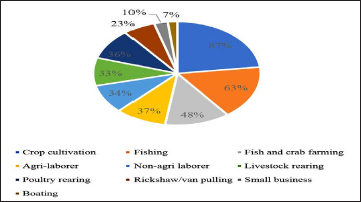
Among the non-agri labourers, a good number of respondents work in brick kilns in different regions of the country. Moreover, a significant number of them go to the Sundarbans to collect honey, crabs, fish, fuel and wood.
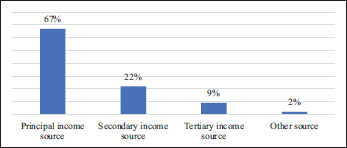
The households were asked how many different sources of income they have (Figure 5). A total of 67% of respondents have a single source of income, 22% have a secondary source of income and 9% have a tertiary source of income. On the other side, 2% of respondents have more than three sources of income.
Salinity and Informal Livelihood in the Study Area
Impacts of Salinity on Informal Livelihoods
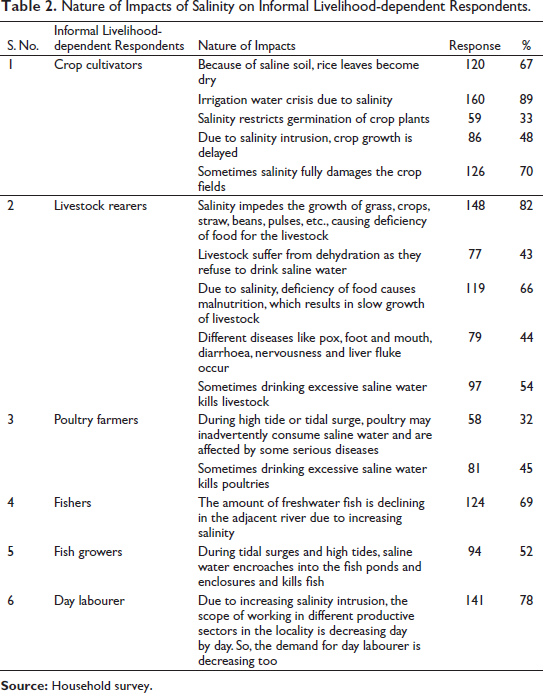
The majority of the respondents in Shyamnagar Upazila rely on informal livelihood. Crop cultivators, livestock rearers, poultry farmers, fishers, fish growers and day labourers are all affected by increasing salinity. The nature of the impacts varies depending on the type of livelihood (Table 2).
Nature of Impacts of Salinity on Informal Livelihood-dependent Respondents.
One of the day labourers of Munshiganj Union, Manik Mia (pseudonym) states:
In 2004, a riverbank erosion caused me to lose my home and agricultural property, leaving me landless. Following that, I began working as a day laborer. Salinity in Shyamnagar Upazila is increasing day by day. Every sector of this Upazila is affected by salinity intrusion, limiting the scope of working as a laborer. I used to make sufficient money to support my family. However, increasing salinity over the last few years has rendered me unable to continue even on a hand-to-mouth basis.
Different Aspects of Taking Loan Due to Salinity and Associated Factors
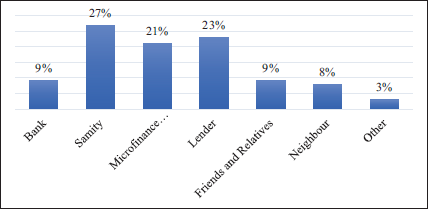
A total of 43% claimed they had to fall into debt because of a loss of income owing to salinity and other associated factors. According to Figure 6, a share of 27% of respondents borrowed money from Samity (cooperative society), 23% borrowed from local lenders, 21% from microfinance institutions and only 9% of the borrowers took loans from banks.
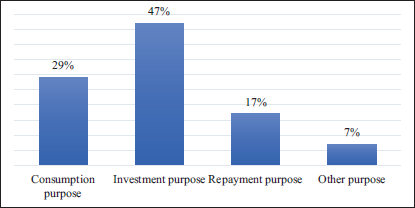
Investment (47%), consumption (29%) and repayment (17%) are the three most common reasons for borrowing money. ‘Other purpose’ is defined by 7% of respondents (Figure 7).
In an FGD, a fish farmer from the Ishwaripur Union says:
During Cyclone Fani in 2019, saltwater water flooded my freshwater fish pond in Bangshipur Village of Ishwaripur Union and killed all of the fish. I borrowed money from a microfinance institution after everything had returned to normal. This made me furious since microfinance organizations’ interest rates are so exorbitant, and it had a negative impact on me financially.
Change in Livelihood Pattern Because of Salinity
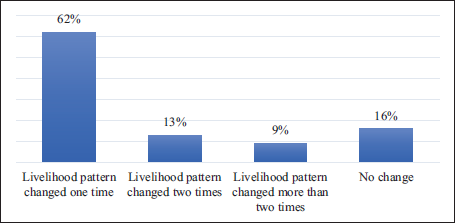
Increasing salinity in southwestern Bangladesh has posed a significant danger to the local population’s existing livelihood strategies. As a result, people frequently change their livelihood patterns and assess whether they are appropriate for their location. It has been discovered that people examine the possibilities of their livelihood until they find an appropriate one. The respondents and participants were asked how many times in the last 5 years they had changed their livelihood choices because of salinity (Figure 8). A total of 84% of the respondents changed their livelihood strategy, with 62% changing one time, 13% changing two times and another 9% changing more than two times.
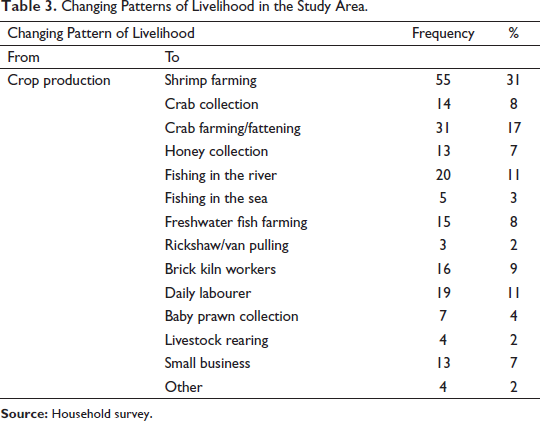
The nature of changing livelihood patterns has been specifically detailed in the tabular format below (Table 3). Crop cultivators make up the majority of those who shifted their livelihood patterns. Crop production was replaced by shrimp farming for 31% of the population, while crop cultivation was replaced by crab farming for 17%. According to the qualitative part of the study, the rate of changing livelihood patterns in this area accelerated shortly after Cyclone Aila in 2009.
Changing Patterns of Livelihood in the Study Area.
Locals have been switching their livelihood options to crab farming in recent years. During the last few years, it has been a popular source of income in the study area. A respondent says:
In our land, my husband and I used to grow crops. Our land’s fertility began to decline in 2009 after Cyclone Aila, due to salty waterlogging. Then we decided to start crab farming because crab can effortlessly be produced in our area’s salty water. We achieved a BDT 28,000 profit in the first year. It is now expanded much more. Our lives have been changed as a result of this new livelihood strategy.
Adaptation Strategies, Nature and Level of Satisfaction
Category-based Local Adaptation Strategies and Their Nature
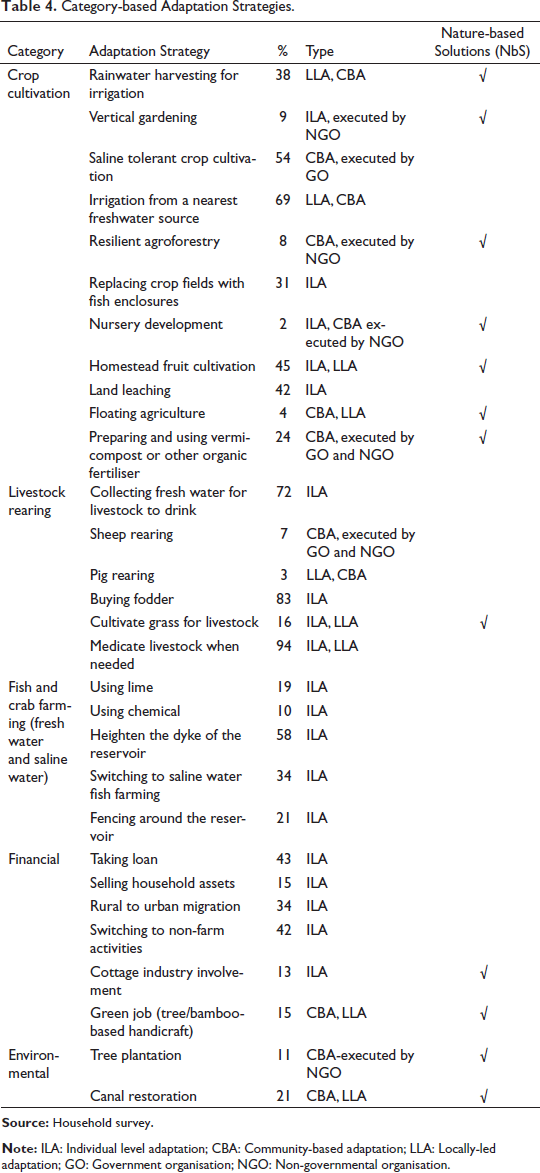
The study’s researchers examined the existing adaptation techniques used by the individuals in the study area. They discovered roughly 30 adaptation techniques, which were categorised based on their nature and execution features. Crop production, livestock rearing, fish and crab farming, financial and environmental were the categories (Table 4). Individual-level adaptation, community-based adaptation and locally-led adaptation were the three forms, which were carried out either independently or with the assistance of government and/or NGOs. NbS were identified from the adaptation strategies to understand whether the community interventions have positive impacts on the environment and ecosystem while having economic benefits from the adaptation strategies. NbS in the area was identified based on the IUCN’s eight principles for NbS 1 (Cohen-Shacham et al. 2016). In Shyamnagar Upazila, mostly NGOs work to promote NbS.
Category-based Adaptation Strategies.
Satisfaction Level of the Local People on Adaptation Approaches
In the study area, various governments and NGOs work to promote adaptation measures for those who are affected by salinity. The researchers asked those people to measure their level of satisfaction (Table 5).
Satisfaction Level of the Local People on Adaptation Approaches.
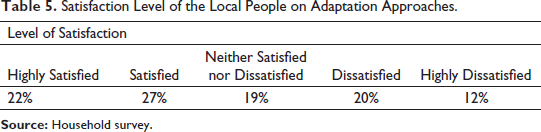
A total of 22% of the households were highly satisfied, and 27% were satisfied with the adaptation measures. So, in total, 49% of local people are either highly satisfied or satisfied. On the other hand, 20% were dissatisfied, with 12% being highly dissatisfied. It’s also been discovered that 19% of local respondents were neither satisfied nor dissatisfied.
Case Study: A Fighter Lady
Hanufa Begum (pseudonym) lives in Chunkuri Village of Munshiganj Union under Shyamnagar Upazila (sub-district). On their land, her husband, Faruk Hossen, used to grow rice and vegetables. In the year of Cyclone Sidr, 2007, a tiger killed Faruk Hossen at the Sundarbans, and Hanufa Begum became a ‘tiger widow’. 2 In 2009, Cyclone Aila flooded away Hanufa Begum’s agricultural lands, resulting in a loss of 80,000 taka (US$940 [US$1 = BDT 85]). Her land was waterlogged for almost 3 years by saline water. With the help of an NGO, she made a living from the cottage industry and handicrafts from 2009 to 2013. Soil salinity damaged the productivity and fertility of the croplands. As a result, in 2014, she decided to turn her cropland into shrimp enclosures. She received grants from another NGO and borrowed the rest of the money for the investment from a local microfinance institution. Hanufa Begum started to prosper from her new business. Her son finished his studies, and her daughter was married to a promising man. Everything seemed to be going swimmingly. In 2019, Cyclone Fani struck her land and destroyed her shrimp enclosures. Waterlogging did not occur this time, although she did lose nearly 3 lakh taka (US$3530 [US$1 = BDT 85]). Hanufa Begum became penniless. She was scared to start shrimp farming again. Furthermore, her community was made aware of the dangers of shrimp aquaculture, which increases salinity in the area. Department of Agricultural Extension (DAE) of the Government of Bangladesh came forward to help Hanufa Begum. They took two plots of land from her to prepare two experimental salinity-tolerant paddy fields and succeeded in cultivating BRRI-61 and BRRI-47. After the experiment, Hanufa Begum started to cultivate saline-tolerant rice and vegetables in her land. In 2020, she made a profit of BDT 34,000 [US$400 (US$1 = BDT 85)] by selling rice and vegetables. Thus, in the last 11 years, Hanufa Begum has taken a variety of adaptation approaches to combat the effects of climate change.
Concluding Remarks and Recommendations
Climate change is expediting various disasters throughout the world, including in Bangladesh. One of them is the salinity of soil and water in Bangladesh’s coastal regions. According to the findings of this study, increasing salinity has a significant impact on individuals in Bangladesh’s southwest Satkhira District, who depend on informal livelihoods. Crop cultivators, livestock rearers and day labourers are mostly affected by salinity in the study area. 87% of the respondents and participants are directly and indirectly involved with crop production, and salinity has a significant influence on this livelihood option. Livestock rearing is substantially impacted after crop production. Roughly 31% of the respondents switched from crop production to shrimp farming as a livelihood option in the previous 5 years, followed by crab farming/fattening (17%). Crab farming/fattening have become quite popular as a source of income in recent years, whilst shrimp farming has declined in popularity due to its role in increasing salinity. A total of 43% claimed they had to fall into debt because of loss of income owing to an increase in salinity and other associated factors. Cooperative societies, in this case, provide the most loans to the respondents in the studied region, and the majority of the loans (47%) are utilised for investment purposes. The study found that 84% of the respondents have changed their livelihood patterns at least once. The researchers looked at the existing adaptation mechanisms that respondents in the study region employed with the help of government and NGOs. They uncovered about 30 adaptation strategies, which were divided into categories depending on their nature and execution features. NbS were identified from the adaptation strategies following IUCN’s eight principles of NbS, with 40% of the strategies falling into this category.
Some recommendations by the authors include: (a) people’s awareness of livelihood diversification can be increased, making them more adaptable to the situation, (b) people in the area should be aware that banks provide significantly lower interest rates than cooperative societies and microfinance institutions, (c) NbS should be widely promoted for the sustainable adaptation of local salinity-affected people, (d) local people’s indigenous knowledge must be understood so that it may be leveraged to develop more sustainable adaptation solutions and (e) top-down adaptation tactics should be discouraged in favour of locally-led adaptation strategies.
Further research on climate finance at the local level is recommended. The potential of NbS should be investigated so that thoughtful actions may be taken. A more thorough investigation on the possibilities of various sorts of systematic livelihood solutions might be conducted so that individuals have more alternatives to select from when they think about shifting livelihood trends.
Footnotes
Declaration of Conflicting Interests
The authors declare that they have no conflict of interest regarding this original research article. The authors have completed the research with their own funding. They have no affiliations with or involvement in any organisation with any financial interest.
Funding
The authors received no financial support for the research, authorship and/or publication of this article.
