




Abstract
We offer a framework for developing the collaborative workplace, developed through a case study of a subsystem of Intuit Canada, a knowledge-based product development firm known for strong collaboration. Grounded in interviews, observations, informal conversations, and archival data, our framework reveals a series of factors that shape work, relationships, and behaviors to promote collaboration widely. Beyond factors, we uncover what it is about them, the underlying properties that created the conditions for employees to work, relate and contribute collectively. We show how the factors interrelate to create two collaborative subsystems; one fostering widespread alignment around strategic goals and the other fostering locally led interactivity to operationalize those goals. We illustrate how the duality works in practice and conclude with implications for future research and practice.
Keywords
Introduction
In our environment, building software, collaboration is important because many crafts are involved—engineers, designers, product managers, marketers, and care people. And the challenge is that most organizations are set up by functions, which create functional seams that become exposed to the customer. Collaboration is required to achieve next-level outcomes, a truly integrated experience that feels seamless and brings all the crafts that I am talking about together. – A leader, Consumer Tax Group of Intuit Canada
How do you design an organization for widespread collaboration? To answer that question, we took a fresh perspective to inquiry, reasoning that before we could understand the organizational elements that support collaboration, we first needed to know how collaboration manifests in the contemporary knowledge-based firm. With the Consumer Tax Group (CTG) of Intuit Canada, we had an organization built to promote collaboration. As the leader above emphasized, a seamless customer experience relied on the collaborative contributions of a wide range of cross-functional peers. Through a comprehensive case study at the CTG, we sought to explore the many ways that peers collaborated before uncovering the supportive workplace elements.
Our quest to uncover the design elements that promote widespread collaboration evolved from two developments. First, collaboration itself is changing. No longer layered atop an organization to augment performance, collaboration across roles and units is fast becoming the primary way that work gets done. The complex and shifting nature of work means that people from different functions with diverse skills need to connect in ever-changing configurations to generate quality, efficiency, and innovation (Amelkin et al., 2018; Edmondson, 2018; Fjeldstad et al., 2012; Mortensen & Haas, 2018). Second, most organizations are not designed for fluid and dynamic interactivity. Traditional design elements are ill matched to the dynamism required of more interrelated and co-evolving ways of working and relating. The focus is therefore shifting to understanding a wholly supportive context for collaborating (Adler & Heckscher, 2018; Hackman, 2007; Mortensen & Haas, 2018; Suddaby et al., 2011; Trist, 1977; Tannenbaum et al., 2012).
Through a dual approach to inquiry, we zoomed-in to explore collaboration as a cross-boundary competence and subsequently zoomed-out to explore the makeup of collaborative contexts. Together, the approaches generated a ‘both/and’ dilemma. While the collaboration literature tended to promote a locally organic understanding of cross-boundary interactivity (e.g., Edmondson, 2012a, 2018; Mortensen & Haas, 2018), the literature exploring wider collaborative contexts favored centralized governance and processes (e.g., Adler & Heckscher, 2018; Kolbjornsrud, 2018; Galbraith, 2010). Our quandary? If collaboration is locally organic and also centrally facilitated, what is the organizing logic? In other words, what are the organizational elements that enable local players to respond organically while also aligning players across the broader system? Moreover, given the complexity of the makeup of the collaborative firm, what might those elements look like in practice and how do they cohere to generated collaborative capacity?
We contribute to the literature exploring collaborative workplace frameworks by answering these questions. First, through the fresh eyes of our dual lens, we offer an alternative framework of the collaborative workplace based on how three foundational factors shape work, relationships, and behaviors to promote collaboration widely. Beyond factors, we uncover what it is about them, the underlying properties that generated collaborative capacity. Second, we shed light on how organizations can shape the factors to promote centrally steered and locally organic forms of collaboration to derive a both/and benefit and illustrate how the duality works in practice.
We begin by reviewing the literatures on contemporary collaboration and collaborative workplace frameworks to frame an evidence-based lens for our inquiry. Next, we present the case of the CTG of Intuit Canada to reveal our collaborative framework through a vivid description. We conclude with a discussion of the implications of our findings for research and practice.
A Dual Lens to the Literature Review
Our approach to inquiry offered a fresh perspective from which to understand collaboration and the organizational elements that support it. Reasoning that “it takes richness to grasp richness” (Weick, 2007, p.16), we aimed to expand our capacity for seeing. Our first lens zoomed-in to explore how collaboration manifests in the contemporary knowledge-based firm. Our second lens zoomed-out to explore the collaborative work context as an ecological whole. Below, we share insights from each lens to shape an evidence-based lens for our inquiry.
Zoomed-In Approach: Exploring Collaboration as a Cross-Boundary Competence
At its most basic, collaboration is the practice of two or more entities working together (Bedwell et al., 2012) to achieve value that neither entity can realize working independently (e.g., Corporaal et al., 2015). Bedwell et al.'s (2012) systematic review of the literature defined collaboration as “an evolving process whereby two or more social entities actively and reciprocally engage in joint activities aimed at achieving at least one shared goal” (p. 130). In their conception, collaborating entities come together because they have divergent skills or resources to solve a task of mutual interest. The interactivity need not be uniform or static; at times, the parties may be working independently, coordinating their efforts, or engaging in more reciprocal behaviors, and contributions may be uneven as the process unfolds. Cross-boundary collaboration, by extension, is the practice of working collectively across any number of organizational boundaries, including unit, disciplinary, geographical, temporal, and hierarchical (e.g., Edmondson et al., 2019; Hsiao, Tsai, & Lee, 2012).
We explore three literatures that attend to the nature of cross-boundary collaborative efforts and shed light on the supportive contextual conditions; they are the team learning (e.g., Edmondson 2012a, 2018), social network (e.g., Cross et al., 2008), and social learning (e.g., Wenger et al., 2002) literatures. Together, they reveal a picture of cross-boundary collaboration as dynamic efforts that co-evolve at the point of need to engage the right mix of talent around learning-oriented efforts.
The first theme of contemporary cross-boundary collaboration is that efforts evolve dynamically at the point of need. Whereas traditionally, team structures have emphasized permanence and relative stability to promote enduring value, in today's dynamic contexts it follows that collaborative efforts co-evolve as needs present (Eisenhardt & Gulanic, 2000; Hackman, 2007; Mortensen & Haas, 2018; Tannenbaum et al., 2012). Edmondson (2012b; 2013) describes the dynamic formation as teaming; more like self-organizing for a pickup basketball game than playing on a team with set plays. Similarly, scholars from the social network and learning perspectives describe the co-evolving dynamic as hubs of “dynamic participation” (Mortensen & Haas, 2018, p. 347), or networks that rapidly form and dissolve (Cross et al., 2008), or communities of practice (Brandi & Elkjaer, 2011; Brown & Dugid, 1991, 2000; Wenger et al., 2002). Importantly, all perspectives emphasize that local players are best positioned to notice and attend to the problems before them (Cross & Gray, 2013; Cross et al., 2016; Dewar et al., 2009; Mariotti & Delbridge, 2012).
The second theme of contemporary collaboration is that the makeup of who's involved and for how long is fluid. Traditionally scholars have emphasized the importance of stable teams to develop a shared learning context (e.g., Moreland & Myaskovsky, 2000) and sustained roles and responsibilities (e.g., Hackman, 1990, 2002). In contemporary contexts, collaborators benefit from reaching beyond their core to seek advice and learnings (Amelkin et al., 2018; Edmondson, 2018; Pentland, 2012) and to coordinate with others in the value stream (Ancona & Bresman, 2007; Cross et al., 2010). Beyond outreach, fluid membership enables collaborating peers to target their involvement to their best contributions. As Edmondson (2012b) explains, when organizations tackle out-of-the-ordinary initiatives, “It's just not possible to identify the right skills and knowledge in advance and to trust that the circumstances will not change” (p. 77). Jeffery's (2003) study of the makeup of a cross-functional research group is illustrative. Referring to the project as a “constantly maturing agenda” (p. 553), over time the core group shifted from 10 members to 3, interactivity increased, and meetings became informal. Jeffery noted, “it was just the way that things happened” (p. 554).
A third theme is that collaboration is becoming more learning oriented. Traditionally, organizations have favored work approaches that rely on planning and execution over learning and innovation (Edmondson 2003, 2018). Yet, cross-boundary challenges are by nature complex, and that complexity drives the need for interactive learning (Chan et al., 2007; Edmondson & Lei, 2014; Pennington, 2008, 2010). As Cummings and Kiesler (2005) explain, it is the “juxtaposition of disciplinary expertise, perspectives, approaches, tools, and technologies” (p. 704) that enables collaborators to problem solve and generate useful solutions to complex challenges. Beyond the simple exchange of knowledge, scholars working with the social learning tradition emphasize how actively conversing and improvising together enables collaborators to share and absorb each other's domain logic (Brown & Duguid, 2000; Edmondson, 2013; Hargadon & Sutton 1997). Through joint practice, collaborators experiment with placing their domain logic within another's through prototypes, sketches, metaphors, and the like (Bechky, 2003).
Contextual Enablers of Fluid, Co-Evolving Collaboration. If collaborative efforts co-evolve at the point of need, engage players fluidly, and rely on collective learning, what are the contextual enablers that afford it? First and foundationally, local players, ideally situated to notice and interpret the problems before them, must be free to coalesce, exchange knowledge, and experiment with solutions (Edmondson, 2012b; Eisenhardt & Galunic; 2000). Consistent with Edmondson's (2012b) notion of teaming, peers must be free to identify when to engage, with whom, and how. Within the social learning and network traditions, the latitude of peers to coalesce and problem solve is earned by peers themselves, who, through helpful contributions, acquire a sense of legitimacy or perceived competence (Antonacopoulou & Pesqueux, 2010; Brandi & Elkjaer, 2011; 2010; Cross & Gray, 2013; Lave & Wenger, 1991).
The second contextual enabler creates a social-relational climate of trust and inclusivity to support collaborators to seek and integrate expertise with others. Perceptions of trust support knowledge exchange across role and unit boundaries by fostering seeking behaviors—to acquire knowledge from others— and helping behaviors—whereby others are willing to share what they know and offer assistance (Cross et al., 2020; Levin & Cross, 2004). On point, Abrams et al. (2003) found that a sense of social ease, built over time by peers relating to each other personally, translated into work-related approachability. Fieldwork reveals that social ties develop through forums, spaces, roles, and protocols that encourage people to cross-pollinate. While gatherings (Abrams et al., 2003; Cross et al., 2020) and common workspaces (Elsbach & Bechky, 2007) facilitate fortuitous encounters, integrating roles and protocols promote the exchange of information across boundaries (Cross et al., 2020; Edmondson, 2019; Jang, 2017; Long et al., 2013).
A third contextual enabler supports collaborating peers to learn together. Building from the notion that collective learning flows from practicing together, scholars have identified how various tools, processes, and protocols combine to enable active and iterative learning. Typically, those aids include a learning-oriented problem-solving approach. On point, Hargadon and Sutton’s (1997) seminal study of product development teams at IDEO illustrated how successive rounds of physical prototyping and testing enabled cross-disciplinary experts to innovative together. Edmondson's (2003, 2012b, 2013) conception, referred to as execution-as-learning, begins with framing the challenge for learning (as a question to be explored, not a solution to be implemented), followed by preparatory planning and iterative rounds of trial and reflection. Approaches are underpinned by a set of protocols encouraging members to embrace failure, seek diverse input, test with real-time data, and be curious, amongst others. Some approaches embed core roles in the problem-solving methodology—such as facilitators, coaches, or project managers—to guide and align collaborators as they work (e.g., Edmondson, 2012a). Edmondson (2012b) describes these learning aids as scaffolds in that they offer a “light, temporary structure” (p. 77) that equips collaborators to progress together.
Zoomed-Out Approach: Designing the Collaborative Organizational Context
A foundational principle underpinning the zoomed-out approaches is that collaborative success requires a holistically supportive organizational context (Adler & Heckscher, 2018; Agranoff, 2012; Fjeldstad et al., 2012; Kezar, 2006; Kislov et al., 2017). It is well established that organizations must be fit to respond to environmental complexity (Burns and Stalker, 1961; Lawrence & Lorsch, 1967) and that highly complex environments require greater interactivity and responsiveness than traditional contexts can afford (Heckscher & Adler, 2006; Fjeldstad et al., 2012; Snow, 2015). Trist (1977) was one of the earliest voices to discuss the need for a reimaged organization to support the need for greater levels of responsiveness and collaboration. Referring to the environment as the turbulent field, Trist (1977) argued that higher levels of interdependence, complexity, and uncertainty were surpassing the capability of the traditional organization to cope. For Trist, collaborative behaviors relied on a new organizational ecology based on participative and democratic principles.
Below, we examine three collaborative workplace frameworks that have evolved to address the need for greater workplace responsiveness and interactivity. Each framework is built from the foundational premise that organizations are comprised of interconnected parts, dynamically interacting with their environments (Meyer et al., 1993; Thompson, 1967) and behaving more like an ecology than a machine (Morgan, 1986). As to the nature of the interconnected parts, each framework conceptualizes the workplace design elements in distinct ways. While the reconfigurable organization literature (e.g., Galbraith, 2010; Mohrman et al., 1995) specifies how core organizational features enable co-evolving teams and networks to form, link and align, the workspace ecology literature (e.g., Becker, 2004, 2007; Davis, 2019) emphasizes the importance of physical space alongside supportive technological and social subsystems, and the collaborative community literature (e.g., Adler & Heckscher, 2018; Heckscher & Adler, 2006) emphasizes a shared, galvanizing purpose and an ethic of contribution.
The Reconfigurable Organization. Working within the tradition of configural analysis, Susan Mohrman and colleagues from the Center for Effective Organizations were among the first scholars to design an organization holistically for collaboration (Mohrman et al., 1995). Their team-based organization employed Galbraith’s (1973) organizing elements to generate collaborative capacity. More recently, the expression of the team-based form has evolved to match the needs of today's complex, fast-moving world, with teams forming dynamically (or reconfiguring) around emergent opportunities (Galbraith, 2010; Harris & Beyerlein, 2008; Pasmore et al., 2019; Winby & Mohrman, 2018).
A configural approach to organizational design, as the name implies, views organizations as configurations of elements that align to confer a strategic and/or operational value. Value creation is dependent on the quality of the elements and their coherence (or internal fitness) and how well the configural logic fits with the conditions of the environment (or external fitness) (Galbraith, 1973, 2006; Miles & Snow, 1984; Meyer et al., 1993; Miller, 1987; Thompson, 1967). Over time, a dynamic fitness occurs as internal elements reconfigure to match environmental shifts (e.g., Fjeldstad et al., 2012; Galbraith, 2010; Miles & Snow, 1984, 2005; Snow, 2015). Flowing from the core principle that the more dynamic the environment, the more adaptable the form must be (Burns & Stalker, 1961; Lawrence & Lorsch, 1967, Miller, 1987), fast-moving environments require reconfigurable organizational forms (Galbraith, 2010).
As to the makeup of configurations, the elements vary depending on the purpose and focus of the examination (Miller, 1987). Earlier frameworks, for example, Galbraith’s (1973) star model and Peters and Waterman’s (1982) 7-S framework, shape generic configurations of strategic, structural, operational, and people-related elements to generate internal fitness matched to environmental conditions. Alternatively, Miles and Snow, and Mintzberg were among early scholars to generate configural typologies to match a firm's strategic positioning (Miles & Snow, 1978; Snow & Miles, 2005) or organizational type (Mintzberg, 1979). Importantly, the principle of equifinality (Ludwig von Bertalanffy, 1968) assumes cross-firm variation in expressing effective configurations (e.g., Gresov, 1989; Miller, 1987). Below, we employ Galbraith’s (1973) organizing elements of strategy and structure, integrating processes, and people and rewards, to explore the core components of the reconfigurable form (Galbraith, 2010).
Beginning with the first set of design elements, strategy and structure, the reconfigurable form is both flexible and stable to enable two kinds of work. The flexible part enables highly emergent strategic work. Via a sophisticated governance framework, leaders scan environmental trends, shape new priorities, and configure teams with the right talents and resources to tackle priorities. With each round of priority setting, as talent is refocused and reassembled to tackle new assignments, the organization is reconfigured (Galbraith, 2010; Harris & Beyerlein, 2008; Pasmore et al., 2019; Winby & Mohrman, 2018). Paradoxically, the stable part provides the platform from which the flexible teams work. A cadre of functional experts builds and aligns the frameworks, tools, business processes, and linking mechanisms to support, equip and align collaborators as they work (Galbraith, 2010; Pasmore et al., 2019). Referred to as a co-acting configuration, scholars have identified how distinct yet mutually beneficial configurations within a firm, for example, centralization and decentralization, exploration and exploitation, and stability and innovation (Grandori & Furnari, 2013), generate a type of organizational ambidexterity (O’Reilly & Tushman 2004). Gulati and Puranam (2009) refer to the synergistic benefits derived from co-acting configurations as a compensatory fitness, as they combine to generate alternative yet useful sources of value.
The next element, integrating processes, highlights the importance of the stable platform from which collaborators link and align as they work across roles, teams, and units. Integrating mechanisms hold the organization together and bolster efforts across vertical and lateral boundaries (Galbraith, 2010; Harris & Beyerlein, 2008; Mohrman et al., 1995; Pasmore et al., 2019). Vertically, the governance framework scans for environmental drivers, shapes new priorities, and adapts team assignments like “the human body with its sensors feeding information to the brain” (Pasmore et al., 2019, p. 77). Team chartering approaches populate and resource teams to assume accountability and succeed (Galbraith, 2010; Harris & Beyerlein, 2008; Mohrman et al., 1995). While authority flows to well-equipped local players, cascading goals, performance metrics, and collective forums enable central leaders to provide overall alignment and congruence (Galbraith, 2010; Pasmore et al., 2019; Winby & Mohrman, 2018). Laterally, a wide array of integrating mechanisms, including roles (such as project leads and cross-team coordinators), forums for shared interactivity, and communication protocols, underpin how the flexible teams work and align. IT platforms enable teams to share information, integrate and coordinate their work, and track and share progress with relevant others. A collaborative philosophy guides leaders to promote involvement, build trust, develop people, and work collectively (Galbraith, 2010; Harris & Beyerlein, 2008; Mohrman et al., 1995).
The shaping of the final elements, people and rewards, recognizes that members require collaborative skills and orientations to contribute effectively. For example, members are expected to adopt a spirit of mutual helping, attend to team and wider organizational goals, redirect their efforts as new priorities emerge, and work interactively (Mohrman et al., 1995). While leaders promote involvement, build trust, and nurture essential skills through developmental programs, rewards are tied to the value people create for their teams and the overall business. All efforts promote a system-wide orientation to learning and responsiveness (Galbraith, 2010; Pasmore et al., 2019; Winby & Mohrman, 2018). As Mohrman and colleagues (1995) emphasized years ago: “It is not enough to say that learning is necessary for teams to be effective … Learning is the essence of the team-based organization” (p. 350).
The Organizational Ecology
Foundationally, the well-designed organizational ecology requires coherence and dynamism, whereby physical space is one of several co-evolving elements that support how individuals work and interrelate. Having recognized the nonroutine nature of knowledge work, Pava (1983) focused the well-designed STS on advancing workers’ ability to deliberate—to reflect, ponder, question and experiment—and do so, as needed, in discretionary coalitions. Pava understood that knowledge-based work benefited from people with diverse perspectives and abilities joining together opportunistically to share knowledge, experiment, probe, and problem solve (Austrom & Ordowich, 2018). With that shift, the work itself and its deliberative nature became the driving force of STS design (Austrom & Ordowich, 2018) to afford useful interactivity patterns for knowledge sharing, problem-solving, and innovation (Becker, 2007; Davis, 2019; Pava, 1983). To meet changing priorities, the organization is cast as being in perpetual motion as employees adopt and adapt relevant social, technical, and spatial features in mutual support (Pava, 1983). In turn, those spatial, technological, and social advances transform how people work, connect, and engage (Becker, 2004, 2007; Chan et al., 2007; Davis, 2019; Horgen et al., 1999; Kampschoer et al., 2007).
A second principle, referred to by Becker (2007) as eco-diversity, posits that organizational ecologies must accommodate and adapt to a wide range of ever-evolving purposes (Davis, 2019). Those purposes encompass the need for knowledge workers to deliberate independently and collectively for easy exchange, discussion, and problem-solving. Such deliberative encounters can be planned or opportunistic, ranging from short bursts of interactivity to more formal and ongoing efforts (Heerwagen et al., 2004, Pava, 1983). To accommodate the many ways that peers work together, designing to a ‘minimal critical specificity’ ensures that spaces, technologies, and protocols allow people to choose where, when, and how they will work (Davis, 2019, Pava, 1983).
A wealth of scholarship examines how workspace design affords the many ways that knowledge workers interact and collaborate. Shared awareness, a general sense of being in-tune and ready for interactivity, is enhanced through greater transparency (Becker, 2007) and permeable boundaries (Davis, 2019) afforded by protocols, practices, and workspaces that enable information, knowledge, and decisions to flow widely (e.g., Hua et al., 2011). Brief interactions, or quick and unplanned exchanges, are bolstered through a supportive relational network whereby people feel safe to reach out to others for help (e.g., Heerwagen et al., 2004). Whereas work pods designed to human scale (Becker, 2007) promote the necessary socialization for easy exchange, neutral zones stretch people to mix beyond their home locales to widen the circle for fortuitous encounters (e.g., Hua et al., 2011). Working together, the highest form of interactivity requires easy access to well-equipped private workspaces—such as project rooms and breakout spaces with whiteboards and other tools—to afford collective problem solving, prototyping, and decision making (Becker, 2007; Davis, 2019; Heerwagen et al., 2004; Hua et al., 2011). The development of virtual features—from spaces for peers to serendipitously meet to private spaces for targeted interactions—are increasingly employed to connect colleagues working remotely and with their locally situated peers (e.g., O’Hara et al., 2011).
Enhancing the quality of work-life is a third principle inherent to the well-functioning organizational ecology, stemming from Trist and Bamforth’s (1951) early discovery that technical performance and worker morale are inextricably linked (Danielsson, 2019; Davis, 2019). As referenced earlier, workspaces matched to the interactivity needs of peers can be morale boosters by promoting communication flows, engagement, and social ease (e.g., Becker, 2007; Heerwagen et al., 2004). Well publicized examples of firms employing the design of workspaces to bolster their innovative and collaborative work practices and technologies include Google, 3M, and IDEO, amongst others (Danielsson, 2019; Fuzi, Clifton & Loudon, 2014; Groves, 2010). However, fieldwork also shows how ill-considered spatial features can create stress, overload and disruption by negating workers’ needs for quiet time, privacy, and control (e.g., Hua et al., 2011; Danielsson, 2019; Davis et al., 2011). As discussed earlier, scholars stress that these unintended burdens are not due to the office features per se, but rather to their mismatch with work approaches, relationships, and technologies (e.g., Becker, 2007; Davis et al., 2011; Elsbach & Pratt, 2007).
The Collaborative Community. Scholars employing a community logic base for the collaborative workplace argue that communities are uniquely designed to generate the high levels of commitment and collaboration required to adapt and innovate in a dynamic landscape. Comparing bureaucracies, markets, and communities, Adler & Heckscher (2018) reason that hierarchies are built for coordination to achieve pre-set goals from layers above and markets for independent actors to optimize exchange-based gains. Only communities, they suggest, are designed to promote self-organizing efforts around collective goals and outcomes. Alongside Adler and Heckscher (Adler, 2001; Adler & Heckscher, 2018; Adler et al., 2008; Heckscher & Adler, 2006; Heckscher, 2007), a wide group of co-contributors have extended the notion of community within (e.g., Fjeldstad et al., 2012; Kolbjornsrud, 2018) and across firms and networks (e.g., Gulati et al., 2012; Snow et al., 2011, Snow, 2015).
Communities rely on trust-based relationships, communal values, and a set of practical integrating mechanisms to enable members to dynamically form around challenges and opportunities and access the necessary resources while doing so (Adler et al., 2008; Heckscher & Adler, 2006; Heckscher, 2007; Fjeldstad, et al., 2012; Snow, 2015). Below, we explore common features of community-based organizing, including a shared guiding purpose and value of helpfulness, a set of integrating mechanisms to equip and guide collaborators, and practices to promote people's collaborative competence and orientation.
Shared purpose is a foundational organizing principle of the collaborative community, building from Selznick's (1957) notion that community forms as people co-create shared value (Adler & Heckscher, 2018; Snow et al., 2011). Adler and Heckscher (2018) argue that collaborative organizations require a distinctly collaborative type of purpose. Purpose, they suggest, must be central to organizational life by being “deliberate” to unify and motivate efforts around shared aims and guide the formation of strategic priorities and “deliberated” (p. 21) to guide collaborators as they wrestle with the realities of real-world dilemmas. Alongside purpose, shared values set the foundation for mutuality and reciprocity amongst members. Essentially, a collective sense of trust (e.g., Ostrom, 1990) that others are willing and able to help, coupled with a sense of membership, sets the tone for outreach and helping activities as people work interchangeably (Adler & Heckscher, 2018; Fjeldstad et al., 2012; Kolbjornsrud, 2018; Snow et al., 2011; Snow, 2015).
To scale collaboration widely, integrating mechanisms enable people to link and align effectively within and across projects. Interactive processes provide a set of community designed tools, protocols, technologies, and roles to enable information and knowledge exchange, as well as the pooling and sharing of resources, tracking and sharing of progress, development of collective work products, coordination of efforts, and formation of collective decisions (Adler & Heckscher, 2018; Adler et al., 2008; Adler et al., 2011; Fjeldstad et al., 2012; Galbraith, 2010). While central roles may exist to aid aligned progress, power and authority flow to those viewed as best suited and situated to contribute (Adler & Heckscher, 2018; Galbraith, 2006, 2010; Kolbjornsrud, 2018). By way of example, Jay Galbraith (2006), also a contributor to collaborative communities, described how leaders in the companies he studied derived their effectiveness more from their reputational skills as enablers and trust builders than from their formal roles.
A final element, the design of practices to select for, develop, and motivate collaborative behaviors, recognizes the nuanced set of skills collaborators require to work effectively in an interconnected and agile setting (Adler & Heckscher, 2018; Fjeldstad et al., 2012; Galbraith, 2010; Snow, 2015). Those skills require actors to think about and contribute to the wider aims, integrate their domain knowledge, and flex to shifting priorities, as cultivated through the example of leaders and influential others, rewards, and stretch experiences (Adler & Heckscher, 2018).
By zooming out, the literature revealed a range of organizational elements that clustered into five general categories 1) a shared purpose and strategy to align collaborators around a common cause and high priority work, 2) a welcoming, trust-based social climate promoting values related to mutuality and reciprocity, 3) integrating mechanisms including work-related tools to guide and equip collaborators and linking roles, forums and processes to align efforts, 4) the design of physical space to afford easy connectivity, and 5) people practices to reward, promote, and develop collaborative contributions. Importantly, the elements and their importance took on a different flavor in each conceptualization. The collaborative community framework (e.g., Adler & Heckscher, 2018; Heckscher & Adler, 2006) emphasized a shared, galvanizing purpose and a community-minded ethic of contribution. The organizational ecology literature (e.g., Becker, 2004, 2007; Davis, 2019) emphasized the importance of physical space alongside supportive technological and social systems. The reconfigurable organization approach (e.g., Galbraith, 2010; Mohrman et al., 1995) specified core organizational features to form and align co-evolving teams to serve ever-shifting opportunities. All frameworks are built from the recognition that a dynamic marketplace requires greater interactivity and innovation than traditional contexts can afford.
Together these insights offered a preliminary lens from which to explore collaborative efforts and the collaborative work setting, yet questions remain. The first concerns the elements of the collaborative ecosystem and how they cohere. While the zoomed-out frameworks share elements in common, no framework incorporates all factors, and each builds from a different logic. The question becomes, what organizational elements are essential to shaping the collaborative firm, and might there be a comprehensive integrating logic? A second concerns the centrally and/or locally led nature of cross-boundary collaboration. The zoomed-in literature promoted a view of collaboration as organic, peer-led encounters afforded by empowered peers and welcoming social climates. Alternatively, the zoomed-out literature emphasized centrally guided features, including an overarching purpose and strategic priorities, governance systems, formal linking roles and forums, and enabling managerial and operational processes. The question becomes, is collaboration centrally or organically driven, or both? If both, how are the efforts aligned? Relatedly, there is a need for a thorough illustration of what those elements look like in practice to demonstrate their practical applicability (e.g., Chan et al., 2007). These questions guided our field-based inquiry.
The Case of the Consumer Tax Group of Intuit Canada
The Consumer Tax Group (CTG) of Intuit Canada offered a unique and fortuitous site for inquiry. Intuit, a global company headquartered in Mountain View, USA, is a leading software provider of financial management solutions for businesses, consumers, and accounting professionals. At its Canadian head office in Toronto, Ontario, the CTG employs approximately 80 employees with additional groups of approximately 60 people working in satellite offices throughout Canada and in Bangalore, India.
Widely recognized in the popular press for its engaging and collaborative capacity (e.g., Grenier, 2018), our pre-research correspondence confirmed that collaboration was not simply added-on, but essential to how the group innovated, delivered, and supported their products and services. The core of the CTG's work is the design and delivery of user-friendly tax preparation and filing software, developed and offered through four highly collaborative teams: (a) product development: product managers define the product features and manage the offerings, and software engineers create the product, working closely with tax analysts; (b) design: designers create the user experience within each product focusing on the artistic design of the products as well as their usability; (c) care: care staff offer direct customer facing assistance; and (d) marketing: marketing staff attract and retain customers through campaigns directed to online, retail, and financial services markets. Over two seasons—a planning season and a tax season—the teams work collectively to first identify the product and service innovations that will generate the greatest customer impact, and then to design, build, and deliver them. As the teams move from planning the priorities that will drive product and service innovation to delivering them, the pace quickens as teams test, monitor, and revise solutions in real time.
Our study focused on the collaborative interactions amongst a subset of 40 or so people as they completed the final month of their tax season and transitioned to the planning season. Informants included (a) a product development team, (b) the marketing team, (c) the experience design team, (d) a series of teams that work across functions, including mission teams and the scrum of scrums team, amongst others, and (e) core roles including leaders, team leads, scrum masters, product managers (PMs), and a program manager.
Method
Weick (2007) asks researchers to approach the study of complex social phenomena with a head full of theories, while at the same time emphasizing the power of a finely tuned sense of observation and curiosity. In this spirit, and so armed with our preliminary theoretical lenses, we employed a variety of techniques to increase the trustworthiness of the data including the triangulation of semi-structured interviews, observation, and document analysis, as described below.
Data Collection
The first author spent 50 days over two time periods observing the CTG organization and conducting one-on-one, semi-structured interviews. She was the sole researcher interfacing on site with research participants. From the researcher's initial introduction, she was warmly welcomed and generously invited to claim a home space alongside employees, as well as attend activities, from daily stand-ups to senior leadership planning sessions.
The first block of inquiry occurred during the intense tax season during which the researcher spent approximately 20 days observing organizational members as they experienced the final weeks, days, and minutes leading to the tax season close. The second block of inquiry occurred during the planning season, which followed, during which the researcher spent approximately 30 days onsite conducting individual, semi-structured interviews and observing teams. In total, the data were gathered through three interrelated streams:
Semi-structured interviews. 40 one-hour, face-to-face semi-structured interviews were conducted and tape recorded, in which informants were asked to reflect on two questions:
How do you collaborate? Sample questions related to this theme included: Tell me about your work? In what ways do you need to interact with and rely on others to do your best work? How would you describe the purpose and nature of your interactions? What might a typical pattern of interaction look like over the course of a day, week, or project? What are the organizational features that support you to collaborate? Sample questions related to this theme included: What does your organization do to support you and your peers to collaborate effectively? Think about a feature as a support; anything in your work context that makes it easier for you to collaborate. What features (supports) are the most important enablers for your collaborative work? How have these features (supports) changed over time? To what effect? For employees in a leadership role, the questions were reframed to tap their perspectives as leaders.
Having spent considerable time observing the respondents, the researcher was better equipped to understand the interviews in a relatable way, with respondents illustrating their answers with scenarios that the researcher had directly observed. Following the interviews, the researcher's continued access to respondents afforded an informal opportunity to check and clarify the interview notes.
Observations. The data collection focused on watching and talking to employees as they participated in formal and informal meetings and events. Notes and photographs were taken to capture events, interaction patterns, behaviors, and the mood/energy, and logged in a journal in real time, to denote the date, forum, and time. In all, approximately 400 pages of notes were logged. Notes were reviewed daily to highlight experiences of interest and reflected on over time to follow how events and experiences progressed. As one example, the researcher noted how information and decisions passed across teams and how those decisions were interpreted and eventually enacted. The observations included:
Cross-functional observations. A host of cross-functional meetings and events related to the initiation, planning, prioritization, implementation, monitoring, and coaching of the group's work were observed. While not exhaustive, these included (a) a series of meetings related to the setting of five strategic priorities (referred to as missions) and the launch of five associated cross-functional mission teams; (b) weekly reviews and daily stand-ups to guide and track mission team progress across product categories; (c) show-and-tell sessions and walkabouts in which the mission teams shared their progress with all employees; (d) weekly key performance indicator (KPI) review meetings with the leadership team; (e) weekly scrum of scrum meetings in which product managers and scrum masters planned and prioritized tasks across products; (f) two monthly all-hands meetings in which the vice president shared priorities and reported progress with all employees. Within-team observations. The researcher spent at least one week co-located with the marketing team, a product development team, and the design team, attending daily stand-ups and meetings, and observing within- and across-team interactions. The researcher also followed one of the five mission teams by tracking their process and progress via (at least) weekly attendance at team meetings and periodic, informal touch-base conversations. Informal discussions. The researcher had hundreds of informal conversations with leaders and employees. While the content varied widely and often involved personal chit chat, the great majority of employees were friendly, genuinely curious, and willing to volunteer their perspectives on what made their work and workplace collaborative. Unstructured meetings. The researcher attended several employee-initiated meetings/events, including: (a) a hackathon in which eight teams of volunteers designed and delivered a new product or service within a 48-h period, and (b) a Get Your Groove On boot camp led by care professionals and tax analysts, in which employees volunteered to assist with the heavy call volumes associated with customer queries during the final days of tax season. HR-related meetings. The researcher attended a planning meeting for the Assessing for Awesome hiring process, which was led by the group's talent manager and involved the hiring manager and peers of the new hire. The purpose of the meeting was to identify the core skills and values required by the new hire and to design a craft, or assignment, and interview questions that would enable the new hire to display their essential talents and attributes.
Materials about the organization. Relevant press from various sources, including Fortune, Business Week, Inc. magazine, Harvard Business Review, and popular books were examined. Supportive artefacts, as identified by respondents, were gathered as examples of collaborative tools and approaches including the Assessing for Awesome Hiring tool, the core values statements, and the Design for Delight Methodology Handbook.
Data Analysis
Respondent interviews were the primary source for data analysis, with observations providing a contextualized understanding of the interview themes and the document analysis offering supportive artifacts. Having spent considerable time observing the respondents in action, our understanding of the interview themes was greatly illuminated. In keeping with the research aim to offer a vivid illustration of the design elements that afford collaboration, we sought to draw out “recurring themes (presented as categories, factors, variables, themes) that cut through the data” (Merriam, 2002, p. 38). Depicted in Figure 1, we cycled through an iterative, multi-step process aimed at deeply understanding the data, drawing out themes and patterns, and relating the themes and patterns carefully to the extant literature, our observational notes, and collected artifacts.
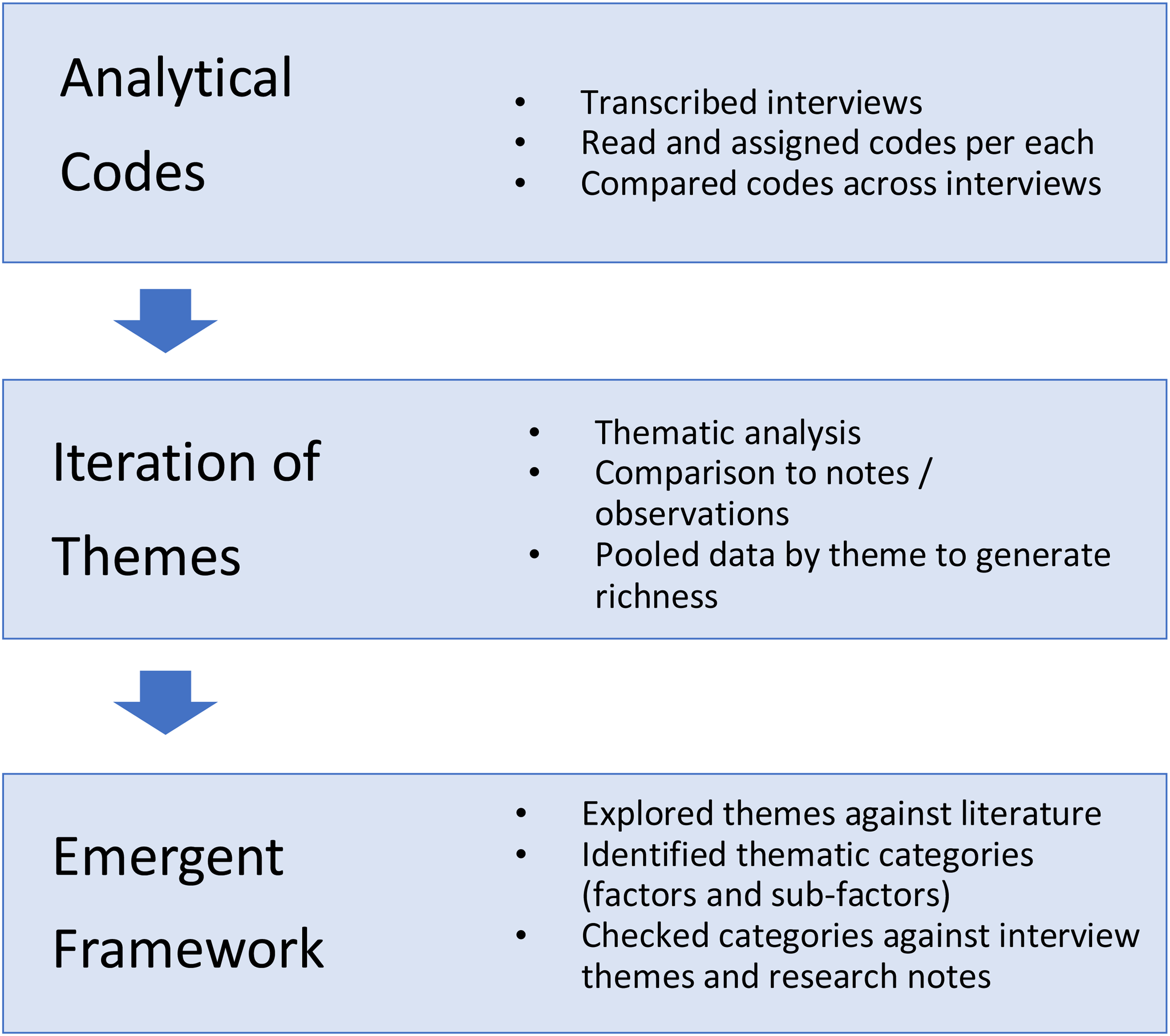
The analytical process.
We began by transcribing the tape-recorded interviews, a step that allowed for a refamiliarization with each interview (and respondent) to gain a nuanced appreciation for not only the words, but the tone, pace, and pausing which gives the data meaning. Once transcribed, each interview was reviewed to identify the codes, in the form of organizational features that supported collaboration, that surfaced within each. As an example of one respondent's interview, 10 codes were identified including: team level accountability; project managers link teams around common priorities; workspace enables quick outreach to peers; willingness/orientation of peers to help others; missions focus collective efforts; mission team meeting framework; leaders create social opportunities for everyone to interact; all hands forums keep everyone in the loop and connect people around wider goals; design thinking approach and tools; and easy access to breakout rooms for impromptu meetings. Akin to an intense listening exercise no attempt was made to generate an impression of how the codes were common or different, we simply pulled out the codes that each respondent identified to “adhere faithfully to informant terms” (Gioia, et al., 2012, p. 20). This first reading produced 10 to 20 codes per interview. A cross-interview reflection produced approximately 80 codes that were captured manually in a code book.
Next, building from the codes, we began a thematic analysis, starting with a single interview and continuing through to a saturation of themes. Following the thematic analysis, we had identified 12 working themes, each with a set of 8 to 10 qualifiers. With the themes identified we undertook a detailed review of each theme in relation to the interview data. This essential step enabled the (a) testing of the themes for accuracy to ensure the interview data supported the themes, (b) identification of overlaps amongst the themes to generate boundaries, and (c) exploration of the relative ordering of themes and subthemes. The process required several iterations and benefited from periods of time away from the data to return with fresh eyes and an open perspective.
As a final step, we employed explanation-building to develop higher-order conceptual categories, or factors. The categorization of the factors emerged from a fluid and iterative process of exploring how the themes worked together to support collaboration. Emerging explanations were carefully related to observational notes and remembrances of how respondents worked, related, and interacted with each other. Where applicable, artifacts from the study site were referenced for confirmation and further detail. As the factors emerged, they were compared to the extant literature to consider similarities, differences, and alternative explanations. With each iteration of the categorization, and there were several, the conceptual categories, or factors, became clearer. From the 12 working themes, three overarching factors (each with a set of subfactors, or elements) emerged, as collaborative work, collaborative relationships, and collaborative behaviors, along with a logic for how those factors interrelated to form two collaborative sub-systems, one supporting centrally guided collaborative efforts and the other supporting locally led collaborative efforts.
To summarize, three data sources were collected and analyzed to triangulate the data, including interviews, documents, and observation. To reduce this risk of incomplete or inaccurate data, interviews were tape recorded and transcribed and observational notes were taken and thoroughly reviewed. To support the internal validity of the study findings, we approached the work with a multi-faceted theoretical lens from which to seek and understand the data so as not to pre-suppose a framework or theory, but rather to allow an interpretation to emerge. We employed a rigorous, multi-stage process to analyze the data, building from initial codes to the creation of themes and the development of conceptual categorizations. As we worked, we related the data to the literature, carefully building explanations that incorporated the evidence, while also considering alternative explanations.
Findings
Through a holistic and nuanced illustration of a single case, we confirm many of the collaborative workplace design features identified in the examined literature. Beyond confirmation, we offer an alternative framework and organizing logic. Below, we share the factors supporting widespread cross-boundary collaboration at our study site before offering a logic model for how the factors combined to promote centrally steered and locally organic forms of collaboration to derive a both/and benefit.
The Factors Supporting Widespread, Cross-Boundary Collaboration
We found that the conceptual framework of the collaborative workplace builds from three factors that combine to shape work as a set of interdependent tasks, relationships to promote the necessary interactivity, and behaviors to cultivate collaborative contributions. As shown in Figure 2, each factor—collaborative work, collaborative relationships, and collaborative behaviors—comprises three design elements, as represented in the vertical columns. Below in Figure 2, we illustrate how the factors and associated elements were employed at the study site and identify the properties that generated their collaborative capacity.
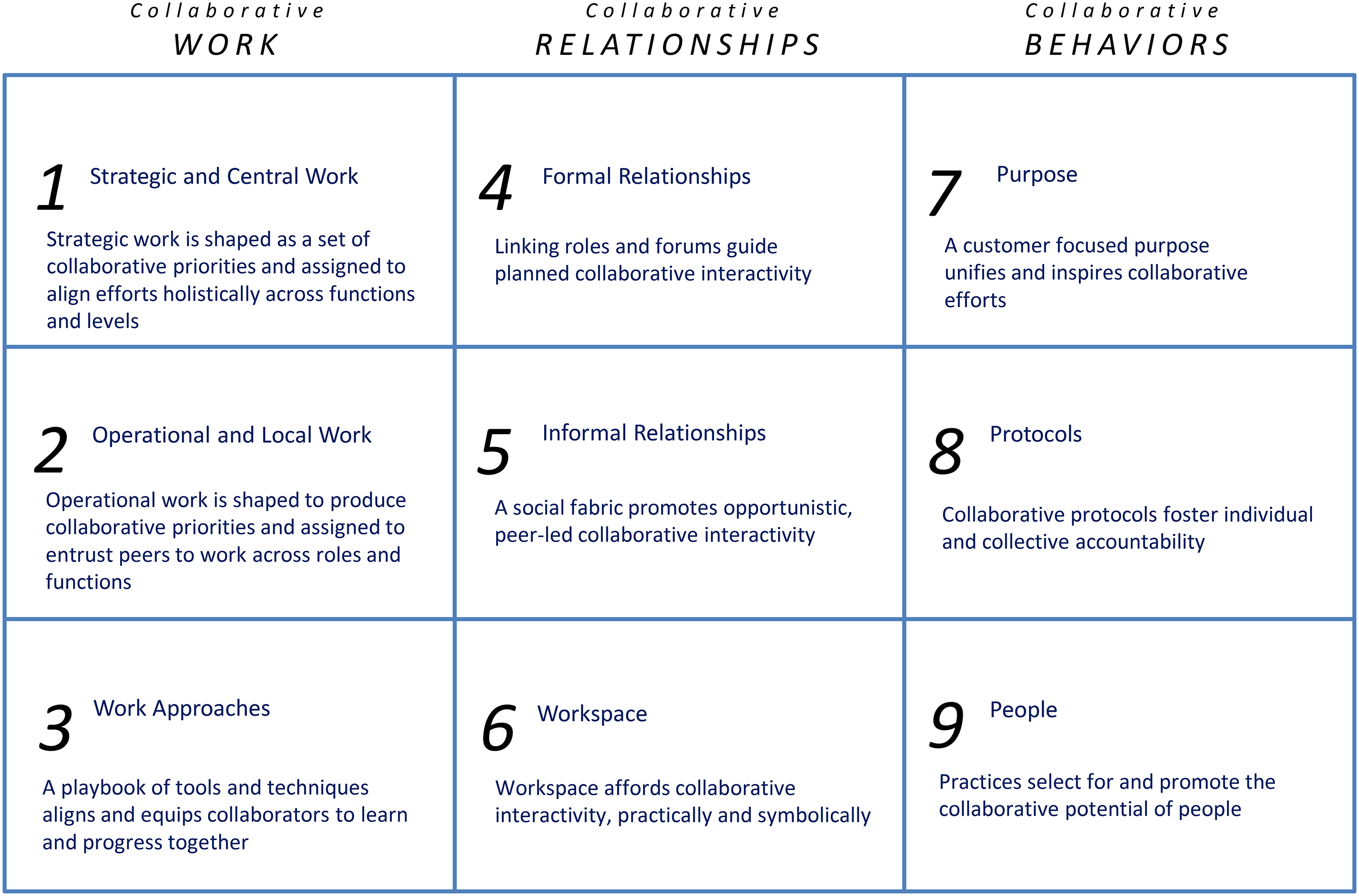
A framework for designing collaborative capacity.
Factor: Collaborative Work -
Work Tasks are Shaped, Assigned and Approached to Promote Collaborative Efforts
The first factor, the design of collaborative work, highlights the importance of how leaders shaped, assigned, and approached work. Foundationally, work at the CTG was understood to be a highly collaborative effort. A need to innovate products annually in the highly competitive tax software industry necessitated speed and interdependence: “Frankly, we can't afford to be siloed and move at a snail's pace.” The shaping of collaborative efforts applied to two types of work, one strategic and the other operational: (1) the strategic work, framed as missions, engaged cross-functional teams in defining the agenda for how products and services would be innovated for each tax season; and (2) the operational work engaged the functional units in designing and offering those high impact innovations. A set of shared work approaches aligned peers around how they worked together. Below, we identify the elements related to the design of collaborative work and, through illustration, reveal the properties that generated their collaborative capacity.
Interdependent goals created a collective focus that unified efforts and elevated how peers attended to their work. Strategic work was intentionally crafted to mobilize collaborative efforts through the pursuit of strategic missions. Missions are a set of strategic priorities defining how the organization will innovate its products and services for each tax season. Beginning annually, insights from investigative pre-work informed the creation of 5 missions and cross-functional mission teams. The aim was to bring multi-functional thinking to the challenges, always involving a product manager and, depending on the challenge, a member from the experience design, engineering, marketing, and customer care teams. So defined, missions set a unifying agenda for the whole organization. At a full-day immersion event, all employees were introduced to the missions. The dual goals were to “give everyone a strong feeling around what we are doing” and build the context for each employee's contribution: “it helps me anticipate the questions I’m going to get from the mission teams.” More than a sharing event, each mission team designed an interactive activity to engage peers in their challenge, and customer activities offered a first-hand account of what was important to them.
An essential by-product of the shared awareness of the missions is that it elevated how peers understood and attended to their work. Respondents reported that the missions expanded their perspective, from a focus on daily tasks to the wider cross-boundary outcomes: “because obviously when you understand what you are building and why, it helps you to be thinking about that bigger picture.” Describing a perspective from his marketing role, a respondent shared, “And you don't think this is my marketing job, this is where I want to excel, it's more like, how's this going to affect the organization?” Through regular all hands meetings, employees were kept apprised of the mission progress, a condition respondents attributed to keeping them in the know, “it's virtually impossible to be unaware of what's going on around here” and attuned holistically: “And, it's like, what you’re doing is affecting the whole organization, not just your group.” Essentially, the shared awareness transformed work from tasks peers performed individually, to contributions peers offered collectively. Our finding, that overarching strategic priorities unify and guide the efforts of peers throughout the organization, is a feature highlighted in the collaborate community and reconfigurable team-based organization literatures (e.g., Heckscher & Adler, 2006; Galbraith, 2010; Mohrman et al., 1995; Pasmore et al., 2019), as is the role of leaders in forming and populating teams with the requisite cross-functional expertise to tackle strategic imperatives (e.g., Galbraith, 2010; Pasmore et al., 2019).
A framing for discovery guides peers to think and learn together. Missions were understood to require a messy, exploratory process that relied on peers learning together across domain boundaries. Consistent with Edmondson's (2003, 2012b) concept of framing for learning, missions were shaped as “how do we …” questions to foster collective exploration rather than solutions requiring execution. In recounting how the leadership team described her team's assignment, a mission team member shared: “You four people go away and work on one of our five big bets this year. …We’re not diving deep into it. We’re not finding the insights. We’re not savoring the surprises. We’re asking you to collaborate with us”.
Consistent with the social learning literature (e.g., Brown & Duguid, 2000; Hargadon & Sutton, 1997; Pennington, 2008, 2010), it was through the interactive process of engaging in data collection and analysis that teams garnered new insights and developed clarity around what was important to their customers. A first phase of the process, described as broadening, required the teams to step back to understand their challenges, and a second phase referred to as narrowing, shifted the focus to identifying and testing potential solutions. Commenting on the generative value of the process a respondent shared: “You might start out thinking that you know the answer, but I guarantee, if you go through the process you are going to find out something totally unexpected.”
Another respondent, reflecting on his team's failure to do so, described their corrective coaching from leaders: We all got our mission and we all started running [laughter]. What I learned is that you need to start by framing the problem and getting the data to back up your problem. We didn't do that. And so, our first couple of team reviews were like, ‘Ok, that's cool, but how do you know what you are proposing is going to solve the problem? And by the way, what is your problem?’ So, we realized we needed to step back.
Assignments align efforts and distribute accountabilities across teams and levels. The purposeful distribution, or assignment, of mission related accountabilities, was also an enabler of collaboration. Beyond chartering teams, the study site showed how collective work can be distributed amongst multiple groups of collaborators for both clarity and congruence. Rather than a directive approach, the process was described as a collaboration to define “the what” and “the how.” While the leadership team framed the priorities (the what), the mission teams discovered the best approach to achieving those priorities (the how). In turn, the functional teams experimented and problem-solved around delivering those product innovations. The teams were fully empowered yet guided by a common aim at every level. In this way, the strategic and operational goals, responsibilities, and efforts were compatible and in service of each other, a finding associated with the goal congruence literature (e.g., Rico et al., 2017).
Team-level accountability balanced with leadership oversight afforded local ownership and aligned progress. Team-level authority surfaced as an essential element for enabling the collaborators to work and learn together, a theme widely reported in the literature for enabling team members to connect and co-contribute meaningfully (e.g., Adler & Heckscher, 2018; Brandi & Elkjaer, 2011; Edmondson, 2012a; Galbraith, 2010). With each assignment, the responsibility for doing the work and making associated decisions followed, a condition leaders deemed to be necessary for committed, collective effort. As a leader shared, their role was not to second guess, or decide, but to foster a sense of ownership amongst team members: And the leadership team signs up for that too. … There is not going to be any of, ‘ok I told you so, you shouldn't have done that’. So, if you know that's not going to happen and you don't get to have a scapegoat, then you are all really working hard to make the right decisions.
Explaining the connection between accountability and commitment, a team member explained: “We’ve done the thinking, the exploration, the why, what, and how. We can't help but be committed. So, there is a level of ownership that adds to the overall collaboration and willingness to engage.”
While each team was accountable, team-level latitude was counter-balanced by leadership coaching, a practice Adler and Heckscher (2018) and Galbraith (2010) credit to empowering teams to own their work while also achieving aligned progress. The weekly coaching sessions were described by leaders as developmental to “workshop through stuff” and “rewire their thinking” and by team members as being both intense, like presenting before a panel of judges on “Intuit's Got Talent” while at the same time developmental: “They don't tell us what to do. They … help us see things we might not have considered. It sharpens our tool kit.”
Collective goals aligned cross-functional peers to integrate their contributions dynamically. As with the strategic mission work, the agenda for product and service innovation created a set of collective goals for the functional teams to join around. While each functional unit had a role to play related to their domain expertise—that is, product management, experience design, customer care, and marketing—their offerings were understood to be highly interdependent. Yet it was understood that the functional experts were best positioned to identify issues requiring alignment and to join with colleagues to share information, experiment, and problem solve. Consistent with the zoomed-in literatures describing collaboration as emergent, needs based, and localized (e.g., Edmondson, 2012b; Mortensen & Haas, 2018), problems and queries surfaced as the functional peers tackled their work. As a respondent explained: “So, once you start to get into something, the level of complexity goes up exponentially. So, I’ll pull up to [name] and go, ‘What did you do to fix this?’ And he can show me in two minutes.”
Beyond aligned goals, respondents attributed the cross-pollination of their contributions to being the elixir that led to higher order outcomes, expressed as being “fuller”, “more innovative”, and “richer”: “So the designer and the engineer looking at a problem at the same time will come at it from different perspectives and together will come up with a better solution.” Using a building analogy to differentiate the diverse but essential interdependencies a respondent related the roles of experience design to the architect, the back-end engineers to the builders, the front-end engineers to the plumbers and electricians, and XD to interior designers. Summing it up, a respondent offered: “It's our collective knowledge that builds the right thing.”
Distributed authority empowered peers to meaningfully connect and co-contribute. Also consistent with the literature, a local freedom amongst participating peers was essential to enabling peer-led interactivity (e.g., Edmondson, 2012b; Brandi & Elkjaer, 2011; Eisenhardt & Galunic, 2000). Local accountability achieved two important conditions. First and fundamentally, peers were freed to connect as they pursued their work: “If you want something, you don't have to go up the ladder and down the ladder to the other side to get something done. You just go and talk to the person and get the conversation rolling.” That freedom promoted an easy interactivity amongst peers: “Sometimes you start a conversation with one person and it's like, so and so is going to have a take on this, so you go to that person's desk, and it grows naturally.” Respondents reported that with authority they felt a deep sense of “responsibility for carrying the product” which caused them to invest more fully, “because you are not just putting in a recommendation and waiting for someone higher up to make a decision, you can go pretty deep on solving a problem.” While essential to fluid interactivity and ownership, team level accountability could be trying. In one recounting a team leader shared the angst he and his team were experiencing regarding the selection of a new tool. For weeks, they had been debating the merits of and testing alternative tools to no satisfying end. Confessing light heartedly that it would be great if somebody “would just make the decision for us,” he knew that no such decision was coming.
As in the case with the mission teams, leadership oversight provided checks and balances to peer-level accountability. Functional teams and their leaders met daily in stand-ups to share progress and receive feedback, supplemented by one-on-ones with leaders and weekly meetings.
Techniques and tools aligned how peers practiced together. Similar to how a playbook directs the efforts of a sports team, an approach to working, variously described as “agile,” “lean,” and “design thinking,” set a unifying framework for how work was conducted. The agile framework promoted weekly cycles to achieve blocks of tasks (referred to as sprints), provided a regular venue for juggling workloads, pitching ideas, and receiving feedback (via daily stand-ups), and set coordinating roles. Leaders provided a host of tools and resources, including an iterative learning process and toolkit called design for delight and innovation champions supported both mission and functional teams as they experimented with the tools. Given the importance of customer data, an analytics group coached the teams to think proactively about the questions that might generate deeper insights. And as new technologies evolved, peers were encouraged to acquire and experiment with them. In all, the techniques and tools created a common approach to how peers worked together, setting the playing field for working together.
A common workflow and cadence aligned how peers progressed together. Underpinning the techniques and tools, a common workflow and cadence focused and guided work and progress. The annual product innovation cycle was aligned with the tax season and began each year anew as the previous season ended. As described earlier, the cycle started with a broadening phase in which the mission teams identified the highest-impact innovations before entering a narrowing phase, during which the functional teams built those innovations. The shift in focus and pace from the broadening to narrowing phases was palatable. For the engineers and designers, the broadening stage was experienced as a state of anxiety inducing limbo, described as feeling “weird,” “dodgy,” “frustrating,” and “uncomfortable.” An engineer explained, “Until the missions become clearer, we are confused. It's just the way it is.” However, he continued, once the teams know what to execute, the race is on: “And everybody's got to implement, implement, implement. We can see where we are supposed to go, and we respond minute by minute.” Respondents shared how the pace and subsequent sense of urgency acted as a unifier that “kind of forces collaboration because people can't sit and let things get sorted at their own pace.” Referring to a resultant sense of collective resolve another member shared: “It creates pressure, focus, the need for speed, and a competitive spirit. It requires all hands-on deck. … It can be exhausting, but it's also liberating.”
Factor: Collaborative Relationships -
Formal Linkages and Informal Relationships Support Peers to Collaborate
Collaborative relationships defined the purpose and nature of the interactivity pattens amongst collaborators and the linking mechanisms that enabled them. Both formal and opportunistic linkages were intentionally designed to support the centrally guided strategic mission work and the locally guided operational work. While mission team linkages forged a tightly orchestrated dynamic alignment, the local and opportunistic peer-led linkages relied on a supportive social climate. Importantly each linking system served and strengthened the other. A final element, the design of workspace, created a spatial-relational platform for formal and opportunistic interactivity.
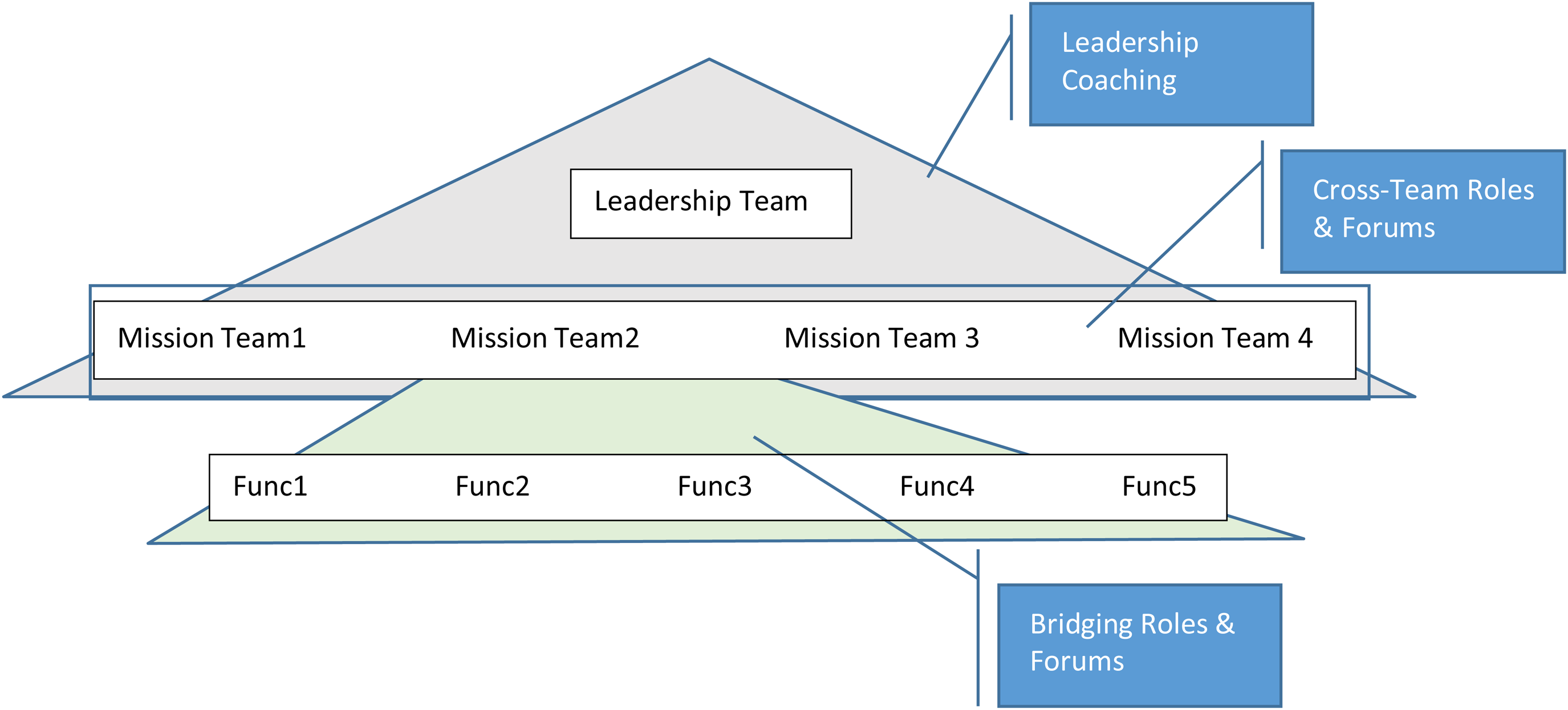
The design of collaborative relationships.
Leadership coaching relationships ensured momentum, aligned progress, and oversight. Through two regular forums—one weekly with each mission team and the other bi-monthly with all mission teams—the leadership team offered oversight and guided progress. The forums went well beyond reporting; they provided a venue for the leadership and mission teams to think and learn together. As referenced earlier, the meetings were rigorous, workshop-style affairs in which the leaders delved into the issues by asking probing questions, seeking confirmatory data, and offering alternative explanations or paths to purse, referred to as pushes. As an example, at one bi-monthly meeting, following a team's presentation, a leader praised their exceptional efforts and then coached them to “be bolder and take some risks” for their next iteration of work to see where a less cautious path might take them. As teams reported progress the leadership team identified issues requiring decisions, attended to barriers, and offered help around lagging efforts. Respondents reported how the regularity of the reporting generated a “forcing function” or a “heathy urgency” to “make sure that teams were moving ahead.”
Cross-mission team roles and forums enabled teams to work in dynamic alignment. Given that the mission priorities overlapped, with learnings or decisions from one mission potentially impacting the others, mission teams were connected. And, as the season progressed and the focus narrowed, the pattern of connectivity increased from weekly and monthly, to also daily forums. Daily, representatives from each mission team met in a stand-up to keep abreast of each team's progress: “It's a quick update: What are you working on? Where do you need help? What do you need to ask the other teams? What was accomplished over the past day?” To augment the daily standups, all teams met weekly for a one-hour session: “We have two objectives: each team gains visibility into what the other teams are doing, and to ask if we are duplicating efforts or wasting resources.” To keep the customer perspective front and center teams met periodically with a customer panel: “The goal is to get the customers in front of the teams so that they can actually picture a customer when they are developing solutions.” Importantly, the visibility of work kept the work collaborative. As peers shared their progress, others naturally offered information or help. The regularity kept people aware of how their decisions impacted others and who else to involve. Essentially, a coordinator role, the program manager, tracked efforts, decisions, and progress while facilitating each forum.
Bridging roles and forums aligned the strategic mission and operational communities. A role and forum for priority management was essential to aligning the mission teams’ innovation agendas with the functional teams who would produce those innovations. Essentially, a team of product managers (PMs), one assigned to each product, were responsible for overseeing the end-to-end design, development, and delivery of each product; they were literally and figuratively in the center of the action, described variously as being “in the middle of all the moving parts”, the “connective tissue and the driver of progress”, and “the central point of everything.” Weekly, in a forum called the scrum of scrums, PMs bridged mission team representatives with leads from the engineering and design groups to prioritize the most impactful requests into a common agenda for product development. Based on an assessment of impact and feasibility, those priorities were scheduled into each product team's workplan. As one PM defined the prioritization process: “Everybody wants their initiative to go forward, so it's our job to balance all of the forces. At the end of the day, it's about impact.”
Together, the linking roles and forums kept the teams working in an evolving form of dynamic alignment. While the pace created pressure, a theme offered widely and reflected earlier, respondents explained that it was part of being in a fast-paced climate: There is pressure. You know that daily at 10:45 you need to provide an update of what happened in the last 24 h, on Tuesday you need to provide an update around what you have done in the last week, and then at experience review with the senior leadership team you need to show progress. So, the meetings keep everything moving. I guess there are pressures … but I think it's for the greater good to ensure that we continue to drive on the objectives that are fundamental to our success.
Community building activities generated a sense of belonginess to the wider team. Through a wide array of social opportunities—from all-hands meetings to clubs and recreational activities—people developed a sense that they belonged to a broader community, expressed as being “all in this together” and “part of something bigger.” Noting their voluntary nature, a respondent pointed out that each form of social activity “attracts different people, engages people differently, and touches people in a different way.” Respondents shared how easy, friendly, and playful access built new connections between people, levels, and functions. For example, in describing the feeling as a “sense of boundarylessness,” a new recruit shared how welcomed he felt when “within my first week, I was having a drink with [the CEO] and just talking like a couple of buddies.” Like the social network tradition, the new relationships, or ties, were credited with expanding the informational network (e.g., Abrams et al., 2003; Cross et al., 2020; Elsbach & Bechky, 2007). A self-described “fitness guy,” explained how meeting people in the gym built new relationships and expanded his informational bandwidth: “I meet so many people at the gym, and that's cool because you learn a lot about the company. I love the gym.” And in a lighthearted opposition to the many gathering opportunities an engineer shared how some of us “go ugh!” when invited to yet another social. Whatever the experience, respondents explained how the “cross-pollinating of people before they need to work together” created a “base of familiarity” that “breaks the ice” for seeking assistance, offering help, or adapting to a new team.
Rapport building activities readied peers for genuine interactivity. While a sense of belongingness expanded the team to which people identified, a sense of rapport between working peers primed them for engaging genuinely. Consistent with Abrams et al. (2003), a social ease built from chitchat and getting to know each other, translated into work-related approachability. Respondents were in broad agreement that with rapport, they felt safe and supported to express their ideas and to question each other without the inquiry being perceived as a personal slight. This sense of safety to “just tell us what you think, because that's what we want to hear” was identified as a necessary ingredient for peers to share and integrate their diverse functional abilities. Described as being “respectfully disrespectful … because we're forward with each other, but . . . also respectful”, respondents explained that with the rapport they were better able to “put themselves out there,” “speak their minds,” “fire ideas back and forth” and “push back”. Beyond creating safety for genuine interactivity, rapport caused peers to assume a spirit of mutual accountability. Knowing a fellow employee beyond their work role shifted the interaction from formulaic to personal, whereby people were more willing to ask for and offer help and to come through for each other: When someone is in the army and going to battle, they support the person on either side. Well, it's hard to do that if you don't know them. So, by getting to know and respect each other, we go that extra mile for each other.
To provide rapport-building time, leaders supported a wide range of activities, from team-building sessions to supporting travel to meet colleagues working in different settings. In recounting the purpose of his recent visit to the San Diego office, a respondent shared: “My whole purpose was to meet people and have a beer with them, so that when they get an email or phone call from me, they know who the hell I am.” In promoting the rapport building value of physical over virtual connectivity, another respondent was perplexed as to why a physical presence created a more meaningful bond: “Like, that rapport that you get with someone you sit next to, that you never ever get, even if you video-conference every day. And I don't know why.”
Practically, the design of workspace made it easy for peers to connect and convene. At the CTG the design of workspace was understood to be an asset and part of the platform from which people interacted. While not a mandatory policy, leaders favored their people coming into the office. Approximately one year before the study period, they co-located employees in the Edmonton and Toronto offices in the Toronto headquarters. Shortly thereafter, all functions, beginning with the design group, migrated to an open and roomy office space, with the functional teams sitting together in family-style clusters. The move to the new space was not by decree, but rather a grassroots effort led by the example of the design team, whose leader surmised, “In order for us to think like teams, we had to all be together.” The move was described as a makeshift effort, requiring stealth ingenuity: “So, this space was open, and we literally started stealing desks from the cafeteria and working here. It was funny how it all happened.” Over the next few months, the remaining functional teams followed: “Gradually, more and more people wanted to sit here. And people were coming over and it was just nicer; we gravitated towards each other.” Equipped with sticky notes and an understanding of their work-related connectivity patterns, team members made the space their own: “And we all had a go, saying, ‘I should be sitting beside this person for this reason’ and we reorganized the thing. But I think we did a pretty good job.”
The resultant arrangements emulated collaborative workspace characteristics from the organization ecology literature. In keeping with the ideals of Becker’s (2007) eco-diversity and Davis’ (2019) flexible workspace choices, the study site provided different types of workspaces for different types of collaborative work. Two spatial factors, proximity and transparency (Becker, 2007; Heerwagen et al., 2004; Hua et al., 2011), positioned peers so they could see and hear each other to gauge availably, access each other, and intervene with helpful contributions. Also emphasized in the literature (Heerwagen et al., 2004; Hua et al., 2011), the ease of being able to transition from working independently to gathering the right group of peers in a well-equipped breakout space was widely touted as “allowing quick, spontaneous collaboration with minimal commitment, because [the rooms] are so easy to move to . . . And it's all spontaneous, the ability to say, ‘Hey, do you have some time?’”. Dedicated mission team rooms provided dependable spaces for working and housing artifacts of progressive work and all rooms were equipped with web-ex meeting tools and large screens to incorporate peers working virtually.
While the workspace promoted connectivity, the flip side was that the connectivity could be disruptive to individual work. As one respondent amusingly shared, “So that's the only real downside. It works great because it facilitates communication, but it's also bad because it facilitates communication.” As supported by the literature pointing to the disruptive nature of workspace (e.g. Hua et al., 2011; Danielsson, 2019; Davis et al., 2011), noise and disruptions were identified as irritants when respondents required quiet for calls or independent thinking. To signal one's lack of availability, peers sent out non-verbal cues, the most common being putting on headphones or moving to a private area for respite. Curious, we asked respondents whether they would choose to go back to their cubicles’ relative privacy. The great majority offered that they would not. As one respondent surmised: “It's for the greater good. You might not get as much work done for yourself, but as a team, you're figuring out things in a global sense.”
Symbolically, the design of workspace liberated people to connect beyond boundaries. In addition to the practical ease via which people interacted, participants emphasized the symbolic significance of physical space. In contrasting their experiences of their former cubicles, respondents volunteered how they felt freed from “boxes”, “silos”, “barriers”, “isolation”, “cubes”, and “separation” while leaders spoke to how the layout emulated how they wanted the organization to work. As one respondent explained, “We talked a lot about working together and breaking down silos, but it didn't really feel like it happened until the cubicles went away.” Referring to the felt sense of openness as an “approachability factor” whereby it “almost encourages you to tap someone on the shoulder,” respondents described how they felt “automatically included” in the conversations around them. A sentiment expressed by many, the bright open spaces and funky Canadian inspired décor—including a colorful moose in the foyer, a canoe hanging from the ceiling, and campfire sitting areas—was described by one team member as being “buzzy; it's open and bright and you hear a buzz and it's really motivating.”
Factor: Collaborative Behaviors -
A Shared Purpose, Protocols, and People Practices Promoted Collaborative Contributions
A top theme widely identified was that people were an energizing force for collaboration. People and how they contributed was one of the most referenced themes offered by respondents who described their colleagues as “open,” “generous,” “competent,” “conscientious,” and “passionate.” Reflecting on his peers, a respondent shared, “I’ve never had a ‘no’ ever here. I don't know what no is around here [laughter]”. Three design elements cultivated collaborative attitudes and behaviors at the study site through purpose, protocols, and people practices.
Approximately 5 years before the study period, the global CEO challenged a task force to find a way to generate meaning in daily work; something that would be “inspiring, … big and bold enough for people to get behind, and … customer focused.” The representative tasked to represent Canada on this challenge, aptly called Ignite, described how she and her fellow teammates were immersed in a 4-week think tank. Reasoning that they would not find purpose within the four walls of their meeting room, the Ignite team came up with the “crazy idea” of taking to the streets to meet potential customers where they lived. Through the experience of talking to real people, they learned lessons that went far beyond the insights packaged in their marketing reports. As the leader explained, “As you listen you start getting attached to these people. . . . You know, their lives happen 365 days a year. Doing taxes is just one thing. Life's important, not taxes. That was the big aha.” From there, the critical insight that taxes are “something people do not want to do, so the best thing we can do is just do it for them” stuck.
Realizing that their inspiration came from the process of connecting with people, the Ignite team designed an experience to connect employees with potential customers: “No one would get what we had just discovered unless they got outside and talked to people.” So they brought employees into neighborhoods on buses in groups of 30 to talk to real people, followed by storytelling sessions in which employees shared their experiences. The employees were similarly touched: “They had a story, a person, they could relate to, someone who was relying on them. That was the connective tissue.” From there, the Ignite experience spread to all employees in the U.S. and Canada.
Coming full circle, the Ignite experience is regenerated yearly through the shaping of the strategic missions, so set to innovate products and services for customer ease. An annual immersion event invites all employees to learn about the missions in interactive customer sessions. Routinely face-to-face touchpoints with customers supplement customer analytics to keep customer needs real. And through a robust relational framework of roles and forums, peers engage in briefings and activities to remain linked around mission-focused progress.
The sentiment expressed by many is that purpose is so embedded in their DNA that all efforts contribute to solving customer problems in one way or another. A simple story of an interaction between a care and marketing team member is illustrative. The researcher was stuck by how both informants offered the same story as an example of how the serendipitous sharing of customer data lead to an immediate and fruitful solution. As the care team member recounted, “I was at my desk complaining” about a packaging issue that had come to his attention through customer feedback. Given their proximity, a marketing team member overheard him, and a conversation ensued. While both team members reported being surprised by the interaction, as their seating arrangement and subsequent interactivity was new, there was no question that the customer “pain points” were relevant, and the marketing team member described how this data would inform his packaging decisions. From the development of strategic missions to the prioritization of the operational workplans to the data-based insights driving team members, customer needs were central.
Peers were expected to share ideas and consider the input of others. A first protocol prompted people to speak up, reach out, and be open to the queries and ideas of others. Referred to as “boundaryless leadership,” peers were encouraged to offer ideas and pose questions for issues beyond their roles, and on the flip side, to be open to the ideas and of others. As described by a respondent: “Don't be afraid to participate, criticize, offer suggestions for improvement, even for things that have nothing to do with your direct work. . . . And then expect to be challenged, … but it's in the aim of perfecting and being better.”
Peers were expected to use their personal judgement having considered the input of others. A second protocol for individual judgment caused peers to thoughtfully consider the input of others while maintaining ownership for and a knowledge-based stance around their work. As a leader explained: “It's really useful to have people offering different views. However, the owner then needs to take the insights and integrate them. You can have your input, but we leave it to the people to do their crafts.”
Together, the dual protocols prompted peers to think and act beyond boundaries and cultivated a sense of both individual and collective accountability. More than words on the wall, these protocols were role modelled by the leadership team and all team leads. That encouragement was subtle yet powerful. Leaders actively sought the opinion of peers, welcomed questions, praised provocative ideas, and coached teams to take ideas seriously and to seek additional data and perspective from customers and their fellow teams. As a result, work and meeting forums were highly engaging affairs, whereby “pushes” or questions and suggestions came from all angles. An example of a meeting amongst leaders is illustrative. A year prior, a senior leader had made a decision that, via his own admission, required a prompt reversal. Together, the leadership team identified a new path requiring execution by a unit lead and his team. When that lead suggested that he would have a workaround within two weeks, his colleagues ‘pushed back’ around the timing, reflecting that the issue was mission-critical and reflective of the whole organization. So coached by his peers, the unit lead had the workaround in place by the end of the week.
People were hired for their technical skill and collaborative orientation. Using a process called assessing for awesome leaders placed a high value on hiring people with high-caliber skills who work well with others. The hiring process was widely named as a source for creating a skilled, like-minded workforce: “They hire people not only from the technical side, but from the culture fit standpoint, and it really helps in terms of collaboration.” At the same time, respondents reported that they welcomed the efforts of leaders to redirect or exit employees who did not work inclusively, as they created dissonance and confusion. Referring to a former colleague, a respondent explained: “I really liked him. But he created dissonance because he got it in his mind that ‘I don't have to pay attention to what others are saying’. He was working under the model that he was the expert and that he had to pull a rabbit out of his hat.”
People were recognized for their collaborative contributions over results. Once hired, people were recognized for how they contributed to the wider goals. As one respondent explained, leaders directed their praise to how people worked, rather than to the specific results: “And the things that [leader's name] celebrated were the ahas and insights and the data that led to them . . . not the results.” Recognition took many forms, from public thank yous to offers to work on assignments to new roles: “So the best reward you can get at Intuit is leaders saying, 'We want you to work on this, because we see that you are doing this right … and we want you to do more of it’.” Through recognition, respondents reported that they felt both noticed and appreciated, and that caused them to feel that they—and their contributions—mattered: “It's more than just saying that they value employees. It's like they have a true appreciation for us, and it makes going to work pleasant, most days anyway [laughter].”
People movement between teams fostered a cross-boundary perspective. Cross-unit mobility was identified widely by respondents as providing the “movement, variation, and development” they desired, while at the same time generating a wider understanding of the organization's work. Touting the ability to move across roles and teams as a type of cross-training to strengthen overall performance a respondent shared: “I will stay in this role until I feel like I’m an expert and then I’ll be asked to tackle something else. So, there is that growth aspect and I think getting exposed to different roles helps me to collaborate.”
As architects, leaders designed the building block factors—of work, relationships, and behaviors—to foster widespread collaboration. Work was shaped, assigned, and approached as a collaborative effort, relationships were forged to enable the requisite interactivity, and behaviors were cultivated to promote cross-boundary contributions. As cultivators, leaders inspired and nurtured collaborative activities through their daily activities as coaches, role models, and performance drivers; they guided and steered the mission team efforts, fostered widespread contributions amongst the operational teams, and equipped and enabled efforts. The role of leadership in cultivating widespread collaboration is well identified in the literature. Leaders have been found to be instrumental in infusing shared purpose, role modeling engagement, opening boundaries, and promoting psychological safety, amongst others (e.g., Edmondson et al., 2019; Galbraith, 2010; Hansen, 2009). In this work, leaders fulfilled those roles, and then some. So essential was the role of formal leadership we cannot envision the collaborative capacity at our study site without it.
The Logic of Strategic & Operational Collaborative Subsystems
In addition to identifying a set of collaborative factors, this study identified a unique logic model for how those factors interrelate to generate collaborative capacity. While all combinations of any number of factors and their associated elements are mutually reinforcing, the logic of the framework identifies three overarching factors—the design of collaborative work, relationships, and behaviors—that interrelate in two core ways, one supplemental and the other compensatory.
A first form of interrelatedness is reinforcing, or what Gulati and Puranam (2009) refer as a supplemental fitness. As shown in Figure 4 across the horizonal columns, two organizing structures for collaborative work were identified, both operating in tandem: one strategic and centrally guided (as shown in row 1), and the other operational and locally guided (as shown in row 2). While each subsystem was focused on a different form of collaborative work, both were enabled by commonly useful supports related to work approaches, workspaces, and practices to form a supportive platform (as shown in row 3).
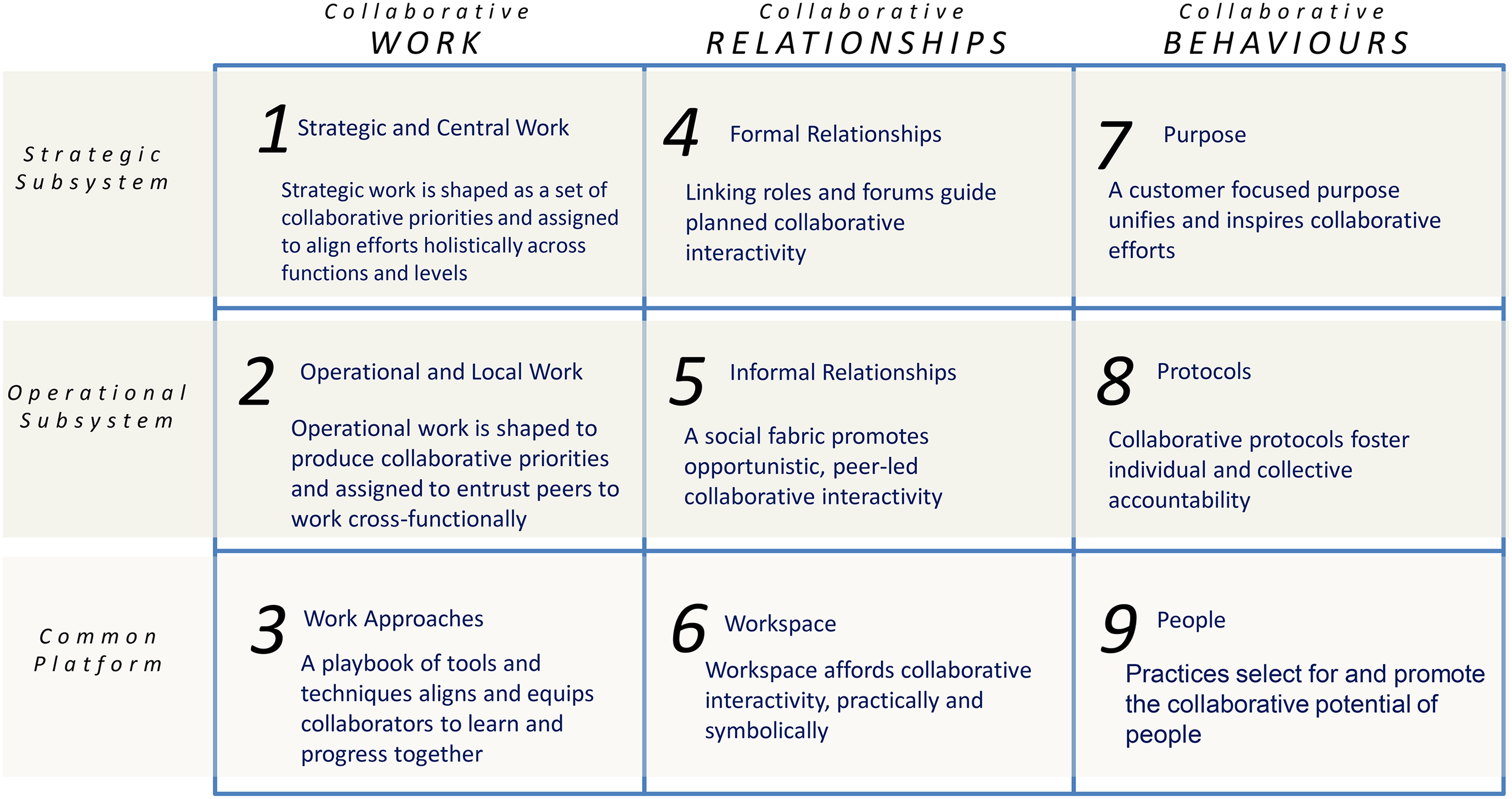
The strategic & operational collaborative subsystems generate a supplemental fitness. Notes: The Strategic Collaborative Subsystem (shown in row 1) generates central alignment around the creation of strategic innovation goals. The Operational Collaborative Subsystem (shown in row 2) generates local responsiveness around the delivery of innovation goals. The Common Platform (shown in row 3) provides for standard work methods and tools, workspaces, and people practices supporting how collaborators engage.
The elements of the strategic and centrally guided subsystem, as depicted in row 1, cohered to focus the design of work, relationships, and behaviors around a unifying strategic agenda. The work was tightly steered through a robust planning process directed to prioritizing the product and service innovations (design of collaborative work). Given that mission priorities intersected, linking roles and forums ensured that information and learnings flowed amongst teams and a reporting rhythm kept the teams progressing at an expected pace (design of collaborative relationships). A customer-focused purpose to solve customer problems created a unifying cause and underpinned all mission-related efforts (design of collaborative behaviors). Through an operational and locally guided subsystem of work, relational and behavioral elements, as shown in row 2, work was inherently fluid to give domain experts the freedom they needed to apply their crafts and seek help as interdependencies surfaced (design of collaborative work). A social fabric built to generate belongingness and rapport afforded impromptu peer-led interactivity (design of collaborative relationships), and behavioral protocols guided peers to seek and offer help while remaining rooted in one's expertise and accountabilities (design of collaborative behaviors).
A second form of interactivity, shown in Figure 5, supported collaboration through duality, whereby the cross-tendencies associated with the strategic and operational subsystems generated a compensatory fitness (Gulati & Puranam, 2009).
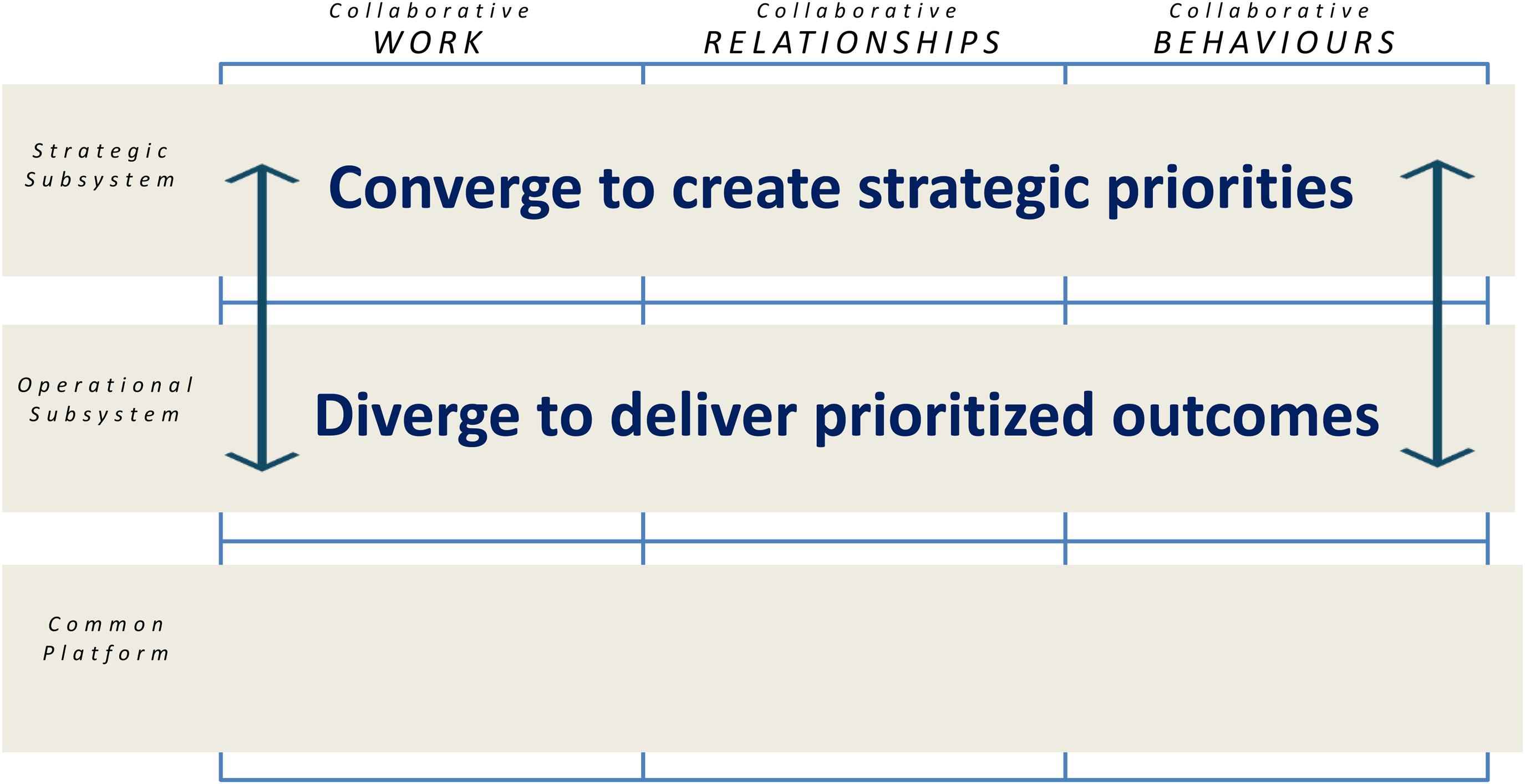
The strategic & operational collaborative subsystems generate a compensatory fitness. Note: Together the strategic (shown in row 1) and operational (shown in row 2) subsystems generate an essential pattern of convergence to form strategic priorities and convergence to operationalize those priorities.
Essentially, the co-acting subsystems created a pattern of convergence around the creation of a strategic innovation agenda and divergence around the design and delivery of product and service innovations. The strategic sub-system was centrally guided to enable members to converge to set a clear what, a unified innovation agenda. In turn, those priorities focused and grounded the efforts of the functional teams as they diverged to deliver the how. When it came to the producing the innovations, a local freedom to connect, share information, problem solve, and experiment was essential to innovating effectively and efficiently.
Fundamentally, our framework follows an organizing logic identified by the socio-technical scholar Calvin Pava (1983) who cast the nature of work itself, in our case strategic and operational work, as the central principle for organizing (Austrom & Ordowich, 2018). Pava's foundational insight was that the nature of the work—its complexity and the need for deliberative encounters amongst peers—was the guiding force from which supportive technical and social enablers, by way of forums, protocols, tools, and processes, followed.
In addition to highlighting the guiding role of collaborative work and the two subsystems flowing from strategic and operational work, this work demonstrates that both centrally led and locally led forms of collaboration are mutually beneficial. The reconfigurable, team-based framework also depicts the compensatory nature of two forms of work, one strategic and the other operational (Galbraith, 2010; Harris & Beyerlein, 2008; Pasmore et al., 2019; Winby & Mohrman, 2018). Their framework highlights a flexible-stable duality, with flexible teams focusing on strategic and evolving priorities and the operational sub-system providing the underpinning processes and systems. While the collaborative community and ecosystems literatures do not reference dualities, both specify the importance of having a guiding purpose and/or set of priorities for aligning the efforts of locally empowered actors (e.g., Adler & Heckscher, 2018; Davis, 2019). Interestingly, the cross-boundary collaboration literatures (e.g., Eisenhardt & Gulanic 2000; Mortensen & Haas, 2018; Wenger et al., 2002) favor the converged and locally led pole of our duality, without the strategic subsystem to guide and ground the efforts.
Discussion
This single-case descriptive study offers a holistic, nuanced, and real-world illustration of the factors that cohere to support cross-boundary collaboration in a knowledge-based firm. It is well understood that the generalizability of findings from a single case to other firms is limited. Yet case studies can generate insights with an analytical generalizability to enrich our understanding of the phenomena in question (Creswell, 2009; Eisenhardt & Graebner, 2007; Yin 2014, 2018). In this spirit, we offer reflections on this work's application to future practice and research.
Our framework identifies three core factors for organizational leaders (as designers) to attend to: collaborative work, collaborative relationships, and collaborative behaviors. The fundamental insight is that the design of these three elements bolsters the collaborative potential of a firm. The logic of our framework advises designers to begin with how they think about and shape work tasks. Foundationally, is work understood to be an effort that requires interdependence and engagement, or independence and solo effort? How leaders think about work sets the focus and attention of efforts, identifies who is involved and accountable, and specifies how those accountabilities align. From that base of collaborative work tasks, the design of collaborative relationships and behaviors follow. Collaborative relationships set the pathways for interactivity; they support the interaction patterns needed to fulfill the collaborative work. Collaborative behaviors set the expectation for how people are meant to contribute beyond their roles to support collective efforts. By doing so the designer will focus work efforts for interdependence, define the need and mechanisms for interactivity, and promote collaborative behavioral contributions.
Our study site example demonstrates that the design of a collaborative workplace is a nuanced undertaking. Leaders shaped two types of collaborative work—one centrally guided and strategic, and the other locally enacted and operational—to generate two mutually supportive collaborative subsystems. While central and local systems of collaboration have been identified in the literature, scholarly communities have tended to favour one form over the other. For example, the social network and learning literatures have tended to favour local, peer-led interactivity (e.g., Cross, et al., 2008; Edmondson & Harvey, 2018) and the wider ecosystems approaches, for example the reconfigurable team-based organization (e.g., Galbraith, 2010; Pasmore et al., 2019), have tended to emphasize centrally guided efforts. This work demonstrates that central and local collaborative subsystems are mutually beneficial to generate a compensatory fitness (e.g., Gulati & Puranam, 2009). We illustrate what a compensatory fitness looks like along a central-local dimension, and within the context of enhancing collaborative capacity. A central-local duality enabled coherence around the development of strategic goals and divergence to execute those goals.
The ‘both/and’ thinking associated with the central-local duality enriched collaborative capacity in ways that may be surprising from a traditional organizational view. Deftly, leaders shaped and assigned strategic work so that it was both steered by leaders and conducted by cross-functional teams. A partnership between leaders attending to the ends, and teams attending to the means, kept the work highly collaborative and set the role of central leaders as guides and coaches rather than directors and orchestrators. Locally, peers were free to interrelate and apply their craft-based expertise as they designed and delivered products and services. This peer-led collaboration, however, was built from the base of the centrally steered collaboration. In other words, the common goals flowing from the centrally steered and strategic efforts provided the common aim around which delivery-oriented teams integrated their efforts. In promoting collaborative work, leaders did not minimize the importance of individual expertise and initiative. Rather, individual expertise and perspective were valued and encouraged in service of the collaborative aims.
Given the uniqueness and complexity of contemporary organizations, we do not offer our collaborative framework as a recipe to follow dutifully, but as a conceptual lens from which to ask and answer the big questions associated with the collaborative design of work, relationships, and behaviors. Importantly, the specific set of design choices will be unique to each firm. What's important is that the factors are attended to and co-designed. As organizations, agencies, and governments strive to tackle complex challenges, often with diverse factions seeking input and ownership, it can be illuminating to adopt ‘both/and’ thinking to reflect on how collaborative efforts can be both centrally, and locally led, for the benefit of all.
Another area ripe for scholarly exploration concerns the usefulness of the study findings to a virtual, or blended work setting. As the trend towards the virtual workplace intensifies, we suspect that the framework remains useful. As organizations migrate to virtual and blended settings, however, some of the framework elements may become more or less important. For example, a social fabric of belongingness and rapport—built from a range of social activities and afforded by the design of physical workspace—was instrumental in causing employees at the study site to identify with the wider team and to work collectively. The question emerges as to whether belongingness and rapport remain important in the virtual or blended work context, and if so, how they can they be cultivated. Extending this question to our wider framework, how can leaders in a virtual setting use the framework to shape, distribute and scaffold work, while affording the right pattern of social-relational interactivity, and cultivating collaborative behavioural contributions?
Study Limitations
Our findings are subject to several limitations. As referenced earlier, the generalizability of our findings from a single case to other firms focusing on different types of work, situated in diverse contexts, and working with larger or smaller populations, is limited. A second limitation relates to our approach of combining onsite observation with interview data. While we greatly benefited from observing the daily interactions of mission and functional teams in action, we recognize that being onsite, observing, and relating with respondents, may have influenced how they responded in interviews and acted. Given the onsite frequency of the researcher, her presence became an accepted part of the work environment and was unlikely to impact our data and findings significantly.
Closing Comments
Through the example of an exemplar collaborative workplace, we show that collaboration is a way of working, relating, and contributing, as afforded by a supportive context. We offer a holistic framework from which organizational leaders can rethink collaborative work and remake their workplaces. Our hope is that our framework will inspire the next generation of leaders to design workplaces that support people to easily connect and co-contribute around work that matters.
Footnotes
Declaration of Conflicting Interests
The author(s) declared no potential conflicts of interest with respect to the research, authorship, and/or publication of this article.
Funding
The author(s) received no financial support for the research, authorship, and/or publication of this article.
