



Abstract
Collaborating is increasingly characterized by working across domains and organizations. Teams rapidly form and dissolve, actors and settings frequently change, yet most academic research focuses on stable organizations and team configurations with familiar domains. This leads to the question: how do people successfully collaborate across domains and organizations in circumstances where there is little shared knowledge? We explored this question within the nascent digital health sector when Hacking Health—a non-profit organization—used an open innovation approach to bring together actors from different domains and organizations in temporary spaces to spur new collaborations. We found that actors faced many challenges and engaged in four interconnected types of knowledge work to address them: exploring, complementing, mapping, and modeling. This article reveals how Hacking Health’s open innovation approach used different kinds of temporary spaces to progressively orient actors in their knowledge work to develop sustainable collaborations to create digital health solutions.
Keywords
Introduction
Addressing contemporary business and societal problems increasingly occurs in temporary spaces outside of formal organizations and among actors from different knowledge domains. For instance, scholars have shown that open-science challenges (Lakhani et al., 2007, 2013), innovation tournaments (Terwiesch and Ulrich, 2009), crowdsourcing contests (Afuah and Tucci, 2012; Majchrzak and Malhotra, 2016), experimental spaces (Zietsma and Lawrence, 2010), and hackathons (Carlile and Dionne, 2024; Irani, 2015) open new and temporary pathways of knowledge flow among people who are new to one another and who come from outside organizational boundaries (Lifshitz-Assaf, 2018). Research has shown that these open innovation spaces, although temporary, can support developing novel and creative solutions (Harvey et al., 2015) by supporting the application of distant knowledge to solve issues in fields in need of innovation (Jeppesen and Lakhani, 2010) and by facilitating the combination of ideas from different domains (Lifshitz-Assaf et al., 2021). Briefly put, this means that actors in these temporary spaces rapidly engage in new collaborations and knowledge development efforts with others with whom they have little to no shared knowledge.
Such cross-domain collaboration generates tremendous challenges related to the different problems actors identify in a situation, the methods they use to address them, and their interests. Despite the pragmatic tensions these challenges generate (Carlile, 2002), research has shown that temporary spaces do lead to novel combinations of knowledge and at an accelerated pace (Fayard, 2023; Lifshitz-Assaf et al., 2021). This raises significant and underexplored questions regarding how actors solve these emerging tensions to collaborate in temporary spaces, and the role of temporary spaces in supporting actors’ capacity to address cross-domain challenges outside organizations. Previous research shows that actors who face pragmatic challenges in their collaborations either negotiate their differences by transforming their existing knowledge to create common ground (Carlile, 2004; Levina and Vaast, 2005) or transcend their diverging perspectives to rapidly integrate their distant ideas (Majchrzak et al., 2012). Research also shows that the context where actors work—such as their organizational site—influences actors’ capacity to interact and engage in knowledge work across domains (Nicolini, 2011). Yet this body of research has mostly been conducted in stable organizational settings where some knowledge and practices, such as organizational priorities and methods (Sole and Edmondson, 2002), are already shared among individual members, leaving unexplored some of the specificities of situatedness where people collaborate that influence the pragmatic challenges they face and must address.
To address this, we use a practice-based view with a pragmatic focus on knowledge being situated in practice (Carlile, 2002; Gherardi, 2008). This suggests that actors who share a context of practice—either within a domain (Lave and Wenger, 1991) or an organizational site (e.g. Brown and Duguid, 2001)—develop situated knowledge in the form of language and methods as they face similar problems in their practice (Cook and Brown, 1999; Tsoukas, 2002). Such situated knowledge enables effective knowledge sharing and development within, but may also lead to collaboration challenges when working across domains (Bechky, 2003; Carlile, 2004). A pragmatic view of the situatedness of knowledge frames such cross-domain challenges by considering knowledge as localized, embedded and invested in practice (Carlile, 2002). This view stresses that knowledge is not generic in nature but fits the problems actors face in their practice, that it is not easily transferable given its tacitness, and that we must consider that individuals are naturally inclined to reuse their existing knowledge to solve future problems (Carlile, 2002). This framework makes explicit the sources of situatedness that may generate pragmatic tensions that need to be addressed for actors to successfully collaborate across domains and organizations. We thus use this framework to understand how temporary spaces may support actors in their effort to address the situatedness of knowledge in these unique collaboration contexts. Further, we do not consider a temporary space as “an empty container for situations” (Gherardi, 2008: 521), but as offering conditions provisionally orienting actors’ actions. We attend to the conditions of different temporary spaces and their impact in the way actors engage in knowledge work across domains.
We examined participants in four kinds of temporary spaces—cafes, workshops, hackathons, and bootcamps—that constitute the open innovation approach organized by Hacking Health (HH) from 2013 to 2017 in Montreal, Canada. HH is an international non-profit organization founded in 2012 that specializes in organizing events designed to foster new collaborative efforts between actors from the worlds of healthcare and technology. The HH events we observed—which we conceptually refer to as temporary spaces—gathered clinicians, researchers, programmers, designers, and entrepreneurs to develop new digital solutions to healthcare challenges.
We focused on what participants in these temporary spaces do as they try to develop shared problems, language, methods, and interests to facilitate collaboration—what we call knowledge work. We define knowledge work as actors’ efforts to address the localized, embedded, and invested nature of their own and others’ knowledge to develop shared knowledge that facilitates collaboration. Our analysis revealed four types of knowledge work crucial in the temporary spaces observed: exploring, complementing, mapping, and modeling. Through this knowledge work, actors explored other perspectives beyond their localized knowledge, complemented their embedded knowledge by adding language and methods suited to their new temporary context, mapped their knowledge to test potential combinations of knowledge across domains, and modeled cross-domain interdependencies in a project to assess how different knowledge elements of a project could be combined in a sustained way. Our analysis further revealed that these four types of knowledge work are supported by different kinds of temporary spaces that mediate the epistemic orientation of this knowledge work and the development of shared knowledge. Focusing on the relationship between the different kinds of temporary space and different types of knowledge work, we have identified what we label the pragmatic cycle of knowledge work: an accumulating cycle of interconnected knowledge work that supports actors in developing shared knowledge in new situations to facilitate collaboration across domains.
Theoretical framing
A pragmatic view of the situatedness of knowledge in practice
A practice view of knowledge challenges traditional cognitivist views of knowledge and knowledge flows (Nicolini, 2012). This perspective sees knowledge not as an asset but rather as situated in the practice of actors (Brown and Duguid, 1991; Cook and Brown, 1999; Miettinen et al., 2009; Orlikowski, 2000, 2002) and the sites where these practices unfold (Nicolini, 2011). This means that actors’ knowledge and their capacity to share knowledge cannot be considered in isolation from the context where it is practiced (Carlile, 2002). A pragmatic view also emphasizes that situated knowledge generates pragmatic boundaries when working across domains that stem from knowledge being localized, embedded, and invested in actors’ different practices (Carlile, 1997, 2002). Carlile (2002) considers that knowledge is always localized, embedded, and invested in practice and thus mutually reinforcing. We use this language to focus on the different sources of situatedness and therefore analytically separate these characteristics to be more explicit about how the layers of the situatedness of knowledge relate to the pragmatic challenges of working across domains and organizations.
First, knowledge is localized around the problems and circumstances actors repeatedly experience as they engage in a given practice. The situatedness of this knowledge ensures that practitioners know how to solve the specific part of a problem localized in their practice. But it also situates actors’ perception of a problem in a way that relates to their domain, which can generate a sort of “innovation blindness” (Leonardi, 2011: 347) to the problems actors from other domains and organizational sites focus on and the methods they use to solve them (Sole and Edmondson, 2002). For instance, in developing digital health software for cardiac monitoring, an entrepreneur might prioritize business-model focus while a scientist may prioritize patient recovery time.
Second, knowledge is embedded in the doing and the methods actors use as they address local problems and circumstances. Much knowledge lays tacit in its hidden entanglement around the problems, methods, and language actors use in a given practice (Oborn and Dawson, 2010). Actors who share similar work circumstances experience comparable problems and thus share language and methods of how to solve these problems (Lave and Wenger, 1991; Orr, 1990). For instance, Sole and Edmondson (2002), in their study of dispersed teams in multinational organizations, found that knowledge, such as priorities and approaches to work, was situated in the different sites where cross-functional teams worked. Further, the more distance that stands between actors’ situated practices (the problems they focus on, the language they use, and their methods), the more challenging it is to identify and communicate relevant embedded knowledge (Edmondson and Harvey, 2018).
But the more challenging layer of situatedness relates to actors’ knowledge being invested in their practice. Actors naturally develop an interest around the methods and ways of doing in which they invested time and effort to develop and that allowed them to successfully address their local problems and circumstances (Carlile, 2002). Past success makes actors reluctant to change their knowledge (Carlile, 2004) because that accumulated knowledge brought them success, social status, and other sources of value (Bourdieu and Wacquant, 1992; Kaplan et al., 2017; Pachidi et al., 2021). A pragmatic view of knowledge recognizes that actors naturally reuse their current knowledge and methods to solve future problems (Howard-Grenville and Carlile, 2006). For instance, given past success, a seasoned tech entrepreneur would favor developing a business model that can convince investors of her project’s commercial potential over a senior scientists’ interest to apply for research grants to conduct longer-term research and publishing.
Previous research has looked to understand how such cross-domain pragmatic challenges can be addressed, with a focus either on a transcending (Majchrzak et al., 2012) or a transforming approach (Carlile, 2004). Majchrzak et al. (2012) observed that cross-domain actors in brainstorming contexts could collectively share and assemble knowledge without creating a common understanding and mutual interests. Here, actors were using “discursive practices” (Gherardi and Nicolini, 2002: 433), such as downplaying differences (Majchrzak et al., 2012), to rapidly analyze problems and promptly define potential solutions across their different perspectives (Gherardi and Nicolini, 2000). Research shows that transcending differences naturally involves political dynamics of positioning one’s ideas, preferences, and priorities, and suppressing different interpretations to quickly come up with new ideas (Comi and Vaara, 2022; Gherardi and Nicolini, 2002). A transcending approach, however, does not fully address the consequences of such political dynamics that could lead to tensions in the next stage of implementing those ideas.
A transforming approach is about addressing these consequences that require change in actors’ knowledge (Carlile, 2004). Research has shown that cross-domain actors transform their knowledge and invest their time and effort in new practices that become a common ground across domains (Dougherty and Dunne, 2012). For instance, Levina and Vaast (2005) showed how sales agents from an insurance company reinvested some of the time they used to work with clients in the new practices of posting information and ideas in the shared commercial initiatives folder. A transforming approach focuses on the longer processes involved in developing common ground that support longer-term coordination and collaboration across domains (O’Mahony and Karp, 2022; O’Mahony and Bechky, 2008).
However, the relative strengths of the two approaches—the capacity to rapidly generate a breadth of new ideas (transcending) and the development of lasting collaborative bonds (transforming)—have not been considered for their potential integration in the progressive development of shared knowledge across domains. Furthermore, the work involved in addressing pragmatic challenges in temporary spaces has not been examined. A pragmatic view of knowledge as localized, embedded, and invested helps uncover with more detail how knowledge work addresses the situatedness of their current knowledge and establishes new situated knowledge in temporary spaces.
A pragmatic view of objects in temporary spaces
A practice-based view of knowledge unveils the importance of spaces and situations in knowledge work (Schatzki, 2005; Tsoukas, 2002). We consider temporary spaces as contexts that are not empty vessels for actors’ actions and interactions, but rather as contributing to the way actors engage in knowledge work. Nicolini’s (2011) view of “site” has clear parallels with the way we consider temporary spaces. When looking at different sites where clinicians practiced telemedicine with their patients, he observed that any changes in the “practical conditions” from one site to another resulted in changes in the way actors were expected to interact and behave regarding “who can do what” and “whose views count” (Nicolini, 2011: 613). The conditions of the site therefore oriented the way actors engaged in doing telemedicine. Furthermore, a practice-based view shows that the objects constitutive of these sites are not merely background objects, but that they are constitutive of the situated context and actions actors engage in as both objectives and means, creating mutual orientation and associations around shared problems and solutions across domains (Knorr-Cetina, 1982; Macpherson and Clark, 2009; Nicolini et al., 2012).
We therefore suggest that focusing on objects in temporary spaces helps illuminate how temporary spaces mediate the way actors collaborate across domains and organizations. For instance, research has shown that the conditions of temporary spaces such as hackathons can “manufacture urgency and an optimism”, which push participants to temporarily set aside their differences to spur the rapid development of digital prototypes (Irani, 2015: 800). This means that the practical conditions of temporary spaces orient the way actors engage in knowledge work. We leverage the concepts of epistemic objects (Knorr Cetina, 1997) and boundary objects (Star and Griesemer, 1989) to deeply examine these practical conditions and how they orient actors’ knowledge work—that is, their efforts to address the situatedness of knowledge from different domains. Although these have not been used this way in previous literature on objects, these are conceptual tools that help unveil the temporary means and ends that organize actors’ knowledge work in temporary spaces. Briefly put, epistemic objects provide a general orientation of the knowledge work actors engage in while boundary objects provide a particular concrete instance of the knowledge work actors use across domains.
Epistemic objects are fundamentally processual, open-ended objectives that orient an actor’s or a group of actors’ knowledge work (Knorr Cetina, 1999). They are a source of motivation that fuels collaboration to solve things actors do not yet know (Ewenstein and Whyte, 2009; Nicolini et al., 2012; Rheinberger, 2005). This means that epistemic objects provide an interest for actors to invest their knowledge in resolving what is still unknown in a situation. The concept of epistemic object has historically emerged to study the research work of groups of expert natural scientists, and their orientation to find solutions to their research objects (e.g. Knorr Cetina, 1999; Rheinberger, 1997). Knorr Cetina (1997) suggested that epistemic objects were becoming increasingly important to understand any kind of expert work, whether finding new molecules, new treatments, or solutions to social problems. The concept has since been used by organizational theorists, for instance to understand change in organizational routines (Miettinen and Virkkunen, 2005) and the creative work of designers (Ewenstein and Whyte, 2009). This research has emphasized how the artifacts actors design, and the methods, practices, and routines they use in their everyday work can be “made into an object of enquiry” (Miettinen and Virkkunen, 2005: 438) to generate alternative ways of working and thinking (Ewenstein and Whyte, 2009). We follow this line of research and use epistemic objects as a conceptual tool to characterize the types of orientations supported by temporary spaces. By types of orientations, we relate to epistemic objects’ capacity to generate questions (Ewenstein and Whyte, 2009) about specific things that need changing for collaboration across domains to unfold (for instance, the problems actors want to focus on, their language and methods, and interests).
Boundary objects are more concrete and oriented in the present as a means to support actors in doing cross-domain knowledge work (Carlile, 2002; Star and Griesemer, 1989). Research has demonstrated that such objects can enable epistemic work (Majchrzak et al., 2012) and facilitate dialogue allowing actors to find common ground despite differences (Comi and Vaara, 2022; Ewenstein and Whyte, 2009; Swan et al., 2007). Research has also shown that such work can spur rapid knowledge sharing between cross-domain actors by mitigating their differences through the development of partially shared understanding (Star and Griesemer, 1989), and that interactions supported by boundary objects can generate sustainable change on the boundaries that separate cross-domain actors (Barrett and Oborn, 2010; Bechky, 2003; Leonardi et al., 2019). Star and Griesemer (1989) and Carlile (2002) differentiated four types of boundary objects: repositories of common language, standardized methods, maps, and models. The types of boundary objects used by actors guide the types of knowledge work they engage in (Carlile, 2002; Levina and Vaast, 2005). We therefore use these types of boundary objects as empirical points of departure to identify the types of knowledge work actors engage in to resolve their epistemic objects and address issues related to the situatedness of knowledge. This conceptual apparatus helps address the following research questions: how do participants in temporary spaces address the situatedness of their knowledge and create new situated knowledge to sustain collaboration across domains? How do different temporary spaces orient the types of knowledge work actors engage in?
Methodology
This study consists of a qualitative data collection conducted during temporary spaces organized by Hacking Health (HH) between December 2013 and July 2017 in Montreal, Canada. From the outset, the study was informed by an interest in collaboration among participants of different domains and organizations. The particular focus on analyzing the relation between temporary spaces and knowledge work across domains that emerged in HH temporary spaces became clear following one insight: the specific context of each kind of temporary space observed oriented specific types of knowledge work that would not have emerged in normal work contexts.
Research setting and empirical methods
HH is an international non-profit organization founded in Montreal, Canada, to foster interactions between the technology and health sectors to improve healthcare services to the population. HH’s main feature of its open innovation approach is organizing temporary spaces that bring people from technology and healthcare into a shared space to innovate digital health solutions. Digital health refers to the use of information technology and electronic communication tools, services, and processes to deliver healthcare services. The HH model of temporary spaces has quickly gained international traction, with HH temporary spaces now being organized in more than 45 cities across the globe. HH used a core set of different kinds of temporary spaces: cafes, workshops, hackathons and bootcamps. In Table 1, we present these temporary spaces and summarize the ones we observed.
Description of events observed as temporary spaces.
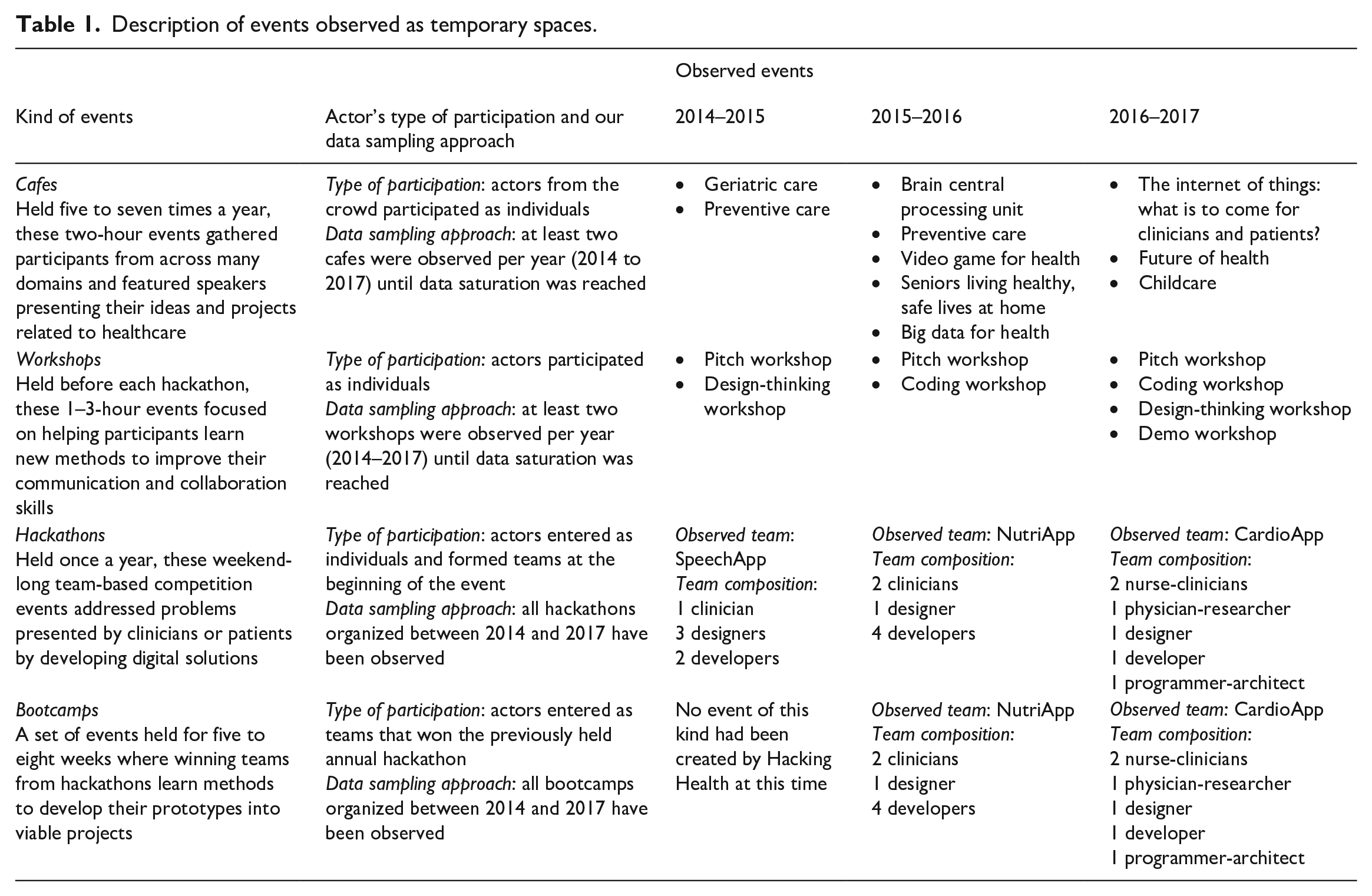
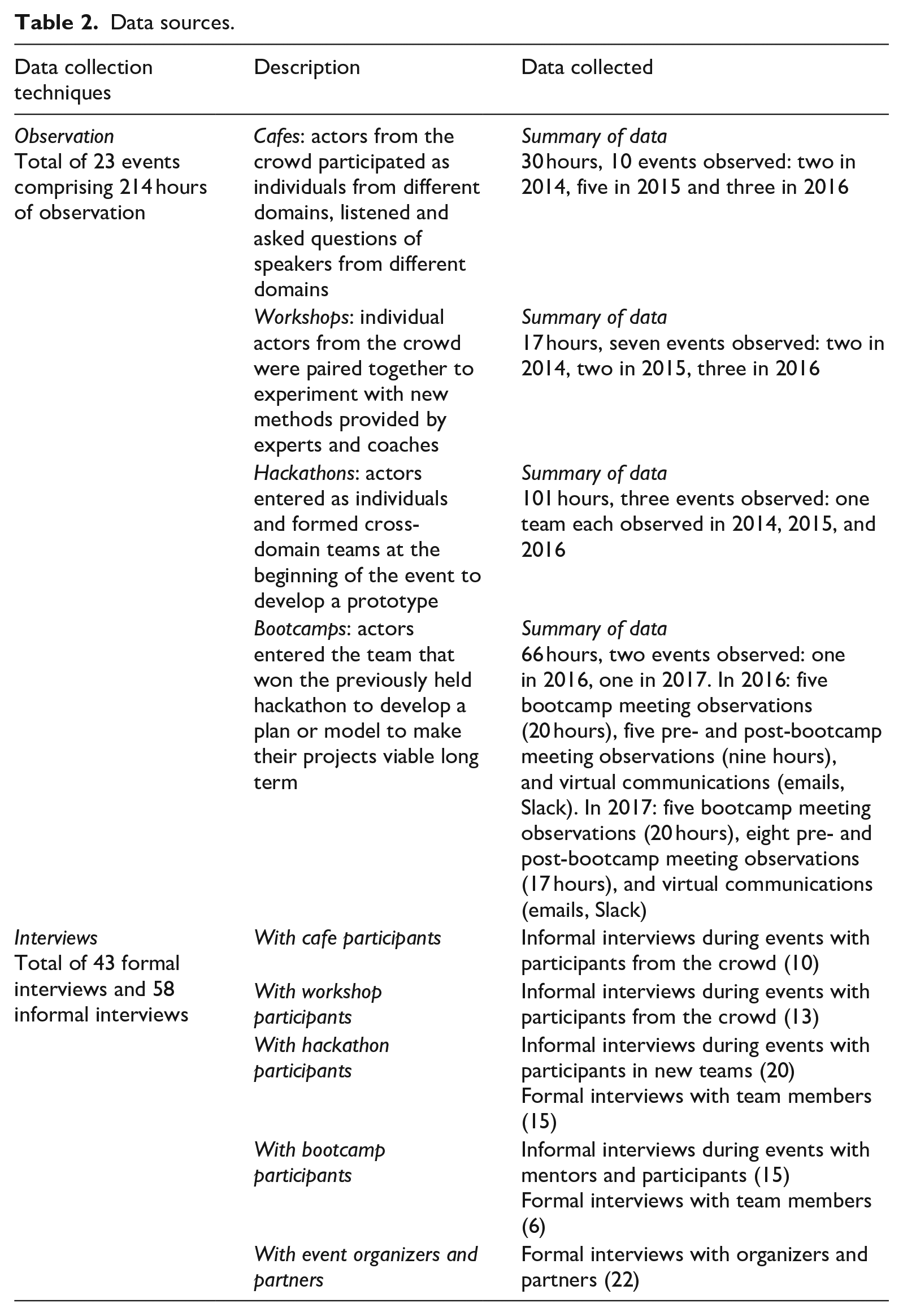
Following principles of process research (Gehman et al., 2018; Langley, 1999), an ethnographic method was the primary approach to data collection (Van Maanen, 2006), with some adaptations to focus on the short duration characteristic of the temporary spaces where the knowledge work we observed was performed. We used techniques that could capture the processes that unfolded in the short span of the temporary spaces. Where possible, participant observation was used to collect data across the variety of HH temporary spaces. Table 2 presents a summary of the collected data.
Data sources.
Participant observation
The first author conducted fieldwork in the temporary spaces organized by HH from December 2013 to July 2017, for a total of 23 temporary spaces observed (10 cafes, eight workshops, three hackathons, two bootcamps). This means that the sampling approach of the observed temporary spaces was informed in part by the kind of temporary spaces HH organized during those years. We observed all hackathons (held annually from 2014 to 2017) and bootcamps (held annually between 2016 and 2017) organized during this period and examined at least two cafes and workshops per year until reaching data saturation (Glaser and Strauss, 1967; Saunders et al., 2018). Each temporary space was observed in its total length, but observational techniques were adapted to the kinds of temporary spaces observed and the types of participation that characterized how participants engaged in temporary spaces—meaning either as individuals or as members of a team (see Table 1 for more detail). During cafes and workshops, we observed participants as individuals given that they did not come in as members of a team. In cafes, we observed organizers’ and guest speakers’ presentations and took notes of their interactions with the audience of individual participants. We then stayed during the networking phases of these cafes to conduct informal interviews with individuals from that audience. For workshops, the first author adapted observations to track specific individual participants through each workshop, depending on the tools being taught. For example, in workshops focused on pitching, the first author shadowed one clinician (who was preparing to pitch in front of the following hackathon crowd) per workshop. This helped track their learning of new techniques from a domain different from theirs.
For hackathons and bootcamps, the first author became involved in the lifecycle of one hackathon and bootcamp team per observed temporary space (see Table 1 for team and project descriptions). This deeper look at a smaller number of teams in temporary spaces allowed the collection and analysis of fine-grained ethnographic details of the work actors engaged in as they began a new collaboration across domains and organizations in a temporary space. The following criteria were used to select the teams to observe during hackathons and bootcamps. First, they were led by a healthcare clinician. Second, solutions were not designed before temporary spaces. Third, teams were composed of individual participants from different domains including at least clinicians, programmers, and designers. Fourth, teams involved members of different organizations.
He observed those teams for the duration of each hackathon (35 hours of observation per temporary space) and bootcamp (five four-hour bootcamp sessions and five to 10 pre- and post-bootcamp team meetings per temporary space), including informal moments outside of structured temporary spaces. For instance, teams continued to work late into the night and early in the morning. We observed the teams SpeechApp in the 2014 hackathon, NutriApp in the 2015 hackathon and the 2016 bootcamp that followed, and CardioApp in the 2016 hackathon and the 2017 bootcamp that followed (see Table 1 for more detail). The first author continued to follow the hackathon teams that advanced to bootcamp and stayed involved with team members’ lives outside of planned meetings. He observed teams in virtual meetings after the normal workday, in bootcamp homework settings, in strategic meetings with potential partners (other startups, presentations in hospitals, etc.), and in other informal meetings like team dinners.
Interviews
We conducted a total of 43 formal interviews and 58 informal interviews, both during and after temporary spaces. During hackathons and bootcamps, we interviewed all team members at least once, either during breaks, at specific critical moments during temporary spaces, or over meals. We engaged in short, real-time informal interviews during the observation phase to understand how participants interpreted situations as they occurred (Patton, 2014). These informal interviews were particularly important in our setting because some temporary spaces—for example, hackathons—involved a lot of computer programming and on-screen interactions while being the site of important yet quick negotiations. During these interviews, we asked participants to recount ongoing knowledge work, explain key interactions and challenges, and describe perceptions of tasks they performed to support project development. After HH temporary spaces, we conducted formal, open-ended interviews with participants who shared the challenges they faced during these temporary spaces and how they resolved them. These formal interviews were recorded and transcribed before they were analyzed.
Data analysis
Our analysis focused progressively on the knowledge work that participants engaged in as they addressed the situatedness of their knowledge and developed new shared knowledge to collaborate with others. Below are the two analytical steps we used to develop our theory of the knowledge work that unfolds in the different kinds of temporary spaces observed.
First step: Identifying the types of knowledge work occurring in temporary spaces
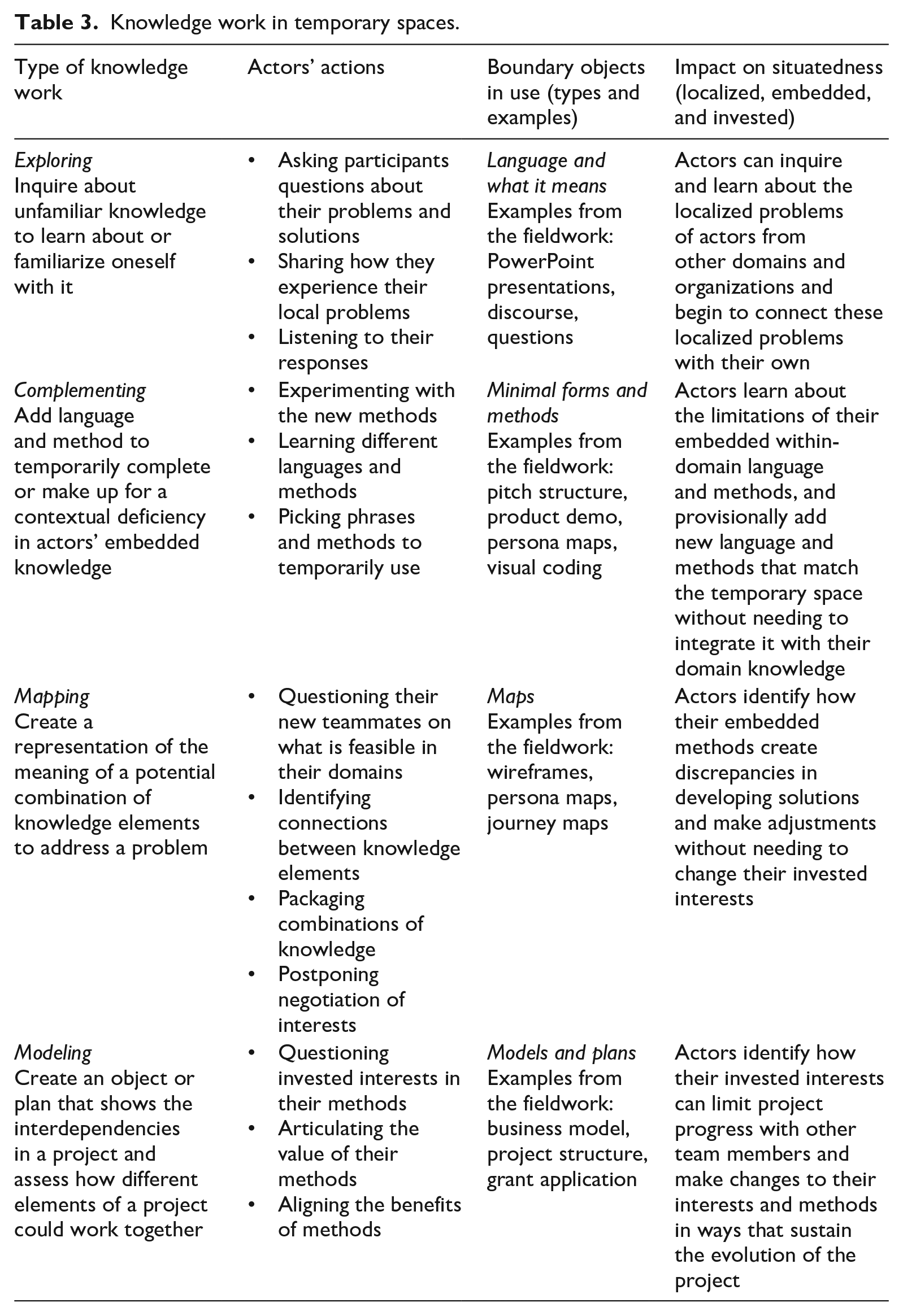
During a first round of coding, we assigned descriptive codes that evoked actors’ actions when trying to engage in knowledge sharing (see Table 3 for a depiction of the coding process). We consolidated the descriptive codes of actions that were identified across temporary spaces and participants for a total of 13 codes. We then identified the types of boundary objects used by participants, as described by Star and Griesemer (1989) and Carlile (2002), and mobilized the language of localized, embedded, and invested (Carlile, 2002) to associate actors’ actions with their impact on the situated nature of actors’ knowledge. Finally, we correlated these categories to develop our framework of the different types of knowledge work actors engaged in. Analyzing these across different “sites” became a “dispositive” to more clearly identify the knowledge work participants engaged in (Nicolini, 2011: 612). We identified four types of knowledge work: exploring, complementing, mapping, and modeling.
Knowledge work in temporary spaces.
Second step: Identifying how temporary spaces orient knowledge work
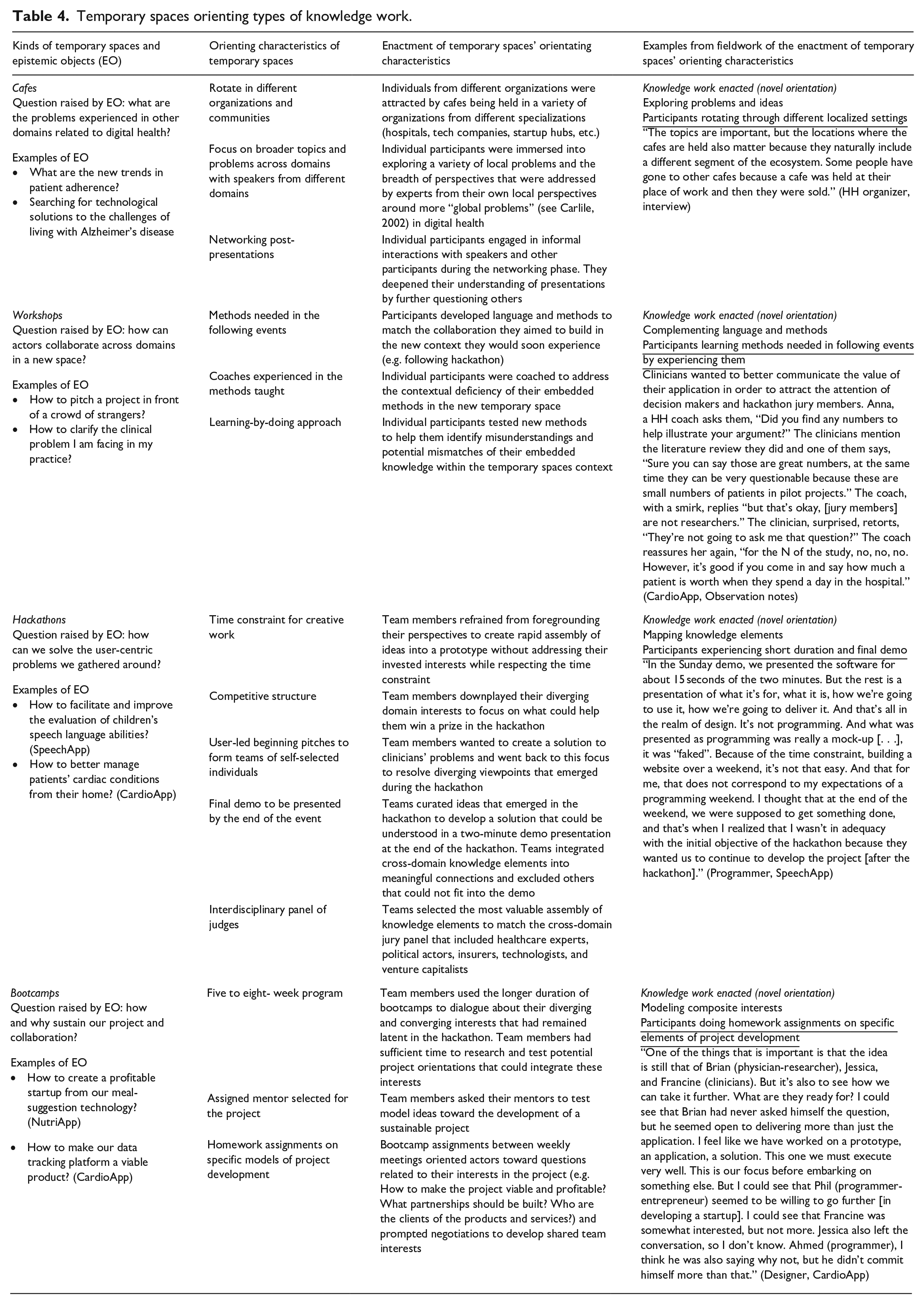
Building on Knorr Cetina’s (1999) view of epistemic objects as orienting how knowledge work unfolds, we coded what we labeled the “orienting characteristics” of temporary spaces that promote knowledge work toward specific epistemic objects (see Table 4 for a depiction of the coding process). We then coded actors’ enactment of these orienting characteristics to show the relationality between space and action (see Table 4 for a representation). This coding process helped show how temporary spaces provided a focus around specific epistemic objects that oriented the types of knowledge work participants used. This clarified the relationship between epistemic objects, which provide a general orientation of knowledge work, and boundary objects, which provide a particular concrete instance of knowledge work—and therefore how specific temporary spaces orient specific types of knowledge work to address differences in actors’ situated knowledge.
Temporary spaces orienting types of knowledge work.
Findings
Our research question asked how participants in temporary spaces address the situatedness of their knowledge and create new situated knowledge to sustain collaboration across domains. To accomplish this, we analytically took two passes at the phenomena and separated them in two steps. In the first step, we present the four types of knowledge work used in these temporary spaces (also see Table 3). These four types cover a range of actions that enable the situated aspect of participant knowledge to be addressed. The types of knowledge work are as follows: (1) exploring different locales; (2) complementing embedded language and methods; (3) mapping knowledge elements; and (4) modeling composite interests. We then present the second step, which focuses on different kinds of temporary spaces that support these specific types of knowledge work. We describe how temporary spaces orient knowledge work toward specific epistemic objects as actors develop new shared knowledge to support collaboration.
Knowledge work used to address the situated nature of knowledge in temporary spaces
Knowledge work 1: Exploring different locales
The first type of knowledge work was observed in each of the four kinds of temporary spaces. We labeled this type of knowledge work exploring different locales, where participants inquired about unfamiliar problems from other locales by asking other participants questions about their problems and listening to their response. This type of knowledge work is not oriented to critiquing or convincing others; those asking questions are exploring knowledge not judging. Here, the emphasis is on pure inquiry rather than actors seeking to contest knowledge. Exploring helped actors familiarize themselves with the localized nature of their own knowledge (Carlile, 2002) as well as the knowledge of others as they inquired about the problems they face and the ideas they have.
One example of exploring occurred in a cafe focused on the potential of robotics in patient healthcare. In this situation, exploring unfolded between a speaker—an oncology surgeon who researched and used robotics in surgery—and a participant in the crowd. The participant asked questions about practicing surgery with robots:
When I look at the pictures you showed in your presentation [a picture of a group of surgeons and technicians using a robot during a surgery], I don’t fully understand how you interact with the robot and your patients. I was wondering what feedback you receive when doing surgery with a robot?
Only visual. I could say that I feel it, and at times it does feel like I do, but I truly don’t.
Would you gain something from feeling it?
As of now, I would say no, but if you bring me the tool to do it, I may say how did I operate without it!
In this interaction, the participant asked a question to better understand what the surgeon experienced in his localized practice. Given that few people engage in robotic surgery, the cafe setting allowed for open inquiry. The speaker then explained how he experiences surgery, mentioning the bodily sensations he feels as he operates. This opened a new question about developing tools that could improve surgeon–robot interactions.
A second example of exploring comes from the CardioApps team participation in a bootcamp. The mission model methodology used in the bootcamp provided a schedule, week by week, of what participants should learn. Teams were assigned with a mentor to facilitate this process, and the CardioApp team invited their mentor to one of their recurring virtual meetings. Team members asked questions from their own domain perspectives to understand how their knowledge could be useful from another domain’s standpoint. For instance, CardioApp’s clinicians asked their mentor about the business value of doing research to validate the clinical hypothesis. Here is a dialogue between the clinician and the team mentor:
So in a first step, we want to understand if patients like the application, in a second step of research see the impact on hospitalizations, then in a third step even maybe see the impact on mortality rates. What is the added value of doing all these research protocols? Is it worth the investment?
First you have a tough market. One of the biggest risks in your specific market, heart failure, is adoption. I look at my father, 77 years old, technology is not his best friend. So, if there is no adoption, there is no user, if there is no user, there is no data, nothing. [. . .] So there’s a lot of value in [doing research about] that. And you’re going to have to prove the points, what are the selling points to the person who’s going to pay.
In this dialogue, the mentor clarified the business value of the research steps identified by the clinician. Such questions aimed at understanding how the research problem from the clinician domain could be used to deal with problems in other domains, in this case the customer and business domain. While exploring, actors did not contradict each other’s views, although the potential for conflict certainly exists. Rather, they used the temporary spaces to ask as many questions as they could to explore potential avenues without evaluating and closing doors. For example, during the line of questioning presented above, the team physician-researcher went deeper and asked about the volume and kinds of data that could be collected during the research phase to increase early product adoption.
Knowledge work 2: Complementing embedded language and methods
The second type of knowledge work we identified is complementing the embedded language and methods actors use in their situated domains. Adding language to complement one’s language and methods is a way of “rounding off” to match the temporary spaces’ situatedness, creating a simpler means of communicating across domains than if actors used the language and methods of their own domain. This involved a set of actions meant to complement the contextual deficiency in one’s embedded methods to communicate with actors from other domains. Complementing involved actors: (1) understanding that participants from other domains used different language and methods than theirs; (2) recognizing the limitations of their own methods; and (3) adding to their existing, embedded methods in ways that facilitate shared language and knowledge. This helped actors demystify and resurface their embedded methods—that are mostly tacit and difficult for participants to identify and change (Carlile, 2002; Oborn and Dawson, 2010)—and the meaning they generate. But actors did not fully integrate the new-to-them knowledge developed in these interactions given that they did not fully understand the consequences of the language and methods at this point. Instead, they added language and methods to contextually complement processes of creating some shared meaning.
An example of this type of knowledge work is illustrated during a pre-hackathon pitch workshop where participants prepared brief speeches to attract new members to their projects. The pitch workshop was an opportunity for clinicians and patients to prepare by learning the effective structure of a pitch that would attract new team members from other domains. Hackathon teams were formed, based on these pitches, from among technologists, programmers, designers and other healthcare professionals gathered as a crowd of individual participants at the beginning of the hackathon. Facilitators helped participants prepare for their pitches. As one of the facilitators at this workshop mentioned, “You need to explain who you are, what problem you want to solve, why we should focus on it, and what kind of idea you have in mind to solve it.” Clinicians initially had trouble communicating pitches across knowledge domains under the one-minute time allotment. Clinicians typically presented their ideas with a research orientation as they are accustomed to using within their hospital setting. Dimah, a clinician who later formed the SpeechApp team in her hackathon, was put into a group of three that included a coach and a programmer to practice her pitch and presented her idea:
Research in speech-language pathology has shown that 80% of children’s language difficulties related to speech disorders can be resolved when children are diagnosed before they are—
And, time!
Already! I didn’t have time to say half of it.
How can I explain how the research supports my idea?
Well, you don’t! That’s not what coders and designers look at in a project.
(Workshop, Observation notes)
Dimah could not communicate her idea within the one-minute limit in her familiar way. By dialoguing with the coach and programmer, she identified that her embedded language and methods were built on the shared knowledge domain of clinicians and researchers. Dimah’s observation revealed the limitations of her embedded language and methods and how they did not work with outsiders in the context of a hackathon. She could then complement her usual research-based method with her facilitator’s coaching to focus on the “problem she experienced in her daily practices”.
Temporary spaces’ participants needed to complement their existing methods by recognizing their limitations and differences with other domains’ embedded knowledge, and then compensating for this contextual deficiency. We use the expression “contextual deficiency” to emphasize the transitory nature of language and method that is specifically tailored to support the translation of knowledge in temporary spaces.
Knowledge work 3: Mapping knowledge elements
The third type of knowledge work is mapping knowledge elements. Mapping occurred in newly formed teams and involved creating a representation—for instance, in the form of a picture, demo, or presentation—of the meaning of a potential combination of knowledge and ideas to address a problem. This involved individuals questioning their teammates on what was possible across domains and then creating a map that represented an assemblage of what each team member could contribute. The creation of the map was an iterative process of mapping and remapping that encompassed a continuous process of team dialogue and individual testing. This allowed teams to create and refine their shared knowledge, and then use that mapped combination to test their knowledge at a deeper level in presentations to mentors and judges for example. Mapping brings to the fore actors’ different embedded knowledge and the dependencies across them without those actors needing to negotiate the consequences of these dependencies on their different interests.
Differences in the embedded nature of participants’ methods affected how participants understood their new colleagues’ suggestions and created challenges for alignment within the short timeframe of temporary spaces. Misunderstandings hindered teams’ ability to build shared meaning and problem solve under time constraints. They also led participants to focus on the dimension of the problem related to their own domain. On the CardioApp team, one clinician described, “I think that everyone was looking at the problem and the solution through the lens of their own domain.” Through mapping, teams identified misunderstandings and their consequences, which could significantly impact workflows. Mapping created more rapid and effective communication among team members and a better understanding of their roles and responsibilities, which mitigated misunderstandings.
One example of mapping came from observations of the SpeechApp team in a hackathon. By using mapping processes during an iteration meeting, the team was able to pinpoint a key issue that created confusion among team members. Chris (designer) listened to Dimah’s (clinician) problem and goals and then discussed her program needs with Robert and Thomas (programmers). Chris drew a wireframe of the project and its constitutive elements on a large piece of paper in the middle of the team’s table and presented it to his teammates. Thomas took out his earbuds and raised his eyes above his laptop’s screen to look at the wireframe and seemed surprised: “Why is ‘API’ standing there in the middle?” Dimah looked alarmed by the comment: “We have been talking about API for the whole day!” She had asked programmers on her team numerous times if it would be possible to build a feature allowing her to read the API transcript of the recorded samples of children with none of them giving clear answers. Dimah then said: “API means ‘Alphabet Phonétique International’ (a technical French term meaning International Phonetic Alphabet).” Thomas strongly reacted: “That’s what you meant when you talked about API! When you told me about API, I did not see symbols, I imagined other things.” API in the programming field means Application Programming Interface, a set of routine definitions, protocols, and tools for building software and applications. Thomas later said that it “pushed [him] towards an understanding of what she was saying that was not making any sense”. After realizing this discrepancy and its potential impact for the project, Thomas started asking Dimah follow-up questions about the process of translating children’s language in the International Phonetic Alphabet. As he said, “From there, I think everyone realized that we had to pay more attention to how we shared information if we did not want to head straight into the wall.”
Mapping helped develop a shared understanding of what each member could bring to the project without requiring a deep understanding of each other’s knowledge domains. In addition to gaining a better understanding of what was possible for each team member, mapping helped teams understand dependencies among the different elements being developed. Mapping the different prototype elements helped translate the design of the solution into cognitive and material representations so that team members could work in their own silos while maintaining a shared picture of the overall project. Mapping, however, was used in a way that did not bring to the fore the invested nature of actors’ knowledge. It did not push actors into changing their methods but encouraged dialogue for team members to consider other perspectives and potential problematic interactions across differences.
Knowledge work 4: Modeling composite interests
The fourth type of knowledge work is modeling composite interests, through which team members negotiated and created an object or plan that combined elements from different domains, showed their interdependencies, and orientated further project exploration. This type of knowledge work was only observed in teams looking to further sustain their projects, and so involved participants’ interests, which led to conflicts about how the future of the project would evolve. Negotiating actors’ different invested knowledge was essential to address how actors could reinvest their knowledge into new kinds of endeavors outside the situated contexts of their current domains, in ways that would still satisfy their respective interests. When participants were not aware of the dependencies and consequences of their interests on others, they not only filtered out the interests from other domains but also hardened their respective positions. To overcome this bias, teams held probing conversations about how to connect the value of each team member’s domain to the collective project.
Developing a collective orientation for the project within the bootcamp temporary space required transforming participants’ approach to project development. Clinician interest in the CardioApp team was to rapidly develop the prototype into a functional application that could quickly support their nurse colleagues in hospitals and generate value for their patients. Physician-researcher interest was to scientifically validate the clinical claims of the product with a two-year research project that would examine the technology’s impact on hospitalization and mortality rate. Programmer and designer interest was to contribute to the development of the application in a way that focused on a wider market that could generate startup value.
The CardioApp team therefore had to create a model to develop composite interests. Doing so was essential to address the invested nature of their knowledge so that team members could change and then reinvest their knowledge toward a shared model of project development. One example of modeling occurred in the third meeting of the 2017 bootcamp, in which team members discussed their ability to attract venture capital funding. Phil, a programmer with previous startup experience, stressed the importance of developing a clear business plan saying, “It’s even more important than the product itself to get VC [venture capitalist] interest.” Jessica (nurse-clinician) counters, “I understand what pharma wants, but I have no idea what VCs are looking for. I don’t get it at all!” (CardioApp, Bootcamp, Observation notes). In this conversation, Phil proclaimed that building a business plan was even more important than developing the solution, suggesting a comparative evaluation of where to invest effort. That notion engaged Jessica and the other clinicians who acknowledged their limitations, requiring them to transform (Carlile, 2004) their invested knowledge so that their methods better fit the venture capitalist model.
Developing a cross-domain model required team members to identify and share their implicit invested interests. For example, the physician-researcher explained that the value of developing a two-year research project with the application was to validate the digital product’s clinical hypotheses based on rehospitalization rates while tracking the impact of prescription drugs on patients’ health. This could help attract pharmaceutical companies to financially support the research. The entrepreneur-programmer who wanted to raise venture capital funding to advance the project discussed the need to enter the market as soon as possible to beat competitors and focus on building technology that could migrate into the US healthcare market. This apparent impasse led the team to create a new scientific-entrepreneurial development model. Here is a vignette representing the composite interest created by the CardioApp team:
“Maybe pharma revenues would be a medium-term plan to finance the development of the platform, but we should think about another way for the long term.” For him, proving the benefits of their services through research “will be of interest to hospital providers in a private context. That explains my perspective on the US market. It seems that this is the direction that we will eventually have to go in if we want to be profitable. What do you think?” Brian (physician-researcher) agrees that monetization within the Quebec healthcare system is not an easy task, but that it should still be the first step before moving toward the American market: “I wouldn’t do the business plan in terms of the US market because it would be too abstract at this point. [Going to the US market] would be for a second step, for another round of investment.” Phil agrees that Quebec could be considered as an “opportunity for experimentation before stretching to the American market”. (CardioApp, Bootcamp, Observation notes)
As this vignette shows, using modeling helped team participants collectively become aware of alternative approaches to how the project could evolve. Team members uncovered the inner workings of their respective individual models of knowledge development to contribute to collective model development. Through this process team members made the flow of knowledge elements and their interdependencies explicit, and then developed a new model that having taken into consideration those changes reflected a more complete set of mutual interests. This led to the development of a model that combined and aligned both research and startup approaches.
How temporary spaces orient the types of knowledge work actors engage in
In this section, we focus on the role that different kinds of temporary spaces play in orienting specific types of knowledge work aimed at addressing the situated knowledge of actors from different domains. As Table 4 outlines, we analytically separated the orienting characteristics of each temporary space and the enactment of these orienting characteristics by participants. Although in practice these characteristics emerge as consequential in the doing and therefore cannot be separated out, this analytical cut allows us to more precisely depict the specificities of each temporary space, and how participants enacted “orienting characteristics of temporary spaces” to engage in specific types of knowledge work. This highlighted the novel orientation of each kind of temporary space, and how the characteristics of a temporary space channel its primary orientation. By novel orientation, we mean that each kind of temporary space uniquely initiates one type of knowledge work, although other types of knowledge work can also occur.
Cafes: Exploring problems experienced in other domains
Orienting characteristics
Cafes are a series of meetings held in different locations, including hospitals, startup hubs, and technology firms, to bring together speakers and participants from different knowledge domains and organizations. Speakers, who come from different domains and organizations such as tech startups, health science, policy making and clinical practices, articulate their view of the topic of the cafe based on their own local perspective. They present their innovative work related to this topic and the problems they focus on in their practice. For example, subject matter experts presented on themes such as geriatric health, preventive health, or robotics in patients’ trajectories from the standpoint of their respective domains. Participants, who also come from different domains and organizations, ask clarifying questions to try to connect presentations with their own localized views. After the presentations and discussions, a one-hour networking session took place.
Enactment of orienting characteristics
Cafes facilitate the knowledge work of exploring. By being held in different organizations and locations, cafes allow new individual participants to join when they are held in their own organizations, and for other participants to explore problems in new knowledge locations. As one HH organizer recalls: What I found [in hospitals] is that there is a significant group . . . who are very interested in digital health apps and how they can improve healthcare. And they are also frustrated quite a bit by the [technological] tools they are given . . . so we basically pull in people like that who are doctors and nurses who are interested in technology and would like to see improvements.
Given their distant locales, temporary spaces’ participants would not naturally meet in their own work environments and therefore would not share their localized knowledge. By rotating to different locations and combining speakers from different domains around broad topics, cafes spurred participants’ imagination and willingness to explore diverse sets of knowledge around a shared topic.
Workshops: Learning new methods for collaboration
Orienting characteristics
Most workshops were held right before hackathons to help individual participants prepare for engaging in collaborations with people from disparate domains. Participants experimented with new methods of communicating their ideas and knowledge, but also received coaching to understand distinctions from actors in other domains. Workshops also had an epistemic orientation to foster exploration and inquiry, but deliberately emphasized the development of shared language and common methods to create communication bridges across localized problems and ideas. Workshops used a learning-by-doing approach where gathered individuals experimented with the methods taught. When experimenting with these methods, individual participants were supported by experienced coaches.
Enactment of orienting characteristics
Workshops encouraged actors to engage in the knowledge work of complementing to develop shared yet simple methods of initiating collaboration. Participants listened to the methods and techniques (such as design thinking, persona maps, and pitches) taught by coaches, then quickly experimented by using their local problems and project ideas as content. For most participants, it was their first time both using these methods and entering a cross-domain hackathon. In a pitch workshop, one clinician learned to whom she should address the pitch. She reflected: [. . .] at the pitch [workshop], the coach asked me a surprising question: “Well, who are you looking to recruit [in your team]?” I had no idea whatsoever. Then she told me, “You need three key words: programmers, designers, and medical professionals.” So I repeated that in my [hackathon] pitch. (Clinician, Project Nutriapp, 2015)
The coach’s question helped her begin to identify her lack of understanding about the context of collaboration and team formation specific to the hackathon. Her response also underscored that she simply added language without fully understanding what it meant, as revealed in the comment the clinician later said “[I] didn’t even know that designers existed.” Developing enough common language and methods to initiate communication in the upcoming temporary spaces is the epistemic objective that motivates participants to develop knowledge without the need to fully understand the meaning or consequences of this new language for future collaboration.
Hackathons: Developing a prototype or a demo
Orienting characteristics
In the cases observed, hackathons were annual 48-hour temporary spaces that required participants to form knowledge-diverse teams and produce a project demo and prototype to be judged. In addition to brainstorming and connecting their localized knowledge, hackathon team members must work on developing partially functional prototypes, allowing actors’ embedded knowledge to be surfaced and improving knowledge mapping. The competitive, time-bound nature of the hackathon induced team members from different domains and organizations to rapidly try new ideas, evaluate their potential to be developed rapidly, adapt them, and then package them for a jury. Given the short duration of the temporary space, hackathon participants had to quickly get to know their new team members, their capabilities, and what could be collaboratively developed given team members’ backgrounds. The competitive dimension of the event created a temporary shared interest of developing a winning outcome, focused on the need of a patient or clinician user, for team members to coalesce around and map their respective knowledge elements in a useful way.
Enactment of orienting characteristics
Hackathons helped actors map potential combinations of knowledge around a possible solution. Our analysis of team interactions during hackathons showed that participants brought specific understanding of the problems to solve and the ways to solve them that were embedded and invested in their own domains’ language and methods. Orienting hackathons toward a jury competition encouraged the mapping of participants’ perspectives while discouraging invested knowledge from diverging. From the outset, participants did not know what their new teammates could produce and whether it could be accomplished within the allotted time. For example, three clinicians and two programmers took part in developing the CardioApp team project. The clinicians wanted a solution to track their patients at home to reduce rehospitalization, but they did not know if this was feasible given hackathon time constraints. The clinicians presented their problem to the programmers and cautiously inquired about feasibility. As one clinician from the CardioApp team noted, “It’s just a matter of quickly seeing if what someone is proposing is gonna work. We had to figure this out pretty quickly.” After suggesting solutions, individual team members worked on separate tasks to test what was possible to produce in the hackathon period. As the same clinician mentioned, “there was a bit of a journey they (programmers) had to make on their own”, signifying that team members had to test potential solutions related to their specific knowledge domain. Then, during iteration meetings teams could re-map their development process according to the tested suggestions. These frequent meetings helped evolve progressive, shared understanding of the problems that could be resolved with the prototype based on what could be produced and valued before the end of the hackathon.
As time elapsed in the three hackathons we observed, team members started engaging in more regular conversations about what to produce and how those elements could integrate for the final demo. Team members who had worked on elements of the project from their respective domains now needed to determine which elements to combine, change, and polish to present in the two-minute demo. The demo presentation time constraint and jury members’ domains oriented participants to suspend the invested nature of their knowledge to emphasize what could be understood and valued by the jury. As one physician-researcher from CardioApp mentioned, “If it wasn’t clear to the average person, it wasn’t going to be clear to the jury. It had to be simplified, and since we only had two minutes, we couldn’t explain overly complicated concepts.” Thus, team members continued mapping possible combinations of knowledge as an epistemic object as they produced demos and prototypes for the jury.
Bootcamps: Sustaining prototypes as projects
Orienting characteristics
Bootcamps are the longest kind of temporary spaces observed in this research. They were held as five- (2016) to eight- (2017) week programs, with a schedule of five three-hour meetings that required whole team attendance. These teams were the winning teams from the previous hackathons. The meetings were organized as short lectures on different topics related to further developing a project, such as customers’ needs, business model creation, and market analysis. These lectures led to homework assignments that were then workshopped during bootcamp meetings so teams could identify and address misunderstandings regarding the work to be performed. During these experimentations, teams were assisted by bootcamp organizers and their assigned mentors. Between meetings, teams were required to do their homework assignments and could request meetings with their mentors for support.
Enactment of orienting characteristics
Bootcamps engaged newly formed teams on questions of making their projects viable after the hackathon. Teams were only loosely tied following hackathons and therefore were concerned about how to continue their collaboration to build on the temporary agreements reached during the hackathon. The invested nature of knowledge became very prominent in the bootcamps given that participants needed to sustain their involvement and so live with the consequences of agreements made. This required them to reflect and develop viable projects that addressed both personal interests and the interests of the entire team. As one clinician from the CardioApp recalls: The next step [after winning the hackathon] is to quickly get together, because deep down we wanted to take a little break but at the same time we can’t afford it. We need to get [re-]attached, to ensure that the team remains welded together and wants to continue. To maintain this team cohesion. To continue to build on trust, to develop so that the prototype becomes a pilot project to test it and do research to identify who can help us take it further and how we should do it.
The multi-week series of bootcamp meetings supported deeper inquiries and conversations about how to transform and sustain projects into the future. Actors used business-model scenarios, research protocols, and budgeting tools to model how their projects would be assembled and unfold. This modeling moves a step beyond mapping by representing the causal interactions and flows across potential elements of the model to determine project viability.
Team members used these models to identify mismatches between different visions of the future held by individual members and to make trade-offs and changes to establish shared, sustainable team interests. Such negotiation was informed by the homework assignments given by bootcamp organizers and supported by teams’ assigned mentors. For instance, in the bootcamp’s first session, the organizers asked teams, “Do you really know your customers that well?” They then shared a question guide to prompt teams to interview at least 10 potential customers to understand their needs, so teams could evolve their product idea aligned with those needs. CardioApp team members wondered, “should we do this for all our potential customers?” The team realized that patients were not necessarily the paying customers, but that other stakeholders could also be interested in the product and be more suitable as paying customers. Before the following bootcamp session, CardioApp met with its assigned mentor, a data valorization specialist in a major health-tech company. The physician-researcher in the team asked the mentor: How can we generate value so that [our product] can develop and expand, and that means achieving a certain level of financial viability? We’ve already thought about a few [business] models. In our case, the patient is probably not the most suitable payer, because it’s an elderly patient, a patient from a socio-economic point of view who doesn’t necessarily have an income. Could it be a viable model to resell the data we would collect over the long term?
This example shows that participants used all four types of knowledge work iteratively to develop sustainable projects. Team members asked questions to explore new ideas and reframe the problems they would address, added new language (for instance, the language of “financial viability” from the quote above), and developed additional methods to assess the potential value of new combinations. This iterative cycle of types of knowledge work pursuing epistemic objects then identified new model elements and necessitated integrating them into a model of composite interests capable of generating cross-domain value.
Discussion
Our examination of temporary spaces as a context for cross-domain collaboration with little to no shared knowledge provided an extreme set of circumstances capable of demonstrating a pragmatic view of the situatedness of knowledge and the work involved in developing new shared knowledge. This has helped unveil more clearly the orientation of different kinds of temporary spaces and different types of knowledge work that individuals engaged in to address pragmatic tensions related to their own and others’ situated knowledge.
A pragmatic cycle of knowledge work in temporary spaces
The practice-based view of knowledge has drawn our attention to two fundamental aspects of organizational knowledge: that individual knowledge is situated (Tsoukas, 2002) and that differences in knowledge can generate pragmatic tensions when actors collaborate with individuals from other domains (Carlile, 2002). Practice-based theorists naturally take organizational sites seriously as spaces where shared problems and methods develop in cross-functional teams (Orlikowski, 2002; Sole and Edmondson, 2002) and that have practical conditions that organize local regimes of knowledgeability (Nicolini, 2011). Yet situatedness has not fully been considered from a pragmatic standpoint, which recognizes knowledge as localized, embedded, and invested in practice (Carlile, 2002). Much of this research has either described the impact of situated knowledge on organizational practices (e.g. Macpherson and Clark, 2009) or portrayed situatedness as being mostly stable and as evolving over long periods of time (Nicolini et al., 2022). This research has not looked at situations where there is a lack of sharedness among actors in a space. Examining and analyzing actors’ cross-domain collaboration in different kinds of temporary spaces is a rare opportunity to revisit and enhance our current understanding of situatedness and deepen our understanding of how actors progressively address the pragmatic tensions related to their situated knowledge.
What we have identified in the relationship between the different kinds of temporary spaces and different types of knowledge work is an accumulating cycle that develops shared knowledge in a new situation—in this case, in temporary spaces. Our focus on the orienting characteristics of temporary spaces and the knowledge work that actors engage in as a result has revealed how work initiates and drives a process of progressively addressing the localized, embedded, and invested knowledge of actors for sustainable collaboration to arise. As shown in Table 4, our analysis unveils the specific elements of actors’ situated knowledge that were made into objects of enquiry, the orienting characteristic of temporary spaces, and their interaction with participants’ knowledge work in those temporary spaces. The pragmatic cycle of knowledge work that unfolds is a much broader and interconnected effort of developing shared knowledge that could potentially contain developing joint problems, common language, shared methods, and composite interests depending on the stage in the cycle. In Figure 1, we illustrate how the sequence of different kinds of temporary spaces and the types of knowledge work oriented by them becomes a successive and accumulating cycle. Our figure also makes clear in what temporary spaces the types of knowledge work we identified occurred. This clarifies that different types of knowledge work can co-occur and be interconnected in some temporary spaces. We found that the different types of knowledge work we identified were not necessarily associated with a single kind of temporary space, but rather they were progressively used in increasingly larger combinations (see Figure 1). For instance, in cafes we only observed exploring, and at the other end of the spectrum in bootcamps, we observed exploring, complementing, mapping, and modeling as a cumulative cycle of different types of interconnected knowledge work.
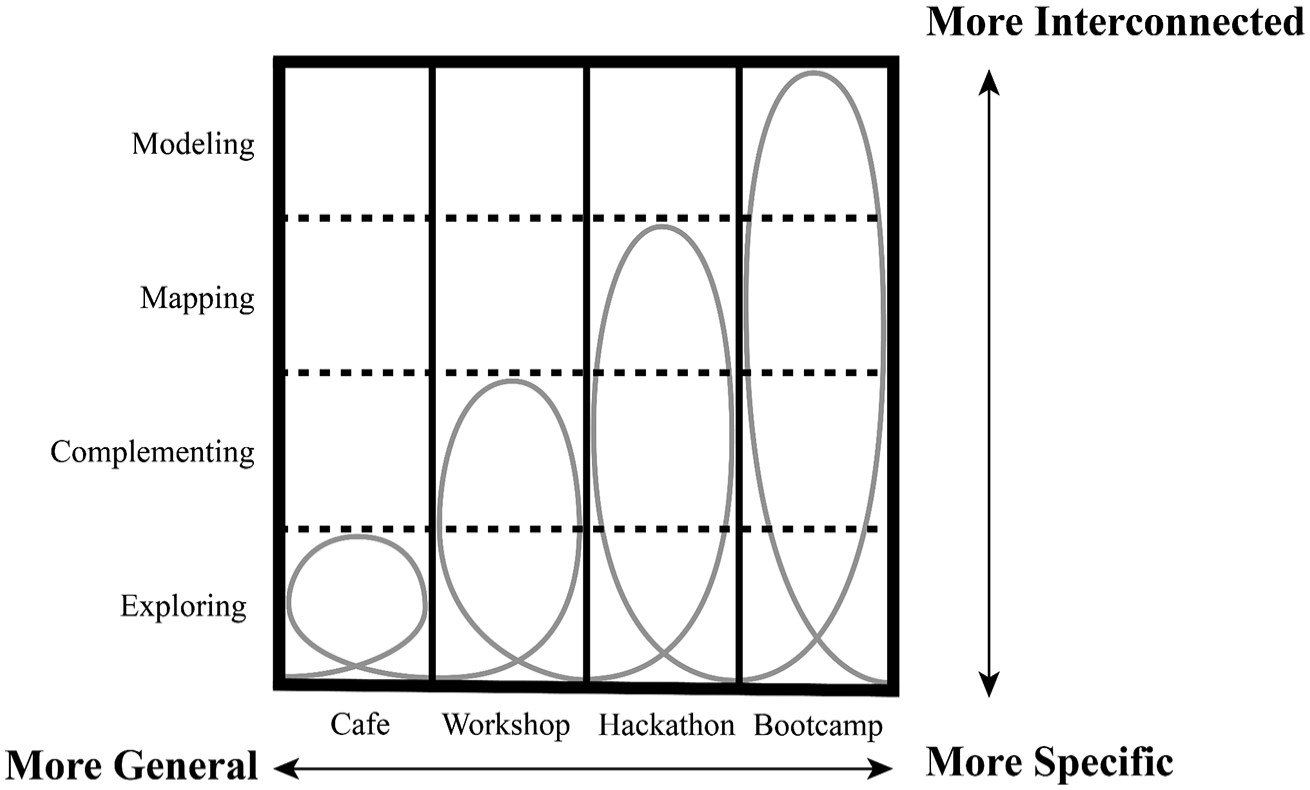
The pragmatic cycle of knowledge work in temporary spaces.
Temporary spaces and cumulative knowledge work in the pragmatic cycle
The pragmatic cycle of knowledge work is oriented by the interconnected temporary spaces actors engage in. Cafes open up a variety of localized knowledge for individual actors to explore beyond their own situated knowledge and problems. Although exploring does not generate any negative consequences on an actor’s current knowledge, this knowledge work initiates the new pragmatic conditions for new encounters outside an actor’s current situated knowledge. Given their situated knowledge, actors have a tendency to remain within the confines of their domain and organization and choose not to expose themselves to new dependencies given the potential cost of having to adapt and change their practices. Exploring is a means to expand beyond one’s situated knowledge to open up to new situations and potential dependencies and their consequences.
Workshops’ orienting characteristics support individual actors in identifying what we label the contextual deficiency of their knowledge—a situation in which actors’ current knowledge does not adequately match the new context they engage in. This leads actors to complement their knowledge in the form of minimal languages and methods that allows an accelerated capacity to communicate and collaborate with others despite knowledge domain differences. Existing research on the pragmatic view of knowledge recognizes that actors’ knowledge is “at stake” (Carlile, 2002: 445) and must therefore understand the value of the knowledge to develop, given the cost of transforming their current knowledge (Carlile, 2004). Yet research has not shown a progressive path that actors can engage in toward transforming their knowledge. Workshops play a significant role by orienting actors toward the knowledge work of “complementing”, contributing to a pragmatic view of knowledge by unveiling a next step into actors’ process of transforming their knowledge when engaged in a situation that is new to them. Actors are oriented to try new knowledge in a way that is a lower “cost” (Carlile, 2002: 446) than transforming their current knowledge and then assess the value of new knowledge in a new context of practice.
The knowledge work we observed in cafes and workshops has been overlooked in studies on cross-domain work given their empirical focus on within-organizational settings where much is shared (e.g. Bechky, 2003; Carlile, 2002, 2004), but nevertheless they are a part of the work required to address current situated knowledge and develop future situated knowledge. Our research therefore contributes more broadly to the pragmatic view of knowledge boundaries. This research shows that boundaries arise when differences in actors’ knowledge become consequential given mutual dependency (Carlile, 2004). Previous research that identified and studied pragmatic boundaries examined contexts of collaboration where actors’ dependencies across domains had already existed or been recognized (e.g. Barley, 2015; Carlile, 2002; Comi and Vaara, 2022; Levina and Vaast, 2005). This explains why such research focused on the means to address boundaries the pragmatic tensions generate when cross-domain actors’ dependencies are consequential.
In the case of actors in cafes or workshops, however, these dependencies and pragmatic tensions were not yet revealed and so they were open to various possibilities in this new situation. By examining and describing a more complete set of types of temporary spaces and types of knowledge work, we have extended the pragmatic view of knowledge to include exploring and complementing as a part of the work that is essential to initiating new collaboration across situated knowledge. As actors engaged in exploring in cafes, and exploring and complementing in workshops, they began to work on understanding the potential problems, language, and methods to use despite domain and organizational differences. Even though there were no direct boundaries, this knowledge work involves addressing the localized, embedded, and invested knowledge of actors prior to forming new collaborations.
Hackathons then orient actors to rapidly map and remap elements of their knowledge and their dependencies. This type of knowledge work allows new team members to connect their localized knowledge, broaden the scope of problems across domains, and iterate new knowledge elements and new connections as the work (communicating, prototyping, etc.) reveals further aspects of their embedded knowledge in addressing a new situated problem. The orienting characteristics of hackathons (e.g. time-constrained competition, producing a demo and jury) manage power dynamics by orienting cross-domain teams’ knowledge-development efforts toward solving clinicians’ problems to win the hackathon prize, and downplaying actors’ different interests. This transcending approach (Majchrzak et al., 2012) facilitates the rapid development of new ideas and combinations of ideas and perspectives in a way that sidesteps their potentially diverging interests for the time being. Yet we also expand this approach by showing how a shared context, in this case a temporary space, can orient actors to use a transcending approach to surface and connect their knowledge elements in dynamic ways.
Bootcamps orient participants to engage in deeper dialogues about the invested nature of their knowledge and what they are building together. Teams build on shared understanding developed in the hackathon to accumulate the knowledge to address how to solve the problem they are focusing on. In bootcamps, the knowledge work of modeling took the process of addressing the invested nature of knowledge a step further than a transcending approach by not only helping actors rapidly assemble knowledge elements, but also causally testing specific dependencies to better determine if their project was sustainable. Such a causal flow created clarity about the consequences of their invested knowledge and the transformations (Carlile, 2004) that would be required for the collaboration to continue.
Concerning the question of how to initiate, develop, and sustain collaboration, we recognize that the different types of knowledge work can co-occur in different temporary spaces, but are enacted differently in the cycle of knowledge work. Exploring work in cafes is naturally more general or open-ended work than exploring in a bootcamp. So, in a cafe exploring is a classic example of the need to develop a new epistemic objective of how digital technologies can help address health problems in society. This is the initial exposure to a different set of localized problems and ideas that could be used to begin outlining potential joint problems. Going right to a bootcamp and modeling in a nascent field such as digital health would not be an effective way to initiate collaboration when potential joint problems are not yet recognized among possible collaborators. To develop actors’ capacity to establish joint problems, the workshops support the development of some common language and early shared methods through complementing. This means that actors also explore in workshops as they explore the limits of their current language as well as new language and methods they could develop to complement their situated knowledge.
Then, we see how in hackathons and then in bootcamps participants develop joint problems, common language, shared methods, and eventually composite interests that are specific to their team’s collective project. In the hackathon, we see how exploring and complementing serve mapping work, and how actors can iteratively support the growth of new situated knowledge through assembling various knowledge elements into a working demo. Exploring happens in bootcamps as well, but is more specific to the project and with iterations across all four types of knowledge work. Consider modeling, if a team models the knowledge elements that they previously mapped, they may reveal the need for additional, specific work to address consequences identified in the model. When this occurs, the team can explore additional problems and ideas, complement more language and methods, and map new elements and potential dependencies. As the team continues to work, they “re-model” the interdependencies among a new set of knowledge elements—and so engage in an iterative cycle to develop more specific knowledge that can better sustain a cross-domain project. This cycle recalls and expands on Dougherty and Dunn’s (2012) examination of the development of common ground in complex innovation settings. They identified the work of actors in developing shared problem spaces, crafting common models, and projecting farther forward into the problem space by re-modeling as a means of establishing common ground. Although they identified transformation as essential in this process, they did not frame nor examine the development of common ground as a sequencing, iterative, and accumulative cycle.
Transcending and transforming knowledge in the pragmatic cycle
Given the strong connections among knowledge work in these temporary spaces, our study induces consideration of its sequential and progressive impact on the development of shared knowledge across domains, connecting the transcending (Majchrzak et al., 2012) and transforming (Carlile, 2004) approaches in a meaningful way. Comi and Vaara (2022: 1857) recently showed both transcending and transforming as being “entwined in the same project”. Even so, they emphasized how actors either mobilized a transcending or a transforming approach to manage the visibility of boundaries across actors’ domains. The relative strengths of the two approaches have not been considered for their potential integration in the progressive development of shared knowledge across domains. Research has shown that transcending generates depth of knowledge while transforming is about breadth (Comi and Vaara, 2022). Our research accounts for these complementary strengths and shows the sequential flow from a transcending to a transforming and an accumulating cycle to be an essential approach. Given this, we revisit these two views of addressing pragmatic tensions.
Most research using a transforming approach (Bechky, 2003; Carlile, 2004; Swan et al., 2007) did not separate more creative brainstorming from transforming processes. This was likely the case since these were stable organizations with a strong operational requirement for the integration of knowledge. The transforming approach therefore did not make transcending an explicit earlier step of progressively addressing pragmatic boundaries through a transformation process. Transcending has been observed in processes of brainstorming in the earlier phases of a project (Majchrzak et al., 2012) and in organizations where knowledge is continuously revised (Kellogg et al., 2006). In the context of collaboration, we observed, actors had little to no shared knowledge at the outset and wanted to fully develop and integrate the project resulting from their collaborative efforts. This elucidates the progressive relationship between transcending and transforming in identifying and addressing the pragmatic tensions that arose. Our comparative description of the knowledge work actors engaged in during hackathons as compared with bootcamps clearly reveals that a transcending approach does not fully address pragmatic tensions that become consequential when actors look to sustain new ideas into shared projects. But transcending does create and identify the assemblage of knowledge elements for those consequences to more fully emerge and then be addressed through transforming.
We also expand the transcending and transforming approaches by identifying knowledge work that addresses the pragmatic nature of situatedness prior to engaging in direct cross-domain efforts. The knowledge work of exploring and complementing did not have either a transcending or transforming quality, but nevertheless they are a part of the pragmatic cycle required to address current situated knowledge and develop future situated knowledge. They identify and initiate new dependencies across situated domains that spark actors’ need to engage in knowledge work corresponding to a transcending or a transforming approach. Our study therefore reveals a fuller process of the pragmatic conditions that must be developed around knowledge differences for collaboration to occur.
Implications and future research
Our examination of this extreme collaboration context where there was little to no shared knowledge has broad implications regarding how to support actors in engaging in cross-domain collaboration. This can be applied to how strategic workshops and radical innovation projects are developed outside of organizations or how change management and training initiatives are organized inside of organizations. These broader implications are especially crucial for contemporary organizing that is increasingly virtual and temporary, where teams rapidly form and dissolve (Edmondson and Harvey, 2017) and take place within an accelerated rhythm of life and social change (Rosa, 2013). This reality augments the challenge of creating sharedness given individuals’ limited exposure to stable shared experience. Furthermore, today’s contemporary organizational contexts increasingly involve solving complex and undefined problems with individuals outside domains and organizations (Chesbrough, 2003; Diriker et al., 2023; Edmondson and Harvey, 2018; von Hippel, 2005). This leads to the organizational challenges regarding the progressive and iterative processes required to address this increasing novelty and the pragmatic tensions they generate (Carlile, 2004, 2002; Dionne and Carlile, 2019).
Our study contributes to a deeper understanding of how to progressively and effectively address the situatedness of knowledge from a pragmatic understanding of creating new situatedness in such dynamic organizing contexts. We acknowledge the limitations of this one study, so we invite future research to examine such extreme collaboration and innovation contexts to further explore the processes of developing new situated knowledge to address contemporary challenges. For example, future research could examine more comparatively how different sequences of kinds of temporary spaces can enable and orient types of knowledge work needed in opening innovation across domains and organizations in other circumstances. Further research could also track and compare individual participants and teams across a fully determined series of temporary spaces, and its interrelation with their normal spaces of work. This could expand on the pragmatic cycle of knowledge work and its transformative impact on actors’ knowledge and practices.
Conclusion
We explored the ways in which actors engage in knowledge work in temporary spaces outside of their domains and organizations. We drew upon a pragmatic view of knowledge to revisit the notion of knowledge being situated in practice and its implication for knowledge work occurring in these temporary spaces where little is shared. Such spaces are very different from the organizational conditions traditionally observed in research using a knowledge in practice lens (e.g. Brown and Duguid, 1991; Cook and Brown, 1999; Lave and Wenger, 1991). This allowed us to more fully depict how temporary spaces orient knowledge work for actors from different domains to develop the requisite shared knowledge to collaborate. Our framework illuminates the roles of particular types of knowledge work—exploring, complementing, mapping, and modeling—that helped develop shared knowledge across domains. The main contribution of our study is to advance our understanding of the situatedness of knowledge in practice from a pragmatic view by revealing how temporary spaces engage actors in a pragmatic cycle of different types of knowledge work to address the localized, embedded, and invested nature of their knowledge and of others to initiate, develop, and sustain collaboration.
Footnotes
Acknowledgements
Our heartfelt thanks go out to all the participants in our research studies, and we extend our appreciation to the members of Hacking Health for their unwavering assistance in our data gathering process, and sharing valuable insights. We are also indebted to our friends and colleagues for their contributions and constructive feedback that has greatly enhanced this manuscript, especially the MOSAIC research group from HEC Montréal for their continuous support. We must also express our profound gratitude to the three anonymous reviewers and our editor, whose direction was invaluable during the review process. We take full responsibility for any errors that may still exist.
Funding
The authors disclosed receipt of the following financial support for the research, authorship, and/or publication of this article: This work was supported by the Fonds de Recherche du Québec-Société et Culture [186105]; and the Social Sciences and Humanities Research Council of Canada [752-2017-2123].
