




Abstract
Research on policy-advisory systems worldwide has shown that historically dominant sources of advice traditionally located in-house to the government have been increasingly supplemented by other actors and outside knowledge. However, the vast majority of research has concentrated on the anglophone context. Yet, countries with a consensus-seeking, neo-corporatist tradition provide a special case in terms of policy advice and merit more scholarly attention. What counts as evidence in these countries is the expert rationality of institutional representatives. The position and role of academic research in consensus-based systems is unclear, and is the focus of this article. Can we observe commonalities across consensus-style countries, or do differences prevail? We investigate two typical consensus-seeking countries: Belgium and Germany. To examine the supply side of policy advice, the article reviews current evidence regarding their policy-advisory systems. For the demand side, we present insights from a survey among federal ministerial officials. We find common trends between the two cases but their nature and extent are idiosyncratic. In Belgium, the supply of and demand for academic policy advice is comparatively lower, while the German case exhibits more change in the advisory landscape and institutionalisation of the supply of and demand for academic research.
Points for practitioners
• Countries with a consensus-seeking, neo-corporatist tradition provide a special case in terms of policy advice.
• The findings suggest that there are common trends but their nature and extent are idiosyncratic.
• In Belgium, the supply of and demand for academic advice is comparatively lower.
• Germany’s policy-advisory landscape exhibits more change and institutionalisation of the supply of and demand for academic research.
Introduction
Recent years have seen increased scholarly attention to policy advice. We know that policy advisors are located both inside and outside of government, and subject to more or less government control within the policy-advisory system (PAS) (Craft and Howlett, 2013; Halligan, 1995). Historically dominant sources of advice traditionally located in-house to government have been supplemented by other actors and outside knowledge (Van den Berg, 2016; Vésely, 2013). Despite available comparative studies, the policy-advisory literature remains biased, especially in three regards.
First, while studies on the ‘utilisation of academic research’ in policymaking have received their fair share of scholarly attention, especially since the seminal works of Weiss (1980) or Caplan (1979), they have remained largely disconnected from research on the PAS. The fact that academic research as policy advice is not included in early models of policy advice (Halligan, 1995, Craft and Howlett, 2012) is indicative of this. Consequently, there is little evidence about the particular role of academic advice in a changing advisory landscape.
Second, studies on academic research as policy advice have mainly treated the supply side of advice production (Howlett, 2019). Even studies that did cover the demand for and use of academic research by policymakers (e.g. Amara et al., 2004; Head et al., 2014; Manwaring, 2019) rarely considered the interplay with the supply side.
Third, research on policy advice has predominantly concentrated on the anglophone context and ‘Westminster systems’ (Craft and Howlett, 2012, Howlett, 2019; Hustedt, 2019). Other countries have gained less attention. Currently, a second wave of PAS research (Craft and Wilder, 2017; Howlett, 2019; Hustedt and Veit, 2017) also includes non-Westminster and non-Organisation for Economic Co-operation and Development (OECD) cases (e.g. Belyaeva, 2019). Nonetheless, systematic comparative studies on non-Westminster OECD countries are hardly available.
Comparative research on non-Westminster systems, particularly the role of academic advice therein, is more than a matter of empirical completeness. The patterns and interrelations of policy advice in those countries can be expected to essentially differ. Within an anglophone context, the ‘foundations of expertise’ are generally considered to be based on technically most-qualified experts and empirical science. Yet, in countries with a consensus-seeking, neo-corporatist tradition, what traditionally counts as ‘evidence’ is the expert rationality of ‘authorised institutional representatives’ (Straßheim and Kettunen, 2014: 270), such as employer and employee organisations. This calls into question the role of academic research as policy advice and possible commonalities or differences between consensus-seeking countries.
This article investigates both the supply of and demand for policy advice based upon academic research in two consensus-seeking countries (Lijphart, 1999): Belgium and Germany. Both countries have neo-corporatist traits, a federal state structure and relatively strong bureaucratic traditions (Mayntz and Scharpf, 1975). While country size varies, 1 this has not been identified as a clear source of PAS variation (see Hustedt and Veit, 2017). From a supply-side perspective, the nature and type of present-day institutions for academic advice are discussed. For this, the investigation reviews recent analyses of the PAS in both countries (e.g. Blum and Schubert, 2013; Brans and Aubin, 2017). From a demand-side perspective, the article investigates the prevalence of the use of advice produced by academics, as well as perceptions of its role. We rely on survey data collected with federal ministerial officials in both countries.
The article supplements evidence from single-case-study research in other consensus-seeking democracies. It thereby strengthens the empirical and theoretical foundations of the policy-advisory literature, complementing existing insights with more evidence from countries with different foundations of expertise, and, as such, adding to the second wave of PAS research.
In the next section, we define academic advice and present two competing scenarios regarding the supply of and demand for academic research in consensus-seeking democracies with neo-corporatist traits. Next, we describe the main provisions for the supply of academic advice in Belgium and Germany, and particular developments in their PASs. Thereafter, we turn to the demand side of academic advice by presenting survey results. In the final section, we discuss which of the competing scenarios applies to Belgium and Germany, and close with a more general outlook.
Dynamics in academic policy advice
Definitions
We investigate academic policy advice, that is, academic research that is actively supplied to or demanded by policymakers for their policy work. This includes research across all academic disciplines. Sensu stricto, academic research is produced at universities, including universities of applied sciences. Sensu lato, we also consider non-university research institutes internal or external to the government, as well as certain think tanks that operate at arm’s length of the academic world (Thunert, 2013), thereby acknowledging that their outputs can vary strongly depending on them taking up more academic or more advocacy tasks (Jochem, 2013).
Considering academic advice in both senses corresponds to present-day dynamics in PASs, as observed especially in anglophone countries (Craft and Howlett, 2013; Halligan, 1995) but also in The Netherlands (Van den Berg, 2016). Three dynamics are commonly distinguished: the pluralisation, professionalisation and politicisation of policy advice. Pluralisation refers to the shift from a mainly vertical PAS to a more horizontal one (Craft and Howlett, 2013), where prominent internal advisory actors (such as the public service) cease to have a quasi-monopoly, and where new, external advisory actors emerge. Given the definition of academic research outlined earlier, the article is mainly focused on traditional consensus-style advisory arrangements, as well as the (changing) role of actors that provide academic advice, such as universities, research institutes or think tanks. Professionalisation points to the build up of the competences of internal or external actors to advise on different aspects of policy (Fobé et al., 2017; Van den Berg, 2016). Politicisation, in our context, denotes the extent to which partisan/political aspects of policy advice have displaced non-partisan public sector sources of policy advice (Craft and Howlett, 2013: 188).
Academic advice in consensus-seeking countries: two competing scenarios
Consensus-based democracies constitute a special case for the study of PASs, and the role of academic advice therein. Rather than establishing ‘minimal-winning coalitions’, political power is shared between the legislature and executive. In consensus-based democracies, institutions and procedures ‘encourage consensus rather than allowing the will of those who represent a simple majority of the population to prevail’ (Burgess and Pinder, 2007: 9). Belgium and Germany constitute cases of consensus-based democracies with clear neo-corporatist characteristics. They typically have a restricted number of key interest groups that provide information and support to governments in return for privileged and often institutionalised access to policies (Lehmbruch and Schmitter, 1977). The Belgian and German political systems accommodate many societal organisations that take up an institutionalised role in implementation, as well as in policy decision-making. Next to achieving an instrumental goal, neo-corporatist arrangements also serve as a means for establishing societal support for policies, and in this sense, they strengthen the democratic legitimacy of policy decisions. Furthermore, in consensus-seeking countries with neo-corporatist traits, the bureaucracy often has a strong position in policymaking. This means that it can draw on strong internal policy expertise (Mayntz and Scharpf, 1975), while dependence on and thus the use of external expertise might be weakened.
All of this puts the role of academic research as policy advice into question. Up to date, little evidence exists on whether there are commonalities in the extent and ways in which consensus-based democracies rely on advice that stems from academic research. Two different lines of reasoning can be identified.
In the first scenario, external actors providing academic research have difficulties in securing structural access to policymakers. The policy-advisory landscape is, in this case, already crowded by other (societal) actors, and political decision-makers want to avoid an additional veto player in the policy process. After all, academic research can potentially call into question political compromises between government and interest groups that are not easily achieved. Evidence of this scenario has been provided, for instance, in the evaluation field (Varone et al., 2005). In the second, competing, scenario, academic research constitutes a framework within which compromises among neo-corporatist stakeholders can be achieved. In this case, neo-corporatist advisory arrangements take up the role of ‘boundary actors’, incorporating both academic research and explicitly value-based perspectives (Halffman and Hoppe, 2004). Governments can be expected to be better placed in leveraging support for difficult issues, as Crowley and Head (2017) argued for the case of expert councils. We expect a strong supply of and demand for academic policy advice in consensus-style systems in this scenario. The article investigates which of these scenarios is most apparent in Belgium and Germany.
Provisions for supplying academic policy advice
There are different formal and informal ways to include academic research in policymaking. Notably, academic policy advice may be supplied or demanded from university researchers or other policy advisors internal or external to the government. Belgium and Germany boast several traditional, institutionalised arrangements that provide academic policy advice.
Consistent with neo-corporatist traditions, many sources of academic policy advice are permanently institutionalised. Belgium and Germany have permanent advisory bodies that have permeated all governmental levels and sectors. As Veit et al. (2017: 99–100) note, in the German advisory body system, ‘trust in expertise is generated by institutional representation or affiliation of experts’. The German scientific advisory bodies include councils of experts, government commissions (e.g. the German Council of Economic Experts) or the scientific advisory boards of different ministries. The consensus-style civic epistemology is also clearly apparent in the Belgian advisory landscape, although academic advice is less extensively institutionalised via advisory bodies; in Belgium, more than in Germany, those are dominated by interest representation. However, a few notable examples of expert advisory bodies do exist. In addition, of course, societal advisory bodies also incorporate academic expertise in their advice to a certain degree (Fobé et al., 2013).
Traditional arrangements for (academic) policy advice have managed to resist dynamics towards change. In Belgium, plans to reshape the advisory body landscape into a model for the provision of objective analysis in which academic evidence would have a key role were attempted but eventually failed. In Germany, changes of the advisory body system were more profound, though they were not part of deliberate reform attempts, as has been the case in some other countries (Veit et al., 2017).
Alongside the typical consensus-style advisory arrangements, both countries can rely on academic advice provided internally by specialised agencies and departmental research institutes. The extent to which they produce academic research, and to which they are independent from the ministries, shows large within-country variation (Weingart and Lentsch, 2008). In Germany, departmental research institutes with a long-standing tradition include the Robert Koch Institute (founded in 1891), the Institute for Employment Research (founded in 1967) and the Federal Institute for Population Research (founded in 1973). In Belgium, we find, for example, the National Bank and Federal Planning Bureau as established institutions that produce long- and short-term socio-economic analyses and prognoses. Governments also have departmental units or agencies for the in-house production of expert advice. They are often assigned the additional task of ensuring the collection and dissemination of academic research generated by external actors. Especially in Wallonia, such units play a decisive role, performing the bulk of (statistical) analysis, monitoring and evaluation (Fobé et al., 2017).
While institutionalised arrangements for the provision of advice remain relatively strong, both Belgium and Germany have seen changes in their PASs that have also impacted the provision of academic policy advice. Evidence on the pluralisation observed in many OECD countries (Halligan, 1995) is only just emerging in consensual democracies (Van den Berg, 2016). Building on the cases here, we argue that pluralisation has manifested itself at a slower pace.
In Germany, the pluralisation of the advisory landscape can be regarded as a significant change from a traditional system. New advisory actors have amended in-house expertise, and – with regard to neo-corporatist traits – ‘the once strong influence, of business associations and unions in particular, has declined remarkably’ (Heinze, 2013: 135). Particularly over the past 20 years, policy advisors have increased and diversified (Mayntz, 2009), as is reflected in the emergence of a ‘consulting industry’ (Heinze, 2013) or the expansion of parliamentary expert resources (Brown et al., 2006). The number of think tanks has also increased but it is important to add that ‘academic think tanks’ have a long-standing tradition (Jochem, 2013), for instance, the Fraunhofer Institutes, Max Planck Institutes and the Social Science Research Centre Berlin are highly reputed in carrying out (commissioned) academic research for the German government (and other users). Despite the sustained public funding of academic think tanks or non-university research institutes, they have ‘re-discovered’ policy advice and knowledge transfer as one of their core tasks (Thunert, 2013: 256). In sum, new and reshaped sources of policy advice have supplemented the vast and established academic research arena in Germany, which has strong historical roots tying it to the policymaking system.
Similarly, in Belgium, advice competition has increased since the 2000s, and the number and type of external policy advisors have diversified. There are more commercial players involved in providing policy advice across policy levels. However, this growth is modest and does not yet match the levels observed in The Netherlands or Germany, even when taking into account different country sizes. Also, the think-tank landscape is only gradually emerging, most notably, in Flanders. In Wallonia, their functions are taken up by political-party study centres, with the Walloon Socialist Party’s Institut Emile Vandervelde being the most prominent example (Fraussen et al., 2017). Other than this, the 12 universities, as well as a number of other academic institutes (e.g. university colleges or business schools), supply academic advice at different levels of government. Over the past two decades, governments have set up institutional interfaces between academics and policymakers. In 2001, policy research centres were established in Flanders. They conduct both short- and longer-term policy research, and they function as key players in the supply of academic policy advice. In federal Belgium too, multi-university consortia produce research to support policies. Overall, however, the policy–science interface is still relatively fragmented (Brans et al., 2017a).
Next to pluralisation, we clearly notice a trend of the professionalisation of policy advice. This dynamic can be observed within the public service itself, especially in Germany, as well as among the external actors that advise governments and/or seek to influence them. As in other countries, the internal professionalisation of advice in Germany was reflected in the regulation of advisory processes. Between 2004 and 2007, a working group on ‘Scientific Policy Advice in the Democracy’ was installed at the Berlin-Brandenburg Academy of Sciences and Humanities. In 2008, it published ‘guidelines for policy advice’. Coincidentally, similar efforts towards professionalisation took place within department research institutes. An evaluation of their functioning resulted in the publication of ‘10 guidelines for modern departmental research’ in 2007. Alongside the professionalisation of internal policy advice is a professionalised ‘advisory industry’ in Germany (Mayntz, 2009), in which many different providers compete. These include commercial consulting agencies of different size, think tanks and individual experts – flanked by interest groups and lobbies, on the one side, and by academic policy advice, on the other.
Dynamics of change and professionalisation are evident in the establishment of professional networks of researchers (and practitioners) in certain policy areas. In Belgium, we find the Permanent Conference for Territorial Development in Wallonia (founded in 1997), the Société Wallonne de l’Evaluation et de la Prospective (founded in 2000, though abolished in 2018) and the Flemish Evaluation Platform (founded in 2007) (Fobé et al., 2017). In Germany, we find the Evaluation Society (founded in 1997) and a Journal for Policy Advice and Political Consulting (founded in 2011). Further, the increased professionalisation of policy advice has influenced higher-education programmes. In Belgium, methodological courses on policy analysis, or evaluation, and policy-sector-specific courses, have become available since the 1990s (Brans et al., 2017b). In Germany, attention to policy analysis in academia has equally increased: courses on policy analysis have gained importance within BA programmes, in addition to the creation of specialised policy analysis MA programmes (Reiter and Töller, 2013) and public policy schools (e.g. the Hertie School of Governance in 2003).
A third dynamic discerned in Belgium and Germany relates to their highly politicised political systems. Belgium and Germany are identified as partitocracies (De Winter et al., 1996). Policy processes are dominated by political parties, rather than individual policymakers or legislators. For Germany, after moving with almost all ministries to the new capital in 1999, it is relevant to refer to the more competitive political climate in Berlin as compared to the ‘Bonn Republic’ (Heinze, 2013). One specific case gaining attention in the public debate and in academic research (see Veit et al., 2017) was the use of ad hoc expert commissions under the red–green government of Chancellor Schroeder (1998–2005). Here, reforms of unemployment and pension policy were prepared by deliberately pluralised commissions, trimming the influence of employers and labour associations compared to previous decades (Heinze, 2013).
The expert commissions exemplify how academic research was used politically to ‘unlock political blockades’ (Heinze, 2013: 136). A ‘politicisation of science’ has also become evident (Weingart and Lentsch, 2008). In Belgium, academic evidence provided by ad hoc expert commissions or policy research centres has been laid aside in the decision-making process on pension reform and educational policies. Additionally, dynamics towards pluralisation and professionalisation in Belgium are also inhibited by the durability of the so-called ministerial cabinets, which continue to dominate policy formulation and ‘combine technical expertise with political feasibility’ (Brans et al., 2017c: 64). In this sense, pluralisation and professionalisation in Belgium and Germany maintain an uneasy relationship with the high levels of formal, administrative and functional politicisation (Hustedt and Salomonsen, 2014). Politicisation implies that ‘the necessary policy compromises cannot primarily reflect academic evidence, with its uncompromising claims to the truth’ (Brans et al., 2017a: 291). In Belgium and Germany, it has led to concerns about the integration of academic research in policy.
In sum, both countries share important structural interfaces for academic policy advice. Following trends of the pluralisation and professionalisation of policy advice, new institutional arrangements were adopted, thereby corroborating observations in The Netherlands (Van den Berg, 2016). Dynamics impacting on Anglo-Saxon countries are also apparent in consensus countries. The pluralisation of the PAS is at least partly the outcome of a delegitimisation of advisory arrangements rooted in neo-corporatist traditions, such as traditional advisory bodies. It will be relevant to further examine to what extent new arrangements have supplemented traditional ones, replaced them or exist in parallel. The latter seems possibly most likely, establishing an advisory system that can be more or less ‘activated’ depending on the politicisation of a particular policy issue.
Demand for academic research
Methodology
The supply dynamics of academic advice show the contingent paths followed by Belgium and Germany. We now turn to the demand for academic advice. To this end, we make use of data from large-N online survey research at the federal level of government in both countries. Our questionnaire was modelled along the ‘Governments, Academics and Policymaking’ (GAP) survey, initiated by Talbot and Talbot (2014) in the UK. For reasons of comparison, we stayed close to the original formulations of the questions, while making them suitable for the German and Belgium systems.
The survey is focused on civil servants’ attitudes towards academic research. In Germany, it was launched from April to September 2015, targeting office holders at the highest and second-highest executive positions in all (14) German federal ministries. These senior officials are responsible for supervising division members (and heads of units), and are key for transmitting demands from the political leadership level to the line hierarchy. The survey was (partly) answered by 124 respondents, reflecting a response rate of 34.9% (20% for fully completed). In Belgium, the survey was integrated into a broader research project (Aubin et al., 2017) and sent between February and July 2015 to middle-range civil servants with a university degree in eight federal departments (Economics, Finance, Justice, Foreign Affairs, Internal Affairs, Health, Social Security and Defence). These actors are assumed to take up policy-analytical tasks in Belgium and often truly take part in decision-making. The 904 respondents in the Belgian survey correspond to a response rate of 38%.
The German and Belgian data enable a view of the demand side of policy advice, that is, ministerial officials’ attitudes towards academic research in their policy work. It must be noted that the data differ to some extent, mainly for pragmatic research reasons. 2 However, in several instances, the German questionnaire was forwarded by higher office holders to members of their staff and then answered by middle-range civil servants. The initial differences between the two target populations need to be taken into account but, in this way, have also been extenuated.
Results
Covering the demand side of academic advice, we treat: (1) developments in the access to and use of academic research in policy work; (2) present-day use; and (3) the perceived role of academics in policy work. The survey consulted respondents about their attitudes towards academic research in its broadest sense, asking for their access pathways to different forms of ‘academic research and expertise’, including books or journal articles by academics, as well as research commissioned by Parliament. 3
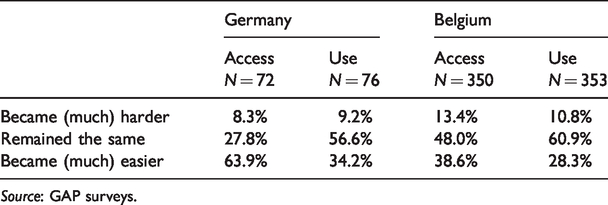
First, we asked respondents to what extent they felt that ‘it is getting harder or easier to access and use academic research and knowledge in policymaking’. The perception of access and use (see Table 1) provides an indication of the general position of academic research in policymaking and the perceived gap between both.
Perceptions of access and use of academic research in policymaking.
Source: GAP surveys.
As to the development of access to academic research, the results differ between the two countries. In Germany, almost two-thirds of respondents believe that academic research has become more accessible, whereas in Belgium, less than 40% believe that this is the case. Rather, Belgian respondents feel predominantly that access to academic research has remained about the same, and about 14% feel that it has become harder than before. Perceptions on the possibilities for the use of academic research display similar differences; yet, in both settings, more than half of the respondents feel that this has remained the same.
The findings are interesting when we link them to the trends of pluralisation and professionalisation discussed earlier: the supply of academic research has increased in both countries, but at least for Belgium, this is not reflected in more access or in more use on the demand side. Moreover, we find contrasting results regarding access and use. The findings challenge possible assumptions that improved access to academic research would necessarily lead to easier use (cf. Oliver et al., 2014). Important barriers preventing policymakers from easily using policy research remain but, as the results suggest, not all consensus-style democracies experience the same obstacles, or at least not to the same degree. It will take more systematic research to explain and understand these obstacles in each country.
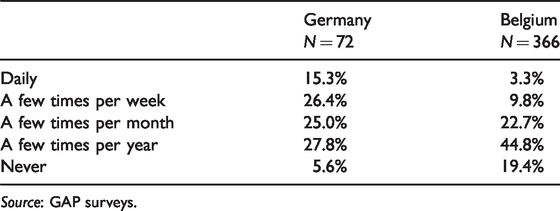
The question that follows from this, then, is the extent to which civil servants actually make use of academic research. We observe notable differences between the two countries (see Table 2), reflecting the perceptions on the development of access and use outlined earlier.
Frequency by which respondents apply arguments stemming from academic research in their work.
Source: GAP surveys.
In Germany, three-quarters of respondents use research in their policy work on a regular basis (i.e. at the least a few times per month). In Belgium, this is much lower: one-third of civil servants report the regular use of academic research. Most respondents in Belgium make use of academic research ‘a few times per year’. However, the starkest difference concerns the share of respondents who indicate that they never rely on academic research in their policy work. In Belgium, the number of non-users amounts to almost 20% of respondents, and is thereby about four times higher than in Germany. To explain their limited reliance on academic research, some Belgium federal civil servants indicated that they were mainly involved in matters of implementation, that their policy domain had little or no academic research available, or that preparing legislation generally does not require them to consult academic research.
These strong differences between the countries echo the varying institutionalisation of academic research in policymaking. Historically, academic research has stronger roots in Germany than in Belgium. Differences may also represent variegating epistemological cultures on the user side, with less Belgium respondents feeling inclined to rely on academic expertise (Brans et al., 2017a: 291).
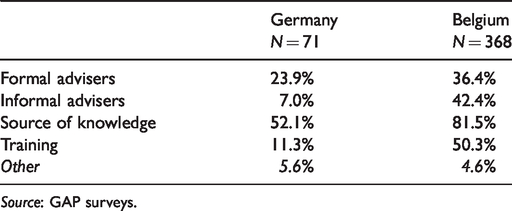
Finally, views on the role of academics (sensu stricto) in policymaking are investigated (see Table 3). Despite the question being asked differently, 4 it generates quite similar results. Most respondents in Belgium and Germany indicated that academics should function primarily as sources of knowledge in policymaking. Also, about one-quarter think that they should function as formal advisers, while only a limited number think that they should be involved as informal advisers. The role assigned by German respondents to training policy personnel is limited when compared with Belgium. This corresponds to findings from the supply side (see Blum and Jungblut, 2019). German high-ranking officials are more predisposed towards an instrumental and transparent role for academics in the policy process.
Perceptions on how academics should be involved in the policy process.
Source: GAP surveys.
In both countries, the conceptual knowledge utilisation (Weiss, 1980) of academic research in policymaking seems to take primacy over other roles – and more so in Belgium, where a majority of respondents assign value to academics offering training to policymakers. Considering that the overall use of academic research is lower, it may also be the case that there is more opportunity to fill the ‘gap’ between science and policy in Belgium in this way than there is in Germany. The instrumental use of academic research, on the other hand, is important in both settings. However, in Belgium, an informal role as adviser is favoured over a formal advisory role, whereas informal advisory roles are not esteemed in Germany. Perhaps, the crowded Belgian advisory system, with its numerous institutionalised advisory bodies consisting primarily of societal advisers, makes respondents a bit more hesitant to agreeing with a formalised role for academics on top of that as well. More generally, the results point at a core characteristic of consensual systems: their specific PAS traditions make it difficult for academics to take up a significant role as individual formal advisers. This contrasts sharply with the findings of Talbot and Talbot (2014) in the more pluralist setting of the UK.
Conclusions
To contribute to a more robust picture of academic policy advice in today’s consensus-based democracies, this article has explored the cases of Belgium and Germany, both from a supply- and from a demand-side perspective. On the supply side, both countries display significant continuity of advice in their PASs, especially regarding provisions internal to the government. In the external provision of academic research, the trends of the pluralisation, professionalisation and politicisation of advice surfaced. However, the base upon which old and new institutional arrangements of academic evidence rest is quite different. Germany has a long-standing tradition of taking up academic advice in policymaking, whereas in Belgium, institutional arrangements are more modest. Overall, we find more stability and adherence to the traditional features of consensus-seeking democracies in the Belgian case, while the German case exhibits more change. This includes a booming ‘consulting industry’ in Germany, in addition to the – at least partly – fractioned links between parties and their research institutions. Concurrently, academic think tanks and non-university research institutes have (re)discovered academic policy advice as one of their core tasks. For the demand side, the GAP survey results again indicate some similarities between the two cases, but also some notable differences that correspond to the developments described for the supply side. Overall, respondents in Germany state more frequently that access to academic research is becoming easier, and they also seem to use evidence for their policy work on a more regular basis, than in Belgium. Notwithstanding, the preferred way of ministerial officials in both countries to include academics in policymaking is as transparent ‘sources of knowledge’ rather than formal or informal advisers.
These findings point to common trends in Belgium and Germany. However, their extent and ways are also idiosyncratic. If we conceive the two scenarios posited earlier as representing the ends of a continuum, Belgium comes closer to the pole where the supply of and demand for scientific policy advice are still relatively low. Changes in institutional advisory arrangements are not reflected in a firmer place for academic research in policymaking. By comparison, Germany can be positioned closer to the other side of the spectrum, with the supply of and demand for academic policy advice being increasingly more institutionalised, and sometimes providing leverage to reaching compromises among societal stakeholders.
This article can be read as a call for more longitudinal and systematic research into the role of academic policy advice within and across PASs. It would be interesting, for instance, to investigate more closely where we can position other consensus-based democracies in Europe. The Austrian case, for example, seems to show an even higher stability compared to Belgium and Germany, with the country’s unique form of consociationalism based on political parties and associations continuing to define its PAS (Bandelow et al., 2013). The article also aimed to bridge the often separated supply- and demand-side perspectives in research on PASs. Probing deeper into this interplay seems a worthwhile future avenue for comparative case-study research. Interesting, for instance, is the observation that expert advisory bodies are increasingly taking on some of the features of boundary organisations, as is also observed in non-neo-corporatist countries (Crowley and Head, 2017). This also begs the question as to whether policy advisory systems will eventually converge in the longer run along the observed dynamics of pluralisation, professionalisation and politicisation.
Following events relating to the issue of a ‘post-factual era’ or ‘post-truth politics’, research on the role of academic research in policymaking is timely. We must be aware, though, that a decreased use of or even refusal to take up academic research in policymaking is by no means contradictory to the pluralisation and professionalisation of policy advice. Rather, an ‘oversupply of facts in the 21st century’ (Davies, 2016) may also contribute to a situation where there are too many sources of policy advice. These can then be used selectively – as expertise and counter-expertise – in political processes, thereby possibly undermining their own credibility rather than increasing it.
Footnotes
Declaration of conflicting interests
The authors declared no potential conflicts of interest with respect to the research, authorship and/or publication of this article.

Funding
The authors received no financial support for the research, authorship and/or publication of this article.