




Abstract
Ministerial cabinets hold a central place in the Belgian politico-administrative system, carrying out the bulk of policy formulation. However, they do not operate in isolation and rely on other actors of the policy advisory system for information supply and advice. They request, receive and use various advisory inputs. This article investigates how ministerial advisers utilize policy advice when they formulate policies. Based on a unique survey targeting ministerial cabinet members, it shows that policy advice utilization varies according to the source and its location in the policy advisory system. The sample consists of ministerial advisers from 11 ministerial cabinets in the two Belgian federated entities’ governments of Wallonia and the Wallonia-Brussels Federation. Ministerial advisers still predominantly use advice from the civil service, which points to the continued importance of advice provision from internal, in-house sources. However, advice from external actors – such as trade unions, civil society or consulting firms – have been observed to have rather high repercussions on policy formulation activities too. Advisory bodies appear to be very much active in supplying advice, but this same advice does not yield comparatively higher utilization scores.
Points for practitioners
This study focuses on policy advice utilization by members of ministerial cabinets in Belgium, especially when they formulate policies. It shows that internal, in-house sources remain important advice-providers and their advisory inputs still abundantly feed into the policy work carried out at the level of government. However, this article provides evidence that external sources might also supply advice that directly finds its way to decision-makers working in ministerial cabinets and that have considerable repercussions at that level too. This is the case for advice from trade unions, (organized) civil society or consulting firms, among others. Quite importantly for practitioners, our results suggest that ministerial advisers sometimes prefer controlling advisory exchanges and running separate consultations with one stakeholder at a time, instead of having to deal with collective, internal institutions that represent multiple interests, like advisory bodies. We did not observe striking differences in the degree of utilization between solicited and unsolicited advice, which means that for civil servants or stakeholders, sending policy advice previously unrequested by ministerial cabinets is not necessarily a fruitless strategy to follow.
Keywords
Introduction
Ministers usually have personal offices for support and assistance, varying in size and role. In Belgium, these offices, called ministerial cabinets, are particularly dominant in the functioning of government. Within ministerial cabinets, ministerial advisers perform a myriad of tasks and activities on behalf of executive officials and serve as an extension of ministers’ political personality (Eichbaum and Shaw, 2017: 471). A sub-group of advisers work more specifically on the formulation and the implementation of policies, while others take care of political-strategic tasks, communication, secretariat or logistics. In policy formulation, ministerial advisers take part in substantial and procedural activities (Craft, 2016). Substantial means that these activities are oriented at the definition of policy contents, while procedural activities are mainly about processes, coordination and management of the actors involved in policy delivery, for example located in ministries.
In Belgium, the bulk of policy formulation is produced in ministerial offices instead of ministries (Aubin and Brans, 2020; Brans and Aubin, 2017). The policy formulation phase is particularly information-intensive insofar as it involves preparing and consolidating proposals prior to final decision-making (Howlett and Mukherjee, 2017). Ministerial advisers are often in a position of intermediation or brokerage, trying to accommodate the policy positions and preferences of ministers, public servants, non-state actors and stakeholders. They gather and integrate the contributions of other actors in policy formulation (Eichbaum and Shaw, 2017: 472). This article focuses precisely on these “bridging” activities, which refer to the process-based integration of advisory inputs by ministerial advisers (see Craft, 2015). Currently, little is empirically known about how ministerial advisers use policy advice. Where does policy advice come from and how is it used in top governmental circles, especially in policy formulation activities? Why is policy advice more extensively used in some circumstances than in others?
This article presents results from an original survey conducted in the Belgian federated entities’ governments of Wallonia and Wallonia-Brussels Federation (FWB), between 2018 and 2019. Considering that mere description can already reveal a lot about social and political phenomena (Gerring, 2012), we largely rely on descriptive statistics to show how policy advice is used in ministerial offices. We also attempt to examine some of the characteristics of the advice that comes across not only as most frequently mentioned, but also as most intensely used by ministerial advisers. This allows to empirically test theoretical expectations derived from studies on the operations of policy advisory systems and patterns of advice circulation and utilization therein.
Firstly, we review the literature on policy advisory systems and ministerial offices. Secondly, we present the analytical framework based on policy advice utilization conceptualization and the identification of some of its conditioning factors. Thirdly, we tackle case selection and methodological issues such as survey data collection and analysis. Finally, we report and discuss results to make sense of the observed patterns of policy advice circulation and utilization.
Ministerial offices in the policy advisory system
Since the 1990s, scholars have proposed analytical tools to classify and locate policy advisers. This perspective has moved away from an actor-by-actor approach to understand policy advisory systems as a whole, which are defined as systems “of interlocking actors, with a unique configuration in each sector and jurisdiction, who provide information, knowledge and recommendations for action to policy makers” (Craft and Howlett, 2012: 80). Accounts of policy advisory systems sometimes take a dynamic turn where shifts toward the outsourcing, externalization or re-internalization of policy advice are pinpointed within specific sectors (Hustedt and Veit, 2017; Veselý, 2013).
Thus defined, policy advisory systems include a whole range of actors who coexist and interact. They may be internal – including ministerial government, the bureaucracy and wider public sector – or external – that is, non-state, societal actors or private organizations (Craft and Howlett, 2013). Within advisory systems, ministerial advisers occupy a special position in that they are both receivers/users of advice (both internal and external) and providers of advice (to the ministers). They transform and adapt advisory flows to the necessities of policy work (Hustedt et al., 2017; Shaw and Eichbaum, 2010, 2018).
We argue that it is important to consider ministerial advisers as consumers of policy advice, rather than just being simple producers of advice for ministers. In previous research specific to policy advisory systems, the use of advice has often been addressed at the macro or meso levels of policy sectors or organizations. In this article, we shift the focus onto the micro-level of individual users working in ministerial offices, which represents a new empirical contribution to the fields of inquiry about ministerial advisers and policy advice. Moreover, the analysis of policy advice as an informational or knowledge base, along with its characteristics, enables examinations that are more grounded and embedded in ministerial offices’ practices.
Policy advice utilization in ministerial cabinets
This section defines policy advice utilization and meets the challenges of its measurement. Furthermore, a series of conditions for policy advice utilization are identified and put forward.
Policy advice and the gradual process of utilization
Conceptual vagueness still characterizes the definition of policy advice. A first definition considers that policy advice covers the “analysis of problems and the proposing of solutions” (Halligan, 1998). A second view understands policy advice as offering “suggestions and support for action, not the action itself” (Veselý, 2017: 143). Based on these, we define policy advice as a piece of information concerning policy, which is processed in order to help and/or influence an actor to make a decision. Against this background, advice does not correspond to raw information, facts and data (for example, statistical reports about unemployment rates). Indeed, in addition to being informative, policy advice remains a more or less transformed and interpreted message pointing at directions for decision-makers to take action (Barker and Peters, 1993: 10).
Policy advice utilization is not conceived as a mere and instantaneous transmission of a “message” to a receiver, but rather as a process of acquisition, understanding and mobilization. This process takes several stages, which together constitute a progressive scale of utilization (Knott and Wildavsky, 1980; Van de Graaf and Hoppe, 2006). For the purpose of operationalization, we have adapted the knowledge utilization scale (Landry et al., 2001b) to advice utilization in ministerial cabinets (Figure 1).

The five stages constitutive of the policy advice utilization process. Source: Adapted from Landry et al. (2001b).
In the first stage of utilization, after having received policy advice, ministerial advisers simply take note of it (cognition). Advisers may then refer to the advice, mentioning it in internal written or oral exchanges with colleagues (second stage, reference). In a more advanced stage of use, advisers adhere to the advice and promote it so that other ministerial cabinet colleagues recognize its merits (third stage, effort). In the fourth stage (influence), policy advice comes to influence a minister's position, choices and decisions. Finally, in the highest stage, the advice leads to concrete measures partially or fully derived from it (application). We use this stage model to operationalize policy advice utilization by ministerial advisers.
The conditions for policy advice utilization
In this section, we turn to the conditions for policy advice utilization, based on two main advice characteristics: the source of information and the initial solicitation of advice. First, intrinsic characteristics of policy advice should affect how it is used. Like any means of communication, policy advice includes, in addition to the contained message, a sender (here, the advice-giver), a medium and a receiver (here, the advice-taker). It appears that decision-makers are more sensitive to the sender (or source) of information and, by the same token, to its reputation, than to informational content and qualities (Doberstein, 2017).
There are potentially countless sources of advice within a policy advisory system. From a pluralistic perspective, a policy advisory system is analogous to a marketplace where policy ideas are supplied and seek to meet demand, with intermediaries facilitating exchanges (Craft and Howlett, 2012; Maloney et al., 1994). Policy advisory systems are viewed as relatively open spaces, where potential advice-providers coexist and compete for government attention. Access to government is not equal, however, and depends on the nature of the actor network (e.g. pluralist, neo-corporatist, etc.), resources of the advice-giver, and its ideological congruence with the government (Craft and Wilder, 2017).
Policy advice literature suggests that the location of a source matters substantially in the take-up of advice (Craft and Howlett, 2012; Halligan, 1995, 2001). In conformity with locational models, the source of advice is valued as a function of its proximity to the government. According to Halligan (1995, 2001), proximity proceeds from a source location closer to the government and a higher government control over the source. Location is either internal, typically when advice comes from ministerial offices (i.e. ministerial government), public service (including agencies), legislatures and advisory bodies, or external, when it comes from social partners, interest groups or civil society, among others. We thus formulate the following hypothesis (H1: “proximity hypothesis”): the closer an advice-giver is vis-a-vis the government, the more likely the advice should be used.
Actors external to the government (re)gain centrality and importance within the policy advisory system if their advisory inputs can be more easily controlled by governments (Halligan, 1995, Veselý, 2013). Conversely, internal advisory sources should sometimes be sidelined insofar as the government has little control over them, for example statutory civil servants or formal, permanent (as opposed to ad hoc) advisory bodies. Crucially for ministerial cabinet actors, greater controllability of policy advisory inputs means more responsiveness to their needs and desiderata (Craft and Wilder, 2017). We thus put forward the following hypothesis (H2: “government control hypothesis”): government control over the source of advice reinforces proximity dynamics and hence should foster policy advice utilization.
A second characteristic of advice emanating from the relevant literature is whether the advice is requested by ministerial advisers or ministers (see Bossens et al., 2014). An initial request by users makes for a more optimal matching between the demand and supply sides of advice. Solicitation is also linked to the notion of timing in advice-provision (Veselý, 2013: 202). Solicitated advice is more likely to come to ministerial offices in a timely manner. Otherwise, without previous solicitation, there is a greater risk that organizations supply advice that is unwanted and uncalled-for by ministerial offices. Therefore, we expect that advice that is neither requested nor expected, or that is the result of an imposed consultation, should be less used. Conversely, advice that is solicited is more likely to be used (H3: “solicitation hypothesis”).
A survey of ministerial advisers in Belgium
Case selection
Belgium, once a unitary state, has undergone processes of federalization, which have led to the creation of two types of federated entities: regions and communities. Both the federal government and federated entities have their own exclusive competencies, with no hierarchy between the laws of the former and the latter (i.e. principle of equipollence of norms). 1 Regions (Wallonia, Flanders and the Brussels-Capital Region) are mainly responsible for economic matters, and communities (French-, Flemish- and German-speaking) for “personalized” matters (education, culture, sport, etc.). Each government acts in its own field of competence and in its own jurisdiction.
Choosing the two French-speaking Belgian governments as case studies is owing to the complexity of the Belgian federation (government resignations, coalitions, regional divide, three different spoken-languages, etc.), but offers good validity and generalizability. Belgian federated governments work on the preparation of policy proposals, which are submitted to parliaments, followed by legislative outputs. Moreover, regional and community governments, when combined, already cover a large field of competencies. 2 Therefore, the size, scope and functioning of these governments are quite comparable to those of national governments.
Currently, each minister disposes of a cabinet (a maximum of nine ministers in Wallonia and eight in Wallonia-Brussels Federation). For a matter of transparency, lists of ministerial cabinet members are published on the governments’ official websites, but remain indicative only. However, these lists make it possible to estimate staff size in ministerial offices. In 2018 (that is, the period of the study), on average there were 61 ministerial advisers per minister in Wallonia and 52.5 per minister in the Wallonia-Brussels Federation. 3
In Belgium, ministerial cabinets are largely made up of seconded civil servants, but also of contractual advisers who may previously have worked in politics (party activists and professionals), in the private sector or other sectors (non-profit etc.). Once appointed (usually by ministers and/or political parties), these individuals cease to be impartial to become inherently partisan-political characters. In a political system like Belgium, ministerial cabinets have an important function of communication, negotiation and coordination with other coalition partners, and have to make sure that the coalition agreement is respected. Beyond partitocratic or partisan functions, they are both a source of personal loyalty for ministers (Walgrave et al., 2004) and of expertise relevant to policymaking (Brans et al., 2017). Lastly, one of the key functions of Belgian ministerial cabinets is to take care of policy formulation, which differs quite considerably from other countries where policies are mostly produced by middle-range or high civil servants, like in the neighboring Netherlands (Brans et al., 2006).
Surveying ministerial advisers
We conducted an online survey from June 2018 to April 2019 using Limesurvey. The questionnaire consisted of 35 questions, among which several were optional. A first part included questions about advisers’ profile and function; while in a second, the adviser had to recall a recent policy proposal (here specifically, a draft piece of legislation), on which background and contextual questions were asked. In the third part, the adviser had to give answers about a first piece of advice, specifying the use that had been made of it. Giving answers for a second and third piece of advice on the same policy proposal was possible.
The survey was not sent to the entire ministerial office team but only to ministerial advisers involved in policy work. We contacted each ministerial adviser individually by email. Survey participation was subject to prior written agreement by the responsible minister and the cabinet itself provided a contact list of ministerial advisers. We took those precautions in order to avoid a blockage at the beginning of the survey and to ensure that an accurate list of ministerial advisers was available.
Responses were obtained for 125 pieces of policy advice, and from 113 ministerial advisers working for 11 of the 14 ministerial cabinets of the two governments, and for 10 ministers in total. All three political parties of the two ministerial governments were represented. 4 While the finite and exact population of ministerial advisers is virtually impossible to determine, it is possible to give estimates about survey coverage. With a maximum of 250 to 300 ministerial advisers involved in policymaking, the survey covered at least 30% to 40% of the overall targeted population. The survey response rate (i.e. ratio between the invitations sent and the number of returned questionnaires) is 67.7%, which is particularly high for both an online survey and research on ministerial cabinets.
Variables' operationalization
Measuring policy advice utilization
The magnitude of policy advice utilization is measured for each of the one to three pieces of advice selected by respondents, using a scale adapted from Landry et al. (2003). With regard to the magnitude of policy advice utilization, the question is worded as follows: “To what extent do the following statements describe the utilization that was made of this piece of advice?”. Five items were then proposed to respondents, each of which reflecting a stage or gradient of the utilization process.
5
For each item, responses were mandatory to progress into the questionnaire, and respondents had to place the cursor on a point of a scale ranging from 0 (“not at all”) to 10 (“completely”):
Cognition (item 1): I read, understood and assimilated the piece of advice; Reference (item 2): I made reference to the piece of advice in written or oral communication with colleagues or my minister; Effort (item 3): I endorsed the piece of advice and defended it in front of other colleagues or my minister; Influence (item 4): The piece of policy advice successfully influenced my minister; Application (item 5): The piece of advice contributed to the implementation of concrete policy measures deriving from it.
The overall intensity of the utilization process is measured by a utilization index that includes all five items. Scores associated with the five gradients of utilization are weighted to give them increasing importance from the first to the second, from the second to the third, and so on.
6
The score for the first item is weighted with 1, the second with 2, the third with 3, and so forth.
7
For example, a piece of advice rated 10 on each of the utilization items, after weighting, would obtain a score on the average utilization index of 10. An advice rated 10 on the first four items and 9 on the last one would obtain a utilization index score of 9.6. Finally, an advice rated 9 on the first item and 10 on the other four would obtain a score on the utilization index of 9.93. Therefore, the weighting means that a small change in use at the top of the scale has a greater impact on the index than an identical small change at the bottom. The idea is to give extra weight to a more definitive instrumental use of policy advice as opposed to mere consideration or reference.
Measuring the conditioning variables of policy advice utilization
Two main characteristics of advice are expected to condition utilization: the source of advice ( = provider) and solicitation/request by ministerial offices. With regard to advice providers, the first conditioning variable, survey respondents answered the following question: “What was the source of this specific piece of advice?” by selecting a response from the 16 proposed categories (see Table 1). List effects were mitigated with random changes for each respondent in the order of appearance of categories.
Sources of policy advice, proposed categories.
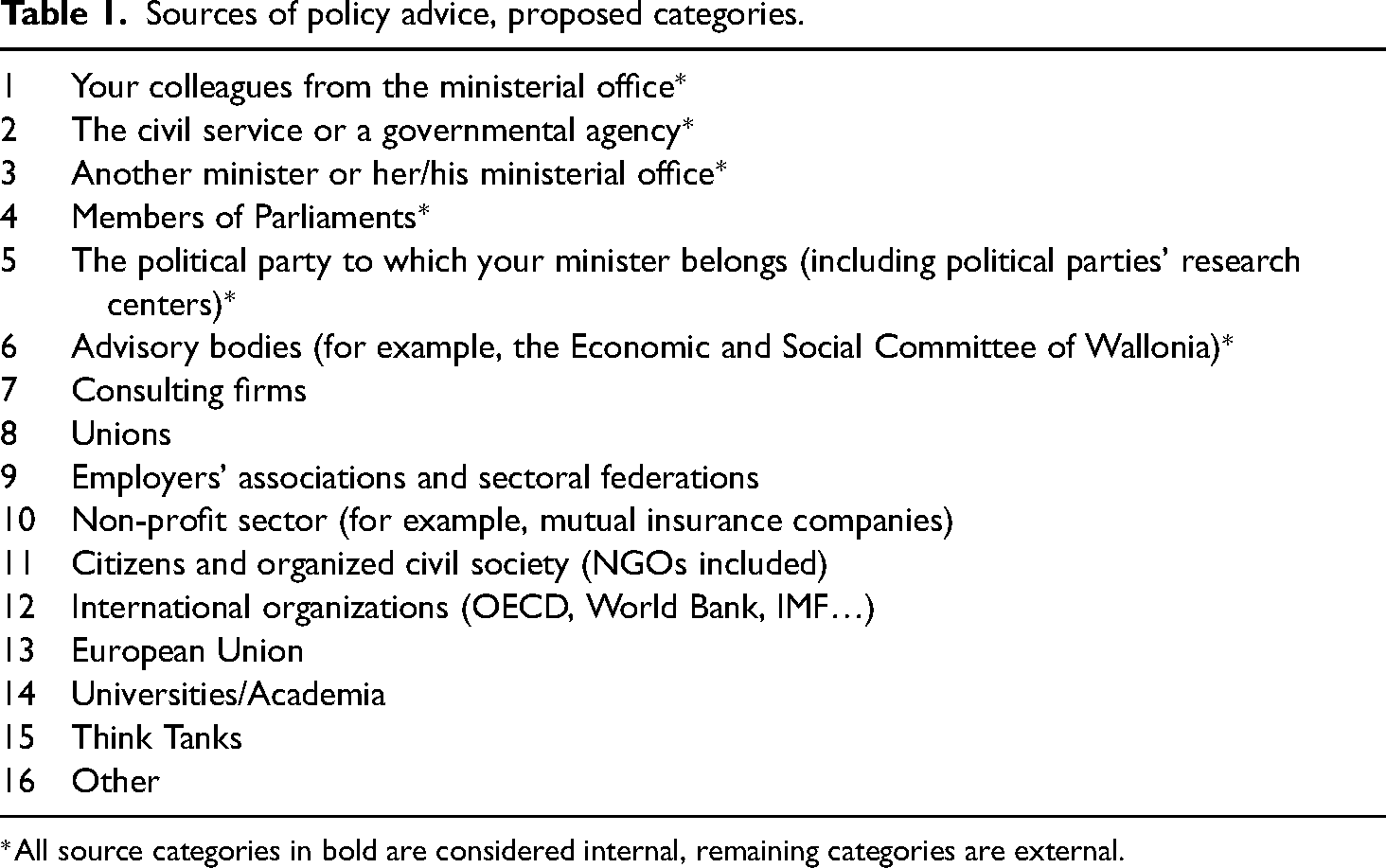
All source categories in bold are considered internal, remaining categories are external.
We did not ask respondents to name the organization providing the advice in order to de-personalize answers and ensure that advisers did not have to point to a specific organization. The goal was to avoid socially desirable responses or even no response at all.
Regarding the second conditioning variable, the desired or solicited nature of the advice, we asked the following question: “Have you received this piece of advice because you asked for it in the first place?”, with a binary response choice “yes–no”.
A fairly high utilization overall
Looking at pieces of advice ( = our basic units of analysis) described by the 113 respondents, those are, on balance, quite extensively used. The mean of the weighted magnitude of utilization is 6.97 and the median is 7 on a scale from 0 to 10 (see Table 2). Considering a standard deviation of 1.76, the variable has relatively little dispersion. This higher-than-expected utilization of advice is partly imputable to ministerial advisers self-selecting the pieces of advice they were responding about, choosing advice that was particularly significant in their eyes and made an impression on them.
Policy advice utilization index, overall scores (weighted).
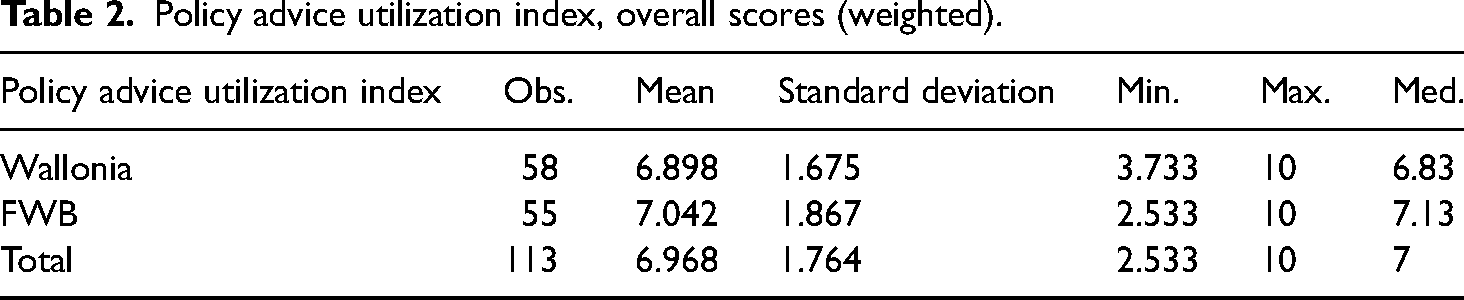
The overall, aggregated policy utilization scores also vary by cases (see Table 2 above). The magnitude of policy advice utilization is, on average, slightly higher in Wallonia-Brussels Federation than in Wallonia. Decomposing the index back to its five original component items shows fairly high averages for the more advanced stages of utilization (see Table 3 below). Logically, the average (unweighted) utilization scores generally follow a downward trend, moving from one stage to the next. The later stages generate less utilization (Figure 2).
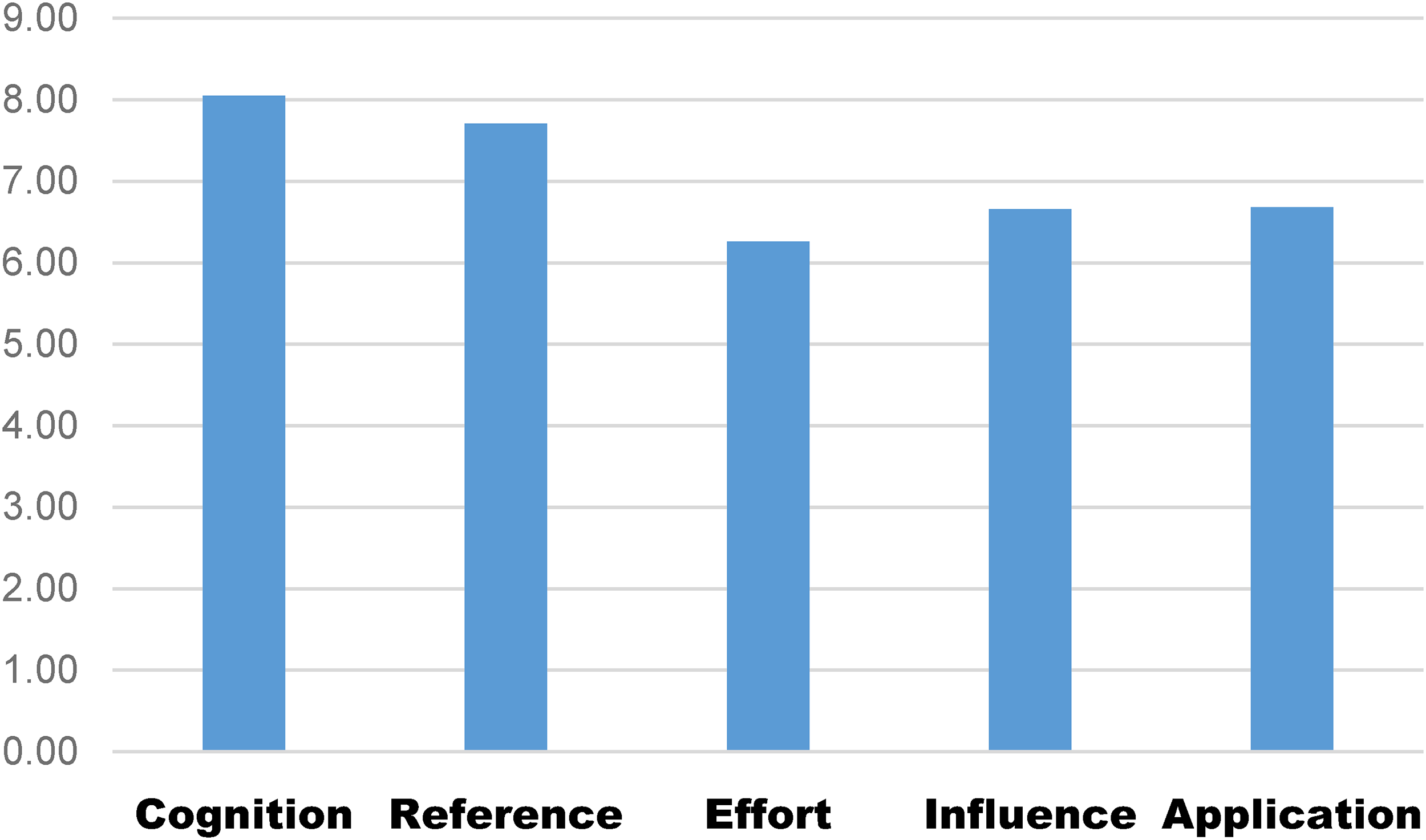
Bar chart of policy advice utilization by stage.
Policy advice utilization, by stage.
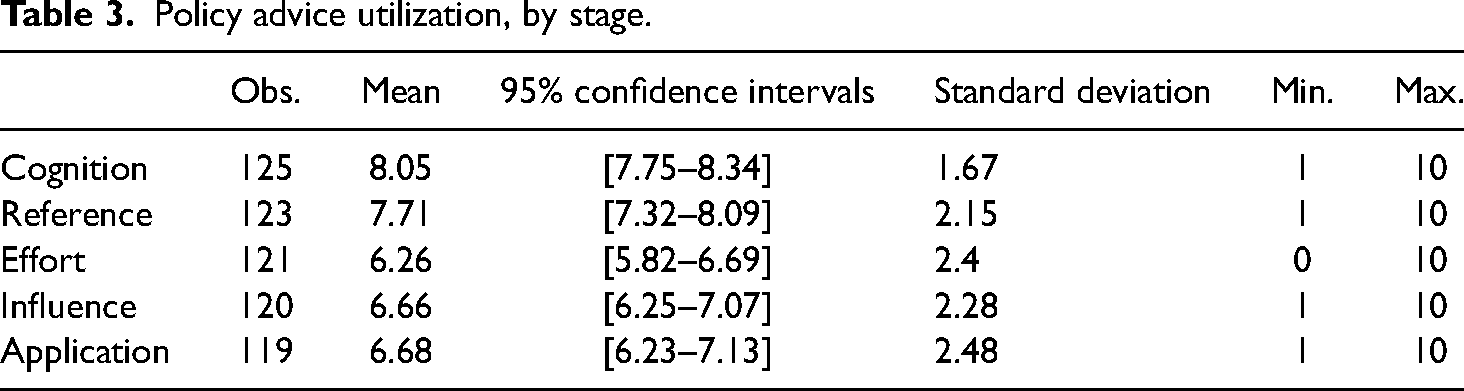
There is, however, a slight discontinuity between the “effort” stage, and the “influence” and “application” stages. These two final stages overlap almost perfectly – that is, any advice that succeeds in influencing a minister would more be more likely to generate concrete policy measures. The “effort” stage may be more behaviorally demanding for ministerial advisers (i.e. endorsing, pushing and championing some advice). At the same time, it may infrequently happen that a single piece of advice is so remarkable that a ministerial adviser becomes its supporter and passes it on to other cabinet colleagues. That may be why the “effort” stage yields comparatively lower utilization average scores.
A high utilization conditioned by advice characteristics
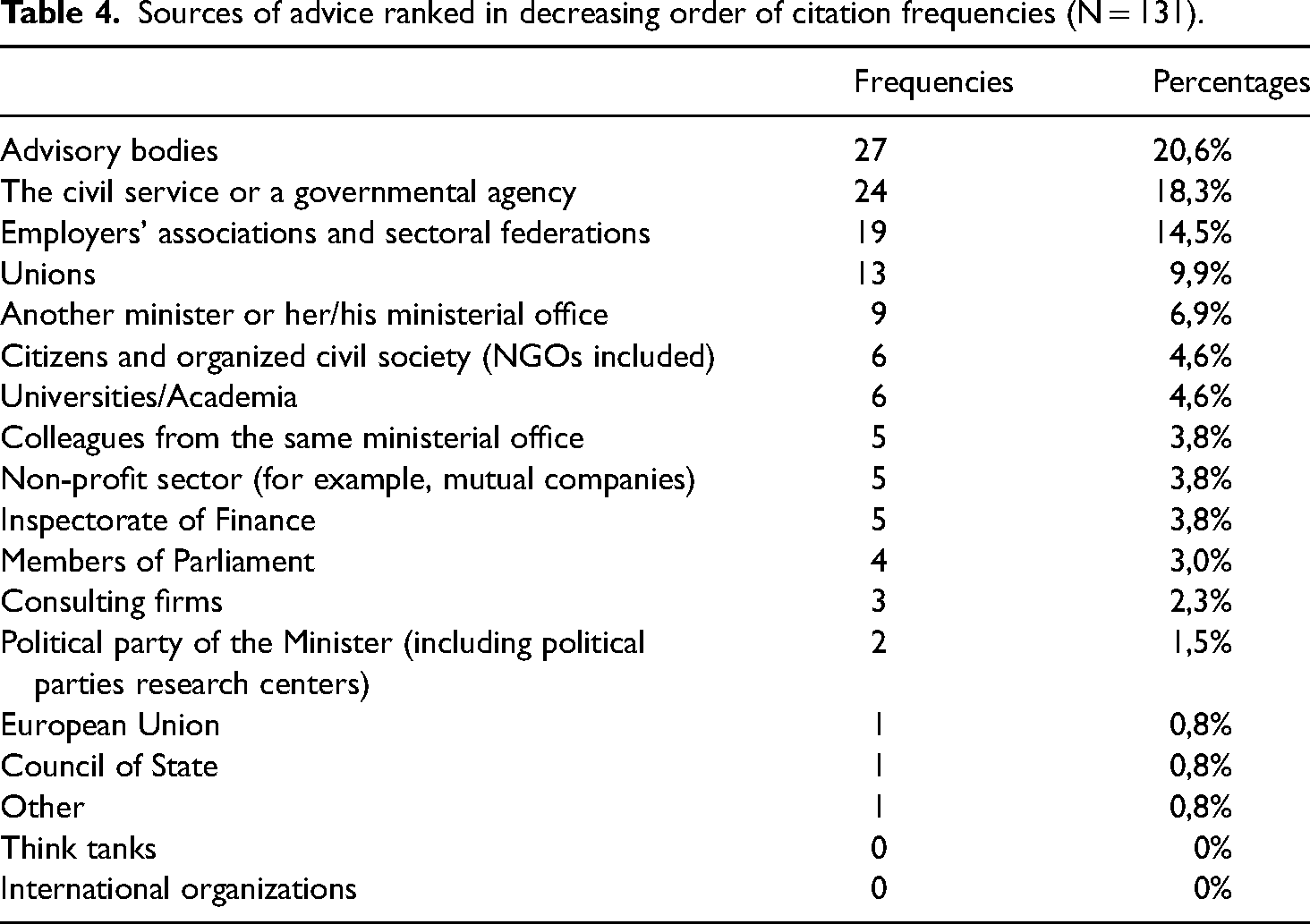
This section presents the apparent saliency and ascendency of certain advisory sources used by ministerial advisers, and the destinies of solicited or unsolicited advice. The frequencies of citation show which source categories were selected by respondents in the survey – that is, the ones the advisers think of first (see Table 4). In terms of internal sources, ministerial advisers more readily think of advisory bodies, the civil service and governmental agencies, other ministers or their offices. As for external sources, social partners (unions and employers) are clearly in the lead. Advice of civil society and academics is much less frequently mentioned. This reliance on internal, in-house advice is consistent with previous research on Belgian civil servants (Aubin and Brans, 2020). Here, we also find the possible effects of the neo-corporatist regime and its arrangements on policy formulation activities. The pieces of advice that left the most lasting impression on the minds of ministerial advisers are those from institutional consultations or those of actors most present and influential in this regime, namely social partners. The flow of internal advice remains important; equally concerning cabinet members and civil servants, even if it appears that on average ministerial advisers are more in contact with private actors or stakeholders than civil servants in their quest for information. While consultations with advisory bodies (which may be imposed), could be judged as excessively formal and not very significant, ministerial advisers have a different perception of them and seem to take them seriously, given how often advice coming from these bodies is mentioned in the survey.
Sources of advice ranked in decreasing order of citation frequencies (N = 131).
In order to make finer distinctions between actors providing advice, sources are cross tabulated with their associated utilization scores (see Table 5). Surprisingly, policy advice from academia, as a knowledge producer (Craft and Howlett, 2012), generates the highest usage scores. However, this result must be relativized because of the low number of occurrences, which once again suggests that respondents only thought of commenting on the type of advice that particularly influenced them.
Policy advice utilization by source categories.
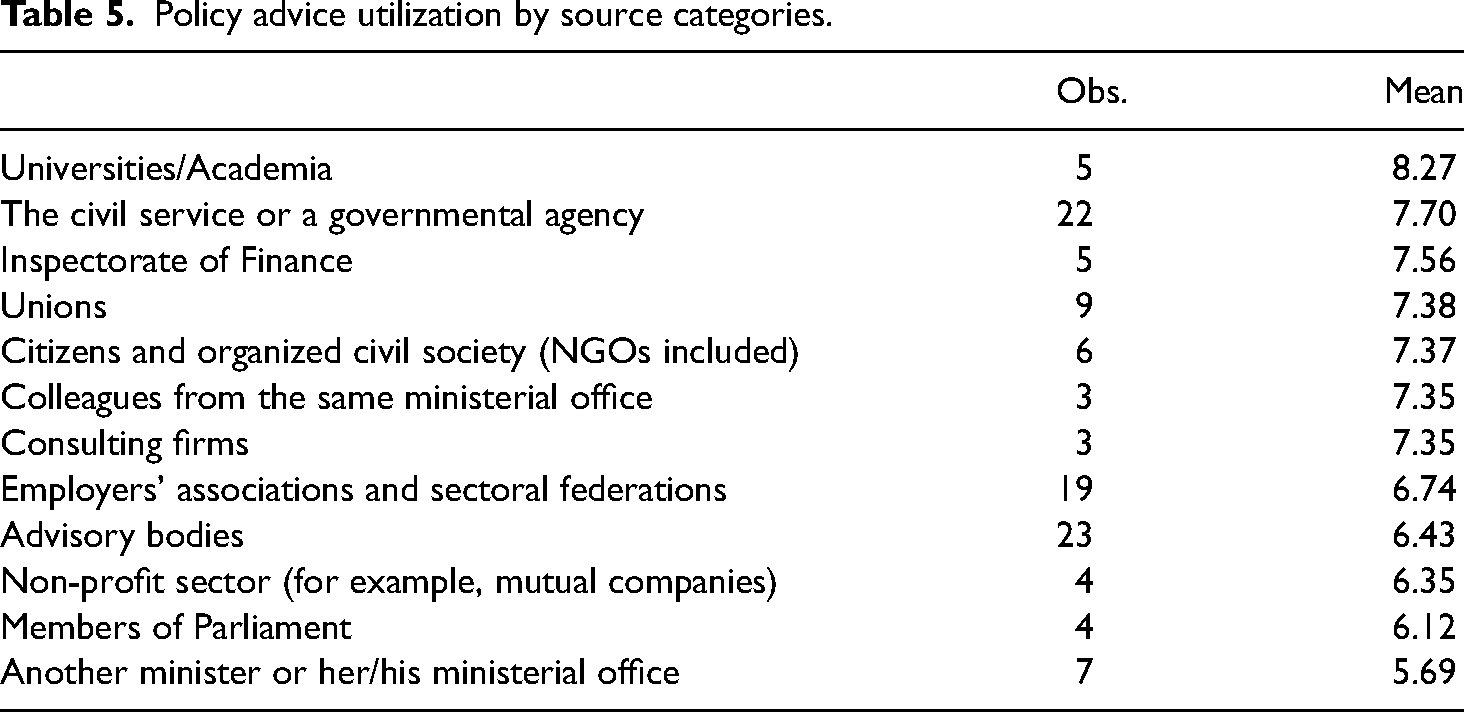
Second, policy advice most extensively utilized came from the civil service and public agencies. Respondents mentioned this advice very often too, demonstrating the importance of advisory input from the bureaucracy (Brans and Fobé, 2021), even into the policy work of ministerial offices. Although this may seem obvious at first glance, it remains that both civil servants and ministerial cabinets would at times express little trust in each other. Public servants might feel excluded and believe that ministerial offices work in isolation (Eraly and Göransson, 2018), and, in turn, ministerial advisers sometimes complain that they are not sufficiently supported by bureaucrats. These results clearly show the interest of this type of survey, which, through factual questions, might come to challenge preconceptions or commonplace ideas. The Inspectorate of Finance, which is an administrative body that the respondents added on their own initiative in the “other” response category, is also very much followed in its advice.
Within the executive branch, advice from colleagues working in the same ministerial office is used more significantly than advice from other ministers or their offices. However, the number of occurrences is lower for the former, which can be indicative of a pyramidal work organization where each adviser follows his or her own files. Policy advice from other ministerial cabinets is certainly frequent because of the important coordination work done by those same offices in a multi-party coalition government (Göransson and Eraly, 2015). Advice coming from the legislative branch (i.e. Members of Parliament) do not reach a high level of utilization either.
When engaging with stakeholders, ministerial advisers receive policy advice from a variety of sources as well. Although advisory bodies are the most frequently cited, it is not their advice that achieves the highest utilization scores, but the advice of unions taken separately. Quite singularly, the advice of business and industry federations is more frequently cited but less used than that of trade unions. The few instances of advice cited from citizens and civil society (excluding non-market sector organizations, counted as a separate category) score high in utilization. Consultancy firms, which are used to assisting the Walloon Government at the stage of policy formulation and evaluation (Fyalkowski and Aubin, 2013), are not mentioned very often, even though their advice is utilized to a relatively high degree.
It was expected that solicited advice would potentially be used more extensively than advice sent to cabinet advisers on their own initiative. Results show that this is not the case (see Table 6). The two types of advice reach similar utilization scores, with unsolicited advice yielding slightly higher utilization scores. This tends to undermine the “solicitation hypothesis” (H3). Consequently, we will not come back to these results at lengths in the discussion. It is nonetheless interesting to note that ministerial advisers take an active part in soliciting advice and hence are not passive recipients within policy advisory systems. It also shows that it may not be futile for public servants or interest groups to take initiatives and send policy advice to ministers and their entourage.
Policy advice utilization if solicited or unsolicited.

In closing, policy advice characteristics seem to affect utilization. Advice citation frequencies and utilization scores vary quite markedly depending on the sender, whereas the solicited nature of advice is apparently not associated with significantly higher utilization.
Discussion and conclusion
Belgian ministerial advisers think first and foremost of policy advice from sources internal to the public sphere, like the civil service (i.e. ministries and public agencies) or the Inspectorate of Finance, from the executive branch, or of private, societal actors sitting in organizations internal to government, such as permanent advisory bodies. Advisory bodies are an integral part of the Belgian political regime, with consensual functioning and neo-corporatist features (Fobé et al., 2017; Pattyn et al., 2022).
Not only is internal advice frequently mentioned, but it is also among the most extensively used. This is in-line with our expectations (H1: “proximity hypothesis”) based on locational models, emphasizing proximity to government and a core executive, public or private sector insiders’ advantage over more peripheral actors and outsiders (Halligan, 2001). Internal advice-providers tend to enjoy a privileged position in Belgium's policy advisory systems; they remain determinant and significantly affect policy work in ministerial offices. Nevertheless, this assertion comes with one exception: within the internal arena, the advice of other ministerial offices appears frequent but at the same time more disregarded and less decisive. This might be owing to the principle of ministerial responsibility, which would generate a sort of division of labor between ministerial offices, not without consequences on advisory exchanges between them. Coalition governments and hence different political sensibilities across ministerial portfolios might further hinder advisory linkages with ministers and ministerial offices that are not from the same political party.
Although internal sources remain central in the production and use of policy advice, the full picture is more mixed because external or peripheral actors release policy advice that is also largely used. This is noticeably the case for the advice given by academia, trade unions, organized civil society and, to a lesser extent, consulting firms (Sturdy, 2021). Advice from these externally located actors taken individually seems to generate more extensive use in ministerial offices, than advice channeled through permanent advisory bodies, where some of these external, societal actors are also represented. Therefore, policy advice may take different routes, not necessarily with the same fate in terms of utilization: a direct route from external actors straight to ministerial offices and another, more indirect, where advice from external actors like trade unions, is mediated and possibly diluted through collective consultations and negotiations occurring within advisory bodies. Based on our results, it would appear that ministerial advisers sometimes prefer direct advisory exchanges with one organization at a time and to run separate consultations with each stakeholder, rather than dealing with collective institutions that represent multiple interests. In such institutions, it would be more difficult for ministerial advisers to both control and isolate signals and advisory inputs, and to discover the genuine policy position of one single organization. Hence, it appears that research about policy advisory systems was quite right in emphasizing controllability of advice in addition to the location of its source. The “government control hypothesis” (H2) thus receives partial support. Besides, regarding consultancy firms, the purchasing of policy advice may explain the higher-than-average utilization scores. These findings about advice utilization from external sources are noteworthy and speak to the argument that policy advisory systems have undergone some degrees of externalization (Veselý, 2013).
Some sources of advice are conspicuous by their absence among the actors mentioned. None of the respondents ever mentioned any advice from think tanks. This confirms the weakness of these actors in Belgium and especially in Wallonia where they are marginal (Fraussen et al., 2017). The case of the political parties’ research centers is also striking. Possibly, these actors are more active in the background, bring a support function and intervene only occasionally in case of politically sensitive issues or a lack of expertise. Supranational and international organizations, including the European Union, are advisory actors that appear little present.
Future research, possibly adopting a different methodological approach (e.g. ethnography), should be able to confirm, question or complete this study's findings, by uncovering the various flows of advice circulating towards ministerial offices, and especially the reason why some advisory inputs may figure more prominently in policy formulation activities. Policy advice utilization patterns may also differ between policy domains (Burstein, 1991), or may depend on ministerial offices size, as smaller cabinets should have weaker internal policy capacity and therefore should push cabinets to rely even more on outside actors. This remains to be established empirically by future studies.
To conclude, the most decisive advice is not necessarily internal, even if it abounds and comes out as well utilized. Some external advice might find its way into ministerial offices and have considerable incidence at the level of ministerial governments. It also appears that unsolicited advice may have significant repercussions in policy work as well, perhaps because of the unexpected, “out-of-the-box” ideas it conveys. Advisory flows do not strictly equal one another in policy formulation.
Footnotes
Declaration of conflicting interests
The author(s) declared no potential conflicts of interest with respect to the research, authorship, and/or publication of this article.
Funding
The author(s) disclosed receipt of the following financial support for the research, authorship, and/or publication of this article: This work was supported by the FNRS, (grant number T.0252.16).
