




Abstract
We argue that “analytic” bureaucratic agencies are essential actors in the policy process because of their role acting as both information processing organizations and policy design specialists. Analytic agencies can exert unique influence over lawmaking activities because legislators consider them expert informational sources in a multitude of areas. Rather than assume policy advice falls rigidly into either “political” or “technical” forms of information, we show that an analytic office can produce both types of content. Whereas previous policy process scholarship almost exclusively examines elected officials and federal agencies, this article tests our theory using a state agency, California's Department of Finance (DOF). Our findings demonstrate how the Governor delegates partisan legislative signaling duties and neutral expert budgetary advice to the same trusted analytic personnel. The data include every introduced bill in six recently completed legislative sessions and show how DOF recommendations are strongly associated with bill passage and the Governor's veto.
Keywords
Introduction
Even literature that affords special attention to bureaucracy has mostly ignored the importance of bureaucratic actors during the initial policy design and projection phases, instead focusing on policy implementation (Pressman & Wildavsky, 1984; Sabatier, 1986), problem identification (Workman, 2015; Workman et al., 2017), and solution development (Wilson, 1989). In addition, recent work analyzing bureaucratic involvement in the early stages of the legislative process focuses on area-specific personnel (Bradley & Haselswerdt, 2018; Kroeger, 2022a), neglecting the essential role occupied by analytic bureaucrats whom policymakers regularly rely on for essential information and expertise. In light of the above discussion, we seek to answer the following question: how do analytic bureaucratic agencies influence the policy process?
This study adds important nuance to the bureaucratic politics literature by demonstrating how “analytic” agencies tasked with bill analyses, revenue projections, and policy recommendations occupy a central role in lawmaking. Instead of examining individual legislators or bureaucrats dedicated to service delivery, we argue that analytic agencies should be examined in greater detail to obtain a fuller portrait of what determines the failure and passage of legislation. How these trusted bureaucratic agents impact the outcome of legislation is an understudied question largely ignored in extant scholarship.
We begin with an overview of the rich literature detailing bureaucratic information processing and its relationship with legislative signaling. By integrating arguments from the agenda-setting and bureaucracy literatures, we argue that specialists in analytic bureaucracies occupy a vital role in the policy process. Incorporating the insights of these actors is a critical but often overlooked step toward understanding why some bills fail while others pass. The article proceeds by presenting the data, which includes every introduced bill in both chambers of the California legislature from 2007 to 2018, along with bill analyses and recommendations produced by the Department of Finance (DOF), the Governor's “chief fiscal policy advisor.” 1 After demonstrating that the recommendations by the DOF are tightly linked with bill outcomes, we discuss the findings and highlight avenues for future research.
Theory and Hypotheses
Information Sources and Legislative Signaling in the Policy Process
Although legislators are not intentionally recruited to be experts in any single policy area, they are often expected to choose among sophisticated policy options with limited resources. Responding to constituent concerns, raising campaign money, and developing a policy agenda requires vast resources and are impossible to accomplish alone. These persistent demands force legislatures to serve as information processing systems (Porter, 1974) to collect, assemble, and prioritize the multitude of signals from the environment (Jones & Baumgartner, 2005). Coordinating the varied streams of information essential to assembling a policy agenda is a challenging endeavor requiring legislative expertise and deep knowledge of the policy process. Because legislators are frequently overburdened with diverse duties, the crucial responsibility of information processing often falls upon legislative and bureaucratic staff. As such, legislators offload essential information processing duties to trusted bureaucratic agents and staff to maximize policymaking efficiency.
Well-compensated bureaucratic staff dedicated to providing expert information to legislators has long been a feature of state and federal policymaking in the United States (Boushey & McGrath, 2017). Kingdon's (1984) seminal text provides some of the first evidence of how information processing staff set the policy agenda. In interviews with senior bureaucratic personnel, Kingdon notes how the Office of Management and Budget (OMB) and Council of Economic Advisors (CEA) provide information used in policy formulation (1984, p. 26). Among these essential staff is the OMB Budget Examiner, who reviews and comments on draft documents prepared by congress at multiple stages of the legislative process (Johnson, 1988). Not only does the OMB budget examiner provide a wealth of institutional knowledge to policymakers, but also the role acts as an advocate for the president's policy priorities with various interest groups and the public (Johnson, 1989). Moreover, elected officials must pursue and listen to information from experts to define problems, construct policy solutions, and ultimately enact policy to satisfy constituent demands (Baumgartner & Jones, 2015). It is unsurprising that these “insider” sources (Mooney, 1991) play key roles at multiple stages of the lawmaking process given the “bottleneck of attention” present in all large organizations (Jones & Baumgartner, 2005). Therefore, the limited information processing resources present in individuals and organizations often requires problem-solving by expert bureaucrats dedicated to a particular policy area (Baumgartner & Jones, 2015). And because legislatures are information-rich environments, the prioritization of information by bureaucratic personnel frequently determines legislative outcomes.
Contrary to previous studies that have documented policy signaling through more direct channels such as bill sponsorship (Rocca & Gordon, 2010) or legislative cue taking (Box-Steffensmeier et al., 2015), we argue that legislators can signal policy preferences through trusted information processing bureaucratic staff, similar to the role occupied by the OMB budget examiner (Johnson, 1989). In an era where legislative activity is declining and policymaking has shifted more toward the oversight of bureaucratic agents enforcing existing law rather than developing new laws (Lewallen, 2020), legislators communicating their policy preferences through bureaucratic staff has received surprisingly little attention.
When legislators communicate their policy preferences, it is often done during the drafting and amendment phases of the legislative process (Katzmann, 1989). Although scholars have examined how the president can become involved early in the lawmaking process to pursue policy goals (Beckmann, 2010), little has been written that details how these negotiations involve bureaucratic aides. Kernell (2005) and Hassell and Kernell (2016) provide detailed accounts of how Statements of Administration Policy (SAPs) communicate the policy preferences of presidential administrations to legislators. Since the 1970s, the OMB has issued SAPs to signal the administration's support or opposition to legislation at late stages of the legislative process; most SAPs are sent to congressional leaders as the bill receives its first floor consideration in either chamber. The White House also occasionally sends a “threatening” SAP in reaction to a legislative defeat at some stage in the policy process (Kernell, 2005). Although SAPs provide a good measure of the President's policy agenda, they are produced for only a fraction of introduced bills. 2
“Analytic” Bureaucratic Agencies
Analytic bureaucracies perform the critical function of expanding the information processing capacities of policymakers by providing them with expert information required for policy development. Expert information supplied to elected officials by analytic agencies is primarily technical content essential for policy creation (Blom-Hansen et al., 2021) rather than tactical advice such as building relationships with other legislators. Previous scholars have referred to workers in these agencies as “administrative professionals” (Bhatti et al., 2009) and note that the information provided to policymakers frequently spans multiple policy areas (Baekgaard et al., 2018), a key difference from standard civilian bureaucrats primarily focused on one or few areas. Analytic agency personnel usually possess substantial training in law, economics, or public policy and are highly skilled in policy formulation, estimation, and planning (Bhatti et al., 2011). Thus, information produced by analytic agencies is primarily incorporated into lawmaking activities prior to implementation and is routinely trusted by policymakers regardless of party affiliation (Hird, 2005).
One widely studied type of analytic agency is the Legislative Budget Office (LBO), which produces baseline estimates of revenues and expenditures, examines proposals for new programs, and generates policy briefs for specific programs upon request (Straussman & Renoni, 2011). LBOs evaluate complex budgetary information so legislators can more easily understand fiscal and policy issues (Anderson, 2008). Indeed, the LBO provides legislatures with greater decision-making capabilities and an enriched understanding of the breadth and complexity of the budget, thus allowing legislators to make decisions at their own behest. Chohan and Jacobs (2017) argue that LBOs occupy two primary roles: one as a “normative-advisory” role, where LBO staff provide essential policy design and formulation advice to legislators early in the legislative process, and a “mechanistic-costing role” focused on budgetary analyses and revenue projections. LBOs are explicitly nonpartisan organizations that operate to promote transparency, simplify complexity, enhance credibility, and encourage accountability for legislatures across the world (Johnson & Stapenhurst, 2008).
Scholars have loosely identified nonpartisan agencies such as the Congressional Budget Office (CBO) and Congressional Research Service (CRS) as “analytical” bureaucracies because of their role in providing expert information to members of Congress (Fagan & McGee, 2022; Jones et al., 2019). Analytic agencies, however, need not be nonpartisan: The OMB provides critical legislative information to the president and his administration early in the lawmaking process. Thus, many analytic bureaucracies serve in partisan roles under elected officials—and thus cannot be labeled nonpartisan agencies—but still perform many of the functions identified by scholars of LBOs. In this capacity, California's DOF provides a special opportunity to study how a partisan analytic agency located in the executive branch influences bill outcomes by processing information and signaling legislative priorities.
This article aims to extend recent work by Kernell and his coauthors (2019) detailing OMB logs, which communicate presidential administration policy preferences on a bill-by-bill basis as either “in accord”, “consistent”, or “not in accord” with the program of the president along with previous work from Johnson (Johnson, 1988, 1989) regarding the essential role occupied by the OMB budget examiner. Indeed, the OMB frequently provides clearance for select legislation based on its alignment with the policy program of the White House, a sophisticated task requiring bureaucratic expertise. As we detail in our extension of the valuable work performed by Kernell et al. (2019), California presents an excellent arena to test how the recommendations of an organization highly similar to the OMB prioritizes information, communicates policy preferences, and influences the passage of legislation. The exceptionally clear data, described in detail below, allows us to extend previous scholarship by connecting agency recommendations with both bill passage and bill veto.
Information Processing and Legislative Signaling: The Role of the DOF
Our theory is straightforward: the policy advisory system (PAS)—the related set of actors and organizations that provide policy advice to policymakers (Craft & Halligan, 2020; Halligan, 1995)—often includes analytic agency personnel for the purposes of legislative signaling and information processing. Foundational studies have argued that bureaucratic personnel act either as “neutrally competent” (Heclo, 1975) or “politically responsive” (Moe, 1985) in the course of their work. We diverge from this classic view and argue that policy advice does not necessarily fit neatly into either “technical” or “political” forms of information (Craft & Howlett, 2012) and can be both partisan and deeply technical. Although performing these twin functions may blur the traditionally sharp distinction between governmental information sources, this overlap has become increasingly prominent across the world (Craft & Howlett, 2013). As such, California's DOF occupies this unusual role providing both political and technical information at multiple stages of the lawmaking process.
The vast amount of information available to the Governor of California necessitates the prioritization of information by trusted aides and bureaucratic agents. Although the Governor and his office are wise to pay close attention to policy outputs originating from the legislature, they cannot do so because of the sheer volume of legislative activity. Thoroughly understanding the nuances of each bill is impossible without considerable assistance from information processing staff. Over 4,000 bills are introduced each regular legislative session, of which the DOF analyzes roughly one-fourth. Rather than expend the resources of his personal staffers in vetting bills at early stages of the legislative process, the Governor relies on information processing from agencies like the DOF to distill and sift through the influx of new legislative proposals.
Officially, the DOF acts as a watchdog on legislative proposals that may have a fiscal impact on the state's budget; however, it also works as an informational signaling mechanism for the Governor. The DOF's main role is to serve as a clearinghouse for state financial information and to work in tandem with the Governor, executive departments, and agencies to specify an initial budget for the state based on ongoing programs. As part of this role, the DOF actively monitors and analyzes legislative proposals that may have a fiscal impact on the budget. This responsibility allows the DOF to shape and influence policy proposed by legislators.
The DOF analyzes bills introduced in every legislative session that have been marked “fiscal” by Legislative Counsel 3 and produces a report of its potential fiscal impact along with a statement evaluating whether the proposal aligns with the Governor's policy priorities. Given that almost all policies require funding, the DOF's scope of review is broad and extends to all types of proposals that fall under the purview of the Appropriations Committee in either chamber of the legislature. The decision to issue reports is made by the DOF's internal legislative managers and leadership, which generally includes bills that are expected to have a substantial short-term or long-term impact on the state budget.
Furthermore, DOF staffers frequently provide expert information to legislators by testifying during committee hearings or by providing financial expertise to elected officials and their staff. Each DOF analysis provides the legislative and fiscal summaries of each bill and signals a position of support, neutral, or oppose to the bill. This position signaling is where the DOF exerts most of its legislative influence as an agency, as it identifies problematic bills to legislators during the drafting and amendment phases of the legislative process.
The DOF's Recommendation Process, Hypotheses, and Case Study
The process of issuing a position on a bill is complex and nuanced, especially if the DOF ends up taking an oppose position. During the drafting period, legislative offices usually contact relevant stakeholders regarding the proposed policy. This occasionally includes the DOF if the proposed bills are expected to significantly impact the budget. DOF staffers also regularly monitor bills submitted to the legislature and often contact authors’ offices to clarify proposed bills. Hence, the DOF is closely informed of policy proposals at an early stage of each legislative session. Prior to issuing a position, DOF staffers can encourage legislators to modify bills to conform to the Governor's policy priorities and agenda. They meet with authors’ staff to communicate the DOF's concerns; bill authors and staff take these critiques very seriously since it indicates that the bill may be opposed and vetoed by the Governor. Legislators frequently file substantive amendments to assuage concerns raised by the DOF in hopes of increasing the likelihood their bill is written into law.
A formal oppose position indicated in the DOF's written analysis is most likely an indication that the issues identified were not resolved in the first stage of deliberation. Bill authors who received this position were either unable or unwilling to sufficiently modify their proposal to address the concerns of the DOF. An oppose position from the DOF is analogous to a red flag; legislators who see this opposition may more closely scrutinize the bill, making it more difficult to pass during chamber or committee voting. As a result, authors and their staff often work to amend the bill during the legislative process or negotiate with DOF staffers to convince the DOF to drop its opposition. Altering the DOF's position can occur as the bill progresses through committees and across chambers, but it does not happen frequently or easily.
By the time a bill reaches the Governor's desk, the DOF has already flagged the problematic bills that fail to align with the Governor's policy agenda. The arduous legislative process along with the information organized by the DOF has filtered policy proposals that have been adapted to the Governor's preferences. The Governor can reliably depend on bills that retain the oppose position by the DOF as uncompromising and deserving of a veto because it does not match the administration's policy agenda. Throughout the legislative process, the DOF acts as more than an impartial analyst, but instead shapes policy outcomes through its informational signaling on legislation, especially toward the final stages of the process. Indeed, an oppose recommendation has been flagged by the DOF and is either considered at odds with the Governor's policy agenda or contains superfluous spending measures whereas a neutral recommendation is considered a positive signal because DOF personnel failed to identify any clear problems with the bill.
Our two hypotheses are extensions of the same central assumption that positive (negative) DOF signals are associated with legislative success (failure).
To elaborate on these points further, consider SB 823 (2015), which created a legal pathway for victims of human trafficking to expunge criminal records that resulted from their victimization. The bill aimed to help victims forced to commit nonviolent crimes by their traffickers, and hence had criminal records that barred them from jobs and other opportunities. SB 823 was opposed by the DOF due to high estimated costs and concerns that it may incentivize more crime. Our interview with an ex-staffer about the bill alongside personal observations found that the author's office took the opposition from the DOF very seriously and worked hard to convince them to drop their opposition. 4 The ex-staffer, then in charge of shepherding the bill through the legislative process, recalled how they had multiple phone calls along with an in-person meeting with DOF analysts to negotiate potential amendments to address their concerns. Though it was too late to officially change their position by releasing an updated report, DOF personnel agreed to withdraw their opposition. In addition, conversations with the Governor's office noted that the Governor would not veto their bill; indeed, these conversations with the DOF ensured the bill would eventually be written into law.
This brief case study illustrates how the DOF and legislators interact, specifically when there is opposition to a bill. First, legislators and their staffers take the opposition seriously and work to convince the DOF to change a negative recommendation. Senior staff time and attention are limited and precious; initiating multiple phone calls and arranging meetings with DOF personnel without valuing their position is highly unlikely. Our interview also demonstrates how signaling can be used during the legislative process to concretely alter legislation by including amendments designed to satisfy DOF staff. Second, the Governor's office considers the DOF's recommendations when it considers which bills to sign or veto. Because legislators know that the Governor often uses the DOF report as a heuristic when signing bills into law, they frequently file amendments to garner DOF approval.
Our remaining analyses provide concrete statistical evidence of how DOF reports influence bill outcome. Estimating how rigorously each individual legislator attempted to change DOF report position for a given bill is beyond the scope of our study and would require hundreds, if not thousands, of interviews. Similarly, thoroughly investigating why the DOF communicated opposition or support to each individual bill cannot be ascertained. Our evidence, therefore, consists of a large-N, correlational approach outlined below in greater detail.
Data and Method
Our data include over 26,000 introduced bills in both chambers of the state legislature gathered between 2007 and 2018. The important unobserved characteristic of bill quality lends our dataset to selection bias on our dependent and independent variables. It is indeed possible that the DOF produces reports for primarily “high quality” bills, but we are ultimately unable to know why some bills were ignored. Thus, we attempt to adjust for these issues using multiple variables that proxy for bill quality. Our unit of analysis is the individual bill i in a given legislative session t that includes the bill author along with a number of other bill-specific traits described below in greater detail.
Dependent Variable
Bill Outcome
Our analysis utilizes two binary dependent variables that both measure bill outcome. In the first set of models, our dependent variable takes the value of one for a passed bill and a zero if it failed to become law. This specification allows us to measure the legislative signaling influence of DOF reports. The dependent variable in the second group of models assumes the value of one if a bill is vetoed and a zero if it becomes law, thus isolating our analysis to only bills that have arrived at the Governor's desk.
Independent Variables
DOF Bill Analyses
For select bills introduced in either the Assembly or Senate that receive a hearing in the respective chamber's Appropriations Committee, the DOF will produce a bill analysis 5 that assesses the fiscal impact of the legislation. The office will only provide analyses for certain bills because of the large volume of bills and the steep constraints of a balanced budgeted legislature. Reports include the bill's estimated impact on the state budget, relevant sponsors of the legislation, the elected official who introduced the bill, and a “date of amendment” if the bill has been amended. The bill analyses concisely summarize legislation into a report below two single-spaced pages. All reports include a recommendation that primarily originates from the DOF indicating support, neutral, or oppose, 6 similar to the communications contained in OMB logs (Kernell et al., 2019). An example of a DOF bill analysis is shown in Figure 1.
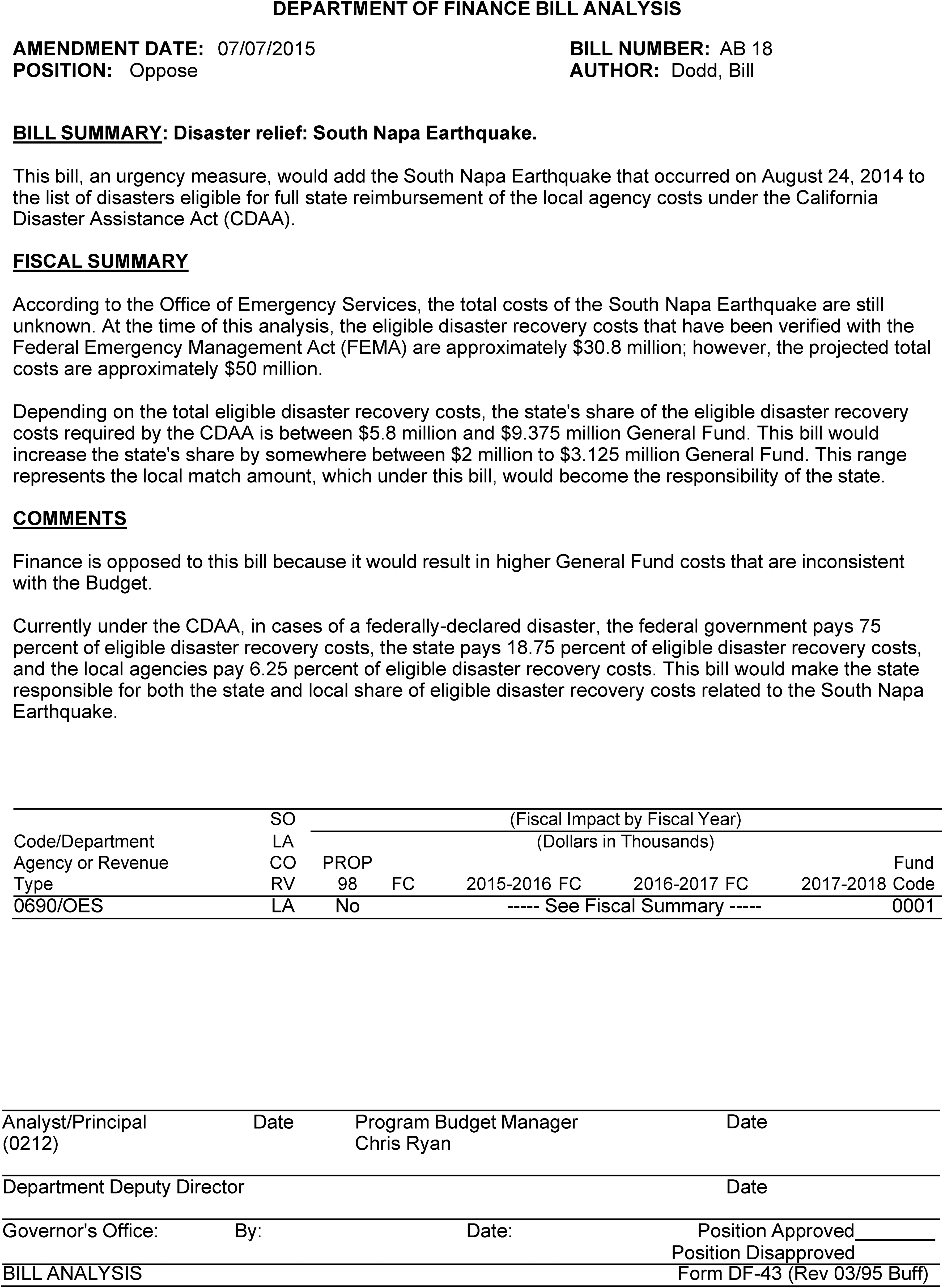
Example of Department of Finance (DOF) bill analysis.
A support recommendation communicated in a DOF reportis usually issued in coordination with the Governor's administration early in the bill drafting process, which partially explains the high percentage of bills that pass when supported by the DOF. Whereas the neutral or oppose positions are still both produced by the DOF, they are usually communicated with less direct input from the Governor's administration. Indeed, DOF communicates the latter two recommendations at a much higher rate than support for items, as shown in Table 1. Furthermore, the DOF has produced two or more reports for approximately 20% of bills and three reports for approximately 2% of bills. 7 Our data contain every introduced bill from 2007 to 2018 along with every fiscal analysis produced by the DOF, which includes 10,388 reports evaluating 8,484 unique bills. 8 After the data have been cleaned and categorized, this leaves a total of 7,780 unique reports matched to their corresponding bill. The report recommendation is the key independent variable in this study and is a factor variable with four unordered categories: (1) No DOF report; (2) DOF oppose; (3) DOF neutral; and (4) DOF support. Bills without a DOF report are used as the reference category.
Department of Finance (DOF) Report Position and Bill Outcome, all Legislative Sessions.
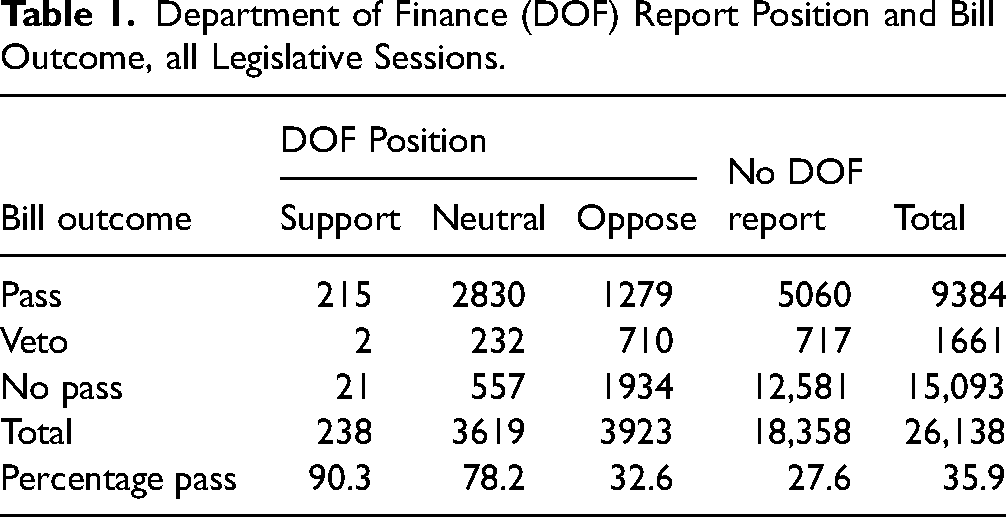
Table 1 illustrates bill outcome alongside DOF recommendation type. DOF report position and bill outcome appear to be tightly linked: items with DOF support pass at a rate above 90%. Bills that receive no report pass at lower rates than bills opposed by the DOF, an unexpected pattern that raises the issue of selection bias and is addressed later in the results section. Put together, Table 1 suggests that bills reviewed by the DOF are of special importance and deserve substantial attention from lawmakers.
Figure 2 shows the distribution of our independent variable across all legislative sessions. The vast majority of introduced bills receive no DOF analysis; the highest combined number of reports produced in a given session never exceeds 1,300 out of an average of 4,356 introduced bills. Furthermore, support recommendations never exceed 97 for any legislative session and an average of 40 across all sessions. In contrast, neutral and oppose recommendations average 603 and 653 reports, respectively. Another important feature of Figure 2 illustrates the consistency of the DOF: Both oppose and neutral recommendations never exceed 855 and never drop below 461.
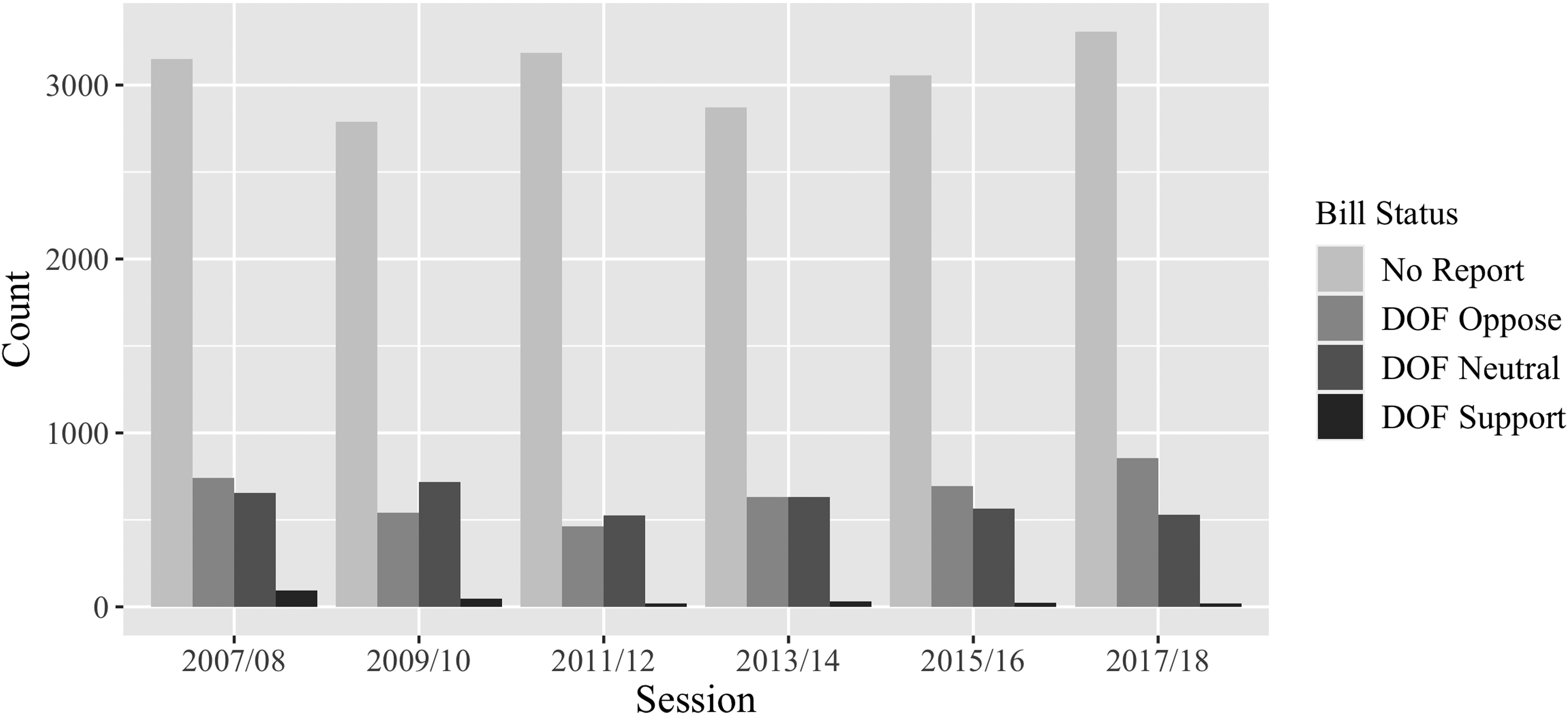
Introduced bills and Department of Finance (DOF) reports.
Democrat
Bills introduced by members of the Democratic Party have been assigned a one and a zero if belonging to another party. The Republican Party is a perpetual minority in California politics throughout our data; it is therefore important that we control for party affiliation when evaluating the relationship between DOF report and bill outcome.
Committee Chair
Committee chairs possess substantial agenda control and can advance bills in the policy process that ordinary legislators cannot. We, therefore, designate each bill introduced by a chair of a standing committee in both chambers of the legislature a one and a zero otherwise.
State of the State Address (SOSA)
California's Governor addresses both chambers of the legislature at the beginning of each calendar year. This “State of the State” (SOSA) address is similar to the President's State of the Union (SOTU), whereby the executive attempts to set the legislative agenda for the upcoming session. Using transcripts 9 from each SOSA in our data, we have identified specific policy proposals and matched those with legislative activity during that session. It is our assumption that bills included in the SOSA will be more likely to become law than otherwise because the Governor possesses substantial agenda-setting authority.
Leadership
Related to the binary committee chair indicator above, party leaders routinely exhibit more agenda control over the policy process than ordinary legislators. Thus, we have assigned all bills introduced by whips and floor leaders of both major parties a one and a zero otherwise.
Appropriations Committee
The DOF pays special attention to bills heard in the Appropriations Committee of both houses of the California legislature as part of its duty as the Governor's chief fiscal policy advisor. Bills therefore introduced by a member of the Appropriations Committee in either chamber are identified with a dichotomous variable.
Appropriation Indicator
All introduced bills are either identified with a “Yes” or “No” label from Legislative Counsel, which indicates whether or not a bill requires substantial funding. Only 7% of bills are marked for appropriations by Legislative Counsel and these bills become law at approximately 42%, a higher margin than all introduced bills (35%).
Bill Length
We proxy for policy complexity by using the total number of words in the latest version of a bill following previous scholarship using statute length to estimate policy complexity (Farhang & Yaver, 2016; Maltzman & Shipan, 2008). Although bill length is an admittedly rough measure of complexity, we argue it is superior to subjectively grouping bills into sophisticated and simple policy areas (Jakobsen & Mortensen, 2015).
Number of Bill Amendments
We assume bills that have received many amendments will pass at higher rates, all else equal, than bills with fewer amendments. A bill with multiple amendments has clearly received more attention from lawmakers than one with zero amendments. Thus, we control for the number of unique amendments to each bill; the variable is a discreet interval measure ranging from 0 to 14. Including this measure helps address our selection bias issues; on average, bills that become law in our data are amended over 3 times whereas bills that fail to become law have fewer than two amendments.
Number of DOF Reports
The number of DOF reports never exceeds three for any bill. A bill with three reports, all else equal, has garnered substantially more attention from the DOF than a bill without any reports. Our data indicate that bills with zero DOF reports pass at approximately 27%. The likelihood a bill becomes law climbs to 54% with one DOF report, 59% with two DOF reports, and 61% with three DOF reports. Thus, this measure is deeply important as it helps us account for the selection bias problem noted earlier.
Republican Governor
The DOF is located in the executive branch and acts primarily as the chief fiscal policy advisor to the Governor. The first two sessions in our data have been identified with a dichotomous variable to account for divided government during this time period. We assume standard assumptions regarding divided government in applying this measure: bills will be less likely to be passed and will be more likely to be vetoed if the Governor is not a Democrat. 10
Sponsor
We control for the presence and type of “sponsor” listed on the DOF report. We control for sponsorship status because we assume an item supported by a powerful entity is more likely to become law than one without any sponsorship, all else equal. Sponsors of legislation range from private organizations such as the Southern California Casino Association to governmental entities like the California Secretary of State. Because the types of sponsoring organizations vary widely, we adapt the typology used in Schlozman et al. (2015) to separate sponsor types into six unordered categories: (1) Business/Professional; (2) Government; (3) Labor; (4) Single issue/Identity; and (5) Public interest. The sixth and final category is the reference category and identifies bills without a listed sponsor. Each sponsor group within the data set is coded to identify the group's predominant constituency and its primary policy focus. For example, a group like the California Business Properties Association's (CBPA) main constituents are landowners who lease property for profit. They often advocate on issues related to building, land, and zoning. Therefore, they would be coded as a business/professional group. 11
Policy Area
We use a modified version of the widely used Comparative Agendas Project (CAP) (Bevan, 2019) coding scheme to code each individual bill into one unique policy area. Our data contain 22 unordered categories ranging from topics such as macroeconomics and domestic commerce to agriculture and technology. Although the CAP coding scheme has most frequently been used to measure policy attention at the national level (Green-Pedersen, 2019; Shpaizman, 2017), recent studies have used CAP codes to evaluate state (Kroeger, 2022b; McLaughlin et al., 2010) and local political phenomena (Shannon, 2022). 12 Because extant scholarship assumes that certain policy areas are more complex and thus require more attention than others (Jakobsen & Mortensen, 2015), we utilize a policy-area fixed effect in our models to adjust for any potential unobserved variation between policy areas.
Individual-member characteristics such as committee membership, leadership status, and party affiliation have all been acquired through the California legislature's Office of the Chief Clerk. 13 Number of bill amendments, appropriations spending identifiers, and bill length were all collected from the California legislative archive. 14 A list of selected variables is shown in Table 2.
Summary Statistics of Relevant Variables, all Legislative Sessions.
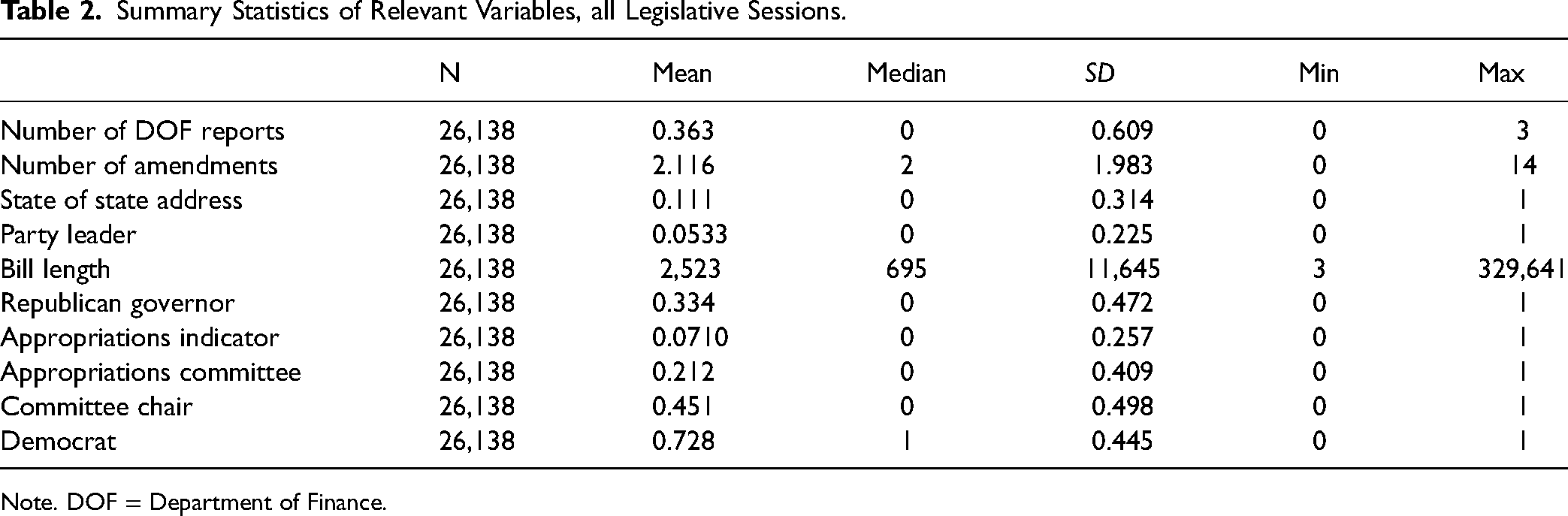
Note. DOF = Department of Finance.
Estimation Strategy
The main specification of the model applied to investigate the influence of DOF report position on bill outcome is
The first section of our analysis focuses on bill passage versus bill failure, whereas the second group of models evaluates the Governor's veto in comparison to passed bills. Our first section allows us to test the relationship between DOF report position and bill passage, estimating how report position can act as a signaling mechanism to other policymakers. The dependent variable in this initial set of models, therefore, contains the value of one for a passed bill and a zero for those that have failed to become law. 15 The second part of our analysis evaluates how DOF report position is linked with bill veto. For the second analysis, we restrict our sample to those only the Governor had the opportunity to veto—bills that have passed both chambers of the state legislature—and therefore the number of observations falls dramatically. Thus, our dependent variable assumes the value of one if the bill was vetoed by the Governor and a zero if it became law.
The separate specifications allow us to test the influence of the information provided by the DOF in two distinct settings. Firstt, we assess the influence of the DOF during the lawmaking process prior to a bill passing the legislature. Once the DOF issues a recommendation it signals the Governor's policy preferences to the legislators responsible for drafting the bill. A bill opposed by the DOF faces an uphill battle toward passage, and thus may dissuade additional activity on the bill. After a bill has passed both chambers, it is sent to the Governor's desk where it is accompanied by the DOF report recommendation. The Governor then uses the report recommendation as a heuristic to determine whether to veto the bill or sign it into law.
Results
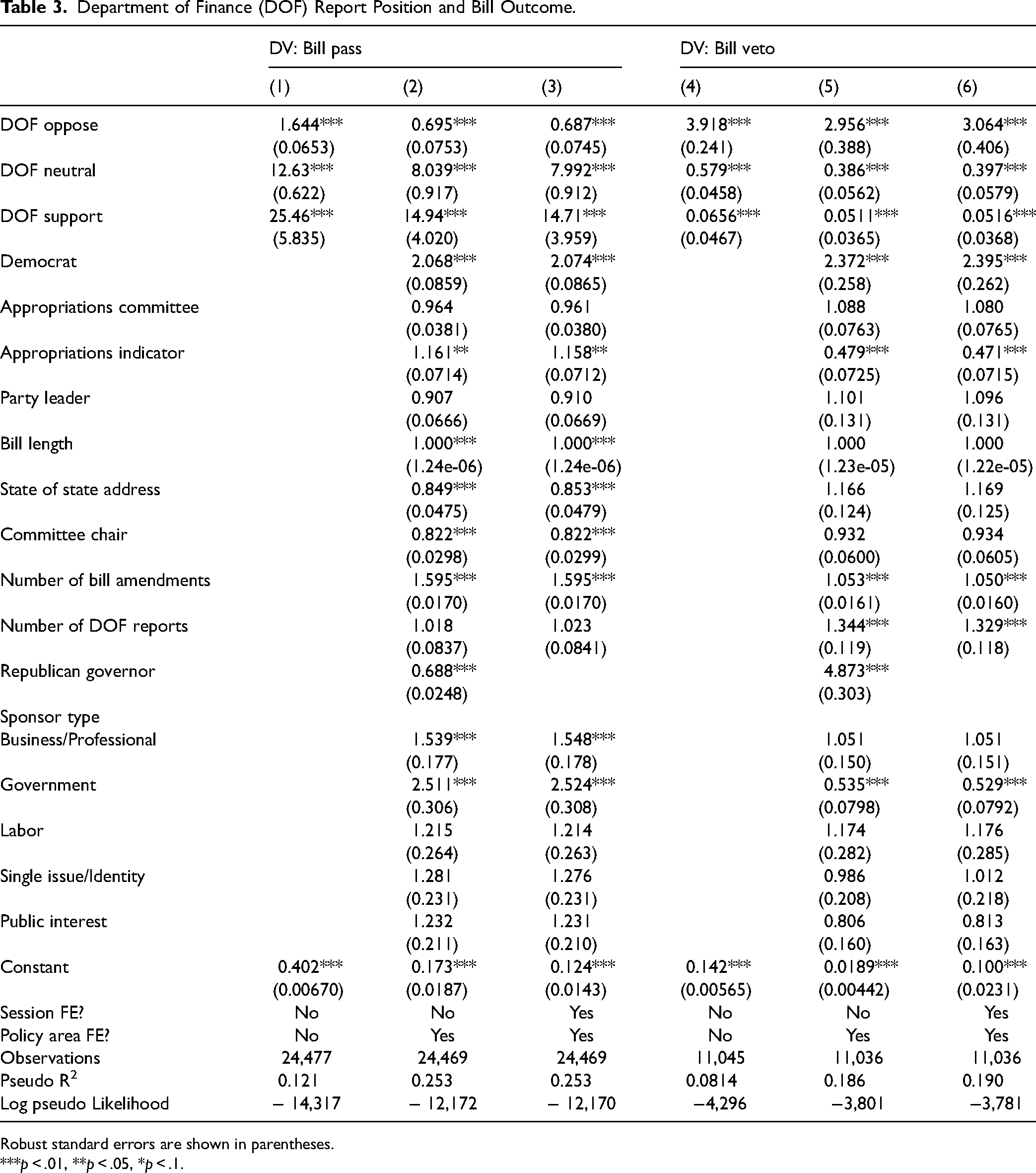
Each model is presented with odds ratios rather than log odds for easier interpretability in Table 3. We begin by displaying the baseline model in columns 1 and 4 which include no bill-specific covariates beyond the report positions of the DOF. These estimates closely track the tabulations shown in Table 1 and suggest all bills that receive a DOF report become law at higher rates than bills without a report, whereas DOF opposition is more strongly associated with bill veto than neutral, support, or bills without a report. Columns 2 and 5 display the results of our full model without session fixed effects and a dichotomous variable indicating sessions controlled by a Republican Governor. 16 These estimates differ substantially from those presented in columns 1 and 4; column 2 shows bills opposed by the DOF pass at substantially lower rates than bills without a report, whereas bills designated neutral and support pass at much higher rates, all else equal. Column 5 displays similar effects to those in column 4: bills opposed by the DOF have a much higher likelihood of being vetoed than bills without a report or bills with support or neutral positions.
Department of Finance (DOF) Report Position and Bill Outcome.
Robust standard errors are shown in parentheses.
***p < .01, **p < .05, *p < .1.
We test Hypothesis 1a and 1b with the models shown in columns 3 and 6 of Table 3. Column 3 suggests that if a bill is opposed by DOF, all else equal, the likelihood it will become law in comparison to bills without a report declines over 31%. In addition, the same model estimates that bills supported or designated neutral by the DOF pass at rates of nearly 1,500% and 800%, respectively, in comparison to bills without a report. All three estimates are statistically and substantively significant; an associated 31% decrease in the likelihood a bill becomes law and 800% or 1,400% increases in the odds a bill is passed are large effects.
Column 6 executes our full model and alters our dependent variable by isolating our sample to bills that have passed both chambers of the legislature. The model suggests that bills opposed by the DOF are 300% more likely to be vetoed than bills without a report; bills supported by the office and bills designated neutral are 95% less likely, and 61%less likely, respectively, to be vetoed in comparison to bills without a report. Similar to column 3, all DOF report position coefficients are statistically and substantively significant. Although odds ratios allow our regression estimates to be more easily interpretable than log odds, we display predicted probabilities to directly compare the four unordered outcomes of our independent variable alongside both dependent variables.
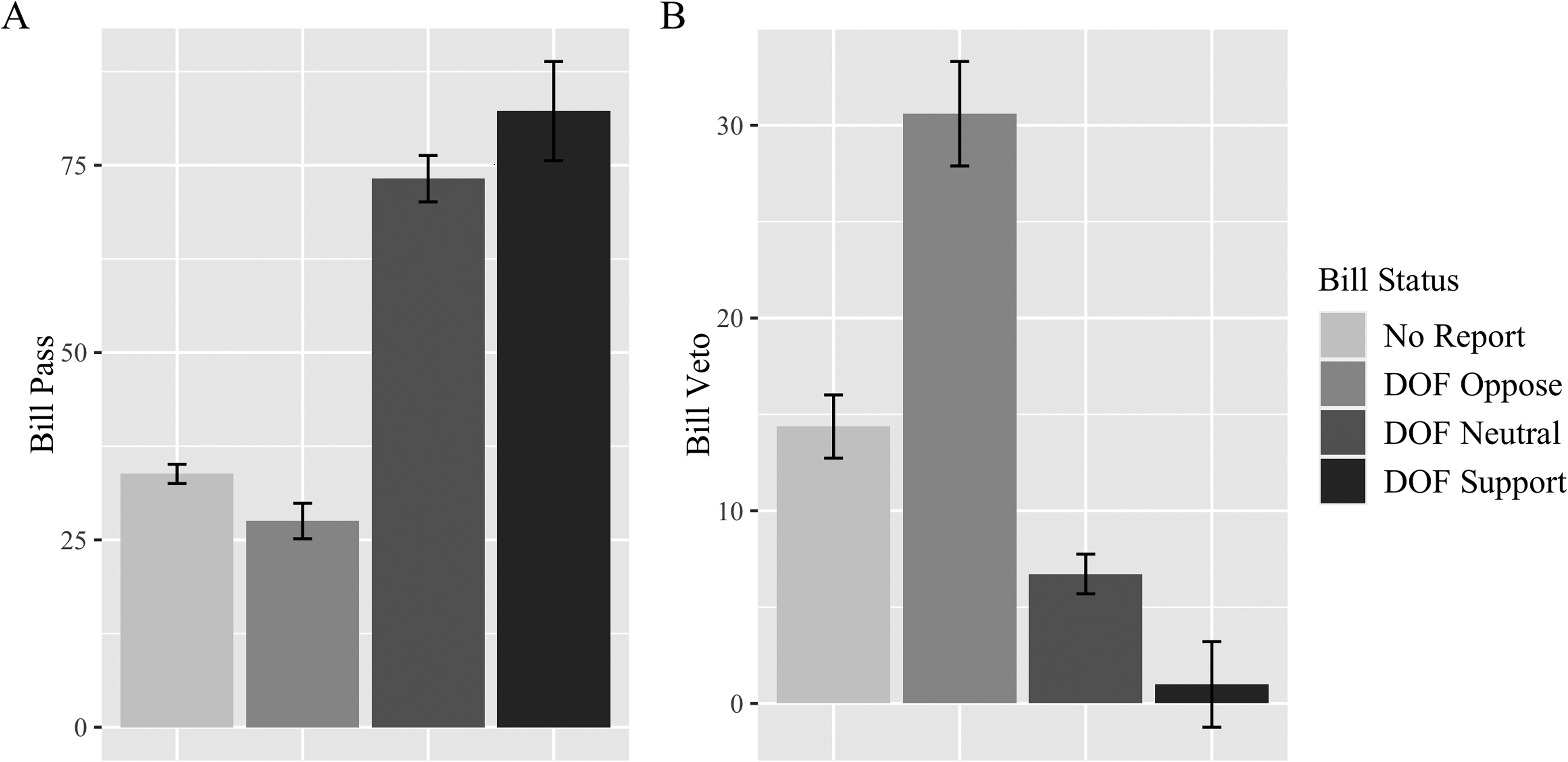
The predicted probabilities of columns 3 and 6 are shown in Figure 3 in panels A and B, respectively. All told, the projected bill passage rates shown in Figure 3 largely align with the crosstabs displayed in Table 1 with the exception of bills opposed by the DOF: bills opposed by the DOF become law at a rate approximately five percentage points lower than items without a DOF bill analysis. Indeed, DOF opposition appears to significantly reduce the likelihood a bill becomes law, contrary to what is shown in Table 1. Panel A also provides strong evidence in support of Hypothesis 1a, where neutral and support DOF recommendations pass at rates nearly 3 times that of bills without a report. We are unable to sufficiently determine whether support or neutral recommendations pass at rates different from each other, however, because the confidence intervals overlap. Panel B indicates how DOF opposition is used as a signal for the Governor to veto legislation, as 30% of bills opposed by the DOF are predicted to be vetoed. Our estimates also suggest that approximately 7% of bills marked neutral by the DOF are vetoed compared to 14% of bills without a DOF report. This figure suggests that the DOF can be used as a mechanism to signal the Governor's policy preferences and as an information processing device to inform the Governor's policy decisions. Because a neutral position is considered a positive recommendation, the relatively high number of vetoes indicates the Governor does disagree with the DOF on several occasions.
Department of Finance (DOF) position and predicted bill outcome.
The statistical significance of each control variable differs substantially. Party affiliation plays a deeply important role for the passage of legislation and bill veto, as bills introduced by Democrats are more likely to become vetoed and more likely to become law than Republicans. We view this largely as a function of how few bills are introduced by Republicans: Democrats author over 72% of bills in our data. Items designated by Legislative Counsel—the appropriations indicator—as requiring substantial funding from the Appropriations Committee pass at rates approximately 16% higher than bills without the identifier, all else equal. This finding is both substantively and statistically significant, as it provides evidence that large funding bills of all types pass at higher rates than ordinary legislation. Our Appropriations Committee indicator provides little explanatory power, however, with zero estimates showing statistical significance. Further, the party leader variable is statistically insignificant in all executed models, a peculiar finding largely due to the strong predictive power of our party variable. Bill Length appears to be strongly associated with bill passage, although the effect is substantively small. Indeed, the statistical significance of our policy complexity measure indicates a strong association between complexity and bill passage, but our coefficient's substantive interpretation is zero. We consider this a surprising finding, as we assumed that more sophisticated legislation would pass at higher rates, all else equal.
Another surprising estimate is the coefficient of the SOSA, which is both statistically and substantively significant. Although the coefficient presents null results in column 6, column 3 suggests that bills mentioned in the SOSA are approximately 15% less likely to pass than other introduced bills, all else equal. At first glance, this is an extremely odd finding as we expect the Governor, like many executives, to have substantial agenda control. A closer examination of extant literature, however, reveals a different portrait of governors’ agenda-setting powers. As noted by Kousser and Phillips (2012, p. 20) in their analysis of American governors, governors frequently lose policymaking negotiations because they lack concrete lawmaking authority and state legislators are often content with existing law. When governors win their policy negotiations, it usually comes from leveraging their budgetary authority to extract concessions from the legislature.
As expected, the number of times a bill has been amended is statistically significant and positive, indicating that additional bill amendments increase the likelihood it will become law and become vetoed. Contrary to expectations, our committee chair dummy variable is both statistically significant and below one in column 3, indicating that a bill introduced by a committee chair has a reduced likelihood of becoming law in comparison to no pass, all else equal. 17 The number of DOF reports associated with a given bill is statistically significant only for bill veto, which suggests that bill authors unsuccessfully amended bills to assuage DOF concerns. Lastly, our sponsor variable demonstrates that bills with professional and governmental sponsors are substantially more likely to become law than bills without a report or other types of bill sponsors. Governmental entity sponsorship is the only type of sponsor that will reduce the likelihood of bill veto, as the likelihood of a veto falls by nearly 50% if a government actor sponsors the legislation.
Discussion
After testing Hypotheses 1a and 1b by estimating two logistic regression equations that control for a multitude of important covariates, our results indicate that DOF position is strongly associated with bill outcome. In accordance with our theoretical expectations, the estimates shown in Figure 3 suggest strong evidence in support of both hypotheses: DOF opposition reduces the likelihood a bill will pass and raises the likelihood a bill will be vetoed in comparison to bills without a report. Moreover, DOF support and neutral positions are associated with a much higher rate of passage and a reduced rate of veto than bills without a report and those opposed by the office. These estimates align with theoretical expectations and can only be observed by adjusting for many key covariates.
Figure 3 shows that bill opposition is negatively associated with bill passage and positively associated with bill veto in comparison to other recommendations. It also illustrates important subtleties associated with the office: approximately 7% of bills marked neutral by the DOF are later vetoed by the Governor. This is an important finding; the Governor vetoing legislation approved by the DOF demonstrates the nature of the office as one that signals policy preferences and renders many of its own decisions. That the Governor disagrees with DOF recommendations adds nuance to the office's role in generating evidence-based content. Although our quantitative estimates suggest a strong association between report position and bill outcome, we may actually be underestimating the influence of the DOF. Indeed, the qualitative evidence unearthed by our case study of SB 823 (2015) indicates a substantial portion of DOF influence is unobservable.
Conclusion
In this article, we sought to determine how an analytic agency influences lawmaking activity by evaluating reports produced by the California DOF. After adjusting for many bill-specific covariates, we found that DOF opposition, neutrality, and support are tightly connected with bill outcome. These results supplement previous research that shows veto threats influence policymaking activity (Guenther & Kernell, 2021) and add nuance to the rich bureaucracy and information processing literatures.
Our approach differed from previous research focusing on legislative success and information processing in two important ways. First, most studies examining bill outcome have focused almost exclusively on individual legislator qualities and internal policymaking dynamics (Anderson et al., 2003; Volden & Wiseman, 2014). Although elected officials ultimately introduce bills and can “go public” to marshal support for policy (Kernell, 2006), we provide unique evidence of analytic bureaucratic actors occupying a central role in the legislative process by communicating explicit policy preferences on a bill-by-bill basis. Elected officials have perhaps garnered an improper amount of attention for their role in the passage of legislation. In reality, legislators are overworked and struggle to prioritize all the streams of information required to develop sophisticated policy. Elected officials must therefore offload legislative signaling and policy design duties to trusted bureaucratic specialists.
Second, the bureaucratic information processing literature largely ignores the initial stages of policy development and its connection with bill outcome. Scholars have demonstrated the importance of the federal bureaucracy for problem identification, implementation, and service delivery. Still, they have overlooked the advisory role occupied by analytic bureaucrats in the initial stages of policy design. We show that specialized bureaucratic actors occupy a central role in the nascent and latter stages of the legislative process. Whereas Kernell (2005) examines SAPs and “veto threats”, this article provides a tangential measure to assess how the executive branch in a large state sends signals to other branches of government.
Many states and municipalities rely on analytic bureaucratic actors like the DOF to assist legislators and their staff develop policy. For example, the Mayor's Office of Management and Budget (OMB) in New York City provides “vital information” about current economic trends to the Mayor and other city officials. 18 Virginia's Department of Planning and Budget (DPB) advises the Governor in the “prudent allocation of public resources and promote[s] the development and implementation” of fiscal policy. 19 While the New York City and Virginia offices are most directly analogous to California's DOF, many state legislatures house analytic agencies tasked with providing expert information to policymakers (Hird, 2005). 20 We believe the results here are more broadly informative than California because of the state's large size in population and budget, highly professionalized legislature, and the robustness of our findings when controlling for divided government (Kroeger, 2022b). Examining more states (and their respective analytic offices) to validate and extend our estimates should be seriously considered by legislative politics and bureaucracy scholars. Indeed, the influence of these organizations on lawmaking has yet to be fully realized in extant research.
The policy areas where analytic bureaucratic expertise is most likely to become involved is a fascinating potential avenue for scholars to investigate in future work. 21 It is our hypothesis that policies spanning across multiple areas (such as transportation and healthcare) will be more likely to include expert information from analytic bureaucratic organizations, as these policies often require unique problem identification and solution develop strategies to execute. Our choice to measure policy area using the CAP coding scheme precludes us from performing this analysis because each bill must be coded into a singular policy area. A study including the number of policy areas of each bill would be of great interest to scholars of legislative politics, bureaucracy, and public policy and could be accomplished using topic modeling (Grimmer, 2013) or an ethnographic case study (Gerring, 2004).
Future studies examining the policymaking influence of analytic agencies may need to submit Freedom of Information Act (FOIA) requests due to the confidential nature of many offices. Analytic bureaucracies exist to process and provide information to legislatures; it is usually unnecessary to provide publicly available reports to scholars and the public. Unearthing confidential reports and identifying the expert information included in the communications between analytic agencies and the legislatures they serve can provide a wealth of insight into the modern policy process.
Supplemental Material
sj-docx-1-arp-10.1177_02750740231164414 - Supplemental material for Analytic Bureaucracy and the Policy Process: Evidence from California
Supplemental material, sj-docx-1-arp-10.1177_02750740231164414 for Analytic Bureaucracy and the Policy Process: Evidence from California by Henry Flatt and Nhat-Dang Do in The American Review of Public Administration
Footnotes
Declaration of Conflicting Interests
The author(s) declared no potential conflicts of interest with respect to the research, authorship, and/or publication of this article.
Funding
The author(s) received no financial support for the research, authorship, and/or publication of this article.

Supplemental Material
Supplemental material for this article is available online.
Notes
Author Biographies
References
Supplementary Material
Please find the following supplemental material available below.
For Open Access articles published under a Creative Commons License, all supplemental material carries the same license as the article it is associated with.
For non-Open Access articles published, all supplemental material carries a non-exclusive license, and permission requests for re-use of supplemental material or any part of supplemental material shall be sent directly to the copyright owner as specified in the copyright notice associated with the article.
