




Abstract
Studies on the adoption of innovations often treat an organization as a uniform entity. Such studies implicitly assume that perceptions regarding the adoption of an innovation are identical across the organization. However, organizational theory and change management literature argue that organizations are composed of distinct groups that have different values and goals. It is therefore important to dissect the organization and to look at the various internal stakeholders involved. In this study, we follow this advice and study how two key organizational groups (city managers and Works Council members) perceive their organization’s members’ views regarding the specific innovation of teleworking. We use unique data collected through two nationwide surveys of city managers and Works Council members. The results show that there are crucial differences in the perceptions of the two groups, with city managers generally being more positive about the innovation. Based on our analysis, we conclude that it is important to distinguish between different organizational stakeholders in the innovation adoption process and that managers should be aware of a bias in their perceptions.
Points for practitioners
It is important to distinguish between the various organizational stakeholders in the innovation adoption process because they probably have different attitudes regarding an innovation. Managers should look beyond their own perceptions regarding an innovation and be aware that they are probably more positive in their perceptions than are others in their organization. More specifically, we found that Works Council members attach more importance to the ability to try out innovations before their full introduction than city managers. It is also more important for them that an innovation seems easy to implement and use.
Keywords
Introduction
Innovation in public organizations has received considerable attention in recent years (Hartley et al., 2013; Walker et al., 2015). In response to citizens’ rising expectations, budgetary constraints and a number of problems that, because of their complexity, cannot be solved using standard solutions, there is a growing demand for public organizations to adopt innovative practices (Albury, 2005; Hartley et al., 2013).
Within research on innovation adoption in public sector organizations, much attention has been focused on the organizational level, for instance, when seeking to explain why some organizations are more innovative than others (Walker et al., 2015). However, by focusing on the organization as the unit of analysis, most studies do not distinguish between the various stakeholders involved in the innovation adoption process (for a notable exception see Moldogaziev and Resh, 2016), thereby implicitly assuming that perceptions regarding the possible adoption of an innovation are uniform across the organization. Here, innovation adoption is defined as: the process through which an individual [or other decision-making unit] passes from first knowledge of an innovation, to the formation of an attitude toward the innovation, to a decision to adopt or reject, to implementation and use of the new idea, and to confirmation of this decision. (Rogers, 2003: 20)
This study addresses this gap by opening up the ‘black box’ of the innovation adoption process within organizations. We combine the public sector innovation literature with insights from organization behavioural theory (for instance, Allison, 1971; Cyert and March, 1963; Pfeffer, 1992) regarding the competing interests of different groups of organizational actors. In so doing, we focus on the perceptions of two important groups in the innovation adoption process, namely, city managers and Works Council members. In Dutch municipalities, city managers are the most senior staff managers and have the main responsibility for deciding whether new work practices will be introduced. A Works Council can best be described as a ‘shop-floor’ organization that represents the employees. We suspect that these groups will differ in their perceptions since managers, given their organizational position and the power this entails (Pfeffer, 1992), will pursue different goals and have separate motives from Works Council members. This could ultimately result in the latter being dissatisfied with an implemented innovation (for examples in the change management literature addressing the impact of hierarchical level, see Jones et al., 2008; Kanter et al., 1992; Luthans and Sommer, 1999).
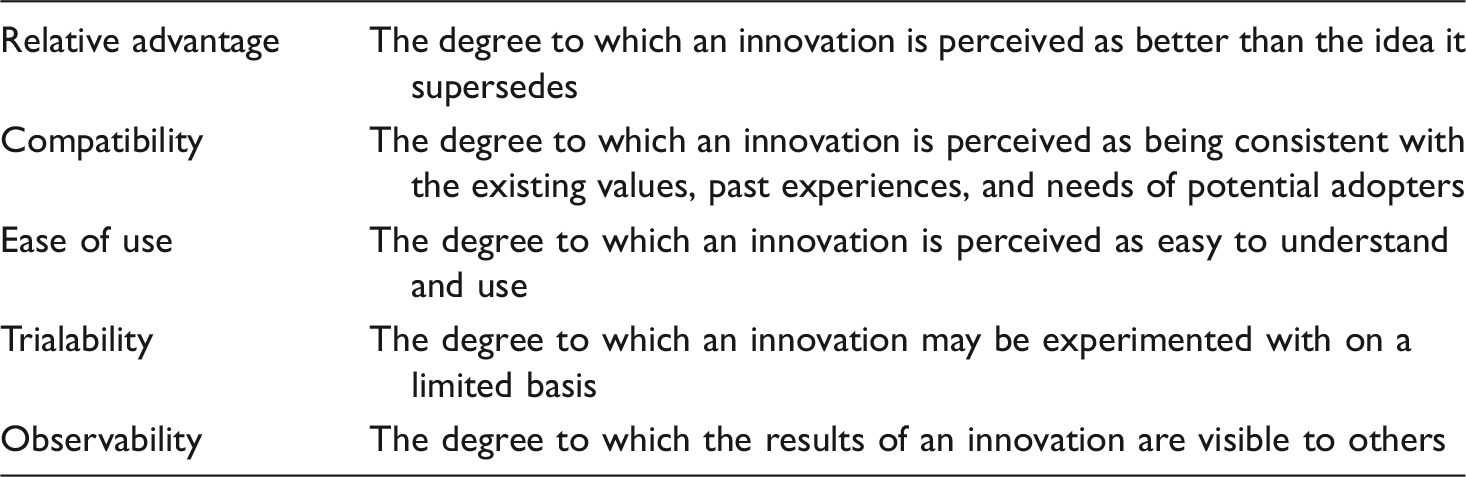
To analyse the perceptions of these two groups, the implementation of teleworking in a Dutch local government setting was taken as a specific case. Recently, many municipalities in the Netherlands have allowed their employees to decide for themselves whether to work at the office or at home (A+O fonds Gemeenten, 2013). This adoption of teleworking practices can be considered a typical innovation in that it is new to the adopting unit, offers a fundamental change to existing work practices and is intended to change the organization. More specifically, we assess whether city managers and Works Council members evaluate their organization’s members’ views regarding the innovation differently. Attention is particularly focused on the impact of organizational position (i.e. being a city manager or a Works Council member) on the relationship between two relevant goals (improved service delivery to citizens and increased job satisfaction for public sector employees), attributes of the innovation (relative advantage, compatibility, ease of use, trialability and observability (based on Rogers, 2003)) and organizational satisfaction with the implemented innovation as perceived by the two involved stakeholders.
Based on the above, this article aims to answer the following research questions:
To what extent do city managers and Works Council members differ in their perceptions regarding the responses of their organization’s members to the teleworking goals and attributes, and regarding their satisfaction with the adoption?
How does organizational position moderate the relationship between the teleworking goals and attributes and the perceived organizational satisfaction with the implemented innovation?
To address our research questions, we draw on data from two surveys applied across all Dutch municipalities. The first survey concentrates on the perceptions of city managers (n = 183, response rate = 47%), while the second survey measures the perceptions of the Works Council members (n = 198, response rate = 50%). Alongside these quantitative data, we also use qualitative insights from interviews to interpret the quantitative results.
This brings us to the outline of this article. In the second section we develop a theoretical framework. Next, in the third section, we outline the methodology used to test the developed hypotheses. The findings from an analysis of both surveys and the interviews are presented in the fourth section, and these are discussed, and conclusions are drawn, in the fifth section.
Theory and hypotheses
Research on innovation goals and innovation attributes
In this study, we examine two innovation goals that have frequently been addressed in the innovation literature as drivers for innovation adoption, namely, improved service delivery to citizens and increased job satisfaction for public sector employees, as these can be related to both the external (societal) and internal (organizational) orientation of the innovation adoption process (Albury, 2005; Hartley et al., 2013; Johnson and McIntrye, 1998; Walker et al., 2011). In terms of the external context, De Vries et al. (2016) show that public innovations are often stimulated by government organizations aiming to serve citizens, for instance, by addressing societal needs such as ageing or unemployment, or by improving service delivery to citizens. Innovation adoption is, then, seen as a way to address citizens’ demands, with citizens increasingly demanding more personalized public services (Albury, 2005).
However, innovation adoption is also frequently driven by a large variety of internal organizational wishes, such as improved organizational productivity and performance, or an increase in employees’ job satisfaction (Boyne et al., 2005; Johnson and McIntye, 1998). Studies that examine the work motivation of public sector employees frequently find that job satisfaction is important (e.g. Moynihan and Pandey, 2007). Consequently, innovation in the form of new working methods can be seen as a way to increase job satisfaction (Johnson and McIntye, 1998) and, through this, work motivation. Both goals (namely, improved citizen service delivery and increased job satisfaction) are also frequently included in studies on the introduction of teleworking (e.g. Baane et al., 2010; Pomp et al., 2009).
Innovation attributes.
Differences in perceptions of the innovation process due to position
Differences in the perceptions of organizational actors have been studied for at least 50 years, with important early work by scholars such as Cyert and March (1963). The seminal work by Cyert and March (1963) conceptualized organizations as heterogeneous entities composed of functionally differentiated groups, pursuing different goals and promoting various interests. In essence, they assume that organizations consist of individuals who bargain to determine the goals of the wider organization, an activity that will often result in organizational conflict (Cyert and March, 1963).
In this regard, our study examines two important groups of stakeholders, namely, city managers and Works Council members. In the Netherlands, a Works Council usually represents the workers at a workplace, and is elected by all employees.
The legal rights of a Works Council are stated in the Act for Works Councils (Wet op de ondernemingsraden (WOR)). 2 Among the most important legal entitlements of a Dutch Works Council are the rights to give advice, to be informed and to provide consent. A Works Council must first stand up for the interests of all personnel and is, moreover, legally obligated to operate in the interests of the organization at large. Second, a Works Council has the right to be sufficiently informed on all relevant matters so as to be able to optimally perform its tasks. Finally, a Works Council has the right of consent with respect to all social arrangements within the organization insofar as the matter in question has not already been regulated in a collective agreement between employers and trade unions. When it comes to the introduction of teleworking, the Works Council has the right to be informed and to give advice as this amounts to an important technological and organizational change. As stated in article 25 (paragraph 1 k) of the WOR, the Works Council must be asked for its opinion. Moreover, in article 27, topics are listed that require approval (the right of consent) of the Works Council if they are to be changed due to the introduction of teleworking. These topics include, among others, the changing of working hours, working conditions and the absenteeism policy. Hence, whether Works Councils can invoke this right depends on the extent to which certain organizational structures are affected by the implementation of teleworking.
In the Netherlands, city managers are the most senior staff managers and, as such, have the main responsibility for deciding whether new work practices will be introduced. As the most senior appointed official, the city manager is responsible for the day-to-day operations of the municipality.
When considering the relationship between city managers and Works Councils, authors have referred to underlying differences in organizational position, and the power this implies, as a potential source of conflict between different organizational stakeholders. For instance, in Pfeffer’s (1992) account of power-dependent relationships, it is argued that the outcomes of an exchange relationship derive from the dependence that one party has upon the other when it comes to obtaining a vital resource. Hence, power comes from: (1) being in the right place, that is, in a place that provides control over resources such as budgets; (2) having extensive access to information about the organization’s activities, about the preferences and judgements of others, and about what is going on; and (3) formal authority. When addressing these three sources of power, Pfeffer (1992: 128) particularly emphasizes position as a very important formal source since people can have power as a consequence of their formal position in the organizational hierarchy.
When applying Pfeffer’s taxonomy to the positions of city managers and Works Council members, city managers are evidently more powerful since they possess formal authority and have control over other valuable resources, such as budgets. Such differences often result in conflicts of interest between groups. Cyert and March (1963) note how top management usually sets the goals of an organization, which are then implemented through decision-making at lower management levels, often resulting in disagreement on the goals that organizations try to achieve.
Addressing the specific role of top managers, Damanpour and Schneider (2006) argue that top managers affect innovation adoption by controlling resources and influencing major decisions, especially strategic ones. As such, top managers are a potent force for, or against, innovation, especially if decision-making power is concentrated in their hands. This is likely to lead to differences between city managers and Works Council members in how they perceive their organization’s members’ views regarding a particular innovation.
Given that we anticipate differences in perceptions, we draw heavily on insights from the change management literature to predict the likely differences. Most studies on organizational change conclude that when it comes to evaluating new organizational practices, managers are more positive than other organizational stakeholders (see, e.g., Jones et al., 2008; Luthans and Sommer, 1999). For instance, managers are often more optimistic about the goals that the changes will help to achieve. When it came to setting the goals for an organizational change, Covin and Kilmann (1990) found that managers were less concerned than others over establishing a clear purpose. On this basis, we formulate the following hypothesis: Hypothesis 1: Compared to Works Council members, city managers will evaluate their organization’s members’ views regarding the innovation’s goals more positively. Hypothesis 2: Compared to Works Council members, city managers will evaluate their organization’s members’ views regarding the innovation’s attributes more positively. Hypothesis 3: Compared to Works Council members, city managers will perceive their organization’s members as being more satisfied with the implemented innovation. Hypothesis 4: Organizational position will moderate the relationship between the innovation’s goals and attributes and the perceived organizational satisfaction with the implemented innovation.
Data and methodology
Research setting
Statistics show that the incidence of teleworking in the Netherlands has been rising since 2000. Regarding the public sector, a report by the Netherlands Institute for Social Research (Sociaal en Cultureel Planbureau (SCP)) indicated that in 2014, 44% of public servants could determine where to work (telework), while 53% of the public servants who can determine their own place of work, work from home at least one day a week (SCP, 2016). This rise in teleworking practices can be related to the growth in the so-called ‘New Ways of Working’ (NWW), which was introduced around 2009. Central to this flexible approach to work, which was adopted from large private sector companies such as Microsoft, is that employees can organize their work flexibly. One of the major components of NWW is that employees can decide for themselves where they work (telework). Currently, almost all municipalities have, at least to some extent, introduced the teleworking option. This was reflected in the surveys we conducted, as only 11 respondents (out of 381) indicated that teleworking had not been implemented in their organization.
Design and sample
Two parallel surveys were conducted. The first survey concentrated on the perceptions of the city managers, while the second survey measured the perceptions of the Works Council members. For both surveys, we invited all 393 Dutch municipalities to participate. In June 2015, we sent the two Web-based questionnaires to 393 city managers and 393 Works Council members. After an introductory email and reminders, 183 city managers and 198 Works Council members responded (47% and 50% response rates, respectively). We then rejected those who indicated that teleworking had not, at least partially, been implemented in their organization, resulting in a database with 370 respondents. The characteristics of the samples were as follows: 50% of the Works Council members were female, and the average member age was 49 years. These figures are very similar to the Dutch local government means (49% female, average age = 48 years) (A+O fonds Gemeenten, 2016). Of the city managers in our sample, 24% were female, which is consistent with unpublished data obtained from the Dutch foundation for city managers (23% female). However, the average age of the city managers in our sample (M = 53 years) was slightly higher than the value in the unpublished data (M = 45 years).
In addition to the surveys, we conducted six in-depth interviews with three employees (employee, senior manager, Works Council member) in two municipalities. In so doing, our main aim was to validate our findings by asking the respondents to reflect on the main results (namely, that city managers are generally more positive about the innovation). These qualitative data are analysed in the ‘Analysis and results’ section.
Measures
All the questionnaire items used five-point Likert scales, with answer categories ranging from ‘strongly disagree’ to ‘strongly agree’. Given that we were interested in the shared ‘consensus’ view regarding the innovation process, and were seeking the perceptions of the individual city managers and Works Council members of what this consensus view was, items were sometimes slightly adapted to emphasize this aspect (for instance, ‘we’ instead of ‘I’ was used). The online Appendix provides an overview of all items included based on a Confirmatory Factor Analysis (CFA) (see ‘The measurement model’).
Innovation goal – improved citizen service delivery
The perceived societal goal of the innovation (improved citizen service delivery) was measured using the four-item scale for client meaninglessness devised by Tummers (2012), an example item being ‘Because of teleworking, we can help citizens more efficiently than before’. The Cronbach’s alpha was .93.
Innovation goal – increased employee satisfaction
The innovation goal of increased employee satisfaction was measured using Tummers’s (2012) four-item scale for societal meaninglessness, an example item being ‘Overall, we think that teleworking leads to an increase in satisfaction of employees’. The Cronbach’s alpha was .92.
Relative advantage
We measured relative advantage using five items from the scale by Moore and Benbasat (1991), an example item being ‘Teleworking improves the quality of the work we do’. The Cronbach’s alpha was .88.
Compatibility
Compatibility was measured using three items from the scale developed by Moore and Benbasat (1991), including ‘Teleworking fits into our work style’. We deleted one item due to its low factor loading. The Cronbach’s alpha for the two-item measure was .86.
Ease of use
Ease of use was measured using five items from the scale by Davis (1989), including ‘It is easy for us to become skilful in the use of teleworking’. The Cronbach’s alpha was .89.
Trialability
Trialability was measured using the five-item scale by Moore and Benbasat (1991), with items such as ‘Before deciding whether to use teleworking, we were able to properly try it out’. The Cronbach’s alpha was .89.
Observability
Observability was measured using the five-item scale developed by Moore and Benbasat (1991), a typical item being ‘We have seen what others do using teleworking’. Initially, three items were deleted due to their low factor loadings. Then, as the resulting scale had a reliability of only .50 we decided to remove this construct from our analysis. This is discussed further in our ‘Analysis and results’ and ‘Conclusion’ sections.
Organizational satisfaction with implemented innovation
To assess organizational satisfaction with the implemented innovation, we drew on Quinn and Shepard (1974) who captured job satisfaction. We rephrased the items to reflect innovation satisfaction, an example item being ‘Overall, employees of our organization are very satisfied with teleworking’. The Cronbach’s alpha was .85.
Moderator and control variables
The moderating variable is position (Works Council member = 0, city manager = 1). Moreover, some commonly used individual control variables were included in the analysis, namely: gender (female = 0), age (continuous), tenure (in years, continuous) and educational level (categories). We also added two organizational control variables that are commonly included in the innovation literature, namely, organizational slack resources and organizational size. Data for slack resources were drawn from the 2013 annual financial accounts of Dutch municipalities (VNG, 2014), while organizational size was measured using unpublished data from the foundation overseeing the labour market and education fund for municipalities (A + O fonds Gemeenten). Slack resources (log) were measured using the solvency ratio (continuous variable). This ratio provides insight into the degree to which a municipality is able to meet its financial obligations. Size (log) was measured by the number of full-time employees and was also treated as a continuous variable.
Analysis and results
The measurement model
We applied CFA followed by Structural Equation Modelling (SEM) using Mplus. We conducted a CFA to analyse whether the factor structure of the scales was also present in the data. For all the factor loadings, a cut-off point of .60 was applied. As noted in the previous section, this resulted in the exclusion of one item from the compatibility scale and three items from the observability scale. Then, given the low Cronbach’s alpha (.50) for the remaining observability scale, we decided to remove this construct from our analysis. The final CFA model proved to be a good fit for the data, with a root mean square error of approximation (RMSEA) of .06 (criterion ≤ .08), comparative fit index (CFI) of .92 (criterion ≥ .90) and Tucker–Lewis Index (TLI) of .91 (criterion ≥ .90).
Examining the perceptions of city managers and Works Council members
In order to test Hypotheses 1–3, t-tests were carried out to assess differences between the perceptions of the city managers and Works Council members. The t-tests indicated significant differences between the two groups for all the included variables except relative advantage and the innovation goal of improved citizen service delivery.
Hypothesis 1 states that city managers will perceive the evaluation by their organization’s members regarding the innovation goals more positively than the Works Council members. However, the t-test results indicate that the difference between the two means for the goal of improved citizen service delivery is not significant (t = –1.13, p = n.s.). Conversely, the results provide support for a difference in the perceptions of increased job satisfaction as the mean score by the city managers is significantly higher (t = –1.98, p < .05).
Results of t-tests.
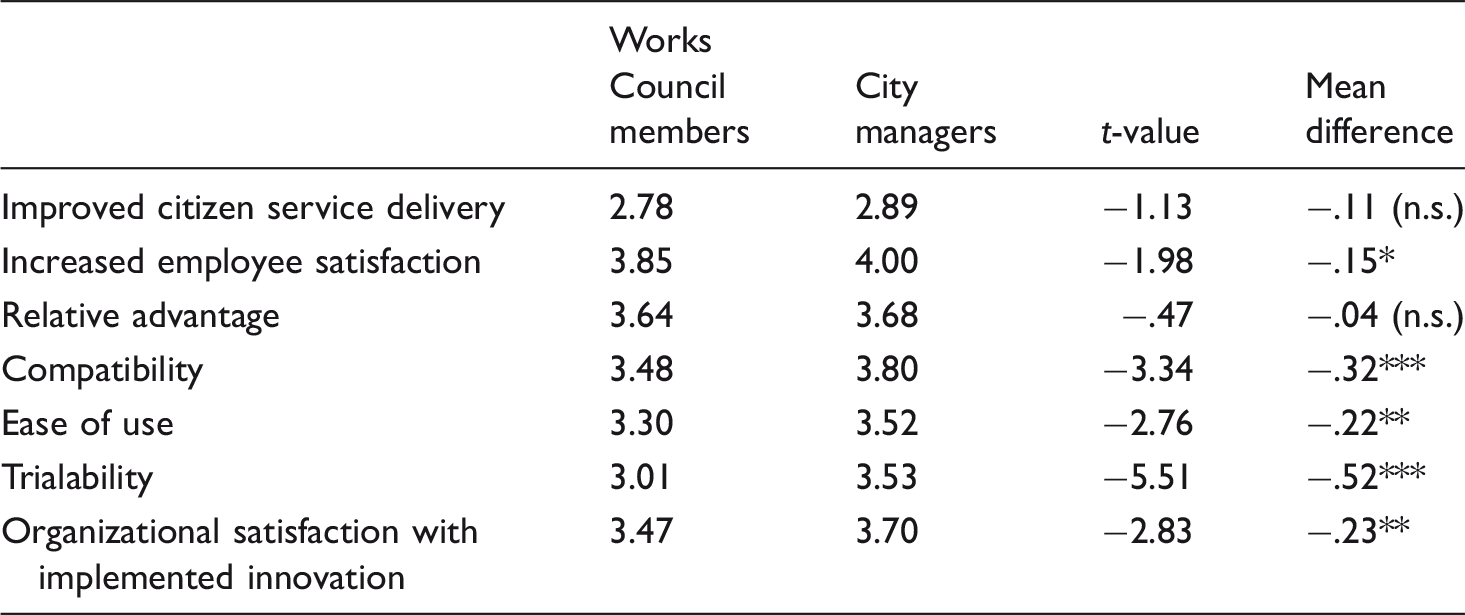
Notes: *p < .05; **p < .01; ***p < .001. n.s. = non-significant.
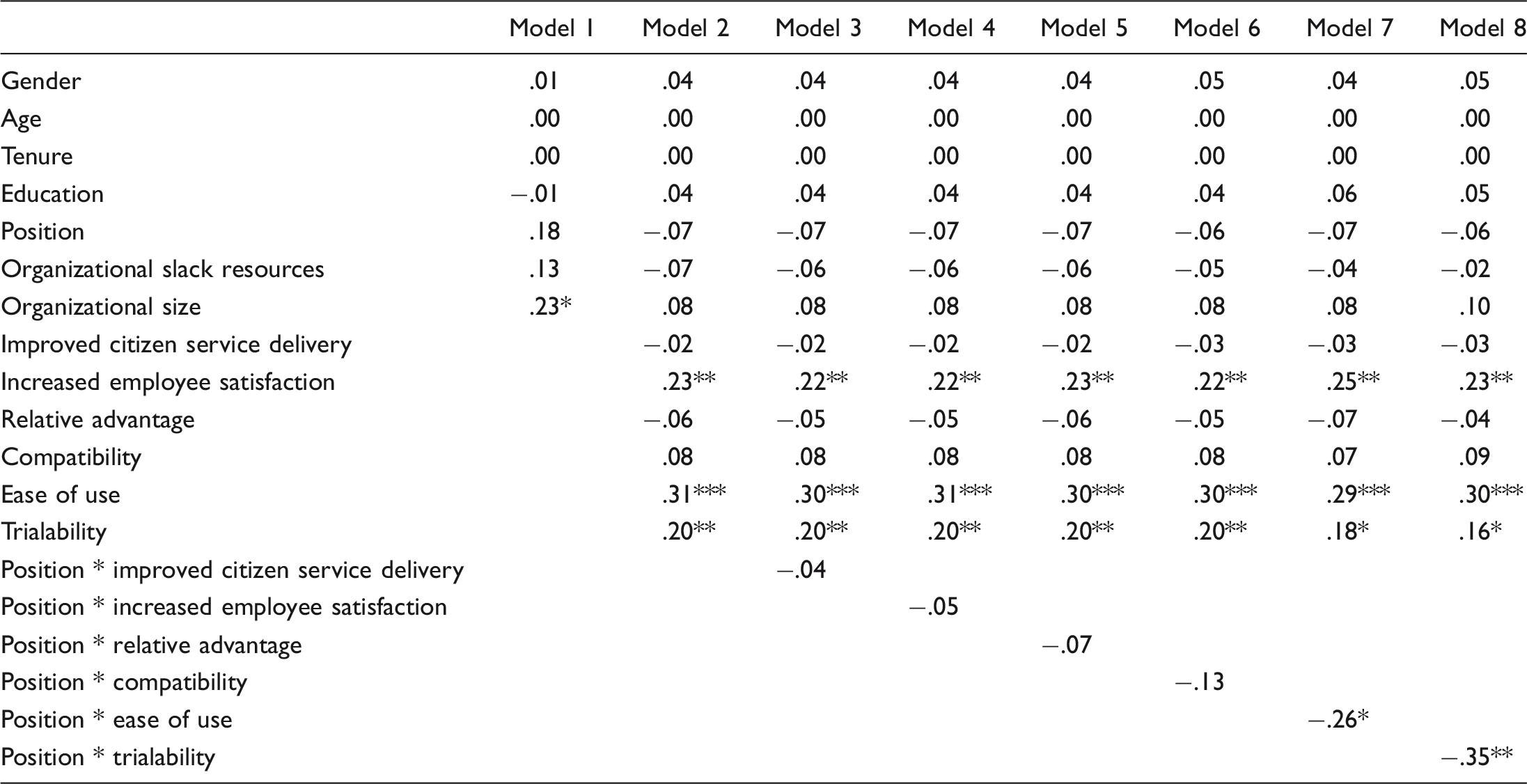
Results of SEM analyses for organizational satisfaction with the implemented innovation.
Notes: *p < .05; **p < .01; ***p < .001.
The first model included only the control variables, whereas Model 2 included all the variables but without interaction effects. Model 2 shows that an increase in employees’ satisfaction is positively and significantly related to organizational satisfaction with the implemented innovation (β = .23, p < .01). In terms of the innovation’s attributes, the results indicate that both its ease of use (β = .31, p < .001) and its trialability (β = .20, p < .01) are significantly related to organizational satisfaction with the implemented innovation. However, the analysis indicates that neither an innovation improving citizen service delivery nor an innovation having a relative advantage or greater compatibility are related to a boost in satisfaction with the implemented innovation. We elaborate on these findings in the ‘Conclusion’ section. Furthermore, the model explained 56.5% of the variance (R2) in organizational satisfaction with the implemented innovation.
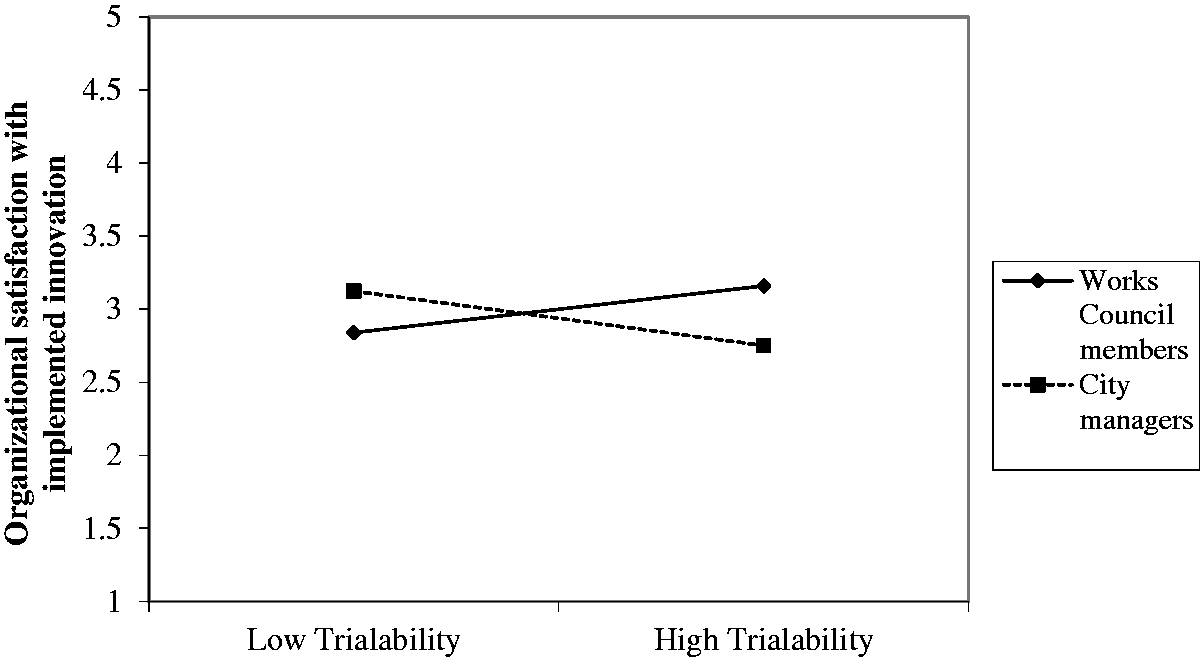
As reflected in Hypothesis 4, we are especially interested in the impact of organizational position (being a city manager or a Works Council member) on the perceived relationship between the innovation’s goals and attributes and the organizational satisfaction with the adopted innovation. In Models 3 to 8, interaction variables, between position and the innovation goals and innovation attributes, were included separately in the analysis. This analysis identified two significant interaction effects: between position and the ease of use and trialability of an innovation. Thus, Hypothesis 4 is only partly supported in that an interaction effect was present in two of the three significant relationships. These statistically significant relationships are plotted in Figures 1 and 2 to help interpret the effects. The figures show that when both the perceived ease of use and trialability are higher, Works Council members in particular perceive a higher degree of organizational satisfaction with the implemented innovation. As such, these results indicate that Works Council members attach greater importance than do city managers to the ability to try out innovations in advance of their full introduction, for instance, through pilot projects, and that it is also more important for them that an innovation is easy to implement and use.
Interaction effect of position and ease of use. Interaction effect of position and trialability.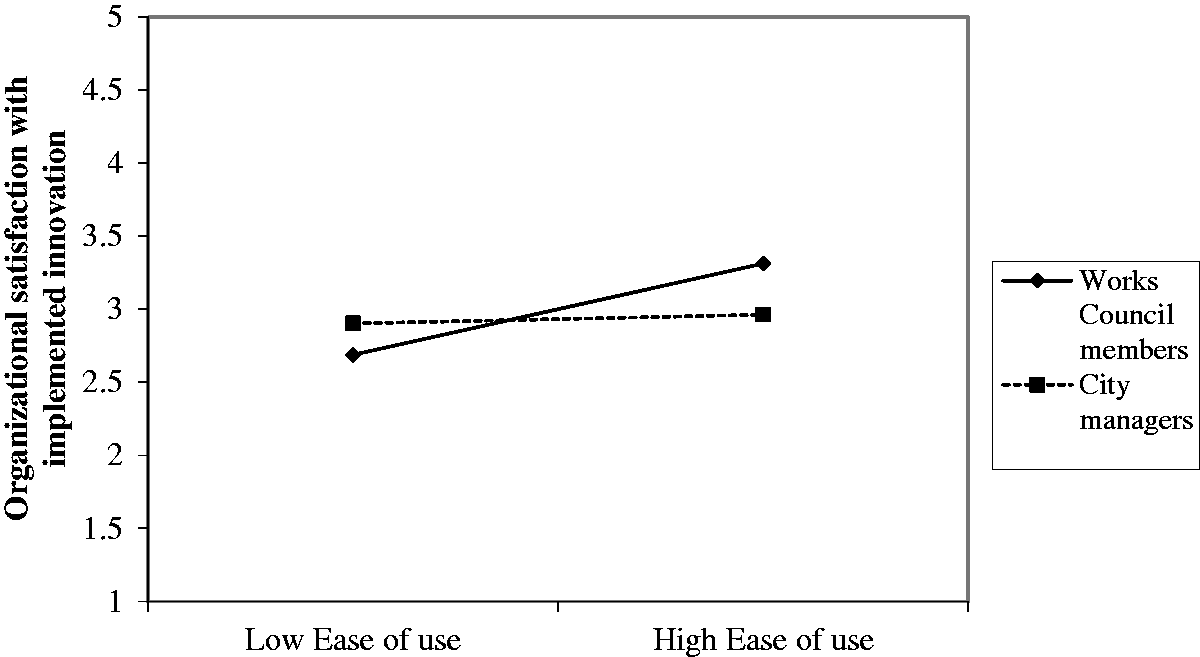
To increase our understanding of the roles of the various actors in the innovation process, we finally consider the qualitative data that were collected through in-depth interviews. First, it was clear that, in both organizations, the Works Council was clearly involved in the teleworking adoption process. An indication of this is that the Works Councils were informed about the introduction of teleworking during regular meetings, which usually take place every six weeks. The following quote illustrates this: ‘In the regular meetings, our city manager informed the Works Council members regarding the status of the introduction of teleworking’.
The Works Councils were also asked to provide advice on the introduction of teleworking and, sometimes, to give formal consent when, as a result of the introduction of teleworking, formal working practices changed. For instance, in one municipality, the clock that registered how many hours people worked was removed. In this regard, one public servant stated that: ‘We had a clock which registered how many hours public servants worked. That’s something we abolished, and which specifically required the consent of the Works Council’.
Related to this, respondents noted how, although the relationship between the city manager and Works Council was based on mutual respect, there were often conflicts of interest. In this regard, respondents particularly noted how the Works Council has to watch the process very carefully given its duty to represent the views of the employees, while city managers tend to be more positive because they have to promote the introduction, and do not have to devote time to the practical problems that employees might experience due to the introduction of teleworking. An illustrative quote is: ‘A city manager will always be positive about teleworking because he is ultimately also the person responsible for it [the implementation]’. Another noted that: It is a different role. The city manager is a ‘visionary’, who is taking a helicopter view into the future of the organization and sees the positive effects of teleworking that might occur. He/she is not concerned with all the [practical] troubles at the lower level [due to the introduction of teleworking]. However, the Works Council also has the role of being a sort of ‘gatekeeper’ and to represent the views of the public servants who might experience all kinds of problems in their daily work due to teleworking’s introduction.
Conclusion
This study presents evidence on public innovation adoption from the perspectives of city managers and Works Council members. Our study has been conducted across Dutch municipalities using unique evidence from nationwide surveys of both groups. The research questions posed in this study examined differences in perceptions concerning the innovation adoption process and tested the impact of organizational position. The main findings indicate important differences between the two groups, and suggest that a multiple stakeholder perspective should be applied in seeking a comprehensive understanding of the adoption of innovations in public sector organizations.
First, we examined the perceptions of city managers and Works Council members concerning the views of their organization’s members regarding the innovation adoption process. Regarding the innovation goals examined (namely, improved service delivery to citizens and increased job satisfaction for public sector employees), we found, contrary to what we expected, that city managers and Works Council members do not have different perceptions regarding improvements in the services provided to citizens. This suggests a shared perspective regarding serving the public interest, possibly reflecting a common public service motivation, which has been shown to motivate people to work in the public sector (Perry and Wise, 1990). An additional comment on this specific goal relates to its somewhat symbolic nature. Although studies on public innovation in general, and more specific studies on teleworking, often highlight this aim (see, for instance, Albury, 2005; Pomp et al., 2009), our results indicate that this goal did not play a major role in determining organizational satisfaction with the implemented innovation. A possible reason for the non-significance of service delivery, an aspect that could be tested in future research, might be related to the specific type of innovation analysed. Since teleworking is concerned with changes in internal organizational practices, it will have a limited impact on citizens, while other service-related innovations will have a more direct effect.
However, in terms of the other innovation goal (namely, increased employee satisfaction), and particularly for some of the innovation attributes considered (compatibility, ease of use and trialability, but not relative advantage), as well as the organizational satisfaction with the implemented innovation, the results showed a far more contrasting picture, with the perceptions of city managers differing significantly from Works Council members. Here, our analysis showed that city managers were consistently more positive than Works Council members, for instance, by indicating a much higher degree of organizational satisfaction than Works Council members. This highlights the need to take account of the perceptions of a range of organizational stakeholders. Such a critical reflection on the consequences of organizational position on perceptions of the innovation adoption process has previously been largely overlooked, although there are some notable exceptions (e.g. Moldogaziev and Resh, 2016).
Second, we examined how organizational position moderates the relationship between these goals and attributes and perceptions of organizational satisfaction with the implemented innovation. The analysis indicated two significant interaction effects: between job position and the trialability and the ease of use of an innovation. These results indicate that Works Council members attach more importance to the ability to try out innovations in advance of their full introduction than city managers, and that it is also more important for them that an innovation is perceived as easy to implement and use. One possible explanation for the trialability finding is that trialling an innovation gives the Works Council members some control over the innovation adoption. For instance, during or after a pilot project, a Works Council can inform the city manager how employees experienced this pilot and what problems still need to be tackled. In this way, the Works Council is able to express employees’ wishes regarding the implementation and, hence, monitor the innovation adoption.
We did not find significant relationships between relative advantage, compatibility and organizational satisfaction with implementation. Boyne et al. (2005) suggest that this may be due to a lack of accurate measures for innovation characteristics, and this could be addressed in future research.
As with all studies, this study has a number of limitations. First, the results of this study, and its implications, should be interpreted in light of the specific innovation studied, namely, teleworking. Further research on other innovation types in different contexts could clarify the generalizability of our results. For instance, studies could examine innovations that are more externally oriented, such as the redesign of external business processes. Moreover, studying the impact of the various legal rights, which could be applied by Works Council members during the innovation implementation process, could be useful. Further, the specific Dutch context of the innovation studied should not be overlooked given that the Netherlands can be considered as a frontrunner when it comes to the introduction of teleworking, with this option open to most public servants in local government settings.
This brings us to future research suggestions. Since our study clearly suggests that different groups of organizational actors should be identified in future research, a valuable avenue would be to obtain data from a broader range of organizational groups (such as senior management) and also maybe to see how their views change as the innovation adoption progresses through different stages. In the present study, we focused on hierarchical level in identifying groups, and it could be that other organizational identities, such as belonging to a certain work unit, are as important in shaping perceptions of innovation adoption. For instance, it could be that members of a specific work unit perceive an innovation (such as a one-stop shop for citizens) as particularly beneficial because they are in daily contact with citizens, and hence see the benefits most clearly. In this regard, future studies could draw on social identity theory (Tajfel and Turner, 1986) to explain how individuals in the workplace may react to an innovation based on their professional and work unit identities.
A final methodological recommendation relates to the measurement of an innovation’s characteristics. In our analysis, we found that the measure for the observability construct was particularly weak. Consequently, a methodological recommendation for future research would be to improve the available measure by elaborating on its conceptual range and testing this in a CFA.
Summarizing, this study presents evidence on public sector innovation adoption from the perspectives of city managers and Works Council members, and shows that there are crucial differences in the perceptions of these two groups, with city managers generally being more positive about the innovation. Based on our investigation, we conclude that it is important to distinguish between the different organizational stakeholders in the innovation adoption process, and that managers should be aware of a bias in their perceptions. More research is needed to analyse how various types of groups, and the identities they cherish, influence the fostering of public sector innovation adoption and how reactions to innovation adoption change over time. This will help in understanding the satisfaction, or lack thereof, with innovation implementation within public sector organizations.
Footnotes
Acknowledgements
The authors would like to thank Dr Brenda Vermeeren for her statistical help and the two anonymous reviewers for their constructive comments on earlier versions of this article. Moreover, our gratitude goes to Frans Mencke (VGS) and Fred Jansen (A+O fonds Gemeenten) for their assistance in the collection of data.
Funding
This work was supported by the European Union Seventh Framework Programme (320090) (Project Learning from Innovation in Public Sector Environments (LIPSE)).
Notes
References
Supplementary Material
Please find the following supplemental material available below.
For Open Access articles published under a Creative Commons License, all supplemental material carries the same license as the article it is associated with.
For non-Open Access articles published, all supplemental material carries a non-exclusive license, and permission requests for re-use of supplemental material or any part of supplemental material shall be sent directly to the copyright owner as specified in the copyright notice associated with the article.
