




Abstract
The application of hydraulic oscillator can solve the problems of large friction and serious pressure support in the drilling process of extended reach well and long horizontal well, but the conventional hydraulic oscillator parameter setting is not reasonable, high pressure consumption, easy to make the ground machine pump overload operation and failure. Therefore, based on the LuGre dynamic friction model theory, a calculation model for the friction between drill string and rock wall under the condition of longitudinal oscillation is established, and the influence law of hydraulic oscillator oscillation parameters on drag reduction efficiency is studied. The results show that the change of oscillation intensity, oscillation frequency and oscillation amplitude can improve the drag reduction efficiency, and the increase trend of drag reduction efficiency is first increased and then decreased. The selection of each parameter has the optimal value. According to the analysis of orthogonal test results, it is found that the reduction degree of friction between drill string and borehole wall rock by each parameter is in the order of oscillation intensity, oscillation frequency and oscillation amplitude from the largest to the smallest.
Introduction
With the increasing number of horizontal Wells, drilling problems encountered in the construction become prominent. How to reduce operating costs and improve the mechanical drilling rate of horizontal Wells has become a research focus. There are many factors affecting the mechanical drilling rate, and one of the key factors is friction.1–4 In the process of horizontal well drilling, the friction resistance of the drill string and the drilling depth are almost linear on the horizontal section and the oblique section, which greatly affects the mechanical drilling speed.5–7 In 2023, Liu used a hydraulic oscillating motor to improve sliding pressure and reduce drilling friction in the Bohai Sea. However, the large working pressure drop was not conducive to hole cleaning with increasing well depth. 8 In 2023, Wang et al. utilized the NOV (National Oilwell Varco) hydraulic oscillator anti-sticking technology to reduce the frictional drag between the bottomhole assembly and the wellbore, resulting in a doubled efficiency in friction reduction. 9 In 2022, Wang et al. analyzed the motion characteristics of hydraulic oscillator control valve by establishing a mathematical model of the control valve, and found that the oscillation frequency of the hydraulic oscillator increased with the increase of the return spring rate. 10 In 2022, Zhang verified the friction reduction law of drag reduction tools by analyzing the number of blades of the impeller, the through hole area of the pressure plate and other parameters, and found that the increase in the number of blades of the impeller of the drag reduction tool and the increase of the through hole area of the pressure plate all had a positive effect on the reduction of friction resistance. 11 In 2022, based on theoretical research and field application, Zhang found that the drag reduction tool uses periodic oscillation to reduce the contact time between the drill string and the well wall to achieve the effect of drag reduction. 12 In 2022, Meng et al. achieved the purpose of drag reduction by optimizing the disc spring parameters of the hydraulic oscillator, and the final drag reduction efficiency increased by 36%–106%. 13 In 2015, Abdo and Al-Sharji studied the influence of the oscillation parameters of the hydraulic oscillator on the friction resistance of the drill string, and found that the oscillation frequency only works within a certain range of drag reduction, and the frequency is out of range has almost no effect. 14 In 2002, Littmann et al. studied the effect of tangential oscillation change on drag reduction efficiency, but ignored the frictional influence of the contact deformation of the two surfaces when calculating friction, resulting in high calculation results. 15 In summary, scholars at home and abroad are keen on the applied research on the drag reduction effect between drill string and wellbore system during horizontal well drilling, but so far there has been no in-depth study of the drag reduction mechanism of hydraulic oscillators.
In recent years, hydraulic oscillator devices have been widely used in horizontal well drag reduction (Figure 1). The hydraulic oscillator uses the pulse pressure to generate axial oscillation force, which works in combination with the bottom drilling tool, which can improve the friction conditions between the drilling string and the rock of the well wall, play a role in reducing drag and improving the drilling efficiency.16–18 Several parameters of the hydraulic oscillator are the key to the drag reduction effect, including the oscillation frequency, oscillation intensity, and oscillation amplitude of the hydraulic oscillator.19–21 Some scholars have found the relationship between the oscillation frequency of the hydraulic oscillator and the drag reduction efficiency, when the drill string produces axial oscillation, the oscillation frequency and the speed of the drill string itself will be superimposed, and the oscillation speed changes with time according to the sinusoidal law. 21 In 2018, Li et al. found that during the sliding drilling process of hydraulic oscillator, the friction between the drill string and the well wall was consistent with the oscillation cycle, showing a near-sinusoidal curve change, and the oscillation force played an important role in the change of friction. 22 In 2022, Zhong compared the changes of drill string parameters with and without oscillator, compared five sets of oscillation amplitude and conducted sensitivity analysis, and the results found that the drill string increased with time, and the drilling pressure changed irregularly with time. 6 Based on the LuGre dynamic friction model, this paper establishes the calculation model of friction between the drill string and the well wall during the drilling sliding process, and analyzes the influence of these parameters on the drag reduction law by using the established calculation model on the oscillation frequency, oscillation intensity and oscillation amplitude changes of the hydraulic oscillator, and obtains the optimal value of the parameters, which provides a theoretical basis for the optimization parameters of drag reduction in the process of horizontal well drilling.
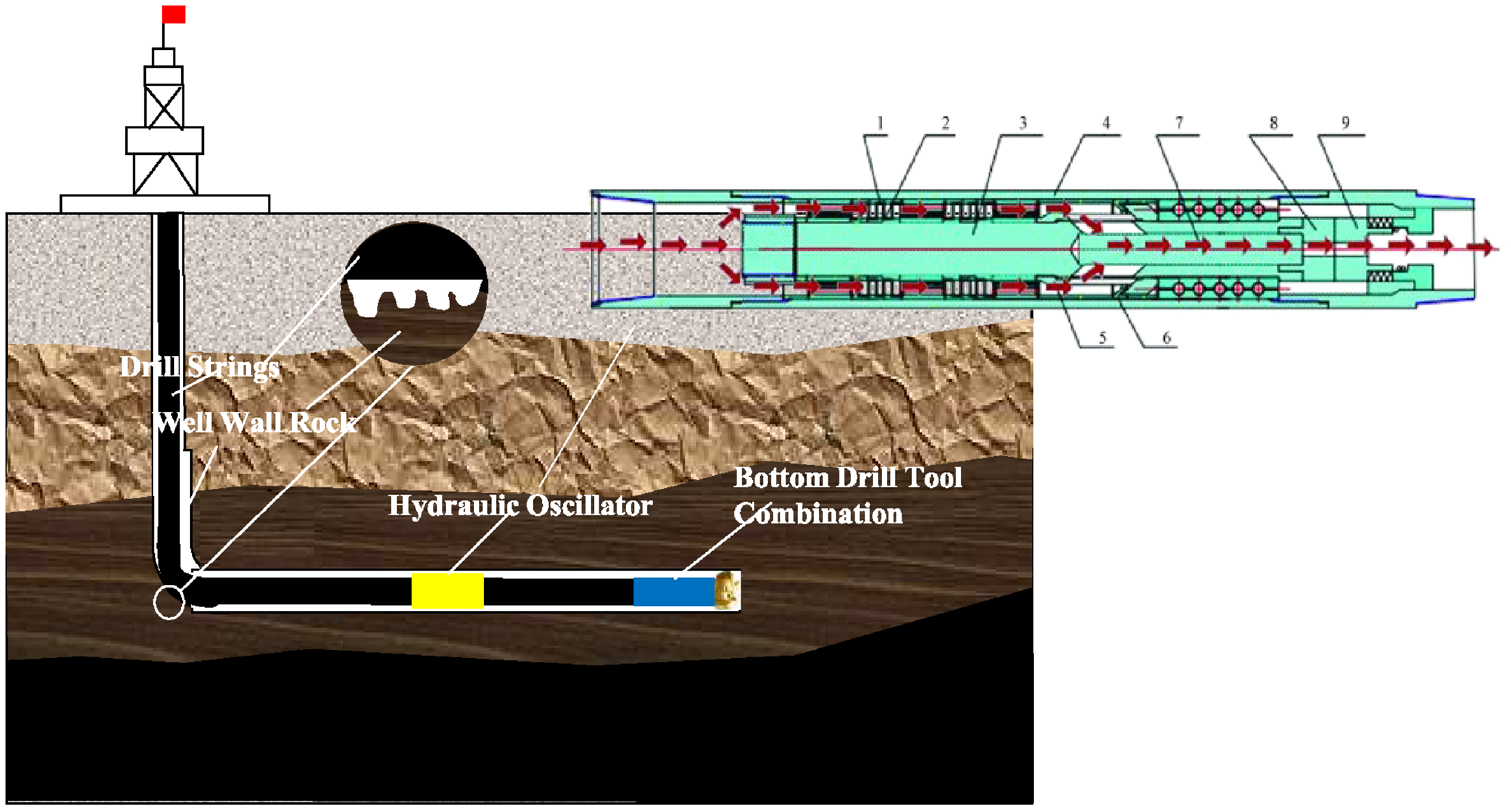
Sliding friction diagram of downhole drill string and wellbore. 1. Turbine stator; 2. Turbine rotor; 3. Turbine spindle; 4. Jacket; 5. Shunt sleeve; 6. Deflector; 7. Center rod; 8. Rotary valve; 9. Static valve.
Hydraulic oscillator structure and working principle
The hydraulic oscillator is mainly composed of three parts: vibration short section, power short section and valve shaft part. The vibration short section contains a piston shaft and a spring, when the drilling fluid pressure increases, push the piston upward movement compression spring, when the pressure decreases, the spring pushes the piston downward movement, so reciprocating drives the drill string to occur periodic movement; The power stub part is the bottom motor that drives the rotary valve to rotate; The valve shaft part is the source of pulse signal generation, and the reciprocating staggered movement of the fixed valve disc and the moving valve disc is controlled by the rotation of the rotary valve to realize the periodic control of the staggered position.23–26
The working principle of the hydraulic oscillator is: drilling fluid through the power short section part to drive the rotor rotation, so that the moving disk valve to do plane reciprocating movement, because the moving disk valve hole eccentric opening, so the change of overcurrent area also occurs periodic changes, resulting in water hammer phenomenon, that is, pressure pulse. The pressure pulse drives the reciprocating movement of the drill string, so that the static friction between the drill string and the rock of the well wall is converted into dynamic friction, so that the energy loss caused by friction is reduced, and the function of reducing friction and reducing torque is achieved.25–29
Mathematical model of drill string friction
Based on the working principle of hydraulic oscillator and the theoretical analysis of the influence on drag reduction efficiency, the mathematical model and solution method of drill string friction are established on the basis of several hypothetical conditions.
Model assumptions
To establish a mathematical model of drill string friction, the assumption is:
(1) The oscillation mode of the hydraulic oscillator belongs to simple harmonic oscillation.
(2) Assume that during the combined work of drilling tools without hydraulic oscillator, the relative rest between the drill string and the rock of the well wall is relatively stationary.
(3) It is assumed that the axial oscillation generated by the hydraulic oscillator itself has no effect on the oscillation of the drill string.
(4) The oscillation effect generated by the drill string itself during the drilling process is not considered.
(5) The axis of the drill string is in contact with the well wall in the horizontal section.
(6) Assume that the friction between the drill string and the drilling fluid system has no effect.
(7) It is assumed that the precompression force of the spring system in the hydraulic oscillator has no effect.
(8) The influence of the axial force of the drill string on the drag reduction effect is not considered.
LuGre dynamic friction model and drill string motion equation
In the horizontal well drilling process, the drill string produces axial oscillation under the oscillation of the hydraulic oscillator, relative to the well wall rock low frequency, low amplitude oscillation, the friction direction between the drill string and the well wall rock will also change with the change of the direction of the oscillation force, the drill string in a cycle in two states of motion: sliding and stationary. 30 Dahl model is the basis of other dynamic friction models, the friction characteristics near the maximum static friction stage as a dynamic friction model of spring characteristics, so that the motion state switching under the static model is continuous, can predict friction hysteresis, but it cannot describe well friction, cannot find Stribeck effect, mane model is from the microscopic perspective to explain the friction phenomenon between the drill string and the well wall, can accurately describe the characteristics in the microscopic friction process, but the numerical calculation of the time step is extremely short, time-consuming. 31 The LuGre dynamic friction model combines the advantages of the two models and uses the average offset of the two pairs of elastic manes after deformation to model, which belongs to a continuous model, considering the static friction and Stribeck negative slope effect, overcoming the friction random behavior of the mane model, and the transition between different friction states is smoother.32,33 Therefore, the LuGre dynamic friction model was used to characterize the dynamic friction characteristics between the drill string and the well wall rock, and the LuGre dynamic friction model for friction between the drill string and the well wall rock (Figure 2).
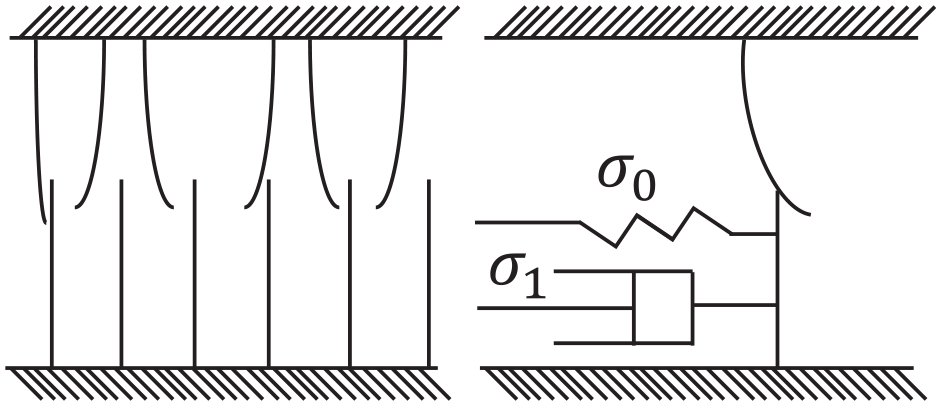
LuGre dynamic friction model between drill string-bore.
The friction between the drill string and the well wall rock is expressed as:


Substituting equation (2) into equation (1) yields:

When the mane deformation reaches its maximum, the variable z remains constant.

The Stribeck effect is described by the function g(

When
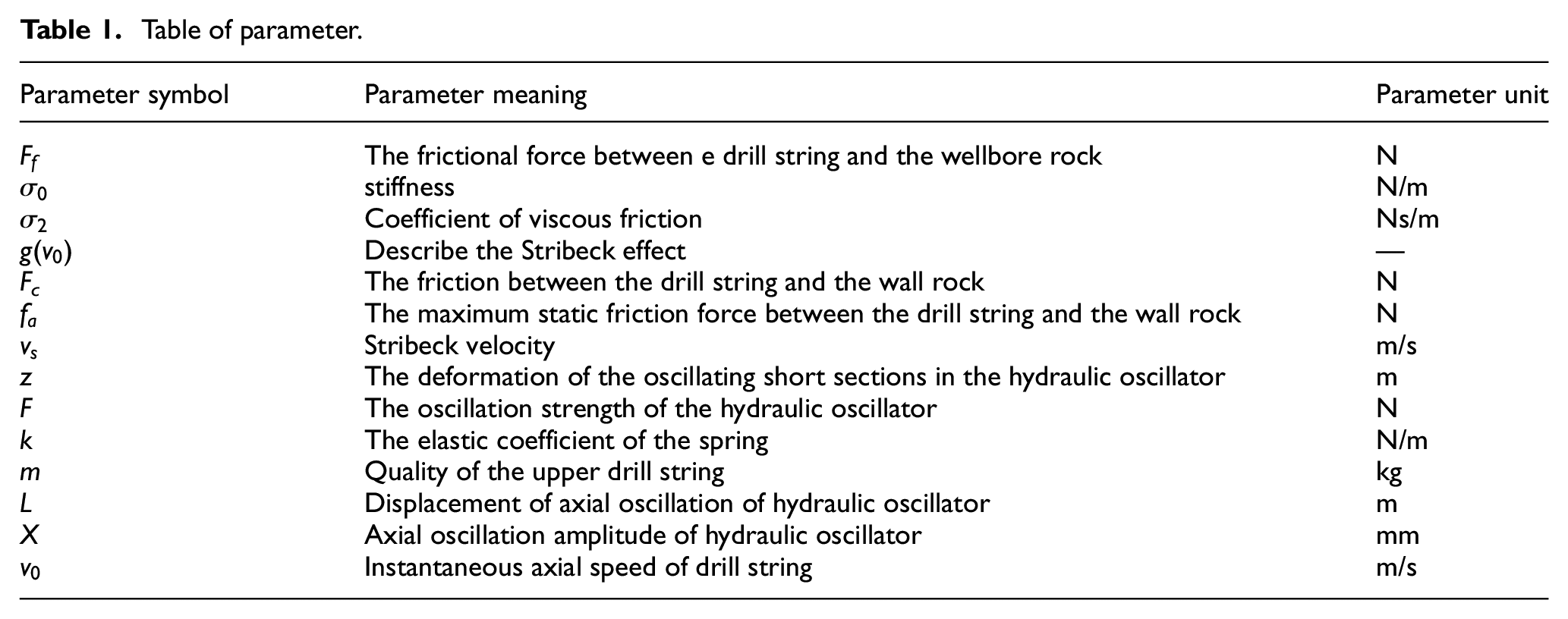
Table of parameter.
The LuGre dynamic friction model can describe static and dynamic friction characteristics such as stick-slip motion friction hysteresis and pre-sliding displacement.
The equation of motion of the drill string under the oscillation of the hydraulic oscillator is:


The axial instantaneous velocity of the drill string under the oscillation of the hydraulic oscillator is:

Model solving
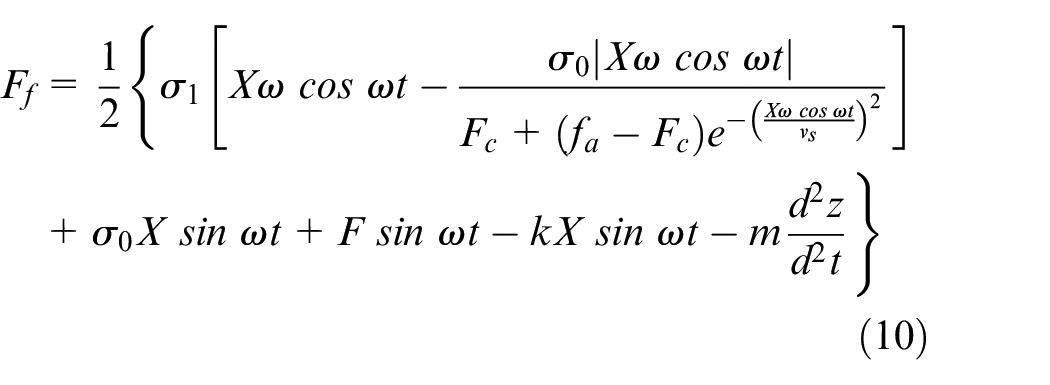
Combined with formula (3)–formula (8) the calculation model between the oscillation frequency oscillation intensity oscillation amplitude and friction of the hydraulic oscillator can be obtained:
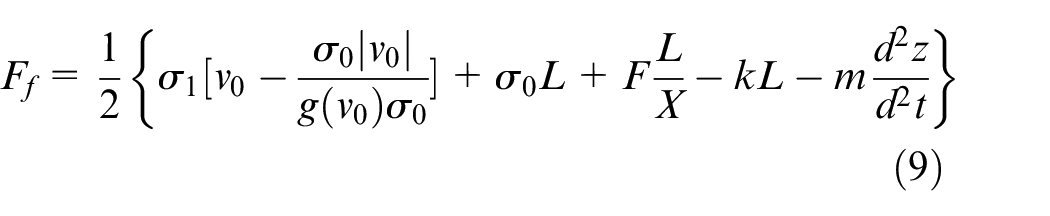
Substitute formula (7) and (8) into formula (9):
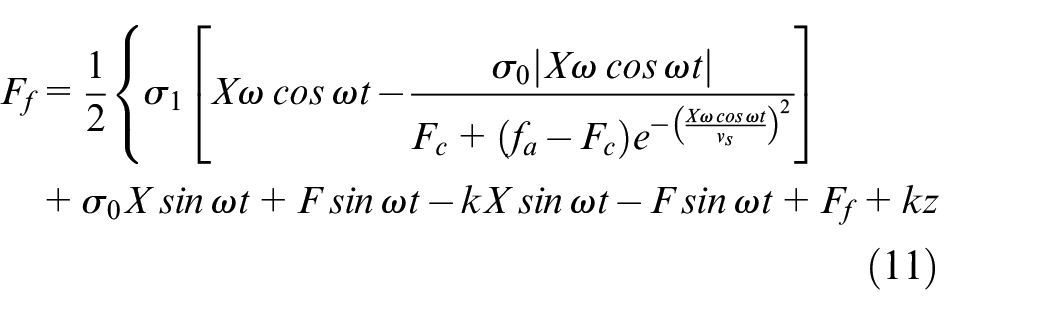
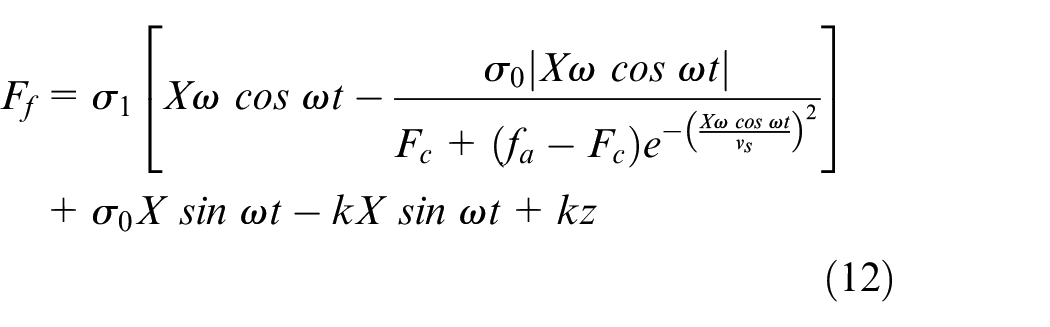
To simplify:
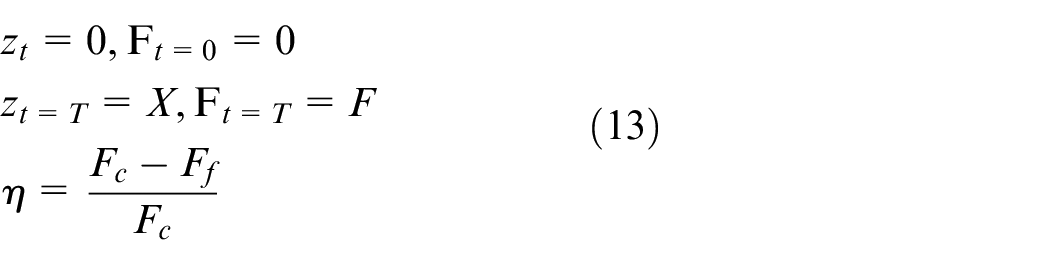
Boundary conditions
The factors affecting the drag reduction effect mainly include tool parameters (oscillation frequency oscillation intensity oscillation amplitude). The stiffness between the drill string and the well wall was selected
Analysis of the influence of various parameters of hydraulic oscillator
Single factor influences the law
The effect of oscillation intensity on drag reduction effect
The oscillation frequency of the hydraulic oscillator was selected as 12, 15, 18, 21 and 24 Hz and the influence of the oscillation intensity of the hydraulic oscillator on the drag reduction effect was studied. It can be seen from Figure 3 that the increase of oscillation intensity can significantly reduce the friction between the drill string and the rock of the well wall and the influence of oscillation intensity on the drag reduction effect at different oscillation frequencies is consistent. When the oscillation intensity increases from 0 to 50 kN the friction curve shows a trend of first significantly decreasing and then stabilizing. Among them when the oscillation intensity is 40 kN under the action of the hydraulic oscillator the friction between the drill string and the well wall rock decreases significantly and the drag reduction efficiency is as high as 56.8% when the oscillation intensity is 0–40 kN with the increase of the oscillation intensity of the hydraulic oscillator the drag reduction efficiency also gradually increases and the friction between the increased drill string and the well wall rock shows a significant decrease trend; When the oscillation intensity of the hydraulic oscillator is 40~50 kN the friction between the drill string and the rock of the well wall has almost no change. It can be inferred from this that when the oscillation intensity of the hydraulic oscillator increases the energy transmitted by the hydraulic oscillator to the drill string gradually increases the axial pressure of the drill string also gradually increases the vibration attenuation time of the drill string is extended and the time of the drill string in the sliding state is extended which improves the transmission of axial force increases the limit of wellbore extension overcomes the obstruction of friction makes the drill bit get more load for rock breaking improves drilling efficiency and reduces the friction between the drill string and the rock on the well wall. However the influence of oscillation intensity on drag reduction effect is limited and when the oscillation intensity exceeds 40 kN the oscillation intensity has basically no effect on the drag reduction effect.
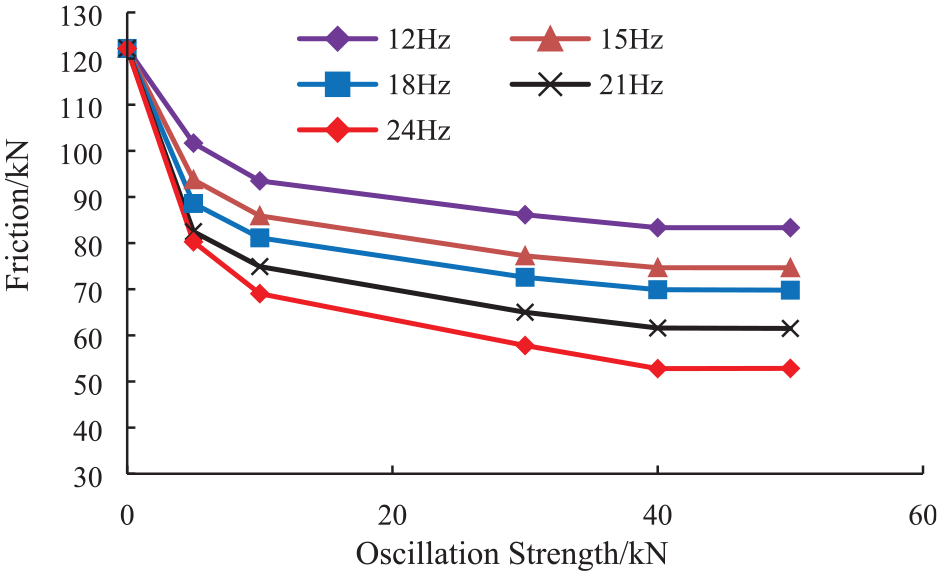
Friction curve with oscillation intensity.
The effect of the oscillation amplitude on the efficiency of the drag reduction effect
The oscillation frequency of the hydraulic oscillator was selected as 12, 15, 18, 21 and 24 Hz, and the influence of the oscillation amplitude of the hydraulic oscillator on the drag reduction effect was studied. It can be seen from Figure 4 that the increase of oscillation amplitude can significantly reduce the friction between the drill string and the well wall rock, and the influence of oscillation amplitude on the drag reduction effect at different frequencies is consistent. When the oscillation amplitude increases from 0 to 18 mm, the friction curve shows a trend of decreasing first and then stabilizing. Among them, when the oscillation amplitude is 16 mm, under the action of the hydraulic oscillator, the friction between the drill string and the well wall rock is significantly reduced, and the drag reduction efficiency is as high as 44.6%. When the oscillation amplitude is 0–16 mm, with the increase of the oscillation amplitude of the hydraulic oscillator, the friction between the drill string and the well wall rock shows a significant decrease trend. When the oscillation amplitude is 16–18 mm, the friction between the drill string and the well wall basically does not change. It can be inferred that when the oscillation amplitude increases, under the action of the hydraulic oscillator, the maximum axial stress oscillation amplitude in the drill pipe is greater than the axial stress oscillation amplitude at the bottom of the drill string, which improves the transmission of axial force, reduces the friction between the drill string and the rock of the well wall, and achieves the purpose of drag reduction. However, when the oscillation amplitude exceeds 16 mm, the oscillation amplitude has basically no effect on the drag reduction effect.
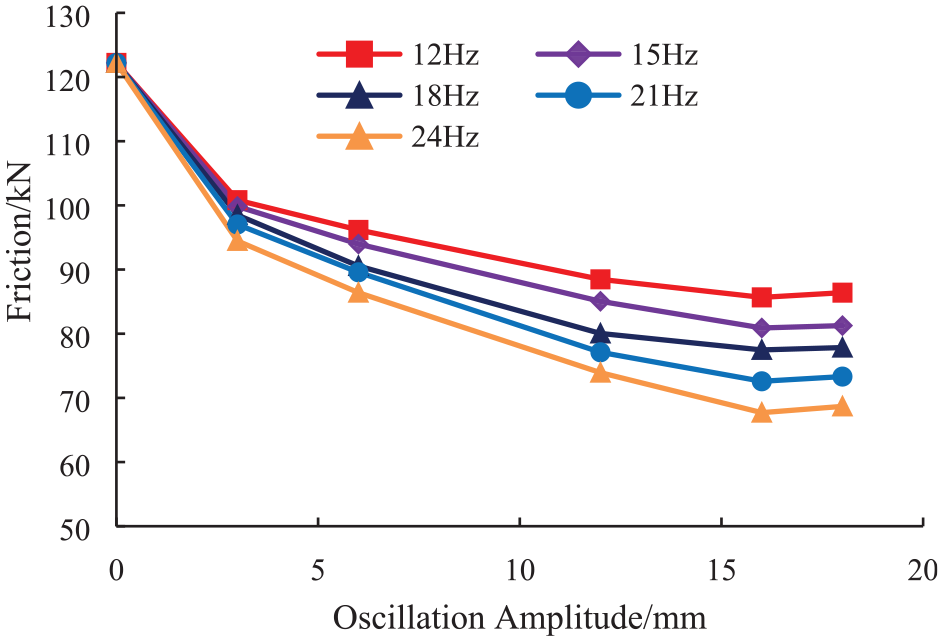
Friction curve with oscillation amplitude.
The effect of oscillation frequency on drag reduction effect
The oscillation intensity of the hydraulic oscillator was selected as 10, 20, 30, 40 and 50 kN, and the influence of the oscillation frequency of the hydraulic oscillator on the drag reduction effect was studied. It can be seen from Figure 5 that the increase of oscillation frequency can significantly reduce the friction between the drill string and the rock of the well wall, and the influence of oscillation frequency on the drag reduction effect at different intensities is consistent. When the oscillation frequency increases from 0 to 24 Hz, the friction curve first decreases obviously and then tends to be stable. Among them, when the oscillation frequency is about 15 Hz, under the action of hydraulic oscillator, the friction between the drill string and the rock wall is reduced significantly, and the drag reduction efficiency is as high as 34.5%. When the oscillation frequency is from 0 to 20 Hz, the friction resistance between drill string and rock wall decreases obviously with the increase of oscillation frequency of hydraulic oscillator. However, when the oscillation frequency is 20–24 Hz, the friction between the drill string and the rock wall does not change. It can be inferred that when the oscillation frequency increases, under the action of the hydraulic oscillator, the drill string moves more and more violently in the borehole, so that the number of contacts between the drill string and the well wall rock is significantly reduced, thereby effectively reducing the friction between the drill string and the well wall rock. However, the influence of oscillation frequency on drag reduction effect is also limited, when the oscillation frequency exceeds 20 Hz, the oscillation frequency is not particularly significant.
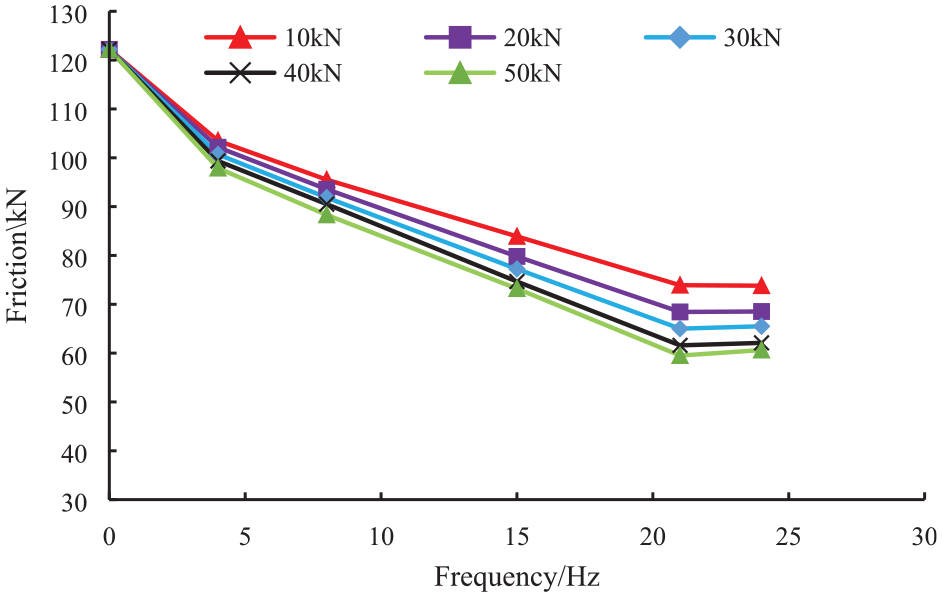
Friction curve with oscillation frequency.
Multi-factor influences the law
The change of friction resistance of single factors can reflect the oscillation drag reduction law to a certain extent, but the drag reduction effect in actual construction is a combination of multiple factors.5–7 Liu et al. found that there is interaction between hydraulic oscillation parameters, but the study on the strength of influencing factors is still shallow. Therefore, the analysis results are as follows: Under the action of a hydraulic oscillator, the frequency and amplitude of oscillation can have an impact on the frictional force between the drill string and the wellbore. The amplitude and frequency of the hydraulic oscillator may lead to an increase in the contact area between the drill string and the wellbore, resulting in changes in the frictional force.8–12 In order to understand the oscillation drag reduction effect and its interaction under three factors: oscillation frequency, oscillation intensity and oscillation amplitude, the statistical orthogonal test method was used to select L9(34) orthogonal table for numerical experiment, and the factor level and test results were shown in Tables 2 and 3, respectively.
Table of factor levels.
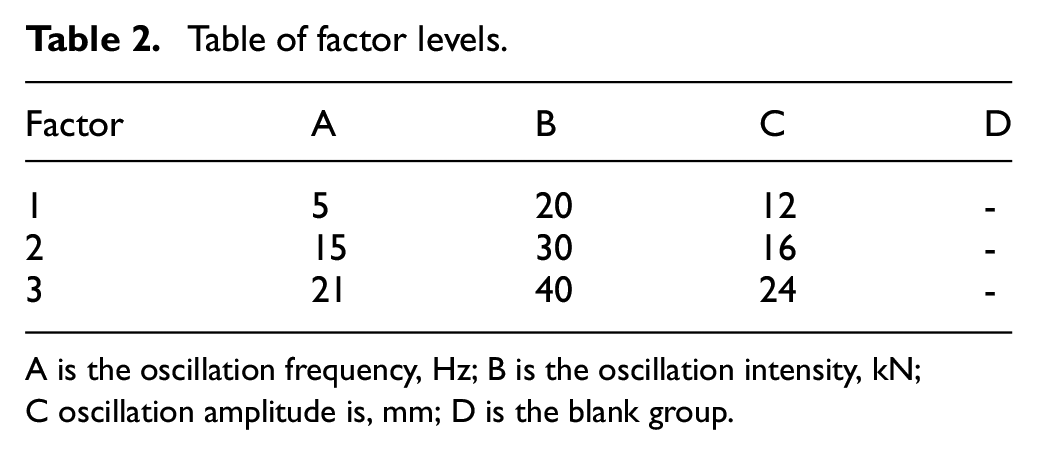
A is the oscillation frequency, Hz; B is the oscillation intensity, kN; C oscillation amplitude is, mm; D is the blank group.
Orthogonal test results.
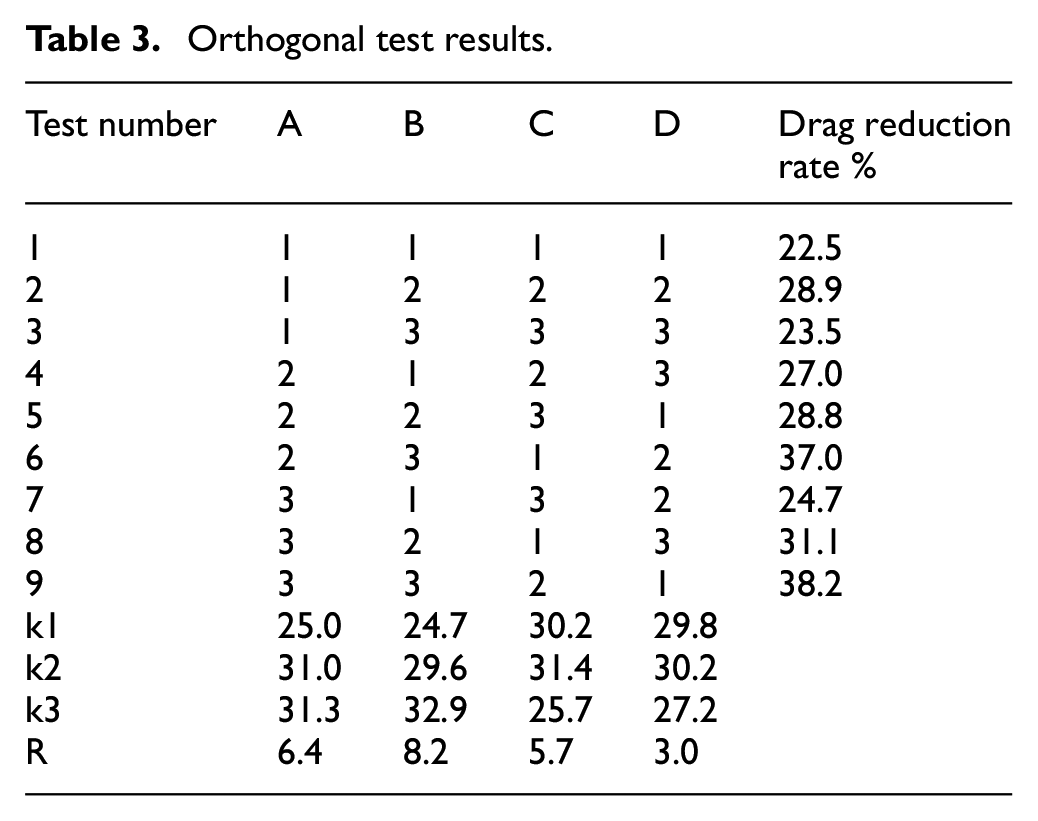
The range ratio analysis of the orthogonal experimental design results in Table 3 was carried out to study the influence of hydraulic oscillator on the friction between the drill string and the well wall rock under the conditions of each oscillation parameter. Among them, ki (i = 1, 2, 3) represents the average drag reduction efficiency of each level of a certain oscillation factor, and R represents the corresponding range of each factor.
Through calculation, it is found that the range (R) corresponding to each hydraulic oscillator parameter is arranged in order from largest to smallest, in order: oscillation intensity > oscillation frequency > oscillation amplitude, the range of oscillation intensity is the largest, and the range of oscillation amplitude is the smallest. It is explained that in the process of horizontal well drilling, the oscillation intensity of the hydraulic oscillator is the main factor affecting the friction change between the drill string and the well wall rock, and the oscillation frequency of the hydraulic oscillator is a secondary factor, followed by the oscillation amplitude of the hydraulic oscillator. This test index is drag reduction efficiency, the larger the index, the better, so according to the average value of A, B, C, so when the oscillation intensity, amplitude, frequency of the hydraulic oscillator is 40 kN, 15 Hz, 16 mm, the drag reduction effect is the best.
Conclusion
In this study, the influence of hydraulic oscillator parameters on the drag reduction efficiency of horizontal well drilling process is systematically explored,32,33 and the following understanding is obtained:
(1) By comparing the calculation results of various parameters of the hydraulic oscillator, the use of hydraulic oscillator in the drilling process of horizontal well can effectively reduce the friction between the drill string and the rock of the well wall, increase the drilling pressure of the drill bit, and then improve the drilling efficiency. During the initial stage, the action of the hydraulic oscillator generates a cyclic scouring effect, which refers to the periodic pressure changes that flush solid particles out of the drilling fluid. This scouring effect reduces the friction between the drill string and the wellbore, resulting in a decrease in frictional force. However, as the drilling progresses and the well depth increases, the contact area between the drill string and the wellbore continues to increase, leading to an increase in frictional force.
(2) Based on the LuGre dynamic friction model theory, an analysis and calculation model of friction between the drill string and the well wall rock under the longitudinal oscillation condition of the drill string is established. The calculation results show that when the oscillation intensity, frequency and amplitude of the hydraulic oscillator are 40 kN, 15 Hz, and 16 mm, respectively, the drag reduction effect is the best.
(3) Based on orthogonal experiments, the influence of interaction of various factors on hydraulic pressure reduction effect was further explored. The study shows that the order of oscillation parameter to reduce friction degree is as follows: oscillation intensity > oscillation frequency > oscillation amplitude.
The above studies also show that reasonable regulation of hydraulic oscillator parameters can effectively reduce the friction between the drilling string and the wellbore rock, shorten the drilling cycle, and improve the drilling speed.
Footnotes
Declaration of conflicting interests
The author(s) declared no potential conflicts of interest with respect to the research, authorship, and/or publication of this article.
Funding
The author(s) disclosed receipt of the following financial support for the research, authorship, and/or publication of this article: This research was funded by Key Research and Development Project of Shaanxi Province (grant number 2022GY-133), China Postdoctoral Science Foundation (grant number 2023MD734222), National Natural Science Foundation of China (grant number 52074224) and Key Research and Development Program of Shaanxi Province (grant number 2023-YBGY-312).

Data availability statement
Data sharing not applicable to this article as no datasets were generated or analyzed during the current study.