




Abstract
Although attention-deficit/hyperactivity disorder (ADHD) and intellectual giftedness have been associated with atypical sensory processing and heightened sensitivity, no studies have specifically examined how these neurodevelopmental conditions interact to influence sensory sensitivity and sensory processing. This study aimed to investigate the sensory sensitivity and sensory processing of children with intellectual giftedness and ADHD. Using a cross-sectional correlational design, 159 parents (Mage = 40.65; 93.29% mothers) from Quebec, Canada, of children (n = 209; Mage = 9.38; 57.20% boys) aged 6 to 16 years—with intellectual giftedness (n = 50), ADHD (n = 61), both intellectual giftedness and ADHD (n = 52), or neither (n = 46)—completed the Sensory Profile 2 to assess their child’s sensory processing. In a subsample (n = 90), parents additionally completed the Highly Sensitive Person Scale about their child to assess the child’s sensory sensitivity. Findings revealed that the interaction between intellectual giftedness and ADHD was associated with a decrease in sensory registration, a dimension of sensory processing, whereas the presence of either intellectual giftedness or ADHD alone was linked to increased sensory registration. This suggests that children with intellectual giftedness and ADHD tend to be more attuned to sensory stimuli in their environment, potentially reflecting a reduced capacity for sensory filtering and an increased risk of sensory overwhelm. These findings align with existing evidence indicating that such children may benefit from sensory-inclusive environments that facilitate better sensory modulation, thereby promoting adaptive functioning and well-being.
Plain Language Summary
Some children experience the world around them in a much more intense way than others. This is especially true for children who are intellectually gifted, have attention-deficit/hyperactivity disorder (ADHD), or both. These children may notice more details in their surroundings or become easily overwhelmed by sounds, lights, textures, or emotions. While previous studies have looked at how giftedness and ADHD separately affect how children react to sensory information, this study is one of the first to explore how having both traits together influences sensory sensitivity. In this research, 159 parents from Quebec, Canada, answered questions about their children’s behavior. The study included 209 children between the ages of 6 and 16. Some were gifted, some had ADHD, some had both, and some had neither. Parents completed questionnaires about how their children respond to everyday sensory experiences—like noises, touch, movement, and emotional situations. The results showed that children with both giftedness and ADHD were more sensitive to sensory information overall. Interestingly, they also had lower levels of “sensory registration,” meaning they noticed more sensory details around them and had a harder time filtering out unimportant information. This can lead to sensory overload, making it difficult for them to focus, stay calm, or feel comfortable in busy or noisy places. Understanding how these children experience the world can help parents, teachers, and professionals better support their needs. Sensory-friendly environments—such as quiet classrooms or calm home spaces—may help them feel more at ease, focus better, and thrive both emotionally and academically.
Keywords
Sensory sensitivity and sensory processing are often cited as characteristics of intellectual giftedness (Dakhlallah & Ahmad, 2022; Gere et al., 2009; Greven et al., 2019; Rinn & Majority, 2018). These studies suggest that gifted children would process and react to sensory stimuli differently than their non-gifted counterparts. However, the evidence for this sensitivity factor is mainly derived from clinical observations rather than empirical research (Rinn & Bishop, 2015). Moreover, gifted children with attention-deficit/hyperactivity disorder (ADHD) may also have sensory sensitivity and sensory processing difficulties. Examining the real and perceived characteristics of giftedness is important to understand gifted and twice exceptional children’s intellectual, social, and emotional needs and, ultimately, develop effective interventions. Consequently, it appears essential to study sensory sensitivity and processing among children with giftedness, ADHD, and both giftedness and ADHD.
While there is no consensus in the scientific literature on the definition of giftedness, the National Association for Gifted Children (NAGC, 2019), an internationally recognized American organization in the field, defines it as the potential to achieve significantly higher levels of performance in skills or creativity across one or more domains, compared with peers of the same age, experience, and environment. When this area of activity relates to the intellectual domain, it is specifically referred to as intellectual giftedness. In both clinical and research settings, the identification of intellectual giftedness is primarily based on cognitive assessments employing tests measuring academic performance or intelligence quotient (IQ; Lubinski, 2016; Silverman, 2018). The most commonly cited threshold for intellectual giftedness in psychology and neuropsychology is an IQ score of 130, which is two standard deviations above the mean of 100, indicating a prevalence of 2.28% in the population (Tordjman & Kermarrec, 2019). However, it is important to note that in the field of gifted education, intellectual giftedness is often defined more broadly, extending beyond a single IQ cutoff to encompass multiple dimensions such as creativity, talent, and motivation (e.g., NAGC, 2019; Sternberg, 2018). From this perspective, some researchers advocate for a more comprehensive approach to identifying intellectual giftedness, integrating psychometric assessments, such as IQ tests, with supplementary methods like interviews or self-report questionnaires that evaluate characteristics commonly associated with intellectual giftedness (Desvaux et al., 2024; Francis et al., 2016; Martin et al., 2010).
According to children’s medical and psychological records, ADHD is the most frequently reported comorbid disability associated with intellectual giftedness (Barnard-Brak et al., 2015; Cordeiro et al., 2011; Foley-Nicpon & Assouline, 2020). ADHD is a neurodevelopmental disorder characterized by symptoms of inattention and hyperactivity/impulsivity that manifest before the age of 12 and impair daily functioning in at least two settings, such as school and home (American Psychiatric Association, 2022). This disability affects both non-intellectually gifted and intellectually gifted children at similar rates, with prevalence estimated between 3% and 9% (Antshel, 2008; Mullet & Rinn, 2015).
Sensory Sensitivity and Sensory Processing: Theoretical Frameworks
Two theoretical models guide current research on sensory functioning (e.g., Greven et al., 2019; Turjeman-Levi & Kluger, 2022). The Sensory Processing Sensitivity model defines sensory sensitivity as a biologically based temperament trait characterized by deeper cognitive processing of stimuli, increased susceptibility to overstimulation, heightened emotional and physiological reactivity, higher awareness of subtle environmental cues, and behavioral inhibition (for a review, see Greven et al., 2019; Pluess et al., 2023). By contrast, Dunn’s (1997) Sensory Processing theory explains individual differences in sensory processing through neurological thresholds (high and low) and corresponding behavioral responses (active or passive). Although the two models have a common theoretical basis, they reflect distinct conceptual approaches, with the former emphasizing emotional reactivity to sensory stimuli and the latter focusing on behavioral responses (Turjeman-Levi & Kluger, 2022). Nonetheless, several researchers have used them interchangeably to study sensory sensitivity (Bakker & Moulding, 2012; Jerome & Liss, 2005; Meredith et al., 2016). Disentangling sensory sensitivity and sensory processing is, however, an important endeavor, as it may lead to a better understanding of the characteristics of gifted children and provide useful guidelines for intervention.
Sensory Sensitivity and Sensory Processing in Children With Intellectual Giftedness, ADHD, and Both Conditions
Although research on sensory sensitivity or sensory processing in children with both intellectual giftedness and ADHD is limited, a recent study conducted by Giroux (2025) found no overall difference in sensory sensitivity between children with intellectual giftedness, those with ADHD, those with both conditions, and those with neither condition. However, some differences emerged with aesthetic sensitivity, a dimension of sensory sensitivity which refers to aesthetic awareness, such as the ability to be moved by music or art and noticing and enjoying fine scents or tastes (Aron & Aron, 1997). Aesthetic sensitivity was found to be significantly higher in youth with intellectual giftedness, whether or not they also had ADHD, compared with those without giftedness. This result refines previous clinical descriptions that broadly associate sensory sensitivity with intellectual giftedness, by indicating that the relationship may concern specific facets of sensory sensitivity, particularly the aesthetic domain, rather than the construct as a whole (Giroux, 2025).
Although studies examining children with both intellectual giftedness and ADHD are scarce, some additional studies have examined intellectual giftedness and ADHD separately. In the case of children with intellectual giftedness, Samsen-Bronsveld and colleagues (2024) found that, based on the Sensory Processing Sensitivity model, children with high cognitive abilities, as defined in their study by performance in the top 10% on cognitive measures, exhibited significantly higher sensory sensitivity compared with those with lower cognitive abilities, but similar levels to those with average or above-average abilities.
These findings stand in contrast to those of Gere and colleagues (2009), who studied sensory processing in intellectually gifted children employing Dunn’s Sensory Processing theory. Their results revealed that children with intellectual giftedness showed heightened environmental sensitivity, as well as more intense emotional and behavioral responses, compared with children without intellectual giftedness. However, these comparisons were based on age-normed measures without a designated comparison group, which limits the generalizability of their results. The discrepancies between these two studies may be explained by differences in how sensory sensitivity, sensory processing, and intellectual giftedness were operationalized.
By contrast, most studies focusing on children with ADHD are grounded in Dunn’s Sensory Processing Theory and consistently yield similar findings regarding sensory processing. More precisely, children with ADHD exhibit lower sensory-motor abilities and higher prevalence of atypical sensory processing patterns compared with their peers without ADHD (e.g., Dalpatadu et al., 2017; Delgado-Lobete et al., 2020; Dellapiazza et al., 2021; Jurek et al., 2025; Little et al., 2018; Panda et al., 2023; Rani et al., 2023; Shimizu et al., 2014). One particularly noteworthy finding is the heightened sensory processing observed in children with ADHD, characterized by their increased detection of sensory information compared with children without ADHD, which results in heightened reactivity to environmental sensory stimuli (Dunn & Bennett, 2002; Ghanizadeh, 2011; Mangeot et al., 2001). These studies underscore that children with ADHD generally face greater challenges in sensory processing than their counterparts without ADHD.
Current Gaps and Inconsistencies
In sum, research on sensory functioning across these populations reveals important gaps and inconsistencies. In children with both intellectual giftedness and ADHD, the only available study reported no overall differences in sensory sensitivity across groups, but revealed that gifted youth, regardless of the presence of ADHD, showed higher scores in the aesthetic dimension (Giroux, 2025). In the case of children with solely intellectual giftedness, only two studies have specifically investigated sensory functioning, and their findings are not fully consistent due to differences in conceptual frameworks. Samsen-Bronsveld et al. (2024), working within the Sensory Processing Sensitivity framework, reported higher sensory sensitivity among children with high cognitive abilities, whereas Gere et al. (2009), using Dunn’s Sensory Processing Theory, highlighted heightened environmental and emotional–behavioral sensitivity based on age-normed profiles rather than a directly matched comparison group. Additional evidence from adult samples has also reported elevated sensory sensitivity among individuals with high cognitive abilities (De Gucht et al., 2023, 2024; Rinn et al., 2018). By contrast, studies of children with ADHD have focused mainly on sensory processing within Dunn’s model, consistently reporting atypical patterns and heightened reactivity (e.g., Dalpatadu et al., 2017; Little et al., 2018; Panda et al., 2023; Rani et al., 2023; Shimizu et al., 2014). Taken together, these findings suggest that research on intellectual giftedness has predominantly focused on sensory sensitivity, whereas studies on ADHD have mainly addressed sensory processing. However, very little is known about how these two neurodevelopmental conditions may interact when they co-occur, particularly in relation to sensory sensitivity and processing. This lack of scientific evidence raises the possibility that children who present both intellectual giftedness and ADHD could exhibit heightened levels of both sensory sensitivity and sensory processing, a hypothesis that remains to be empirically tested.
Furthermore, very few studies examined gender differences in sensory sensitivity and sensory processing among children with intellectual giftedness and ADHD. While no study to date has explored gender differences among intellectually gifted children, the limited research on children with ADHD has yielded mixed findings. For instance, a systematic review concluded that sensory processing difficulties in children with ADHD are not gender-related (Ghanizadeh, 2011), whereas another study reported higher levels of sensory processing related to tactile and body position in girls (Bröring et al., 2008). This latter finding aligns with studies conducted in the general population, which show that girls may exhibit higher levels of sensory sensitivity than boys (Baryła-Matejczuk et al., 2022; Smith et al., 2022; Trå et al., 2023; Weyn et al., 2021). In this context, a study investigating sensory sensitivity and sensory processing in children with both intellectual giftedness and ADHD, while providing an updated, gender-specific perspective on sensory functioning in this population, is surely needed.
The Current Study
The overall aim of this study was to investigate the sensory sensitivity and sensory processing of children with intellectual giftedness and ADHD, as reported by their parents.
Method
Participants
This study collected data from 159 French-speaking parents residing in Canada, representing a total of 209 children aged between 6 and 16 years (Mage = 9.38; SD = 2.51; 57.20% boys). The sample consisted primarily of mothers (n = 149; Mage = 40.54; SD = 4.67), with a smaller proportion of fathers (n = 10; Mage = 42.00; SD = 6.78). Notably, 39 parents (34 mothers and five fathers) provided information for more than one of their children. Most families had either two (51.70%) or three children (29.50%). Regarding their educational background, the majority of mothers (79.40%) and fathers (74.60%) held university degrees, and a significant proportion worked full-time (70.60% of mothers and 90.90% of fathers). The median family income was reported as $140,000 (in 2023 Canadian dollars).
Regarding the neurodevelopmental conditions of the children, 102 (48.80%) were identified as intellectually gifted, while 113 (54.10%) were identified as having ADHD, operationalized as follows below. Among those with ADHD, 81.40% had been diagnosed with either the DSM-5 combined subtype or the hyperactive-impulsive subtype, whereas 18.60% met the criteria for the inattentive subtype. Of the full sample, 50 children were identified with intellectual giftedness (50.00% girls), 52 children were identified with both intellectual giftedness and ADHD (40.40% girls), 61 children were identified exclusively with ADHD (31.70% girls), and 46 children did not present with either condition (52.20% girls). Prior psychological or neuropsychological evaluations were conducted for 35.40% of children (Mage = 7.37; SD = 1.90; 72.10% boys), predominantly by neuropsychologists (73.50%), which led to the diagnosis of various neurodevelopmental disorders, including ADHD, learning disabilities, and the identification of intellectual giftedness. Behavioral difficulties were the leading reason cited by parents (71.60%) for requesting an assessment of their child. Overall, 85.00% of children attended public schools, with 78.38% enrolled in regular programs and 21.62% in enriched programs. In addition, 13.80% of the children had experienced grade acceleration.
In terms of study measures, all 159 parents completed the Sensory Profile 2 to assess their child’s sensory processing, whereas a subsample of 90 parents (Mage = 41.28; SD = 4.56; 91% of mothers) also completed the Highly Sensitive Person Scale (HSPS) about their child to assess the child’s sensory sensitivity. This difference in sample size reflects the fact that the HSPS was introduced after data collection had already begun. The subsample was proportionally distributed across the four groups (intellectually gifted, ADHD, both conditions, and neither), ensuring comparability with the full sample.
Procedures
This study, authorized by the Research Ethics Board for Humanities and Social Sciences at the University of Sherbrooke, is a part of a broader examination into the psychosocial adaptation in children with intellectual giftedness and ADHD. Data collection occurred between 2021 and 2024. Recruitment was conducted via advertisements in diverse community settings (e.g., schools, libraries, cinemas). Interested parents underwent a screening phone interview and, if eligible, participated in a comprehensive 150- to 180-min session at the University’s Childhood and Adolescence Assessment and Intervention Clinic, part of the University of Sherbrooke’s psychology department. It is worth mentioning that exclusion criteria were applied to parents of children with significant sensory (e.g., deafness), motor (e.g., cerebral palsy), or neurological disorders (e.g., epilepsy) that could interfere with the validity of intelligence testing. Parents of children with intellectual disabilities or autism spectrum disorder were also excluded to prevent potential confounding factors.
During the session, children completed cognitive assessments (Wechsler Intelligence Scale for Children–5th edition [WISC-V], Tower of London, Delis-Kaplan Executive Function System Color-Word Interference Test [D-KEFS], Conners continuous performance test–3rd edition [CPT-3]), administered by a clinical psychology graduate student under the close supervision of a licensed psychologist/neuropsychologist. Meanwhile, parents completed a series of questionnaires and participated in a semi-structured interview based on the DSM-5 ADHD criteria (K-SADS-PL-DSM-5) and a clinical interview focused on daily functioning and characteristics frequently observed in individuals with intellectual giftedness. If the second parent was unable to attend this meeting, they were provided the option to complete online questionnaires (approximately 30 min).
The identification of intellectual giftedness was based on an IQ score of 130 or higher on the Full-Scale Intelligence Quotient (FSIQ) or the General Aptitude Index (GAI) of the WISC-V intelligence scale, considering the test’s margin of error. This criterion aligns with established guidelines for assessing intellectually gifted children with a co-occurring disability (Rowe et al., 2010; Silverman, 2018). To enhance identification accuracy, validate, and contextualize the IQ results, IQ scores were supplemented by a review of children’s developmental history and parent-reported child characteristics commonly associated with intellectual giftedness (Heller, 2013; Zaia et al., 2018). The identification of ADHD was determined according to the DSM-5-TR criteria, as assessed through the K-SADS-PL-DSM-5 interview and the Conners questionnaire (3rd edition).
Materials
To enhance accuracy and ensure uniform administration across the broad age range (6–16 years), and to reduce participant burden for children completing a comprehensive cognitive battery (150–180 min with scheduled breaks), questionnaires were completed by parents rather than by children. First, they were asked to complete a questionnaire designed to gather sociodemographic information and capture details about their child’s developmental history. This tool covered several areas, collecting information about the parents’ characteristics, including age, profession, education, and financial situation. It also included details about the child, such as age, gender identity, biological sex, school type, and current academic grade. In addition, the questionnaire included questions about the family’s living environment, including marital status and the number of siblings in the household. The questionnaire also invited parents to provide information regarding any psychological or neuropsychological evaluations their child may have undergone, including the timing and purpose of these assessments. Finally, it explored developmental milestones, such as the ages at which the child began speaking or walking.
Sensory Sensitivity
Sensory sensitivity was measured using the Highly Sensitive Person Scale (Aron & Aron, 1997), which was translated into French and adapted to allow parents to respond on behalf of their children. As no validated French version of the questionnaire (Aron & Aron, 1997) was available, a back-translation procedure was conducted in line with established guidelines (Klotz et al., 2023). The original questionnaire was first translated into French by a bilingual research professional. A second independent bilingual research professional then back-translated it into English. The two versions were compared, and discrepancies were discussed and resolved collaboratively by the two research professionals involved in the translations and the lead researcher to ensure semantic and conceptual equivalence. Finally, the original self-referential items (e.g., “I. . .”) were rephrased in the third person (e.g., “My child . . .”) to allow parents to report their perception of their child’s behaviors and experiences. This 27-item self-assessment questionnaire is rated on a 7-point Likert-type scale (i.e., 1 = not at all to 7 = extremely). It evaluates a general sensitivity factor along with three specific subfactors. Ease of excitation measures heightened reactivity to both internal and external stimuli, often leading to feelings of sensory overload. Aesthetic sensitivity assesses an enhanced appreciation of aesthetic experiences and heightened sensitivity to fine sensory details. Low sensory threshold denotes increased responsiveness to subtle environmental stimuli (e.g., Lionetti et al., 2019; Pluess et al., 2023; Trå et al., 2023). Analyses involving sensory sensitivity are based on a subset of the sample (n = 90). In this study, Cronbach’s alpha coefficients demonstrated high reliability for the overall instrument (α = .937), as well as for the subscales Ease of Excitation (α = .875), Aesthetic Sensitivity (α = .825), and Low Sensory Threshold (α = .856).
Sensory Processing
Sensory processing was assessed using the French version of the Sensory Profile 2 (Dunn, 2014), a standardized 192-item questionnaire measuring children’s behaviors in response to various sensory experiences in daily life. Parents rate the frequency, or the degree of each of the child’s behaviors described in the items, using a 5-point Likert-type scale (i.e., 1 = when presented with the opportunity, the child responds in the manner described every time, or 100% of the time to 5 = when presented with the opportunity, the child never responds in this fashion, or 0% of the time). This tool assesses nine sensory factors, including auditory, visual, movement, touch, body position, and oral sensory processing, as well as broader socio-emotional, attentional, and general sensory regulation aspects. It also evaluates four sensory processing quadrants: registration, where children tend to miss sensory cues; seeking, characterized by an active search for sensory input; sensitivity, reflecting heightened reactivity to stimuli; and avoidance, where children withdraw from overwhelming sensory experiences. Scoring of the Sensory Profile 2 was conducted using paper-and-pencil protocol forms, and only scale scores were entered into the database; item-level responses were not retained. As a result, internal consistency coefficients could not be computed in-sample. We therefore report the reliability indices provided in the instrument manual (Dunn, 2014), which range from .60 to .90 across subscales, reflecting acceptable to excellent reliability.
Data Analysis
IBM SPSS software (version 29) was used to analyze the data. All postulates related to the main analyses (e.g., independence of observations, homogeneity of variances, absence of univariate outliers, normality of residuals, linearity and independence of residuals, and absence of multicollinearity) have been verified. Skewness values ranged from −0.21 to 0.64, revealing slight asymmetry, while kurtosis values ranged from −1.23 to 0.89, suggesting a moderate flattening of some distributions. To further improve normality, a log transformation was applied to the variables related to sensory sensitivity and sensory processing. Furthermore, to address the potential issue of non-independence of observations, which arises from some parents in the sample providing data for multiple children, mixed models were used to ensure the robustness of the primary analyses because they provide more accurate estimates when data are hierarchically structured. Residual and Q-Q plots were used to evaluate model assumptions. Residual plots showed no discernible patterns, and Q-Q plots confirmed that residuals were approximately normally distributed across the different groups.
Pearson correlation analyses and mean comparisons (via analysis of variance [ANOVA] or t-tests) were conducted to examine the associations between subscales and full scales of sensory processing and sensitivity, and to identify relevant sociodemographic variables to control for in the main analyses. These included the child’s and parents’ ages, gender, family income, parental occupations, educational levels, and marital status, as well as other potential influencing factors, such as daily medication use, prior psychological assessments, reasons for assessment, and developmental history. Given that none of these variables showed medium or large effect sizes (r ≥ 0.30, η2 ≥ 0.13, or d ≥ 0.50) in relation to sensory sensitivity and sensory processing, none were controlled for in the main analyses, as recommended by Cohen (1988).
Main analyses included several mixed-effects models, each conducted to analyze a separate continuous dependent variable (i.e., sensory sensitivity and processing scales and subscales). These models evaluated the fixed effects of two independent variables—intellectual giftedness and ADHD in children (each categorized as present or absent)—as well as their interaction. When significant main or interaction effects were detected, Bonferroni-corrected post hoc pairwise comparisons were conducted to clarify group differences. Parameter estimates are reported to describe the magnitude and direction of these effects. Because all sensory sensitivity and sensory processing variables were log-transformed, fixed-effect coefficients are expressed on a log scale. Their numerical magnitude may therefore appear modest, even when they reflect meaningful proportional differences between groups.
To address the potential non-independence of observations resulting from parents participating in the study with multiple children, a random effect for parent participation was incorporated into the models. This random effect was included to mitigate clustering effects and ensure more precise estimates of group differences.
For the secondary objective, additional mixed-effects models were employed. Gender was included as a main effect, along with its interactions with intellectual giftedness and ADHD. This approach allowed for an examination of potential gender-related differences in sensory sensitivity and sensory processing, and how these might interact with the presence of intellectual giftedness and ADHD in children.
The validity of the mixed-effects models was assessed by examining their goodness of fit, which reflects how well the models explain variability in sensory sensitivity and sensory processing scores across groups. Key metrics included the Akaike information criterion (AIC), with lower values indicating a better model fit, as well as residual analyses to confirm model adequacy. Multiple models were compared, and those with the lowest AIC values were selected as the best-fitting models. Overall, the goodness-of-fit metrics and residual analysis indicated that the mixed-effects models provide a robust fit to the data, effectively capturing the variability in sensory sensitivity and sensory processing scores across the different groups.
Results
Preliminary Analysis
Table 1 displays the descriptive statistics and Pearson correlations for the sensory sensitivity and processing measures. Results revealed significant positive associations, with medium to large effect sizes, between the total score of the sensory sensitivity questionnaire, including its subscales “Ease of Excitation” and “Low Sensory Threshold,” and all subscales of the sensory processing questionnaire. The “Aesthetic Sensitivity” subscale of the sensory sensitivity questionnaire generally showed significant positive correlations of moderate size with most subscales of the sensory processing questionnaire, except for the “Movement” and “Conduct” subscales, where no significant correlations were observed.
Descriptive Statistics and Correlation Coefficients Between Measures of Sensory Sensitivity and Sensory Processing.
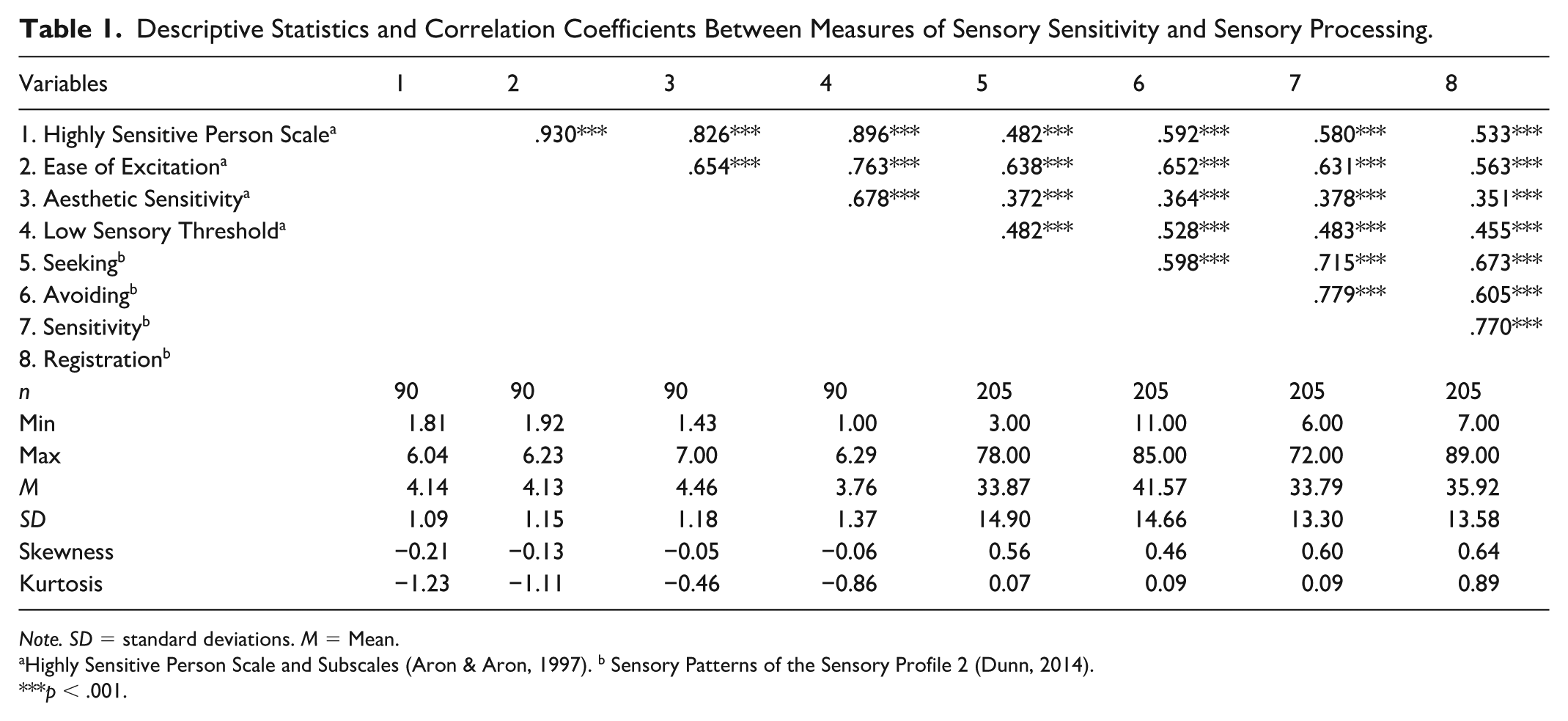
Note. SD = standard deviations. M = Mean.
Highly Sensitive Person Scale and Subscales (Aron & Aron, 1997). b Sensory Patterns of the Sensory Profile 2 (Dunn, 2014).
p < .001.
Main Analysis
Effect of Children’s Intellectual Giftedness and ADHD on Sensory Sensitivity and Sensory Processing
The results of the mixed-effect models, as summarized in Table 2, revealed an interaction effect between intellectual giftedness and ADHD on sensory processing, specifically in the domain of sensory registration. The parameter estimates, presented in Table 3, indicated that this interaction was associated with a decrease in sensory registration, whereas the presence of either intellectual giftedness or ADHD alone was associated with an increase in sensory registration. Follow-up Bonferroni-corrected post hoc pairwise comparisons supported this pattern.
Type III Fixed-Effects Tests of Intellectual Giftedness and ADHD on Sensory Sensitivity and Sensory Processing in Mixed Models.
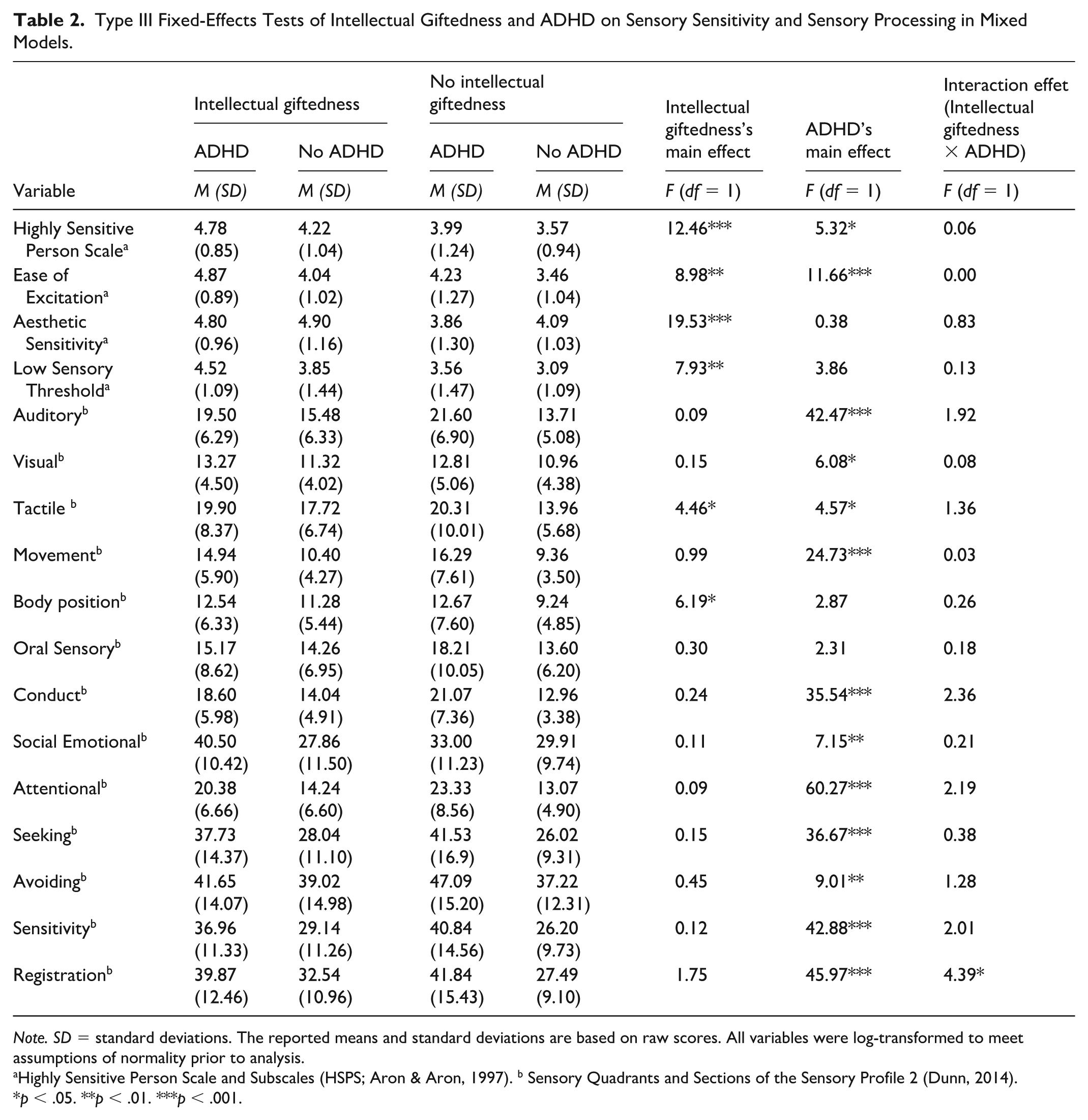
Note. SD = standard deviations. The reported means and standard deviations are based on raw scores. All variables were log-transformed to meet assumptions of normality prior to analysis.
Highly Sensitive Person Scale and Subscales (HSPS; Aron & Aron, 1997). b Sensory Quadrants and Sections of the Sensory Profile 2 (Dunn, 2014).
p < .05. **p < .01. ***p < .001.
Parameter Estimates for Fixed Effects of Intellectual Giftedness and ADHD and Random Effects of Parent Participation on Sensory Sensitivity and Sensory Processing in Mixed Models.
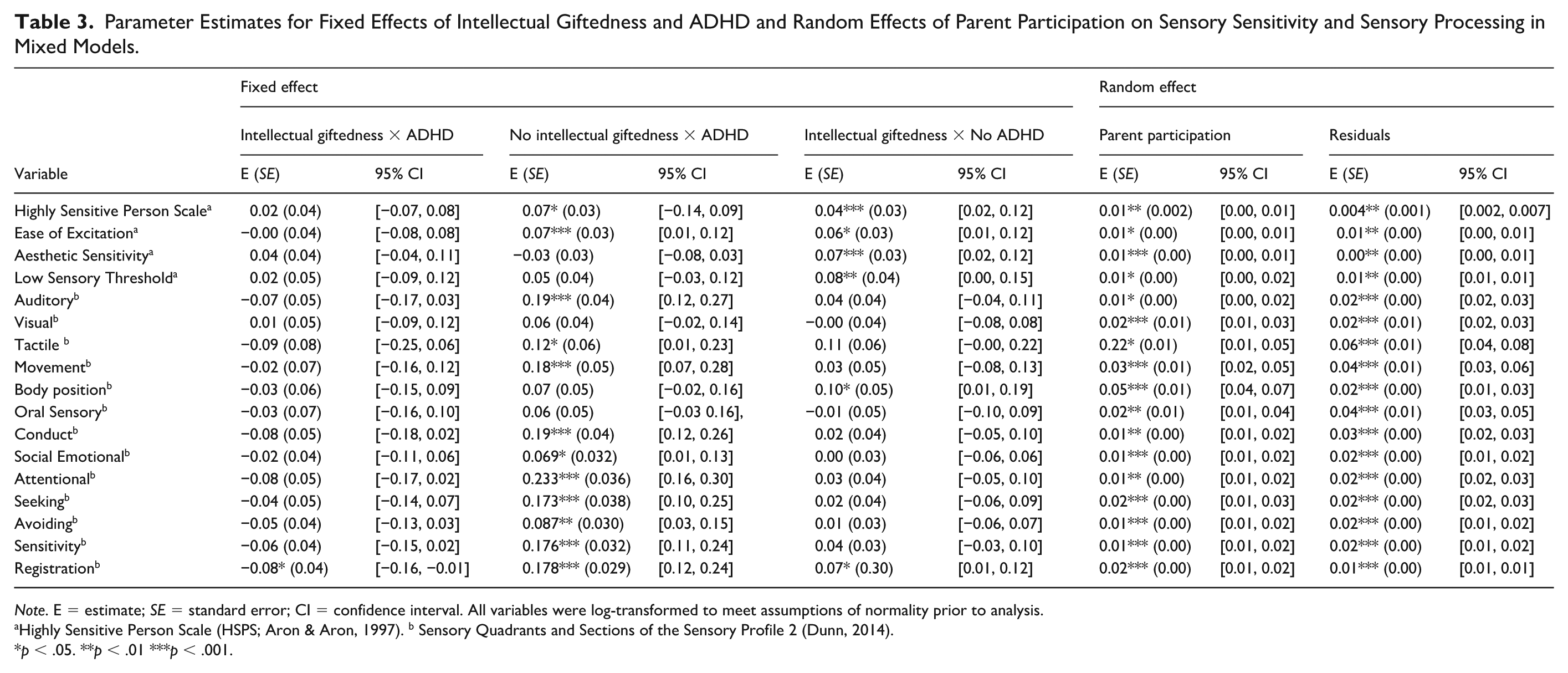
Note. E = estimate; SE = standard error; CI = confidence interval. All variables were log-transformed to meet assumptions of normality prior to analysis.
Highly Sensitive Person Scale (HSPS; Aron & Aron, 1997). b Sensory Quadrants and Sections of the Sensory Profile 2 (Dunn, 2014).
p < .05. **p < .01 ***p < .001.
Significant main effects of intellectual giftedness were observed on sensory sensitivity, including the total score and its subscales assessing ease of excitation, aesthetic sensitivity, and low sensory threshold, as well as on the tactile and body position subscales of sensory processing. More precisely, the presence of intellectual giftedness was associated with higher scores on these subscales of sensory sensitivity and sensory processing. Bonferroni-corrected post hoc pairwise comparisons confirmed that children with intellectual giftedness scored significantly higher than children without intellectual giftedness on all scales and subscales for which a main effect was detected.
Similarly, significant main effects of ADHD were observed on the total scale of sensory sensitivity and its ease of excitation subscale, as well as on the sensory processing subscales for auditory, visual, tactile, movement, conduct, social-emotional, attentional, seeking, avoiding, sensitivity, and registration. Again, parameter estimates revealed that the presence of ADHD is associated with increased scores on these specific measures of sensory sensitivity and sensory processing. Follow-up Bonferroni-corrected post hoc pairwise comparisons supported this pattern.
Significant random effects of parent participation were observed for all dependent variables related to sensory sensitivity and sensory processing. These random effects were appropriately accounted for in the models, ensuring the robustness of the fixed-effect estimates (see Table 3).
Effects of the Child’s Neurodevelopmental Condition and Gender on Sensory Sensitivity and Sensory Processing
The results indicated no significant three-way interaction effect between gender, intellectual giftedness, and ADHD on sensory sensitivity, nor on sensory processing. However, a significant two-way interaction between gender and intellectual giftedness was observed for tactile sensory processing, F(1, 193.772) = 6.853, p = .010, and body position sensory processing, F(1, 150.518) = 4.385, p = .038. To further characterize this interaction, we examined the parameter estimates corresponding to the simple gender effects within the intellectually gifted subgroup. Girls with intellectual giftedness tended to show lower tactile sensory processing scores, E = −0.161, SE = 0.112, 95% confidence interval (CI) [−0.383, 0.061], p = .153, and lower body position sensory processing scores, E = −0.174, SE = 0.095, 95% CI [−0.361, 0.013], p = .068, than boys with intellectual giftedness, although these contrasts did not reach statistical significance. Thus, despite the statistically significant overall interaction between gender and intellectual giftedness, the follow-up simple effects should be interpreted as descriptive trends only. This cautious interpretation is warranted given the small sample sizes in some gender cells and the resulting limited statistical power.
Discussion
Both ADHD and intellectual giftedness have been associated with atypical patterns of sensory processing, as well as heightened sensitivity (e.g., Gere et al., 2009; Ghanizadeh, 2011; Little et al., 2018; Panda et al., 2023; Rinn & Majority, 2018). However, little is known about how these neurodevelopmental conditions relate to sensory functioning, specifically in terms of sensitivity and processing. Thus, the primary objective of this study was to investigate sensory sensitivity and sensory processing among children presenting both intellectual giftedness and ADHD.
Our findings revealed a statistically significant interaction between intellectual giftedness and ADHD on sensory registration. Here, the term “interaction” refers to the statistical outcome of our analyses, but it also corresponds to children who are twice exceptional (i.e., presenting both intellectual giftedness and ADHD). Although the associated simple effects were generally small in magnitude, the pattern indicated that children with both characteristics tended to show a decrease in registration, whereas those with either intellectual giftedness or ADHD alone tended to show an increase. Lower registration scores suggest a tendency to be more attuned to sensory stimuli in the environment, which may sometimes lead to feelings of overwhelm. In contrast, a higher score indicates a tendency to miss sensory cues.
While our results do not allow firm conclusions about the mechanisms underlying these differences, several empirical perspectives may help contextualize the findings. Previous research has suggested that atypical sensory registration in children with ADHD may relate to attentional disengagement or difficulties selectively processing relevant information, potentially linked to hypoactivity in neural systems supporting response inhibition (Albajara Sáenz et al., 2020; Kofler et al., 2024). Consistent with this view, Little and colleagues (2018) reported atypical registration patterns in children with ADHD, who may therefore benefit from additional cues, physical or verbal, to support task engagement.
In contrast, some studies have proposed that children with intellectual giftedness may benefit from enhanced executive functions (T. E. Brown et al., 2011; François-Sévigny et al., 2022; François-Sévigny & Pilon, 2025; Fugate et al., 2013; Simoes Loureiro et al., 2009), allowing them to efficiently focus on task-relevant stimuli while disregarding secondary sensory input. These frameworks suggest that distinct regulatory strategies may characterize each group.
However, the interaction between intellectual giftedness and ADHD may be associated with difficulties in filtering, which could limit these children’s ability to effectively prioritize the sensory information they perceive. This vulnerability may contribute to a continuous state of overstimulation, potentially leading to feelings of being overwhelmed and increased daily distress (Dunn, 2014).
Furthermore, the results revealed a general trend in which more associations are observed between ADHD and sensory processing, and between intellectual giftedness and sensory sensitivity. This may suggest that children with ADHD and those with intellectual giftedness tend to capture distinct aspects of sensory experiences. In children with ADHD, this experience may be more centered around behavioral reactivity to sensory inputs, whereas in children with intellectual giftedness, it may reflect greater emotional reactivity to sensory stimuli (Turjeman-Levi & Kluger, 2022).
In addition, the results indicated that the presence of ADHD in a child was associated with higher levels of sensory processing across various domains, including auditory, visual, tactile, movement, conduct, social-emotional, attentional, seeking, avoiding, sensitivity, and registration. These findings are consistent with existing research on sensory processing in children with ADHD, which highlights atypical sensory patterns (Dunn & Bennett, 2002; Ghanizadeh, 2011; Little et al., 2018; Panda et al., 2023; Rani et al., 2023). These atypical sensory processing patterns (e.g., auditory, visual, tactile, movement) may help explain inappropriate responses relative to environmental expectations in various settings (conduct), such as school and home (Dunn & Bennett, 2002; Rani et al., 2023). They may also be associated with socio-emotional responses of children with ADHD, potentially manifesting as emotional dysregulation, such as outbursts when they struggle to complete a task (Dunn, 2014). This is consistent with the findings of Reynolds and Lane (2009), who reported that children with ADHD exhibiting sensory over-responsivity tend to experience heightened levels of anxiety. In this regard, although the children with ADHD in the sample appeared to actively seek sensory stimulation in their daily activities (seeking), they also seemed to prefer engaging with such sensory input in a predictable manner within a structured framework (avoiding). This avoidance strategy may reflect an attempt to cope with heightened reactivity to sensory stimuli (sensitivity). Accordingly, the results also revealed an increase in sensory sensitivity among children with ADHD, particularly in the form of ease of excitation—a tendency to become easily overwhelmed by both internal and external stimuli.
Gender Differences in Sensory Sensitivity and Sensory Processing
According to the results, children with intellectual giftedness tended to exhibit higher overall levels of sensory sensitivity, as well as heightened levels of sensory processing specifically related to tactile and body position modalities. These findings may contrast with those of Samsen-Bronsveld and colleagues (2024), who did not establish a conclusive relationship between intellectual giftedness and sensory sensitivity among children, possibly due to differing criteria used to define giftedness (top 10% on the COVAT-3). Conversely, regarding tactile sensory processing, our findings may align with those of Li and colleagues (1998), who reported that differences in tactile discrimination accounted for roughly 20% of the variability in intellectual ability within their sample.
Although no prior research has examined gender differences in sensory processing specifically among intellectually gifted children, our findings revealed an interaction between gender and intellectual giftedness for tactile and body position processing. However, the follow-up comparisons within the gifted subgroup did not provide statistically reliable evidence of gender differences, and the observed patterns should therefore be regarded as descriptive rather than conclusive.
At a descriptive level, the trends observed in our sample did not follow the direction typically reported in studies of children with ADHD or autism spectrum disorder, where girls tended to show higher tactile and body position sensitivity (Bröring et al., 2008; Osório et al., 2021). One important difference is that studies documenting such gender effects often rely on children’s self-reports and use assessment tools other than the Sensory Profile 2. In contrast, our study relies solely on parent-reported measures, which may capture a different perspective—one shaped not only by observable behaviors, but also by how children express or mask their difficulties.
This methodological distinction is particularly relevant in light of gendered socialization processes. Girls with intellectual giftedness may internalize sensory challenges or mask them more effectively, making these difficulties less visible to parents (Bask, 2015; Magson et al., 2023). Social expectations portraying girls as calm, composed, and adaptable may further reinforce these perceptions (Kerr & Multon, 2015). Together, these factors could contribute to the appearance, based on parent reports only, that gifted girls are better adapted in tactile and body position processing. These interpretations remain speculative, especially given the small number of participants in some gender subgroups and the resulting limitations in statistical power. Nevertheless, they offer a plausible framework for understanding why parent-reported patterns in our study may diverge from findings obtained through self-reported measures in other neurodevelopmental populations.
Strengths and Limitations
This study is innovative as it is among the first to examine sensory sensitivity and sensory processing in youth presenting both intellectual giftedness and ADHD, while taking gender into account, using two complementary measurement tools (e.g., the Sensory Profile 2 and the Highly Sensitive Person Scale). In addition, the methodological approach was designed to minimize sampling biases, a common limitation in research on intellectual giftedness. Possible sampling biases were mitigated by employing a rigorous identification process for both intellectual giftedness and ADHD, which was conducted within the study itself by graduate students in psychology under the close supervision of an experienced psychologist/neuropsychologist. Furthermore, participants from all groups were recruited through standardized procedures within the same environment, ensuring uniformity (Lavrijsen & Verschueren, 2023). The study also benefited from the inclusion of a comparative control group, which enabled a more robust interpretation of the findings by establishing a reference point for the observed effects.
However, this study presents some limitations that should be considered. First, it relied exclusively on parent-reported data, thereby increasing shared method variance. Yet, T. Brown and colleagues (2021) emphasized the potential for bias in parent-reported sensory assessments, as parents’ perceptions may be influenced by their own sensory sensitivities. In addition, the parent-adapted version of the Highly Sensitive Person Scale employed in this study was not informed by either the Highly Sensitive Child Scale (Weyn et al., 2021) or its parent-report counterpart (Sperati et al., 2024), as these instruments had not yet been validated at the onset of data collection. Nevertheless, the parent-adapted version showed satisfactory psychometric properties, supporting its use in the present study.
Another limitation concerns the sample size discrepancy between the two instruments: while all 159 parents completed the Sensory Profile 2, only a subsample of 90 parents completed the Highly Sensitive Person Scale, since this measure was introduced later during data collection. Consequently, findings based on the Highly Sensitive Person Scale should be interpreted with caution, as they may not be fully representative of the larger sample. Although we relied on previous validation studies (Aron & Aron, 1997; Dunn, 2014), we did not reassess the validity of the Highly Sensitive Person Scale and of the Sensory Profile 2 in the current study. Moreover, internal consistency coefficients could not be computed for the Sensory Profile 2.
Another limitation is that no statistical correction for multiple comparisons was applied, which may have increased the risk of Type I errors. Accordingly, the results should be interpreted with caution and warrant replication in future studies. Furthermore, the sample comprised only 8.72% of fathers, which limits the generalizability of the study’s findings across different parental perspectives. This underrepresentation of fathers may introduce a potential bias in the data, as mothers and fathers can have different perceptions of their child’s sensory processing and related behaviors. Finally, the generalizability of these findings is also influenced by the fact that the parents in the sample have higher levels of education and household income compared with the average Canadian population.
Practical Implications
This study has some implications for clinical and educational practice with the population presenting both intellectual giftedness and ADHD. First, the findings suggested that some children with both intellectual giftedness and ADHD are more attuned to sensory stimuli in their environment, which could reflect a reduced capacity for sensory filtering. While this heightened attunement may sometimes lead to sensory and cognitive overload, it is important to note that this does not apply to all children in this population. Rather, our results highlight specific patterns of vulnerability that may characterize certain subgroups. For those children with intellectual giftedness, Banks (2024) proposed several recommendations for creating a sensory-inclusive school environment, including reducing visual clutter to enhance focus and establishing sensory spaces, such as quiet zones, where children can retreat when feeling overwhelmed. Teachers could also benefit from training on sensory functioning differences, equipping them to better identify and respond to signs of sensory overload in students, and to adapt classroom layouts, transitions, and routines accordingly. In addition, collaboration with occupational therapists is recommended to assess sensory needs and implement appropriate classroom modifications, creating a more supportive and accommodating learning environment (Banks, 2024).
Second, given that the results revealed that children with ADHD tend to experience sensory processing through behavioral reactivity to stimuli, whereas children with intellectual giftedness tend to experience it more through emotional reactivity to sensory inputs, therapeutic interventions should be tailored to their specific sensory profiles. For children with ADHD, approaches focused on sensory modulation could be implemented to help them better manage and respond to environmental stimuli (Mimouni-Bloch et al., 2018; Shimizu et al., 2014). Conversely, for children with intellectual giftedness, interventions centered on emotional regulation, such as mindfulness, could be prioritized to help them better channel their sensory sensitivity (Gulla & Golonka, 2021; Hebert, 2016). These implications should therefore be interpreted with caution and not generalized to all children with intellectual giftedness or ADHD.
Finally, for children who are intellectually gifted, have ADHD, or present with both conditions, developing individualized sensory profiles using validated questionnaires such as the Sensory Profile 2 or the Highly Sensitive Person Scale can help educators and clinicians work closely with families to design targeted accommodations. Examples include flexible seating options, noise-canceling strategies, or sensory toolkits (e.g., fidget tools, weighted blankets), all aimed at fostering self-regulation and well-being in educational and daily environments. These findings therefore emphasize the value of systematically integrating sensory assessment into both clinical and school settings to guide personalized interventions.
Future Directions
The results and limitations of this study highlighted some avenues for future research. First, it would be valuable to examine sensory sensitivity and sensory processing using a multi-informant approach that incorporates input from the child, parents, and teachers. This method would provide a more comprehensive understanding by capturing diverse observations across different contexts, leading to a more accurate and nuanced evaluation of the child’s sensory experiences and challenges. In line with this, some researchers have developed multi-informant tools to assess sensory sensitivity in both preschool and school-aged children (Kähkönen et al., 2024; Lionetti et al., 2019).
In addition, future research should incorporate the assessment of anxiety, given its well-documented association with heightened sensory sensitivity and atypical sensory processing (e.g., Reynolds & Lane, 2009). Including validated measures of anxiety would help clarify whether anxiety acts as a mediator or moderator in the relationship between neurodevelopmental conditions and sensory processing. Such integration would provide a more comprehensive picture of the emotional and behavioral correlates of sensory sensitivity in intellectually gifted and ADHD populations.
Future research should also examine whether heightened sensory processing and sensitivity in intellectually gifted and ADHD populations represent adaptive traits, such as increased perceptual awareness, or indicate functional impairments, emotional distress, and daily challenges. Qualitative methods, such as semi-structured interviews or focus groups, can offer deeper insight into how children, their families, and educators perceive and manage these sensitivities. Understanding whether heightened sensitivity fosters benefits like creativity, empathy, and attention to detail, or leads to sensory overload, behavioral issues, and emotional dysregulation, could guide targeted interventions to enhance coping strategies and adaptive functioning in children presenting with both intellectual giftedness and ADHD.
Footnotes
Acknowledgements
The authors used ChatGPT 4o to assist in the translation of the document, which was originally written in French, the authors’ native language. The authors declared they took steps to ensure accuracy of AI-generated content, and that it contains no plagiarism or bias.

Ethical Considerations
Ethical approval for this study was obtained from Research Ethics Board—Humanities and Social Sciences at the University of Sherbrooke (approval no. 2021-3026) on October 28, 2021.
Funding
The authors disclosed receipt of the following financial support for the research, authorship, and/or publication of this article: This work was supported by a grant from the Fonds de recherche du Québec and the Social Sciences and Humanities Research Council to Mathieu Pilon. Matthieu Johnson-Constantin was supported by the Summer Research Internship Program in the Social Sciences and Humanities Discipline at the Université de Sherbrooke. Juliette François-Sévigny was supported by a graduate fellowship of the Social Sciences and Humanities Research Council and the Université de Sherbrooke. Catherine Cimon-Paquet was supported by postdoctoral fellowships of the Social Sciences and Humanities Research Council and the Fonds de recherche du Québec. Mathieu Pilon is the senior author and principal investigator on this study.
Declaration of Conflicting Interests
The authors declared no potential conflicts of interest with respect to the research, authorship, and/or publication of this article.
Open Practices
The data analyzed in this study are available upon request for purposes of reproducing the results. The code or protocol used to generate the findings reported in the article are not available for purposes of reproducing the results or replicating the study. There are no other newly created, unique materials used to conduct the research.