




Abstract
A highly sensitive person is known to have greater levels of sensory processing sensitivity (SPS) referring to a personality trait to exhibit high stimulation and arousal while processing subtle sensory signals. However, how SPS levels reflect the profile of sensitivity in exteroceptive and interoceptive sensory processing remains inadequately understood. Thus, we collected data using the Highly Sensitive Person Scale (HSPS), the Glasgow Sensory Questionnaire (GSQ), and the Body Perception Questionnaire–Short Form (BPQ-SF) from 600 Japanese adults, and examined their relationships. The results revealed that SPS levels, assessed by the HSPS, were significantly, positively correlated with hypersensitivity scores of the GSQ in several exteroceptive sensory domains. Further, SPS levels were positively correlated with sensitivity in interoceptive awareness assessed by the BPQ-SF; however, it does so scarcely. Our findings suggest that SPS levels reflect a subjective sensitivity to exteroceptive sensory processing regardless of sensory domains and narrowly to the interoceptive sensory processing.
Keywords
Introduction
Sensory processing sensitivity (SPS 1 ) is a personality trait that indicates an individual’s tendency to demonstrate high stimulation and arousal while processing a subtle sensory stimulus (e.g., Aron & Aron, 1997; Aron et al., 2005). Aron and Aron (1997) developed the Highly Sensitive Person Scale (HSPS) to measure individual differences in SPS levels and demonstrated the validity of SPS as a dimensional personality trait. They also assumed that the level of SPS can partially explain behavioral differences in people with different levels of social and emotional personality traits, such as introversion and extraversion (Aron & Aron, 1997). This indicates that since introverts are highly sensitive, easily overstimulated, and over-aroused by subtle stimulation (i.e., higher levels of SPS), they tend to perform unsatisfactorily in social situations, such as meeting strangers or talking in a group, both of which are high stimulation situations. In congruence with this, scores of highly sensitive persons (HSPs) were revealed to be related, but not identical, to persons exhibiting social introversion and emotionality (e.g., Aron & Aron, 1997; Listou Grimen & Diseth, 2016; Smolewska et al., 2006). Additionally, certain studies have highlighted advanced understandings of SPS by replicating and demonstrating its relationships with other personality traits: behavioral inhibition and behavioral activation measured by the BIS/BAS Scale (e.g., Smolewska et al., 2006), shyness (e.g., Aron et al., 2005), and depression (e.g., Liss et al., 2008; Yano & Oishi, 2018).
Although the original study suggested that the levels of SPS lie on a continuum of a one-factor model (Aron & Aron, 1997), several studies have revealed that SPS has the structure of a three-factor model (e.g., Liss et al., 2008; Smolewska et al., 2006; Takahashi, 2016; Yano & Oishi, 2018). Smolewska et al. (2006) examined the factor structure model of HSPS and found that the three-factor model was the best fit. In their model, one factor is a low sensory threshold (LST) comprising items related to unpleasant sensory arousal to external stimuli, followed by ease of excitation (EOE), consisting of items related to being mentally overwhelmed by external and internal demands, and aesthetic sensitivity (AES), which includes items related to aesthetic awareness (Smolewska et al., 2006). Subsequent studies replicated the good fit of the three-factor model of HSPS in different samples (e.g., Liss et al., 2008; Takahashi, 2016; Yano & Oishi, 2018).
With a similar framework of SPS assumed dimensions of individual traits, recent studies have explored individual differences in subjective experiences and awareness on the perception of internal and external sensory information (e.g., Cabrera et al., 2018; Kuiper et al., 2019; Robertson & Simmons, 2013; Sapey-Triomphe et al., 2018; Ujiie & Wakabayashi, 2015; Wang et al., 2020). Internal sensory perception, also known as interoceptive sensation, refers to the processing of sensory signals from internal bodily functions related to the regulation of the autonomic nervous system, such as pain, body temperature, hunger, satiety, muscle tension, heart rate perception, and thirst (e.g., Cabrera et al., 2018; Fiene et al., 2018; Porges, 2007). Studies developed the self-reported assessment for interoceptive sensory sensitivity by measuring subjective experiences of sensory signals related to internal bodily functions (e.g., the Body Perception Questionnaire–Short Form; BPQ-SF, Cabrera et al., 2018); they also demonstrated the validity of the assessment as dimensional individual traits like the SPS, within typically developed populations (e.g., Kobayashi et al., 2021; Wang et al., 2020).
Similarly, the sensitivity to external sensory perception, also called an exteroceptive sensation, has been investigated in previous studies, especially in the field of autism spectrum disorder (ASD) (e.g., Baranek et al., 1997; Crane et al., 2009; Foss-Feig et al., 2012; Robertson & Simmons, 2013). These studies have developed the assessment of the profile of hyper- (or hypo-) sensitivity; hypersensitivity indicates a lowered threshold for gaining sensory inputs that most people deem impalpable, while hyposensitivity indicates a failure to gain or respond to sensory inputs that most people consider easy to comprehend (e.g., Robertson & Simmons, 2013; Simmons et al., 2009). To measure the levels of hyper- (or hypo-) sensitivity in several sensory domains, Robertson and Simmons (2013) developed the Glasgow Sensory Questionnaire (GSQ), which assesses the frequency of experiencing hyper- or hypo-sensitivity in seven sensory domains: visual, auditory, gustatory, olfactory, tactile, vestibular, and proprioceptive. Studies have revealed the validity of the hyper- (or hypo-) sensitivity as an individual trait by demonstrating that the GSQ scores were distributed on a continuum across neurotypical samples along with their levels of autistic traits (e.g., Kuiper et al., 2019; Sapey-Triomphe et al., 2018; Takayama et al., 2014).
However, it remains unclear how the levels or sub-factors of SPS are related to the individuals’ sensitivity in external and internal sensory processing compared to the growing research in its association with personality (e.g., Listou Grimen & Diseth, 2016; Liss et al., 2008; Smolewska et al., 2006; Yano & Oishi, 2018). The concept of SPS includes several components related to multistage sensory processing from low to high order processing (Aron & Aron, 1997). In support of this, previous studies have shown a three-factor structure; LST, EE, and AS (e.g., Smolewska et al., 2006). Among these factors, the LST and EE reflect sensitivity in relatively lower-order sensory processing, while the AS is presumably related to higher-order processing, such as sensory experience and preference. If the SPS arises from the higher sensitivity in sensory processing, it can assume that the subscales of LST and EOE were associated with sensitivity in exteroceptive and interoceptive sensation. To confirm this, we examined relationships between the HSPS, BPQ-SF, and GSQ among 600 Japanese adults via an online questionnaire. The BPQ-SF, developed by Cabrera et al. (2018), assesses individual differences in subjective experiences of sensory signals regarding internal bodily functions concerning interoceptive sensory sensitivity. The GSQ, developed by Robertson and Simmons (2013), assesses individual differences in the frequency of experiencing hyper- or hypo-sensitivity concerning exteroceptive sensory sensitivity.
In this study, we assumed that the levels of SPS, especially in subscales of LST and EOE, reflect individual differences in sensitivity in sensory processing or exteroception and interoception sensations, since the conception of SPS involves sensitivity in processing sensory information and not problems in the sense organs (Aron & Aron, 1997). In the following study, we tested two hypotheses. First, high levels of SPS would associate with high sensitivity in processing from several sensory domains (i.e. visual, auditory, gustatory, olfactory, tactile, vestibular, and proprioceptive) assessed by the GSQ. Second, high levels of SPS would be associated with high sensitivity in interoceptive awareness assessed by the BPQ-SF.
Methods
Participants
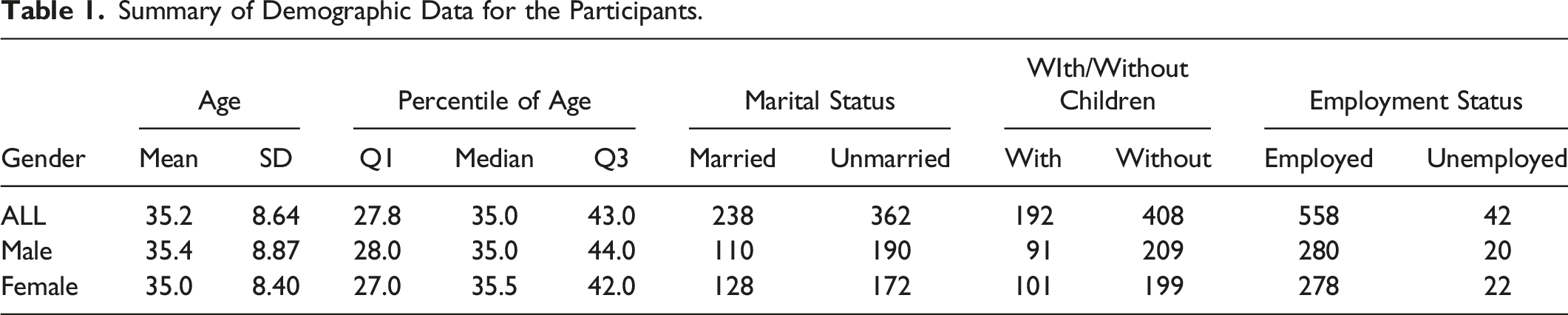
Summary of Demographic Data for the Participants.
Instruments
Japanese version of the highly sensitive person scale
The HSPS, developed by Aron and Aron (1997), is a self-reported questionnaire to measure individual differences in sensory-processing sensitivity. The Japanese version of the HSPS was developed and normalized by Takahashi (2016), with 19 items (e.g., “Are you easily overwhelmed by strong sensory input?”) rated on a 7-point Likert scale. The total possible scores on the HSPS range from 19–133. Cronbach’s alpha of the total items of the HSPS was .91. As mentioned above, the original study on SPS assumed a one-factor model (Aron & Aron, 1997). However, certain studies have demonstrated that the three-factor model, comprising LST, EOE, and AES, was the best fit (e.g., Smolewska et al., 2006; Takahashi, 2016). Cronbach’s alphas of the sub-scales of HSPS were .87, .86, and .66, showing acceptable reliability.
Japanese version of the GSQ
To measure SPS in exteroception sensation, we used the Japanese version of the GSQ (Takayama et al., 2014), containing 42 items scored on a 5-point Likert scale. Each item can obtain a score from 0 to 4 points. This scale assesses individual differences in the frequency of experiencing hypersensitivity (e.g., “Do bright lights ever hurt your eyes or cause a headache?”) and hyposensitivity (e.g., “Do you ever run your hand around the surface of an object before picking it up?”). Cronbach’s alphas of total-GSQ and subscales of hypersensitivity and hyposensitivity were .97, .92, and .95, respectively. In addition, this scale can assess the degree of hyper- or hypo- sensitivity for seven sensory domains separately: visual, auditory, gustatory, olfactory, tactile, vestibular, and proprioceptive. In this study, we used hypersensitivity scores for each of the seven sensory domains.
Japanese version of the body perception questionnaire–short form
To measure SPS in interoceptive sensation awareness, we used the Japanese version of the BPQ-SF (Kobayashi et al., 2021). This scale assesses subjective experiences of sensory signals of internal bodily functions such as muscle tension (e.g., “Muscle tension in my face”), heart rate perception (e.g., “How fast is my heart beating”), and thirst (e.g., “My mouth is dry”). The Japanese version of BPQ-SF contains 26 items scored on a 5-point Likert scale. The total possible scores on the BPQ-SF range from 26 to 130. Cronbach’s alpha of BPQ-SF was .96. In this study, we used total scores of the BPQ-SF since its Japanese version exhibited a good fit for the one-factor structure model (Kobayashi et al., 2021).
Japanese version of the Ten-Item Personality Inventory
To confirm the validity of the HSPS, we used the Japanese version of the TIPI— the TIPI-J. The TIPI-J is a short version of the Big Five Inventory that assesses personality traits in five domains: extraversion, agreeableness, openness, conscientiousness, and neuroticism. This questionnaire comprised two items per domain, with a total of 10 items, scored on a 7-point Likert scale. Following the scoring method used in Oshio et al. (2012), we measured the items on a scale of 1–7 points. In this study, we used extraversion and neuroticism scores to evaluate the convergent validity of the HSPS by calculating correlation coefficients. The Cronbach’s alphas of extraversion and neuroticism were .82 and .46, respectively.
Procedure
All methods were preregistered on Open Science Framework (https://doi.org/10.17605/OSF.IO/CEJG6). The current study was conducted in July 2021. We collected questionnaire data from Japanese adults via an online research platform created by an online Internet research service (iBRIDGE Co., Tokyo, Japan). Participants completed Japanese versions of the HSPS, GSQ, BPQ-SF, and TIPI-J. Data from the participants were analyzed.
Analysis
First, we analyzed the factor structure of the HSPS. We confirmed the validity of the three-factor model by comparing the fit of factor structures between the one-factor and the three-factor model by using confirmatory factor analysis with the Maximum Likelihood Estimation with robust standard errors (MLR). To compare the goodness of fit between models, we used the Akaike information criterion, which has been used in the previous study of HSPS on the Japanese sample (Takahashi, 2016). Following this, we evaluated the reliability and validity of the Japanese version of the HSPS by calculating the internal consistency (Cronbach’s alpha) and analyzing the correlation between scores of HSPS and neuroticism (from TIPI), respectively.
We then analyzed the link between the scales used and our purposes by calculating the correlation coefficients using Spearman’s rank correlation method. 2 To test how the subscales of HSPS were related to exteroceptive hypersensitivity in the seven sensory domains, we conducted multivariate multiple regression analysis. The subscales of HSPS were considered predictor variables, and the scores of hypersensitivity in the seven sensory domains from GSQ as objective variables. Furthermore, we performed a multiple regression analysis with the subscales of HSPS as predictor variables and scores of BPQ-SF as objective variables to understand whether and how the subscales of HSPS were related to sensitivity in interoceptive sensation awareness. All raw data for this study are available on the Open Science Framework (https://osf.io/4srm3/files/).
Results
Results of Confirmatory Factor Analysis (CFA) with the Maximum Likelihood Estimation with robust standard errors (MLR) for the Highly Sensitive Person Scale (HSPS).
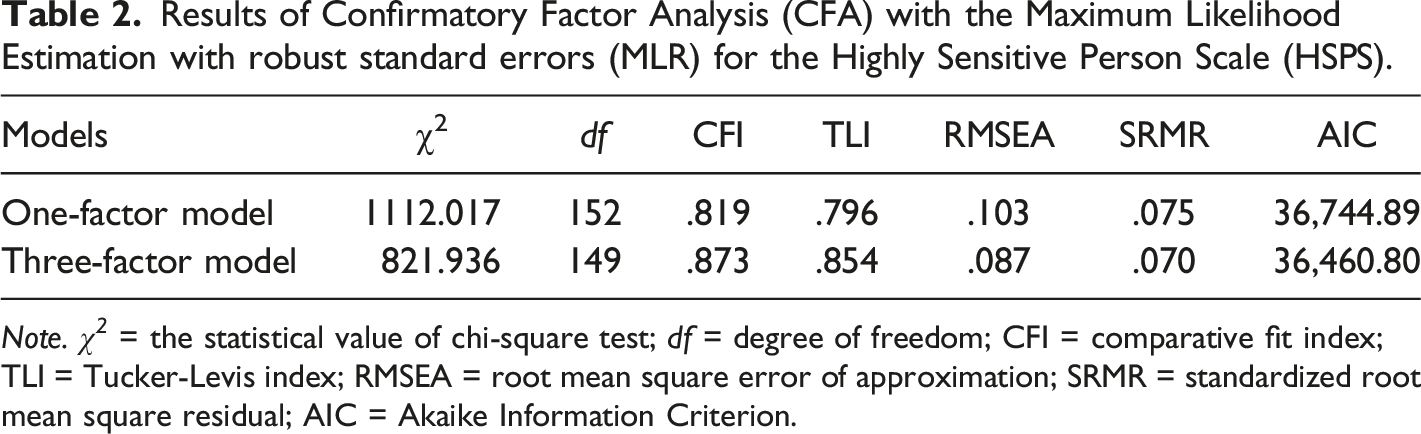
Note. χ 2 = the statistical value of chi-square test; df = degree of freedom; CFI = comparative fit index; TLI = Tucker-Levis index; RMSEA = root mean square error of approximation; SRMR = standardized root mean square residual; AIC = Akaike Information Criterion.
Summary of the Results of all Scales.
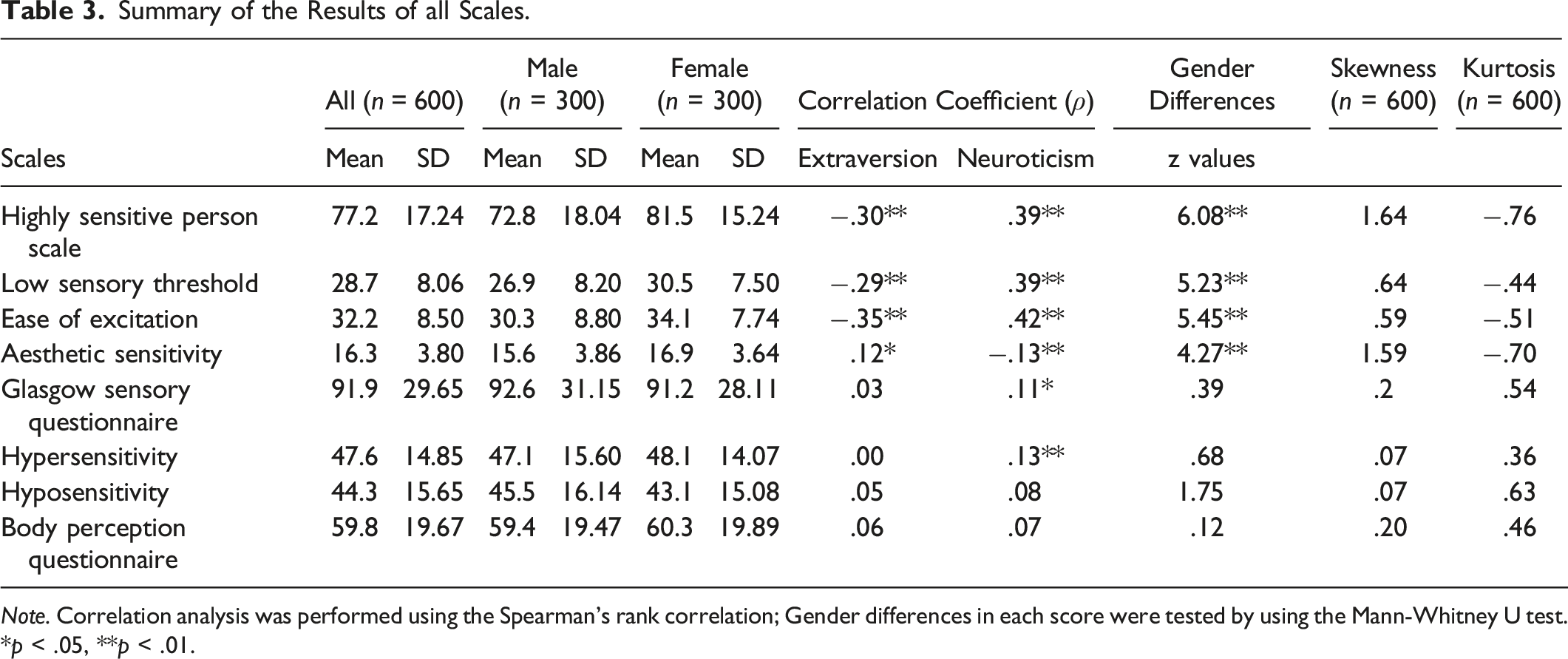
Note. Correlation analysis was performed using the Spearman’s rank correlation; Gender differences in each score were tested by using the Mann-Whitney U test.
*p < .05, **p < .01.
Correlations Among Highly Sensitive Person Scale (HSPS), the Subscales of Glasgow Sensory Questionnaire (GSQ), and Body Perception Questionnaire-Short Form (BPQ-SF).
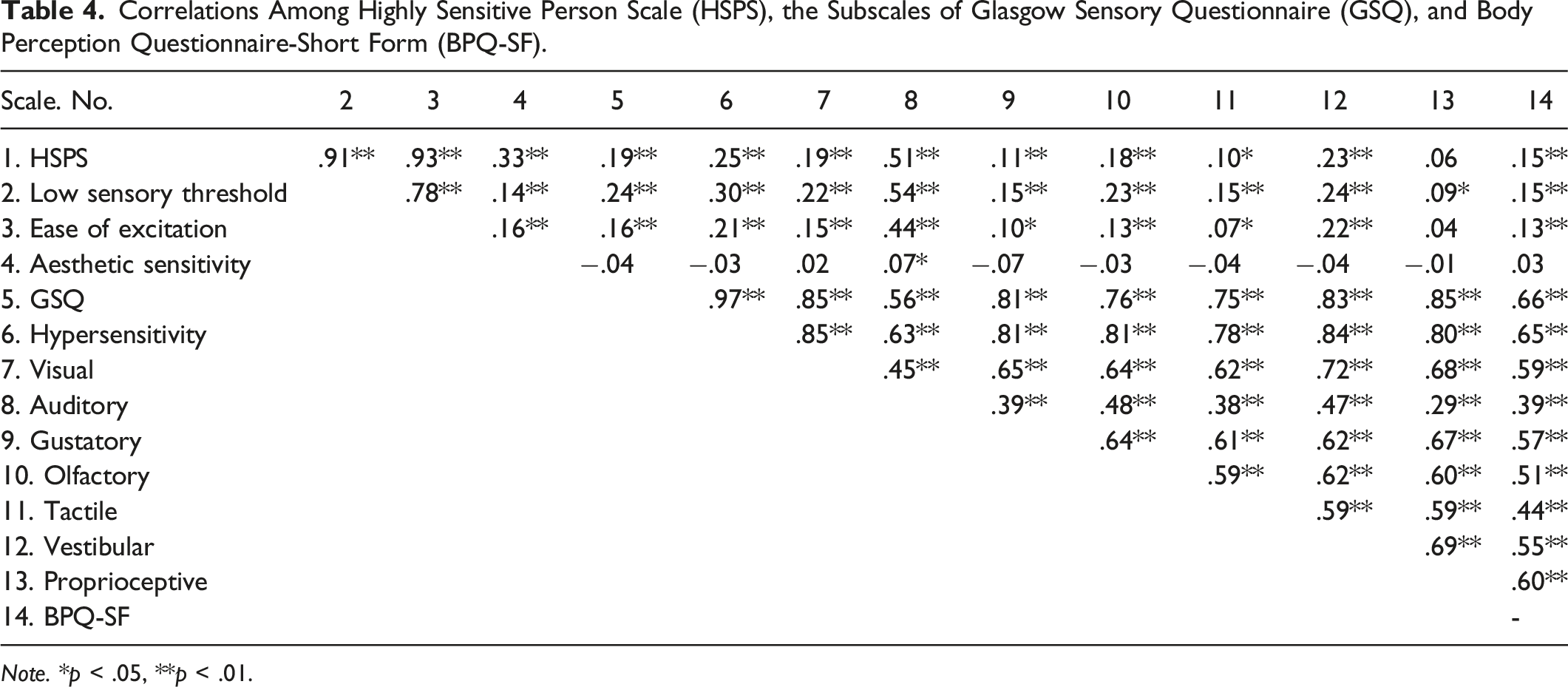
Note. *p < .05, **p < .01.
Results of the Multivariate Multiple Regression Analysis for Hypersensitivity in the Seven Sensory Domains of the Glasgow Sensory Questionnaire (GSQ).
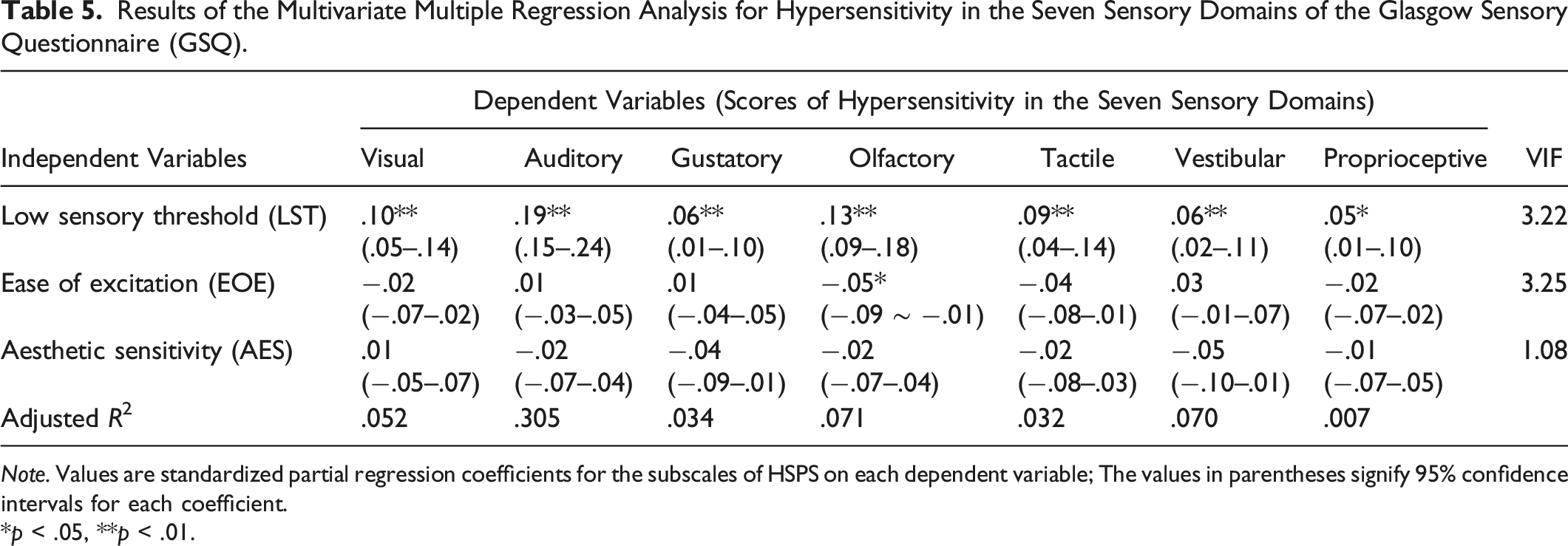
Note. Values are standardized partial regression coefficients for the subscales of HSPS on each dependent variable; The values in parentheses signify 95% confidence intervals for each coefficient.
*p < .05, **p < .01.
Results of the Multiple Regression Analysis for Scores of the Body Perception Questionnaire-Short Form (BPQ-SF).
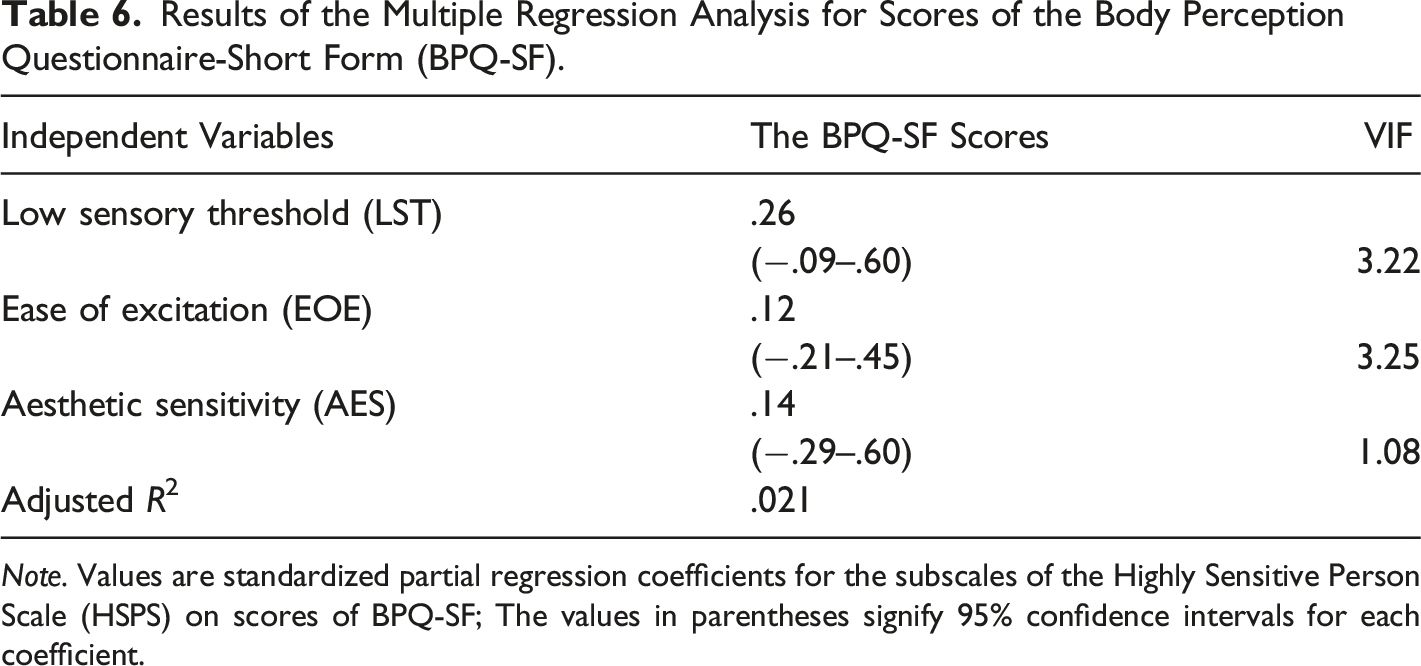
Note. Values are standardized partial regression coefficients for the subscales of the Highly Sensitive Person Scale (HSPS) on scores of BPQ-SF; The values in parentheses signify 95% confidence intervals for each coefficient.
Discussion
This study examined the relationship between levels of SPS and sensitivity in external and internal sensory processing by using the HSPS, GSQ, and BPQ-SF. We tested two hypotheses: first, that high levels of SPS would be associated with high sensitivity when processing from several sensory domains (i.e., visual, auditory, gustatory, olfactory, tactile, vestibular, and proprioceptive); second, that high levels of SPS would be associated with high sensitivity in interoceptive awareness. Our results demonstrated that the total HSPS scores were positively correlated with hypersensitivity scores in six sensory domains, but not in the proprioceptive domain; thus, the first hypothesis is partially supported. By contrast, the HSPS scores were positively correlated with the BPQ-SF scores; however, but only slightly. Thus, our second hypothesis was not fully supported.
Concerning the relationship with GSQ, our results demonstrated that the levels of the HSPS, especially in the LST factor, reflect the sensitivity of external sensory stimulus regardless of sensory domains. This indicates the validity of factor models of the HSPS since the LST factor demonstrates an aspect of being easily overstimulated and over-aroused in SPS. Although correlation analysis showed that LST and EOE scores were significantly correlated with scores of hypersensitivity of GSQ in several domains, this may be due to the higher correlation between LST and EOE scores. Indeed, the multiple regression analysis revealed that solely LST scores significantly predicted hypersensitivity scores of GSQ in all sensory domains. This result may indicate that the LST and EOE factors reflect ordered processing coupled with each other. Aron and Aron (1997) considered the ordered processing demonstrated by people with higher levels of SPS when sensory information is received to be overstimulated due to lower thresholds to subtle stimuli, and then experienced high arousal response due to overstimulation, leading to negative emotional reactivity. Based on this assumption, the LST factor may reflect the process of overstimulation to subtle stimuli, while the EOE reflects the regulation of emotional responses arising from the overstimulation. Indeed, our results showed that the LST scores were highly associated with hypersensitivity scores of the GSQ, while the EOE scores were mostly correlated with negative reactivity (i.e., neuroticism).
Furthermore, we found that the level of SPS reflected only a small degree of sensitivity to interoceptive awareness. Aron and Aron (1997) considered that the SPS conceptions included the degree of hunger or pain sensitivity, which were interpreted as interoceptive sensations. In this study, we tested the relationship between levels of SPS and the degree of sensitivity in interoceptive sensory processing by the BPQ-SF, which assesses the subjective experiences of sensory signals of internal bodily functions, such as muscle tension, heart rate perception, and thirst. In our results, correlations between BPQ-SF scores and the HSPS scores and between LST and EOE scores were slightly significant. Compared to the hypersensitivity results of the GSQ, the sizes of correlations with the BPQ-SF were negligible. Furthermore, multiple regression analysis also showed that the subscales of HSPS, especially the LST scores, significantly predicted hypersensitivity scores of the GSQ but not BPQ-SF scores. We considered that this trend of differential correlations with the HSPS indicates an overlap of items across scales and suggests that, like the LST factor, the SPS levels reflect sensitivity to external sensory stimuli relative to internal sensory stimuli. Our results also revealed a high correlation between the BPQ-SF scores and GSQ hypersensitivity scores, although items across the two scales did not overlap.
Our results replicated the three-factor model of the HSPS, as repeatedly shown in previous studies (e.g., Liss et al., 2008; Smolewska et al., 2006; Takahashi, 2016; Yano & Oishi, 2018). However, the reliability and validity of the three-factor model were not sufficient to be generalizable due to the homogeneity of the sample; participants in previous studies consisted of university students aged 18–26 years old (Liss et al., 2008; Smolewska et al., 2006; Takahashi, 2016; Yano & Oishi, 2018). In contrast, we recruited Japanese adult participants in their 20s–40s from the general population, whose gender ratio was also controlled. This result contributes to the generalizability for the reliability and validity of the HSPS and its factor model in the general population. The three-factor model would be reasonable for considering the conception of SPS, which includes some aspects of sensory processing. The initial study suggested that the level of SPS can partially explain behavioral differences in individuals with different levels of social and emotional personality traits, which extends from perceptual differences in the lower level (i.e., lower thresholds to sensory inputs) to individual preferences in high order levels (i.e., creative or aesthetic orientation) (Aron & Aron, 1997). Consistent with this, in the three-factor model, each factor accounts for different levels of behavioral differences associated with sensory sensitivity; the LST factor indicates the tendency of being overstimulated, the EOE factor indicates the tendency to be mentally overwhelmed by external and internal sensory signals, and the AES factor indicates a creative and aesthetic orientation (e.g., Smolewska et al., 2006; Takahashi, 2016). The first two factors were associated with negative emotional reactivity due to high sensory sensitivity, while the subsequent was related to personality traits, such as openness, rather than emotional reactivity (Smolewska et al., 2006). Our results similarly demonstrated that LST and EOE scores were significantly correlated with neuroticism, while AES scores were scarcely correlated.
One limitation of this study is that it lacks evidence at the behavioral level because it did not consider psychophysics. Our study aimed to examine the relationship between the HSPS and other scales based on similar conceptions of sensory sensitivity; it was then used on the subjective assessments for sensitivity in internal and external sensory processing. There has been insufficient evidence on how subjective hypersensitivity influences the lower thresholds to subtle external and internal stimulus (e.g., the relationship between the subjective sensitivity in vision and lower thresholds to subtle brightness, or the relationship between the subjective hunger sensitivity and the feeling of hunger). Therefore, to confirm the validity of our results at the behavioral level, future studies should confirm the relationship between the level of SPS and the behavioral responses that reflect sensitivity in internal and external sensory processing.
Conclusion
In summary, the current study provided evidence supporting the assumption that the levels of SPS, assessed by the HSPS, reflect the subjective sensitivity of external sensory stimulus regardless of sensory domains. Our results also demonstrated that the levels of SPS reflected a small degree of subjective sensitivity to internal sensory stimulus, although there was a significant, but slightly correlation.
Supplemental Material
Supplemental Material - Subjective Sensitivity to Exteroceptive and Interoceptive processing in Highly Sensitive Person
Supplemental Material for Subjective Sensitivity to Exteroceptive and Interoceptive processing in Highly Sensitive Person by Yuta Ujiie and Kohske Takahashi in Psychological Reports
Footnotes
Acknowledgments
We would like to thank all those who participated in our experiments.
Declaration of Conflicting Interests
The author(s) declared no potential conflicts of interest with respect to the research, authorship, and/or publication of this article.
Funding
The author(s) disclosed receipt of the following financial support for the research, authorship, and/or publication of this article: This study was supported by a Grant-in-Aid for Early-Career Scientists (Grant No. 19K20650 and 22K13880), the Promotion of Joint International Research (Grant No. 20KK0054), and a Grant-in-Aid for JSPS Fellows (Grant No. 19J00722). This work was also supported by a Grant-in-Aid for Scientific Research on Innovative Areas “Construction of the Face- Body Studies in Transcultural Conditions” (Grant No.17H06342).
Ethics
This experiment was conducted according to the Declaration of Helsinki and was approved by the local Ethical Committee. Participants provided written informed consent for their participation and for publication in an online open-access platform.

Supplemental Material
Supplemental material for this article is available online.
Notes
References
Supplementary Material
Please find the following supplemental material available below.
For Open Access articles published under a Creative Commons License, all supplemental material carries the same license as the article it is associated with.
For non-Open Access articles published, all supplemental material carries a non-exclusive license, and permission requests for re-use of supplemental material or any part of supplemental material shall be sent directly to the copyright owner as specified in the copyright notice associated with the article.
