




Abstract
The emergence and spread of a new pandemic, COVID-19, have raised topics of concern for health professionals, policy makers and publics across the globe. Governments have struggled to find the right policies to stop disease transmission, but all have introduced social distancing. In the United Kingdom this has come to be understood as staying at home and, when outside, maintaining a physical distance of approximately two metres between oneself and others. In this article, the authors examine the emergence of this new social representation as portrayed in one UK broadsheet and one tabloid with the widest circulation: The Times and The Sun, between early March and early April 2020. Using social representations theory and thematic analysis, the authors show that social distancing struggled to emerge from underneath government obfuscation. It was first seen as a threat to normal life, which in modernity is predicated on mobility; it was later portrayed as a threat to social order; and finally perceived as a burden that, like the lockdown (its conceptual twin), needed to be lifted.
Introduction
Coronavirus (COVID-19) is an infectious disease, caused by SARS-CoV-2. Since its first clinical observations in Wuhan, Hubei province, China in December 2019, the virus has spread around the world and, on 11 March 2020, was declared a pandemic. The United Kingdom introduced a policy of ‘social distancing’, which prohibited physical contact with people outside of one’s household (Government Guidance, 2020), and announced a nationwide lockdown on 23 March. As of late May 2020, the UK’s daily death rate was the highest in the world (Cuthbertson, 2020).
Social distancing has emerged as a central tenet of the UK government’s COVID-19 response. It was hoped that this practice would be enforced, accepted and enacted by the entire population so that disease incidence would decrease, the lockdown could be lifted and the economy restarted. Yet not everyone understands social distancing in the same way, which has been attributed, in part, to ‘mixed messages’ from the government and other institutions (e.g. Rowena and Sample, 2020). In this article, we use thematic analysis and social representations theory to examine the emergence and elaboration of social representations of social distancing in the UK print media, at a key moment in time. An analysis of emerging social representations may in turn enable us to understand and predict how people will think and act in response to the pandemic.
Social distancing
The concept of ‘social distancing’ has a long history in sociology, starting with work by Robert Ezra Park (1924) and Emory S Bogardus (1925). According to Jackson (2010: 193), it is generally ‘used to describe the relationship between individuals and groups in society’ and ‘captures a variety of relations of difference, such as social class, race, ethnicity, sexuality, or physical ability as well as the fact that groups may be close spatially . . . but they do not mix’.
This concept seems to be independent from that of ‘social distancing’ as used in public health, where it denotes a practical intervention ‘designed to reduce interactions between people in a broader community, in which individuals may be infectious but have not yet been identified hence not yet isolated’ (Wilder-Smith and Freedman, 2020). This is especially important in disease transmitted through droplets, such as COVID-19. Social distancing is there to mitigate risk. In fact, ‘[o]ne of the easiest ways for people to lower their risk of infection during an epidemic is for them to reduce their rate of contact with infectious individuals’ (Reluga, 2010: 2). This measure has been used in polio and influenza pandemics since the beginning of the 20th century, most recently during the SARS outbreak of 2003 (Bell, 2004).
Currently, social distancing is understood to refer to a physical distance of between one and two metres from other people, therefore also, and perhaps more appropriately, called ‘physical distancing’, a phrase that did not catch on, however. Social distancing is now becoming a new social norm and part of everyday life. In the UK, the rules concerning social distancing have varied over time, but up to June 2020 people were asked to stay at home and to leave the home only to purchase essential items, for health reasons or to go to work (but only if they cannot work from home). Moreover, they were asked to refrain from physical contact with anyone outside their home and keep a distance of two metres (six feet) when interacting with others.
Social distancing in pandemic times is, in sociological terms, quite paradoxical and counterintuitive behaviour. In normal times people engage in social distancing or avoidance with regard to those they see as deviant or stigmatised in some fashion (see Albrecht et al., 1982), that is, as ‘other’ in terms of ethnicity, wealth or health. During the pandemic, however, this changed. Social distancing is now observed around everybody – both around people with whom one would normally engage as well as those whom one would normally avoid. Social deviance is, in turn, attributed to those that do not practise social distancing, that is people who infringe the new rules that govern social space and social interaction, especially the two-metre rule.
Although this public health measure has important implications for social interaction and social order, sociological studies of its societal impact are only beginning to emerge. Some political scientists have examined the situation in the United States where, unlike in the UK, compliance with social distancing measures has been polarised (Allcott et al., 2020). Another study has examined stigma mitigation under social/physical distancing conditions and rightly asks: ‘While an integral component of containment, how can we ensure that physical distancing does not exacerbate othering, avoidance, and mistreatment toward persons associated with COVID-19?’ (Logie and Turan, 2020).
In order to understand and predict how people are reacting to the COVID-19 outbreak and possible future resurgences of the virus, it is important to examine how the pandemic and its mitigation strategies are being communicated to the general public, and whether such communications are clear and consistent or vague and confusing.
Social representations in the media
The phrase ‘social distancing’ was not in widespread use until the outbreak of COVID-19 in 2020. Social distancing crept into people’s vocabulary gradually around February–March 2020, at first when talking about something strange, foreign and far away, then, from March onwards as something close to home.
The UK government first announced that such social distancing measures might be introduced on 4 March 2020 (Public Health Matters, 2020). This advice was gradually refined and then formalised on 23 March (Government Publications, 2020a), when the lockdown was announced and the police were given relatively loose guidance to enforce the still relatively vague rules. Further guidance was issued a week later, when it became clear that more consistency was needed in the police’s approach.
The media constitute an important source of societal information concerning science, medicine and health (Briggs and Hallin, 2016; Jaspal and Nerlich, 2020a; Jaspal et al., 2014). The media (such as newspapers, social media and television news) help transform scientific knowledge into ‘common sense’ knowledge and enable people to think, talk and behave in relation to it. This is what Moscovici (1988) has referred to as social representations. First, science communicators use familiar and culturally accessible phenomena in order to communicate about COVID-19. This is referred to as anchoring. For instance, COVID-19 has been anchored to seasonal flu, which may create the erroneous impression that the two epidemics, and ways of curbing them, are the same. Second, visual and linguistic ‘tools’ are used to describe the pandemic, which serve to render it psychologically tangible. This is referred to as objectification. Anchoring and objectification give rise to social representations, that is, frameworks of meaning which shape how we think, feel and act in relation to COVID-19 (Jaspal and Nerlich, 2020b).
Metaphors are one of the main ways of achieving objectification. People make sense of the new or unfamiliar, in our case the novel coronavirus, by seeing it through the lens of the old or familiar. This also shapes the ways we act on the world, including through government policies (Vallis and Inayatullah, 2016). Metaphors have been employed abundantly throughout the pandemic (Nerlich, 2020), from the conventional ones used to deal with disease, such as war and battle, to more creative ones, such as a visual metaphor illustrating the importance of social distancing: a row of burning matches, with one match ‘stepping’ out of the line to break the spread of the fire (Gallucci, 2020). In terms of policy relevance, war metaphors (such as ‘combat’, ‘fight’, ‘defeat’) serve to demonstrate governmental control, may foster a sense of collective action, but also justify fighting the ‘adversary’ at all costs (Sanderson and Meade, 2020).
The nature and content of media reporting affect not only public understanding of COVID-19 but also people’s responses to it. Media reporting tends to focus on negative events, frequently deemed to be more newsworthy, such as death toll, the risk factors and growing disease incidence, which may increase fear of infection, paranoia and death anxiety (Ahorsu et al., 2020) and can create social representations of doom and disaster in relation to the COVID-19 pandemic. It is easy to see how these representations may also contribute to risk appraisal concerning the pandemic (Jaspal et al., 2020).
Public compliance with novel prevention policies, such as the social distancing policy, is dependent on one’s ability to understand and relate to them (Jaspal and Nerlich, 2020b). This, in turn, depends on clear and effective risk communication, especially by government agencies, messages that are then taken up and disseminated by the media. These media representations then contribute to shaping social representations. In this article, we examine a small sample of media/social representations at key points in the UK government’s risk communication efforts.
We focus on The Times and The Sun, a broadsheet and a tabloid respectively, which have the widest circulation in the UK (Statistica, 2019). In order to determine the timeframe for our sampling, we examined Google trends and ascertained when people in the UK searched most for the novel phrase ‘social distancing’. As Figure 1 shows, searching for ‘social distancing’ spiked over the month of March.
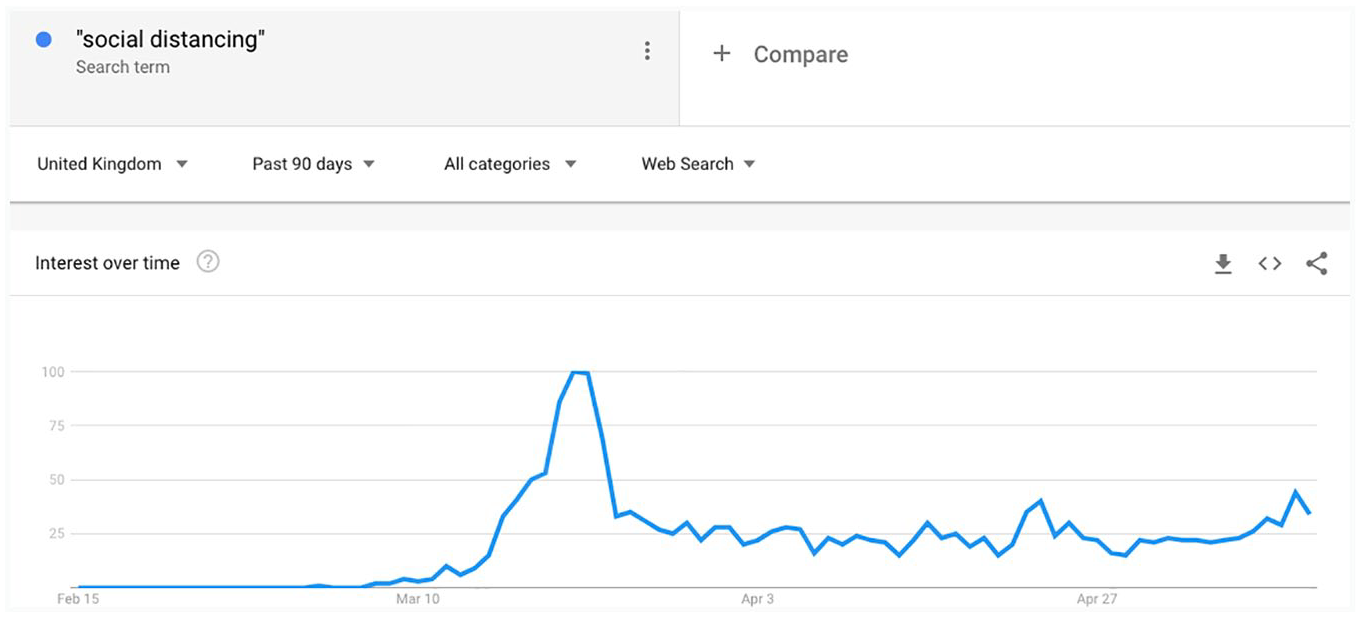
Google search trend for ‘social distancing’ in the UK (as of 15 May 2020).
March 2020 was the time when ‘social distancing’ began to emerge as a linguistic phenomenon and as a social representation. Social distancing began to be gradually embedded in how people think and talk about a new way of life and developed into a new social norm. This is consistent with the observation that the media tend to reflect but also shape public debates and perform an agenda-setting function (Happer and Philo, 2013).
For our analysis we focus on articles published during five short synchronic ‘slices’ through time, based on key events, such as government announcements. These snapshots provide some insight into the nature and tone of the media debate during the early phases of the outbreak, how it progressed over time, and the social representations that it generated. Although these social representations may be introduced or outlined in the print media, they subsequently enter other forums of discussion, such as social media, political rhetoric and everyday talk – indeed, there is a reciprocal relationship between these forums (Jaspal et al., 2014).
Method
The corpus
The aim of this study was to identify and examine emerging social representations of social distancing, rather than to provide a comprehensive overview of the entirety of UK media reporting. We therefore undertook a fine-grained qualitative thematic analysis of articles published in two widely read newspapers. The Times can be regarded as a centre-right broadsheet publication and The Sun a right-wing tabloid publication. Both are national newspapers and have the widest reach among broadsheets and tabloids, respectively.
Using the keyword ‘social distancing’ on the ProQuest database, we conducted a search of the print versions of The Times and The Sun. We extracted all articles published in these outlets on the following dates in 2020, which had been identified as key milestones during the early phase of the epidemic in the UK:
3–4 March – Prime Minister (PM) Boris Johnson reveals the government’s action plan.
16–17 March – the PM gives a press conference advising against non-essential physical contact and travel.
23–24 March – the PM announces the ‘lockdown’.
30–31 March – the Government provides more clarity about social distancing rules.
8–9 April – a death toll of 10,000 is reached in the UK, reiterating the need for social distancing to reduce the incidence of COVID-19.
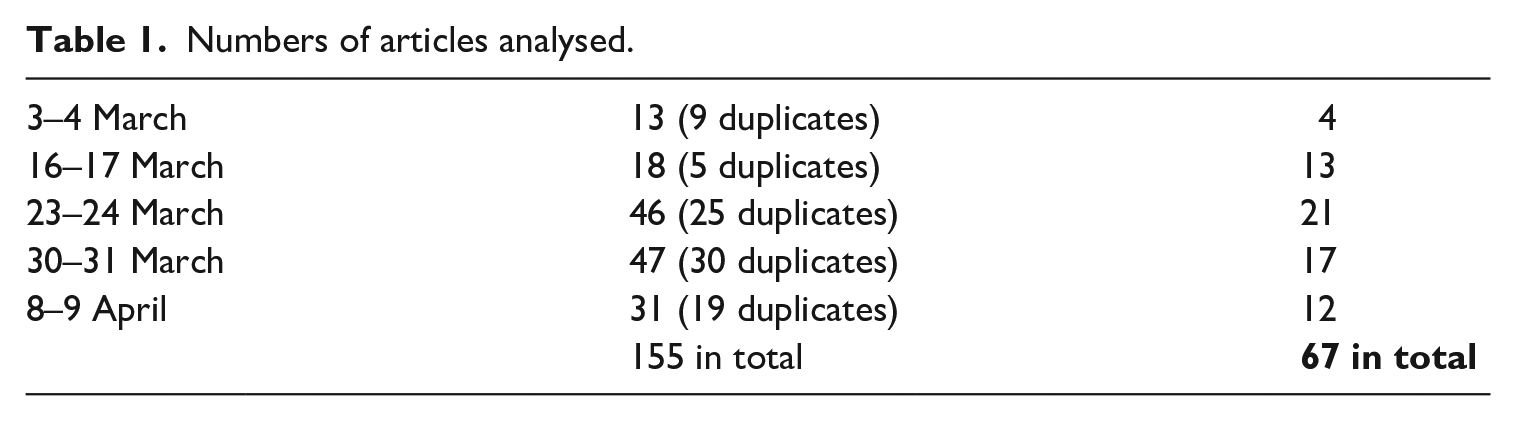
Using the ‘Hide Duplicate Results’ function, which excluded most duplicate stories, this process yielded a total of 155 newspaper articles. Additional duplicates and near duplicates were excluded manually, which resulted in a final corpus consisting of 67 articles. Table 1 provides an overview of the distribution of articles. For the final analyses the last two sets of data, 30–31 March and 8–9 April, were analysed together, as they overlapped thematically.
Numbers of articles analysed.
Analytical procedure
We analysed the corpus using a social constructionist variant of qualitative thematic analysis, which has been described as ‘a method for identifying, analysing and reporting patterns (themes) within data’ (Braun and Clarke, 2006: 78). This approach enables the analyst to focus on what is ‘being done’ with language, rather than the exclusive content of media reporting. This is consistent with Willig’s (2008: 112) observation that the discursive themes that arise from the analysis ‘facilitate and limit, enable and constraint what can be said, by whom, where and when’.
Both the headline and the main body of each article was subjected to thematic analysis. We read and re-read the articles to familiarise ourselves with the broader themes that we subsequently discussed analytically. First, initial observations were made which captured the essential qualities of each article, the units of meaning and dominant rhetorical techniques. Second, we discussed our respective initial codes, which included inter alia general tone, particular forms of language, comparisons, categorisations and emerging patterns in the data. During this stage, there was particular focus on the discursive processes of anchoring and objectification in order to identify the construction and dissemination of particular social representations of social distancing. Third, the initial codes were collated into preliminary themes and subsequently arranged into a coherent structure that reflected the overall thematic analysis.
In addition to describing dominant themes in the corpus, we identified linguistic elements, especially metaphors, which performed the functions of anchoring and objectification. In the analysis below, we provide extracts from the articles that exemplify the superordinate themes.
Analysis
The analysis focuses on emerging media and social representations of government messaging on ‘social distancing’. During the period under study, the PM himself rarely used the phrase ‘social distancing’ in speeches and announcements, leaving a void to be filled by the media. The media’s treatment of this emerging construct is the focus of our analysis, which proceeds chronologically from the first major announcement of changes to normal life at the beginning of March to debates about how to restore normality that were beginning in early April. We focus on the type of language (and especially the type of metaphor) used in the newspapers, and how they contribute to the formation of social representations.
3–4 March: Social distancing – a potential but distant threat to continuity
On Tuesday 3 March, the PM revealed the government’s action plan on how to manage the COVID-19 outbreak and limit its spread (Government Publications, 2020a). It contained information on their overall strategy (contain, delay, research, mitigate), as well as advice on how people could protect themselves from the virus (Government Speeches, 2020a). It did not contain the phrase ‘social distancing’. The plan outlined possible ‘population distancing’ measures. An associated news item contained the statement: ‘The government may also ask businesses to consider more home working and discourage unnecessary travel as part of a “social distancing” strategy to delay the peak of the outbreak’ (Government News, 2020). At that time, government reports and newspapers still used quotation marks to indicate the novelty of the phrase.
When announcing the action plan at a press conference, the PM was flanked by experts, namely Sir Patrick Vallance, the Government Chief Scientific Adviser, and Professor Chris Whitty, the Government Chief Medical Adviser, a sight that soon became familiar to television viewers, with both politicians and scientific experts present at these daily press conferences varying over time.
The focus of the speech was on handwashing, not ‘social distancing’. A government blog post, which used the phrase ‘social distancing’ (Public Health Matters, 2020), frequently used modal verbs indicating probability or possibility rather than certainty, such as ‘could’ or ‘would’, thus making social distancing appear vague and relatively distant.
This hesitancy comes through in the reporting in early March, especially in The Times, where discussions of social distancing were hedged by modal verbs (‘action that would be considered could include “populating-distancing strategies”’, Times, 4 March). The Sun too used some of these words, as in ‘Ms Freeman also said “social distancing measures, self-isolation and restrictions on public events” could be brought in’ (Sun, 4 March). Use of these verbs serves to construct an emerging but uncertain social representation of social distancing as a potential mitigation strategy. Yet, at this stage, reflecting the government’s stance, the press too was somewhat ambivalent about its role in curbing the pandemic.
Overall, as The Times pointed out on a more critical note, the ‘“coronavirus plan” is light on detail with principles instead of practical measures’ (Times, 4 March). This did not prevent The Sun from referring to the action plan as a ‘battle plan’, indeed ‘a four-part battle plan [which] will include a “social distancing” strategy, urging Brits to work at home and avoid unnecessary travel’ (Sun, 3 March). It states that the ‘PM is to throw Britain onto a war footing to fight the outbreak’.
In contrast with the general vagueness of advice provided, The Sun uses rather strong language, a war-type language that we found throughout the corpus, but is perhaps best encapsulated by The Sun’s 3 March headline: ‘Army on standby as Boris declares war on coronavirus with battle plan to kill off deadly bug’. Other examples of this war and danger framing are: ‘deadly coronavirus’ (Sun, 3 March), ‘stark warning’ (Sun, 3 March), ‘fears the virus is spreading rampantly throughout the UK’ (Sun, 3 March), ‘Clampdown’ (Sun, 4 March), ‘Doomsday situation’ (Sun, 4 March), and ‘hard-line new powers brought in to stop the spread of the killer bug’.
Thus, coverage in The Sun, following cues from the government itself (Government Press Release, 2020), anchors social distancing, which is considered a possible component of the ‘battle plan’, to war, danger and doom – an arguably populist framing. COVID-19 is represented as a deadly threat and itself is anchored to death and destruction, including to apocalyptic imagery. Social distancing, though a necessary ‘weapon’ against COVID-19, is constructed as disruptive to our lives. A headline in The Times echoes this rather threatening language when it says: ‘Contain, delay, then hunker down: the virus action plan’ (4 March). Despite these strong words, the body of the article goes on to state: ‘Handshake bans, event cancellations, blanket school closures and other “social distancing” measures are not yet recommended: officials believe that they would be too disruptive to be worthwhile. Taking drastic action now also risks making people fed up with onerous restrictions by the time they become necessary.’ The fear of premature social distancing fatigue was discussed heavily at the time, fuelling confusion in relation to this measure.
Social distancing as an emerging social representation was caught between the strong language of war, battle and danger, on the one hand, mainly used by the government and the tabloid newspapers, which aims to conjure up images of collective, concerted and coordinated action, and a vague language of something that could or might happen, on the other hand. This meant that social distancing was not yet seriously being entertained as a viable option for the UK but rather as a relatively distant threat to the continuity of normal life, disrupting the thread between past, present and future (see Jaspal and Nerlich, 2020b).
As graphic images of ‘social distancing’ began to stream in from Italy, which went into ‘lockdown’ on 9 March, the tone of reporting gradually shifted towards a serious consideration of this policy and its potential impact on the general population. However, despite abandoning ‘track and trace’ on 12 March and moving from the containment to the mitigation phase, social distancing was still not widely recommended, which allowed COVID-19 to spread.
16–17 March: Social distancing – a necessary but threatening reality
On 16 March the PM gave another press conference (Government Speeches, 2020b) in which, yet again, he failed to use the phrase ‘social distancing’, instead referring to the avoidance of ‘contact’. For instance, he indicated that ‘now is the time for everyone to stop non-essential contact with others and to stop all unnecessary travel’, providing only limited information about what this means and how ‘essential’ and ‘unnecessary’ were to be understood.
Coverage of this press conference in The Sun and The Times was sparse. However, anticipating events about a week later, a headline in The Times proclaimed: ‘Britain in lockdown’ (Times, 17 March). Using a metaphor which frames life as a telephone exchange, the article states that ‘Normal life was put on hold for up to a year’. The Sun was relatively quiet about all this, only reporting on the ‘doors closing’ on some types of betting. This is surprising as The Times reports that ‘Speaking at Downing Street, Mr Johnson acknowledged that he was asking for “a very substantial change in the way that we want people to live their lives, and I can’t remember anything like it in my lifetime. I don’t think there has really been anything like it in peacetime.”’ He even uses the term ‘draconian measure’. This clearly constructs social distancing as a threat to people’s sense of continuity. Consistent with the war metaphors already in use in the first wave of reporting, this serves to objectify COVID-19 as a military adversary and measures to defeat it as being equally as disruptive to our lives as those used in wartime. Again, in spite of this, this potential weapon against a common enemy seems to be rather blunted, insofar as the PM does not mention it by name and provides no clear and concise rules about how to use it.
There is no real critique yet of this lack of clarity, apart from in a rather exceptional article in The Sun in their Ireland edition. This long article, published on 17 March, reports the views of Irish experts about the new measures being introduced. They all look towards other countries like South Korea (coping well) and Italy (coping badly) as comparators or anchors for how they frame the UK government’s response. This anchoring of discourse in comparisons with other countries became a dominant, but disputed, theme in newspapers at the time. The Irish experts regard the British approach as ‘dangerous’ and even ‘reckless’, a word that came to be used for the behaviour of individuals who were not complying with the social distancing rules (see below). Using the metaphor of fire, one expert says ‘Their [the government’s] view is let this fire burn and they will try and damp it down where they can and spread it out over a period of time.’ The management of the pandemic was framed through a number of metaphors. One was the war metaphor, prominent in the early phase of reporting, another was the fire metaphor – subtler and less prominent (see Cox, 2020). Sometimes the pandemic was seen as a wildfire that had to be put out quickly, at other times, as in this article, as a slow burn or a contained burn that highlighted more control over the spread and management of the pandemic.
In contrast to this perceived British approach, the Irish experts are very clear in indicating that, having learned from other countries, social distancing has to be taken very seriously – it is indeed absolutely necessary: ‘we certainly need to make a serious and radical change in terms of how we do things socially’, ‘stick to your family unit and no more’, ‘[m]ake no mistake we are the vectors for Covid-19. So we need to adjust what we’re doing if we’re going to stop this disease being transmitted.’ This highlights that normal life is normal no more, and that social distancing is a new social normal – the social representation of ‘the new normal’ and that we all carry a responsibility to change how we live and interact (Zinn, 2020).
This plain speaking differs from the war and doom framing used initially by some government officials and amplified by some newspapers, such as The Sun. One example in particular stands out: ‘Dr Mallon said the Irish public needs to look at their actions, adding: “Everyone in this country needs to make two choices. They need to look at their actions and say, ‘Do my actions help with limiting the spread of the virus, or do my actions help the spreading of the virus?’ If your actions are helping to spread this virus, then you’re not helping. If everyone takes this seriously then the treatment will be incredibly effective and we will get out of it early.”’
The Times elaborates on the social distancing policy, namely the emerging social and psychological challenges that will be faced by the elderly as a result of this policy. These include loneliness, tensions within households, lack of physical exercise and so on: ‘Most of all, this may be a frightening experience. Most older people have routines that will be severely disrupted so they are likely to need reassurance’ (Times, 16 March).
Overall, social distancing is represented as necessary but also as being socially disruptive and especially deleterious for more vulnerable groups in society, such as the elderly. An iconic representation of social distancing began to take hold, namely the two-metre rule, which gradually became embodied in social interactions. As The Times pointed out on 16 March: ‘The rule of thumb when going out is to avoid coming closer than two metres or three steps from someone else.’
23–24 March: Social distancing – ordering, blaming and shaming
On 20 March the government announced further measures on social distancing, including the closure of public venues. On 23 March the PM gave an important address to the nation during which he finally announced a general ‘lockdown’. Again, this was framed not directly in terms of social distancing, but as follows: ‘From this evening I must give the British people a very simple instruction – you must stay at home.’ (Government Speeches, 2020c). This was a switch from the use of modal verbs such as ‘could’ or ‘would’, indicating possibility, at the beginning of March, towards direct orders and commands and the use of modal verbs such as ‘must’, indicating certainty. The government was now instructing people to adhere to its still vague and changing rules about social distancing, encapsulated in one clear message: ‘Stay at home’.
There was a distinct context in which this new language of social ‘order’ emerged, over and above cases of COVID-19 rising and deaths increasing. The month of March saw almost uninterrupted sunshine. This meant that the ‘stay at home’ and ‘social distancing’ messages, which had been advisory, were interpreted loosely by some people, especially those with no gardens. People ventured out, particularly after 18 March when schools were closed. Just before the lockdown, there was also Mothering Sunday on 22 March, where again the PM’s messaging was confusing. On 20 March he was still contemplating seeing his mother, while on the 22 March he said: ‘I know that everyone’s strongest instinct is to go and see their mothers in person, to have a meal together, to show them how much you love them. But I am afraid that this Mothering Sunday the single best present that we can give – we who owe our mothers so much – is to spare them the risk of catching a very dangerous disease.’
In this context, a new language emerged about people going out to seek fresh air and exercise. Words like ‘flouting’ the guidance, rules, measures, advice, etc. about social distancing were used frequently. There was talk of ‘reckless Mother’s Day outings’ (Sun, 23 March). Even the PM attacked the ‘heedlessness’ of people (Times, 23 March). These people were framed as herds of animals: ‘flocked (to parks, beaches and markets)’, ‘rammed (with day trippers)’, ‘spilled out’ and ‘(throngs of people) packed (on commuter trains, the tube etc.)’ – something that became informally known as ‘park shaming’.
Both newspapers chided people who ‘failed to obey’ the simple instructions issued by the PM and were blamed for ‘ignor[ing] the Government’s advice’. The Sun, sticking to its tough language, therefore stressed on 23 March: ‘You have to stay two metres apart; you have to follow the social distancing advice.’ The rule of thumb has been replaced by an order.
One can observe a change, from representing social distancing as a threat to the continuity of normal life to seeing non-compliance as a threat to social order. This threat is exacerbated by perceived ‘social deviance’. As Thompson pointed out in an article for Revise Sociology: ‘The societal reaction to Coronavirus is certainly a very stark illustration of the context dependency of crime and deviance. . . . The recent emergency legislation which put the country into lockdown has made a whole swath of previously “normal activities” deviant, if not criminal, and it’s changing the nature of what we think of as both criminal and deviant’ (Thompson, 2020).
For example, one article in The Sun pointed out: ‘Anne, who is in her mid-70s, told the Irish Sun of her horror after throngs of people packed beauty spots across the country and openly flouted social distancing advice’ (Sun, 24 March). Hence, there were those who were adhering to the rules and those ‘others’ who were not; there were ‘us’, law-abiding people speaking the same war language as the government and the tabloids and ‘them’, who were not. An article in The Sun entitled ‘Mind the Gap’ (23 March) stressed that: ‘People of all ages flouted guidance on social distancing designed to stop coronavirus spiralling out of control.’ One article cited ‘frantic families’ calling ‘for tougher measures in the war on Covid-19’. The focus of opprobrium was on the masses that poured, flowed or spilled into forbidden spaces, rather than on individuals.
At that time, the police were deployed to enforce social distancing rules. This led to another type of blame game. Not ‘us vs them’, but people vs the police/state. As there was no clarity about what the rules meant, the police misjudged some of their interventions. There was thus enforcement amidst confusion: ‘The government still cannot say clearly whether the goal is to suppress the virus or whether it is still seeking only to slow its spread. . . . The result has been public confusion at the time when people wanted decisive leadership’ (Times, 23 March), and: ‘The country needs to know that Mr Johnson has a coherent strategy.’
The PM framed his confusing, rather than coherent, strategy of the belated ‘lockdown’ again in terms of war metaphors: ‘In this fight we can be in no doubt that each and every one of us is directly enlisted. Each and every one of us is now obliged to join together.’ ‘The people of this country will rise to that challenge.’ ‘We will beat the coronavirus and we will beat it together.’ Through the war framing, responsibility is attributed to individuals and individual actions (complying with or flouting the two-metre rule, never going out in groups bigger than two people), rather than the state and its actions. This ‘shifts the blame from government to individuals: (so-called) panic buyers, people in parks, the implicit responsibility in the constant emphasis on handwashing. It means we are less likely to want to seek out the root causes for the severity of the impacts of the virus (such as austerity, structural inequality or our own eating habits)’ (Blackmore, 2020).
At the same time as blaming and shaming those who flouted the rules, newspapers gradually also began to blame the government. While The Times reported that ‘Mr Macron saw Britain’s policy as “benign neglect”’ (Times, 23 March), The Sun quoted the Mayor of Bergamo, one of the towns hardest hit in Italy, as saying: ‘I don’t understand why the Government didn’t decide in time to protect the citizens’ (Sun, 24 March).
In an article with the ironic title ‘War leader’, The Times points out: ‘For the most of the first half of March, the official advice was simply to wash one’s hands. On March 12, as countries across Europe and the world closed schools, restaurants, bars and shops and introduced lockdowns and travel bans, the Government merely advised that those ill with coronavirus symptoms should self-isolate for seven days.’ And: ‘The result has been public confusion at a time when people want decisive leadership. . . . The country needs to know that Mr Johnson has a coherent strategy. Otherwise the prime minister who dreamt of being Churchill may find himself cast as Neville Chamberlain.’ Issuing unclear orders and then blaming people for not obeying them properly is not conducive to establishing social order.
30–31 March and 8–9 April: Blaming, praising and weariness
On 30 March the government tried to clarify its social distancing guidance (Government Publications, 2020b). This guidance was withdrawn on 1 May and replaced with guidance called ‘Staying at home and away from others (social distancing)’, putting the phrase ‘social distancing’ for the first time in a prominent position (Government Publications, 2020c).
In the 30 March guidance, ‘social distancing’ was defined as ‘steps you can take to reduce social interaction between people. This will help reduce the transmission of coronavirus (COVID-19).’ Measures were set out and people were told: ‘For now, you should rigorously follow the social distancing advice in full.’ There was also advice on mental well-being. However, this advice was not mentioned during the press conference led by Dominic Raab, and, yet again, the phrase ‘social distancing’ was not used (Government Speeches, 2020d).
On 30 March, the sun was still shining, which enticed people yet again to go outside. Both The Sun and The Times still reported on people ‘flouting the lockdown, breaching stay-at-home laws, panic-buying’ (Sun, 30 March) and stated: ‘Thousands of Britons flouted the rules on gatherings and social distancing, with police forced to break up football matches and, in one case, a karaoke party’ (Times, 30 March). One voice in particular registered a protest against the way in which the police tried to enforce these rules. Lord Sumption, a former Supreme Court judge, warned that we are entering a police state and that it was not right to put ‘our population into house imprisonment’, using a rather drastic metaphor for the lockdown and its enforcement, which echoed the metaphor of ‘house arrest’ used when the lockdown was announced (headline, Sun, 24 March). However, other voices also came to the fore, as a Times columnist pointed out that the ‘past week has seen great shows of civic solidarity’ (30 March) and as the Chief Scientific Adviser said that people were doing a ‘good job’ of social distancing and that social distancing was working (Times, 31 March).
As the stress and burden of social distancing began to be felt, discussions slowly started about when it was time to lift the lockdown and return to ‘normal life’. However, experts warned that the government had to be careful. As a government minister, quoted in The Sun, pointed out: ‘If we practise the social distancing measures, if we follow the rules that the Government has outlined, if we follow that good scientific advice, then we can delay the infection rate and that gives our NHS the chance to become more resilient’ (30 March).
The new social representation of ‘social distancing’ became ever more embedded in social life. The end of March also saw some events that made people think more about the importance of this measure, as Prince Charles, Matt Hancock (the Secretary of State for Health and Social Care) and the PM were diagnosed with COVID-19 and the PM was later admitted to hospital.
On 8 April a milestone of sorts was reached: the hundredth day since the start of the pandemic and a death toll of 10,000. Warnings about keeping up social distancing were still issued alongside blaming people for not doing so, not only those ‘masses’ of people that ‘flock’ and ‘flout’, but also ‘self-serving celebrities, business leaders, MPs and their families, who have cowered away in their second homes’ (Sun, 9 April). Blaming others for ‘flouting’ ‘the rules’ was still part of the press coverage.
There was still unease about the forces of social order, namely the police, for ‘overstepping the mark’. On 9 April The Times reported the results of a YouGov survey that indicated that the ‘majority of the British public support the lockdown but a third think that some police offers have gone too far’. In Letters to the Editor, people said that it was ‘Time to cut us some slack’ (Sun, 9 April). Again, there was also some praise and people were told to be proud of themselves (Times, 9 April). ‘Annemarie Plas, the organiser of the Clap for our Carers campaign, said that she wanted to use this evening’s clapping to encourage people to respect social distancing over the bank holiday’ (Times, 9 April). The symbolic action of clapping for key workers every Thursday evening at 8pm became an established part of social action, both in the UK and elsewhere in the world.
The duration of the lockdown continued to be discussed and speculations about its end started to circulate. However, people were ‘told to brace for weeks more in lockdown’ (Times, 9 April) and medical staff were reportedly set to face a ‘test of courage’ during a long lockdown (Times, 8 April). Social distancing was metaphorically related to strength and endurance.
Alongside such force metaphors, new landscape and journey metaphors emerged around waves, peaks and plateaus. At the time of writing (May 2020) people began looking for an ‘exit strategy’ ‘as the pandemic’s peak moved into sight’ (Times, 9 April).
Discussion and conclusion
At the beginning of March, the social representation of ‘social distancing’ began to emerge as a threat to social life and was closely associated with the two-metre distance rule. By the beginning of April this distant threat had turned into a new social reality, but one that many people now wanted to escape. After being framed through the lens of a lockdown, or as some called it ‘house arrest’, social distancing gradually became associated with the visual and visceral metaphor of the ‘exit strategy’, the search for a path or a door out of this perceived prison.
Social distancing as a new norm for social conduct gradually embedded itself in social life despite mixed and confusing messages by the government. Indeed, the PM avoided the phrase in his press conferences. This is the general theme that emerges from our analysis. It is one of prevarication, confusion and, at the same time, increasing calls for action from experts. This is problematic in a situation where a government strives to bring a pandemic under control and wants its citizens to comply with new rules of life. Some of the confusion was related to a clash in communication styles with tough and strong, even war-like language (government and The Sun), which contradicted, at least initially, the hesitant roll out of social distancing measures, shrouded in imprecise language.
As public compliance with novel prevention policies, such as that of social distancing, is dependent on their ability to understand and relate to it, it was surprising to find that our corpus included little discussion on how social distancing really affects and relates to social life. There was some discussion of abandoning the ritual handshaking before football matches, the need for shops to enable ‘responsible social distancing’, the difficulties of working with the two-metre rule in mind, the impact on the finance sector and CEOs having to work from home. However, there was little reporting about how people might cope physically and mentally with enforced restrictions to movement. This is a significant omission in view of the deleterious impact of social distancing on mental health (Lopes and Jaspal, 2020).
Instead, emerging social representations of social distancing focus on threat, blame and burden. Initially, social distancing was reported as a threat to social life. This social representation intensified when non-compliance with social distancing rules was seen as a threat to social order and linked to social deviance, on the one hand, and to the police going beyond their remit, on the other hand. In later reporting, social distancing was increasingly represented as a burden rather than a threat. People were reportedly weary of, but also confused about, the measures, and discussions began about when it would end. Yet, there was also some emerging evidence of social distancing being anchored to social solidarity, mutual support and mutual aid. This was either framed through the fraught lens of war (i.e. everybody doing their bit, we are in it together), or through symbolic actions, such as weekly clapping for key workers.
In short, the competing social representations of social distancing as a threat to our sense of continuity, on the one hand, and a necessary normative behaviour to be observed by all, on the other, became dominant in media reporting of COVID-19 during the month of March. This complex social representational field in the UK press may have significant implications for public understanding, behaviour and compliance with preventive measures.
Social distancing may be constructed as threatening to one’s lifestyle, identity and well-being and therefore resisted. Yet, it may also be understood to be an essential norm to be observed, with non-observers being stigmatised and marginalised.
Coupled with the lack of clarity about social distancing from government officials, it is easy to see how the emerging social representations of social distancing in the press could further fuel confusion about COVID-19 and how to prevent infection in the general population. A fundamental requirement in emergency situations, such as that of COVID-19, is a shared understanding of risks, what is required to reduce them and how this can collectively be achieved. During the early phase of the COVID-19 pandemic, social representations of social distancing in the UK media provided neither.
Footnotes
Funding
The authors received no financial support for the research, authorship, and/or publication of this article.
