



Abstract
New parties are a key mechanism behind party system innovation as voters are offered new choices. To explain party entry (i.e. participation in a lower house election for the first time), the state-of-the-art has typically focused on domestic determinants. This, however, assumes that party entry takes place in an international vacuum. Building on the policy diffusion literature, we explore how party family members abroad influence party entry in the focal country. Based on a new dataset on the evolution of each party family in 17 Western European party systems between 1961 and 2016, including 2191 new parties, our mixed-methods approach combining spatial econometric models with pathway case analysis demonstrates that party entry is influenced by the entry and electoral success of their party family abroad. This has important implications for the literature on party entry and the international diffusion of policy platforms.
Introduction
Given existing parties’ programmatic inflexibility, new political parties are considered the main source of dynamism in democratic party systems. New parties and not the ‘old’ formulate new policy agendas and accommodate shifting voter preferences (Hooghe & Marks, 2018, p. 112). Consider the impact of En Marche in France, Podemos and Vox in Spain, M5S in Italy, or the AfD in Germany. Also a vast amount of new parties exists without these levels of electoral success. Think about the many pirate, animalist or feminist parties across Europe. Notwithstanding that these new parties are very different in terms of ideology and success, they all shake Lipset & Rokkan, 1967 thesis of frozen party systems.
Given this role of new parties as potential drivers of party system change, many scholars have tried to isolate what factors explain their entry, defined as their emergence on the ballot of lower house elections for the first time. Predominantly, this work focuses on domestic determinants of new party entry. Important insights have been acquired into how structural and institutional features of a polity (Cox, 1997; Hug, 2001; Tavits, 2006), and more dynamic elements like voter turnout, political discontent, party-voter incongruence and electoral fragmentation shape party entry (e.g. Bol et al., 2019; Bolleyer & Bytzek, 2013; Hug, 2001; Ibenskas, 2018; Kselman et al., 2016; Lago & Martínez, 2011; Laroze, 2019; Laver & Sergenti, 2011; Lowery et al., 2013; Sikk, 2012; Tavits, 2006, 2008; van de Wardt & Otjes, 2021). Yet, all these studies focus on strictly national causes, thereby assuming that new party elites are not inspired by what happens abroad. This, however, does not sit well with the policy diffusion literature (e.g. Graham et al., 2013) and recent studies on the diffusion of party platforms (Böhmelt et al., 2016, 2017; Ezrow et al., 2019), arguing that political elites emulate and learn from policy positions adopted elsewhere.
To fill this gap, we are the first to provide quantitative evidence for diffusion effects. Specifically, we develop six hypotheses. We begin by distinguishing emulation from learning: In case of emulation, party families diffuse because of their normative and socially constructed properties, meaning that political groups are driven by the advocacy of policies for its own sake. In turn, learning occurs if it is the electoral success of the party family abroad also matters. The Emulation from entry hypothesis (H1) holds that parties are more likely to enter in response to the entry of party family member abroad, while the Learning from entry hypothesis (H2) theorizes that it is the electoral success of these foreign entrants that matters. Next, we combine these two mechanisms with the question of whether only new parties or also the non-new play a role. The Emulation from density hypothesis (H3) specifies that the density of party family members abroad increases party entry in the focal country, whereas the Learning from density hypothesis (H4) posits that the vote share of party family members abroad does this. Last, H5 and H6 express that the relationships proposed in H3 and H4 are curvilinear and that the positive effects of density (H5) and vote share (H6) of the party family abroad dwindle at high values of these spatial variables.
The hypotheses are tested on a new dataset we collected and coded ourselves. It includes each new party (and thus each party family) in a set of 17 Western European democracies for the entire post-war period. Our spatial econometric models confirm H1 and H6. Using a mixed methods design, based on the outcome of this Large-N analysis, we also select two pathway cases, the greens and populist radical right, for qualitative analysis to elucidate the causal mechanisms behind these confirmed hypotheses. Jointly, our findings imply that political groups only emulate from party family members abroad that are new, while only learning from the electoral performance of the non-new.
Theory and Hypotheses
Previous Work
The rich literature on new parties consists of game-theoretic studies (e.g. Kselman & Tucker, 2011), agent-based models (e.g. Laver & Sergenti, 2011) and empirical studies. Important insights have been provided into how structural and institutional factors (Farrer, 2017; Hug, 2001; Tavits, 2006) and more dynamic characteristics such as the density of electoral niches (Kitschelt, 1988; van de Wardt & Otjes, 2021), the collapse of existing parties (Laroze, 2019), open space in the issue agenda (Hug, 2001; Lowery et al., 2013), voter turnout (Lago & Martínez, 2011), political discontent (Sikk, 2012; Tavits, 2008) and electoral fragmentation (Kselman et al., 2016) correlate with new parties’ entry. However, prior work only considers national-level explanations.
This is at odds with several case studies on the diffusion of social democracy (Delwit, 2005), Christian democracy (Hanley, 1996), third-way politics (Studlar, 2003) and right-wing populism (Rydgren, 2005; Van Hauwaert, 2019) and with the vast policy diffusion literature, positing that actors are more likely to adopt policies already adopted abroad (e.g. Gilardi, 2012; Graham et al., 2013; Shipan & Volden, 2008). The only quantitative study that we know of which does consider policy diffusion among parties focusses on platform change in response to foreign parties (Böhmelt et al., 2016, 2017; Ezrow et al., 2019). We do not want to downplay this study’s contribution, actually being our main source of inspiration. Yet, understanding how new party families emerge due to international contagion is arguably even more important. Except for some notable examples like the adoption of a Third Way platform by many social democrat parties, existing parties are mostly constrained in the magnitude of change they can credibly pursue (e.g. Hooghe & Marks, 2018). Hence, the emergence of new party families is an even stronger mechanism of party system renewal than change by existing parties.
Defining Party Family
Before formulating our hypotheses, we clarify how we define party family: ‘one of the most undertheorized and least specified approaches to the general classification of parties’ (Mair & Mudde, 1998, p. 211). Like Mair and Mudde (1998), we understand party families as a set of parties that shares a common ideology, a ‘belief system that goes right to the heart of a party’s identity’ (ibid.: 220). Hence, this definition taps into what parties are, rather than into the policies they address in one specific election. Consequently, party family membership is relatively stable throughout a party’s life (even though we do allow parties to move from one category to the other in case of profound ideological transformations).
There are many different approaches to classify party families. The Comparative Manifesto Project (CMP), for example, largely follows traditional work in the discipline. They identify: green, socialist or other left parties, social democratic, liberal, Christian democratic, conservative, nationalist, agrarian and ethnic and regional parties. Additionally, the CMP identifies the family of special issue parties (Volkens et al., 2013). For three reasons this classification is unsuitable for us. First, as also noted by Mair and Mudde (1998), this categorization only covers the largest and most established party families. Hence, we would miss most of the new parties entering the electoral arena. Pirate parties, for instance, are not classified as a separate party family in the CMP. Yet, it is difficult denying that they share a distinct and common ideology. Second, and related, one may overestimate diffusion effects if only established, electorally successful families are considered. Third, the question of how many families there are relates to the definition of boundaries between ideologies. Also here a protocol does not exist (Mair & Mudde, 1998). Rather than using abstract categories like ‘socialist or other left parties’, when referring to party family members in our hypotheses, we mean those in a party’s ‘core family’. For instance, while both are part of a more abstract radical left category, we distinguish the core families of democratic socialist parties from the communist core family (March & Mudde, 2005). New democratic socialist parties should primarily be seen as family members of other democratic socialist parties than as family members of communist parties that differ by rejecting the democratic order.
In sum, a more fine-grained delineation of party families is needed to make valid inferences about their diffusion. Below, we will also empirically prove the validity of our approach.
A Cross-National Diffusion Theory on Party Entry: Emulation Versus Learning
Now that our party family conceptualization is clarified, we formulate our hypotheses on party entry. Following Cox (1997, p. 162), we assume political groups face a fourfold choice: (1) they can decide not to engage in electoral activities and to pursue their goals by strategies like lobbying; (2) they can try to become nominated on the ballot of established parties; (3) they can start a new party in the espoused believe that it will be electorally viable (below, we link this to office and policy-seeking parties); or (4) they can start a new party for other reasons than electoral success (below, we label this pursuit of policy purity). Our model explains why political groups chose the third or fourth option over the first and second.
We assume that a party is not the only, and not necessarily the optimal, organizational choice for a political group to pursue its goals (also see Farrer, 2017). Rather, this is a complex decision involving uncertainty. Hence, we theorize that political groups rely on heuristics and, more specifically, that they emulate or learn from the emergence and density of their party family abroad.
Based on the policy diffusion literature, we distinguish between emulation and learning. In case of emulation, policies diffuse because of their normative and socially constructed properties instead of their objective consequences (Gilardi, 2012, p. 13). Hence, it is a normative ambition to imitate (Van Hauwaert, 2019, 516). Translated to the party goal literature, emulation coincides with the pursuit of policy purity where political elites find the advocacy of an ideology more important than winning votes or gaining access to public office benefits (Harmel & Janda, 1994, p. 270; H. H. Pedersen, 2012). Hence, political groups found parties because of the ‘expressive utility’ they derive from doing so – that is, from the expression of ideological ideals for its own sake (Sánchez-Cuenca, 2004, p. 330). In case the elites of political groups seek policy purity, they should be emboldened by the entry of their party family in foreign elections regardless of the latter’s electoral success. Hence, we hypothesize: Emulation from entry hypothesis (H1). Higher entry rates of a party family abroad increase its entry rates in the focal country
That advocacy of an ideological platform matters more than its electoral success (emulation) is at odds with the alternative causal mechanism of learning identified in diffusion research. Learning ‘involves a determination of whether a policy adopted elsewhere has been successful’ (Shipan & Volden, 2008, 841–42). When success is difficult to measure, various shortcuts can be taken. For instance, policymakers may interpret broad adoption of a policy without subsequent abandonment as evidence of success. In case of parties, success can be measured more easily by looking at foreign parties’ electoral results. Thus, based on the learning mechanism, it is not so much the entry of party family members abroad that matters, but their electoral success.
That parties would learn from this success is consistent with the notion of both office and policy-seeking parties in the formal literature. Office-seeking elites will announce a new party anywhere along the spectrum in a single-minded pursuit of office (e.g. Downs, 1957), while policy-seeking elites found parties to implement their preferred policies (e.g. Bol et al., 2019; Kselman & Tucker, 2011). While policy-seeking parties do value the policies in themselves, like office-seeking parties (and unlike policy-purity parties) they need electoral success to reach their goal.
The theory of strategic entry echoes that new parties are started by instrumentally rational elites who must maximize their vote share in the short run, either to enjoy the spoils of office or to influence policy (Tavits, 2006, 2008). Political groups will become political parties if perceiving that the costs (c) of entry are equal or lower than the benefits (b) of political office times the likelihood (p) that they will be elected. While political groups are likely aware of b and c, estimating p may be more difficult. Hence, next to domestic factors that could enhance their electoral success, policy and office-seeking elites may also use the recent electoral success of ideologically similar parties, those part of their family, as a heuristic for their potential success in their own country.
The learning and the emulation dynamics discussed above can also be spurred by go-between actors (Graham et al., 2013). If a party family enters somewhere, mass media in other countries will likely cover this event, particularly if it is successful, and do their best to relate it to domestic affairs. For instance, since the election of Emmanuel Macron, newspaper articles reflecting on who could be the ‘Belgian Macron’ have burgeoned. 1 Hence, mass media can increase the electoral opportunities for embryonic parties of the same ideological family (Rydgren, 2005). Also, go-between activities of think tanks could matter.
In keeping with the learning mechanism that office and policy-seeking elites must also consider the electoral performance of foreign party family members, we hypothesize: Learning from entry hypothesis (H2). Higher vote shares obtained by new party family members abroad increase its entry rates in the focal country
Entry Versus Density
Thus far, we have only considered new parties’ impact on party family entry in other countries. Yet, political groups may also be influenced by foreign family members created earlier that are still present in the political arena. This issue of continuity over time is also addressed in the policy diffusion literature with the expectation that diffusion would be facilitated when a policy remains in place for a longer period of time (Shipan & Volden, 2008, 842). In analogy, we find it crucial to test whether it is the density (the number) of the party family abroad that triggers diffusion, or especially/exclusively new family members.
There are various reasons why political groups may also, or even more, emulate and learn from non-new parties within their family. First, their continued presence could make them more easily noted by ideologically likeminded political groups abroad hesitating about running for elections. If a party quickly disappears after its emergence, it does not exert a strong signal from which political groups could emulate or learn. Second, the literature on party families and international party organizations stresses the role of transnational contacts and direct support within party families (e.g. McDonnell & Werner, 2020). Arguably, parties that have been around for a while are better at providing direct support than new parties. The latter still suffer from the liability of newness (Freeman et al., 1983), meaning that they might primarily be concerned with their own survival.
We acknowledge that we cannot directly test whether this direct support or their signalling function is more important. Yet, since both mechanisms are potential drivers of diffusion, we find it crucial to contrast the effect of entry and density of party families abroad. In case of density, we distinguish between mere participation in elections or the vote share obtained by foreign party family members. Which of the two matters again depends on whether political groups emulate or learn. This reasoning yields the following two hypotheses: Emulation from density hypothesis (H3). Higher density of the party family abroad increases its entry rates in the focal country Learning from electoral success hypothesis (H4). Higher vote shares obtained by the party family abroad increase its entry rates in the focal country
Party Family Lifecycle
We also formulate two hypotheses that did not guide the design of this study, but were suggested by its results. 2 When statistical tests revealed that the party family’s density and vote share abroad have curvilinear effects, we realized that this can be linked to a lifecycle perspective on party families. That individual parties can pass different life stages is well-established in the new party literature. Pedersen’s (1982) famous lifecycle model, for instance, distinguishes the threshold of declaration, authorization, representation and relevance where the party subsequently announces its decision to contest elections, actually contests elections, gains parliamentary representation and manages to establish itself as a relevant political actor.
To our knowledge, such an approach has not yet been linked to the evolution of party families. We find it particularly relevant to distinguish between an insurgent phase where party families begin passing the threshold of authorization in several countries and a consolidation phase where it has fully established itself internationally in terms of density and continued electoral success. Obviously, only few families reach this consolidation stage; yet, when they do so, it seems illogical that new family members would continue entering with the same pace as before. From an emulation logic, the firm presence of the family should remove the normative desire to imitate. In turn, learning becomes less likely as the ideological niche is already successfully taken. This yields our final two hypotheses: Emulation from density curvilinearity hypothesis (H5). Higher density of the party family abroad increases its entry rates in the focal country, but the effect dwindles at very high levels of density. Learning from density curvilinearity hypothesis (H6). Higher vote shares of the party family abroad increase its entry rates in the focal country, but the effect dwindles at very high levels of electoral success.
In sum, we propose that entry rates of party families should partly be understood as a process of international contagion. Our six hypotheses account for the different possibilities through which diffusion can occur. This is needed since we pool different families at different stages in their lifecycle.
Besides testing whether diffusion effects weaken when party families have consolidated (H5 and H6), the empirical pattern as to which of our four core hypotheses (H1-H4) are (dis)confirmed will yield even more insight in party family lifecycle dynamics. Evidence for H1 but not H3 would mean that political groups only emulate from new party family members abroad. In turn, support for H4 but not for H2 would imply that political groups learn from the electoral success of both new and established party family members abroad but not particularly more from the new. A significant negative effect of the vote share of new party family members abroad would even reveal that political groups only learn from the success of those that have been present for a while. Hence, a relationship may be observed between the motivation of the political group (emulation vs. learning) and the newness of the actors to whom they respond.
Data and Methods
We compiled a cross-national and longitudinal dataset, including each election between 1961 and 2016 in 17 Western European 3 countries. 4 Our dependent variable, Party family entry, varies by country-party family-year and counts the number of parties of a certain family contesting lower house elections for the first time. 5 Party families contribute one observation per year in each country and start producing observations after the party family has materialized for the first time in any Western European party system. Because our estimator (see below) is only available for linear models, we use the variable’s natural logarithm after adding the value of 1 (see also Böhmelt & Bove, 2020). 6 As shown in the Supporting Information (SI, 3.9), our findings hold against inverse hyperbolic sine transformation.
Our party family counts are from a new, publically available dataset, containing information on all parties that contested post-war elections in 17 Western European countries (van de Wardt et al., 2023a). It is the most comprehensive attempt thus far to include all new parties within the countries selected. Extant work either makes inferences about all new parties, but employs a threshold when selecting them (Tavits, 2008, p. 123), or explicitly confines itself to viable new parties (Bolleyer & Bytzek, 2013, p. 774; Lago & Martínez, 2011, p. 13). This also applies to the well-known ParlGov database (Döring & Manow, 2020) which only includes (new) parties in election results if they managed to secure parliamentary representation or obtained at least one percent of the vote. Thanks to our data collection effort, we can isolate new party entry from new party success. To be fair, also Hug (2001) endeavoured to include new parties regardless of their size. He focussed on 20 countries between 1946 and 1991 and identified 326 new parties. Yet, he could only find background information (e.g. electoral success) on 225 of them (Hug, 2000, p. 193). Our new dataset includes 2191 new parties.
We consider two new party definitions in the paper. First a broad definition where any type of party except for party name changes is coded as new in its first national-level electoral contest. This includes genuinely new parties, but also splinters, mergers or divisions. All these forms provide opportunities for politicians to bring a new ideology to the market, which justifies coding them as new. Yet, we also test whether our results hold if mergers and divisions are excluded as new parties. This narrow definition follows the literature on strategic entry (Hug, 2001; Tavits, 2006). In the SI, we show that our findings also hold when splinter parties are not regarded as new (SI, Section 3.8).
Party family is assessed based on ideology (Mair & Mudde, 1998, p. 220). The definitions can be found in Table A1 of the SI and the codebook and data is also publically available (van de Wardt et al., 2023a). Since definitions must travel cross nationally (Mair & Mudde, 1998, p. 224), we merged national interpretations of the same ideology. For instance, Falangist parties were merged into the extreme right. Yet, since we expect that political groups primarily respond to parties within their core family, we were cautious, and still ended up with the 74 party families depicted in Figure 1. Only 37 of them gained at least one parliamentary seat throughout the timespan of our analysis. Yet, since we focus on when parties pass the threshold of authorization (i.e. participation in national elections for the first time) regardless of their success in doing so, we must also include electorally marginal party families. Only including those that obtained electoral success would yield selection bias as these families more likely diffuse. The consequence of including each party family is that we might stretch the meaning of emulation as the diffusion of policies because of their normatively desirable properties. That is, for satirical parties and personal vehicles arguing that they engage in policy advocacy could be considered a stretch. We decided against excluding these two categories, as we find it more important to study diffusion without selection bias. Moreover, satirist or entrepreneurs may still be inspired and model themselves after likeminded parties abroad, even though it is more difficult to call this type of emulation policy diffusion. Entry by party families included in the case selection, 1961–2016.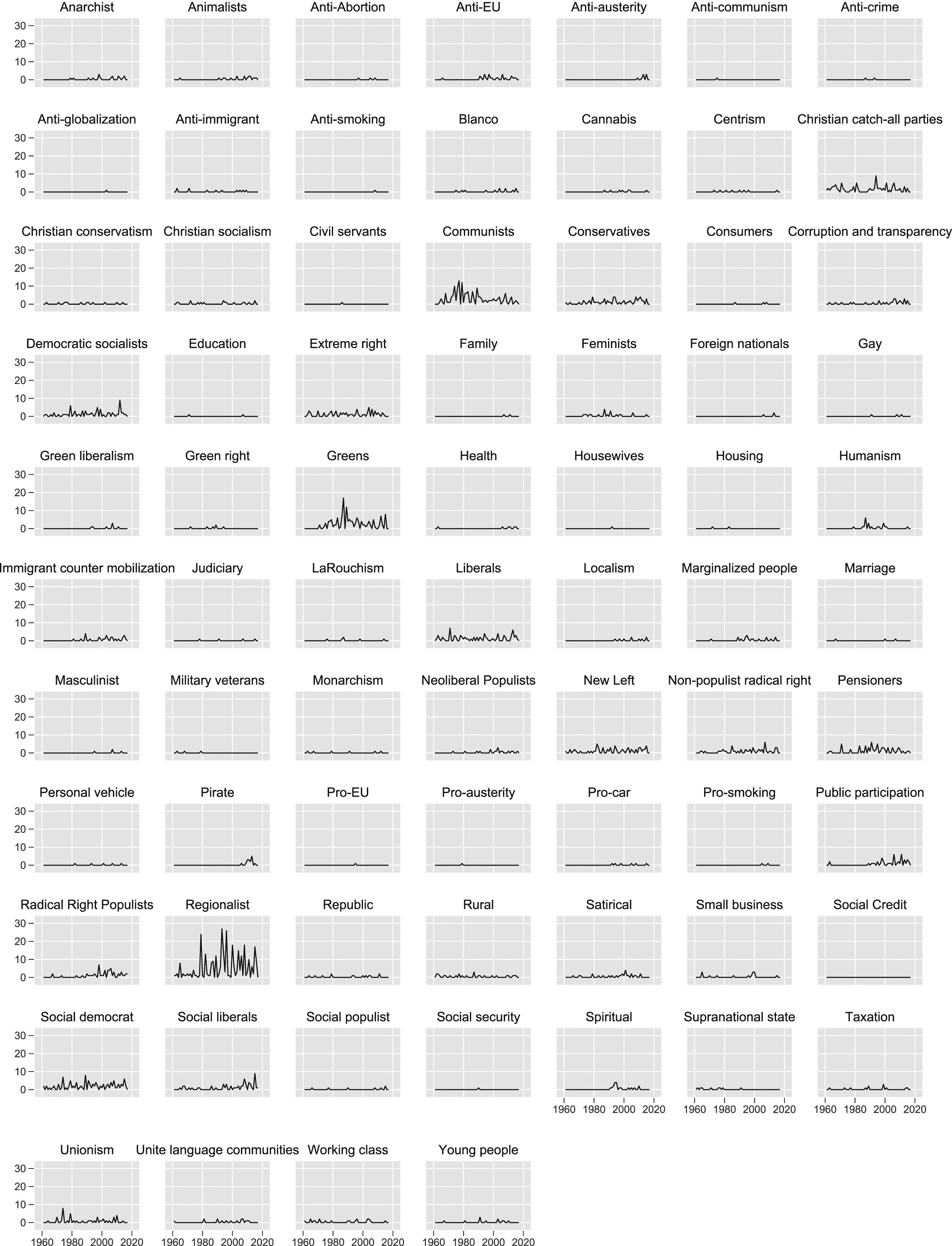
In the section “Placebo Test” we prove that political groups primarily respond to foreign parties in their core family: Contagion effects weaken and ultimately disappear if party families are grouped into more abstract categories. Here, we also show that political groups do not respond to party entry within the broader families identified by the CMP (Volkens et al., 2013), but only to the entry of foreign parties within their core family. This justifies our fine-grained classification scheme.
Empirical Strategy
To test H1, we estimate a spatial lag model (Franzese & Hays, 2007). Party family entry in party system i is explained by entry of the family abroad at an earlier time e−1 and several domestic control variables. Which observations (in our case, country-party family-years) affect one another is specified in the connectivity matrix W. The equation is as follows:

We adopt the spatial lag structure from Böhmelt et al.’s (2016) study on the diffusion of party platform change. Yt is the dependent variable and captures the natural logarithm of the count of new party family members in the focal party system in the most recent elections (thus, in the current election if year t is an election year), Yt-1 denotes the entry of this family in the country’s second-most recent elections, and Wye-1 (the spatial lag) is the product between the connectivity matrix W and the entry of the family in all available foreign countries in their second-most recent election viewed from year t. 7 To clarify, party entry in the Dutch 2002 elections is explained with the entry rates of the same family in the 1997 UK elections rather than their 2001 elections, the 1998 German elections rather than their 2002 elections, et cetera. The average number of years ago in which foreign elections took place where entry rates are derived from is 5.12, with a standard deviation of 1.64. Analogous to Böhmelt et al., (2016), we assume that diffusion, in our case starting a new party, takes time. Yet, our findings are robust against shorter time lag specifications (SI, 3.5).
We will evaluate each hypothesis separately and in a multiple spatial temporal lag autoregressive (m-STAR) model of the form:

Since we have 48,849 observations, W is a 48,849 by 48,849 matrix, where wi,j captures the relative connectivity of party system j to party system i for each party family. A score of 1 indicates that j influences i, whereas 0 denotes no connection. Since some countries transitioned to democracy after the start of the sample period, the number of peer countries varies over time. We do not row-standardize (i.e. divide each cell by the row total) the weighting matrix, as this would imply that the effect of peer countries becomes smaller, the more there are (Plümper & Neumayer, 2010). We, however, prefer assuming that diffusion effects may grow stronger when a party family can materialize in more countries. Nonetheless, we reach the same conclusions if we row-standardize W (SI, 3.4).
H1 is supported if ρ1 is positive and statistically significant. Since we do not row standardize, this means that party family entry in the focal country is expected to be higher in response to a higher sum of entries of the same family in elections that recently took place abroad. The null-hypothesis holds that this effect does not significantly differ from zero. The remaining hypotheses are tested with the product of the weighting matrix W with the temporally lagged (1) vote share of all new party family members abroad (H2), (2) density of party family members abroad (H3) and (3) vote share of party family members abroad (H4). Again positive and statistically significant effects of ρ denote that the null-hypothesis can be rejected. If so, party family entry in the focal country increases with the summed vote share of new party family members (H2) and the summed density (H3) and vote share (H4) of both new and “old” party family members in recent elections. We add the squared terms of density and vote share of party family members abroad to accommodate for the curvilinear effects of these two spatial variables (see H5 and H6). If these terms reach significance, we automatically reject H3 and H4 that posit linear effects. Further analysis on the predictive margins will then be needed to test whether the shape of the relationship conforms to the dynamics expressed in H5 and H6.
Diffusion research often studies the role of contextual factors (e.g., Plümper & Neumayer, 2010; Shipan & Volden, 2008). Hence, we ran models with spatial lags weighted according to: (1) proximity and population difference between country i and j; (3) whether country j is i’s biggest neighbour; and (3) how similar the electoral system of country j is to i. In each specification, our unweighted measure reached statistical significance (available upon request). Hence, we stick with the unweighted spatial lag in this paper. How country characteristics condition diffusion merits a standalone paper.
Estimation
We estimated our models with spatial-OLS (S-OLS) and spatial maximum likelihood (S-MLE). Both estimators have complementary (dis)advantages. The two main advantages of S-OLS are, first, that unbalanced panel structures like ours are allowed where the number of observations (i.e. party family-country-year combinations) is not constant across panels (i.e. party family-country combinations). As explained above, the observations per party family differ depending on when it has entered for the first time. Even if we would let all party families contribute observations from 1961 onward (thereby assuming that a family like pirate parties could already have entered in 1961), the panel would still be unbalanced as the number of peer countries is not constant over time. Several Southern European countries only become part of our sample after their transition to democracy. Besides allowing unbalanced panels, a second advantage of S-OLS is that inclusion of time fixed effects recommended by several scholars is allowed (e.g. Plümper & Neumayer, 2010).
Yet, main disadvantages of S-OLS are, first, that it does not tackle the potential simultaneity problem due to the inclusion of the spatial lag (Yt influences ρWYe-1 and vice versa). Even though this simultaneity bias is very limited in large samples like ours (Franzese & Hays, 2007, p. 12) and that we partly solve this problem by temporally lagging the spatial lag, we show that our findings hold against the S-MLE estimator which corrects for this (Franzese & Hays, 2007, p. 5). Furthermore, the S-MLE estimator also permits spatially correlated errors alongside the spatial lags and is considered the most advanced model currently available (Elhorst, 2021). However, only balanced panels are allowed (for R, see Millo & Piras, 2012; StataCorp, 2019). So, our S-MLE analysis can only start in 1982 when all countries have transitioned to democracy. Moreover, we must specify that all families can potentially enter from 1982 onward. This is why we moved the S-MLE models to the SI (Section 3.1), focussing on the S-OLS estimator in the paper.
Controls
We control for the variables deemed important in the theory of strategic entry (Tavits, 2006). These include rules on new party establishment, electoral institutions (costs), the degree of corporatism (benefits) and variables tapping into the likelihood of new party success like economic growth. We also include the effective number of electoral parties (Kselman et al., 2016), voter turnout (Lago & Martínez, 2011) and the degree of electoral volatility by regeneration (Chiaramonte & Emanuele, 2017). For the operationalizations and descriptive statistics, see Table A2 of the SI.
Results
Do Party Families Diffuse?
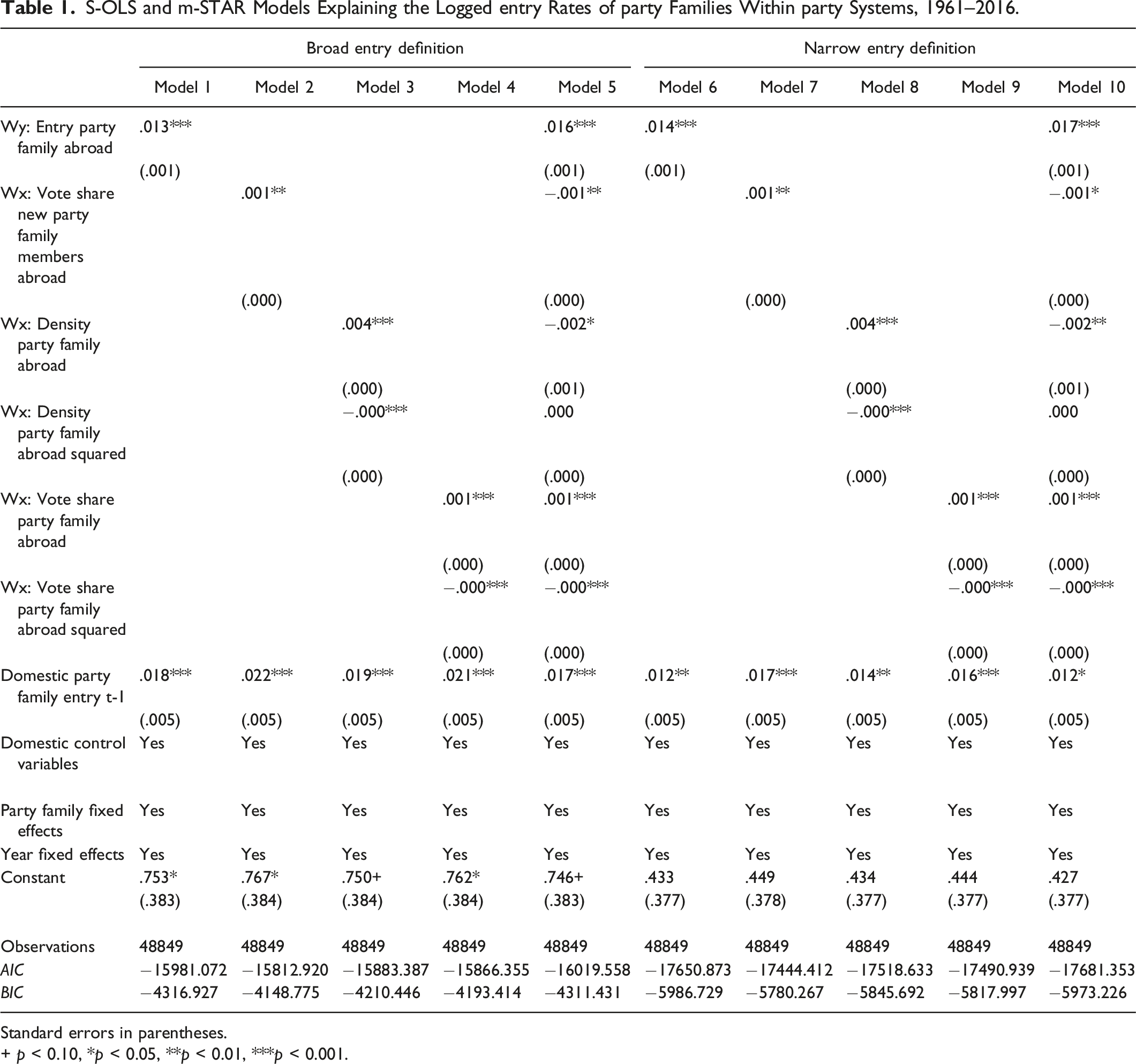
S-OLS and m-STAR Models Explaining the Logged entry Rates of party Families Within party Systems, 1961–2016.
Standard errors in parentheses.
+ p < 0.10, *p < 0.05, **p < 0.01, ***p < 0.001.
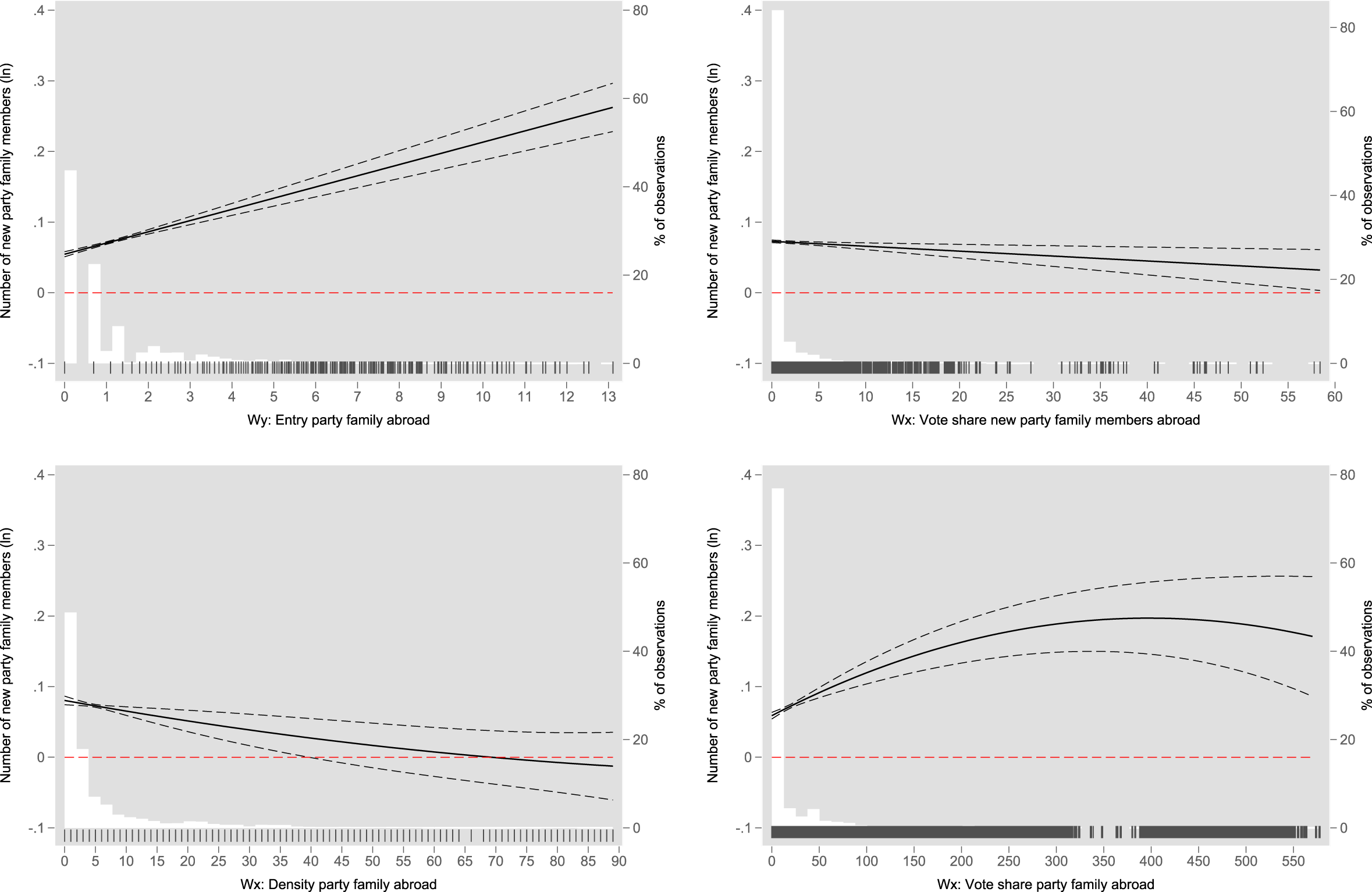
Predicted party family entry (ln) for increasing values of the spatial lag based on Model 5 Table 1, 95 percent confidence intervals. Histogram and rug plot at horizontal axis illustrates distribution of the spatial lag.
As shown in Models 1 and 6 of Table 1, we confirm the Emulation from entry hypothesis (H1). The spatial lag’s coefficient is positive and statistically significant both against our broad (ρ = .013, Model 1) and narrow definition (ρ = .014, Model 6). Moreover, the effect becomes stronger in the m-STAR model where we also control for the other spatial variables (ρ = .016 in Model 5, ρ = .017 in Model 10). Since we did not row standardize the connectivity matrix, the interpretation of these effects is not straightforward. To estimate the short-run impact of lagged party family entry abroad on the family’s entry in the focal country in the current year, following Plümper and Neumayer (2010, 430), we multiply the spatial lag’s coefficient with the average number of neighbours (15). This gives a short-run effect of .24 (15*.016), or 1.271 parties. Yet, since we also have a lagged dependent variable in our model, we must also consider the long-run impact where party family entry in the focal country in the current years keeps increasing party family entry in subsequent years (through this lagged dependent variable). Using the formula proposed by Plümper et al. (2005, 336), we arrive at a long-run effect of .244, which translates into 1.276 new parties. 8 Thus, if party family entry would increase with one party in each foreign party system, the entry of that same family in the focal country increases with 1.271 new parties in the short run and with 1.276 parties in the long run. That the long-run effect is only negligibly larger implies that lagged party family entry abroad will only increase party family entry in the focal country in the current year. Notice that we also find minimal long-run effects for the other spatial lags (presented in Section 2.3 of the SI). Hence, diffusion takes place with a short time lag. This makes sense: Once a party family has entered in a country, it is less likely to continue doing so as the niche is already taken.
To further illustrate effect sizes, Figure 2 (upper-left) plots the predicted values of our dependent variable against the observed range of the spatial lag. The expected value of party family entry (ln) increases from .055 to .262 (thus, from 1.057 to 1.30 parties) when the spatial lag increases from its minimum to its maximum. This is a sizable effect.
Regarding the Learning from entry hypothesis (H2), Models 2 and 7 initially suggest party family entry to increase with the lagged vote share of new party family members abroad (ρ = .001 in Model 2, ρ = .001 in Model 7). However, these effects become negative and statistically significant in the m-STAR models (Models 5 and 10). This runs counter to H2.
Turning to the Emulation from density hypothesis (H3), the main and squared term of foreign density in Models 3 and 8 reach statistical significance. However, as shown in Figure 2 (bottom-left), the effect of density abroad on entry rates in the focal country is highest when density abroad is at its lowest. Hence, neither H3 nor H5 is confirmed.
Regarding the Learning from electoral success hypothesis (H4): Both when tested separately (Models 4 and 9) and simultaneously (Models 5 and 10), we find evidence for a curvilinear effect. 9 As shown in Figure 2 and as anticipated by H6, the relationship between vote share of the family abroad and entry in the focal country flattens at very high level of electoral success. To recap, since we do not row standardize, the x-axis depicts the summed electoral success across all peer counties. Higher values are thus indicative of a stronger electoral presence of a family abroad. The histogram and rug plot in the back depict the distribution of the spatial lag. Almost all the cases are located below the tipping point where higher vote share of family members abroad increases party family entry in the focal country. The relatively few cases beyond the tipping point, all concern mainstream party families (the social democrats, liberals, etc). Since they have already firmly established themselves internationally, it is unsurprising that even higher electoral success does not encourage even more entry.
Finally, we address what the empirical patterns of (non) findings in the m-STAR models has to say about how diffusion takes place. Importantly, that the effect of entry of party family members abroad (H1) remains positive and statistically significant (Models 5 and 10), while we find a negative effect for density of the family abroad (H3) suggests that political groups are only inspired by new party family member abroad and not by their higher density. Thus, newness of the actors abroad is crucial for emulation to take place. Turning to the learning mechanism, the joint dynamics where the effect of electoral success abroad is positive and significant but that of new party family members (H2) is negative and significant (Models 5 and 10), means that political groups only learn from the success of already existing party family members abroad rather than from the new. Our explanation holds that electoral success of parties that have already been present for a while not only signals that an ideology can foster electoral success, but also that this denotes that it brings continued electoral success. Hence, political groups whose vote-seeking motives trump the pursuit of policy purity may not only learn from electoral success of a party family abroad, but also from whether it manages to consolidate its electoral success in the long-run.
In sum, political groups only emulate (respond regardless of electoral success) from new party family members abroad, while they only learn (respond to electoral success) from the success of the non-new.
Section 2.2 of the SI presents the effects of the domestic control variables: They mostly have insignificant effects or effects that are not robust across our two estimators (S-OLS and S-MLE).
Placebo Test
The elephant in the room of each diffusion study is demonstrating that spatial correlations indeed reflect contagion rather than actors contemporaneously responding to similar domestic circumstances. Our statistical evidence for contagion is that the effects of the spatial lags hold in our S-MLE specification with spatially clustered errors (SI, Section 3.1). Additionally, we clustered the standard errors by party family-year (SI, Section 3.6), and demonstrate that emulation dynamics weaken through time (SI, Section 3.7).
We also carried out a so-called placebo test (Gilardi, 2016): If political groups really respond to foreign parties from the same party family, these diffusion effects should dwindle, the less ideologically similar the foreign parties are. In Figure 3, we display the short-run effect of a spatial lag where we aggregate our 74 core families into (a) 26 broader categories or (b) four broader categories, and (c) when we simply consider the entry of all parties abroad. For instance, within the 26-cat. classification, neoliberal populists, the populist radical right, the non-populist radical right and the extreme right are aggregated into ‘radical right’. In turn, the very abstract 4-cat. scheme forces all families in either a left-progressive, right-conservative, liberal-centrist or local-regional bloc. For the classifications, see Table A1 in the SI. Alternative party family classification schemes. 95% confidence intervals. Based on regression coefficient displayed in Table A5 (Core family entry vs. Broader bloc 26 cat., Broader bloc 4 cat. and All foreign parties) and A6 (Core family entry vs. CMP family entry) of the SI.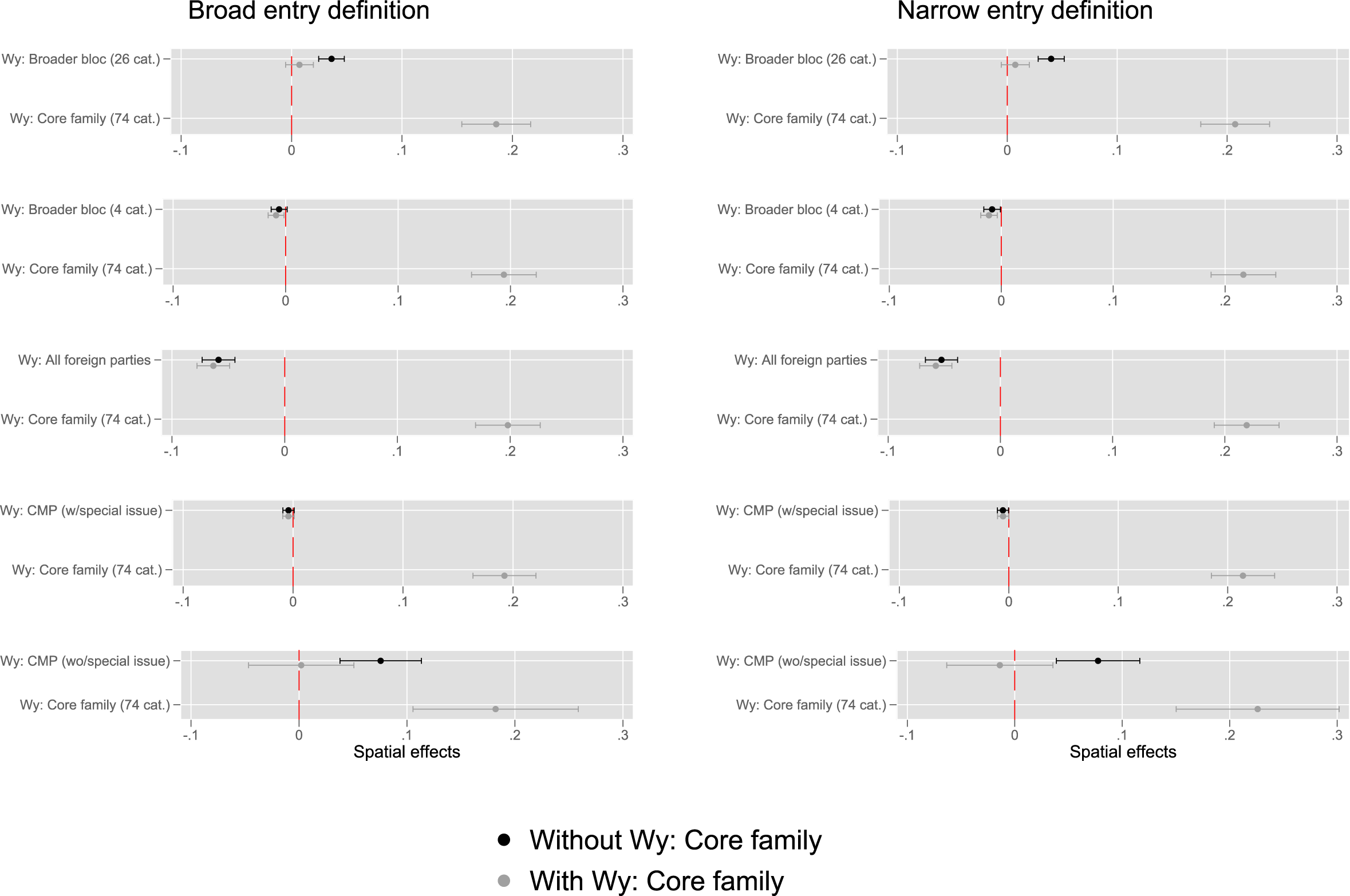
In a first model (black confidence intervals), we only include the spatial variable with the alternative, more abstract classification. In a second model (grey confidence internals), we control for the spatial lag based on our fine-grained classification scheme referred to as ‘Wy: Core family (74 cat.)’. So, the 26-category spatial lag exerts a positive effect at first, but dwindles if we control for ‘Wy: Core family (74 cat.)’. This means that parties only respond to the entry of parties in their core family. Diffusion effects break down even more against the four-category spatial lag or when we consider the entry of any foreign party: These effects are negative rather than positive. The classification based on our 74 core families, however, consistently increases party entry.
The four figures at the bottom also reveal that regardless of whether we include the CMP’s special issue category, this spatial lag fails to matter. The spatial lag that does not consider special issue parties (‘Wy: CMP wo/special issue’) at first exerts a positive and significant effect. Yet, it disappears once we control for the spatial lag based on our 74 core families. All patterns above are consistent across both our broad and narrow definition of entry. Hence, diffusion must be understood with a fine-grained classification of party family.
The Greens and Radical Right-Wing Populists as Pathway Cases
Our Large-N analysis has shown that political groups are either inspired by the entry (H1) and/or the electoral success (H6) of their party family abroad. To further elucidate our causal mechanism that political groups emulate or learn from party family members abroad, we also conduct a pathway case analysis: A mixed-methods technique proposed by Gerring (2007) where, based on the outcome of the Large-N quantitative analysis, one selects a case (an observation in the regression model) where the occurrence of the event of interest (in our case: the event of party family entry) is well-predicted by the specific variable of theoretical interest for a qualitative more in-depth analysis to gain a better understanding of the causal mechanisms connecting this variable of interest with the event of interest. Ideally, one hopes to find that the mechanisms proposed in the theory section indeed apply to some extent.
To assess the suitability of observations as pathway cases, one must calculate each observation’s pathway score. Here one first runs the model without the independent variable of theoretical interest. Then one calculates the absolute distance between the residuals from this reduced model and those from the full model where this independent variable is present. Higher positive scores occur when an observation’s residuals in the full model are smaller than in the reduced model. Hence, is case of H1, we compare two model specifications where we include and exclude the entry of party family members abroad. Higher positive (lower negative) pathway scores imply that events of party family entry in a focal country are much better (poorer) predicted if we include this spatial lag in our model specification. To calculate pathway scores for H6, we repeat the same exercise, comparing the residuals where we include and exclude the lagged vote share and its square of the party family abroad.
Notice that our observations (entry of a family in a focal country), and thus our pathway scores, vary at the level of country-party family-years. However, we want to explore how different diffusion rationales evolve within party families. Hence, rather than focussing on individual pathway scores we consider the distribution of these scores within party families. As shown in the SI (2.4), over the sample period, the greens offer the highest median pathway score for emulation (H1), while the radical right populist (RRP) party family provides the highest median pathway score for learning (H6). Furthermore, the summed vote share of the RRP family across all countries ranges between zero and 148. Thereby, the family is located well before the tipping point where the relationship with entry rates flattens (see Figure 2, bottom-right). Since we want to examine the learning mechanism with a family where vote share abroad increases entry rates, this is crucial.
We now move on to the qualitative evidence for emulation among the greens and learning among RRP parties taking place at times when pathway scores on these mechanisms are high. Figure 4’s top figure displays the standardized entry and electoral success of the greens over time. To visualize how the family evolves irrespective of when elections took place, we sum by year the entry and electoral success of the greens in the most recently completed elections across all countries. In turn, the bars in the bottom figure provide the median pathway scores (across all focal countries where the greens entered in the most recent elections) on both the emulation and the learning mechanism by year. For instance, the median emulation pathway score of .055 in 1985 is based on the entry of green parties in five countries’ most recent elections, and thus calculated based on five individual pathway scores. The positive median score reveals that these entry occurrences are much better predicted if entry of party family members abroad is included in the model. A negative median and corresponding bar score on either emulation or learning signals that inclusion of the spatial variable of interest deteriorates the prediction. As said, we selected the greens because of their highest overall median across the whole sample period (see SI 2.4), indicating that this is the dominant mechanism behind their diffusion. However, Figure 4 plots median pathway scores by year and also adds learning pathway scores so as to clarify that both emulation and learning may happen within the same party family. The top figure represents the summed entry (black line) and summed vote share (grey line) of the greens across all countries in our data. To plot them in the same space, we standardized both time series around their means. The bottom figure denotes the median pathway score for emulation (black bars) and learning (grey bars) for all observations of green party entry that we observe across countries in a given year.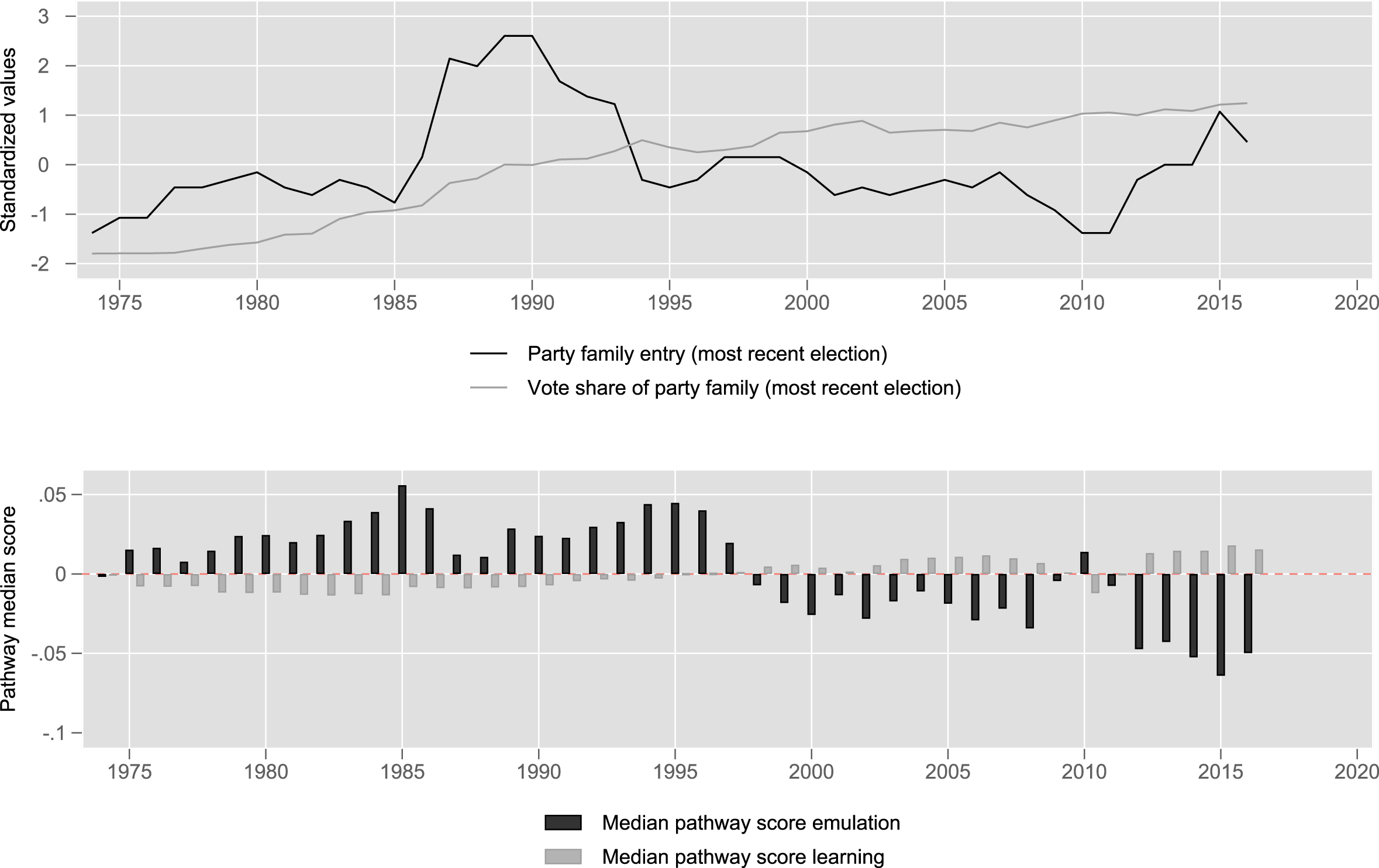
As shown, a pattern of consistently positive median emulation pathway scores is observed until 1997: the era corresponding with green parties’ peak entry. After that, medians become negative, meaning that adding party family entry abroad more poorly explains the entry of the greens in focal countries. Moreover, the median pathway score on the alternative mechanism of learning starts becoming positive. Hence, learning comes to trump emulation as a diffusion mechanism, illustrating that both emulation and learning can happen within the same party family.
In the theory section we link emulation to the pursuit of policy purity and a normative desire to imitate. That the entry of the earlier green parties produces high median pathway scores makes sense. They arose from new social movements built around the grass-roots democracy ideal where the party is a vehicle to express its members’ convictions instead of helping political elites into public office (Rüdig & Sajuria, 2020). In fact, when in 1981, AGALEV, one of the first green parties, gained representation in the Belgian parliament, it was very much to its own surprise and to the disappointment of a significant share of its members (Deschouwer, 2019, p. 41). While there were certainly ideological differences within this first generation of green parties – for instance, whether they were EU-sceptic – this non-instrumental organizational model was its worldwide tenet (Prendiville, 2019, p. 90). Particularly the ‘Basisdemokratie’ of the West-German die Grünen with its rotation of offices, lack of a single leader and decentralized party structures is often mentioned as the key example after which other green parties modelled themselves (Burchell, 2001, p. 114). For instance, when discussing the entry of Luxembourg’s the Greng Alternativ, Koelble (Koelble, 2019, 133) indicates that the party has copied the rotation of office principle and that it emulated programmatic elements of the Grünen. The Grünen first contested national elections in 1980 as part of the first wave of green parties. Hence, several years later it enters the spatial lag of other countries, explaining the new entries in these countries. This is why, for instance, the entry of the Greng Alternativ (cited above) and GLEI produces a high individual pathway score of .035 in 1989.
Besides political groups being emboldened by the entry of other green parties like the Grünen, we also found direct cooperation across green parties during the era with the consistently high pathway scores. Most notably, prior to the 1984 EP elections, contacts were established between green parties from Belgium, France and the UK and with leftish parties from Italy and the Netherlands. Despite ideological differences, these elections paved the way for the foundation of a minimal common platform (Buck, 2019, p. 168). Consistent with our argument that established parties are better able at giving direct support, throughout the 1980s, we mostly encountered examples where it was a more established actor, the German Grünen, that provided the support. For instance, Bolleyer (2010) documents how the Irish Greens, a party which first entered national elections in 1987, received advice from several of the Grünen’s top politicians that travelled to Ireland. The individual Irish emulation pathway score of .008 in 1987 is the highest we encountered in that country. This example helps explaining how seemingly unrelated entry in distinct countries can be understood from activities of go-between actors like the Grünen.
Turning to RRP parties, they provide the highest median pathway score on learning over the entire sample period (H6). Yet, as shown, in Figure 5, if we consider median pathway scores by year, high median learning pathway scores are especially observed between 2013 and 2016. During that time, they are also accompanied by negative medians on emulation. So, this is when the learning mechanism is truly dominant. The top figure represents the summed entry (black line) and summed vote share (grey line) of radical right populist (RRP) parties across all countries in our data. To plot them in the same space, we standardized both time series around their means. The bottom figure denotes the median pathway score for emulation (black bars) and learning (grey bars) for all observations of green party entry that we observe across countries in a given year.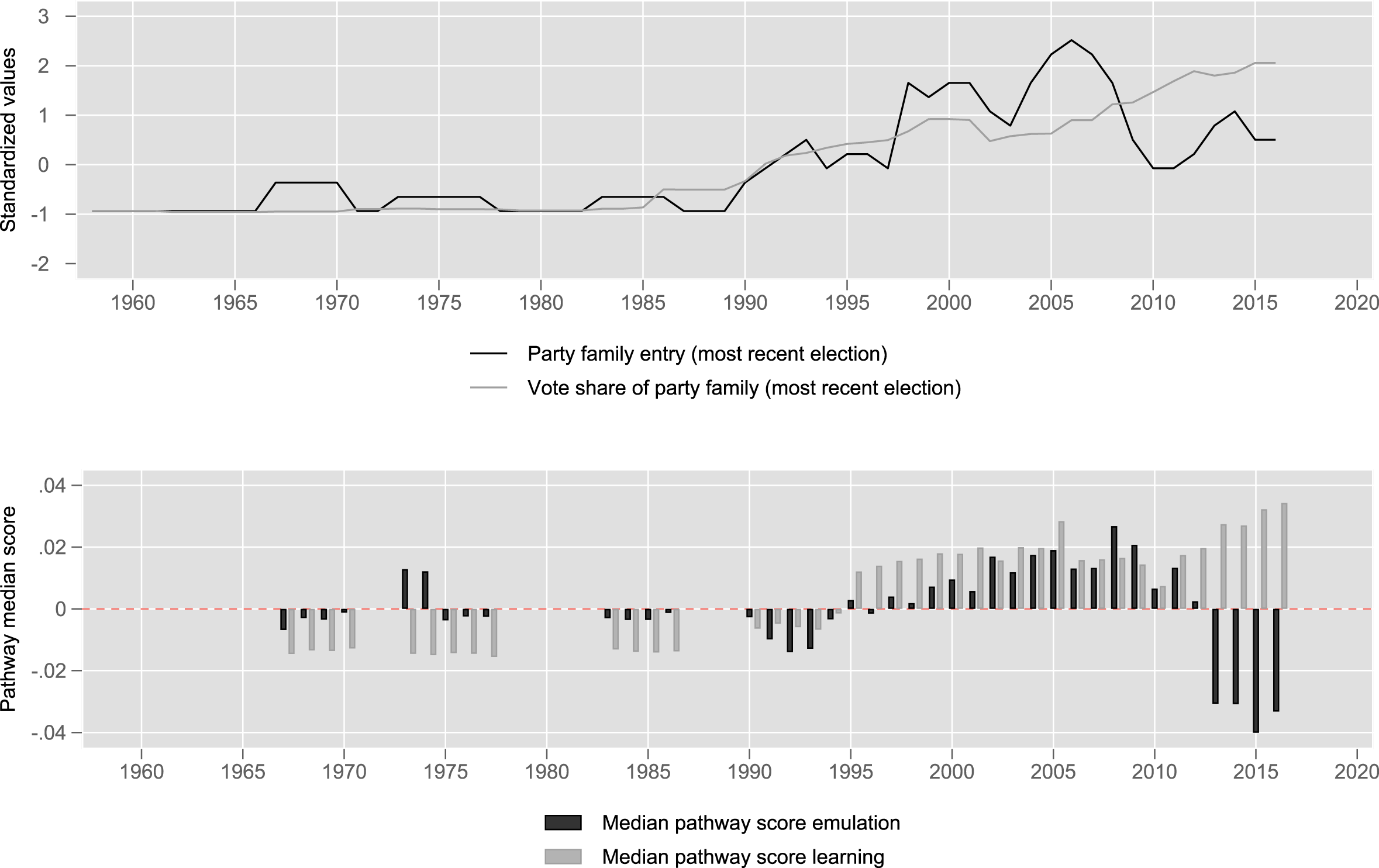
As shown, in their early days, we only find evidence that emulation mattered. The positive median emulation score in 1973 is driven by the entry of the French Front National (FN). Back then, radical right parties across Europe ran with the ‘old’ master frame containing a biologically based notion of racism. Consequently, they were stigmatized as racists and electorally marginalized. Hence, there was simply no electoral success from which FN could learn. Instead they emulated the electorally unsuccessful old master frame from the Italian MSI (part of the extreme right and thus its broader ideological bloc), even copying its logo (Igounet & Picco, 2016).
The turning point was the FN’s electoral breakthrough in the 1984 elections where it had revamped itself with a new master frame, combining ethno-nationalist xenophobia with anti-establishment populism. By focusing on cultural protectionism instead of biological racism, this new frame was able to attract new voter groups and it resonated all over Europe (Rydgren, 2005). It was almost literally re-used by the Dansk Folkeparti (DF) (Rydgren 2005) that first contested elections in 1998 and produces the Danish maximum pathway score on learning of .019.
Yet, as said, the highest median pathway scores on learning are observed between 2013 and 2016: A period coinciding with the entry of Alternative für Deutschland, Fratelli d’Italia (FdI) and Spain’s Vox. Their entry comes after a peak in the party family’s electoral success, but a drop in its entry rates. It appears like these parties learned from the success of the new master frame. For instance, Vox has been described as ideologically similar to the FN from the 1980s (Fernández Vázquez, 2019). Moreover, the aforementioned parties resort to cultural protectionism instead of biological racism and deny links with the extreme right (e.g. Giuffrida, 2022). The centrality of the FN’s master frame until today illustrates that political groups better learn from foreign parties that have been present for a while.
Regarding international cooperation, RRP parties are still not fully united and are either in Identity and Democracy or European Conservatives and Reformists Party (ECR). Still, Europarties have been an important international resource for new parties during the era of high median pathway scores in the 2010s. Specifically with regard to Vox, just before its electoral breakthrough, its party leader was invited by a Polish MEP of PiS and the ECR to deliver a speech in the EP that attracted a lot of media attention (Bonini, 2022). Also less institutionalized contacts between parties like Lega Nord (LN), Vox, FdI, FN Fidesz and Donald Trump took place. In its early days, Vox was close to the Italian LN (El Confidencial, 2022). And until today it holds a warm relationship with FdI (Bonini, 2022). Georgia Meloni, party leader of FdI already had close contacts in Spain during her days in the youth organization of MSI. Her frequent visits to Spain intensified with the rise of Vox. In 2019 she gave a speech on a Vox party convention, delivering her famous ‘I am Giorgia’ slogan in Spanish. More recently, she travelled to Marbella to endorse a Vox candidate in the Andalusian elections. Meloni herself could already count on the support of FN in FdI’s early days. In 2015, in an Italian television show, LePen expressed that while she had not yet danced with Meloni (jokingly referring to her dancing in a club with LN party leader Salvini after a FN congress), she highly admired the FdI’s achievements. In turn, Meloni expressed her support for LePen during several French elections. And both parties continue to run with the same tricolour flame from the former MSI in their logo (ibid.). Consistent with our arguments, a pivotal role is played by established parties, FN and LN. Yet, the collaboration between FdI and Vox shows that also new parties are able to support each other.
In all, our pathway case discussion echoes Rydgren’s (2005, 415) claim that the fact that RRP parties look very much alike has less to do with similar circumstances in national party systems than with ideas and practices diffusing from successful parties to embryonic ones abroad.
Discussion and Conclusion
Our study based on 17 Western European countries and a timespan of nearly five decades confirms that party entry increases in response to the entry (H1) and electoral success (H6) of party family members abroad. Based on the effects in the m-STAR models, we further concluded that, in case of emulation, new parties are only emboldened by new foreign family members. As for learning, new parties only respond to the electoral success of family members that are not new anymore (i.e. that entered at an earlier time period than specified by the spatial lag). Last, electoral success no longer induced new party entry if the party family enjoys very high levels of electoral success (H6).
We made sense of this pattern arguing that like parties (Emanuele & Sikk, 2021; Mustillo, 2009), party families also have their own development trajectories. Political groups that primarily want to advocate an ideology for expressive reasons (policy-purity) are likely to join the cause in the early insurgent phase of a party family. Hence, they will only respond to the entry of family members abroad. Vote-seeking political groups, in turn, are motivated by success. They may be more inspired by the consolidated electoral success of non-new family members abroad as this signals that an ideology can also be electorally viable in the long-run. Also consistent with a life-cycle explanation, we observe a tipping point: once a party family has materialized and becomes electorally dominant everywhere, even higher levels of success will not attract new parties anymore. Further, we have argued that parties that are already present for a while are better able to give support to embryonic political groups abroad than new parties. This can serve as an alternative explanation for why party family entry only coincides with the electoral success of non-new parties abroad.
Our article brings four key contributions. First, the literature on party entry has typically considered within-country developments (Bolleyer & Bytzek, 2013; Cox, 1997; Farrer, 2017; Hug, 2001; Lago & Martínez, 2011; Lowery et al., 2013; Tavits, 2006; van de Wardt & Otjes, 2021), masking the extent to which new party elites look across borders. While qualitative studies on the history of party families have pointed in this direction (e.g. Delwit, 2005; Rydgren, 2005), we are the first to provide systematic, quantitative evidence for this practice. Our robust evidence for international contagion also feeds into a broader reflection on how representative politics works. New parties have been conceived as vessels that feed new ideas into the political system and that address changing citizen demands within a country (Hooghe & Marks, 2018). We show that this process is permeable to social and political developments in other countries. Hence, we would applaud further work on diffusion and its interplay with domestic context.
Second, we cast a new light on the international diffusion of political platforms. The only quantitative study thus far analyses whether parties adjust their platform in response to foreign government parties in their party family or to any foreign party in government (Böhmelt et al., 2016). They find evidence for the latter and conclude that it is ‘primarily success of policies that matters’ (Böhmelt et al., 2016, p. 407). As such, parties of the same party family do not influence each other, and authors conclude that party family is irrelevant as a contextual layer. We, however, identify a new mechanism of how political platforms diffuse internationally. We demonstrate that political groups do launch likeminded parties in response to the entry of their party family abroad. So, party family is an important lens after all through which to understand ideological renewal in party systems.
Thirdly, we contribute to the literature on party families (Mair & Mudde, 1998). We have tested the emulation mechanism within different classifications of party families: from core families that consist of parties that share a common belief system to larger blocs that are more ideologically dissimilar. We demonstrate that new parties only respond to the entry of foreign parties if they are ideologically similar. Hence, we invite scholars to study diffusion with fine-grained classification schemes like ours.
Finally, we also advance policy diffusion theory (Graham et al., 2013; Shipan & Volden, 2008). Gilardi and Wasserfallen (2019) recently identified the political dimension of policy diffusion as a blind spot in that literature. First, diffusion is mostly studied in a technocratic way where policy-makers adopt policies from elsewhere based on the objective, favourable effects they have had. Yet, policy-makers may also process information through ideological lenses, meaning that the emulation mechanism needs a more prominent place. Second, the diffusion literature almost exclusively concentrates on policy adoption rather than the initial, and arguably more important, stage of problem definition (Gilardi & Wasserfallen, 2019). We contribute to this by contrasting the impact of entry of foreign parties and electoral success of foreign parties. Thereby, we carefully isolated the emulation mechanism and confirmed its relevance. Second, we zoomed in on the process of normative pre-filtering by showing that political groups only emulate from foreign parties that resemble them ideologically (Figure 3). Moreover, we prove the relevance of diffusion at the very beginning of the policy cycle. New problem definitions travel with new parties and may change the terms of the political debate and therewith the adoption of new government policies.
Our findings also pose further questions. First, notwithstanding that we made an effort to further clarify the diffusion mechanisms (emulation and learning), our aggregate observations of new party counts are not ideal for uncovering causal mechanisms. Hence, qualitative and experimental research is needed to further disentangle them. Second, in future research we will address how contextual country factors condition diffusion effects. Third, while we developed different spatial variables to accommodate for the fact that we pool many party families that are in different development stages, we would welcome further research on the developmental lifecycle trajectories of specific party families. While several innovative studies have modelled the different trajectories for new parties (e.g. explosive, flop and meteoric) (Emanuele & Sikk, 2020; Mustillo, 2009), this can also be done at the party family-level.
We hope that this paper will serve as a source of inspiration to bring international diffusion more to the forefront in understanding party system change.
Supplemental Material
Supplemental Material - Contagion From Abroad. How Party Entry in Western Europe is Influenced by Party Family Members Abroad, 1961–2016
Supplemental Material for Contagion From Abroad. How Party Entry in Western Europe is Influenced by Party Family Members Abroad, 1961-2016 by Marc van de Wardt, Jean-Benoit Pilet, Gijs Schumacher, and Arjen van Witteloostuijn in Comparative Political Studies
Footnotes
Acknowledgments
Earlier versions of this paper have been presented at the 2017 European Political Consortium (ECPR) general conference, at the 2018 State of the Federation conference in Belgium and at a workshop at the University of Amsterdam. The authors would like to thank the discussants and participants at these events as well as Paul Allison, Tobias Böhmelt, Paul Elhorst, Laurenz Ennser-Jedenastik, Robert Franzese, the four anonymous reviewers and the editors for their useful suggestions. Moreover, they thank Sigrid van Trappen for her excellent research assistance. Marc van de Wardt acknowledges the financial support for this project from two completed research grants from the Research Foundation Flanders ‘FWO’ (grant no. FWO16/PDO/198) and the Fund for Scientific Research (F.R.S.-FNRS) (grant no. 28091302). He is also grateful to the research groups GASPAR (Ghent University) and Cevipol (Université Libre de Bruxelles) for hosting him during these postdoctoral fellowships.
Declaration of Conflicting Interests
The author(s) declared no potential conflicts of interest with respect to the research, authorship, and/or publication of this article.
Funding
The author(s) disclosed receipt of the following financial support for the research, authorship, and/or publication of this article: This work was supported by the Research Foundation Flanders ‘FWO’ (grant no. FWO16/PDO/198) and the Fund for Scientific Research (F.R.S.-FNRS) (grant no. 28091302).

Data Availability Statement
The data given this article are the data and code to replicate all analyses is available in the Dataverse: https://doi.org/10.7910/DVN/JZQLMF (van de Wardt et al., 2023b).
Supplemental Material
Supplemental material for this article is available online.
Notes
Author Biographies
References
Supplementary Material
Please find the following supplemental material available below.
For Open Access articles published under a Creative Commons License, all supplemental material carries the same license as the article it is associated with.
For non-Open Access articles published, all supplemental material carries a non-exclusive license, and permission requests for re-use of supplemental material or any part of supplemental material shall be sent directly to the copyright owner as specified in the copyright notice associated with the article.
