




Abstract
Even if political parties have new labels, they often can be perceived as a continuation of an earlier existing grouping. The main goal of this article is to discuss how to assess party novelty and congruence (similarity with a previously existing party) and, in particular, to present the framework for analysis of party continuity and newness. Some Polish political parties (Law and Justice [PiS], Civic Platform [PO], Confederation Liberty and Independence [K WiN]) are used to illustrate the approach. We aim to answer the question of whether they were genuinely new when they entered the parliament for the first time or whether they could be considered as a continuation of previously existing groupings in terms of ideological identity, candidates, leadership, and their political elites. The research also encompasses analyses of further party development in these areas to demonstrate that our framework can also be used to measure changes occurring within existing parties. We go beyond researching newness as a dichotomous variable, outline the areas in which party newness can be measured, define indicators of novelty and congruence, and operationalize them given the conditions in Central and East European countries. Then we measure the level of party newness in each of these areas, using ranges from being a genuinely new party to a perfect congruence with an earlier existing grouping.
Introduction
The Polish political scene has undergone many changes since the collapse of communism. Despite the fact that new parties have appeared at each election, it can be argued that there is a kind of stability within certain political options. 1 Parties have been rarely created from scratch, mostly being “rooted newcomers.” 2 In Poland, the entire party system changed in the early 2000s as first-generation parties (that emerged at the beginning of democratic transition) were replaced by second-generation ones (created in the post-transition era), among them Law and Justice (PiS) and Civic Platform (PO), still constituting the core of the party system together with some newcomers (third generation). 3 However, even if parties have had new labels, in some way they can be perceived as a continuation of earlier existing groupings. This article’s goal is to point out that party newness is a multidimensional issue and to introduce a measure of continuity and changes in parties. We use it to examine three existing parties and their predecessors (indicated on the basis of literature) to determine how much and when they changed. Using this measure, we can also determine to what extent the analysed parties broke continuity with their predecessors, and—if there are several potential predecessors (the case of PO)—with which there is greater continuity.
We answer the question as to whether the analysed parties were created as genuinely new or could be considered a continuation of previously existing groupings in terms of their leadership, political elite, candidates, and ideology. In our opinion, even if the party label and/or legal status have changed, and even if the party is perceived as new, it may still display a far-reaching continuation with an earlier existing entity in various areas. However, we do not limit our analysis to the time of parties’ founding but track their development up to the last elections in 2019 and after in order to follow ongoing changes in all the areas outlined.
The subjects of our research are three Polish parties: the currently (2022) ruling PiS and the biggest opposition party PO, both created in 2001 with roots dating back to the early 1990s, and the far-right Confederation established before the 2019 parliamentary elections. The latter, in particular, can be perceived as an interesting case in terms of novelty level. It was created by and around the charismatic politician Janusz Korwin-Mikke (JKM) who had earlier founded and abandoned a few parties. Each time, regardless of the party label, he was the main focus of electoral appeal.
The level of party novelty and continuity is crucial for two reasons. First, it is useful to predict party durability as rooted newcomers usually have a better chance of long-term survival than do genuinely new parties. 4 Second, it is essential for measuring the electoral volatility that results from new party entries and old party exits (replacement) in order to distinguish this from the overall level of volatility. 5 Hence, it sheds new light on the assessment of the stability of the party system.
For quite a long time, the Polish party system was described as very unstable, showing traces of stability only after the emergence of the new parties in 2001. 6 Using the Polish case, we wonder whether the continuity can be greater than we had supposed as parties sometimes claim to be new, whereas in fact they just undergo a kind of rebranding. The question as to why parties want to be seen as new is beyond the scope of our research; we merely focus on the multi-levelness of party newness and its measurement, as we perceive it as significant for the stability of the party system.
We begin by reviewing the definitions related to party newness as a dichotomous or non-dichotomous variable and outlining our framework for analysis. Based on the conceptual discussion, we define several dimensions of party novelty (party name, legal status, party leader, elite, candidates and programmatic stances) and formulate their operational definitions. We analyse parties using a scale ranging from 0 (new party) to 1 (continuation of an old party) for each of the above-mentioned dimensions and finally assess the overall level of newness and congruence. The most important result of our research is that we have shown that party novelty/congruence is multidimensional and can vary across dimensions—a party may be new in some areas (e.g., party elites and candidates), but at the same time can serve as the continuation of an old party in other fields (e.g., leader and programme). When a party has several recognized predecessors, it can resemble one of them in terms of leadership and another in terms of programme, and so on.
Party continuity is inevitably a question of degree. Nevertheless, for some applications it might be necessary to distinguish new parties categorically. In such cases, the question of determining a cut-off point arises. As it is possible that some spurious continuity might appear at random (for instance, due to programme similarity), we treat this as a statistical problem: we consider a party to be new if the value of the aggregate continuity index is small enough that we can rule out the null hypothesis that it arises at random with 95 per cent confidence—that is, below the 0.05th quantile of the cumulative distribution of the sum of our component indices.
Using some examples from Poland, we point out that newly created parties may display only a modicum of novelty. The research is based on primary sources selected for this particular criterion. For the party name, legal status, leader, and elite, we used party statutes and other data from the Registry of Political Parties held by the District Court in Warsaw. For candidates and also for the elite, we used candidates’ lists and additional data from the National Electoral Commission. For ideology, we used programmatic platforms and data from the Manifesto Project Database (MARPOR). 7 The existing subject literature, including academic studies, biographies, and party activists’ memoirs, was also of significant importance for our research.
What Are New Parties and How to Research Them—The Framework for Analysis
To answer whether a party is new or not, it is necessary to define what novelty means in the case of a political party, which is complicated. 8 Looking for a proper definition in the subject literature, we can find that these are parties competing in an election for the first time, 9 parties competing on novel issues, 10 or parties with a new origin. 11 Even if we consider only the last category, we still face the question of whether it means only parties created from scratch or also those that emerge as a result of party transformations, splits, and mergers. The subject literature is helpful here, though the answers it delivers are various. According to one of the oldest and broadest definitions by Harmel and Robertson, 12 all of them (genuinely new, or resulting from splits, mergers, and transformations) can be perceived as new. Birch includes only those mergers or splits that have names that differ from those of their predecessors. 13 According to Bolleyer 14 and Mainwaring et al., 15 in the case of splits only the largest party should be considered as a successor and the others categorized as new entities; similarly, in the case of mergers, a newly created party should be considered as a continuation of the biggest predecessor. The definitions by some other scholars are even narrower; they accept as new parties those resulting from a split but exclude mergers 16 or tend to exclude both. 17 The explanation by Sikk 18 is the narrowest; according to him, a party is new if there is no continuity in terms of political leadership and personnel. Depending on whose definition we adopt, the number of new parties may appear different. Taking the definition from Harmel and Robertson, we find a lot of new parties in CEE countries after the collapse of communism; however, the number decreases drastically when we employ Sikk’s definition.
What the definitions have in common is that they all tend to classify parties as new or old. However, the picture is not always dichotomous, as some parties can be new in some areas or to some extent. For this reason, other scholars propose a more sophisticated non-dichotomous explanation. The Barnea and Rahat 19 concept goes beyond researching “newness” as a dichotomous variable. Based on the idea of the “three faces” of a political party—party-in-the-electorate, party-as-organization, and party-in-government 20 —they have outlined the areas in which party newness can be measured and have defined the relevant criteria. Novelty is researched in a few fields, though it is still regarded as a dichotomous variable in each of them. Litton 21 goes a step further assessing in her “thick” two-dimensional conceptualization of the degree of party novelty. The Sikk and Köker 22 concept goes beyond qualitative research proposing an interval scale of party novelty, which enables the measurement of the level of party newness in various areas; however, they take into consideration only three dimensions: party structure, leader, and candidates.
Our framework draws from these ideas; however, we define our own indicators of novelty and operationalize them considering the conditions in CEE. The novelty of a political party is analysed by its attributes: party name, legal status, party leader, elite, candidates and ideology. We study only those variables that can be controlled by a party; for this reason, we exclude electoral volatility as the voters’ behaviour is not controllable. Organizational structures of parties are also omitted as—due to formal rules and party traditions—Polish parties tend to establish similar structures; hence, there are few meaningful differences not only between a particular party and its predecessor but also among all parties. 23
In our concept, the party can be new (or not) in each of the analysed areas. Unlike Sikk and Köker, we examine a party’s novelty and similarity to the groups believed to be its predecessors and not to all existing parties. The scale used for the measurement of party newness (difference compared to the party considered as its predecessor) and continuity (similarity with this party) ranges from 0 (perfect novelty) to 1 (perfect continuity). These values can be treated as two extremes between which intermediary categories are located. The only indicator that must be regarded as dichotomous is legal status—a party is registered as new (range 0) or not (range 1); for all other variables, intermediate types are possible (Table 1).
Measurement of Party “Newness”: Framework for Analysis
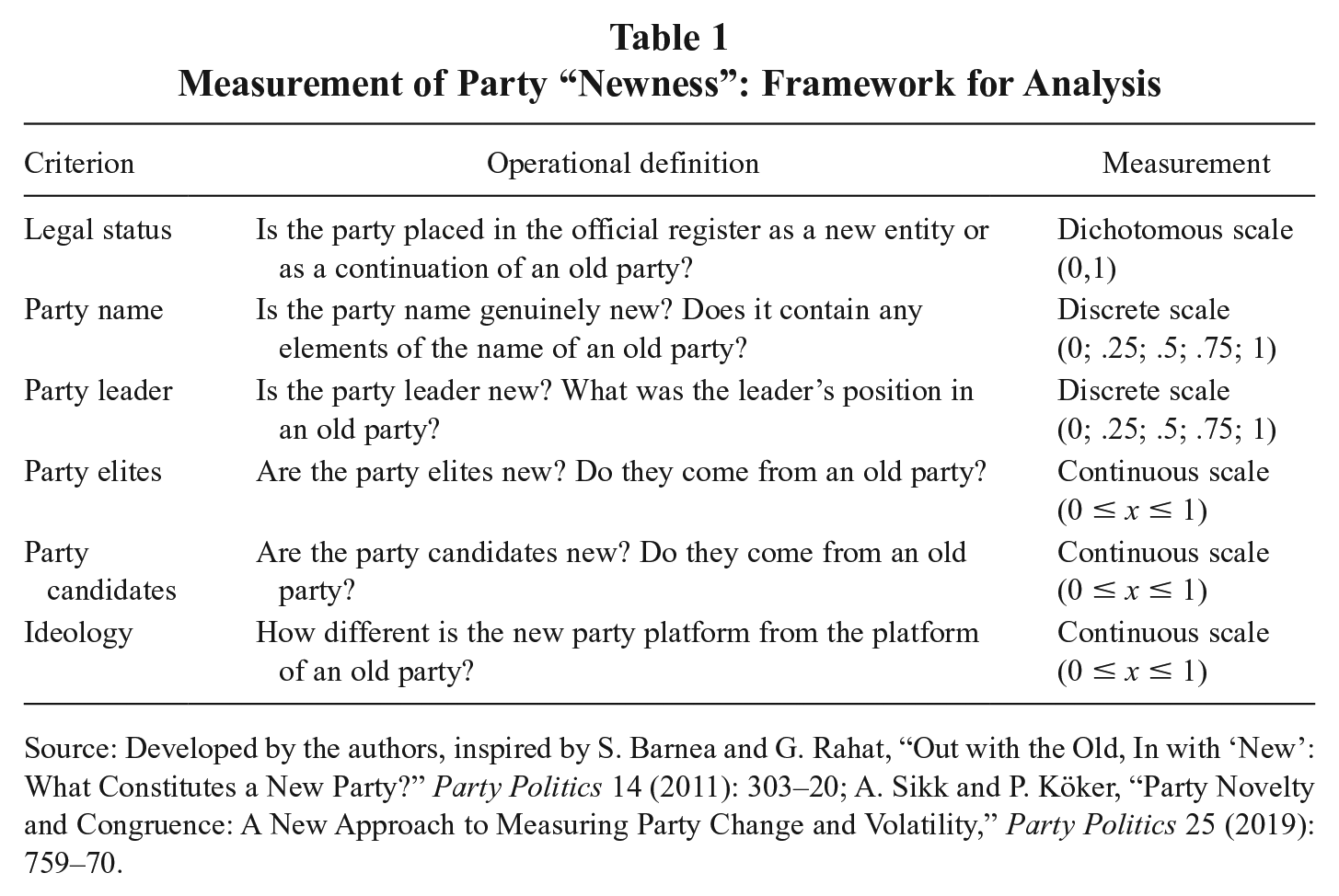
Source: Developed by the authors, inspired by S. Barnea and G. Rahat, “Out with the Old, In with ‘New’: What Constitutes a New Party?” Party Politics 14 (2011): 303–20; A. Sikk and P. Köker, “Party Novelty and Congruence: A New Approach to Measuring Party Change and Volatility,” Party Politics 25 (2019): 759–70.
We use mixed methods to measure the level of party newness as accurately as possible. Wherever it is achievable, we choose quantitative analyses and a continuous scale; however, the nature of some variables (criterion of newness) and available data mean that this is not always possible; then we use qualitative methods and a discrete scale. 24 The latter is inspired by the 5-point interval scale by Sikk and Köker, 25 to which—depending on intensity—various scores were attributed. A party can be completely new (range 0), new with continuation from an earlier existing party slightly visible (.25), partly new and partly continuing a previous entity (.5), continuation with a touch of novelty (.75), and perfectly congruent with an old party (1). This discrete scale is used to assess the novelty level of the party name and party leader (Table 2). The other party attributes (party elite, party candidates, and ideology) are measured on a continuous scale ranging from 0 to 1.
Measurement of Party “Newness”: Party Name, Party Leader, and Their Operationalization
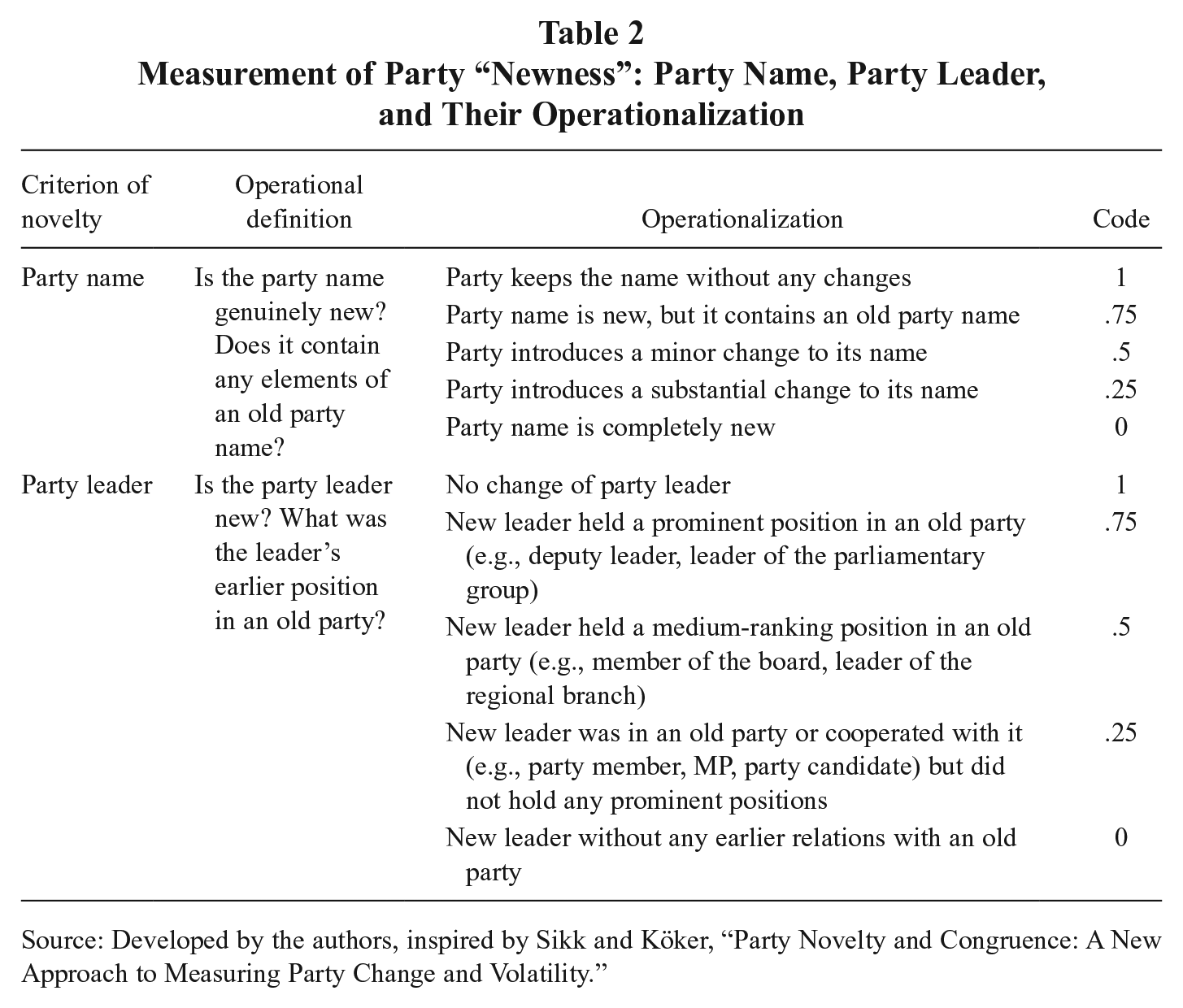
Source: Developed by the authors, inspired by Sikk and Köker, “Party Novelty and Congruence: A New Approach to Measuring Party Change and Volatility.”
Our unit of analysis is a party-as-of-general-election-date: for each of the parties under analysis, and for each general election between 1993 and 2019 (inclusive), we compare the party in question as it existed as of the date of the given general election with its version (or the versions of its presumed predecessors, if any) as of the prior general elections starting with 1991. The 1991 election is treated as the founding one, 26 understood here as the first pluralist election in a post-authoritarian context. The analytical framework presented can be used to measure not only the level of party novelty and continuity compared to its predecessor, but also the level of change in the existing party.
As mentioned above, our framework encompasses the following party attributes: party name, legal status, leader, elites, candidates, and ideology. Their operational definitions and assigned codes are presented in Tables 1 and 2. However, there are some particular remarks to be added. First, we track all the name changes but assign codes only to the names used by parties at the time of a parliamentary election. The issue is complicated as parties in CEE countries often compete as a part of broader coalitions that have their own names. Each time, we assign points to the name of a party, not a coalition. The question of change in a party’s legal status is connected with the formal requirements posed by the Party Law. The first law of 1990 did not impose many requirements on parties to be recorded. 27 Under the new Party Law of 1997, the demands were much more challenging. 28 Parties were required to re-register at that point, but this was due to the new law and should not be treated as a new legal status. 29 As with party names, we track all the changes in leadership of the analysed parties and their predecessors; however, as our unit of analysis is the parliamentary term of office, ultimately we take into consideration only the leadership at the time of parliamentary election.
The other indicators of party novelty, namely the party elite, candidates, and ideology, are measured on a continuous scale ranging from 0 (a completely new party) to 1 (perfect continuation). We measure elite continuity in two steps. First, we identify the members of the party elite in each party of interest as of the date of each general election. We begin by ascertaining the members of the party’s highest collegial executive body (usually referred to as party boards) through analysis of the records of the official Registry of Political Parties, as well as of other available sources (such as media reports). Since for some parties (especially small and weakly institutionalized ones) such a body is very small or its membership is difficult to ascertain with reliability, if the number of members ascertained is below 9, we expand our elite set by adding party founders, leading MPs, and other politicians who are considered members of the party elite in the literature. Second, we define the elite continuity index for a pair of parties
The next indicator measured in a continuous way stands for party candidates. Code 0 (a completely new party) was ascribed to a party if none of its candidates had contested the previous election with a party considered as its predecessor. If all candidates contested the previous election with the same party, Code 1 (perfect continuity) was assigned. Most parties can be placed between these extreme values; hence, we employ the candidate continuity index, defined as the share of candidates who have previously run for an old party. In assessing this, one must answer the question whether all candidates are of the same importance for the party. Some earlier studies on candidate turnover have been inclined to analyse full candidate lists, 30 whereas others have focused only on the top of a list (a threshold of 25% or 10%), arguing that stability tends to be substantially higher among the top candidates while those placed at the end of lists have no electoral prospects. 31 Bearing in mind these arguments, we have decided to analyse full lists, but at the same time to weigh candidates as described in detail in the appendix. 32
The last indicator is party ideology understood as the set of values, views, and principles that a party believes in. Following Barnea and Rahat 33 as well as Beyens et al., 34 we decided to analyse ideology on the basis of party electoral platforms. 35 Our aim is to outline how different a new party platform is from the old one. We measure ideology continuity through the cosine similarity measure of the programme topic distributions, that is, the ratio of the dot product and a product of norms of the probability vectors:
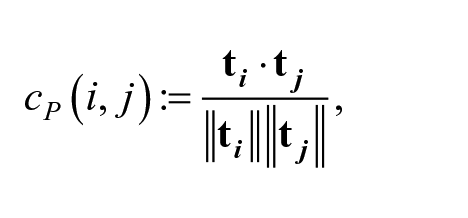
where
Law and Justice
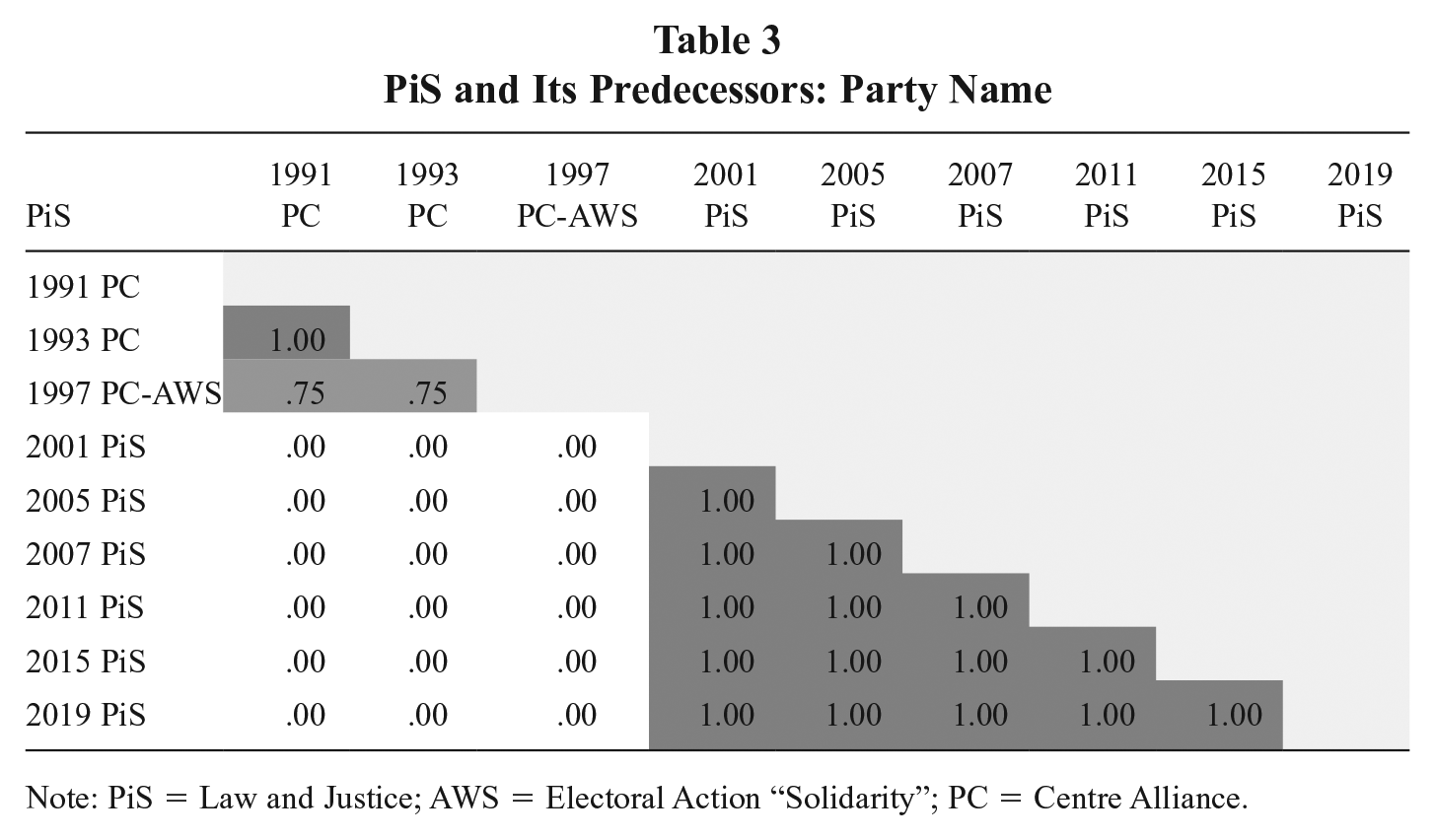
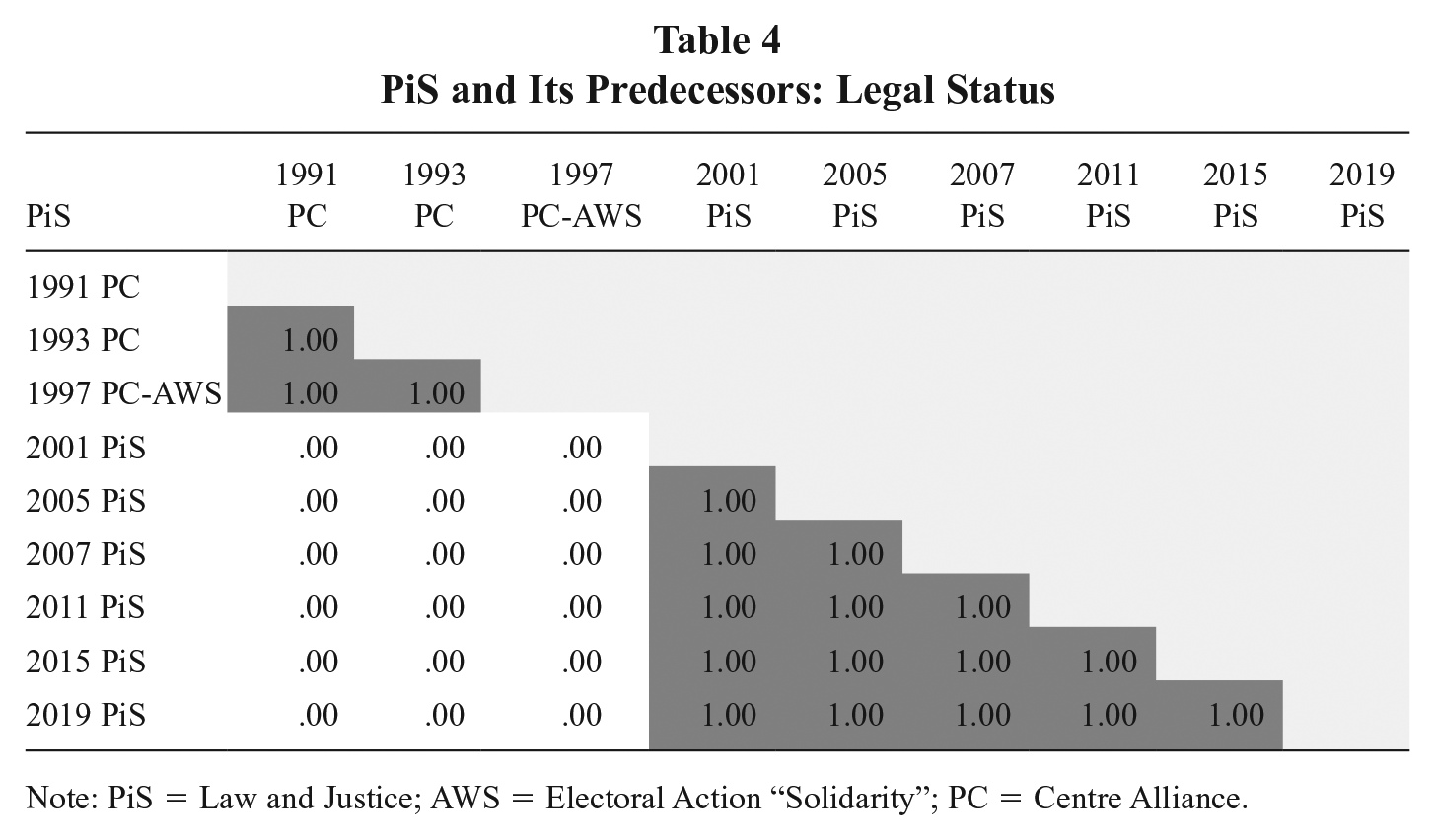
PiS was created in 2001; however, some parties—already existing in the early 1990s—can be perceived as its predecessors, namely the Centre Alliance (PC) in 1990–1997, the Centre Alliance–Electoral Action “Solidarity” (PC-AWS) in 1997–1999, and the PC again in 1999–2001 (Figure 1). All these entities were listed in the official Registry of Political Parties, and we study them consecutively in terms of their novelty and continuity. PC was one of the first political parties formed in Poland after the transition in 1989; it was initiated in May 1990 by Jarosław Kaczyński. PC never contested elections under its own name; it was always a part of a broader coalition. In 1991 it served as the main component of the Centre Citizens’ Alliance (POC), in 1993 as part of the Centre Alliance–Polish Union (PC-ZP), and in 1997 as a member of a coalition called the Electoral Action “Solidarity” (AWS). 38 At this time, PC changed its name to PC-AWS. In 1999, due to a party split, some activists of the new party returned to the original name, the PC, and as such it existed until its dissolution in 2001 when PiS was created. PiS successfully took part in all subsequent parliamentary elections and served as the ruling party in 2005–2007 and again since 2015. All these changes can be traced in Tables 3 and 4. There is continuity of name and legal status between PC and PC-AWS and then no continuity between PC and PC-AWS on the one side, and PiS on the other side; hence, taking into account name and legal status, PiS can be perceived as a new party.
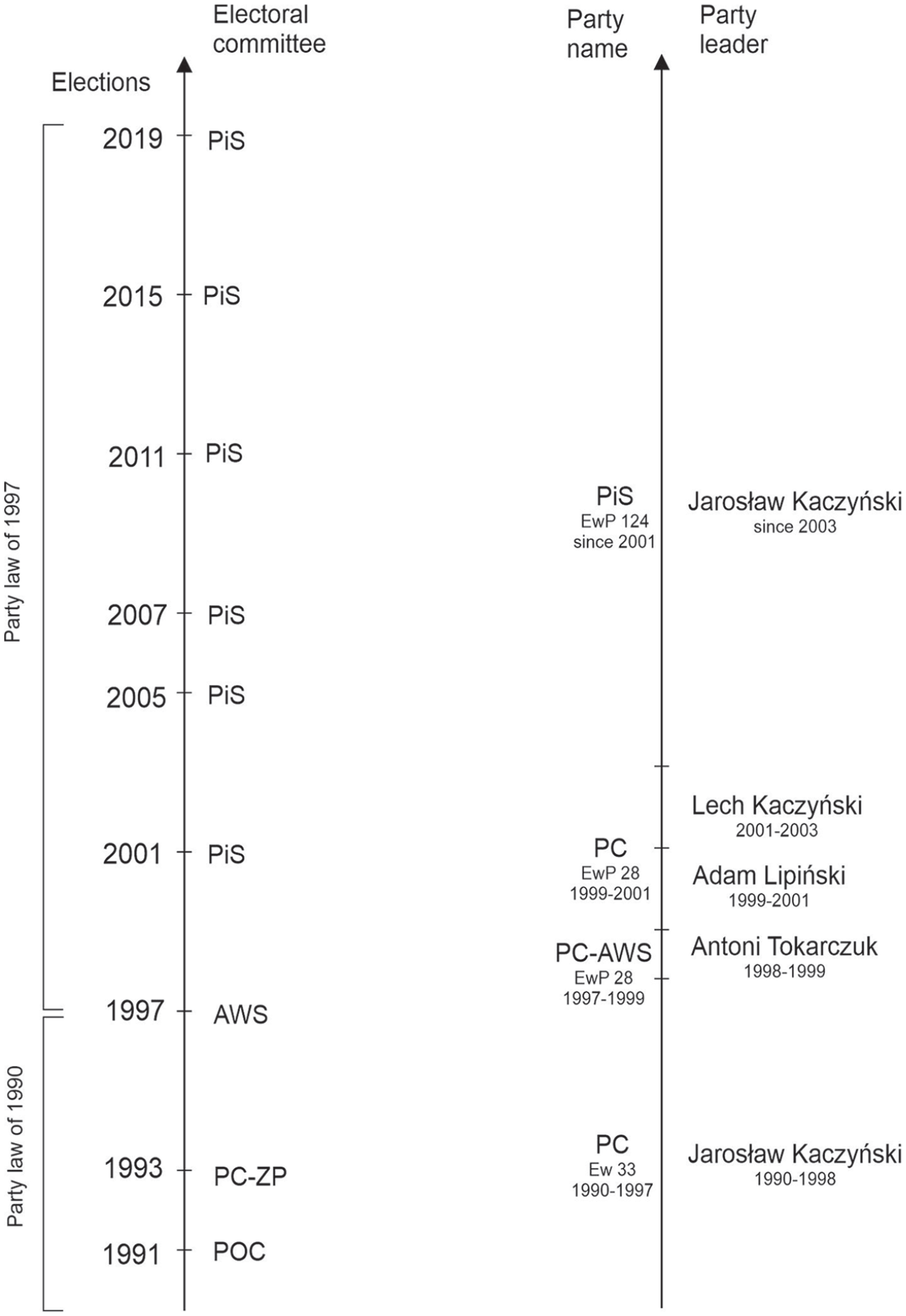
PiS and its predecessors
PiS and Its Predecessors: Party Name
Note: PiS = Law and Justice; AWS = Electoral Action “Solidarity”; PC = Centre Alliance.
PiS and Its Predecessors: Legal Status
Note: PiS = Law and Justice; AWS = Electoral Action “Solidarity”; PC = Centre Alliance.
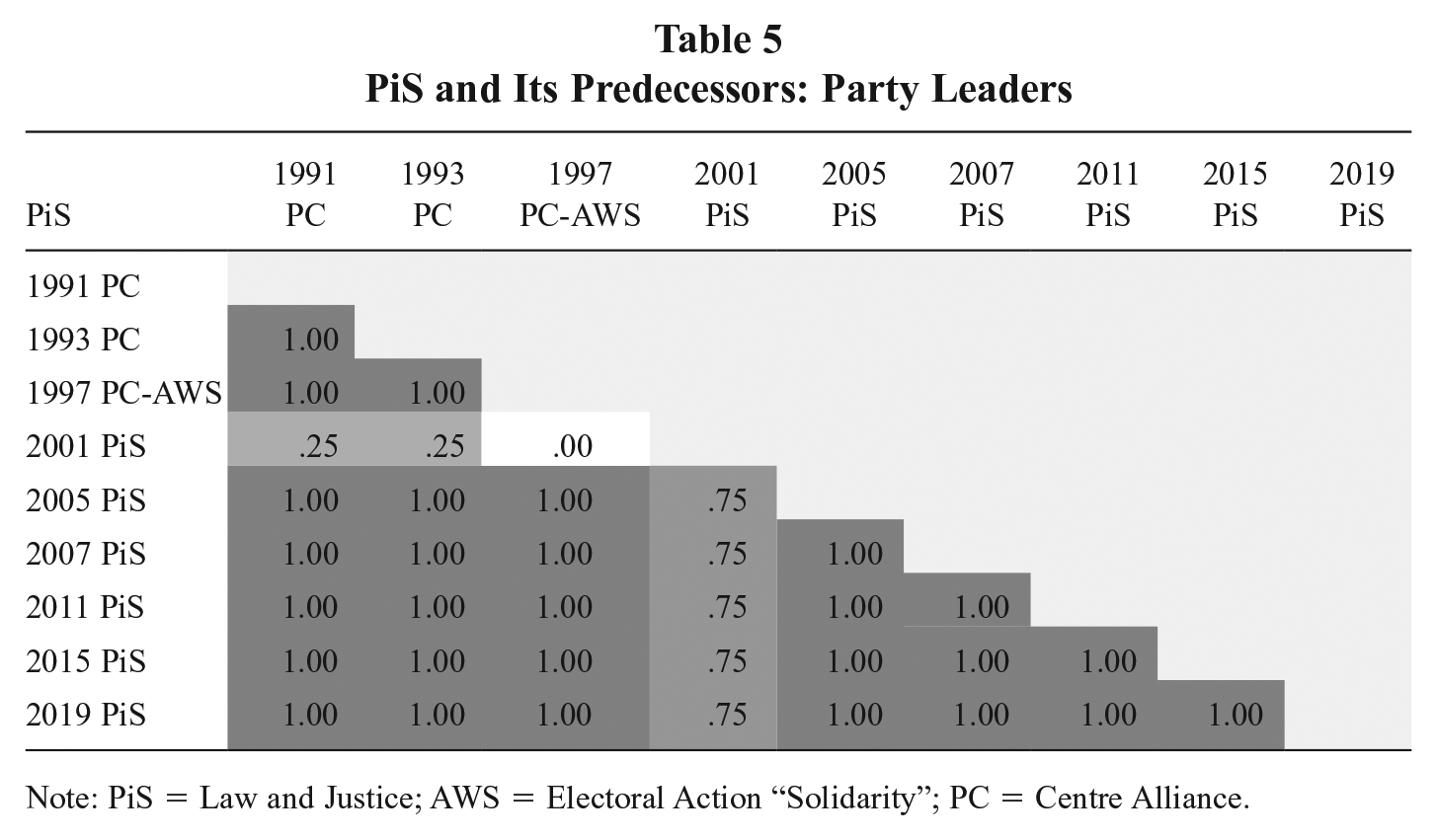
The question of PiS party leader is illustrated in Table 5. There is a strong continuation of Jarosław Kaczyński’s leadership, except for 2001. However, in fact, Kaczyński was not in the position of leadership either in PC-AWS (1998–1999) or in the restored PC (1999–2001). In 1998, due to the conflict with the leadership of the AWS, Kaczyński not only ceased to be the leader, but he even left the party, which was shortly transformed into PC-AWS. The leader of the new grouping was Antoni Tokarczuk (1998–1999). When a group of activists decided to return to the name PC, the party was led by Adam Lipiński until its dissolution in 2001. After PiS was founded in 2001, it was formally led by Lech Kaczyński, Jarosław’s twin brother, replaced by Jarosław Kaczyński in 2003 (Figure 1). In the case of Lech Kaczyński, a continuation is visible between PiS of 2001 and PC of 1991 and 1993 because he was MP for the POC in the Sejm in 1991–1993.
PiS and Its Predecessors: Party Leaders
Note: PiS = Law and Justice; AWS = Electoral Action “Solidarity”; PC = Centre Alliance.
To sum up, the period 1998–2003 was the only period when Jarosław Kaczyński was not a party leader. In Table 5, this is shown for 2001, because we only take into consideration the leadership at the time of an election.
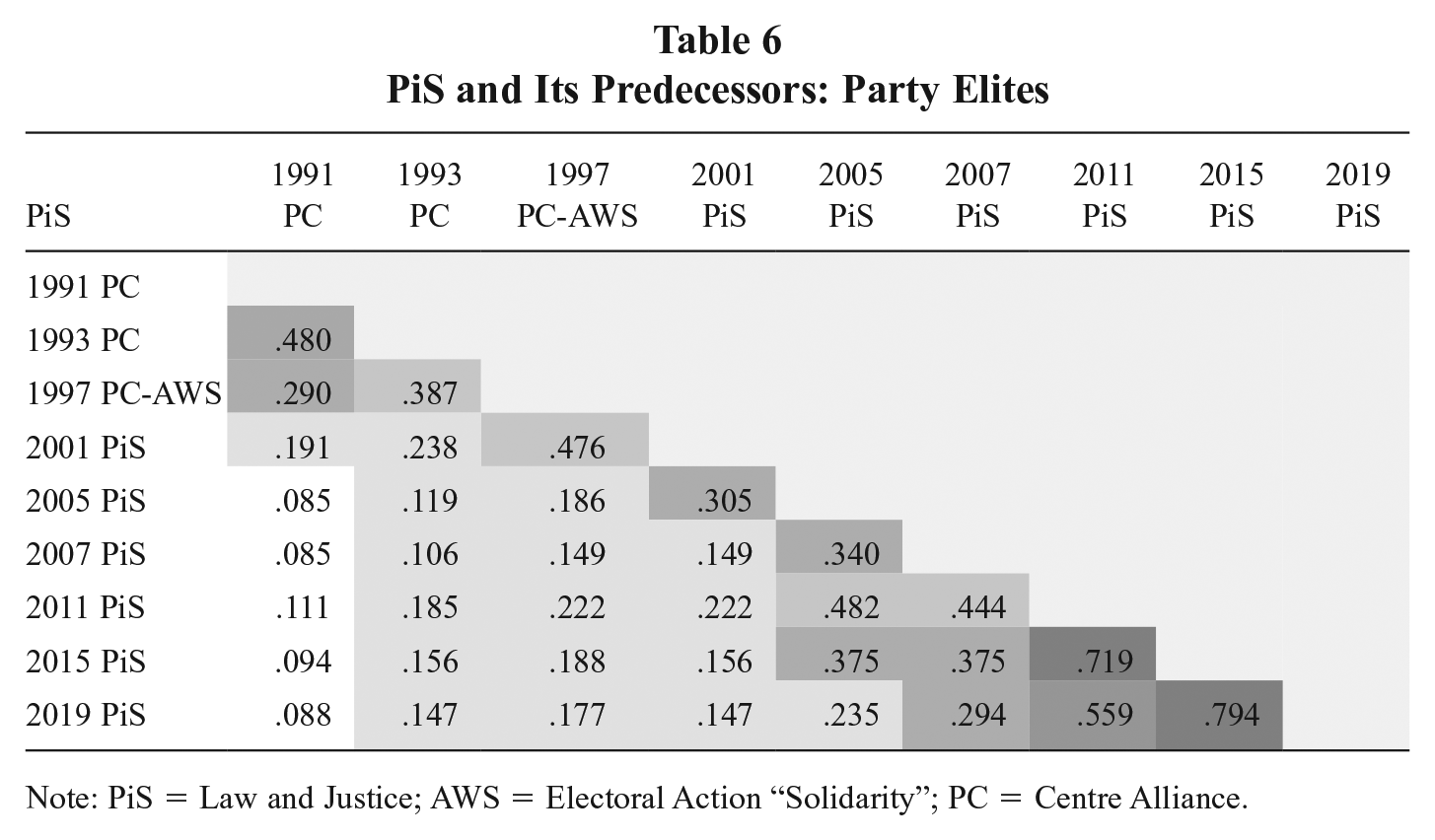
Looking for data on the party elite of PiS and its predecessors, we focused on the central executive bodies of the parties. Patterns related to their continuity and change are presented in Table 6. The general trend that can be observed is that there was initially a continuation between two consecutive elections, but not an earlier one. The PC elite of 1993 was partly the same as that of 1991, and the elite of 1997 partly overlapped with that of 1993 but to a lesser extent with that of 1991, and so on. This also applies to the issue of elite continuity between PiS and its predecessors. When PiS was created in 2001, almost half of its elite came from its immediate predecessor—the PC-AWS of 1997, and much less from PC of 1993 and 1991. The tendency of continuing elites from the previous election, but not the earlier ones, occurred also in 2005 and 2007. A change took place only in 2011; the party elite at that time was a continuation not only of that from 2007 but also of the one from 2005. The trend related to the continuation of party careers for three or even four parliamentary terms was also visible in 2015 and 2019. One may suppose that politicians are active in party politics for two consecutive terms; they decide to stay longer only when there are real prospects for public office.
PiS and Its Predecessors: Party Elites
Note: PiS = Law and Justice; AWS = Electoral Action “Solidarity”; PC = Centre Alliance.
Answering the question of how many candidates contested the previous election with a party perceived as a predecessor and then stood for the next one on behalf of the analysed party, we can observe only a low level of continuity until 2005 (Table 7). 39 The share of candidates who contested the 1993 election on the list of PC-ZP and served as candidates of POC in 1991 was less than a quarter. It was even lower in 1997 compared to both the 1991 and 1993 elections; however, it is important to remember that the party was then part of a broad electoral coalition, AWS. The number of candidates who in 2001 were placed on the list of the newly created PiS and who four years earlier had contested the election as a part of AWS exceeded a quarter. In 2005, the continuity meaningfully increased—almost half of PiS candidates had contested the election with this party four years earlier. Later on, the congruence is even more significant, with the most impressive result in 2007 when the continuation was at the level of .8. It is quite obvious that PiS placed many incumbents on its electoral lists in all subsequent elections.
PiS and Its Predecessors: Party Candidates
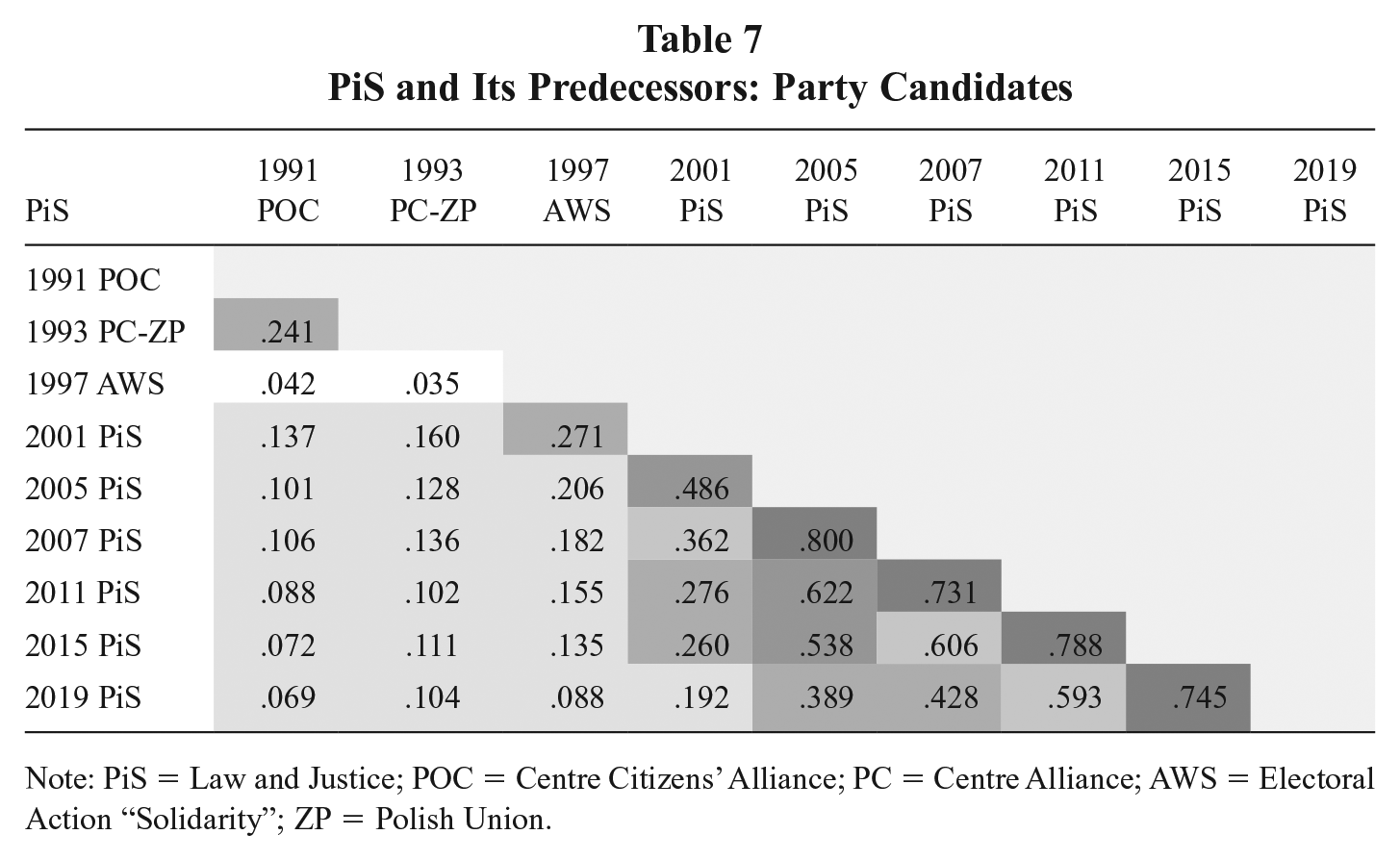
Note: PiS = Law and Justice; POC = Centre Citizens’ Alliance; PC = Centre Alliance; AWS = Electoral Action “Solidarity”; ZP = Polish Union.
The continuation of party ideology in the case of PiS and its predecessors is illustrated in Table 8. Looking at the consecutive elections, there is a quite strong continuation visible between each party active in a given election and its predecessor, except for the 2001 and 2007 elections when values are slightly lower. In 2001, the immediate predecessor of PiS was the AWS, which had its own programme, while PC was part of this coalition. In this context, it is worth mentioning that there is no clear pattern of smaller values of continuation between PiS and AWS—while it was lower in 2001 and 2007, it increased in 2005 and again in 2011. Those differences, which can be traced not only between PiS and AWS but also between various PiS programmes for different elections (e.g., PiS 2007 and 2005), turn our attention to the specificities of electoral programmes, which were our unit of analysis. Such documents usually address the problems and questions important during the election period; therefore, they may be quite different from election to election even in case of the same party. However, there is a persistent continuation between PiS starting in 2001 until 2015 and PC-ZP in 1993. Overall, the values of programmatic continuation between PiS and its predecessors are quite high, with differences due to the specific character of electoral programmes. The trend of lower values can be observed only for the latest PiS programme in 2019 and almost all its predecessors, except the PiS programme of 2015, when we deal with continuity at the level of .8.
PiS and Its Predecessors: Party Ideology
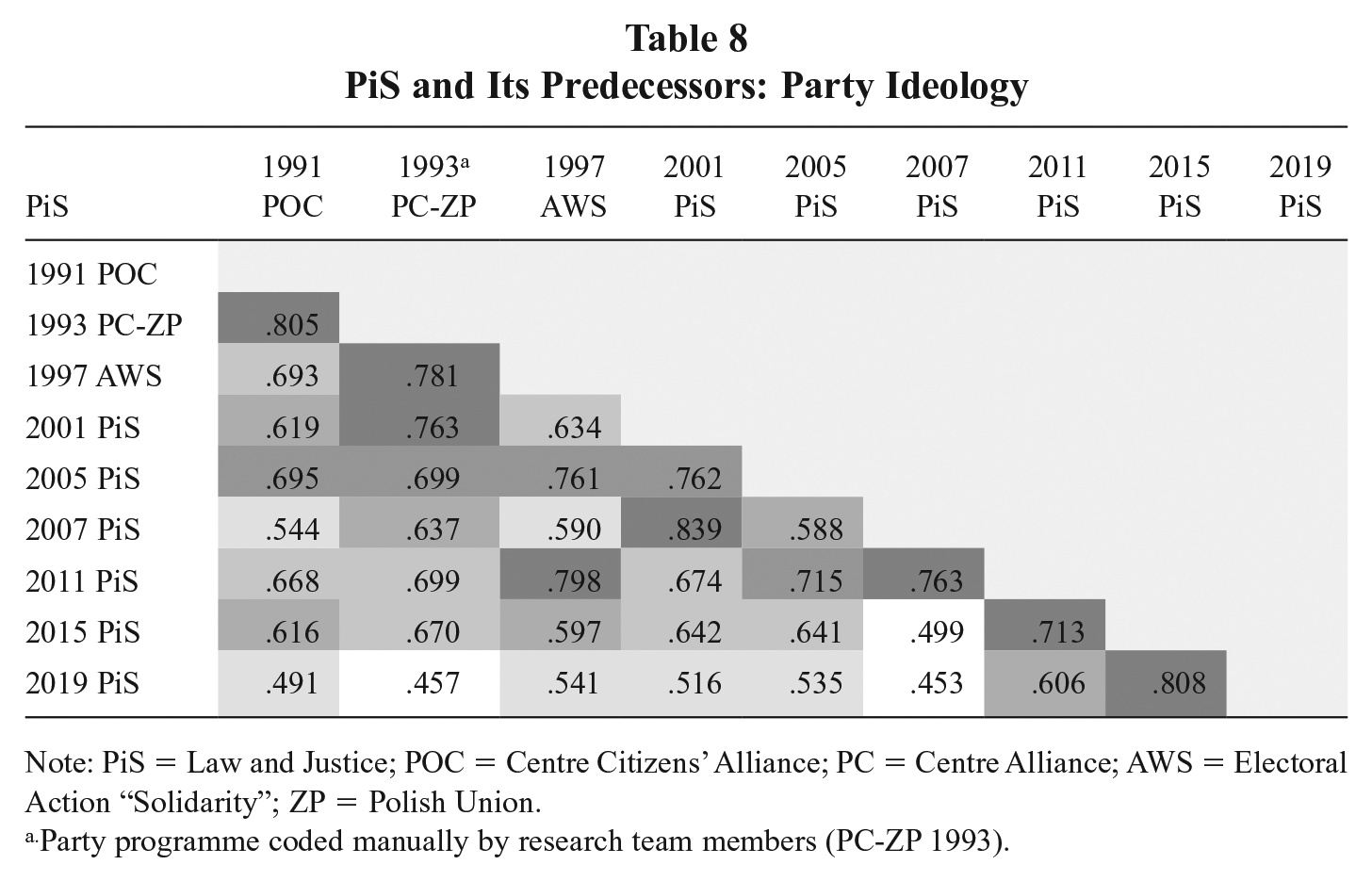
Note: PiS = Law and Justice; POC = Centre Citizens’ Alliance; PC = Centre Alliance; AWS = Electoral Action “Solidarity”; ZP = Polish Union.
Party programme coded manually by research team members (PC-ZP 1993).
Summarizing, in terms of party name and legal status, PiS is definitely a new party. In the area of leadership, there is a strong continuation of Kaczyński. In other areas, continuation may also be traced; however, the patterns differ. In the area of elites, a clear continuity is visible initially between two consecutive elections and then in 2011 a trend of continuity runs for more than two parliamentary terms. In the case of candidates, the initial low level of continuity began to rise in 2001 and since 2005 the increase has been much more visible. As to party ideology, the programmatic continuation between PiS and its predecessors is quite high, with the interesting case of continuity between PiS and PC-ZP, persisting despite the long distance in time, only fading slightly in the 2019 election.
Civic Platform
PO was established in January 2001 as an initiative by three politicians: Maciej Płażyński, Donald Tusk, and Andrzej Olechowski. Initially, Płażyński served formally as the party leader. They declared PO an alternative for voters disenchanted with existing parties and were looking for “more diversified ways to engage in politics than political parties.” 40 Consequently, PO was created as an electoral committee, and it was supposed to be registered as a political party only after the elections.
The initiative was based on the electoral potential generated by the success of Olechowski, who came second in the presidential elections in 2000. Tusk was at that time a deputy leader in the Freedom Union (UW); however, after being defeated in the race for the party leader position, he decided to leave UW at the beginning of 2001. Płażyński, previously known as a regional governor in Gdańsk, had served as a deputy leader of AWS in 1997. Tusk turned out to be the strongest of the initial three PO leaders, later becoming the only one, while the two others eventually left the party. We consider two parties as immediate predecessors of PO, that is, UW and the Conservative People’s Party (SKL). The former was created in 1994 as a result of a merger between the Democratic Union (UD) and the Liberal-Democratic Congress (KLD); we also investigate those parties as PO predecessors. 41 The SKL was formed in 1997. It was a part of AWS and its members also became an important group in the newly established PO in 2001 (Figure 2). 42
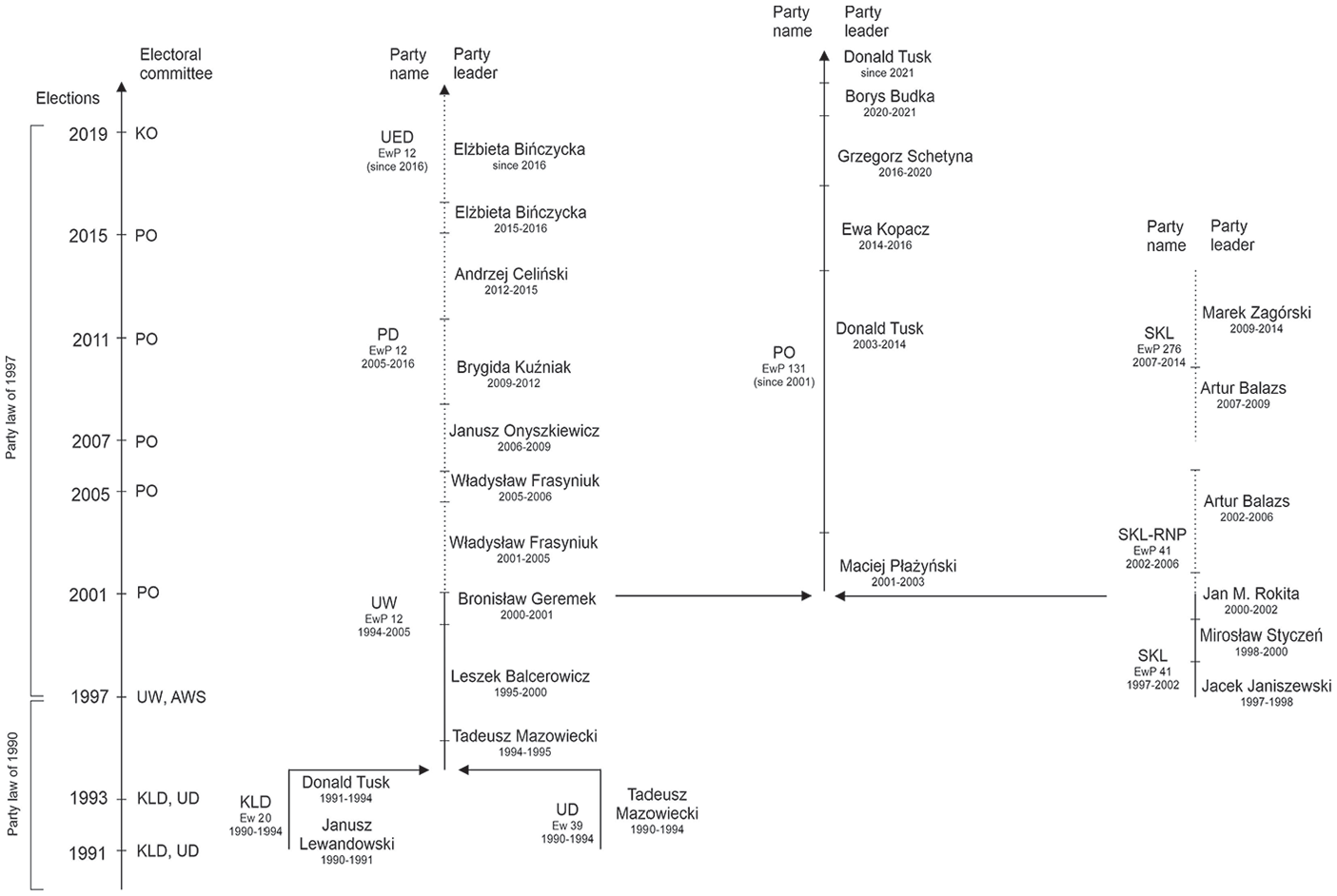
PO and its predecessors
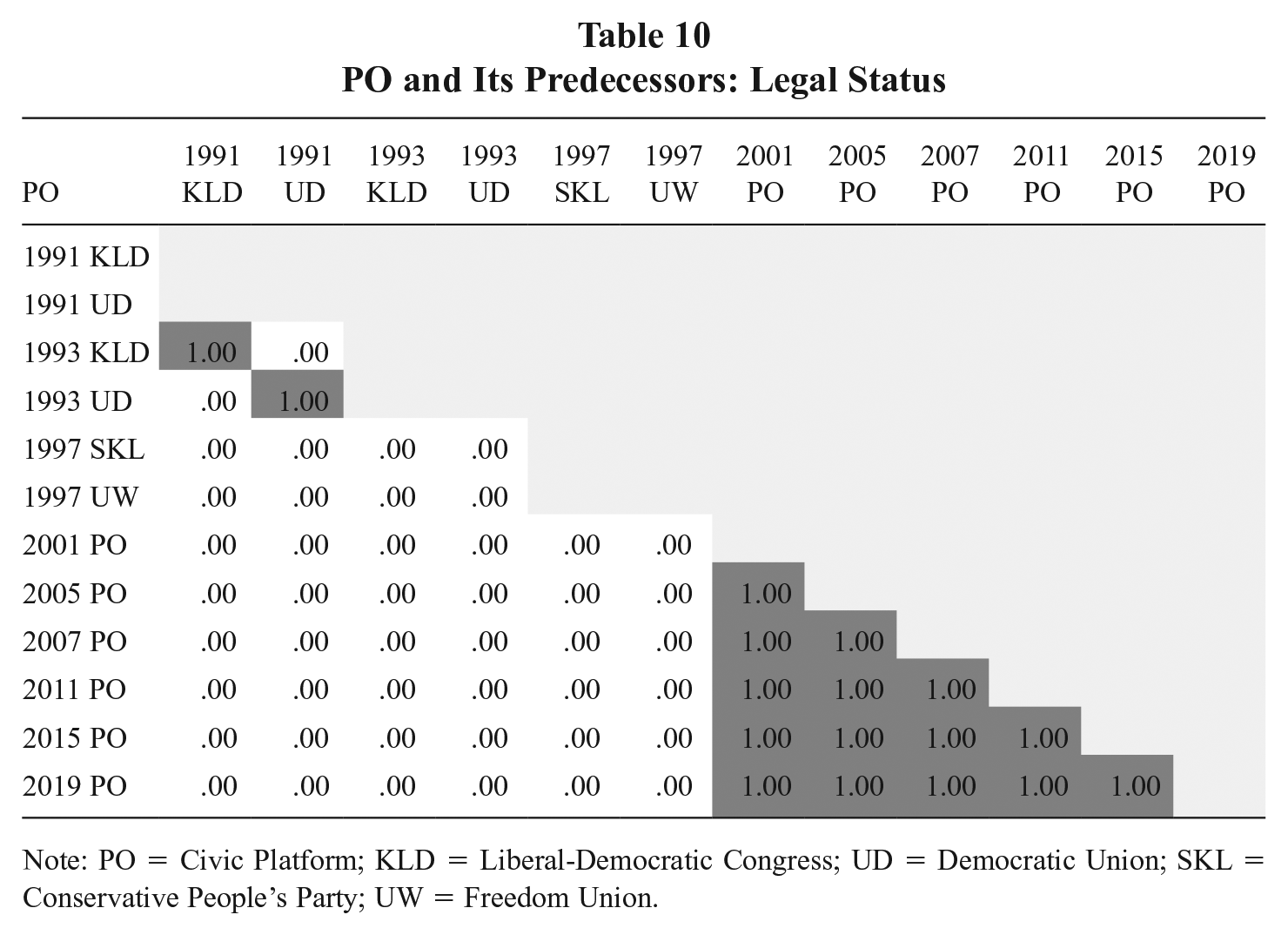
Regarding the names of the parties analysed (Table 9), the PO is a genuinely new label. Considering the predecessors of the party, there is a slight continuation between the UW and the UD displayed by the word “Union.” Table 10 illustrating the legal status shows even less continuation; PO is a visibly new party from this point of view.
PO and Its Predecessors: Party Name
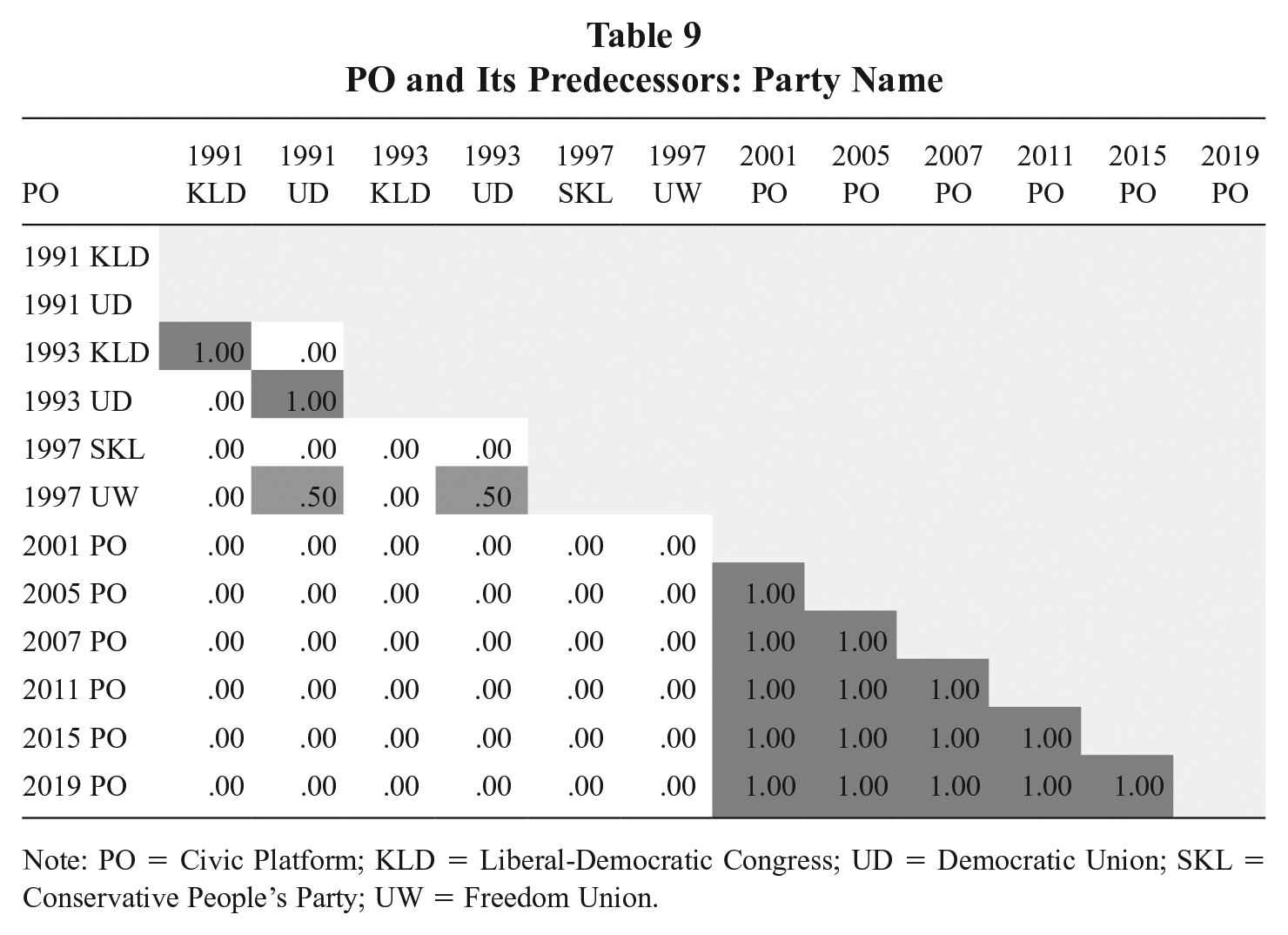
Note: PO = Civic Platform; KLD = Liberal-Democratic Congress; UD = Democratic Union; SKL = Conservative People’s Party; UW = Freedom Union.
PO and Its Predecessors: Legal Status
Note: PO = Civic Platform; KLD = Liberal-Democratic Congress; UD = Democratic Union; SKL = Conservative People’s Party; UW = Freedom Union.
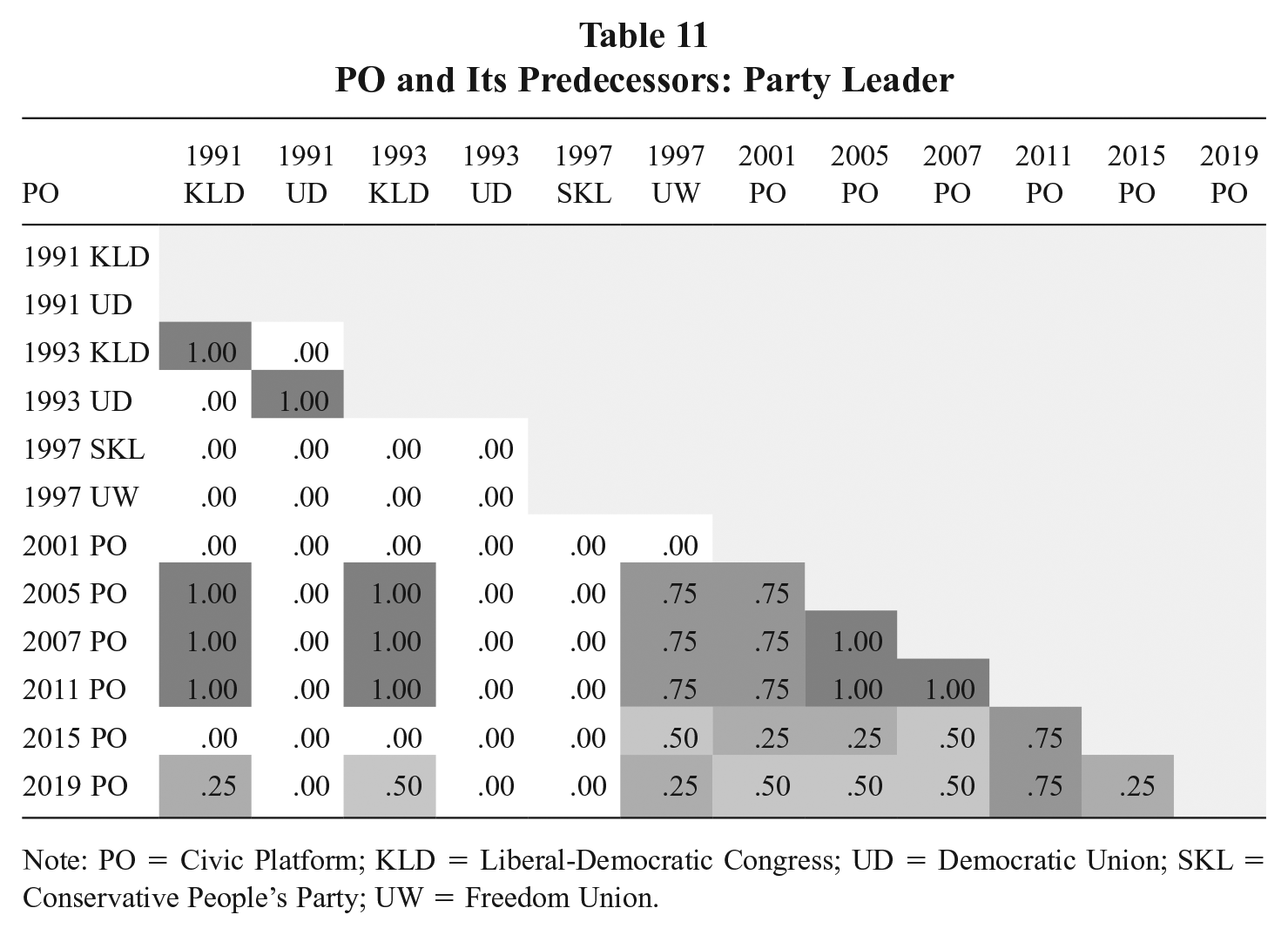
The longest serving leader of PO was Donald Tusk, who was also a leader of KLD and deputy leader of UW, which is visible in Table 11 as a strong continuation of KLD, UW, and PO leadership. Lower continuation values for PO in 2019 and its two predecessors, KLD and UW, are related to the leadership of Grzegorz Schetyna, who was elected in 2016 and served as the PO leader until 2020. He was earlier a member of KLD and a member of its board since 1992 and then MP for UW. A slightly lower continuation applies also to PO in 2015 and UW. This is the case of Ewa Kopacz, acting PO leader in the years 2014–2016, while in UW she was a leader of the regional branch. Clearly, there is no continuation of leadership between PO, UD and SKL.
PO and Its Predecessors: Party Leader
Note: PO = Civic Platform; KLD = Liberal-Democratic Congress; UD = Democratic Union; SKL = Conservative People’s Party; UW = Freedom Union.
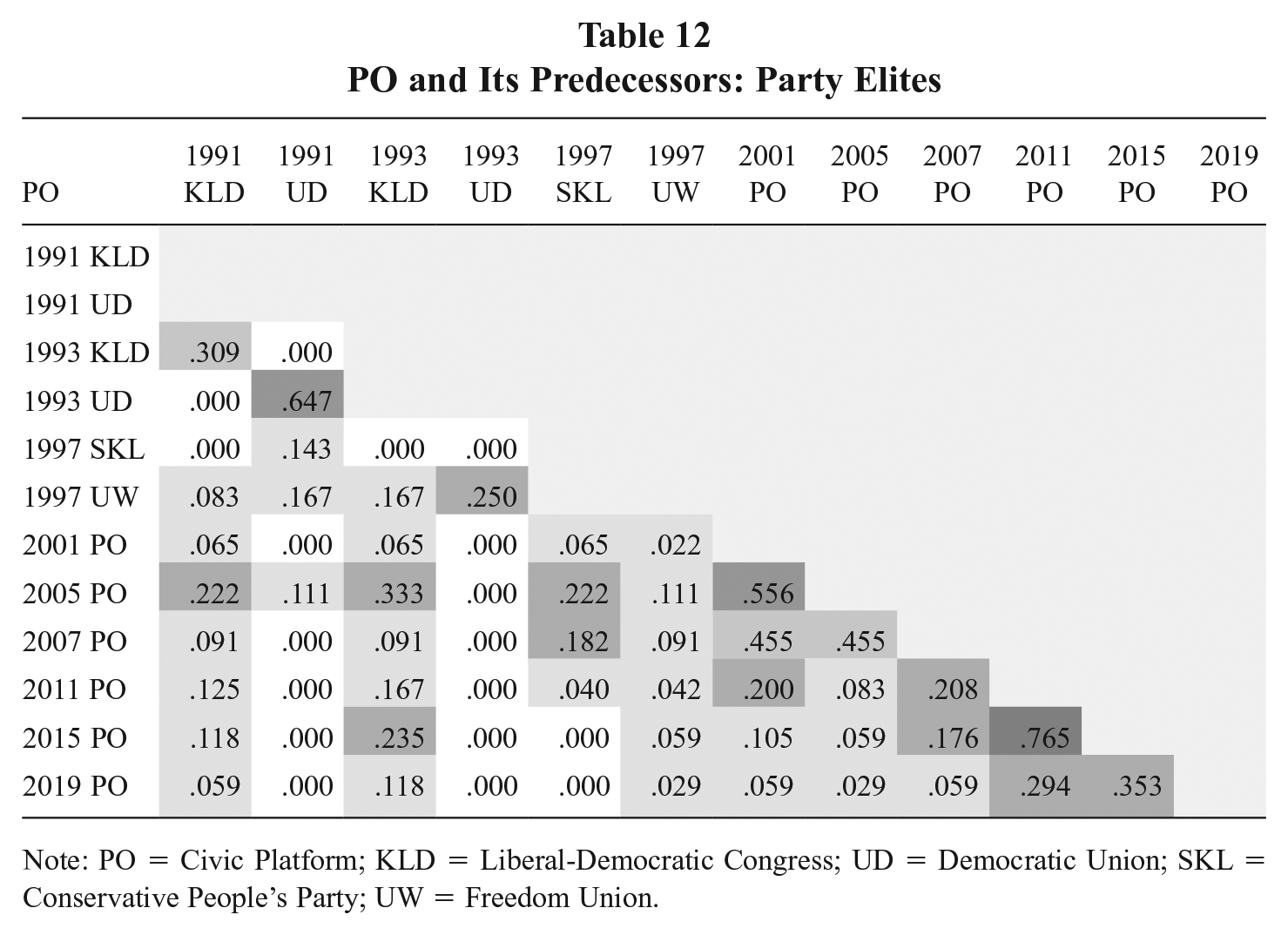
The continuation of the party elite between PO and its predecessors in terms of values reached is low (Table 12). There is a small overlap between PO and KLD, valid from the very beginning of PO in 2001 until the last election analysed, that is, 2019; this may be due to the fact that Tusk gained the strongest leadership position out of the three initial party leaders, and some people from his former political milieu were recruited to top positions. In the case of the other PO predecessors, SKL and UW, there is a continuation at the beginning of PO activity, that is, 2001, 2005, and 2007, but later it fades and in the case of SKL disappears completely. Worth mentioning is UW, whose elites in 1997 show continuity with both KLD and UD. This should not be surprising, remembering that UW was the result of a merger between UD and KLD.
PO and Its Predecessors: Party Elites
Note: PO = Civic Platform; KLD = Liberal-Democratic Congress; UD = Democratic Union; SKL = Conservative People’s Party; UW = Freedom Union.
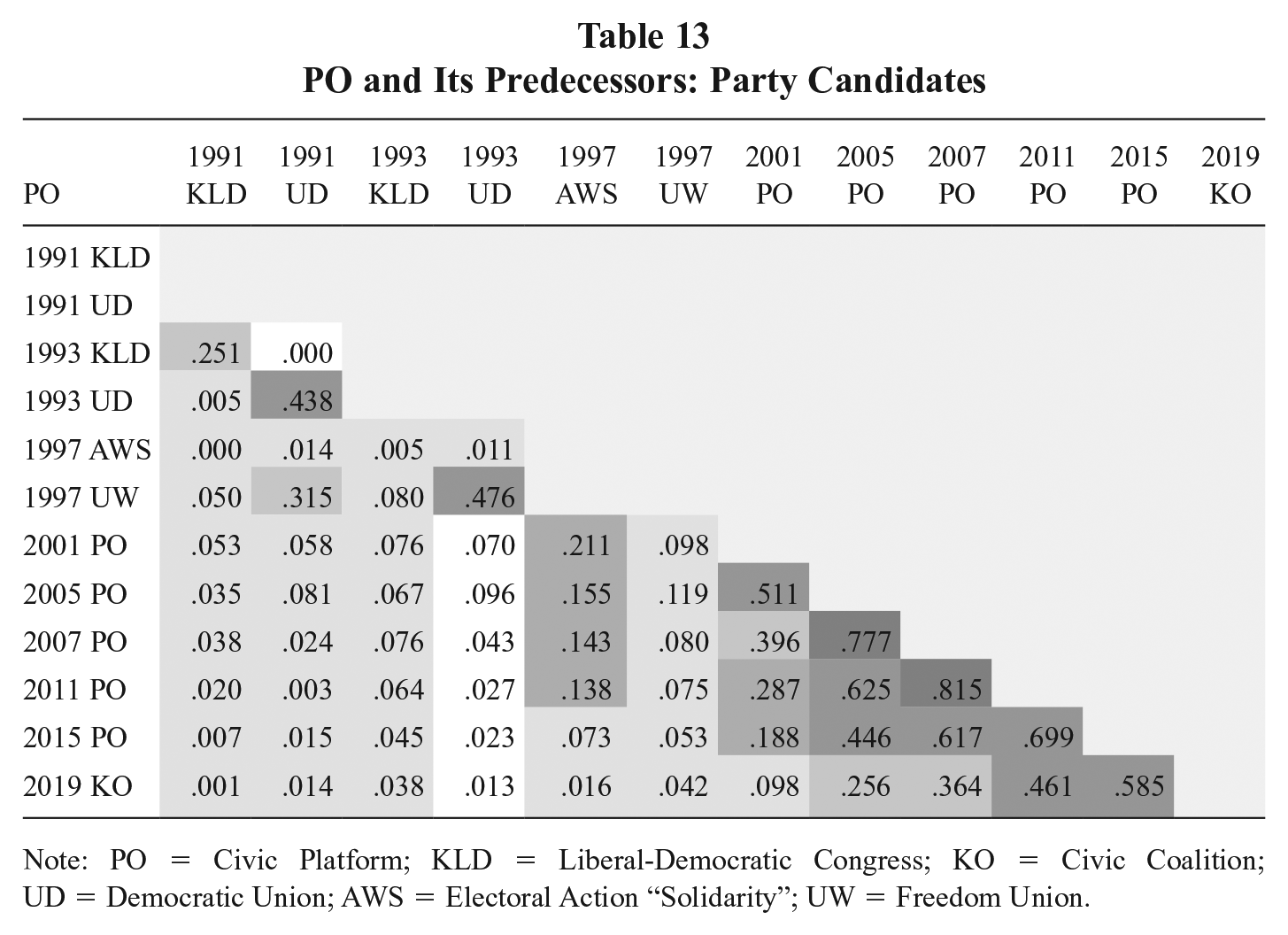
As for the party candidates (Table 13), a quite clear pattern of continuity starts with AWS and UW in 2001; both were the immediate predecessors of PO at the moment of its founding. This continuity persists for subsequent elections, fading in the two last ones, 2015 and 2019. Some continuity may also be traced between PO and its two predecessors of 1993, KLD and UD. The former persists longer, whereas the latter fades more quickly. There is also a continuation in PO candidates in consecutive elections since 2005.
PO and Its Predecessors: Party Candidates
Note: PO = Civic Platform; KLD = Liberal-Democratic Congress; KO = Civic Coalition; UD = Democratic Union; AWS = Electoral Action “Solidarity”; UW = Freedom Union.
Table 14 illustrates the ideology of the party. The most visible continuity between PO and its predecessors concerns UW. However, some programmatic continuity may be traced between PO and AWS and to a slightly smaller degree between PO and UD of 1993. The continuity between PO and KLD in 1993 is even smaller, which is a different picture than that concerning leader and elites, where the degree of continuity was a little higher.
PO and Its Predecessors: Party Ideology
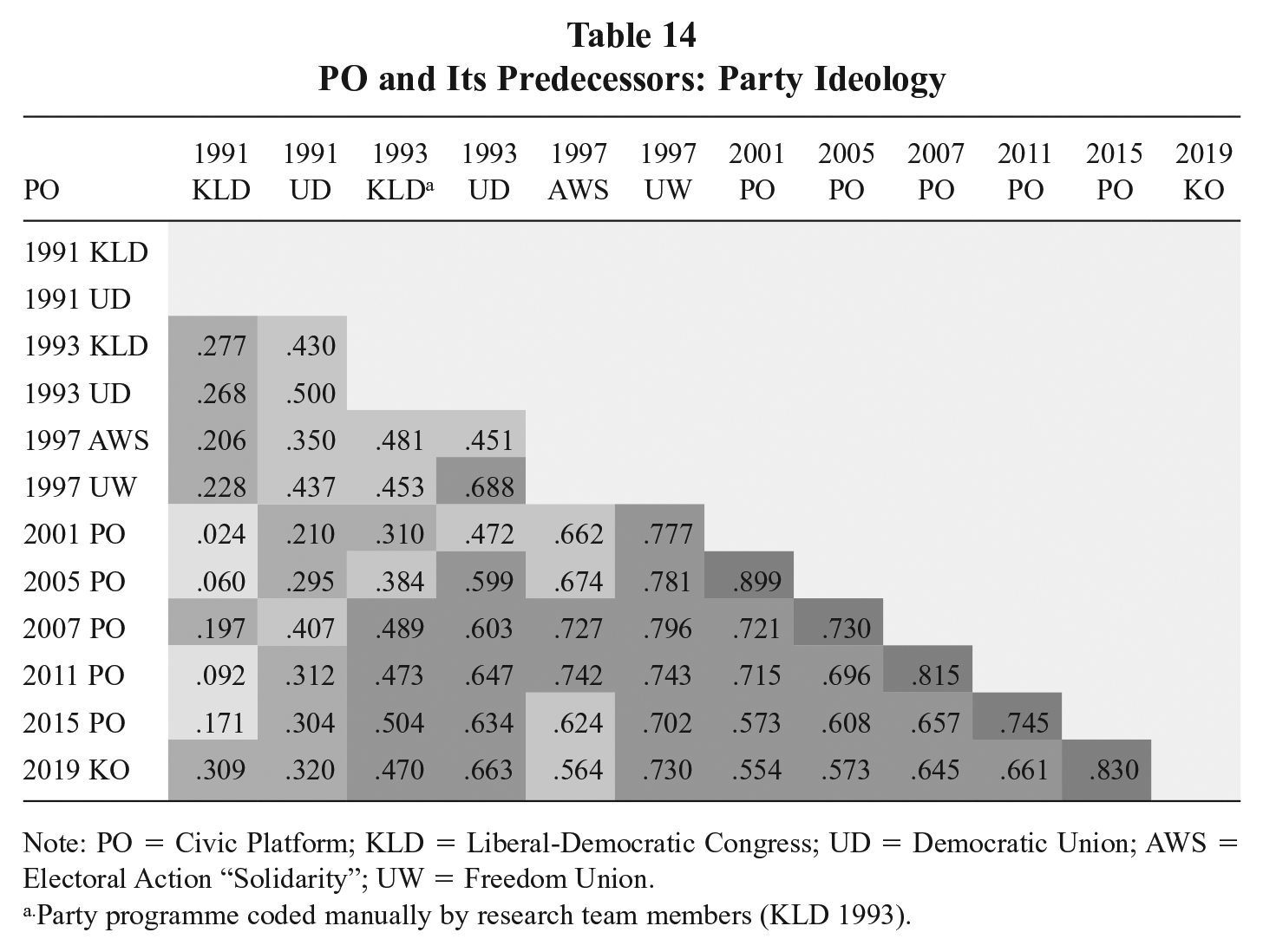
Note: PO = Civic Platform; KLD = Liberal-Democratic Congress; UD = Democratic Union; AWS = Electoral Action “Solidarity”; UW = Freedom Union.
Party programme coded manually by research team members (KLD 1993).
In summary, in the areas of name and legal status, PO is definitely a new party. In the area of leadership, there is a visible continuity of Donald Tusk as a party chairman. In other areas the continuation may also be traced; however, it pertains to different party predecessors in different areas. In the area of the party elite, there is a persistent continuation between PO and KLD, which may be connected with Tusk’s leadership of both parties. Other continuations may also be observed but are not so clearly articulated. In the area of candidates, the clearest continuation is between PO in 2001 and its two immediate predecessors of 1997, AWS and UW. In the area of ideology, PO takes the most after UW, with a smaller contribution from AWS and UD. The smallest amount of ideology transfer occurred between PO and KLD. PO is a good example of a party with a few predecessors, which is demonstrated by its unevenly spread continuities. It resembles one party in the area of leadership and elite, and the other in the field of candidates and programmatic issues.
Confederation Liberty and Independence
The Confederation Liberty and Independence (K WiN) was registered before the 2019 election as a party composed of the Coalition for the Renewal of the Republic—Liberty and Hope (KORWIN), the National Movement, the Confederation of the Polish Crown, and a few smaller groups. 43 K WiN is a kind of an umbrella organization established to achieve election results that its members could not achieve on their own. 44 Nevertheless, all its member parties still exist as separate groups. We perceive KORWIN, created in 2015, as the immediate predecessor of K WiN. The abbreviation of the party name KORWIN is, in fact, a backronym of the party founder’s name Janusz Korwin-Mikke (JKM). He is an 80-year-old charismatic and eccentric leader, well known for his expressive views and controversial, politically incorrect statements related to homosexuals, women, people with disabilities, sex education in schools, Hitler, and so on.
Even if KORWIN appeared in 2015 as a newly created party, its genesis dates back to the collapse of communism when JKM created his first group, the Union of Real Politics (UPR), in 1989. Since then, he has been a leader of several parties, repeating the same pattern: when support for the party decreased or his position as a leader was threatened, he established a new entity. Due to his popularity, this new party was usually more successful than the old one (Figure 3).
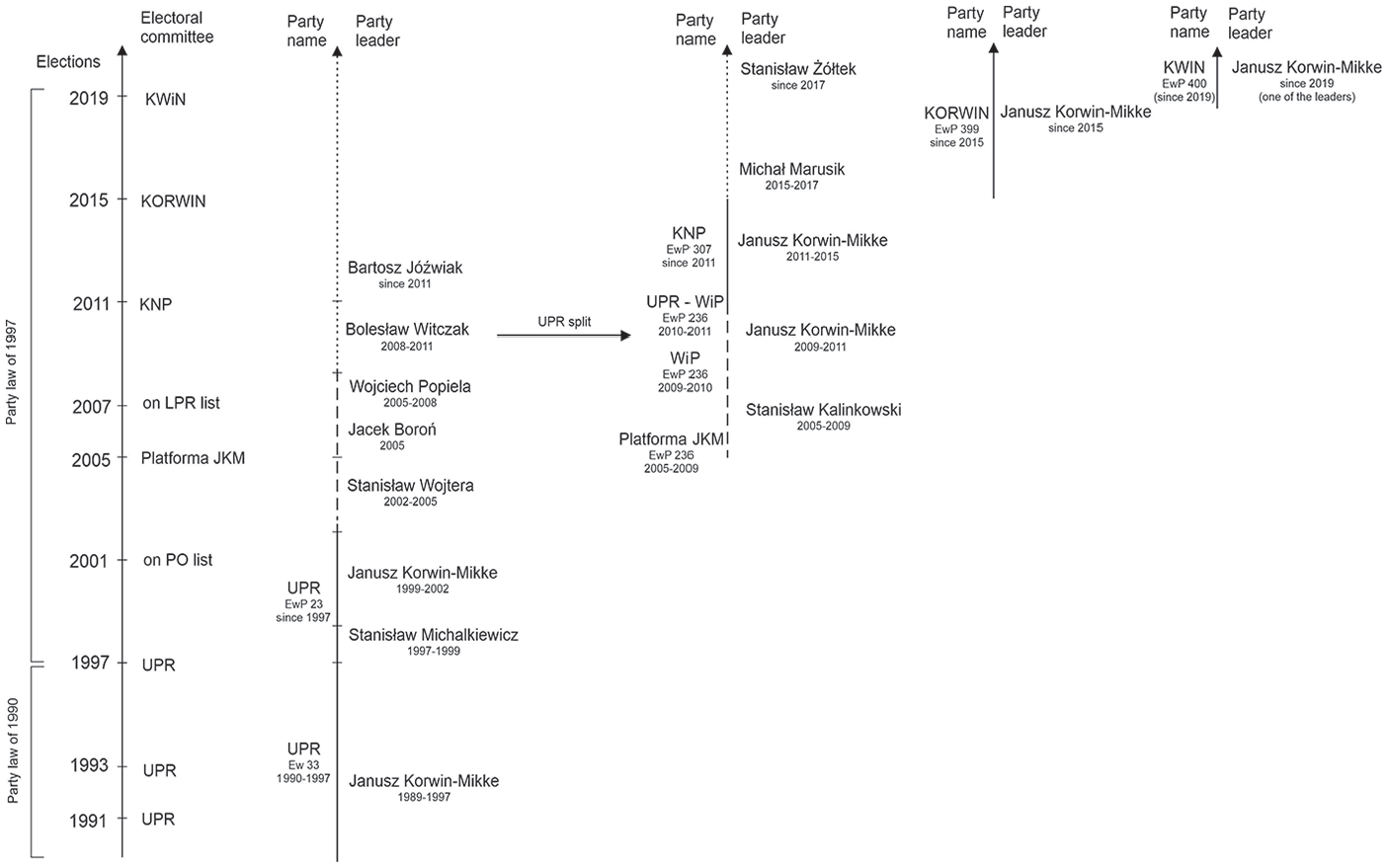
K WiN and its predecessors
Before the 2005 elections, elites connected with UPR attempted to reignite their waning popularity by creating a new political party and registering it as the JKM Platform. They hoped to unite supporters of JKM under this name but were planning to dissolve the party after the election. 45 Korwin-Mikke, however, ended up not joining the Platform, and the elites of UPR kept the party after the election as a kind of label, assuming this registered entity might prove useful in the future. Finally, its name was changed to Liberty and Lawfulness (WiP) in 2009 and then Korwin-Mikke left UPR and became a leader of the new party. In the meantime, there was a split in UPR, when the group led by Stanisław Michalkiewicz joined WiP as well. In this way, a new group UPR-WiP was formed; in 2011, it changed its name to the Congress of the New Right (KNP), also referred to as the New Right of JKM. When JKM lost his power in KNP in 2015, he left it and established the KORWIN party, which became a part of the K WiN in 2019. 46 This coalition party does not have a single leader, but rather a Council of Leaders, where all member parties are represented.
In terms of continuation of a party name, the label “Union of Real Politics” was used at the time of the 1991 founding and all subsequent elections; all that time, UPR has been registered as the same legal entity. KNP in 2011, and KORWIN in 2015 and K WiN in 2019 were recorded in the Party Registry as new; therefore, since 2011 there is no continuity of legal status and party name (Tables 15 and 16).
K WiN and Its Predecessors: Party Name
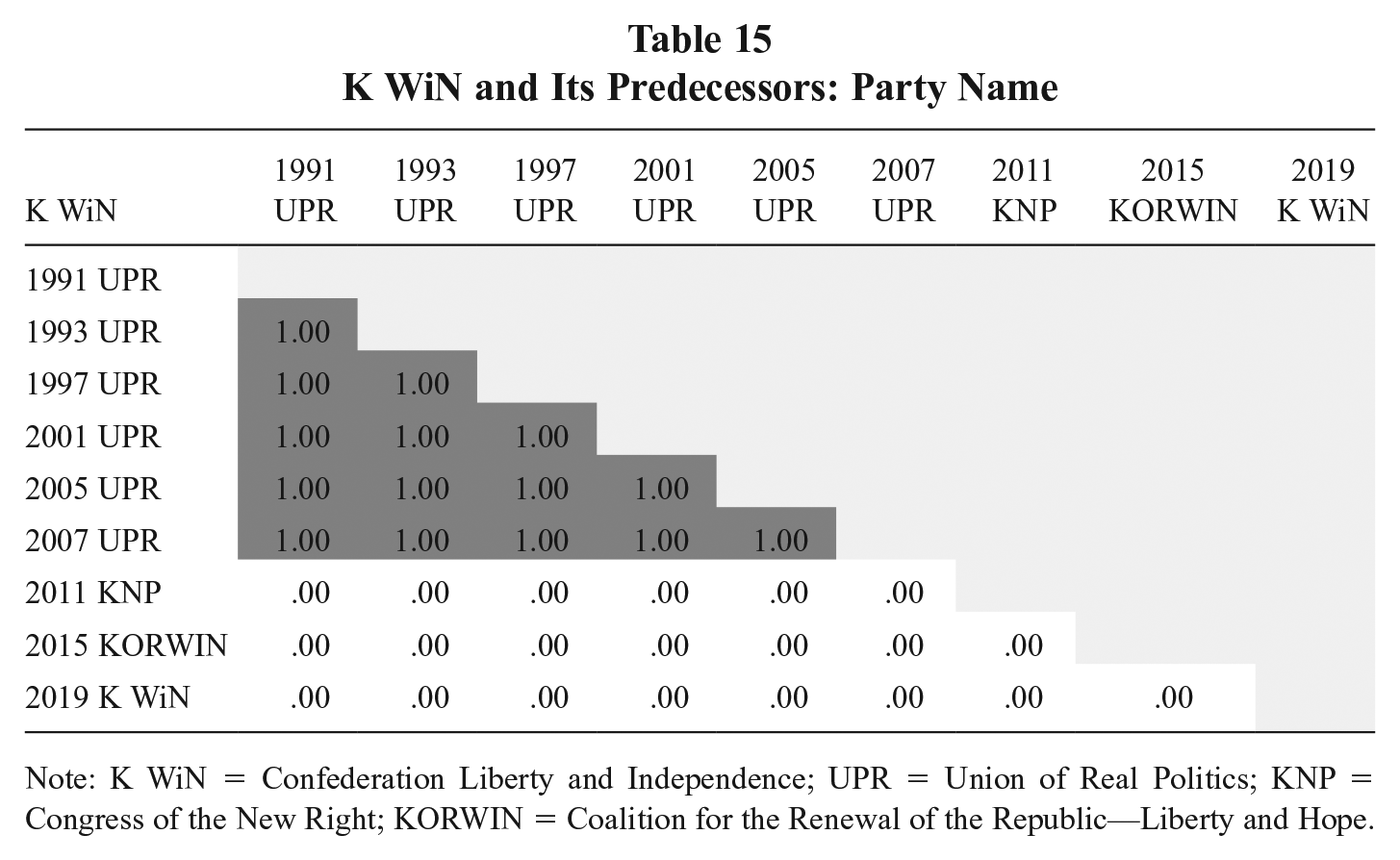
Note: K WiN = Confederation Liberty and Independence; UPR = Union of Real Politics; KNP = Congress of the New Right; KORWIN = Coalition for the Renewal of the Republic—Liberty and Hope.
K WiN and Its Predecessors: Legal Status
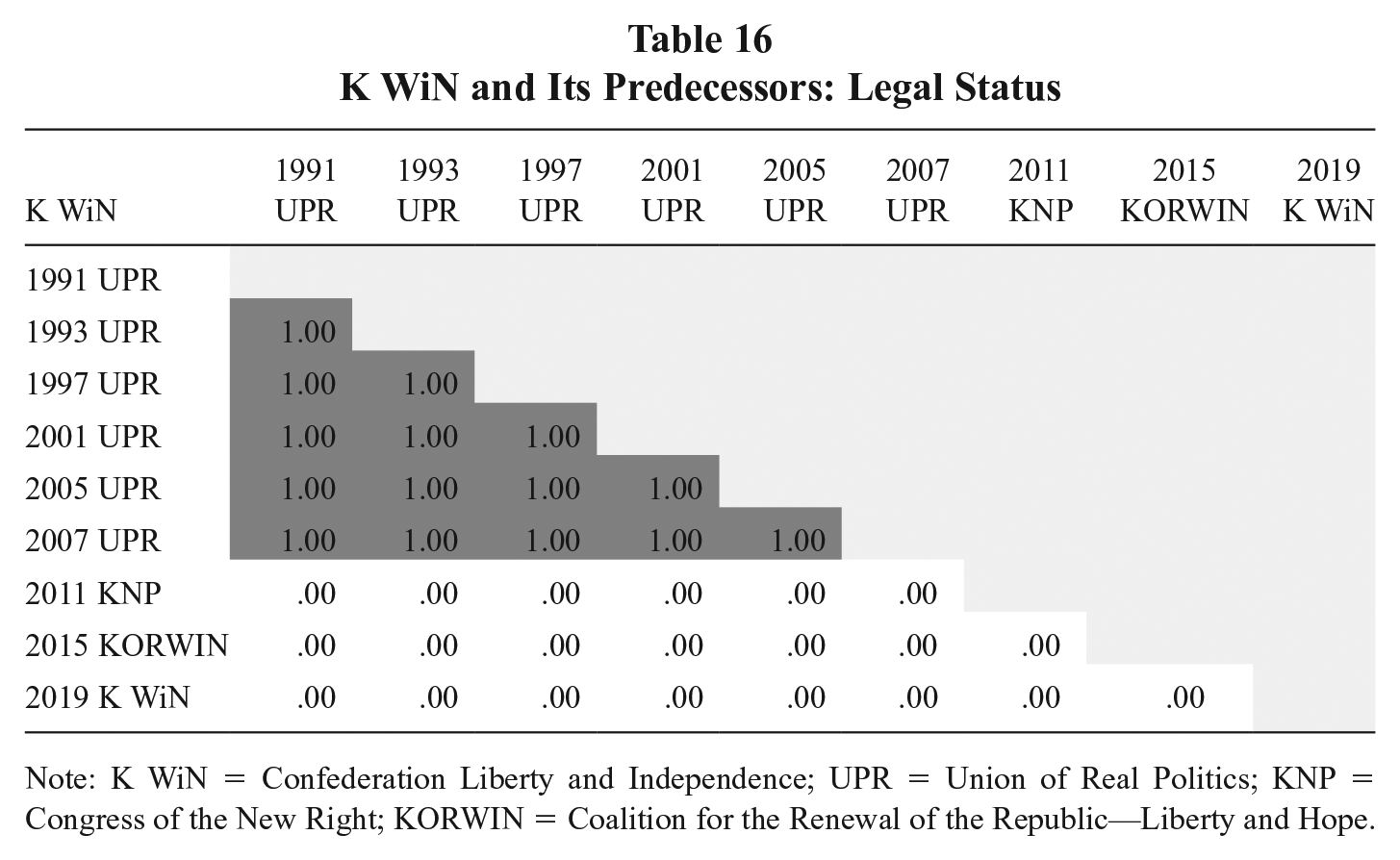
Note: K WiN = Confederation Liberty and Independence; UPR = Union of Real Politics; KNP = Congress of the New Right; KORWIN = Coalition for the Renewal of the Republic—Liberty and Hope.
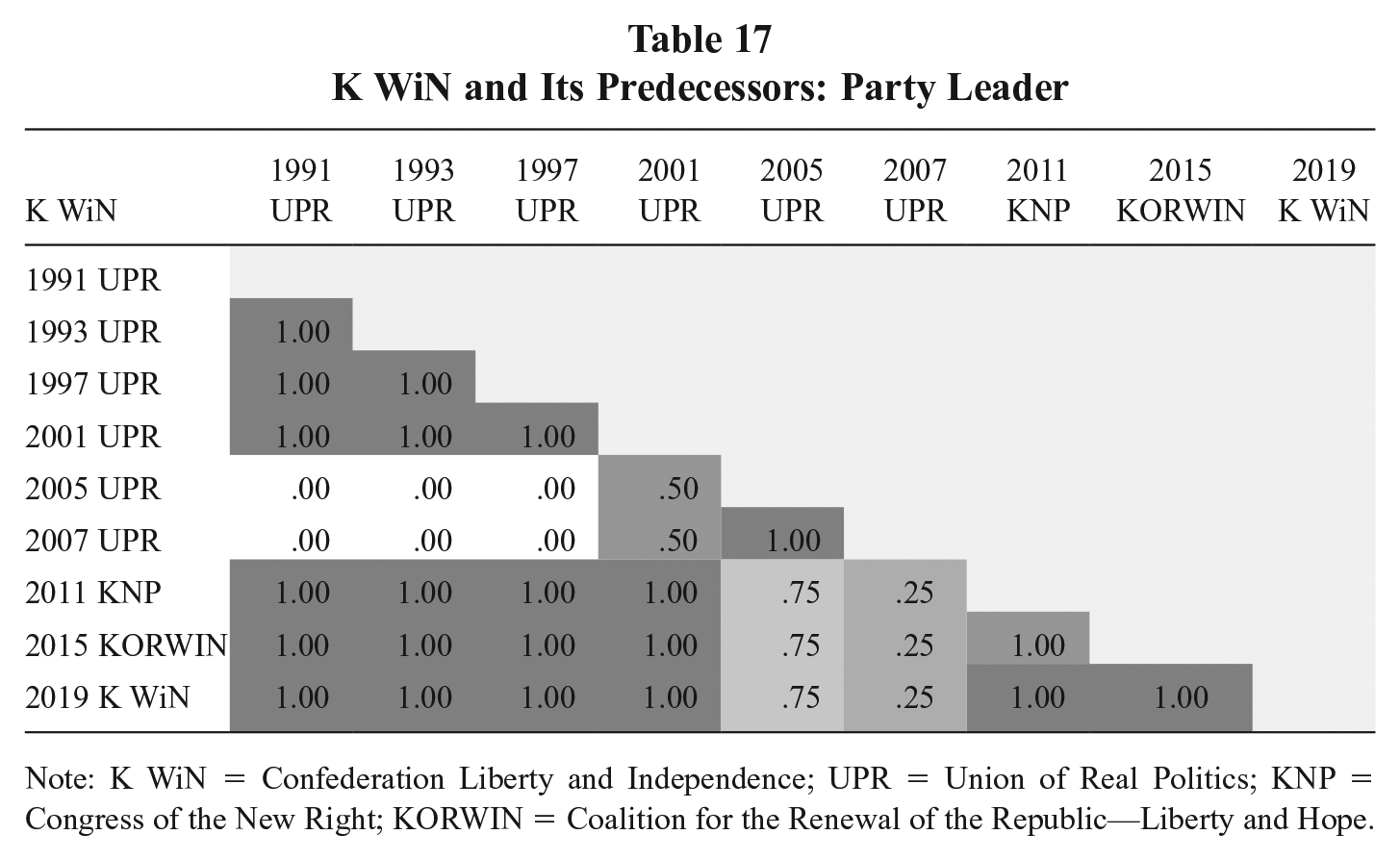
Both the Confederation and all its predecessors were established by Korwin-Mikke, and hence we deal with significant continuation in terms of leadership (Table 17). He was leader of UPR during the 1991, 1993, 1997, and 2001 elections. In 2002, he resigned, justifying this with the need to hand over power to a younger generation; hence, Wojciech Popiela led the UPR at the time of the 2005 and 2007 elections. Even if JKM formally was not leader in 2005, UPR candidates ran for this election from lists bearing his name, the JKM Platform; therefore, his position was still strong. After Korwin-Mikke left UPR in 2009, he was leader of a few newer parties: WiP (2009–2010), UPR-WiP (2010–2011), KNP (2011–2015), KORWIN (since 2015), and one of the leaders of K WiN since 2019. Although some of his previous parties (UPR, KNP) have survived, the newest parties, KORWIN and K WiN, led or co-led by Korwin-Mikke himself, seem to be much more successful in terms of electoral results; hence, they are considered in our research.
K WiN and Its Predecessors: Party Leader
Note: K WiN = Confederation Liberty and Independence; UPR = Union of Real Politics; KNP = Congress of the New Right; KORWIN = Coalition for the Renewal of the Republic—Liberty and Hope.
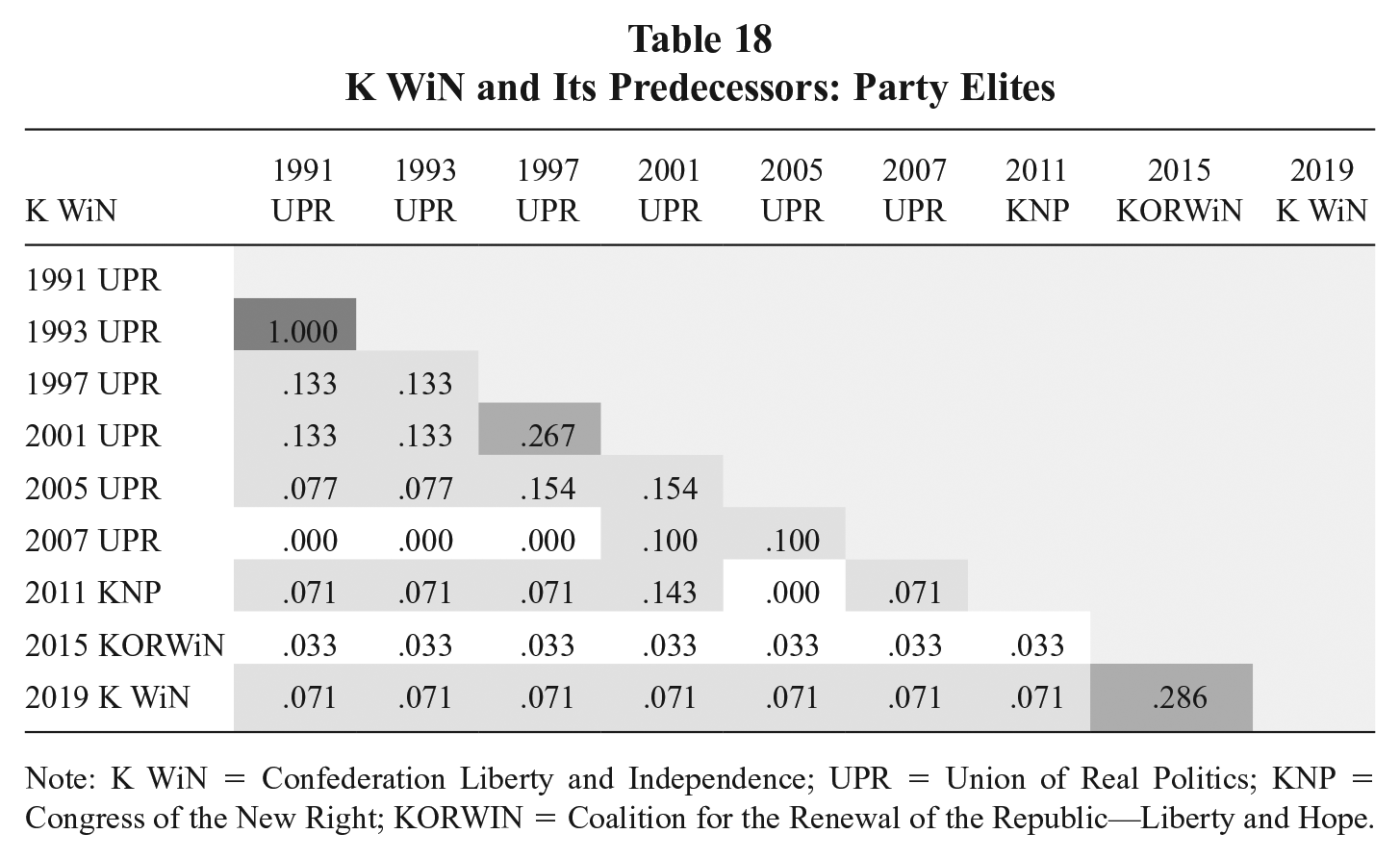
The continuation of the elites and candidates of the parties is much lower (Tables 18 and 19). For elites, this was significant between UPR in the 1993 and 1991 elections and slightly visible between K WiN of 2019 and KORWIN of 2015. There was no continuity between the UPR elite in 2007 and the same party in the elections of 1991, 1993, and 1997 or between the KNP of 2011 and the UPR of 2005. This was due to the weakening position of UPR, when JKM ceased to be its leader, and the outflow of elites to other parties at the time of the 2005 and 2007 elections.
K WiN and Its Predecessors: Party Elites
Note: K WiN = Confederation Liberty and Independence; UPR = Union of Real Politics; KNP = Congress of the New Right; KORWIN = Coalition for the Renewal of the Republic—Liberty and Hope.
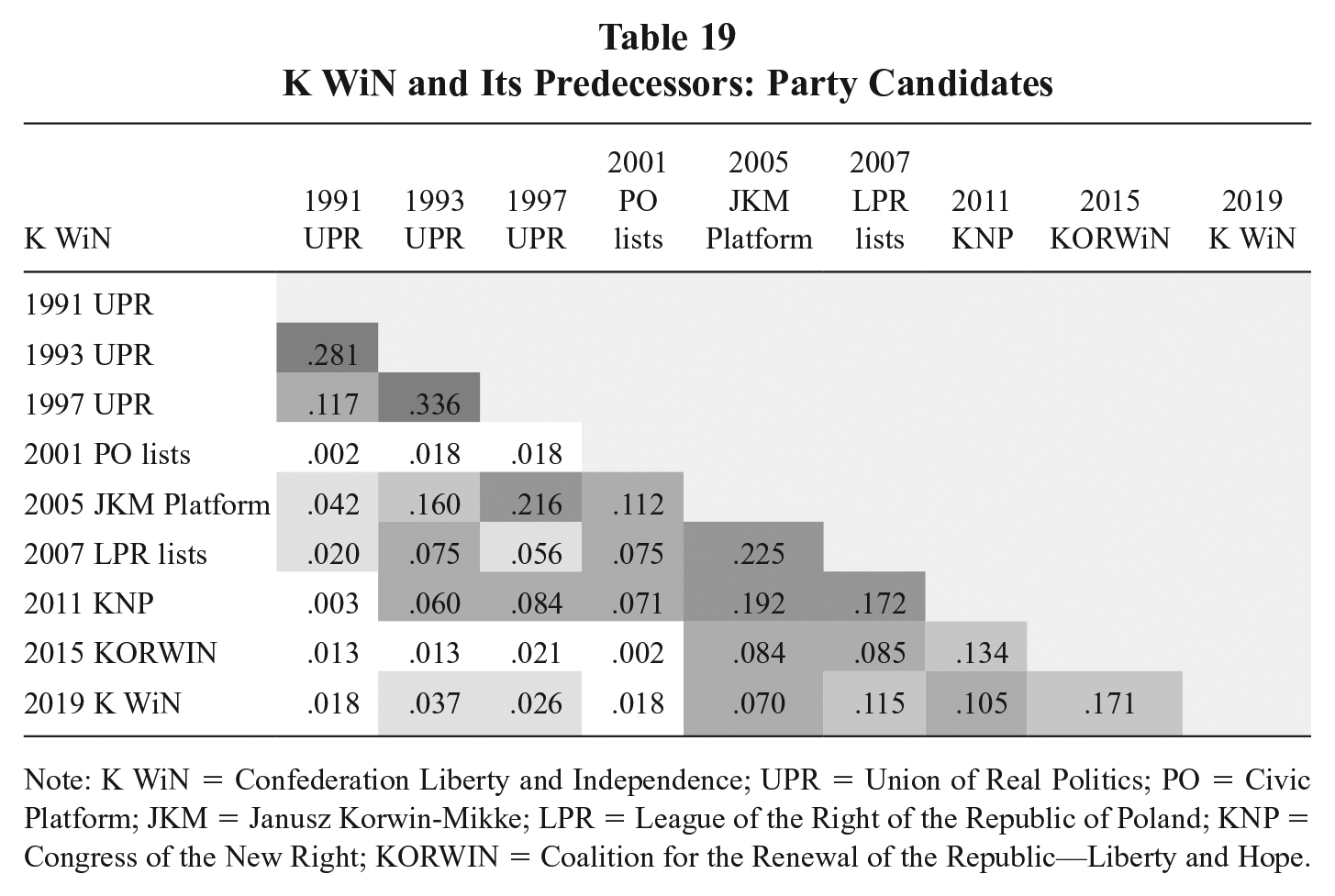
K WiN and Its Predecessors: Party Candidates
Note: K WiN = Confederation Liberty and Independence; UPR = Union of Real Politics; PO = Civic Platform; JKM = Janusz Korwin-Mikke; LPR = League of the Right of the Republic of Poland; KNP = Congress of the New Right; KORWIN = Coalition for the Renewal of the Republic—Liberty and Hope.
In the case of party candidates (Table 19), continuation can be observed between the 1993 and 1991 elections as well as in 1997 and 1993, when the UPR was able to register its own lists. However, in 2001 the party candidates ran from the PO lists; hence, continuation was at a low level. In 2005, UPR politicians created a special entity for electoral purposes, the JKM Platform; therefore, they were able to put on its lists more candidates from the previous elections. In 2007, UPR decided to place its candidates on the lists of the League of the Right of the Republic of Poland (LPR) 47 ; the continuation was then at the level of a quarter of these candidates that ran from the JKM Platform in 2005, which can be perceived as one of the best results for this party. A slight continuity is visible also in the case of KNP of 2011, KORWIN of 2015, and K WiN of 2019, on the one hand, and candidates related to this milieu since 2005, on the other hand. Unlike the party leader, there is almost no continuity between the candidates of these three parties and those who ran in elections from 1991 to 2001; this is due to the passage of time and the fact that politicians active in the 1990s left politics. JKM seems to be an exception here.
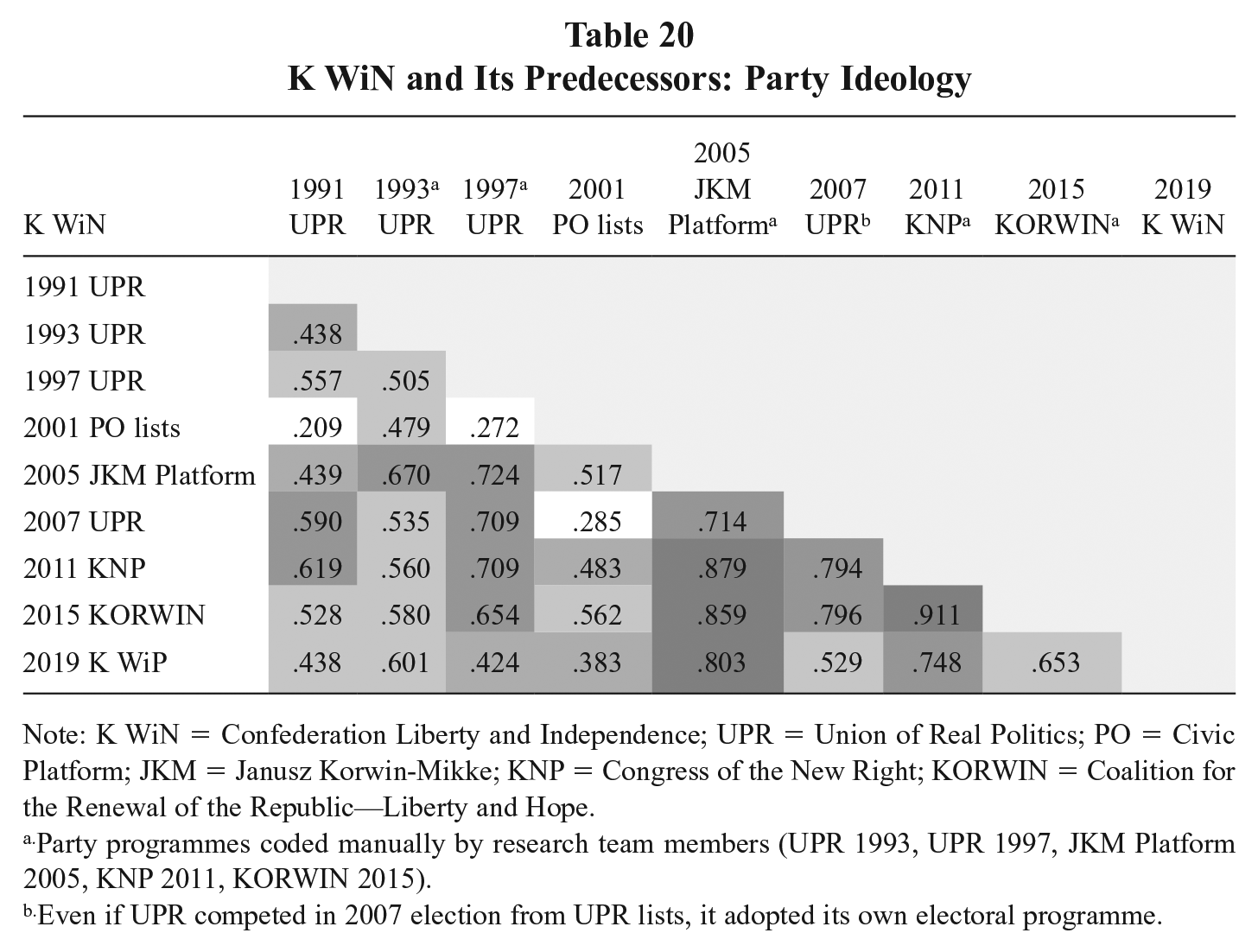
The results related to programmatic issues allow us to see a noticeable continuity (Table 20). Very often it reached the level of more than half. The really impressive continuation can be observed between the KORWIN and KNP programmes of 2015 and 2011, respectively; it is at the level of .9. A prominent continuation level occurred also between the KNP of 2011, KORWIN of 2015, and K WiN of 2019 programmes on the one hand and the JKM Platform of 2005 on the other hand; it reached a level of over .8. Not surprisingly, a low level of continuity is observed between the programme of 2001 and all programmes adopted earlier and later. The UPR candidates ran then from the PO lists; hence, they did not have their own election platform, but used the programme of this party, the ideology of which was different. 48 Overall, the continuity in terms of the party programme in all parties created by JKM is meaningful.
K WiN and Its Predecessors: Party Ideology
Note: K WiN = Confederation Liberty and Independence; UPR = Union of Real Politics; PO = Civic Platform; JKM = Janusz Korwin-Mikke; KNP = Congress of the New Right; KORWIN = Coalition for the Renewal of the Republic—Liberty and Hope.
Party programmes coded manually by research team members (UPR 1993, UPR 1997, JKM Platform 2005, KNP 2011, KORWIN 2015).
Even if UPR competed in 2007 election from UPR lists, it adopted its own electoral programme.
Here, we consider several parties recorded in the Party Registry with different names and numbers. Treating all of them as separate entities gives the impression that there were a lot of new parties on the far-right side of the political spectrum after the collapse of communism. However, using our framework for analysis, we prove that even if we dealt with many new party labels, at the same time we can observe quite meaningful continuities in terms of party leader, programme, and, to a lesser extent, elites and candidates. All parties analysed in this section were led by JKM, and their programmes reflected to a certain degree his views. Even if he was not the formal leader at one or other time, he usually managed to maintain influence in the party. The continuation in terms of party elites and candidates is sometimes visible from election to election, but is not so impressive over the whole period analysed as there was a generational change in politics. An evident breakthrough in continuity is visible at the beginning of the twenty-first century. The handing over of power in UPR by JKM also influenced the departure of other activists. His return to the game sparked a revival of the party, but the fact is that they are no longer the same activists who collaborated with JKM in the 1990s.
Results and Conclusion
A study of the subject literature devoted to new political parties shows that novelty is by no means a clear-cut category, nor it is easy to research. 49 In the case of many parties, it is difficult to answer the seemingly simple question as to whether they are new on the political scene or not. Parties that are registered under a new name are often considered new. However, the new party label may only be a marketing operation aimed at bringing an effect of freshness, and thus helping a certain group of politicians to win the next election. The findings so far show that novelty is a multidimensional category. Following this path, we decided to investigate three Polish parties to answer the questions of whether they are new, in which areas they are new, and to what extent they are new. To do this, we employed six indicators of party novelty: party name, legal status, party leader, elite, candidates, and ideology, and tried to assess the level of novelty and continuity in each of them. Some indicators were measured on a continuous scale (party elite, party candidates, ideology), others using a discrete one (party name, party leader), while legal status was described dichotomously (registered as new or not). Based on qualitative and quantitative analyses, we argue that despite the new name and legal status, the party may still display a far-reaching continuity with an earlier existing entity in various areas.
We analysed the ruling party PiS, the main opposition party PO, and the far-right group K WiN. The first two parties were recorded in the Party Registry in 2001, the latter in 2019, all with new names and numbers. However, we have shown that, despite the new name and legal status, these parties were not created from scratch. We compared the main party attributes to assess the level of party novelty and continuity, taking a parliamentary term of office as a unit of analysis. The issue was complicated because Polish political parties have often contested elections as parts of broad electoral coalitions. This has crucial consequences because party candidates, electoral platforms, and partly also the party elite melt into the greater whole; hence, it is difficult to identify and compare them with predecessors and successors. Despite these problems, tracking PiS, PO, K WiN, and their forerunners in the entire period after the collapse of communism, we were able to show continuity in various areas and to different extents.
The continuation was most obvious in the area of party leadership. Jarosław Kaczyński, Donald Tusk, and JKM have been in Polish politics since the very beginning, creating parties that served their political interests. Although they changed party labels, they were able to draw the attention of party elites and voters, who supported them. The other area of significant continuity is party ideology; this was visible in all three cases. Party programmes have obviously changed, adjusting to current problems and issues. However, some subjects and values expressed in them seem to be important for a particular political environment; hence, there is some level of continuity. Novelty occurred to a greater extent in the areas of party candidates and elites. This could be due to the extended period that was analysed, from 1991 till 2019, which partly meant a generational replacement.
Considering to which extent the parties are new, we aggregated the component indices into a single index of party continuity. We cannot simply average them since the three continuous components (candidate, elite and programme continuity) have very different distributions. We solve that problem by transforming them into identically distributed variables using the probability integral transform, that is, by compounding the values of each of those three indices with their respective empirical cumulative distribution functions (where the distribution is taken over all pairs being compared under the given index). We then average the resulting values, as well as the leadership continuity index, obtaining the aggregate party continuity index.
According to this aggregate index, the highest level of continuity can be observed in the case of PiS (Table 21). It oscillates between .474 (similarity between PiS of 2001 and PC of 1991) and .935 (similarity between PiS of 2019 and 2015), increasing its values from election to election. The diagonal (marked in Table 21 with arrows) is our proximate continuity, showing the level from one election to the next. We can find here top-level results about continuity; however, there is also a shift, especially between 1993 and 1997 and again between 1997 and 2001, that may signify a kind of newness. A major break here can be explained by the fact that in 1997 PC melted into the broader coalition of AWS and in 2001 PiS emerged from this coalition. Continuity values are significantly higher starting from the 2005 election; hence, not surprisingly, we deal with greater congruence between PiS itself in subsequent elections than between PiS and its predecessors. Nevertheless, the index values indicate a continuation also in comparison with the PiS predecessors (PC, PC-AWS). A surprising but interesting phenomenon is that the continuity of PiS with PC and PC-AWS, lowest in 2001 when the party was created, increased over time till 2015 when it began to drop slightly. It means that over time the party became more like its predecessors. This phenomenon occurred in PO as well; hence, we will address it a bit further.
PiS and Its Predecessors: Aggregate Continuity
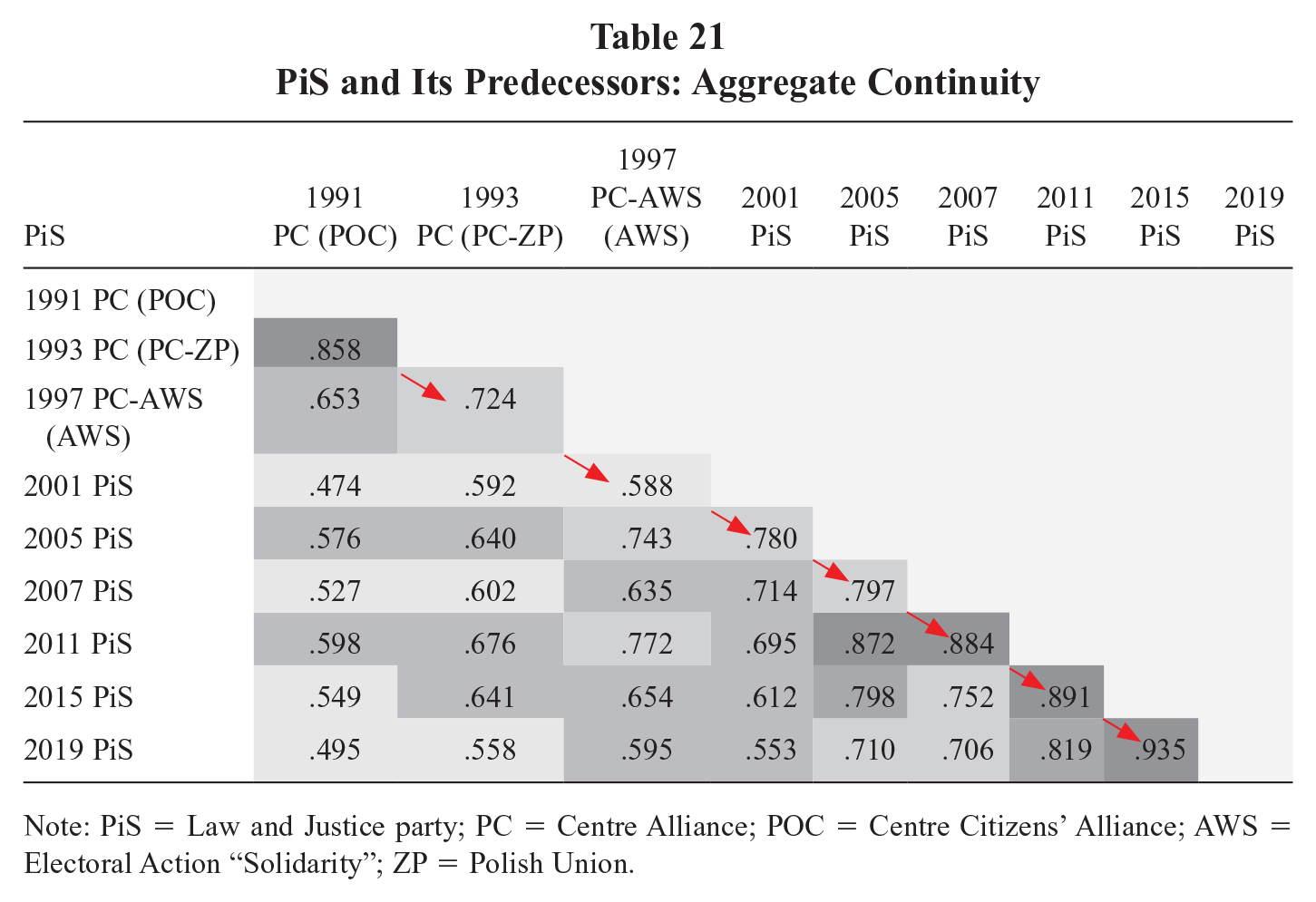
Note: PiS = Law and Justice party; PC = Centre Alliance; POC = Centre Citizens’ Alliance; AWS = Electoral Action “Solidarity”; ZP = Polish Union.
The aggregate continuity of PO is lower, but still visible, taking higher values only from the 2005 election (Table 22). In 2001, a slight congruence can be observed between PO and its immediate predecessors SKL and UW. Considering the parties that existed at the beginning of the 1990s, continuity is present in the case of KLD and almost nonexistent in the case of UD.
PO and Its Predecessors: Aggregate Continuity
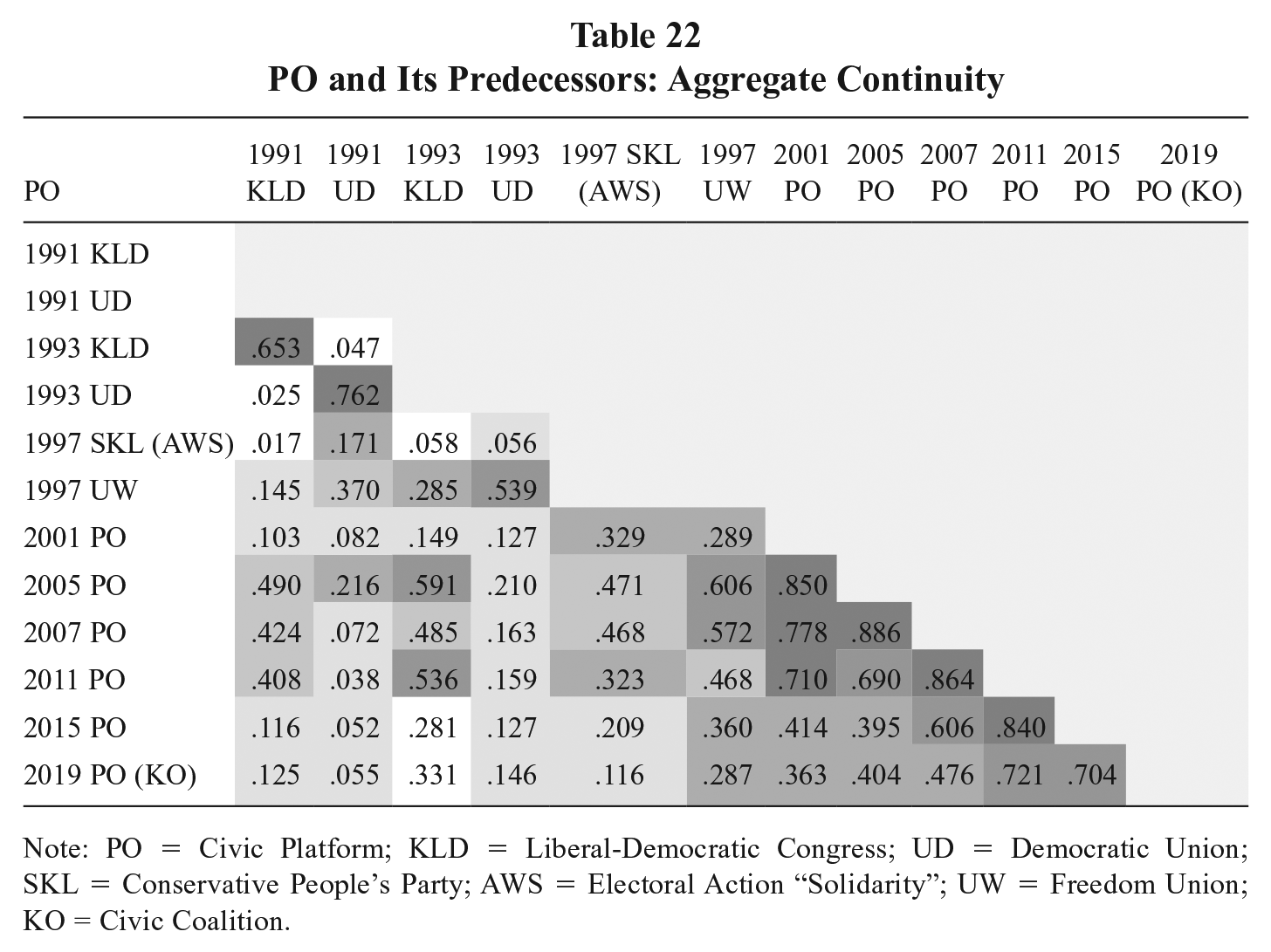
Note: PO = Civic Platform; KLD = Liberal-Democratic Congress; UD = Democratic Union; SKL = Conservative People’s Party; AWS = Electoral Action “Solidarity”; UW = Freedom Union; KO = Civic Coalition.
It is worth noting that we observe here the same trend that was visible in the case of PiS, namely a lowering of overall continuity co-occurring with the year of the new party creation, which interestingly rises again in later years. In the case of PO, similarly to PiS, the value of the aggregate continuity with its predecessors falls in 2001, and then rises for the next three elections to fall again in 2015 and 2019, albeit not to quite as low a level as in 2001 (Table 22). This trend means that while forming a new party might give an impression of change, the party soon returns to the paths of its predecessors, thereby supporting the assumption about continuity. Bearing in mind the prominent level of party leaders’ continuity, we can outline a scenario of development that occurred in the case of PiS and PO: a party leader leaves, creates a very new party, and then over time recreates it in the image of the party he left; the new party increasingly resembles the old one.
Considering the parties created by JKM (Table 23), we can observe the continuation between UPR in the subsequent elections in the early 1990s, as well as the continuation between KNP, KORWIN, and K WiN after 2011. The congruence is visible from election to election but is much lower at longer intervals.
K WiN and Its Predecessors: Aggregate Continuity
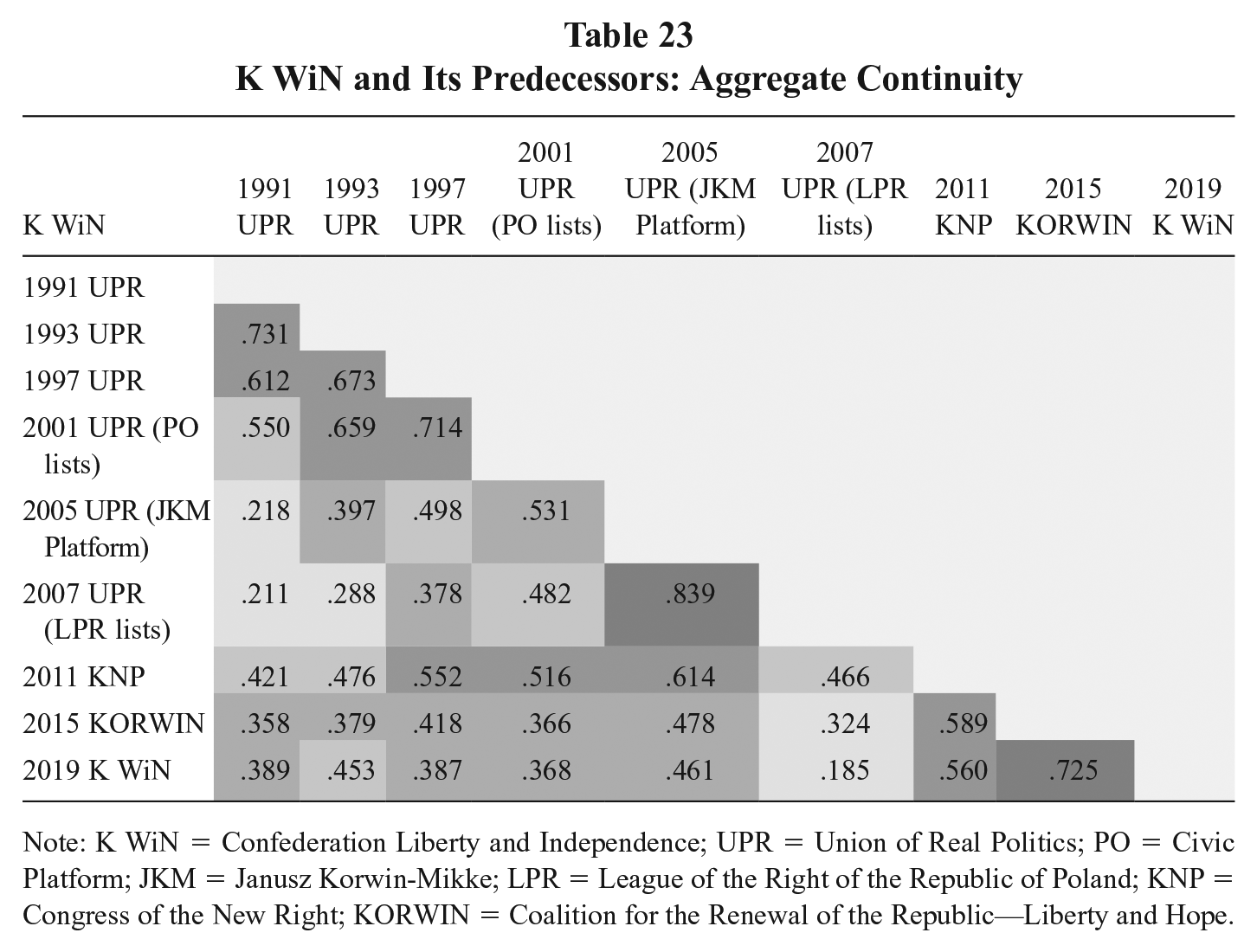
Note: K WiN = Confederation Liberty and Independence; UPR = Union of Real Politics; PO = Civic Platform; JKM = Janusz Korwin-Mikke; LPR = League of the Right of the Republic of Poland; KNP = Congress of the New Right; KORWIN = Coalition for the Renewal of the Republic—Liberty and Hope.
We have shown that party novelty/congruence is multidimensional, and the level of continuity can vary across dimensions. In addition, when a party has a few recognized predecessors, it can be to some extent a continuation of each of them in various areas. However, sometimes it might be necessary to distinguish new parties categorically. As was already stated in the introductory section, a cut-off point is then necessary. We consider a party to be new if the value of the aggregate continuity index is small enough that we can rule out the null hypothesis that it arises at random with 95 per cent confidence—that is, below the 0.05th quantile of the cumulative distribution of the sum of our component indices. It can be analytically determined to equal approximately .242. Taking this into account, we may draw the tentative conclusion that neither of the three analysed parties is definitely new (Tables 21, 22, and 23). They all show various levels of continuity with their predecessors. However, PO at the moment of its creation (2001) displayed a deficient level of congruence with its antecedents: in two out of four cases perceived as its predecessors, the level of continuity was well below the cut-off point.
The examples analysed in the article show that even if the party label and formal status are new, the party can still be to a great extent the continuation of earlier existing entities. It may be also the case with other Polish parties and may mean that the party system is much more stable than we think, with parties continuing some political options that appeared at the beginning of the transformation, often with the same leadership. This may also be the case with party systems in other CEE countries; therefore, further research on the subject is needed.
Footnotes
Appendix
Acknowledgements
We are grateful to Prof. Kevin Deegan-Krause for his valuable feedback and Dr. Dariusz Stolicki for his enormous research assistance. We are also grateful to the Jagiellonian Center for Quantitative Political Science for sharing raw data on candidate continuity. We also thank participants of the panel “Party Systems in Hard Times II. Change and Adaptation” at the ECPR General Conference in 2020 and the panel “Political Parties in Europe” at the IPSA General Conference in 2021 who discussed our theoretical framework and the first results of our research. All remaining errors are ours.
Funding
The article emerged from the research project “Does the novelty bring changes? New parties in the Polish party system” funded by the National Science Centre, Poland, grant number (2019/33/B/HS5/01757) for years 2020–2023. Open Access of this publication has been supported by a grant from the Faculty of International and Political Studies under the Strategic Programme Excellence Initiative at Jagiellonian University.
