




Abstract
New parties can shake up party systems by advancing new issues, influencing established competitors and affecting the dynamics of party competition. However, which kinds of new parties are successful? While the literature has extensively focused on institutional-level and election-level drivers of new party success, the literature on party-level determinants of new party success is scarce. As most studies on new party success focus on party entry at the election level or on new party survival, we argue that these studies suffer from selection bias as they do not leverage information on unsuccessful parties. This is understandable, since quality data on unsuccessful parties’ vote shares, party organizations and ideological characteristics are scant. To overcome this limitation, we examine the party-level determinants of new party success in the Netherlands, including all parties that have participated in national parliamentary elections since 1946. Our findings have important implications for the study of new parties in modern democracies.
Introduction
A political party’s first seat in parliament has an unmistakable impact on its political future. For example, the Dutch Forum voor Democratie (Forum for Democracy, ‘FvD’) was one of two parties to enter parliament in 2017. It grew to become the largest party in the 2019 provincial elections and secured two seats in the 2019 European Parliament. In contrast, the newly formed GeenPeil did not meet the effective threshold of 0.67 per cent of the vote and quickly faded from the political scene. This example from the Netherlands is indicative of the fact that parliamentary representation comes with important resources for emerging parties (Dinas et al., 2015). Moreover, new parties that achieve parliamentary representation have been shown to affect the positions of established parties in parliament (Abou-Chadi and Krause, 2018; Meguid, 2008). In short, there is a large disparity in impact between parties that enter parliament and those that do not (Dinas et al., 2015).
Even so, most studies examining the determinants of new party success arguably suffer from selection bias. Most studies examine the survival of new parties once they have achieved parliamentary representation or limit their focus to parties that have achieved parliamentary entry (Arter, 2016; Bolleyer and Bytzek, 2013; Dinas et al., 2015; Hug, 2000; Lago and Martínez, 2011; Laroze, 2017; Selb and Pituctin, 2010; Tavits, 2006, 2008). Others exclude parties that fall below a certain percentage of votes (Kselman et al., 2016; Van de Wardt et al., 2017). In other words, for data availability reasons, many studies select ‘on the dependent variable’ (but see Van de Wardt and Otjes, 2018 for an exception). While these studies have been highly instrumental in understanding the longevity of neophyte parties, it remains unclear why certain parties meet the effective minimum threshold in the first place and why other parties do not. To learn why new parties succeed, it is necessary to look at those that fail.
Except for a descriptive account of electoral participation of new parties in the Netherlands (Krouwel and Lucardie, 2008), there is very little research and data on the electoral participation of parties that do not have parliamentary representation. One reason is the lack of data on new parties. Standard resources in party politics research such as ParlGov (Döring and Manow, 2019) or the Political Data Yearbook (Clark and Meijers, 2019) include parties only when they have achieved a certain share of the vote. While electoral commissions in some countries, such as the Netherlands, do publish the results for all participating parties, in other countries, such as Germany, unsuccessful parties are grouped as ‘others’ by the electoral commission. Moreover, even if we know which unrepresented parties participated, there are virtually no data available on their policy positions. Resources for party positions based on manifestos (Volkens et al., 2017) or expert judgments (Meijers and Zaslove, 2020; Polk et al., 2017) do not include data on the programmatic positions of unsuccessful parties.
Therefore, research on new party success is often limited to independent variables at the system or election level (Lago and Martínez, 2011; Laroze, 2017; Selb and Pituctin, 2010; Tavits, 2008; Van de Wardt et al., 2017). These studies provide crucial insights into the structural determinants of new party success but fail to explain why one party enters parliament and another does not. Independent variables at the individual party level are needed to answer that question. We fill this gap by examining the determinants of new party success in parliamentary elections in the Netherlands from 1946 to 2017 – focusing in particular on variables pertaining to party organization and party ideology. Given its permissive electoral system, the Netherlands is a good case to study the determinants of new party success (Shugart and Taagepera, 2018). Building on and extending existing descriptive work by Krouwel and Lucardie (2008), we construct a dataset of new party participation in the Dutch Tweede Kamer elections. As data on the policy stances of new parties are not available, we supplement these data with newly coded data pertaining to new parties’ ideological profiles and organizational characteristics.
We find that niche parties are more likely to win votes in parliamentary elections. The previous political experience of the lead candidate and the number of previous unsuccessful attempts to enter parliament also positively affect a party’s success. Last, while splitting from existing parties does not seem to be a fruitful electoral strategy, merging two existing parties does improve electoral performance.
New parties’ emergence, success, and survival
Research on the success of new political parties has examined determinants at different levels: the system, the election, and the party. At the system level, the electoral system and electoral thresholds are relevant to new party success (Harmel and Robertson, 1985; Selb and Pituctin, 2010). Tavits (2006) finds that institutional variables related to the ‘costs of entry’ affect new party formation, such as registration cost, number of petitions necessary to participate and mean district magnitude (see also Van de Wardt et al., 2017).
At the electoral level, the effect of the political opportunity structure on the fate of new parties has been extensively studied. If the political opportunity structure is favourable, new parties are likely to have greater incentives to compete in elections and will have higher chances of winning. Specifically, research shows that both the nature of the issue agenda and the present supply of political parties affect new party emergence and success (Hug, 2001; Lago and Martínez, 2011; Laroze, 2017; Lowery et al., 2011, 2013; Van de Wardt et al., 2017).
In short, the extant research shows that emerging new parties are affected by institutional rules and by the political opportunity structure created by the supply of existing political parties as well as gaps in the issue space. However, while research on new party entry at the system and election levels has blossomed, research on the party-level determinants of new party success remains rather limited. Studies that do examine variables at the party level often use a qualitative approach to focus on party financing, ideological positioning, political leadership, and political survival (Harmel and Svasand, 1993; Lucardie, 2000, 2008, 2009; Sikk, 2012).
In addition, studies on new party success have employed various conceptions of ‘success’ – studying party emergence (its foundation or first participation in elections), party entry (its entry into parliament) and party survival (its persistence in parliament). Bolleyer and Bytzek (2013), for example, conduct a quantitative study with party-level independent variables using survival as the dependent variable) and find that a new party’s affiliations with existing organizations make survival more likely (see also Beyens et al., 2016). Others examine the emergence or ‘birth’ of new parties by studying their first electoral participation (Hug, 2001; Kselman et al., 2016; Lowery et al., 2013; Tavits, 2006). Although this research has been extremely valuable for our understanding of the dynamics of political supply, parliamentary entry is arguably the critical juncture in a party’s lifespan, as it provides parties with a range of resources otherwise unavailable (e.g., Lago and Martínez, 2011; Laroze, 2017).
In this contribution, we study the party-level determinants of electoral success and entry for all parties not represented in parliament prior to the election (see Krouwel and Lucardie, 2008). In doing so, we can advance our understanding of the impact that new parties’ ideological and organizational characteristics have on their electoral success. Our approach also avoids the selection bias that is introduced by focusing solely on successful parties. As Van de Wardt and Otjes (2018) argue, avoiding such selection bias would allow researchers to separate a party’s newness from its electoral success.
The party-level determinants of new party success
New parties can differ from one another in many different ways. Krouwel and Lucardie’s (2008) rich descriptive assessment of new parties in the Netherlands notes that the party-level factors that determine a new party’s performance fall into two categories: party organization and party ideology. We discuss the characteristics of each category below.
Party organization: Leadership
Before establishing themselves in parliament, new parties are mostly defined by their leaders (Arter, 2016). This is the first of three phases of party development as described by Harmel and Svåsand (1993: 72): ‘Few demands are placed upon the party and few visible actions are taken for it by other than its leader’. The fate of the party depends largely on its leader’s qualities (Lucardie, 2000, 2009). Indeed, ‘[t]he ideal leader for phase one will combine the qualities of creator, communicator, and charismatic’ (Harmel and Svåsand, 1993: 74). Influential cases of successful new parties, such as Silvio Berlusconi’s Forza Italia or Pim Fortuyn’s LPF, illustrate this.
Although some new party leaders may possess charisma and organizational skills as a form of raw talent (Arter, 2016), it is likely that many develop these traits throughout their political careers. This can be a liability for new parties. Despite this, a new party’s leader may rely on previous political experience to guide their party towards its first seat. In this way, political experience becomes an underlying cause of effective new party leadership. In addition, when a party leader has previous political experience, it is likely that her new party is of higher news value (Galtung and Ruge, 1965). Experienced new party leaders may also be able to rely on the network they have built through the years to gain access to information or other resources. Therefore, we posit the following hypothesis: Hypothesis 1: If a new party’s lead candidate has previously occupied a seat in parliament, the electoral performance of the party is better.
Party organization: Splits and mergers
Similarly, new parties that originate from existing parties may well have higher chances of success. Such parties may benefit from the organizational maturation of their predecessors. Moreover, if a new party originates from previously existing parties, it can enjoy the benefits of parliamentary representation. As Dinas et al. (2015) argue, parties with parliamentary representation often display greater levels of professionalization and receive more media attention than (new) parties without parliamentary success. Hence, parties that spring from existing parties may have a competitive advantage vis-à-vis competitors that start ‘from scratch’. Two types of parties emerging from existing parties can be distinguished. Splinter parties are parties that have split off an existing party. Merger parties are the result of two (or more) existing parties joining forces. As a merger party springs from multiple existing parties, it may be especially advantaged vis-à-vis other competitors. Harmel and Robertson (1985) and Krouwel and Lucardie (2008) have already noted that splits and mergers tend to be more successful than a newly established party. It is worth verifying these effects with new cases while controlling for other party characteristics. We postulate the following two hypotheses: Hypothesis 2a: If the new party is the result of a merger of two existing parties, the electoral performance of the party is better. Hypothesis 2b: If the new party is the result of a split from an existing party, the electoral performance of the party is better.
Ideology: Niche parties
The ideological profile of a new party is also likely to matter for its electoral success. In particular, parties that address new issues can shake up the party system (Hobolt and De Vries, 2012) – reducing ‘issue slack’ (Lowery et al., 2011). Niche parties compete primarily on a small number of noneconomic issues and take more extreme positions on those issues (Meguid, 2008; Wagner, 2012).
A few well-known categories may come to mind when thinking of niche parties, such as anti-immigrant parties and green parties. However, including only these categories as pertaining to niche parties arguably induces selection bias based on niche party success. For instance, agrarian parties or parties with a narrow ethnic appeal can also be characterized as niche parties (Bischof, 2017). We therefore include a variety of niche parties in our analysis. The notion that new parties can embrace a niche issue for electoral gains is in line with Lowery et al. (2011), who showed that slack in the issue space of a political arena stimulates the emergence of new niches and corresponding new parties. Latching onto such an issue is easier for new parties, which are not constrained by any existing positions – especially if they are not the product of a merger. These conclusions suggest a positive effect of nicheness on new party success. Niche parties draw voters from the ranks by taking extreme positions on specific issues. New parties that promote mainstream issues do not have this ability and are forced to compete with the established mainstream parties. This may decrease their chance of success, as new ‘mainstream' parties do not have the vast resources their competitors have, and voters are less likely to switch parties when the issue they care about is already represented by an established party. Accordingly, the third hypothesis is as follows: Hypothesis 3: If a new party is a niche party, the electoral performance of the party is better.
Data and methods
We study the determinants of new party success based on an original dataset comprising all new parties participating in parliamentary elections since 1946 in the Netherlands. The Netherlands is a suitable case to study new party success for a number of reasons. First, the Dutch open-list proportional electoral system is one of the most permissive electoral systems in the world (Shugart and Taagepera, 2018). Its nationwide electoral threshold, proportional formula for seat allocation, lack of a formal electoral threshold and low effective threshold of 0.67 per cent of the vote make the Dutch electoral system particularly conducive to new party success. This suggests that the fortunes of new party success lie primarily at the party and election levels rather than at the institutional level – making it a suitable case to study the party-level determinants of new party success. In addition, the Dutch case is emblematic of the European-wide processes of decreasing voter alignment (Dassonneville, 2013) and increased electoral volatility (Van der Meer et al., 2015).
Since 1946, new parties have made 237 attempts to enter parliament with an average of 12 new contestants per election. Of those attempts, 28 passed the effective electoral threshold, which has been set at one seat or 0.667 per cent of the vote since 1956. The total list of parties is summarized in Table A1 in the Appendix. Because some parties have made multiple attempts to win a seat, the dataset contains 184 unique new parties. As seen in Figure 1, the number of new parties increased notably since the 1960s, but the number of successful new parties has remained more or less stable.
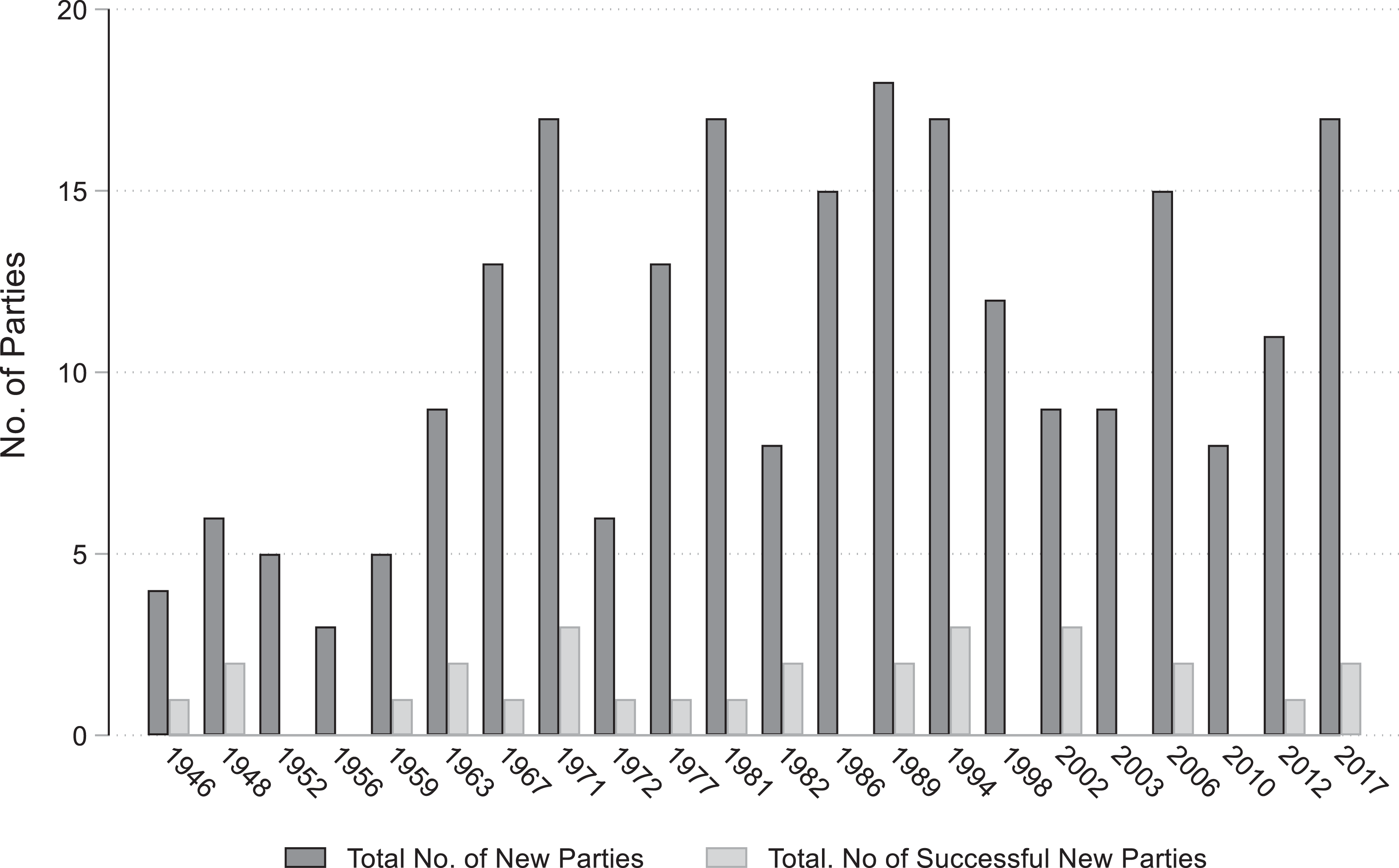
Total number of new parties and total number of successful parties per election year.
The complete list of parties yields interesting historical insight into the Netherlands’ less successful parties, such as the Staatkundige Federatie (‘Political Federation’), which gained merely 31 votes; Partij tot Likwidatie van Nederland (‘Party for Liquidation of the Netherlands’), which propagated abolishing the country; and Partij Geluk voor Iedereen (‘Happiness for Everyone Party’), which included some handwritten poems and a drawing in its party programme.
Operationalizing party newness
The operationalization of party newness is not straightforward. As Otjes (2012: 22) argued, newness is ‘a matter of gradation’. Newly established parties, splits, mergers and renamed parties are all new to some degree. In some instances, it can be unclear whether a party is new. If an existing party continues to exist under a new name, we do not regard the party as new. If a party is newly founded under a previously used name, such as the two instances of Leefbaar Nederland founded in 1999 and 2016, we do regard it as new (DNPP, 2017a, 2017b). Barnea and Rahat’s (2011: 311) definition offers a clear dichotomy between new and non-new parties: ‘[a new party is] a party that has a new label and that no more than half of its top candidates (top of candidate list or safe districts) originate from a single former party’. However, this definition is not feasible in this contribution, as it requires investigating the career of every individual candidate on each list as well as determining which positions are ‘safe’. We consider new all parties that compete in an election without holding a parliamentary seat prior to the election. This allows us to examine explicitly whether the repeated (unsuccessful) participation of a new party affects its electoral success. 1
Dependent variables
We set out to measure the determinants of new parties’ electoral success in a fine-grained manner. The dependent variable used in this study is therefore a continuous variable measuring the number of votes a party has secured. Data by NLverkiezingen.com (NLverkiezingen, 2017) have been used to measure the number of votes for every attempt to enter parliament. These data were validated by sampling results from the Electoral Council (Kiesraad, n.d.). We take the logarithm of the number of votes to ensure normality of the distribution and of the residuals.
We additionally operationalize party success as a dichotomous dependent variable measuring whether a party has achieved parliamentary representation. This was done by comparing a party’s number of votes with the electoral threshold. The electoral threshold was based on a list by NLverkiezingen.com (NLverkiezingen, 2017) and checked by sampling results from the Electoral Council (Kiesraad, n.d.). This dichotomous dependent variable is a less fine-grained measure of party success that may mask underlying variation in new party success. At the same time, one could argue that it is a more theoretically relevant measure, as the actual parliamentary representation of new parties is ultimately decisive.
Independent variables
This section describes the key independent variables we use to estimate our models. Detailed information on the coding procedure can be found in Table A2 in the Appendix.
The first hypothesis stipulates the expectation that the previous political experience of the new party’s leader positively affects the party’s electoral performance. The leader of a party can mean several things: the head of its board, its political leader, or the head of its group in parliament. Since this contribution collects data from elections, the lead candidate (the first name on the ballot) will be regarded as the leader. Political experience is operationalized as a dichotomous variable indicating whether a party leader has previously held a seat in parliament. 2 To create the variable for political experience, the names of all new party leaders were collected. For elections since 1986, these names were included in the official election results downloaded from kiesraad.nl. Reports of earlier election results did not include party names. The party to which each party leader belonged was deduced by comparing the numbers of votes on the official election results with the numbers listed in the dataset. For example, if the list led by both L.R.J. Ridder van Rappard and Nederlands Appèl (‘The Netherlands Appeal') won 24376 votes, Ridder van Rappard must be the leader of Nederlands Appèl. This method is used for all elections between 1946 and 1982. The name of the leader of the Middenstandspartij (‘Middle Class Party') in 1948 could not be traced back.
To determine whether new party leaders previously held a seat in parliament, Parlement & Politiek was searched (Parlement & Politiek, n.d.). Since every Dutch member of parliament in history has a dedicated page on this website, the absence of such a webpage indicates that the party leader in question has not been a member of parliament. If a webpage is present, the leader’s career summary is searched for the mention of a seat in parliament. For example, Charles Welter was a member of parliament in 1937 before contesting elections with Lijst Welter in 1948 (Parlement & Politiek, n.d.). In several instances, the first name on a party’s list varied between voting districts. In these cases, every first name on a list was reviewed. Of all 237 entries, 28 had a leader who had previously held a seat in parliament. Most elections had one or two new parties with politically experienced leaders; the most recent elections were an exception, as four parties were led by experienced politicians.
Hypotheses 2a and 2b put forward the expectation that parties that have split from an existing party or parties that are created through a merger between two existing parties have better chances of electoral success. Splits are operationalized as parties for which the DNPP (2017c) or Vossen and Kooijmans (n.d.) explicitly note that the party has split off from an existing party or whose politician(s) were in parliament immediately prior to the election. However, splinter parties do not necessarily have leaders with political experience. A recent example is VoorNederland (‘For the Netherlands’), which split off from PVV but chose outsider Jan Roos as its leader. Merger parties are the result of the integration of two existing parties represented in parliament. A party is thus considered a merger party when it is characterized as such by DNPP (2017c) or Vossen and Kooijmans (n.d.) or when both constitutive parties have previously occupied seats in parliament.
In contrast to parties represented in parliament, data on new parties participating in elections are scarce. While manifesto data (Volkens et al., 2017) or expert survey data (Polk et al., 2017, Meijers and Zaslove, 2020) are rich data sources for successful parties, they do not offer information on the leagues of unsuccessful parties in Europe’s democracies. To capture the ideological direction of all new Dutch parties, we therefore code parties’ ideological directions on the basis of available party materials such as manifestos and pamphlets. Most texts were retrieved from the DNPP (2017c) and the Repertorium Kleine Politieke Partijen 1918–1967 made available by the Huygens Instituut (Vossen and Kooijmans, n.d.). For all indicators, the issues must be presented as a core part of the party programme.
Hypothesis 3 stipulates that niche parties have higher chances of electoral success than non-niche parties do. Whether a party is a niche party or not is measured with a dummy variable. As defined earlier, niche parties are ‘parties that compete primarily on a small number of noneconomic issues’ (Wagner, 2012). We measure 10 different forms of nicheness as laid out in Table 1. A party is considered a niche party only if the ‘niche issue’ takes centre stage in its party manifesto. The niche issue coding is mutually exclusive. In cases where multiple niche issues could apply (e.g., anti-immigration and European integration), the most salient niche issue in the party’s documentation is selected. The ‘other’ category is a residual category for parties that focused on one, often idiosyncratic, issue. Such issues include safe traffic, emancipation of unmarried citizens, and even ‘abolishing the country’.
Niche categories.
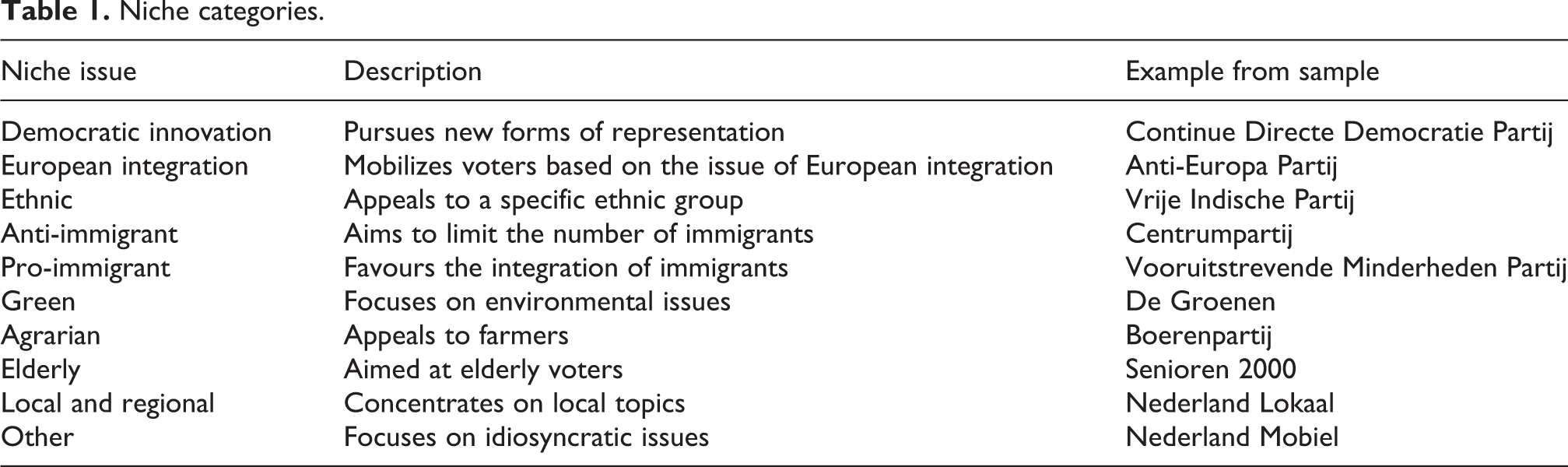
Table 1 shows the full list of niche party types that have been coded along with a description and an example from the sample. Figure 2 shows the number of new niche parties per category and whether a party has achieved parliamentary representation. Interestingly, we see that parties advancing the rights of ‘the elderly’ are the most ubiquitous niche parties in the Netherlands, followed by parties proposing democratic innovation and parties in the residual ‘other’ category. Elderly and anti-immigrant parties are the most successful niche parties.
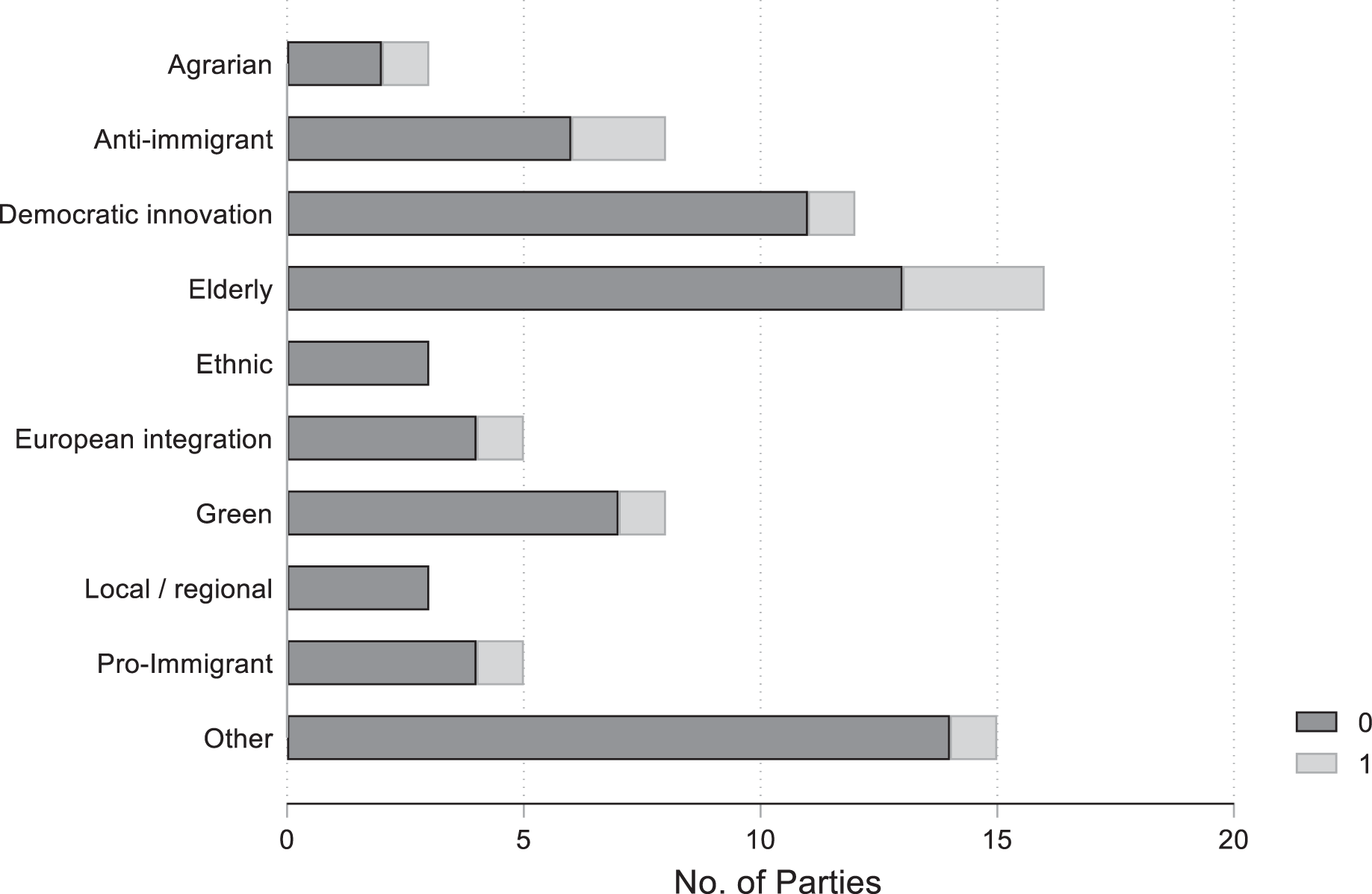
Niche parties per category.
Control variables
We add several control variables to the analysis to avoid unobserved party-level or election-level variables confound our findings. At the party level, we control for a party’s economic left–right ideology. Given the lack of fine-grained, continuous data on unsuccessful parties, we operationalize a party’s left–right position as a pair of dichotomous variables. Left-wing parties favour equality, redistribution, reduction of poverty, labour rights, socialism, or communism. Right-wing parties support freedom, a small government, libertarianism, tax relief, and a free market. If the economic position of a party cannot be characterized as either left or right, the party scores ‘0’ on both dummy variables. Given that niche parties do not prioritize left–right issues, these parties score ‘0’ on both dummy variables. 3
In a robustness test in the Appendix, we also measure a party’s cultural position. An emphasis on tradition, family values, or national identity points towards a culturally conservative party, whereas pacifism, emancipation, idealism, international integration, the embracing of modern issues, or the legalization of soft drugs are characteristics of a culturally progressive party. In a robustness test, we also control for confessional parties to ensure that the religious character of the party does not confound our results. Multiple parties in our dataset were derived from particular religious denominations, such as Catholicism, Protestantism, Islam, and other religious groups.
Often, new parties do not succeed on their first attempt but rather contest elections multiple times before entering parliament. In the Netherlands, the most prominent example is the Socialist Party, which succeeded in achieving representation after five fruitless attempts. This shows that not all is lost for new parties that fail on their first try. On the contrary, previous attempts may contribute to the political experience of new party leaders. It is therefore important to control for the number of previous attempts. Previous attempts are measured as a count variable ranging from 0 to 5.
In addition, we control for a number of election-level variables. To account for time trends in the data, we include a variable measuring the year of the election. As the extant research has amply demonstrated, the propensity of new party success depends on the available political supply in the party system (Lago and Martínez, 2011; Lowery et al., 2011). We therefore control for the effective number of electoral parties (ENEP) in the previous election (t − 1) – measured on the basis of ParlGov data (Döring and Manow, 2019).
Electoral volatility may also affect new parties’ fortunes. High volatility may signal to parties that voters are willing to switch loyalties. At the same time, high volatility signals that competition is high, which might deter new party entry (Van de Wardt and Otjes, 2018). We measure the level of volatility in the previous election (t − 1) on the basis of the index developed by Pedersen (1979) using data collected by Emanuele (2015). 4 Furthermore, aggregate-level voter turnout may affect new party success. As Lago and Martínez (2011) argue, low turnout signifies electoral market failure – suggestive of a positive political opportunity structure for new parties. We control for turnout using data from IDEA (2019). As the economic performance of a country can affect new parties’ success (Van de Wardt and Otjes, 2018), we control for the level of GDP (growth) at the time of the election on the basis of World Bank data (2019). Last, we control for the change in the effective electoral threshold in the Netherlands in 1956 with a dummy variable. In 1956, the number of parliamentary seats increased from 100 to 150, lowering the effective electoral threshold.
Model specification
To examine the determinants of new party success, we use two modelling strategies. First, we estimate OLS regression models with the percentage of votes a party secures as the dependent variable. Since we have a few repeating parties that participated again after initial unsuccessful attempts, we cluster the standard errors by party. To account for unobserved changes over time, we include a control variable measuring the election year. Second, we estimate probit regression models to assess the determinants of party success measured as a dichotomous variable of whether or not a party achieved parliamentary representation. In these models, we also cluster the standard errors by party. To appropriately assess the effect of time on our estimates, we also estimate multilevel mixed-effects linear regression models in which parties are nested in years (Table A5). Figure A1 shows that there is some variation over time in our main dependent variable. However, the intraclass correlation of Year is very low at 0.034, suggesting that most variation is at the party level and not the election level. We also specify a regression model with year-fixed effects (Table A6) and a model in which we cluster our observations per election year (Table A7). 5
Results
Table 2 shows the models estimated by OLS regression analysis. 6 Model 1 shows the results for the independent variables of interest without election-level control variables. Model 2 shows the complete model including all control variables.
OLS regression analysis.
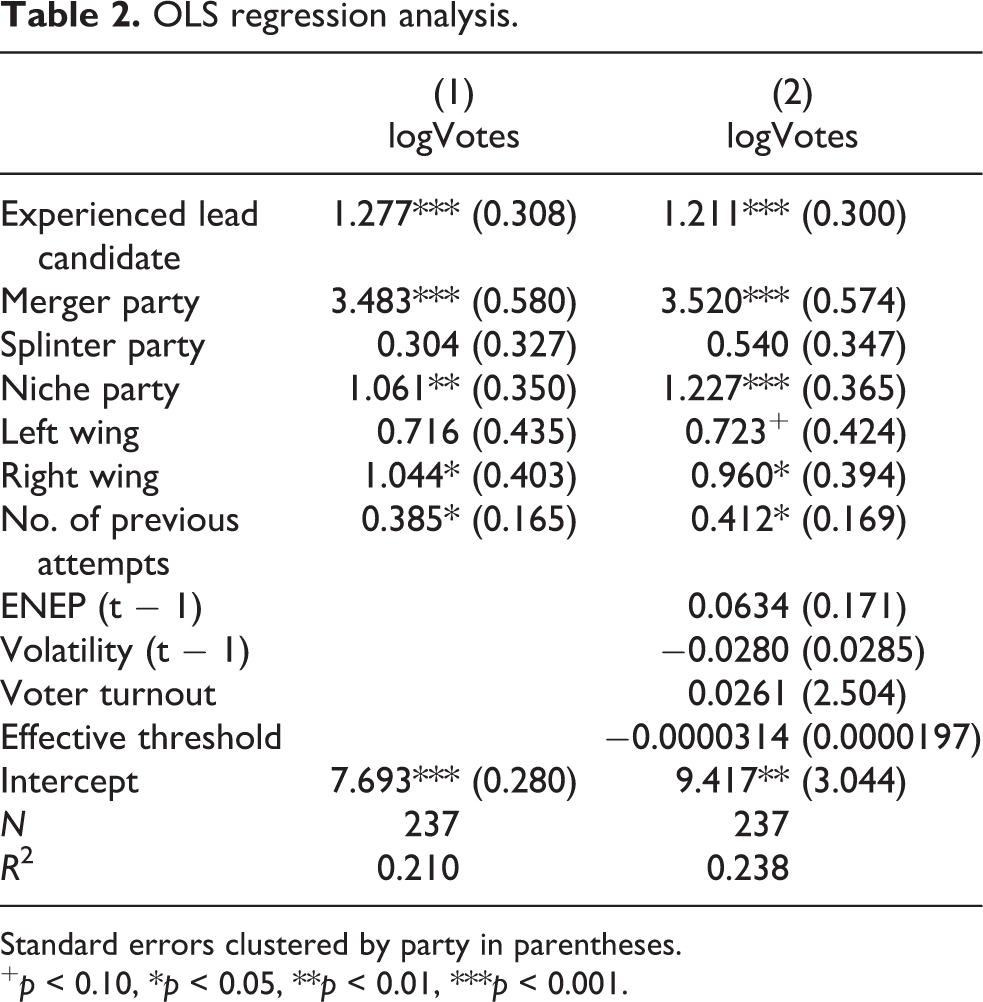
Standard errors clustered by party in parentheses.
+p < 0.10, *p < 0.05, **p < 0.01, ***p < 0.001.
Hypothesis 1 spelled out the expectation that if a new party’s lead candidate has previously been a member of parliament, her or his party has greater chances of electoral success. The coefficient for ‘experienced lead-candidate’ shows a positive and statistically significant effect in both Model 1 and Model 2. This allows us to accept Hypothesis 1. Hypotheses 2a and 2b formulated the expectation that parties that resulted from mergers and splits have greater chances of electoral success.
Models 1 and 2 show that parties resulting from a merger indeed have higher chances of electoral success. Hypothesis 2a can therefore be accepted. Being a splinter party, i.e. a party that split from an existing party, also has a positive effect on electoral success, but that effect is not statistically significant. However, the variable does show a statistically significant effect in some of the alternative model specifications in the Appendix (Tables A4 and A5). Hence, while there is suggestive evidence that splinter parties have an electoral advantage over other new parties, we tread with caution and reject Hypothesis 2b.
Hypothesis 3 postulated that niche parties have greater chances of electoral success, as they address issues often ignored by mainstream parties. The coefficient for niche party is positive in both Model 1 and Model 2 and statistically significant at the 0.05 level. 7 Therefore, we accept Hypothesis 3. However, this average effect likely masks much variation in the niche party variable. We therefore estimate a separate model with the niche party categories as separate dummy variables. Figure 3 shows a coefficient plot of the niche party categories as separate independent variables. 8 We find a positive, statistically significant effect for anti-immigrant parties, agrarian parties, elderly parties, ethnic parties, and local or regional parties as well. By contrast, green parties and EU-focused parties are not more likely to be successful than ‘non-niche’ new parties are. This picture deviates somewhat from the established view in the literature on the ideology of newly emerging parties (see, for instance, Van de Wardt et al., 2017). Anti-immigrant parties, green parties and Eurosceptic parties have arguably been most successful in terms of survival as well as political impact (Abou-Chadi, 2016; Meijers, 2017). However, in terms of initial electoral success, a wider array of political parties come to the fore, including parties such as agrarian parties or elderly parties. Whereas anti-immigrant parties seem to do well in their first elections, green parties do not. This also highlights the importance of avoiding the selection bias produced by an exclusive focus on parliamentary entry and survival. At the same time, while agrarian parties, elderly parties, ethnic parties, and local or regional parties have higher chances of initial success, this does not necessarily speak to their electoral survival or impact. In contrast, the opportunity structure for such parties may be rooted in these parties’ failures to build strong, cohesive, and enduring parties, as the recent collapse of the Dutch elderly party 50Plus suggests.
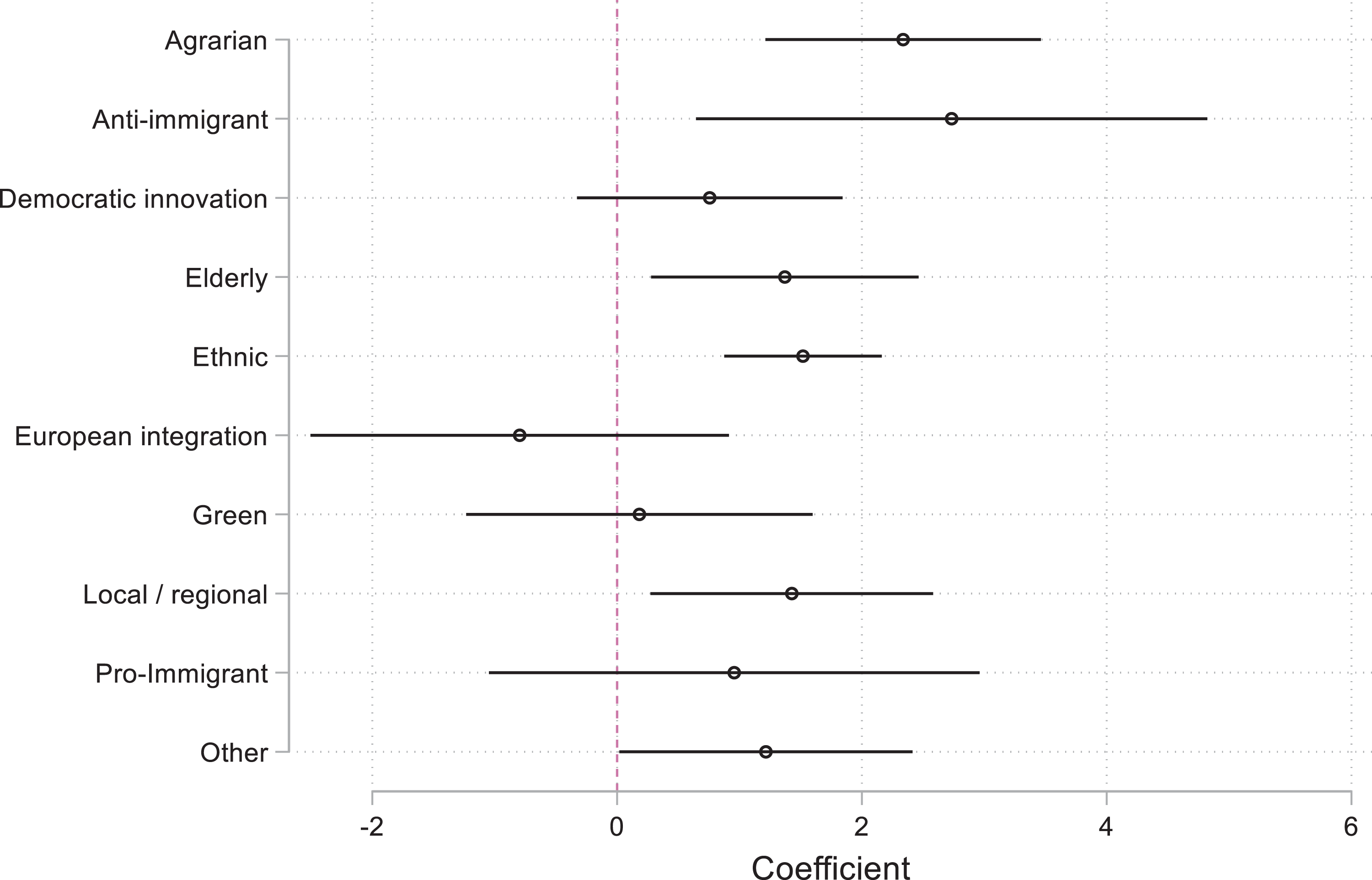
Coefficient plot of niche party dummy variables (with 95% confidence intervals).
Turning to the control variables in Table 2, we see that being a right-wing party has a positive and statistically significant effect on electoral success. The coefficient for the left-wing party is slightly smaller and not consistently significant across the models. In addition, parties that have attempted to enter parliament previously have a slight advantage – suggesting that perseverance pays off. The election-level control variables do not have an effect on our dependent variable.
In addition to the OLS regression, we estimated a probit analysis taking a dichotomous variable that measured whether a party achieved parliamentary representation as the dependent variable. 9 This analysis is inevitably less fine-grained, as the dependent variable masks much of the variation. One could also argue that it is theoretically more relevant, as it captures the crucial distinction between failure and success in achieving parliamentary representation. Figure 4 shows a coefficient plot of the probit regression analysis for our key independent variables. The coefficient plot is based on the full model with control variables. 10 The parliamentary experience of the lead candidate and being a merger party are positively related to achieving parliamentary representation. By contrast, and in line with the OLS regression, being a splinter party does not affect success. In line with the OLS regression analyses, the coefficient of the niche party variable is positive, but it is not statistically significant in the probit model. This suggests that emphasizing niche issues does not suffice to make it into parliament.
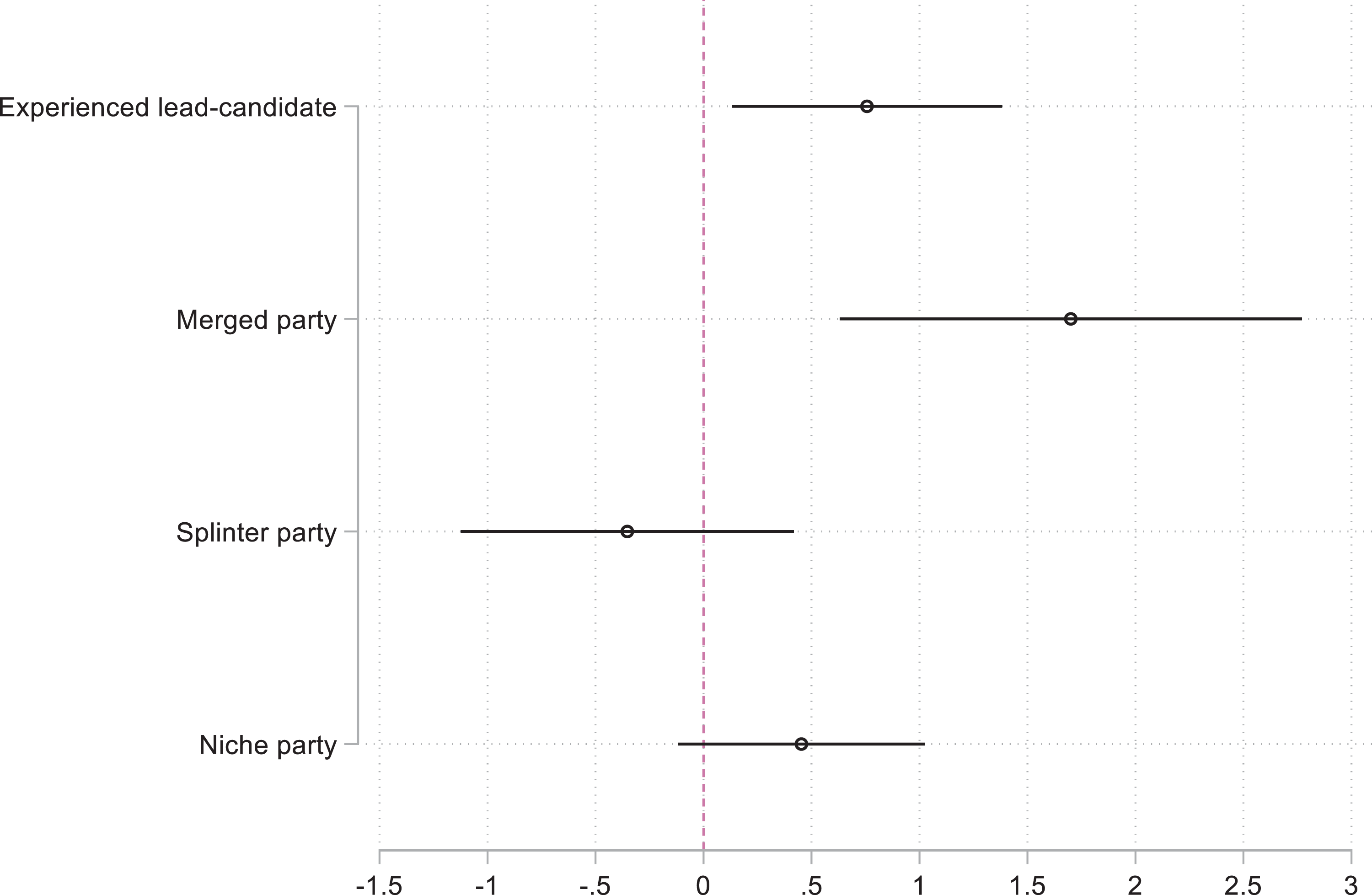
Coefficient plot of key independent variables of the probit regression analysis (with 95% confidence intervals).
Conclusions
All parties were once new. Seventy years after winning its first seats in parliament, the conservative-liberal party VVD is the leading governing party in its third consecutive cabinet, while parties such as the Middenstandspartij (‘Middle Class Party'), Onafhankelijke Nationale Groep (‘Independent National Group') or the Partij voor Wereldregering (‘Party for World Government') are long forgotten. Whereas the VVD achieved parliamentary representation in 1948, its fellow new competitors did not. In this article, we set out to examine why certain new parties are successful, while others are not.
While the literature on new party success has amply focused on the effects of institutional characteristics and election-level variables on new party success, studies examining the party-level determinants of new party success are more limited. Moreover, existing party-level research on new party success arguably suffers from selection bias in favour of entry, as Van de Wardt and Otjes (2018) also note. While we have rich information resources on parties that did achieve parliamentary representation, we lack data on parties that did not.
In this contribution, we have built on previous work by Krouwel and Lucardie (2008), who collected a list of new parties competing in elections in the Netherlands. In doing so, we created a unique data set in which we coded all new parties’ organizational and ideological characteristics. A total of 184 new parties contested elections between 1946 and 2017, which amounted to 237 attempts to enter parliament.
In terms of party organization, we found, as hypothesized, that new parties with a lead candidate with previous parliamentary experience tend to perform better in elections. Lead candidates who have served as MPs bring much political experience to the table. In addition, individuals who have established a reputation in national politics benefit from higher ‘brand awareness’ by both voters and the news media. Future research should examine the importance of previous political experience in other political domains, such as local political, civil society, or political party organizations.
As hypothesized, we also found that parties that are the result of multiple parties joining forces have higher chances of electoral success. By contrast, splinter parties, which have split off from an existing party, do not have significantly better electoral results than those of other new parties. This difference might be explained by a difference in resources, as mergers combine the resources of existing parties, while splinter parties start from scratch (Krouwel and Lucardie, 2008). Strongly partisan voters may also have hostile feelings towards politicians who ‘steal’ seats from their preferred party (Dalton and Weldon, 2007; Ibenskas, 2020). Future research should therefore examine the impact of both party resources and leadership dynamics on new party success.
With respect to party ideology, we hypothesized that niche parties, which primarily mobilize on noneconomic issues, have greater chances of entering parliament. Our empirical analyses confirmed this supposition. This is in line with issue competition theory (De Vries and Hobolt, 2012) and the literature on agenda slack (Lowery et al., 2011, 2013; Van de Wardt et al., 2017), which suggests that when new parties emphasize issues previously ignored by established political parties, they have better chances of electoral success. However, a niche party profile cannot suffice for parliamentary entry, as the probit analysis shows.
To our knowledge, our contribution is the first study assessing the party-level determinants of new party success on the full population of new parties participating in national elections since WWII in a given country. While our study empirically focuses on the Netherlands, our results also have bearing on our understanding of new parties in other modern European democracies. Previous political preference, party history and a party’s niche ideology are also likely to affect political success for new parties in other European countries. That being said, new party success in other political contexts is affected by different institutional rules and settings that might interact with key party-level variables. For example, it is possible that strategic voting in less proportional systems makes niche parties unlikely winners. As the British case of UKIP shows, different electoral rules can increase the discrepancy between the number of votes obtained and the seats secured in parliament. To assess the moderating effects of institutional characteristics, future research should examine the party-level determinants of new party success in other European democracies.
Our study demonstrates that party-level variables are essential in understanding new party success. Even when controlling for election-level factors, party-level effects remain crucial. Although variables at electoral or national levels are of course important, this study shows that variables at the party level need to be included in the body of research on new party success. This presents a challenge for new party scholars, as quality party-level data on unsuccessful parties are scarce. Enriching existing data with the information of parties that have failed to enter parliament will open up possibilities to dig deeper into which characteristics allow a party to cross the parliamentary threshold. In particular, determining the policy positions of Europe’s new parties and comparing these with the positions of their competitors would yield relevant knowledge.
We have argued that studying the characteristics that distinguish one party from another is the only way to uncover the richness of new political parties. It shows the diversity of the supply side between different historical periods, from the Revolutionary Communist Party of 1948 to the Happiness for Everyone Party of 1986. As such, new parties offer a particularly colourful insight into party politics.
Supplemental material
Supplemental Material, sj-pdf-1-ppq-10.1177_1354068820966573 - New kids on the ballot: The party-level determinants of new party success
Supplemental Material, sj-pdf-1-ppq-10.1177_1354068820966573 for New kids on the ballot: The party-level determinants of new party success by Rein Wieringa and Maurits J Meijers in Party Politics
Footnotes
Declaration of conflicting interests
The author(s) declared no potential conflicts of interest with respect to the research, authorship, and/or publication of this article.
Funding
The author(s) disclosed receipt of the following financial support for the research, authorship and/or publication of this article: Maurits Meijers gratefully acknowledges financial support from the Dutch Organization for Sciences (NWO Veni Grant VI. Veni.191R.018, ‘The Reputational Cost of Party Policy Change’).

Supplemental material
Supplemental material for this article is available online.
Notes
References
Supplementary Material
Please find the following supplemental material available below.
For Open Access articles published under a Creative Commons License, all supplemental material carries the same license as the article it is associated with.
For non-Open Access articles published, all supplemental material carries a non-exclusive license, and permission requests for re-use of supplemental material or any part of supplemental material shall be sent directly to the copyright owner as specified in the copyright notice associated with the article.
