




Abstract
This study introduces a population-ecological approach to the entry and exit of political parties. A primary proposition of population ecology is that organizational entry and exit depends on the number of organizations already present: that is, density. We propose that political parties mainly experience competition from parties in the same ideological niche (left, centre, right). Pooled time-series analyses of 410 parties, 263 elections and 18 West-European countries largely support our expectations. We find that political parties are more likely to exit when density within their niche increases. Also there is competition between adjacent ideological niches, i.e. between centrist and right-wing niches. In contrast to our expectations, neither density nor institutional rules impact party entry. This raises important questions about the rationale of prospective entrants.
Studies on the organizational nature of the party system are among the classics of comparative political science. Especially the question of why some countries have more parties than others has received considerable attention (e.g. Lowery et al., 2010). This is unsurprising. The number of parties shapes several important phenomena such as the electoral choices on offer and the nature of coalition politics. Nonetheless, these studies provide only implicit arguments on party entry and exit. The argument, for instance, that low proportionality leads to a low number of parties does not tell whether the actual parties competing in subsequent elections will remain the same or change. Yet, party entry and exit likely shape – in a substantial way – the phenomena mentioned earlier. Party systems with a high degree of turnover provide the opportunity for new ideas to rise on the political agenda, but may complicate coalition politics, as illustrated by the recent breakthrough of ‘Podemos’ and ‘Ciudadanos’ in Spain. ‘Frozen’ party systems, in turn, may be easier to govern but insensitive to societal changes like shifting voter preferences. In this article, we develop a new population ecological theory on party entry and exit. We examine under which circumstances new parties find fertile grounds, and when parties find it more difficult to survive.
Our article builds upon population ecology (Gray and Lowery, 1996) as well as ecologies of ideologies (Barnett and Woywode, 2004). Population ecology is a body of literature within organizational sociology analysing the entry and exit of organizations such as social movements (e.g. Minkoff, 1997), interest groups (e.g. Gray and Lowery, 1996), or newspapers (e.g. Boone et al., 2002). Except for Lowery et al. (2010, 2013), no efforts have been made to apply this theory to parties. The primary proposition of population ecology is that organizational entry and exit depends on the number of organizations already present: that is, density. At higher levels of density, simply too many organizations (in our case parties) compete for the same scarce resources (in our case voters). Subsequently, existing organizations will exit and new organizations will be inhibited from entering (Hannan and Freeman, 1989). Our main contribution comes from the choice to look at the number of parties and their entry and exit within ideological niches (left, right, and centre) rather than at the system level. Parties compete for voters with ideologically proximate parties, not with parties at the other end of the political spectrum. Consequently, population ecology’s central assumption of density dependence – the effect of density on party entry and exit – must be assessed within and between ideological niches. We link the organizational ecological argument about within-niche competition and competition between adjacent niches to the proximity model (Downs, 1957), and competition between the flanks (i.e. the right and left-wing niche) and the centre to the directional model of voting (MacDonald et al., 1991).
Our population ecological theory brings several important innovations to the party competition literature. First, the state of the art considers either party entry or exit. However, the two are related processes; exiting parties provide room for new entrants. The demise of Democrazia Cristiana, for instance, led to the rise of a wide array of new parties, including Forza Italia. Therefore, we introduce a new theory that simultaneously explains both entry and exit. Second, besides the fact that extant literature almost exclusively focuses on party entry, it also tends to focus mostly on the entry of specific party families like the Greens (e.g. Kitschelt, 1988) or Radical Right (e.g. Rydgren, 2004), which also implies selection bias towards relatively successful new parties. Our theory explains the entry and exit of any kind of party. We realize that attempts do exist like the theory of strategic party entry that are generic (Cox, 1997; Tavits, 2006) and also the few studies on new party survival travel beyond individual party families (e.g. Beyens et al., 2016; Bolleyer, 2013). Yet, and that is our third contribution, despite their importance, these studies ignore the role of environmental pressures, density, considered by population ecology.
Formal citizen-candidate models do stress environmental pressures: the entry of candidates is endogenous to political competition (Besley and Coate, 1997; Osborne and Slivinski, 1996). By means of computer simulations – agent based models (ABM) – these insights have been implemented (e.g. García-Díaz et al., 2012; Laver and Schilperoord, 2007). New parties will emerge at locations where party density is low. As voters are being poorly represented in these regions, dissatisfied citizen will start new parties. By the same token, parties will ‘die’ in the more dense regions of the space. Yet, how these insights translate to the real world has not been examined in a systematic way. This study seeks to fill this void. Additionally, unlike the ABM literature, our population ecological model not just examines how party entry and exit is affected by proximate parties (density effects within niches), but also how non-proximate parties impact each other’s survival chances (density effects across niches). Further, we use different dependent variables and focus on whether parties regardless of their electoral viability enter or exit elections, whereas ABM define entry and exit as being above or below an electoral threshold set by the analyst. Last, citizen-candidate models assume that parties are built from scratch by dissatisfied citizens; our model includes each type of entry and exit (e.g. mergers, splits, etc.).
Our longitudinal and cross-sectional study focuses on 18 West-European countries over the full post-war time period. The findings on party exit show, first, that parties mainly compete with parties in the same niche. Second, in case of competition between niches, we find that the centre only experiences competition from adjacent right-wing parties with whom they have resource overlap. There is no evidence that centre parties experience competition from the left. From the directional model (MacDonald et al., 1991) it can be inferred that competition effects come from the flanks on the centre; yet our findings lend more credence to the proximity model (Downs, 1957). We find that parties compete with ideological likeminded parties, but not that centrist positions are specifically penalized. Party entry, in turn, turned out to be independent of niche density and other variables capturing the costs, benefits and likelihood of successful entry.
Theory and hypotheses
This study applies insights from population ecology to political parties. Organizational ecologists take inter-organizational dynamics as central to understanding the structure and development of any population of organizations (Gray and Lowery, 1996; Hannan and Freeman, 1989). A primary proposition of population ecology is that organizational entry and exit depends on the number of organizations already present: that is, density. The density-dependent model’s basic assumption is that organizations in a population rely on the same finite resources (e.g. customers, funding and members) to exist. When the number of organizations in a given population rises – increasing density – competition increases. At a certain point the carrying capacity – the maximum number of organizations sustainable at a given resource level – will be reached, causing lower rates in organizational entry and higher rates in organizational exit. 1 In case of party systems, Lowery et al. (2010, 2013) suggest that the carrying capacity is set by resources like electoral institutions, cleavages and the spread in the parliamentary issue agenda.
The density-dependence model further posits that it takes time to build trust among participants in organizations such as activists, members, ‘eminent grises’ and leaders in the case of political parties, as well as with their clientele – in case of parties: voters. Once standards of procedure are established in an organization, the expense of change increases greatly (Hannan and Freeman, 1989: 138). The model therefore claims that organizations tend towards inertia, which makes them more likely to exit than to change. This implies that change in an organizational population occurs through the competitive replacement of less successful organizations with more successful ones rather than through existing organizations changing their structure or goals.
We believe that political parties may also display a considerable degree of inertia, especially with regard to their ideology (as compared to leadership or campaign strategies). Downs (1957: 142) proposes, for instance, that parties cannot ‘change ideologies as if they were disguises’. Once a party has placed its ideology ‘on the market’, it cannot just abandon or radically alter it without being punished. Rational voters will refuse to support unreliable parties and no party can afford to acquire a reputation for ideological zig-zagging. Admittedly, a number of studies show that parties adjust their policy platforms in response to electoral stimuli (Adams, 2012). Yet, even parties that aim to maximize their votes or their control over public office are constrained by ideological principles when responding to electoral incentives. Thus, while parties undeniably change their party platform at times, they should also display a considerable degree of inertia.
Competition within and between ideological niches
The density-dependence model assumes that all organizations in a population compete for the same resources; yet, recent population ecological studies on social movements have found that organizational interdependence is conditioned by similarities and dissimilarities in ideologies and identities. Hence, competition should be examined within ideological niches rather than assuming that the full sector of organizations competes for the same voluntary, identity-building and political resources (e.g. Barnett and Woywode, 2004). These studies also refute the common assumption that like-minded organizations cooperate – rather than compete – with each other to achieve their shared goals. In reality, these organizations are primarily competing with each other for limited common resources (Vermeulen, 2013). Therefore, we subdivide the party system in ideological niches.
A distinction can be made between the fundamental and realized niche. The fundamental niche is the resource space in which an organization can persist in the absence of competition. The realized niche is the subset of the fundamental niche in which the organization can sustain itself in the presence of competitors (Hannan et al., 2007). In this article we apply the perspective of the realized niche on party systems. Organizations tend to stay within their niche, which is also true for parties. A party tends to stay committed to its ideology, for policy reasons, but also because attempts to radically alter its positions in hopes of appealing to voters who are at considerable positional distance will likely lack credibility (Downs, 1957). Parties are specialist organizations operating in a particular niche within a party system. Their survival depends on the support of distinct segments of the electorate, from which they obtain their resources in the form of voters, members and activists.
This implies that niches in the party system should be identified on the basis of how parties position themselves along the most important ideological cleavages. Recent studies have used the ‘left-right’ dimension as a dominant dimension of party conflict (e.g. De Vries et al., 2013). The left-right dimension not only includes economic left-right issues, but also new politics and cultural issues have been integrated in this dimension (Van der Brug and Van Spanje, 2009). Theoretically, there are strong incentives for political parties to fight their conflicts on a single dimension rather than multiple. New issues may bring about voter realignment and reshuffle the relationships among parties (Schattschneider, 1960). We therefore divide the party system into three distinct niches: left, centre and right.
In the following lines we outline our hypotheses. To start, parties with similar ideological positions compete for the same voters (Downs, 1957; MacDonald et al., 1991). Since parties closely positioned to one another on the left-right dimension share the same pool of party members, activists and voters, we believe that competition will be most strongly accentuated among parties that share the same niche. For instance, the German left-wing niche includes the Social Democrat SDP, the Greens and the Socialist ‘Die Linke’. This produces substantial competitive pressures that may force any one of these parties out of business and makes the successful establishment of a new German left-wing party unlikely. We thus expect that the density within a party’s own niche (1) increases its odds of exit, while simultaneously decreasing the likelihood of new party entry within that niche (2) that these effects are stronger than competition effects between niches: H1: As density within a party’s niche increases, its odds of exit increase, while simultaneously the likelihood of entry within its niche decreases. These competition effects are stronger than those between niches. (Within-Niche Competition Hypothesis) H2: As density in an adjacent niche increases, a party’s odds of exit increase, while simultaneously the likelihood of entry within its niche decreases. These competition effects are stronger than those between non-adjacent niches. (Adjacent Competition Hypothesis)
Based on this, we expect more densely populated ideological flanks to compel voters to discount a centrist policy position. This will ultimately lead to further reducing the utility to vote for a centrist party. Thus, higher density at the flanks will inhibit centrist party entry and fuel centrist party exit. H3: higher density at the flanks will inhibit centrist party entry and fuel centrist party exit. These competition effects are stronger than those from the centre to the flanks. (Directional Competiton Hypothesis)
Alternative explanations
Our hypotheses posit that parties enter or exit in response to the number of parties in their own niche or in different niches. Yet, some party systems or niches sustain more parties than others, which we measure by means of several control variables.
At the level of niches, market size could increase the number of sustainable parties. Subsequently, the larger the proportion of the electorate that can be placed within a niche, the higher the entry and lower the exit rates of parties in that niche. Second, more fragmented voter preferences within a niche may produce higher entry and lower exit rates since there are more distinctive groups for parties to represent. Last, Lowery et al. (2013) have demonstrated that a fragmented parliamentary issue agenda increases the carrying capacity since parties have more room to distinguish themselves from competitors. Therefore, in niches depicting higher spread in parties’ issue emphases, we expect more entry and less exit of parties.
At the party system level, we control for the proportionality of the electoral system since parties may be more likely to enter if they can more easily convert their votes into seats. Since recurrent failure to gain representation is hard to cope with, disproportional electoral systems could also fuel exit. Also, we consider a country’s social heterogeneity. Some studies claim that more heterogeneous societies increase the likelihood of new issues emerging, which subsequently increases the likelihood of entrance (e.g. Hug, 2001) and could decrease the likelihood of exit. Additionally, we include some controls that build upon Tavits’ (2006) theory of strategic entry, which argues that a party enters if the benefit of entry times the probability of success equals the costs of entry. The likelihood of success should decrease with the institutionalization of the party system. Strategic voting plays a greater role if voters have clear expectations of which parties will be viable on Election Day. In turn, the costs of entry refer to arrangements like the number of signatures required to start a party. Last, the benefit of political office is captured by a country’s degree of corporatism. In corporatist countries, government and parliament are less important domains for conflict resolution, making party entry less attractive. Even though these controls pertain to party entry, arguably, parties will be more likely to exit if entry is facilitated: easier entry provides more candidates for failure. Also, parties could be more likely to exit if their leaders can easily start new parties. Therefore, we will also include these controls in our party exit analyses.
Finally, and at the level of individual parties, we include the age of the party in our models on exit. According to the ‘liability of newness’-thesis, younger organizations are more likely to fail (e.g. Freeman et al., 1983).
Data and operationalizations
To test the hypotheses, we compiled a longitudinal dataset containing information for 18 West-European countries on every democratic post-war election up until 2013. 2 Endeavouring to make our three ideological niches functionally equivalent over time and across countries, we chose to restrict our analysis to Western Europe. Post-communist party systems are not only often structured by different cleavages (e.g. state vs. church, communist vs. post-communist), but in many instances, also by multiple cleavages (Bértoa, 2014), which would violate our assumption of uni-dimensionality.
Operationalizations
To derive data on party exit, entry, density and left-right positions, we turned to the ParlGov Database (Döring and Manow, 2015), which contains information on elections for all countries under examination for the entire post-war period. Parties are included in this database if they gain at least one per cent of votes in an election. For each party that once in its existence was viable enough to meet this threshold and enter the database, we asserted that all the elections in which it ran are included. 3 We abided by Parlgov’s one-percent threshold, as this prevents us from overestimating niche density with totally unviable parties.
Our first dependent variable, party exit in national elections, is dichotomous (0 alive, 1 exit) and measured at the level of party/elections. A party exits the last election it contests before never again reappearing on the national ballot (Lowery et al., 2013). For specific reasons explained below, our second dependent variable, party entry, varies at the level of elections and captures the number of parties that entered the ballot for the first time. Our focus on ballot entry and exit implies that we capture a party’s persistence: whether it remains motivated to contest elections. This not necessarily correlates with its sustainability, i.e. whether it remains represented in parliament (also see Bolleyer, 2013).
To eliminate bias, we consider all types of entries and exits, except for party name changes. Contrary to previous work on party entry that only includes organizationally new parties or splits from parent parties that continue to exist (e.g. Hug, 2001; Tavits, 2006), we also consider successor parties, mergers, divisions into multiple parties and parties joining larger parliamentary groups as instances of entry. Similarly, parties not only exit if they disappear completely, but also if their activists start a successor party, they merge into a new party, join a larger group, or divide into multiple new parties. Our unrestrictive definition is in line with population ecological theory (Lowery et al., 2013). There simply seems no good reason to apriori assume that other types of entry and exit than the ones considered by the party competition literature are not affected by the environmental pressures (density) studied in this article. The probability of party exit through mergers, for instance, likely increases with density too. Nonetheless, we asserted that our findings are robust against a more restrictive definition of entry and exit (see the online appendix, Section 2.2). We acknowledge that a merger, joining or division could also be a strategic move by a self-sufficient party to increase its electoral strength (Bolleyer, 2013).
Our key independent variable, niche density, captures the number of parties in a niche. We combine expert survey and the Comparative Manifesto Project (CMP) data to assign parties to niches. This increases reliability and ensures that we have data for all, i.e. both large and small, parties included in the study. The CMP dataset is the largest available, cross-national and longitudinal dataset on party policy positions (e.g. Volkens et al., 2013). Procedures to derive policy positions from these elections programmes are documented in detail elsewhere (Budge et al., 2001). The parties’ general left-right positioning – known as the Rile measure – can be calculated by a formula that combines parties’ positions on multiple issues, resulting in a measure ranging between −100 and 100 (Laver and Budge, 1992). Importantly, this includes both economic issues such as market regulation and welfare state expansion, and post-material or cultural issues such as environmental policies that have been subsumed into the left-right dimension of Western European party systems. Thus, while the meaning of the left-right dimension may evolve over time, our three niches keep structuring the party systems under examination. For each party/election observation, we calculated the party’s distance in standard deviations – its z-score – to the mean left-right party position observed in that election. Subsequently, we calculated its mean z-score over all elections, thereby solving the problem of missing party data for individual elections.
We also used the Chapel Hill Expert Surveys (Bakker et al., 2015) to measure parties’ left-right positions. Quite a number of small parties are covered by expert surveys but not by the CMP. This will not bias our niche placements, as CMP and expert survey left-right placements are close approximations (McDonald and Mendes, 2001). Again we calculated a party’s average z-score. In a final step, we took the mean over the parties’ average CMP z-score and its average expert surveys z-score, implying that both types of data carry equal weight. Parties with a final average z-score below −.5 were coded as left; those with a mean higher than −.5 and lower than .5 as centre; and those with a mean equal to or higher than .5 as right. These cut-off criteria were chosen by comparing the distribution of party families across the three niches with alternative classification procedures. We opted for the one with the best face validity. Additional analyses were carried out to assert that the findings are not driven by the classification approach (see the online appendix, Sections 2.3 and 3.2).
Figure 1 shows that parties in our left niche are almost exclusively Social Democratic, Communist/Socialist and Green. As would be expected, the centrist parties are more evenly distributed across party families: most notably, the Liberal (many Social Liberal parties fall in this category), Christian Democratic, Agrarian and Social Democratic. The vast majority of right-wing parties belong to the Conservative, Liberal and Christian Democratic families. Finally, the bottom right box in Figure 1 shows that the median standardized left-right positions of the centrist and the right-wing niches are located closer to each other than those of the centrist and left-wing niches. This implies that resource overlap, in terms of voters, is likely higher between the right and the centre.
Descriptive statistics: distribution of party families per niche.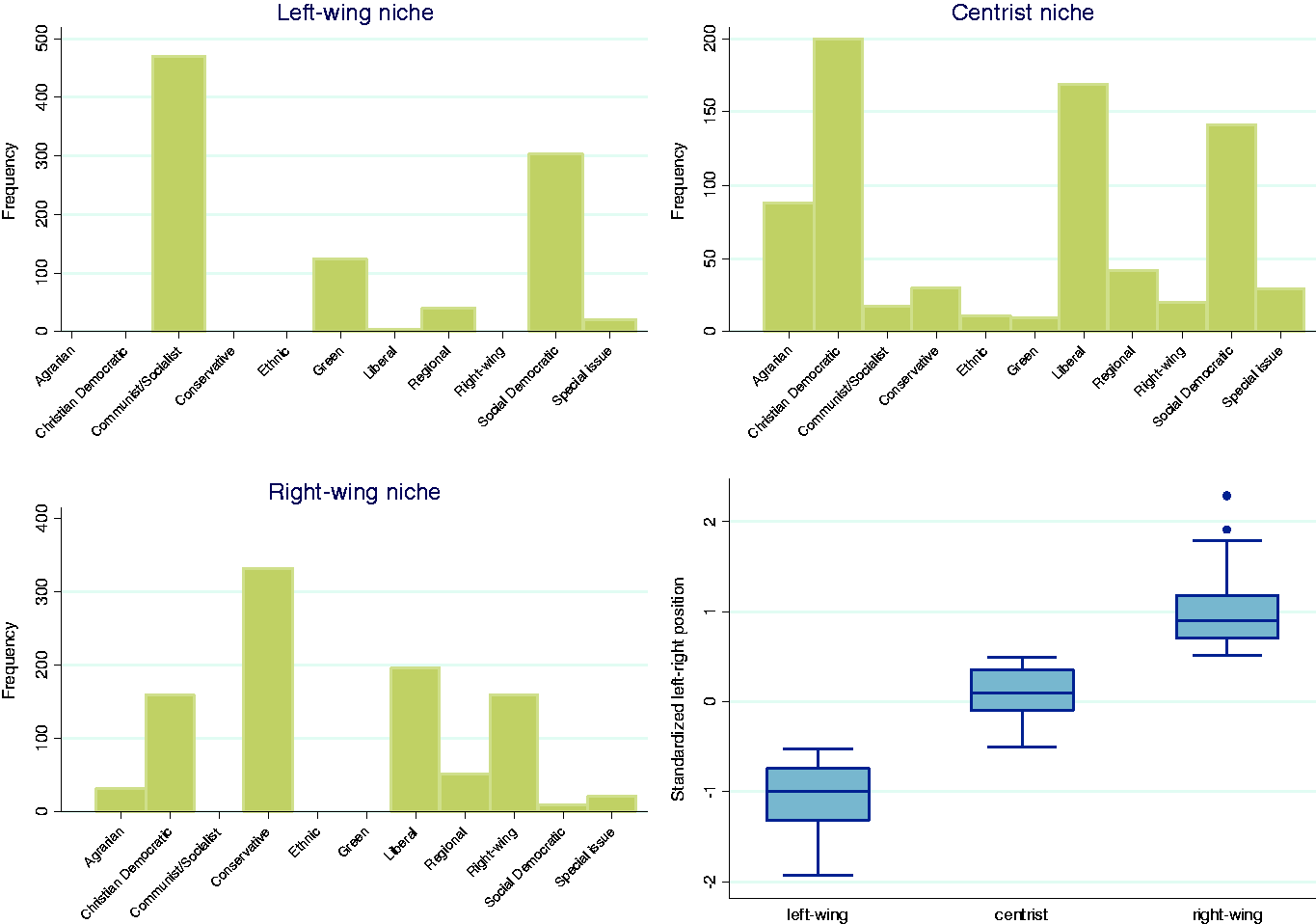
We used two indicators to capture the carrying capacity of a niche. First, to gauge the density of each niche in terms of potential voters, we rely on the Eurobarometer (EB) surveys that ask respondents to place themselves on a general left-right scale ranging from 1 (left) to 10 (right). By means of the same cut-off criteria used for parties (left < −0.5, centrist ≥−0.5 and ≤0.5, right >0.5), voters are assigned to the three niches based on their z-scores. Subsequently, we determined the percentage of the electorate falling in each niche. 4 To explain entry and exit at t, we use all voter placements available after the preceding election. If available, also data collected during election year t is included in the estimates.
Second, we measured the fragmentation of a niche in terms of cleavages by calculating an inverse Herfindahl index over the distribution of party families. A minimum value of 1 implies that all parties within a niche belong to the same family, with increasing values indicating more fragmentation. Party family membership may serve as a proxy for the underlying cleavage structure of a niche, as party families tend to group together parties that mobilized in similar historical circumstances and had the intention of representing similar interests’ (Gallagher et al., 1995: 181). Third, on the basis of the CMP, we again constructed an inverse Herfindahl measure that captures the density of the issue agenda within each niche (for more details on the exact calculation, see Greene, 2014). Theoretically, the resulting measure equals 1 if all parties competing in an election only emphasize one single issue – producing maximum concentration – whereas increasing values denote more issue agenda density. Analogous to our other indicators of carrying capacity, this variable varies at the level of niche/election combinations.
As for the remaining controls, we first captured party system proportionality by means of the Gallagher index (1991), with higher values indicating greater disproportionality. Second, we controlled for the social heterogeneity of a country, using a measure proposed by Fearon (2003) to calculate the effective number of ethnic groups. Third, to tap into the costs, benefits and likelihood of successful entry, as identified by Tavits (2006), we include the number of democratic elections after Second World War as a proxy for party system institutionalization (likelihood of success); the Siaroff scale of economic integration, capturing the lack of corporatism (benefits); and finally, the amount of deposit for registering a party as a proportion of current GNP per capita, the number of signatures required to have access to the ballot (petition) per 1000 eligible voters and public party financing measured by a dummy variable if public funds were available for covering a share of the campaign expenditure (costs).
Finally, in our models explaining party exit, we account for party age by subtracting the election year from the party’s founding year. We use a square root transformation of age as the effect of ‘newness’ should diminish over time.
Statistical approach
Explanations of party exit are examined by means of discrete time duration models (see also Rabe-Hesketh and Skrondal, 2008). To implement this method, we manipulated the data structure so that a party contributes one party/election observation for each year it is included in our dataset. Notably, the final available elections for each country are excluded from the analyses, as logically, we cannot know yet for which parties these elections turned out to be their last. Since elections are nested within parties, we specified robust standard errors clustered at the level of parties.
The causes for party entry were evaluated by means of a count variable. The discrete time duration models are unfeasible because we do not know which parties exist as organizations but did not appear on the ballot for the first time. Significantly, count data do not follow a normal distribution and ordinary linear regression is therefore not suitable to analyse the data. As a solution, two different types of Poisson models are usually considered. The ordinary Poisson model assumes a distribution in which the mean of the dependent variable roughly equals the variance. Yet, in some of our models, the dependent variable is strongly over-dispersed. In these cases, we opted for a panel negative binominal regression, which is equipped to deal with over-dispersion (Hall et al., 1984).
In the supporting information (see the online appendix, Section 1.1) we present the different model specifications and the predicted signs of the coefficients in case our hypotheses are fully confirmed. We lagged the independent variables in the models examining party entry so that density in the previous election explains entry rates at election t. Lagging the independent variables was not necessary in case of party exit. A party receives a 1 on ‘exit’ in the last election in which it runs, and as such, its exit is explained by what happened during that final election.
Empirical results
Logistic regression explaining party exit within ideological niches.
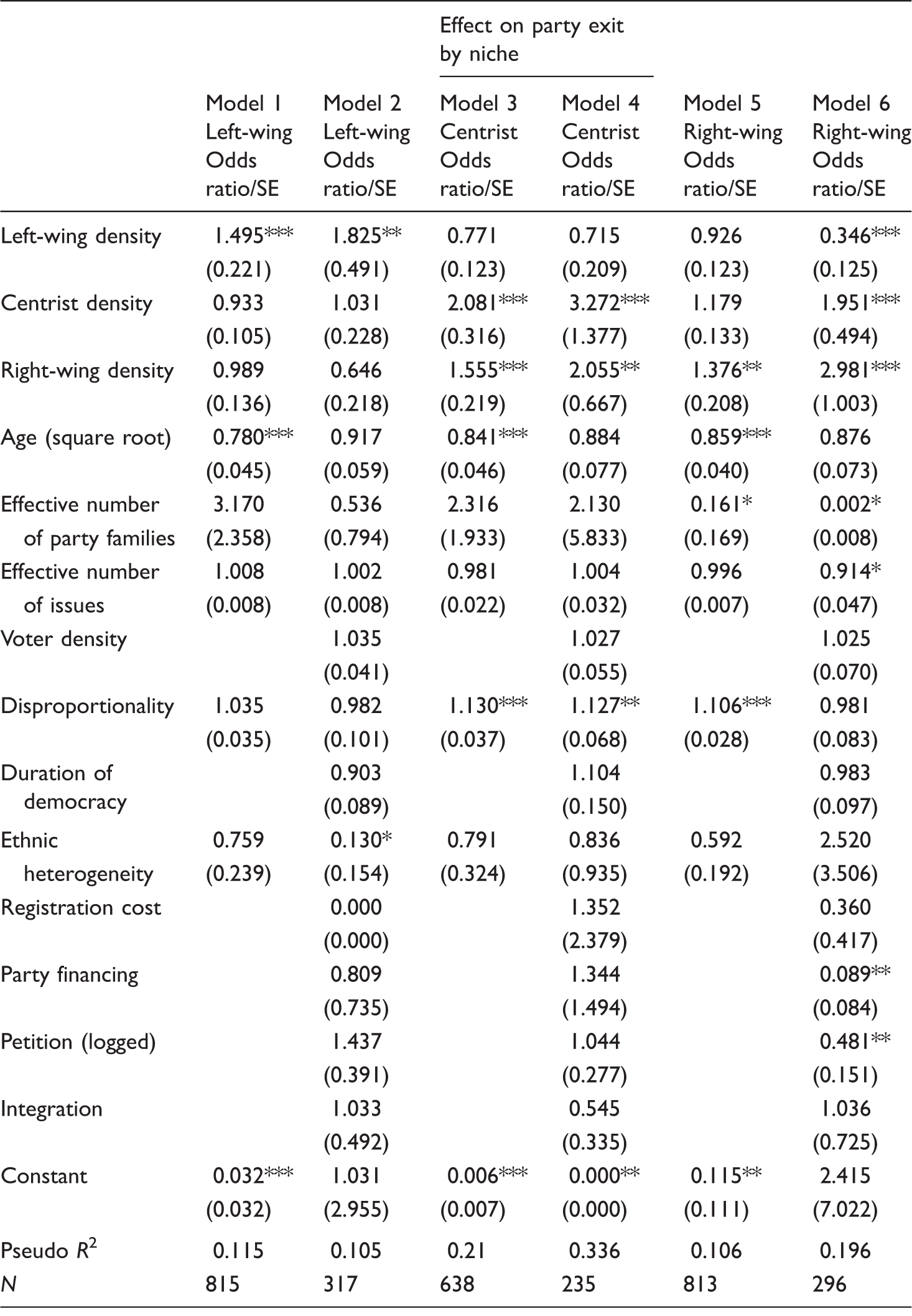
Notes: *p < .1; **p < .05; ***p < .01 (two-tailed). Logistic regression explaining party exit by ideological niche. The coefficients are odds ratios. Standard errors in parentheses.
Poisson and panel negative binominal regressions explaining party entry within ideological niches.
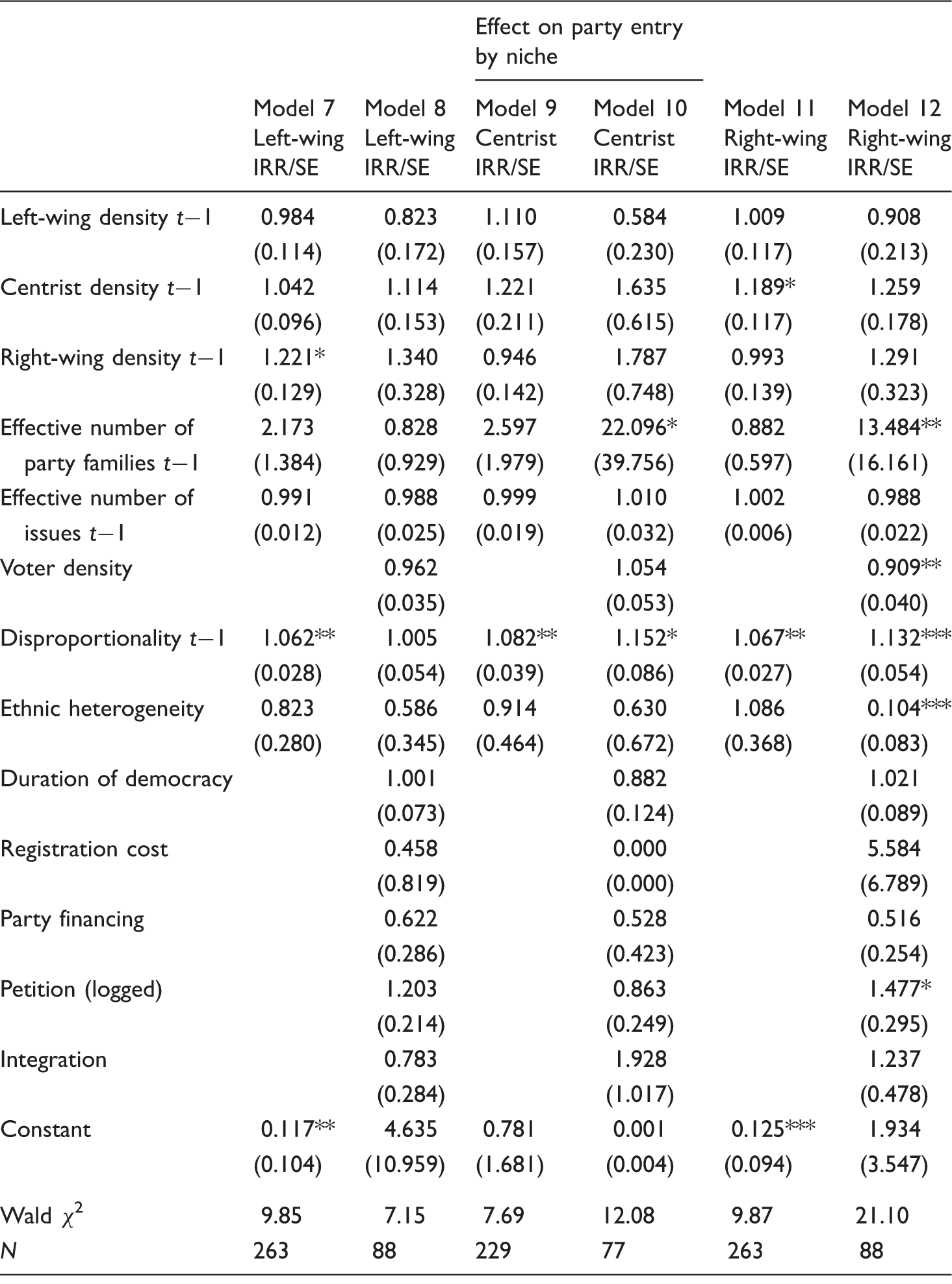
Notes: *p < .1; **p < .05; ***p < .01 (two-tailed). Poisson and panel negative binominal regressions explaining party entry by ideological niche. The coefficients are incidence rate ratios. Standard errors in parentheses.
Our Within-Niche Competition Hypothesis (H1) posits that competition effects take place within niches and that effects within niches are stronger than those between niches. In case of party exit (Table 1), we find strong evidence for H1. If left-wing density increases with one party, the odds of left-wing party exit increase by a factor of 1.50 (Model 1). This effect holds if we add voter density and the additional controls (odd ratio = 1.83, Model 2). We also find that the likelihood of party exit in the centrist (odds ratio = 2.08 in Model 3, odds ratio = 3.27 in Model 4) and right-wing (odds ratio = 1.38 in Model 5 and odds ratio = 2.98 in Model 6) niches increase with density. Even though the centre also experiences competition from the right and vice-versa, within-density effects are always stronger than the effects between niches (e.g. 2.08 > 1.56, Model 3). If we turn to party entry (Table 2), however, we find no evidence whatsoever for H1. All within-niche density effects are statistically insignificant. Thus, overall H1 is only confirmed on the basis of the party exit models. Substantively, this means that density dependence works by causing exit among parties that compete for the same resources (voters, members and activists), rather than discouraging new parties from entering.
Now that we have established that competition is strongest within ideological niches, the Adjacent Competition Hypothesis (H2) examines competition between adjacent niches. Regarding party exit, Table 1 demonstrates that right-wing density increases the exit of centrist parties. In response to one additional right-wing party, the odds of centrist party exit increase by 1.56 (Model 3) and by 2.06 (Model 4) if we add the controls. Also, there is some evidence – only in the full model – that centrist density increases the exit of right-wing parties (odds ratio = 1.95, Model 6). Since we do not find competition effects between the other adjacent niches – the centre and the left – the evidence for H2 is not as strong as for H1. Still this suffices to accept the second part of H2, that competition effects between adjacent niches are stronger than those between non-adjacent ones. That is, competition effects are absent between the non-adjacent left and right-wing niches. Model 6 even shows that the odds of right-wing party exit decrease when left-wing density increases (odds ratio = 0.35). Again, the evidence does not extend to our model explaining party entry, as Table 2 shows that the between-niche effects are either statistically insignificant or in the opposite direction. Right-wing parties are more, rather than less, likely to enter when centrist density increases (irr = 1.19, Model 11). Given that this effect is extremely close to reaching conventional levels of statistical significance when the controls are added (irr = 1.26, p = .103, Model 12) this provides quite some evidence in favour of a predator-prey relationship, where right-wing parties both destroy (see Models 5 and 6) and feed off centrist ideology.
Are competition effects more likely to come from the flanks on the centre, as can be inferred from the theory of directional voting (MacDonald et al., 1991)? There is no convincing evidence for the Directional Competition Hypothesis (H3). First, even though right-wing density promotes centrist party exit, centrist party exit should also be fuelled by increasing left-wing density. A likely explanation for competition coming from the right on the centre – but not from the left on the centre – is the greater resource overlap between the right and centre (see Figure 1 bottom right box). This provides additional evidence for the Downsian proximity model: besides resource overlap with other centrist parties, centrist parties face competition from proximate right-wing parties. A recent example of this phenomenon is the rise of populist Radical Right parties in several countries of Western Europe. As predicted by the Within-Niche Competition Hypothesis (H1), this clearly affects the mainstream right. The German free-market FDP did not survive recent election when the radical challenger AfD split the right-wing vote. Simultaneously, and in line with the Adjacent Competition Hypothesis (H2), also the centrist CDU-CSU was electorally affected. Whereas, and in contrast to the Directional Competition Hypothesis (H3), CDU-CSU does not seem to be affected by an increasingly populated left-wing niche after the breakthrough of Die Linke. In terms of Sartori (1990), the higher resource overlap between the centre and the right could be due to the latter having stronger blackmail potential than the left. That is, centrist parties are more likely to converge to the policy positions of the right than the left. A speculative explanation may be related to the specific Western European international historical context in which the anti-Communism of the Cold War exacerbated the distinction between the left and the centre, something that came in addition to the anti-revolutionary positions of the religious-inspired parties. A second reason for not adopting H3 is that centrist parties also foster right-wing party exit (Model 6). Hence, we accept H1 and H2 that are based on the proximity model, but reject H3.
Finally, in the theory section we only considered competitive relationships where density fosters exit and limits entry; yet, parties – especially those with low resource overlap – could also benefit from each other’s presence. Specifically, left and right-wing parties may need each other’s sustained presence to remain legitimate, and presence of ‘the enemy’ also offers a good reason for these parties to rise up (Vermeulen, 2013). In terms of party exit, Table 1 provides some evidence that the odds of right-wing exit decrease with left-wing density; yet, this effect is only significant in the full-model (odds ratio = .35, Model 6). Regarding party entry, there is only evidence that more left-wing parties enter when right-wing density increases (irr = 1.22, Model 7). This effect, however, become insignificant when additional controls are added (Model 8). Thus, there is some but no systematic evidence that the flanks benefit from each other’s presence.
As for the controls, we could only find limited evidence that the carrying capacity of a niche or the party system impacts party entry and exit. The odds of left-wing exit are lower in more heterogeneous countries (Model 2), right-wing parties are less likely to exit when their niche is more diverse in terms of issues and cleavages (Models 5 and 6), and finally, right-wing and centrist parties are more likely to enter when more cleavages are activated in a niche (Model 10 and 12). Otherwise the carrying capacity exerts no significant effect, or its effect is in the opposite direction. Thus, there is only moderate evidence that party entry and exit is resource-dependent.
Turning to the effect of electoral institutions, in line with our expectations, there is some evidence (Table 1, Models 3, 4 and 5) that greater disproportionality fosters party exit. Political parties have a more difficult time surviving in an institutional context where it is harder to translate votes into parliamentary seats; most likely, because recurrent failure to gain representation is hard to cope with. Surprisingly, however, our results provide even stronger evidence (see Table 2, Models 7 and 9–12) that disproportional party systems promote party entry. Additionally, party system institutionalization (duration of democracy) and the variables capturing the costs of entry hardly exert an effect on entry (nor exit). Model 12 even suggests that right-wing parties are more likely to enter when more signatures are needed to enter the ballot. As we discuss below, these findings are at odds with theories assuming strategic entry (Tavits, 2006).
Finally, consistent with previous research (e.g. Freeman et al., 1983), the findings in Table 1 provide some evidence that the odds of exit decrease with party age (see Models 1, 3 and 5). Five additional analyses, which are reported in the online appendix, were carried out to assert the robustness of our findings. We (a) included cubic splines to model the hazard rate of party exit (b) reran all our models with more restrictive operationalizations of party entry and exit (c) asserted that the findings are not driven by our criteria for determining niche membership (d) examined whether the population-ecological assumption that organizations exit rather than adapt is justified and (e) added additional controls. These tests continued to support our conclusions.
Discussion and conclusion
The question of why some countries have more parties than others has received considerable attention in political science. However, these studies only implicitly theorize about the entry of new parties and the exit of existing ones. The aim of this article is therefore to open the black box of the number of parties and explain variation in party entry and exit across countries through time. In so doing, we build upon population ecology (Gray and Lowery, 1996; Hannan and Freeman, 1989) as well as ecologies of ideologies (Barnett and Woywode, 2004). Our specific contribution lies in that we show that parties compete with each other for resources within and across ideological niches.
Our longitudinal analyses of 18 Western European countries during the period 1945–2013 demonstrate that competition is strongest within ideological niches. That is, left-wing, centrist and right-wing exit rates are best explained by the density within their own niche. Yet, competition between adjacent niches also takes place, as right-wing density promotes centrist party exit. Centrist parties are not hapless victims of those at the flanks, however, since the centre mostly suffers from right-wing parties located nearby and does not suffer from a stronger presence of left-wing parties. Therefore, the Downsian (1957) proximity model offers more explanatory power for our results than the directional model, which suggests that parties in the centre will be penalized for their centrist stance (MacDonald et al., 1991).
Two important questions come out of these findings. First, we found that party entry rates are unaffected by niche density whereas exit is. In line with these results, some population ecologists argue that while competition will force unfit organizations out of business, it remains an open question whether competition affects entry rates (Gray and Lowery, 1996: 44). However, our non-findings on entry highlight the need to further empirically assess the causal, ‘strategic’ mechanisms underlying the empirical (e.g. Kitschelt, 1988; Tavits, 2006) as well as the agent-based-modelling literature (e.g. Laver and Schilperoord, 2007), which all presume strategic entry. One may identify two explanations for why party entry would be less strategic than is commonly expected in the literature: first, building on biology, density may affect the success of the reproductive effort of species but not the effort itself (Gray and Lowery, 1996: 44). Some species continue breeding but fail to keep alive most of their off-spring in case of resource scarcity. In case of human behaviour, this view is echoed by bounded rationality theory, positing that humans are cognitively constrained in many ways; the impact of these constraints increase, the more difficult the choice problem at hand (Bendor et al., 2011). One could easily argue that the decision of entering an election is very complex in terms of costs, benefits and likelihood of success. Hence, bounded rationality theory might better explain the behaviour of prospective entrants than models assuming utility-maximization (e.g. Cox, 1997; Tavits, 2006). Our results at least suggest that party elites fail to make the right calculation: entry rates do not respond to niche density, disproportional systems produce higher entry rates and variables capturing the costs of entry fail to have their hypothesized effects. A second explanation for our findings could be that some prospective entrants, even if they manage to maximize utility, aim for other goals than parliamentary representation like aggregating interests in society, promoting a message by participating in an electoral campaign and, perhaps, to survive as interest group. To isolate such parties, it would be fruitful to distinguish between different thresholds of entry. In line with the literature to which we seek to speak, we focus on entry in national elections (threshold of authorization). Yet, it should be easier to find evidence in favour of strategic entry when a higher threshold is chosen like entry in the national legislature (threshold of representation), or becoming a relevant party (threshold of relevance) (Krouwel and Lucardie, 2008). In future work, we would like to further evaluate this claim.
Another main question coming out of our findings is why, contrary to population ecological studies on other types of organizations, we only find moderate evidence that a niche’s carrying capacity influences entry and exit. We believe that the relationship between resources and density may be atypical for parties. Commonly, large numbers of organizations are observed in relative resourceful niches due to specialization of organizations. However, there may be limits regarding the extent to which parties can specialize in terms of issues or the voters they try to appeal to. When mobilizing votes, parties need to participate in election campaigns and engage in dialogue with other parties. This forces them to take positions on more than a single issue: anti-immigration parties, for instance, will also need to say something on employment policies. Parties may also have incentives to refrain from specializing too much. There are institutional premiums for larger parties, so maybe parties cannot – or do not want to – specialize to the same extent as other organizations like interest groups, which produces a ‘ceiling’ on niche density. In that way, more resources do no automatically increase survival chances within a niche. However, we need a better understanding of how different types of parties are affected by the carrying capacity of the party system. Population ecological research on resource partitioning (García-Díaz et al., 2015) has shown that dual market structures may emerge where a few, large generalist organizations (in our case mainstream parties) dominate the market centre, while many specialist organizations (in our case niche parties) can be found in the market’s periphery. So perhaps the relationship between resources and parties is only atypical in the centre of the party system. Further research is necessary to unpack this relationship.
This article provides an ambivalent picture of the organizational nature of party systems. On the positive side, we find that if too many parties offer a similar ideological position, some will be crowded out. This creates room for new parties, ideas and people. On the negative side, we cannot systematically explain why new parties enter. This study yields no indication of strategic entry and only little evidence that entry rates respond to societal variables like voter preferences.
Funding
The author(s) disclosed receipt of the following financial support for the research, authorship, and/or publication of this article: Marc van de Wardt’s research is supported by postdoctoral research grants from the Research Foundation Flanders ‘FWO’ (Grant number: FWO16/PDO/198) and the Fund for Scientific Research Wallonia ‘FNRS’ (Grant number: 28091302).
Footnotes
Notes
References
Supplementary Material
Please find the following supplemental material available below.
For Open Access articles published under a Creative Commons License, all supplemental material carries the same license as the article it is associated with.
For non-Open Access articles published, all supplemental material carries a non-exclusive license, and permission requests for re-use of supplemental material or any part of supplemental material shall be sent directly to the copyright owner as specified in the copyright notice associated with the article.
