




Abstract
How do democratization processes affect voter turnout in new democracies? Existing work points to an expected boost in electoral turnout after democratization as newly democratic citizens are euphoric to exert newly democratic freedoms or because they developed new political attitudes and behaviours by mobilizing for democracy. While intuitive and normatively appealing, these explanations have not been theoretically nor empirically scrutinized within the literature. This paper develops and tests novel theoretical expectations on the processes and legacies of democratization that impact voter turnout in new democracies. Using electoral turnout data from 1086 national elections between 1946 and 2015, and turnout survey data of over 1 million respondents between 1982 and 2015, we find that the boost in voter turnout (1) exists only for the first election after transition, (2) its effect depends on the life cycle during which individuals experienced the transition and (3) it is less dependent on transition type.
Keywords
Introduction
How do democratization processes affect electoral turnout 1 in new democracies? Existing explanations propose we should observe a boost in electoral participation after democratic transitions as newly democratic citizens ache to participate politically after a period of political repression. One set of explanations highlight the existence of a short-term boost in electoral turnout driven by the enthusiasm and euphoria of the first election after authoritarianism (i.e. founding elections) (Kostelka, 2017; Pettai, 2012). The second set of explanations emphasize a long-term effect of transitions, particularly for transitions driven by popular mobilization, as mobilization has the potential to socialize and develop democratic political behaviours and attitudes within the citizenry (Bayer et al., 2016; Bethke & Pinckney, 2021; Chenoweth & Stephan, 2011; Pinckney, 2020). While there is some empirical evidence for the former explanation as a driver of turnout after democratization (Kostelka, 2017), there has not been a systematic examination of which of the two set of explanations drive voter turnout in new democracies. Existing work either rely on anecdotal evidence (Bayer et al., 2016; Bethke & Pinckney, 2021; Chenoweth & Stephan, 2011; Pinckney, 2020) or do not distinguish empirically between these explanations and their short-term and long-term effects (Kostelka, 2017).
The evolution of turnout in national elections in post-communist Poland and Romania highlights the importance of distinguishing between these two explanations. Both countries transitioned from communism at the end of 1989, Poland after a sustained mobilization period by the Solidarity movement, while Romania’s mobilization was more spontaneous in December 1989, with former communist elites using the cover of the protests to oust Ceausescu via a coup (Siani-Davies, 2005). Figure 1 shows the evolution of electoral turnout in national elections
2
in Poland and Romania both in black, while the blue line shows the yearly electoral turnout rate in all elections in established democracies
3
as a reference point. Electoral turnout in Poland and Romania.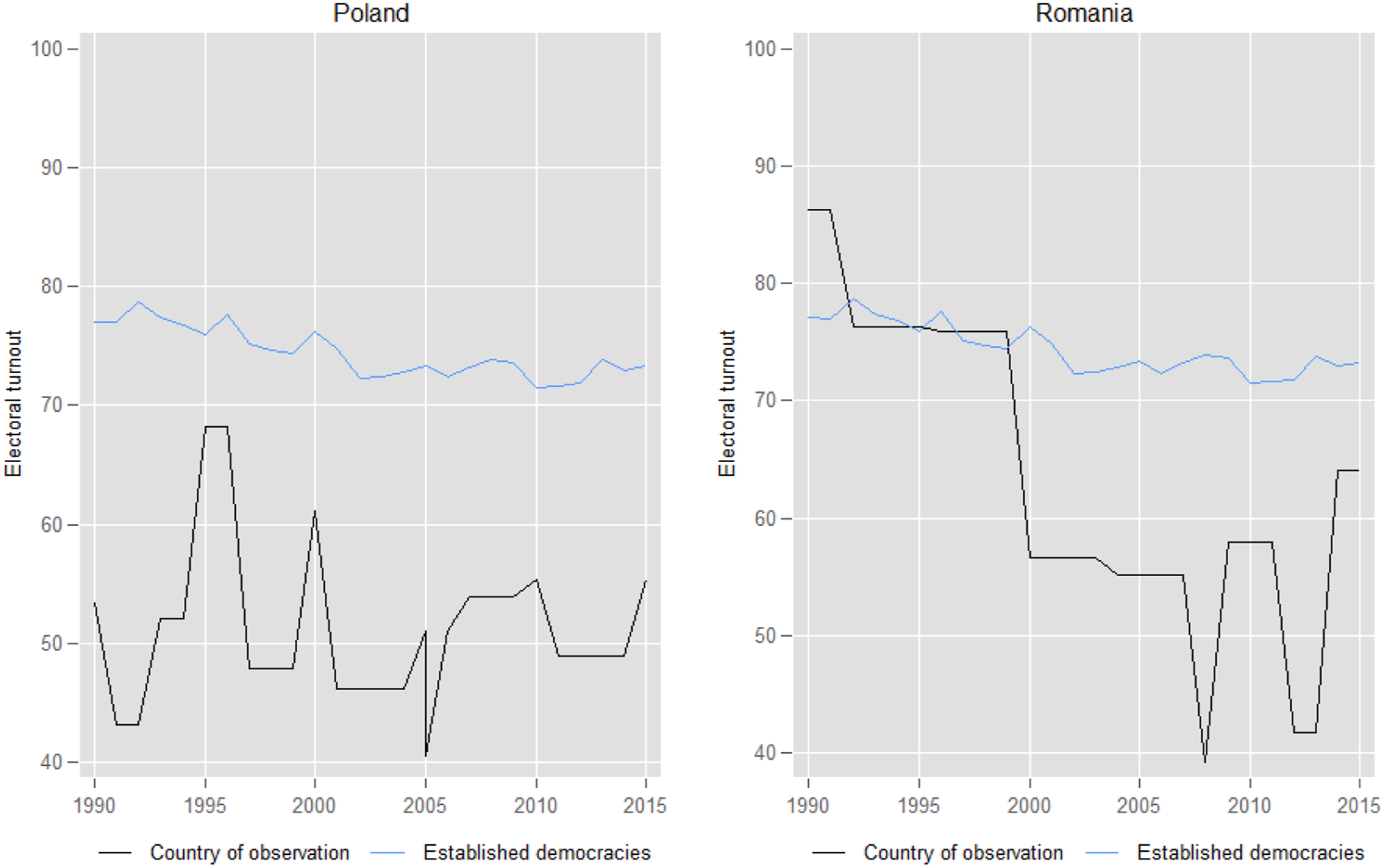
Poland’s electoral turnout after transition seems not to have been boosted by the democratic transition (despite its sustained mobilization against communism) as the turnout in its founding election was only 53.4%, lower than the average yearly turnout rate of 78.92% in established democracies or the average 75.9% turnout in founding elections in other new democracies. 4 Moreover, its electoral turnout has been mostly constant since then (except the election in 1995), but consistently far below rates from established democracies. In turn, Romania seemed to have benefitted from a boost in electoral participation brought about by the transition as its founding election had a turnout rate of 86.2%, a rate above the one of turnout in established democracies (78.92%) or other founding elections (75.9%). Yet, the democratization electoral boost seemed to have dissipated as democracy consolidated in Romania, indicating mostly a short-term legacy effect of the transition. However, it is difficult to disentangle whether the observed electoral boost was due to the founding election or the mobilization that contributed to the fall of communism in Romania, or whether turnout rates are simply lower in new democracies (such as Poland), regardless of their transition experience.
Against this background, the paper revisits the effect of democratic transitions on electoral turnout in new democracies by developing and testing novel theoretical propositions on the short-term effects of founding elections (i.e. first election after transition) and the long-term, legacy effects of transition types. These propositions start from the assumption that the decision to vote is driven by citizens’ attitudes (Blais & Daoust, 2020) and it is a practice individuals develop over their lifetime (Aldrich et al., 2011). Moreover, both attitudes and political behaviours are shaped by the regime under which they develop (Neundorf & Northmore-Ball, 2021), but also by events of rapid change, stress and drama, such as democratic transitions (Jennings, 1987). The key distinction between transition types is whether a peaceful, organized campaign from the bottom up was involved in initiating, leading and bringing to fruition democratization through a campaign of nonviolence 5 (Pinckney, 2020, p. 3) or whether the country has transitioned to democracy through a different mode. Building on this, (1) the paper discusses why choosing the counterfactual matters for identifying the existence of an electoral boost after democratization, (2) highlights why the electoral boost in turnout may be driven by the founding election, and not the transition type and (3) proposes that transition type might have heterogeneous effects on cohorts within a country, based on the lifecycle during which they have experienced the transition event (Bartels & Jackman, 2014).
The observable implications of these propositions are tested in the most comprehensive time series cross-sectional research design to date using electoral turnout data at aggregate and individual level from new and established democracies between 1946 and 2015. 6 The analysis leverages data on democratic transitions from Geddes et al. (2014) and Pinckney (2020), election turnout data from the International Institute for Democracy and Electoral Assistance (IDEA) and Varieties of Democracy (V-Dem) (Coppedge et al., 2019) and a harmonized public opinion data on voter turnout of close to 1.2 million respondents from (Neundorf et al., 2020). At the aggregate level, the analysis compares voter turnout rates in 1,086 national parliamentary and executive elections from 100 democracies between 1946 and 2015. At the individual level, the paper uses cohort analysis using linear and generalized additive models (GAM) to compare how cohort exposure to different transition types affects self-reported turnout in national elections of close to 1.2 million respondents from 85 democracies between 1982 and 2015.
The results of the empirical analysis qualify existing explanations about the boost in electoral participation expected after democratic transitions. Firstly, the election-level analysis shows that there is no difference in aggregate levels of voter turnout between established democracies and new democracies conditional on the process that established the new democratic regime under observation. However, the boost in electoral participation in national elections seems to be driven mostly by the first election after transition, regardless of the transition type. These results indicate mostly a short-term boost in electoral turnout driven by the founding election, therefore raising doubts about the long-term effect of civil resistance transition on political behaviours (Bayer et al., 2016; Chenoweth & Stephan, 2011; Kostelka, 2017; Pinckney, 2020). Secondly, the cohort analysis further shows that transitions do exert a long-term effect on turnout at the individual level. Precisely, both transition types affect individual electoral turnout based on the life cycle during which respondents had experienced the transition, with a slightly bigger effect for transitions through nonviolent resistance. More specifically, the cohort analysis shows that individuals that experienced civil resistance transitions during their formative years (15–29 years) are more likely to having participated in the most recent election, while older individuals at the time of transition are less likely to turnout to vote under the same conditions. The results are robust to a battery of alternative model specifications, alternative explanations, confounding factors and estimation strategies.
This paper brings several contributions to the literature on democratization processes and democratic consolidation (Linz & Stepan, 1996; O’Donnell & Schmitter, 1986), nonviolent resistance (Bayer et al., 2016; Chenoweth & Stephan, 2011; Pinckney, 2020) and legacies of contention (Davenport et al., 2019). Firstly, the paper provides novel theoretical propositions on why the electoral boost expected after democratization may not have the dynamics proposed in previous literature (Bayer et al., 2016; Chenoweth & Stephan, 2011; Kostelka, 2017). More precisely, it highlights the theoretical and empirical importance of distinguishing between the different explanations as these have different short-term and long-term effects on turnout (Kostelka, 2017). Secondly, the paper highlights the importance of contentious events during an individual’s formative years (Bartels & Jackman, 2014; Rodon & Tormos, 2022). The empirical evidence clearly shows the heterogeneous effects that democratic transitions have on individuals’ political behaviour based on the life cycle during which they experienced the transition event (Jennings, 1987). Finally, the paper contributes with novel data and empirical evidence to the literature on the long-term effects of contentious events on political attitudes and behaviours, a literature that is still in its infancy and requires more theoretical and empirical attention from scholars (Davenport et al., 2019). It does so by showing that contentious events affect more strongly the individuals most likely to participate and benefit from the outcomes of these events (Chenoweth & Ulfelder, 2017; Goldstone, 2002).
Popular Mobilization and Electoral Turnout
The methods through which political change can be achieved (Abrahms, 2006; Pape, 2006; Sharp, 1973) and the conditions under which democracy arises has received a lot of attention from scholars (Acemoglu & Robinson, 2006; Boix, 2003; Dahl, 1973; Geddes, 1999; Przeworski, 2000). Starting with the work of Stephan & Chenoweth (2008), a vast empirical literature on the effects of nonviolence has developed showing that the strategic use of nonviolence help societies and citizens enact political change that is more meaningful than using violence (Chenoweth & Stephan, 2011; Gleditsch et al., 2022; Sharp, 1973). This literature shows that nonviolence is more likely to achieve its stated objectives (Stephan & Chenoweth, 2008), reduce autocrats’ survival in office (Chenoweth & Belgioioso, 2019; Gleditsch et al., 2022), has a higher likelihood of bringing democracy (Celestino & Gleditsch, 2013; Chenoweth & Stephan, 2011; Kim & Kroeger, 2019; Pinckney, 2020), makes democracies more likely to survive (Bayer et al., 2016; Kadivar, 2018) and increases the quality of democracies (Bethke & Pinckney, 2021). This joint set of findings point to a democratic dividend of nonviolence (Bayer et al., 2016) as the characteristics of nonviolent resistance that make it more likely to achieve success (e.g. lower barriers of participation, diverse membership, consensus decision making, etc.) extend beyond the existence of the campaign in helping post-transition societies keep the new regime’s power in check (Bethke & Pinckney, 2021).
Several reasons have been proposed as to why successful nonviolent mobilization is likely to lead to stronger democracies, even after the mobilization activities wind down: (1) the active participation of citizens in the mobilization develop norms of behaviour likely to enhance the prospects of political engagement after the transition (Chenoweth & Stephan, 2011), (2) the participants in the campaign are more likely to become involved in politics afterwards (Bayer et al., 2016) and produce political leaders with more pro-democratic preferences (Pinckney, 2020), (3) the culture of cooperation and compromise inherent to nonviolent mobilization strengthen citizens’ expectations of a peaceful post-conflict political regime (Bayer et al., 2016; Chenoweth & Stephan, 2011), (4) creates an active civil society that will defend democracy against erosion by mobilizing citizens (Bayer et al., 2016) and (5) diffuses power from elites to citizens by creating a sense of people’s ability to enact political change through individual and collective political participation post-mobilization (Pinckney, 2020).
While these explanations differ in form as to why successful nonviolent resistance has positive effects on democracy and its consolidation, they all point to the same general direction: nonviolence has the power to shape political attitudes in society and to change the political behaviour of elites and citizens to the point that democracy becomes the only game in town (Linz & Stepan, 1996). Moreover, the change in political attitudes and behaviours happens concomitantly, reinforcing each other, with potential long-term effects on political participation in new democracies. The direct implication of these arguments is that this change in political attitudes and behaviours should translate into a boost in electoral turnout after democratization for democracies formed through nonviolent resistance. There are several reasons why this electoral boost should exist based on the changes in political attitudes and behaviours produced by nonviolence. Firstly, voting in democratic elections is usually a low cost action driven by individual attitudes and interests (Aldrich, 1993; Blais & Daoust, 2020). Electoral participation in democracy has even lower barriers for participation than nonviolent resistance as there are no physical sanctions associated with voting. If indeed nonviolence generates new and enhanced norms of political participation among citizens, then we should observe these manifesting directly in levels of electoral turnout in new democracies. Secondly, elections represent the main mechanism through which individuals in a democratic society solve the underlying conflict over distribution of power and resources in a nonviolent and peaceful manner (Dahl, 1973). In the absence of free and fair elections, the pro-democratic change in political attitudes of the citizens could not manifest themselves. Finally, if nonviolence produces political leaders with a more pro-democratic stance, which is also (presumably) preferred by the electorate, then we should observe more electoral participation of this pro-democratic public to ensure their preferences are represented in the new democracy. The discussion above points to the following hypothesis:
Democracies formed through nonviolent resistance have higher rates of electoral participation compared to democracies formed through other transition modes or established democracies.
Democratization Boost or Bust?
While the arguments underpinning the electoral boost expected after transitions through nonviolence seem to make sense at face value, they rely mostly on anecdotal evidence and there has not been many empirical attempts in separating short-term effects from long-term effects, or distinguishing them from alternative explanations (i.e. euphoria of the founding elections) (Davenport et al., 2019; Kostelka, 2017). The theoretical propositions developed below unpack the legacies of democratic transitions on voter turnout in new democracies by separating short-term effects (i.e. founding elections) from long-term effects (i.e. transition type). In doing so, it builds on theoretical arguments and empirical evidence from the literature on electoral habit formation (Neundorf & Niemi, 2014; Neundorf & Northmore-Ball, 2021; Vowles et al., 2017), elections in new democracies (Pettai, 2012; Tavits, 2008), autocratic legacies (Neundorf & Pop-Eleches, 2020) and political socialization (Bartels & Jackman, 2014).
The paper conceptualizes the decision to vote in national elections as one driven by underlying individual political attitudes (Blais & Daoust, 2020) and it being a practice that individuals develop over their lifetime (Aldrich et al., 2011). Moreover, the political attitudes driving the decision to vote and the habits 7 around voting are shaped by the regime under which individuals have been socialized (Neundorf et al., 2020; Neundorf & Northmore-Ball, 2021; Neundorf & Pop-Eleches, 2020), but also by events of rapid change, stress and drama (such as democratic transitions) (Jennings, 1987).
Largely, we have two groups of voters that we are comparing: the first, are citizens from established democracies whose political socialization context emphasize norms of political participation, electoral turnout and commitment to democratic norms (Neundorf, 2010; Neundorf et al., 2020; Neundorf & Northmore-Ball, 2021). The second group are citizens emerging from authoritarianism, whose political socialization has been geared more towards disengagement from politics and away from democratic norms (Zhukov & Talibova, 2018). The former group is considered to be more stable in its political attitudes and behaviours given the equilibrium in the political system (Kostadinova, 2003). The latter group’s political attitudes and behaviours are more likely to be shaped by the transition event given the uncertainty of transition and the changes in state-society relations (Olar, 2023; Kostadinova, 2003). Starting from these assumptions, the paper develops novel theoretical propositions on the effect of transitions on voter turnout based on (1) identifying the counterfactual for the potential electoral boost after transition, (2) the enthusiasm generated by the founding election and the challenges in maintaining mobilization in the post-transition phase and (3) the heterogeneous socializing effect of mobilization and transitions on individuals’ political attitudes and behaviours.
Establishing the Counterfactual
We can establish whether democratization brings a boost in electoral participation only in relation to a counterfactual scenario. If we are interested in establishing the general boost in electoral turnout of democratization (regardless of the process that brought democracy), then our counterfactual would be elections and individuals in established democracies. 8 However, if we are interested in also examining whether transitions through nonviolent mobilization have a pro-democratic socializing effect, then we need to clarify whether we expect this to be in relation only to other transition types, or more generally in relation to established democracies. For example, in the literature on nonviolent resistance (Chenoweth & Stephan, 2011; Pinckney, 2020), the counterfactual is anything except nonviolence, but this counterfactual group is quite heterogeneous and not always directly specified. This is important as our theoretical expectations about the effect of nonviolent mobilization on political attitudes and behaviours may be dependent on which group we are comparing the effect of nonviolence to.
Firstly, the literature on voter turnout habit formation (Vowles et al., 2017) shows that established democracies develop their citizens’ voting habits by emphasizing the opportunities to vote and participate politically. In contrast, autocracies that hold elections actively engage in electoral manipulation (Schedler, 2013) that aim to depress and discourage the electoral participation of citizens (Birch, 2011). Moreover, voting in uncompetitive elections held under authoritarianism creates less engaged voters that do not have the chance to develop the same electoral practices as their democratic counterparts (Neundorf & Northmore-Ball, 2021). In other words, the development of voting habits works as a stock variable that accumulates over time and which hardly changes once it forms. Then, it matters under which conditions individuals develop their voting habits because it will affect nonviolence’s ability to change that. Democratic transitions are momentous events in the life of a country, characterized by uncertainty and a reformulation of state-society relations (Olar & Neundorf, 2023; Pinckney, 2020). However, transitions are mostly a short-term shock to the political system (Miller, 2021), with important consequences for the political development of the country (Bayer et al., 2016). Existing evidence points at nonviolence improving freedom of expression and association autonomy (Bethke & Pinckney, 2021). Yet it is not entirely clear whether transitions through nonviolent mobilization can trump voting practices developed over a long period of time, under autocratic conditions, to such an extent that they become normatively better than the ones of voters from established democracies. Or whether, these new norms of participation continue to manifest only through non-electoral types of participation (i.e. civil society membership and activity) after the transition (Fernandes, 2015).
Secondly, comparing the effect of nonviolent transitions to other transition types brings several theoretical and empirical challenges. Within the nonviolence literature (Chenoweth & Stephan, 2011), the counterfactual is considered to be violent transitions (Bayer et al., 2016; Pinckney, 2020). However, comparing the effect of nonviolence to violence on political attitudes is challenging as the literature on exposure to violence and political attitudes is split in its theoretical expectations. The prosocial behaviour camp stresses the importance of post-traumatic growth and finds that individuals who were exposed to war and violence during their lifetime are more likely to engage in prosocial and cooperative behaviour and to participate politically (Bauer et al., 2016; Blattman, 2009). The anti-social behaviour camp stresses the alienating role of exposure to violence and finds that individual exposure to violence reduces interest in politics and electoral turnout (Alacevich & Zejcirovic, 2020; Zhukov & Talibova, 2018). Given the lack of theoretical consensus and generalizable findings, it is challenging to be theoretically definitive on whether violent or nonviolent transitions are more likely to create more pro-democratic voters.
There are also two empirical challenges associated with the comparison between violence and nonviolence. Firstly, there are too few cases of violent mobilization that led to democracy (Bayer et al., 2016) as violent mobilization has been found to be associated with transitions to authoritarianism (Celestino & Gleditsch, 2013). Secondly, exposure to violence can also happen during nonviolent mobilization as in the vast majority of cases (over 80%) autocracies rely on lethal repression to break the campaign. Then, one would need to separate between exposure to violence versus the type of tactics 9 (and its associated norms) to understand what affects political attitudes and behaviours.
An alternative solution would be to compare transitions through nonviolence with other transition types (e.g. elites pacts, foreign imposition, elections, coups, etc.). Collapsing these other transitions into one category may provide some empirical leverage to examine the effect of nonviolent transitions on political attitudes, but it may be difficult to understand what processes may be driving the underlying relationship. 10 However, this distinction separates the extent to which the larger society has participated in the process that brought down autocracy.
Being excluded from the transition event may reinforce the alienation from politics that citizens have experienced under authoritarianism. 11 In turn, the norms of compromise, consensus and participation developed during periods of nonviolent mobilization reduce the alienation felt by newly democratic citizens, and makes them more likely to turnout to vote as a mean to protect the newly founded democracy. However, this short-lived socializing experience of mobilization may not be able to create more pro-democratic citizens than the ones in established democracies. Then, we expect that:
Voter turnout in national elections should be higher in democracies emerging out of nonviolence compared to other new democracies, but it should be lower compared to established democracies.
Founding Elections and Democratic Choices
Previous arguments about the pro-democratic effect of transitions through nonviolence fail to consider that its legacy might be short lived and that other confounding, short-term shocks, might be driving the boost in electoral participation after transition. One such potential factor is the first election after transition, the so-called founding election. These elections are considered to be momentous events in the political life of a country as citizens, after a long time of political repression, have the option of expressing their political preferences at the ballot box (Klingemann, 2019). These elections are generally associated with enthusiasm and euphoria from the transition, which galvanizes citizens to the polls, particularly since these elections pit against each other opponents and supporters of the previous regime (Pettai, 2012). Then, existing research showing the existence of a democratization bonus based on the mode of transition might be misguided as it does not separate between the effect of founding elections from those of transition type (Kostelka, 2017). More simply, the boost observed in founding elections (compared to ‘normal elections’ in established democracies) may be explained simply by the euphoria associated with the founding elections, not necessarily with the pro-democratic effect of citizens’ participation in the transition.
Campaign demobilization can happen quite quickly once the main objective of the popular mobilization campaign has been achieved because the complicated realities of building democracy set in, and societal actors are faced with complicated choices for subsequent political development (Munck & Leff, 1997; Stradiotto & Guo, 2010). Transitions are generally events characterized by high levels of uncertainty as state-society relations change drastically and the rules of the political game are in flux (Pinckney, 2020). If activists cannot maintain their mobilization during the transition period to shape the rules of the democratic game, then old elites will simply game democracy in their favour (Albertus & Menaldo, 2018; Pinckney, 2020). The challenge of maintaining pressure on decision makers after transitions comes from the very strategic choices that activist make to maximize support and participation from within society during the mobilization phase. More simply, nonviolent resistance aimed at political change is built on the lowest common goal and a single-issue item (i.e. political/democratic change) (Bayer et al., 2020). Counterintuitively, this might be the ‘easier’ objective of dissidents, as building and consolidating democracy can be a more complicated task than anticipated, thereby squandering the enthusiasm that made mobilization and transition possible.
After transition, society and its various actors may be split on their preferences and views of how the future looks like and are put in front of making complicated decisions (Beissinger, 2013). Moreover, some actors may attempt to highjack the process to make sure their vision of the future is implemented, as it happened after the Iranian Revolution of 1979. Decisions about the future of the country are generally made in formal and informal negotiations between old and new elites (Dudouet & Pinckney, 2021; O’Donnell & Schmitter, 1986) which are then cemented through democratic elections. Founding elections present the electorate with an uncertain future, with losers and winners of the transition pitted against each other (Pettai, 2012). Who wins the election may have more to do with the ability to mobilize the electorate using pre-existing partisan resources and networks (Tavits, 2008). Similarly, autocratic successor parties are remarkably successful in the election immediately after transition (Grzymala-Busse, 2020). If the election fails to deliver a democratic system that matches citizens’ expectations of democracy, this will squander the enthusiasm generated by the mobilization. Moreover, subsequent elections will shift away attention from the drivers of the founding elections (i.e. democracy vs autocracy) or what made change possible (i.e. popular mobilization) into other aspects of more saliency to electoral competition (e.g. economic concerns, provision of public goods, civil liberties, etc.).
To conclude, if the electoral boost is attributable to founding elections, then we should observe a higher rate of participation in these elections compared to other elections in new democracies or to elections in established democracies. However, if the electoral boost is attributable to the type of transition (i.e. nonviolence vs other types), then we should observe higher rates of electoral turnout in democracies formed through nonviolence compared to elections in new democracies, but also compared to established democracies (Hypothesis 1).
Political Socialization of Younger Cohorts
The arguments about the pro-democratic effect of civil resistance transitions on electoral turnout assume that it exerts homogeneous effects on all citizens in a society. However, the political socialization literature indicates such experience can be quite heterogeneous as individuals’ political attitudes is influenced by the life period during which they go through certain experiences or are exposed to certain events (Bartels & Jackman, 2014). Of particular importance in the formation of political attitudes is the so-called formative period, between childhood and adulthood (15–29 years of age), during which citizens form their core political attitudes and behaviours which remain constant over their lifetime (Bartels & Jackman, 2014; Neundorf & Niemi, 2014). During this period, individuals are more easily influenced by external factors that shape their understanding of life and society (Sears & Valentino, 1997). Then, if nonviolent resistance has the power to shape individuals’ political attitudes and behaviours, it is more likely that it will affect individuals who experienced it during their formative years rather than later in life.
The reasons for why this happens are two-fold. Firstly, younger individuals are more likely to mobilize and participate in social mobilization as they are more receptive to new and unorthodox ideas that aim to challenge old forms of power (Goldstone, 2002). Also, younger cohorts may act as movement entrepreneurs as these movements often emerge from student movements and organizations, which in general are also more likely to accept the potential risks associated with challenging an autocracy (Chenoweth & Ulfelder, 2017; Ritter & Conrad, 2016). Additionally, these individuals’ electoral habits have not fully formed yet, which emphasizes the potential impact that nonviolence will have on their political attitudes and behaviours. Secondly, older generations may be less likely to participate and show support for nonviolent mobilization as they are more risk-averse and have more to lose if punished, but also because they may have been exposed to a longer period of regime indoctrination. Younger cohorts may value the democratic gains of nonviolent mobilization more as they endured the cost of participation and its potential consequences. Then, we can expect that nonviolent resistance may impact more strongly the political attitudes and behaviours of younger cohorts that experienced it compared to similar cohorts or older cohorts from established and new democracies. Building from the arguments on the exclusion of citizens from transition events (as discussed above), we would expect a negative effect for those individuals that experienced transitions through other modes, with those in their formative years being more likely to be affected. To summarize:
Individuals that experienced a transition through nonviolent mobilization during their formative years are more likely to turnout to vote compared to individuals that experienced it after their formative years and to those that did not experience a transition through nonviolence.
Individuals that experienced a transition through other modes are less likely to turnout to vote compared to those that did not experience a transition through other modes. The negative effect should be stronger for those that experienced the transition during their formative years.
Research Design
The observable implications detailed above are tested in a sample of new and established democracies with turnout from 1,086 national elections from 100 countries between 1946 and 2015 from IDEA’s dataset, and with individual survey-level data of over 1 million respondents from 85 countries. The electoral turnout data is matched with data on transition modes from Pinckney (2020) and Geddes et al. (2014) for 148 democratic spells. Each democratic spell that started after 1946 is coded based on its mode of transition to democracy, 12 while countries that have been continuously democratic since before 1946 are considered established democracies and are used as a reference point. They are used as the reference point due to having cemented their citizens electoral habits through free and fair repeated electoral cycles (Vowles et al., 2017), thereby offering an aspirational level of electoral turnout for new democracies based on a developed culture of political participation (Klingemann, 2014). Moreover, it allows us to compare how the shock that makes a country transition from one institutional equilibrium (i.e. autocracy) to another equilibrium (i.e. democracy) impacts voter turnout. 13
Electoral Turnout Data
The country-level electoral turnout data is culled from IDEA and captures the percentage of all registered voters that cast a vote according to official results in executive and legislative national elections, ranging between 17.82 and 97.6%, for a total of 1,086 elections between 1946 and 2015.
At the individual level, we use individual survey-level data from 86 countries that were designed as academic studies to be fielded in several countries that were democracies at the time of the survey, which have questions that are less country specific, and which are comparable across borders. Survey respondents are asked whether they participated in the most recent national election, and the dependent variables takes a value of 1 if they respondent ‘Yes’, and 0 if they say ‘No’. This harmonized public opinion dataset contains 625 (country x wave x study) existing surveys (Neundorf et al., 2020; Neundorf & Northmore-Ball, 2021) from the following projects: • World Values Survey (WVS), 1981–2014 • International Social Survey Project (ISSP), 2002–2013 • Asian Barometer (ANB), 2001–2014 • Afrobarometer (AFB), 1999–2015 • Americas Barometer (AB), 2004–2014 • European Social Survey (ESS), 2002–2014 • Eurobarometer (EB), 1979–1995 • Comparative Study of Electoral Systems (CSES), 1996–2015
The final dataset that consolidates the individual and country-level independent and control variables gives us a total sample of 1,070,972 respondents from 85 countries between 1982 and 2015. 14
Transition Types
The first two independent variables are the mode of transition to democracy for each democratic spell in the regime data from Geddes et al. (2014) that has been updated until 2015 by Derpanopoulos et al. (2016) and by Pinckney (2020). Firstly, a democracy is coded as having been formed through nonviolent resistance when the political change (to democracy) ‘was initiated, led and brought to fruition through a peaceful, organized campaign from the bottom up, a campaign of nonviolent resistance’ (Pinckney, 2020, p. 3), 15 such as the Carnation Revolution of 1974 in Portugal, the People’s Power Movement in the Philippines in 1986 or the 2018 Velvet Revolution in Armenia. Otherwise, new democracies are coded as having been formed through other modes of transitions (including coups, elite pacts, civil wars/insurgencies, elections, foreign imposition, etc.) if they became a democracy after 1946. Finally, all democracies that have had an uninterrupted democratic spell since at least 1946 are considered established democracies and are always coded as 0 on the mode of transition as these cases serve are the reference category for comparing rates of electoral turnout. Separate binary variables are then generated to capture the mode of transition for each new democratic spell (nonviolent resistance or other mode of transition). The final binary independent variable captures whether an election was the first election after transition by matching the elections from IDEA with those from NELDA (Hyde & Marinov, 2012) to identify the date at which the election was held.
The experience of individuals with transition type is captured by matching the modes of transition variables with the life cycle during which an individual respondent has experienced the transition. Precisely, using the birth year of each respondent we generate cohort variables capturing whether an individual experienced the transition during their formative years (15–29 years old) or afterwards (30+ years old). Then, the binary variable capturing the life cycle during which an individual experienced a transition allows us to unpack which cohorts are more likely to be affected by the mode of transition. The reference category (taking a value of 0) are formed of cohorts in which individuals were under 15 years of age (or unborn) or that lived their entire lives in established democracies.
Control Variables
At the country-level, several variables are included to account for alternative explanations of voter turnout in national elections (Geys, 2006; Kostelka, 2017; Kostelka & Blais, 2021). Firstly, the natural log of the population in 1000s (from the World Bank data) and natural log of GDP/capita at t-1 are included as controls as well. The former reduces the importance of one individual’s vote (Blais, 2000), while the latter should account for the fact that voters may be driven to vote due to economic concerns (Anderson, 2000). The models account for several characteristics of the electoral system and the election as these have been found to be some of the most important drivers of turnout. A variable capturing the type of electoral system (proportional and majoritarian vs mixed and other types) from Variety of Democracy (V-Dem) (Coppedge et al., 2019) is included as they impact voters’ incentives to turnout and parties’ incentives to mobilize voters (Stockemer, 2015). Next, a variable capturing compulsory voting is included as this increases the level of participation in elections (Franklin, 2004; Kostelka, 2017). Finally, at the election-level, the models include a variable capturing whether there were concurrent elections happening on the same day (e.g. both presidential and legislative) and the type of election (legislative vs presidential), as presidential elections could galvanize higher levels of participation due to the focus on choosing a single candidate (Geys, 2006).
For the individual level analysis, the control variables are selected based on meta-analysis by Smets & Van Ham (2013) showing which individual characteristics affect voter turnout. The individual level models include age, age squared, gender, level of education (primary or less, secondary or post-secondary) and a binary variable capturing whether the respondent is working.
Empirical Analysis
Strategy 1: Election-Level Turnout
The paper uses three different estimation strategies to unpack the effects of the democratic transitions on voter turnout. Firstly, Hypotheses 1-3 are tested using an Ordinary Least Squares model with democracy-election/year as unit of analysis that accounts for country unobserved heterogeneity using country random effects 16 and robust, clustered standard errors by country. 17 Next, the model includes decade fixed effects to account for changes that drive the decline in voter turnout across countries reported by previous studies (Kostelka, 2017; Kostelka & Blais, 2021). Finally, the model also includes regional fixed effects to account for regional democratization waves (Huntington, 1993) and other potentially unobserved geographic or cultural specificities that may drive the results.
Electoral Turnout in New and Established Democracies, 1946–2015.
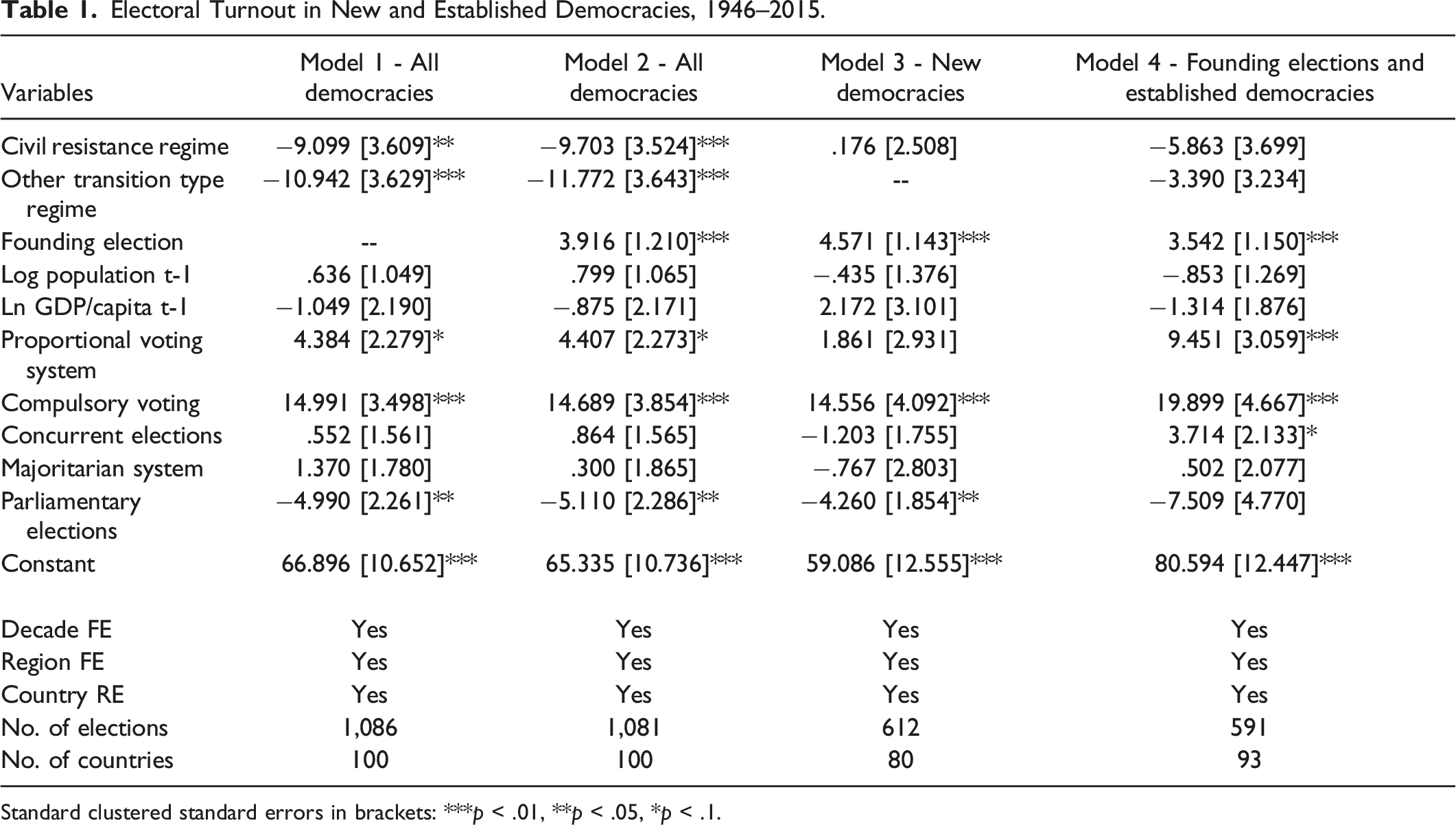
Standard clustered standard errors in brackets: ***p < .01, **p < .05, *p < .1.
Several robustness tests reinforce these findings. Firstly, separating between transition types does not seem to make a difference, as the coefficients are not statistically significant from one another, while the results from founding election remains identical. 19 Next, accounting for the number of years of mobilization for regime change using NAVCO 1.3 (Chenoweth & Shay, 2020) does not affect the reported results, nor does it seem to affect the levels of turnout in national elections. 20 Finally, accounting for the number of years a country has been a democracy or its overall level of democracy (using the liberal democracy index from V-Dem) does not alter the results reported above. 21
These results cast doubt on the proposition that civil resistance transition boosts turnout in new democracies by creating a long-term, pro-democratic legacy within the citizenry. The results indicate a short-term boost in electoral participation as founding elections seem to have higher turnout levels compared to ‘normal elections’ (Kostelka, 2017). This indicates that the electoral boost is driven mostly by the enthusiasm that democratic transitions spur within society, but appears to be mostly short lived. 22 The lower rates of turnout in elections in new democracies, regardless of transition type, further reinforces the argument that electoral turnout is a practice that individuals develop and accumulate over time, and is being influenced by the conditions under which this has developed (Neundorf & Northmore-Ball, 2021; Vowles et al., 2017).
Strategy 2: Cohort Analysis of Individual Turnout
At the individual level, the paper uses a Linear Probability Model to estimate the effect of a transition on self-reported turnout in the most recent election using the methodological approach of cohort analysis (Neundorf, 2010; Neundorf & Niemi, 2014). This approach identifies the effect of transition characteristics of those generations that experienced it during or after their formative years. These models distinguish between three colinear time trends: age, period and cohort (APC). Precisely, a person’s decision to vote may be driven by their age, by events taking place in the country in which they live (i.e. period effect), and by their socialization during a certain moment of their life (i.e. the cohort effect).
To test Hypotheses 4 and 5 – the long-term socialization effect of the transition – we are interested in identifying the cohort effect. We achieve this by including in the model controls age and age squared (to allow for non-linearity) to capture the ageing effect, and year (of the survey) fixed effects to capture the period effect. The cohort effect is captured by generating binary variables that capture the type of transition a respondent has experienced during (15–29 years) or after (30+ years) their formative years using the year of birth (i.e. the cohort effect). Then, by not including the birth year for the cohort effect, we break the linearity of these three factors, and use the transition type during and after each cohort’s formative years (Rodgers, 1982). We also include individual and country-level control variables as discussed above, survey and region fixed effects to capture any country or region-specific heterogeneity, and country random effects to leverage both within and between country variation 23 with clustered standard errors at the country of birth level.
Age, Period and Cohort Models of Individual Turnout in Most Recent Election, 1982–2015.
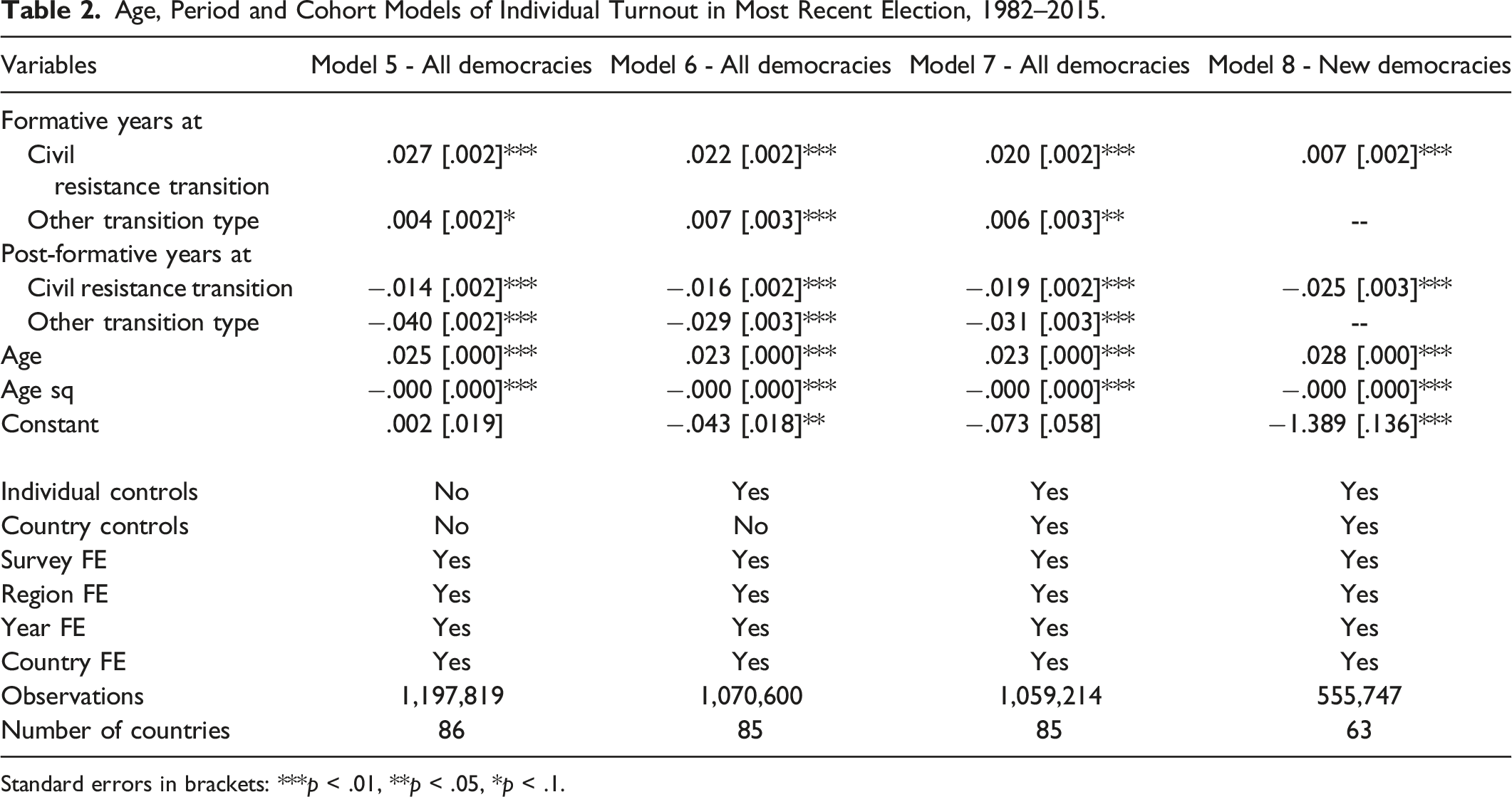
Standard errors in brackets: ***p < .01, **p < .05, *p < .1.
Firstly, the results show that individuals that experienced a civil resistance transition during their formative years are about 2 percentage points more likely to turnout to vote in the most recent national election compared to respondents from established democracies (Model 5–7), but also compared to those that experienced other types of transitions (Model 8). Secondly, individuals that experienced other types of transitions are also more likely to turnout to vote in the most recent national elections compared to citizens from established democracies, but this effect is relatively small (less than 1 percentage point). Thirdly, individuals that experienced a transition after their formative years are less likely to turnout to vote compared to individuals from established democracies (Model 5–7). Interestingly, experiencing a civil resistance transition after the formative years decreases the likelihood to turnout even compared to individuals that have experienced other types of transitions (Model 8), but this effect is most likely driven by having younger cohorts within the reference category (see next section). These results lend support to the argument that the long-term socializing effect of civil resistance transition is more likely to affect those who are also more likely to participate in mobilization, while challenging the idea of a homogenous effect on everyone in society (Chenoweth & Stephan, 2011; Pinckney, 2020).
Strategy 3: Generalized Additive Models
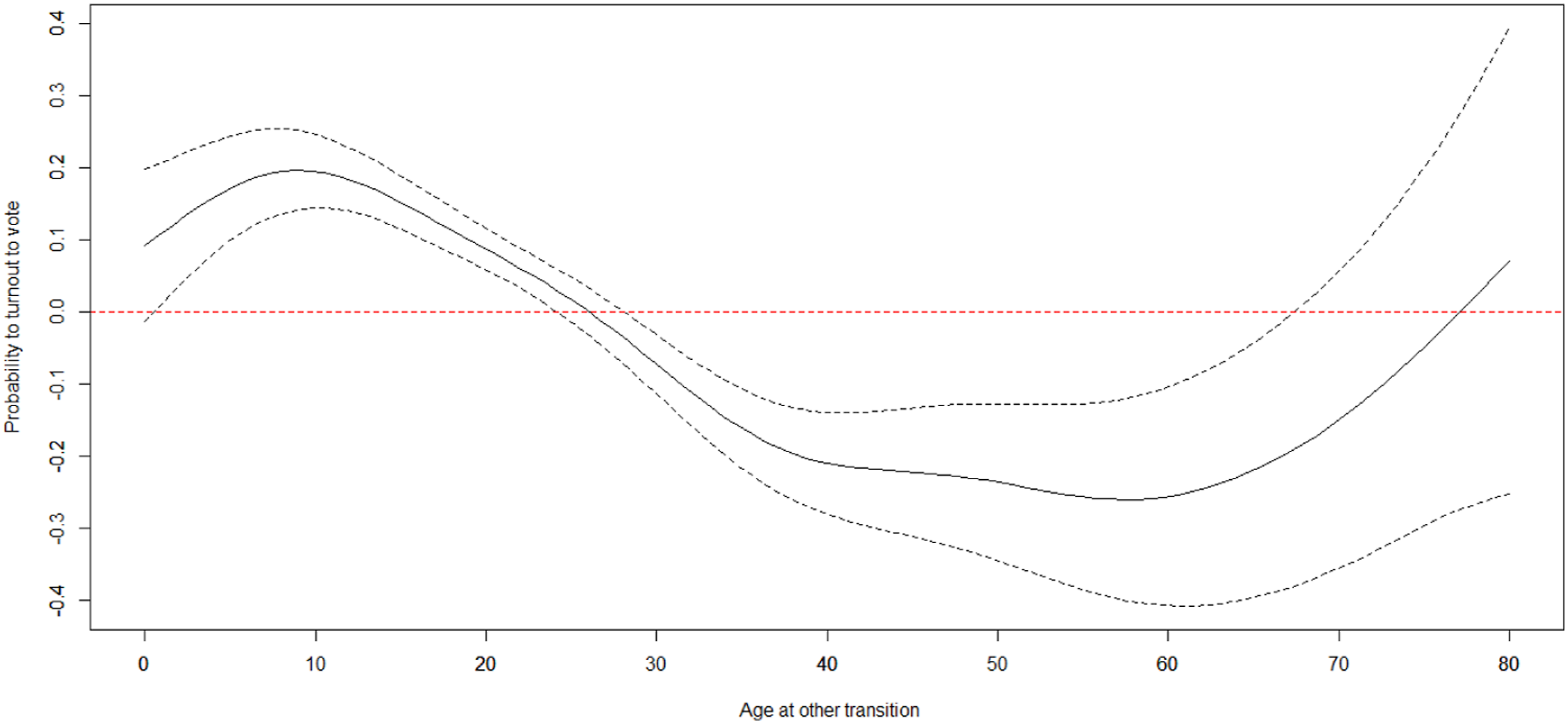
The final empirical strategy used to uncover the long-term effect of transition types on electoral turnout uses GAM to allow a more flexible, non-linear cohort effect. 25 The APC models reported above make a strong assumption about the periods during which one can be most influenced by the transition, the so-called formative years. This approach of strict cut-offs has been criticized by previous literature as there is ambiguity about the exact boundary of delineating social generations (Spitzer, 1973), also referred to as the ‘problem of generations’ (Mannheim, 1970). Then, the GAM models estimate a smoothed non-linear effect of cohort 26 by using the age at the time of each transition type. This serves as a proxy for the cohort effect described for the APC models above and is able to retrieve cohort commonalities for groups born in temporal proximity (Grasso, 2014; Wuttke et al., 2022). More precisely, the effect of age at transition is estimated for each set of new democracies based on the type of transition they experienced (civil resistance vs other types), and then for all new democracies (similar to Model 8).
Figures 2 and 3 above summarize the probability to turnout to vote based on the age at which respondents experienced each transition type. In Figure 2, we observe that individuals that were younger than 28 years at the time of transition (including those that were not born) are much more likely to turnout to vote compared to older cohorts, in line with the arguments proposed in the paper. Figure 3 indicates a similar pattern for individuals that experienced other types of transition before their 28th birthday, as they have a higher likelihood to turnout to vote in the most recent election compared to older cohorts. These results hold when estimating this effect for all new democracies or for all democracies,
27
but with a much more attenuated effect for those individuals that experienced other types of transitions (see Figures A3.1-A3.4) Generalized additive models smoothed term for age at civil resistance transitions, 1982–2015. Generalized additive models smoothed term for age at other transition types, 1982–2015.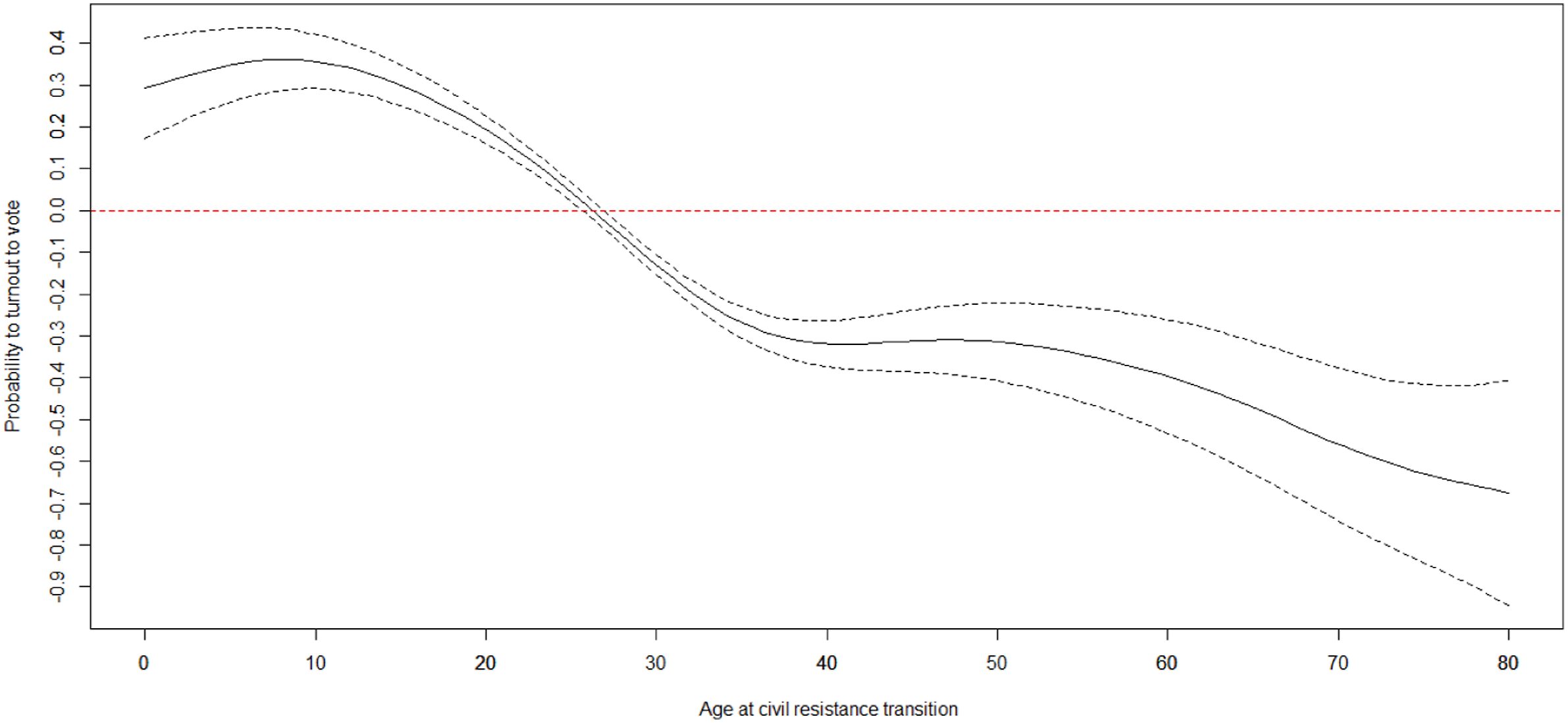
Robustness Checks
The first potential concern about these results is over-reporting of election turnout by survey respondents, especially in a context with strong norms and generally higher levels of electoral participation (Jackman & Spahn, 2019; Karp & Brockington, 2005), with over-reporting being more common in established democracies. In contrast, one could also expect that there might be a strong desirability bias in democracies formed through civil resistance as non-participation in elections might be seen as a failure to live up to the expectations of the transition (Pinckney, 2020). Table A3.4 of the Online Appendix estimates the effect of transition type on over-reporting in democracies 28 and finds there is no statistical significant difference 29 in over-reporting between new and established democracies.
Next, the robustness of the results reported above is tested by accounting for potential alternative explanations. Firstly, we account for the length of nonviolent mobilization an individual has experienced leading up to the transition starting with the age of 15 years old. 30 The results from Table A3.5 indicate that a longer exposure to nonviolent mobilization leading up to the transition does not affect propensity to turnout to vote later in life. Then, the results reported above indicate that what meaningfully impacts citizens’ political behaviour is being able to enact a change through mobilization (i.e. transition to democracy) rather than simply being exposed to mobilization. Secondly, we unpack the other transition type category into different transition category types 31 to examine how they impact individual turnout. The results show that transition types have very heterogeneous effects on turnout based on their types and the life cycle during which they were experienced. The effect of transition through nonviolent mobilization remains identical, 32 while, interestingly, transitions through elections exert negative effects for all cohorts experiencing these during and after their formative years. In turn, transitions that happened through civil wars exert positive effects regardless of the cohort. Finally, we account for several macro-level indicators that could confound the relationship. Precisely, accounting once more for years of democracy and level of democracy at the country level does not affect the reported results (see Table A3.6). Moreover, we also account for the previous regime type and the number of elections held in an autocracy because past electoral mobilization (even under autocratic conditions) impact contemporary voter turnout at an aggregate and individual level (Kostelka, 2017; Neundorf & Northmore-Ball, 2021). Accounting for past regime characteristics or previous number of autocratic elections does not affect the main results reported in the paper. 33
The models from Table 2 account for country unobserved heterogeneity using a random effects model at the country-year level to allow unobserved period and country specific factors to vary. An alternative to estimating the effect of cohort transition events would be to use country and year fixed effects to account for unobserved heterogeneity that is specific to each country in the sample, and which does not vary over time. Then, Table A3.8 from the Online Appendix reports the same APC models from Table 2 estimated using country, year and survey fixed effects to account for current context of a country that might drive individual voter turnout (see Neundorf & Niemi, 2014; Neundorf & Northmore-Ball, 2021). This model specification does not change the results reported in Table 2, as the variables capturing experience with transition types are statistically significant, with a bigger effect size for experiencing a civil resistance transition during formative years. We also re-estimate the models by including decade of birth fixed effects to account for any other unobserved confounders at the generation level that might confound the cohort effect of transition type, but the results reported above remain identical (see Table A3.9). A final robustness test for model specification uses a pooled APC linear model that uses analytical weights for the survey data, but the results remain substantively identical (see Table A3.10).
Conclusion
This paper revisited explanations of the expected electoral boost after democratization by developing novel theoretical propositions on how modes of transition affect aggregate and individual turnout in national elections. Existing work converged towards the idea that democratic transitions in which citizens participated develop novel political attitudes and behaviours bring a boost in electoral turnout in new democracies (Bayer et al., 2016; Chenoweth & Stephan, 2011; Kostelka, 2017; Pinckney, 2020). While intuitive and normatively appealing, this proposition has only been partly tested by existing research (Kostelka, 2017) and did not receive systematic empirical and theoretical scrutiny despite being a key insight of the literature on nonviolent resistance (Bayer et al., 2016; Chenoweth & Stephan, 2011; Pinckney, 2020).
Using a very comprehensive dataset of voter turnout at the election and individual level, the results of this paper qualify existing explanations of the electoral boost we can expect after a democratic transition. Firstly, the election-level analysis shows that voter turnout is driven mostly by the excitement and euphoria of the transition as the first election after the transition has higher levels of turnout compared to other elections in new and established democracies. Moreover, the type of transition does not seem to exert effects on levels of turnout in new democracies. Secondly, at the individual level, the analysis shows that individuals that experienced a democratic transition during their formative years, regardless of its type, are more likely to turnout to vote in a national election, while those that experienced it later in life are less likely.
The lack of convergence between the effect of transition types between the election and individual level analysis highlights a very interesting empirical puzzle that could be explained by a couple of factors. Firstly, the different (positive and negative) cohort effects the analysis uncovers can explain why the individual level findings do not aggregate at the election level. In other words, the cohorts that are less likely to participate (those past their formative years) based on their transition experience may negate the positive effect that younger cohorts may have on electoral turnout. Secondly, this difference can also be explained by the fact that the election level analysis captures actual electoral behaviour while the individual level analysis captures reported electoral behaviour. While over-reporting does not seem to be an issue for the analysis, this difference in types of behaviours that are captured by each analysis could explain why we observed this difference in the effect of transition type at the election and individual level. This puzzling finding is beyond the scope of this article and future research should unpack this further.
The results of this paper have several important implications for our understanding of democratization processes, nonviolent resistance and legacy of contention. Firstly, the paper shows that modes of democratization shape not only political attitudes, but also the political behaviour of newly democratic citizens. Secondly, it offers a more nuanced understanding of the long-term effects of contentious events on individual political behaviours, an area of literature in need of further attention from scholars (Davenport et al., 2019). Finally, it shows that all new democracies experience a boost in participation for their founding election, regardless of their mode of transition which contradicts existing explanations focussing on pre-transition processes.
Supplemental Material
Supplemental Material - Democratization Boost or Bust? Electoral Turnout After Democratic Transitions
Supplemental Material for Democratization Boost or Bust? Electoral Turnout After Democratic Transitions by Roman-Gabriel Olar in Comparative Political Studies
Footnotes
Acknowledgements
I would like to thank Felix Bethke, Jonathan Pinckney, Rebecca Cordell, Felix Haass, Belen Gonzalez, Nate Grubman, Marius Radean, the participants at the 2022 “Securing the Victory” workshop held at the Peace Research Institute Oslo and the three reviewers for very useful comments in revising the paper. I would also like to thank Rayssa Pinheiro for her help in editing and proof-reading the paper. All errors and omission are my own.
Declaration of Conflicting Interests
The author(s) declared no potential conflicts of interest with respect to the research, authorship, and/or publication of this article.
Funding
The author(s) received no financial support for the research, authorship, and/or publication of this article.
Data Availability Statement
The data given this article are the replication dataset and files for this article are available at  .
.
Supplemental Material
Supplemental material for this article is available online.
Notes
Author Biography
Roman-Gabriel Olar is an Assistant Professor in Political Science at Dublin City University. He obtained his PhD in Government from the University of Essex in 2018. His research interests include democratization processes, autocratic politics, conflict, human rights violations and political behaviour.
References
Supplementary Material
Please find the following supplemental material available below.
For Open Access articles published under a Creative Commons License, all supplemental material carries the same license as the article it is associated with.
For non-Open Access articles published, all supplemental material carries a non-exclusive license, and permission requests for re-use of supplemental material or any part of supplemental material shall be sent directly to the copyright owner as specified in the copyright notice associated with the article.
