




Abstract
How, and under what conditions, does electoral violence influence voter turnout? Existing research often presumes that electoral violence demobilizes voters, but we lack knowledge of the conditions under which violence depresses turnout. This study takes a subnational approach to probe the moderating effect of local incumbent strength on the association between electoral violence and turnout. Based on existing work, I argue that electoral violence can reduce voter turnout by heightening threat perceptions among voters and eroding public trust in the electoral system, thereby raising the expected costs of voting and undermining the belief that one’s vote matters. Moreover, I propose that in elections contested across multiple local rather than a single national voting district, the negative effect of electoral violence on turnout should be greater in districts where the incumbent is stronger. This is because when the incumbent is stronger, voters have lesser strategic and purposive incentives to vote than voters in localities where the opposition is stronger. I test the argument by combining original subnational event data on electoral violence before Côte d’Ivoire’s 2021 legislative elections with electoral records. The results support the main hypothesis and indicate that electoral violence was associated with significantly lower voter turnout in voting districts where the incumbent was stronger, but not where the opposition was stronger. The study contributes new knowledge on the conditions under which electoral violence depresses voter turnout, and suggests that voters in opposition strongholds can be more resilient to electoral violence than often assumed.
Introduction
Democracy is the institutionalization of peaceful political competition. Nevertheless, polls are often marred by violence (Daxecker, Amicarelli & Jung, 2019; Fjelde & Höglund, 2022). Electoral violence is the use of coercion by political actors against humans or property that is substantially linked to an electoral contest (Birch, Daxecker & Höglund, 2020: 4; Fjelde & Höglund, 2022: 166). Such violence constitutes a threat to human security and democratic consolidation (Burchard, 2015; Höglund & Piyarathne, 2009). Existing research often assumes that electoral violence discourages political participation (Staniland, 2014: 114–115). In addition, scholars are increasingly interested in understanding the consequences of electoral violence for democratization (von Borzyskowski & Kuhn, 2022; Young, 2020). However, our knowledge of how electoral violence shapes political participation is still inconclusive (Bekoe & Burchard, 2017; Bratton, 2008; Burchard, 2015, 2020; Gutiérrez-Romero & LeBas, 2020). This study addresses this gap by probing: How, and under what conditions, does electoral violence influence voter turnout?
The study takes a subnational approach and explores how electoral violence shapes local voter turnout in elections contested across multiple local rather than a single national voting district, a system typical for legislative elections. Turnout is an important aspect of political participation to examine because it is a key indicator of democratic health (Burchard, 2015: 124). I view voting as a ‘marginal decision’ that entails low costs and benefits and is therefore malleable to small changes in electoral context (Aldrich, 1993; Ley, 2018). Existing research expects that electoral violence depresses turnout because it heightens voters’ threat perceptions and undermines their belief that voting matters. Adding to previous work, I propose that for elections where local majorities overrule national majorities, the relationship between electoral violence and turnout is moderated by local political geography. In particular, I argue that voters in voting districts where the incumbent is stronger are less resilient to electoral violence because voters in such districts have weaker incentives to ensure large victory margins, and because such districts have a larger pool of opportunistic voters.
I examine these propositions through a subnational analysis of the 2021 legislative election in Côte d’Ivoire, a country with a long history of electoral violence. Electoral violence in the seven months before the polls left 91 people dead and 682 injured. 1 The analysis builds on original georeferenced event data on electoral violence, which facilitates a spatially disaggregated analysis that takes into account both higher- and lower-intensity violent events. I find that while electoral violence was not generally associated with lower turnout, electoral violence was related with lower turnout in voting districts where the incumbent was stronger. In contrast, electoral violence was not negatively associated with lower turnout in opposition strongholds.
The study makes two contributions. First, it contributes knowledge on how electoral violence shapes voter turnout at the subnational level. Democracy watchdogs often recommend that violent polls be postponed to ensure political participation. The fear that electoral violence may discourage voting is not new and makes intuitive sense, yet existing scholarship remains inconclusive (Burchard, 2020: 591). While some studies demonstrate that electoral violence depresses turnout (Bratton, 2008; Höglund, 2009; Mac-Ikemenjima, 2017; Mohamed, 2018), other studies find that electoral violence has no effect or even boosts popular participation (Bekoe & Burchard, 2017; Burchard, 2020; Hafner-Burton, Hyde & Jablonski, 2016). These contradictory findings make it important to further study the democratic costs of electoral violence.
Second, I contribute by theorizing and probing under what conditions electoral violence shapes voter turnout. Although some studies examine how individual-level factors shape political participation and preferences after violent elections (Gutiérrez-Romero & LeBas, 2020; von Borzyskowski & Kuhn, 2022; Young, 2020), our understanding of how local political geography influences voting amidst violence is still limited. Electoral violence is a tool that is often intended to shape the local electoral environment (Wahman & Goldring, 2020: 96). Therefore, it is important to gain new knowledge on the conditions under which electoral violence reduces turnout. Such knowledge can help election observers gauge where violence is most likely to limit popular participation and whether violence shaped the electoral outcome.
Previous research
Electoral violence is ‘violence that is substantially linked to an electoral contest’ in the sense that there is a ‘direct connection of violence to features of the electoral process and dynamics through political parties, voters, candidates, polling, or the institutional arrangements surrounding elections’ (Fjelde & Höglund, 2022: 166). Such violence can take place before, during, and after elections (Daxecker, Amicarelli & Jung, 2019: 717), and can target humans, property, and electoral infrastructure (Harish & Toha, 2019: 693). Electoral violence is a common phenomenon. Straus & Taylor (2012: 23) show that more than half of all elections held in sub-Saharan Africa between 1990 and 2008 experienced violence. Daxecker, Amicarelli & Jung (2019) find that 10,972 violent electoral contention events took place around the world between 1990 and 2012. Likewise, Fjelde & Höglund (2022: 174) estimate that some 24,000 people were killed in electoral violence between 1989 and 2017. Although elections rarely cause widespread violence, some electoral contests trigger considerable death and displacement. For example, Kenya’s 2007–2008 election crisis caused some 1,500 deaths and 700,000 displacements, whereas Côte d’Ivoire’s 2010–2011 electoral crisis left 3,000 dead and 500,000 displaced (Klaus & Mitchell, 2015: 623).
A large body of scholarship examines the causes and dynamics of electoral violence (for an overview, see Birch, Daxecker & Höglund, 2020) and shows that electoral system type (Fjelde & Höglund, 2016), presidential term limits (Taylor, Pevehouse & Straus, 2017), electoral competition (Wahman & Goldring, 2020), underlying land conflicts (Klaus & Mitchell, 2015), and patronage politics (Berenschot, 2020) drive electoral violence. Scholars have paid less attention to the consequences of electoral violence for political attitudes and behaviour (Birch, Daxecker & Höglund, 2020: 10). This is surprising given that the purpose of electoral violence is often to ‘influence the process and outcome of elections’ (Birch, Daxecker & Höglund, 2020: 4). In addition, analysts often assert that electoral violence is detrimental to political participation (Söderberg Kovacs & Bjarnesen, 2018: 2; Staniland, 2014: 113). This study examines the effects of electoral violence on political participation in the form of voting, an essential feature of electoral democracy.
Only a few studies examine how electoral violence impacts voter turnout, and the results are inconclusive and contradictory (Burchard, 2020: 591). Several studies argue that electoral violence triggers emotions like fear and anxiety and therefore reduces turnout. Survey evidence from Africa (Mac-Ikemenjima, 2017) and Nigeria (Bratton, 2008) suggests that a fear or threat of violence depresses voting. Likewise, both qualitative (Höglund & Piyarathne, 2009) and quantitative (Hickman, 2009) evidence from Sri Lanka indicates that electoral violence reduces turnout. In addition, studies of other forms of violence, like violent crime or insurgent violence, demonstrate that fear of or exposure to violence makes citizens less likely to vote (Condra et al., 2018; Ley, 2018; Trelles & Carreras, 2012). Other studies paint a more ambiguous picture. Two quantitative studies of African elections find no association between electoral violence and turnout or voting intentions (Bekoe & Burchard, 2017; Burchard, 2020). Hafner-Burton, Hyde & Jablonski (2016) examine the effect of electoral violence on turnout across 458 elections worldwide between 1981 and 2004, and find that electoral violence increases rather than decreases turnout (see also Mohamed, 2018; Shenga & Pereira, 2019).
I advance knowledge on the consequences of electoral violence for voter turnout in several ways. First, I examine the existing hypothesis that electoral violence reduces turnout at the subnational level. Cross-national observational studies probe the effect at the country level and may therefore overlook that violence can reduce turnout in some voting districts even when there is no cross-national association. This problem is pertinent in countries where electoral violence is unevenly distributed across space. Turning to subnational analysis can mitigate this problem by zooming in on how local electoral violence shapes local turnout, and because it enables analysis of more subtle forms of electoral violence that drive citizen fears (Daxecker, Amicarelli & Jung, 2019: 715; Söderberg Kovacs & Bjarnesen, 2018: 2; Wahman & Goldring, 2020: 94).
Second, I focus on actual turnout rather than self-reported intentions to vote. Because citizens face real costs and benefits from voting, a self-reported intention to vote does not always translate into actual voting. Although observational turnout data also comes with challenges, the benefit is that I do not need to assume that voter intentions match voter behaviour.
Third, I develop and probe a novel theory of how local incumbent strength moderates the effect of electoral violence on turnout. Existing studies presume that voters across heterogeneous localities are equally sensitive to electoral violence. This assumption is problematic in elections contested across multiple voting districts where local majorities matter more than national majorities, a situation typical of legislative elections (Birch, 2007: 1539–1540; Müller-Crepon, 2022: 245). Existing research suggests that local factors like political territorial control (Wahman & Goldring, 2020), stronghold status (Rauschenbach & Paula, 2019), and ethno-political polarization (Müller-Crepon, 2022) shape local patterns of electoral violence. I take stock of these insights by theorizing and examining how local incumbent strength shapes voter resilience to electoral violence.
Voting amidst violence
To theorize the logic of voting amidst violence, I draw on a basic rational choice model that conceptualizes voting as a marginal decision (Panel A in Figure 1). Voting implies costs in the form of time and effort. The model suggests that citizens are more likely to ignore these costs when they believe that their vote matters, are likely to benefit from their preferred candidate winning, and distil a sense of civic duty or satisfaction from voting (Downs, 1957). The individual costs and benefits of voting in consolidated democracies are fairly low: voting requires little effort, and voters gain few direct benefits from participating (Aldrich, 1993: 263). Because voting is a marginal decision, it should be malleable to small changes to the expected costs and benefits. Electoral violence can both impose additional costs on voting and reduce the expected benefits of casting ballots (Ley, 2018: 1968–1969). Affective intelligence theory further suggests that anxious voters are more prone to explicitly consider their behaviour’s costs and benefits (Marcus & Mackuen, 1993). Researchers therefore expect electoral violence to depress voter turnout. Below, I draw on this model to develop both general and conditional expectations about the association between electoral violence and turnout.
First, electoral violence can reduce voter turnout by heightening threat perceptions among voters, that is, by raising the expected costs of voting (C). Political actors often resort to electoral violence as a strategy to deter voting. Violent voter suppression is a common strategy Costs and benefits of voting amidst electoral violence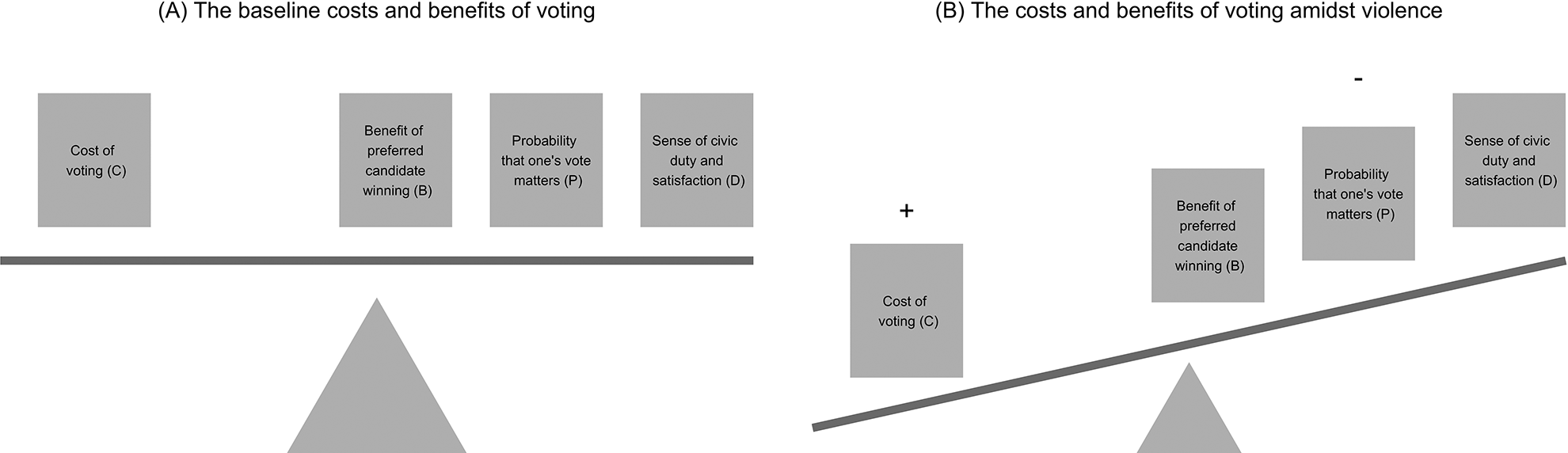
Second, electoral violence can reduce voter turnout by eroding public trust in the electoral system, that is, by undermining the belief that one’s vote matters (P). Political psychology research suggests that exposure to violence provokes feelings like anxiety and anger that prompt citizens to seek out more information and decrease their reliance on habitual voting clues (Marcus and Mackuen, 1993; Söderström, 2018). If such efforts to seek out new information prompt citizens to uncover weaknesses in the democratic system, electoral violence can decrease citizens’ belief that their vote matters. Some forms of electoral violence, especially violence targeting electoral institutions, is devised to undermine trust in the electoral system. Attacks against voter registration offices or ballot distribution centres can, for instance, signal to citizens that the election will be rigged and ballots destroyed. Political actors also resort to electoral violence directed against electoral institutions to challenge decisions perceived as unfair or unconstitutional (Harish & Toha, 2019: 693). While the purpose of such attacks is not always to suppress voting, voters may still conclude that the electoral process is flawed and that their vote therefore will not matter. Furthermore, electoral violence can be aimed at preventing specific candidates from running for office (Harish & Toha, 2019: 693). This can decrease the probability that citizens find a suitable candidate to vote for and therefore become indifferent about voting (Höglund, 2009: 417; Ley, 2018: 1968–1969). Hence, a lower perceived probability that one’s vote will matter (P) should push citizens towards voter abstention (Panel B in Figure 1). Taken together, a first hypothesis is:
Hypothesis 1: The more electoral violence in a voting district, the lower the voter turnout.
Electoral violence, incumbent strength, and voter turnout
Overall, I expect electoral violence to discourage voting. However, I further argue that contextual factors make voters in some localities more resilient to violence than voters in other localities. Existing theories of electoral violence and turnout often assume elections in which two opposing parties compete across a single national voting district. Because winning single-district elections demand national majorities, each vote contributes equally to the electoral outcome and voting incentives should be uniform across violence-affected districts (Birch, 2007: 1539; Müller-Crepon, 2022: 245). In Local incumbent strength The moderating effect of incumbent strength
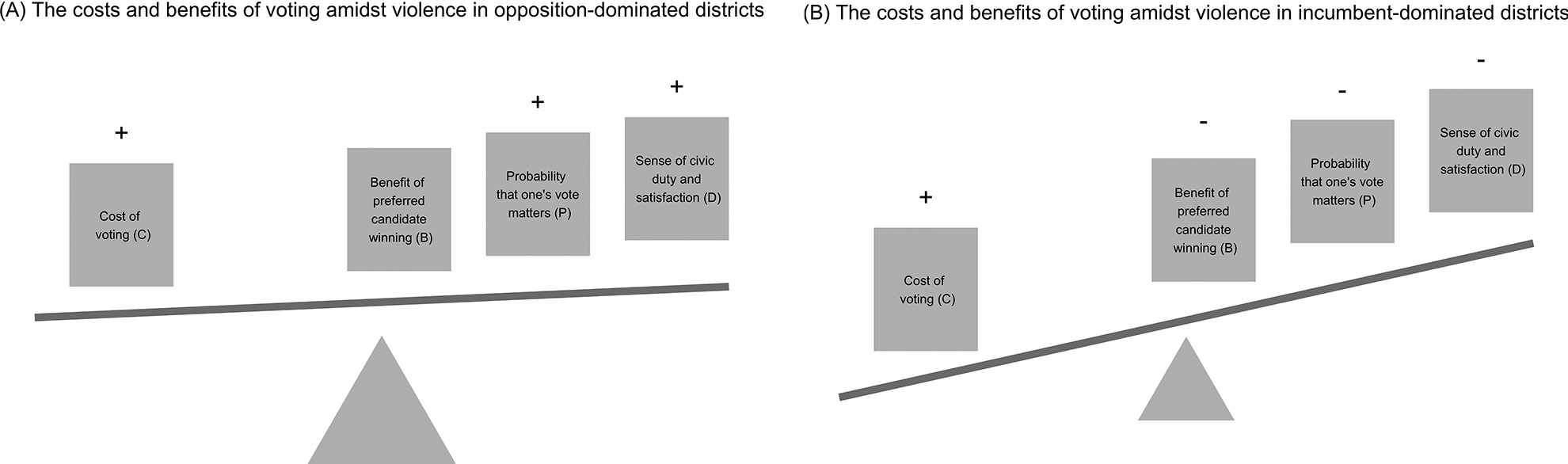
First, voters have lesser strategic incentives to vote in districts where the incumbent is stronger. Incumbents in unconsolidated electoral democracies benefit from centralized state control, and thus control the economic, coercive, and institutional means to stack the electoral deck in their favour (Rauschenbach & Paula, 2019: 686). Incumbents can therefore be confident that success at the polls will translate into political power. The higher a priori likelihood of incumbent victory in more incumbent-dominated districts means that a single vote is unlikely to change the local electoral outcome. Voters – both opposition and government supporters – should hence be less resilient to electoral violence and more likely to abstain their ballot to avoid casting a dangerous and ultimately meaningless vote.
In contrast, voters still have incentives to vote amidst violence in districts where the opposition is stronger. Opposition parties in unconsolidated democracies need to win convincing victories to counter on-the-margin vote rigging by the incumbent. Because incumbents often exert undue influence over electoral institutions and procedures, incumbents have the capacity to overturn narrow electoral defeats (Cheeseman, 2021). This risk of electoral manipulation generates strong incentives for opposition supporters in opposition-dominated districts to vote to ensure an ‘unriggable’ victory margin, despite the opposition’s local dominance. Likewise, the risk of electoral manipulation generates incentives for government supporters to vote to bring about a ‘riggable’ margin of defeat, despite dire odds. Moreover, because opposition-dominated districts can still be contested by multiple opposition parties, competition generates additional incentives to vote (Eichhorn & Linhart, 2021: 612). Thus, as the probability that one’s vote matters (P) is smaller in more incumbent-dominated districts, voters in such districts should be less resilient to an increase in the cost of voting (C) due to electoral violence (Figure 3).
Second, districts where the incumbent is stronger often host a larger pool of opportunistic voters than districts where the opposition is stronger. Incumbents in unconsolidated democracies typically command greater economic resources than the opposition, which they can use to mobilize opportunistic voters through patronage ties and vote-buying (Gutiérrez-Romero & LeBas, 2020: 79). While elections contested across multiple districts should incentivize the incumbent to target their vote-buying efforts on swing voters in competitive districts, existing research shows that a reliance on partisan networks and brokers for conducting vote-buying operations often leads the incumbent to privilege opportunistic voters in incumbent strongholds (Gutiérrez-Romero, 2014; Rauschenbach & Paula, 2019: 692; Stokes et al., 2013). 2 However, because the secret ballot makes monitoring compliance difficult (Nichter, 2008: 21), incumbents are often forced to reward entire districts for their electoral support (Cheeseman & Klaas, 2018: 82), meaning that residents will enjoy the reward regardless of whether they vote. That is, the likelihood that opportunistic voters distil benefits from their preferred candidate winning (B) is not necessarily tied to actually participating in the polls, which should make them less resilient to electoral violence and more likely to refrain from voting. 3
In contrast, voters in districts where the opposition is stronger are more likely to be driven by an intrinsic commitment to voting. Voting for the opposition in unconsolidated democracies is often dangerous, and opposition parties typically lack the economic resources and credit needed to mobilize opportunistic voters (Arriola, 2018). Moreover, given the opposition’s low overall likelihood of capturing the state, opposition parties cannot credibly commit to collectively reward voters after the election (Taylor, Pevehouse & Straus, 2017: 399). Instead, opposition parties often mobilize voters by appealing to more purposive incentives, such as voting to voice dissatisfaction with the regime (de Miguel, Jamal & Tessler, 2015: 1362; Miller, 2015: 692) or to signal support for democratic checks and balances (Bertrand, 2021: 604). Unlike collective rewards, purposive incentives are directly tied to actually casting a vote, which should make voters motivated by purposive incentives more resilient to violence. In addition, existing research shows that people motivated by purposive incentives are more likely to discount personal risks (Lerner & Kelter, 2001; Wood, 2003). Although voters can also be motivated by purposive incentives in districts where the incumbent is stronger, the opportunistic voter pool in those districts should be considerably larger.
4
Hence, as the share of voters motivated by a sense of civic duty and satisfaction from voting (D) is smaller in more incumbent-dominated districts, voters in such districts should be less resilient to an increase in the cost of voting (C) due to electoral violence (Figure 3). Thus, a second hypothesis is:
Hypothesis 2: Electoral violence depresses voter turnout more in voting districts where the incumbent is stronger than in areas where the opposition is stronger.
The argument implies two scope conditions typical of legislative elections. First, as the argument presumes that voting incentives can differ across localities, it should only apply to voter turnout in electoral systems where local rather than national majorities determine electoral outcomes. Second, as the argument assumes that voters have weak incentives to vote when they believe a candidate has a commanding electoral advantage, it only applies to winner-take-all electoral systems and not to proportional systems.
Case introduction and research design
Côte d’Ivoire held legislative elections for the National Assembly’s 255 seats in March 2021. Incumbent President Alassane Ouattara’s RHDP
5
won a narrow victory. Turnout stood at 39%, a slight increase from the opposition-boycotted 2016 legislative elections, but far below turnout rates common before Côte d’Ivoire’s 2010–2011 electoral crisis. Campaigning occurred amidst the worst electoral violence in a decade (Banégas & Popineau, 2021: 461– 462). Violence started in August 2020 when Ouattara announced that he would seek a third term in the 31 Number of electoral violence events per day, 1 August 2020–6 March 2021 Electoral violence events here refer to election-related public acts of coercion by state or non-state actors in the context of electoral competition.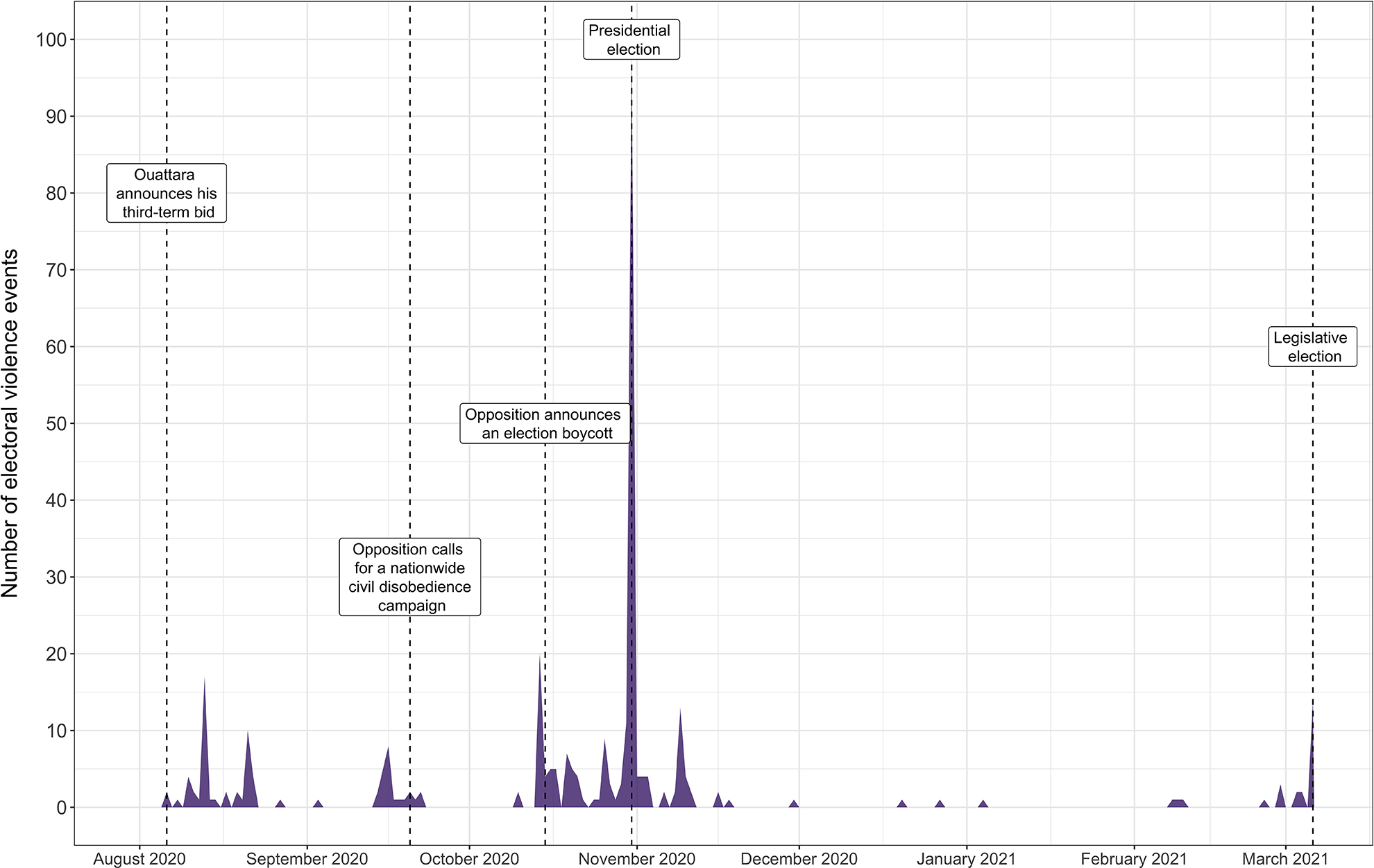
Both theoretical and methodological reasons underlie the focus on the 2021 Ivorian legislative elections. First, Côte d’Ivoire has a long history of electoral violence. Violence has marred every presidential election since 1990 (Daxecker, Amicarelli & Jung, 2019). The electoral crisis in 2010–2011 was particularly severe, and left some 3,000 people dead (Klaus & Mitchell, 2015: 623). Recent elections have been less violent, yet the last three elections all saw some violence (Bjarnesen & Van Baalen, 2021: 5). The high salience of electoral violence makes Côte d’Ivoire a case where electoral violence should be highly likely to reduce turnout. Second, Côte d’Ivoire constitutes a typical example of an African competitive authoritarian regime that holds regular elections and safeguards minimal democratic freedoms, but where the opposition has a serious disadvantage due to the incumbent’s undue influence over key electoral procedures and institutions (EISA & The Carter Center, 2020; 2021). Thus, Côte d’Ivoire provides an opportunity to examine the argument in a fairly representative case. Third, the Ivorian case is feasible to study and fulfils several of my argument’s scope conditions. There is significant subnational variation in electoral violence, incumbent strength, and turnout in Côte d’Ivoire. Legislative elections in Côte d’Ivoire are held across single- and multi-member voting districts and decided using a first-past-the-post system that awards the most popular candidate with the legislative seat(s). Thus, the likelihood of victory varies considerably, which is expected to play a role in moderating the effect of electoral violence on turnout. Moreover, legislative elections in Côte d’Ivoire are multipolar and revolve around three large parties (as well as regional parties and independent candidates), which heightens competition in opposition strongholds.
The unit of analysis is the voting district, the smallest unit for which the IEC released results. Voting districts in Côte d’Ivoire often consist of departments, the country’s third administrative subdivision, with a few exceptions in more populous areas. Voting districts in the de facto capital Abidjan equal municipalities, but are similar in size to departments elsewhere.
Dependent variable
The dependent variable is voter turnout, measured as the share of registered voters that cast their vote in the elections. 9 The data comes from the Ivorian IEC. 10 Average local turnout stood at 48%, yet varied from 14% to 99%. Turnout was lower in southern opposition areas, and higher in northern Ouattara strongholds. Importantly, and in strong contrast to the 2020 presidential election, election observers noted that the polls ‘were held in a calm and largely peaceful sociopolitical context’, and concluded that ‘voting and counting operations were generally conducted in a peaceful and transparent manner’ (EISA & The Carter Center, 2021: 1–2). Thus, the election results should enable a reliable analysis of how electoral violence influenced turnout.
Independent variables
To measure electoral violence, I compiled an original dataset of electoral violence events covering the period 1 August 2020–6 March 2021. 11 Existing electoral violence datasets do not contain information on this time period (Daxecker, Amicarelli & Jung, 2019; Fjelde & Höglund, 2022). I therefore manually coded all incidents of electoral violence, operationalized as ‘public acts of […] coercion by state or non-state actors used to affect the electoral process, or arising in the context of electoral competition’ (Daxecker, Amicarelli & Jung, 2019: 716). The sampling procedure built on the Electoral Contention and Violence (ECAV) procedure, with four deviations. First, instead of the Lexis-Nexis database, I relied on the equivalent Factiva database. Second, while the ECAV extraction strategy is limited to a few English-language news agencies, I extracted news wires from all available Factiva sources in English and French. Third, I manually appended the dataset with election-related events recorded in the Armed Conflict Location and Event Dataset (Raleigh et al., 2010). Fourth, to mitigate media biases, I complemented the Factiva search with a review of election monitoring reports by international and Ivorian human rights watchdogs. 12 This sampling strategy allowed me to capture a greater number of election-related violent incidents than the ECAV extraction strategy. The final dataset contains 320 electoral violence events.
Because the number of dead and injured may not be proportional to the fear the violence induces in voters in countries with a history of electoral violence (Cheeseman & Klaas, 2018: 116), the main independent variable is a count of electoral violence events in the voting district, rather than violence severity. Hence, my operationalization assumes that non-lethal events have the same negative effect on turnout as lethal events (see also Wahman & Goldring, 2020: 100–101). In addition, while most existing studies of electoral violence and turnout count violent events related to the same election and in close temporal proximity to the election, I use a seven-month time frame encompassing two different elections. Two reasons underlie this decision. First, the tight sequencing of the two elections meant that the legislative election was viewed as a continuation of the presidential election campaign rather than as a separate election. Election observers, for instance, reported that lingering impacts from the presidential election and post-election crisis ‘negatively affected the current electoral process’ (EISA & The Carter Center, 2021: 1), Electoral violence and voter turnout by voting district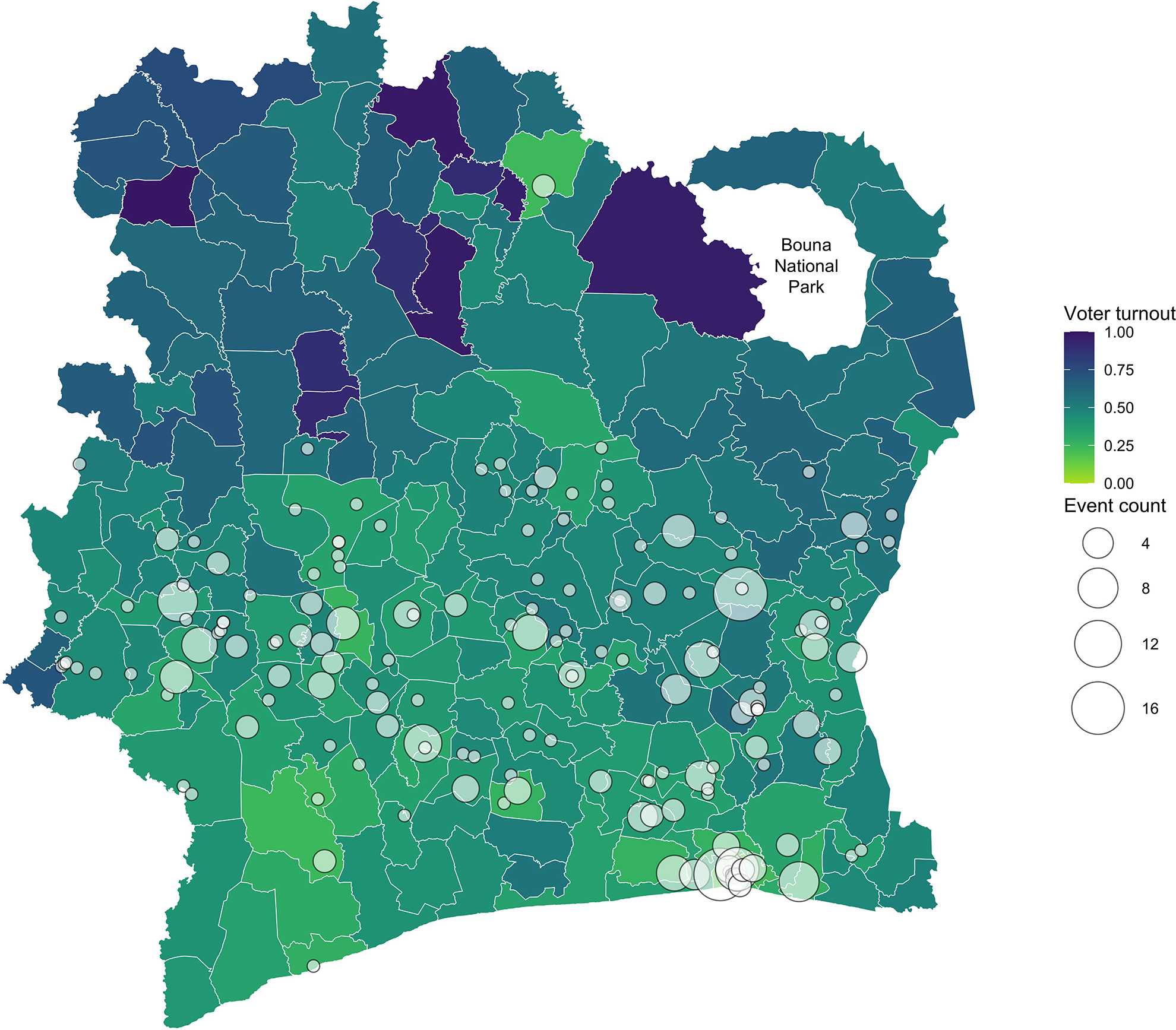
I measure incumbent strength as the share of registered voters in the voting district that voted for the RDR
13
(the RHDP’s predecessor) in the first round of the 2010 presidential election, the most recent Ivorian election contested by all three major parties prior to 2021.
14
Electoral violence and incumbent strength by voting district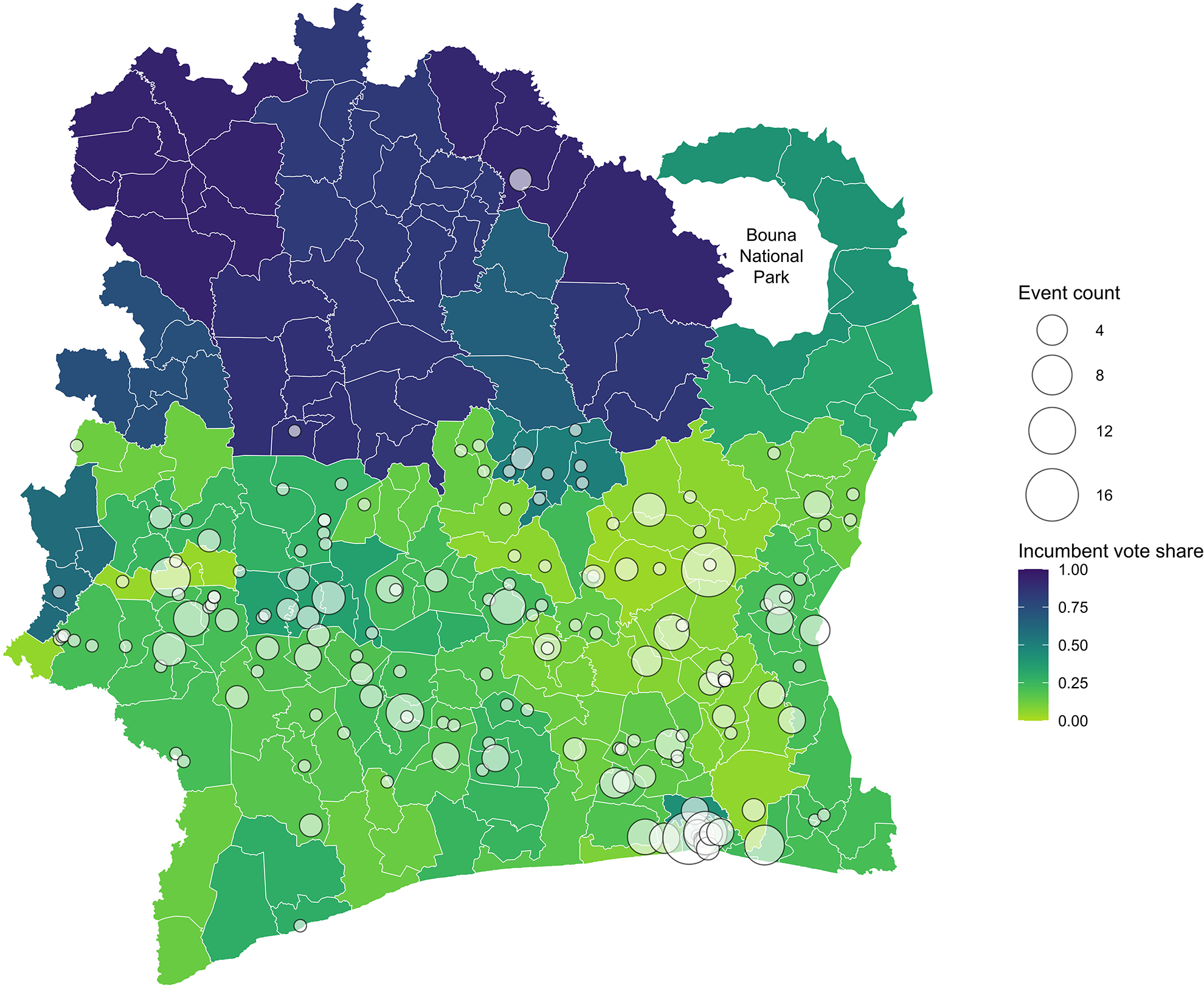
Control variables
Fractional regression of voter turnout and electoral violence
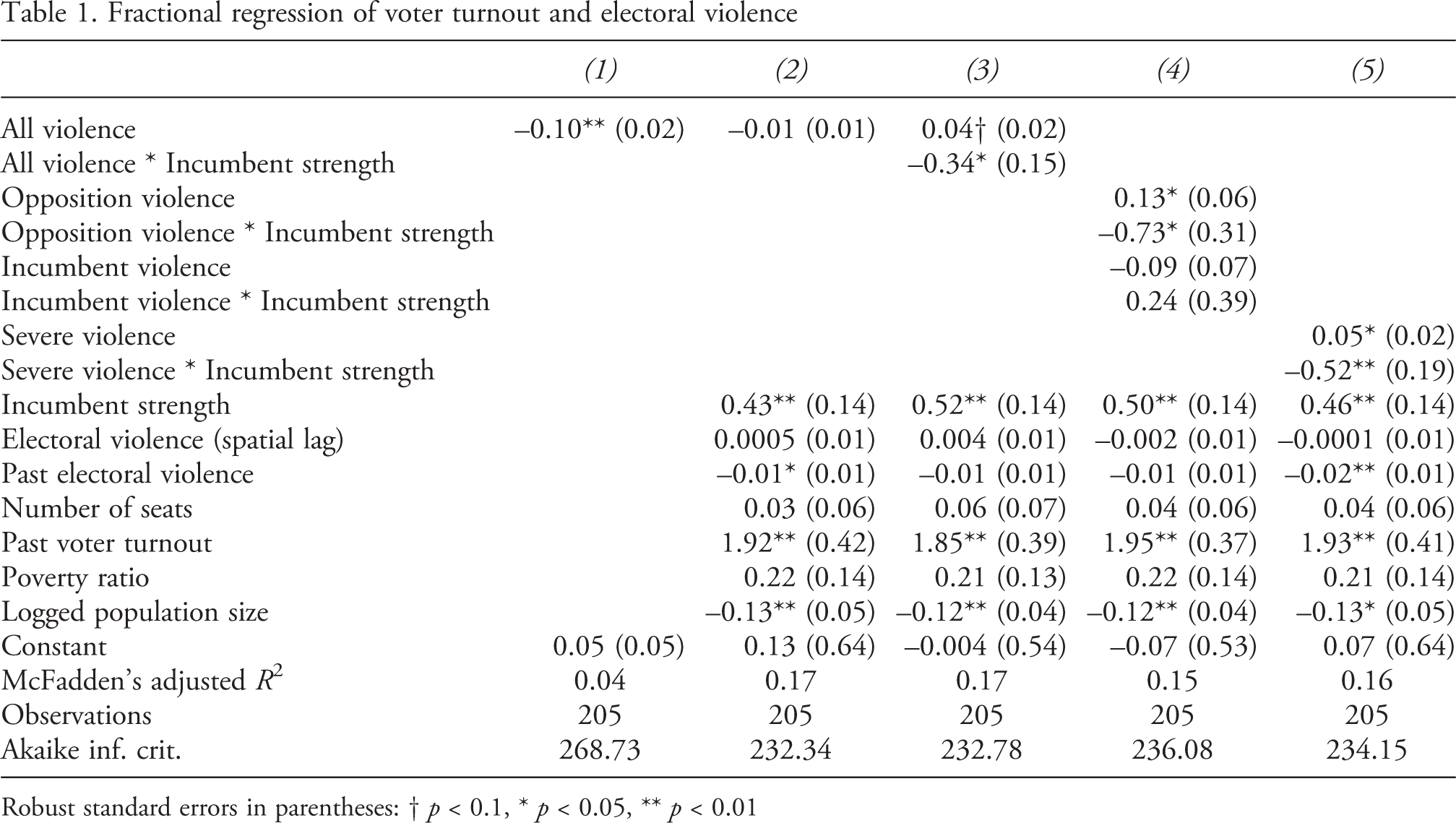
Robust standard errors in parentheses: † p < 0.1, * p < 0.05, ** p < 0.01
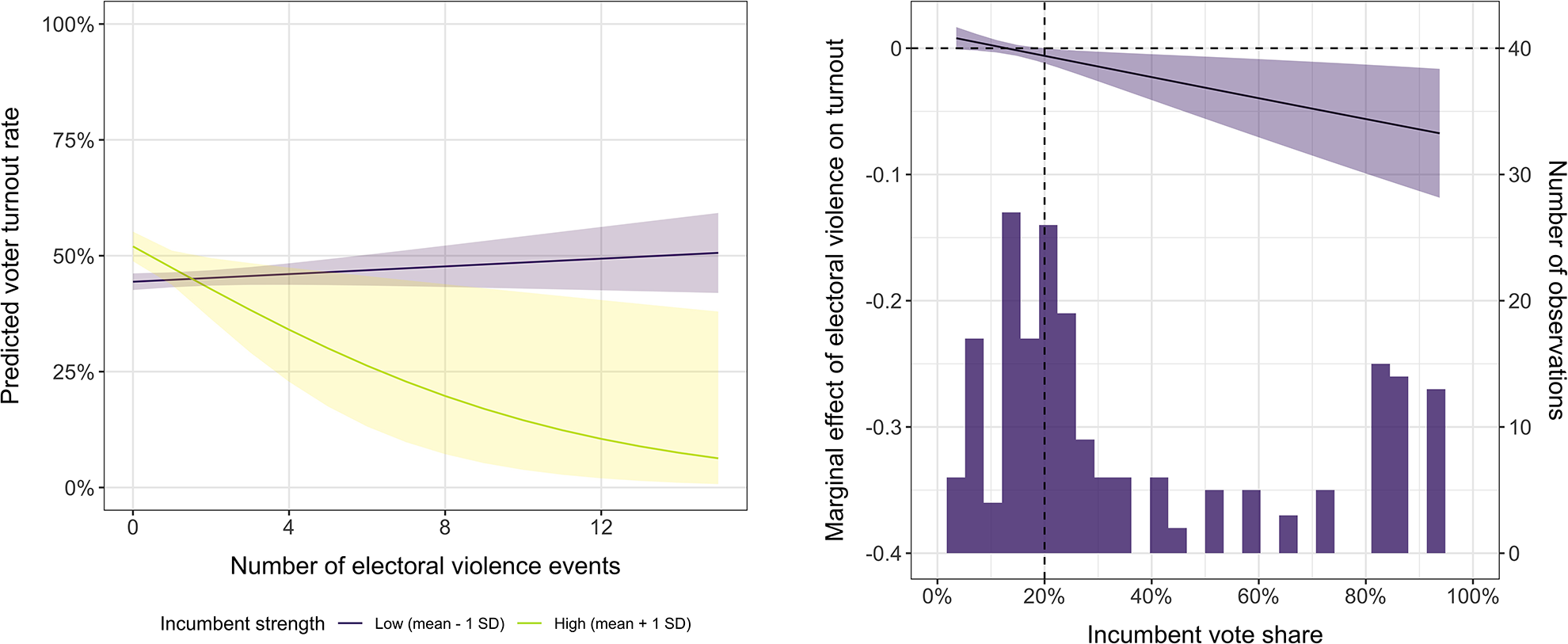
Predicted values and marginal effects
Analysis
The analysis finds that voting districts with more electoral violence had lower turnout, but only in voting districts where the incumbent was stronger. In contrast, electoral violence was not associated with lower turnout in opposition strongholds. The full results are in Table 1. As the outcome of interest is a fraction, all models use fractional response regression and heteroskedasticity robust standard errors (Papke & Wooldridge, 1996).
Hypothesis 1 expects that voting districts with more electoral violence will have lower voter turnout. I find no support for an unconditional association between electoral violence and turnout (Model 1 and 2 in Table 1). While electoral violence has a negative and statistically significant effect on turnout in the bivariate model (p < 0.001), the negative coefficient is not statistically significant in the multivariate model (p ≈ 0.15). Thus, there is no evidence that electoral violence was associated with lower voter turnout across voting districts in Côte d’Ivoire’s 2021 legislative election.
Hypothesis 2 expects that incumbent strength moderates the negative effect of electoral violence on voter turnout so that the effect is greater in voting districts where the incumbent is stronger. I find consistent and robust evidence for this hypothesis. The results in Model 3 in Table 1 indicate that incumbent strength has a moderating effect on the association between electoral violence and turnout. Electoral violence has a positive effect on turnout (p ≈ 0.05), as has incumbent strength (p ≈ 0.0003). Moreover, the interaction term has a negative and statistically significant effect on turnout (p ≈ 0.02), indicating that the effect of electoral violence on turnout depends on how strong the incumbent is in the voting district (or vice versa).
The left panel in Figure 7 visualizes the predicted voter turnout rate as electoral violence increases across different levels of incumbent strength (mean +/– 1 SD), while holding continuous control variables at their mean value and categorical controls at their mode. 16 The figure confirms that electoral violence depresses turnout in voting districts where the incumbent is stronger. A one standard deviation increase in electoral violence (from 0 to 3 events) in a voting district with high incumbent strength (mean + 1 SD) decreases the predicted turnout rate by 15 percentage points or almost a full standard deviation (from 53% to 38%). In contrast, the same increase in electoral violence in voting districts with low incumbent strength (mean – 1 SD) does not generate a statistically significant change in the predicted turnout. The right panel in Figure 7 illustrates the marginal effect of electoral violence on turnout across the observed range of incumbent strength. The graph further confirms that the effect of electoral violence on turnout depends on incumbent strength. Calculating the Johnson-Neyman interval indicates that electoral violence is significantly associated with lower turnout when the incumbent gathered more than 20% of the votes in 2010. Roughly 65% of the voting districts had greater incumbent strength values than this. Hence, while electoral violence is associated with lower turnout, this is not the case in opposition strongholds. 17
Models 1–3 in Table 1 rest on the assumption that electoral violence depresses turnout where the incumbent is stronger regardless of the perpetrator. In contrast, since the perpetrator’s identity may shape the fear of voting to different degrees, Model 4 in Table 1 disentangles electoral violence into two separate count variables: a count of events initiated by opposition-affiliated actors and a count of events initiated by government-affiliated actors. The initiator of violence here refers to the side that first used violence in an event, and does not preclude the possibility that the other side responded with violence. 18 The results from this additional analysis show that opposition-initiated electoral violence is associated with significantly lower turnout in voting districts where the incumbent is stronger (p ≈ 0.02). Moreover, the results indicate that opposition-initiated violence is associated with somewhat higher turnout in voting districts where the incumbent is weaker (p ≈ 0.02). In contrast, incumbent-initiated electoral violence is not significantly associated with turnout, nor is the interaction term. These findings are consistent with existing research that distinguishes between electoral violence strategically aimed at mobilizing in-group members and violence strategically seeking to demobilize out-group members (Burchard, 2020; Wahman & Goldring, 2020), yet suggests that this logic does not hold for incumbent-initiated violence prior to Côte d’Ivoire’s 2021 election. 19
Moreover, the results in Models 1–4 all rely on the assumption that both more and less severe types of electoral violence have a uniform effect on voter turnout (conditional on incumbent strength). To unpack this assumption, Model 5 in Table 1 uses an electoral violence variable that only counts events that resulted in bodily harm. The results remain robust, indicating that the main finding is not an artefact of including less severe electoral violence events.
Regarding the control variables, the spatial lag of electoral violence, past electoral violence, the number of seats, and poverty have no consistent substantial effect in any of the models. Others fit prior expectations. Unsurprisingly, higher turnout in 2016 is associated with higher turnout in 2021. Moreover, as expected, more populous voting districts had on average lower turnout. This is a recurring pattern across Ivorian elections, and consistent with previous findings from Nigeria (Bratton, 2008: 626).
Robustness checks and additional analysis
The results remain robust across several alternate model specifications, including a placebo test, disaggregating electoral violence by timing, using a dichotomous independent and moderating variable, using the number of victims instead of events as the independent variable, excluding uncertain electoral violence events, using alternative measures of incumbent strength, excluding voting districts with irregular election results, including region-level fixed effects, controlling for voter turnout in the 2020 presidential election, and estimating parsimonious models. All robustness tests are discussed in Online appendix A.
Two additional considerations warrant discussion. A first concern is that the control variables do not fully address possible selection biases. Electoral violence is not random. In fact, Figure 6 shows that electoral violence was less common in northern voting districts where the incumbent was stronger. This pattern means that while violence-affected opposition strongholds are compared to non-affected opposition strongholds where violence was still a credible risk, violence-affected incumbent strongholds are compared to non-affected incumbent strongholds where violence was unlikely. This discrepancy constitutes an inferential threat. As voters may assess the costs of violence both based on past violence and a perceived future risk of violence, voters in voting districts where the incumbent was weaker may have been overall more likely to stay at home, thus leaving little room for further decreases in turnout.
I address this challenge by using matching to create a more balanced covariate distribution (Iacus, King & Porro, 2012). Matching helps overcome selection bias by limiting the differential likelihood that a voting district experiences electoral violence. I match voting districts with at least one electoral violence event with districts that had no events. Given the small sample size, I use only incumbent strength and electoral violence (spatial lag) as matching variables. I employ coarsened exact matching (CEM), which creates a quasi-experimental sample in which the matching variables are similarly distributed across voting districts with and without electoral violence. CEM excludes control observations that are too different from treated observations, and produces weights that account for remaining imbalances in the distributions of the matching variables (Ho et al., 2007). The matching significantly reduces imbalances across voting districts with and without violence. 20 Yet, since some imbalance remains, I control for confounders in the matched analysis. Since the matching procedure limits meaningful variation in the count of electoral violence events, all models use an electoral violence dummy as the independent variable. The results are reported in Table A3 in Online appendix A and remain robust, although it should be noted that the p-value of the interaction term increases from p ≈ 0.02 to p ≈ 0.08.
A second concern relates to my argument’s underlying assumptions. The argument is that prospective voters in districts where the incumbent is stronger are more likely to abstain from voting when exposed to electoral violence because they have lesser strategic and purposive incentives to vote. Overall, the argument presumes that (i) voters across the board perceive voting in the context of violence as costly, and (ii) that voters in districts where the opposition is stronger perceive greater incentives for voting. While an exhaustive examination of these assumptions is beyond the study’s scope, contextual evidence suggests that these assumptions are plausible.
First, evidence suggests that electoral violence increased the perceived cost of voting. In general, the electoral violence was of a character that should influence risk perceptions among all prospective voters rather than among a smaller group of perceived targets. Much of the violence was public; it targeted election officials, polling stations, and electoral institutions, and it involved large-scale property destruction. Clashes, violent protests, and repression of violent protests accounted for 47% of all electoral violence events. This violence involved hundreds of participants, affected innocent bystanders, and caused much material damage. Arson or ransacking of polling stations constituted another 24% of violent events, which pinpointed voting stations as high-risk sites, and 9% of the events involved erecting roadblocks to intimidate voters and prevent people from reaching polling stations. Survey data furthermore indicates that Ivorian voters fear electoral violence and that such fears influence political participation. Some 75% of Ivorians in the latest Afrobarometer round answered that political competition often or always breeds violent conflict. About 80% of these respondents also replied that people often or always have to be careful about how they vote in elections. Moreover, opposition voters were more likely to perceive a connection between political competition and violent conflict than incumbent supporters (77% vs. 62%), suggesting that the differential effect across more and less incumbent-dominated localities is not driven by opposition voters being less fearful of electoral violence (Afrobarometer, 2018).
Second, there is evidence that there were greater strategic incentives for voting in districts where the opposition was stronger. The 2021 average victory margin in voting districts won by the RDR in 2010 was about 40 percentage points, compared to 20 percentage points in voting districts won by the opposition in 2010. A key reason for this is that the 2021 Ivorian opposition consisted of multiple national, regional, and independent candidates that gathered considerable local support. Factionalization likely heightened incentives to vote in opposition-dominated districts compared to more incumbent-dominated districts. Moreover, voters in districts where the opposition was stronger – most of whom were likely opposition supporters – had incentives to help ensure an ‘unriggable’ victory margin. Election observers and country experts noted that Ouattara’s regime engaged in considerable electoral manipulation before the 2020–2021 electoral cycle, like tampering with the voter registration process, disqualifying and harassing opposition candidates, exerting undue influence over the IEC, and using the Covid-19 pandemic to ban opposition rallies (Amnesty International, 2020; Bjarnesen & van Baalen, 2020: 7; EISA & The Carter Center, 2020: 8–10). Such concerns should have incentivized voters in more opposition-dominated areas to remain committed to voting to ensure a large margin of victory, despite the violence.
Conclusion
This study develops and tests a novel argument about the heterogeneous effects of electoral violence on voter turnout. Using new data on electoral violence before Côte d’Ivoire’s 2021 legislative election, I demonstrate that electoral violence was associated with lower voter turnout, but only in voting districts where the incumbent was stronger. Electoral violence in opposition strongholds, in contrast, was not associated with lower turnout. My findings contribute nuance to existing contradictory research on the effects of electoral violence on turnout, and highlight that such effects can be conditional on local political geography in elections where local majorities trump national majorities.
The findings are based on evidence from Côte d’Ivoire, and further research is needed to evaluate whether they are applicable elsewhere. Readers should take note of several case-specific characteristics when considering the findings. First, the 2020–2021 electoral violence appears primarily expressive rather than strategic, meaning that much of the violence aimed to signal frustration with the electoral process rather than influence the electoral outcome. Further research can assess whether the findings are also applicable in contexts where electoral violence is part of a more concerted intimidation strategy. Second, much of the 2020–2021 electoral violence was opposition-initiated, even though state repression of opposition-led action also played a role (see Online appendix B). Thus, it is possible that voters in more incumbent-dominated districts were more fearful of electoral violence. Third, Côte d’Ivoire has a multiparty political landscape contested by multiple opposition and independent candidates. This characteristic should further enhance voter resilience to electoral violence in more opposition-dominated districts, as such areas can be hotly contested between opposition candidates. Thus, it is possible that the conditioning effect of incumbent strength is less pronounced in contexts where legislative elections are more dyadic.
I focus on voter turnout in the aggregate and hence cannot determine whether the results are driven by opposition or incumbent supporters abstaining their votes. One task for future research is therefore to probe how individual and local level factors jointly shape turnout in violent elections. Moreover, future research could examine in depth the proposed strategic and purposive incentives held to enhance voter resilience to electoral violence in more opposition-dominated districts (see e.g. Young, 2020). Likewise, I examine only one aspect of local political geography, namely incumbent strength. Future research on electoral violence and political participation could broaden the scope and explore how other local factors, such as local institutional strength, elite coalitions, or presence of election observers condition the effect of violence on turnout. Finally, an important task for future research is to also examine under what conditions electoral violence reduces other forms of political participation, such as campaigning and political engagement.
Voter abstention due to electoral violence undermines democracy. However, my findings suggest that voters in districts where the opposition is stronger can be resilient to electoral violence. Democracy watchdogs often assume that electoral violence is a threat to political participation and deters opposition supporters from voting. My research shows that while electoral violence may indeed depress turnout, voter abstention associated with violence is most likely in more incumbent-dominated areas where changes in turnout exert little influence on the electoral outcome. This finding corroborates existing research that suggests that electoral violence can embolden the opposition to defy the incumbent regime and hold the government accountable for failing to curb violence (Burchard, 2020: 599). Thus, when electoral violence arises because the opposition seeks to counteract unfair electoral practices, postponing violent elections may prove counterproductive for promoting democratic consolidation. Keeping in mind that voters can be resilient to demobilizing electoral violence is important, as incumbents in unconsolidated democracies often use electoral violence as an excuse for extraordinary measures (Jenkins, 2020). While saving lives still provides a convincing reason for holding off on elections marred by violence, my research cautions that such recommendations could disproportionately benefit the government ultimately responsible for preventing violence.
Footnotes
Replication data

Acknowledgements
I gratefully thank Jesper Bjarnesen, Emma Elfversson, Hanne Fjelde, Kristine Höglund, Gudlaug Olafsdottir, Marcellina Priadi, the editors, three anonymous reviewers, and my colleagues for excellent feedback.
Funding
This study was conducted within the project “Political Legacies of Electoral Violence” and funded by the Swedish Research Council (VR2016–05833).