




Abstract
History suggests universities are hotbeds of political protest. However, the generality and causal nature of this relationship has never been quantified. This article investigates whether universities give rise to political protest, drawing on geocoded information on the location and characteristics of universities and protest events in the 1991–2016 period, at the subnational level in 62 countries in Africa and Central America. Our analysis indicates that university establishments increase protest. We use a difference-in-differences and fixed-effect framework leveraging the temporal variation in universities within subnational grid-cells to estimate the effect of universities on protest. Our analysis indicates that localities with increases in number of universities experience more protest. We suggest a causal interpretation, after performing different tests to evaluate whether this reflects confounding trends specific to locations that establish universities, finding no support for this. We also provide descriptive evidence on the nature of university-related protests, showing that they are more likely to emerge in dictatorships and that protests in university locations are more likely to concern democracy and human rights. These findings yield important general insights into universities’ role as drivers of contentious collective action.
Introduction
Universities are often considered hotbeds of political protest. Images of student protests in the 1960s, on campuses such as Berkeley and La Sorbonne, are iconic examples of student radicalism and revolt. Student mobilization has also proliferated in more recent years, in a diverse set of countries including South Africa, Zimbabwe, Hong Kong, and Egypt, and student riots have been implicated in democratic transitions in, for example, Tunisia, Indonesia, and Chile. This suggests a general tendency of universities generating mass political dissent. Indeed, prominent theories of political development and democratization, such as modernization theory (Lipset, 1959) suggest a link between university education and mass protest. Yet, a contrasting view holds that universities—at least in dictatorships—can be institutions of legitimation and indoctrination, creating more docile and loyal citizens. Unfortunately, the generality and causal nature of the university-protest link remains elusive. While some studies consider how education (in general) affects political violence (e.g., Barakat & Urdal, 2009), democracy (Glaeser et al., 2007), and individual political participation (Croke et al., 2016; Persson, 2015; Sondheimer & Green, 2010), the role of universities in shaping contentious protest remains unexplored. We pose the questions: Do locations with more universities see more political protest? If so, do universities induce these protests? And finally, what are the characteristics of university-related protests? Protest events come in many different forms, ranging from spontaneous and apolitical riots to large-scale and organized demonstrations aiming to overthrow regimes.
To provide answers, we utilize information on the subnational locations—in “grid-cells”—of universities across the globe, combined with information on geocoded data on protest in the 1991–2016 period, in Africa, Central America, and the Carribean (where our protest data are available). Combining these sources yields a data set of grid-cells in 62 countries and roughly 4,000 geolocated universities with associated characteristics. With these data, we estimate how temporal variation in universities within subnational grid-cells affects protest events.
We outline two general mechanisms linking universities to protest. First, universities create opportunities for potential protestors to coordinate and overcome collective-action problems, as facilitators of social networks, organizations, and physical infrastructure offering “focal points” for coordination. Second, universities induce social and political grievances that motivate protests. In particular, following theories highlighting how universities promote “civic values,” including political awareness and critical thinking, university students should be drawn toward political activism and more inclined to challenge authorities—especially when governments fail to meet expectations. The main hypothesis to be drawn from these mechanisms is that the establishment of universities should increase overall protest activity.
Our findings support this expectation. Using a difference-in-differences and fixed-effect approach, we find that grid-cells with increases in universities see increases in protest activity. This holds also when conditioning on a number of relevant confounders such as income, urbanization, and population, and different ways of modeling potential time trends in university establishment. We test whether this could reflect confounding pretrends in places that establish universities, finding no evidence of this. We also perform a number of additional tests to demonstrate robustness and further support a causal interpretation of this finding.
Drawing on fine-grained protest actors and goals, we then look more closely into the nature of university-related protests. This descriptive analysis reveals that the link between universities and protest is more pronounced for less democratic regimes. We also find that university-related protests are more often concerned with political issues such as democracy and human rights, but less commonly related to economic grievances and food-concerns. This could be, for instance, because universities induce democratic preferences and grievances against autocracies, or, because universities attract individuals with these kind of preferences.
Our findings inform major debates in political science and beyond. For example, they support the view that (tertiary) education is a key driver of political activism and collective action. And, although this article only explores one of many pathways through which universities are linked to democratization, the evidence that university protests are typically concerned with democracy and human rights aligns with the notion of universities as a potential challenge to autocratic (and poorly governed) regimes across the globe (Campante & Chor, 2012; Glaeser et al., 2007). Our finding that universities facilitate protest is also consistent with the claims of “modernization theory,” connecting economic modernization more generally (of which education is an instance) to societal change driven by collective action (Inglehart & Welzel, 2005; Welzel, 2013). Finally, it speaks to recent findings on how modern social infrastructures—such as communication technology and education—conduces political instability and mass uprisings (e.g., Dafoe & Lyall, 2015).
Background
The rise of universities is one of the most profound social developments in the modern era. Universities have fostered scientific breakthroughs, and produced large global increases in human capital. Universities likely play a major role in processes such as economic growth, declining poverty, infant mortality, and disease (e.g., Valero & Van Reenen, 2019). What is the role of universities in generating political change and mobilization?
One answer emphasizes the role of universities as education producers. A decade of research has established a link between education in the population and democratization (Acemoglu et al., 2005; Glaeser et al., 2007; Murtin & Wacziarg, 2014), and mass protest is often envisioned as the causal mechanism propelling high-education countries toward regime change (e.g., Campante & Chor, 2012). Some have directly tested the link between average education levels and mass protest. For instance, Campante and Chor (2012) find educated individuals more likely to protest during the Arab spring (see also Dahlum and Wig (2019)). Yet, the link between universities and mass protest is still poorly understood, for several reasons.
First, with some exceptions—including the studies reviewed above—extant literature has primarily investigated how education more generally is linked to conventional political participation aiming to channel preferences within the framework of current political institutions, such as voting (see e.g., Berinsky & Lenz, 2011; Dee, 2004; Freeman, 2003) and party membership (see e.g., El-Said & Rauch, 2015; Persson, 2015; Sondheimer & Green, 2010). This includes recent regression-discontinuity studies of national education reforms, identifying both participation enhancing (Larreguy & Marshall, 2017) and dampening effects (Croke et al., 2016). Yet, the insights from studies of education and political participation cannot be easily applied to “contentious politics”—including mass protest—understood as political actions aiming to “fundamentally challenge others or authorities” (Tarrow, 1994). Contentious collective action is likely to be associated with much higher costs (due to, for example, collective-action problems) and driven by different grievances than conventional political participation.
Second, the popular image of universities as hotbeds of protest is supported by both anecdotal examples and qualitative country-specific studies (e.g., Brooks, 2016), but lacks general evidence. For instance, universities as protest locations has garnered attention in studies of 1960s campus activism (with a focus on the United States) (e.g., Van Dyke, 1998). Yet, it is not obvious that universities are, on average, more protest-ridden than other locations or institutions. For example, selection-bias likely plays a role in the public discourse on protest events: The universities that do experience social unrest, such as Berkeley and the Sorbonne, are the ones that tend to be remembered, and these cases are rarely contrasted with locations where protest occurred but with no universities. Moreover, it is not given, from a theoretical point of view, that universities should stoke social unrest. As noted above, universities can serve as institutions for regime legitimation (perhaps especially in dictatorships) (Gerschewski, 2013). Universities can also serve as public goods benefiting populations and could thus reduce popular grievances and social unrest in recipient populations.
Third, due to the largely qualitative nature of existing studies, the potential causal effect of universities on mass protest remains to be estimated empirically. For instance, extant studies are not able to disentangle whether communities are more likely to see political protest because of the presence of universities, rather than some other characteristic of those locations.
Fourth, while existing (large-N) studies often consider the political outcomes of either primary or secondary schooling, or an average measure of years of schooling, the qualitative literature highlights the role of tertiary education, specifically, in shaping mass mobilization and political discontent (Weiss & Aspinall, 2012). Theoretically, tertiary education is a plausible driver of political mobilization as a result of its academic content and the institutional life it requires (students attending comprehensive institutions, with an array of student activities). This calls for a general systematic treatment of the role of universities in shaping mass protest.
Finally, while the above contributions illuminate important aspects of the education-mobilization relationship, they do not emphasize a key fact about tertiary education: Universities as social and physical institutions, in addition to producers of learning outcomes. In this article, we discuss how the institutional structures and daily organized activities of universities can create powerful platforms for collective action.
To address these gaps, we present a novel analysis probing the university-protest relationship in a large sample of countries using subnational data. First, this allows us to answer whether there is a (moderately) generalizable link between universities and mass protest. Second, the granularity of our data allows us to better grasp the causal and heterogeneous nature of this link.
Linking Universities to Mass Protest
We understand mass protest along the lines of Tarrow’s “contentious politics” (Tarrow, 2007)—as coordinated, collective claims on authorities, made through public performances. Mass protest events require a minimum level of coordination, but vary in their organization, size, and duration. Mass protests also vary in their goals and targets—ranging from maximalist claims aimed at governments, to more specific issues, such as dissatisfaction with rising food prices or anger at international organizations. University-related protests may also relate to issues such as tuition fees, education reforms, or university policies.
Consistent with insights from political psychology and behavior, we expect higher education to raise political awareness (see, e.g., Galston, 2001), inducing education recipients to want political change. However, individual preferences for change are not sufficient to explain protest participation (e.g., Lichbach, 1998), which may be inhibited by collective-action problems—even when enough people prefer the expected outcome of protest. Below (section “Universities and collective-action problems”), we discuss how universities can help participants overcome collective-action problems, before outlining how universities may shape preferences and goals (section “Universities and grievances”).
Universities and Collective-Action Problems
Theories of collective action commonly emphasize two hurdles that those wanting to mobilize a mass protest must overcome: An information problem and a motivation problem. One version of the information problem is elegantly outlined in Kuran’s (e.g., 1995) discussion of preference falsification, which occurs when individuals have incentives to falsify their motives, including preferences for political change, and refrain from dissent. In autocracies, preference falsification is strong due to fears of repression. In less-repressive contexts, preference falsification can still occur due to social desirability biases and cultural expectations. The stronger the social desirability of a given preference, which is a function of how many other people express it, the weaker the incentives to express contradictory preferences. In a situation with widespread preference falsification, where the statements (or silence) of others can reflect either preference falsification or genuine preferences, it is hard to know how widely one’s view is shared. This will discourage the expression of political dissent. Another type of information problem emerges when the coordination of protest is inhibited because people lack access to other people’s intentions regarding where and when to protest. Per definition, mass protest is tightly linked to the coordination of individual actions, which requires a steady flow of information regarding location and behavior (Schelling, 1980). In sum, information problems can affect the decision to protest per se, and also the coordination around the time and place of a protest.
The motivation problem is related to what Tullock (1971) calls the “paradox of revolution”: Engaging in protest has potential costs, such as being jailed or subject to violence, while the benefit realized by protest is invariably a public good (such as regime-change), with no possibility of excluding nonprotesters. This discourages individual protest participation and is further compounded by the fact that most individuals have miniscule impacts on the protest outcomes they desire. Consequently, potential protesters will have (strong) incentives to stay at home, even when their preferences align with the goals of the protesters and they have information about other people’s preferences. Below, we outline how the presence of universities should influence both these obstacles to collective action—the “information problem” and the “motivation problem,” through several channels.
Social networks
First, universities stimulate social networks. Students interact on a daily basis within universities, by partaking in seminars, lectures, and colloquia and also through interactive spare-time, involving student activities, organizations, social events, and even common living arrangements (student dormitories). These interactions should foster strong social networks among individuals in the university community. Social networks alleviate the aforementioned collective-action problems. For example, they contribute to the flow of information and, consequently, reduce both preference falsification and coordination problems (see, e.g., Lohmann, 1994; McClurg, 2006). They also moderate the “motivation problem” by raising potential reputation costs from free-riding (Campbell, 2013; McAdam, 1986). Importantly, the choice to participate in collective action is tightly linked to shared identities with other protesters (Polletta & Jasper, 2001). Universities create and reinforce such shared identities, such as the category of “student,” or the probably even more salient identity category “student of this university.” In line with this, the social-movement literature offers widespread evidence that individuals are usually recruited to protests through pre-existing social ties (see, e.g., McAdam & Paulsen, 1993).
Organizations
Universities offer a plethora of campus organizations that bolster the mobilization capacities of potential protesters. Protest movements often emerge from and/or synergize with already existing organizations, such as churches, women’s movements, labor–student unions (Staniland, 2014). The advantage of existing organizational structures can be illustrated by the protest movement in Kenya in the 1990s, initiated by the Student Organization of the Nairobi University (SONU), that effectively drew on student newspapers to disseminate criticism of the regime, and publish pamphlets were easily disseminated through students’ mailboxes (Amutabi, 2002). After having their protest dispersed by police, the students could quickly regroup due to the networks and communication facilities of the student union.
Opportunity costs
Universities remove (often highly capable) people from the labor market, albeit temporarily. This decreases these people’s opportunity costs of protesting, since students are rarely fully employed (and employment yields high opportunity costs). Students’ opportunity cost calculations are also undoubtedly influenced by their age and family characteristics (young and often unmarried and childless)—which suggest that students may have lower opportunity costs and less to lose from protest. Universities also offer a less regulated environment than a workplace, with fewer mandatory activities and voluntary attendance. This gives students freedom to partake in protests.
Focal points
Universities offer “‘focal points” that reduce coordination problems for citizens seeking to act collectively (Schelling, 1980; Sugden, 1995). Crucially, universities provide physical campuses that are well-suited for coordinating protest. The social-movement literature suggests that physical proximity (to other potential protesters), in addition to social networks, is a key determinant of protest participation (e.g., Snow et al., 1980). Campuses often provide open spaces for congregation, as well as student-body offices, newspapers, and other facilities making the campus a natural focal point for protest. There are numerous examples of how university protests benefit from the campus structure, such as the series of student strikes at the National Autonomous University of Mexico (UNAM), that were able to pressure local and national governments through prolonged physical occupation of the main campus (Boren, 2001).
In summary, universities should lower barriers to collective action by providing networks and organizations, by lowering opportunity costs, and through creating focal points for mobilization. Clearly, other institutions or organizations offer some of the same advantages. For example, workplaces such as factories, firms, or government offices may also strengthen social networks and provide focal points. Similarly, organizations such as churches or labor unions may offer social networks and organizational structure facilitating coordination. Our analysis does not compare universities to these types of institutions. Yet, we contend that universities may yield particularly strong opportunities for collective action, given the unique way in which universities institutionalize students in all aspects of life (including living arrangements and spare-time activities), students’ relatively lower opportunity costs than other segments of the population, and their less codified daily schedules. Crucially, universities should also stimulate preferences for political change (through protest), which we turn to next.
Universities and Grievances
Universities should not only facilitate protest by reducing collective-action problems but also through activating political grievances that motivate political protest.
Existing evidence suggests that education recipients are more knowledgeable about politics and more critical toward governments (see e.g., Hillygus, 2005; Solis, 2013). Universities are usually highly political environments. For instance, the University of Nairobi in the 1960s, 1970s, and 1980s is described as a “hub of political activism,” filled with public speeches, sharing of political literature, pamphlets, and political performances of plays, songs, and poems (Amutabi, 2002). At the same time, universities may promote political awareness and critical thinking through being encouraged to solve problems in creative ways and working independently. The ideological role of the university was emphasized by the prominent Zimbabwean student activist Steve Biko, who said “in the lecture rooms and the library, students are in constant interaction with ideas; it’s easy for them to have ideological development, they develop faster than those who learn from concrete experiences” (Zeilig & Ansell, 2008, p. 18). Hence, both university environments and the classroom activities may stimulate political awareness and critical thinking, both conducive to political protest.
Specifically, university environments arguably stimulate preferences for democracy, citizen empowerment, and civil rights (e.g., Welzel, 2013). On this account, the practices cultivated in universities—critical thinking, self-management, dialogue, and creativity—can spill over into political preferences for individual autonomy and self-governance (Inglehart & Welzel, 2005). These arguments imply that universities should be particularly conducive to protests aimed at large-scale political reforms at the national level, rather than just protests with more parochial aims. When governments do not perform, and ordinary channels of influence are exhausted, students (and graduates) will be motivated to protest. Students have indeed championed political reforms and revolutions in a wide range of countries such as Kenya, South Korea, Indonesia, the Philippines, Haiti, Yugoslavia, Romania, China, Ethiopia, South Africa, and Zambia. For instance, in the Kenyan case described above, university students protested against corruption, police brutality, human rights abuses, and election fraud (Amutabi, 2002).
To be sure, there are numerous examples of university-related protests with more narrow claims, including protests against student loan schemes, financial aid policies, campus facilities, tuition fees, and food and accommodation costs (these types of protests are included in the protest data we use). In other cases, universities give rise to more general “bread riots,” or demonstrations against the World Bank’s structural adjustment programs. Nevertheless, dissatisfaction with local university policies or other specific (parochial) concerns often develop into national political claims. For instance, the wave of protests in Egypt that unfolded across universities in Cairo and Alexandra in 1968, started out targeting perceived unfair university policies, but soon developed into a movement for representative parliament and separation of powers (Abdalla, 2008).
Countervailing Mechanisms
It is our view that most plausible mechanisms, such as those described above, indicate that universities should increase protest. However, we readily acknowledge that there are potential countervailing mechanisms that could make universities less conducive to protest.
First, rather than being incubators of political awareness and antiregime sentiments, universities can in some instances be used by the regime as vehicles for promoting obedience, loyalty, and support. In authoritarian regimes, tertiary education can be used to indoctrinate students in the regime’s ideology or promote loyalty to the existing leader, through both the syllabus and extra-curricular activities (Gerschewski, 2013). This was, for example, famously the case in East Germany and the Soviet Union, where universities were used to instill students with the reigning Marxist ideology, and a pool for recruiting party cadre (Connelly & Grüttner, 2010).
Second, it is quite clear that universities and university education are public goods that benefit their recipients. Therefore, they may be used to co-opt the recipients of education and strengthen their loyalty to the existing system. Finally, it could be argued that some forms of tertiary education may reduce political awareness and critical thinking, in turn stifling political dissent. This could be expected from education emphasizing discipline, memorization, and the acceptance of presented facts as opposed to critical analysis. If one or several of these mechanisms are at play, any protest-inducing effect of universities due to, for example, coordination advantages or social networks, could be canceled out by indoctrination and increased loyalty to the existing regime.
Finally, while students may have lower opportunity costs in their period as students, they may (often) have more promising economic futures than nonstudents. Their long-term opportunity costs may thus be higher, resulting in more to lose economically from standing against the regime. A nuance to this argument is that students may be particularly aggrieved when their education is not translated into economic opportunities, as argued in Campante and Chor (2012).
Main Expectations
In spite of these potential countervailing mechanisms, we think the protest-inducing mechanisms described above are likely to dominate. The two main mechanisms discussed—the alleviation of collective-action problems and the activation of grievances—will arguably apply with varying degrees of strength to different agents. In particular, the mechanisms will presumably apply most strongly to students, as their capacities and grievances are directly affected by attending university. However, it is unlikely that the effects of university presence only apply to students on campus. For example, universities alleviate collective-action problems also for off-campus (non-student) individuals in the near vicinity. They can, for example, use the campus as a focal point for protest, to join already ongoing campus protests, and benefit from on-campus organizations. Protests emerging at university campuses may also spill over into neighboring areas, as students take to the streets or other groups are able to mobilize based on nearby university protests. This was observed in the Tiananmen square protests in China in 1989, which originated on campuses in Shanghai, Nanjing, and Beijing, before spilling onto Tiananmen square in Beijing.
To summarize, we have outlined two general mechanisms through which universities influence mass protest; by alleviating collective-action problems and inducing political awareness and grievances. This yields the expectation that communities with more universities see more protests.
Data
Key Variables
For data on protest, we utilize the Social Conflict Analysis Data set (SCAD) (Salehyan et al., 2012). This comprises event-data on protest from 1990 to 2016, covering all of Africa, Central America, and the Carribean. While we would like to investigate a global protest data set, none is available with a similar transparency and consistency as SCAD. We operationalize protest as any of the following event-types: Demonstrations (organized or unorganized), spontaneous riot (violent or nonviolent), as well as limited and general strikes. We thus exclude all forms of organized violence, by rebels and governments, and we only include protest events that have a precise enough geo-location (most events). 1
Since we want to compare locations with more, less, and no universities, this requires a unit of analysis that is simultaneously (a) subnational and (b) independent of our variables of interest (protest and universities). We therefore rely on the Prio-Grid (Tollefsen et al., 2012) which is a global raster data structure comprising 50 × 50 km grid-cells. Thus, our unit of analysis becomes the grid-cell year. The countries included in SCAD (numbering 62) and the time period covered (1990–2015) yields a total of 447,055 grid-cell years across Africa and Central America.
Our university data come from the website www.4ICU.org, which is a search engine comprising information on over 12,500 universities worldwide. The website encourages unlisted universities to submit information (that is subsequently verified), and it is the most comprehensive catalog of present-day universities available. It has very extensive coverage, and face validity tests for a number of countries indicate that
We georeference universities using their addresses and Google-map coordinates. The georeferencing procedure manages to geocode
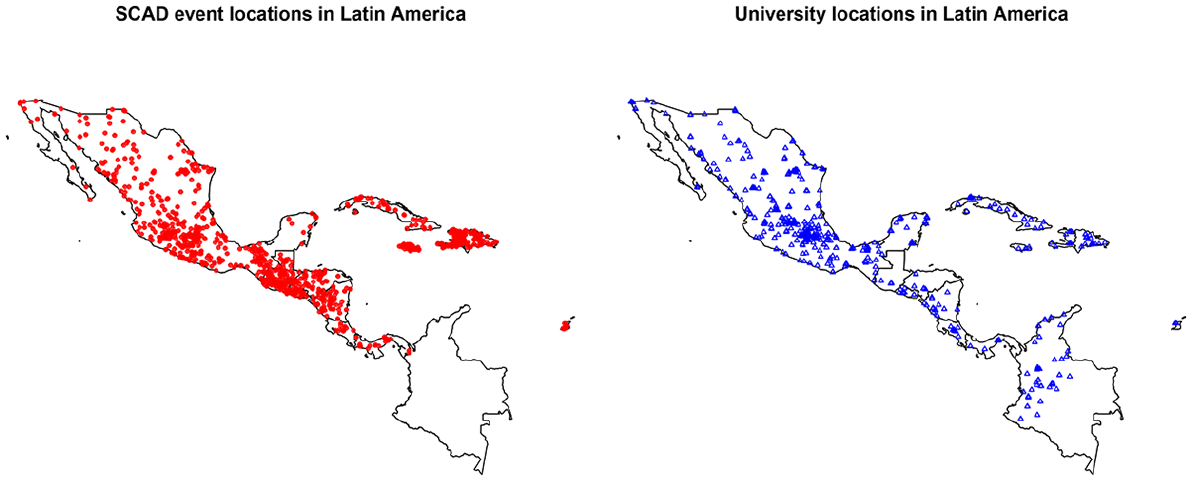
Protest events and geolocated universities in Latin America.
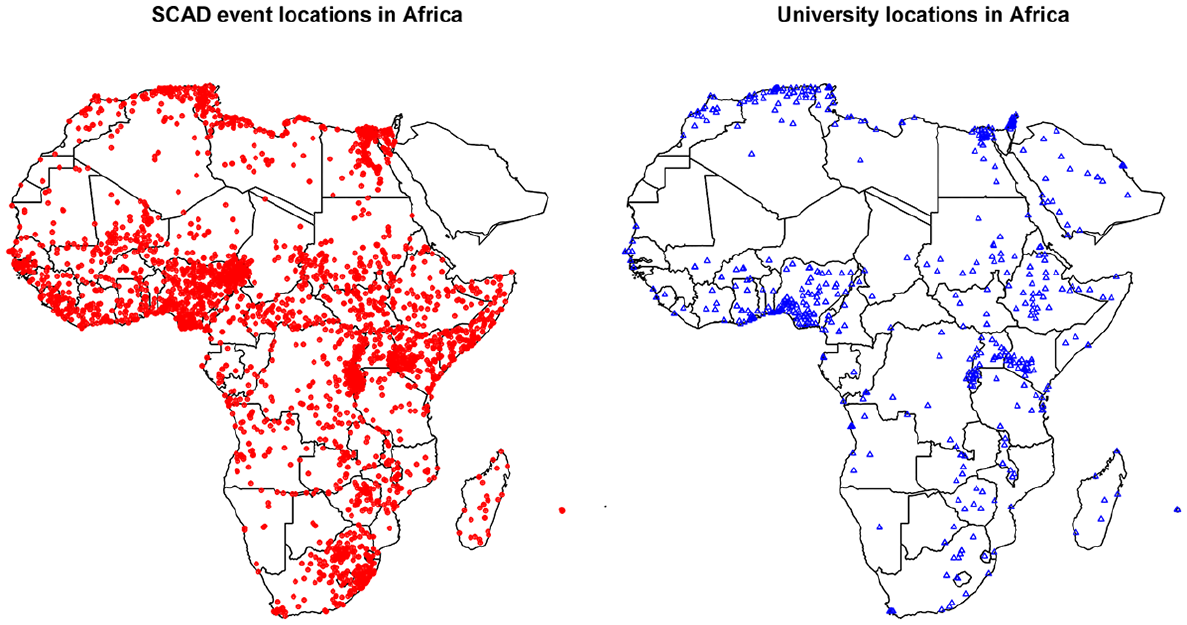
Protest events and geolocated universities in Africa.
A potential issue with these university data could be that all, or most, large urban areas have a university. This would lead to limited variation in the data (when conditioning on, for example, level of urbanization), and make the comparison between “university locations” and their counterfactual difficult. Another challenge could arise if there is little variation in the number of universities over time. Yet, there is rather large variation in the number of universities across urban locations, and over time. Many major cities have universities located in smaller suburban areas and nearby towns, and there is great variation in the number of universities across urban locations. There is also a fair amount of universities in smaller towns and rural areas. There is also significant variation over time in our sample. Roughly 60 % of the universities in our data are built after the start of our time-series (1990). Table 11 in the appendix displays the change in number of universities from the start and end of our sample, for all countries in the data. It shows that most countries experience very large increases in the number of universities over time (happening within grid-cells). Most countries increase their university-numbers by more than 50 %.
Estimation
Our empirical analysis compares as similar observations as possible, with more, less, and no universities. With the PRIO-grid-cell year as our unit of analysis, we estimate linear models of the log of protest events (

Where the log of protest in t + 1 is regressed on the universities
Since the main threat to inference in this setup relates to unmeasured temporal variation within grid-cells, we need to include potential confounders that are time-varying and capture the process behind university establishment. We believe universities are created for a number of reasons. First, it seems quite clear that universities have a higher likelihood of being established once a city reaches a certain population, and, in particular, has a large enough nearby urban area to sustain a university. This will happen due to increased direct demand for universities by large urban populations and also due to less tangible factors such as local politicians seeking the prestige of having a university in their area. University construction (and attendance numbers) also depends on local economic development. This suggests that universities follow cell trends in urbanization, population, and income, that could severely confound the over-time relationship between university placement and protest. Since most of these factors are also affected by universities in the grid-cell, it is safe to say that they have both pretreatment and post-treatment components. On one hand, population dynamics, urbanization, and income are not fully driven by universities, making them plausible confounders. On the other hand, they are partly “bad controls” that can yield posttreatment bias (Angrist & Pischke, 2009). We propose a pragmatic solution to this, by lagging these covariates, excluding them from some models, and including them in others, showing that results do not hinge on their inclusion/exclusion. To capture economic activity, we include estimates of local-level grid-cell product, p.c., as well as average night-time light density (measured by satellites) taken from the PRIO-GRID. To capture urbanization and demographics, we include measures of population density and urban land cover from PRIO-GRID.
Political patronage may also play a role, whereby local populations that are seen as dissenters toward the regime will not be granted public goods such as universities. To capture this, with an eye to the developing country context we are investigating, we include a time-varying measure indicating whether the majority ethnic group in the grid-cell is excluded from power, following Cederman et al. (2013). There will also be national factors determining university placement, such as national reforms, shifts in governments, and so on. Trends like this will be captured by our country-year interactions. Finally, to account for spatial clustering, we add a spatially LDV in those models where we include covariates.
Our argument is about universities causing new protests to occur, rather than attracting protests that would otherwise protest elsewhere. However, since we study grid-cells, we could be picking up that universities just attract rather than cause protest activity. To investigate this, we also estimate models at the country level (see Online Appendix, section 2, p.2), as well as grid-level models without grid-cell fixed effects, where we can leverage between-country variation (and variation over time within the same country). While these models raise issues about omitted confounding at the country-level (both between countries and over time), we include grid-level models without grid-cell fixed effects in our baseline analysis, to compare with the models restricted to grid-cell variation. This comparison is not intended to investigate the causal effect of universities, but only to serve as a diagnostic check for the possibility that universities attract protests rather than cause it. If coefficients are attenuated in models allowing for country-level variation, then this may indicate that universities attract protest. Since the grid-cell version of these models exclude grid-cell fixed effects, we include some static covariates such as mountainous terrain, average temperature, longitude and latitude, log distance to the border and the capital city, as well as a binary indicator for capital city. These—all taken from Prio-Grid—are included to capture a broad spectrum of geographic variation within countries, that will affect university placement and political activity. The country-level models control for GDP, democracy, and population. More detailed information and sources for these controls can be found in the appendix.
Results
Benchmark Results
Table 1 displays results from our baseline models. Column 1.1 shows our benchmark model with country-year interactions, as well as grid-cell fixed effects. This compares the same grid-cell over time as the number of universities varies. Column 1.2 adds a LDV and removes the cell-fixed effects, while column 1.3 displays the most demanding model adding both cell-fixed effects and a LDV (as well as a spatial lag). We investigate the coefficient across these three different specifications, since the combination of LDVs, and unit-fixed effects can yield quite sensitive estimates. The results align with our expectations across these specifications, yielding a positive and precisely estimated coefficient in columns 1.1 to 1.3. All coefficients are substantial—ranging from .019 (column 1.3) to .109 (column 1.2) in the model with only a LDV.
Benchmark Results: OLS Models of Protest.
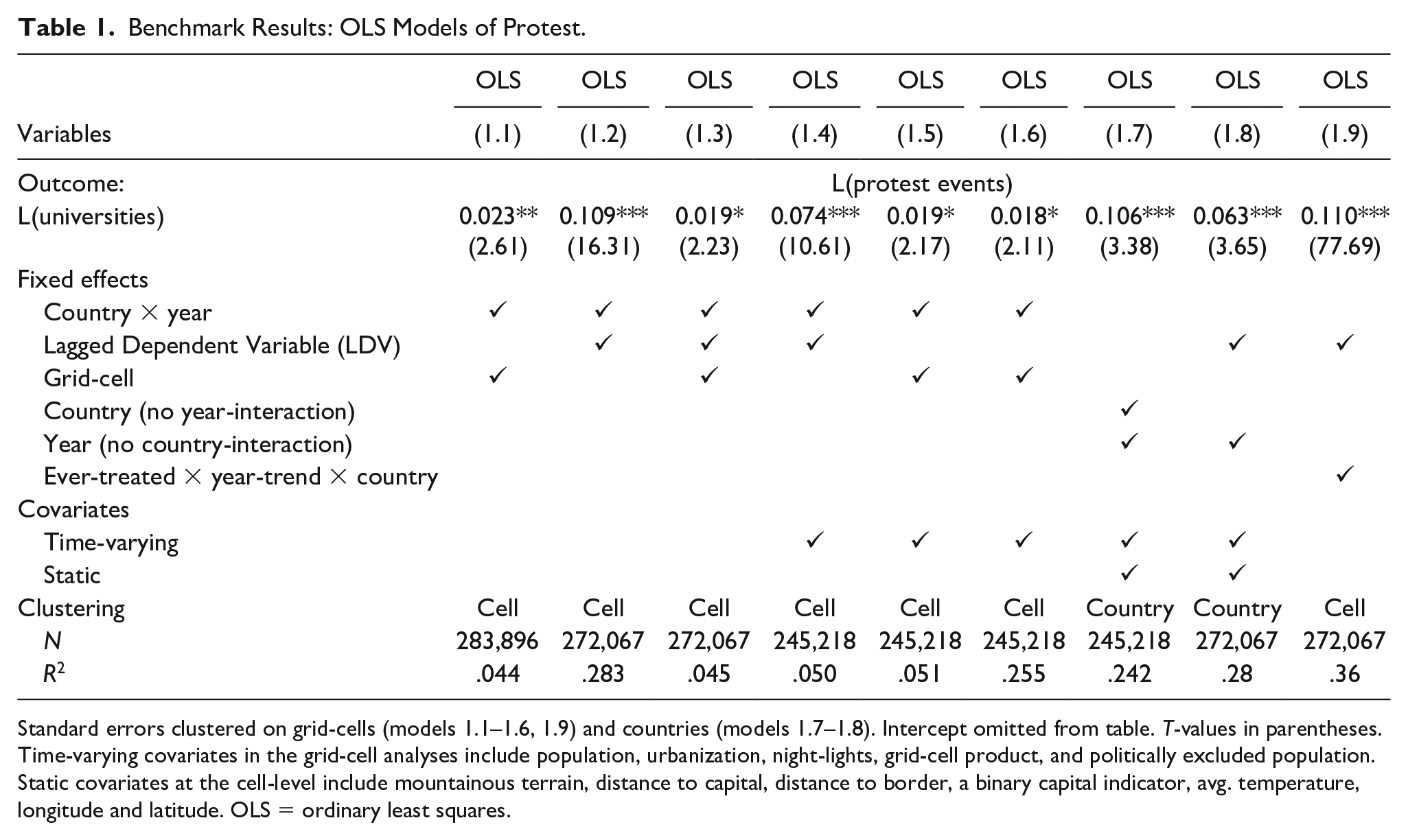
Standard errors clustered on grid-cells (models 1.1–1.6, 1.9) and countries (models 1.7–1.8). Intercept omitted from table. T-values in parentheses. Time-varying covariates in the grid-cell analyses include population, urbanization, night-lights, grid-cell product, and politically excluded population. Static covariates at the cell-level include mountainous terrain, distance to capital, distance to border, a binary capital indicator, avg. temperature, longitude and latitude. OLS = ordinary least squares.
Columns 1.4 to 1.6 add time-varying covariates (discussed above) to the baseline specification. As noted, these represent potential omitted confounders but also may induce posttreatment bias, meaning that there are problematic aspects to both including and excluding them. The inclusion of these time-varying controls do not greatly reduce the estimated coefficient for universities, in neither of the models with different grid-cell and LDV combinations. The coefficients are slightly reduced, as is to be expected given the discussion of posttreatment bias and confounding above, but remain positive and significant. The fact that the coefficients remain positive and precisely estimated when adding these controls is not so surprising, either from the perspective on these covariates as “bad controls” or as potential confounders. The reason is that we would not expect variation in income and demographics to determine or be determined by the establishment of a university on a year-to-year basis.
Models 1.7 and 1.8 allow us to gauge the difference between our estimated results drawing on within-grid-cell variation and the results when we allow for country-level comparisons. Column 1.7 estimates a model with country- and year-fixed effects, and no grid-cell fixed term (or LDV). This increases the coefficient by a significant amount, suggesting that the results in our grid-cell level analyses are not simply due to the grid-cells with universities attracting protests that would otherwise occur elsewhere in the country; universities are associated with increased protest at the country level. Column 1.8 drops the country-fixed-effects clustering standard errors on countries. This is intended to gauge between-country variation and account for the possibility that the decision to locate universities is taken at the country level, and that errors cluster by countries rather than grid-cells. A conclusion from the debate about the proper level on which to cluster errors (e.g., Abadie et al., 2017) is that errors should be clustered at the level of the “assignment mechanism.” In this case, the construction of universities in many developing countries could be a country-level decision, since there is a scarce resource pool for building universities and often quite obvious locations in which to build them (e.g., in the capital and major cities). However, we think a case can be made that the appropriate level at which to cluster errors is the grid-cell, in particular in cases where the relevant data-generating process is generating within-grid-cell variation. Year-to-year decisions to open universities in a specific location will most often depend on local-level processes, for example, relating to demand and supply. As we have shown above, there is a large number of universities, also in developing countries, and they exist in quite heterogeneous locations. However, we think there is no good reason to have firm a priori beliefs about this question, and therefore also estimate models with country- rather than grid-cell-specific clustering of the errors. This is done in column 1.8, and also for several specifications in the appendix.
As noted, our primary identification strategy draws on within-cell variation in university establishment and protest incidence. We should therefore be wary of confounders that trend differently over time in the treatment and control groups. The ideal solution to this would be to condition on temporal trends in each grid-cell (i.e., cell-specific trends) but this is unfeasible (we have approximately 12,000 cells, and estimating a trend for each of these, while conditioning on years, countries, and so on, is too demanding of our data). We opt for a second-best solution which is to control for separate time trends (within countries) for the groups that are “never treated” and the group that is “treated at some point.” This assumes a common (linear) country-specific trend for the group of cells in a country that is treated at some point, and lets this trend be different from the trend in the group of cells in that country that is never treated. When conditioning on this trend, we are thus conditioning our university estimate on two different country-specific time trends; one for the group of cells that is treated at some point, and one for those that are never treated. Since there is no over-time variation in our group of “never treated” cases, we must estimate this without cell-fixed effects. Results from such a model is shown in column 1.9. As we can see, the results remain strongly positive and significant when opting for such a control strategy.
Identifying Assumptions
The identifying assumption supporting a causal interpretation of our university coefficient is that there are parallel trends in the treatment group and the control group in the absence of treatment. While there is no confirmatory test of this, we conduct several diagnostics to probe potential violations. We test whether there are anticipation effects, obtaining if the increase in protest in the treatment group started prior to the treatment (conditional on covariates). We test for this by regressing our outcome on universities and leads of changes in the university indicator. If the leads of the treatment have positive associations with the outome at
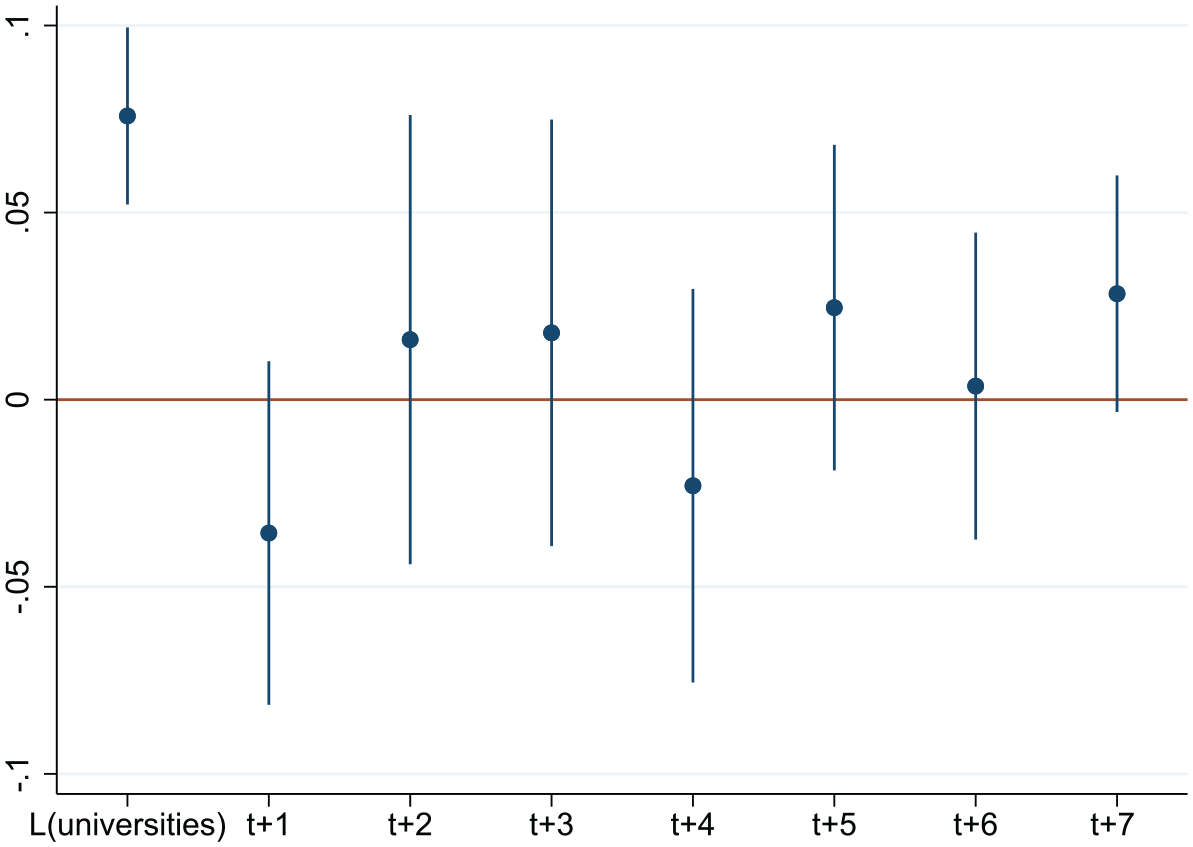
Testing for pretrends: Different leads of the treatment.
Another way to test for violations of parallel trends is to check if the key estimate changes once we condition on more flexible ways of constructing the pretrend in protest. It could be that protest in
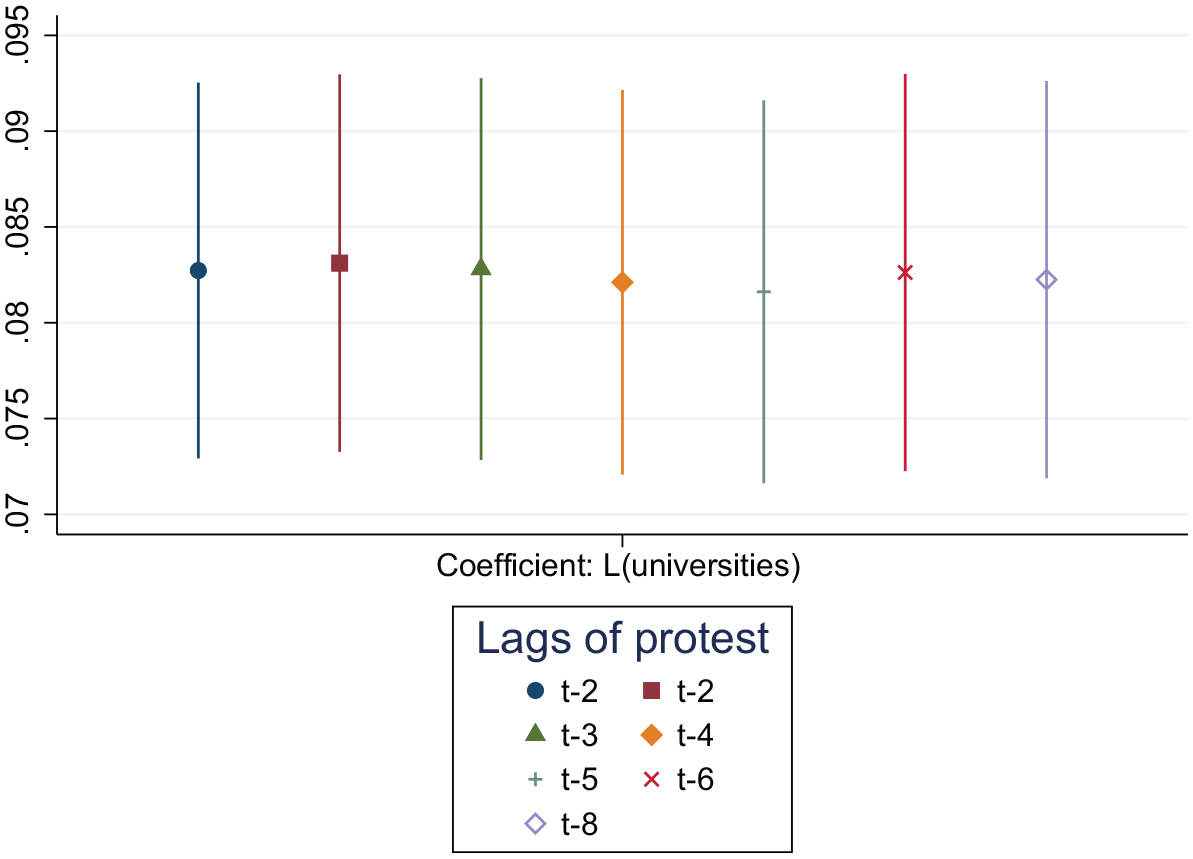
Conditioning on pretrends in protest: The point estimates represents the L(universities) coefficient across models conditioning on different lags of protest
Universities yield a substantial increase in protests. The sample-wide standard deviation of the outcome is .59, and the estimates in Table 1 range from representing 4% to 18 % of this standard deviation. The estimated effects are also large in substantive terms. For example, if we base our calculation on Model 1.4 in Table 1, a cell with three universities will, on average, see one more protest event every year than a similar cell without any universities. Since such effects cumulate over time, the increases in protest yielded by universities can become very substantial.
Additional Tests
We perform a number of additional tests of our core finding, most of which are presented in the appendix. First, as a complement to our difference-in-difference identification strategy, we estimate two-stage least squares (2SLS) models endogenizing university placement by leveraging the location of colonial-era Christian mission stations in Africa. These missions often set up educational facilities that seeded the later evolution of universities, and their locations have recently been used to instrument for local levels of education in the postcolonial era (Acemoglu et al., 2014). While we put more stock in our core identification strategy leveraging within-cell variation over time, we conduct instrumental-variable (IV) analyses as a complement that relies on a different source of variation and embeds different identifying assumptions. We present the IV strategy and its results in more detail in the appendix (section 5, p.7), but note here that the IV models produce similar results as our core models: Universities are associated with increased protest.
To further assuage endogeneity concerns, we conduct a test where we only consider universities founded prior to 1960 (i.e., for the most part colonial-era universities), to alleviate concerns that universities are founded in response to contemporary political instability. Roughly 25% of the universities in our sample are found prior to 1960, and these are mostly colonial universities, were founded by European colonizers. We also perform a test where we circumscribe our sample to only consider grid-cells with more than 200,000 inhabitants (per 50 × 50 km) and re-estimate our models. This is an attempt to make our units more equal, by comparing cities to other cities, while varying the number of universities (note that we still control for population density, to capture size differences above the threshold). As noted above, there is, in fact, substantial variation across urban locations in the number of universities hosted. While this reduces our sample greatly (see below), it arguably makes for a more evenhanded comparison of grid-cells.
These three tests are shown in Table 2. All of these tests reveal coefficients that are consistent with the baseline results, and they show that our conclusions are similar when we adopt empirical approaches that depart from core empirical strategy.
Additional Tests: 2SLS, Old Universities, and Urban Cells.
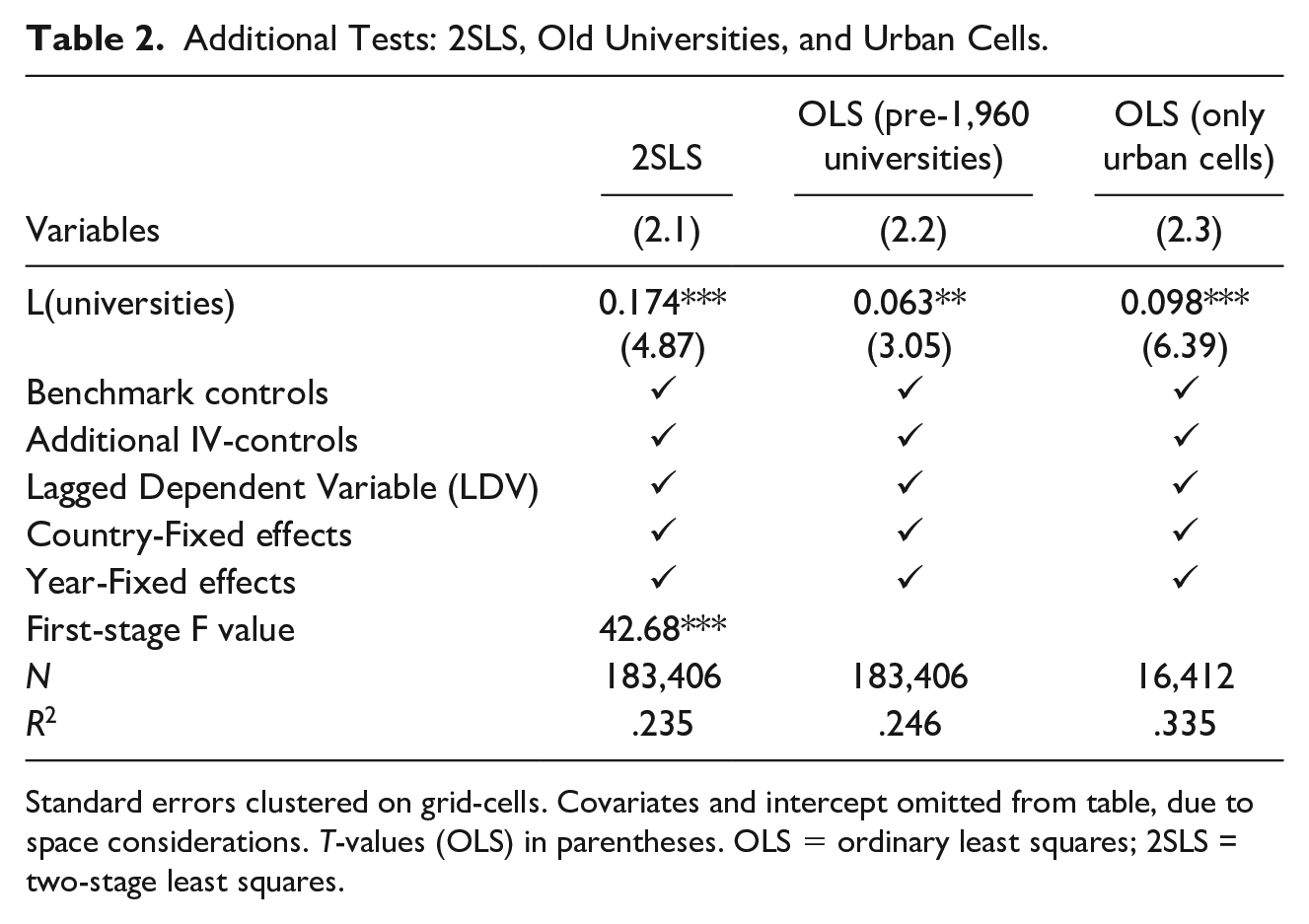
Standard errors clustered on grid-cells. Covariates and intercept omitted from table, due to space considerations. T-values (OLS) in parentheses. OLS = ordinary least squares; 2SLS = two-stage least squares.
We conduct one more test to strengthen our causal interpretation. This starts from the observation that some aspects of the operation of universities are not endogenous to protest, such as the (formal) timing of academic semesters. If we can show that protests are more frequent during the academic semester in university locations than in nonuniversity locations, then this yields additional evidence for an effect of universities. We use public information on the (national) academic calendars in each country, and code this where available for 45 countries in the SCAD sample at the monthly level, a procedure described in the appendix. We combine this with a monthly version of our grid-cell data set, registering monthly protest events. Note that we do not have month-varying data for any other variables than protests and semester months. It could be that the academic semester correlates with other national holidays that would impact protest activity regardless of universities. We therefore estimate the effect of the academic semester (on protest) in places with universities and compare this to the effect in places without universities, in a model including fixed effects on years and countries, and country-specific (linear) time trends (months). 2 This analysis reveals significant effects of the academic semester on protest in places with universities, but not in places without them. Results from this estimation are shown in the appendix (section 11, Figure 2).
We conduct several additional tests, all presented and discussed in the appendix. For example, we investigate whether universities increase protests when also controlling for local education levels using data from the Demographic and Health Survey (DHS) (Dahlum & Wig, 2019). We find positive results from universities even when controlling for education. 3
To investigate whether our results reflect reporting bias in the protest event data, we perform the test for diagnosing this suggested by Weidmann (2016), finding no evidence that our results are driven by reporting bias (Online Appendix, section 6, p.10). We also explore whether our effects vary by university ownership structure (public-private), finding that both public and private universities are linked to protest, although the effect is somewhat stronger for private universities in dictatorships (Online Appendix, section 8).
As additional robustness tests, we investigate whether the university effect is specific to either Africa or Central America and the Caribbean, finding rather similar results in both regions. These and other tests are discussed in the appendix. An important caveat to our results is the possibility that these findings do not generalize outside of the studied regions; Africa, Central America, and the Caribbean. It could be that relationships differ in, for example, Western European countries, or Asia. Yet, it is important to keep in mind that the studied regions are highly heterogeneous and that the results are strong in regions as different as Central America and Africa.
The Nature of University Protests
What kind of protests do universities generate? While our theory does not yield firm expectations allowing us to test mechanisms, this is an interesting descriptive question in itself, as well as a stepping stone for future research and theorizing about universities and protest. As noted, there is a lot of heterogeneity in protests. For instance, while some protests build on more parochial concerns such as university fees or food prices, others seek to promote democracy and the rule of law. Having established that university locations are more prone to protest, and that this is probably due to the presence of universities (rather than other location-characteristics), we now present some exploratory tests to assess the nature and goals of university-induced protests.
First, following arguments (noted above) about universities as drivers of political reform and even regime change, we probe whether the protest-inducing effect of universities is especially strong where there are strong grounds for antiregime political discontent. For example, it could be that universities increase protests against autocratic governments. Calls for democracy could be induced by universities (both inside and outside of the classroom), or they could simply be due to universities agglomerating individuals with strong commitments to democratic values.
To investigate whether universities have different effects in different regimes, we interact our grid-cell level university measure with a country-level measure of regime types, namely the Regimes of the World categorization (Lührmann et al., 2018) from the Varieties of Democracy (V-DEM) data set (Coppedge et al., 2019). This distinguishes between liberal democracies, illiberal democracies, electoral autocracies, and closed autocracies. These models control for potential background factors such as GDP, population, and include country- and year-fixed effects. We find that the relationship between universities and protest is more positive in less democratic states, as shown in Figure 5.
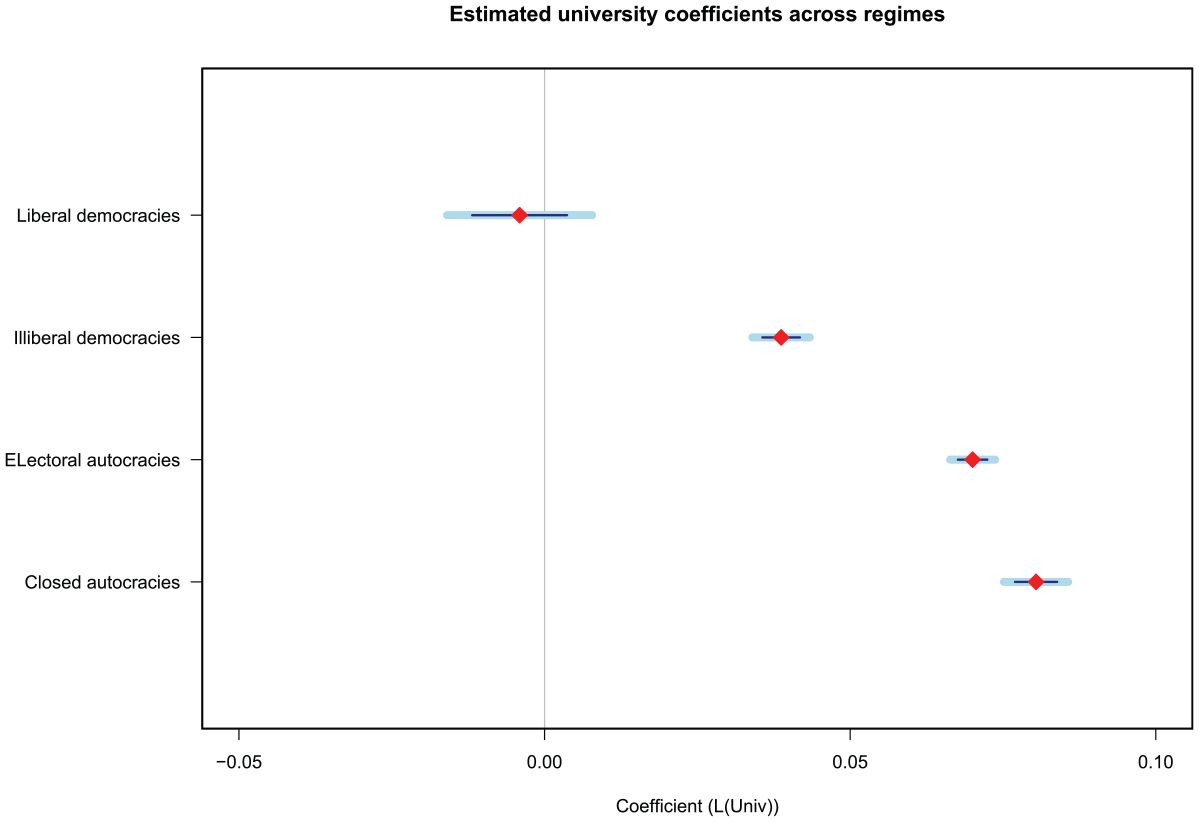
The effect of universities across regime types.
While this test informs us about one structural condition for university-related protests, it does not tell us, specifically, about whether university-related protests differ in kind from protests happening in places without universities. To probe this, we take the individual protest event as our unit of analysis, and ask: How do protests in areas with more universities differ from other protests? We define (more or less) “University-related protests” by the number of universities in the grid-cell where the protest takes place, also when conditioning on grid-cell controls from the above models. This changes the unit-of-analysis to the protest-level, and uses covariates from the location of the protest (in the year the protest took place). Note that our unit-of-analysis here is the individual protest, while our right-hand side variables measure features of the grid-cell where the protest is located. The question these models answer is; given that we observe protests, how do protests differ (in kind) between locations varying in the number of universities (conditioning on e.g., urbanization)? We do not perform this analysis to make strong causal claims, but to provide some interesting descriptive evidence on the types of protest that tend to take place in university locations.
One thing we can explore using the SCAD data is whether protests in university cells are different (from protests in nonuniversity cells) in terms of protest goals. We use the information on protest aims in the SCAD data set, referencing different protest aims concerning the categories: Elections, the economy, food, the environment, ethnic/religious issues, education, domestic violence, foreign policy, or support for the government. A final question we pose is whether protests in university cells are more likely to involve students. If the university-protest link does not somehow involve students, it is harder to make the case that the operation of universities is a crucial causal factor in university locations.
Results from this investigation is presented in Figure 6. It explores the most common protest issues occurring in university locations (measured by the L(univ) coefficient). Each coefficient represents a separate regression where the relevant protest-characteristic is regressed on L(universities) and covariates, including urbanization, night lights, cell income, political exclusion, and the geography covariates described above. Since each protest characteristic is binary, the coefficients can be interpreted as linear probabilities. It shows that as the number of universities in the protest cell increases, protests are more likely to concern democracy/human rights issues and also issues concerning foreign policy and domestic/internal violence. Furthermore, it seems that university-related protests are more likely to relate to education-issues, which is unsurprising.
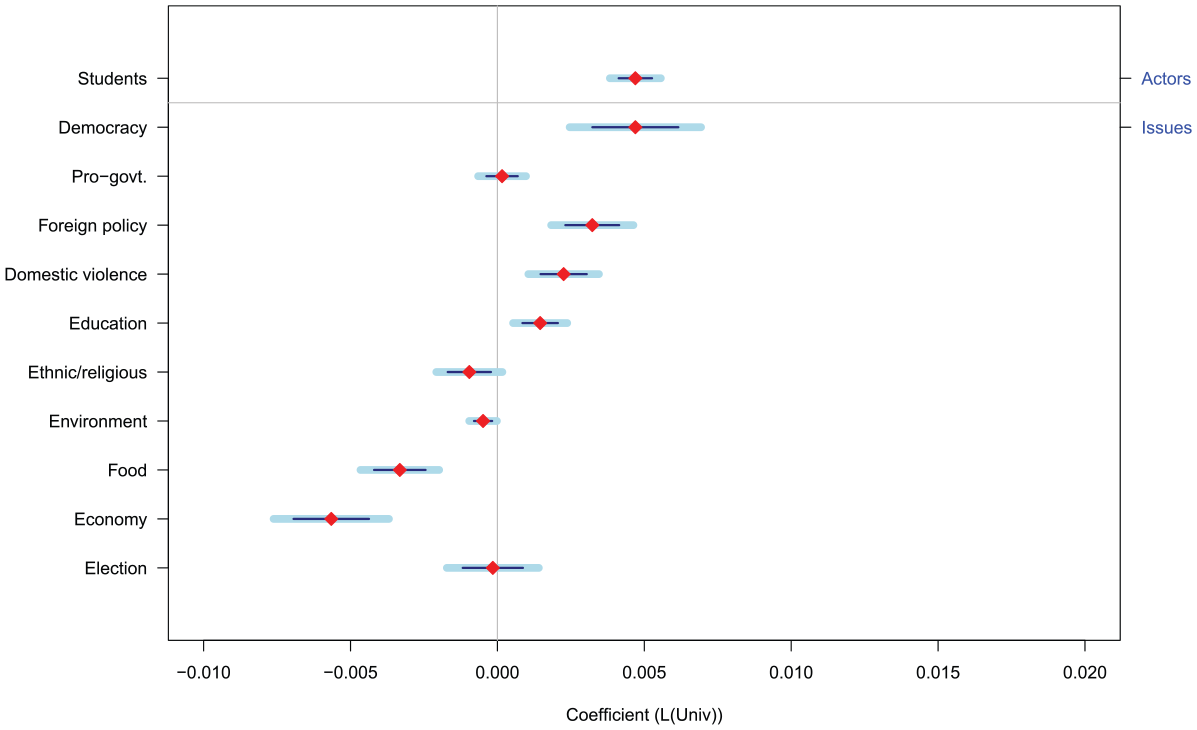
The nature of university-related protests: Protest issues and actors.
Figure 6 also shows that protests in university locations are also more likely to involve students; a basic validity check of our argument above.
We believe these descriptive results raise interesting questions for further analyses. Protests in university locations conform with the image of “democracy protests” (Brancati, 2016) around the world. We note that these findings do not necessarily imply that universities induce political awareness and preferences for democracy and revolution. In fact, these results could reflect liberal, democracy-oriented youth sorting into university locations based on skills or preferences. Distinguishing between these different mechanisms falls outside the scope of this article, and we leave this important question for future research.
Conclusion
The remarkable global increase in education has several positive effects. It empowers citizens and unlocks the creative potential of populations, which may again increase citizens capacity to mobilize. We present the first global study testing this citizens’ capacity, relying on geolocated universities and protest-event data across 64 countries in Africa and Central America.
Our results indicate that locations (grid-cells) within countries increasing their number of universities are more likely to see increased protest events. We use an identification strategy leveraging within-cell variation in the number of universities, where the identifying assumption is that there are parallel trends (conditional on covariates) in the absence of treatment. We encourage future research to investigate the university-protest link using different research designs, to gain a more varied body of evidence.
We find that the relationship between universities and protest is particularly strong in dictatorships, and that protests-in university locations are more often associated with calls for democracy and human rights, and that they involve students as actors.
Our findings have a number of broader implications. First, they could suggest some meso-level evidence for the mechanism tying education to democracy in the literature (Acemoglu et al., 2005; Glaeser et al., 2007; Murtin & Wacziarg, 2014), namely that higher education is linked to protest against dictatorships. Our analysis suggests that one crucial facet of “modernization”—institutions of higher education—gives populations greater motivations to challenge autocratic governments while enhancing their abilities to do so. It is important to stress that the identified relationship between universities and protest, do not mean that universities cause democratization. Universities may have other effects, such as boosting economic growth, training competent regime personnel and so on, that prevent us from concluding about the macro-level equilibrium effects of universities on democratic transitions. Second, in presenting systematic evidence for a link between universities and protest, we provide general support for the numerous historical examples of university-related protest, originating on campuses worldwide (Zeilig, 2007). Finally, these findings speak to expectations regarding conditions that facilitate collective action—by indicating that the spatial and institutional characteristics of universities are highly conducive environments to political protests.
Supplemental Material
Appendix_CPS_r_and_r_1301 – Supplemental material for Chaos on Campus: Universities and Mass Political Protest
Supplemental material, Appendix_CPS_r_and_r_1301 for Chaos on Campus: Universities and Mass Political Protest by Sirianne Dahlum and Tore Wig in Comparative Political Studies
Supplemental Material
Replication_data_CPS – Supplemental material for Chaos on Campus: Universities and Mass Political Protest
Supplemental material, Replication_data_CPS for Chaos on Campus: Universities and Mass Political Protest by Sirianne Dahlum and Tore Wig in Comparative Political Studies
Footnotes
Acknowledgements
The authors thank Milli Lake, Katharina Mustasiita, Andrea Ruggeiri, Vincenzo Bove, Kristian Skrede Gleditsch, Jonas Vestby, Ragnhild Nordaas, Carl Henrik Knutsen, Andreas Kotsadam Scott Gates, Magnus Rasmussen, Kyle Marquardt and participants at the workshops “Autocratic Diversity” at the University of Aarhus and “Political Dissent: Causes, Tactics and Outcomes” at the University of Essex, and the workshop “Historical Aspects of Intrastate Conflict” at the University of Oslo, the Varieties of Democracy Postdoctoral Seminar, the Conditions and Violence and Peace Seminar at the Peace Research Institute Oslo, for comments. Presented at the annual meeting of the American Political Science Association (APSA), San Francisco, August 31 to September 3, 2017 and the annual meeting of the Network of European Peace Scientists (NEPS), Verona June 18 to 20, 2018.
Declaration of Conflicting Interests
The authors declared no potential conflicts of interest with respect to the research, authorship, and/or publication of this article.
Funding
The authors disclosed receipt of the following financial support for the research, authorship, and/or publication of this article: This research was supported by a Research Council of Norway TOPPFORSK grant 275955/F10, Securing the Victory (PI: Kristian Skrede Gleditsch).

Notes
Author Biographies
References
Supplementary Material
Please find the following supplemental material available below.
For Open Access articles published under a Creative Commons License, all supplemental material carries the same license as the article it is associated with.
For non-Open Access articles published, all supplemental material carries a non-exclusive license, and permission requests for re-use of supplemental material or any part of supplemental material shall be sent directly to the copyright owner as specified in the copyright notice associated with the article.
