




Abstract
Cross-sector partnerships (CSPs) offer much-needed collaborative spaces to address socio-ecological problems. Yet it is unclear if and how CSPs activities contribute to transformative innovation (TI) that addresses these problems and creates socio-ecological impact. Understanding how CSPs can contribute to TI is essential for CSP practitioners and researchers in order to address pressing socio-ecological problems. To better understand how CSPs can contribute to TI and socio-ecological impact, I conducted a multiple case-study of eight CSPs in the field of sustainable, circular packaging. The findings—based on the novel Transformative Innovation Process framework this article introduces—reveal three innovation pathways with different potentials for contributing to socio-ecological impact. Of the three, the complementary pioneering and adapting pathways have the greatest potential for contributing to socio-ecological impact, and the consolidating pathway has the least potential. This article makes theoretical contributions to the CSP literature as well as practical contributions for CSPs.
Keywords
The socio-ecological problems that society is facing today are so intertwined that they require actors from across disciplines and sectors to collaborate to achieve systemic socio-ecological impact and transformative change (Dentoni et al., 2020; Schot & Kanger, 2018; Wasieleski et al., 2021). Sustainability transitions scholars propose that complex socio-ecological problems can be addressed by transformative innovation (TI), a challenge-led policy approach that facilitates a variety of activities and innovation modes across societal sectors to realize macro-level change into a desired direction (Diercks et al., 2019; Haddad et al., 2022; Schot & Steinmueller, 2018). For example, the transition to a circular economy represents a TI-challenge concerned with the socio-ecological goals of reducing CO2 emissions, natural resource extraction, waste, and pollution (Kern et al., 2020). Therefore, TI-challenges address socio-ecological problems such as climate change, biodiversity loss, land conversion, and pollution.
An important condition for TI to address socio-ecological problems is that all concerned actors—including policymakers, civil society organizations, citizens, businesses, academia, and associations—see the proposed solutions as desirable, feasible, and viable (Novy et al., 2022; Schot & Steinmueller, 2018; Stirling, 2009). To align and coordinate their activities in a desired direction, though, these actors need shared spaces (Garud & Gehman, 2012; Mazzucato, 2021).
One such space is cross-sector partnerships (CSPs), defined as a collaboration of actors from more than one societal sector who come together to resolve a common issue (Clarke & Crane, 2018; Seitanidi & Crane, 2014; Selsky & Parker, 2005). CSPs can resolve some of the difficulties in TI by establishing a broader challenge perspective, aligning on a common objective, and achieving systemic leverage (Bergek et al., 2023; Clarke & MacDonald, 2016; Dentoni et al., 2020). Hence, CSPs offer much-needed collaborative spaces for actors seeking to reconfigure structures to achieve shared socio-ecological goals.
A major obstacle for researchers and theory, though, is understanding how CSPs can achieve those goals. Most CSP research focuses on specific activities of CSP actors, investigates relational processes among actors, and evaluates the outcomes of the actions to partners within a CSP (cf. Clarke & MacDonald, 2016; Le Ber & Branzei, 2009). In this article, I will refer to such analysis of activities and relational processes within a CSP as micro-level analysis to differentiate it from the analysis of broader, macro-level socio-ecological impact. So, while CSP research provides needed insight into how individual CSPs are organized, this level of analysis limits the degree to which CSP literature can inform our understanding of how CSPs can bring about socio-ecological impact on the macro-level. Additionally, the focus on the organizational level of analysis makes it difficult to connect insights from CSP literature to other fields, such as TI research. In other words, even though scholars assume that CSPs can achieve transformative change (Dentoni et al., 2018; van Tulder & Keen, 2018), current CSP literature cannot tell us whether and how CSPs really contribute to transformative, systemic, socio-ecological impact (Clarke & Crane, 2018; Stadtler et al., 2024; van Tulder et al., 2016). This lack of insight and understanding presents a limitation in theory and practice, as transformative change leading to socio-ecological impact is often the ultimate aim of CSPs (Stadtler et al., 2024).
These theoretical limitations have two corresponding practical risks. First, if societal actors cannot see that CSPs are creating socio-ecological impact—and what those impacts are—CSPs may lose legitimacy in critical parts of society. Second, if CSPs cannot understand how to create macro-level socio-ecological impact, they may focus their attention and energy on activities that do not coherently address the underlying TI-challenge. In sum, the current CSP literature lacks the critical analytical tools and perspectives necessary to address research questions that connect different levels of analysis and look into the transformative potential of CSPs to create macro-level socio-ecological impact.
One way of overcoming these limitations is by incorporating perspectives, tools, and analytical lenses from the TI literature into the CSP literature. One particularly relevant notion from the TI literature is the transformative outcomes (TOs) concept. TOs provide an analytical lens for analyzing impact across multiple levels and capturing the dynamic and cyclical (i.e., nonlinear) processes involved in realizing transformative, socio-ecological impact (Ghosh et al., 2021). Since the relationship between CSP interventions and macro-level socio-ecological impact is often not linear (van Tulder et al., 2016; van Tulder & Keen, 2018), the TO literature provides a necessary perspective for capturing the dynamic and cyclical nature of CSP activities required to link those activities to macro-level socio-ecological impact. In short, incorporating elements from the TI literature (Haddad et al., 2022) into the CSP literature (Stadtler et al., 2024) allows us to directly link CSP interventions with socio-ecological impact, thus helping to overcome a serious limitation of the CSP literature, to provide practical guidance to CSPs, and to answer the important research question: How do CSPs contribute to socio-ecological impact?
To answer the research question, I conducted a comparative multi-case study (Eisenhardt, 1989, 1991, 2021) of micro-level organizational activities, meso-level processes, and macro-level outcomes in eight European CSPs pursuing the TI-challenge of creating a more-sustainable and circular packaging ecosystem. The qualitative process analysis (Cao, 2007; Langley, 1999) draws on multiple sources, including 1,057 pages of public documents, 9 interviews, 14 videos, fieldnotes from 3 industry events, and 3 quantitative reports. This analysis revealed three process pathways that lead to greater and lesser potentials for contributing to socio-ecological impact. CSPs following the adaptive and pioneering process pathways—that is, those CSPs that engage in complex activities, such as experimentation, piloting, and double-loop learning—have the greatest potential to contribute to socio-ecological impact because these pathways bear the potential to build and expand novel structures. The consolidating pathway has the least potential for contributing to socio-ecological impact because its aims are restricted to consolidating and institutionalizing existing knowledge, preventing this pathway from creating novel structures.
Another important finding of this multi-case study is demonstrating that transformative CSP activities are less dependent on the initial design of a partnership than most CSP literature assumes (cf. Pattberg & Widerberg, 2016; Stadtler et al., 2024). Complex transformative activities may develop during the collaboration, meaning that as the partners’ understanding of the challenge evolves, this evolution can bring about the willingness to engage in complex activities that contribute to macro-level socio-ecological impact. In other words, the initial design of a CSP is less important than its readiness to continuously adapt aims and activities based on new insights.
The findings about the process pathways were abstracted from the novel Transformative Innovation Process (TI-Pro) framework that emerged from the multi-case analysis. This framework provides researchers and practitioners with a process map for assessing the current status of CSPs and navigating the TI process by identifying six distinct phases—comprising goals, activities, and modes of innovation—and elucidating how these phases are necessary or sufficient to contribute to socio-ecological impact. TI and CSP researchers and practitioners can use the TI-Pro framework to identify changes partnership orchestrators need to initiate to make a greater contribution to macro-level socio-ecological impact. This novel framework provides the necessary levels of analysis and detail that researchers need, yet that the CSP literature has not provided.
The rest of this article is structured as follows: First, I argue why the CSP literature needs the analytical tools and perspectives of TI literature, and describe the current understanding of change processes in both literatures. Second, I explain the research approach and methods, then I present the innovation process pathways found in this research as well as the novel, empirically grounded TI-Pro framework on which the process-pathway findings are based. Finally, I discuss the contributions of these findings to research and practice.
Background: The Role of CSPs in the TI Process
The TI literature contains theoretical notions that the CSP literature can benefit from. First, the multi-level analytical lens in TI literature (Haddad et al., 2022) explicates the evolutionary process stages in macro-level change toward socio-ecological goals—a perspective missing in CSP literature. Building on this knowledge, the TOs research demonstrates how cross-sectoral collaboration enables macro-level transformative socio-ecological impact through meso-level mechanisms such as knowledge sharing, experimenting, learning, and developing joint future scenarios (Alvial Palavicino et al., 2023; Ghosh et al., 2021). For these reasons, research on TOs in CSPs can benefit from the TI literature. Specifically, in this article, it allows developing an analytical approach that helps in answering the research question by linking CSP activities and goals to macro-level change leading to socio-ecological impact. Notably, the TI literature can also benefit from CSP research because understanding how innovation processes in CSPs unfold can help TI researchers and practitioners to develop better frameworks and methods for just democratic involvement. In addition to these benefits, integrating elements of TI literature into CSP literature also makes sense because both literatures share similar research methods and both are increasingly concerned with the question how cross-sectoral collaboration can address socio-ecological problems.
Despite these similarities and the contributions that both literatures can make to one another, connecting the two literatures to answer the research question requires acknowledging important differences between them. One of the biggest differences is that the two literature streams foreground different ontologies, resulting in different target groups as well as levels and units of analysis (Clarke & Crane, 2018; Garud & Gehman, 2012; Haddad et al., 2022; Stadtler et al., 2024; see Table 1 for details). Next, I compare the understanding of innovation processes in both literatures and explain in more detail why and how I connect the two literatures to address the research question.
Comparison Between TI and CSPs Research.

Note. CSP = cross-sector partnerships; TI = transformative innovation.
The Innovation Process in CSPs
CSP research is transdisciplinary and covers many topics and theories (Branzei & Le Ber, 2014), yet its dominant perspective and understanding of CSP processes is relational, focusing primarily on conditions, processes, tensions, mechanisms, and outcomes of successful cross-sectoral collaboration (Bryson et al., 2015; Garud & Gehman, 2012). Early CSP research identified collaborations as moving through stages: (1) formation, (2) implementation, and (3) evaluating outcomes (Selsky & Parker, 2005). Later, CSP research focuses on how the collaboration process may increase value for partners (Austin & Seitanidi, 2012a; DiVito et al., 2021; Oskam et al., 2021). In most cases, then, CSP process research foregrounds relational processes rather than the innovation processes that can explain how knowledge and socio-material systems evolve.
Van Tulder and Keen (2018) provided a first link between CSP research and innovation processes. The authors build on the complex adaptive systems view (Dentoni et al., 2020; Snowden & Boone, 2007) to argue that CSPs need to be analyzed according to their potential for innovation rather than their relational processes. More concretely, Van Tulder and Keen (2018) argue for analyzing CSPs based on their potential to address challenge complexity, generate learning outcomes that go beyond existing knowledge, and, ultimately, the potential of CSPs to transform systems. According to these criteria, different activities and distinct outcomes result from three modes of innovation (Snowden & Boone, 2007; van Tulder & Keen, 2018):
The clear mode is appropriate when CSPs want to achieve clearly defined goals. Partners implement “best practices,” which requires plannable activities. In this static approach to change, success is evaluated once a goal is achieved.
The complicated mode is appropriate when CSPs want to attain goals that are clearly defined but that require deep expertise and analytical planning to implement. Partners adjust or scale structures based on “good practices,” building on existing knowledge and using structured project management that includes clearly defined milestones and evaluation criteria.
The complex mode is appropriate when CSPs are operating under uncertainty in domains where practices, technologies, and patterns are just emerging. In these circumstances, detailed goals cannot be defined in advance; only a broad vision can be sketched. Partners focus on iterative activities, including experiment-based learning and piloting. Accordingly, evaluation is there not only to evaluate success but also to learn and shape future activities. Evaluation activities emerge from previous learning cycles.
In short, Van Tulder and Keen’s (2018) conceptual paper categorizes CSPs according to challenge and innovation process complexity. While this important paper moves us closer to understanding why CSPs differ in their potential to achieve socio-ecological impact, the authors assume a static definition of challenge complexity that does not reflect the nonlinear, continuous, evolutionary, and dynamic processes in TI (Garud & Gehman, 2012; Schot & Steinmueller, 2018). Whereas from a dynamic process perspective, all three innovation modes may occur within one CSP as goals, activities, the overarching TI-challenge, and the underlying socio-ecological problems evolve (Garud et al., 2010; Snowden, 2021). In other words, while these three innovation modes are useful for better understanding the transformative potential of CSPs, a thorough understanding of innovation processes in CSPs requires acknowledging that a single CSP may cycle through all three innovation modes (Margolis & Blomsma, 2024). Without the analytical tools for studying these dynamics we will not fully understand how CSPs contribute to continuous, evolutionary, and dynamic innovation processes that may lead to socio-ecological impact (Stadtler et al., 2024). Therefore, next, I turn to the evolutionary process perspective that the TI literature provides.
The Innovation Process in TI: An Evolutionary Perspective
The evolutionary process perspective in TI research assumes that socio-technological innovation moves through three macro-level evolutionary process stages (MEPS), from (1) niche building through (2) niche expansion to (3) regime change (Schot & Steinmueller, 2018). When directed toward socio-ecological goals, these three stages can lead to a socio-technological sustainability transition that results in positive socio-ecological impact (Markard et al., 2012). Time horizons in such sustainability transitions are long—potentially evolving over decades—and require changes in societal mindsets, policies, practices, and infrastructures (Schot & Kanger, 2018). TI scholars argue that sustainability transitions can be directed toward meaningful socio-ecological goals by the means of cross-sectoral collaboration and democratic involvement (Diercks et al., 2019).
But TI research lacks concrete frameworks and tools that can address implementation challenges in cross-sectoral collaboration (Haddad et al., 2022). While MEPS help to understand macro-level dynamics in systemic change, it remains unclear how to assess the potential of CSPs to contribute to each of the three MEPS—and ultimately to socio-ecological impact. Because CSPs are just one actor among many in societal transitions, addressing this analytical challenge requires a better understanding of what contributes to each of the MEPS on the meso-level of analysis. This macro–meso-link is the focus of the TOs concept in the TI literature.
TOs are the underlying meso-level mechanisms that enable the three MEPS in TI (Ghosh et al., 2021):
Niche building requires shielding, learning, networking, and navigating expectations.
Niche expansion consists of upscaling, replicating, circulating, and institutionalizing.
Regime change calls for destabilizing, unlearning and deep learning, strengthening regime-niche interactions, and changing mindsets.
Additionally, Ghosh et al. (2021) exemplify each TO through a list of possible activities. So, similar to the systemic change concept in the CSP literature, TOs explain how micro-level organizational activities lead to meso-level system alterations that have the potential to achieve socio-ecological impact (Clarke & Crane, 2018; Ghosh et al., 2021). TOs, in other words, increase the likelihood that a TI-challenge will succeed in resolving socio-ecological problems.
The meso-level concept of TOs connects the micro- and macro-levels of analysis. Specifically, it illuminates how organizational activities influence macro-level societal transformation as described by the MEPS, creating pathways toward socio-ecological impact. Even so, the TO framework has two important limitations: it presents TI as a rather linear sequence of stages and follows the assumption that the main orchestrators of TI are public actors. Such a linear, policy-driven illustration of the innovation process cannot explain how this process unfolds and which process pathways CSPs can take to contribute to TI and socio-ecological impact. Since system innovation is cyclical, with some TOs overlapping and MEPS occurring in parallel (Alvial Palavicino et al., 2023), a linear understanding fails to recognize that one TI-challenge, such as a circular economy transition, may have many competing or complementary solutions across different evolutionary stages (Rogge & Reichardt, 2016). For example, in the circular economy transition, there is ongoing contestation around problem perspectives, technologies, and materials that is reinforced by the fact that incremental improvements of mature technologies compete with more radical emerging solutions (Bening et al., 2021; Blomsma & Brennan, 2017; Kern et al., 2020). Therefore, a more-complete conceptual understanding of TI processes and corresponding socio-ecological impact requires an empirical understanding of concrete process pathways in CSPs.
Assuming that the main orchestrators of TI are public actors is another limitation because the CSP literature shows that various actors can initiate and orchestrate CSPs (Stadtler et al., 2024). Integrating CSP process analysis into the TO framework can address this limitation because it acknowledges the activities of private actors in CSPs. Hence, integrating a CSP process lens into the TO framework can contribute important insights to both fields and provide an analytical approach that acknowledges the cyclical nature of complex innovation and recognizes all actors involved in TI.
In sum, a useful way to contrast between CSP research and TI research is to understand CSP research as primarily analyzing the organizational process within a CSP (micro-level), while TI research views CSPs as one of many actors involved in a long-term societal transition process toward socio-ecological change (macro-level). To comprehensively answer the research question “How do cross-sector partnerships (CSPs) contribute to socio-ecological impact?” therefore requires using the CSP literature to investigate innovation modes (clear, complicated, or complex) within an individual CSP (level of analysis) composed of diverse societal actors, while the TI literature is necessary for understanding macro-level evolutionary stages (niche building, niche expansion, changing regimes) in long-term transitions and the contributing meso-level TOs. In other words, as the TOs concept resides at the meso-level of analysis, it represents a necessary bridge between organizational activities (micro-level) and socio-ecological impact of a TI-challenge (macro-level).
Research Design
A multiple-case study of eight CSPs collaborating to create a more-sustainable and circular packaging ecosystem in the European Union (EU) is a particularly suitable research design for comparing and contrasting innovation process pathways and for answering my research question (Eisenhardt, 1989, 1991, 2021). A more-sustainable and circular packaging ecosystem can contribute to socio-ecological impact by reducing CO2 emissions, natural resource use, waste, and pollution. A case overview is presented in Appendix A. By comparing eight case histories, with each case treated as a unique experiment, I was able to identify unique patterns in each case (Eisenhardt, 1991). From these insights, I analytically generalized cross-case patterns, and this comparison allowed me to extend CSP and TI theory (Eisenhardt, 1989, 1991, 2021).
I combined inductive and deductive methods in this study, which is appropriate if both methods are clearly delineated. Qualitative research commonly assumes the false dichotomy of choosing between either inductive methods (for theory-building) or deductive methods (for theory-testing; Kuckartz, 2018). Theory-building and theory-testing, however, are closely related: both rely on previous literature, a priori definitions of research questions and constructs, theoretical sampling, and exploratory data (Eisenhardt, 1991). The data analysis for this study therefore combined deductive qualitative content analysis (Kuckartz, 2018; Mayring, 2014) with inductive process analysis (Eisenhardt, 1989, 2021; Langley, 1999) and pattern matching (Cao, 2007; Eisenhardt, 1989, 2021) in four steps (see Figure 1) to arrive at the theoretical framework. MAXQDA software (VERBI Software, 2022) supported data coding and analysis. The detailed research design is described below.
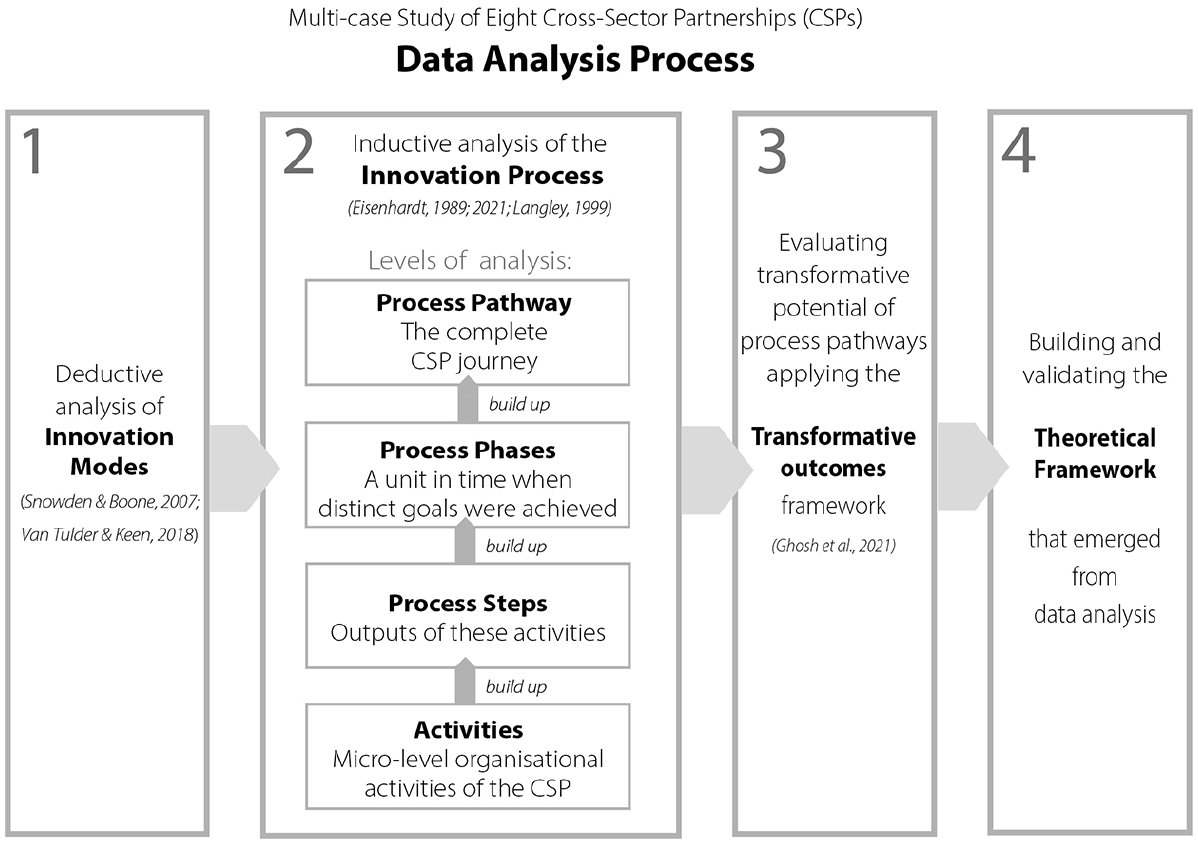
Data Analysis Process.
Case Selection
The transition toward more-sustainable and circular packaging in the EU is a process that has increasingly accelerated since 2016, when the EU Commission began introducing policy measures to foster that goal (Directive (EU) 2019/904, 2019; European Commission, 2018, 2020). This regulatory push paralleled rising negative sentiment among consumers and civil society about packaging pollution (Testa et al., 2020). The highly dynamic environment created by these combined pressures resulted in the founding of several CSPs between 2016 and 2021 to promote and encourage sustainable and circular packaging innovation. As this research analyses TI process pathways, a variety of cases focusing on a single TI-challenge (sustainable and circular packaging) was an ideal context to answer my research question.
I began case selection by researching online, snowballing, attending practitioner events, and talking with experts. This initial research resulted in a selection of 13 CSPs. I then used theoretical sampling to select the eight cases that were most appropriate for answering my research question (Eisenhardt, 2021). I assumed that CSPs with a broad purpose (e.g., increasing packaging circularity) followed different process pathways than CSPs with a narrowly defined purpose (e.g., improving the sorting process in recycling). Hence, I selected two polar types (Graebner & Eisenhardt, 2004) with different purpose specificity: four CSPs with a broad purpose and four with a narrow purpose.
Additionally, I controlled for antecedents of success (Davis & Eisenhardt, 2011; Eisenhardt, 2021): all CSPs in the sample satisfy the seven factors for CSP success (see Appendix B) that Pattberg and Widerberg (2016) identified. Because all CSPs in the sample start with favorable structural conditions, we can assume that differences in transformative impact really result from different innovation process pathways rather than from different antecedent conditions. While theoretical, the sample is still representative of large multinational CSPs in circular packaging, as it contains the largest initiatives in the EU in the time period between 2016 and 2021 (see Appendices A and E for details).
Data Collection
The data sources are diverse and include 1,057 pages of public documents, 14 videos, fieldnotes from three industry events, CSP websites, and quantitative progress reports (see case overview in Appendix A). All documents and videos were published online. Industry events were documented as fieldnotes between November 2020 and March 2022. The videos, such as assembly recordings, were used to triangulate the findings (Davis & Eisenhardt, 2011).
The data also include nine semi-structured interviews with one CSP to validate the findings. The interviews were conducted online in the first quarter of 2021, and lasted between 25 and 55 min. Interview participants included all relevant sectors and value chain segments. The questions, structured into technological and social dimensions, focused on opportunities, challenges, activities, and the evolution of the CSP.
Data Analysis
Consistent with Eisenhardt’s multi-case research method, the analysis started with a broad research question (“How do CSPs contribute to change toward socio-ecological goals?”) and theorizing took place throughout the data analysis by moving between data patterns and literature review (Eisenhardt & Graebner, 2007). Before doing detailed data analysis, I reviewed the data and constructed individual case histories (Eisenhardt, 1989). Throughout the analysis process, I consulted related literature (see section “Background: The Role of CSPs in the TI Process”) to identify theories that could help me understand the emerging patterns. This iterative process between data and theory pointed me to theoretical frameworks that helped to refine the research question in line with the emerging patterns. The detailed data analysis consisted of four steps (see Figure 1).
Step 1: Deductive Analysis of Innovation Modes
In this step, I analyzed which innovation modes occurred in the selected cases and whether these modes followed a sequential pattern. To identify innovation modes and sequence, I applied qualitative content analysis (Kuckartz, 2018; Mayring, 2014), a method that looks at quantitative patterns in qualitative data. Concretely, the CSP activities were assigned to one of the three innovation modes presented in the section “Background: The Role of CSPs in the TI Process” (clear, complicated, or complex; see coding examples in Appendix C). To balance effort and outcome in the coding process, I concentrated on documents that elucidated the partners’ activities, while excluding those that focused on frame conditions or technical recommendations. An intercoder reliability assessment helped to refine the code definitions early in the process.
The deductive analysis identified the number of clear, complicated, and complex activities per case (see Appendix D). Additionally, I differentiate between CSPs that (a) actually plan and perform complex activities as part of their initial design; (b) only pursue complex activities after adapting goals and design; and (c) recommend complex activities but do not engage in them. This differentiation resulted from reviewing diverging patterns in the case histories.
Step 2: Inductive Analysis of the Innovation Process
In this step, I used inductive analysis to understand how the innovation process pathways among CSPs differed. An inductive approach is justified because no studies focus specifically on innovation process pathways in CSPs. First, I constructed case histories for each CSP (Eisenhardt, 1989). Next, I analyzed the case histories in two ways: within-case and cross-case. The within-case analysis used temporal bracketing (Langley, 1999) to identify how micro-level organizational activities (level 1) build up process steps (level 2) that comprise process phases (level 3; see example in Table 2). Activities are micro-level units that describe what a CSP did. Such activities build up process steps—that is, distinct outputs that may be finished, ongoing, or planned. Several process steps constitute a process phase, defined as a unit in time when distinct goals were achieved. Each process pathway consists of a sequence of phases, describing the complete innovation journey of the CSP (see Figure 1). Constructs, such as process steps and phases per case, emerged from the data during the inductive analysis process.
Example of the Three Levels of Analysis.

After finishing the within-case analysis, I moved on to cross-case comparison using cross-case analysis techniques, such as between-pair comparison of similar (e.g., broad vs. broad) and polar (e.g., broad vs. narrow) types (Eisenhardt, 1989, 1991, 2021). To support this comparison, I used graphical process analysis techniques, including sequencing (Mahringer & Pentland, 2021) and blueprinting (Bitner et al., 2008). Specifically, I looked for similarities and differences in the purpose, phases, and process steps. During this analysis, I revisited the case histories multiple times looking for related patterns at different levels of analysis (activities, process steps, process phases). Hence, the final definitions of the process steps and phases result from an iterative process of comparing and contrasting the cases. From this process, a framework emerged. It consisted of several phases, with each phase corresponding to a specific goal. In addition, the between-case analysis allowed me to identify distinct process pathways among the cases.
Step 3: Evaluating Transformative Potential of Process Pathways
This step was aimed at identifying the potential of CSPs to contribute to TI by achieving TOs. Here, I applied pattern matching (Eisenhardt, 1989) to identify which cases could achieve the TOs described in the literature. Specifically, I searched each case history for proof of the TOs listed in the TOs framework (Ghosh et al., 2021). As each MEPS is associated with four specific TOs (see section “Background: The Role of CSPs in the TI Process”), I analyzed each process step in the innovation process to identify its potential for contributing to these TOs and the overarching MEPS. Finalizing this step allowed me to move toward answering the overall research question on the cases potential to create socio-ecological impact.
Step 4: Building and Validating a Theoretical Framework
In this final step, I applied pattern matching to contrast, compare, and combine the findings from the three steps above, which I used to develop the theoretical framework. First, I compared the patterns from deductive (Step 1) and inductive (Step 2) analysis to contrast and match patterns across cases. Second, I related the clusters identified through pattern matching to the findings from Step 3. From this analysis, the final version of the TI-Pro Framework iteratively emerged.
Finally, I concluded the analysis process by validating and refining the framework (Eisenhardt, 1989) using an additional data set from nine semi-structured interviews with one CSP working on a specific sustainable packaging solution. I analyzed the interview data deductively using the previously defined theoretical framework. This coding refined the theoretical framework, especially the process steps in Phase 4. Additionally, I presented the theoretical framework at three scientific conferences and a CSP practitioner workshop to validate its contribution to theory and practice.
Findings
This research analyzed the innovation process of eight CSPs to identify their potential to contribute to socio-ecological impact and found three process pathways: pioneering, adapting, and consolidating. Though the CSPs in our sample were all based in Europe, had similar goals, a variety of international partners from various sectors, and began with favorable antecedent conditions and similar process activities (see Appendix B), the analyzed CSPs followed very different process pathways. The adapting and pioneering innovation process pathways have the greatest potential to contribute to TI and socio-ecological impact.
CSPs following the pioneering process pathway (cases 4 and 5) exhibit high potential for contributing to all three MEPS: developing niches, expanding niches, and changing regimes because these CSPs not only consolidate knowledge but also pursue complex activities, such as piloting emerging solutions and negotiating joint business cases. Importantly, though, cases 4 and 5 focused on a narrowly defined purpose, such as reusable packaging or digital sorting technology, so their outcomes will affect very specific implementation problems in reusable packaging or waste sorting. Hence, pioneering CSPs have the potential to make deep contributions to building, expanding, and institutionalizing specific niches within a much broader TI-challenge.
The adapting CSPs (cases 6, 7, and 8) have high potential to contribute to socio-ecological impact because they evolved: from initial activities of consolidating knowledge, these CSPs transitioned toward more-TOs by incorporating complex activities. Initially, their potential was limited to expanding niches, yet after adapting their innovation activities these CSPs also demonstrated potential to contribute to socio-ecological impact by building niches and changing regimes. Among the three cases only one case (case 6) followed a narrow purpose definition (making flexible packaging recyclable), whereas the other two cases (cases 7 and 8) defined their purpose broadly (promoting and enabling circular, sustainable packaging). Hence, the contribution potential of adapting CSPs is not limited to a narrow purpose but may encompass a broad TI-challenge addressing a variety of socio-ecological problems.
The CSPs in the consolidating innovation process pathway (cases 1, 2, and 3) pursued the overarching goal of consolidating and sharing knowledge on existing sustainable, circular packaging problems and solutions. Correspondingly, their activities contribute to only one out of the three MEPS: expanding niches. Some activities within these cases, such as creating a sense of urgency or promoting the initiative, may also eventually contribute to changing regimes, but doing so requires that these early activities be followed by more-elaborate unlearning and “deep learning” activities from the complex innovation mode, such as facilitating pilots or developing business cases. Since the CSPs in the consolidating innovation process pathway do not pursue these activities, these CSPs do not contribute to the other two MEPS: changing regimes and developing niches. In sum, consolidating CSPs exhibit the least potential to contribute to socio-ecological impact. Detailed evidence for the three innovation process pathways and associated MEPS is presented in Appendix E.
In the remainder of this section, I present the empirical findings in two parts. Part 1 describes in-depth the TI-Pro framework that emerged from the data analysis (see Figure 2); part 2 details the three process pathways and their potential to contribute to socio-ecological impact (see Table 3).
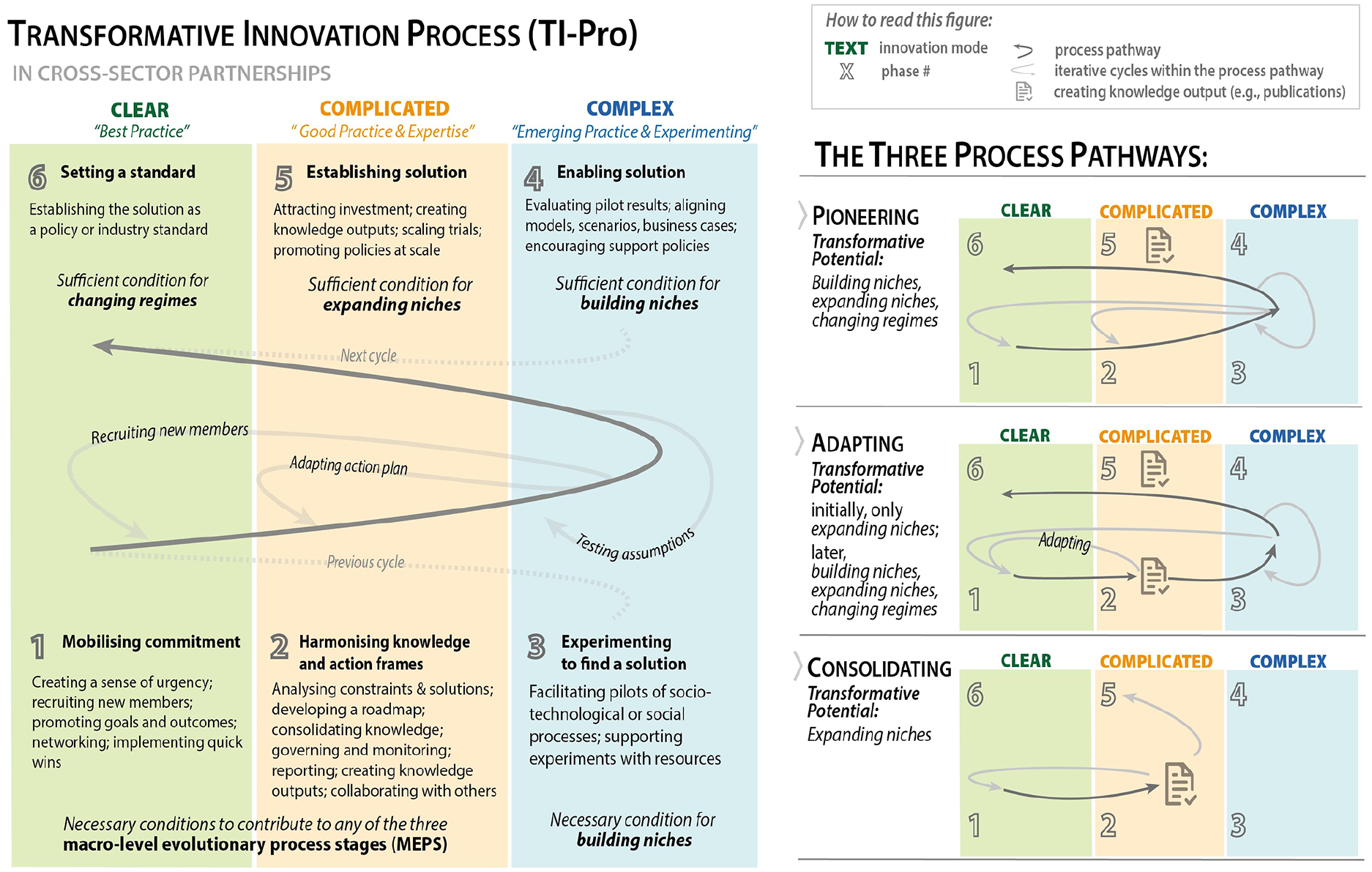
TI-Pro and the Three Process Pathways.
The Three Process Pathways.
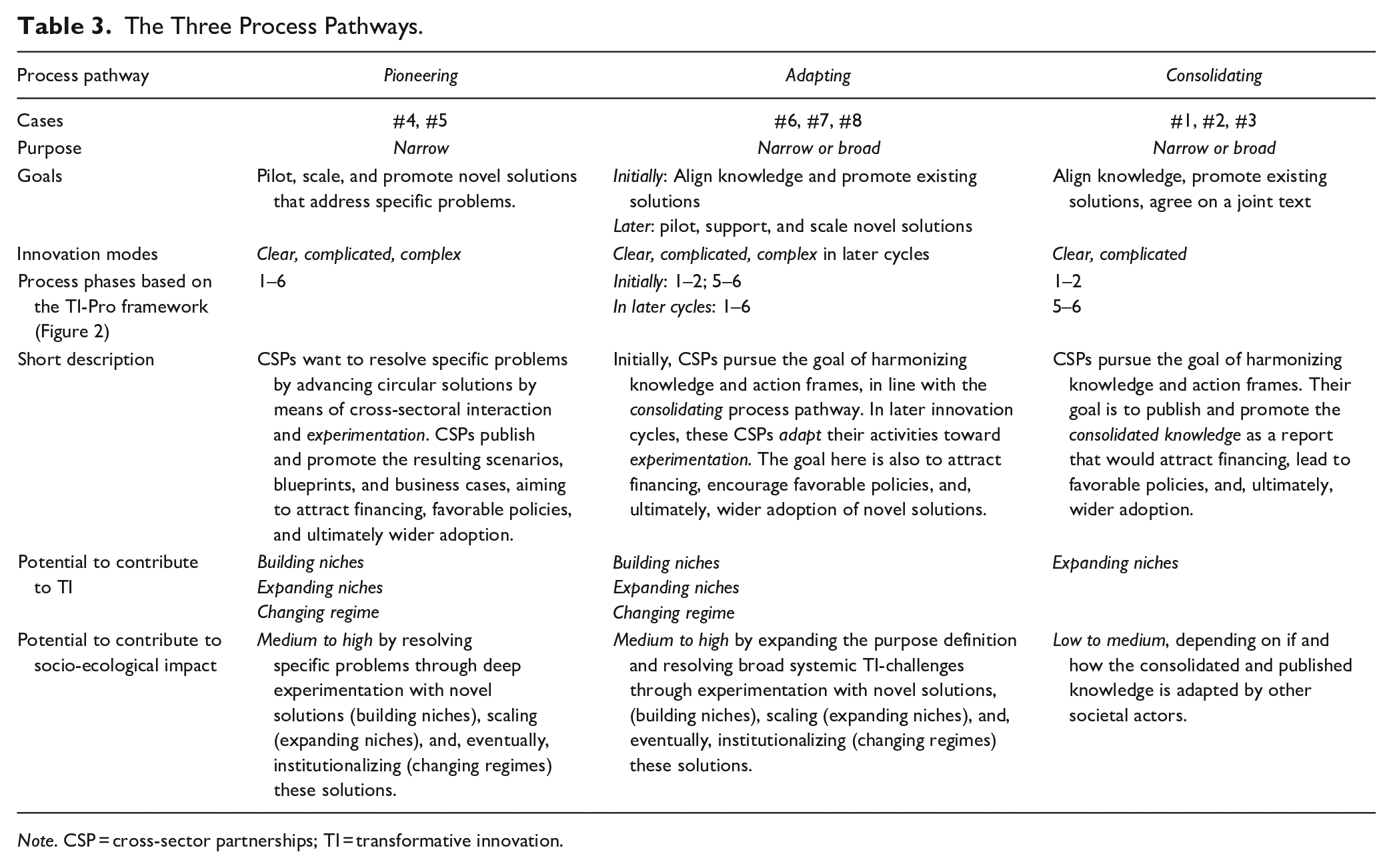
Note. CSP = cross-sector partnerships; TI = transformative innovation.
The TI Process
Analyzing the eight cases revealed six phases of the innovation process, with each phase corresponding to one of three innovation modes (see Figure 2): (1) mobilizing commitment (clear); (2) harmonizing knowledge and action frames (complicated); (3) experimenting (complex); (4) enabling solution (complex); (5) establishing solution (complicated); and (6) setting a standard (clear). An important finding from the analysis is the cyclical rather than linear process of innovation: The analyzed CSPs move through many iterative cycles (see Figure 2, light-gray arrows) and some activities, such as promoting the initiative, are done continuously (see Appendix E). Even though the process is iterative, though, the phases are sequential, as earlier preparatory phases (1–3) are necessary conditions for advancing to later concluding phases (4–6).
Next, I inquired into how the six phases affect the three MEPS: building niches, expanding niches, and changing regimes. Phases 1 and 2 are necessary conditions to contribute to any MEPS—without mobilizing commitment and harmonizing knowledge and action frames, the CSP cannot agree on a joint purpose—whereas Phase 3 (experimentation) is necessary to advance toward building niches. The lower half of Figure 2 (Phases 1–3) thus represent the conditions that are necessary but insufficient to advance toward certain MEPS: in other words, these are preparatory phases. In contrast, Phases 4 through 6 in the framework are sufficient conditions for advancing toward a specific MEPS: Phase 4 is required for a CSP to contribute to building niches, Phase 5 is critical to expand niches, and Phase 6 is indispensable for changing regimes. Notably, the CSP is just one of many agents involved in the macro-level TI process and the CSP alone is unlikely to change the regime or expand a niche, but those CSPs that do reach one of the concluding phases (4–6) can make a contribution to transforming the system toward socio-ecological impact. Below, I describe each phase of the process in depth.
The goal in Phase 1 is to mobilize commitment by sending clear messages that create a sense of urgency among concerned actors, promote the initiative and its goals, and ultimately convince new members to join. 1 All CSPs engage in networking activities among existing and potential members in this phase. A common activity during this phase is implementing quick wins, such as facilitating public awareness campaigns on pollution or substituting materials to increase packaging recyclability. By implementing unanimous best practices, such “quick-win” efforts signal that the initiative is effective. The downside of quick wins is that CSP members may perceive them as sufficient and shy away from setting more-ambitious and more-difficult goals. For example, the annual progress reports in case #7 indicate that most members succeeded in implementing design-for-recycling and material substitution efforts but made few advances in developing circular business models for refill and reuse. Most Phase 1 activities are clear innovation mode activities.
The goal in Phase 2 is to harmonize knowledge and action frames. In this phase, all analyzed CSPs share and analyze participants’ knowledge on constraints and solutions in order to harmonize perspectives and create knowledge outputs, such as reports, guidelines, or policy recommendations. As knowledge on constraints and solutions requires deep expertise, a common activity in this phase is to establish workstreams for sub-topics. Facilitating the activities also requires establishing governance and reporting structures, monitoring progress, as well as aligning action using roadmaps.
As diverse participants hold different views and interests, tensions may arise. For example, in case #6 members were aligned around a high-level goal (“recyclable packaging”) but exhibited very diverse perspectives on how to reach that goal, with some arguing for developing more sophisticated recycling technology, while others preferring to simplify packaging design (Kuhlmann et al., 2023). Such tensions are resolved differently depending on CSP structure and goals. For instance, some CSPs converged on one prescribed solution (cases 1, 5, and 6), whereas other CSPs encourage their members to choose individual solutions to achieve joint targets (cases 2 and 7). But generally, all CSPs shared two aims in this phase: harmonizing their participants’ understanding of circular packaging ecosystems and publishing the results. Hence, most activities in Phase 2 are associated with the complicated innovation domain. Phases 1 and 2 are necessary but not sufficient for a CSP to contribute to any of the MEPS.
Phase 3 focuses on experimentation as a way to move from ideas to developing socio-technological solutions. In this phase, CSPs facilitate technical trials of sorting and recycling solutions (cases 5 and 6) or pilot socio-technological processes for reuse solutions (case 4). In two cases, CSPs did not directly orchestrate facilitation but only engaged in experiments as supporters by offering blueprints and knowledge (case 7), financing (case 8), as well as networking opportunities and public promotion (cases 7 and 8). In these two cases, the CSPs pursued the broad aim of increasing packaging circularity, whereas those CSPs that engaged directly in experimentation (cases 4, 5, and 6) focused on very specific goals, such as improving recyclate quality through digital technologies (case 5), developing circular standards for flexible packaging (case 6), or testing and scaling durable, reusable packaging (case 4). We can thus conclude that CSPs with a narrowly defined, specific purpose are more likely to actively orchestrate experimentation, whereas CSPs with a broad purpose act as experimentation supporters.
The activities in Phase 3 are associated with the complex innovation mode, frequently with many small cycles between Phase 3 and Phase 2: after conducting experiments CSPs may see the need to reframe existing knowledge and adapt action based on new insights. Likewise, a CSP may deliberately return to Phase 1 to recruit additional partners needed to conduct a pilot. Ultimately, Phase 3 is necessary for those CSPs aiming to contribute to building niches, such as novel reuse and recycling systems. Notably, only five out of eight CSPs in the data set actually entered Phase 3. From Phase 3 on, then, innovation pathways diverge. Phases 1 through 3, then, can be considered preparatory phases, while Phases 4 through 6 are the concluding phases.
Those CSPs that generated useful insights from experimentation continue to Phase 4, which aims to enable a solution. Phase 4 is the key phase for translating experimental insights or pilot results into collaboration models (cases 4 and 6) or business cases/scenarios (cases 4, 5, and 6). Even though these activities involve expertise and calculations, the association with complicated activities is misleading. In fact, the models, scenarios, and business cases that appear in this phase still contain many unknowns or assumptions. The goal of Phase 4 is not to calculate something precisely, but rather to see how the growing insights from experimentation can inform the design of a future systemic solution, which is why Phase 4 activities are mostly associated with the complex innovation domain: while not guided by clear milestones and precise goals, these activities guide the solution search through iterative learning cycles.
Searching for a solution is a process that cycles between Phases 3 and 4: in Phase 3, the CSP engages in pilots/experiments, whereas in Phase 4 the CSP participants make sense of the experiments and decide how the results of these experiments will inform action. Often, this sensemaking process identifies the need for additional or scaled experiments in Phase 3. Questions such as “Will the technology work at the required speed and industrial scale?” and “If a niche experiment in one category is successful with consumers, can we scale it to other categories?” require additional testing. Essentially, the aim of Phase 4 is to take a solution from proof-of-concept to proof-of-commercialization to give partners certainty that investments into infrastructure, public campaigns, and new ventures will pay out.
What stands out in the preparatory phases (1–3) is that CSP participants focused on building a shared “we” identity: signing commitments, implementing quick wins, sharing knowledge, pursuing joint experiments, for example. In Phase 4, though, the identity dynamics shift back to the individual perspective, with the “Who?” questions becoming more-salient again: “Who is paying?,” “Who is responsible?,” “Who is getting value out of that?” The conflicting interests at the base of these questions may lead to tensions, but in spite of such tensions, participants generally recognize that only cross-sectoral collaboration can master the TI-challenge of enabling circular solutions and actually building novel niches for specific solutions, such as reusable packaging or for broad solutions such as new circular business models. Creating a blueprint for a functional, cross-sectoral circular solutions, though, is not an easy task: joint sensemaking plays just as critical a role as the experiments that preceded it. Completing Phase 4, then, is the sufficient condition for a CSP that really wants to build a niche.
In the subsequent Phase 5, CSPs attempt to establish a solution at scale, which involves publishing and promoting the successful experiments and the resulting knowledge, such as blueprints and scenarios. Such promotion is needed to attract finance, shape policies, and enable trials at big industrial facilities (case 5) or within new geographies (case 4). If a CSP succeeds at these activities, it has the potential to contribute to expanding a niche. Notably, it is not always CSP experiments that are scaled in Phase 5: CSPs also attempt to promote and scale existing solutions developed by their members, associates, or other societal groups (cases 1, 2, 3, 7, and 8).
Most activities in Phase 5 can be attributed to the complicated innovation mode, with the exception of experiments-at-scale that exhibit features of both innovation modes—complicated and complex. For example, preparing an industrial level trial (case 5) involves several complicated activities, such as defining clear goals, planning milestones, sharing expertise, and coordinating participants. At the same time, even an industrial level trial is still a complex experiment: even if everything has been prepared perfectly the outcomes cannot be foreseen in advance. The main goal is not only to demonstrate a proof-of-technology but also to learn what is not working and needs improvement.
This finding demonstrates that niche expansion happens in cycles as well. For instance, in case 4, the CSP proposed starting with scaling reusable solutions for coffee-to-go, which represents a niche extension within this specific category (complicated) but at the same time could pave the way for building niches in other categories (complex). Policies also play a vital role in encouraging stakeholders to adopt solutions and scale: in Germany, for example, the food-and-beverage industry (i.e., restaurants and cafes) must now offer consumers reusable to-go-packaging as an option.
Phase 6 is the ultimate goal for all CSPs: they want to set a standard, either within their industry or even as an obligatory policy solution. If the CSPs succeed, their solution will become a clear best practice for all industry practitioners, contributing to changing regimes. While all analyzed CSPs articulate this as a goal, none of them actually achieved their target within the time period analyzed (2016–2022). This outcome is not surprising, since most analyzed CSPs set targets for 2025 (cases 1, 2, 6, and 7) or even beyond 2030 (case 3). Worth noting is that only one TO was not present in any of the analyzed cases: destabilizing regimes, even though in the underlying TO framework (Ghosh et al., 2021) this is one of the four mechanisms required to achieve regime change. We can only speculate that this mechanism might have been missing because the analyzed CSPs were young or because in all analyzed cases, regime actors were strongly present.
As indicated above, the TI-Pro framework (Figure 2) describes all phases that may be part of the TI process. Three cases, though (1, 2, and 3), skipped Phases 3 and 4 because these CSPs did not engage in complex activities, such as experimentation (consolidating process pathway). Other cases (6, 7, and 8) did not plan complex activities in their initial design but adapted these later during their collaboration (adapting process pathway). Only two cases (4 and 5) actually included complex activities as part of their initial set-up (pioneering process pathway). The TI-Pro framework was the basis for answering the research question because it identified the three distinct process pathways (see Table 3) described in more detail below.
The Pioneering Process Pathway
CSPs following the pioneering process pathway (cases 4 and 5) aim to pilot and scale specific socio-technological solutions by pursuing experiments, which they expect will provide a better understanding of the complex socio-technological system and may even lead to reframing the current understanding of the TI-challenge. For example, in case 5, participants gradually adjusted their understanding of how different ecosystem actors could benefit from the technology, which led to adding additional requirements for the proposed solution. The pioneering process pathway comprises all six phases of the TI-Pro framework across all three innovation modes (see Figure 2) and has the potential to contribute to all three MEPS: building niches, expanding niches, and changing regimes (see Table 3).
However, because the goals of the experiments are specific, the contribution will also be solution-specific: case 4 may contribute to establishing novel solutions for reusable packaging, and case 5 may achieve its goal of introducing a novel technology that would improve sorting and increase the quality of recyclates. Thus, while the pioneering cases have the potential to contribute to all three MEPS, their outcomes are not sufficient to make a comprehensive macro-level transition happen. Instead, the pioneering pathway can contribute to building, expanding, and institutionalizing very specific niches that may ultimately become a vital part of resolving the overarching TI-challenge and contributing to socio-ecological impact.
The Adapting Process Pathway
The adapting process pathway (cases 6, 7, and 8) is one in which CSPs initially follow the consolidating process pathway—focused on consolidating knowledge and publishing guidelines (case 6), toolkits (cases 7 and 8), or reports (cases 6, 7, and 8)—yet, after achieving these initial outcomes, adapting CSPs identified specific structural or knowledge gaps and reconsidered their desired outcomes (see Figure 2 and Table 3). Thus, these CSPs adapted their activities and moved to Phase 3, where they started to facilitate experimentation (case 6) or actively support experimentation (cases 7 and 8). Such engagement included technical experiments (case 6), organizing and funding entrepreneurial competitions (case 8), or facilitating systemic experimentation to develop blueprints (case 7). Those adapting CSPs who acted as supporters (cases 7 and 8) focused on a broad purpose definition, whereas the adapting CSP that directly orchestrated experimentation (case 6) followed a specific purpose.
All adapting CSPs aim to enable (Phase 4) and scale (Phase 5) the niches identified during experimentation. These CSPs promote pilot results (cases 6, 7, and 8), calculate material-flow scenarios and business cases (case 6), encourage policy frameworks (case 7), and work on attracting investment (cases 6, 7, and 8). Thus, even when adapting CSPs act as supporters (cases 7 and 8) rather than orchestrators (case 6), they still exhibit the potential to build niches and expand niches. This can happen via direct orchestration of experiments in specific niches or by supporting experiments in different niches connected to the overarching TI-challenge. As the adapting CSPs engage in deep interaction and experimentation, with nonregime actors as well, these CSPs have the potential to extend their frames beyond the existing mainstream solutions and to actually change regimes.
In conclusion, adapting CSPs transform themselves toward complex activities: these CSPs start with the consolidating process pathway but adapt their aims during the collaboration and pivot toward complex activities. In two cases, where the adapting CSPs focus on the broad purpose of making packaging more sustainable, they exhibit potential to become active facilitators of the systemic transformation toward more-sustainable packaging.
The Consolidating Process Pathway
The main goal of a consolidating process pathway is connecting different actors to consolidate knowledge and align frames (cases 1, 2, and 3), such as establishing voluntary target-based commitments to foster sustainable packaging innovation or forming an alliance of C-level decision-makers from various sectors consolidating knowledge to build a common agenda for circular packaging innovation. The initial activities in all consolidating CSPs are focused on Phases 1 and 2 (see Figure 2 and Table 3). In Phase 1, the CSPs engage in mobilizing commitment and demonstrating quick wins, such as facilitating public awareness campaigns (cases 1 and 2), whereas in Phase 2, the partners align their knowledge and action frames and create knowledge outputs. These activities focus on system constraints and solutions that may address these constraints (cases 1, 2, and 3). This approach often involves complicated activities such as system-mapping and setting up monitoring systems (case 1) or facilitating large amounts of data and information (cases 1, 2, and 3). Additionally, members report on their individual progress (cases 1 and 2).
All consolidating CSPs stated that their goal is to promote enabling frame-conditions, establish sustainable packaging solutions at scale (Phase 5), and thus contribute to expanding niches, with the ultimate aim of introducing new guidelines and standards in Phase 6 and thus contributing to changing regimes. One reason why these CSPs were not able to do so was because their members are mainly regime actors, such as big companies or policy officials. Because these CSPs had limited interaction with nonregime actors, they had few opportunities to reframe the TI-challenge and the underlying socio-ecological problems which would have opened the path to identifying regime-changing solutions.
In sum, the consolidating cases have the potential to expand niches because these CSPs include large companies that can directly contribute to niche extension by adopting circular practices, such as design-for-recycling, but consolidating CSPs cannot contribute to niche building because they do not engage in experimentation. Likewise, their potential to actually change regimes remains hypothetical as long as these CSPs do not deeply engage with societal actors outside the existing regime.
Discussion
In answer to the research question “How do CSPs contribute to socio-ecological impact?” I identified two process pathways—the adapting process pathway and the pioneering process pathway—that provide CSPs with the greatest potential to contribute to socio-ecological impact through TI (see Figure 2). Both process pathways can potentially contribute to socio-ecological impact via all three MEPS—niche building, niche expansion, and regime change—but of the two, the adapting process pathway is better able to address the broad, open-ended, macro-level TI-challenge, whereas the pioneering process pathway contributes to deep experimentation enabling very specific niches.
Due to their cross-sectoral structure and broad goal definition, adapting CSPs have the capacity to extend their problem frames across actor boundaries and scales and support solution search across relevant parts of the system. In contrast, CSPs following the pioneering process pathway contribute to building and extending very specific niches that may ultimately become a critical part of an overall transition, yet on their own, the activities of pioneering CSPs are not sufficient to create a system-level transformation that addresses the TI-challenge and the underlying socio-ecological problems. So, we can say that the two process pathways are complementary, as adapting CSPs contribute a systemic, broad understanding and framing of the TI-challenge, whereas pioneering CSPs orchestrate deep experiments that can address specific implementation problems that stand in the way of realizing socio-ecological impact.
In addition to answering the research question, this study also contributes the novel TI-Pro framework on which the process pathway findings are based (see Figure 2). This framework, based on empirical data from eight cases, identifies CSPs’ dynamic and cyclical progression through six distinct phases of a TI-Pro, and links micro-level CSP activities and their corresponding innovation modes to transformative socio-ecological impact on the macro-level via meso-level CSP process pathways. Each phase, associated with a distinct innovation mode, represents either a necessary or sufficient condition contributing to a specific stage in the macro-level evolutionary transition. Hence, CSPs’ innovation modes and sequence of activities—and the resulting process pathways the CSPs follow—determine their potential to engage in TI and contribute to socio-ecological impact. The process pathways identified in this study (see Table 3) and the novel TI-Pro framework on which these process pathway findings are based (see Figure 2) contribute to CSP literature and theory as well as to practice. Next, I discuss the theoretical contributions this article makes and then the practical implications.
The Potential of CSPs to Contribute to Macro-Level, Evolutionary, Socio-Ecological Impact
The primary contribution of this article is to the CSP literature. The empirical results demonstrate that in spite of similar antecedent conditions, CSPs may follow different innovation pathways toward TI, resulting in varying potential for them to contribute to systemic and evolutionary macro-level socio-ecological impact. The theoretical contribution of this article thus lies in demonstrating three diverging process pathways—adapting, pioneering, and consolidating—and their differing potential to shape long-term, evolutionary socio-technological processes. Furthermore, by identifying the adaptive process pathway, I also demonstrate that a CSP’s transformative potential is not determined by its initial design and goals, but may evolve in the course of the collaboration.
The process pathways this study identifies—abstracted from the empirically based TI-Pro framework—contributes to CSP literature by overcoming a major limitation of this literature; namely, its inability to identify whether or how CSPs have the potential to contribute to macro-level socio-ecological impact. This limitation has been primarily a result of the level of analysis in prior research. Previous research of CSP processes has focused on relational processes, such as overcoming tensions and reconciling value within CSPs (cf. Clarke & MacDonald, 2016; Le Ber & Branzei, 2009), which means that the main level of analysis of this research has been on the micro-level organizational processes and meso-level outcomes inside the CSP. From this perspective, complex activities can help CSPs overcome internal tensions (Oskam et al., 2021). But since the core aim of CSPs is to address societal and socio-ecological problems that cannot be dealt with by actors from an individual sector alone (Selsky & Parker, 2005), and since CSPs play such a critical role in TI, we should also consider how CSP processes contribute to addressing socio-ecological problems on the macro-level. Hence, the contribution of this article is connecting micro-level organizational activities and meso-level processes in CSPs to macro-level impact in addressing socio-ecological problems. The findings of this study show that complex activities contribute to overcoming tensions in the external environment, contributing to building transformative, innovative niches with the potential of addressing socio-ecological problems.
As TI-challenges, such as a circular economy transition, reside at the heart of most CSP initiatives, current research from the relational perspective offers only a partial picture. A purely relational focus overlooks the underlying socio-technological process dynamics, where innovation phases require different innovation modes linked to differences in goals and activities. A full discussion of collaborative socio-ecological impact thus requires a discussion of innovation modes and their specific contribution to macro-level evolutionary transition stages (MEPS). Critically, macro-level socio-ecological impact cannot be achieved by focusing on just one transition stage. This article demonstrates how different process phases are critical to achieving distinct evolutionary outcomes throughout the process. As a set, these three MEPS—building niches, developing niches, and changing regimes—contribute to socio-ecological impact on the macro-level. Thus, the contributions of a CSP to transformative socio-ecological impact will vary: pioneering and adaptive CSPs have the potential to contribute to all three MEPS, whereas consolidators focus only on developing existing niches.
By engaging with the macro-level perspective, this article illuminates why and how problem-centric CSPs are more likely to achieve transformative socio-ecological impact than purely solution-focused CSPs (Stadtler et al., 2024): due to their broad purpose perspective adapting CSPs have the capacity to explore the TI-challenge first, before deciding on specific experiments. But the finding also challenges the typology that differentiates CSPs into mitigative and transformative, with mitigative CSPs being solution-oriented and transformative CSPs being problem-oriented (Stadtler et al., 2024). The pioneering CSPs in our data set were solution-oriented—as their focus was on developing a specific solution—and transformative at the same time. Therefore, this article encourages a more-differentiated approach to CSP typology that explicitly takes the socio-ecological systemic aims of CSPs and the nonlinear evolutionary nature of the innovation process into account.
CSP Design as an Ongoing and Adaptive Activity
In identifying the adapting process pathway, this article makes another contribution to the CSP literature by exposing a false assumption in prior CSP research: that complex, double-loop learning activities are antecedent conditions that must be an initial part of CSP design to achieve success (Pattberg & Widerberg, 2016; van Tulder & Keen, 2018). This article demonstrates that while this assumption may be true for pioneering CSPs, adapting CSPs may adapt complex activities only after gaining insights from the collaboration process. This finding adds additional evidence to the study by Oskam et al. (2021) showing that the need for experiments emerges throughout the collaboration, not just in the beginning. As a consequence, this study shows that understanding CSP design is an ongoing and adaptive activity can inform a more-differentiated approach to CSP analysis focusing attention on questions around which conditions enable CSPs to engage in complex activities and what prevents them from doing so.
The TI-Pro Framework
The findings show that when engaging in a transformative initiative, CSPs move through different process phases, characterized by three distinct innovation modes. Although all process phases may contribute to socio-ecological impact, albeit to varying degrees, the different innovation phases and modes require different analytical lenses. For example, the relational perspective may be valuable when analyzing CSP formation or conflict, whereas the evolutionary lens allows us to analyze how CSPs contribute to knowledge evolution and macro-level system change. By introducing the TI-Pro framework, this article shows just how important it is to include the long-term, macro-level, evolutionary perspective—in addition to, rather than to the exclusion of, the relational and event-oriented perspectives (Garud & Gehman, 2012).
A final contribution of this study to CSP literature is the integration of aspects from TI literature. Developing the TI-Pro framework and identifying the process pathways would not have been possible without integrating the important meso- and macro-level analytical lenses—the dynamic, cyclical, and evolutionary innovation perspective; MEPS; and TOs—from TI research. Thus, this article shows that integrating these important concepts from TI literature was necessary for answering a fundamental research question in CSP literature. This finding and contribution has implications for future research as well, suggesting that both research streams—CSP and TI—would benefit from further interdisciplinary interaction to develop theories that are fit to address complex socio-ecological problems (Wasieleski et al., 2021).
Transformative Innovation: CSPs’ Critical Role in Cross-Sectoral Niche Building
Finally, this article also demonstrates that complex activities have more potential for contributing to transformative socio-ecological impact than do activities intended solely to consolidate knowledge. The findings of this study demonstrate why complex activities are so important for TI, as well as the critical role that CSPs play in fostering these activities. The findings show that complex cross-sectoral activities—such as experimenting, aligning value, and, ultimately, building new niches—are critical for resolving tensions in the external environment. Such tension-resolving niches can only develop because CSPs provide a space for cross-sectoral knowledge-sharing, experimentation, learning, and, vitally, value renegotiation through scenarios, modeling, and communication. Developing such tension-resolving cross-sectoral spaces is somewhat unique to CSPs: Knowledge-consolidating activities could potentially happen outside a CSP—for example, by cross-sectoral study of a specific TI-challenge—but the capacity to change structures and build new niches by closely engaging concerned stakeholders across sectors is unique to CSPs. Thus, what the findings reveal is that CSPs play a critical and unique role in harmonizing stakeholders’ perspectives and shaping TI that is desirable, feasible, and viable across sectors and bears the potential for lasting socio-ecological impact.
This finding about CSPs’ unique position has implications for practice as well as research. For CSP orchestrators, the results indicate that in addition to considering whom to bring into a CSP for pragmatic reasons, the orchestrators must also consider whom to involve to democratize the niche-building process, since a variety of perspectives will lead to more diverse socio-ecological goals and more inclusive niche-building activities. At the same time, decision processes will become more challenging as perspectives diversify (Klitsie et al., 2018), so it is important to develop clear principles for democratic actor involvement and governance. For research, this article suggests that both CSP and TI research should focus very closely on the niche-developing role and processes in CSPs to help us better understand how to resolve the tension between accelerating innovation and democratic involvement.
Implications for Practice
For CSP practitioners, the TI-Pro framework and the three associated process pathways can be both a tool for assessment as well as a blueprint for orchestrating and governing a collaboration. This framework, based on the empirical work of this study as well as research by Van Tulder and Keen (2018) and Ghosh et al. (2021), encourages CSPs to ask three iterative questions to guide their decision-making and activities:
(1) Which TOs are we aiming to achieve?
(2) Where do we currently stand in the innovation process?
(3) Do we have the right partners and governance structure to engage in a particular innovation mode?
The TI-Pro Framework thus gives CSP orchestrators and participants a greater ability to assess their own activities and evaluate how those activities will contribute to TI and systemic socio-ecological impact. Hence, the TI-Pro framework provides practitioners with a more-reflexive approach than previously existed for designing, orchestrating, and iterating CSP work toward socio-ecological goals.
Limitations and Boundary Conditions
In selecting data for this multi-case study, I defined three boundary conditions for data collection: (1) all cases were responding to the TI-challenge of circular and sustainable packaging, (2) all CSPs were located in the EU, and (3) all CSPs met similar antecedent conditions. These boundaries were intentionally defined to illuminate how—despite similarities in the TI-challenge, geography, and antecedent conditions—process pathways can differ. Although I suspect that my findings will generalize to other CSPs with industry actors working to address socio-ecological problems, further work is needed to understand the generalizability and the limits of the findings in this study.
The main limitation of the empirical part of the study is that all collaborations are ongoing, meaning that limited data are available on formal goal achievement. In addition, because the time horizon for this study was limited to 5 years, this article focuses on the potential of CSPs to contribute to TI. To examine the actual contribution of CSPs to TI requires a much longer time horizon. To better understand, assess, and confirm the link between meso-level processes and macro-level socio-ecological impact, another assessment should be conducted after 2025 (analyzing formal goal achievement) and 2030 (assessing contribution to socio-ecological impact).
Another limitation is that I analyzed CSPs as a unit rather than analyzing participating organizations or individual agents within CSPs. An analysis of specific organizational or individual agents may identify additional insights that complement the findings of this article. For example, analyzing how organizations or individuals use their knowledge, skills, and negotiation power to transition between the phases of the innovation process and to influence the direction of change may offer insights on why some cross-sectoral innovations are more transformative than others. The role of orchestrators deserves special attention as they facilitate sensemaking across organizational boundaries. So, the processes and tools orchestrators deploy may influence if a CSP moves toward experimental activities and knowledge productions or only consolidates knowledge.
Finally, because the findings speak to transforming socio-technological systems toward socio-ecological goals, the conclusions about the potential to achieve macro-level socio-ecological impact are tentative. For example, I did not consider the risks of rebound effect or the parallel retention of technologies that exuberate socio-ecological damage (Koretsky et al., 2023; Zink & Geyer, 2017). Both fields—CSP and TI research—would benefit from more theorizing and studies on how to connect socio-technological systems with socio-ecological impact, for example, by establishing closer links to the industrial ecology discipline (Wasieleski et al., 2021).
Conclusion and Research Outlook
This article found three innovation pathways in CSPs, two of which—via different means—have the greatest potential to contribute to macro-level socio-ecological impact through TI. The findings, based on a multi-case study of eight European CSPs, demonstrate that the diverging CSP process pathways lead to diverging outcomes: some CSPs only consolidate knowledge to scale existing solutions (consolidating pathway), while others experiment to build and expand novel niches (pioneering pathway) or evolve from consolidating knowledge to building and expanding niches (adapting pathway). While the adapting and pioneering pathways present the greatest potential for contributing to socio-ecological impact, their goals are also the most uncertain as they reside in the complex innovation mode. Importantly, as the innovation journey is not linear but rather dynamic and cyclical all CSPs could potentially adapt complex activities, such as experimentation, as part of their goals.
The six-phase TI-Pro framework this article introduces provides practitioners with an assessment tool and a blueprint that guides innovation journeys toward socio-ecological impact. For scholars, the framework can be used to assess how process phases and innovation modes inform researchers’ choice of analytical lenses and levels of analysis. This article also contributes to CSP and TI literatures by integrating elements of the TI literature into the CSP literature and creating a link between micro-level organizational activities, meso-level process pathways, and macro-level transformative socio-ecological impact. This link illuminates the critical role that CSPs play in building the desirable niches that contribute to TI and socio-ecological impact.
The findings of this study have implications for future research directions as well. Future CSP research should critically engage with the six phases identified in the TI-Pro framework to identify which questions and analytical lenses are appropriate in each phase. For example, CSP scholars could utilize the relational perspective to analyze how adapting CSPs use the first two phases to build up relational capital, which increases their potential for succeeding in later phases and contributing to socio-ecological impact. The findings of this study also indicate that CSP scholars should engage with CSP practitioners to identify which specific implementation challenges arise in each phase and how scholars can contribute prescriptive knowledge to support implementation. Finally, future research should investigate why some CSPs pursue complex activities that contribute to double-loop learning and niche-development while others do not. Questions such as why and how CSPs adapt complex activities over time, which mechanisms support such adaptation, and how we could support this process as engaged scholars have both academic and pragmatic value in contributing to socio-ecological impact (Van De Ven, 2007; Wasieleski et al., 2021).
Footnotes
Appendix A
By selecting cases that share the structural success antecedents in CSPs recommended by Pattberg and Widerberg (2016), I control for alternative explanations in order to focus on the less-explored aspects of the TI process in CSPs. This theoretical sampling technique is recommended in the Eisenhardt multi-case analysis (cp. Davis & Eisenhardt, 2011; Eisenhardt, 2021).
Appendix B
Antecedents of Success in Theoretical Sampling of the CSP Cases.

| Impact factors for CSP success (Pattberg & Widerberg, 2016) | Applicable? | Explanation |
|---|---|---|
| 1. Favorable political and social context | Yes | The challenge of making packaging in the EU more sustainable and circular is supported by policymakers and other actors (Foschi & Bonoli, 2019; Testa et al., 2020). |
| 2. Optimal partner mix | Yes | All cases are large multi-actor CSPs, ensuring optimal partner mix as partners are adjusted throughout the process. |
| 3. Leadership | Yes | All CSPs have agreed on a project charter and an official leadership structure with high-level sponsors. |
| 4. Stringent goal-setting | Yes | All CSPs have defined goals. |
| 5. Professional process management | Yes | All CSPs are facilitated by a professional orchestrator. |
| 6. Regular monitoring and reporting | Yes | All CSPs monitor and publish results. |
| 7. Sustained funding | Partly | In most cases, project outcomes determine if the project will continue. Nevertheless, I consider this criterion as fulfilled, as outcome-based budgeting is appropriate in TI (Mazzucato, 2021). |
Note. CSP = cross-sector partnerships; EU = European Union; TI = transformative innovation.
Appendix C
Coding Examples for Innovation Modes of Activities and Their Contributions.
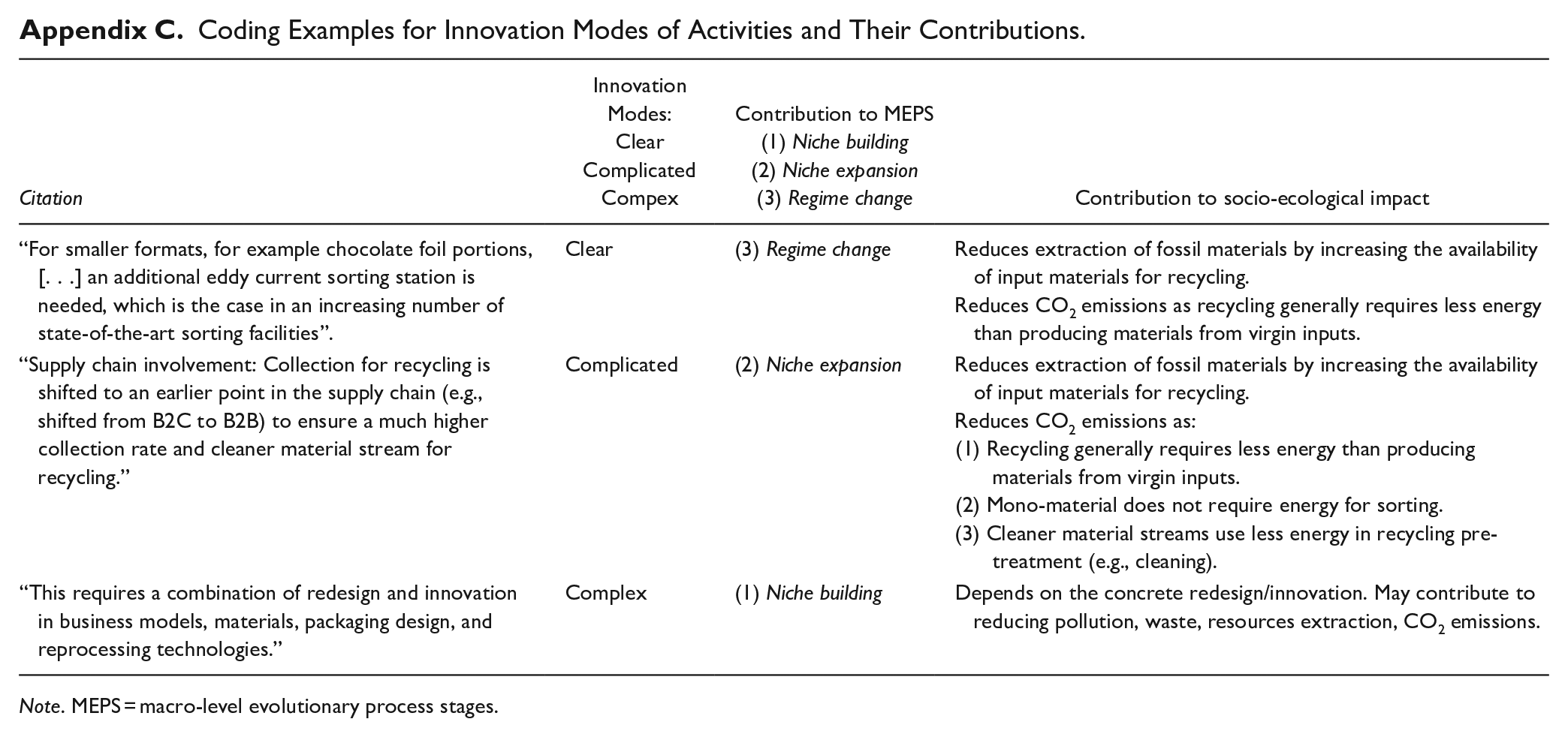
| Citation | Innovation Modes: |
Contribution to MEPS |
Contribution to socio-ecological impact |
|---|---|---|---|
| “For smaller formats, for example chocolate foil portions, [. . .] an additional eddy current sorting station is needed, which is the case in an increasing number of state-of-the-art sorting facilities”. | Clear | (3) Regime change | Reduces extraction of fossil materials by increasing the availability of input materials for recycling. Reduces CO2 emissions as recycling generally requires less energy than producing materials from virgin inputs. |
| “Supply chain involvement: Collection for recycling is shifted to an earlier point in the supply chain (e.g., shifted from B2C to B2B) to ensure a much higher collection rate and cleaner material stream for recycling.” | Complicated | (2) Niche expansion | Reduces extraction of fossil materials by increasing the availability of input materials for recycling. Reduces CO2 emissions as: (1) Recycling generally requires less energy than producing materials from virgin inputs. (2) Mono-material does not require energy for sorting. (3) Cleaner material streams use less energy in recycling pre-treatment (e.g., cleaning). |
| “This requires a combination of redesign and innovation in business models, materials, packaging design, and reprocessing technologies.” | Complex | (1) Niche building | Depends on the concrete redesign/innovation. May contribute to reducing pollution, waste, resources extraction, CO2 emissions. |
Note. MEPS = macro-level evolutionary process stages.
Appendix D
Overview of IMs Per Case.
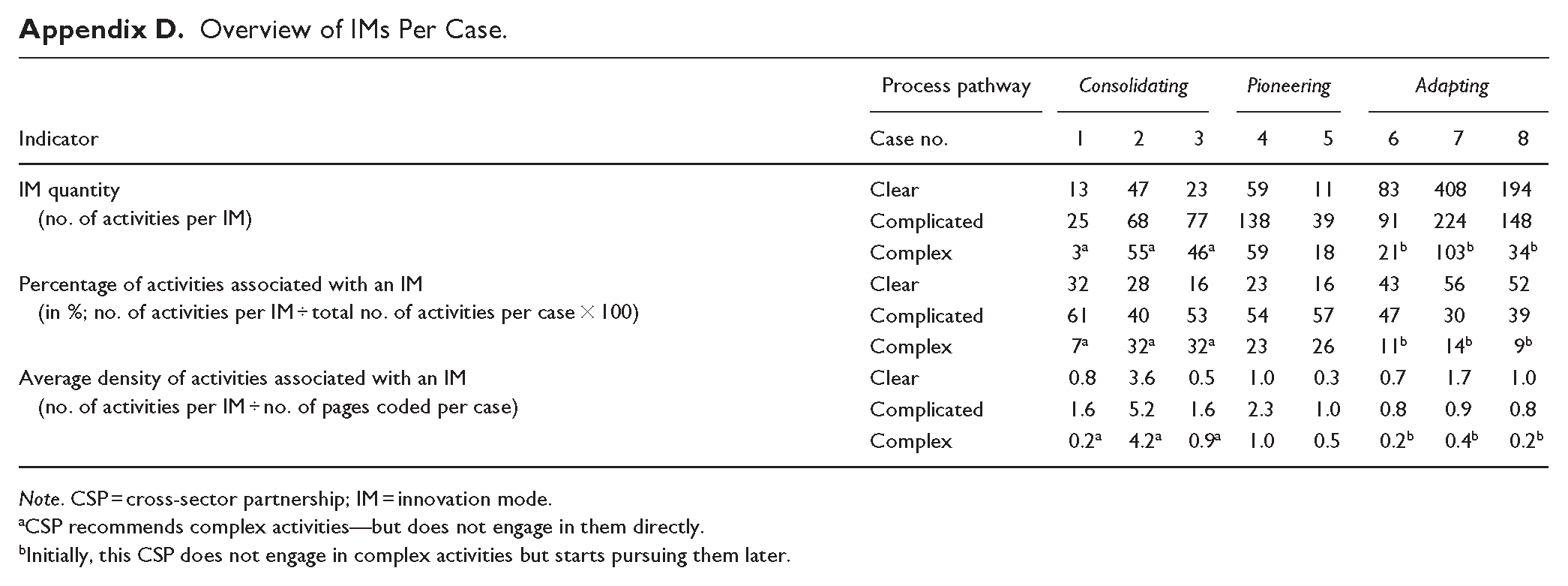
| Indicator | Process pathway | Consolidating | Pioneering | Adapting | |||||
|---|---|---|---|---|---|---|---|---|---|
| Case no. | 1 | 2 | 3 | 4 | 5 | 6 | 7 | 8 | |
| IM quantity(no. of activities per IM) | Clear | 13 | 47 | 23 | 59 | 11 | 83 | 408 | 194 |
| Complicated | 25 | 68 | 77 | 138 | 39 | 91 | 224 | 148 | |
| Complex | 3 a | 55 a | 46 a | 59 | 18 | 21 b | 103 b | 34 b | |
| Percentage of activities associated with an IM(in %; no. of activities per IM ÷ total no. of activities per case × 100) | Clear | 32 | 28 | 16 | 23 | 16 | 43 | 56 | 52 |
| Complicated | 61 | 40 | 53 | 54 | 57 | 47 | 30 | 39 | |
| Complex | 7 a | 32 a | 32 a | 23 | 26 | 11 b | 14 b | 9 b | |
| Average density of activities associated with an IM(no. of activities per IM ÷ no. of pages coded per case) | Clear | 0.8 | 3.6 | 0.5 | 1.0 | 0.3 | 0.7 | 1.7 | 1.0 |
| Complicated | 1.6 | 5.2 | 1.6 | 2.3 | 1.0 | 0.8 | 0.9 | 0.8 | |
| Complex | 0.2 a | 4.2 a | 0.9 a | 1.0 | 0.5 | 0.2 b | 0.4 b | 0.2 b | |
Note. CSP = cross-sector partnership; IM = innovation mode.
CSP recommends complex activities—but does not engage in them directly.
Initially, this CSP does not engage in complex activities but starts pursuing them later.
Appendix E
Detailed Overview of Findings Per Case.
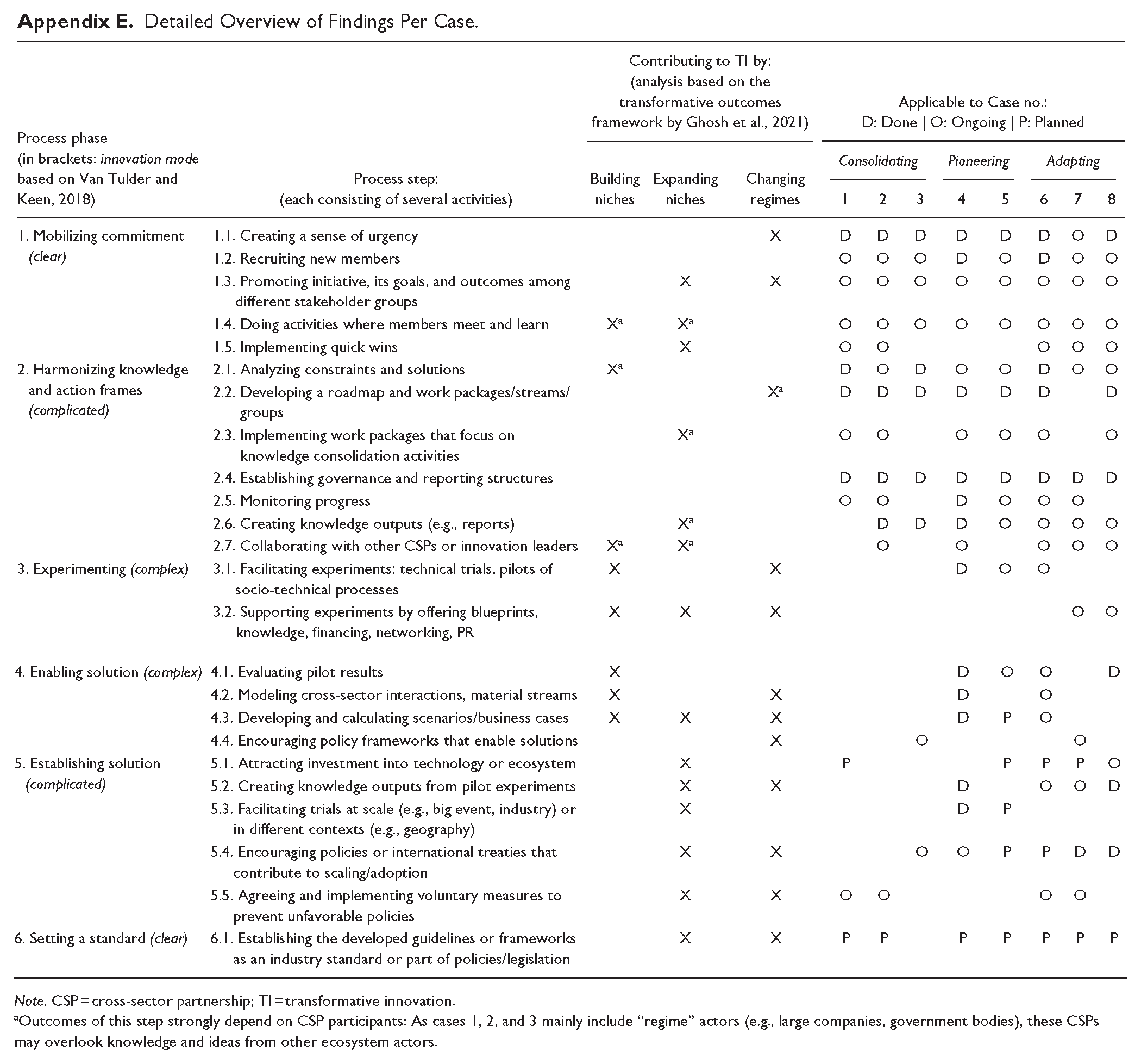
| Process phase(in brackets: innovation mode based on Van Tulder and Keen, 2018) | Process step:(each consisting of several activities) | Contributing to TI by:(analysis based on the transformative outcomes framework by Ghosh et al., 2021) | Applicable to Case no.:D: Done | O: Ongoing | P: Planned | |||||||||
|---|---|---|---|---|---|---|---|---|---|---|---|---|
| Building niches | Expanding niches | Changing regimes | Consolidating | Pioneering | Adapting | |||||||
| 1 | 2 | 3 | 4 | 5 | 6 | 7 | 8 | |||||
| 1. Mobilizing commitment (clear) | 1.1. Creating a sense of urgency | X | D | D | D | D | D | D | O | D | ||
| 1.2. Recruiting new members | O | O | O | D | O | D | O | O | ||||
| 1.3. Promoting initiative, its goals, and outcomes among different stakeholder groups | X | X | O | O | O | O | O | O | O | O | ||
| 1.4. Doing activities where members meet and learn | X a | X a | O | O | O | O | O | O | O | O | ||
| 1.5. Implementing quick wins | X | O | O | O | O | O | ||||||
| 2. Harmonizing knowledge and action frames (complicated) | 2.1. Analyzing constraints and solutions | X a | D | O | D | O | O | D | O | O | ||
| 2.2. Developing a roadmap and work packages/streams/groups | X a | D | D | D | D | D | D | D | ||||
| 2.3. Implementing work packages that focus on knowledge consolidation activities | X a | O | O | O | O | O | O | |||||
| 2.4. Establishing governance and reporting structures | D | D | D | D | D | D | D | D | ||||
| 2.5. Monitoring progress | O | O | D | O | O | O | ||||||
| 2.6. Creating knowledge outputs (e.g., reports) | X a | D | D | D | O | O | O | O | ||||
| 2.7. Collaborating with other CSPs or innovation leaders | X a | X a | O | O | O | O | O | |||||
| 3. Experimenting (complex) | 3.1. Facilitating experiments: technical trials, pilots of socio-technical processes | X | X | D | O | O | ||||||
| 3.2. Supporting experiments by offering blueprints, knowledge, financing, networking, PR | X | X | X | O | O | |||||||
| 4. Enabling solution (complex) | 4.1. Evaluating pilot results | X | D | O | O | D | ||||||
| 4.2. Modeling cross-sector interactions, material streams | X | X | D | O | ||||||||
| 4.3. Developing and calculating scenarios/business cases | X | X | X | D | P | O | ||||||
| 4.4. Encouraging policy frameworks that enable solutions | X | O | O | |||||||||
| 5. Establishing solution (complicated) | 5.1. Attracting investment into technology or ecosystem | X | P | P | P | P | O | |||||
| 5.2. Creating knowledge outputs from pilot experiments | X | X | D | O | O | D | ||||||
| 5.3. Facilitating trials at scale (e.g., big event, industry) or in different contexts (e.g., geography) | X | D | P | |||||||||
| 5.4. Encouraging policies or international treaties that contribute to scaling/adoption | X | X | O | O | P | P | D | D | ||||
| 5.5. Agreeing and implementing voluntary measures to prevent unfavorable policies | X | X | O | O | O | O | ||||||
| 6. Setting a standard (clear) | 6.1. Establishing the developed guidelines or frameworks as an industry standard or part of policies/legislation | X | X | P | P | P | P | P | P | P | ||
Note. CSP = cross-sector partnership; TI = transformative innovation.
Outcomes of this step strongly depend on CSP participants: As cases 1, 2, and 3 mainly include “regime” actors (e.g., large companies, government bodies), these CSPs may overlook knowledge and ideas from other ecosystem actors.
Acknowledgements
A single-authored article was a requirement to complete the PhD program. But you never walk alone. I would like to thank my colleagues Julia Anne Gross and Charis Luedtke as well as my supervisor, Fenna Blomsma, for their continuous support. Kai Kraushaar has generously shared his data and supported data collection. I extend my gratitude to the participants of the PROS 2022 and CSSI 2022 Paper Development Workshops as well as the NBM 2023 and EGOS 2023 Conferences for their feedback on previous versions of this article. In particular, I would like to acknowledge Nicolas Antheaume, Alberto Bertello, Giovanna Capponi, Nicolas Chevrollier, and Joanna Stanberry. I am also grateful to Marc Abernathy and Jayda Fogel for their copyediting assistance and Nur Gizem Yalcin for her support on the intercoder assessment. The guidance provided by the editors, Martina Linneluecke and Domenico Dentoni, along with the valuable advice from the three anonymous reviewers, was critical in enhancing the contribution and clarity of this article.
Declaration of Conflicting Interests
The author declared no potential conflicts of interest with respect to the research, authorship, and/or publication of this article.
Funding
The author disclosed receipt of the following financial support for the research, authorship, and/or publication of this article: This article is part of a PhD thesis funded by the Foundation of German Business (Stiftung der Deutschen Wirtschaft). The funding organization had no influence on the content of this article.
Notes
Author Biography
