




Abstract
Transforming linear value chains toward circularity is rife with challenges, like valorizing materials and building supply relationships. Meta-organizations, organizations with organizations as members, may help alleviate these challenges. They can facilitate sustainability transitions by mobilizing collective action, but less is known about their potential for reconfiguring value chains toward circularity. We explore this by conducting a qualitative case study of two meta-organizations for textile circularity. Our findings reveal five key collective activities for reconfiguring value chains toward circularity through meta-organizing: setting material agendas, balancing membership openness and closedness, brokering new relationships among organizations, facilitating material-based platforms, and opening new material opportunities. The first three activities worked in parallel toward two outcomes that enabled material-based platforms and new material opportunities: circular co-experimentation and localized circular supply chain development. Our findings strengthen our understandings of how meta-organizations can build new links across industries and sectors, enabling value chain reconfiguration and broader systemic transitions.
Keywords
Introduction
How do you convince people to take a chance on untapped potential, especially when the outcomes are uncertain? The transition toward circular economy is rife with such uncertainties, as it requires new ways to use undervalued materials and new value chains to bring those materials to market (Bocken et al., 2016; Farooque et al., 2019). The challenge of innovation is compounded since circular products often require material inputs that are not readily available on the market, such as post-consumer or post-business waste (Wells & Seitz, 2005). This creates a potential difficulty for organizations trying to innovate toward circularity: They may need supply partnerships at the outset so they know what materials are available to work with, even if it is unclear what exactly they will be able to make out of them.
Circular economy is an economic model in which resources are reused throughout multiple life cycles using strategies like recycling, refurbishing and sharing (Kirchherr et al., 2017), as well as shifting to renewable materials when possible (Näyhä, 2019; Reim et al., 2019). The concept of circular economy has received much attention from firms, the public sector, and non-governmental organizations, and consequently many collective initiatives have been formed to facilitate the transition to a circular economy (Patala et al., 2022). Implementing circular solutions often requires collaboration between actors, as typically no one entity has agency over all stages of the material life cycle (Frishammar & Parida, 2019; Parida et al., 2019). Collaboration can help mitigate some of the risks that may otherwise immobilize the transition toward a circular economy (De Lima & Seuring, 2023).
One structure for tackling boundary-spanning challenges like the shift to circular economy is the meta-organization, an organization of organizations built around a shared system-level goal (Gulati et al., 2012). Meta-organizations can take many different forms—like trade associations (Spillman, 2018), multi-stakeholder initiatives (Carmagnac & Carbone, 2019), or standards development organizations (Rouquet et al., 2023)—that are more structured than an informal network without being a formal institution of governance (Chaudhury et al., 2016). Within meta-organizations, members deliberatively coordinate their activities, often through activities like knowledge sharing or self-regulation (Berkowitz, 2018). These super-structures have a growing role in addressing societal challenges, such as corporate responsibility in the oil and gas sector (Berkowitz et al., 2017), the sustainability of palm oil (Carmagnac & Carbone, 2019) and various other sustainability challenges (Valente & Oliver, 2018).
Despite the attention to circular economy, circular value chain reconfiguration faces barriers. There are material limitations to what is possible (Sahimaa et al., 2024), as well as market risks for individual firms (De Lima & Seuring, 2023). Meta-organizations may be uniquely suited to address these challenges, as they can facilitate collaborations with diverse actors that may alleviate those risks (Berkowitz et al., 2017). However, to date, there is only one paper exploring meta-organizing for circular economy, and it is in the context of platform orchestration rather than value chain reconfiguration (Blackburn et al., 2022). Thus, we ask the research question: How can meta-organizations aiming for increased resource circularity enable value chain reconfiguration?
To explore this question, we conducted a qualitative study of two European meta-organizations aiming for circularity in the textile sector. Our findings reveal five key collective activities for reconfiguring value chains toward circularity through meta-organizing: setting material agendas, balancing membership openness and closedness, brokering new relationships among organizations, facilitating material-based platforms, and opening new material opportunities. The first three activities worked in parallel toward two outcomes—circular co-experimentation and localized circular supply chain development—that together enable material-based platforms and new material opportunities.
Our study has important implications for research on circular economy and meta-organizing. Compared to many meta-organizations that facilitate collective action within existing industries, circular economy meta-organizations build new material links across industries and sectors with the goal of value-chain reconfiguration. Understanding these meta-organizations can enrich the understanding of how meta-organizations’ horizontal associative structures can enable broader systemic transitions in vertical value chains.
Theoretical Background
Circular Economy and Value Chains
Circular Economy Conceptual Foundations
Circular economy is “an economic system that replaces the ‘end-of-life’ concept with reducing, alternatively reusing, recycling and recovering materials in production/distribution and consumption processes” (Kirchherr et al., 2017, p. 229). More holistic conceptualizations include replacing non-renewable resources with bio-based materials (Näyhä, 2019; Reim et al., 2019), and we use this conceptualization in this paper. Oftentimes, these activities are framed as decoupling economic growth from natural resource use (Ghisellini et al., 2016; Govindan & Hasanagic, 2018).
Circular economy implementation requires action and collaboration at the micro, meso, and macro levels (Kirchherr et al., 2017). Within individual companies, circular design strategies and business models—like designing for disassembly or charging for access rather than ownership—enable materials to physically and profitably move to their next use lives (Bocken et al., 2016; Lüdeke-Freund et al., 2019). At the meso level, collaborations and value chains can play an important role in sharing materials and circular knowledge (Farooque et al., 2019; Genovese et al., 2017; Patala et al., 2022). These arrangements can take different forms, such as cross-sectoral partnerships, industrial ecosystems, or marketplaces (Rajala et al., 2018). In addition, new actor roles may emerge to facilitate activities like collecting, transporting, and processing waste materials (Tate et al., 2019). Finally, at the macro level, institutional environments can both enable and hinder circular economy implementation (Moreau et al., 2017), as well as incentivize some circular approaches (such as recycling) over others (such as reducing material inputs) (Ranta et al., 2018).
Challenges of Circular Value Chain Reconfiguration
Organizations generally cannot implement circularity alone, as they often require capabilities and/or materials not available internally (Frishammar & Parida, 2019; Parida et al., 2019). These capabilities may include actor roles that do not normally exist in conventional supply chains, such as collecting or remaking waste materials (Tate et al., 2019). Thus, circular value chains can require collaborations both within and between supply chains (Farooque et al., 2019), going beyond simply engaging new suppliers.
The uncertainty of circular economy’s firm-level benefits can prevent companies from investing in transformative solutions (Parida et al., 2019), thereby hampering the emergence of circular value chains. These uncertainties are driven by both the limitations of materials themselves as well as by the market viability of circular offerings. First, the physical properties of materials limit what can be done with them. For example, cotton and polyester blended fabrics are highly difficult to separate, restricting the opportunities for recycling blended textiles (Sahimaa et al., 2024).
On the market side, there are various sources of risk that may hinder the emergence of circular value chains. A significant risk comes from pricing, as circular materials can be more expensive than their virgin material counterparts (De Lima & Seuring, 2023; Genovese et al., 2017). In addition, circular products often valorize materials seen as valueless or undesirable (Corvellec, 2019). Downstream, this can limit the market for those circular products (Govindan & Hasanagic, 2018). Other notable risks include organizations’ lack of knowledge and expertise, operational and technical risks, and uncertainty around usable secondary resources (De Lima & Seuring, 2023). These risks and their impacts can be mitigated through inter-firm collaboration, circular product design, information sharing, flexibility, and financial risk management (De Lima & Seuring, 2023).
Meta-Organizations
Meta-organizations have unique characteristics that could help alleviate the risks that currently hold back circular value chain reconfiguration.
Meta-Organization Conceptual Foundations
Meta-organizations are structures with organizations as members (Ahrne & Brunsson, 2008) whose relationships are centered around a system-level goal (Gulati et al., 2012). Meta-organizations can facilitate collective action through resource pooling, information sharing, capacity-building, expansion of geographic reach, and lobbying (Berkowitz & Dumez, 2016). They can also orchestrate supply chains through standard-setting meta-organizations or formal, geographically co-located clusters (Rouquet et al., 2023).
The definitions of meta-organizations vary between the so-called “European school” (Berkowitz & Bor, 2018) built around Ahrne and Brunsson’s work (2008) and the North American tradition building on the work of Gulati et al. (2012). The main difference between the two traditions is that Ahrne and Brunsson see meta-organizational membership constrained to other organizations, whereas Gulati et al. have a wider definition that can include individuals as meta-organization members (Berkowitz & Bor, 2018; Garaudel, 2020). We define meta-organizations as comprised of other organizations, but we nonetheless also build on the meta-organizational design work of the North American school. We think the traditions on both sides of the Atlantic can offer complementary insights on the formation and function of meta-organizations with organizations as members.
Furthermore, the literature on meta-organizations and ecosystems overlaps in many ways, warranting a clarification of terms. While the two streams of literature have developed largely independently, both are focused on understanding how independent and heterogeneous organizations interact and collaborate, in arrangements broader than an industry or sector, toward a collective goal in the absence of legally binding agreements (Gomes et al., 2021; Gulati et al., 2012). Gomes et al. (2021, p. 7) define ecosystems as a type of meta-organization that “create[s] value related to a systemic innovation for a targeted audience.” In line with these authors, we view ecosystems as one manifestation of meta-organizations, as the circular economy meta-organizations under examination involve collectively generated systemic innovations targeted toward textile industry audiences.
The boundaries around meta-organizational membership can vary widely. On one end of the spectrum are closed meta-organizations (such as supply networks) that require approval to join, and on the other end are open meta-organizations (such as open-source platforms) that anyone can join (Gulati et al., 2012). Boundaries are also drawn around where members are from—they could be from within the same value chains, same industries, related industries, or unrelated industries (Berkowitz et al., 2017).
Within the boundaries of meta-organizations, members can access new collaboration opportunities. By organizing various projects and initiatives, meta-organizations facilitate connections among members (Carmagnac & Carbone, 2019). They make space for the interests of the individual organizations while also aiming to find convergent ones, enabling connections among diverse organizations (Berkowitz & Dumez, 2016; O’Mahony & Bechky, 2008) and co-opetition (Berkowitz, 2018; Berkowitz & Bor, 2018). Meta-organizations’ efforts to connect member organizations can also de-risk sustainability transitions by giving organizations access to diverse information sources, making space for a variety of sustainability approaches, and co-constructing sustainability practices with other industry players (Berkowitz et al., 2017).
Meta-Organizing for Sustainability and Circular Economy
Managing grand challenges—like climate change and poverty—requires navigating complex, uncertain situations and engaging with a diverse array of stakeholders (Ferraro et al., 2015). Meta-organizing for sustainability has been studied from a variety of perspectives, as shown in Table 1. Meta-organizations can be used to address gaps in regulation and create new markets (Berkowitz & Souchaud, 2019; Peixoto & Temmes, 2019), facilitate the diffusion of sustainability principles across a supply network (Carmagnac & Carbone, 2019), help govern natural resources (Berkowitz et al., 2020), govern commons through formalized network contracts (Corazza et al., 2021), improve the ability of member organizations to achieve systemic goals (Valente & Oliver, 2018), facilitate the diffusion of new definitions of sustainability (Vifell & Thedvall, 2012), and diffuse sustainability practices across an organizational field in response to external threats (Kaplan, 2024). Researchers have also identified the importance of local context (Alo & Arslan, 2023) and country-specific attributes (Chaudhury et al., 2016) when meta-organizing action toward sustainability.
Overview of Previous Literature on Meta-Organizing for Sustainability.
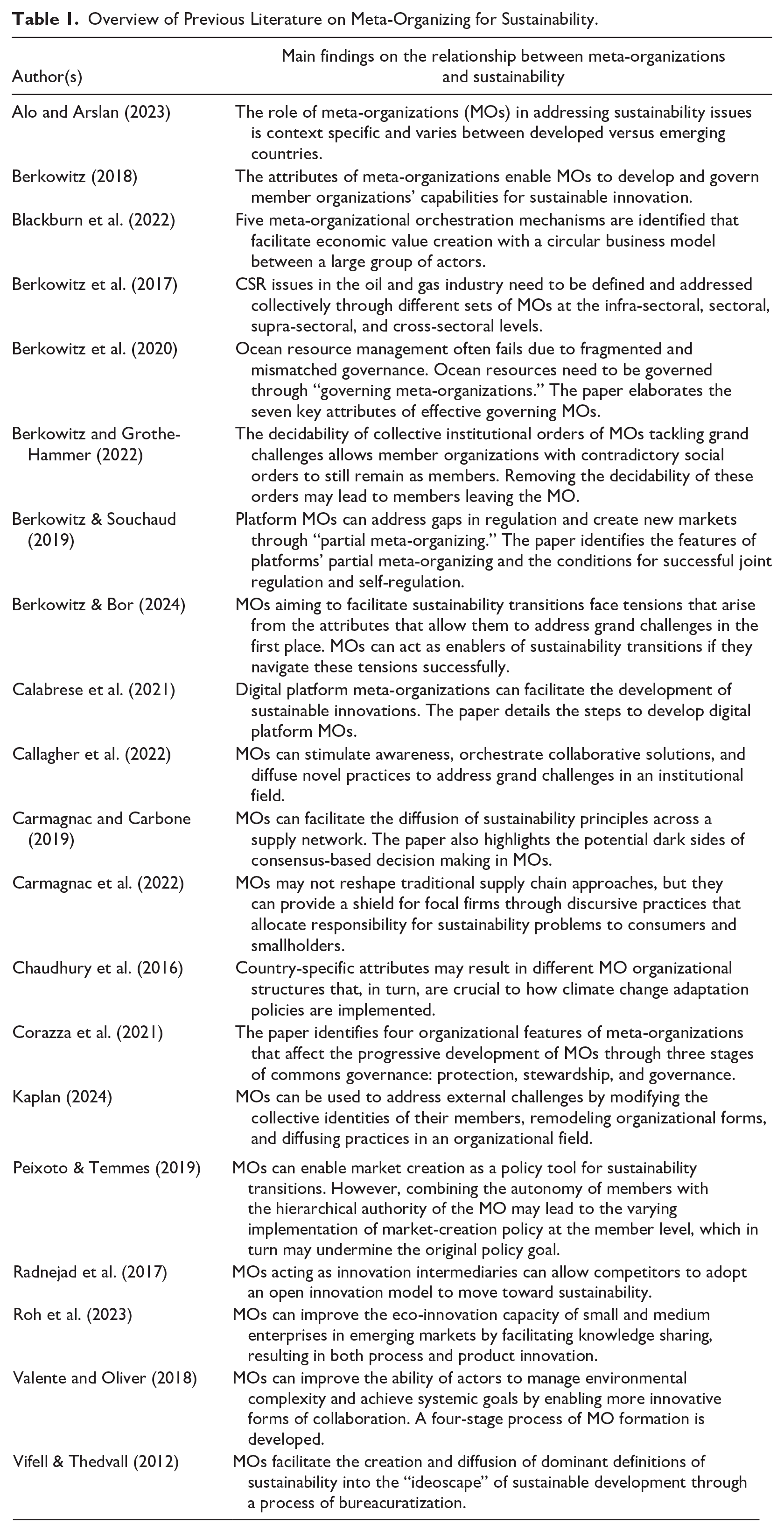
Meta-organizations have also been found to enable sustainable innovation. They can help develop and govern their member organizations’ capabilities for sustainable innovation (Berkowitz, 2018); facilitate sustainable innovation or circular business models through digital platforms (Blackburn et al., 2022; Calabrese et al., 2021); stimulate awareness, orchestrate collaborative solutions, and diffuse novel practices to address grand challenges (Callagher et al., 2022); improve the eco-innovation capacity of their members (Roh et al., 2023); and facilitate open innovation between competitors (Radnejad et al., 2017).
Finally, researchers have also studied some of the dark sides, tensions, and shortcomings of meta-organizations. For example, meta-organizations may use discursive practices to shift responsibility for sustainability problems away from their member organizations (Carmagnac et al., 2022). Paradoxically, the traits that allow meta-organizations to facilitate collective action toward grand challenges, especially the diversity of their member organizations, also create tensions that may generate change inertia (Berkowitz & Bor, 2024), undermine policy goals (Peixoto & Temmes, 2019), or lead to members leaving the meta-organization (Berkowitz & Grothe-Hammer, 2022).
In the existing literature, only the study of Blackburn et al. (2022) looks at meta-organizing for circular economy. Their study examines the role of meta-organizations in facilitating digital platforms for circular economy, identifying enabling mechanisms for circular business models built on resource-centric matchmaking logics, and realizing mechanisms for circular value creation.
Although only this one study examines circular meta-organizations, adjacent literature streams on circular ecosystems and collaborations shed light on how circular meta-organizations may be different than ones focused on other sustainability goals. Circular initiatives aim to valorize previously unvalued materials and orchestrate value chains built on new practices and logics (Bansal & Mcknight, 2009; Frishammar & Parida, 2019). Because of the profound change entailed by the transition to circular economy, circular economy ecosystems are most successful when building upon ecosystem readiness assessments to analyze whether the resources and capabilities are available to reach circular economy aspirations (Parida et al., 2019). Their activities sometimes involve creating new roles for consumers and supply chain actors, as well as finding and deploying new technologies for sorting and/or processing waste materials (Sandberg, 2023). Circular ecosystems may also be characterized by polycentric governance rather than the centrality of a single focal firm, which requires mutual adjustments between actors, practices for collective agency, and structures for sharing resources (Patala et al., 2022).
Ultimately, what sets circular economy collaborations apart most from other types is that their activities are explicitly centered around reconfiguring resource use. Dynamic collective structures can enable material sharing between private, independent entities (Patala et al., 2022). “Resource-centric matchmaking” (Blackburn et al., 2022, p. 20) can be the driving logic for choosing the mission, members, and processes of circular meta-organizations. The discursive activities in circular economies elevate previously devalued materials into “resources in use” (Feldman & Worline, 2012), changing the relations and practices involved in managing those materials. In this way, circular ecosystems actively create, rather than just discover, opportunities for extracting value from unused materials (Bansal & Mcknight, 2009).
To summarize, we argue that there are challenges to reconfiguring value chains toward circularity and that the unique characteristics of meta-organizations could help alleviate them. Despite this promising avenue of study, we have seen that meta-organizations for circularity have only been studied as platform orchestrators (Blackburn et al., 2022), not value chain reconfigurers. Meta-organizations more broadly have been studied for their potential to shape value chains (Rouquet et al., 2023), but not in the context of circularity. Our study therefore examines the unexplored intersection of meta-organizing, circular economy, and value chain reconfiguration. In addition, although there is existing literature on circular economy value chains and meta-organizing for sustainability, it is less known how meta-organizations and their members collectively organize their material development activities to reconfigure value chains toward circularity. These collaborative practices enable organizations to physically manipulate materials to use them in new ways, such as by developing fabrics out of wood offcuts or cracking the challenge of textile recycling. These activities in turn can create new relationships and material flows within value chains. This gap is important to study, as material properties constrain what can be done, potentially limiting the opportunities for circular transitions.
Methodology
We utilized a case study approach to examine how meta-organizations reconfigure value chains toward circularity. More specifically, we utilized an inductive approach (Gioia et al., 2013) in our case analysis. In this approach, informants are seen as knowledgeable agents who can articulate their experiences, and the data collection and analysis aim to capture their own sensemaking rather than reflect a priori theoretical constructs (Gioia et al., 2013). It is suitable for developing novel theoretical insights from data in research contexts where existing theory is sparse enough to make using a priori theoretical constructs unfeasible.
Traditionally, case studies with inductive theory building tend to focus on single cases in order to emphasize depth, while case studies focused on comparison tend to go for breadth and involve a higher number of cases (Gehman et al., 2018). However, inductive approaches have also been utilized with a small number (e.g., two to three cases) to open up the potential for some comparative insights while not sacrificing all of the depth associated with single case studies (Granqvist & Ritvala, 2016; Halme et al., 2012; Lawrence & Dover, 2015).
We followed this approach and studied two cases. This allowed us to build richer insights on the role of meta-organizations in sustainability transitions. It allowed us to identify the commonalities of meta-organizational roles even across somewhat different activity domains (although still within the broader domain of circularity transitions). On the other hand, it also allowed us to identify how different organizational structures in meta-organizations, such as the presence of an orchestrator, may affect the roles played by meta-organizations.
In addition, analyzing two rich data sets led us to comparative insights that went beyond structural differences. For example, we identified two parallel outcomes (circular co-experimentation and localized circular supply chain development) of the first three activities in our framework. We may have missed this in data with less depth. Likewise, while both of those outcomes were visible in both cases, each was stronger in one case. Thus, the comparison of two rich data sets specifically illuminated these two parallel outcomes. In the next subsection, we will describe the cases and further explain how the dual case approach helped with theory building.
Case Selection
Our empirical cases are two Finnish meta-organizations, TEX and BIO, that aim to research and implement solutions for circular and bio-based textiles. The current textile industry produces myriad ecological problems, such as waste, carbon emissions, and nonrenewable resource consumption for petrochemical-based synthetic fibers (Niinimäki et al., 2020). It is also vertically disintegrated, with networks of sub-suppliers spread throughout the world (Niinimäki et al., 2020).
TEX is a co-operative entity that aims to advance textile recycling, which has previously been limited largely due to the difficulty of separating cotton-synthetic blends (Sahimaa et al., 2024). The meta-organization grew out of a pilot project for textile collection and sorting in southwest Finland. It is run by a diverse group of organizations from different sectors and contains a variety of partners, including universities, a public research institute, a regional waste management operator, various companies, and not-for-profit organizations. The first official phase of TEX was a 2017–2019 publicly funded textile collection and sorting pilot project. The second phase, begun in 2019, is focused on circular business models for textiles. The research from this phase produced a product-service system pilot project in 2021. In 2022, TEX launched a successor project that aims to solve textile waste problems through circular economy, which is also linked to the BIO meta-organization.
BIO is a €50 million research and development collaboration and ecosystem led by two incumbent firms, ForestCo and EnergyCo. Its management is assisted by a partner firm, EcosystemManager, with advisors from Finnish innovation and technological research institutions. It received funds for the years 2020–2024 from a public funding instrument for ecosystems led by large incumbent firms. Its mission is to develop technologies and business concepts for novel and circular bioproducts, including textiles. Much of the material research happens in constituent project consortia, making BIO a meta-organization of meta-organizations. There are also member organizations that are not currently active in the projects.
We chose these two cases utilizing the notion of theoretical sampling (Patton, 2002), through which cases are selected by analyzing the presence and variation of theoretical constructs of interest. In our case, this meant that both cases fulfilled the characteristics of a meta-organization and had explicit aims for value chain transformation toward circularity. While we initially began our study focusing on the TEX case, we added the BIO case based on certain similarities and key differences.
A key similarity between the cases relates to context: both are geographically situated in Finland and aim to engage with the textile industry. We focused on textile meta-organizations in Finland for two main reasons. There are several recent textile circularity innovations in the country, such as the bio-based Ioncell fiber, which are important enablers for value chain reconfiguration and have generated considerable public interest in the field. In addition, the lack of giant incumbent clothing brands (like H&M and Zara) means there is relatively little inertia from existing conventional supply chains, which could hinder circularity action. We also wanted to keep our cases in the same industrial context. The textile sector is highly global and vertically disintegrated, with a vast array of suppliers due to the technical simplicity of production (Jiang et al., 2012). The process of value chain reconfiguration may look different in other sectors, which are built on specialized technical knowledge.
The key differences between the cases relate to meta-organizational features. While both cases fulfill the definition of a meta-organization (being organizations whose members are also organizations), there are major differences in their management structures and core activities. TEX emphasizes self-organization and is thus characterized by the absence of a formal orchestrator. Its activities prioritize collaboration for closing the loop in textile value chains, and it has a strong focus on collecting, sorting, and managing textile waste. BIO, on the other hand, is co-orchestrated by two large companies and focuses primarily on collaborative innovation for novel uses of bio-based materials.
Data Collection
Our data collection ran from 2021 through spring 2023, as shown in Table 2. We collected 11 interviews with key members of each meta-organization, for a total of 22 interviews, all conducted remotely over video conferencing software. Most interviews were conducted by two members of the research team. Interviews were conducted in the meta-organization’s working language: Finnish for TEX and English for BIO. Our interviewee selection was guided by two key criteria: (1) we aimed for maximum diversity in the types of organizations the interviewees represented and (2) we chose organizations and individuals that had been substantially involved in the meta-organizational activities. The Finnish interviews were translated by the native Finnish-speaking members of our research team.
Overview of Data Collected.
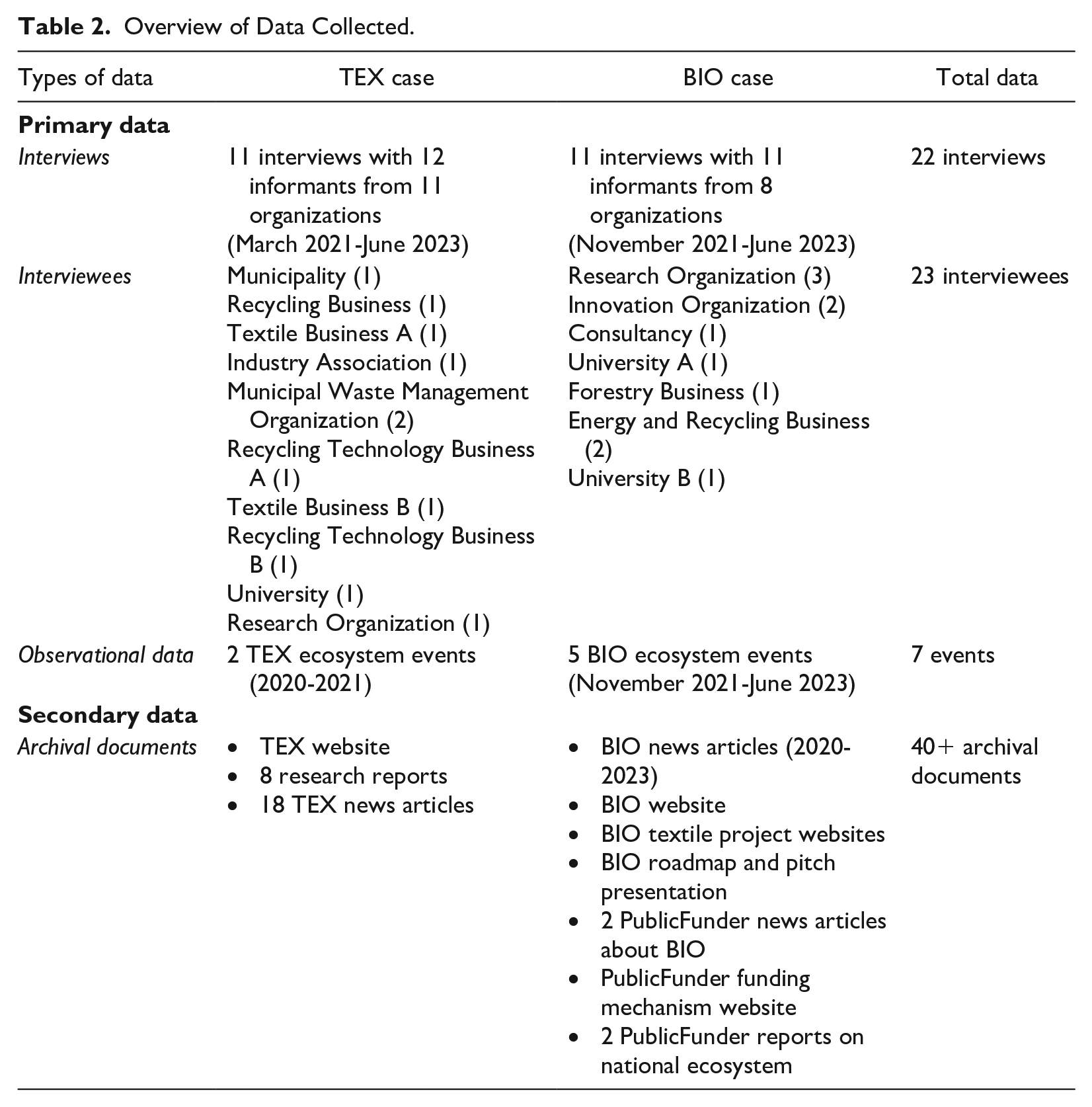
In addition to collecting interviews, we observed five ecosystem events hosted by BIO: two public annual seminars, two annual seminars for ecosystem members, and one thematic workshop for members. Furthermore, we joined the BIO member email list and online platform. We also observed multiple events related to TEX. In addition, we collected a variety of archival materials about both meta-organizations, including web pages, articles, and reports. We used this observational and archival material to strengthen our understanding of the meta-organizations’ activities and their positions in the broader national circular economy innovation context.
Data Analysis
To analyze the data, we first inductively coded first-order concepts within each case (Gioia et al., 2013). These first-order concepts were meta-organizational practices, i.e., they were undertaken by the collective rather than just a specific member of the collective. These included, for instance, linking companies, research institutions, and public-sector actors in the case of BIO. The first two authors each focused on coding one of the cases, for language reasons. However, we also cross-coded some interviews in each case to ensure shared understanding. We also discussed our coding throughout the process and together identified second-order themes and aggregate dimensions that fit across both cases, iterating between the data and literature. The aforementioned first-order code, for instance, linked to the second-order code “Facilitating new cross-sectoral relations.” Finally, second-order codes were linked to broad aggregate codes, such as “Brokering new relationships among organizations.” Our resulting data structure is shown in Figure 1. Throughout the analysis process, we discussed differences in the case data, which informed the brief case comparison at the end of the findings section. This allowed us to have a richer understanding of the meta-organizations’ role in circularity transitions than we would have had by focusing on either of the cases alone.
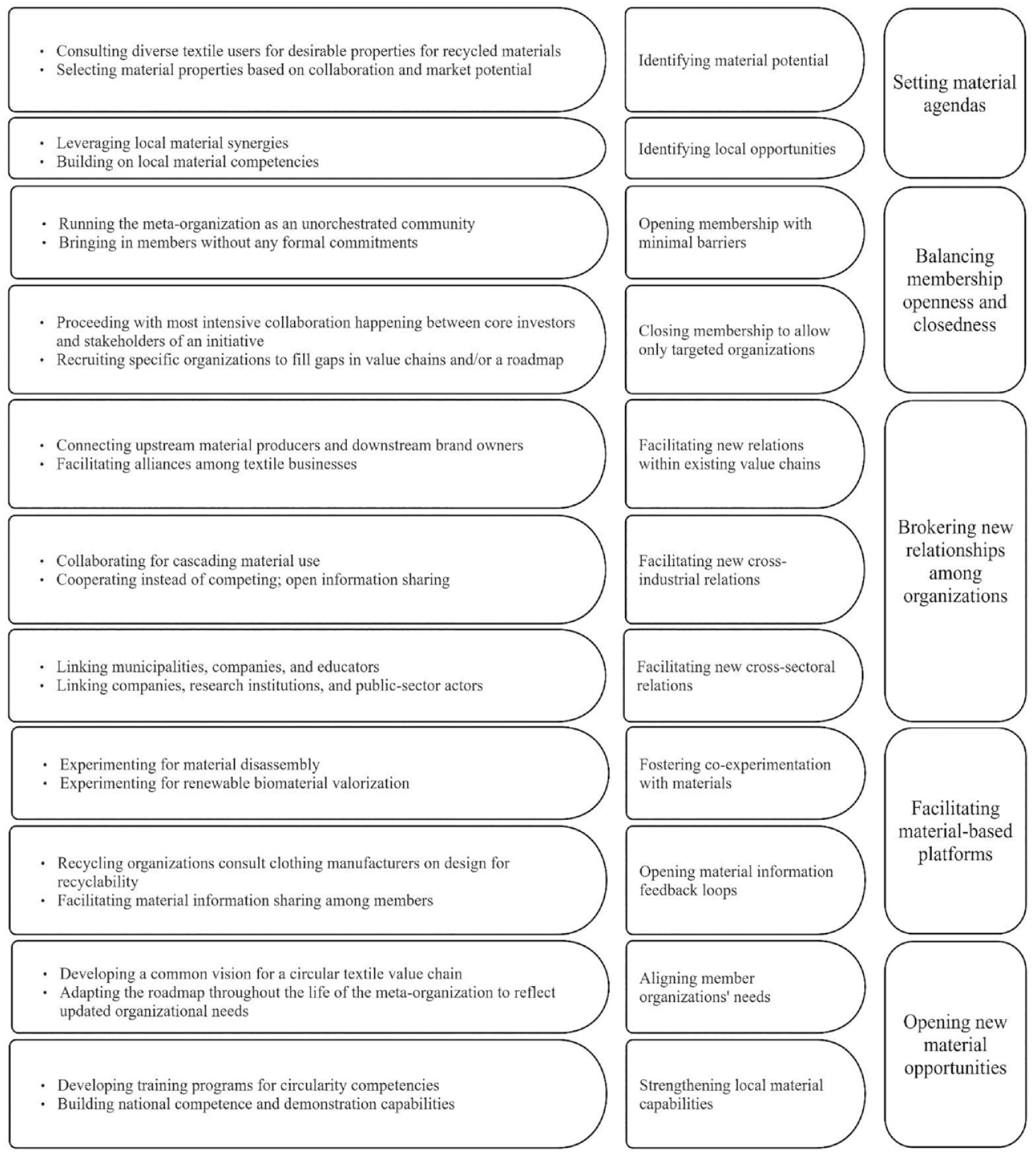
Coding framework and data structure.
Findings
Conceptual Framework for Circular Value Chain Reconfiguration Through Meta-Organizing
We identified five key collective activities for reconfiguring value chains toward circularity through meta-organizing, as shown in Figure 2: setting material agendas, balancing membership openness and closedness, brokering new relationships among organizations, facilitating material-based platforms, and opening new material opportunities. The first three happen fluidly in both parallel and sequence as the meta-organization recruits members. From there, they can begin facilitating material-based platforms and continually adjusting as new material opportunities open up. This in turn circles back to continue the cycle of (re)setting material agendas, recruiting members, and facilitating new relationships.
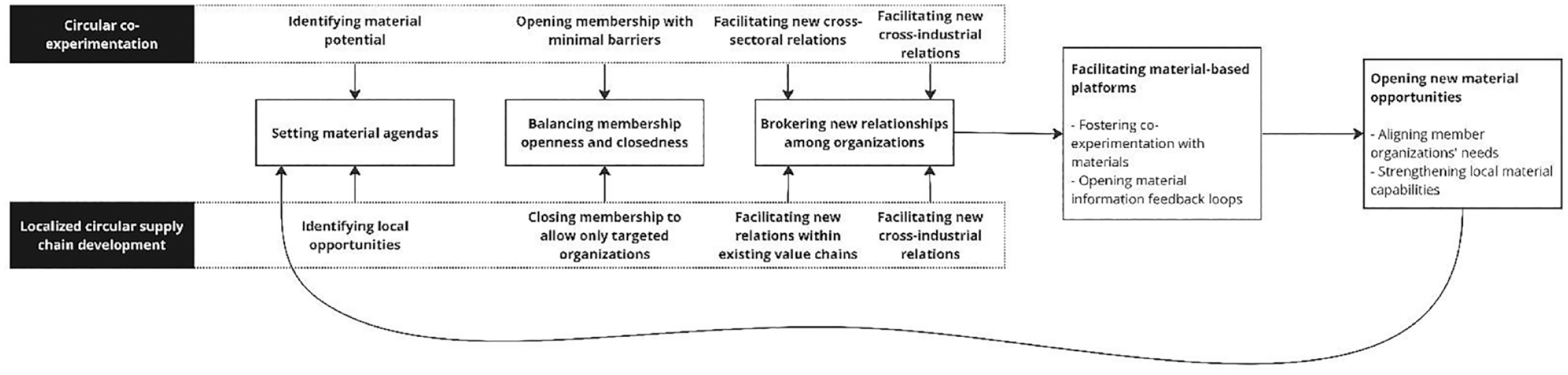
Meta-organizational activities for reconfiguring value chains toward circularity.
Collaborative Activities for Circular Value Chain Reconfiguration
Setting Material Agendas
The first activity we identified was setting material agendas to guide the meta-organizations’ membership and activities. One of the key aspects of setting novel material agendas was identifying material potential. They did this first by expanding awareness of materials across multiple life cycles. This contrasts with the short, temporally bound windows of material responsibility in conventional value chains, in which organizations are only responsible for materials during their individual step of the value chain. One TEX informant described a plan to pilot material responsibility across multiple material life cycles:
“We want to demonstrate a three- or four-cycle operational model, where we first produce for example a cotton T-shirt, which is provided for example to consumers as a service. . .the material ownership stays with us. . .Then, at the end of its life cycle, it’s recycled. We will add a little bit of some other recycled material and do a second life cycle, which will likely have a similar operational model. . .For the third cycle, it will likely have more than 50% recycled polyester, meaning that it will likely be the most suitable for workwear. For the fourth cycle, we can make it into nonwovens or insulation” (ClothingBrand).
TEX helped to develop this type of operational model by promoting holistic life cycle thinking through its key activities, such as building and disseminating knowledge related to products or extending life cycles and making materials usable across multiple life cycles. One particularly important activity for TEX was founding a recycling plant in 2021, which processes both commercial and household textiles at a local level. The plant became an important enabler for extending textile life cycles, and it has become a focal point for material-related collaboration both within and outside of TEX.
An additional consideration for material potential was whether there was a substantial enough need for research and development, and a large enough potential end market, for competitors to work together. In the BIO case, bio-based textiles were identified as meeting both of those criteria. This made experimentation within this material space attractive for bringing together diverse actors in collaborations through the BIO meta-organization.
Second, identifying material potential involves recognizing local opportunities for material valorization. The textile industry, like many modern manufacturing industries, is based on global supply chains spanning multiple continents. Developing local opportunities involved building up local business ecosystems based on material synergies, either within the country or a specific region. In BIO, this meant focusing on valorizing biomaterials already at hand, such as wood for cellulose. As one informant said, “from Finland[’s] perspective, I think we are seeing that cellulosic raw materials have a big opportunity in nonwovens. And if they would have more foothold in the main markets in nonwovens, then maybe they could be more and more something that for example could be offered from Finland” (NonwovenProject 1).
In TEX, identifying local opportunities focused on building local partnerships based on existing local actor capabilities: “We think about all parts of this [recycling] ecosystem, from collection to mechanically opening the fibers and to producing new products from the recycled materials. . .we have been able to find local actors for all parts of the chain” (MunicipalRecyclingCo). This close proximity meant that there were preexisting relationships among some industry members. As one informant said, “I can see that it is quite an important role in Finland, that we have involved so many different actors from this network over the years, and that they have somehow been involved in this in the inner or outer circle. And that this discussion will be held more strongly” (RecyclingCo).
Balancing Membership Openness and Closedness
The next activity we identified was balancing membership openness and closedness. Both meta-organizations are open to new members with a low threshold for joining. TEX is an uncoordinated, open network of projects and initiatives. BIO requires no contracts, fees, or other forms of formal commitments from member organizations. As a ForestCo informant said, “We want to keep it open, we want to keep people involved, because we offer interesting content, interesting opportunities. . . .we want to make it very low, the hurdle of joining.” In addition, its constituent projects are meta-organizations themselves with their own members, making the boundaries between who is and is not a member of BIO even more porous.
At the same time, both also have closed, targeted processes for recruitment. Both aim to develop specific value chains, which requires engaging organizations that fill identified gaps. In addition, as project activities are established, it can be perceived as difficult for new organizations to get involved, as one of the TEX informants shared with us. Both TEX and BIO have projects that are past the research and development stage (such as a new textile recycling facility in TEX and a bio-based textile product in BIO), and at that point, they need specific supply partnerships to bring those new offerings to market.
Brokering New Relationships Among Organizations
This mix of membership openness and closedness makes space for diverse relationships within and between value chains, industries, and sectors, leading to the third collective activity: brokering new relationships among organizations. Conventional supply chains are typically focused on specific industries, spanning multiple tiers of highly focused manufacturers. In contrast, circularity-based value chains have more cross-industrial relations, as residual materials from one industry may be reused in another industry. In addition, circularity-based value chains can involve a higher degree of interaction between sectors, as many recycling and reuse organizations can be publicly owned or not-for-profit.
First, these new relationships involved new types of integration within existing value chains. In TEX, this typically meant deeper relations between upstream material producers and downstream brand owners for developing more effective circular solutions: “We have several large brand partners who we co-develop with. We are in a lucky position to choose partners, as the textile industry now feels sustainability is imperative for future success” (RecycledFiberTechCo). This value chain integration typically meant collaboration between recyclers and brand owners to either improve the recyclability of products or to design new products with recycled materials.
Meta-organization members in a facilitating role (e.g., municipalities) explicitly mentioned how purposeful value chain integration is a key activity that they engage in:
“First thing we did was to analyze the value chains we have here and see what is missing. . . and now that we have the seed organizations, we can develop value chains around them. We then identify firms in other regions in the same value chains and what they need, e.g. new information” (City).
In BIO, integration within existing value chains largely happened through knowledge sharing within its constituent projects. Each project team intentionally built its own consortium of partners, in some cases taking care to include each point in the value chain. In one such example, the research team “wanted to include companies throughout this nonwoven value chain, so raw material producers, technology developers, nonwoven product producers, and on the customer side, so that we could have coverage of the different viewpoints to the value chain” (NonwovenProject 1).
The second key activity for brokering new relationships was forming links between industries. In TEX, cross-industrial collaboration was focused on the textile, construction, furniture, recycling, and forest industries. Typically, these collaborations focused on cascading material use. For instance, depending on the quality of recycled textile fibers from discarded clothing, they could be used as inputs for new clothing, fabrics for furniture, non-woven textiles (such as in health care or cleaning applications), or insulation material for the construction industry. TEX facilitated the development of these relations by acting as a boundary spanner between the different industries while also developing novel cross-industrial expertise: “The deeper you go in circularity thinking, the more clear it is that cross-industrial collaboration is more important than it is for conventional, linear economy. You need new type[s] of interfaces and long-term planning in order to increase the lifespans of these products” (City).
In the case of BIO, forming links between industries was most clearly demonstrated by the core partnership between ForestCo and EnergyCo: “BIO is. . .two things, it’s the collaboration between ForestCo and EnergyCo and the R&D programs we have. And then it’s also the name of the ecosystem” (ForestCo). ForestCo and EnergyCo work closely together to set BIO’s goals, vet potential member projects and organizations, communicate to members, and plan events. This has allowed competence sharing: “It’s good to collaborate between ForestCo and EnergyCo because we have quite small teams, both of us, and then we can utilize the competences a bit cross-border as well” (ForestCo).
The lengthy, extensive task of bioproduct development, as well as the large market potential, enabled the cross-industry research and development aspect of ForestCo and EnergyCo’s BIO collaboration. The development of textile biomaterials specifically was seen as sufficiently broad to enable collaboration where there might have otherwise been competition:
“The synergies override the possible competitive positioning. . .we have the different raw materials and different textile fiber technologies, and the market is still kind of pulling for huge amounts of new sustainably produced textile fibers. . .[this] enables us co-work and not to compete with each other. . .to co-operate in the building of this new value chain and make it commercial. It absolutely [was] this textile theme [that] was kind of the connecting item why we started to think about partnering up” (EnergyCo).
They emphasized that the task of developing new textile value chains, which include technologies still emerging, would be a difficult task for one company to take on alone.
BIO also facilitated cross-industry collaboration through its loose membership structure and focus on information sharing. BIO’s intentionally porous boundaries, with organizations having a low threshold for joining and no contracts or financial commitments, resulted in a diverse array of industries represented in BIO’s membership.
Third, we identified the development of new cross-sectoral relations to be a core element of both meta-organizations’ activities. In TEX, in addition to the regional partnerships described previously, there were several research and educational organizations involved, helping with circular innovation knowledge development, as well as training and educating professionals in new circular business skills. One city manager described the importance of cross-sector collaboration for circular economy development: “We have very in-depth collaboration with the companies here already. From customer acquisition to process design. . .the latest development was a collaborative branding of a new recycling-focused quality certificate in the area” (City).
In BIO, the biggest source of cross-sector collaboration was between academic institutions and private companies. Research institutions in the meta-organization “are an important part there because the idea behind these kind of innovation ecosystems is really to boost the development of future solutions. So researchers are the ones to bring them basically to the companies and to propose new ways of solving challenges” (InnovationFacilitator). The Finnish biomaterial space was seen as particularly fruitful for this type of synergy: “In Finland in this area, we [are] used to hav[ing] this type of industrial-academic collaboration quite a long time already. So that is helping us: we know the practicalities” (TechnicalResearchOrg).
There were also examples of collaborations with other public sector actors. For example, one BIO project on nonwoven fibers linked private-sector personal protective equipment companies with university researchers and public hospitals. They worked closely with their partners, visiting a partner every few months for a workshop. In one example, their visit aimed to understand the hospital end users’ needs for bio-based nonwoven fiber products: “We have a chance to go to PublicHospital. . .we can see the environment that they are [in]. . .and of course, they have really strict rules there, and we try to find out what they hope for the face masks” (NonwovenProject 2). The different partners in the project worked together to take on this development task. Public institutions provided the use cases, research institutions conducted material investigations, a technical research institution offered pilot- and laboratory-scale facilities, and company partners had production capacities and their own materials research capabilities.
Facilitating Material-Based Platforms
Once the meta-organizations had members and began brokering relationships among them, they entered the stage of facilitating new material-based platforms. In contrast to conventional supply chains, circular supply chains are more strongly based on material-focused interrelations rather than product- or service-focused ones. We found two important ways in which meta-organizations can facilitate this shift.
First, both meta-organizations engaged in novel types of material co-experimentation. Unlike conventional supply chains with manufacturing requirements for different tiers dependent on the final products and customers’ product needs, circular business can follow a more serendipitous logic, where new opportunities are sought based on the materials available.
In TEX, the new co-experimentation activities occured among the set of actors that provided used textile materials, recycled said materials, and utilized the recycled materials in different contexts: “If we think about this production and a kind of ecosystem, our idea is to bring together the group of organizations which utilize this material stream, and make something out of it” (City). The core area of experimentation was focused specifically on finding new lives for used textile materials: “We enable the material to have a new life, sometimes as a similar product but more often this mechanical recycling leads to a different type of product” (RecyclingCo).
BIO’s activities were explicitly organized around material-focused innovations. Some of BIO’s thematic areas were specific biomaterials to valorize. There were already some such projects in the ecosystem, and there were calls in BIO events for new material-focused activities, such as research projects on target materials. Although the other thematic areas were nominally product-focused (e.g., textiles), the activities within these themes were also organized around material development. Each thematic area had goals that included new biomaterial innovations.
The material orientation lent itself to large-scale research and development projects coordinated by a meta-organization: “Bioproduct technology development is so huge that we also encourage other companies and operators to join us in the development work” (EnergyCo). The material focus areas were chosen to contain ForestCo and EnergyCo’s shared thematic interests, as well as themes that were individually interesting to each. This made space for both collaborations and individual product development.
The relationships among members—particularly those involving public-sector actors—made space for co-experimentation that looked far into the future. A BIO project on bio-based nonwoven materials explored future opportunities instead of developing specific materials directly for commercialization, shifting the temporal orientation of the knowledge created and shared:
“I think that the companies who participate [in these] kind of public research projects see that this is sort of bringing them a longer-term future perspective. . .[we] try to build this kind of visibility of the opportunities, and then, the next phase would be to make more technology-specific, or raw-material-specific, or product-specific maybe co-innovation approaches for certain companies” (NonwovenProject 1).
Co-experimentation made space for the potential emergence of more radical innovations.
Second, meta-organizations can promote information feedback loops from different stages of the product life cycle that concern material requirements for circular business. For example, in TEX, the newly founded recycling company developed knowledge on the material properties of textile recycling through its own operations, and it heard additional customer needs from organizations using its recycled textile outputs. Consequently, this allowed it to communicate with firms upstream in the original textile value chain about material requirements for second and third life cycles of the materials. This might mean, for instance, that the original manufacturers can take recycling requirements into account when designing their products: “We are able to give feedback to the product design phase, so if a firm that’s designing, e.g., workwear wants to design the clothing in a way that the material stays in circulation for as long as possible, we are able to help with that” (RecyclingCo).
The BIO information feedback loops were largely limited to different phases of the material development and production processes. In the projects within the meta-organization, research organizations worked in partnership with one another and with companies (and in some cases, public-sector actors) to develop and test new bio-based materials. In some projects, the material research process is done iteratively in close collaboration with organizational partners, who provide information throughout on their needs and use cases.
The BIO organizers actively facilitated information sharing among members. Twice a year, BIO organized two seminars, one only for members and one that is open to the public. During these meetings, select members are given the opportunity to introduce themselves, share their material research findings, and/or pitch their services. BIO and its information-sharing opportunities were seen by the orchestrators as “an open platform for bringing people together and sharing their thoughts and ideas about what they want to do, what kind of partners they want to find, what do they want to do with these, so that they can then enable basically the planning and initiating of projects” (ForestCo).
Opening New Material Opportunities
As the meta-organizations facilitated their material platforms, they put effort into opening new material opportunities based on the learnings and activities of members and projects. The first key activity to do this was aligning member organizations’ needs. BIO developed a “Vision for 2030” roadmap, despite only being funded through 2024, for the commercialization of new biomaterials. The BIO orchestrators continually updated the roadmap in consultation with their steering committee, adjusting to meet the needs of the two leading companies as well as key member organizations. At each of their annual meetings (one open to the public, the other only to members), the orchestrators presented the latest status and updates on the roadmap, as we saw when collecting observational data during these events.
The work of aligning member organizations’ needs by continually updating the roadmap beyond the project’s end date seemed to be in service of BIO’s goal of creating a lasting ecosystem. Since research and development were seen as “really slow,” the goal was that “the relationships will last after the projects as well. Whether they will become another project or business, that remains to be seen. But at least people know each other” (ForestCo). The orchestrators saw it as their job to plant seeds that could grow after the funded period:
“I think we will have to be really ambitious in trying to make as strong a foundation as possible during these four years so that after the time runs out, we will have a truly unique ecosystem that there will be a need for the participants to continue the association with it. But it will be a definite challenge” (EcosystemManager).
There was also speculation that the relationship between the two leading companies, ForestCo and EnergyCo, developed by working on BIO, might lay the foundation for future collaborations with others in the meta-organization.
Along with aligning members’ needs, the two meta-organizations also worked to strengthen local material capabilities. In BIO, localization was achieved by orienting around building and promoting a national innovation base. Much of Finland’s textile production has ended in the past decades, and there are renewed efforts to restart it. BIO’s goals are to develop new bio-based textile fibers that can enter global markets, with additional efforts to increase recycling and traceability. Some informants expressed a hope that BIO would specifically help in “maintaining a competence space in Finland” (TechnicalResearchOrg) for bio-based innovation. This was echoed by partners in higher education, who planned to use learnings from their BIO work in future teaching and research.
Similarly, developing local material valorization capacities can facilitate the formation of new links between industries in a specific region, as well as new partnerships between sectors, e.g., between a municipal waste management company and local firms. In the TEX case, the launch of the local recycling plant facilitated new connections between actors that were previously disconnected due to local constraints in material processing. In BIO, the collaboration between EnergyCo and ForestCo facilitated building a regional ecosystem of partners that, in turn, increased the actors’ local capacity to valorize materials. In both cases, the increased local material valorization capacity motivated and facilitated the investigation of new use cases for materials across different value chains.
The processes of aligning member organizations’ needs and strengthening local material capabilities formed a feedback loop back to the beginning of the process, as agendas were updated, new members recruited, and new relationships brokered.
Differences Between the Cases
Thus far, we have focused on the features of meta-organizing common across both cases. Comparing the TEX and BIO cases allows us to also draw out additional insights on how the structure and type of meta-organization may affect the processes we identified.
Within the five key collective meta-organizational activities, we observed that the first three (setting material agendas, balancing membership openness and closedness, and brokering new relationships among organizations) worked in parallel toward two outcomes: circular co-experimentation and localized circular supply chain development. These outcomes then acted as the focal areas of the material platforms, from which new material opportunities later emerged. The co-experimentation practices made space for divergence and serendipity that could support research and development of circular textile materials. Conversely, the supply chain practices involved converging around the development of specific value chains to bring circular products to market. We saw both outcomes in both cases, as shown in Table 3, but co-experimentation was a stronger focus in BIO and localized supply chain development was stronger in TEX.
Illustrative Quotes.
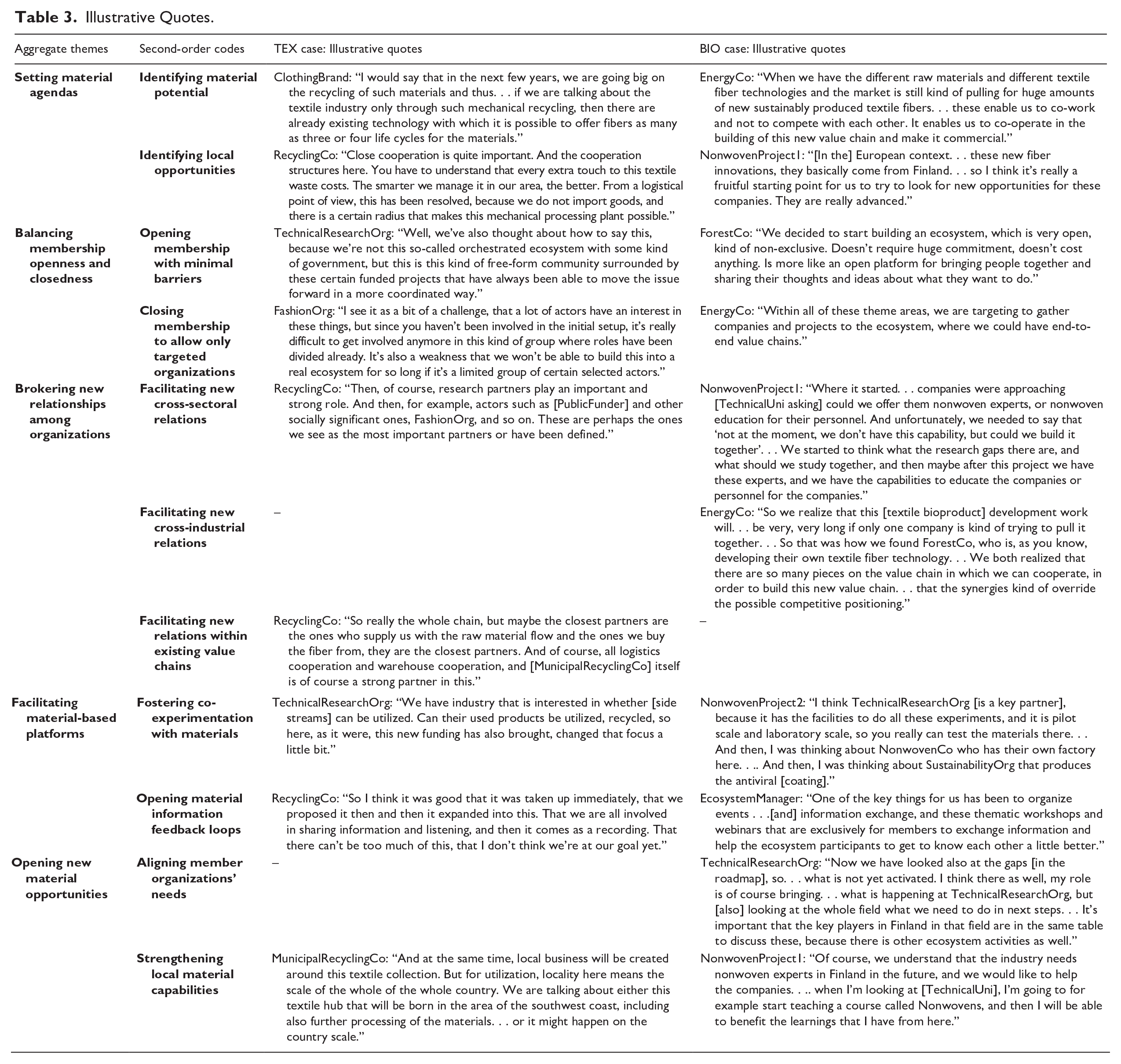
Another key differentiating feature in the two meta-organizations we studied was the presence of orchestrators. TEX was explicitly stated to be an un-orchestrated meta-organization, while BIO was orchestrated by two multinational firms: “TEX isn’t orchestrated the same way BIO is. We don’t have any funds to orchestrate the community, but we have been able to maintain a LinkedIn page during the projects and we have had a website up and running throughout our activities” (ResearchManagerTEX). Our analysis leads us to believe that orchestration can notably affect the mechanisms of diversifying value chains in the value chain reconfiguration process. Specifically, developing cross-sector partnerships appeared to have a considerably stronger role in the un-orchestrated TEX, while building cross-industrial relationships was more prevalent in BIO. This may also be due to the nature of BIO, which was led by two private-sector organizations from different industries.
In addition, the nature of information feedback loops also appeared different in the two cases. BIO was organized more as a centralized system with multiple deep collaborative projects around a central platform, while TEX had multiple intersecting feedback loops focused on developing the quality of recycled textile materials. Thus, we believe that the presence of orchestrators may also act to centralize information flows related to material circularity in the meta-organizations. However, this is with the caveat that the presence of two co-orchestrators was seen as making communications across the BIO meta-organization more open than they would have been with one orchestrator, since ForestCo and EnergyCo had to make their tacit thinking explicit in their interactions with one another.
Another key differentiating feature of the meta-organizations was the focus of their circular action. TEX was more focused on closing material loops by reusing products and recycling textile material, while BIO was focused on replacing non-renewable materials with bio-based renewable ones. Based on our findings, we think this difference may especially affect the nature of co-experimentation activities. Co-experimentation for closing material loops may be driven more by modifying existing product design to improve material circulation, for example by improving quality to enable product reuse, making disassembly of materials easier, and modifying the composition of blended materials to improve recycling. In contrast, co-experimentation for replacing synthetic fibers with renewable materials emphasizes identifying novel higher-value applications (i.e., completely new products) for materials which may currently have low to no value. The experimentation is thus more materially focused, while the potential range of new products can be higher. Consequently, the products under discussion in BIO’s textiles vertical stretched beyond textiles to also include non-woven fiber products, such as medical face masks, cleaning wipes, and tea bags.
Discussion and Conclusion
Theoretical Implications
Implications for Circular Economy
Using the context of circular economy, we contribute a view of how meta-organizations can work to reconfigure the relationships among organizations in value chains toward circularity, helping mitigate circularity’s material and market risks. We saw how the meta-organizations developed materially focused and locally oriented collective activities, aiming to transform the textile industry norm of complex, global supply chains organized around the steps of garment production. Rather than just changing the principles by which established value chains operate (Carmagnac & Carbone, 2019), they aimed instead at creating new value chains for the emergence of material innovations and the revitalization of regional environments. Our findings examine the underexplored nexus of circular economy, meta-organizing, and value chains, providing theoretical contributions to literature on circular economy and meta-organizing for sustainability.
First, we contribute to the literature on sustainability and circular economy by showing the activities through which meta-organizations reconfigure value chains toward circularity. The shift to material-focused organizing and novel platforms provided an anchor for potential circularity transitions, as tangible investments must be made to develop and produce these new circular and bio-based materials. This materiality moves meta-organizations beyond just being spaces for developing and diffusing information, practices, and capabilities to member organizations (Berkowitz, 2018; Carmagnac & Carbone, 2019; Valente & Oliver, 2018). The kind of material innovations under development are high risk, and being orchestrated by publicly funded meta-organizations alleviated, to an extent, the risk for individual actors. Likewise, companies co-experimenting with material innovations with public-sector researchers were able to explore more radical material innovations than they would have been able to do on their own with near-term financial pressures. Having the space within the meta-organizations to experiment with potentially more disruptive materials allowed individual organizations to collectively move beyond incremental sustainability innovations to build new networks (Adams et al., 2016), opening more radical potential transition pathways within the constraints of material properties.
We also add nuance to the existing discussions on circular value chains (e.g., Farooque et al., 2019; Geissdoerfer et al., 2018; Genovese et al., 2017) by identifying the presence of parallel activities for co-experimentation and localized value chain development in both meta-organizations. This highlights the importance of developing new materials for the circular transition and adds a temporal dimension to circular value chain discussions. Based on our findings, it appears that the circular transition needs continual cycles of developing value chains for the circular products of today while simultaneously innovating new materials for tomorrow. These parallel sets of activities may help meta-organizations avoid drifting into stagnation if progress stalls in one domain.
Focusing on the development of local circular value chains also contributes to the role of place in circularity. The two meta-organizations could be seen as scaling deep, in which an organization (or in this case, a meta-organization) aims to foster “enduring growth anchored to its original location” (Kim & Kim, 2022, p. 1732). The case meta-organizations show that businesses’ place orientation is rooted not only in social or cultural loyalties, but also in the material environments in which they are embedded. Thus, they bear some similarity to regenerative organizations, which seek to revitalize the natural ecosystems in which they are embedded (Slawinski et al., 2021). Both meta-organizations’ members prioritized using materials available within the region or country, such as discarded textiles or wood offcuts. This type of effectuation logic, where firms seek new opportunities for utilizing the local resources they have available, has been identified as important for circularity development (Bansal & Mcknight, 2009). At the same time, not all of the meta-organizations’ members (or even orchestrators) are place-based enterprises (Shrivastava & Kennelly, 2013)—the two leading companies of BIO, for example, have a presence in multiple countries. Our findings show that the activities of a meta-organization can create a sense of place-rootedness and encourage effectuation logic that may not necessarily be present in the member organizations on their own.
Our findings also broaden the view of who can be involved in the circular transition, as circular economy research has largely focused on business models and individual business innovation as the locus of circularity transformation. While this has shifted the attention from recycling activities to broader business models, the role of actors beyond individual businesses or their existing supply chains has not been addressed adequately (Dzhengiz et al., 2023). Aside from the notable exception of Blackburn et al. (2022), the role of meta-organizations has not been given enough attention in circular economy literature. Our findings show how meta-organizations can diversify value chains by bridging industries and sectors, shifting value chain relationships to bring materials into greater focus and changing actors’ material awareness and responsibility. These findings broaden the literature on circular economy by showing how value chain reconfiguration is an essential element in the transition to circular business models, going beyond showing that collaboration within and between supply chains is necessary (Farooque et al., 2019). Our findings show that these new value chains can be fostered by meta-organizations that bridge relevant industries and non-business actors linked to specific material resource systems.
In parallel, we also found that collaboration for circular material co-experimentation is important to meta-organizing for circularity. While experimentation has been covered in previous circularity literature, it generally focuses on business model experimentation (Bocken & Konietzko, 2023; Bocken et al., 2018), often within individual firms (Aminoff & Pihlajamaa, 2020; Hofmann & zu Knyphausen-Aufseß, 2022) but also sometimes within ecosystems (Konietzko et al., 2020). Curiously, co-experimentation with new materials is underexplored in the literature, which is surprising since circularity is fundamentally about materials. Aminoff and Pihlajamaa (2020) mention material experimentation under the umbrella of technological challenges, but their focus is contained to learning experiments rather than the sort of material research and development we saw in our cases. In addition, we have not seen other literature link material co-experimentation and circular value chain development as two intertwined sets of activities that can happen in parallel, which situates co-experimentation in a broader structural change process that can keep material innovations from dying on the vine.
Implications for Meta-Organizations
Second, our findings also contribute to the research on meta-organizations. We contribute to recent research focusing on resource flows in meta-organizations (Bor & Cropper, 2023). Studying meta-organizations in the context of circular economy increases our understanding of materials and their use as a type of resource for meta-organizing. More specifically, the knowledge pertaining to utilizing materials in a circular fashion was a major resource in the meta-organizations we studied. These were not resource flows from the member organizations to the meta-organizations, as is the case with, for example, financial flows or in-kind contributions (Bor & Cropper, 2023). Instead, they were novel resources collectively generated through interactions among members and the materials with which they work. We propose that further research should delve more deeply into the resources generated by meta-organizations as a collective, as well as the relationships between actors and physical materials in meta-organizing.
Our findings also offered new empirical perspectives on structure and governance in meta-organizations for sustainability transitions. Our empirical cases complicated the dichotomy of closed (e.g., supply network) vs. open (e.g., open-source platform) meta-organizations (Gulati et al., 2012). In the process of reconfiguring value chains, the meta-organizations demonstrated both openness to a wide array of new members across industries and closedness in building relationships within the region or country that fit their meta-organizational roadmaps. The balance of openness and closedness was important, as it enabled the two parallel outcomes (circular co-experimentation and localized circular value chain development) that we identified in our findings. The orientation toward openness demonstrated that meta-organizations with looser structures—and crucially, more nascent offerings and agendas—than standards organizations and co-located clusters can also reconfigure value chains, expanding on those two initial meta-organizational forms identified by Rouquet et al. (2023) as having the potential for supply chain orchestration. In addition, information sharing within the meta-organizations helped diffuse capabilities to members (Berkowitz, 2018) and helped diversify relationships by advertising organizations’ capabilities to potential partners and thus further supported value chain reconfiguration.
Practical Implications
Our research also has implications for practice, specifically for managers and public funding bodies engaging in circular economy activities. For managers, our findings help to illustrate the importance of collective activities in meta-organizations for circularity transformation and how these may enable further internal efforts toward circularity. Specifically, our findings show the importance of building meta-organizations that intentionally engage actors both within and beyond target value chains, especially when organizing around material innovations rather than products. Meta-organization orchestrators should then deliberately facilitate relationships among actors within value chains, across industries, and across sectors. Orchestrators should also plan collaborative activities which, in parallel, aim for advancing circular experimentation as well as localized circular value chain development, as both of these are important for circularity transitions.
For public bodies funding circular economy meta-organizations, our findings offer insights into what parameters can enable fruitful collaborations for circular material innovation. Funding programs for circular innovation should leave room for experimentation rather than focusing solely on outcomes like export potential. They should also invest in local circular value chain development. In addition, public funding bodies may want to consider being open to various governance structures in the meta-organizations they fund, as we saw in our findings that the governance model (e.g., having two co-orchestrators or no formal orchestrators) can shape how interactions in the meta-organization proceed.
Limitations and Future Research
Our contributions were limited by the focus on case studies in the Finnish geographical context and the relatively short time span of data collection. We hope to see future studies looking at meta-organizations in different contexts across longer periods of time, which would add further breadth and depth to the understanding of their potential for circular value chain reconfiguration.
We think our contributions can open fruitful pathways for future research. One avenue for future research is the extent to which organizing around material properties can create new path dependencies, for example by fostering new product designs and supply chain relationships that do not allow reversion back to unsustainable materials. Another potential avenue for future circular economy research would be to study the joint impacts of multiple meta-organizations on circular development. While the empirical cases we studied were focused on value chain reconfiguration, other meta-organizations for circular economy might be focusing on issues such as new extended producer responsibility legislation or consumer platforms for exchanging used products. Studying the joint impacts of different types of meta-organizations could help bring broader insights on meta-organizations’ roles in circular economy transformations.
A third future research stream could explore in more detail the impact of different governance structures on circular meta-organizations. We identified differences between meta-organizations with and without orchestrators, and larger-scale comparative studies such as multiple case studies or qualitative comparative analysis (QCA) could delve deeper into these differences. A fourth research avenue is to study actor motivations and the role of individuals in developing circular meta-organizations. The business case for participating in circular meta-organizations involves more uncertainty than conventional research and development initiatives, as the economic incentives, cultural norms, and material infrastructure of the linear economy remain unsupportive of circular business logic. Better understanding of the motivations of actors and individuals within the actor organizations would help illuminate how businesses become involved in circular meta-organizing despite the uncertain business outcomes. Finally, future research could also further explore the role of place embeddedness in circular meta-organizations, for example by looking at place embeddedness’ different forms or diverse impacts, including potential downsides.
In this paper, we explored the role of meta-organizations in circular transformations. Based on our study, we propose that meta-organizations have a key role to play in breaking through the linear paralysis in conventional supply chains. They can enable value chain reconfiguration toward circularity by creating more diverse relationships, promoting co-experimentation, facilitating the development of new platforms, and consequently opening new opportunities to improvise circularity. On the other hand, meta-organizations are not the sole solution for scaling up circularity. The strong place embeddedness we identified in the studied meta-organizations can limit how actions scale in global value chains. In order to go beyond the focal actors of a place-based meta-organization, the meta-organizational structures may need to be replicated by other actors in other places. Alternatively, activities may scale up through the value chains of global firms participating in the meta-organizations.
We hope our work spurs further research into the role of meta-organizing in circular economy transitions and the potential of material-based meta-organizing to generate grounded and achievable circular initiatives.
Footnotes
Appendix: Interview Guide
The following interview guide was used in both cases. Depending on the actor, we also added additional questions, such as on activities specific to public-sector actors or universities researching material valorization. An example of such additional questions is at the end.
Declaration of Conflicting Interests
The author(s) declared no potential conflicts of interest with respect to the research, authorship, and/or publication of this article.
Funding
The author(s) disclosed receipt of the following financial support for the research, authorship, and/or publication of this article: This work was supported by the Academy of Finland’s Strategic Research Council’s Grant No. 327299, Sustainable textile systems: Co-creating resource-wise business for Finland in global textile networks/FINIX consortium and the Academy of Finland’s Grant No. 337714, Circular Design Network.
