




Abstract
Individuals start and join social enterprises to catalyze social impact but may not subjectively experience their work as impactful. In this article, we inductively uncover when social enterprise members question the impactfulness of their work and how they engage in sensemaking to experience their work as impactful. Exploring the experiences of members across two social enterprises with different missions, we provide insights into instances creating ambiguity of or discrepancies in impactfulness and unearth how individuals navigate these in different circumstances with two distinct sensemaking practices: internalizing and compensating. We reveal the efforts required to experience work as impactful, highlight the heterogeneity and agency in maintaining this perception, and suggest a potential dark side for members and missions of social enterprises.
Experiencing impactful work is a main motivator for individuals to start or join social enterprises (Austin et al., 2006; Doherty et al., 2014; Moses & Sharma, 2020; Usanova et al., 2022). Social enterprises aim to catalyze beneficial outcomes for individuals, communities, organizations, society, and/or the environment (Stephan et al., 2016) through market mechanisms (Mair et al., 2012). Although working in social enterprises may not be lucrative, individuals justify their financial and personal sacrifices with the expectation of experiencing their work as impactful (Dempsey & Sanders, 2010). However, examples from practice and research show that members of social enterprises sometimes lack this experience. Aiming to counter individuals’ questioning of whether their work is impactful, membership organization Social Enterprise UK (2019) started the #MyJobMatters campaign as a reminder “that their role is making a difference.” Emerging meaningful work research also suggests that members of social enterprises may struggle to perceive impactfulness because of organizational practices, such as impact measurement (Beer et al., 2021).
Social entrepreneurship research does not provide insights into how members of social enterprises maintain subjective experiences of impactful work. Research on the broader category of meaningful work (Lepisto & Pratt, 2017; Rosso et al., 2010) shows that maintaining this perception requires reinterpretation and reframing of impact (Jiang, 2021) or of the self (Schabram & Maitlis, 2017). However, even this auxiliary literature lacks nuance on how members of social enterprises maintain perceptions of impactful work in their everyday experiences. Instead of everyday experiences and potentially diverse forms of reframing varying across situations, this research stream has prioritized extreme contexts, such as crises (Jiang, 2021), and unitary reinterpretations of impact across a single organization (for an exception see Schabram & Maitlis, 2017). Thus, this study aims to explore the following research question: How do members of social enterprises maintain their subjective experiences of impactful work?
To address this research question, we employed an inductive theory-building approach with data from a multisited ethnography (Marcus, 1995) across organizations addressing two social issues: climate and refugee crises. Our findings show that members of social enterprises question work impactfulness when experiencing (1) ambiguity without cues confirming positive impact and/or (2) discrepancy between anticipated and experienced impactfulness from cues confirming negative impact or disconfirming positive impact. Members of social enterprises maintain their sense of work impactfulness by engaging in two sensemaking practices: internalizing (to address ambiguity) and compensating (to tackle discrepancy). When individuals perceive impact as invisible and/or slow to manifest, they internalize to enhance their subjective experiences of impactfulness by creating psychological closeness, through which they visualize and maintain existing impact. Relatedly, the practice of compensating entails creating new accounts that highlight broader impact than the organizational mission and motivate pursuing novel activities to support a wider range of beneficiaries, thereby expanding the sources of impactfulness.
Our findings have three core implications for research. First, for social entrepreneurship research and the emerging stream on impactful work as a type of meaningful work (Lepisto & Pratt, 2017; Rosso et al., 2010), we unearth different types of cues that challenge subjective experiences of work impactfulness and explicate their influence on different sensemaking practices within, instead of between, individuals (Schabram & Maitlis, 2017). Such nuanced understanding of how distinct cue types can trigger different practices acknowledges impactful work as an ongoing process (Lepisto & Pratt, 2017), whereby individuals strive to continuously maintain subjective experiences of their work as impactful. This ongoing process can have a potential dark side for individuals through illbeing and exclusion, and for organizations through inefficiencies and mission creep.
Second, and related, we expand the understanding of mission neglect in social entrepreneurship and uncover the potential role of individuals’ subjective experiences of impactfulness. While research so far has prioritized mission drift as a dominant form of mission neglect (Ometto et al., 2019; Ramus & Vaccaro, 2017), we propose that social enterprises can also face mission creep as the accumulation of new goals, tasks, and programs expanding beyond the original organizational mission (Haugh & Kitson, 2007; Jonker & Meehan, 2008) that stretches the organization too thin to meet goals related to the original mission. In addition, we propose how individuals’ subjective experiences of impactfulness can have an enabling, hindering, or proactive role in how social enterprises maintain their mission, thus complementing the current focus on the role of institutional and financial pressures (Battilana & Dorado, 2010).
Third, we enrich the emerging understanding in social entrepreneurship research of psychological closeness as the subjective experience of events, issues, individuals, and groups as close to the self (Liberman et al., 2007; Trope & Liberman, 2010). While prior research shows the importance of existing psychological closeness for accessing resources (Drencheva et al., 2021; Rose et al., 2021), our findings showcase how members of social enterprises can create psychological closeness, instead of taking it for granted.
Theoretical Background
Impactful Work in Social Entrepreneurship
The potential to catalyze positive societal impact is an important motivation to start or join social enterprises. Because working in social enterprises may not be a lucrative career option, the opportunity to experience work as impactful is the main nonfinancial incentive (Austin et al., 2006; Doherty et al., 2014; Moses & Sharma, 2020; Reynolds & Holt, 2021; Usanova et al., 2022). This is also evident in the characteristics of individuals who start or join social enterprises: possessing values, identities, and emotional experiences aligned with benefiting others (Battilana & Dorado, 2010; Besharov, 2014; Hockerts, 2017; Stephan & Drencheva, 2017). For members of social enterprises, anticipating work that serves and benefits others justifies the sacrifices regarding financial incentives, personal relationships, and well-being (Dempsey & Sanders, 2010). This article defines impactful work as work which is subjectively experienced as significant, focused on serving and benefiting others in ways that transcend the self, and has positive valence (Beer et al., 2021; Lepisto & Pratt, 2017; Lips-Wiersma, & Wright, 2012; Rosso et al., 2010).
However, members of social enterprises may struggle to perceive work impactfulness for three main reasons. The first is unawareness of how their work makes a difference. The impact of individual or organizational contributions may be invisible because catalyzing deep, sustainable change progresses slowly and requires cross-sectoral collaborations (Stephan et al., 2016). Yet research in organizational behavior shows that individuals experience work as impactful when they encounter consistent, frequent, and durable cues that visualize the positive impact (Grant et al., 2007; Sonnentag & Starzyk, 2015). Second, as social enterprises take action toward catalyzing positive societal change, they also face difficult ethical challenges (Bhatt, 2022; Drencheva & Au, 2022; Hota et al., 2023; Sengupta & Lehtimäki, 2022) and social justice questions (Kimmitt & Muñoz, 2018), such as the trade-offs between creating income-generating opportunities for marginalized communities and exposure to human trafficking risks (Au et al., 2022). As members of social enterprises acknowledge these ethical challenges and the potential exclusion created through their work, they may question if their work makes a difference. Third, a social enterprise’s social/environmental and financial goals can be segregated or prioritized differently within the organization or over time (Battilana & Dorado, 2010; Battilana et al., 2015), creating tensions and contradictions that raise questions about the impact and worthiness of one’s work in relation to the organizational mission. Such questions are amplified when tensions and contradictions produce mission drift as a social enterprise prioritizes financial goals in operations and practices (Ramus & Vaccaro, 2017). These reasons for members’ fluctuating experience of work impactfulness relate to the inherent uncertainty and complexity of social enterprises (Battilana & Lee, 2014).
While members of social enterprises are likely to question the impactfulness of their work, social entrepreneurship research provides no insights into how they respond in such circumstances. How do they reconcile the dissonance between their potentially idealized expectations and current subjective experiences? Such dissonance is stressful, for example, fundraisers with low perceived work impactfulness experience high emotional exhaustion and report more negative self-views (Grant & Sonnentag, 2010). Thus, individuals will likely strive to resolve the dissonance between their potentially idealized expectations and current subjective experiences (Elliot & Devine, 1994; Festinger, 1962). However, the extant social entrepreneurship literature neglects this dissonance, focusing instead on how the organization catalyzes (or not) societal impact (Rawhouser et al., 2019).
Impactful Work as a Type of Meaningful Work
Research on meaningful work, of which impactful work is a type, offers insights into individuals’ experiences of impactful work and how they address dissonance. First, impactful work is a subjective experience but neither arbitrary nor irrational (Blustein et al., 2022; Lips-Wiersma, & Wright, 2012; Lysova et al., 2019; Rosso et al., 2010). Experiencing work as impactful may or may not be predetermined by the organizational mission or specific task, but it is interpreted and constructed by the individual as an active agent (Lepisto & Pratt, 2017). Researchers have often studied impactful work in settings where impact is expected, such as animal shelters (Bunderson & Thompson, 2009; Schabram & Maitlis, 2017), refugee resettlement agencies (Jiang, 2021), social enterprises (Beer et al., 2021), and firefighting or other lifesaving contexts (Grant, 2008). These studies show that even individuals whose work is expected to be impactful or whose organizations are infused with purpose may struggle to see how they make a difference. This means that the organizational mission is not sufficient for experiencing work as impactful without practices that communicate and visualize the mission and connect it to individuals’ work (Beer et al., 2021; Carton, 2018). In addition, perceptions of impactful work are unstable and can fluctuate because of crises (Jiang, 2021) or internal processes (Beer et al., 2021).
Second, research on meaningful work shows that maintaining one’s perceptions of work as impactful is effortful and requires reinterpretation and reframing of impact or the self. Studies have investigated workers in animal shelters who see their work as a calling (Schabram & Maitlis, 2017), in refugee resettlement agencies (Jiang, 2021), and in NASA during work on the moon-landing mission (Carton, 2018): all show that when individuals face challenges and doubts about work impactfulness, they reinterpret what impact means to them and how their work contributes to achieving the organizational purpose. For example, individuals may adopt a temporal understanding of their work and the organizational mission when a crisis prevents them achieving the full mission (Jiang, 2021) or reinterpret impact by focusing on stepping stones toward the mission when it is too ambitious and abstract (Carton, 2018). Individuals may also develop different accounts of themselves and their own guiding purpose when facing poor working conditions, poor management, or moral injustice (Schabram & Maitlis, 2017). Thus, subjective experiences of impactfulness require individuals to continuously create coherent accounts and “better meanings” of why one’s work is impactful or the role one plays (Lepisto & Pratt, 2017).
However, research on impactful work is only emerging (Lepisto & Pratt, 2017) and important issues await examination. Studies have focused on maintaining the sense of impactfulness in extreme situations, such as crises (Jiang, 2021), highly abstract and ambitious missions (Carton, 2018), or toxic work environments (Schabram & Maitlis, 2017), through mostly unitary responses (for an exception, see Schabram & Maitlis, 2017). Consequently, we lack nuance on when members of social enterprises (or other purpose-driven organizations) question the impactfulness of their everyday work and how reinterpretations of impact may vary within, instead of between, individuals. For example, how might individuals reframe their understanding of impact differently? Thus, with this article, we aim to address the following research question: How do members of social enterprises maintain their subjective experiences of impactful work?
Research Design
We aim to deepen understanding of how members of social enterprises maintain subjective experiences of impactful work. We employed an inductive research design with the Gioia methodology (Gioia et al., 2013) and data from a multisited ethnography (Marcus, 1995) focused on individual experiences within employing organizations. Multisited ethnographies enable in-depth understanding of subjective experiences across spaces (Horst, 2009; Hovland, 2011; Marcus, 1995) where they are diffused and shaped (Coleman & von Hellermann, 2011; Falzon, 2009). While our focus is individual experiences of impactful work, these cannot be separated from the organization, whose structures and targeted social need influence how impact is catalyzed and perceived (Beer et al., 2021; Jiang, 2021). In addition, an inductive approach is appropriate for researching “how” questions (Edmondson, & McManus, 2007), such as ours, particularly in complex entrepreneurship settings (Henry & Foss, 2015).
Research Context
Our research investigates the experiences of members of Malaysian social enterprises, rarely represented in social entrepreneurship research published in Global North journals. Despite efforts by the Malaysian state to support and promote social entrepreneurship (Tariq, 2019), it is still only emerging and awareness is limited in mainstream society. Malaysia’s rates of social entrepreneurship activity are among the lowest among counterparts, including other Southeast Asian and efficiency-driven economies (Bosma et al., 2016). As of January 2021, only 43 social enterprises had received Social Enterprise Accreditation. Most social enterprises are new, with 86% established since 2010, and many are small: 72% generate an annual income ≤ RM 250,000 (approximately GBP 45,750), and the average workforce size is 11 full- and part-time staff (British Council, 2018).
Perceptions of impact can vary by the targeted social need and organizational structure, so we further narrowed the study context to allow sharp focus on nuances that may be less visible across diverse organizations with different missions, structures, and business models (Langley & Abdallah, 2011). We selected two social enterprises (given pseudonyms to protect informants’ identities) that provide a theoretically rich context because of the social issues they target: climate and refugee crises. While the social enterprises aim to address different social needs, they were similar in size, organizational structure, maturity, and level of social enterprise accreditation.
Formed in 2012, Roots promotes positive climate action through responsible production and consumption, education, and consultancy. It develops products, services, and initiatives enabling individuals, organizations, and industries to rethink and reimagine their consumption and production. For example, Roots hosts sustainability education workshops; develops fashion products, alternative energy projects, and sustainable structures; and supports corporations to adopt sustainable practices. At the time of fieldwork, it had 11 full-time members and 12 interns and contract partners. Roots is a theoretically rich context to examine impactful work in social enterprises because climate action is a significant challenge in Malaysia (Sachs et al., 2020), which ranks near bottom in the global Climate Change Performance Index (Burck et al., 2021), indicating that impact is slow to materialize.
Sunshine, founded in 2016, offers catering, meal delivery, and meal subscription services to individuals and organizations. Food is prepared by refugee chefs who receive 50% of the income generated from sales as freelance suppliers. Sunshine also offers learning and culinary experiences with refugees to enhance understanding of the refugee crisis and address the stigma associated with refugees. At the time of fieldwork, Sunshine employed eight full-time staff members and 11 interns and part-time contractors. Sunshine offers a theoretically rich context to examine impactful work in social enterprises because Malaysia is a popular destination for refugees but has not acceded to the 1951 Refugee Convention and 1967 Protocol. Thus, Malaysia is theoretically a site for temporary settlement while refugees await resettlement or repatriation, yet resettlement to third countries is a long-term and unlikely outcome (United Nations High Commissioner for Refugees, 2020, 2021), again meaning impact is slow to materialize and contested.
Data Collection
We conducted fieldwork between August 2019 and January 2020. Our data sources include formal interviews with members of social enterprises and a comprehensive field diary capturing observations and notes from dozens of informal interviews with individuals in and around the social enterprises (see Table 1 for a summary). Formal and informal interviews with members of social enterprises were the main data sources, while interviewing members of support organizations, beneficiaries, and clients and making field observations helped us contextualize and triangulate informants’ experiences.
Data Sources.
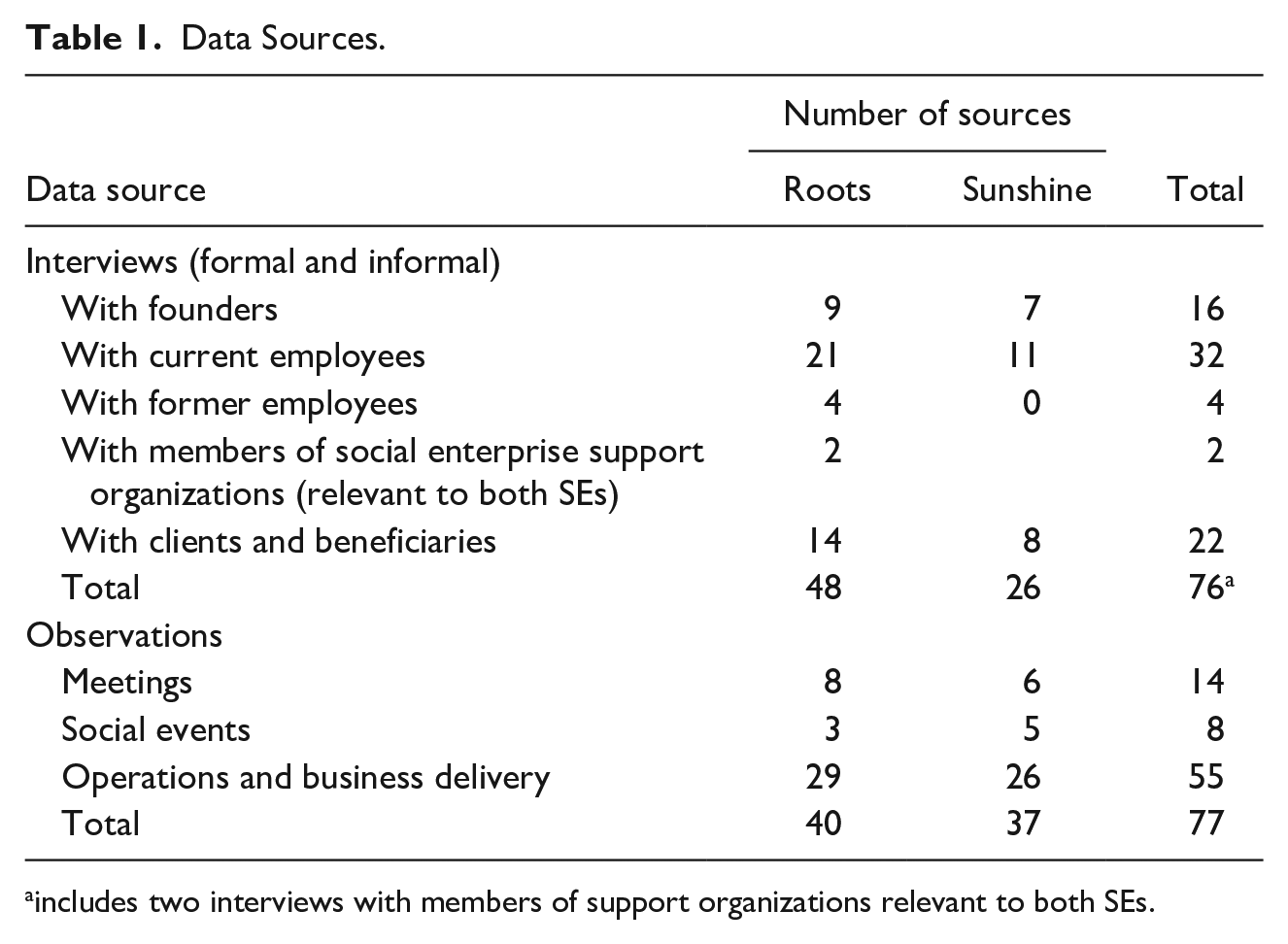
includes two interviews with members of support organizations relevant to both SEs.
Formal Interviews
Our fieldwork started with formal semistructured interviews to collect rich, detailed accounts of the personal experiences of 13 members of social enterprises across different units in each organization and with different tenures: four founders, six full-time employees, and three interns. In addition, we interviewed one founder and one employee who had left Roots, helping to confirm accounts and insights. Each interview started with contextualizing questions to capture personal histories, expectations, and experiences. Our interview protocol then used the critical incident technique (Butterfield et al., 2005; Cope, 2003; Dasborough, 2006; Oliver & Roos, 2003), with questions posed on instances when informants did not experience their work as impactful or questioned the impact of their work. We asked informants when such instances occurred, how they felt, what they thought about them, what prompted any questions about work impactfulness, and what they did in response. In addition, we interviewed one stakeholder from a support organization who had worked closely with the founding teams of both social enterprises and become a confidant and mentor. The participant’s responses helped us triangulate certain experiences and provided additional insights on the context of both organizations. All interviews were recorded and transcribed.
Field Diary
We also recorded observations and performed dozens of informal interviews with current and former members of both organizations and with stakeholders, including beneficiaries of Sunshine. Field observations were made on 77 occasions, comprising meetings, events, or site visits observing operations. We observed business delivery, project and unit meetings, town hall and social meetings with organizational and community members, and workplace interactions. We asked questions for clarification and checked inferences during breaks and when events or meetings ended. Our detailed records of observations included notes about content and processes, including verbatim quotes. We captured these details in notebooks that enabled recording key incidents, interactions, and conversations as they happened (Zilber, 2002); notes were usually typed up at the end of each day. These observations helped us “see” and confirm cues for impact, such as artifacts made from waste materials or family visitations; to contextualize individuals’ working experiences, such as distance from beneficiaries; and to capture instances of impact reframing as they occurred, such as acceptance that impact can be invisible during an observed meeting.
During these observations, we conducted dozens of informal conversations with current and former members of both social enterprises and stakeholders, including formally interviewed informants. This helped us triangulate previously emerged insights and gather further incidents of questioning impactfulness and concurrently reframing of impact. During fieldwork, we also informally interviewed another senior member of a different social entrepreneurship membership organization who had worked closely with the founders of both focal organizations and become a mentor/confidant. We found informants much more candid when talking informally than during formal interviews. We recorded notes from these informal conversations in the field diary.
Data Analysis
While still collecting data, we engaged in parallel and iterative data analysis to identify how informants maintained subjective experiences of impactful work. While we describe this process as linear for readability purposes, it was actually iterative, moving between and among data, relevant literatures, and emerging patterns to refine the analysis and explore slightly different research questions as our understanding of the phenomenon and the theoretical puzzle evolved (Corley & Gioia, 2004; Gioia et al., 2013).
We started by categorizing raw data into first-order codes that gave voice to informants and founded the analysis on their perspective (Gioia et al., 2013). Units of meaning were coded with “in-vivo” labels, capturing the language informants used. When in-vivo labels were unavailable, we used simple phrases to describe a unit’s meaning. We constantly compared each unit of meaning to the previous one in the data source, as well as all units within a category to ensure they reflected the same experience and to refine boundaries. At this stage, we identified expectations of impactfulness, diverse triggers for questioning if one’s work is impactful, and varied explanations of and actions following such questioning. For example, we identified that triggers were related to projects, beneficiaries, and reference points. Our observations and informal interviews helped us “see” the diverse triggers for questioning, such as distance to beneficiaries and reported impact, and “hear” the explanations shared in meetings among members of social enterprises.
As we continued first-order coding, we began to consider how first-order codes related to one another (Gioia et al., 2013). The first-order codes described the key elements of informants’ experiences from their own perspectives, but did not reveal theoretical explanations and relationships. To derive theoretical building blocks with explanatory value, we abstracted and consolidated first-order codes (based on their relationships) into second-order themes and dimensions, giving theoretical interpretations of informants’ lived experiences (Gioia et al., 2013). We continuously developed new and changed existing themes and dimensions to reflect instances not fitting our themes from previous rounds of analysis. At this stage, we constantly compared themes to ensure they were clearly differentiated, yet captured the nuanced meaning of constituent first-order codes. When creating or changing themes, we reanalyzed all data based on the new set of themes. We also iteratively grouped the second-order themes into overarching theoretical dimensions. This involved evaluating the relationships between themes and refining them into more abstract and parsimonious categories.
Late in the analysis, we made two turning points based on engagement with the literature that allowed us to develop the insights presented in the article. First, we started exploring sensemaking as an analytical lens for understanding how members of social enterprises reframe meanings of impact. Sensemaking occurs when individuals experience confusing events or nonoccurrence of expected events that violate expectations, such as not perceiving that one’s work makes a difference having anticipated it would. Such events and nonevents jolt routines (Meyer, 1982) and interrupt current understanding, thus triggering the process of sensemaking (Weick, 1995) to answer the questions “what’s going on here?” and “what do I do next?” (Weick et al., 2005, p. 412). Sensemaking creates meaning through cycles of interpreting cues that challenge current understanding and enacting the interpretation to restore the interrupted flow and check one’s new understanding of the situation (Maitlis & Christianson, 2014; Sandberg & Tsoukas, 2015; Weick, 1988, 1995). As we progressed data analysis with a sensemaking lens, we discovered it allowed us to capture the nuanced experiences of our informants and thus we maintained sensemaking as an analytical lens.
Second, we noticed that two enactments seemed particularly powerful, given the frequency in the data: bringing impact closer and broadening the notion of impact and focused on them. At this stage, we discovered the concept of psychological closeness as describing whether individuals subjectively perceive events, issues, individuals, or groups as close to the self and present in daily experiences (Liberman et al., 2007; Trope & Liberman, 2010). This concept accurately captured first-order codes in the “bringing impact closer” second-order theme, so we retained the label to avoid confusion in the literature. Focusing on the two enactments, we identified links to not only specific interpretations (as expected from a sensemaking perspective) but also to distinct cues that challenged impactfulness as ambiguity or discrepancy. We came to recognize the links between specific cues, impactfulness disturbances, interpretations, and enactments as distinct sensemaking practices, which we labeled internalizing and compensating based on the underpinning mechanisms.
Figure 1 presents how we moved from first-order codes to second-order themes and dimensions.
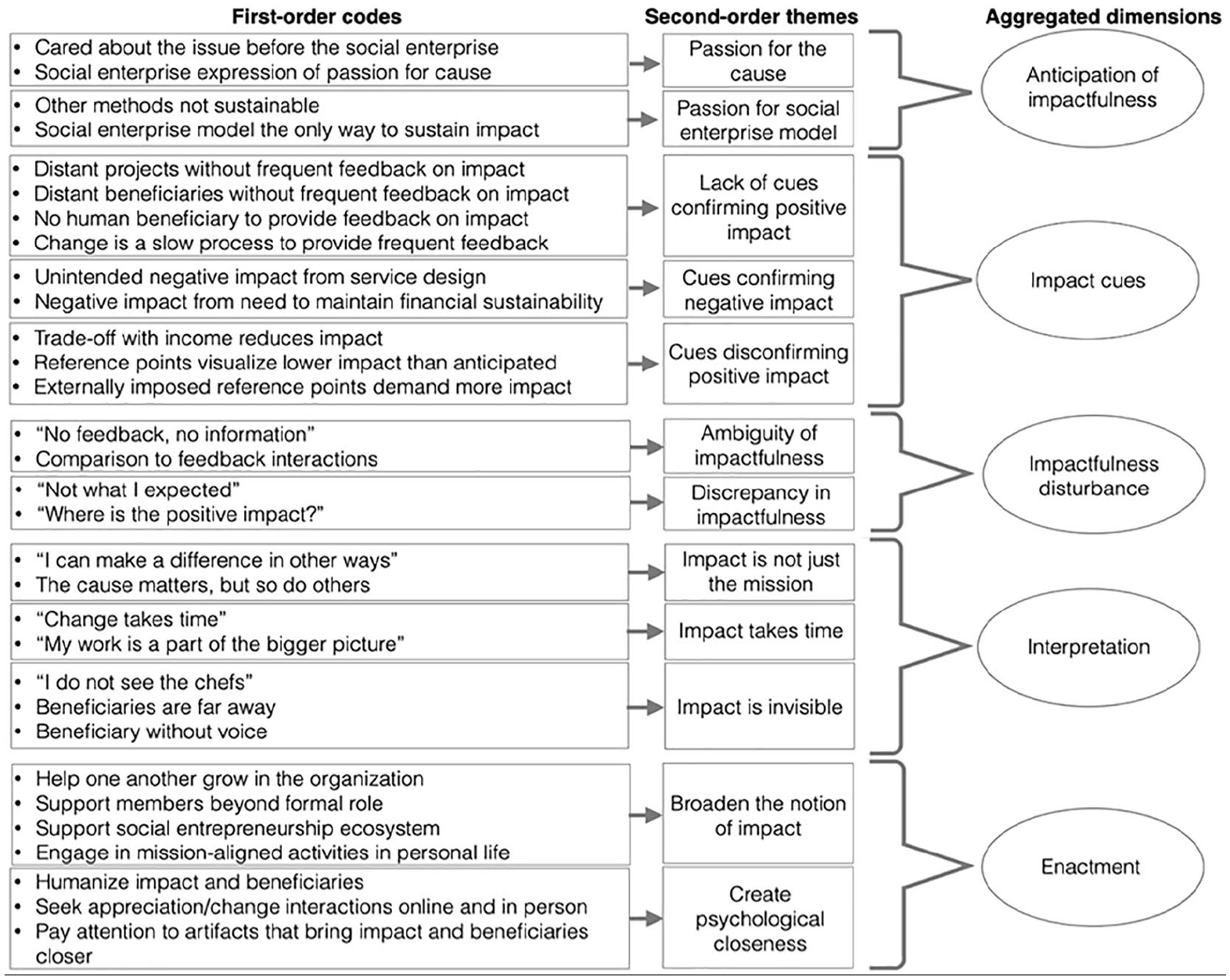
Data Structure.
While traditional notions of validity and reliability are less applicable in interpretive research, we took several steps to ensure the findings were trustworthy (Lincoln & Guba, 1985). Overall, we aimed to remain close to informants’ lived experiences and maintained theoretical relevance through critical and challenging reflections and discussions. During data collection, we performed numerous checks to clarify details and inferences. We used multiple data sources and interviews with informants to triangulate data. Finally, our analysis is founded on informants’ lived experiences and language, yet we maintained theoretical rigor and parsimony (Gioia et al., 2013) by differentiating first-order codes, second-order themes, and aggregated dimensions.
Findings
Core to informants’ experiences of impactful work was their initial anticipation of impactfulness from work. This anticipation was crucial from a sensemaking perspective as it defined the situation for informants and made salient any impact cues that violated their expectations of impactfulness. Informants experienced three distinct cue situations as salient: the absence of cues confirming positive impact and the presence of cues confirming negative impact or disconfirming positive impact. Our analysis also showed that different impact cues were associated with different impactfulness disturbances as disruptions to subjective experiences of impactful work. Impactfulness disturbances thus provided nuance on how impact cues violated anticipated impactfulness and how these violations were experienced. As informants needed new understanding of the situation and how to function within it, they engaged in sensemaking to create new meaning through (1) interpretation to explain to themselves what was happening and (2) enacting this new understanding of the situation and testing its plausibility (Maitlis & Christianson, 2014). More specifically, we identified internalizing and compensating as two distinct sensemaking practices of informants respectively experiencing ambiguity of or discrepancy in impactfulness (see Figure 2).
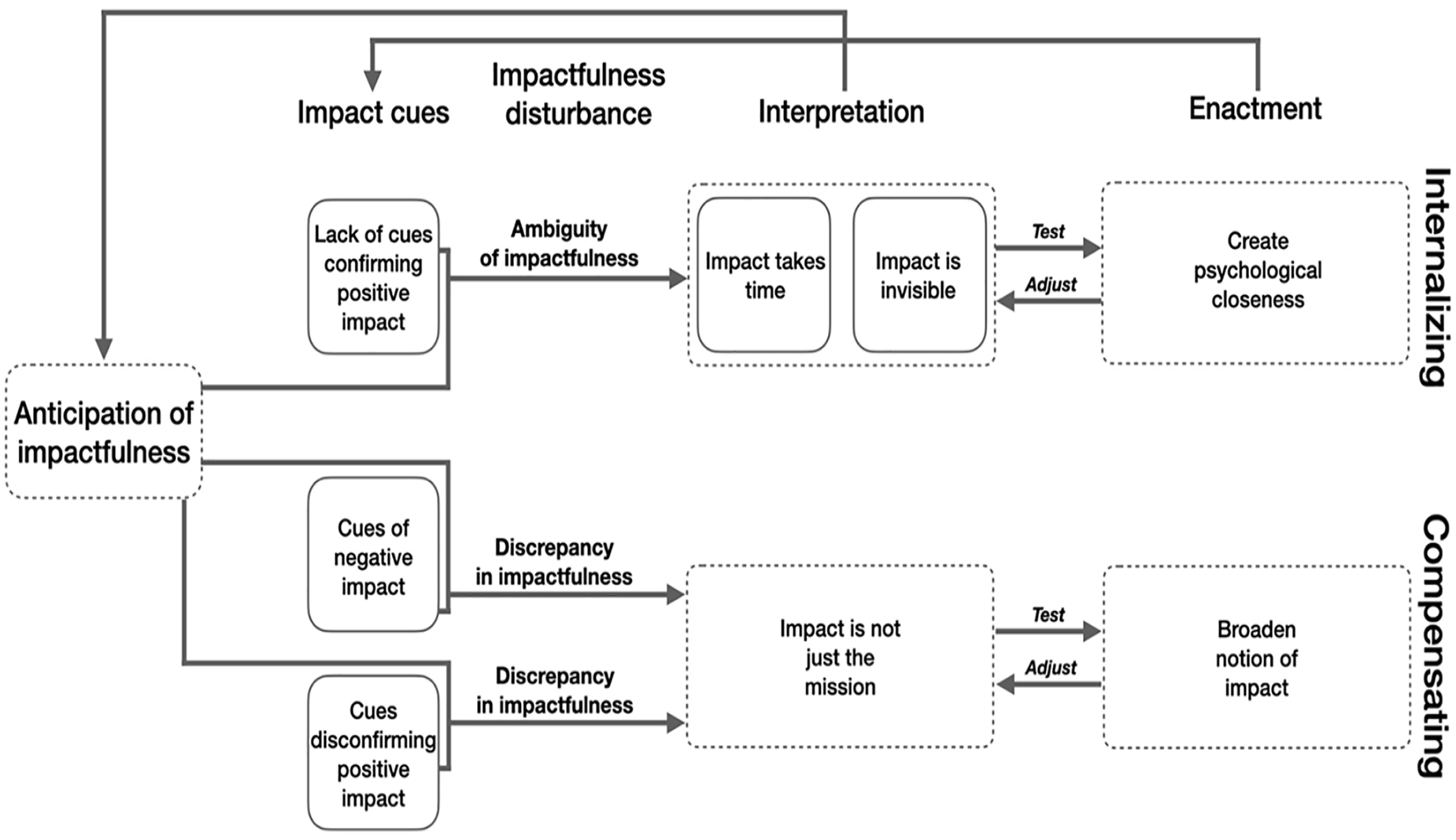
Proposed Model: Maintaining Subjective Experiences of Impactful Work in Social Enterprises.
Next, we briefly outline informants’ anticipation of impactfulness and then describe the two sensemaking practices as triggered by different impact cues and associated with distinct impactfulness disturbances, interpretations of impact, and enactments of the interpretations.
Anticipation of Impactfulness
Informants started their social entrepreneurship journeys in anticipation of experiencing their work as impactful. Essential to their experiences was passion for the core cause of their chosen social enterprises and for the social entrepreneurship model, which translated into experiencing work as significant to who they were: “because of the work that we are doing, or I am doing, personally for me it really resonates with my . . . I feel my larger purpose in calling” (Founder #1, Roots). For informants, working in the social enterprise expressed their passion and continued previous experiences with the cause, such as advocacy and volunteering with nonprofit organizations. They anticipated that working in the social enterprise would make a difference in sustainable ways they considered impossible with other models, such as nonprofit organizations. This aligns with the dominant social entrepreneurship discourse: “we decided to run Sunshine as a business because in a bigger picture, if we are strong as a business, we can continue to impact people” (Founder #2, Sunshine). This anticipation of experiencing work as impactful was common among not only the founders but also employees, inspired to join the organizations by their stated mission to make a difference, which aligned with these individuals’ passion for the specific cause and for sustainable impact: “I want to leave a mark on how to make changes in the fashion world” (Employee #3, Roots); “this is one way that I can walk the walk, not just talk the talk” (Intern #1, Sunshine). Informants had a wide variety of organizational roles: some members worked directly on design and delivery of services toward positive impact, while others’ tasks were removed from direct impact, such as in finance and human resources. Yet even individuals in the latter roles expected to experience impactfulness, as exemplified by a finance manager (Employee #2, Roots): I mean finance is very broad, I could work in so many big companies out there, but I chose to work here because I feel more connected to the goal, to the environment.
When informants questioned their work impactfulness, they engaged in internalizing and compensating as sensemaking practices to maintain subjective experiences of impactfulness. Next, we elaborate on these two practices, including their associated impact cues, impactfulness disturbances, interpretations, and enactments.
Internalizing as a Sensemaking Practice
Internalizing was characterized by experiencing ambiguity of impactfulness, incorporating the lack of cues confirming positive impact into one’s interpretations of the situation, and enactment by creating psychological closeness to enhance subjective experiences by maintaining and visualizing impact.
Impact Cues and Associated Impactfulness Disturbance
Informants questioned work impactfulness when lacking cues to confirm the impact of their work. Both social enterprises measured their impact to some degree, with Roots producing detailed project and annual impact reports. Yet the positive impact was not always visible to informants. The informants in both social enterprises often received no cues to confirm and visualize the positive impact of their work because of the nature of the tasks and of the targeted social issues. For Roots informants, some projects were physically distant from where the team was based, making impact not easily visible. For example, Roots members conducted projects with marginalized communities in remote rural areas with limited beneficiary interactions. In addition, their main beneficiary, the environment, could not provide direct feedback to demonstrate members’ positive impact: “if you drink from a plastic cup or use plastic, you can’t tell you are hurting the environment” (Employee #1, Roots). While Sunshine had human beneficiaries based locally, members nonetheless struggled to see the impact of their work as they rarely worked directly with refugee families, and thus could not visualize impact: Because I don’t really know the family. So when you don't see the community or tie your work to a face. . . everyone is just [a] number (Intern #1, Sunshine)
Importantly, for both social issues—the climate and the refugee crises—all informants acknowledged the difficulty of seeing impact, which required long-term commitment and slow change: “Things don’t happen overnight. [. . .] it’s not like they [refugees] join Sunshine then next day they can get the money” (Employee #1, Sunshine). The former founder of Roots elaborated on impact visibility: when you are tackling some of the bigger problems in society [. . .] it is not clear to what extent you are achieving that because you talk with people, you engage with people, and [at the] end of the day you go home and you don’t see any results.
The absence of impact cues was associated with ambiguity of impactfulness, whereby informants lacked clarity and visualization of their work’s positive impact. It triggered deep questioning among informants of whether their work was impactful: “A lot of time actually, a lot of time you feel . . . you work hard until midnight, and it isn’t bringing change” (Former Employee, Roots). Informants experienced these cues’ absence as ambiguity because they lacked feedback to confirm and validate that their work made a difference. They thus questioned their experiences as their work’s impact was open to interpretation: they could assume it made a difference or that it did not. This questioning and doubt was often contrasted to instances where they had cues confirming their work’s positive impact and thus experienced impactfulness. For example, Roots Employee #1 contrasted the lack of cues confirming positive impact with salient and vivid positive feedback from beneficiaries: “What you are doing right now is actually creating an impact, what you are doing right now, have, have, have [sic] impacted me.” [. . .] those people that. . . come back, that say “You should continue this with other companies.” Or they themselves telling the company “Hey we want Roots to be there, we want what you did with them, we want it again.”
Interpretation
Seeking to understand their experienced ambiguity and how to function within this situation through internalizing, informants interpreted the lack of cues confirming positive impact in two interrelated ways: “impact takes time” and “impact is invisible.” They incorporated positive cues’ absence into their accounts of the situation and adjusted their expectations of experiencing impactfulness from work. Thus, these two interpretations created plausible explanations of the ambiguity aligning directly with the lack of positive impact cues. Through these two interpretations, informants accepted the ambiguity of impactfulness.
Prompted by the lack of positive impact cues, informants accepted a long-term perspective and internalized that impact takes time. Acceptance meant a new understanding of the ambiguity of impactfulness: “I realized there is only so much you can do” (Former Employee, Roots); “we realized that wow, what we are doing is the [sic] speck in the ocean” (Founder #1, Roots). While acceptance may be viewed as surrender, this awareness and understanding of the ambiguity of impactfulness was powerful in maintaining informants’ engagement in the social enterprises as it created a plausible explanation of the situation. The nature of social enterprises as organizations facing trade-offs and uncertainty was instrumental in accepting that impact was slow to materialize: “we are in this for the long term. We have to be here in 15, 20 years from now” (Founder #1, Roots). In addition, informants internalized the lack of positive impact cues as due to distance (e.g., projects in remote locations) or voiceless beneficiaries: “Mother Nature doesn’t have a voice” (Employee #1, Roots).
As Sunshine Intern #1 explained, not seeing impact in the moment “doesn’t mean things are not changing” because “you have a small part in the transformation” when the bigger picture is considered. Like all informants, she broke down the process and highlighted to herself specific tasks (e.g., campaigns to increase sales, new narratives to reduce stigma toward refugees) that contributed to catalyzing positive impact: I’m thinking of myself as a very small ciku [sapodilla fruit, illustrating how small she is], but I’m still there in the whole thing. So even if I don’t get to see the direct impact . . . I know that this campaign would bring this meal order. It’s okay because I know that whatever I’m doing helps the overall or I contribute to the overall numbers.
Enactment
Further making sense of the ambiguity of impactfulness through internalizing, informants tested their new interpretations by creating psychological closeness. This enactment tested informants’ interpretations that impact takes time and/or is invisible by maintaining and visualizing existing impact to make it more salient, thus reducing ambiguity by creating cues confirming positive work impact. Informants created psychological closeness with impact and beneficiaries to make impact more salient in their everyday experiences. Specifically, they created psychological closeness by humanizing beneficiaries, seeking interactions demonstrating change and appreciation, and paying attention to tangible artifacts demonstrating impact.
Informants humanized beneficiaries and impact by linking change to specific individuals and “moving beyond the numbers” (Employee #1, Sunshine). They acknowledged that while change may not always be visible in impact metrics, they could see it in the changed lives of those they supported directly. Where the social issue they worked to address (i.e., positive climate action) lacked a human face, informants linked the environment as a beneficiary to close individuals in their personal lives. For example, Roots Employee #1 explained: “At the end of the day, when we are talking about sustainability, the people you are impacting are your family, are the community.” In humanizing impact by linking it to specific direct beneficiaries or personally relevant individuals, informants created psychological closeness and visualized impact more easily.
Informants also sought and paid attention to interactions with beneficiaries and customers who demonstrated change and appreciation as cues to visualize impact close to them. As impactfulness is a subjective experience, interactions providing cues consistent with one’s anticipated impact were significant and often cherished for extended periods as reminders of impactfulness. Roots Employee #3 reflected on the positive interactions with customers buying fashion items made from “waste” materials: [when] you see people actually demanding more ethical and sustainable things. When you meet the customer who was so enthusiastic about it, it kinda refreshes the memory that we are here for a reason.
Yet informants did not always have opportunities to interact with beneficiaries because of physical distance. Consequently, they sought more frequent interactions with beneficiaries in person and online to visualize work impactfulness. For example, Roots members who struggled to perceive impact from distant projects worked hard to gather the resources for semiregular project visits and used technology-mediated interactions to visualize work impactfulness: “we visit them like three months once [. . .] and we interact with their teachers very often as well, so, we can see our effort helping” (Employee #2, Roots). While Sunshine’s beneficiaries were individuals physically close to the organization, not all members of the social enterprise interacted with them. Consequently, informants started family visitations to bring members physically and psychologically closer to beneficiaries, facilitating visualization of work impactfulness: “But all those things progress slowly. Once you get closer with the families, then you will be able to understand” (Founder #1, Sunshine).
Informants from both social enterprises created psychological closeness with impact by paying attention to tangible artifacts in their everyday work and workplace. For Sunshine informants, these artifacts included images of beneficiaries in their working space, which brought them psychologically closer. For Roots informants, such artifacts were evident in workplace design: the “entire office was furnished with “waste” materials whereby everything was upcycled, such as shelves, tables, and desks, or secondhand” (field diary). Upcycled items, such as sculptures and products made for sale, were exhibited throughout the office, “with labels providing information about the resources used, the impact of using ‘waste materials,’ such as seatbelts from car manufacturers, and the people behind these products. Indeed, there are many examples of the impact of Roots—on labels, posters, and leaflets, all the materials being saved from landfills scattered around the space in raw form, in the process of being transformed, or entirely transformed into new artifacts” (field diary). Roots Employee #3 confirmed the importance of visualizing work impact in the office design: You just have to look into our production room, and you see a whole bunch of materials there, and knowing that these materials that [were] almost thrown away, they are so valuable . . . even [when] we are in our office itself, we can see what we are saving from landfill.
Overall, sensemaking through internalizing enabled informants in the two social enterprises to accept the ambiguity of impactfulness that emerged when lacking cues confirming positive work impact. They maintained perceptions of impactfulness by reframing impact as invisible and slow to materialize, thus incorporating the lack of cues confirming positive impact into their interpretations. In enacting their new interpretations of impact, informants created psychological closeness to impact and beneficiaries, thus creating and visualizing cues confirming positive impact from existing work. However, the internalizing practice was not the only one used by the members of the social enterprises, and we turn to the compensating practice next.
Compensating as a Sensemaking Practice
The sensemaking practice of compensating was characterized by experiencing discrepancies of impactfulness between anticipated and realized impact, triggered by cues highlighting negative impact or disconfirming positive impact. Informants reframed their understanding of impact by questioning and expanding their interpretations about impact scope and enacted these new interpretations by broadening the notion of impact with activities generating additional impact beyond the mission, beneficiaries, and walls of the organization.
Impact Cues and Associated Impactfulness Disturbance
Informants also questioned work impactfulness when noticing cues that either confirmed negative impact or disconfirmed positive impact as both constitute negative feedback.
First, informants questioned work impactfulness when noticing unintended disadvantageous outcomes. For Sunshine informants, the negative impact concerned the safety of refugee families they aimed to support. Sunshine worked with only women refugees as chefs, which challenged traditional gender norms of men as breadwinners; “some husbands don’t respond well, and it can lead to conflict and abuse” (Founder #1, Sunshine). In addition, certain services offered by Sunshine required interactions with customers in refugees’ homes, thus disclosing the identities and locations of refugees and increasing the risk of human trafficking. For Roots informants, the negative impact concerned participation in greenwashing projects to generate income. Members considered it harmful when clients engaged them in short-term initiatives to be seen as environmentally friendly without long-lasting commitment to change. As Roots Employee #1 explained: It’s just for an event, it’s just for greenwashing. [. . .] World Environment Day, or World Environment Week or Month, and for some gimmick, that’s when I’ll question myself
Second, informants questioned work impactfulness when encountering cues that disconfirmed their anticipated positive impact. These triggers stemmed from the hybrid nature of the social enterprises and from reference points. To meet market demand, both social enterprises continuously engaged in trade-offs between impact and income. Sunshine informants shared that all products and services had to meet market expectations because “Yes, it’s to make an impact, but how long can your organization last?” (Founder #2, Sunshine). The organization could not support all refugee families it started working with because “there are certain things where they [refugee chefs] couldn’t reach Sunshine standards” (Employee #1, Sunshine). Thus, when relationships with refugees were terminated because of failure to meet market standards and demand, informants saw their work as less impactful than expected. Similarly, Roots informants openly acknowledged that some projects had no environmental impact by design but were needed to maintain financial sustainability. As exemplified by Roots’ former founder, “basically no point but because we need the revenue . . . it’s always been a trade-off.”
The other source of cues challenging informants’ experiences of impactful work was reference points. Exemplifying the subjective nature of impactfulness, informants questioned their work’s impact when experiencing misalignment between their efforts and subjective experiences in the moment and impact measured by specific indicators. Such misalignments showed the transient nature of impactful work and how reflecting on one’s work changes perceived impactfulness. Roots Founder #2 explained this discrepancy between personal expectations as shaped by transient experiences and objective impact measurements: but when you do a yearly report, then you see “Ok, you’ve done 80 projects, but you’ve only served one community,” and then you feel “Oh, I thought I did a lot more than that?.” So that’s where the mismatch is, for me personally. Because I feel throughout the year . . . It does feel [we have been] helping a lot, but if you put it in numbers, it’s not there.
Sunshine measured its impact only by the number of refugee families supported. Sunshine Founder #1 shared that impact is “seeing the lives being changed drastically, from people who cannot pay rent to people who can pay rent on time,” which could not be captured with numbers. Thus, Sunshine informants experienced refugees’ life events as reference points that triggered questioning of work impactfulness “because sometimes it comes to life and death” (Founder #2, Sunshine). As Sunshine Employee #1 elaborated: When they [refugees] cannot afford health care because they are charged foreigner rates rather than Malaysian . . . The other thing is, they also do not receive equal [medical] treatment. I guess it varies from hospital to hospital or even doctor to doctor. When we meet bad experience like this, we question “Is it because we are not going fast enough?” so that, if they can afford to pay more, they can afford a private, top hospital.
Informants also shared how external reference points imposed by funders and clients asking “show me the numbers” (Founder #2, Sunshine) triggered questioning of work impactfulness. These reference points were cues showing discrepancies between potential and current impact. Roots Founder #2 reflected on an ongoing project in a remote community without recycling facilities, highlighting the pressure imposed by clients: when we bring that [the project] out to speak to the corporate players or the industry players, they are like “Okay. That’s cute. But what can you do industry-wise to maybe change or to research alternatives to plastics instead?” And we thought “Okay. . .you guys are really big, but we can only do this much.” So . . . It was a struggle in terms of. . .We cannot reach to that capacity, but then internally we dwell upon it.
Sunshine Founder #1 shared the same sentiment: We only have 12 active families now; people always question, “Why not 50? Why not 100? Why not 200?” But the impact that we are making is quite deep. But when people question your numbers, then you ask yourself, “Yeah, why can’t I do it faster?”
When informants encountered cues confirming negative impact or disconfirming positive impact, they experienced discrepancies in impactfulness: these cues gave clear and salient feedback of a difference between anticipated and experienced impactfulness. They could see and visualize how their work was less impactful than they had expected: in the beginning, maybe it is a little bit naïve in terms of the impact . . . you want to have a change, you want to achieve . . . it is great to be motivated by those things but maybe you don’t realize (laugh) quite how system change works” (Former Founder, Roots)
Informants often spoke with a sense of disappointment and frustration about the discrepancies: “I wish I could do more, we could do more. I thought we could do more” (Employee #1, Sunshine). In this regard, unlike with ambiguity of impactfulness, informants did not question if their work was impactful because they could see it was less impactful than anticipated. Thus, impactfulness discrepancy was a different subjective experience from ambiguity because “negative” feedback evidenced the gap, instead of the absence of feedback creating space for doubt.
Interpretation
Seeking to understand the discrepancies between their anticipated and experienced impactfulness and how to function in this situation through compensating, informants did not actively interpret cues confirming negative impact or disconfirming positive impact. Instead, they created a new interpretation to counter these cues with an additional explanation of where impact can be generated. Informants created meaning by interpreting the scope of positive impact as greater than the organizational mission, thus compensating for challenges to their subjective experiences of impactful work. This new understanding created new possibilities for subjectively experiencing impact and reducing the discrepancies between anticipated and experienced impactfulness.
Both social enterprises were started and continued to pursue specific missions: positive climate action for Roots and supporting refugees for Sunshine. Yet the informants in both organizations transitioned from expecting impactfulness through pursuing the organizational mission to also seeking impactfulness beyond it when facing discrepancies: “impact can come from other places too, it is not just the refugees we work with, but also our employees” (Founder #1, Sunshine). This was perceived not as changing the mission but as broadening the understanding of impact to enable more opportunities for individuals to perceive their work as impactful, with more frequent and accessible cues compensating for those confirming negative impact or disconfirming positive impact. For example, Sunshine informants shared that their work’s impact on refugees was only one aspect of how they could make a difference: they acknowledged that supporting one another “also makes a difference, but it is not our mission” (Employee #1, Sunshine). This new understanding of impact beyond the organizational mission contrasted with the strictly mission-related impact initially anticipated. Rather than directly explaining the discrepancies between anticipated and experienced impact, this interpretation offered a perspective through which individuals could experience impactfulness in novel ways through their enactment.
Enactment
Further making sense of the discrepancies between expected and experienced impact, informants tested their new interpretation by acting in ways that broadened the notion of impact beyond the organizational mission. Thus, informants’ enactment within the compensating practice was expansion-focused: to experience impactfulness, they engaged in new tasks and activities generating additional impact beyond the mission, beneficiaries, and walls of the organization.
Facing discrepancies between anticipated and experienced work impactfulness, informants sought impact from other tasks and opportunities to make a difference for others, such as helping one another grow, supporting members beyond formal roles, engaging in mission-aligned activities outside work, and supporting the social entrepreneurship ecosystem. Within both organizations there were palpable efforts to support one another and appreciate the impact from helping colleagues. Informants experienced impactfulness from multiple internal opportunities for mutual support, such as informal mentoring and providing emotional and tangible support to co-workers and even their families. Such support was often provided beyond formal roles and job descriptions. Indeed, informants in both organizations often proactively took on extra-role tasks to support others, which helped them experience work impactfulness immediately and with greater clarity, thus narrowing the gap between anticipated and experienced impact. By broadening the notion of impact beyond the organizational mission, informants expanded not only their work goal but also who benefited: “seeing someone else learn from you . . . seeing that difference you can make is also impact” (Founder #1, Sunshine); “helping each other matters” (Founder #2, Roots). For example, Sunshine Employee #1 reflected on the impactfulness she perceived from informally mentoring someone else: When I am trying to do that [mentoring] to another person, it teaches me how to guide a person to think and find a solution rather than [me] finding a solution for that person. I would also be able to share whatever I have learned, sometimes that would help them.
Further broadening the notion of impact, informants brought impact into their personal lives as another enactment to experience positive difference from extra-organizational activities. By blurring the boundaries between work and nonwork, informants engaged in additional activities such as supporting other social enterprises, advocacy, and education in their social circles or simple everyday actions, consistent with their anticipated impact from work. In broadening the notion of impact, informants engaged in activities with the social entrepreneurship ecosystem to support other social enterprises, regardless of their mission because “being part of it [the social entrepreneurship ecosystem] and championing it is the only way you can do something good” (Roots Employee #4) and experience impactfulness at work. These extra-organizational activities augmented informants’ perceptions of positive impact to meet their anticipations and compensated for the limited mission-related impactfulness perceived at work. For example, Sunshine Founder #1 shared that educating family members about refugees was another way to experience work impactfulness: I remember my mum didn’t want me to go to the refugee learning center in the first place. [. . .] I bring her to experience the open house, where she gets to eat in the [refugee] family’s home; I bring her to some of my visitations. And then [to] events that we organize, and she sees it first-hand herself. That definitely changed the word “refugee” in her mind.
Overall, sensemaking through compensating enabled informants in both social enterprises to reduce the discrepancies between anticipated and experienced impactfulness. Informants maintained perceived impactfulness by countering negative-feedback cues with new interpretations of impact as extending beyond the organization’s mission and walls. In enacting their new interpretations of impact, informants broadened the notion to include new activities and sources, thus creating and visualizing cues confirming positive impact from additional tasks. Informants thereby expanded when and why they perceived work impactfulness, even if this broadened the scope of beneficiaries beyond those mentioned in the organizational mission to also encompass colleagues and other social enterprises.
Maintaining Impactful Work in Social Enterprises: A Model
Drawing on the emergent theoretical dimensions and their relationships, this section presents a model of how members of social enterprises maintain subjective experiences of impactful work through sensemaking that allows them to reframe meanings of impact (see Figure 2). Unsurprisingly, individuals start or join a social enterprise anticipating impactful work; however, they subsequently experience (a) ambiguity of impactfulness without cues confirming positive impact and (b) discrepancies between anticipated and experienced impactfulness from cues confirming negative impact or disconfirming positive impact.
Members of social enterprises maintain their sense of work impactfulness by engaging in two different sensemaking practices: internalizing and compensating. Individuals internalize when lacking cues confirming positive work impact and thus experiencing ambiguity, whereby they doubt if their work makes a difference. When engaging in this practice, members of social enterprises accept the ambiguity and internalize the lack of cues confirming positive impact with the explanations that impact is invisible and/or takes time. Testing the plausibility of these explanations, members of social enterprises aim to enhance their subjective experiences of impactfulness by creating psychological closeness to help visualize and maintain existing impact and thus minimize ambiguity. By contrast, members of social enterprises adopt the sensemaking practice of compensating when encountering cues that confirm negative impact or disconfirm positive impact, which create discrepancies between anticipated and experienced impactfulness and trigger questioning about the scope of impact. When compensating, members of social enterprises do not explicitly account for these cues but instead create new accounts highlighting that impact can be broader than the organizational mission; they then act accordingly with novel activities and beneficiaries of their activities that expand the sources of impactfulness beyond the mission and walls of the organization and thus reduce discrepancies.
Overall, sensemaking creates new opportunities to make impact more salient and to catalyze impactfulness from additional sources. Through sensemaking, members of social enterprises address questioning of whether or how much their work is impactful, recalibrate their anticipated impactfulness, and reduce the salience of cues challenging perceived impactfulness. However, doubts on work impactfulness do not disappear: members of social enterprises face multiple, repeated cues challenging subjective experiences of impactfulness, thus triggering iterative sensemaking cycles of switching between internalizing and compensating on encountering different types of cues.
Discussion
This article focuses on how members of social enterprises reframe meanings of impact to maintain a sense of impactful work as creative and agentic actors who take action to align their expectations and experiences. Our findings have three main implications for research on social entrepreneurship and meaningful work.
Implications for Research
First, our findings explicate when members of social enterprises question their work as impactful based on different types of impact cues and how they reframe meanings of impact differently based on cue type. We thereby contribute not only to social entrepreneurship research, which has neglected this topic, but also to research on impactful work, which is less understood than fulfilling meaningful work (Lepisto & Pratt, 2017; Rosso et al., 2010). Previous studies have demonstrated that individuals struggle to see their work as impactful when lacking cues demonstrating how work makes a difference (e.g., Grant et al., 2007). Consequently, individuals engage in different sensemaking practices to reframe their understanding of impact (Schabram & Maitlis, 2017). Our findings enrich this research stream by highlighting that subjective experiences of impactful work are diminished not just by the lack of cues for positive impact but also the presence of cues confirming negative impact or disconfirming positive impact. These cue types help us understand distinct challenges to subjective experiences of impactful work, such as lack of beneficiary contact (Grant et al., 2007), impact measurement (Beer et al., 2021), limited resources to deliver on the mission and achieve impact (Jiang, 2021), or a long-term, challenging mission, such as the moon landing (Carton, 2018). Such challenges are associated with different impactfulness experiences: ambiguity and discrepancy. Overall, by unearthing types of impact cues that challenge experiences of work impactfulness, our findings point to a fruitful research avenue of comparing these distinct cue types and their intensity and frequency in contributing to subjective experiences of impactful work.
By explicating different types of cues (or their absence) that challenge subjective experiences of impactful work in distinct ways as ambiguity or discrepancy, we also unearth how different sensemaking practices are triggered within, instead of between, individuals (Schabram & Maitlis, 2017). When individuals lack cues confirming positive impact, which may happen during long, challenging missions, such as the moon landing (Carton, 2018) or supporting refugees (Jiang, 2021), they can internalize by incorporating these cues’ absence into interpretations of the situation and creating psychological closeness to the mission and impact, for example through a temporary mission (Jiang, 2021) or by humanizing beneficiaries, thus visualizing and maintaining existing impact. By contrast, when individuals face cues confirming negative impact or disconfirming positive impact, they can compensate by broadening the notion of impact beyond the organizational mission and engaging in extra-role and extra-organizational tasks that generate additional impact. Importantly, such nuanced understanding of how different types of cues can trigger different sensemaking practices acknowledges impactful work as an ongoing subjective process (Lepisto & Pratt, 2017), instead of assuming an end-point of stability in perceiving impactfulness: individuals face multiple and different challenges to their perceptions of work as impactful and continuously make sense of these challenges.
While our findings portray members of social enterprises as active, reflective actors who question, enhance, and visualize the impact of their work, these practices can also damage their well-being and be exclusionary. By broadening the notion of impact and creating psychological closeness to impact and beneficiaries through additional tasks and responsibilities, individuals can devote excessive resources, leading to role overload and burnout (Bolino & Turnley, 2005). For example, individuals may not have sufficient resources to engage with beneficiaries and support peers and other social enterprises outside working hours or in addition to their already demanding roles in resource-constrained organizations (Bhatt et al., 2019; Desa & Basu, 2013; Drencheva et al., 2022). Such practices can also be exclusionary for members of social enterprises with limited capacity for additional activities because of personal responsibilities (e.g., caring) or health needs (e.g., postviral syndrome). Indeed, such practices can normalize sacrifices in social entrepreneurship (Dempsey & Sanders, 2010) as common and necessary, potentially limiting who engages and remains involved in this domain. While our findings portray specific sensemaking practices as required for maintaining subjective experiences of impactful work, future research should investigate their dark side and potentially negative outcomes regarding well-being and exclusion.
Beyond the potential negative implications for individuals of the two identified sensemaking practices, compensating could also have negative implications for social enterprises as organizations. Broadening the notion of impact through extra-role and extra-organizational responsibilities may cause members of social enterprises to prioritize tasks with visible positive impact, while neglecting other important tasks offering fewer cues about positive consequences for others, leading to short-term operational issues and inefficiencies. For example, individuals may prioritize supporting colleagues or other social enterprises because these activities entail more salient subjective experiences of impactfulness, compared to tasks such as financial monitoring or quality control that are essential for the organization’s sustainability.
Second, our findings provide initial insights into the importance of individuals’ subjective experiences of impactfulness for how social enterprises’ missions are protected or neglected. In doing so, we complement the focus on institutional and financial pressures as sources of mission neglect (Battilana & Dorado, 2010) and recognize distinct forms of mission neglect. Social enterprises face a difficult balancing act in navigating social/environmental and financial demands and protecting their mission (Battilana & Lee, 2014). This balancing act can be enabled by individuals’ subjective experiences of impactful work or at least ambiguity if their work is impactful. Our findings show that when individuals in social enterprises experience ambiguity about work impactfulness, they create psychological closeness to impact and beneficiaries, thus acting in ways consistent with the mission of the organization to enhance mission-related impact and to make it more salient. In this regard, the internalizing sensemaking practice can enable maintenance of the mission because it brings it psychologically close to individuals, thus contributing to shared accountability for protecting the mission (Ebrahim et al., 2014).
However, the balancing act between mission and money can also be complicated by individuals’ limited experiences of impactful work, potentially leading to mission creep as a distinct form of mission neglect. Our findings show that when individuals experience discrepancy of impactfulness based on cues that provide negative feedback, they compensate by broadening the notion of impact beyond the mission of the organization or the original beneficiaries, for example to support other social enterprises. Thus, the compensatory practice can, in some cases, have long-term effects on social enterprises as decisions to prioritize tasks where impact is salient and visible can slowly shift organizational practices, activities, and culture, potentially leading to mission creep as the accumulation of new goals, tasks, and programs expanding beyond the original organizational mission (Haugh & Kitson, 2007; Jonker & Meehan, 2008). Mission creep is distinct from mission drift, which is the dominant form of mission neglect investigated in research (Mersland & Strøm, 2010; Ramus & Vaccaro, 2017). While mission drift reflects social enterprises’ prioritization of financial over social/environmental activities and goals (Ramus & Vaccaro, 2017), mission creep reflects the prioritization of multiple social and/or environmental activities and goals. Yet mission creep is still a form of mission neglect because it can stretch the organization too thin, leading to ineffective use of resources to meet goals related to the mission of the organization.
Individuals’ subjective experience of impactful work can help social enterprises to address mission neglect proactively, instead of retroactively. Research so far has examined mission neglect after it happens (Ometto et al., 2019). Yet our findings show that challenges to individuals’ subjective experiences of impactful work in social enterprises can stem from fears of potential mission neglect that individuals are aware of. For example, when employees/founders of a social enterprise with an environmental purpose perceive complicity in other organizations’ greenwashing activities that are inconsistent with the social enterprise’ mission and long-term approach. In this regard, challenges to subjective experiences of impactful work can serve as indicators of potential mission neglect that can be addressed proactively. However, when not addressed proactively and in ways consistent with the mission, fears of potential mission drift can lead to discrepancies in individuals’ experiences of impactful work and thus compensatory actions and potentially mission creep. This link between subjective experiences of impactfulness and different forms of (anticipated) mission neglect in social enterprises deserves further research attention.
Third, our findings on the sensemaking practice of internalizing enrich emerging research in social entrepreneurship by showcasing how members of social enterprises can create psychological closeness. Psychological closeness (distance) describes whether individuals subjectively experience events, issues, individuals, or groups as close to (far from) the self (Liberman et al., 2007; Trope & Liberman, 2010). Individuals experience something as psychologically close when it is present in their daily experience and thus associated with concrete and detailed mental representations. By contrast, individuals experience something as psychologically distant when it is not present in their daily experiences and thus associated with abstract and simple mental representations (Trope & Liberman, 2000, 2003);
Emerging research shows that psychological closeness influences how social entrepreneurs seek feedback (Drencheva et al., 2021) or whether they access financial resources (Rose et al., 2021). For example, when potential contributors experience psychological closeness with a crowdfunding campaign, they are more likely to contribute (Rose et al., 2021). Overall, emerging research on psychological closeness demonstrates its benefits for social enterprises. Our findings enrich this stream by showcasing that psychological closeness is neither a given nor static but actively created and sought through humanizing impact: this is done by linking impact to individuals in one’s daily life, creating and pursuing opportunities to interact with beneficiaries online and offline, creating and pursuing appreciation and change interactions, and using tangible artifacts in the workplace. These specific ways of creating psychological closeness enable social enterprises to benefit proactively. For example, leaders of social enterprises can use these practices to (a) help employees and volunteers subjectively experience their work as impactful and (b) engage with resource holders to access resources needed to start and grow social enterprises. It would be highly valuable to research how social entrepreneurs, employees, and volunteers in social enterprises create psychological closeness and with what impact for individuals and the organization.
Limitations and Opportunities for Future Research
This study shows the importance of investigating impactful work as a subjective experience in social enterprises and the need for more research on the topic, yet it also has two main limitations. First, future research is needed to explore our model’s transferability across institutional settings. We see our country context as a strength: given that little research has investigated members of Malaysian social enterprises (for an exception, see Au et al., 2021), our findings contribute to a rich and nuanced understanding of social entrepreneurship appreciating the diversity of organizational and institutional contexts across the globe. However, we acknowledge that Malaysia is a specific institutional environment for members of social enterprises, which may limit our findings’ transferability. Social enterprises in Malaysia are rare and the ecosystem is only emerging (Bosma et al., 2016), with implications for access to resources and trade-offs between income and impact. Moreover, our informants worked in or led social enterprises targeting issues for which impact is slow to materialize and differed to the future. In addition, climate and refugee crises receive little attention and are even stigmatized in mainstream Malaysian society. Taken together, these issues may make it particularly difficult to experience one’s work as impactful, while cultural norms may shape what enactments are considered socially acceptable. Future research can contribute to this research stream by comparatively studying how institutional and organizational contexts, including mission and culture, influence subjective experiences of impactful work among individuals.
Second, future research is needed to investigate differences between social entrepreneurs/leaders and employees/volunteers of social enterprises in how they respond in situations that challenge their subjective experiences of impactful work. While we see our explication of within-person differences in sensemaking practices as a strength, we acknowledge that relationships to the organizational mission may differ between social entrepreneurs/leaders and employees/volunteers of social enterprises, leading to engagement in different sensemaking practices (Drencheva et al., 2021; Schabram & Maitlis, 2017). While studies have examined between-person differences in sensemaking when questioning the impactfulness of one’s work (Schabram & Maitlis, 2017), such differences in social enterprises may be influenced by organization tenure or the strength of identification with the organization or its targeted social issue. At the same time, our focus on sensemaking prioritizes cognitive and behavioral responses to cues that challenge one’s experience of impactful work, yet future research can also examine distinct emotional responses to these challenges, such as disappointment, shame, anger (Williamson et al., 2022), and how emotions play a role in cognitive and behavioral responses. Such potential nuances are worth investigating.
Conclusion
This inductive study explicated when members of social enterprises question the impactfulness of their everyday work and how they navigate these instances through internalizing and compensating sensemaking practices, depending on the cues they encounter. Overall, our findings provide nuanced understanding of subjective experiences of impactful work and psychological closeness among individuals in social enterprises, with potential implications for individuals and organizations.
Footnotes
Acknowledgements
The authors thank Editor Israr Qureshi and the reviewers for their constructive comments and guidance. They are grateful for developmental and constructive feedback by Elisa Alt. An earlier version of this article was presented at the Academy of Management Annual Meeting 2020. They thank the conference participants for their helpful feedback.
Declaration of Conflicting Interests
The authors declared no potential conflicts of interest with respect to the research, authorship, and/or publication of this article.
Funding
The authors disclosed receipt of the following financial support for the research, authorship, and/or publication of this article: For financial support, the authors thank the Arts and Humanities Research Council (grant no. AH/R005354/1).
