



Abstract
Social entrepreneurs need resources to develop their organizations and catalyze social impact. Existing research focuses on how social entrepreneurs access and use resources, yet it neglects how they search for resource holders. This issue is particularly salient in social entrepreneurs’ decisions about whom to approach for interpersonal feedback as a valuable resource. The current literature offers lists of individuals whom social entrepreneurs approach for feedback and implies these individuals can be easily accessed. Thus, it offers little insight into how social entrepreneurs select whom to approach for feedback and why, or why they struggle to access feedback. We conducted an in-depth inductive study based on 82 interviews with 36 nascent social entrepreneurs to investigate how they search for and select individuals to approach for feedback within and outside their social networks through an iterative appraisal process. Our findings start to open the black box of searching for resource holders in the resource mobilization process and offer insights on power and stigma in social entrepreneurship.
Social entrepreneurs start and lead social enterprises to catalyze positive impact and address social needs (Mair et al., 2012). To start their organizations and achieve positive impact, social entrepreneurs need to assemble and creatively combine resources in novel ways (Alvord et al., 2004; Mair & Marti, 2006; Peredo & McLean, 2006). Social entrepreneurship research so far has provided insights into how and when social entrepreneurs use specific approaches to access resources (Desa & Basu, 2013; Hota et al., 2019) and how they use resources to achieve desired outcomes (Bacq et al., 2015; Bojica et al., 2018; Kickul et al., 2018).
Yet, a critical aspect of the resource mobilization process still presents a black box—how do social entrepreneurs search for and select resource holders to approach in the first place? Indeed, how resource holders are selected and approached by entrepreneurs (i.e., the critical first stage of the resource mobilization process) is similarly poorly understood in the broader entrepreneurship literature (Clough et al., 2019). However, the search stage of resource mobilization can have critical imprinting effects on social ventures (Marquis & Tilcsik, 2013; Muñoz et al., 2018) by influencing what resources are accessed, the quality of these resources, and which resource holders have power over the venture and thus can shape its strategy. We begin to open this black box by investigating how social entrepreneurs search for and select others to approach for interpersonal feedback.
Interpersonal feedback is evaluative information about the effectiveness of decisions and behaviors obtained through interpersonal interactions with others (Ashford, 1986). It is a particularly valuable resource for social entrepreneurs (Katre & Salipante, 2012) and entrepreneurs in the start-up phase in general (Bhave, 1994). Decisions about searching and selecting whom to approach for interpersonal feedback (i.e., individuals considered as feedback sources) are potentially impactful for the success of social ventures because they can determine whether social entrepreneurs indeed access the feedback they need and the quality of the feedback. They are also particularly difficult for social entrepreneurs due to the hybrid nature of their ventures, related legitimacy challenges, and the need to navigate multifaceted social issues in complex multistakeholder environments (Battilana & Lee, 2014; Mair et al., 2015; Stephan et al., 2016). For instance, ideally social entrepreneurs would approach for feedback individuals who have a deep understanding of the social issue they address and of business processes.
However, we do not understand how these decisions are made. Existing research emphasizes the importance of feedback seeking for social entrepreneurs but only offers lists of broad categories of potential feedback sources, such as employees or community leaders (Katre & Salipante, 2012; Smith et al., 2012). Yet, how do social entrepreneurs make the decision to seek feedback from a particular community leader or a specific employee? We currently lack an in-depth understanding of how these specific decisions are made and thus how social entrepreneurs initiate relationships with specific resource holders that can ultimately determine the fate of their ventures and their success or failure as social entrepreneurs. Research outside social entrepreneurship on phenomena related to interpersonal feedback seeking, such as on employees’ feedback seeking (Anseel et al., 2015), (social) entrepreneurs’ social networks (Qureshi et al., 2016), and information seeking (Stewart et al., 2008), similarly offers fragmented insights into how choices are made about whom to approach for feedback.
In this article, we ask, “How do social entrepreneurs leading emerging social enterprises search for and select sources of interpersonal feedback?” Through an inductive theory building approach with data from 82 interviews with 36 nascent social entrepreneurs, we uncover how social entrepreneurs engage in an iterative process with repeated cycles of appraisal of benefits, costs, and options within and outside their social networks. We find that social entrepreneurs learn from feedback requests and can even abandon the search for feedback sources altogether. We uncover what attributes social entrepreneurs value when searching for feedback sources and why these attributes are valued based on two underpinning mechanisms: the expected informational value of the feedback obtained and the costs of seeking interpersonal feedback (e.g., costs to image, competitiveness).
Our findings offer two implications for research on resource mobilization in social entrepreneurship. First, our findings develop our understanding of the search stage of resource mobilization as an iterative appraisal process fraught with challenges. They complement past research on resource mobilization in social entrepreneurship, and in the broader entrepreneurship literature (Clough et al., 2019), that has taken the search stage of resource mobilization for granted and focused on how resources are accessed (Desa & Basu, 2013; Hota et al., 2019) and with what outcomes (Bacq et al., 2015; Bojica et al., 2018; Kickul et al., 2018). Overall, our process model can explain why social entrepreneurs approach some individuals for interpersonal feedback as a resource and not others, why these decisions may change over time, and why social entrepreneurs may not access feedback as a specific resource.
Second, our findings uncover novel power dynamics in resource mobilization. Research on resource mobilization implicitly ascribes power to the resource holder who makes the decision whether to transfer resources to (social) entrepreneurs (Hillman et al., 2009; Malatesta & Smith, 2014). Our findings challenge this perspective by outlining where in the search process social entrepreneurs as resource seekers have agency as well as how resource holders may act in ways demonstrating a lack of power. Social entrepreneurship is a context that highlights such uncommon power dynamics because social entrepreneurs often engage with and aim to benefit vulnerable individuals (Stephan et al., 2016). By unearthing these power dynamics, we note wider implications for how those traditionally less powerful in organizations can have platforms for their voices (Bapuji et al., 2020) and for how social entrepreneurs can avoid replicating existing societal power dynamic in the venture development process.
In addition, our findings offer insights for the related literature on information seeking. Although research on information seeking conceptualizes approaching sources of information as an active choice process (Borgatti & Cross, 2003; Robinson & Simmons, 2018), we explicate this process from an appraisal perspective (Folkman & Lazarus, 1980; Lazarus & Folkman, 1984) and thus explain the surprising findings in past research that costs are not associated with the frequency of seeking information (Borgatti & Cross, 2003). Further building on research in information seeking, we extend our understanding of what characteristics are valued in those approached for feedback/information that are particularly relevant in the social entrepreneurship context and introduce new costs to be considered.
Theoretical Background
Social enterprises are considered critical actors at the intersection of business and society in addressing grand societal challenges and catalyzing social impact (Bapuji et al., 2020). They are organizations that seek to address social needs, such as inequality, the climate crisis, or modern slavery, with market-based mechanisms (Mair et al., 2012).
Resource Mobilization in Social Entrepreneurship
To start and successfully operate impactful social enterprises, social entrepreneurs need to mobilize resources. Indeed, social entrepreneurship is often defined in terms of resourcefulness: refusing to accept resource limitations and using resources in novel ways (Alvord et al., 2004; Mair & Marti, 2006; Peredo & McLean, 2006). Resources are the tangible (e.g., financial capital) and intangible assets (e.g., feedback) that social entrepreneurs control or gain access to that enable them to develop their abstract ideas into concrete organizations (Clough et al., 2019). While social entrepreneurs can start the venturing process with a given set of assets through effectuation (Corner & Ho, 2010), they are also dependent on others and need to engage in resource mobilization (Meyskens et al., 2010). Resource mobilization, the process by which social entrepreneurs gather the resources needed for their venturing efforts, is conceptualized as having three distinct key stages as micro-processes: (a) searching for and identifying relevant resource holders, (b) accessing assets from resource holders, and (c) transferring of assets from resource holders to social entrepreneurs to use (Clough et al., 2019).
Resource mobilization is challenging for social entrepreneurs in the early stages of the venture development process for several reasons. First, macroenvironmental forces can make resource mobilization challenging. By their very nature, social enterprises aim to address societal challenges, often in geographic areas where resources are scarce (Mair et al., 2012; Mair & Marti, 2009; Qureshi et al., 2016), which influences what resources are available in the environment to begin with. The prevalent informal norms and views about the role of social enterprises and governments as providers for those in need (Bhatt et al., 2019) as well as political constraints, technology regulation, and difficulty of doing business (Desa, 2012) may further complicate resource mobilization for social entrepreneurs. Moreover, unlike other entrepreneurs, social entrepreneurs characteristically seek to mobilize resources in multi-institutional fields to affect social impact (Besharov & Smith, 2014; Mair et al., 2015). Such multi-institutional fields are marked by diverse stakeholders, such as beneficiaries, customers, local authorities, philanthropic funders, and partners from other sectors (Barinaga, 2020; Lall & Park, 2020; Savarese et al., 2020). This diversity can make it difficult to identify who the relevant resource holders are to approach in the first place.
Second, social entrepreneurs characteristically grapple with legitimacy challenges that can hinder resource mobilization. Social enterprises do not fit into neat categories of nonprofit and commercial organizations (Battilana & Lee, 2014). This hinders their legitimacy because they can be perceived as too social and not social enough and/or too commercial and not commercial enough (Galaskiewicz & Barringer, 2012). Yet, legitimacy as the generalized perception that an organization’s actions are appropriate within the norms and values of its field is essential for accessing resources (Suchman, 1995). Relatedly, because social enterprises do not prioritize profit maximization, there are fewer incentives for resource holders to transfer resources to social enterprises due to a potentially lower and slower return on investment (Bridgstock et al., 2010). Finally, and common to all early-stage organizations, emerging social enterprises encounter challenges in resource mobilization because of their perceived liability of newness, which limits their legitimacy and institutional support (Singh et al., 1986).
Research on resource mobilization in social entrepreneurship has so far been dominated by how social entrepreneurs access and use resources, yet how social entrepreneurs identify and select relevant resource holders has been neglected. Research so far has investigated when and how social entrepreneurs use specific approaches to access and repurpose resources, such as optimization, bricolage, socially oriented bootstrapping, and co-creation (Desa & Basu, 2013; Di Domenico et al., 2010; Hota et al., 2019; Jayawarna et al., 2020). In addition, this research stream has investigated how resources enable specific processes, such as impact measurement (Molecke & Pinkse, 2017), or specific outcomes, such as social impact, growth, innovation (Bacq et al., 2015; Bojica et al., 2018; Kickul et al., 2018). This means that the second and third stages or resource mobilization are prioritized in the existing research. Yet, the first critical stage of resource mobilization, that is searching for and identifying relevant resource holders before they are approached and resources transferred, has been neglected in existing research. In addition, tangible resources, such as finance, have received more attention (Calic & Mosakowski, 2016; Lall & Park, 2020; Lehner, 2013; Parhankangas & Renko, 2017) compared with accessing intangible resources (cf. Corner & Ho, 2010; Di Domenico, Haugh & Tracey, 2010), such as feedback.
These two limitations in our understanding of resource mobilization processes—neglect of how resource holders are initially identified and neglect of intangible resources—are identified in the broader entrepreneurship literature as well (Clough et al., 2019). The reasons for this neglect are likely the greater availability of data on accessing and transferring financial resources, particularly among ventures in the later stages of development (Clough et al., 2019). This means that we currently do not have a robust understanding of how resource mobilization processes are initiated, especially for intangible resources. In particular, we lack an understanding of how social entrepreneurs search for and select resource holders to approach for one valuable intangible resource: interpersonal feedback.
Interpersonal Feedback Seeking in Social Entrepreneurship
Feedback is a critical resource for all entrepreneurs. Feedback is self- or venture-relevant evaluative information about the effectiveness and/or appropriateness of venture-related decisions and behaviors (adopted from Ashford, 1986; Ilgen et al., 1979). In entrepreneurship, feedback as a resource is conceptualized to play a role in developing venture ideas and product-market fit (Bhave, 1994); effective decision-making (Haynie et al., 2012); sensemaking of opportunities (Pryor et al., 2016); establishing, pursuing, and monitoring goal achievement (Nambisan & Baron, 2013); and learning and correcting errors (Frese, 2009). Feedback is arguably particularly valuable in social entrepreneurship. Social enterprises engage with diverse stakeholders whose input plays an essential role in the emergence, performance, and impact generation of these organizations (Branzei et al., 2018; Stephan et al., 2016). They engage with direct beneficiaries, community members and leaders, funders, collaborators, policymakers, and customers, representing different domains and agendas. Because of their hybrid nature, social enterprises also face high levels of uncertainty and complexity (Battilana & Lee, 2014). Thus, in social entrepreneurship feedback can play a role in navigating the needs and demands of diverse stakeholders and the complexity of the venturing process.
One way social entrepreneurs access feedback is through interpersonal feedback seeking as a micro-process, IFS for short. IFS is defined as proactive interactions initiated by a social entrepreneur with individuals to obtain feedback about how effective and appropriate venture-related decisions and behaviors are (building on Ashford, 1986). As such, IFS aligns with the conceptualization of social entrepreneurs as agentic and resourceful changemakers who actively seek feedback, instead of waiting for and responding to feedback provided by the environment (Muñoz et al., 2018). Indeed, IFS offers social entrepreneurs multiple benefits: flexibility, control, and timeliness. IFS enables social entrepreneurs to seek feedback on the topics most relevant to them (e.g., leadership skills vs. the quality of the offering) from the individuals they consider most appropriate to provide feedback (e.g., employee vs. another social entrepreneur) when they need the feedback to meet their needs. Because IFS involves interpersonal interactions with other individuals, it also allows social entrepreneurs to ask for clarification and elaboration, thus tailoring feedback to their individual needs. This can enhance the quality of the feedback and its usefulness for learning and improving decision-making (Haynie et al., 2012) and reduces reliance on inferences, intuition, and biases, which are often inappropriate (Gentner & Collins, 1981).
Research on social entrepreneurs’ IFS is only emerging. It finds that social entrepreneurs seek feedback in different directions: downward (e.g., employees), horizontally (e.g., partners), and outward (e.g., community leaders; Corner & Ho, 2010; Katre & Salipante, 2012; Smith et al., 2012). Social entrepreneurs can seek feedback to solicit ideas, opinions, and complaints when refining opportunities for new social enterprises (Katre & Salipante, 2012), meeting stakeholder needs and learning (Drencheva et al., 2021), or developing trust and networks (Katre & Salipante, 2012; Smith et al., 2012). IFS, or alternatively labeled “giving voice,” can aid the emergence and scaling of social enterprises and help to avoid mission drift (André & Pache, 2016). Arguably, IFS is essential for social entrepreneurs because traditional mechanisms for obtaining feedback, such as market performance (i.e., sales), may neglect the needs and views of beneficiaries when they are different from the customers paying for the product/service.
Despite its importance for outcomes, it is unclear how social entrepreneurs make decisions about whom to approach for interpersonal feedback, how they search for and select feedback sources as resource holders. Feedback sources (i.e., the individuals approached for feedback) have been largely taken for granted in social entrepreneurship research or merely listed in general terms, such as community leaders (Katre & Salipante, 2012). This approach provides general categories to choose from, but does not explain how social entrepreneurs decide whom specifically to ask for feedback from these categories. It does not explain what social entrepreneurs value in the individuals they approach for feedback and why they choose a particular person, given the pool of diverse feedback sources from the commercial and nonprofit domains, inside and outside the organization.
Again, the decision of whom to seek feedback from is critically important from a resource mobilization perspective. Explicating the process of how social entrepreneurs search for and select feedback sources can contribute to our understanding of the first and neglected stage of resource mobilization—search for resource holders (Clough et al., 2019). Explicating this first stage can help us to move away from the implicit assumption that resource holders are available so that social entrepreneurs can achieve their social mission and successfully operate their emerging organizations. Such insights can complement the current quantitative and variable-centric approach in the resource mobilization literature that focuses on the outcomes of accessing resources.
Insights About Interpersonal Feedback Seeking Outside of Social Entrepreneurship Research
Research on interpersonal feedback seeking among employees in organizational behavior (OB), on (social) entrepreneurs’ social networks, and on information seeking also only provides fragmented insights into social entrepreneurs’ selection of feedback sources. In turn, understanding social entrepreneurs’ search for and selection of interpersonal feedback sources can offer complementary insight to these three research streams.
An extensive stream of OB research provides insights into when employees seek feedback, why, and with what outcomes (for reviews, see Anseel et al., 2015; Ashford et al., 2016). This stream of research considers feedback seeking as a micro-process performed by individuals. It broadly shows that employees seek feedback to improve their performance, yet they are also concerned about their image and identity in how seeking feedback can be perceived as a sign of weakness and a lack of competence by others or the self (Hays & Williams, 2011; Tuckey et al., 2010). Social entrepreneurs’ potential image concerns when searching for and selecting feedback sources are important because feedback requests can contradict the heroic portrayals of social entrepreneurs that dominate the media and shape societal expectations of social entrepreneurs (Bornstein, 2004; Leadbeater, 1997). Yet, legitimacy stems from meeting stakeholders’ expectations (Fisher et al., 2017); thus, any image risks from IFS for the social entrepreneur can further damage the already limited legitimacy of social enterprises (Galaskiewicz & Barringer, 2012). Thus, social entrepreneurs may be apprehensive about seeking feedback and need to make active choices about whom to seek feedback from before they can access this valuable resource. In addition, OB research shows that individuals differentiate between feedback sources and make active selection choices about whom to seek interpersonal feedback from. For example, employees distinguish between supervisors and peers in the amount and type of feedback they seek from them based on leadership style or quality of the relationships (Morrison, 1993; Morrison & Vancouver, 2000).
However, OB research on IFS is employee-centric (Ashford et al., 2016) and difficult to apply to social entrepreneurs because leaders (and by extension social entrepreneurs) are positioned as sources of feedback for employees, not as seekers of feedback. In addition, OB research assumes that there is a relationship, albeit with varying quality, between an employee as a feedback seeker and a supervisor as a feedback source. However, social entrepreneurs seek feedback from a large and diverse pool of feedback sources with diverse relationships to the social entrepreneur or the enterprise, inside and outside the organization, as well as from individuals they do not have personal relationships with (Katre & Salipante, 2012).
Research on (social) entrepreneurs’ social networks shows the importance of social networks to access resources, including feedback (Qureshi et al., 2016), yet neglects the specificity of feedback as a resource that poses challenges different from other types of resources. Similar to other tangible and intangible resources, interpersonal feedback can be accessed through social entrepreneurs’ networks (Dufays & Huybrechts, 2014). Research on (social) entrepreneurs’ social networks has focused on the structure of networks (e.g., density, centrality) and how networks can be used to gain access to resources and with what outcomes (for a review, see van Burg et al., 2021). This stream of research acknowledges that entrepreneurs not only leverage existing networks but also can broaden their networks actively and thus approach individuals outside of their networks for resources (Vissa, 2012). Social entrepreneurs can also be constrained by those closest to them and their families who are likely to provide discouraging feedback focused on the costs of following entrepreneurial ideas for social good (Qureshi et al., 2016).
However, research on (social) entrepreneurs’ networks does not differentiate between types of information. For example, research on entrepreneurs’ social networks measures whom entrepreneurs rely on for “valuable advice, guidance, or information relevant to the company” (Vissa & Chacar, 2009, p. 1183). This poses two main challenges. First, feedback is evaluative information, whereas advice is general information about how to approach tasks (Phye, 1991). This is important because feedback has consequences for one’s identity (Conger et al., 2018; Drencheva et al., 2021), which, in turn, shapes the strategic direction of the organization (Powell & Baker, 2014). Second, research on (social) entrepreneurs’ social networks focuses on information relevant to the company, but neglects information relevant to the entrepreneur, such as leadership capacity, which is an important aspect of feedback. Overall, research on (social) entrepreneurs’ social networks does not capture the process of how social entrepreneurs decide whom to approach for feedback nor recognizes the nuances of feedback as a specific resource.
Finally, research on information seeking provides fragmented insights on when social entrepreneurs may seek feedback. This is an expansive research stream that includes studies across levels of analysis—organizations (Stewart et al., 2008), teams (Reddy & Spence, 2008), and employees (Morrison, 1993). For the purposes of this research, studies at the level of the organization or executives are most valuable because they engage with the challenges that social entrepreneurs are likely to experience and reflect the nature of their work as senior leaders in organizations. These studies show that information seeking occurs in environments of rapid change, complexity, and uncertainty (Stewart et al., 2008), which reflects the environments that social entrepreneurs operate in due to the hybrid nature of social enterprises (Battilana & Lee, 2014). This stream of research proposes that selecting whom to approach for information is an active choice process shaped by prior experience as well as the quality and accessibility of the resource holder in a timely manner (Borgatti & Cross, 2003; Robinson & Simmons, 2018), yet also constrained by social fault lines that create boundaries (Qureshi et al., 2018). It proposes that the frequency of information seeking can be influenced by anticipated costs related to reputation and obligation, similar to OB research, albeit this is not empirically supported (Borgatti & Cross, 2003). While information seeking is conceptualized as a process, this process is not examined. Instead, similar to OB research, the focus has been on what variables increase the likelihood or the frequency of information seeking (Borgatti & Cross, 2003). In addition, this stream of research employs a broad perspective on valuable information (Cross & Sproull, 2004), often focusing on environment scanning to spot opportunities or respond to changes (Stewart et al., 2008) and neglecting the evaluative and personal aspects of feedback. Thus, it neglects the interpersonal aspects of seeking feedback as a micro-process and the identity threats that feedback poses as a specific type of information, as discussed above.
Overall, research in social entrepreneurship suggests that social entrepreneurs’ feedback seeking is an important phenomenon providing a valuable and unique resource (i.e., feedback), whereas research on employees’ feedback seeking, (social) entrepreneurs’ social networks, and information seeking suggests that identifying individuals to approach for feedback is an active choice process that can be constrained by existing ties and costs related to identity, image, obligations. However, these fragmented insights do not provide answers to the question of how social entrepreneurs search for and select sources of interpersonal feedback in the early stages of their venturing efforts. Thus, in this article we aim to address the following research question:
Research Design
We employed an inductive theory building approach because it is appropriate for how research questions, such as ours, and for underexamined topics (Edmondson & McManus, 2007; Gioia et al., 2013). In line with our inductive approach, we took steps to ensure the trustworthiness of the findings (Lincoln & Guba, 1985) by remaining close to the lived experiences and language of the participants and clarifying insights through data checks with participants and discussions with stakeholders who helped us to recruit participants.
Research Context
To understand how social entrepreneurs leading emerging social enterprises search for and select sources of interpersonal feedback, we conducted the study in the United Kingdom, where successive governments have supported social entrepreneurship. For instance, through dedicated support organizations, such as UnLtd, dedicated legal forms for social enterprises, and finance for social enterprises (e.g., Big Society Capital, social investment tax relief). At the same time, reduced funding for public services has stimulated the creation of social enterprises to address gaps in provision (Roy et al., 2013). There are currently 471,000 established social enterprises in the United Kingdom (about 9% of the U.K. small business population) that can operate under eight different legal forms, including existing for-profit or nonprofit legal forms as well as special legal forms for social enterprises (e.g., Community Interest Company; Department of Digital, Culture, Media and Sports [DCMS] and Department for Business, Energy and Industrial Strategy [BEIS], 2017), thus making it difficult to identify them through public records. Nascent social entrepreneurs are even rarer. In a 2009 representative survey, nascent social entrepreneurs made up 0.79% of the adult population (Terjesen et al., 2012).
This research setting is important for understanding how social entrepreneurs leading emerging organizations search for and select feedback sources for several reasons. First, the rarity of nascent social entrepreneurs and the diversity of legal forms that they can use makes it difficult for nascent social entrepreneurs to identify peers as one common source of feedback. This diversity also makes it more difficult to identify sources of feedback who can understand the nature of the specific social enterprise to provide appropriate feedback. Second, social enterprises in the United Kingdom operate in multi-institutional environments and often serve multiple customer segments to generate income (Social Enterprise UK, 2019). This means that their pool of potential feedback source is larger compared with commercial entrepreneurs serving a single market segment. Finally, social enterprises in the United Kingdom face challenges about their legitimacy as a product of neo-liberal and austerity policies (Teasdale et al., 2013) which may put off some potential sources of feedback to engage in a feedback interaction with nascent social entrepreneurs.
Participants
We recruited 36 nascent social entrepreneurs with the help of the two largest social entrepreneurship support organizations in the United Kingdom because nascent social entrepreneurs are rare (Terjesen et al., 2012). All participants met the Global Entrepreneurship Monitor’s criteria to identify nascent social entrepreneurs (Terjesen et al., 2012): (a) currently trying to start any kind of activity, organization, or initiative that has a particular social, environmental, or community objective; (b) has taken active steps in the past 12 months to start this activity, organization, or initiative; and (c) generates or plans to generate revenue through trading, but the organization or initiative does not have more than three consecutive months of surplus. Table 1 presents a summary of the participants with pseudonyms to protect their identities.
Participant Characteristics.
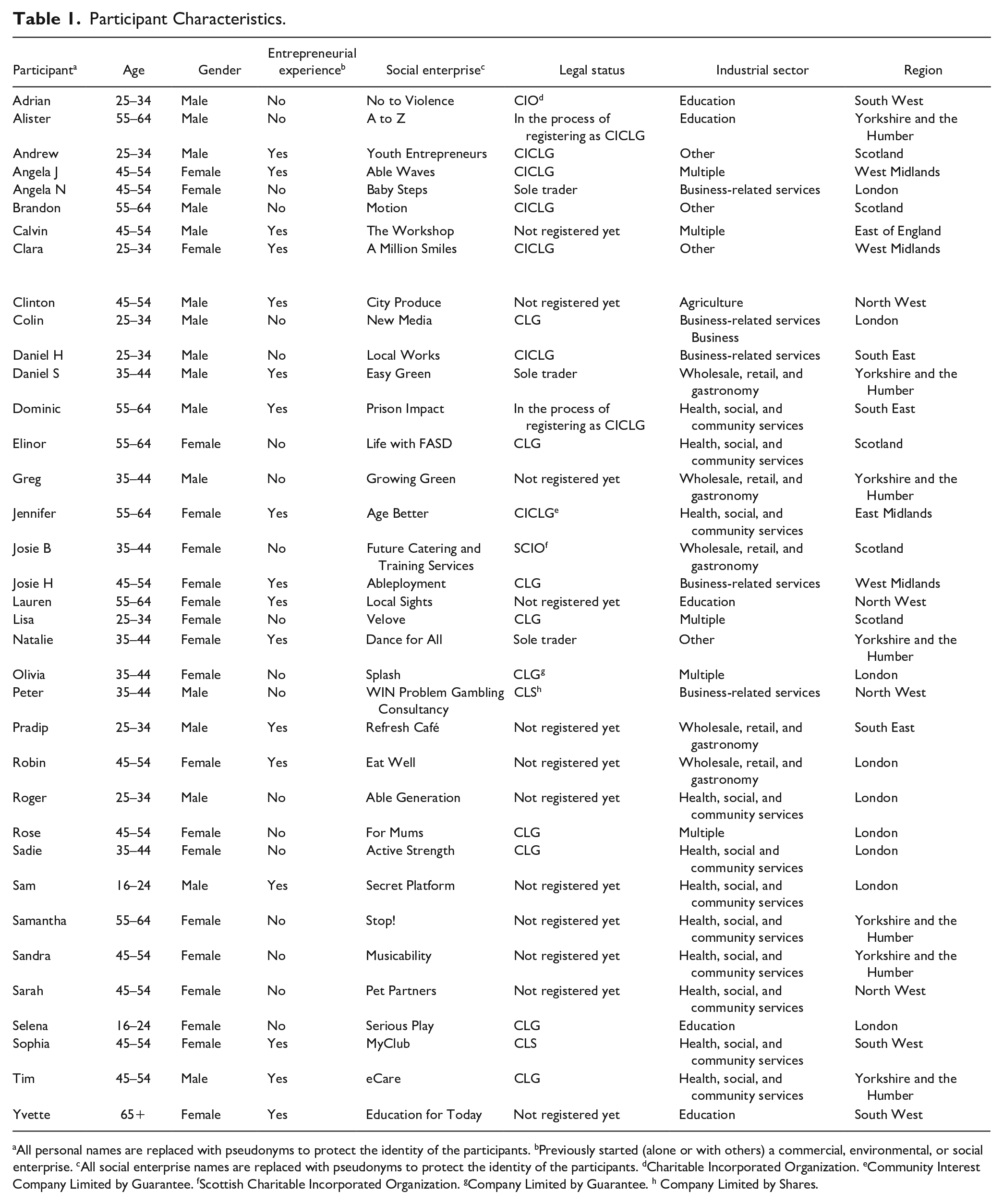
All personal names are replaced with pseudonyms to protect the identity of the participants. bPreviously started (alone or with others) a commercial, environmental, or social enterprise. cAll social enterprise names are replaced with pseudonyms to protect the identity of the participants. dCharitable Incorporated Organization. eCommunity Interest Company Limited by Guarantee. fScottish Charitable Incorporated Organization. gCompany Limited by Guarantee. h Company Limited by Shares.
Data Collection
Data were collected through 82 semi-structured interviews, 36 primary interviews, and 46 secondary interviews. Due to the emergent status of the social enterprises and the private, informal, and interpersonal nature of IFS, semi-structured interviews enabled us to collect rich and detailed accounts of specific IFS interactions and the decisions leading to these interactions. Evidence of IFS interactions is unlikely to be found in organizational documentation. In addition, we considered semi-structured interviews less obtrusive compared with observation, thus minimizing the influence of the researchers on the phenomenon. Finally, this approach allowed us to collect data on considered, yet not approached feedback sources. These are important for our analysis, yet they are unobservable and not recorded. Our approach to data collection relying on interviews is in line with recent recommendations on researching the first stage of resource mobilization (i.e., searching for resource holders) because this stage is not easily observable (Clough et al., 2019).
Interviews focused on accounts of specific IFS encounters or situations where the participants considered IFS but did not seek feedback. Social entrepreneurs’ accounts of IFS encounters and nonevents were useful as they could provide nuanced insights into decisions and interpretations that illuminated social entrepreneurs’ experiences (Orbuch, 1997). The focus on specific accounts is in line with established approaches in investigating interpersonal interactions and micro-processes, such as courageous actions at work (Schilpzand et al., 2015), and has been previously used in investigating entrepreneurs’ decision-making (Reymen et al., 2015). We asked participants to describe their two most recent IFS interactions in detail considering the individual(s) they asked for feedback and how these decisions were made. We also asked for two instances in which the participants considered IFS but decided against it. We considered that such nonevents could highlight what social entrepreneurs valued yet was lacking in feedback sources. We asked the social entrepreneurs to describe the IFS interactions in detail and engaged in probing, refining, and checking with follow-up questions if the information about feedback sources did not surface naturally. To minimize recollection and salience biases and collect rich and detailed data, we focused the interviews on specific IFS interactions from the past 2 months, regardless of their (perceived) significance or outcomes. However, older instances of IFS and their influences on current IFS interactions and learning naturally emerged as the social entrepreneurs shared their accounts. Interviews lasted between 40 and 165 min and were recorded and transcribed.
Data Analysis
While data were still collected, we engaged in parallel and iterative data analysis at the level of the decision about feedback sources. We started by reviewing the data and engaging in first-order coding (Gioia et al., 2013). At this stage, we identified that the process of searching for and selecting a feedback source was initiated by a need for feedback. This need for feedback shaped which attributes of individuals within the social entrepreneurs’ networks were valued, such as traits, skills, and approaches. We engaged in constant comparison whereby each unit of meaning was compared with the previous one in the transcript as well as all units within a category were compared with one another to ensure that they reflected the same attribute (Strauss & Corbin, 2008). At the end of this stage, we identified 24 first-order categories that remained close to the language and experiences of the social entrepreneurs to describe how they decided whom to ask for feedback based on specific valued attributes (e.g., is physically accessible, is actively involved in the enterprise development process).
As we generated first-order codes, we also started to search for, review, and define second-order themes based on the relationships between first-order categories (Gioia et al., 2013). We continuously developed new and made changes to existing themes to reflect instances that did not fit into our themes, iteratively reanalyzing the data. At this stage, we engaged in constant comparison again, this time at the level of themes to ensure they were clearly differentiated, yet captured the nuanced meaning of the first-order categories within them. Ultimately, we identified eight main themes representing different valued attributes that guided social entrepreneurs’ decisions about whom to seek feedback from: experienced, expert, encouraging, challenging, powerful, accessible, engaged, and trusted. We identified two mechanisms underpinning these valued characteristics: influencing the expected informational value of the feedback and influencing the costs of IFS, which helped to differentiate the characteristics.
At this stage, we also uncovered that the social entrepreneurs did not always seek feedback from those in their social networks and sometimes did not even seek feedback at all. When they could not identify appropriate feedback sources within their networks based on the valued characteristics, they expanded their search and considered individuals outside of their social networks. We uncovered that potential feedback sources outside one’s social networks were also evaluated based on perceptions of the same valued characteristics identified earlier. When potential feedback sources were not considered to display the valued characteristics, the social entrepreneurs abandoned their search.
Next, we identified themes that were closely related to each other, combined them into aggregate dimensions, and looked for insights into how aggregated dimensions were related to each other (Gioia et al., 2013). The identified mechanisms underpinning why certain characteristics of feedback sources were considered valuable as well as the second-order themes of expanding and abandoning the search as ways to minimize the costs/maximize the benefits led us to research on cognitive appraisal. Cognitive appraisal explains how individuals assess and respond to situations and encounters (Folkman & Lazarus, 1980; Lazarus & Folkman, 1984). When encountering a situation, individuals engage, first, in primary appraisal to evaluate whether they can benefit or be harmed, particularly in relation to goal achievement, and then in secondary appraisal to evaluate what they can do to minimize the harm or enhance benefits. Cognitive appraisal explains how individuals continuously evaluate what is happening in terms of implications for their well-being. This is relevant for feedback, as evaluative information that is different from other types of information, because feedback is personal by definition and thus with implications for one’s well-being and identity (Drencheva et al., 2021). This lens helped us to develop theoretical dimensions and see the links between different second-order themes. The themes and relationships between them offered a nuanced understanding of how social entrepreneurs searched for and selected feedback sources as one type of resource holders. Figure 1 demonstrates how we progressed from raw data and the language and experiences of the participating social entrepreneurs (i.e., first-order categories) to theoretical dimensions (i.e., aggregated dimensions; Gioia et al., 2013) that served as building blocks of a framework (see Figure 2).
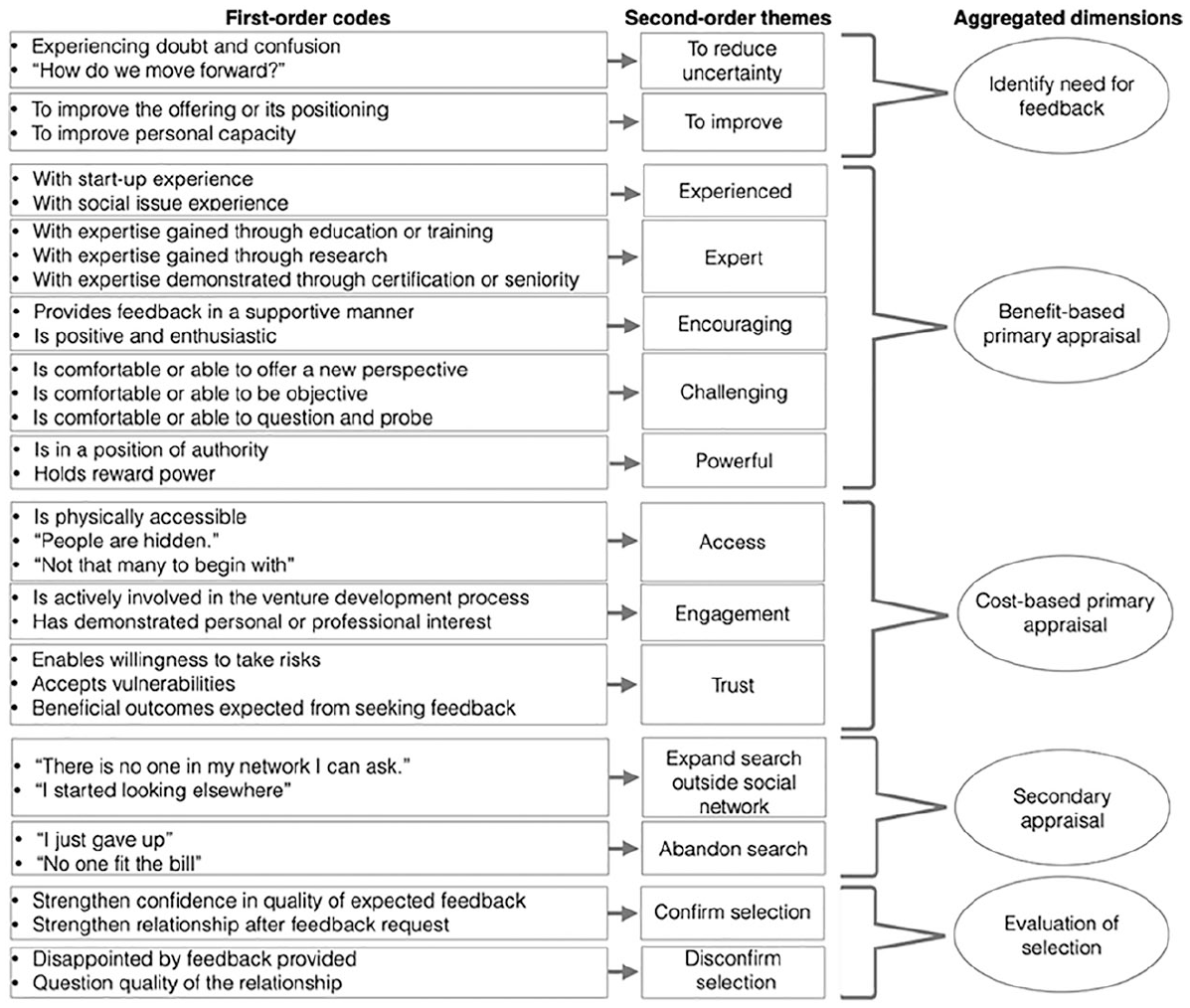
Progressive data structure.
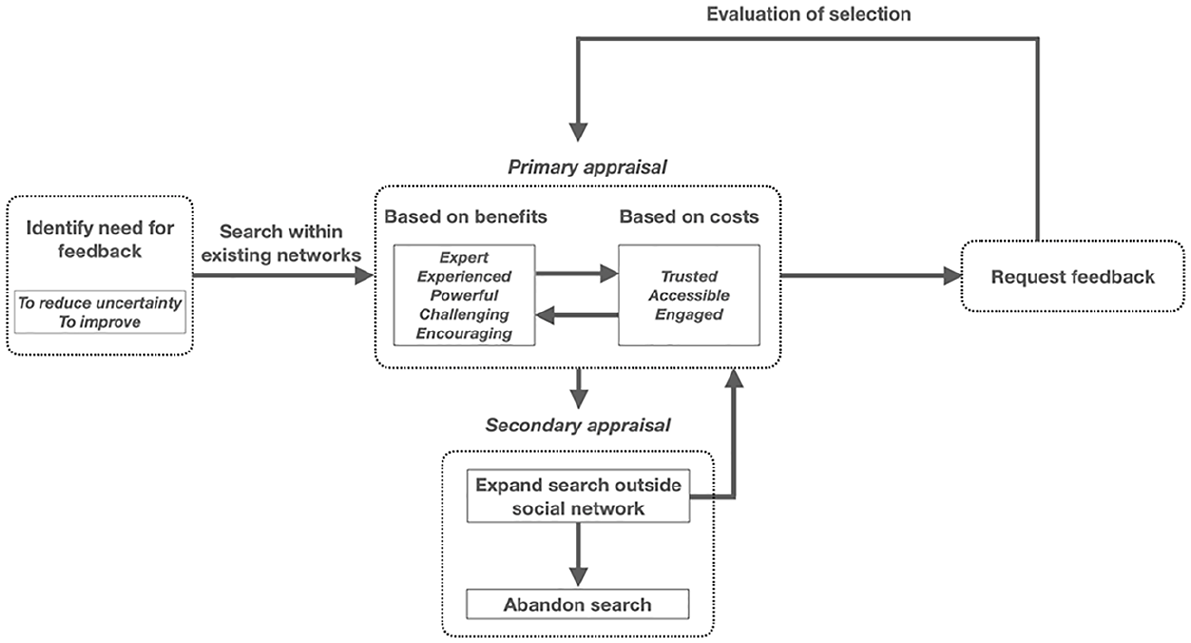
Conceptual framework of social entrepreneurs’ search for feedback sources.
Findings
Our findings indicated that before requesting feedback, the social entrepreneurs engaged in an iterative search process to identify appropriate feedback sources based on different appraisal patterns (see Figure 2). This process started with identifying a specific need for feedback: to reduce uncertainty or to improve. To meet this need, the participants searched for feedback sources within their social networks and evaluated potential sources based on specific characteristics that were associated with benefits (i.e., the expected informational value of the feedback) and costs of IFS. In doing so, social entrepreneurs engaged in primary appraisal (Folkman & Lazarus, 1980; Lazarus & Folkman, 1984) whereby they evaluated potential encounters with feedback sources as beneficial or harmful. When primary appraisal resulted in identifying an appropriate feedback source with low costs, the social entrepreneurs requested feedback. However, when the social entrepreneurs perceived the costs to be high and thus could not identify an appropriate feedback source, they engaged in secondary appraisal (Folkman & Lazarus, 1980; Lazarus & Folkman, 1984) whereby they considered how to modify the situation to minimize costs and maximize benefits.
Engaged in secondary appraisal, the social entrepreneurs expanded their search outside of their networks to identify an appropriate source or abandoned the search when appropriate feedback sources could not be identified. Importantly, this search process was iterative: Social entrepreneurs evaluated each feedback request to confirm or disconfirm the fit of the selected feedback source for future feedback needs, thus serving as prior experience to guide future searches for feedback sources. We elaborate on the key aspect of this process next with illustrative quotes in text and in Table 2.
Illustrative Quotes.
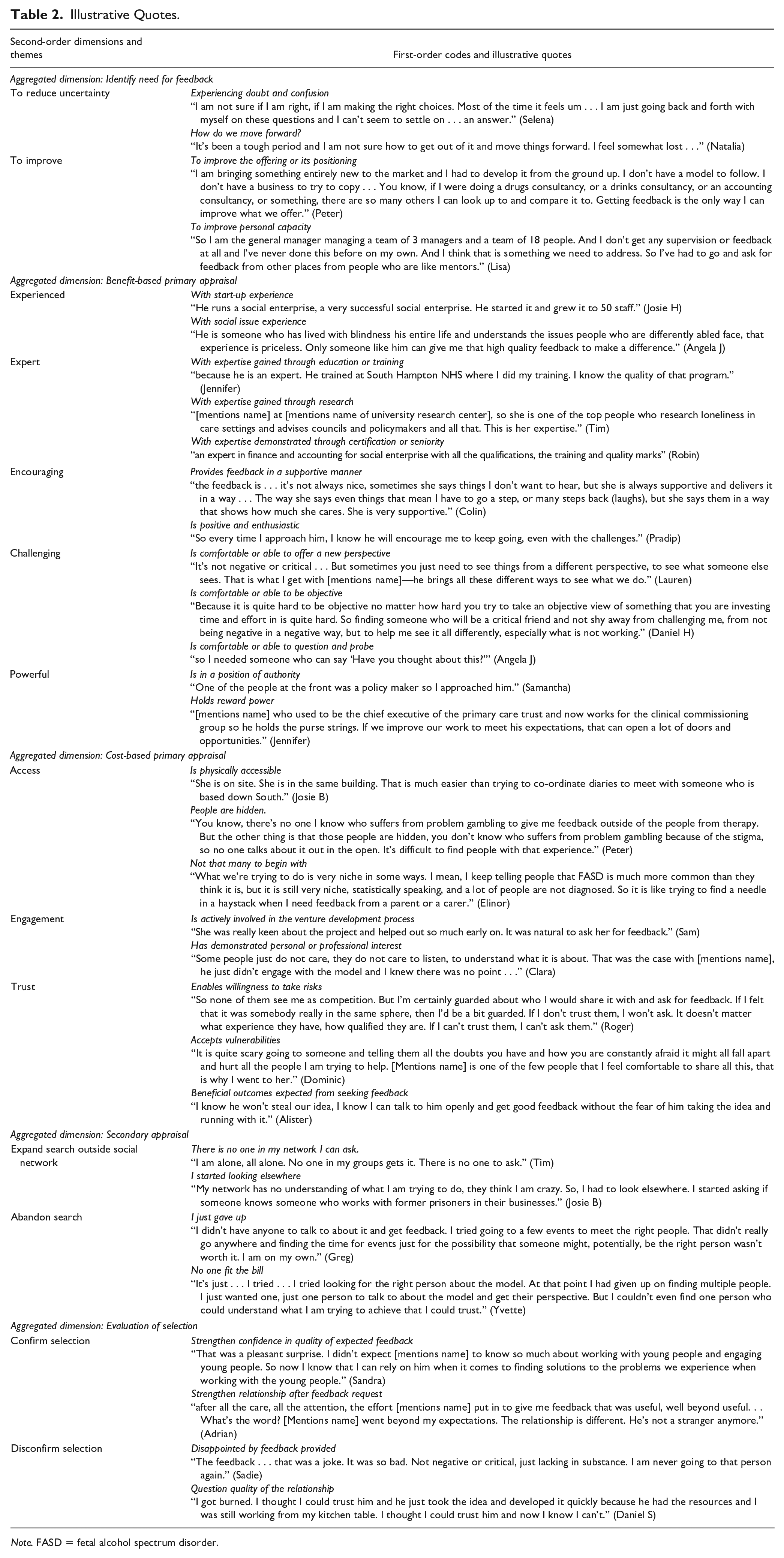
Note. FASD = fetal alcohol spectrum disorder.
Identify Need for Feedback
The social entrepreneurs’ search for feedback sources started with identifying a need for feedback as a resource. They needed feedback to reduce uncertainty and to improve. The social entrepreneurs sought feedback to reduce uncertainty, which referred to minimizing feelings of doubt, confusion, and insecurity. They experienced dilemmas and questioning that had “gone on and on,” often speaking about being unsure, confused, lost, lacking in confidence, which they found uncomfortable, stressful, and slowing down their decision-making and progress. To minimize these negative experiences, they needed feedback to confirm decisions and directions, to select between alternatives, and to generate new alternatives. They perceived feedback seeking as a low-cost experiment to—in their words—“confirm,” “prove,” “validate,” and “test” ideas, decisions, and approaches before making significant commitments. For example, Daniel H described an uncertain situation that had brought up the need for feedback:
But that sort of questioning has gone on and on . . . It’s a very important part, you know, whether we decide to split or not and then what structures we do adopt if we do or don’t. So I’m a little bit lost and I don’t want to make the wrong decision, but we need to make a decision and we need to get on with it . . . So the things that, I suppose, guide that decision making are both internal—what we want as a business and what works for us and that might vary across my board of directors—and then the other influencing factor is what would investors want and what’s going to be the best way of securing the investment that we need. So it’s external, if you like, and that I definitely can’t answer because I’m not an investor.
The social entrepreneurs also needed feedback to improve offerings, positioning, and personal capacity. They considered feedback as a valuable resource to create better products or services or to position them more effectively in the market by enhancing their appeal or correcting errors. Similarly, the social entrepreneurs considered feedback as valuable in improving their personal capacity because it helped them to acquire or alter knowledge, skills, and habits to launch and manage their social enterprises. For instance, several participants specifically referred to “my personal style and how I work with people” and “[h]ow to supervise, manage and look after people in the organization” as their feedback needs. In addition, the social entrepreneurs sought feedback about their personal lifestyles, well-being, work–life balance, and preventing burnout. For instance, Colin needed feedback about his lifestyle, including his diet and sleeping patterns, to become more effective in his work.
The need for feedback was specific to each search and influenced the first stage of the search—the benefit-based and cost-based primary appraisal inside one’s social networks.
Benefit-Based Primary Appraisal of Potential Feedback Sources
Based on the identified need for feedback, the social entrepreneurs started the search for appropriate feedback sources inside their social networks. They engaged in primary appraisal of potential feedback sources who could provide feedback with high informational value because of their knowledge or personal attributes. Thus, they appraised the potential benefits of an encounter. They considered five key characteristics that signaled potential high-value feedback and helped them to select possible feedback sources within their network: experience, expertise, encouragement, challenge, and power.
Experience referred to insider knowledge of processes, systems, and strategies based on firsthand experience with (social) entrepreneurship, the social issue, or the solution. Individuals with experience were perceived to provide high-quality feedback based on their insider knowledge. They could also empathize with the challenges of starting a new organization, dealing with a specific social issue, or working with specific stakeholders whom they understood well based on their own journeys. Summarizing the importance of an experienced feedback source, Pradip exclaimed, “I guess I would have to learn how to do it the hard way.” At the same time, the social entrepreneurs’ discourse revealed that the lack of experience was one of the main reasons to decide against seeking feedback from a specific individual. For example, although Sadie valued other characteristics in a banker as a feedback source, she considered that his lack of experience with her beneficiaries (i.e., young minority women) “disqualified” him from giving feedback related to her social enterprise.
Experience could be gained through personal involvement in starting and leading a new social or commercial enterprise now or in the past. The social entrepreneurs described these sources as “someone who’s done it, who’s been there.” Brandon’s choice to seek feedback about the sustainability of his enterprise from a successful commercial entrepreneur highlighted the value of start-up experience:
He runs a business and he’s got 28-29 staff. He has already experienced a lot of the stuff I am dealing with in this development phase I am at now. [. . .] He owns a proven business. He’s been in business for 9 years, I think, and he started off the same way as me from scratch and now has a multi-million company. So he knows how to make a business sustainable. He knows how to structure finances and processes while I’ve never done this before. I’ve never run a business before. He has been there, seen it, and done it.
However, from the perspective of the social entrepreneurs, experience could also be gained through firsthand engagement with the social issue or the solution. Such firsthand experience was perceived to provide insider knowledge into the problem space and the solution to help the social entrepreneurs conceptualize the social challenge, the offerings they developed, and how they could engage with their stakeholders. Social entrepreneurs found this attribute particularly valuable when they worked with very marginalized communities (e.g., families of prisoners) or very specific social issues and offerings (e.g., problem gambling, animal-assisted therapy). For example, Peter summarized, “You know, there isn’t [sic] that many people with gambling addictions that I know.” These sources often acted as representatives of beneficiaries and customers providing unique insights into these stakeholders. Sam’s choice to seek feedback from a social worker reflected the role of experience with the social issue to complement his IT knowledge:
he can offer something different because he is a social worker and works in social services, so he understands our potential clients and the people who can benefit from purchasing the data . . . He can give us feedback about different parts of the project that we don’t have much experience.
While experience was based on insider knowledge gained through firsthand engagement with (social) entrepreneurship or the social issue, expertise referred to formal knowledge gained through primary research in the field, education, training, and certification. Expertise was focused on formal knowledge in a particular area, such as finances and accounting, social franchising, psychology, animation, or online sales, for which the social entrepreneurs felt they did not know enough to confidently continue their work. Such expertise was perceived as particularly important by social entrepreneurs leading complex or novel enterprises that relied on multidisciplinary insights to catalyze social change. For example, Andrew reflected his need to seek feedback from expert sources due to his lack of knowledge: “I mean I’ve never built websites before, never developed software or ran workshops before. I’ve never developed an educational program before.”
Encouraging referred to the feedback source’s perceived approach to providing feedback in a supportive manner that energized the social entrepreneur to take action. Such feedback sources were perceived to provide feedback that was enthusiastic, positive, and supportive. Their actions and approaches signaled concern for the social entrepreneur and the enterprise, motivation to be on the entrepreneur’s side, and see them succeed. For example, reflecting on why he sought feedback from his friend Robert, Pradip exclaimed, “He just wants to see me be successful and help people!” Encouraging feedback sources helped the social entrepreneurs to maintain their enthusiasm about the enterprise and continue working on it. The absence of this attribute in feedback sources was telling about its importance for social entrepreneurs and their motivation to continue working on their enterprises. Sarah’s conflicting experiences with another social entrepreneur and her former colleagues brought this to the forefront. While she was seeking feedback from a “very supportive” social entrepreneur who emphasized the message of “don’t give up, keep going,” she also experienced the lack of encouragement from experienced and expert feedback sources in the industry, which she considered did not add informational value to the feedback:
A lot of my colleagues, I think, thought I was the slightly mad animal woman, a bit eccentric who would never get this going . . . they knocked me back the first time and I was thinking “I’m mad.”
In contrast, challenging referred to a feedback source who provided honest and objective feedback that brought new perspectives, questioned assumptions, and highlighted potential issues and gaps, thus increasing the expected informational value of the feedback. The social entrepreneurs recognized that they were very closely connected with their social enterprises, in some cases having experienced the social issues they aimed to address. Hence, they sought feedback sources who were “detached,” “objective,” “not biased,” “dispassionate,” and “neutral” to keep the entrepreneurs “leveled” and “grounded.” Thus, challenging feedback sources “will tell me things I don’t want to hear but I need to hear” (Pradip). These feedback sources were not perceived to be necessarily negative or that they always provided negative feedback. Instead, they were perceived to act as “critical friends” who provided new perspectives, challenged taken-for-granted assumptions, and questioned decisions, ideas, and approaches to further develop the social entrepreneurs’ work and the enterprises.
Social entrepreneurs described challenging feedback sources as individuals who were confident and skilled to voice their ideas, opinions, suggestions, and questions. However, some valuable feedback sources, such as beneficiaries or employees, were perceived to lack the confidence to share challenging feedback because of their pervious experiences with stigma or vulnerability. For example, Angela J discussed the lack of challenging feedback from her staff based on who they were as individuals and their previous experiences:
I think that they are quite young and they’re not used to feeling like they have a voice. You know, one girl’s come from TV, but has been, like, at the bottom of the system and has been the one who’s rushed off to make the tea for the team and pick up documents. She’s been at the low end of TV production and the other girl comes from working at Tesco. Well, in both of those jobs they’ve never been asked to sit round a table and asked “How do you think it’s going?” . . . They’re not used to that environment.
At the same time, challenging also referred to the source feeling comfortable to question and challenge the social entrepreneur in a way that was objective and critical. Yet, individuals who were emotionally close to the social entrepreneur, such as family and friends, or experienced power differentials related to vulnerability and stigma, as beneficiaries and employees, were perceived not to share critical feedback. Thus, being a challenging feedback source also referred to individuals’ position in relation to the social enterprise. Also reflecting on the lack of challenging feedback from her staff, Josie H focused on the power dynamics:
Now I have employees, but it is a different relationship because I don’t think they will challenge me in the same way as their boss. So it is the whole power issue. I have to be very aware that I’m their boss. However much I talk about teamwork, you know, so it’s not always going to be necessarily as honest as it could be.
The final characteristic considered in the benefit-based primary appraisal was power, which referred to having the opportunity, capacity, or resources to directly or indirectly influence enterprise outcomes. The actions of these individuals could shape the future of the enterprise because they could directly provide resources or indirectly shape the context of the social enterprise. Thus, they were perceived to provide feedback with high informational value.
Power included both reward power and being in a position of authority or influence. Reward power referred to the potential resources the feedback sources held that were needed for the social enterprise to continue its operations. For example, individuals with reward power were customers, funders, investors, and commissioners. The social entrepreneurs considered that understanding the needs, constraints, processes, and challenges of these individuals through IFS was essential for the financial success of the enterprise “because ultimately that is what will help drive the business forward and make it profitable” (Brandon). Feedback from these individuals could enable the social entrepreneurs to develop offerings that met their needs in an empathetic way, were positioned appropriately, and earned their positive disposition. Thus, individuals with reward power were in a position to directly influence enterprise outcomes based on their decisions to use or procure offerings or to invest.
The second type of power referred to being in a position of authority or influence. It specifically described potential feedback sources in relation to their formal position in the broad system and opportunities to make decisions that could shape the context of the social enterprise. For example, the individuals who were often considered to be in positions of authority were councilors, policymakers, ministers, and gatekeepers. These individuals were perceived to indirectly shape enterprise outcomes by changing requirements, priorities, and procurement processes that could make it easier for the enterprise to operate or to access markets. As gatekeepers, they could provide privileged access to those with reward power, as such was the case with executives or administrators of membership organizations that the social entrepreneurs considered potential customers. Finally, individuals in positions of authority could provide access to valuable information early on, thus enhancing the competitiveness of the enterprise. For example, Samantha shared the benefits of seeking feedback from two individuals in senior positions in the Department of Education: “They were rewriting the curriculum. So what I found out back then was way ahead of everybody else because I knew what was coming and what was going to be in the curriculum.”
Cost-Based Primary Appraisal of Potential Feedback Sources Before a Feedback Request
While identifying individuals who could provide feedback with high informational value, the social entrepreneurs also considered the costs of seeking feedback from these individuals. This represented a cost-based primary appraisal whereby the social entrepreneurs considered characteristics that could influence the effort, image, or competitiveness cost of IFS, regardless of the anticipated informational value of the feedback. During this appraisal, the social entrepreneurs considered three key characteristics of potential sources of feedback, further narrowing down the pool: access, engagement, and trust. Although we present benefit-based and cost-based primary appraisals separately for ease of reading and clarity, they often occurred simultaneously or split seconds from one another. For example, Sophia explained,
When I was thinking about these two options and which way to go, I knew [mentions name] will be perfect to talk to. He knows the two organizations, he has worked with them. He could give me feedback that probably no-one else could. But, immediately, I ruled that out. We are in competition at the moment. I can’t trust him. Not with this. Not with something so big.
Access referred to the ease with which the social entrepreneur could seek feedback from a source based on shared proximity. Social entrepreneurs often worked alone and could not easily ask for feedback when needed. They made comparisons with their previous or other jobs and reflected that seeking feedback when part of a team was opportune, while as a social entrepreneur it was an effort and required more time. Issues with access were common particularly for powerful feedback sources who were often in different localities (e.g., the capital or major cities). Yet, even sources related to the social entrepreneur or the organization, such as team members, could pose issues with a lack of shared proximity, as Josie H explains:
I think the remoteness of the team. I think that causes us difficulties. I think it would be much nicer if we could meet up even if it wasn’t every day but just monthly or something as a team face to face because those relationships are difficult to keep alive when the only communication is through the odd phone call and the odd email.
Beyond access, the social entrepreneurs also valued engagement, which referred to the time, attention, and effort that the feedback source was willing to dedicate to providing feedback. At the lower level of engagement, feedback sources demonstrated a personal or professional interest in the social issue or the enterprise and availability to provide feedback (in a timely fashion). At the higher level of engagement, feedback sources were actively involved in the development of the enterprise. They had previously provided tangible and intangible support to the social entrepreneur, such as introductions to relevant individuals. Their previous actions to support the enterprise gave the social entrepreneurs confidence to ask them for feedback as well. Words and phrases, such as “genuinely interested,” “enthusiastic,” “keen,” “excited,” and “passionate,” were often used by the social entrepreneurs to describe these feedback sources, yet these characteristics were often lacking in individuals. Discussing the lack of interest by his wife, Tim summarized why he did not seek feedback from her anymore: “my wife often throws a blank ear. She’s heard it all before and isn’t very engaged with it and we don’t talk about this anymore.” Lack of engagement was also attributed to limited availability. For example, Sadie reflected on the lack of this attribute in a potential feedback source: “From speaking to the person, he was quite busy and then it was holiday season and then we just couldn’t find a date to meet up.”
Demonstrating the simultaneous nature of benefit- and cost-based primary appraisal is stigma, which was often associated with a lived experience of the social issue and a lack of engagement. Feedback sources with experience of particular social issues were often marginalized and excluded from mainstream society because they were stigmatized. Social entrepreneurs reflected that these individuals often struggled to engage in a feedback request because the IFS interaction exposed their stigmatized identities as “families of prisoners,” “problem gamblers,” and members of a vulnerable community. For example, Dominic reflected on the unavailability of families coping with imprisonment as feedback sources with valuable experience:
But many don’t come forward because they feel stigmatized walking through the door. The hardest part is getting feedback from families about previous experience with imprisonment in the family. That is a challenge.
The final attribute that the social entrepreneurs considered in the cost-based primary appraisal was trust, referring to a relationship between the social entrepreneur and the source whereby the entrepreneur was willing to take risks in feedback requests and expected positive outcomes in response to the requests. The social entrepreneurs’ discourse revealed that IFS was costly because it could expose ideas, methods, and approaches that the feedback source could appropriate. Hence, many participants reflected that they were “cagey,” “guarded,” and “restricted” in terms of whom they approached for feedback. In addition, they considered that IFS might expose vulnerabilities and insecurities, thus damaging their image in front of powerful stakeholders, family members, and friends. This is why the social entrepreneurs considered that a trusting relationship with the feedback source was essential so they could expose their vulnerabilities without attempting to manage their image while expecting that the individual would not appropriate the social entrepreneur’s ideas. The social entrepreneurs’ experiences and descriptions of trust as expecting positive outcomes and willingness to be vulnerable were consistent with established definitions of trust (Mayer et al., 1995); hence, we retained the label.
The social entrepreneurs’ discourse revealed that these relationships had accumulated mutual goodwill whereby self-interest did not guide the entrepreneur’s or the source’s actions toward the other. Many feedback sources had “earned” the trust of the social entrepreneurs and had demonstrated that the social entrepreneurs could expect positive outcomes in response to feedback requests. In such trusting relationships, social entrepreneurs felt comfortable to be vulnerable and share their insecurities. Reflecting on his trusting relationships with an accountant and an entrepreneur, he had recently approached for feedback multiple times, Pradip shared how these relationships were strengthened to allow him to seek feedback about sensitive topics and expose his insecurities without worrying about his image:
So because I’m in recovery . . . I’ve met lots of people in the last 8 years who are also on a similar journey and by the very nature of the journey you become quite close and you talk to each other quite open and become quite open with each other. And over time you develop friendships and usually the nature of the friendships becomes that you can pretty much talk about anything. Whereas most people are actually scared to talk about what’s really going on for fear of looking stupid or not having everything under control, but actually the reality is I can talk to them about all of this because I trust them . . . I don’t really have an issue . . . talking about, like, my financial fears or my fears around having to discipline somebody or my fears around whether I’m going to have the security to find another shop or my fears around taking up credit cards.
Overall, the characteristics valued in the cost-based primary appraisal described the quality of the relationship between the social entrepreneur and the feedback source, which made IFS potentially harmful by costing the social entrepreneur effort, time, image, and competitiveness.
The social entrepreneurs requested feedback when they identified an appropriate feedback source within their social networks and appraised that IFS would entail limited costs. However, engaging in benefit- and cost-based primary appraisal did not always yield appropriate feedback sources because sometimes the costs were perceived as too high or the benefits not high enough. In such situations, the social entrepreneurs engaged in secondary appraisal to consider whether they could expand their search outside their social networks or alternatively abandon IFS altogether if secondary appraisal considerations did not yield alternative feedback sources.
Secondary Appraisal of Potential Feedback Sources
Through secondary appraisal the social entrepreneurs evaluated what actions they could take to minimize the potential costs of seeking feedback and/or to enhance the potential benefits (Folkman & Lazarus, 1980; Lazarus & Folkman, 1984). This process of considering alternative actions started first with searching for alternative feedback sources within social entrepreneurs’ social networks and then broadening outside their network. If the latter failed as well, they then abandoned the search for feedback (sources).
The initial search always focused on the social entrepreneurs’ existing social network, because the social entrepreneurs shared that they preferred to have a relationship with potential feedback sources. Yet, many of the social entrepreneurs perceived that they lacked the “appropriate” networks of business professionals or social entrepreneurs because they “didn’t start with a business network or a professional network at all” (Andrew). As Yvette summarized, “I don’t work in those circles.” For other social entrepreneurs, this lack of “appropriate” networks was created by the unique aspects of the enterprise that posed limitations on whom the entrepreneurs considered to be a credible feedback source. This was the case of Elinor who perceived that the social issue of supporting families with children who suffered from fetal alcohol spectrum disorder (FASD) was very niche given how poorly understood the medical condition was, which limited whom she could go to for feedback: “Very few people are properly diagnosed with FASD and before our daughter arrived I didn’t know anyone who’d had to cope with it. I still know very, very few people who understand the condition.” Thus, social entrepreneurs sometimes struggled to identify individuals in their networks who had the knowledge and personal attributes to provide feedback with high informational value. In some cases, social entrepreneurs could identify an individual who possessed the desirable characteristics in relation to expected benefits, but was not perceived as trusted or engaged, thus increasing the costs. As Olivia explained,
We’ve worked together before so I know she will have great insights on this. Her experience in the industry could be invaluable, but we are now in competition and I can’t trust her.
When the search did not yield appropriate feedback sources, the social entrepreneurs expanded their search outside their social networks. They proactively searched for potential feedback sources through events, existing relationships and membership organizations, and social media. They traveled to similar organizations where the founders of these organizations could provide feedback. For example, Calvin organized visits to several similar organizations in England to get feedback on his novel model. Sarah summarized her experience of selecting a certified therapist with start-up experience in animal-assisted therapy across the country after failing to identify appropriate feedback sources in her social networks: “I really wanted to have some sort of feedback, but then I just got on the internet and started looking for people who might be able to help.”
When considering sources outside of their networks, the social entrepreneurs searched for individuals who demonstrated the same characteristics as those valued in the primary appraisal (i.e., expertise, experience, power, challenging, encouraging, trusted, accessible, engaged). Yet, whether a potential source met the selection criteria was not always evident because of the lack of prior experience and interactions with the individual. In these situations, the social entrepreneurs attempted to put in place safety mechanisms in their selection process. They leveraged existing relationships for introductions and vetting of possible feedback sources. For example, Angela J asked the local Tourism Information Centre to introduce her to several “trustworthy” restaurant owners to get feedback on her mobile application that showed the accessibility of venues. The participants also considered existing cues from public information, such as social media profiles and comments by others. For example, Selena reflected on her decision to eventually use Twitter to reach out to a successful entrepreneur for feedback:
I didn’t know him. Never met him. But he seemed very helpful and generous on Twitter, responding to everyone’s questions and requests, sometimes offering calls instead of responding on Twitter. And a few people in my stream had shared how helpful he was to them. I didn’t know him, but I felt I could trust him.
Overall, when an expanded search outside one’s social networks was successful, the social entrepreneurs requested feedback from the selected source to meet their initial need for feedback. However, sometimes even an expanded search for feedback sources did not lead to identification of an “appropriate” source and the participants abandoned the search for a feedback source. This occurred because the participants did not perceive that anyone they had considered met their selection criteria. Daniel S and Alister explained why they had abandoned their search at different points even when considering individuals outside of their networks. Daniel S highlighted the perceived lack of knowledge among potential feedback sources: “because it is so complex and different, it’s difficult to find anyone who gets it [the business model],” whereas Alister focused on the perceived lack of trust: “There are lots of experts in the industry, but how can I trust them?” In such circumstances, the social entrepreneurs abandoned their search for a feedback source and refrained from IFS, thus not meeting the identified need for feedback.
Evaluation of Selection After the Feedback Request
When the primary and secondary appraisals were successful in identifying a perceived appropriate source for the specific feedback need, the social entrepreneurs requested feedback. This action, however, was not the end of the search process because it provided cues to confirm or disconfirm the selection. It allowed an evaluation of the feedback source and the quality of the feedback provided, thus influencing future searches.
After a feedback request, the social entrepreneurs evaluated if the selected feedback source indeed had the attributes valued in the benefit-based primary appraisal. That is, whether someone was considered experienced, challenging, encouraging, or an expert changed based on feedback requests. For example, this is how social entrepreneurs like Tim, Alister, and Roger discovered that their life partners were not as encouraging as they had believed them to be previously. However, social entrepreneurs also discovered that feedback sources could demonstrate these attributes to a higher degree than expected. For example, individuals in Clinton’s community whom he’d known for a long time demonstrated unexpected experience and expertise in landscaping and agriculture that were useful for developing a community garden, while Calvin discovered that his running partner had experience in leading volunteers that he was not aware of, yet was useful for developing The Workshop. Thus, how sources were perceived in relation to the characteristics evaluated in the benefit-based primary appraisal changed as attributes were discovered or reevaluated after engaging in feedback requests and served as prior experience for future searches for feedback sources.
In addition, as the social entrepreneurs sought feedback through multiple requests from the same individuals, they reflected on how these relationships changed in relation to engagement and trust (i.e., the criteria considered in their cost-based primary appraisal of feedback sources). Feedback requests after an expanded search launched new relationships as social entrepreneurs approached individuals outside of their social circles for feedback. When a feedback source was engaged, the relationship between them and the social entrepreneur strengthened to generate trust and enable them to challenge the entrepreneur. After multiple feedback requests, sources demonstrated increasing support, engagement, and encouragement. These positive changes in the relationships between social entrepreneurs and feedback sources enhanced how these individuals were perceived in relation to the characteristics valued in the cost-based primary appraisal for future feedback requests. Andrew reflected on the changes in his relationships with trusted feedback sources he tended to approach frequently:
They’ve contributed a lot of their own time to help that idea, to help get it to where it is now and over that time I developed a lot of trust with them.
However, the perception of how well a feedback source met the criteria valued in the cost-based primary appraisal could also change in negative ways after feedback requests. For example, social entrepreneurs’ feedback requests were sometimes met with boredom (e.g., Daniel H, Samantha), indifference (e.g., Tim, Samantha), annoyance (e.g., Selena, Roger, Angela J), and doubt (e.g., Tim, Roger). Such responses strained the relationship between the social entrepreneur and the feedback sources and these individuals were rarely approached for feedback after such instances because they were not considered engaged or trusted. In addition, feedback sources could appropriate ideas leading social entrepreneurs to feel “quite restricted with who I trust to ask for feedback and who I share our ideas with because of the experiences we’ve had in the past” (Josie B). These negative responses to feedback requests and changes in relationships informed choices and made some individuals less appropriate feedback sources in the eyes of the social entrepreneurs for future encounters.
Discussion
Our findings start to open the black box of how social entrepreneurs initiate resource mobilization processes (Clough et al., 2019; Hota et al., 2019) in the early stages of their venturing activities. We achieve this by investigating how social entrepreneurs search for and select feedback sources (i.e., the individuals approached for interpersonal feedback as critical intangible resource). Our findings can explain how social entrepreneurs search for and select feedback sources as an iterative process and why specific individuals are approached for feedback while others are not, even if they belong to the same category of potential feedback sources (e.g., community leaders). Overall, our process perspective complements the dominant quantitative variable-centric perspective in resource mobilization (Clough et al., 2019) by explicating how social entrepreneurs start the resource mobilization process and the challenges they may face. Existing research focuses on whether and how often—rather than how and from whom—(social) entrepreneurs access resources and with what outcomes. Our findings have two implications for research on resource mobilization in general and resource mobilization among social entrepreneurs in the early stages of the venture development process. They also offer complementary insights to related research on information seeking.
Searching for Resource Holders as an Appraisal Process
Our findings draw attention to the search stage of resource mobilization as an appraisal process that should not be taken for granted. Rather, it is a process fraught with challenges, which means that it is not always successful in accessing the desired resource. Our findings depict the search for and selection of feedback sources (as one group of resource holders) as an iterative process. This process includes multiple cycles in and outside one’s social networks based on appraisal of valued attributes of those approached for feedback (e.g., as trustworthy). Our findings unveil how the resource mobilization process is initiated with appraisals as well as how the challenges and complexities in the initial stages of the process can influence how later stages unfold or fail to unfold and whether (social) entrepreneurs access the resources they need.
More specifically, our findings complement the scarce research on social entrepreneurs’ interpersonal feedback seeking that has only produced fragmented lists of feedback sources (e.g., community leaders, employees; Katre & Salipante, 2012; Smith et al., 2012). We add to this research by explicating how and why those approached for feedback are selected. More broadly, by investigating the search for feedback sources as one specific resource holder, our findings complement research on resource mobilization in social entrepreneurship that has taken the search stage of resource mobilization for granted and instead focused on how resources are accessed (Desa & Basu, 2013; Hota et al., 2019) and with what outcomes (Bacq et al., 2015; Bojica et al., 2018; Kickul et al., 2018).
Understanding the search for feedback sources as a process matters for two key reasons. On one hand, our process model can explain why social entrepreneurs seek feedback from some individuals and not from others, even from the same category, because they appraise individuals’ perceived attributes differently. Given that identifying a feedback source is the first stage of the feedback-seeking process, explicating what attributes social entrepreneurs value in feedback sources contributes to understanding how the feedback-seeking process unfolds. For example, valued attributes can influence what media is used to seek feedback (e.g., the use of digital tools when lacking physical access) or whether social entrepreneurs even engage in a feedback request (e.g., when individuals with valued characteristics are not identified and the search process is abandoned). Thus, understanding the search process and its challenges can explain whether social entrepreneurs can even access feedback as a valued resource. This is in contrast to the, often, implicit assumption that feedback is readily and widely available to social entrepreneurs (Muñoz et al., 2018).
On the other hand, our process model can explain why the process unfolds differently over time for different social entrepreneurs and for the same social entrepreneur at different points in time. It shows that social entrepreneurs make ongoing decisions of what they value in a potential source for each feedback request and how sources can be perceived differently over time based on the need for feedback. Our findings also highlight the reflexive nature of the feedback-seeking process whereby social entrepreneurs learn from each feedback request, re-evaluate whether the approached source indeed demonstrated the valued characteristics, and expand their social networks through feedback requests to individuals they do not have established relationships with. This is a valuable insight particularly for social entrepreneurs working in nonmunificent environments. In such environments, access to resources is limited by social norms that shape how much resource holders know about social entrepreneurship, how they view social entrepreneurship, and ultimately whether they support social entrepreneurs to engage in an activity seen as norm-breaking (Bhatt et al., 2019). In these environments, social entrepreneurs may face discouraging, opposing, and indifferent feedback from those closest to them and their families due to the costs of norm-breaking (Qureshi et al., 2016). By taking a process perspective, our findings extend these insights highlighting how social entrepreneurs learn from such discouraging and unsupportive interactions and change whom they approach for feedback in the future. Thus, our findings illuminate the reflexive agency of social entrepreneurs that can aid them to navigate challenging environments.
Uncovering Novel Power Dynamics in the Resource Mobilization Process
Our findings expose unrecognized power dynamics in resource mobilization. Research on resource mobilization, and in particular resource dependency, tends to assume that the resource holder is the powerful agent and (social) entrepreneurs are lacking power because others make the decision of whether to give them access to resources (Hillman et al., 2009; Malatesta & Smith, 2014). This is typical when the resource at stake is financial (e.g., pitching to investors or crowdfunding backers; Parhankangas & Renko, 2017), which is the resource most often investigated in the resource mobilization literature in entrepreneurship (Clough et al., 2019). However, investigating feedback as an intangible resource in the social entrepreneurship context calls for this implicit assumption to be recast. Our research challenges this implicit assumption in two distinct ways by showcasing where in the process social entrepreneurs have agency and why some resource holders may have less power than would be expected from a traditional resource mobilization perspective that prioritizes financial resources in commercial settings.
On one hand, our findings showcase how social entrepreneurs have power in multiple aspects of the search process. They are agentic in identifying a specific need for feedback and make decisions about seeking feedback to meet this need, instead of reactively responding to feedback provided by others (Muñoz et al., 2018). They have agency in considering multiple individuals and making decisions about how well these individuals meet their criteria, instead of seeking feedback from anyone who may belong to a specific category (e.g., community leader, beneficiary; Katre & Salipante, 2012). Social entrepreneurs are also agentic in breaking out of the constraints of their social networks and identifying resource holders outside of their networks (Dufays & Huybrechts, 2014). Finally, our findings depict social entrepreneurs as agentic in their decisions to refrain from seeking feedback from some individuals who do not meet their selection criteria or to abandon the search altogether.
On the other hand, resource holders have distinct types of power and may not even be aware of the power they have. In our study, feedback sources as resource holders had two types of power: (a) power as the opportunity, capacity, influence, or resources to directly or indirectly impact outcomes for the social enterprise and (b) experience of the social issue or the solution as a distinct type of knowledge among beneficiaries and employees that is highly valuable to social entrepreneurs because of the complexity inherent in their work (Battilana & Lee, 2014). Yet, those with experience of the social issue may not be aware of the power they have. Our participants shared instances of how employees from vulnerable and marginalized backgrounds may not have the skills or the confidence to provide meaningful feedback to a social entrepreneur who owns the organization they work for. Beneficiaries may also refrain from providing (challenging) feedback because they lack confidence, fear stigmatization after exposing their vulnerable identities, or fear exclusion from a service that they need that is only provided by the social enterprise. These individuals hold power as resource holders, as viewed from the perspectives of social entrepreneurs and resource mobilization scholars, yet they do not always act as such. These power dynamics are likely unique to the social entrepreneurship context with its focus on achieving social change, often for marginalized individuals and communities.
These power dynamics thus suggest that eliciting the voice of beneficiaries or employees who have traditionally had less power (Bapuji et al., 2020) requires careful consideration and construction of mechanisms of how this could be done in ways that are safe while also enhancing their motivation and capabilities for voice (Stephan et al., 2016). Such mechanisms in platforms for the voices of stigmatized and vulnerable beneficiaries and employees can include removing the perceived risks for vulnerable individuals: exposing stigmatized identities or losing access to a needed service. The mechanisms can also focus on enhancing motivation for feedback and voice by demonstrating its importance and how feedback is used. Such mechanisms to enhance the opportunities for vulnerable individuals to provide feedback are important to avoid replicating existing power dynamics when social entrepreneurs seek feedback from those in positions of power and authority who may find it easier to express their interests or to actively exert pressure over social enterprises (Pache & Santos, 2013; Ramus et al., 2018).
Insights for Research on Information Seeking
Our findings on the process of selecting feedback sources also align with and extend related research on information seeking. Research on information seeking conceptualizes approaching sources of information as an active choice process, but does not explicate this process (Borgatti & Cross, 2003; Robinson & Simmons, 2018). We explicate this process and show how social entrepreneurs evaluate the characteristics of potential feedback sources within social networks based on expected benefits and costs (primary appraisal) and expand out of their social networks or even abandon the process to minimize the costs or enhance the benefits (secondary appraisal). This is important because the role of secondary appraisal in identifying ways to minimize the costs can explain the surprising findings that costs are not associated with the frequency of seeking information (Borgatti & Cross, 2003). At the same time, we also draw attention to competitiveness concerns as another cost of seeking feedback/information that is not considered in the information seeking literature.
Further building on research in information seeking, we extend our understanding of what characteristics are valued in those approached for feedback/information that are particularly relevant in the social entrepreneurship context. Our findings that social entrepreneurs value knowledge in potential feedback sources aligns with the research on information seeking (Borgatti & Cross, 2003; Robinson & Simmons, 2018). However, we offer more refined insights than available in the existing literature by differentiating types of knowledge relevant for social entrepreneurs: experiential insider knowledge and formal subject matter knowledge. Experiential insider knowledge of the social issue is particularly relevant in social venturing because of the prosocial goals of social enterprises (Mair et al., 2012). We further extend research on information seeking by showing that knowledge and accessibility (Borgatti & Cross, 2003; Robinson & Simmons, 2018) are not the only attributes that social entrepreneurs value in feedback sources. Indeed, they have high and sometimes even contradictory expectations of feedback sources, such as being both encouraging and challenging or being both powerful and trusted. Critically, these attributes can relate to one another in nuanced ways that are unique to the social entrepreneurship context in relation to stigma. For example, vulnerable and stigmatized individuals can be perceived as having high levels of experience of the social issue; thus, their feedback is expected to have high informational value. Yet, their stigmatized identities can also mean that they are perceived as less challenging in their feedback, reducing the expected informational value of their feedback, and less engaged and accessible, which increases the costs of seeking feedback. Thus, the uniqueness of the social entrepreneurship context as embedding prosocial goals and diverse and vulnerable stakeholders allows us to uncover new characteristics valued in those approached for feedback/information.
Limitations and Opportunities for Future Research
This study has unique strengths, such as multiple interviews with the participants and a sample of early-stage social entrepreneurs, who are typically difficult to access, yet represent a theoretically rich research context in which to investigate resource mobilization (Clough et al., 2019). However, we also acknowledge the limitations of the research, which entail promising avenues for future research on resource mobilization in social entrepreneurship.
First, this study addresses social entrepreneurs’ search for feedback sources from their viewpoints and not those of feedback sources. Social entrepreneurs were the only individuals who could provide accounts of whom they sought feedback from, how, and why, which are difficult questions to address empirically (Clough et al., 2019). However, a richer picture can be painted by examining the topic from an interactive perspective to assess sources’ reactions to feedback requests. For instance, if social entrepreneurs’ feedback requests give stakeholders a platform for their voices, are all stakeholders equally likely to act on this opportunity? How do beneficiaries, as potentially vulnerable individuals, respond to social entrepreneurs’ feedback requests vis-á-vis the responses of funders who are in a position of power?
Second, this study explores only searching for feedback sources as one specific group of resource holders. We narrowed the focus of this study to feedback sources to generate rich and in-depth insights into this process. Future research should test whether the process we identified here is used by social entrepreneurs to search for resource holders for other resources and compare search processes for different resource holders to identify if and how the process can vary depending on the resource needed. Two additional avenues for future research would be fruitful in this area. Our findings show that beyond the expected value of the requested resource, social entrepreneurs also consider the potential costs of accessing the resource in relation to image, competitiveness, and even time and effort. This raises interesting questions about how social entrepreneurs balance between the value of resources and the costs of accessing them and how they protect themselves as individuals and their enterprises when requesting resources.
Finally, interesting insights about the search stage of resource mobilization can be gained from comparative studies between social and commercial entrepreneurs. For example, in our findings experiences with the social issue emerged as a valued characteristic that could lead to feedback with high informational value. Yet, this characteristic was also related to stigma that made it more difficult to access some feedback sources and to gain challenging feedback from them. While stigma and marginalization of the potential feedback source may be less relevant in the context of commercial entrepreneurs, future research can investigate how commercial entrepreneurs with stigmatized and marginalized identities cope with their own stigma when searching for feedback sources and requesting feedback.
Conclusion
This study explores how social entrepreneurs search for and select feedback sources as a specific group of resource holders in the early stages of venture development. Our in-depth inductive study based on 82 interviews with 36 nascent social entrepreneurs offers a novel appraisal process perspective on searching for and selecting feedback sources and potentially other resource holders. It contributes to a broader perspective on resource mobilization in social entrepreneurship that recognizes the so far neglected process of searching for resource holders before resources are accessed and used to achieve organizational outcomes and challenges taken-for-granted assumptions about power among resource holders and resource seekers.
Footnotes
Acknowledgements
We thank Editor Israr Qureshi and the reviewers for their constructive comments and guidance. Earlier versions of this article were presented at the Academy of Management Annual Meeting 2017 in Atlanta, USA, and the Babson College Entrepreneurship Research Conference 2016 in Bodø, Norway. We thank the participants at these conferences for their helpful feedback.
Declaration of Conflicting Interests
The author(s) declared no potential conflicts of interest with respect to the research, authorship, and/or publication of this article.
Funding
The author(s) received no financial support for the research, authorship, and/or publication of this article.
