




Abstract
Although the simultaneous presence of multiple ambitions is inherent in hybrid venturing, pursuing social and/or environmental missions while securing commercial viability can generate ambivalence among stakeholders. In this study, we draw on the notion of “holism” to show how venture founders both embrace tensioned ambitions and sustain hybridity during critical venture development phases. Based on 6 years of data on The People’s Supermarket in the United Kingdom, we identify three distinct practices—fantasizing, bartering, and conjuring—used by founders to harness tensions productively, without compromising their venture’s multiple ambitions. These practices demonstrate the founders’ ability to maintain a venture’s hybrid nature throughout the ideation, organizational, and scale-up phases, thereby shedding light on the application of “holism” within the realm of hybrid venturing.
Multiple ambitions are the lifeblood of hybrid ventures whose mission is to address major social and environmental challenges through the running of a commercial business (Ometto et al., 2019; Shepherd et al., 2019). Yet, the existence of multiple ambitions can create “mixed feelings” among the venture’s stakeholders (Palakshappa et al., 2023). Specifically, hybrid ventures’ multiple ambitions are likely to induce ambivalence, where key stakeholders feel positive about one aspect of the venture yet negative about another (Ashforth et al., 2014). This puts pressure on venture founders as they struggle to balance different goals. Nevertheless, it remains essential for hybrid ventures to persevere in their multiple ambitions to solve problems within their immediate or more distant surroundings (Bhatt et al., 2024; Hota et al., 2023; Klarin & Suseno, 2023).
Recent studies show that hybrid ventures can resolve tensions generated by the existence of multiple ambitions (Battilana & Dorado, 2010; Pache & Santos, 2013; Smith et al., 2013). Typically, however, the responses that are suggested risk concealing key aspects of the hybrid venture, and thus fail to respect the full integrity of the venture’s multiple ambitions (Reich & Wheeler, 2016; Shepherd et al., 2022). In order to address this, scholars have proposed that hybrid ventures may, in fact, actively harness productive tensions (Battilana et al., 2015) by holistically blending “elements that would conventionally not go together” (Smith & Besharov, 2019, p. 1). For example, prior research shows how a large U.S.-based natural food cooperative uncompromisingly maintained both its moral and pragmatic missions (Ashforth & Reingen, 2014), or how a Cambodian social enterprise achieved significant financial success without reneging on its social ambition of supporting disadvantaged individuals (Smith & Besharov, 2019).
Despite apparent evidence of the mutual existence of multiple goals within hybrid venturing, research around this “positive” approach toward tensioned ambitions remains scarce and it remains to be explored how individuals continuously and actively engage with them over time (Ashforth & Reingen, 2014). Examining the practices underlying this positive orientation toward tensioned ambitions during venture development—from ideation to organizing and scaling up (Davidsson & Gruenhagen, 2021)—is thus timely in terms of advancing knowledge on how ambivalences are navigated on the ground. Hence, in this article, we ask: How do founders harness tensioned ambitions in hybrid venture development?
To examine this research question, we draw upon the theoretical perspective of holism, which refers to the simultaneous and proactive engagement with multiple ambitions (Ashforth et al., 2014). We conduct an in-depth analysis of the early development of The People’s Supermarket (TPS), the first member-led convenience store in the United Kingdom prominently to combine the tensioned ambitions of advancing community and environmental goals while creating a business model that has remained financially viable to the present day. Drawing from 6 years (2009-2015) of data collection (interviews, observations, and documentation), we identify three practices—fantasizing, bartering, and conjuring—which founders have employed during different developmental phases to embrace their venture’s hybridity fully. Presenting the venture idea holistically as “harmonious-yet-deviant,” the organization as “controlled-yet-empowering,” and the scale-up as “moderate-yet-bolstered” has helped the founders to generate crucial human and financial resources, create organizational flexibility, and protect the venture from potentially failing to satisfy multiple ambitions.
In conclusion, our study challenges the assumption of viewing ambivalence as an undesirable state that ought to be evaded or resolved (Rothman et al., 2017; Rothman & Melwani, 2017). We contribute to the literature on hybrid venturing (Battilana et al., 2022; Smith & Besharov, 2019) by explaining how the integrity of a venture’s hybridity can be maintained during a venture’s ideation, organization, and scale-up phases. Furthermore, we contribute to research on organizational ambivalence (Ashforth et al., 2014; Ashforth & Reingen, 2014; Rothman et al., 2017)—which has yet to study practices of “holism” in new venture development—by drawing attention to venture founders who actively practice holism, thereby showing how holism practices change over time in terms of their temporal and community orientations. Overall, our study reveals that practicing holism enables entrepreneurs to develop a high-intensity hybrid venture that vigorously pursues an interdependent business model, even if such an endeavor is highly demanding.
Theoretical Grounding
Ambivalence in Hybrid Venturing
Hybrid venturing means the formation of new organizations—such as social, sustainable, or community enterprises—that combine dual or multiple ambitions (Battilana & Lee, 2014; Doherty et al., 2014) and thereby challenge the primacy of shareholder value maximization as a venture’s core goal (Battilana et al., 2022; Mitzinneck & Besharov, 2019). Hybrid ventures often apply business logic to resolve dire social and/or environmental problems and improve the conditions of populations that are marginalized, suffering, and unable to change their situation on their own (Ebrahim et al., 2014; Smith et al., 2013). The prevalence of hybridity can be valuable for enhancing social legitimacy (Pache & Santos, 2013; Weidner et al., 2019) as well as for dealing with various institutional demands (Ormiston, 2023). At a practical level, hybridity can fortify innovative behavior (Ingram et al., 2016; Jay, 2013), generate access to (im)material resources (Lall & Park, 2022; Wry et al., 2014), and create new market opportunities (Dalpiaz et al., 2016).
However, the deliberate attempt by hybrid venture founders to pursue two or more ambitions in their venture’s design and strategy inevitably spawns tensions between different priorities (Battilana & Dorado, 2010; Ebrahim et al., 2014; Pache & Santos, 2013). Importantly, the existence of multiple ambitions can induce ambivalence among stakeholders at an individual or collective level (Ashforth et al., 2014). Ambivalence refers to the state of holding mixed, often contradictory feelings or ideas about something. In the context of new venture development, every decision and action by founders can trigger both positive and negative reactions, and this duality is normally elicited when a given objective clearly involves oppositional ambitions, such as “continuity and change, competition and cooperation, [. . .] top-down and bottom-up mobilization, [. . .] organizational control and individual autonomy” (Ashforth & Reingen, 2014, p. 475). For instance, while a structure of democratic governance may be assessed positively as a way of respecting different opinions, groups, and activities (Muñoz et al., 2020), it can also provoke negative evaluations if a lack of hierarchy renders the venture operationally inefficient (Knupfer, 2013). Experiences of ambivalence cause discomfort and anxiety (Vadera & Pratt, 2013; Yousfi, 2013) and can call into question the trustworthiness of an organization (Eberl et al., 2015). Failure to address these tensions can have detrimental effects on hybrid ventures’ performance and survival (Battilana et al., 2015; Boone & Özcan, 2016). Building fruitful relations with the venture’s stakeholders provides access to knowledge and ideas (Hagedoorn et al., 2023; Prado et al., 2022), while an inability to convince stakeholders can limit the scope of activities and leave a venture powerless to address the important problems which motivated the venture’s establishment (Smith et al., 2013).
Prior research offers numerous suggestions on how ventures can manage and resolve tensions to mitigate the risks induced by ambivalence. For example, studies show that members of hybrid ventures often ease conflict and generate dialogue (Alexius & Furusten, 2020) by working on a common organizational identity (Battilana & Dorado, 2010), strategically managing the transparency of their ambitions (Cappellaro et al., 2021), or incorporating elements that represent different institutional logics (Pache & Santos, 2013). In particular, extant research highlights that ambivalence can be reduced (Rothman et al., 2017; Rothman & Melwani, 2017) by means of “dominance” (greater emphasis on one ambition at the expense of another), “avoidance” (little emphasis on any of the ambitions), and “compromise” (moderate focus on each ambition) (Ashforth et al., 2014). These strategies require adaptations at the individual, group, and organizational levels so as to facilitate changes in the relative importance of the dual/multiple ambitions of the hybrid venture (Ashforth & Reingen, 2014; Smith & Besharov, 2019).
Nevertheless, what is missing here is an understanding of how hybrid ventures can maintain their multiple ambitions and avoid either compromising on the venture’s mission or oversimplifying its heterogeneity during the venture’s early development. Founders who run ventures where hybridity is simple and less intense—for instance those involving a balance between economic and social ambitions (Pache & Santos, 2013)—may compromise on some of their goals, or even avoid adopting a position on any single one of them (Farny et al., 2019). However, choosing to promote one element at the expense of another may not be desirable as this creates conflict between groups (Battilana et al., 2015) and causes divergent stakeholder expectations (Pache & Santos, 2013). In turn, in-depth case studies show that trail-blazing social enterprises might be reluctant to compromise and reduce their strongly hybrid orientation (Smith & Besharov, 2019). Hence, when the venture involves a high degree of hybridity (Battilana et al., 2017; Shepherd et al., 2019)—that is, when multiple, opposing ambitions are highly relevant for the venture—founders cannot shy away from hybridity and, therefore, must continuously emphasize the multiple ambitions at hand (Battilana et al., 2017). To address this dilemma, our research examines: How do founders harness tensioned ambitions in hybrid venture development?
Navigating Ambivalences Over Time: Holism as a Theoretical Perspective
In order to explore how founders harness tensioned ambitions in hybrid venture development, we ground our work in the organizational literature on holism (Ashforth et al., 2014). This body of work proffers a theoretical lens through which to explore responses to ambivalence in a way that simultaneously and proactively embraces a variety of ambitions, for example, social/commercial goals, cooperative/sole ownership, collective/private governance, market/anti-market ambition (Ashforth et al., 2014). In this context, holism represents “less of a win–lose trade-off between the ambitions and more of a win–win embracing of both ambitions” (Ashforth et al., 2014, p. 1465).
Holism resembles integrative perspectives on coping in that it likewise deals with the presence of dual/multiple ambitions (Hahn et al., 2015). However, unlike integrative strategies, holism does not consider these ambitions as having a paradoxical relation, that is, the ambitions are incompatible with each other (Eisenhardt, 2000). Dealing with such paradoxically related ambitions would require either the acceptance of the “mismatch,” their spatial/temporal separation, or the addition of a bridging element in order for stakeholders to embrace all of them (Hahn et al., 2015). Instead, due to its origins in natural science (Smuts, 1926), holism views these different elements as necessarily interconnected in such a way that demands for the entity to be assessed as more than merely the “sum of its parts.”
In this article, we argue that holism, which considers an object as an inseparable whole, can be necessary for sustaining “true” organizational hybridity over time (Shepherd et al., 2019; Smith & Besharov, 2019). Resonating with the notion of holism, examples from organizational contexts abound, for instance, rag-pickers in Mumbai, who discursively evoke both positive and negative meanings for their work so as to achieve “functional ambivalence” (Shepherd et al., 2022). However, as with any response to organizational ambivalence, holism can have both positive and negative effects, depending on either the situation in which it is applied or the time horizon through which its consequences are evaluated (Ashforth et al., 2014). Specifically, holism can be advantageous if the integrity of the various ambitions is vital for the venture, yet its utility in contributing to hybrid “progress” or change (Eisenhardt, 2000) depends on the capacities of those involved in regard to accepting and appreciating the plurality of the venture even as they resist offering clear guidance on choosing between actions and priorities (Ashforth et al., 2014).
Despite its promise, to date, holism has attracted rather little attention within organizational research (Ashforth et al., 2014), and there is a particular dearth of knowledge on how it can be actively applied in hybrid venturing. The development of new ventures entails that founders work on a venture’s idea, set up the organization, and scale up the venture in order to exploit emerging opportunities (Davidsson & Gruenhagen, 2021). These developmental phases impose different types of challenges for ventures and dictate which management practices are feasible and desirable for their founders (Hota et al., 2023).
Methods and Data
Empirical Context and Data
Our empirical work presents an in-depth analysis of TPS, a socially oriented convenience store located in London’s Holborn neighborhood in the United Kingdom. TPS was the first venture that aimed at directly competing with the U.K.’s four big supermarkets by offering a member-led alternative for purchasing local and healthy produce. Run as a cooperative by its members, TPS operates as a viable business while advancing the causes of community development and healthier living. As highlighted in the founders’ frequent public presentations (for example on TEDx), TPS contains multiple and conflicting ambitions, thus providing a fruitful context for the study of how tensioned ambitions are harnessed during venture development. We became acquainted with the venture in March 2009 when Arthur Potts Dawson introduced his “Theory of Unsustainable Britain” in The Independent and his idea for a new sustainable supermarket owned and run by members (Event #2 in Appendix B). The first author contacted co-founder Kate Bull by email in late 2010 after learning that then-Prime Minister David Cameron launched the Big Society Initiative (political project) at the supermarket.
TPS was founded in June 2009 as a private enterprise (later to be re-registered as a community-interest company) by three British entrepreneurs, all of whom embody different areas of expertise and adopt distinct roles in the venture’s management and everyday activities. Arthur Potts Dawson is often referred to as a “celebrity eco-chef” who has worked in several Michelin-starred restaurants and launched two environmentally friendly restaurants. Labeled as TPS’s “visionary,” Potts Dawson recounts how he was inspired by a food cooperative that had been doing business in New York since the 1970s, and how he worked long hours in the supermarket to help launch the venture. Representing retail expertise, Kate Bull is a former senior executive of a large U.K. retailer. At the time of co-founding TPS, she had already left that large corporation and ran her own retail consultancy. Bull explains that she took the position of TPS’s general manager in order to fulfill her wish to use her knowledge of retail to drive social change. David Barrie is a former TV producer and director who has been described as an “urban creative” and “regeneration specialist” involved in projects on city development, public participation, and local food systems. With his expertise in large-scale community projects, Barrie raised early funding, contributed to designing TPS’s concept, and generated vast public awareness through a TV documentary.
Typical for a case study that addresses dynamics within a single setting (Eisenhardt & Graebner, 2007), our data collection was longitudinal (2009-2015) and drew from various data sources (interviews, observation, and documentation).
Interviews
Over two rounds of primary data collection, we conducted 15 in-depth, semi-structured interviews. The initial five interviews were conducted in May 2011, and the remaining 10 interviews followed in October 2014. Interviewees included the founders of TPS, its office organizer, the head of TPS’s environmental committee, and key member-volunteers, all of whom had been actively involved in the development of TPS. Interviews lasted between 1 hour and 3 hours each and were recorded and transcribed verbatim.
As the phenomenon of interest here is episodic in nature, the interviews proved an efficient way for gathering rich empirical data (Eisenhardt & Graebner, 2007) that allowed us to understand the venture founders’ activities and presentiments over time. In particular, the interviews helped us to delve into how the founders experienced ambivalent reactions to their venture’s multiple ambitions and to locate the efforts they undertook to maintain the venture’s hybridity. As the interviews also covered immediate stakeholders of TPS, they allowed us to understand their perspective and how the venture and its founders were viewed by others.
The interview data were complemented by follow-up interactions with the founders and other stakeholders, including phone calls and email exchanges. This type of “serial hanging out” with informants allowed us to capture long-term developments when protracted fieldwork was not feasible (Sandhu et al., 2007).
Observation
We complemented and contrasted the interview data with field notes based on non-participant observations on TPS operations and community life. Over three full working days in May 2011, we generated insights into the day-to-day life of the venture by holding informal conversations with local shop owners, joining gatherings of community members, and visiting community members’ homes. To develop a deeper understanding of the research context, a member of the research team also spent 10 full days in October 2014 observing the supermarket itself and interacting with its members, volunteers, and customers. Taken together, this helped us to enrich our data collection with a naturalistic mode of inquiry (Mair & Marti, 2009).
Documentation
We collected more than 120 documents and media files published and broadcast between March 2009 and February 2015. These data included press articles and releases, feature stories, video documentaries and interviews, speeches, and external and internal reports, which were either privately or publicly available (the complete list of documents is available from the authors upon request).
To obtain and analyze secondary data in real time, we subscribed to several online services. We became followers of TPS on Facebook and Twitter and subscribed to the organization’s monthly newsletter. We also created several Google alerts based on predefined keywords to monitor the internet for relevant TPS content. Over the 6 years of our study, we received weekly internet content reports from four main sources: news, blogs, websites, and videos. These real-time archival data permitted the triangulation of the personal stories offered by the interviewees, thereby reducing the potential for retrospective bias.
The documentation provided insight into the interactions between the founders, the community, local government, and market actors. This allowed us to explore how TPS’s founders were perceived in their context, to capture public perceptions of the venture’s impact on the community, and to assess the degree of acceptance/contestation of the venture’s hybrid ambitions. In this way, the documentation data proved to be invaluable for identifying the different developmental phases of the venture and assessing the reception of the founders’ activities among the venture’s stakeholders.
Data Analysis
As is typical for single-case study research (e.g., Drencheva et al., 2023; Hota et al., 2023), we used an abductive approach (Klag & Langley, 2013) that combined elements of deductive and inductive reasoning, which meant that we recursively went back and forth between theory and data. While iterative, our analytical procedure can be summarized as consisting of three major stages that contributed to the formulation of our findings. In each stage of the analysis we paid attention to establishing the validity and reliability of our findings by involving two members of the research team in the coding of the data, and two members of the research team were tasked with evaluating the similarities/differences in the coding and critically assessing whether the generated findings accurately reflected the theoretical outcomes of interest (namely, “ambivalence,” “tensioned ambition,” and “practices”).
Stage 1: Examining Emergent Ambivalence During Hybrid Venture Development
Our initial analytical objective was to gain an understanding of ambivalence within TPS’s development journey. Thus, we first used our interview data, field observations, and documentation to develop a descriptive narrative of the formation of TPS (see Appendix A). We structured this as a collection of chronologically ordered key events so as to visualize TPS’s venture development (see Appendix B). The narrative and structured depiction of TPS’s development allowed us to see the venture in relation to its versatile stakeholder groups.
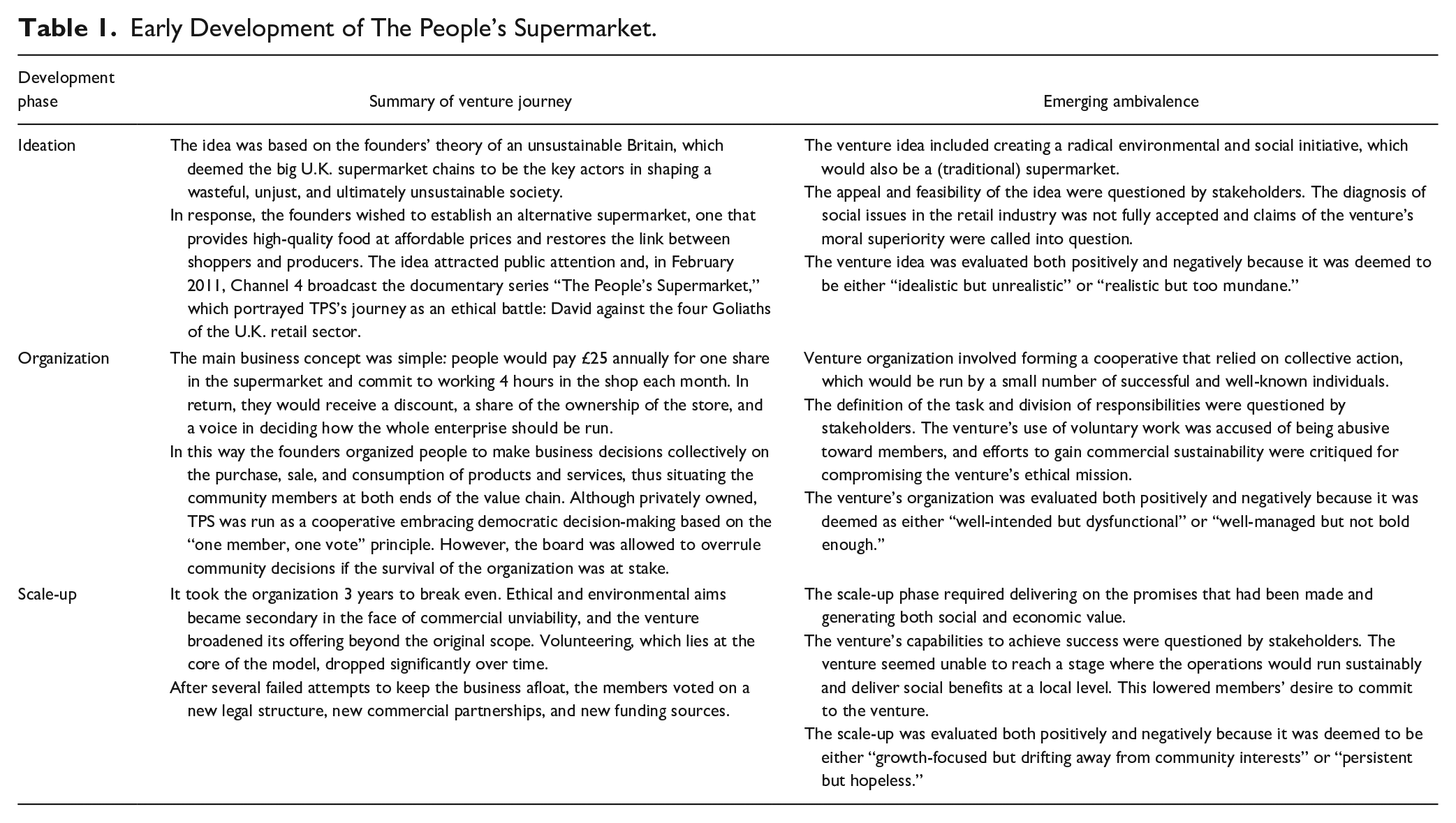
Next, we focused on distinguishing between the key tasks that the founders engaged with during this journey. With this in mind, we differentiated between venture ideation, organization, and scale-up phases as the essential steps in new venture development (Davidsson & Gruenhagen, 2021). While our intention was not to draw clear boundaries between the developmental phases—as some ideation, organization, and scale-up activities can be ongoing even as the venture as a whole progresses from one phase to the next (Davidsson & Gruenhagen, 2021)—these three development phases offered a deeper analytical point of entry for studying experiences of ambivalence across TPS’s developmental phases. Thus, we next identified instances where the venture’s ambitions were evaluated either positively or negatively by stakeholders (Ashforth et al., 2014). Following this, we positioned the experiences of ambivalence along the venture’s journey by assessing whether they related to the venture’s ideation, its organization, or its scale-up. We summarize TPS’s journey as a venture and the concomitantly emerging ambivalence in Table 1.
Early Development of The People’s Supermarket.
Stage 2: Analyzing the Presentation of Tensioned Ambitions
In the second step, we conducted a detailed abstraction from the data so as to understand how founders presented their venture during the different developmental phases. Here, our coding consisted of two parts.
First, we used open, thematic coding to identify the main content of the venture portrayals (i.e., what was presented), organizing the themes that emerged from the data into categories informed by our knowledge of new ventures’ key features (Davidsson & Gruenhagen, 2021). This helped us to link data-driven observations with theoretically informed concepts (Klag & Langley, 2013). On this basis, we concluded that the founders recurrently engaged in verbal and non-verbal efforts to explain the core goals and means of their venture. Delving deeper into the venture development phases, we used temporal bracketing to compare the venture portrayals across the three key phases of the venture’s development (Langley, 1999). As a result, we found that the articulation of the venture’s goals and means progressed from portraying its cause and entry strategy (ideation phase) to presenting its targeted change and governance activities (organization phase), and, finally, to articulating the venture’s achievements and growth activities (scale-up phase).
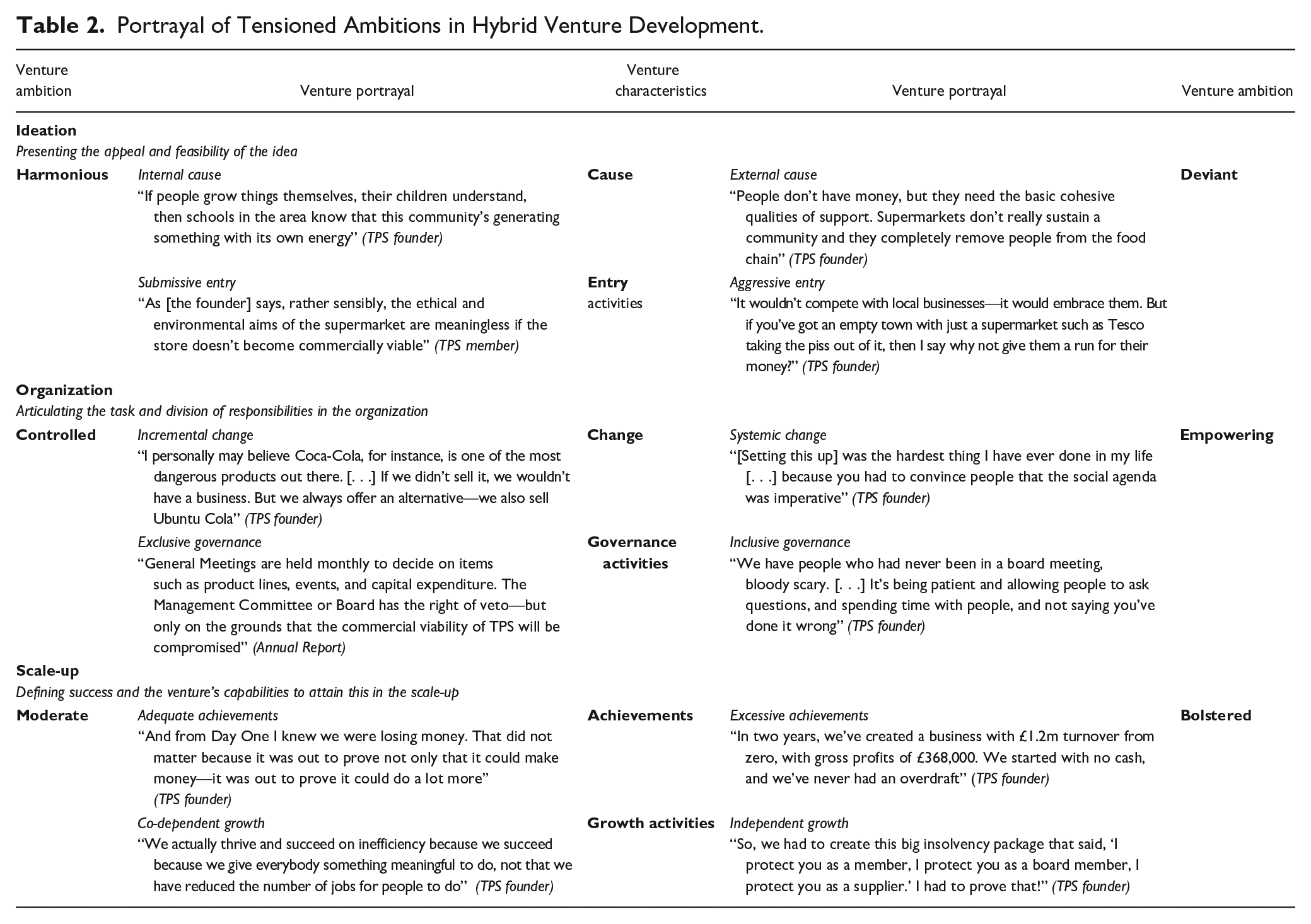
Second, we focused our analysis on scrutinizing qualitative differences within the venture’s portrayal (i.e., how it was presented). To achieve this, we comparatively assessed our emerging findings. We discovered that by making decisions to shape the venture’s operations, and by discussing these choices, the founders constantly combined and recombined different portrayals of their venture. For instance, in the ideation phase, the (social) cause underpinning the venture’s conception was simultaneously presented as tackling an external problem as well as amplifying internal strengths, and the entry strategy was cast as both aggressive and submissive to the operational environment. By assessing these portrayals holistically during each phase of the venture’s development, we concluded that the presentation of the venture amalgamated seemingly oppositional ambitions. We labeled the tensioned ambitions as harmonious–deviant (ideation phase), controlled–empowering (organization phase), and moderate–bolstered (scale-up phase). Table 2 shows the prevalence of tensioned ambitions in presenting the venture.
Portrayal of Tensioned Ambitions in Hybrid Venture Development.
Stage 3: Distinguishing Holism Practices
In the final analytical stage, we theorized on our analytical results in order to respond to our research question of how founders harness tensioned ambitions in hybrid venture development. Here, our specific aim was to clarify the venture founders’ holism practices in the hybrid venture’s development (Langley et al., 2013). We considered practices as open-ended patterns of activities that relate to a certain time horizon and set of concerns (Nicolini, 2009). We analytically combined the type of ambivalence that emerged during different phases, the distinctiveness of the founders’ responses at each time, as well as the consequences that depicted what the founders specifically did (not) accomplish with their practices. On this basis, we aggregated the founders’ responses into three key holism practices—fantasizing, bartering, and conjuring—that were used to harness tensioned ambitions and maintain the venture’s hybridity during the ideation, organization, and scale-up phases.
Research Findings
Our findings reveal how the venture’s founders practiced holism in situations where the multiple ambitions of their hybrid venture were judged both positively and negatively. The ambivalence expressed toward the venture’s idea, organization, and scale-up meant that while some stakeholders appreciated the venture’s goals, they distrusted its chosen means—and vice versa. For instance, in the ideation phase stakeholders who felt that the venture was supporting an important cause simultaneously believed its execution to be unrealistic, and those who judged the venture’s goals as mundane relied on the realistic implementation of those goals. Ambivalence created risks for the venture’s development, threatening the reputation of the founders and limiting the ability of the hybrid venture to attract investment and engage community members in its operations.
In response to this, the founders employed three holism practices by means of which they leveraged the oppositional ambitions in such a way as to make them appear complementary in nature, rather than contradictory. In the venture’s ideation phase, the founders engaged in fantasizing, projecting the venture into an imaginary future where the venture’s hybrid idea could be harmonious yet also deviant in terms of the local conditions that pertained. In the venture’s organization phase, the founders practiced bartering, which entailed reacting to stakeholders’ prevalent desires while maintaining the venture’s vision by proposing that the venture’s organization was controlled yet also empowering. In the scale-up phase, holism was practiced by conjuring up the desired future as already having been realized, presenting the scale-up as moderate yet also bolstered. It is in this way that perceptions of the venture’s success were managed vis-à-vis its original promise.
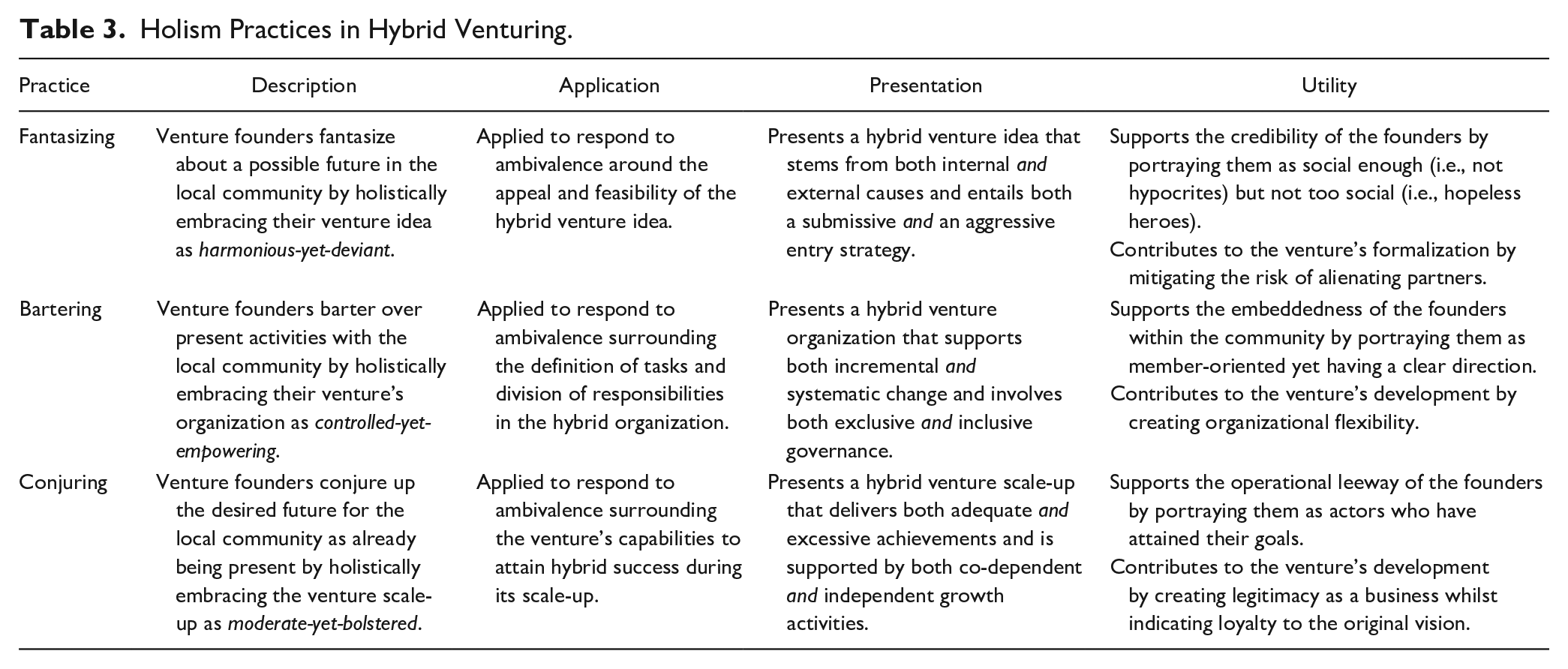
As an outcome, these holism practices contributed to the venture’s development and the integrity of its hybridity. We present an overview of these practices in Table 3.
Holism Practices in Hybrid Venturing.
Fantasizing During Venture Ideation
In its ideation phase, a hybrid venture battles with the challenge of convincing its external and internal stakeholders of the appeal and feasibility of the venture’s business idea. Moreover, ventures need human, financial, and material support to establish themselves in any given locality and industry. Here, the holism practice of fantasizing presents a fictitious and appealing scenario that depicts things that are yet to exist as possible and realistically co-occurring. We define this holism practice as fantasizing about a possible future in the local community by holistically embracing their venture idea as harmonious-yet-deviant, thereby helping the venture to pursue ideation without compromising on its hybridity.
Ambivalence Around the Venture Idea
During its ideation phase, the hybrid venture was intended to be both a novel social initiative that addressed the (alleged) malfunctioning of the retail sector, as well as a traditional supermarket that catered to the needs of local customers. One of the founders describes the necessity of maintaining such a hybrid idea:
I started this business with this dream of creating an ultra-green, ultra-sustainable, environmental business. [. . .] I’d love to think that it is just about the planet, it is just about the kids, and it is just about education; but it is also about the business retaining its business nature, because without that you go bust, and they’ll say, “What a great dream but it didn’t work” (TPS founder).
However, under pressure not to be “too mundane,” the founders faced difficulties in communicating their radical concept, for which little extant evidence existed of its functioning, as the following quote illustrates:
So, you go to a landlord, and you say: “Hi! I am a company that potentially is going to be owned by 5,000 people, you know we want to come and. . . .” Just forget it! “So what are you going to be? Well, a supermarket.” Forget it! “We don’t trust you, we don’t believe you, we don’t think it can be done, we don’t think you are good for the money, so no!” So I go to the bank: “Can I have a bank account?” “No!” You are trying to get a concept like this off the ground and because it doesn’t exist, you can’t show them a previous model (TPS founder).
Portraying a Harmonious-Yet-Deviant Idea
To generate support for their idea, the founders sought to elevate the realism of their ambitions even as they defended the idealism that was crucial for mobilizing social action within the community. With this in mind, they holistically embraced their venture idea as harmonious-yet-deviant.
Here, the founders highlighted the harmonious nature of the venture’s idea by focusing on the community’s own, internal cause of supporting local people and small businesses in the city. They characterized the venture as aiming to create a waste management system that realized “a food wonder from food waste” by accepting “flat peaches and curly cucumbers,” that is, produce rejected by the large supermarkets. Their motto of “For the people, by the people” was an invitation to become part of a force for good within the local community. The following quote describes the internal motivation that stemmed from personal values rather than the analysis of the external environment:
My original criteria were to sell organic food in a loyal, decent, and honest way, with the community running the supermarket, and profits being ploughed back in. I wanted it to be fresh and wild (TPS founder).
To further support the harmonious aspects of the venture idea, the founders acknowledged that the venture had to “fit in” and submit itself to pre-existing structures. Here, the submissive entry strategy was portrayed as finding ways to realize the venture’s ambitions without a “fight,” instead mobilizing a collective spirit, as illustrated in the following quote:
It started a couple of years ago when high streets and small communities were saying, “We don’t want you, we don’t want you!.” And again, that gave me the little spark and belief, hang on a minute, if we found the right location with a cosmopolitan group who actually wanted to pride themselves on being slightly individual [. . .] we can make this work. Because if you’re looking at what the figures are telling you in a different way, which is what I was doing, it gives you a different outcome. And that’s the bit where I saw the gap (TPS founder).
Simultaneously, the founders also portrayed the venture idea as deviating from prevalent retail practices. To articulate the external cause of their venture, the founders dramatized the problems they had identified within the U.K.’s retail industry by leveraging a “Theory of Unsustainable Britain,” which presented the large U.K. supermarket chains as key actors in shaping a wasteful, unjust, and unsustainable society. This critique of the U.K.’s retail industry was frequently repeated in different media outlets and influential public spaces, such as TED conferences. An observer reflects on this narrative in the following quote:
The People’s Supermarket, on the other hand, seems to want to provide its audience with a morally improving hour every week. Learn how the evil corporates are wrecking the high street! See how the big supermarket chains screw over the small farmer! Look at how much food waste Tesco, Asda, and the rest create! (TPS observer).
The venture’s deviant approach was further elevated by presenting a rather aggressive entry strategy into the food retail market. One of the founders wrote an influential article for a major U.K. newspaper (“Let’s take on Tesco with a people’s supermarket”) to argue that the only way of fostering social change demanded a radically new business approach. To voice and amplify their entry strategy, the founders continuously emphasized that “we are nothing you have ever seen,” as well as further distancing themselves from traditional supermarkets, as illustrated in the following quote:
[They ask me:] “So what kind of business are you?” And you look down the list, and we were not on the list, we were in “Other” (TPS founder).
Utility of Fantasizing
Fantasizing was necessary for maintaining hybridity during the initial emergence of the venture. By means of this practice, the founders brought their non-traditional business closer to those early supporters who remained ambivalent about the venture idea, in addition to allowing the founders to acquire credibility and satisfy industry players. The venture received initial funding and donations as well as succeeded in securing a rental contract below market prices. Even the U.K.’s conservative former Prime Minister David Cameron highlighted TPS as a flagship project for his “Big Society” initiative, which focused on community development in the United Kingdom, despite political misalignment.
Fantasizing further involved an element of “disillusion” in that it allowed the founders to believe that their idea of social change was viable. For instance, the founders argued that the first TPS shop in Holborn would never have opened had they simply followed experts’ advice. This holism practice, therefore, helped the founders to imagine the combination of their venture’s multiple ambitions and act upon this fantasized image.
Bartering During Venture Organization
In its organization phase, the venture’s founders faced the challenge of articulating the core task at hand and the division of responsibilities. The organization had to engage community members as volunteers and consumers in support of the venture’s operations. However, it was also essential for the founders to maintain clarity over the venture’s future direction and show external stakeholders, such as funders, that the venture was capable of efficient decision-making. With this in mind, and in order to negotiate with different stakeholders, the founders applied the practice of bartering, which both gave and took away something from stakeholders. On the one hand, the founders presented the venture’s organization as “controlled” by exercising exclusive governance and arguing for incremental change, thereby reducing participants’ autonomy and forcing them to accept more moderate goals and roles. On the other hand, they presented the organization as “empowering” by elevating notions of inclusiveness, democracy, and collaborative action that were geared toward systemic change, thus providing participants with a greater role in achieving a greater task. In this vein, we therefore define this holism practice as bartering over present activities with the local community by holistically embracing their venture’s organization as controlled-yet-empowering so as to create a hybrid organization.
Ambivalence Around Venture Organization
In setting up the organization, the founders aimed at forming a cooperative that relied on collective enthusiasm and action even as they wished to take the lead themselves in steering the venture forward. This is illustrated in the following quote, where one of the founders expresses admiration for former Royal Marines commando officer Bruce Parry, who acted as an advocate, author, and explorer, as well as for celebrity chef and restaurateur Keith Floyd:
One pair [of my socks] has holes in the toes, the other has holes in the heels, so I’m doubling up. I’m skint, but I’m not asking for handouts. [. . .] I’d like to be a cross between Bruce Parry and Keith Floyd. Someone with a sense of adventure who truly loves food (TPS founder).
However, venture organization proved to be problematic since it came to form the very source of instability despite constituting the basis of the model at hand. As community members faced the reality of limited budgets and day-to-day practices, many were happy with merely improving the local supply of food, expressing their unwillingness to commit to volunteering that would support a “societal dream.” Concomitantly, those who had placed their trust in the venture’s management expressed their disappointment over the fact that TPS was less bold and ethical than originally conceived. The founders had to re-evaluate “by whom” and “for whom” TPS was being organized, as illustrated by an observer of the venture’s journey:
It’s a statement: that big is bad and small is beautiful. But “big,” meaning a social division of labour and enormous economies of scale, has done far more for most people than the independent store and the small farmer could ever do. The People’s Supermarket is a rejection of all that, not led by “the people” but by well-to-do folk who are disenchanted with the modern world (TPS observer).
Portraying a Controlled-Yet-Empowering Organization
In light of the ambivalence surrounding venture organization, the founders sought to channel multiple voices, for example through presentations at retail events, to embrace their venture organization holistically as controlled-yet-empowering.
With an eye to building trust in the venture’s organization, the founders evoked a sense of control in the way in which they articulated incremental social change by simply offering its clients ethical, yet affordable, products that promoted healthier living. This attitude of assenting to take smaller steps resulted in the enmeshment of the founders’ original vision of selling organic and fair-trade produce with offerings of products seemingly desired by the community, such as “ethical” crisps, beer, and cigarettes. The following quote illustrates this situation:
The store has had a break-even week for the first time, taking just over £20,000 through the tills. Breaking even means providing the things the members—and the passing trade—actually want. If that means convenience food brands, if it means being “a bit Tesco” . . . well, so be it (TPS founder).
Similarly, control was portrayed by accentuating structured governance and decision-making. The founders relied on more top-down governance practices, for instance by vetoing community decisions. They decided on the acquisition of external financial support and made plans for expanding the business through franchising. The following quote indicates the potential problems inherent in community involvement:
It’s certainly no picnic working with members who are largely untrained in retail, change shifts every four hours, and are juggling all sorts of other responsibilities. On the day I visited, members working included an international student, a High Court judge, and someone who is long-term unemployed (TPS observer).
In contrast to the control thus portrayed, the founders elevated the empowerment of the community in contributing to broader societal changes. The venture was positioned as the starting point for a nationwide ethical movement of social and sustainable enterprises, which would become a driving force for policy development and give birth to a new breed of community entrepreneurs who would spread across the world. One of the founders explained how a supermarket serves as a better means for broader, systematic change than, for instance, any single restaurant ever could:
Why I went from a restaurant scenario to a bigger food situation was that five, six, ok maybe 4% of the population, maybe, had a sustainable option or tried my restaurant [. . .]. In the sustainability sector maybe I influenced, or maybe fed potentially 0.01% of the population. A couple of hundred people a day, couple of thousand people a week, but it is a drop in the ocean when it comes to trying to alleviate the huge issues around sustainability, food security, and food poverty (TPS founder).
Feeding into this narrative of empowerment, venture governance was portrayed as inclusive. The founders embraced the involvement of a multitude of “silent minorities” and claimed that participation in TPS was available and appealing to low-income families, high-income individuals in pursuit of an organic lifestyle, NGOs supporting community causes, retail experts, and local producers who struggled financially. TPS aimed to become a truly community-based business, which would amplify collective enthusiasm in order to keep up operations, as indicated in the following quote:
I would say it was a collective excitement that kept the ball rolling and what was lovely, when you talked to people about the dream, we are creating an urban shop which sold good food but enabled people to have a choice, that was run for and by its community. Everybody we met went, “Yeah, that is a great idea,” and it was only the people who would think too deeply that saw it as a bad idea (TPS founder).
Utility of Bartering
Bartering with the community and external stakeholders fostered organizational flexibility that helped the venture to remain operational. At times, the founders presented an unattainable, big dream, while at other times they highlighted the importance of proceeding more cautiously, which demanded little effort from the community. As a consequence, the invitation to participate in TPS’s quest took multiple forms.
The practice of bartering subsequently supported the founders’ ability to embed themselves better within the local community, rather than being labeled as “naïve rich kids” detached from the interests of the community and the reality experienced by low-income families. While some choices (e.g., changing the venture’s offering) deviated from the venture’s original values, these were seen as a sensible way of navigating toward stability—which would, in turn, provide the venture with opportunities to follow through on its ambitions. These decisions were taken jointly and in the interest of greater change, thereby helping the founders to fade into the background.
Conjuring During Venture Scale-Up
In its scale-up phase, a venture reaches the developmental point in which it is required to evaluate its past and strategize for future expansion. This presents the venture with the challenge of convincingly articulating its capabilities for achieving success. Here, conjuring summons a desired future into the present by manipulating perceptions of promised/desired achievements and how these are to be attained. We define this holism practice as conjuring the desired future for the local community as already being present by holistically embracing the venture scale-up as moderate-yet-bolstered. In this way, the holism practice of conjuring precludes criticism and protects the venture and its founders from (ever) failing by “playing the trick” of projecting success into every achievement and strategy.
Ambivalence Around Venture Scale-Up
During the venture scale-up phase, the founders aimed at achieving a hybrid scale-up, which would deliver both social and economic values. In the following quote, a founder argues that, in fact, hybridity was achieved once the venture came to represent neither a commercial business nor a social endeavor:
If the business model is distinctive, so is the store itself. It’s part normal shop, part eco-store, so Fairy washing-up liquid and tins of Whiskas stand side-by-side with Ecover and organic cat food. [. . .] We don’t judge. . .but we do give choices. [. . .] I wanted it to be fresh and wild. But I realised quickly that 90 per cent of the population don’t shop in Fresh & Wild (TPS founder).
Nevertheless, TPS stakeholders were dubious about the chances of growing the venture in a manner that would remunerate the community. The ambivalence expressed toward venture scale-up stemmed from the realization that the venture could be commercially viable, yet that this might require compromising on community interests and social impact. The struggle between supporting community members and achieving financial stability is illustrated as follows:
It was set up without enough planning and without enough money and so the model was flawed. [. . .] We gave members a 20 per cent discount on meat when we had a 25 per cent margin. We changed the discount to 10 percent but we never recovered from that (TPS member).
Portraying a Moderate-Yet-Bolstered Scale-Up
The founders sought to tackle the ambivalence that arose in the scale-up phase by guiding understandings of the venture’s success, that is, what it had achieved and what it was meant to achieve. To achieve this, they holistically embraced their venture scale-up as moderate-yet-bolstered.
Here, the scale-up was presented in moderate terms by characterizing the venture’s achievements as adequate (reaching that which is possible). For instance, when the supermarket ended up leveraging the sale of “ethical” cigarettes and snacks, the founders argued that TPS “was never meant to be a fully organic supermarket.” While this might have appeared to present a major step back in the delivery of social change, the founders adjusted the narrative to claim that all was as it ought to be. The adequacy of these achievements is illustrated in the following quote:
I would never say to you that the business plan said anything more than that it would vaguely work. And from Day One I knew we were losing money. That did not matter because it was out to prove not only that it could make money, it was out to prove it could do a lot more (TPS founder).
Similarly, the founders emphasized moderation by drawing attention to collective efforts and co-dependent growth activities, which suggested that the venture was not intended to grow “beyond its boundaries.” The following quote highlights one of the founders’ desire to elevate the community’s role in the venture’s growth and to continue relying on collective efforts, even if this proved the venture’s dependency on member-volunteers:
When I was talking to a venture capitalist about it, he actually physically tore up his sheet, because he started off saying we could open up a distribution centre, we could get some self-checkouts in, and I’m like, “No—no, no, no, no, no—that’s not what we’re about” (TPS founder).
In contrast to advocating for moderation, the founders also portrayed bolstered achievements (going beyond that which could be expected) by claiming that the radical food initiative delivered social change as originally intended. The founders further raised expectations by arguing that the venture was poised to achieve something significant: “a commercially viable business that advances the cause of healthy food, zero waste, social cohesion, and community development at affordable prices.” Illustrating the bolstered nature of the scale-up, one of the founders lists the achievements as follows:
In Holborn people are starting to eat more healthily as they have access to affordable, fresh produce; micro-businesses are starting up and reported street crime on the street where the shop is has fallen by 50 per cent (TPS founder).
A bolstered portrayal further took form as the founders started to highlight the autonomy and independent activities of their venture. Here, the founders argued that the venture could achieve growth without government grants, subsidies, or charitable donations. The independence of the venture was highlighted also by distancing it from the volunteer community. The founders planned to grow the venture through an “open-source model,” which would use TPS’s name and follow its values yet financially contribute neither to the original venture nor its members. The following quote illustrates a founder’s satisfaction with growing the business in such a way that evaded complications arising from the versatile wishes of its members:
It was a close call which helped focus members’ minds on choosing products that increase footfall or have larger profit margins. Other plans include starting an external caterer [service] and setting up local market stalls, both as extra income streams and to promote the shop (TPS founder).
Utility of Conjuring
The practice of conjuring equipped the venture and its founders with a “buffer” that protected them from the possibility of failure. When questioned about their achievements and how these were attained, the founders could argue that TPS was judged against conventional measures, which were inappropriate for its situation. This helped to legitimize the venture and allowed it to continue operating as a hybrid venture.
At the same time, conjuring provided the founders with “leeway” by allowing them to share their pride in the venture’s achievements even as they themselves receded into the background. The following quote suggests that the founders had taken the venture to a point where it was deemed to be mature enough to flourish without them:
What we’ve done has a global, universal appeal. People want to create their own economies and independence. Letting other people use the brand involves putting huge amounts of trust in people, but people don’t set out to get things wrong. We can help them by showing what has worked well for us and by highlighting mistakes we made so they aren’t repeated (TPS founder).
A Model on Harnessing Tensioned Ambitions in Hybrid Venturing
Theorizing from our findings we present a model that illustrates how founders apply holism practices to harness tensioned ambitions in hybrid venture development (Figure 1).
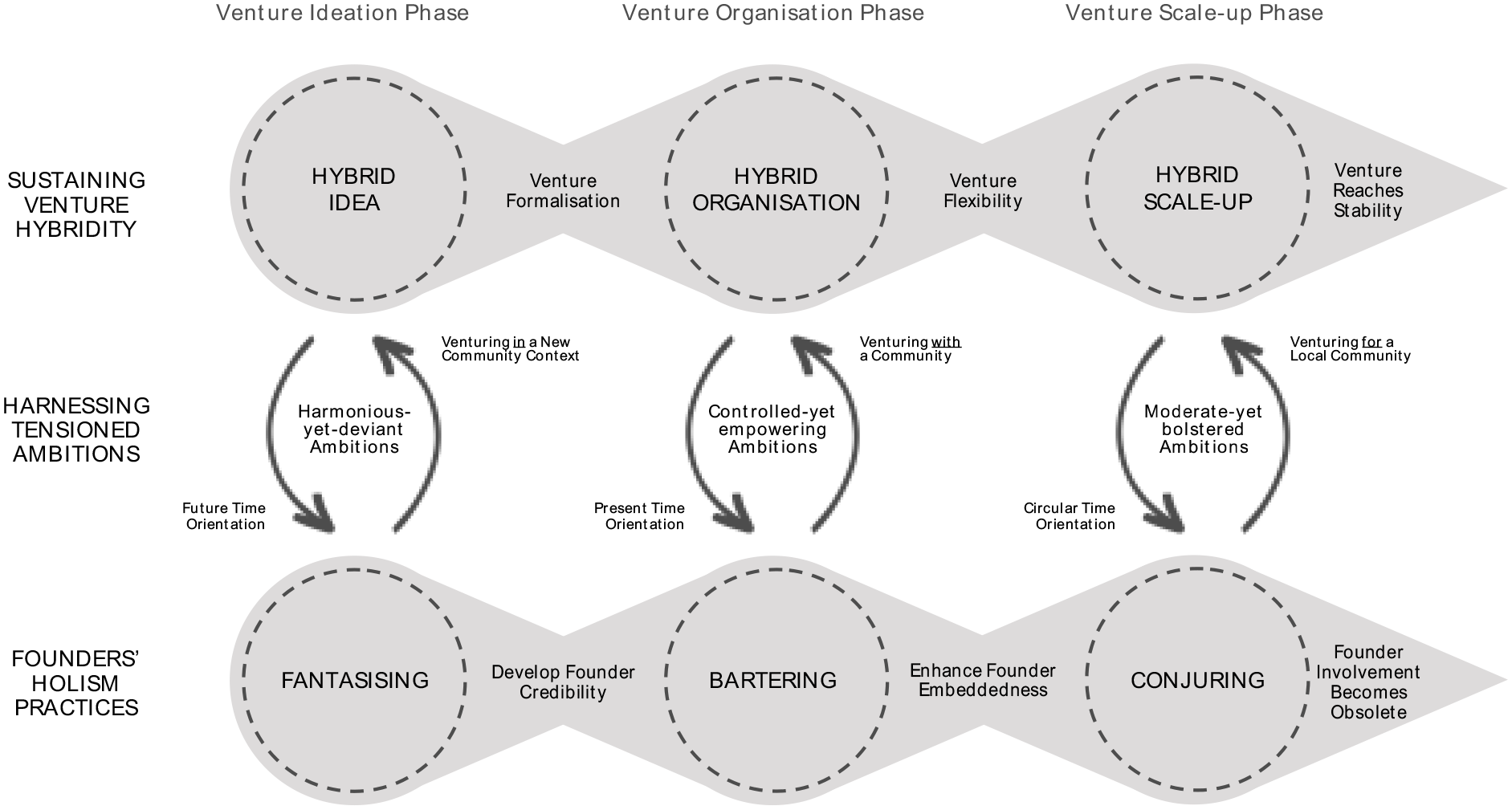
Holism Practices to Harness Tensioned Ambitions in Early Hybrid Venturing.
The model depicts three practices—fantasizing, bartering, and conjuring—employed by founders during the different developmental phases of the operations of a new venture’s ideation, organization, and scale-up (Davidsson & Gruenhagen, 2021). In each phase founders apply holism to integrate ambitions commonly seen as oppositional and tensioned, viewing these in a positive manner and incorporating them as ambitions that are crucial and relevant to the venture (Ashforth et al., 2014). In fantasizing, the venture idea is portrayed as simultaneously harmonious and deviant. This finding resonates with Ashforth and Reingen’s (2014) study on a U.S.-based food cooperative, in the sense that hybrid ventures need to accentuate both idealism and pragmatism. The practice of bartering presents venture organization as both controlled and empowering. These tensioned ambitions experienced in the organization phase align with prior research findings on corporate restructuring processes (Lüscher & Lewis, 2008). When engaging in the practice of conjuring, founders integrate moderation and bolstering into the venture’s scale-up. This finding reveals the similarity between new, hybrid ventures that reach a scaling phase and corporations that both downplay and exaggerate their environmental performance (Kim & Lyon, 2015).
Each of these practices is distinctive in relation to a specific developmental phase, which gives rise to particular tensioned ambitions and, concomitantly, offers varying opportunities for founders even as this limits the scope of their narratives and activities (Hota et al., 2023; Teasdale et al., 2023). As a result thereof, the three holism practices change over time in terms of their temporal and community-related orientations.
During the venture ideation phase, hybrid venture founders essentially struggle to convince others (and possibly themselves) of their idea’s appeal and feasibility. In this initial developmental phase, founders adopt a future orientation and aim at positioning the venture within the community context by imagining and fantasizing about a desirable future to which the venture can contribute. Here, founders strategically employ “backcasting” (Dreborg, 1996), which motivates activities in the present by “counting backwards” and assessing which of these are required in order to attain the future positioning of the venture (as opposed to forecasting what will happen should certain steps be taken). Through fantasizing founders can create “disillusionment,” which imbues them with motivational drive and allows them to act credibly on their articulated social cause (Barton & Muñoz, 2023). Moreover, this practice supports the venture’s formalization by generating emotional appeal and curiosity, thereby attracting the attention of early investors, partners, and customers.
The shift to the venture organization phase poses the essential challenge of finding a balance between community involvement and efficiently and strategically steering the venture forward. In this phase, founders focus on the present and build relationships with the surrounding community. This involves continual bartering with those involved in order to strike the right balance between empowering participants and allowing them to influence the venture, as opposed to maintaining control of the venture themselves to steer it forward. Bartering may seem “messy” and can create complexities in terms of governance (Ashforth & Reingen, 2014); however, it also underpins the “structured flexibility” (Smith & Besharov, 2019) that allows a venture to remain hybrid in terms of its ultimate goals and how it pursues these.
Finally, as the venture matures it becomes able to evaluate whether it is successful in delivering on its hybrid promises. In the scale-up phase, we find that the focus shifts, coming to resemble what we term a “circular orientation.” Here, a circular temporal orientation is evident in the way in which founders actively shape the evaluation of a venture’s achievements by presenting its (future) achievements in relation to its initial intentions when founded. This creates an “evaluative hedge” that buffers the venture against failure by portraying potential negative outcomes as having been originally intended. Such conjuring also involves portraying the venture’s role for the community by accentuating mutual co-dependence with the venture community yet also the venture’s independence, thereby setting boundaries around the venture entity. Portraying the venture as partially dependent on its supporting community helps to maintain employees’ focus during organizational growth (Cha & Edmondson, 2006). Simultaneously, accentuating the venture’s independence—or, its existence as an intangible idea that can exist outside and beyond its present form—allows founders to be credited with the venture’s accomplishments even as they become irrelevant to its future.
In conclusion, we argue that these holism practices form a process that effectively addresses stakeholder expectations as they evolve (Argiolas et al., 2024) and propels the venture and its founders to proceed through each developmental phase. As venture development phases fade away or emerge, holism practices evolve over time and enable the formalization of the new venture, generate organizational flexibility, and, ultimately, imbue the venture with stability. Furthermore, practicing holism during venture ideation enhances founders’ credibility by integrating idealism and realism in their quest, thus precluding their image as “hopeless heroes.” During venture organization, holism promotes founders’ embeddedness within the venture’s surroundings by embracing participants’ involvement in the endeavor at hand even while maintaining founders’ control over the venture’s management. This appeals to a range of stakeholder expectations without excluding any single party from the hybrid venture, as well as providing founders with the space for making necessary adjustments. During scale-up, holism allows founders to detach themselves from the venture and portray it as a self-functioning entity that is independent of key individuals, in particular from the founders themselves.
In addition to contributing to a processual form of development, holism practices are cumulative and, hence, integral parts of the “whole” of a hybrid venture. It follows that, in addition to supporting the developmental process, they are vital to creating a “truly” hybrid venture that translates organizational efficiency (i.e., managing a hybrid idea, hybrid organization, and hybrid scale-up) into effectiveness in terms of contributing to the economic, societal, and environmental good typically pursued by hybrid ventures (Battilana et al., 2017; Klarin & Suseno, 2023).
Conclusion and Implications
In this article, we set out to explore how venture founders harness tensioned ambitions in the development of hybrid ventures. Based on our findings we proffer a novel model (Figure 1) of how three holism practices are relevant here and change over time as they support a venture’s hybridity. In the following, we discuss our study’s implications for future research on hybrid venturing and organizational ambivalence, and we go on to suggest practical implications for venture founders and policymakers.
Implications for Research on Hybrid Venturing
Our theorizing illuminates how hybrid venture founders can pursue a novel venture mission and develop a high-intensity hybrid venture that vigorously pursues an interdependent business model, where the presence of tensioned ambitions is continuously emphasized. We contribute to the literature on hybrid venturing (Battilana et al., 2022; Smith & Besharov, 2019) by attending to a positive orientation of harnessing tensioned ambitions during the development process of a new hybrid venture, that is, the essential ideation, organization, and scale-up phases (Davidsson & Gruenhagen, 2021). Importantly, our study shifts the hitherto predominant investigative focus away from practices that help to avoid or cope with ambivalence (Alexius & Furusten, 2020; Cappellaro et al., 2021), showing instead how venture founders actively seek to leverage multiple ambitions, harness productive tensions (Battilana et al., 2017), and cultivate the venture’s hybridity as a desirable state.
Recent research has highlighted the benefits of hybridity, for instance in retaining an active volunteering base (Farny et al., 2019) and building meaningful relationships (Alexius & Furusten, 2020). Our study provides an indication of how these concrete outcomes can be achieved, and we show how fantasizing, bartering, and conjuring offer an “invitation to act” (Smith & Besharov, 2019) in building a hybrid venture. Furthermore, we propose that harnessing tensioned ambitions contributes to the formation of hybrid ventures by offering an “invitation to forgive” without appealing to helplessness or social stigma (Cappellaro et al., 2021; Shepherd et al., 2022). In particular, the practice of conjuring emphatically calls for giving the venture a chance to continue its operations by arguing that its intentions of providing economic, social, and environmental value are, in fact, manifest.
A focus on the key development phases of new ventures (Davidsson & Gruenhagen, 2021) allows us to suggest that the findings of our study can contribute to the entrepreneurship literature beyond extant scholarly debates on hybrid venturing. In general terms, entrepreneurship involves the introduction of novel ideas and models, thus implying that traditional, purely commercial ventures struggle to portray originality and legitimacy within established industry conventions (Fisher, 2020; Poldner et al., 2017). It follows that novel ventures may evoke ambivalence—and this can be mitigated by practicing fantasizing, bartering, and conjuring.
Implications for Research on Organizational Ambivalence
We advance research on organizational ambivalence by showing how holism is practiced by hybrid venture founders (Ashforth & Reingen, 2014; Rothman et al., 2017). To date, ambivalence has been predominantly viewed as a negative psychological state that people attempt to reduce or resolve (Rothman et al., 2017; Rothman & Melwani, 2017). In contrast to this perspective, holism—which “cultivates ambivalence” by deliberately embracing tensioned ambitions—has attracted little attention and prior research has focused chiefly on its practice within established organizations (Ashforth et al., 2014).
In our study, we show that holism allows venture founders to respond actively to ambivalence and act as change agents who “nudge” a venture forward while remaining loyal to its hybridity. Specifically, practicing holism serves as a self-protective strategy that “buffers” the venture and its founders against critique aimed at questioning the venture’s ambitions. Nevertheless, by cultivating ambivalence holism neither changes evaluations of the venture nor does it rely on sabotaging performance or on defensive pessimism, either of which could handicap the founders or lower the performance of their venture despite serving as a self-protective mechanism (Reich & Wheeler, 2016).
By distinguishing between three different holism practices—fantasizing, bartering, and conjuring—we show that holism practices shift over time in terms of their temporal and community-related orientations. While the initial developmental phase requires future orientation and the projection of the venture’s role in the community, the organization phase necessitates present orientation and the building of concrete relations with the community, and the scale-up phase involves adopting a circular orientation that contrasts (potential) outcomes of the venture with past intentions, accompanied by a focus on arguing for the venture’s role for the community.
Beyond presenting the salience of holism to hybrid venture founders, our study also accentuates the demanding nature of holism. Practicing holism necessitates both “magical” presentational skills and more tangible decision-making on the venture’s activities (Barton & Muñoz, 2023). This process requires time, and engagement in holism depends on an individual’s capacity to accept and “live with” the venture’s multiple ambitions. For instance, the practice of bartering during venture organization can appear inconsistent and contentious, yet it ties the venture community together by enabling dialogue and promoting tolerance for uncertainty (Ashforth & Reingen, 2014). Although not all of those involved in the development of the venture may be equally exposed to these tensioned ambitions, those who are—whether as founders or community members—must eschew the demands or desire to prioritize any one side of the venture’s ambitions and equally embrace, or at least tolerate, its various ambitions. This requires the wisdom to appreciate the complexity of organizational life, in other words, embracing the insight that things may not be either/or but, rather, both/and (Ashforth et al., 2014). Ultimately, adopting holism as an organizational practice and/or theoretical perspective may profoundly change our understanding of hybrid organizations as conflictual spaces in which different ambitions collide, instead coming to view them as inclusive spaces where multiple voices are heard.
Limitations and Further Research
The limitations of our study lie in the fact that numerous intriguing aspects of harnessing tensioned ambitions in hybrid venturing through the application of holism remain beyond the scope of this study. First, our study has focused on founders’ practices without delving into cognition or emotion at the level of individuals and/or teams. Here, further research could examine how strategic venture founders are when engaging with holism. Although it remains difficult to separate conscious and non-conscious activities fully, insight could be generated by learning whether founders intentionally create a “mess” in order to maintain hybridity. Delving into team dynamics could assess whether founders adopt roles to embrace all ambitions of their venture jointly.
Second, in the context of hybrid ventures, it would be fruitful to study concrete events and decisions that occur during the core phases of new venture development. This could indicate how holism materializes through measurable and tangible actions, and how and when it is practiced by framing these activities in particular ways. While ambivalence, ambitions, and hybridity are concepts that are challenging to measure (Eisenhardt, 2000), a more positivist understanding of organizational realities could reveal intriguing dynamics occurring between purported and “true” venture hybridity.
Third, we call for further research that examines those conditions that are (un)suitable for holism practices. When does holism create beneficial outcomes, and when does it become unnecessary, or even detrimental, for hybrid venture development? Here, carrying out longitudinal research beyond the early developmental phases of a venture and investigating how different stakeholders (e.g., volunteers, investors, consumers, funding bodies) react to founders who practice holism promises important insights. In our study, we find that the early development of TPS was afflicted by a constant struggle with ambivalence and the difficulties in getting the venture off the ground although, overall, the venture did persevere. The analysis of alternative storylines across different institutional and resource conditions (Bhatt et al., 2019; Sutter et al., 2023) would serve to generate an understanding of the limits of holism practices in addressing stakeholders with varying (ethical) dispositions (Bhatt, 2022; Bhatt et al., 2022). A longer time period could uncover whether, and how, holism practices are applied by actors other than the initial founders as the venture matures.
Practical Implications
For new hybrid venture founders, our study provides an exemplary yet cautionary tale of how they can enhance their own operational capacities as well as their venture’s survival and success. On the one hand, our study shows the practices of dedicated founders in launching a hybrid venture idea and financially breaking even without compromising on its core mission, vision, and values (Muñoz et al., 2018). On the other hand, we show that holism represents a rather demanding engagement with ambivalence that requires skills from individuals in tolerating slow and emotionally intense processes accompanied by a high level of venture-internal uncertainty. This means that venture founders should carefully consider the necessity of embracing oppositional ambitions and their potential synergies (Shepherd et al., 2019). Moreover, founders should assess their own abilities and their organization’s readiness to deal head-on with ambivalence. Holism practices require patience as they may seem intolerable in the short term but, “when considered as a series over time, they are actually quite nuanced and respect the totality of the object” (Ashforth et al., 2014, p. 1469).
For policymakers and entrepreneurship support organizations, our findings accentuate the demands inherent in developing new hybrid ventures, which involve unconventional modes of thinking and organizing. Today, entrepreneurial innovations are increasingly advocated as a means for solving important social and environmental problems (United Nations, 2022). To support this, policymakers should utilize performance measurement scales that allow reconceptualizing notions of “progress” and “innovation” (Eisenhardt, 2000) and enable founders to communicate their multiple (and oppositional) ambitions in the most comprehensive manner possible (Moss et al., 2018; Muñoz & Gamble, 2024).
Footnotes
Appendix A
Appendix B
Timeline of Key Events.
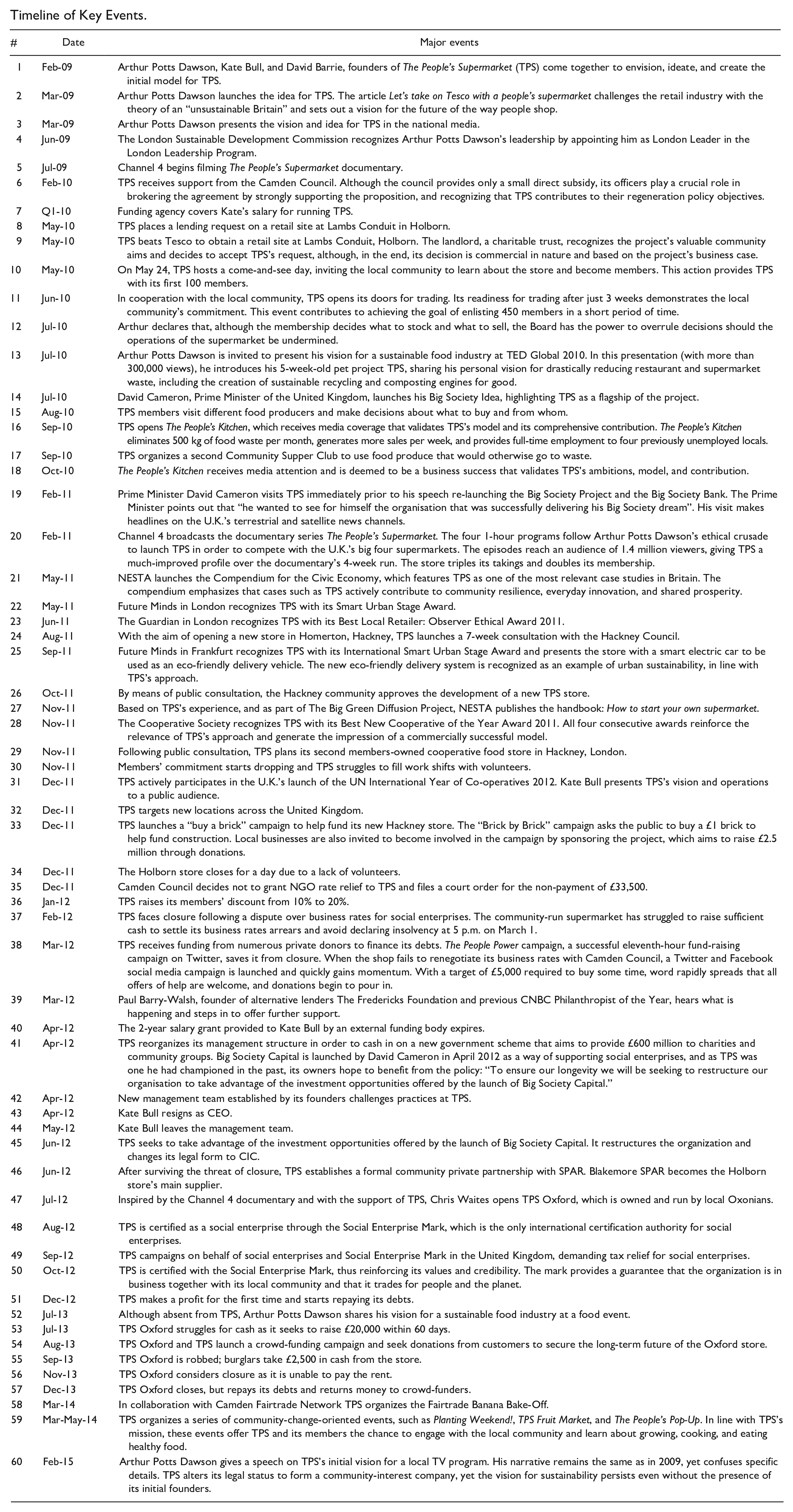
| # | Date | Major events |
|---|---|---|
| 1 | Feb-09 | Arthur Potts Dawson, Kate Bull, and David Barrie, founders of The People’s Supermarket (TPS) come together to envision, ideate, and create the initial model for TPS. |
| 2 | Mar-09 | Arthur Potts Dawson launches the idea for TPS. The article Let’s take on Tesco with a people’s supermarket challenges the retail industry with the theory of an “unsustainable Britain” and sets out a vision for the future of the way people shop. |
| 3 | Mar-09 | Arthur Potts Dawson presents the vision and idea for TPS in the national media. |
| 4 | Jun-09 | The London Sustainable Development Commission recognizes Arthur Potts Dawson’s leadership by appointing him as London Leader in the London Leadership Program. |
| 5 | Jul-09 | Channel 4 begins filming The People’s Supermarket documentary. |
| 6 | Feb-10 | TPS receives support from the Camden Council. Although the council provides only a small direct subsidy, its officers play a crucial role in brokering the agreement by strongly supporting the proposition, and recognizing that TPS contributes to their regeneration policy objectives. |
| 7 | Q1-10 | Funding agency covers Kate’s salary for running TPS. |
| 8 | May-10 | TPS places a lending request on a retail site at Lambs Conduit in Holborn. |
| 9 | May-10 | TPS beats Tesco to obtain a retail site at Lambs Conduit, Holborn. The landlord, a charitable trust, recognizes the project’s valuable community aims and decides to accept TPS’s request, although, in the end, its decision is commercial in nature and based on the project’s business case. |
| 10 | May-10 | On May 24, TPS hosts a come-and-see day, inviting the local community to learn about the store and become members. This action provides TPS with its first 100 members. |
| 11 | Jun-10 | In cooperation with the local community, TPS opens its doors for trading. Its readiness for trading after just 3 weeks demonstrates the local community’s commitment. This event contributes to achieving the goal of enlisting 450 members in a short period of time. |
| 12 | Jul-10 | Arthur declares that, although the membership decides what to stock and what to sell, the Board has the power to overrule decisions should the operations of the supermarket be undermined. |
| 13 | Jul-10 | Arthur Potts Dawson is invited to present his vision for a sustainable food industry at TED Global 2010. In this presentation (with more than 300,000 views), he introduces his 5-week-old pet project TPS, sharing his personal vision for drastically reducing restaurant and supermarket waste, including the creation of sustainable recycling and composting engines for good. |
| 14 | Jul-10 | David Cameron, Prime Minister of the United Kingdom, launches his Big Society Idea, highlighting TPS as a flagship of the project. |
| 15 | Aug-10 | TPS members visit different food producers and make decisions about what to buy and from whom. |
| 16 | Sep-10 | TPS opens The People’s Kitchen, which receives media coverage that validates TPS’s model and its comprehensive contribution. The People’s Kitchen eliminates 500 kg of food waste per month, generates more sales per week, and provides full-time employment to four previously unemployed locals. |
| 17 | Sep-10 | TPS organizes a second Community Supper Club to use food produce that would otherwise go to waste. |
| 18 | Oct-10 | The People’s Kitchen receives media attention and is deemed to be a business success that validates TPS’s ambitions, model, and contribution. |
| 19 | Feb-11 | Prime Minister David Cameron visits TPS immediately prior to his speech re-launching the Big Society Project and the Big Society Bank. The Prime Minister points out that “he wanted to see for himself the organisation that was successfully delivering his Big Society dream”. His visit makes headlines on the U.K.’s terrestrial and satellite news channels. |
| 20 | Feb-11 | Channel 4 broadcasts the documentary series The People’s Supermarket. The four 1-hour programs follow Arthur Potts Dawson’s ethical crusade to launch TPS in order to compete with the U.K.’s big four supermarkets. The episodes reach an audience of 1.4 million viewers, giving TPS a much-improved profile over the documentary’s 4-week run. The store triples its takings and doubles its membership. |
| 21 | May-11 | NESTA launches the Compendium for the Civic Economy, which features TPS as one of the most relevant case studies in Britain. The compendium emphasizes that cases such as TPS actively contribute to community resilience, everyday innovation, and shared prosperity. |
| 22 | May-11 | Future Minds in London recognizes TPS with its Smart Urban Stage Award. |
| 23 | Jun-11 | The Guardian in London recognizes TPS with its Best Local Retailer: Observer Ethical Award 2011. |
| 24 | Aug-11 | With the aim of opening a new store in Homerton, Hackney, TPS launches a 7-week consultation with the Hackney Council. |
| 25 | Sep-11 | Future Minds in Frankfurt recognizes TPS with its International Smart Urban Stage Award and presents the store with a smart electric car to be used as an eco-friendly delivery vehicle. The new eco-friendly delivery system is recognized as an example of urban sustainability, in line with TPS’s approach. |
| 26 | Oct-11 | By means of public consultation, the Hackney community approves the development of a new TPS store. |
| 27 | Nov-11 | Based on TPS’s experience, and as part of The Big Green Diffusion Project, NESTA publishes the handbook: How to start your own supermarket. |
| 28 | Nov-11 | The Cooperative Society recognizes TPS with its Best New Cooperative of the Year Award 2011. All four consecutive awards reinforce the relevance of TPS’s approach and generate the impression of a commercially successful model. |
| 29 | Nov-11 | Following public consultation, TPS plans its second members-owned cooperative food store in Hackney, London. |
| 30 | Nov-11 | Members’ commitment starts dropping and TPS struggles to fill work shifts with volunteers. |
| 31 | Dec-11 | TPS actively participates in the U.K.’s launch of the UN International Year of Co-operatives 2012. Kate Bull presents TPS’s vision and operations to a public audience. |
| 32 | Dec-11 | TPS targets new locations across the United Kingdom. |
| 33 | Dec-11 | TPS launches a “buy a brick” campaign to help fund its new Hackney store. The “Brick by Brick” campaign asks the public to buy a £1 brick to help fund construction. Local businesses are also invited to become involved in the campaign by sponsoring the project, which aims to raise £2.5 million through donations. |
| 34 | Dec-11 | The Holborn store closes for a day due to a lack of volunteers. |
| 35 | Dec-11 | Camden Council decides not to grant NGO rate relief to TPS and files a court order for the non-payment of £33,500. |
| 36 | Jan-12 | TPS raises its members’ discount from 10% to 20%. |
| 37 | Feb-12 | TPS faces closure following a dispute over business rates for social enterprises. The community-run supermarket has struggled to raise sufficient cash to settle its business rates arrears and avoid declaring insolvency at 5 p.m. on March 1. |
| 38 | Mar-12 | TPS receives funding from numerous private donors to finance its debts. The People Power campaign, a successful eleventh-hour fund-raising campaign on Twitter, saves it from closure. When the shop fails to renegotiate its business rates with Camden Council, a Twitter and Facebook social media campaign is launched and quickly gains momentum. With a target of £5,000 required to buy some time, word rapidly spreads that all offers of help are welcome, and donations begin to pour in. |
| 39 | Mar-12 | Paul Barry-Walsh, founder of alternative lenders The Fredericks Foundation and previous CNBC Philanthropist of the Year, hears what is happening and steps in to offer further support. |
| 40 | Apr-12 | The 2-year salary grant provided to Kate Bull by an external funding body expires. |
| 41 | Apr-12 | TPS reorganizes its management structure in order to cash in on a new government scheme that aims to provide £600 million to charities and community groups. Big Society Capital is launched by David Cameron in April 2012 as a way of supporting social enterprises, and as TPS was one he had championed in the past, its owners hope to benefit from the policy: “To ensure our longevity we will be seeking to restructure our organisation to take advantage of the investment opportunities offered by the launch of Big Society Capital.” |
| 42 | Apr-12 | New management team established by its founders challenges practices at TPS. |
| 43 | Apr-12 | Kate Bull resigns as CEO. |
| 44 | May-12 | Kate Bull leaves the management team. |
| 45 | Jun-12 | TPS seeks to take advantage of the investment opportunities offered by the launch of Big Society Capital. It restructures the organization and changes its legal form to CIC. |
| 46 | Jun-12 | After surviving the threat of closure, TPS establishes a formal community private partnership with SPAR. Blakemore SPAR becomes the Holborn store’s main supplier. |
| 47 | Jul-12 | Inspired by the Channel 4 documentary and with the support of TPS, Chris Waites opens TPS Oxford, which is owned and run by local Oxonians. |
| 48 | Aug-12 | TPS is certified as a social enterprise through the Social Enterprise Mark, which is the only international certification authority for social enterprises. |
| 49 | Sep-12 | TPS campaigns on behalf of social enterprises and Social Enterprise Mark in the United Kingdom, demanding tax relief for social enterprises. |
| 50 | Oct-12 | TPS is certified with the Social Enterprise Mark, thus reinforcing its values and credibility. The mark provides a guarantee that the organization is in business together with its local community and that it trades for people and the planet. |
| 51 | Dec-12 | TPS makes a profit for the first time and starts repaying its debts. |
| 52 | Jul-13 | Although absent from TPS, Arthur Potts Dawson shares his vision for a sustainable food industry at a food event. |
| 53 | Jul-13 | TPS Oxford struggles for cash as it seeks to raise £20,000 within 60 days. |
| 54 | Aug-13 | TPS Oxford and TPS launch a crowd-funding campaign and seek donations from customers to secure the long-term future of the Oxford store. |
| 55 | Sep-13 | TPS Oxford is robbed; burglars take £2,500 in cash from the store. |
| 56 | Nov-13 | TPS Oxford considers closure as it is unable to pay the rent. |
| 57 | Dec-13 | TPS Oxford closes, but repays its debts and returns money to crowd-funders. |
| 58 | Mar-14 | In collaboration with Camden Fairtrade Network TPS organizes the Fairtrade Banana Bake-Off. |
| 59 | Mar-May-14 | TPS organizes a series of community-change-oriented events, such as Planting Weekend!, TPS Fruit Market, and The People’s Pop-Up. In line with TPS’s mission, these events offer TPS and its members the chance to engage with the local community and learn about growing, cooking, and eating healthy food. |
| 60 | Feb-15 | Arthur Potts Dawson gives a speech on TPS’s initial vision for a local TV program. His narrative remains the same as in 2009, yet confuses specific details. TPS alters its legal status to form a community-interest company, yet the vision for sustainability persists even without the presence of its initial founders. |
Declaration of Conflicting Interests
The authors declared no potential conflicts of interest with respect to the research, authorship, and/or publication of this article.
Funding
The authors disclosed receipt of the following financial support for the research, authorship, and/or publication of this article: For financial support, we thank the Academy of Finland (Grant Number: 319951).
